ILM

50 Years | 500+ Film and TV credits | 135+ Awards

SINCE 1975

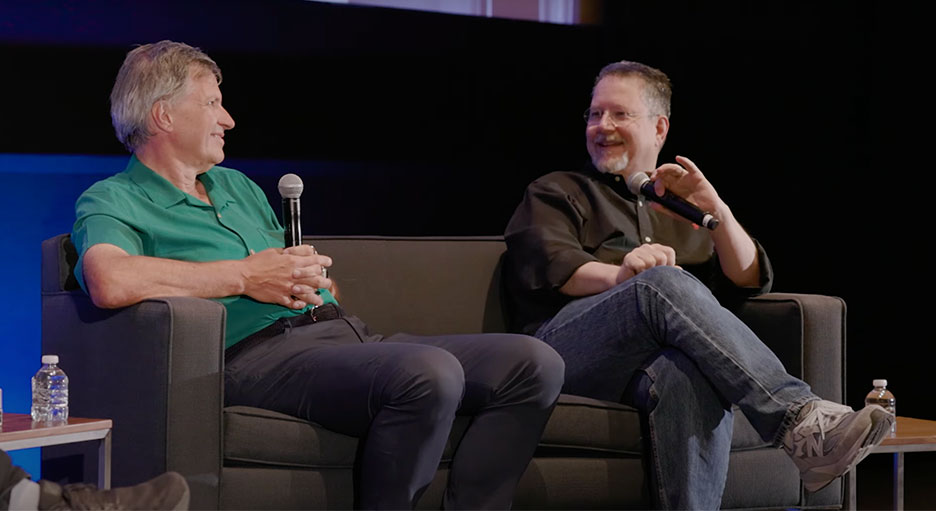
ILM creative director David Nakabayashi, along with artists from ILM’s global studios, including Aaron McBride, Cody Gramstad, Bimpe Alliu, and Chelsea Castro, reflect on the essential role concept art and storyboarding play in the filmmaking process.
By Jay Stobie

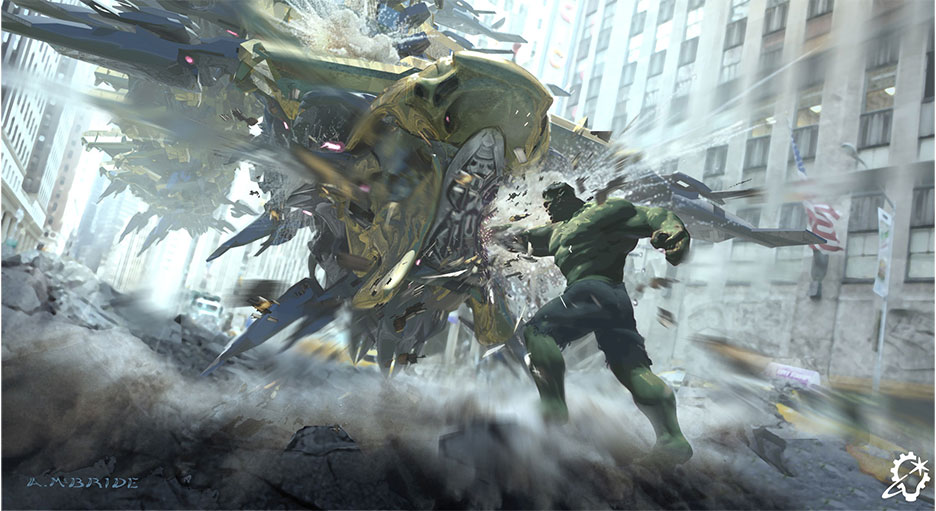
Concept art for The Avengers (2012) by Aaron McBride (Credit: Marvel & ILM).

“ILM Evolutions” is an ILM.com exclusive series exploring a range of visual effects disciplines and highlights from Industrial Light & Magic’s 50 years of innovative storytelling.

From envisioning a look for cursed pirates to plotting out space battles, Industrial Light & Magic has an unparalleled reputation for working wonders in collaboration with filmmakers to bring the stories they envision to life. Built on a 50-year legacy of talent and tenacity, ILM’s Art Department has grown into a global hub for generating and executing the ideas that immerse audiences in the worlds they see on screen. In this installment of ILM Evolutions, we’re heading back to the drawing board to focus on conceptual art and storyboarding, as this indispensable imagery fuels the creative process by visualizing a filmmaker’s ideas in the earliest stages of production.

ILM Art Department creative director David “Nak” Nakabayashi sat down with ILM.com to share his insights on the history of concept art and storyboarding, as well as his own first-hand knowledge of the craft. With an esteemed resume featuring iconic films such as The Hunt for Red October (1990), Jurassic Park (1993), Men in Black (1997), Star Wars: The Phantom Menace (1999), A.I. Artificial Intelligence (2001), Avatar (2009), Star Wars: The Force Awakens (2015), and many more, Nakabayashi now oversees art directors, illustrators, and artists across ILM’s global studios. Additionally, artists Aaron McBride (San Francisco), Bimpe Alliu (London), Cody Gramstad (Sydney), and Chelsea Castro (Vancouver) joined the conversation to highlight their careers and the latest developments in their field.

Concept art for Star Wars: The Phantom Menace (1999) by David Nakabayashi (Credit: Lucasfilm & ILM).

Ideas and Intentions

Concept art and storyboards each serve unique purposes in the production pipeline. “Concept art depicts a scene, setting, place, location, robot, spaceship, weapon – they initially come from the script along with a brief description,” outlines Nakabayashi, who emphasizes the extent to which the art helps the crew visualize the project they will be creating. “These are the key beats in the film. Concept art establishes what we’re going to be doing. We’re showing everyone that this is the movie we’re going to be making when absolutely nobody has any idea what it will look like.”

Nakabayashi cites concept artist Ralph McQuarrie’s contributions to Star Wars: A New Hope (1977) as the perfect example of such art having an inspirational impact on a film. “They based everything on his art. It fed everybody’s imagination.” Today, concept artists regularly assist filmmakers as they design and seek green lights for their films. “Sometimes, ILM will do development or spec work, where we take concept art and show the studio what the movie will be with the same intention as Ralph did. We carried that on.”

While concept art focuses on design, storyboards define the action that occurs on-screen. “Storyboards are all about the cinematic motion, the energy of a visual effects shot. That’s why ILM’s Joe Johnston was such a great foundation for this department. He would draw storyboards with arrows that would be compressed in perspective, and you really understood the depth of what he was trying to say,” Nakabayashi notes. Over time, the advent of digital animatics altered the use of storyboards. “We hardly storyboard anymore these days because animatics act as the filler, but it’s the same principle.”

From a broader perspective, Nakabayashi is quick to point to the artistic value of concept art and storyboards. “A pencil drawing, for me, is as powerful as a Ralph McQuarrie gouache painting. I get consumed by the techniques sometimes, and how a person can draw this perfect angle of a little spaceship cruising through the columns of some weird planet. To draw that sequence helps the director make decisions. It’s about visualizing and timing the film before they actually shoot anything, though it’s all changed quite a bit with the whole animatics tool set.”

Storyboards for Men in Black (1997) by David Nakabayashi (Credit: Sony & ILM).

The Importance of Art

“When you look at the scope of what ILM has done,” Nakabayashi says, “obviously Star Wars was a flashpoint for concept art and storyboards because that was the first way of getting creativity into the movie and bringing visual life into the script.”

Of course, the benefits extend far beyond what is seen on-screen. “Art is important for many other reasons,” Nakabayashi explains. “For ILM, it is also about the budgeting process. Historically, the model shop would look at storyboards and concept art and have an idea of what was coming. Production is very budget-driven. ILM would storyboard their sequences, not just for the artistic impression of it, but for logistics and production. That was how a director would communicate with the visual effects supervisor. ‘We’re going to shoot this practical and this blue screen. We can save a lot of money if we do this with miniatures.’”

Nakabayashi boils the work down to its essence, relaying, “It’s about the artists believing that the future is possible and the creation of the cliche ‘Show me something I’ve never seen before,’ which is sort of a byline we usually get from our clients. We can do that because we have the right people – people who take inspiration from the artists who came before them. That’s ILM’s culture of concept art and storyboarding. I’m not a great storyboard artist, but I can communicate and do the work. To me, that is the most important part – communicating the ideas.”

Concept art for A.I. Artificial Intelligence (2001) by David Nakabayashi (Credit: Warner Bros. & ILM).

Communicating Concepts

As an art director at ILM’s Sydney studio, Cody Gramstad (Sonic the Hedgehog 3 [2024]; Lilo & Stitch [2025]) affirms the significance of communication, stressing, “When it comes to being a concept artist, you’re not necessarily there to create artwork. You’re there to clarify and communicate ideas. My favorite part of the job is actually the conversation where I sit down with a bunch of creative people, brainstorm potential solutions to problems, and get everyone amped up as we figure out our creative direction. Painting and visuals are a part of that, but being able to talk, pitch ideas, and get people excited is one of the most important skill sets.”

Gramstad, whose parents were professional sculptors, takes the notion a step further, suggesting that prospective concept artists can bolster their abilities by balancing the dedication necessary to hone their craft with time off for real-life adventures. “Step away from your computer every now and then, have some experiences, meet people, and socialize,” declares Gramstad, placing value on the correlation between communicating ideas and relating to those around you. “It’s a lot easier to work with someone who has gotten out in the world and brings those stories into their artwork.”

Concept art for Lilo & Stitch (2025) by Cody Gramstad (Credit: Disney & ILM).

The ILM Influence

Turning to Industrial Light & Magic’s unique place in the history of concept art and storyboarding, Nakabayashi states, “ILM is special because it all sort of started here. It’s special because of the people who believed and put their foot down – Colin Cantwell, Ralph McQuarrie, and Joe Johnston. There were others on the outside, like Syd Mead and Ron Cobb, all these illustrators who were doing sci-fi stuff, but ILM was the first one to take the visual effects art department and make it something that everybody wanted to be.”

San Francisco-based senior art director Aaron McBride notes ILM’s post-Star Wars permanence as a standout achievement for the company. “Before ILM, visual effects departments would start up for the duration of a film and be temporary. When the film was over, everyone would get scattered. It was almost nomadic,” McBride mentions. “There was a demand for the work that ILM was doing, and ILM was able to advance technologies because it was kept intact.”

By the time of Star Wars: Return of the Jedi (1983), Nakabayashi explains that directors began approaching ILM for innovative films like Poltergeist (1982), The Goonies (1985), Cocoon (1985), Terminator 2: Judgment Day (1991), and many others. From crafting concept art that gave those films their “first breath of life” to “feeding production with ideas,” Nakabayashi views the ILM Art Department’s past with distinction. “Historically, we’ve had some of the best concept artists ever – Doug Chiang, Harley Jessup, John Bell, Terryl Whitlach, Christian Alzmann, and James Clyne. A lot of the artwork that they created determined whether or not a movie was made. That kind of talent, to me, is the greatness of the department.”

As the visual effects art director on The Phantom Menace, Nakabayashi saw connections between his work and that of his predecessors. “We had all this concept art, and part of my job was to bring it into the real world. That’s what the ILM Art Department has always been at the forefront of back to the days of Joe Johnston because he wasn’t even a storyboard artist when he started. He also got into the model shop and built models. He loved making miniatures and setting up the stage. It was kind of the birth of the visual effects art director. We followed along that path. It’s not just doing the drawing or coming up with an idea, it’s implementing it, as well.”


Executing the Ideas

Nakabayashi recalls his experience collaborating with director Barry Sonnenfeld on Men in Black II (2002). “I was tasked to take a trash can and turn it into a killer robot. I liked the idea that it opens up like a flower, and it comes with multiple gun turrets that are not necessarily normally situated in a standard military platform. Maybe it’s more like an orchid. With a few changes, the design went to computer graphics, and I helped develop it in dailies with the modelers, painters, and animators.”

Turning to his time on A.I. Artificial Intelligence, Nakabayashi posits, “Those worlds – Coney Island, the Rouge City, an underwater theme park – were all absorbed through storyboards that Chris Baker did with Stanley Kubrick for a couple years. We started with that as our inspiration, and then we started doing colored artwork – paintings, drawings, some storyboards for shot ideas – and pitched those to [visual effects supervisor] Dennis Muren and numerous other people. It became this whole world of miniatures, and it was also on the brink of the digital component coming into the workflow. There’s a real marriage of practical effects, which I will still say is the most fun to work on, with the digital component.”

Envisioning new worlds still requires references that ground them in reality. For The Phantom Menace, Nakabayashi saw a dry South Dakota riverbed as a perfect reference for the bottom of Naboo’s oceans, proposing a fresh take on how to approach the Gungan city to Dennis Muren. “I go, ‘What about a booming shot? You track over and dip down to see the top of the city as opposed to always looking up. We’re going underwater, right?’” Such insight and inspiration impressed director George Lucas. Nakabayashi touches on the Gungan shield that comes down on the battlefield, continuing, “I had this idea – it was a parasol and an umbrella, kind of like a sprinkler. George loved it.”

Concept art for Men in Black II (2002) by David Nakabayashi (Credit: Sony & ILM).

Turning the Tide

As is often the case with the work ILM tackles, changes manifested for the art department over the years. Nakabayashi indicates Adobe Photoshop – the editing software co-created by John Knoll, ILM’s current executive creative director and senior visual effects supervisor – as technology that revolutionized his field. ILM even dabbled with Photoshop during its earliest days. “With Death Becomes Her (1992), Doug Chiang took plates and drew the effect of Madeline Ashton [Meryl Streep] having a broken neck. He took pictures of people and we altered them into these effects-type things.”

Along with Photoshop’s availability, concept artists continued drawing with traditional tools like pencils, markers, and paper until ILM received the call for Pirates of the Caribbean: The Curse of the Black Pearl (2003). “The director, Gore Verbinski, was like, ‘These are great drawings, but I want to see what it looks like in my film. Don’t give me a pencil sketch,’” Nakabayashi says. The filmmakers wanted a desiccated – but not bloody or gory – aesthetic for the cursed pirates, so Aaron McBride test-photographed beef, turkey, and salmon jerky.

“The turkey jerky felt the best because it scattered a slightly lighter color and was the closest to the right muscle striation texture,” muses McBride, who credits his shyness at speaking up in dailies for the process, laughing, “I pushed to do the concept art as photo-realistically as possible mostly because I wanted to be able to point to the art and not have to say anything.” As Nakabayashi explains, “Aaron took a plastic skull, a bunch of costumes, and turkey jerky, scanned it, and put all these textures on the face. This gave Gore a direction for his movie, and it was a huge moment. Everybody was trying to copy Aaron after that. We still drew and did other traditional methods, but all of a sudden, everything had to be photoreal.”

Concept art for Pirates of the Caribbean: Curse of the Black Pearl (2003) by Aaron McBride (Credit: Disney & ILM).

Another Dimension

“Getting photoreal is a lot easier now with three-dimensional tools,” Nakabayashi adds. “A quick sketch might happen, but a lot of our artists are excellent at building and designing 3D packages. It’s a great transition point from concept art to visual effects work, because of the digital assets.” 

As an intern, one of McBride’s first jobs actually involved developing photos taken for The Mummy (1999) and scanning them into a computer to be painted. He later experimented with 3D on Star Wars: Revenge of the Sith (2005), and then leaned into it while working on the suit-up machine in Iron Man (2008). “I didn’t have the skill set to do mechanical drawings, so I blocked it out in 3D to figure out how some of the panels and other mechanical things moved,” chronicles McBride. For The Avengers (2012), McBride designed a snake-like creature that dropped soldiers into the Battle of New York. Inspired by the Greco-Roman aesthetic crafted by the Marvel art department, McBride envisioned the troop transport “as a Roman galleon, almost like a biomechanical being, which had fins that were like oars.”

“We have a couple artists in the department who are sort of hybrid artists,” remarks Nakabayashi. “They do 3D, 3D animation, compositing, and things like motion graphics. Sometimes, we want to bring a flat, still drawing to life, and you’ll do a quick projection. Making something move is a huge component for success in your pitch meetings. The animatics these days are so good and so accurate that you can’t deny the distinction. They’re more productive than storyboards.”

Concept art for Indiana Jones and the Kingdom of the Crystal Skull (2008) by David Nakabayashi (Credit: Lucasfilm & ILM).

A Generational Shift

Having contributed to a variety of ILM projects as an art assistant, Chelsea Castro is now making her mark on the next wave of ILM shows as a junior concept artist at the Vancouver studio. Castro, who finds inspiration for her art in everything from books to video game soundtracks, strikes a balance between traditional methods and cutting-edge techniques. “Coming from a 2D background, I tend to sketch as much as I can, and then move on to photobashing [combining photographic and CG elements together into a new piece of art] and texturing,” Castro shares. “Afterwards, I fully build out as much as I can in the 3D software that I’m using. Then I go back into 2D to tweak everything and finalize them.”

Castro sees a fundamental evolution when it comes to storyboarding, explaining, “I feel it has gotten a lot more immersive. We still do the classic line art, but now that you can build whole 3D worlds, I’ve seen storyboards done completely in 3D. Sometimes the artists take their scenes and show it to the client with different cameras set up, like it’s their own film set. The game has changed, but the spirit of it is very much the same,” Castro concludes. “Brainstorming and getting ideas out is great with the new technologies. The refinement is where you fall back on your foundations, techniques, and the skills that you’ve built up.”

Cody Gramstad adds, “3D gets you closer to real-world accuracy. Inherently, as we’re hand-painting things, we have a tendency to make artistic cheats. It’s not necessarily a bad thing in illustration, as we can push that to enhance emotion. But, especially in a live-action context, reality is what makes the world believable – 3D is very useful for that because it takes calculations from the real world. For example, how lighting actually bounces off of different surfaces.”

Bimpe Alliu from ILM’s London studio observes that increased accessibility to 3D software among young people is as vital as the technology itself. “I’ve mentored teenage students who are learning 3D, picking up software like Blender, and learning to model and sculpt,” Alliu details. “Regardless of the gradual transition from hand-drawn paper storyboards to digital storyboards, as well as individual artists’ preferences for 2D or 3D drawing, a combination of those skills are always used to do the work to the best of your abilities,” Alliu asserts. “More people are using different techniques in order to bring together their storyboards. It’s harmonious.”

Concept art for a company holiday card by Chelsea Castro (Credit: ILM).

A Global Approach

As the ILM Art Department’s creative director, Nakabayashi embraces the modern tools bringing our world closer together as he oversees and collaborates with artists at ILM’s international studios. “I’m very much hands off, and I let the artists do their job,” opines Nakabayashi, who jokes, “When something goes wrong, I get called upon.”

For Cody Gramstad, being an art director in ILM’s Sydney studio means handling multiple shows simultaneously. “I meet with visual effects supes and give guidance for the shot sequences and how they’re progressing, and at the same time, provide feedback to the Sydney art department team to guarantee they are targeting the supervisors’ and directors’ goals.” Gramstad points out that the process is often a worldwide effort, regularly involving colleagues at ILM’s other global studios. “We support each other and make sure that we’re getting the work done at the level we need to. Nak and [director of art and development] Jennifer Coronado make certain that standards are equal across the different studios.”

However, informal conversations are just as productive. “There are a lot of art posts and chats. Keeping people inspired becomes really important, and it’s great to have artists around you that can contribute to that. Sometimes, we do design competitions, too,” Gramstad proclaims. “The art directors also sit with the artists every couple months. We break down where we can improve and how to adapt our approach as we move forward on future tasks. There are so many different shows across the world, so they’re all learning different lessons. It takes direct communication to make sure those lessons get spread to all of our studios.”

Concept art for Lilo & Stitch (2025) by Cody Gramstad (Credit: Disney & ILM).

Timelines and Tasks

With video calls continuing to bring our world closer together, ILM’s concept artists are able to communicate with clients and take on projects across multiple continents while working from their respective spaces at ILM’s global studios. This ability allows artists to be flexible in terms of their involvement on any given series or film. “Sometimes, we can be on a show for a day,” says Bimpe Alliu, who estimates that the longest time she spent on a project was her two-year tenure on The Marvels (2023).

Similarly, the timeline is naturally impacted by the stage at which the artists are brought on. A fan of anime who started out by drawing her friends as Dragonball Z characters in her youth, Alliu elaborates on the depth of her tasks, advising, “It can be pre- or post-production. We can be working on plates or creating assets for ourselves. With a recent character design, I was given the previs model and a scan of the actor, so I took those, mishmashed them together, and then detailed the clothes on top of that.”

Watching Iron Man inspired Alliu to pursue her current career, so working on WandaVision (2021) was a full-circle moment for the self-described “massive nerd.” “For the sequence where The Vision is disintegrating, I was designing what the disintegration effects would look like. Not just the space, but also The Vision himself,” Alliu recounts. On ABBA Voyage (2022), Alliu was brought on so early that she “was designing what the room where ABBA themselves would be recording and filming all their motion capture stuff would look like. I even designed baby dragons for a TV show called Lovely Little Farm (2022). They made them into little maquettes, so that was the first time that anything I designed got made physically.”

Concept art for Ant-Man and the Wasp: Quantumania (2023) by Bimpe Alliu (Credit: Marvel & ILM).

A Legacy Earned from Lessons Learned

Despite all the changes that have transpired with concept art and storyboarding over the last half-century, ILM’s history and prestige set it apart as it moved into the present and looks to the future. “ILM has a support structure and legacy that a lot of other studios don’t have. ILM can nudge newer people in the right direction as they learn the lessons that their predecessors have discovered in the past,” Gramstad reveals. “There’s also the sheer amount of variety at a place like ILM. Since so many film studios come to ILM as a source of visual effects experience, we get a huge range of projects. So, more so than any other studio in the world, I think that ILM allows people to be super versatile. One morning, we’ll be working on animated silliness with Sonic the Hedgehog, and two hours later, we’re doing a grounded oil rig on an ocean that has to be absolutely photorealistic.”

ILM’s academic aura benefits its up-and-coming and veteran personnel equally, as Bimpe Alliu resolves, “You don’t have to be the finished article. You’re going to constantly grow, and ILM is always looking for potential. It helps when you’re around people that you can learn from.” Chelsea Castro beams, “At ILM, you feel so included, and everyone shares their time with you. It’s amazing to have access to all these people around the world.” Aaron McBride, who has been with ILM for 27 years, praises ILM’s multi-generational nature for making him a more well-rounded artist, concluding, “New techniques can inform older ones, and older techniques can inform new ones. I’m inspired by what younger artists are doing, and I think it’s important not to dismiss any aesthetic because it’s new to you.”

Concept art for The Sandman (2022-25) by Bimpe Aliu (Credit: Netflix & ILM).

Jay Stobie (he/him) is a writer, author, and consultant who has contributed articles to ILM.com, Skysound.com, Star Wars Insider, StarWars.com, Star Trek Explorer, Star Trek Magazine, and StarTrek.com. Jay loves sci-fi, fantasy, and film, and you can learn more about him by visiting JayStobie.com or finding him on Twitter, Instagram, and other social media platforms at @StobiesGalaxy.

The ILM creative director and Jurassic‘s production visual effects supervisor talks dinosaurs and collaborating with Gareth Edwards.
By Mark Newbold

(Credit: ILM & Universal).

Jurassic World Rebirth (2025) has grabbed global audiences by the hand and pulled them back into the savage world of the Jurassic film series, three years after Jurassic World: Dominion (2022) completed the second Jurassic trilogy. Rebirth has also changed the direction of the franchise, focusing on the genetic heritage of the incredible dinosaur creations.

Taking place on the fictional island of Île Saint-Hubert in the Atlantic Ocean, Rebirth shows the terrifying cost of unchecked genetic manipulation as we meet familiar creatures, including the armored Ankylosaurus, the chicken-sized Compsognathus, the crested, acid-spitting Dilophosaurus, the aquatic Mosasaurus, the F-16-sized Quetzalcoatlus, and, of course, Tyrannosaurus rex (albeit a much beefier one than the classic Rexy).

Along with these classic creatures are new franchise stars Scarlett Johansson as Zora Bennett, Mahershala Ali as Duncan Kincaid, Jonathan Bailey as Dr. Henry Loomis, and Rupert Friend as Martin Krebs. Together, they encounter distinctly unfamiliar dinosaurs, including the enormous Distortus rex, the towering Titanosaurus, and the horrifying Mutadon. It’s a one-way trip for anyone visiting the island – but in the capable hands of director Gareth Edwards (Rogue One: A Star Wars Story [2016] and The Creator [2023]) and visual effects supervisor David Vickery (Jurassic World: Fallen Kingdom [2018], Jurassic World: Dominion, and Mission: Impossible – Rogue Nation [2015]), it’s exactly what was needed for a pulse-pounding adventure in the grand Jurassic style.

Director Gareth Edwards, a frequent ILM collaborator (Credit: Universal).

ILM.com had the chance to sit down with David Vickery to discuss the visual effects of Jurassic World Rebirth. We started by looking at how the visual effects field is viewed today compared to a decade ago, when Jurassic World (2015) broke box office records and made the world stare in awe at dinosaurs all over again.

“The visual effects industry has grown in many ways,” says Vickery. “There’s a lot more trust placed in us than there used to be, even 10 years ago. Back then, visual effects were seen as something of a necessary evil – but now we find ourselves much more readily accepted as a department on set. Nowadays, other departments – whether it’s hair, makeup, costumes, special effects, stunts – rely on visual effects to guide how to film something because they know how vital it is that the visual effects work properly at the end of the process. They want to make sure what they’re doing is conducive to how we’re going to work, and it always used to be the other way around, so that’s been a refreshing change.”

On the surface, the art of visual effects may appear to be made up of equal parts skill, ingenuity, knowledge, and creativity, but the field also requires a healthy dose of collaboration, as Vickery explains.

“Over the years, I’ve found myself not trying to figure out how to do visual effects but rather figure out how not to do visual effects, and, as best I can, enable people on set to get what they need. You rely on the expertise of the crew. The camera operators and special effects technicians might have been in the industry for 30 years, and at ILM, we’ve got a bunch of talented artists that are generalists by nature, so that level of trust in visual effects has definitely grown.

“There’s a narrative in the press about how everything is done in-camera,” Vickery adds. “Well, yeah, everything is shot in camera because you can’t ‘shoot’ visual effects. What you’re trying to capture is as many practical things on set as you can because you can’t go back and get it in post-production.”

(Credit: ILM & Universal).

A veteran of three Jurassic adventures (three and a half if you include the 2019 short, Battle at Big Rock, directed by Colin Trevorrow), Vickery has worked with three directors (Trevorrow, J.A. Bayona on Fallen Kingdom, and Edwards), and that means differing styles and methods in bringing the dinosaurs to life.

“I find it interesting, the experiences I have with crews, directors, and producers who want to make their films in different ways,” he explains. “Colin relied heavily on animatronics for his films [Jurassic World and Jurassic World Dominion]. Gareth is much more comfortable with visual effects and wanted a consistency in his aesthetic by relying on effects for all the creatures and dinosaurs. On top of that, there’s a layer of what’s fashionable in movies at the moment. For a while, it was very ‘in’ to be shooting on green screen, or it was fashionable to use animatronics, and that’s what the public wanted to see. Now there’s a desire to see things filmed on location, and there’s an acceptance of visual effects, so filmmakers respond to that in the way they make their films. It’s interesting to see the evolution in how things are done.”

The style and flair shown by Gareth Edwards in his previous films – and his obvious affection for giants, as evidenced by Godzilla (2014) and Monsters (2010) – led producer Frank Marshall and executive producer Steven Spielberg to offer him Rebirth’s directorial seat in early 2024. And with that came a rare skill set for a major franchise film: a vast working knowledge and understanding of visual effects.

“Gareth’s a very distinctive filmmaker,” explains Vickery. “He comes from a visual effects background, so he truly understands how things work. He’s the type of filmmaker that creatively evolves his thought process as a project develops, so he’s totally happy to change his approach and defer some decision-making to later down the line. Visual effects is a great opportunity for him to do that, but he also likes reacting to natural things that happen on the day.”

(Credit: ILM & Universal).

Along with his knowledge of effects, Edwards is also known for his guerilla filmmaking style, something Vickery would learn more about from an Oscar-winning special effects supervisor.

“We worked with Neil Corbould [special effects supervisor for 2000’s Gladiator and Edwards’s The Creator, among others] on Rebirth,” Vickery says, “and I spoke to Neil beforehand because I was trying to find out what Gareth is like, and he said Gareth shoots really long takes. I’d heard of 20-minute or 30-minute takes on Rogue One, but how do you plan for that? How do you rig special effects knowing that Gareth’s going to roll for 20 minutes? Neil said they put a load of stuff out there – loads of mortars, loads of pots, loads of bangs, loads of fires and squibs, and they fired them off. They gave him something to work with, and Gareth reacted to that. Gareth wants to be in the real world, to react to what’s in front of him, and then capture the best version of that.”

That drive to find the best moments, to allow the actors to add their own essence to their characters, and to rarely say “cut,” extends to the visual effects realm as well, where Vickery found Edwards was every bit as open to allowing ILM to find those moments.

“He’s very open with his creative briefs and gives ILM a lot of creative flexibility in how to work,” says Vickery. “He doesn’t look at something and say, ‘What’s wrong with this?’ At ILM, we look at something and try to understand how we can make it better, and I think that’s why we stand out in the visual effects field. We’re trying to figure out how things can be made better, and Gareth does the same. He looks at something and in his head it’s a 7 out of 10, but what do we have to do to make it a 10 out of 10? What do we have to do to make it an 11 out of 10? He’s always going to wonder what would happen if we pushed it a little bit more. Does it break, or is it better? He doesn’t want to leave any creative opportunities on the table.”

Edwards’s naturalistic style formed the bedrock of the film, giving Vickery and the ILM team an opportunity to do things differently, opting for realistic substance over easier, stylistic options.

“Gareth said early on that he never wanted to get into a situation where the dinosaur walks into shot, strikes a pose, and roars. That feels staged,” Vickery says. “When you photograph animals in nature, they do whatever they want, so there were a few golden rules that he gave us. We should never animate a dinosaur unless we had reference of a real animal to use. It didn’t have to be doing exactly what the dinosaur was doing in that moment because you can’t find real dinosaur animation reference, but it could be something like a large animal looking scared or startled. Gareth said if we do that, he wouldn’t question whether the animation or the intent of the performance was correct, so he was very good at not micromanaging.”

(Credit: ILM & Universal).

Another advantage of Edwards’s understanding of the effects tool kit was that it gave Vickery and his team a framework to build the film around before the work began.

“He would construct an edit for us, but because he understands visual effects, he also understands the possibilities of what the shots can be,” notes Vickery. “We often found that the first time you watched them, it was difficult to understand how he wanted the performances of the creatures to play out, but you started to work on it and put it together, and suddenly we were like, ‘Oh yeah, that really works, the timing here’s really good.’ That’s how his visual effects background plays to his strengths because he can see the finish line much more clearly in his head than most other creatives.”

With all the advantages of a director understanding one of the key elements of the production, the process of building the film forged on.

“The first process we go through is laying the shots out and blocking in very basic key frame animation,” says Vickery. “That process takes a long time because it’s all about getting the composition of the image correct. In post-production, 60% or 70% of our time was spent on layout and animation, and then the rest – composites and lighting – was relatively quick. Gareth’s a great cinematographer in his own right, so he’s able to see when the composition of an image works well, and then ILM takes it from there.”

The presence of a T. rex is a Jurassic tradition, dating right back to the 1993 original and through every iteration since. While the Tyrannosaur isn’t always the “star” of the film – as in Joe Johnston’s Jurassic Park III [2001], which introduced Rebirth star, the Spinosaurus, or Jurassic World’s Indominus rex, Fallen Kingdom’s Indoraptor, and Dominion’s Giganotosaurus – the queen of the lizards remains ever-present. With Rexy, the original T .rex from the first six films not present in Rebirth, her starring role went to a new, even more terrifying Tyrannosaur. The new star appears in a sequence inspired by a scene in Michael Crichton’s original 1990 Jurassic Park novel where Alan Grant and John Hammond’s grandchildren, Tim and Lex Murphy, raft their way back to the main complex on Isla Nublar. It presented more than a few challenges.

(Credit: ILM & Universal).

“The T. rex boat inflation scene was an idea Gareth had really early on,” Vickery says. “We looked at it thinking, ‘How do you inflate a raft, have it pop up, and then like a magic trick, make the T. rex vanish?’ On the day, we had a special effects raft that inflated, but it didn’t fit into the bag, so it was laid out and they popped it up, and it inflated and fell into the water, but it didn’t stand up on its end. It took much longer to inflate, so that was always designed to be a reference for us, and then our effects artists worked on that and created this wonderful piece of dynamic simulation that had to be choreographed as a piece of animation to feel naturalistic, slowly dropping into the water. We spent a long time on the simulation of the raft. As a supervisor, that was a thing of absolute awe-inspiring wonder for me. The artist that worked on that simulation did such an amazing job because it’s an incredibly complex piece of dynamics and timing. We ended up with a subtle piece of animation where, just as the raft is inflating, you start to see the T. rex moving and start to get up.”

Bringing this adaptation of a classic Jurassic scene from the pages of the novel to the big screen required some ingenious thinking, especially given the presence of a sleeping T. rex and a noisy inflating raft.

“We played around with the T. rex a number of times because we had to walk a very thin line,” notes Vickery. “If you thought the T. rex was awake, you’d wonder why it didn’t see the girl and eat her, so it had to look like it was asleep, but not so fast asleep that it wouldn’t have the ability to wake up and move off.” Timing was everything. This newer version of the T. rex wasn’t as simple as reskinning the existing T. rex asset; this required a completely new “build” taking into account the larger frame and bulk of this Tyrannosaur (to say nothing of its ability to swim). Vickery has nothing but praise for the team that worked on the project.

“The creature department has a brilliant understanding of anatomy; they could be biologists. We had a modeler on Jurassic World: Dominion who trained as a palaeontologist at university, but it’s more than just figuring out how its muscles should jiggle and how its skin should wrinkle. That gets you to the equivalent of a shop mannequin version of a dinosaur. The challenge is to imbue character into the creature, so it feels unique amongst its own species.” 

“Gareth would say, ‘I want to see 100 T. rex’s perform and choose the best one,’” Vickery continues. “He wanted the Robert De Niro version, not the shop mannequin, so how do we imbue that kind of character into it? Part of it was to go back to the animation reference, so you really understood the creature’s intent, and part of it was making sure it’s performing in a naturalistic way.

“Gareth explained how, if you block a sequence with an actor and the brief is you come in the door and you sit down at the desk and you pick up the pen, then the person who’s the stand-in for the day will walk in the door and sit at the desk and pick up the pen,” Vickery adds. “But when the actor comes in, they’ll walk in the door and they’ll give him a mean look and they give it the De Niro treatment and you get a real performance. We always look for that level of performance, and that goes all the way back down to the anatomy of the creature. Do you know where its muscles are firing to give tension in the neck or in the legs? Gareth was interested in things that a creature would have that weren’t preserved in the fossil record, so that gave us creative licence to add extra fat layers or muscles, or waddle under the neck or flaps of skin in different places that would help give it character, which the shop mannequin version wouldn’t have had.”

(Credit: ILM & Universal).

In Jurassic World Rebirth, there’s an extra layer to the story of the dinosaurs; alongside the “classics,” there are genetic mutations, creatures created while striving to find the perfect mix of DNA – both biologically ancient and contemporary – to create the attractions demanded in the parks. As Vickery explains, these creatures were never intended to be seen by the public.

“It’s not like Jurassic World, where they were trying to create attractions for the park. These are failed experiments to create truer genetic dinosaurs. Before they figured out the exact strands needed to get a Velociraptor, they didn’t get the combination right, so that’s how we got the Mutadon. You’re supposed to feel a bit sorry for these creatures. It’s like Sloth in The Goonies [1985], initially terrifying, but then you feel really sad for him by the end of the film, and he becomes a hero.” 

Vickery adds with a smile, “I’m not sure you feel that sad for the D. rex, but you do understand that it’s biologically limited. It’s got this huge encumbrance on its head. It’s heavy and weighty, and that means it can’t run really fast.”

In addition to the raft and the T. rex, there are plenty of other visual effects in the river sequence. “When visual effects are successful, people don’t notice them,” says Vickery. “The raft, the grass, the tree, and the land mass that the T. rex was on were entirely digital; it wasn’t shot on location. The thing is, no one’s going to look at it and go, ‘That was a visual effect,’ so it doesn’t get the credit it deserves, and that’s something I think about a lot. When you’re so close to a film and you’re working on every single component of it, you inherently know what’s a visual effect and what’s not. You hope to get to a place where people don’t realize what a visual effect is, but you’ll never fool them with a T. rex, right? It’s hard to know where to place your emphasis when you’re discussing or promoting work, and it’s hard to know where to draw people’s attention because I don’t know what you or the person sitting next to you understand to be visual effects or not.”

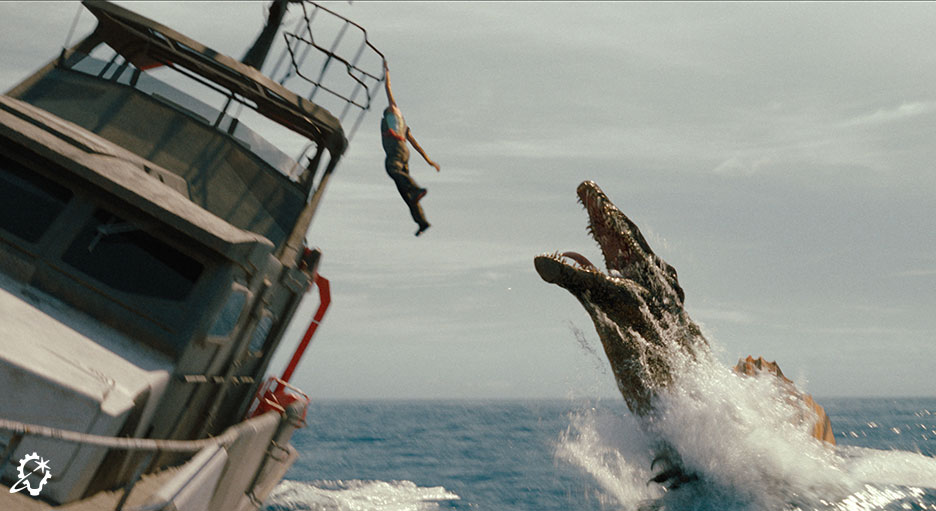
Another unseen visual effect is water, of which there is plenty in Jurassic World Rebirth. From the Mosasaurus attacking Duncan Kincaid’s boat to the T. rex attack on the Delgado family (Manuel Garcia-Rulfo as Reuben, Luna Blaise as Teresa, Audrina Miranda as Isabella, and David Iacono as Luna’s boyfriend, Xavier Dobbs), water is a constant presence in the film. And the marriage between the real-world filming locations and the pixels of ILM required some heavy-duty work to succeed, as Vickery explains.

(Credit: ILM & Universal).

“We spent six weeks in Malta shooting the boat sequence, and the cast were on the water for two days of those six weeks. I took a drone out with the second unit and did aerial photography for another three or four days, so probably 85% of the 300 shots in that sequence were shot on dry land. There are very few shots which don’t have some element of digital water in them, even the shots that were filmed at sea. Perhaps it’s a little more obvious when there’s a huge dinosaur thrashing around in it. But the fact that only 10% to 15% of those shots have real water in them is another thing that audiences may take for granted when they’re watching the film.

“Our effects department, led by CG supervisor Miguel Perez Senent, started development work on the water simulations when we were still in pre-production,” Vickery continues, “so we had a good six months run up to it because there are 50 pages of script that take place on the ocean. So we always expected that to be the biggest technical challenge we had on the entire film.” 

That massive undertaking required new solutions to work. “We built new water solvers in Houdini [3D visual effects software] to help with the white water, the spray, and the secondary and tertiary splashes as the creatures break out of the water, but it was a massive data management issue because the simulations were throwing huge amounts of data around. One of the sims had over 5 billion points of white water spray and splash, so Miguel developed some really clever techniques and tools to help us identify and break those simulations up into regions to make the caches and the sims more manageable.”

The technical aspects of the process are groundbreaking, exactly what audiences and followers of ILM have come to expect over half a century of innovation, but the glue that seals the effects to the physical action requires an artist’s touch.

“Beyond the technical side of it, there’s the visual artistry of being able to blend and match the look of water in Thailand, where it’s slightly greenish-tinted water where you can see through to the rocks and the coral beneath the surface, or the slightly deeper, bluer waters of Malta,” explains Vickery. “And then being able to make sure we’re matching all the different lighting conditions that we had throughout the time we were shooting in Thailand and Malta, on the tank, and on the stage, and all the while trying to live up to Gareth’s standards of cinematography and lighting.

“We had John Mathieson on the show, arguably one of the finest cinematographers alive today,” Vickery adds, “so we’re trying to match our work to the best in the world, whether it’s cinematography or special effects. The artists at ILM stand toe-to-toe with all of those departments.”

(Credit: ILM & Universal).

To evoke the look and feel of the 1993 original, Gareth Edwards chose to film Jurassic World Rebirth on 35mm film using Panaflex Millennium XL2 cameras and vintage C and E Series anamorphic lenses from Panavision, closely following the equipment used by Steven Spielberg over 30 years ago. In days past, such a decision could have caused issues, but decades into the digital age, Edwards’s choice was purely aesthetic.

“I’ve gone back and forth between digital and film with the projects that I’ve worked on at ILM and elsewhere,” says Vickery. “Jurassic World: Fallen Kingdom was fully digital, Avatar: The Way of Water [2022] was digital, Mission Impossible – Rogue Nation [2015] was shot on film, and this Jurassic was shot on film, so I don’t really have any skin in the game as to which one I prefer because it’s the difference between painting on a wall or painting on a canvas. There’s a texture that’s unique to film, which I really enjoy. There’s the grain, the emulsion, the chromatic aberration, the distortion, the shallow depth of field. It helps you bed the visual effects into something that feels real. Gareth wanted the aesthetic of the original Jurassic Park, not the narrative or the characters, just the aesthetic. He wanted it to be as if Universal had gone into their film archives and found something they shot 30 years ago. It felt quite nostalgic at times.”

With a career spanning well over two decades and a role as creative director of ILM’s Mumbai studio, one could be forgiven for thinking David Vickery knows all there is to know in his field. But in an arena built on innovation and creativity, he continues to learn from others and add that knowledge to his own, including from Rebirth’s director.“Gareth would say, ‘Don’t be afraid to try new things,’” the visual effects artist concludes. “When we started designing these creatures, his remit was to do little pencil sketches, so if you give him 13 ideas for a dinosaur, he’d be upset if seven of them weren’t so entirely stupid that we couldn’t use them because we hadn’t pushed the envelope far enough. He didn’t want 13 really safe ideas because we would look back and think, ‘What if we’d pushed it a bit harder?’ It’s much easier to dial back something crazy and make it truly excellent than it is to force something average to be ‘good enough.’ The flip side of that is oftentimes on a film you’ll come up with an idea and you push it harder and harder, and you try and try, but it doesn’t work, so it’s also about knowing when you should tear it up and start again. I feel like I learned a lot from Gareth.”

Vickery pauses for a moment. “He did an amazing job on Rogue One, so if he ever does another Star Wars, I’m in.”

(Credit: ILM & Universal).

Jurassic World Rebirth is available to stream on Peacock beginning October 30, 2025.

Mark Newbold has contributed to Star Wars Insider magazine since 2006, is a 4-time Star Wars Celebration stage host, avid podcaster, and the Editor-in-Chief of FanthaTracks.com. Online since 1996. You can find this Hoopy frood online @Prefect_Timing.

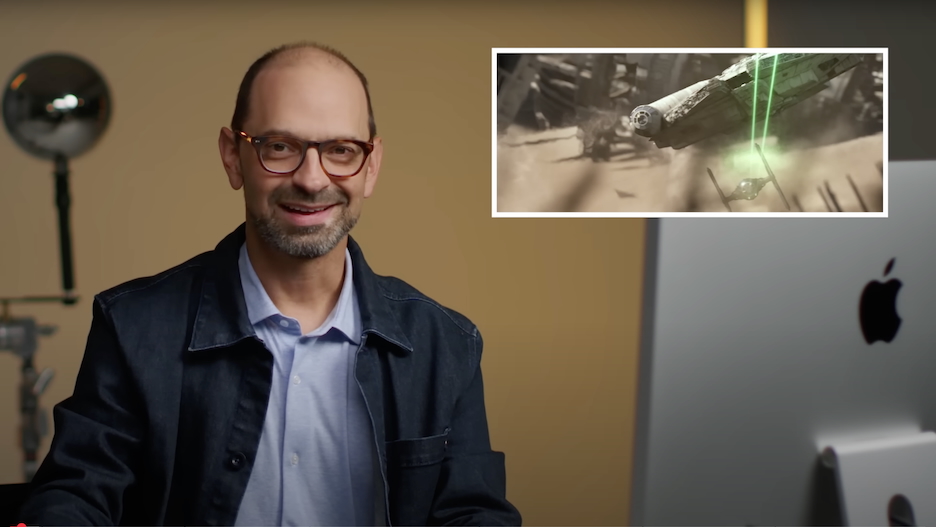
In a special video, the senior compositor examines moments from a number of iconic films.
Industrial Light & Magic senior compositor Todd Vaziri recently joined Vanity Fair to break down classic visual effects shots from productions including Rogue One: A Star Wars Story (2016), Dungeons and Dragons: Honor Among Thieves (2023), Star Wars: Skeleton Crew (2024), Star Trek Into Darkness (2013), Transformers (2007), and Star Wars: The Force Awakens (2015).

“There’s a perception out there that digital effects are a black box, that it just gets shipped off and the directors are just handed this work,” Vaziri comments at one point in the video. “[That] couldn’t be further from the truth. We work directly with filmmakers to achieve their vision.”

Watch the full video at this link or above. And hear more from Todd Vaziri on Lighter Darker: The ILM Podcast.

Read more about Beyond Victory on StarWars.com.

ILM’s new Mixed Reality Playset is available on Meta Quest 3 and 3S headsets.
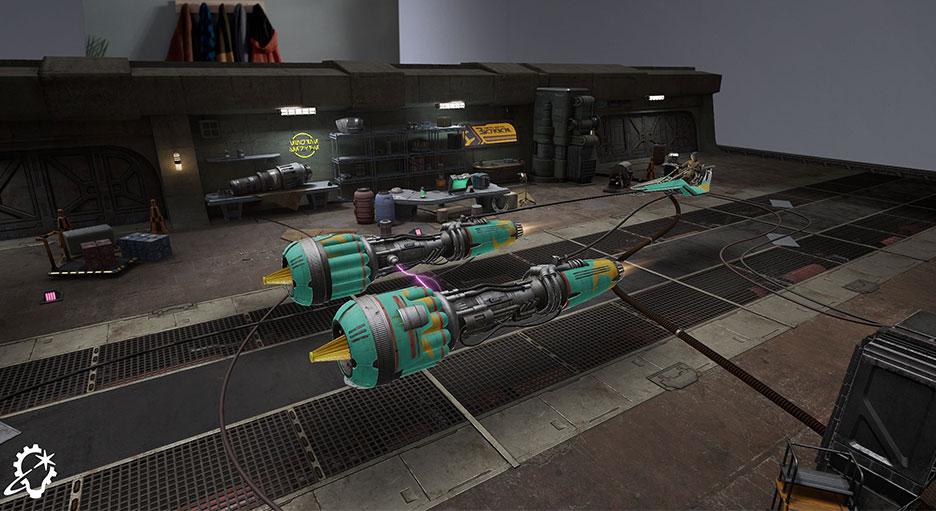
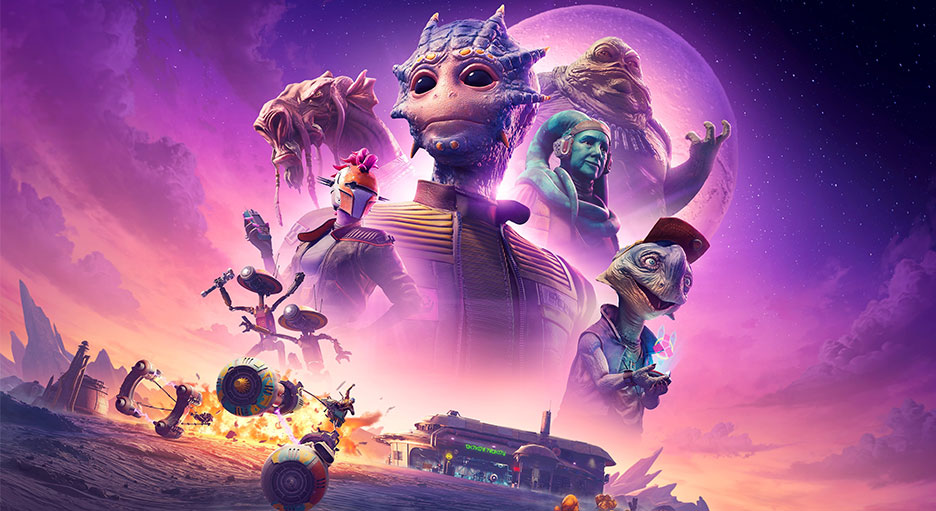
From the team that brought you Vader Immortal and Tales from the Galaxy’s Edge comes ILM’s next bold chapter in interactive Star Wars storytelling: Star Wars: Beyond Victory – A Mixed Reality Playset. Now, you can start this adventure yourself on the Meta Quest 3 and 3S headsets.

Set during the Reign of the Empire, Beyond Victory introduces players to an original story that blends the thrilling world of podracing, a stellar cast, powerful narrative and mixed reality play. To celebrate the launch, we sat down with Beyond Victory‘s director, Jose Perez III, for an exclusive behind-the-scenes look at the creative vision, development journey and personal influences that shaped this experience.


Let’s start with the basics, for those who haven’t heard yet, what is Star Wars: Beyond Victory – A Mixed Reality Playset and what makes it different from previous Star Wars experiences?

Star Wars: Beyond Victory is a mixed reality playset that gives you three ways to experience the fun of the Star Wars galaxy. We have Adventure mode, a short story about an up-and-coming Podracer who’s struggling with grief and the desire for fame. Then we have Arcade mode, which is a really fun, replayable experience that gives you a taste of old-school arcade games with a new mixed reality (MR) twist. And finally, we have Playset mode, where you can literally bring your favorite Star Wars toys to life, scale them up, and have them interact with each other. This is our first time experimenting with mixed reality at this scale, and we wanted to mix it up, no pun intended.

Can you tell us your role in bringing this project to life?

I am the director of Star Wars: Beyond Victory. My job was to work with all the talented artists, programmers, designers, writers, and actors to help bring this experience to life. I get to wear a lot of different hats over the course of development, which keeps me really excited. I came up with the original story, and then worked with our writers and the story team to help flesh it out and give it texture. In this role, I assisted with casting, and I directed the performance capture and voiceover. I was there every day working with the designers, production designers, and artists to help shape the look of the experience and how it feels to move around in mixed reality or drive your Podracer. It’s one of the best jobs in the world, and I’m a very lucky person to have it.

Concept art by Evan Whitefield (Credit: ILM & Lucasfilm).

Piggybacking on that, could you describe how your core team at ILM is organized and how you work together in developing a production like this?

Our team is highly cross-disciplinary. The key roles include designers, engineers, and programmers. We have the entire ILM Art Department and a fantastic production team that helps us pull all of this stuff together. We also have marketing folks who join us, especially as we get towards the end of the project to help show our work to the public. I think how we develop it is where things get most interesting. We like to maintain a culture of kindness, but we also like to be honest when something isn’t working and do our best to make it better. It’s a very iterative, humbling, and egoless process. It’s a lot of really smart, intelligent people working together to try and make the best thing they can on the hardware that we have. We try to keep it honest so everyone should be able to say what they need to say, and we really focus on what’s on the screen — what is the best experience for our guests.

Where did the original idea for a mixed reality Star Wars playset come from? Was this always envisioned as an MR experience?

The original idea was actually a virtual reality (VR) playset for filmmakers to help them visualize and compose scenes. It was a tool I created with a few friends in the Advanced Development Group at Lucasfilm and ILM, for directors working on big Hollywood movies. We found that it was a simple, fun tool for them, and when mixed reality became a viable technology, we knew it could be a cool experience that would easily translate to digital action figures.

Can you tell us about why you decided to make the podracing in this experience something that’s top-down on a holotable in third-person vs. a first-person POV?

It’s not truly ‘top-down’ as much as it is a 3D diorama when you’re standing next to it. It was definitely a conscious choice to make it third-person to fit into what we were trying to do here, which is pushing the boundaries of mixed reality. Early on, we knew we wanted to lean into the “Toy” vibe of the Playset and do something unique with the technology. This approach felt like the natural way to achieve that. I’m a big fan of 1980s retro games, so for me, this was about taking those classic arcade concepts and adding a whole new dimension.


How did you balance innovation with staying true to the Star Wars legacy and canon?

I’m a huge Star Wars fan, so I love working within the established canon. Our innovation came from the way we approached storytelling. This isn’t a galaxy-spanning event; it’s a smaller, personal story. Telling a story in mixed reality is hard, and we made some big choices, like letting the camera cut to express the narrative while you’re looking at miniatures. The key was to balance this innovation with ensuring all the characters and the world fit seamlessly within the broader Star Wars galaxy.

Were there any particular Star Wars films, shows or eras that inspired the tone and style of this experience?

The main inspiration was definitely The Phantom Menace [1999] and the podracing scene. Beyond that, we used the Star Wars galaxy as a palette to tell stories that were interesting to us and that would deepen the world.

Can you explain how you landed on the three distinct modes? How do you balance development for them all since they’re all so different?

We settled on three modes to offer players a variety of experiences. Adventure mode is for those who want a guided story, while Arcade is for replayability and pure fun. Playset is the ultimate sandbox for creativity. The three modes mirror how I experienced Star Wars as a kid: I’d go see the movie (story), hit up the arcade afterward to play the latest Star Wars game, and then go home to play with my toys. This is just a way of bringing a modern version of that nostalgic experience to people today. Balancing development was a challenge because they are so different, but we approached each one as its own mini-project while maintaining a consistent visual style and user interface across all three. This allowed our teams to focus on the unique requirements of each mode without starting from scratch every time.

Concept art by Chris Voy (Credit: ILM & Lucasfilm).

Mixed reality is still new to a lot of fans. How did you approach that, especially for younger players or those new to immersive tech?

Mixed reality is definitely new, and that’s actually really exciting for us. One of the things we love to do here at ILM is really push on new technologies, so it’s a joy to work with Meta and continue to push the boundaries of mixed reality, virtual reality, and, hopefully in the future, augmented reality. For this experience, we knew we had to make it intuitive and accessible. We treat every one of our experiences like it’s the first time someone has ever put on a headset, and this was no different. Making it accessible and user-friendly is something we always come back to; we want to politely walk you through the experience and ensure it’s enjoyable in the most delightful way possible.

Was there a moment during development that made you feel, “This is it. This is Star Wars.”?

Anytime you work on a Star Wars project with ILM and Lucasfilm, you’re going to have those moments. For this one, a couple of moments stand out, especially during the voice recording sessions. Hearing Greg Proops doing the voice for Fode, or Lewis MacLeod voicing Sebulba — it felt like we were right there, talking to those characters! Those performances and the incredible vibe they brought were instantly recognizable. The score was done by Joe Trapanese and Clark Rhee, and what was so awesome about them doing it is that they brought their own unique vibe to the music. We were also able to include some of composer John Williams’ music, and when you mix that in with the new score, you get a fresh, new version of Star Wars that is still very much Star Wars. It’s very exciting.

The audio in this experience is exceptional. Can you talk about what it was like working with Skywalker Sound on Beyond Victory?

Working with the team at Skywalker Sound is always an amazing experience — I’ve been collaborating with them for over a decade now, and they just always bring the heat. They are masters of their craft. It was a true collaboration; they didn’t just provide us with sounds — they worked with us to build a rich, immersive soundscape that elevates the entire experience. They have an incredible library of assets they can pull from across all the films and animated shows. The audio they created for the Podracing alone makes the experience so much more beefy and visceral. Additionally, Kevin Bolin, who is one of the main audio supervisors, provided a lot of great suggestions and even co-directed a couple of parts of this experience. They are truly the best.

(Credit: ILM & Lucasfilm).

Speaking of sound, let’s talk about the cast of Beyond Victory. What was it like working with such a stellar cast? Were they only involved in the voiceover or did any also do motion capture work?

We are always fortunate to get an amazing cast of voice actors, and this was no different. Between Greg Proops, Fin Argus, Lewis MacLeod, as well as Lilimar Hernandez and Bobby Moynihan — we just had such a great time. One of the things that was so fun is that we actually did a full performance capture for this. The audio that you hear was captured at the same time as they were doing the mocap, so it was super fun to see Greg Proops, Bobby Moynihan, Fin Argus, and all these people in the same room collaborating to bring this to life. They all did such an amazing job and they really elevated the entire experience. 

And that’s not even counting the loop group! At Skywalker Sound, we have a loop group of great voice actors who come together to help fill in the world, doing a bunch of background voices and stormtrooper voices. They always do such an amazing job and have worked on the cartoons and films, which brings an authentic Star Wars feel because you’re hearing voices familiar from other Star Wars stories as well. Yes, we had an amazing cast.

I felt like I was reliving my childhood while playing in Playset mode. Were you a fan of the toys growing up and was the intention of Playset to bring some of that nostalgia to life?

Oh yeah, I was a huge fan of Star Wars toys growing up and I’m a huge fan of Star Wars toys now. When I was a kid, I had a bunch of different ones — I had the Ewok Village, I had the Millennium Falcon for a little bit. One of my saddest memories is when I was heading into fourth grade and I gave all my Star Wars toys to Goodwill because I thought I was too old for them, and I immediately regretted it afterwards. It feels like I’ve spent my whole life trying to rebuild that collection! So, this is probably me just tapping into some childhood trauma and trying to bring some of that back [laughs]. Today, my office is full of Star Wars toys.

This must have been a massive cross-disciplinary effort. Can you talk a bit about the collaboration between designers, engineers, writers and the teams at Lucasfilm & Skywalker Sound?

It is a real undertaking. We have a lot of really smart people with a lot of opinions, and getting everybody onto the same page and making sure that we’re working on something we are all proud of is hard to pull off, but I think we did a really good job. Our production team is a big part of that, making sure that all the different disciplines are talking and coming together for the proper meetings. It is a massive cross-disciplinary effort, not just within the people working on Beyond Victory, but you have to remember that we need to fit into the entire Star Wars galaxy. So, we have to be cognizant of all the other projects going on and make sure we fit in that world, too, without breaking canon. A lot of work goes into pulling all of this together, and a great team and production process made it all happen.

(Credit: ILM & Lucasfilm).

We absolutely love seeing Star Wars comics character Grakkus the Hutt in this. Without getting too spoiler-y, is there a moment in this experience that you think fans are especially going to love? Something that will make them pause and smile?

Hopefully there are a couple of moments like that! Grakkus the Hutt is amazing. He was awesome in the comic books, and we just knew we had to bring him into this experience — he’s just too cool. I can’t wait for people to see him in all his glory when he’s standing above you; he’s literally like 12 feet tall! But I think for me, the real moment was getting to see Sebulba in person. Watching him walk around, just seeing the creature that Sebulba is — for me, as someone who loves The Phantom Menace and the prequels so much, it was really cool. It definitely brought me a lot of nostalgia.

ILM celebrates its 50th anniversary this year, and interactive experiences have continued to play an important role in ILM’s diverse range of storytelling. How does Beyond Victory help carry this interactive legacy forward?

It’s incredible to be celebrating our 50th anniversary this year. We’ve done a lot of interactive work through Lucasfilm and ILM, but Beyond Victory marks a new step for us. We’re breaking technological ground by pioneering at this scale in mixed reality. It also, in an unusual way, echoes our early film history, when we were working with miniatures and seeing the world through that lens. As far as carrying our interactive legacy forward, I hope that people see this project as a successful push into new territory. This is the first mixed reality Star Wars project with a full, integrated experience — a cohesive story, an arcade mode, and a customizable playset. At the heart of this, like all ILM projects, is really the story, and I hope people really appreciate it and that these characters can go forward into the galaxy. We’re always trying to do something different, and we hope the community appreciates this push.

Any final message you’d like to share with ILM.com’s readers?

Thank you to the entire Star Wars and ILM fan community. We’re thrilled by the love we’ve received as we explore new realms like mixed reality. We couldn’t do this without you!

Concept art by Stephen Zavala (Credit: ILM & Lucasfilm).

Play Star Wars: Beyond Victory – A Mixed Reality Playset now on Meta Quest 3 and 3S headsets.

Learn more about Beyond Victory’s unveiling at Star Wars Celebration 2025.

ILM.com is showcasing artwork specially chosen by members of the ILM Art Department. In this installment of a continuing series, eight artists from the San Francisco, Vancouver, London, and Sydney studios share insights about their work on the 2025 Disney production, Lilo & Stitch.

Art Director Cody Gramstad

Gramstad: This concept was tackling two key problems for this scene. What should our balance be between Chris Sanders’s soriginal visual style and the limitations of live action expectations?  At the same time, we could use this image to give practical design guidance for the environment team on how to stage the podium space so that the window both frames and provides value contrast to the Grand Councilwoman’s head for our primary focal point.

The iteration process for this concept was an evolution of a pre-existing previs set. From the original film we knew key staging, camera placement, and expected lighting direction. The iterations came in adjusting the environmental elements around the figures, exploring different shape languages and materials, and experiments in color and saturation to find a balance that maintains the personality of the original animated film but could exist in the lighting and material context of a more dimensional rendering approach.

My favorite part of this piece is the simplified value shape language. When this composition is refined down to its most basic fundamental art skills, it creates a graphic shape language that feels in character to the original film, while at the same time allows for a clear read of the primary focal point.

Senior Visual Effects Art Director Alex Jaeger

Jaeger: The main brief for Lilo & Stitch was to try out some ideas to pull it away from looking like an animated feature and make it feel more realistic while keeping all the main structures from the original film the same. 

The work on this piece was done as part of a push to complete a set of shots early for the trailer. As part of the process it was also done in an effort to gain a bit more realism in this sequence and offer up some new suggestions and options for detail and lighting. So, after looking at the existing sequence, I found that the textures overall were soft and that a few indications of hard reflections might help.

One of the challenges was to not alter any of the models, but rather keep my alterations to lighting and texture. So I added more fall-off and texture to the spot lights, added a metallic line element to the platform railing and floor. I also added a more metallic glint to the threads in the banners. The hardest part was finding spots to add metallic elements that would be most effective for the added realism that the client requested, without altering major elements.

Concept Artist Mathilde Marion

Marion: After his trial, Stitch is sent to a lab room where he is being tested upon, and from where he escapes. We needed to start from the client’s design of the room, and in the same spirit, expand a workstation into a DNA reading machine. We came up with a few variations of designs and how it would work, based on the client’s storyboards. This one is, in my opinion, the most successful.

This is a frame of the overall design, but it was actually designed and sent to the client as a series of close-up shots where we can see Stitch’s hair being processed and tested by the machine. There were primarily two challenges: designing a machine in the spirit of the original animated feature, all the while showing a sequence of mechanical events that are somewhat logical. Because the movie isn’t meant to be realistic, we had a bit of leeway, but it still needed to work within the chosen design and make sense story-wise.

I took inspiration from Chris Sanders’s original designs, and the original movie’s assets and weapons. I made a goal to try and match another artist’s style, which is not the easiest thing to do. My style is usually not as cartoony, and it was important for the story that everything was sitting in the right visual universe. A stylized-type of drawing is really tough, as it requires a perfect understanding of the basic shapes, values, and color relationship. You can’t hide behind details or processing in your image. I found that very interesting and had to challenge myself.

Senior Concept Artist Brett Northcutt

Northcutt: I worked on this piece late in the schedule trying to help with lighting and reality cues to improve the look of the shot.

This shot was originally front lit against space and I thought it looked a bit flat. I reversed the lighting to make it back lit, which really helped the mother ship look more imposing. With the ship now pretty dark, adding a nebulous background really helped to make it pop and also added visual interest. Finally, adding a planet to the lower right justified adding some unusual light reflection to the dark side.

Supervising Art Director Fred Palacio

Palacio: The task was to make the character more appealing to a broader audience, while avoiding a design that may appear too frightening for some. The main challenge was the time constraint, as the character had already been modeled, textured, animated, and rendered, so any changes had to be made on the spot.

In situations like this, my approach is to assess where we are and iterate step by step through paintovers, gradually exploring the visual possibilities. For example, we might ask: what if we changed the shape of the pupil? Its size? Its color? What if the skin appeared softer, the color more uniform, or the hair density had more contrast? 

Each adjustment was aimed at subtly shifting the character toward a more stylized, graphical direction, while still preserving the realistic quality the team had already achieved. It felt almost like sending Jumba to our makeup and hairstyling department. We also explored enhancing the clothing by injecting more saturation and slightly shifting the hues to evoke the distinctive palette of the 2002 film.

Art Director Amy Beth Christenson Smith

I worked closely with senior animation supervisor Hal Hickel under a fast deadline to get final boards ready for these sequences. The location had been scouted, so I had to make sure to match the scale and layout of it all.  The most challenging part was also the best part: making sure Stitch had a lot of over-the-top personality and that the comedy would shine through.

The client shared reference for the scouted location, as well as some rough sketches for a few frames. The biggest inspiration came from the characters in the original animated movie, trying to match their body language and personality. I also took inspiration from my pet rabbit – having Stitch turn only his ears in the direction of the sound when the shop doors are opening came from how my rabbit’s ears twitch and turn when she hears any sound.

Art Director Igor Staritsin

This was an art direction shot paintover that was meant to help the visual effects team establish the look of the final shot. The main challenge for this sort of task is to make the concept as close as possible to the final quality of the shot, as if it was seen in the movie. It usually requires quite a bit of research on the subject matter, as we want to make sure that the decisions made are based on reality. For example, a good design is usually achieved not only by establishing a pleasing aesthetic look, but also a logical function. The same goes for shot paintovers. We want to play up the most important elements in the frame that help to tell the story and play down the rest.

For this shot I knew what I was going to do after gathering enough information from my prior research on the task. However, there are certainly moments when one might experience a bit of struggle when trying to find a solution. I think it is best to assess your design in the simplest way possible, meaning one shouldn’t try to go into details too soon and get lost there. It is important to make sure that big shapes read well. Proportions and distribution of shapes make for a pleasing arrangement. When the basics are in place then mindful distribution of details on top will bring the design home.

I really enjoyed adding small details, a variety of materials, and break-ups that made it all look more realistic in the end. Tiny things like halation, bloom, vignetting, and suppressing details in secondary areas, as well as increasing the attention around the focal point really helps to bring it all to life while telling the story in the shot.

Concept Artist Evan Whitefield

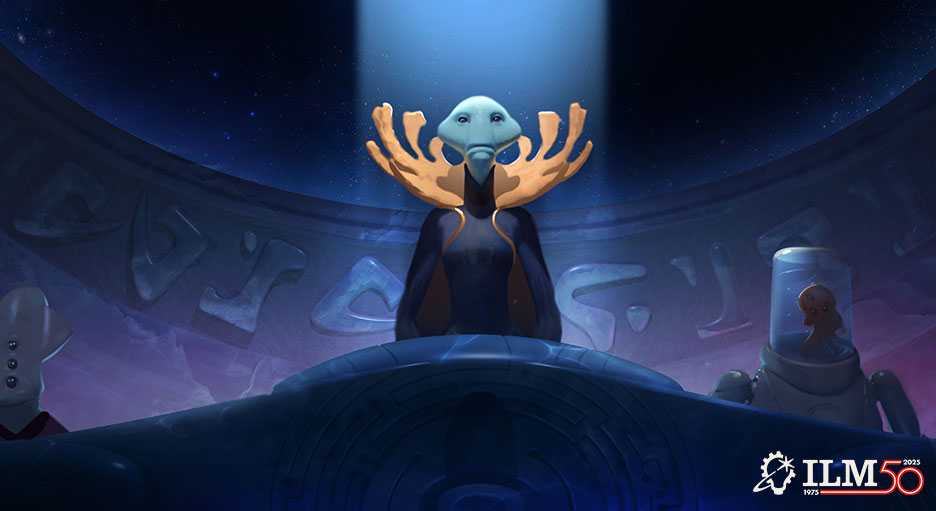
The squid-piloted robot was designed as a supporting but visually memorable background character in the Grand Council chamber. While not a primary character, it helped reinforce the sci-fi tone, scale, and advanced tech of the Galactic Federation. The design retained the creature-in-a-tank-helmet concept, evolving through multiple iterations to balance the charm of the original animated version with a more grounded, high-tech look for the live-action world.

When I first started exploring the design, my goal was to go all out with the initial concepts to really push the creativity and explore extreme ideas without limits. This helped uncover unique shapes and personalities for the squid-piloted robot. Once I had a strong range of options, I focused on pulling things back to create a more grounded, believable design that would fit seamlessly into the live-action world. That balance between bold exploration and practical refinement was key.

One of my favorite details is how the tank-like helmet functions as both a life-support system and a clear window into the squid’s personality, letting its expressiveness come alive. I also love the contrast between the squid’s relatively small size and its massive, bear-like robotic frame. The functional, mechanical design of the robot pairs beautifully with the organic shape of the squid, creating a compelling balance between technology and creature.

See the complete gallery of concept art from Lilo & Stitch here on ILM.com.

Learn more about the ILM Art Department.

Watch Lilo & Stitch on Disney+.

Discover Industrial Light & Magic’s role in helping inspire one of the world’s most iconic pieces of imaging software.
ILM executive creative director John Knoll and his brother Thomas recently joined Adobe’s Russell Preston Brown for a live recording of The Photoshop Archives at Lucasfilm’s San Francisco headquarters. Together, they discussed the origins of Adobe Photoshop, first created by the Knoll brothers in 1987 and acquired by Adobe the following year.

John Knoll had been hired at ILM in 1986 and soon began working the night shift as a motion-control camera operator. He also pursued an interest in computer graphics, then a rapidly expanding field quickly gaining traction in the realms of filmmaking and visual effects. Not long after he started at ILM, Knoll toured the ILM CG Department. The team had only recently been formed after the spin-off of the Lucasfilm Computer Division’s graphics group as “Pixar, Inc.” had left a vacuum for active work in the field within the company. The ILM team retained a fabled Pixar Image Computer, a groundbreaking image processor that had already been used to create a memorable stained glass knight in the ILM production, Young Sherlock Holmes (1985)

Knoll’s exposure to the Pixar machine yielded a glimpse of the future for visual effects, as he explains in The Photoshop Archives, and he quickly set about finding the means to create similar tools that could be adapted on more accessible computers available to the average consumer. He soon recruited his brother, Thomas, already an experienced computer programmer and scientist, to partner with him in the venture. Working on their own time while John continued in his role at ILM, the roots of Photoshop had been planted.

Soon after its debut, Photoshop was employed by ILM artists on James Cameron’s The Abyss (1989), which featured the all-computer graphics pseudopod creature. The software would continue to play an important role in helping the ILM team to innovate CG characters and worlds for many years to come.

Don’t miss the full episode featuring the discussion with John and Thomas Knoll on The Photoshop Archives.

And watch the ILM.com Newsroom for all the latest news and features.

Former Industrial Light & Magic artists join ILM.com to reflect on bringing the pre-digital cinema classic to life.
By Clayton Sandell

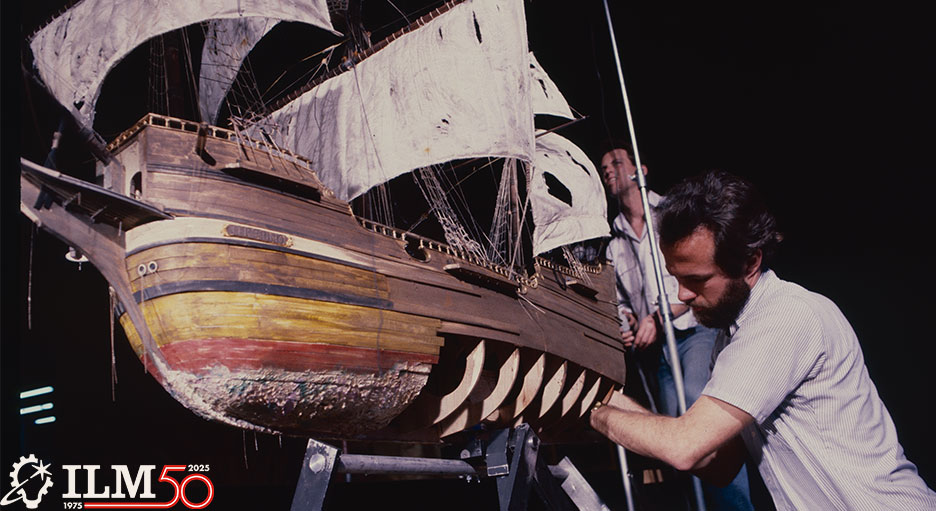
ILM modelmakers at work on the Inferno. L to R: Chuck Wiley, Barbara Galucci, Bill George, Randy Ottenberg (Credit: ILM).

During the summer of 1985, The Goonies hit movie screens and became an instant audience favorite. The timeless adventure tale follows a group of kids on a quest to discover One-Eyed Willy’s hidden pirate treasure, avoid a trio of ruthless family crooks, and save their homes (and way of life) in the “Goon Docks” of Astoria, Oregon.

While it’s not considered a massive visual effects film, part of the enduring charm of The Goonies is thanks to around 20 shots created by Industrial Light & Magic. Forty years later, four former ILM veterans share their memories about working on the celebrated classic.

ILM’s Michael McAlister was hired as the film’s visual effects supervisor, his first time in the role after working as an effects cameraman on projects including E.T. the Extra-Terrestrial (1982), Star Wars: Return of the Jedi (1983), and Indiana Jones and the Temple of Doom (1984).

Dave Carson brought extensive ILM experience to the role of visual effects art director on The Goonies, with credits including Star Wars: The Empire Strikes Back (1980), Dragonslayer (1981), and Star Trek III: The Search for Spock (1984).

The work of The Goonies matte painter and fine artist Caroleen “Jett” Green has appeared in dozens of films, including Willow (1988), Ghostbusters II (1989), and Star Wars: The Phantom Menace (1999).

Before a fruitful run as a visual effects supervisor, Bill George helped build a number of iconic models for films including Star Trek: The Motion Picture (1979), Blade Runner (1982), and Explorers (1985).The Goonies was directed by Richard Donner (Superman [1978], Ladyhawke [1985]) from a story by Steven Spielberg and a screenplay by Chris Columbus. Frank Marshall and the now president of Lucasfilm, Kathleen Kennedy, were among the producers.

The production team conducts a location scout on the Oregon coast (Credit: ILM).

MICHAEL McALISTER, VISUAL EFFECTS SUPERVISOR: Number one, Dick Donner was such a good man. His personality was so big, and he spoke with a booming voice, and he was just confident and gentle and kind. I was really impressed with him. It was a real joy to be around him. I also had good crews at ILM, and the experience of being on location in Astoria, Oregon, which is absolutely stunningly beautiful, was delightful.

DAVE CARSON, VISUAL EFFECTS ART DIRECTOR: It had so many effects shots in the first draft. I remember being in a meeting in Burbank early in the production. I don’t think Dick Donner was even there. And we were talking about the effects. And I said, “Well, I think eventually there’ll probably be like 80 shots.” The blood drained from everybody’s faces. I could see that was not where they were headed. It still was a great project, but the number of shots kept dwindling. The first draft had skeletons that came to life. It was full of effects and fantastic stuff.

I started just by drawing scenes from the script. Nobody asked me to, but you can’t read that script without wanting to draw some of the scenes in it. J. Michael Riva was the production designer, and he was cranking out beautiful stuff. [Art director] Rick Carter made beautiful blueprints. They were establishing the look of this film, and it was great. From that point on, my actual work for the production was pretty much taking established background plates and indicating where the effects would go. There wasn’t too much pie-in-the-sky stuff. I did a bunch of storyboarding of the sequence where the kids run into the cove, and they see some skeletons and they get on the ship.

Concept art by Dave Carson depicts the unfinished sequence when the Goonies are attacked by a giant octopus (Credit: ILM).

The ILM Model Shop built a highly detailed scale version of One-Eyed Willy’s sailing ship, the Inferno. Under the supervision of Barbara Gallucci, Bill George led a model-making team that included Randy Ottenberg and Chuck Wiley. ILM had plenty of previous experience with model spaceships, but building a wooden pirate galleon was something the crew had to learn from scratch.

BILL GEORGE, CHIEF MODELMAKER: I was really happy to be put on the project leading the construction of the miniature pirate ship. We wanted to do a good job and do something impressive that would get people talking. We put more into the model than we needed to. The production provided blueprints, which were amazing. We read books on building miniature ships and had the opportunity to do research and learn. We went to San Francisco Bay to study the Balclutha, which is a vintage wooden sailing ship. We studied all the details, the belaying pins, the rigging, the wood texture and wear. We wanted our model to look as authentic as possible.

We started with stanchions, very much the way you would build a boat. Those were covered in thin sheets of balsa wood. One of the big technical challenges on this was the rigging and the sails. Randy’s main focus was the sails. And, of course, there were no computer graphics that were advanced enough to do CG sails at that point. So the decision was made to make them out of a very, very fine silk, which would blow in the wind, and the silk was also great because it was transparent and pure white. Once again, we did some research. We found that we could use coffee and tea to stain the sails so they had a little bit of a warmer, aged color without stiffening the fabric. At the time Goonies came along, ILM had established itself as the visual effects house of choice for very successful films. Then there were all these films that Spielberg was producing, including The Goonies and Explorers and Back to the Future [1985], and all of them kind of funneled through ILM. It was a really exciting time because there was a whole diversity of interesting projects coming in.

Chief modelmaker Bill George at work on the Inferno (Credit: ILM).

MICHAEL McALISTER: It was unbelievably beautiful. But by the time the model was in the process of getting made, they decided to just go ahead and build the entire set on the soundstage. Which then meant that we didn’t need as many shots using the model.

BILL GEORGE: I was a little disappointed because we didn’t get to showcase it as much in the film. It was very backlit, and it was very far away, and I knew that the model could hold up. So it was a little bit of a disappointment. But I’m super proud of the model we built.

On deck, there’s even a little R2-D2 Easter egg. It was actually a casting from Star Wars. In the model shop, we had molds of the castings that go with the plug at the top of the X-wing starfighter. That’s what that was.

In 2023, the Inferno model was donated to the Academy Museum of Motion Pictures by Richard Donner’s widow, producer Lauren Shuler Donner.

The hidden R2-D2 figure from Star Wars tucked away on the deck of the Inferno (Credit: ILM).
Modelmaker Randy Ottenberg at work on the Inferno‘s masts (Credit: ILM).

Production designer J. Michael Riva had the Inferno and a water-filled cavern built as a full-size, practical set on Stage 16 at the Burbank Studios (now Warner Bros.) in Southern California.

MICHAEL McALISTER: I’ll never forget it. It was the most impressive thing I’ve ever seen in my entire movie career, hands down. The first time I walked on the stage, here’s this full-size pirate ship. And every little glorious detail was just striking.

The director of photography, Nick McClean, was going back and forth to another stage at the same time as he was trying to light this pirate ship, and it wasn’t working out very well. He just didn’t have all that much time to be on Stage 16.

So he just turned to me and said, “Michael, light it for me,” and walked away. I was like, “Oh my God, I don’t know how to light a set!” I was freaking out because I didn’t want to come up short. I didn’t want to disappoint him, didn’t want to embarrass myself. And I remember thinking, “How would you light it if it was a miniature, and just scale it up?” So that’s what I did.

You just got thrown into something, and you had to figure it out. So Nick came back, and he looked at my lighting, and he was pretty happy. Only changed one thing. I learned something about confidence, and I learned something about lighting. It doesn’t really matter how big a thing you’re going to light. It’s all the same idea.

The ILM team made visits to the Goonies sets in Burbank to capture reference photography. Here the Inferno and surrounding cave is under construction (Credit: ILM).

DAVE CARSON: It was an amazing thing to see. One morning on the set, there were probably a dozen of us all standing around drinking coffee, and Steven Spielberg walks in and he’s looking around. We’d met a few times, but he didn’t know me all that well. He says, “So what do you think?” I said, “There’s some great shots here,” and he says, “Oh yeah? Where?” I’m thinking, “Is he kidding me?” I was just trying to be conversational. But I decided I’d just follow through. So I walk over to the island with like twelve people following Steven, and I got down, just trying to find some interesting angles. I don’t know what he made of it all.

Visual effects supervisor Michael McAlister wades in the water tank on the Inferno set (Credit: ILM).

For wide shots of the Inferno, ILM artists Frank Ordaz and Caroleen “Jett” Green created matte paintings to help complete the illusion of a tall sailing ship rising beyond the limited height of the Burbank soundstage. Chris Evans served as matte painting supervisor.

CAROLEEN “JETT” GREEN, MATTE ARTIST: They had that big ship that they shot in a way that, at the last minute, they needed to extend the masts and add sails. We had to work quickly to make it all work perfectly.

The challenge was, we didn’t have much time, and the sails of a ship needed to have fluidity, an airy quality. Our matte painting extensions were static, so lucky for us the shots of the sails were only on for a couple of seconds.

I knew how to paint something realistically. What you also learn with matte painting is how to change lighting. You need to know what goes on with light, whether it’s indoors or outdoors, how it affects everything. If there’s a blue haze that’s moving in the shot, I might add some carefully mixed blue paint to match. It all got combined together.

I was an apprentice matte painter, learning the techniques and skills in order to become a great matte painter. I was working in a room with highly creative people, all excellent at what they do. I really wanted to keep up with these guys. And I told myself, well, “I’m just going to put in 150%.”

Another ILM contribution includes what might be considered an early example of a so-called “invisible effect.” Searching for their next clue, Mikey (Sean Astin) lines up a doubloon with cutouts to match rocks and a lighthouse in the distance. What appears to be a practical shot is actually a mix of multiple blue screen elements, background plates, and matte paintings. A complex rack focus helped complete the illusion.

DAVE CARSON: I remember the challenge at the time on the doubloon shot was they wanted the doubloon in focus and crisp up close. That means anything in the distance is going to be soft. So they had to pull off the rack focus in post-production.

MICHAEL McALISTER: One of the reasons that the shot was never attempted on set is because the rocks in the ocean didn’t exist. And they certainly didn’t exist to line up with the doubloon. So, based on that criteria, it automatically became a visual effect. And dealing with the rack focus was very challenging during that time because it was all optical printer composites, and you didn’t get good mattes out of blurry edges in the optical process. Today, it’s not an issue with all the CG capabilities and the compositing software, but it was a challenge at the time to get that right.

A storyboard by Dave Carson (Credit: ILM).

The organ chamber sequence – in which an incorrectly-played musical note causes part of the floor to fall away and reveal a treacherous cavern below – was achieved using five different matte paintings and a 16-by-20-foot miniature set featuring stalactites, pools of water, and fog. The original set was scaled down in size during pre-production, posing a challenge for creating the critical illusion.


MICHAEL McALISTER: The concept was supposed to be something that instantly communicated absolute death if you fell down there. That was one of the hardest things I’ve actually ever done in my career, creatively. And to this day, I’m not really happy with what that image communicates because it didn’t look like instant death to me. Richard [Donner] and [Steven] Spielberg didn’t ever complain to me about it, but I wasn’t really happy with that. It was supposed to be all misty and foggy, which made the lighting so diffuse that it was just really hard.

The ILM camera crew prepares to shoot the miniature from the ground up. A mirror was used for reference while standing (Credit: ILM).

Four decades later, The Goonies continues to be treasured by fans young and old. In 2017, the Library of Congress added the title to the National Film Registry, which honors movies with cultural, historical, or aesthetic significance.

DAVE CARSON: It’s so funny. Of all the films I’ve worked on, when people find out I worked on The Goonies, a lot of times that’s the one that they’re impressed by. “Oh, you worked on The Goonies? I love that movie!” Yeah, it’s still a very popular film.

BILL GEORGE: The story reminded me of when I was a kid with my buddies, and we were looking for adventure on the street, throwing dirt clods, that kind of stuff. It really captured the essence of that in a really magical way. And I think for kids that age, they’re like, “Hey, let’s make this happen. Let’s find the treasure.” Goonies have a special place in our hearts.

CAROLEEN ‘JETT’ GREEN: We were all seriously into what we were doing: matte painting.

I considered many of the artists geniuses. Just a brilliant group of creatives. We would start painting at around 10 o’clock in the morning and go into the zone of silence for hours. Then we’d come up for air at the same time, lunchtime or later. At times, I would even stay until sunrise. 

MICHAEL McALISTER: It is meaningful to me that there are a few films that I’ve worked on that are classics and will always be remembered. During The Goonies, I had a hunch about it because every kid dreams about finding a pirate ship and a pot of gold. I can’t take any credit for the fact that these movies have such legacies, but it’s nice to have been involved with a movie that made such a dent and endures.

When I first walked the halls of ILM, I realized I was walking among the best in the world at what they do. It was just such a privilege to be in that company, in the company of those artists, that level of creativity and expertise for so many years.

A doodle by an ILM crew member on the Inferno model during its construction (Credit: ILM).

Clayton Sandell is a Star Wars author and enthusiast, Celebration stage host, and a longtime fan of the creative people who keep Industrial Light & Magic and Skywalker Sound on the leading edge of visual effects and sound design. Follow him on Instagram (@claytonsandell), Bluesky (@claytonsandell.com), or X (@Clayton_Sandell).

Industrial Light & Magic has unveiled a new trailer and key art for the podracing adventure that’s coming this fall.

Industrial Light & Magic and Lucasfilm announced today that Star Wars: Beyond Victory – A Mixed Reality Playset, the next groundbreaking entry in interactive Star Wars storytelling, will launch on October 7, 2025, exclusively for Meta Quest 3 & 3S headsets.

“This experience is designed to celebrate storytelling, action, imagination and everything we love about Star Wars,” said director Jose Perez III. “We wanted to give players a new way to step inside the galaxy and make it their own.”

Watch the new trailer below:

Visit StarWars.com to learn more about the exciting new voice cast and distinct gameplay modes for Star Wars: Beyond Victory.

Don’t miss all of the latest updates from Industrial Light & Magic on the ILM.com Newsroom.