Take a deep dive into the creation of Din Djarin’s starship with the artists who built it across physical and digital space.
The modern Star Wars era is a curious beast for traditional modelmakers. There is a contingent of fans that reflexively dismiss CG work as something “less than,” which I have always thought was probably what the craftsman who used the hand-crank drill thought about the electric drill in the early 20th century. Humans are suspicious of and averse to change, especially when it comes to pursuits they are passionate about. But there are those of us who are curious and want to know more about the digital era, and how it comes to bear in the media we so enjoy. And what luck that there is an example of both worlds working seamlessly together that can be talked about, perhaps as a way to open the hearts and minds of the more skeptical among us, to become enthusiastic about all of the tools and methods brought to bear. This perfect example is in the creation and implementation of the Razor Crest models for The Mandalorian series and the feature film The Mandalorian and Grogu, both now streaming on Disney+.
Perhaps you remember that moment when someone excitedly forwarded the shaky fan clip of the Star Wars Celebration presentation on The Mandalorian where Jon Favreau showed that first shot of a physical miniature of the Razor Crest streaking by the screen? Gleaming in space, a real-world filming miniature, in the 2010s?! It felt like an impossibility. The fan video seemed to echo this internet viewer’s thoughts, as the crowd erupted in cheers. We quickly learned that it was a two-foot miniature built by John Goodson and Dan Patrascu. John and Dan form a tight team, building miniatures for the new era of Star Wars storytelling, and have notably built that initial Razor Crest, the light cruiser used by Moff Gideon, Ashoka Tano’s T-6 Jedi Shuttle, and now the four-foot Razor Crest for the film. They joke that they are the last remaining ILM Model Shop builders, separated by a 38-mile “hallway”.
Goodson is ILM Model Shop through and through, having been brought on board in 1988, and has since built hundreds of miniatures, some of which are personal favorites of mine, like the veritable sea of speeder and podracer study models generated during preproduction for Star Wars: The Phantom Menace (1999). Being well-versed in conservation and preservation, he also is responsible for the care and feeding of many of the Lucasfilm artifacts at the new Lucas Museum of Narrative Art.
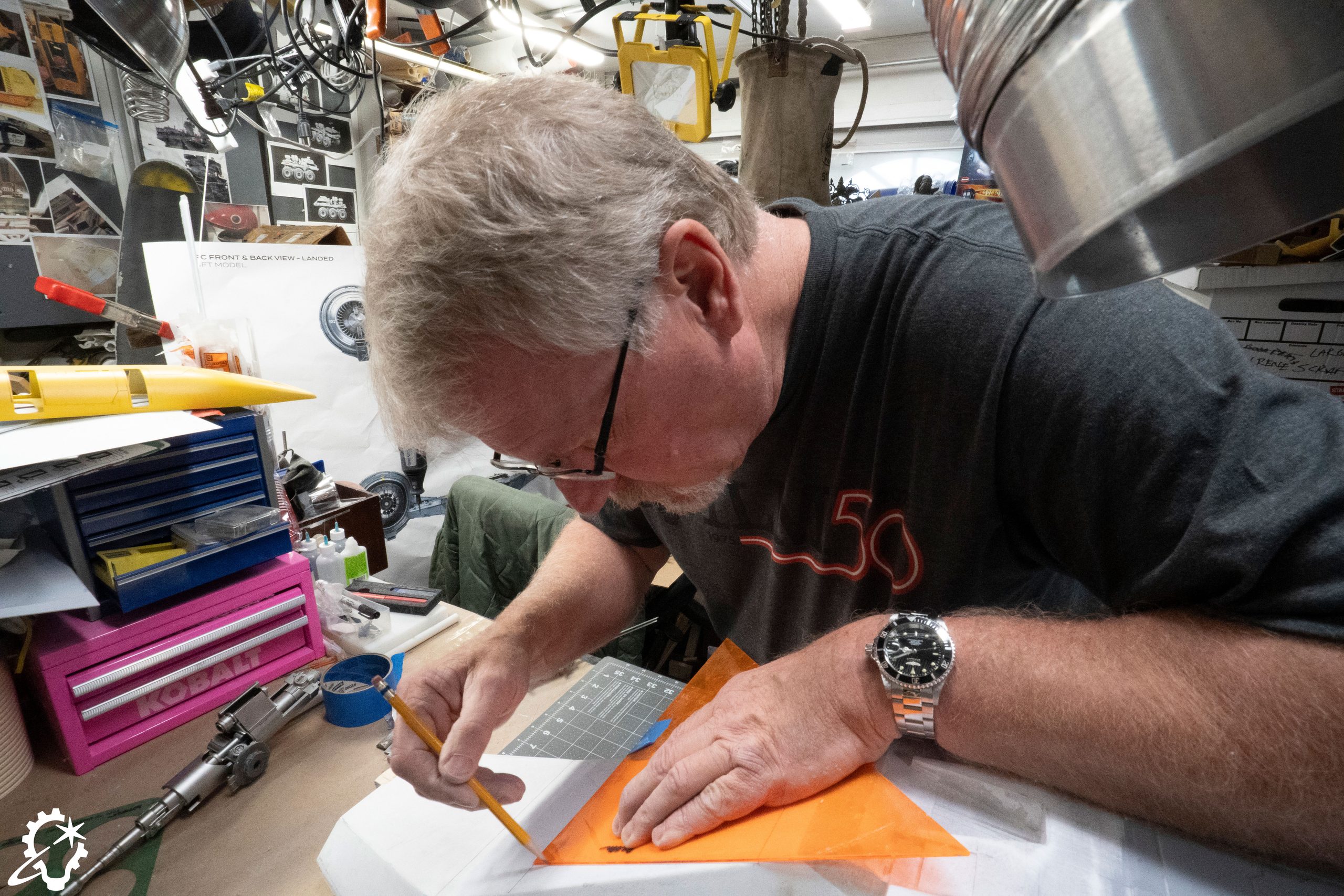
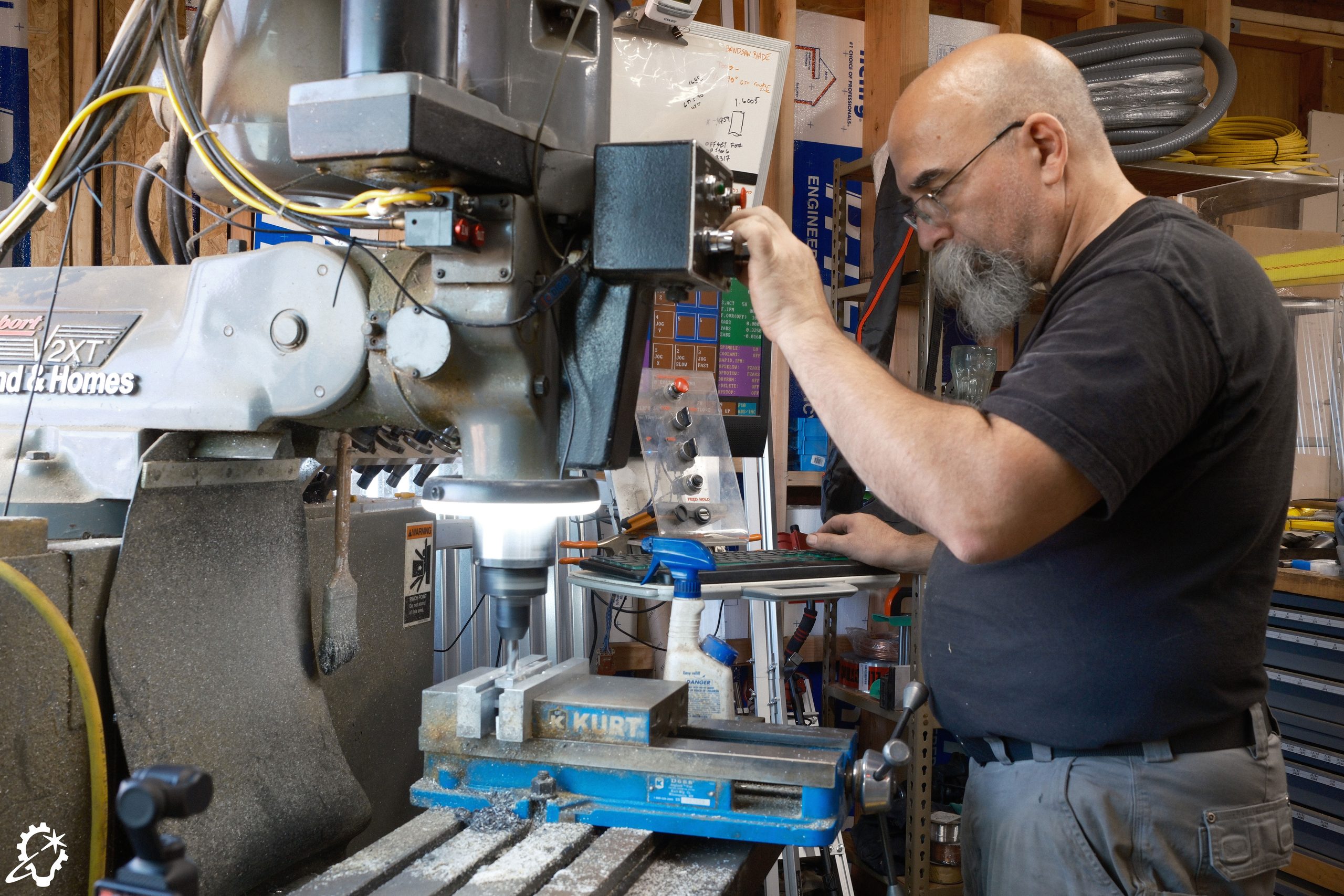
Patrascu is a talented machinist with 35 years of experience and has known Goodson since the early 1990s. They officially started working together during the Smithsonian-sponsored restoration project of Star Trek’s USS Enterprise, and Patrascu also machined all of the internals for the 2001: A Space Odyssey (1968) Aries miniature restoration for the Academy Museum, which features articulated actuators and landing gear as well as an internal armature and sub-structure. Patrascu brings his dialed-in disciplines to the team, creating the all- important armatures, sub-structures, and exacting measurements that filming miniatures require. They joke that Goodson is slowly learning not to submit scrawled glyphs and doodles on napkins to Patrascu, and the latter can let loose a little from time to time.
That original 2-foot Razor Crest came about because Jon Favreau, a fan of filming miniatures, wanted a shot for that Celebration reveal. It was 3D-printed by ILM digital artist Landis Fields on a Form 2, from files created by the Lucasfilm Art Department. This was done under a near-impossibly tight production schedule, and the resin was not quite cured correctly and printed at a lower resolution, which exhibited grow lines. Coupling that with the older Form 2 resin, which was very brittle in nature compared to the more forgiving and “buttery” traditional urethane resin, meant it was a challenging material for Goodson to work with.
This shot request also meant they would need a motion-control (mo-co) system, and ILM’s executive creative director John Knoll enthusiastically built one for this purpose, drawing from his deep well of knowledge and experience with motion-control hardware and software. Knoll built the camera system in his garage, leading the three of them to jokingly refer to themselves as “Three Garage Productions.” Goodson remembers late-night messages from Knoll excitedly showing the latest progress, so it’s safe to say everyone had a wonderful experience building what was needed. They had a Tondreau rig and 15 feet of track, and set up shop in a conference room at ILM’s San Francisco headquarters. It was a definite iterative build. A three-axis head was added, and all “seat of the pants,” like the old days.
At some point, the call was made for two shots at Celebration, so the model would come toward the viewer and then sweep past, meaning most of the model would be visible. While the motion-control system was being built out, the miniature was quickly constructed and coated with HVAC metallic tape, which can be burnished down with a slight loss of fidelity in the detailing but appeared very chrome-like in its finish. It was said to have looked gorgeous but very bright, so while this state of appearance worked for the Celebration shots, it would not be appropriate going forward. Keen observers can also note that the model at this stage did not have the yellow markings. Favreau at one point remarked, “It looks so –” to which Goodson replied, “What, hand-made?” Favreau replied, “Yeah, and it’s kind of – rough,” and Goodson added with a laugh, “It looks great in the dark moving quickly by!”
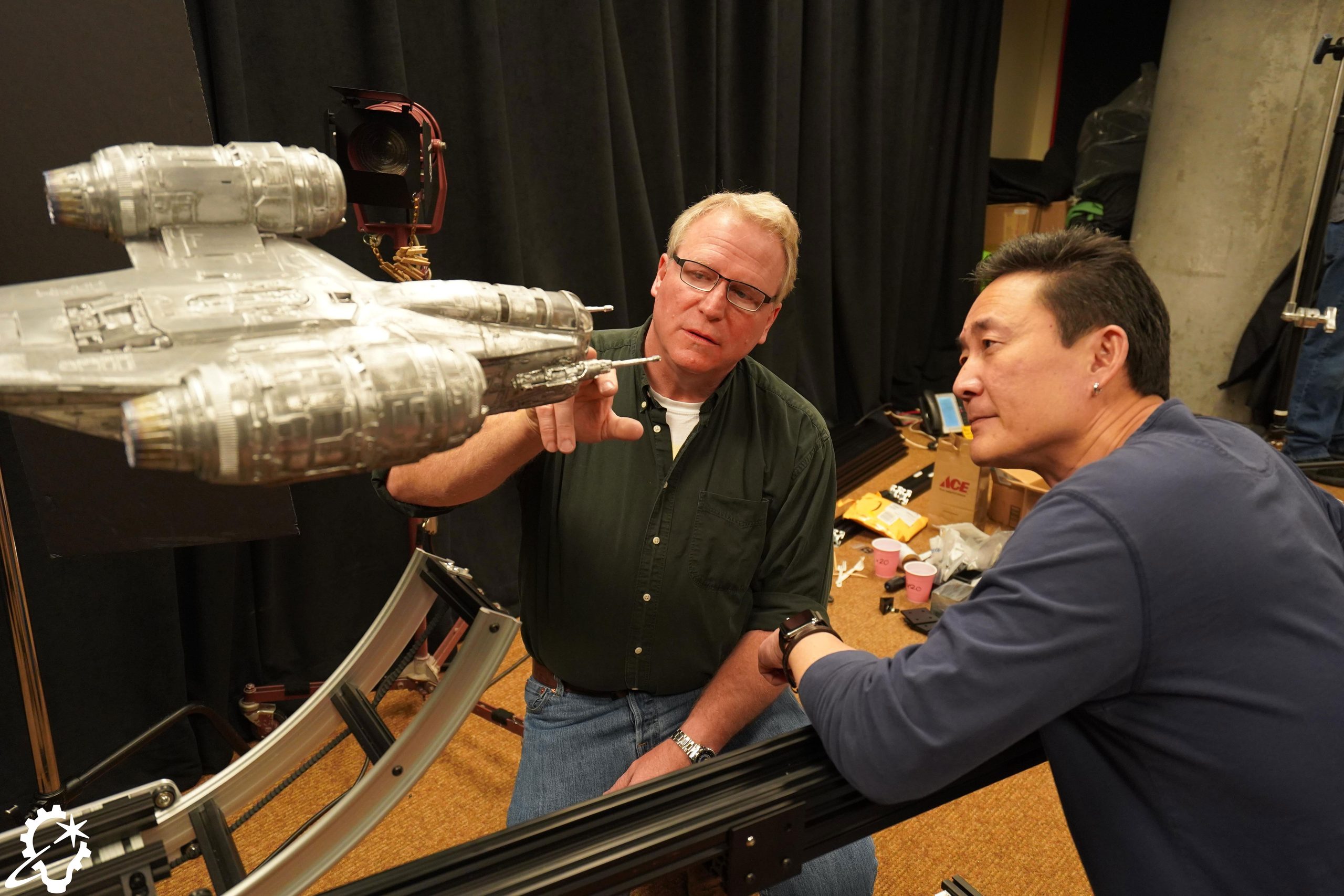
With the initial Razor Crest completed and deemed a success, the model was taken apart and rebuilt. Patrascu built a three-way internal mount for the model. When possible, 3D-printed parts are usually avoided, as their track record is not well known with regard to longevity and stability. While it’s true that in the past there were no real considerations for the lifespan of a filming miniature after production, there is now the intent to make these miniatures more stable and robust, if possible. There has indeed been a sea change in the way these miniatures are approached, so things are no longer “slapped together,” but built to hopefully last a long time. Goodson personally credits his time and training in the archives for learning these methods.
That initial 3D-printed model was broken down “strangely,” like a ship’s hull, and had a tolerance stack, which in this case is when a warped part affects the fit of the next part and so on. So Goodson made new molds and cast the pieces in epoxy fiberglass, since parts would need to be cut into for the access hatches for mounts and the brittle 3D-printed resin would not hold up.
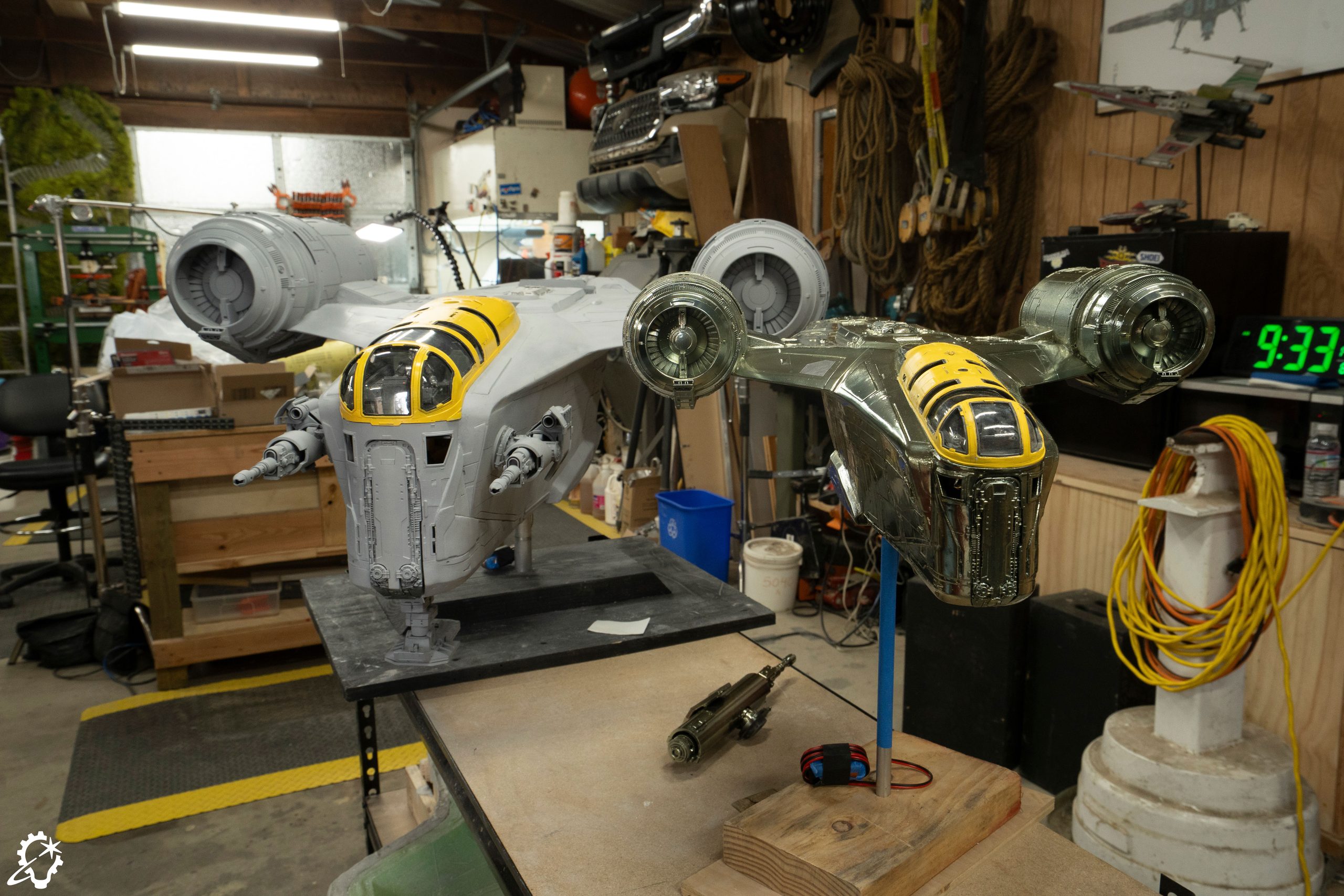
The engines, however, remained prints because of elements like their turkey feather details. The rebuilt model was again covered in foil and sprayed in Rustoleum black automotive primer. Once dry, the model was painted with Zynolyte silver, and each panel was hand-sanded. This provided a very similar match to the 3D renders, so it visually matched the digital assets.
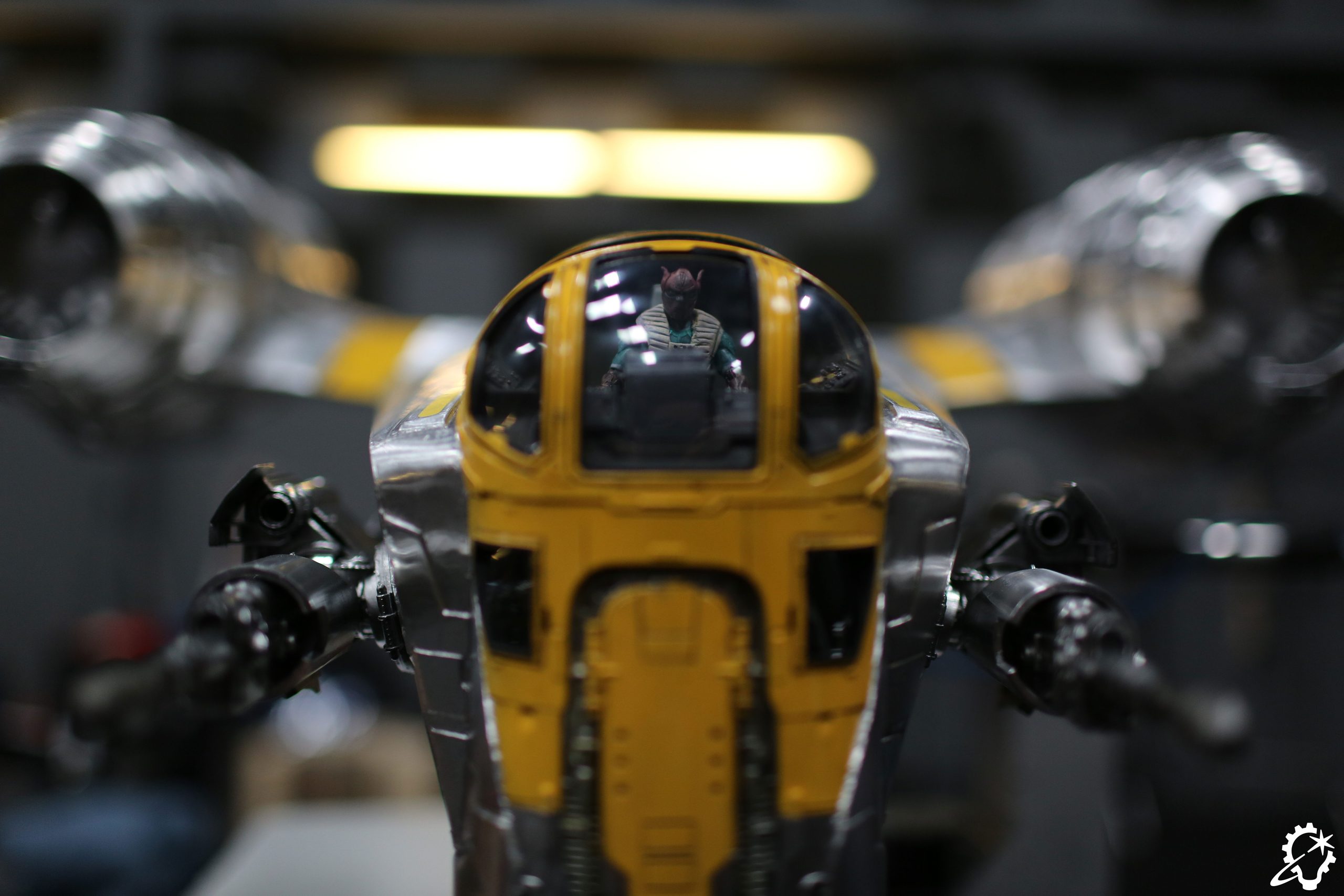
Floquil paint was used for accent panels, and decals rounded out the overall decoration. This iteration of the model was leaps and bounds more polished than the initial Celebration shoot build. For example, the cockpit had hollow consoles with fiber optics running through, and the little Mandalorian figure was adapted from a model kit. It was held in place with magnets to allow easy placement or removal.
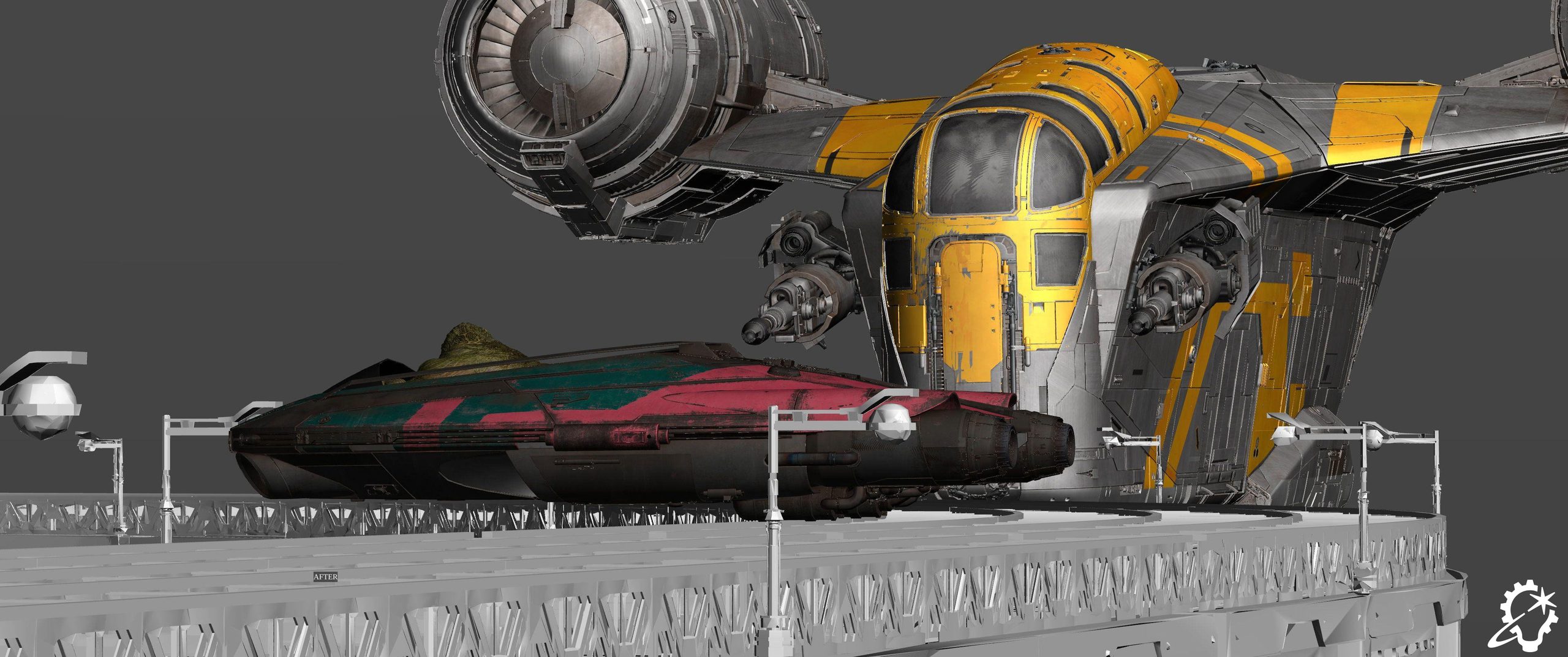
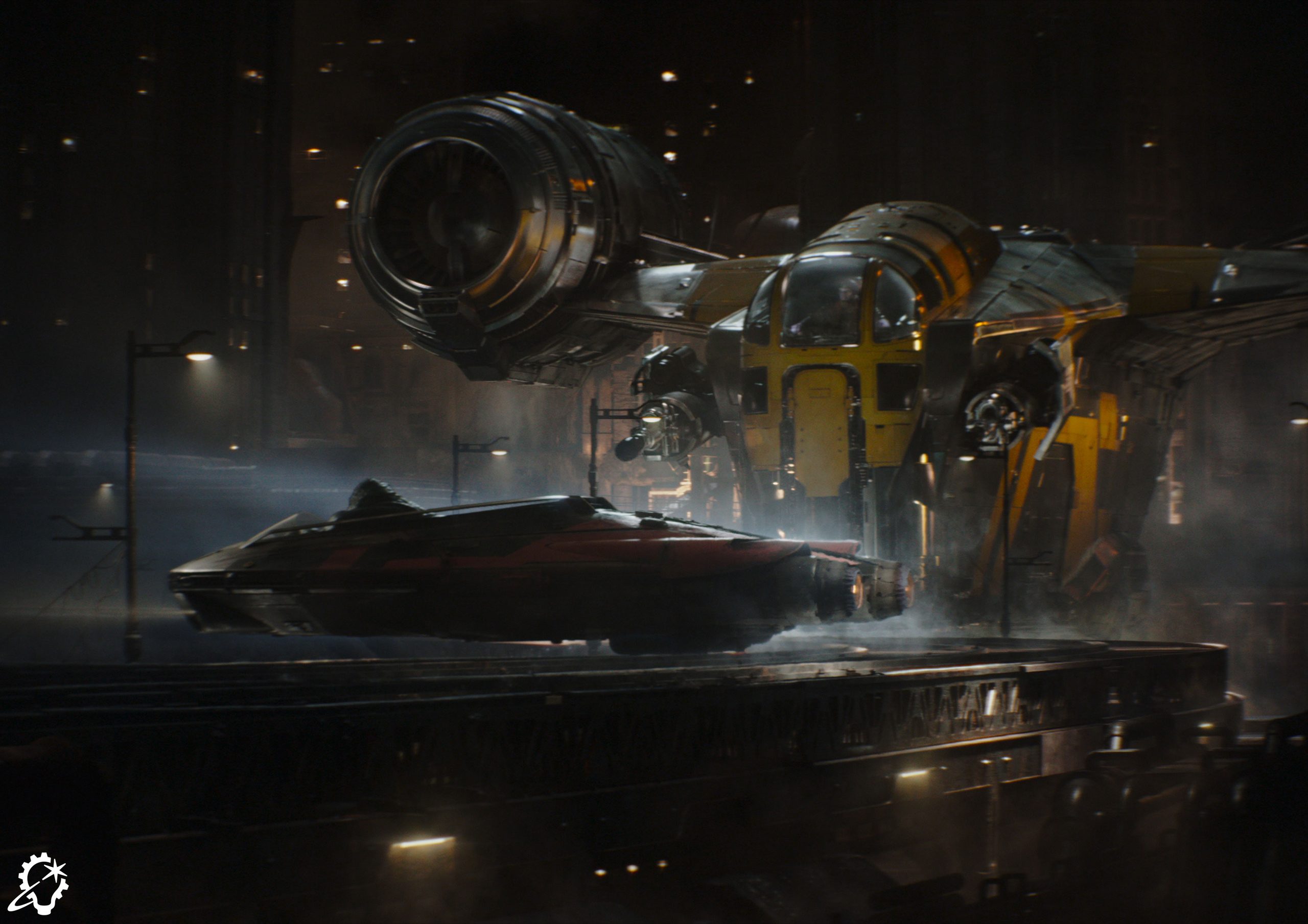
We have explored a little about these digital assets, but as a modelmaker, you may wonder how the digital world comes into play in the physical world – how so many ones and zeroes become tangible styrene and paint, and how they work together. I spoke with ILM’s Jay Machado and Anthony Rispoli to better understand just that. Machado is a hard surface modeler with a childhood propensity for drawing and started his schooling in illustration and concept art, but quickly found a love for 3D modeling. He was a junior artist at ILM when Harrison Ford broke his leg during the production of Star Wars: The Force Awakens (2015). Production briefly paused, and Jay was suddenly the senior person in the room, so to speak, and was tasked with building the new Millennium Falcon. He then became the model supervisor on The Mandalorian Season 1 (2019).
Rispoli comes from a computer science background and was initially hired as a technical assistant at ILM. That role involved code writing, render watching, and other computer-based tasks. It is an excellent stepping stone to the role of technical director, which involves lighting and shading on CG assets. Having no background in this field, he learned the craft on the fly, and everything “clicked” immediately. Rispoli worked on the assets for the first Transformers (2007), excited to light and shade the robots from our childhoods. Later, working on The Mandalorian, Machado would build the CG model, and Rispoli would ensure it was shaded and lit properly at the tail end of the process. They are two people in a deep pool of talented artists working on these productions as a team.
For the Razor Crest, they sent finished renders to Goodson and Patrascu, and the intent more and more was to ensure the digital assets reflected the physical assets as much as the production schedule allowed. As the bar on resolution was constantly raised, the imagery likewise improved. I asked about a personal peccadillo I cannot help but notice: when a single ship’s decoration is cloned multiple times across a squadron of ships, and if that was simply due to production schedule constraints. Amused, the response was affirmative, and whenever this has been brought up in production meetings, John Knoll would respond with a variation of, “If the audience is looking over there, we already have lost them.” A fair point.
So how “hero” do you go on a digital asset? Meaning, how granular should the detail be on a vehicle or creature or other element in a shot? Machado and Rispoli explain that it depends entirely on where the asset is in the film, whether it is in the foreground, middle ground, or background. Is there atmosphere in the environment? Is it day or night? These all come into consideration. And who tackles which ship will depend on the strengths of the artists on the team and the team’s size.
For those wondering, they use Linux boxes, and Machado uses a near-off-the-shelf version of Maya, with a few ILM plug-ins. There is also an immensely powerful proprietary ILM tool called Zeno for unified 3D graphics and pipeline frameworks, and real-time tools are also in the mix. ILM initially ran all of the CG work locally, but now everything is based in a central server, and the Linux boxes can be thought of as “dumb” terminals. Rispoli notes that it’s really come full circle back to the 1960s and 1970s with the locked-down local network.
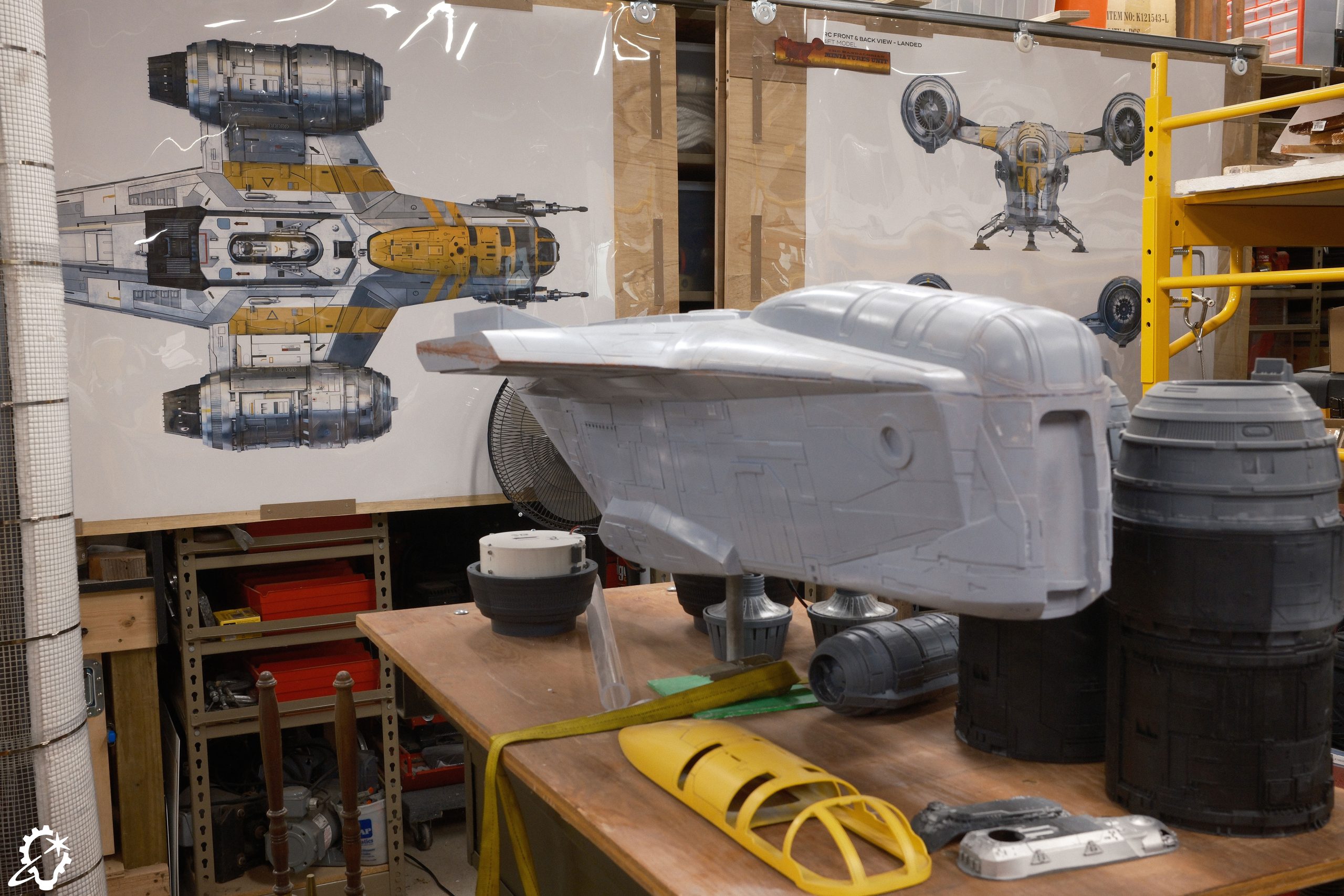
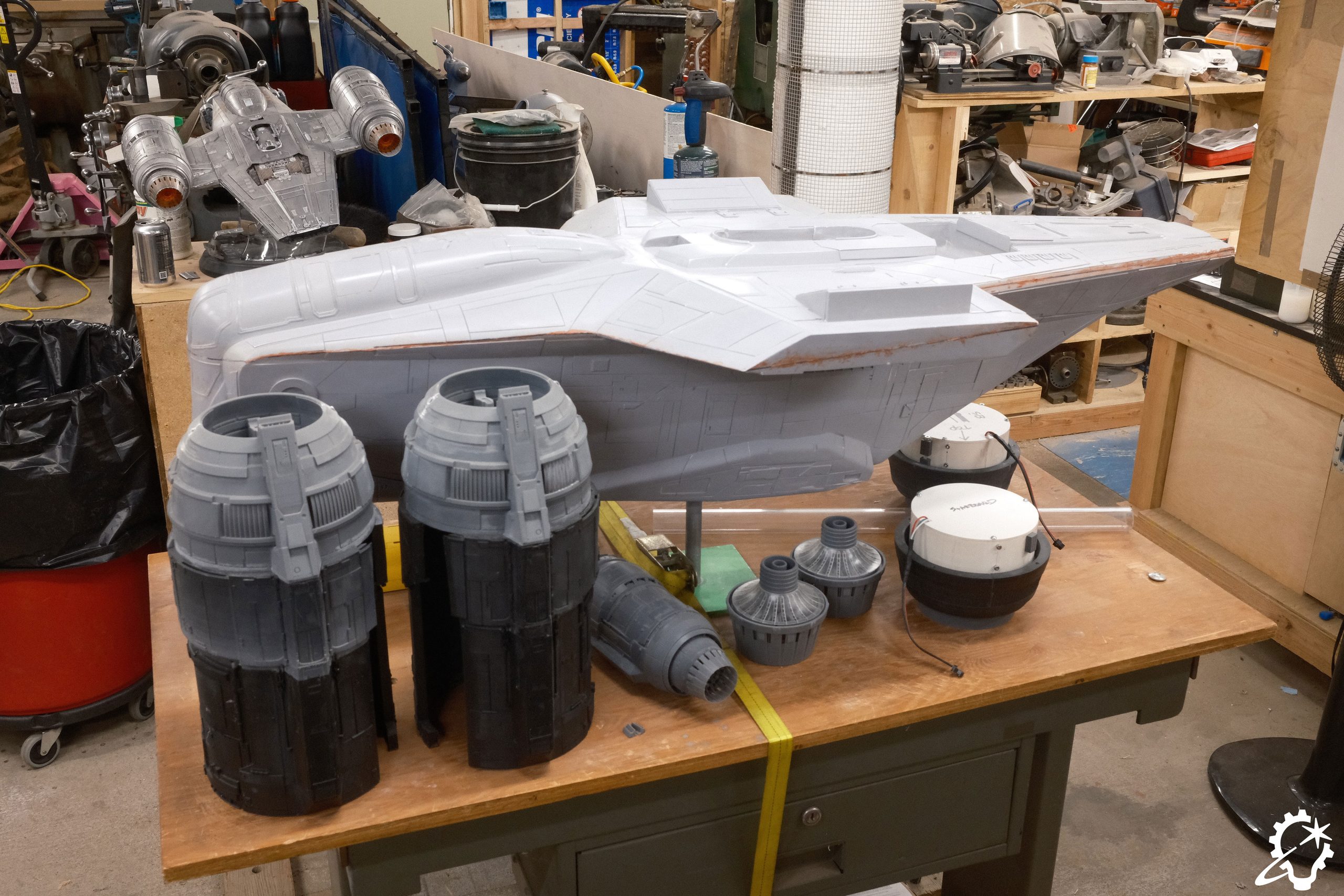
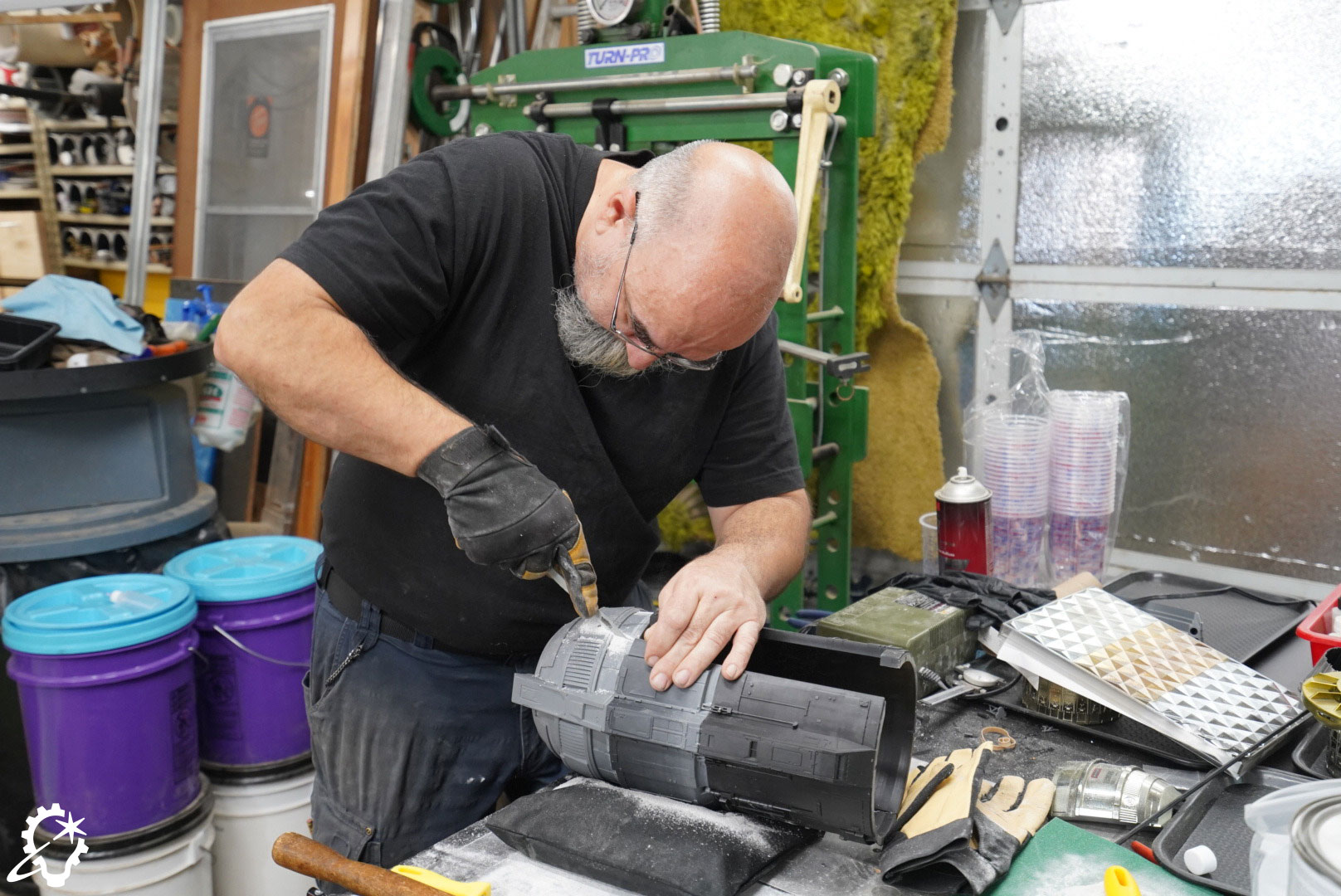
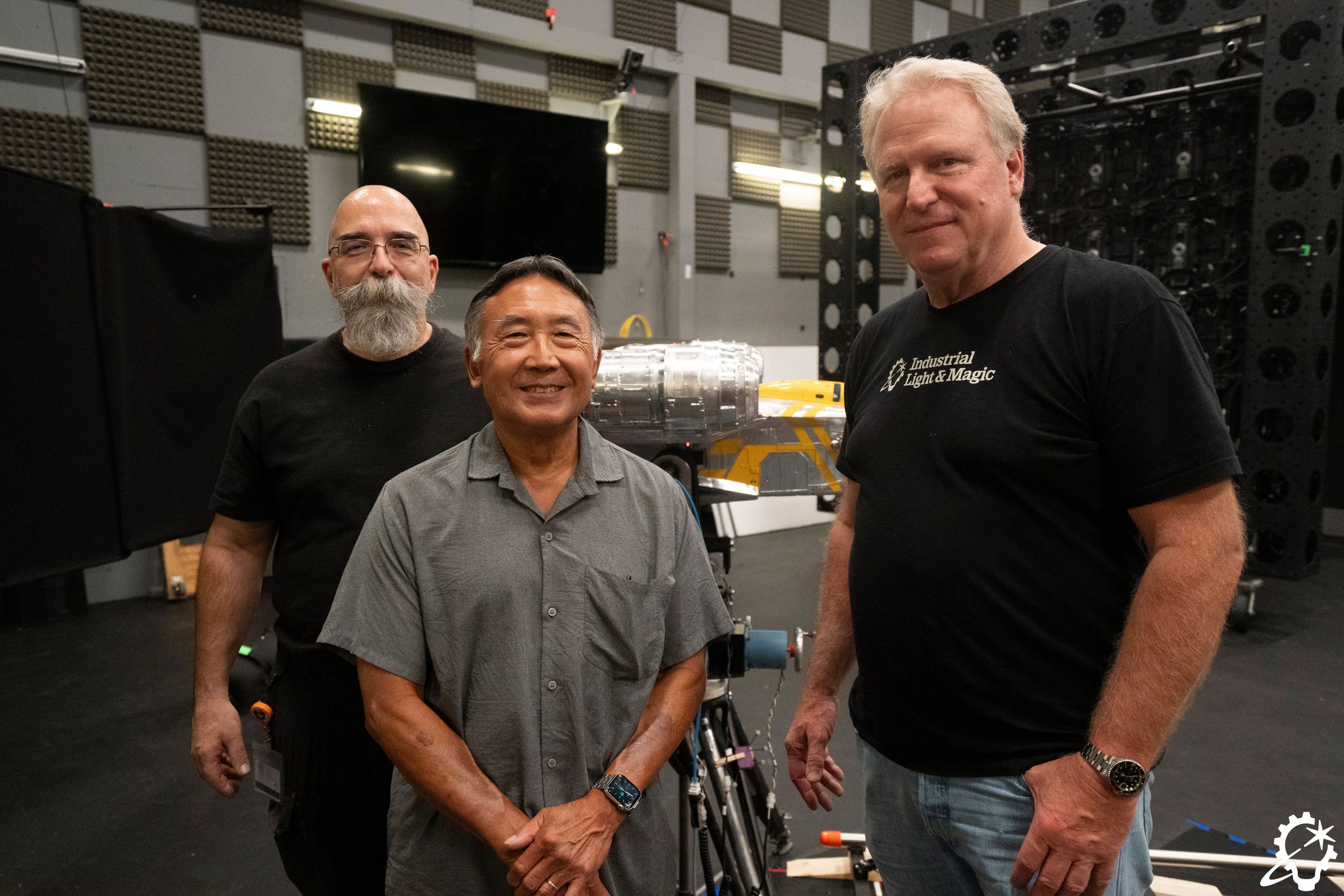
When the decision was made to do a new Razor Crest for The Mandalorian and Grogu, the 4-footer was born. Goodson and Patrascu once again teamed up to work on the model, with special guest star and ILM Model Shop veteran Larry Tan at the bench for a few weeks. Tan came out of retirement to work on this project, and had not worked on a feature film model for 25 years. He also happens to be the ILMer who hired Goodson in 1988!
(As a lovely aside, Goodson requested that Tan receive a credit in the film, and during the crew screening, with Goodson seated nearby, Tan let out a delighted and surprised exclamation when he saw his name scroll by. This truly speaks to the positivity and friendships forged at ILM.)
Work began on the new Razor Crest with six-way renders of the digital asset, which are literally the top, bottom, left, right, front, and back views. This time around, Goodson completely scratch-built the model, with the exception of a few detailed elements and the engines once again. One of these detail pieces is referred to as the “heat sink” and is located on the top, which shows up on other recently built models as well. This is a plug-in unit that allows access to the internal hookups.
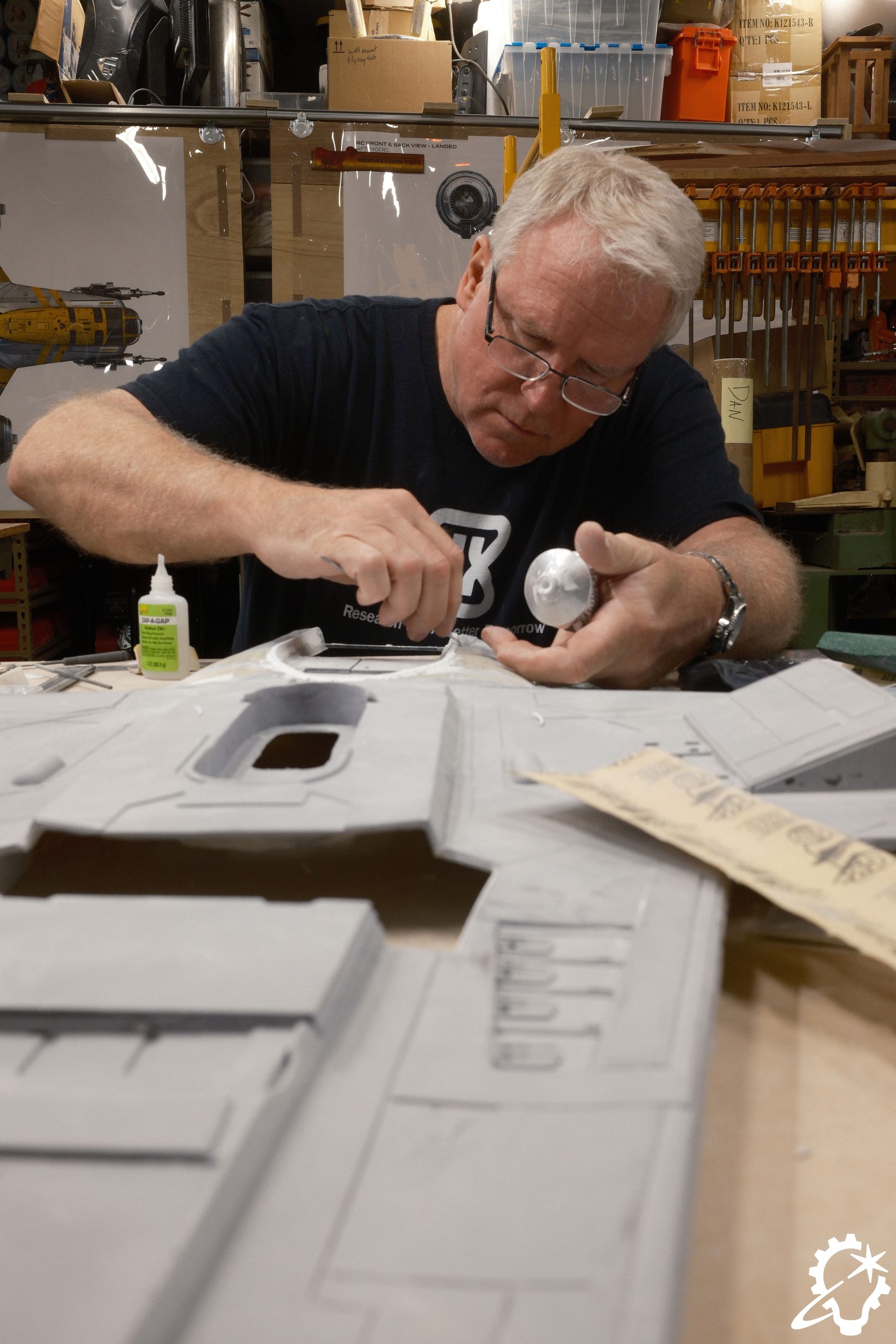
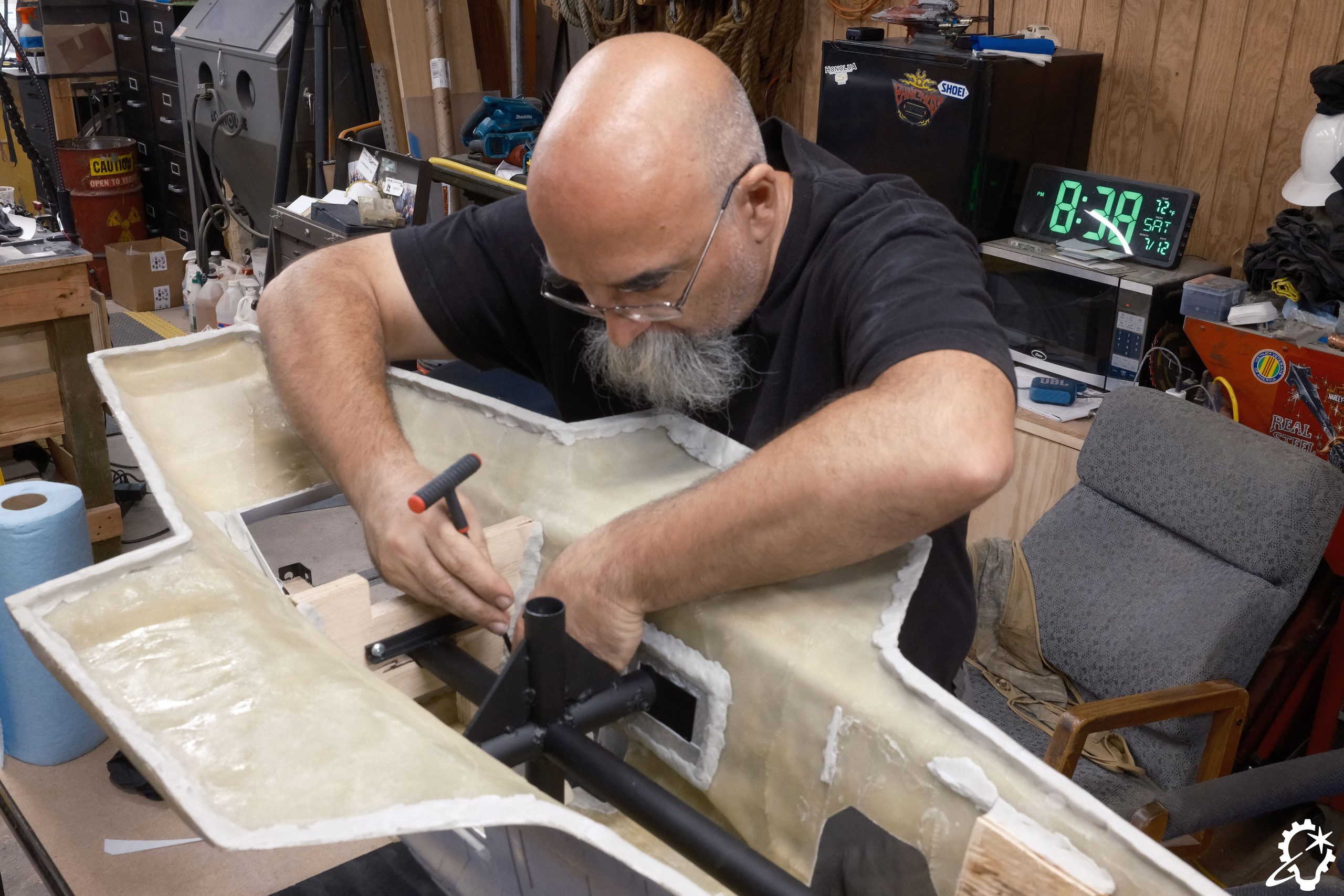
Then, using a Form 4, with greatly improved speed and improved resin, Dan printed any parts needed. To demonstrate to Goodson how these resins have improved, Patrascu took an engine print and tossed it to the shop floor. It bounced and did not break, impressing Goodson. The amusing thing about this moment in hindsight is that the part did not break by pure luck; although shore hardness and tensile strength have changed, these are still 3D prints and not indestructible!
Patrascu then took the digital asset, built in Maya in this case, and completely rebuilt it to be “watertight” in SolidWorks. This meant it could then be 3D-printed, and the process took around 200 hours. The Razor Crest is all in Imperial measurements and is 74.5 feet long.
This new model was up-detailed for close-up work on the big screen, so more granular detail was called for. It weighed in at 40 pounds, and would be seen in a static configuration, so Patrascu built a very robust yet removable set of landing gear. The rear landing gear was half-inch square stainless steel bent rod skinned with greeblies, and the front landing gear was five-eighths aluminum rod. The landing pads were 3D prints. The ramp is also articulated. Goodson refers to the cockpit as the “jewelry box,” and again is all hand-built from styrene and fiber optics. There is no articulation or servos, which was a welcome departure after the T-6 Ashoka miniature. This model, like all hand-built things, is in no way symmetrical. At one point, Knoll and Patrascu were looking at it from the back end, and they noticed the rear twisted a little to one side. With his patented dry wit, Knoll said, “I’m thinking the airframe was bent in an accident at some point before Mando got it.” As we all know, these idiosyncrasies give these miniatures their soul.
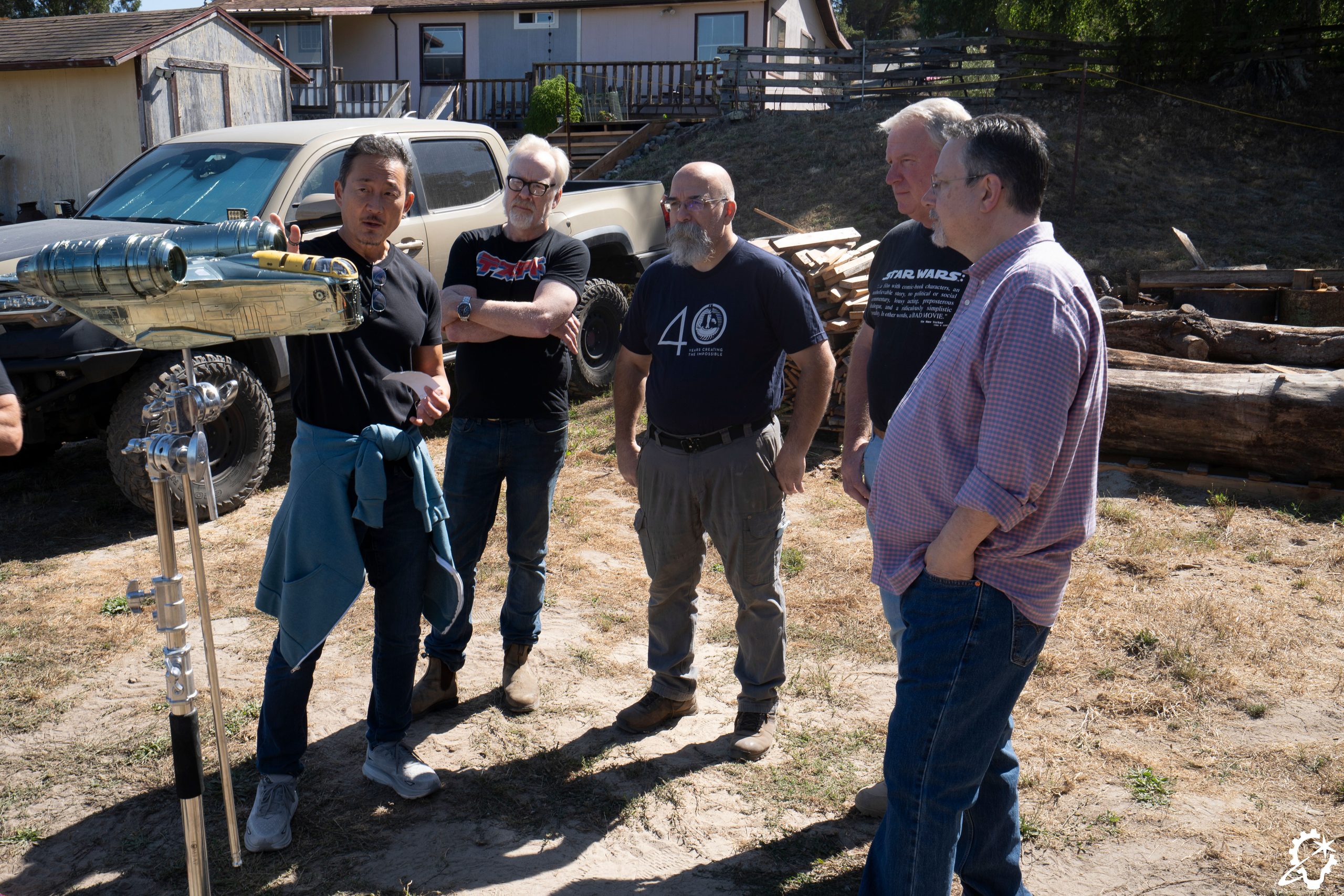
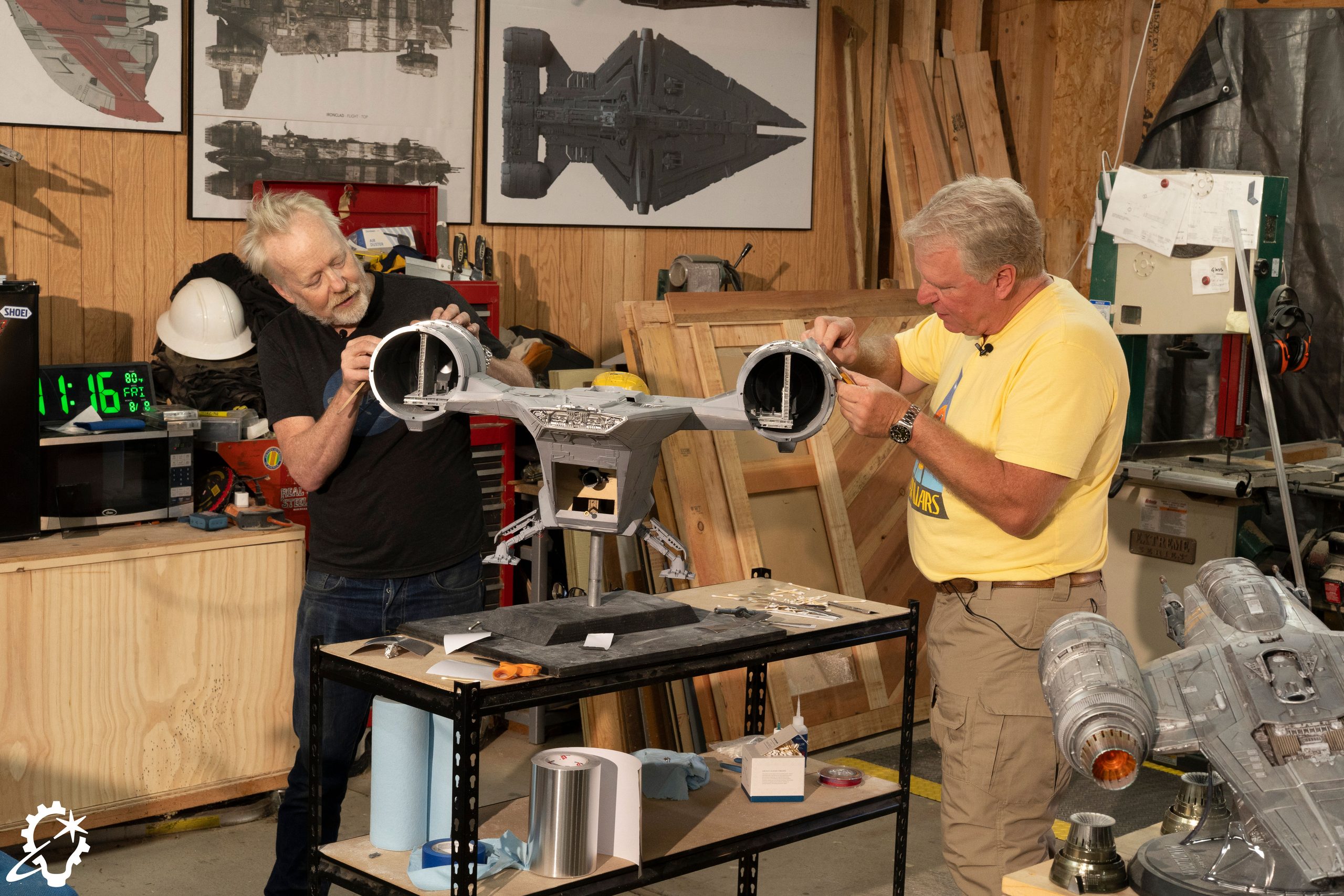
The engines have NeoPixel rings inside with programming provided by Knoll, which utilize the same sequences as the 2-footer for consistency, and power and data are sent to everything internally via a single Ethernet cable, which is a standard used by the team. Knoll says it is a perfect delivery system for these purposes. Mounts are very simple, with a rod inserted into a hole in the armature with two set screws that capture it when locked down. Speed and ease of mounting and removal are necessary in a filming environment.
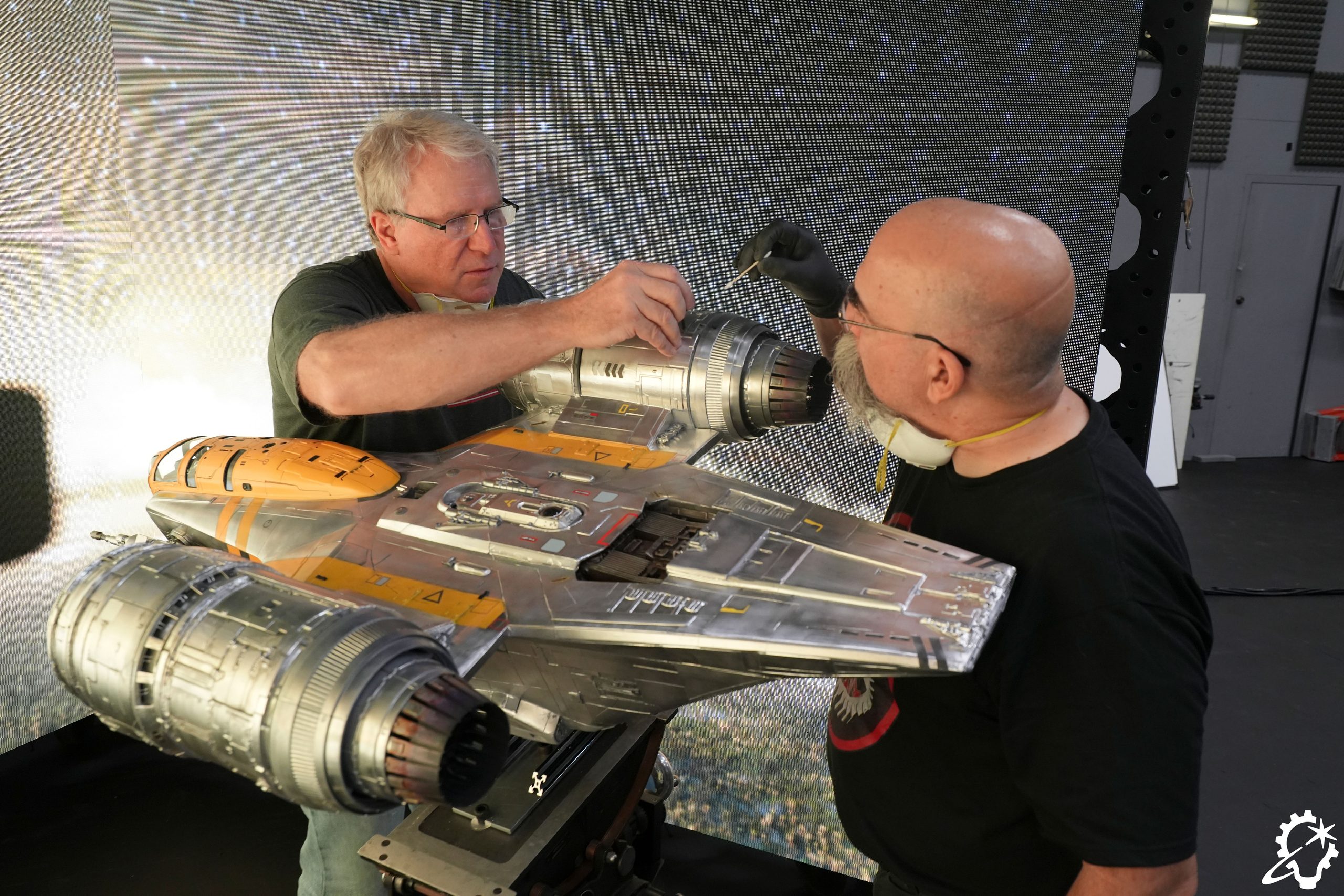
There were paint experiments involving a Tamiya gloss black as an undercoat, a chrome paint coat that looked amazing, but would turn dark and greenish when hit with a 2K top coat. It was evaluated outside, and all agreed it was just too green. Since the model needs a durable finish to survive the rigors of the stage, the metal tape was once again utilized. The yellow paint used for the ship’s markings was quite literally left over from Anakin Skywalker’s podracer, which Goodson had saved. This time, decals were done in Aurebesh, which, if translated, make sense in English. The canopy “glass” was vacuum-formed plastic and designed to easily pop out. The frame could be removed and the “glass” removed from the rear. The lifeboat on top is a separate element that Patrascu made, and it incorporates a Christmas decoration dome shape purchased online. These are great to use as there are no parting lines, ejector pins, or styrene injection marks. All parts that are removable are held in place with magnets.
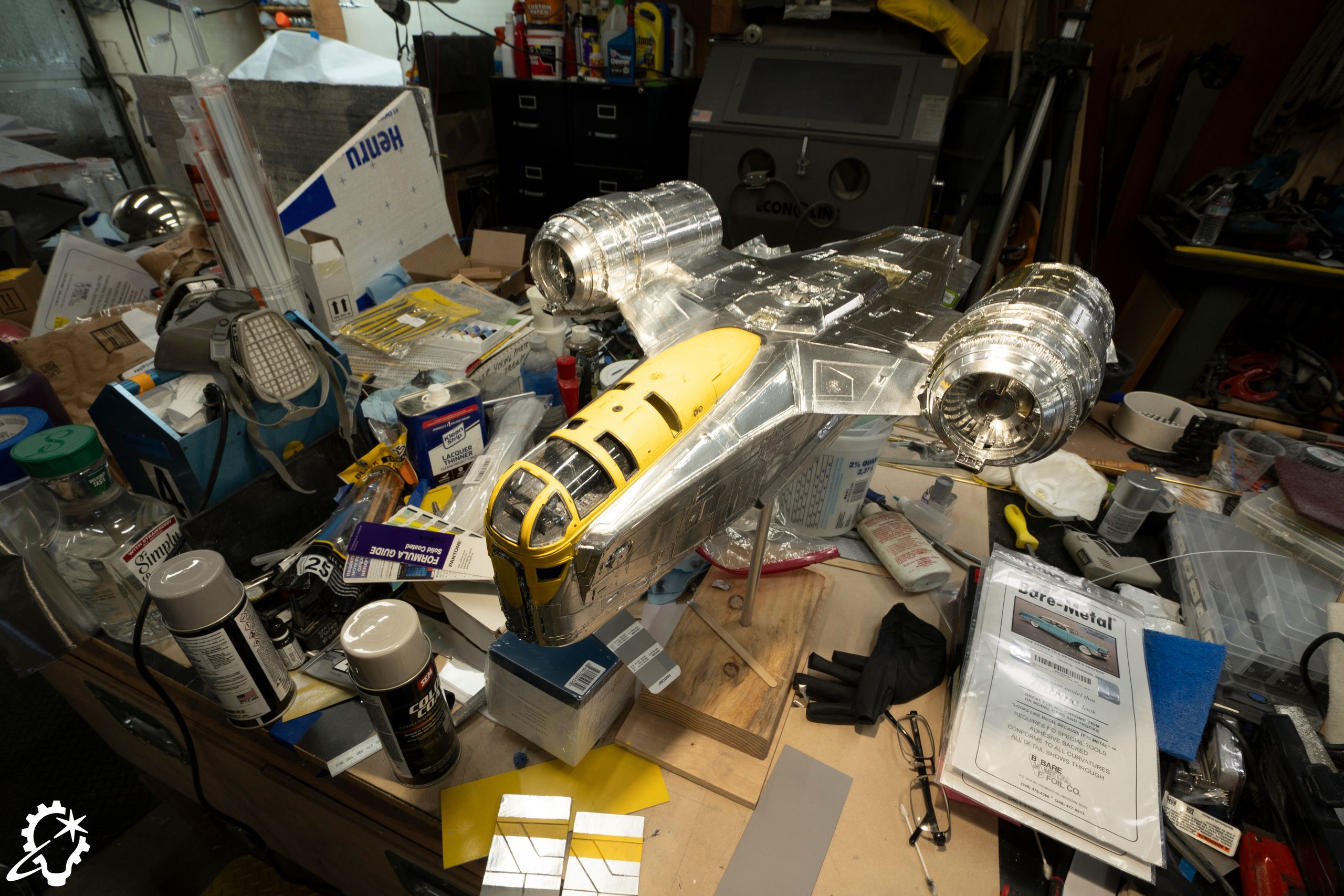
The model was photographed along with some spheres on the sky deck, which is a balcony on the rooftop of ILM’s San Francisco building. The digital team utilized this large amount of reference to quite literally wrap the digital asset with the filming miniature’s photographs, and Rispoli notes this was somewhat of a luxury in a fast-paced production, but can make all the difference on screen. If you can get to 1/100th of a value in color or tone, every scene the model is dropped into reads convincingly and consistently.
Rispoli also recreated shots, watching the moves the model performed. For the cockpit, there was also great care taken to match the digital model and the miniature as much as possible, as some shots would have both versions utilized. In some cases, digital augmented the miniature. Even the cargo hold was remodeled by Machado to match the original set piece, as the pistons on the ramp were also redone to match. Artist Tim Odell took over on paint while Ben Neall, a paint supervisor, painted in the yellow markings. Rispoli explains that all of this inched the digital model closer to the appearance of the practical miniature. From the beginning, the intent was to get that original trilogy look and feel, including performing movements that echoed the limitations of the physical filming equipment’s boom arms and track lengths. Clearly, an extraordinarily collaborative and thoughtful approach by all teams made these shots happen.
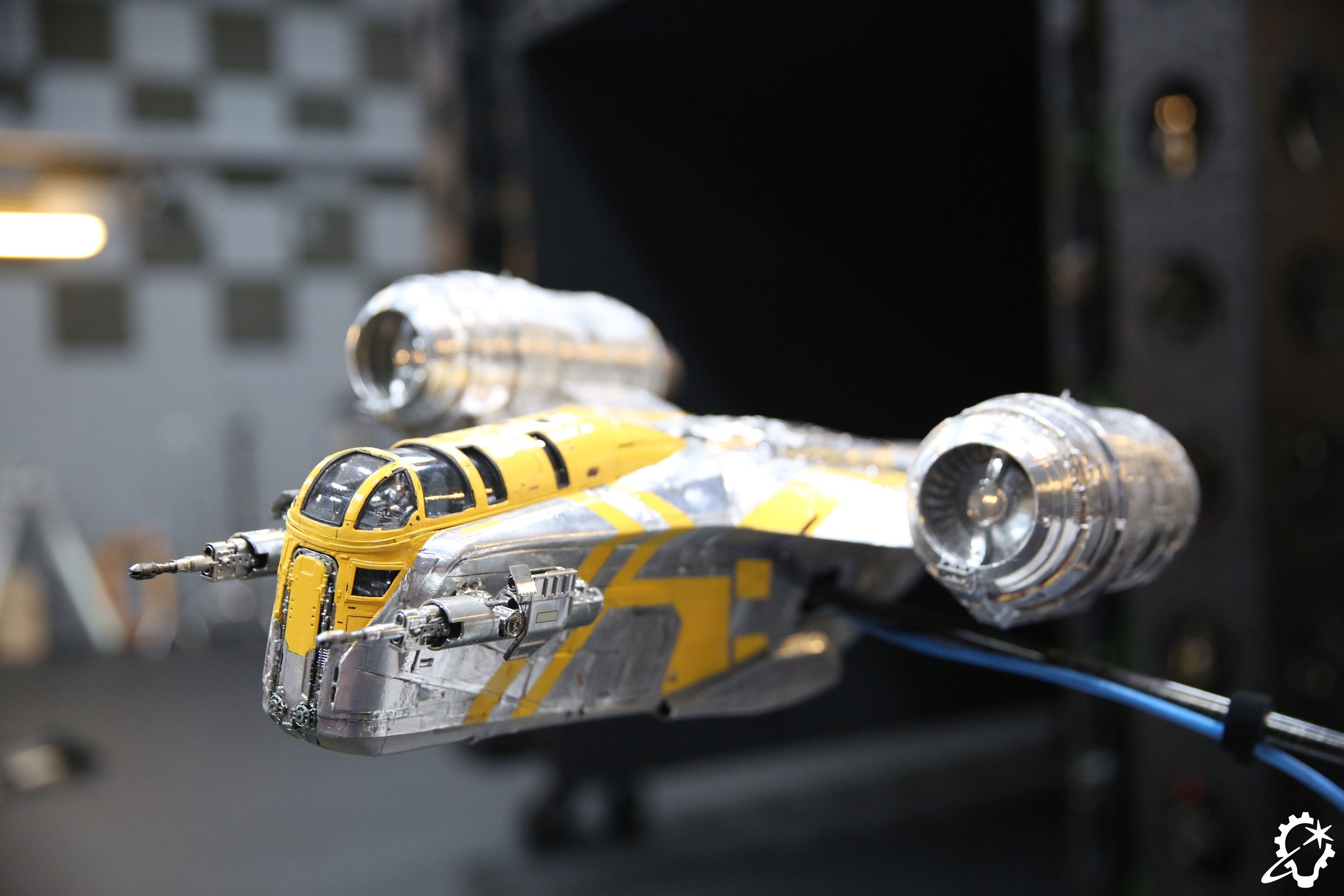
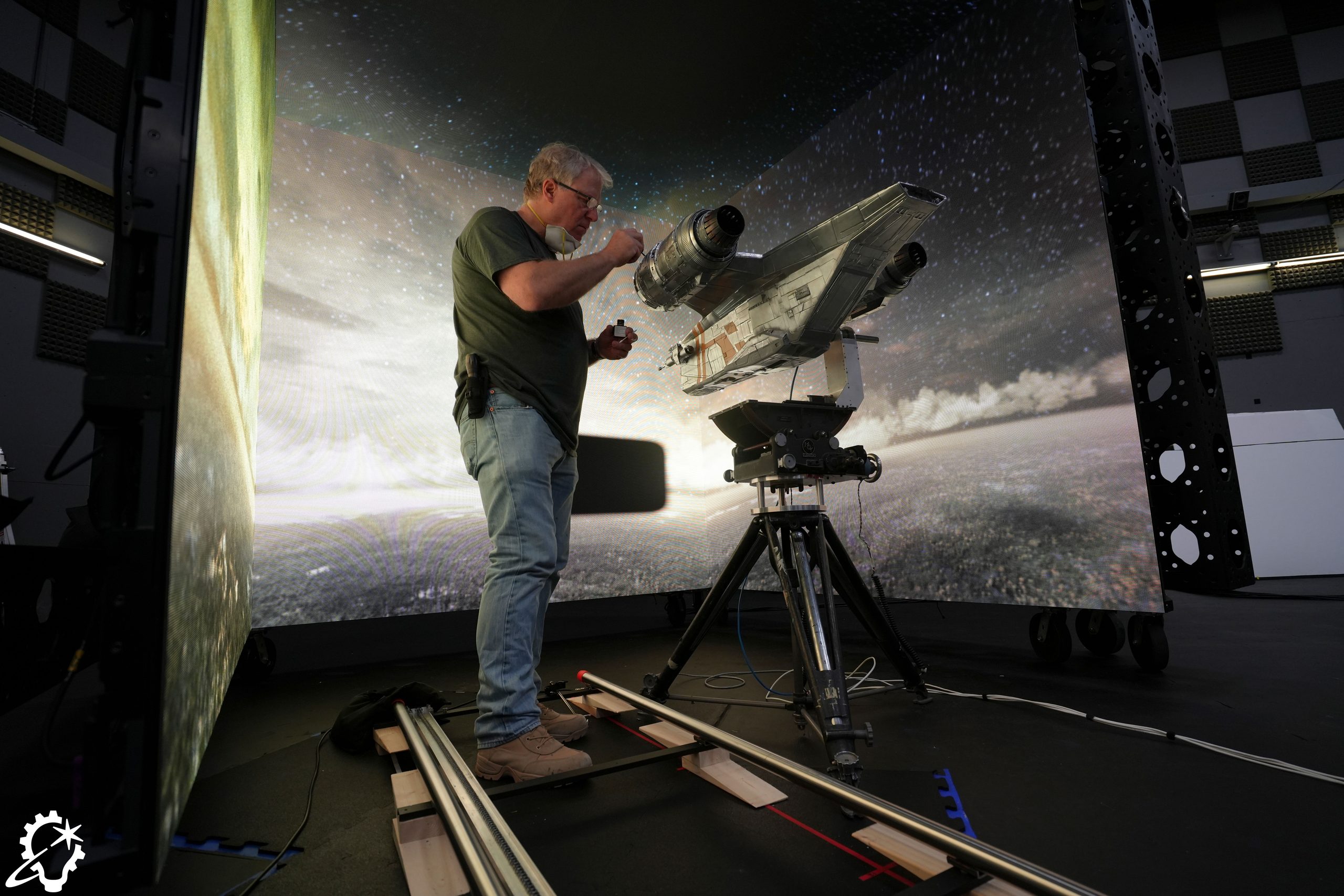
When the model is shot in an StageCraft LED volume, Goodson and Patrascu have to be present for the entirety of the shots, as they are the model “wranglers” and stage support team. Since the model is so reflective, there were unique challenges. Exit sign illumination, cell phone usage, and open doors would all interfere and be visible on the surface of the model. Many times, black foam core was deployed to block the crew and camera from the shot, with a small hole for the lens to peek through. The process was greatly improved and faster than it was in the past, although they still typically shot two to three lighting passes and separate passes for navigation lights, cockpit lights, engine lights, and a blue screen pass.
Generally, each shot has up to eight separate passes. The model can be shot, and Knoll can do a quick composite to verify the shot is good, and then they can move on to the next shot. This means two to three shots can be generated in a day. In the past, a large model such as the Razor Crest could have involved up to 30 people, and now they can get things done with two, which, when asked, still feels strange to them. There were also shots captured outdoors in direct sunlight at Skywalker Ranch for the sky reflections on the model, and in one shot a person was seen in the reflection who was probably 40 feet away. Knoll just had it painted out.
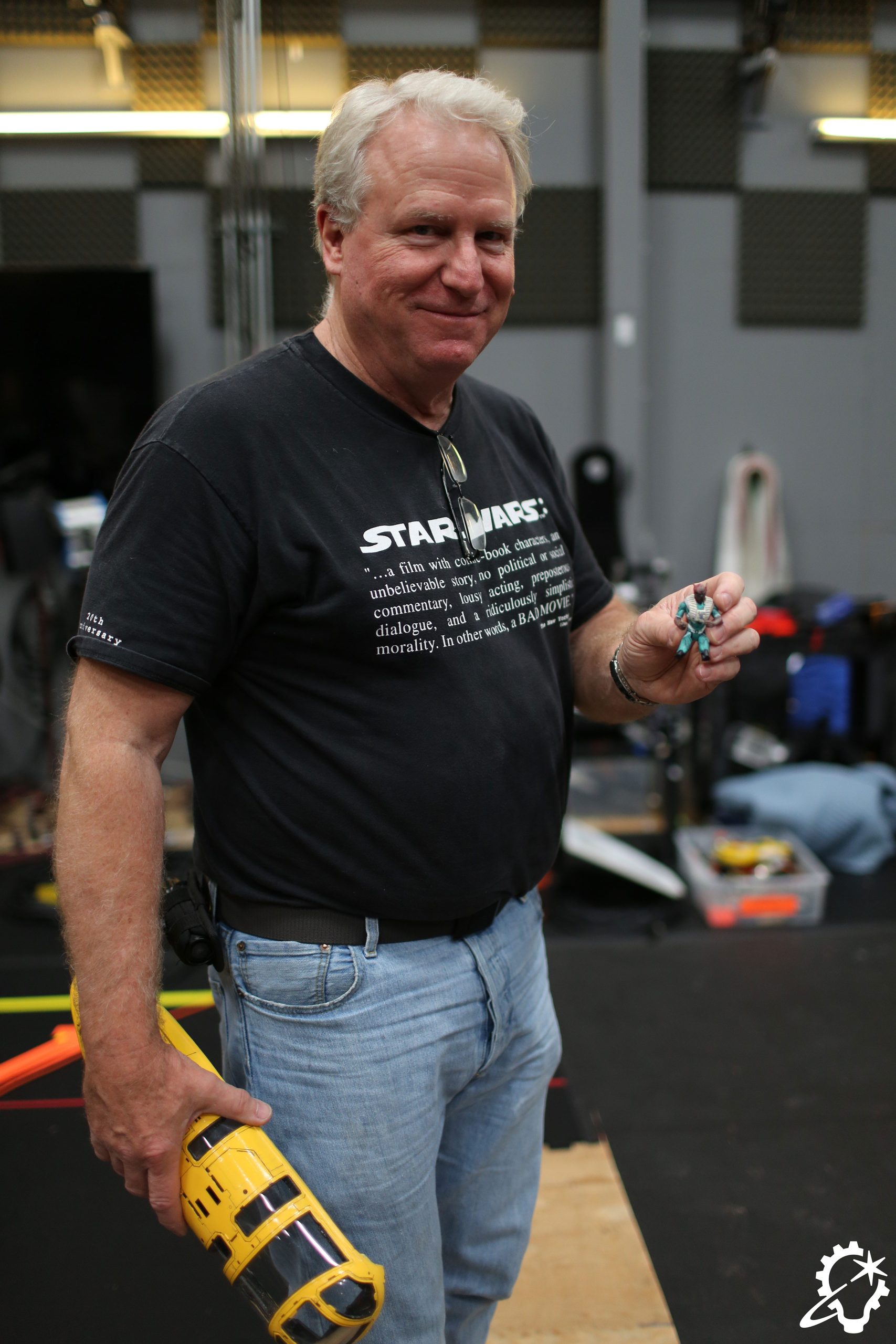
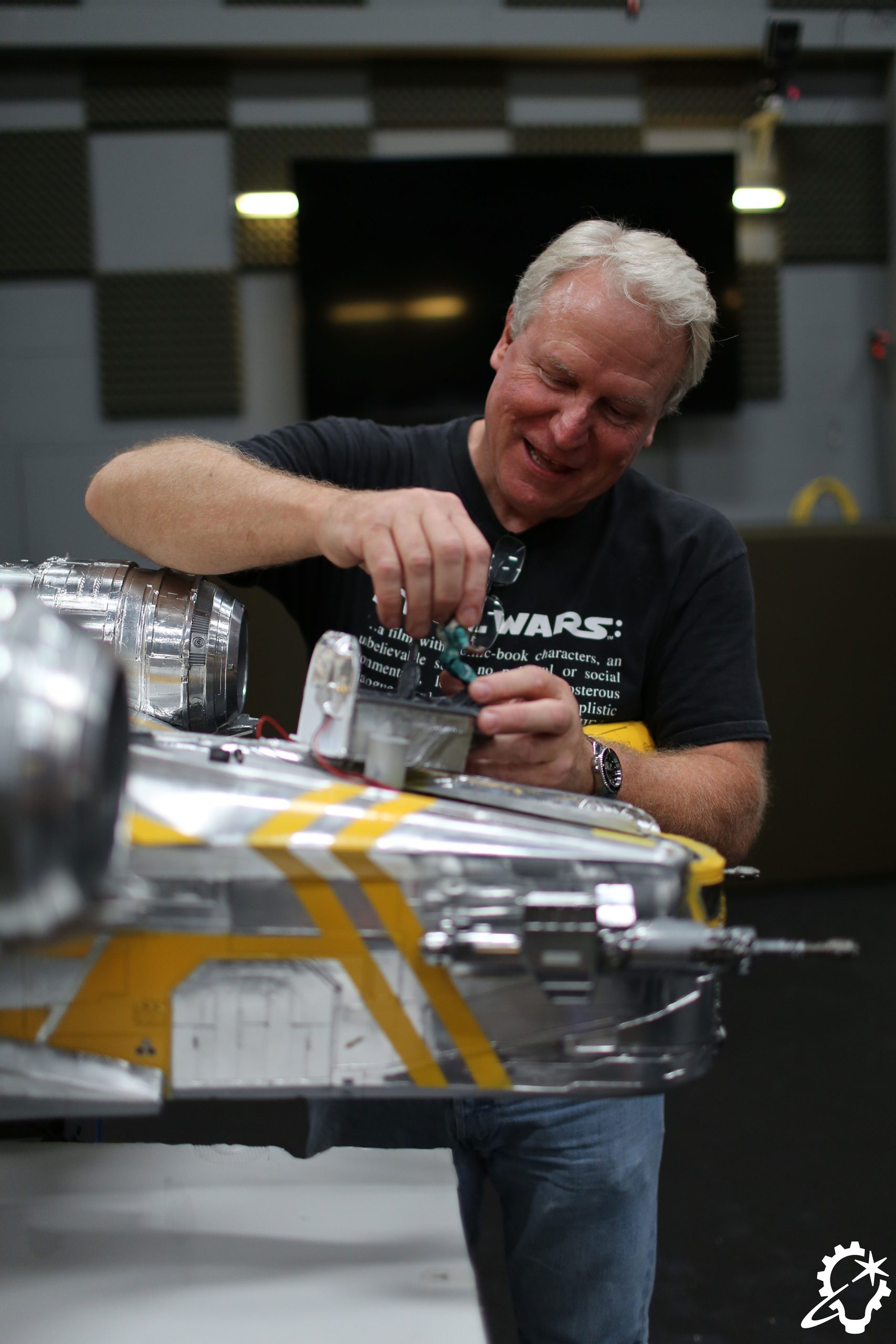
Enter virtual production manager Lindsay Pflum, manager of the “Arsenal,” which is the equipment vault on the motion capture stage. She is in charge of the ILM camera equipment, the various lights, C-stands, etc., and offered grip and gaffer support to production on that first shoot. Pflum was first involved with a request from Knoll for a 5D Mark III camera and remained involved in the production ever since. A key hardware manager for ILM StageCraft, Pflum set up all lights and configurations under Knoll supervision as director of photography for the miniature shoots.
For the feature film, Knoll wanted the LED screens to allow for daytime and foggy environments to really rake across the Razor Crest’s reflective surface, and a custom-made volume was designed and constructed as a square with four LED walls and two open sides to allow access. Dan Patrascu notes that the sides of the box were 8-foot-by-8-foot screens (with one on top). If bottom lighting was needed, there were approximately 2-foot-by-5-foot “wild” screens that could be placed below. The motion capture rig was rebuilt again, perhaps this being the fourth iteration, and Pflum is happy to report that standard dolly track was now used. In the older iterations, an 80-20 track was employed (and not labeled when disassembled!) that had bumps that needed to be physically sanded down to ensure smooth camera travel when filming. Now, the travel is incredibly smooth, and the boom arm allows for more dynamic movement.
The physical limitations echo the original trilogy miniature shots, which those involved agree is a good thing. Everyone on this project worked seamlessly together, and perhaps this is a perfect illustration of how old and new craft come together to bring movie magic to the viewer. The enthusiasm and creativity expressed by those involved is palpable, and it shows in the care and attention to the miniature builds, the camera and stage equipment, and even the astonishing involvement of a certain Y-wing that turned 50 years old this past December. But that is a story for next time.
—
Read more about The Mandalorian and Grogu here on ILM.com:
Something Old, Something New: John Knoll on the Visual Effects of ‘Star Wars: The Mandalorian and Grogu’
“Every shot was a puzzle to decipher”: How ILM Created the Dragonsnake in ‘The Mandalorian and Grogu’
Holograms No More: Bringing the Dejarik Creatures to Life in ‘The Mandalorian and Grogu’
Jason Eaton is an artist who practices fine art and model building. He has a near-30 year career in the collectible prop and toy industry, as well as in the study of ILM miniature minutiae. His goal is to help preserve the information on the materials and processes used in the creation of the filming miniatures we all know and love. He lives in Baltimore, Maryland with his lovely wife and three perfect cats.