
The production visual effects supervisor and ILM executive creative director discusses balancing the handcrafted legacy of the streaming series with the demands of an IMAX theatrical release.
By Jamie Benning
When Star Wars: The Mandalorian and Grogu (2026) was confirmed as a theatrical feature, it presented Industrial Light & Magic executive creative director John Knoll with a challenge that was as much philosophical as it was technical. After years of building one of the most distinctive visual languages in modern television, rooted in puppetry, practical miniatures integrated with computer graphics, and a deliberate handcrafted quality, how do you scale that up for IMAX without losing what makes it special?
“There are sort of two opposing forces here,” Knoll tells ILM.com. “One is that for all the people who have watched and loved the show over the years, you don’t want to do something that’s jarringly different than what they’ve seen before. So it should feel familiar.” At the same time, he was acutely aware that the move to cinema demanded something more. “Everybody’s also aware, hey, we’re making a transition to theatrical, and we want to make the case that you should come out and see this in a theater.”
Those two forces, fidelity to the show’s DNA and the ambition of the big screen, shaped every creative and technical decision that followed.
With approximately 45% of the film shot natively for IMAX, one of the earliest practical challenges was simply learning to think differently about the frame. Television and cinema require fundamentally different approaches to composition, editing rhythm, and the use of space – things that are easy to talk about in theory but harder to verify on a busy set.
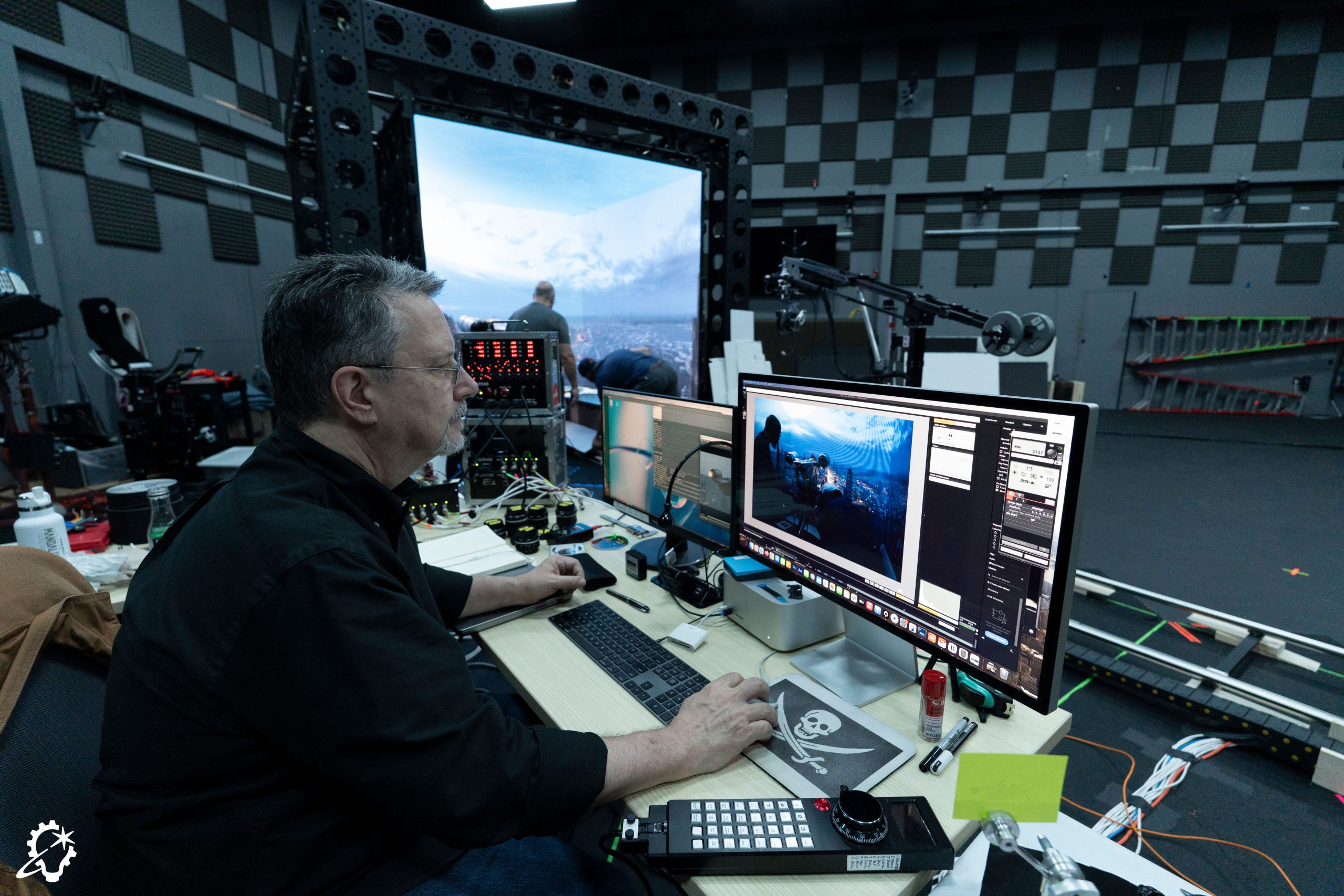
The team’s solution was characteristically inventive. Rather than relying on existing IMAX composition guidelines (documents, Knoll notes, that amount to lists of rules), the team built a bespoke simulation tool. “We built an Apple Vision Pro app that allowed us to take streamed footage from the video taps and to look at it as though it were projected at an IMAX theater,” he says. “You look around, you see the theater seats, and you have this hundred-foot screen in front of you. It is a really good simulation of being in a theater.”
The app drew live from the camera feeds, meaning the crew could put on a headset on set and evaluate compositions in real time, checking headroom, peripheral space, and editing pace against the conditions of a real auditorium. It’s a modern descendant of the kinds of workarounds filmmakers have always improvised to bridge the gap between the monitor and the screen.
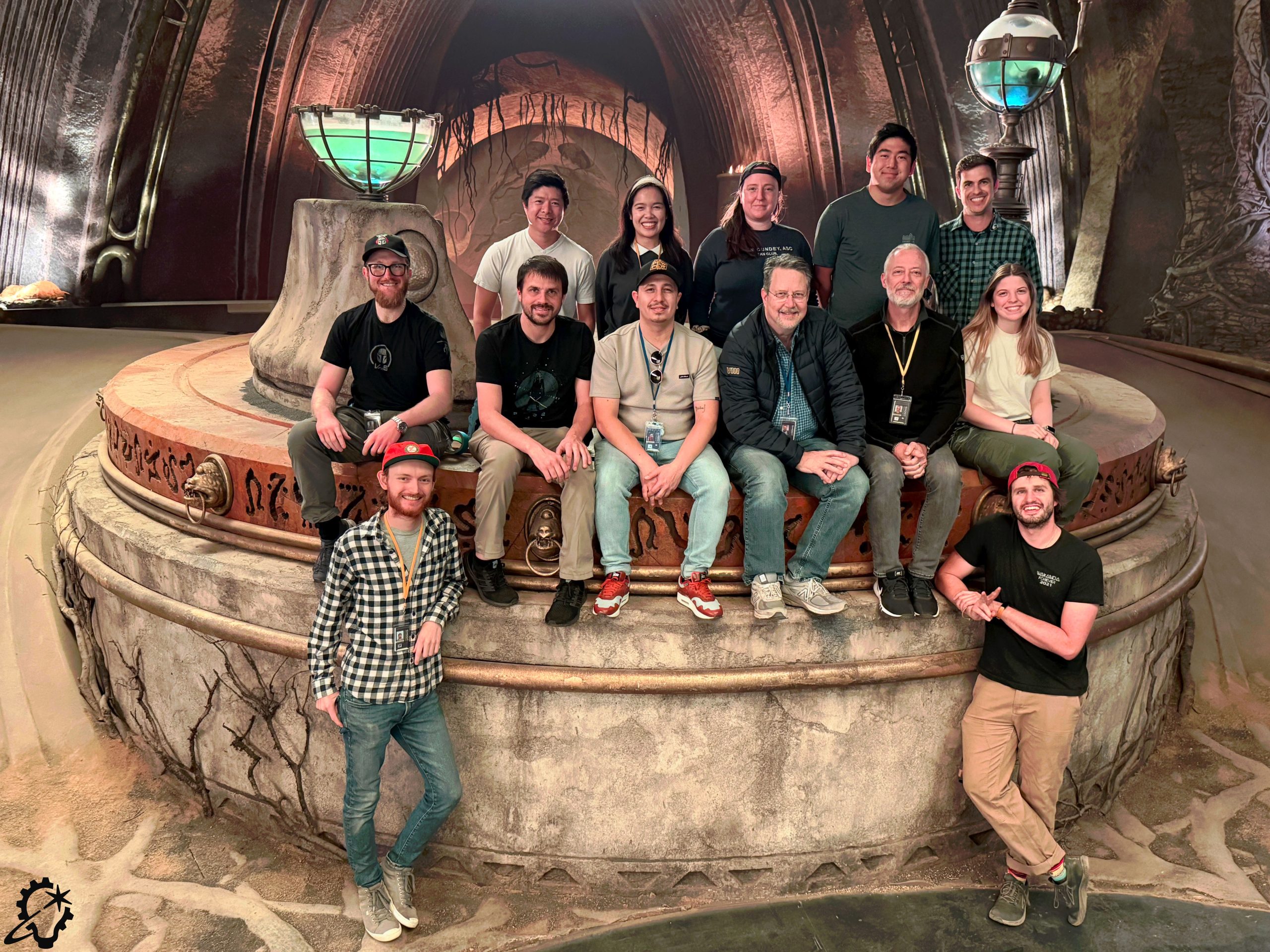
If one philosophy unifies the effects work on The Mandalorian and Grogu, it’s that no technique is inherently better than any other, only more or less appropriate for the job at hand. “We’re pretty comfortable with any technique,” Knoll says, “from the oldest of the old all the way to the newest, latest buzzwords in computer graphics.”
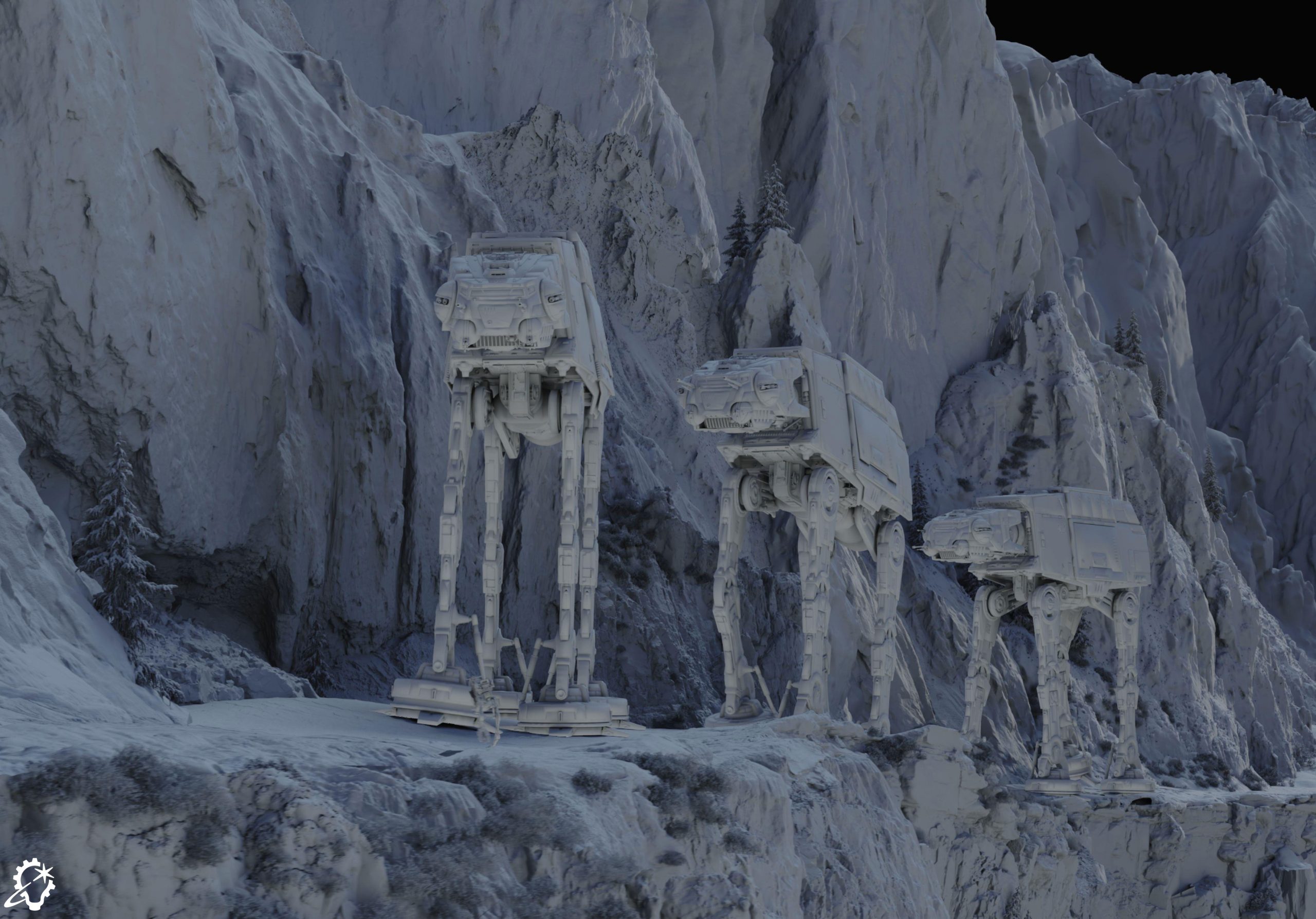
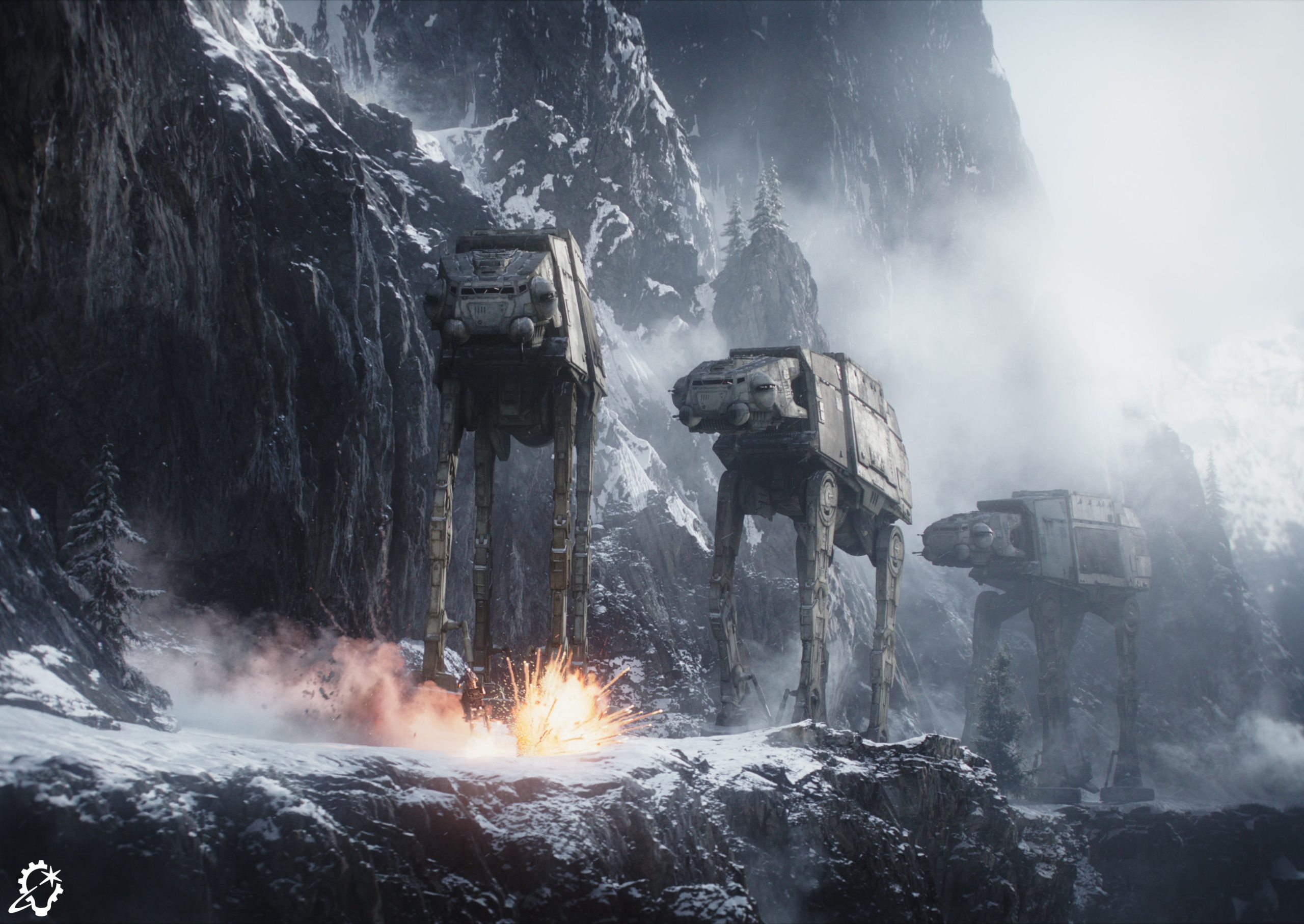
In practice, that means the film draws on a remarkable range of methods developed by ILM and other departments across the production: rubber-mask and animatronic creatures, stop-motion animation, motion-control miniatures, LED volume work, photogrammetry, fully synthetic CG characters, and a technique deployed in recent years at ILM, Gaussian Splatting. What unifies them is not the technology but the intention: Each approach was chosen because it was the right tool, and each was inflected by the visual style established across various Star Wars streaming series.
Knoll is emphatic that this wasn’t nostalgia for its own sake. The Mandalorian series production team built up what he describes as a “legacy style book,” a set of visual and craft values that audiences have come to associate with it, and abandoning that in pursuit of a slicker, more uniformly digital look would have been a betrayal of something real. The handmade quality of the work, the sense that physical things exist in physical space, is part of what gives the world its texture and weight.
The extended production calendar of a feature (something simply not available on a streaming schedule) gave the team time to pursue practical work at a scale they’d never previously attempted.
The most labor-intensive example is the film’s stop-motion sequence, produced by Tippett Studio. Where the streaming series employed their unique skills on other stop-motion moments (most recently the giant trash crab in Star Wars: Skeleton Crew (2024-25), this was a sustained, fully realized action set piece: two complex characters engaged in a fight scene that runs close to two minutes, with extensive interaction between the stop-motion droids and live-action performers. “That took the crew at Tippett, I think, ten months to animate,” Knoll says. “The better part of a year to do that work.” It’s a commitment that would have been impossible on a television schedule, and it shows.
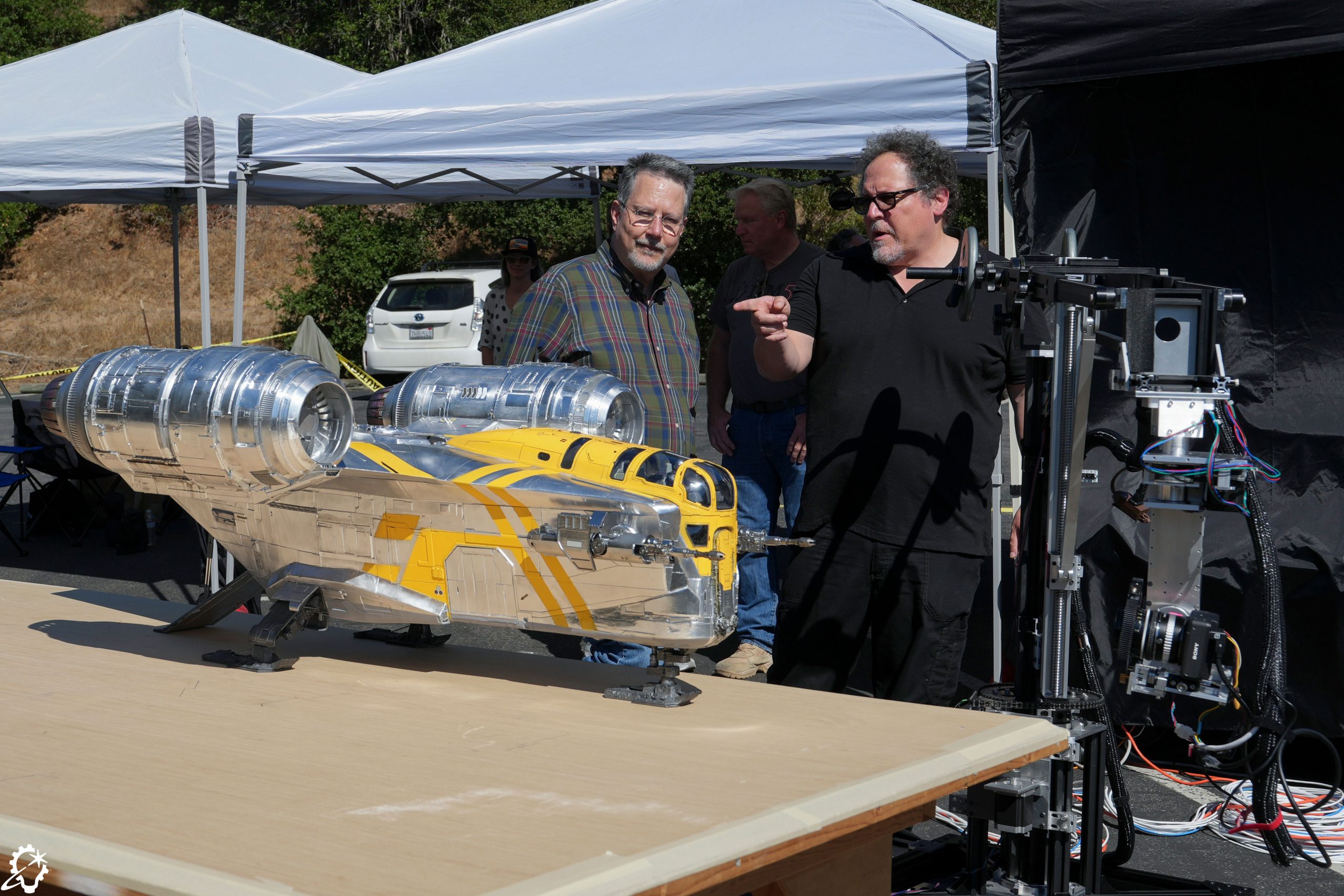
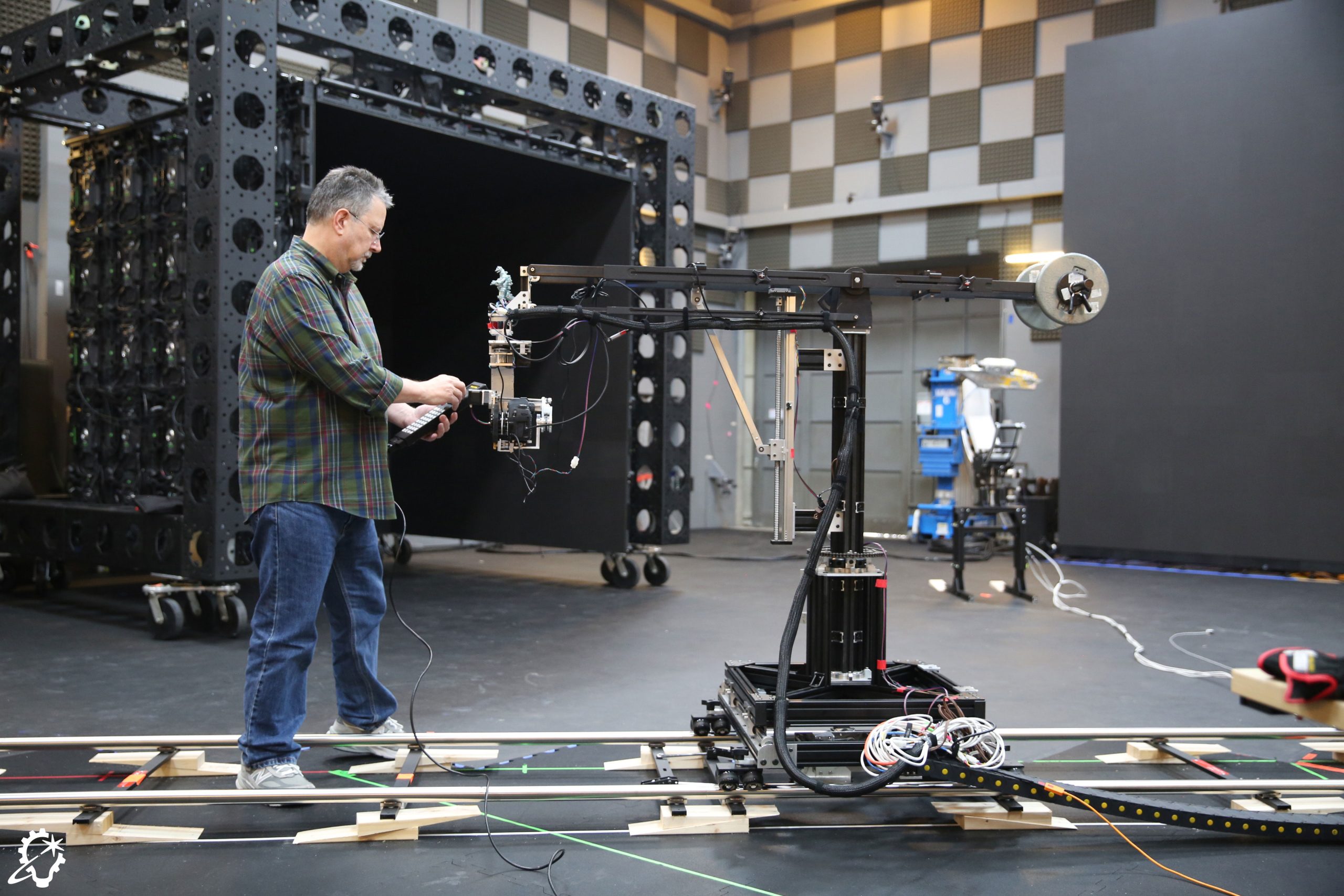
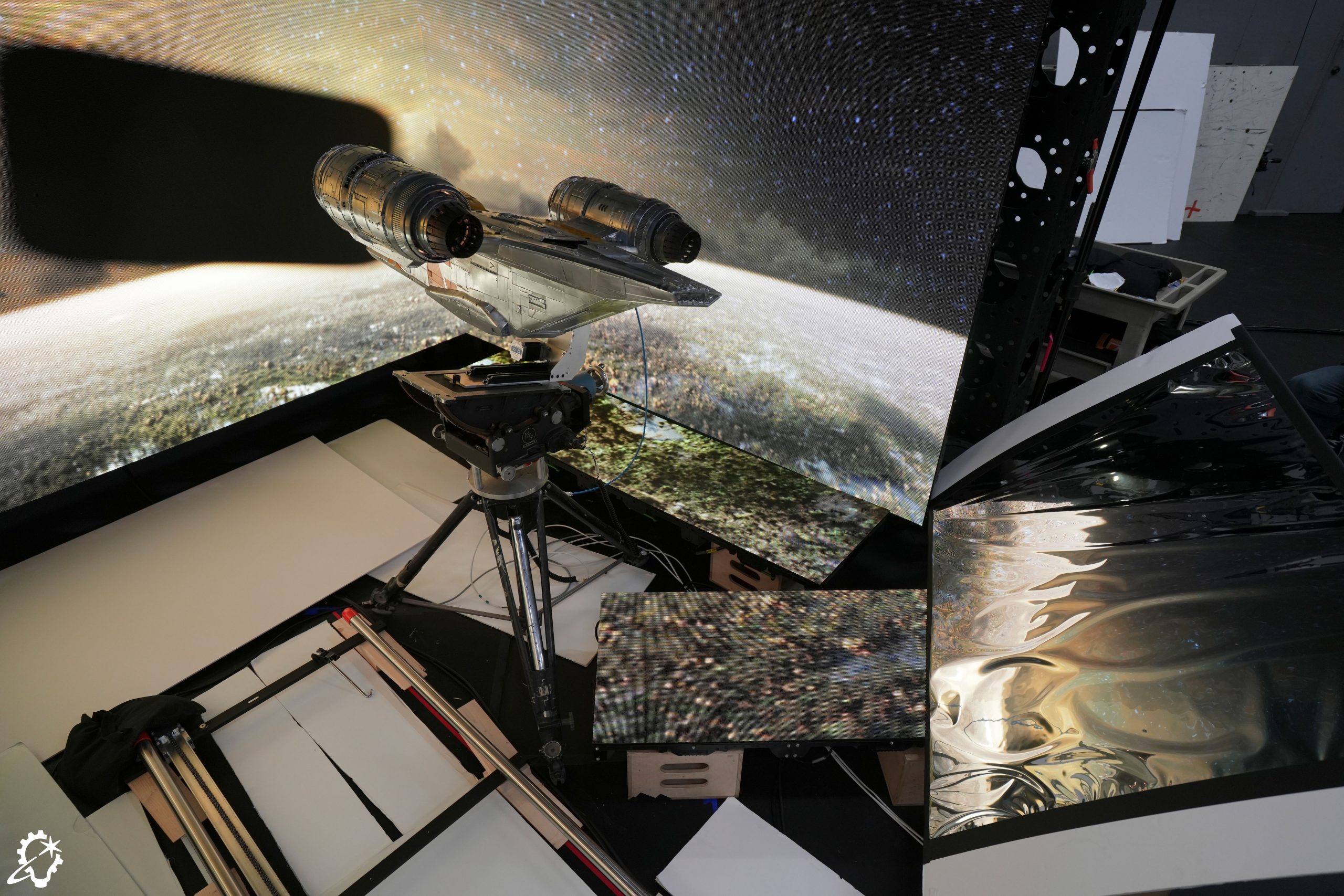
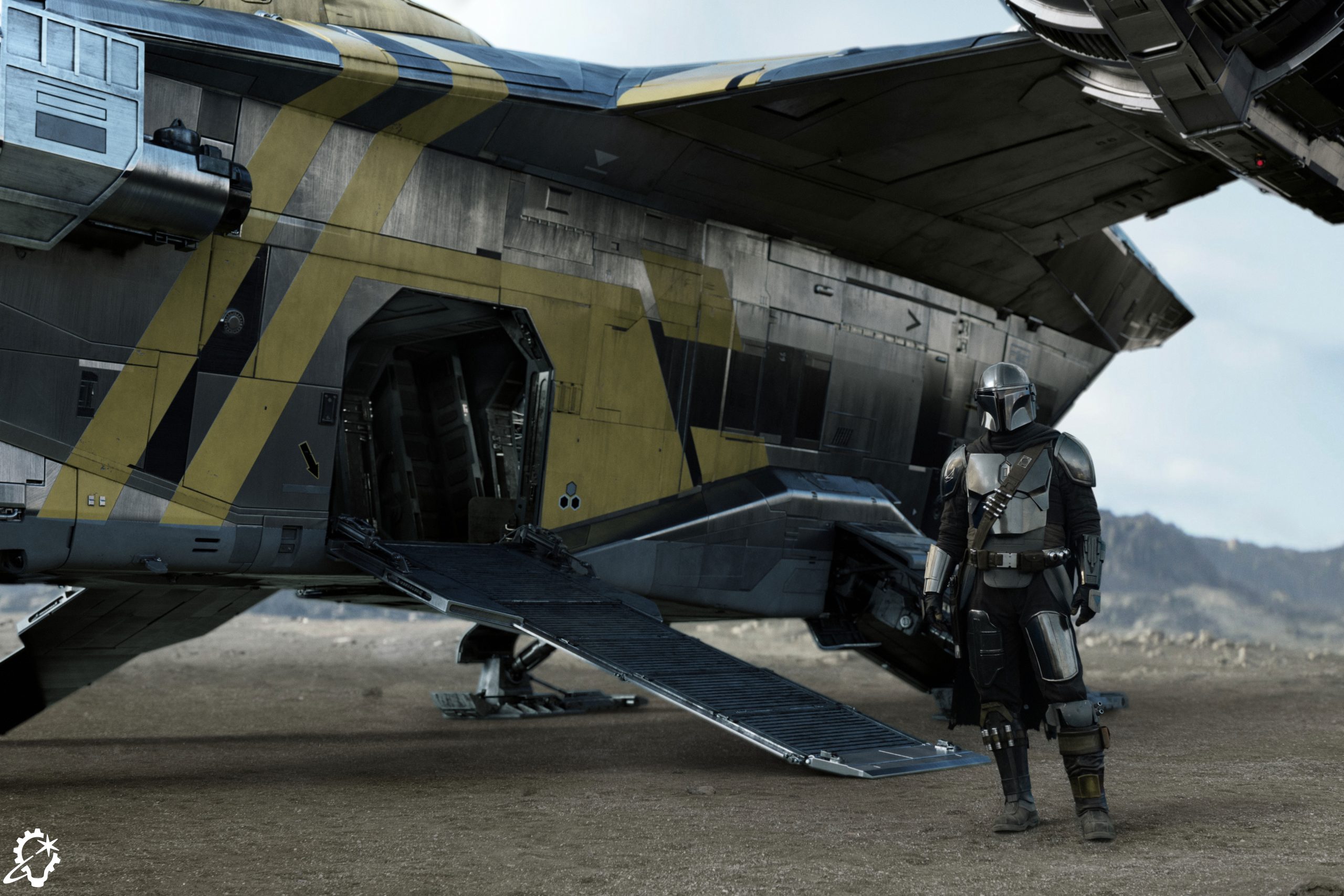
A similar logic drove the decision to finally shoot the miniature Razor Crest, the show’s iconic starship, in an LED volume. Knoll had wanted to do this since season one of The Mandalorian. The challenge with the Razor Crest has always been the same as with Mando’s helmet: Its bare metal finish is defined by its reflections, and conventional stage lighting can’t produce the complexity and accuracy of reflected environments the material demands.
“In space, it’s mostly black around the Razor Crest with bright sunlight,” Knoll explains. “So that’s relatively easy to do with conventional lighting instruments on a stage. But as soon as you’re in atmosphere – flying around clouds or some other more complex environment – all the same issues with Mando’s helmet exist with the Razor Crest.”
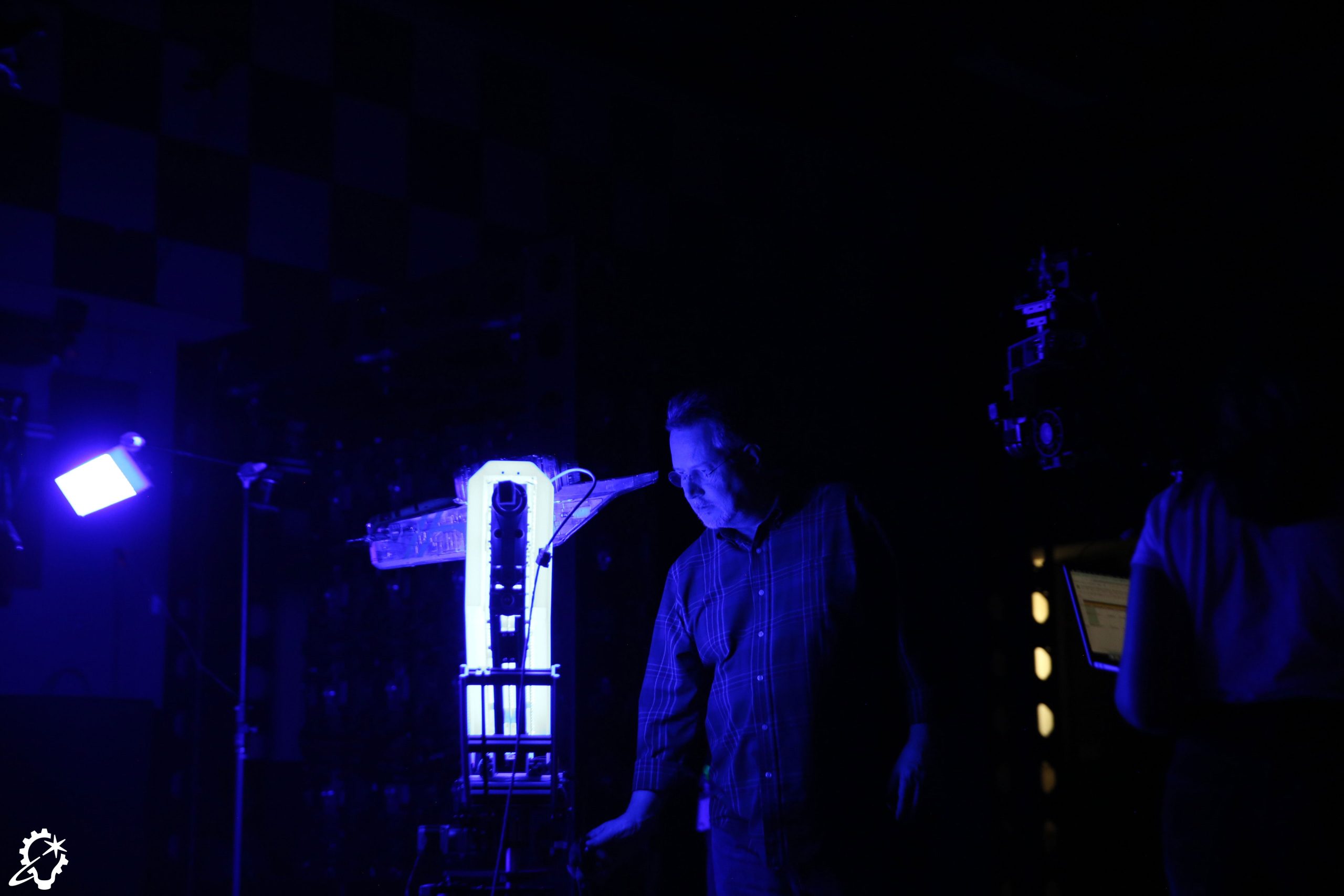
The LED volume, built in part from the same panels ILM uses in its other StageCraft volume installations, such as those used on the episodic series, solved the problem elegantly. A precisely calibrated system allowed the motion-control rig to send sync pulses directly to the volume, advancing the content frame by frame in perfect lockstep with the camera movement. The result was reflections that were accurate, dynamic, and entirely photoreal. An idea that had been in Knoll’s head since 2019 had finally found its moment. For Knoll, there was also something personally satisfying about the work. “I started as a modelmaker, and then I was a motion-control camera operator,” he says. “I spent a lot of my misspent youth doing that kind of thing. So it was fun to get back into it.”
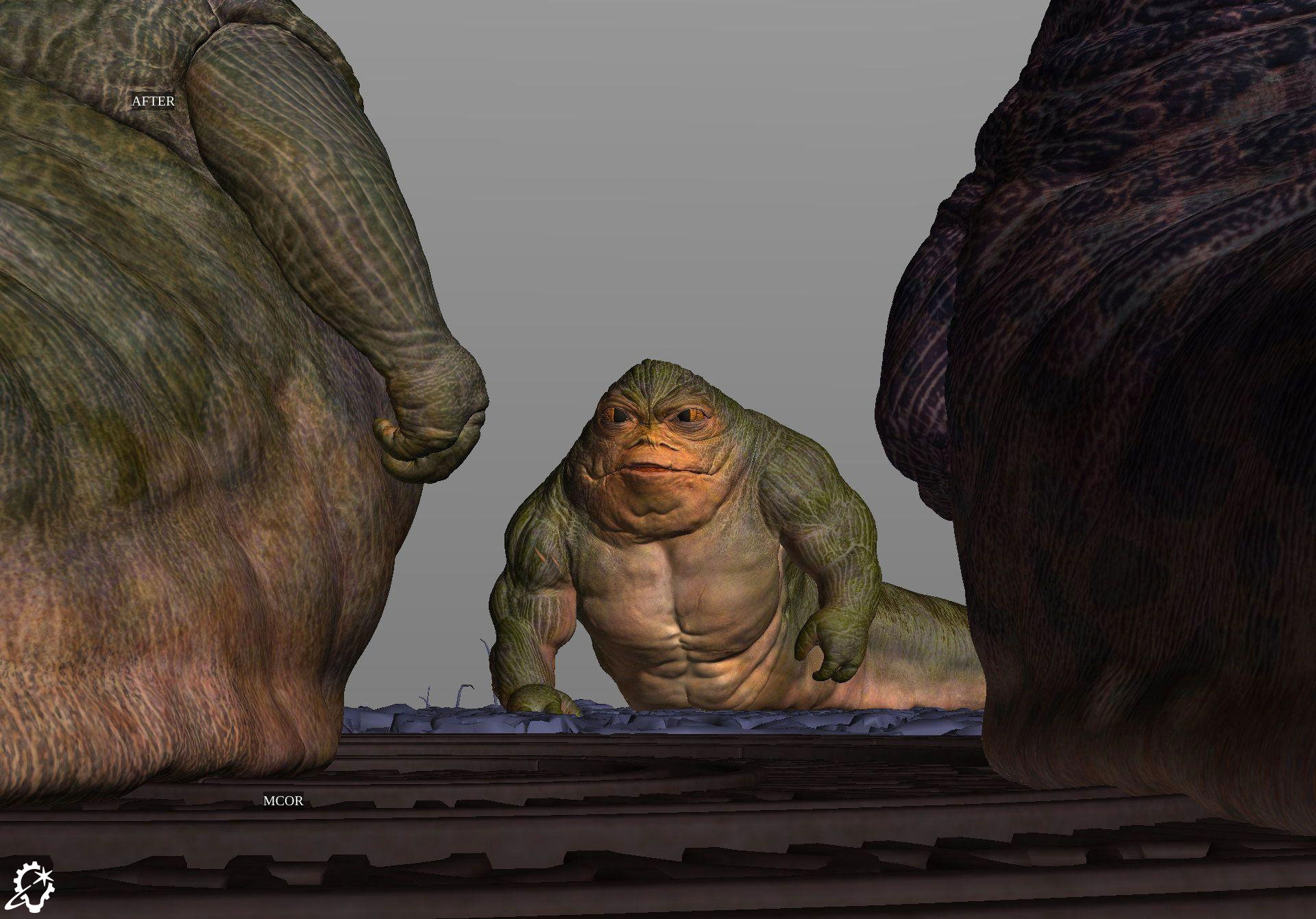
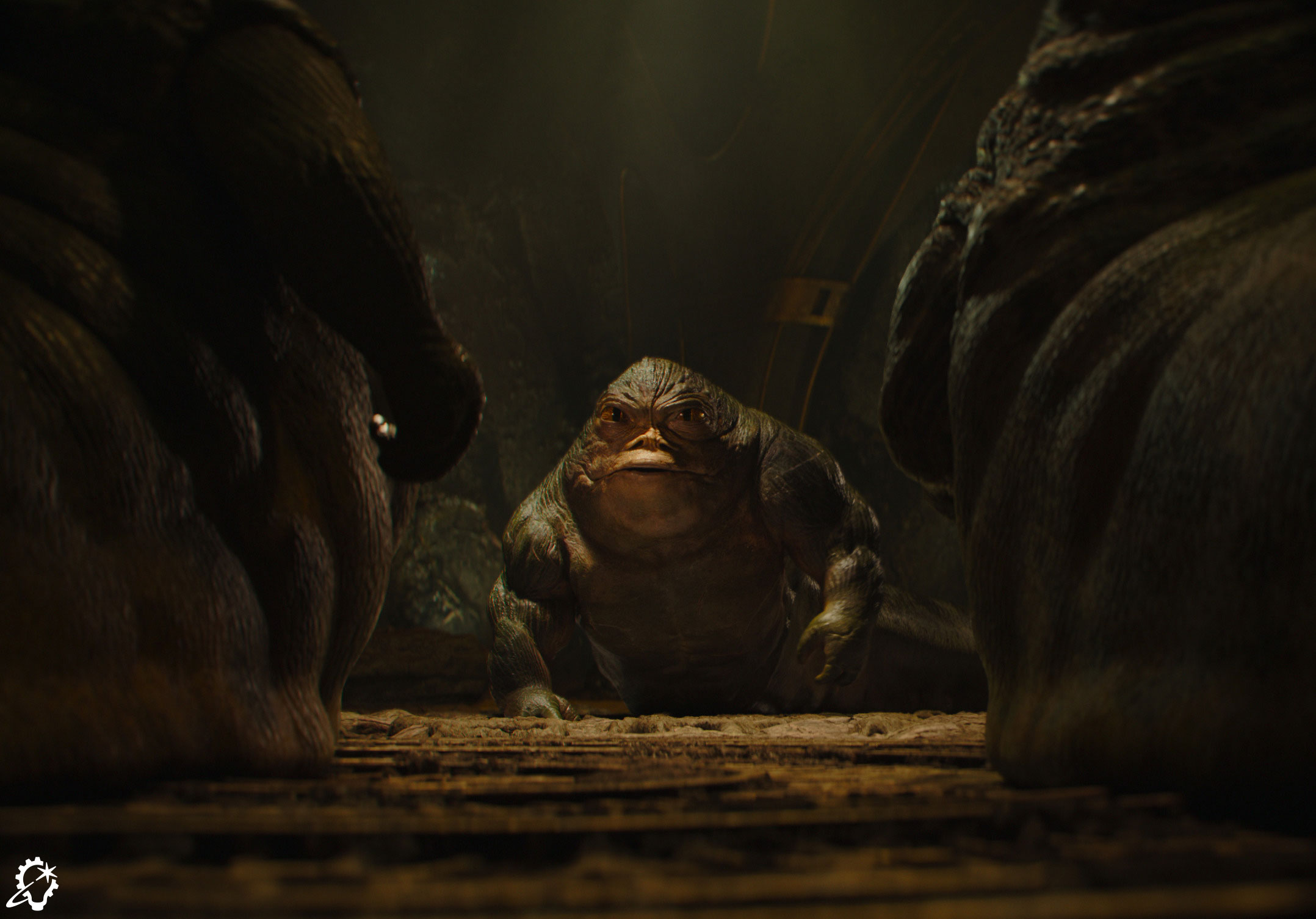
The Mandalorian and Grogu introduces a significant number of fully synthetic characters, among them Embo, the Twins, and most ambitiously, Rotta the Hutt. Together, they represent a substantial proportion of the film’s screen time, and they demanded both a robust animation pipeline and a particular philosophy on set, something Knoll and his animation supervisor, Hal Hickel, feel strongly about: Even when a character will be executed entirely in CG, wherever possible, a real performer should occupy that role on the day.
“It makes life easier for everybody,” Knoll says. “It’s easier for the actors because they’ve got somebody to play their performances against. There’s somebody on set for the director to direct. The camera language is more authentic because of all the little micro-adjustments that the operator makes to improve the composition – you get those when you’ve got somebody in there to react to.” The alternative, he notes, is bifurcating the performance: deciding what happens on set, then figuring out the rest in post. Having someone in the role means it can all happen together at once.
For Embo, that meant casting a skilled martial artist whose fight choreography with Mando could be closely followed in the final CG character. For Rotta, the challenge was different and considerably harder. Knoll is clear that it was “more of a conceptual challenge than a technical one.” The Hutts have never been portrayed as anything but huge, slothenly, slug-like blobs. “You read about Rotta in the script,” Knoll says, “and he’s young and athletic and fit, and he can move fast. He’s a cage fighter, and he speaks English. All of that reads as an amusing thing in the script, but trying to turn that into a compelling image is difficult.”
The key question was movement: How does a creature of that mass move quickly enough to be a credible threat? The team tried everything – snakelike undulation, inchworm locomotion – before finding their answer in nature. “The best reference for us ended up being elephant seals,” Knoll says. “You see elephant seals charging, they do this sort of galumphing thing.” The group then came up with what became Rotta’s signature move: a barrel roll that covers ground with surprising, unsettling speed. “He’s a little over a meter in diameter,” Knoll notes, “so he covers about 3.14 meters in a split second.”
For all the satisfaction of returning to practical techniques, the film also marks ILM’s first production use of Gaussian Splatting, a technology that sits at the opposite end of the spectrum from motion-control models and stop-motion droids.
Gaussian Splatting is, in simplified terms, a form of volumetric capture: Rather than solving for geometry as conventional photogrammetry does, it encodes view-dependent shading information directly into a point cloud, producing renders that handle complex, shifting light with a level of realism that geometry-based methods struggle to match. As Knoll puts it: “It’s like a more realistic, better, and more flexible photogrammetry.”
The practical problem it solved was the Razor Crest’s interior. The production built a detailed, full-scale interior set, but it was large, heavy, and bolted to the stage floor. It couldn’t be moved, and it couldn’t be in the same shot as scenes set outside the ship. Any time the film needed to show a view up into the interior from the ramp or the landing pad, Knoll would owe a separate shoot or a CG solution. Gaussian Splatting offered a third option. After receiving a demonstration of the rig, Knoll arranged for cinematographer Dave Klein to light the interior, then sent the capture team through with their array.
“It was only a 15, maybe 20-minute shoot to capture around 20,000 images of the inside there,” Knoll says. “And then we had this lovely interior capture that I could see from any angle I wanted to in post. I didn’t have to figure out exactly where the camera needed to be to capture it. I had something that could be used any time I wanted to represent the interior.”
Hiding things in plain sight is a Lucasfilm tradition as old as the company itself. R2-D2 and C-3PO appear as hieroglyphs on the walls of the Well of Souls in Raiders of the Lost Ark (1981). The opening nightclub in Indiana Jones and the Temple of Doom (1984) is named Club Obi Wan. Princess Leia’s Boushh disguise in Star Wars: Return of the Jedi (1983) carries the number 1138 on the helmet – a nod to George Lucas’s debut feature THX 1138 (1971). The tradition runs deep, and The Mandalorian and Grogu is no exception.
Amid everything else (the stop-motion droids, the LED miniature work, the fully synthetic characters, the Gaussian Splatting experiments), there is one detail Knoll mentions almost as an aside, but which clearly means a great deal to him.
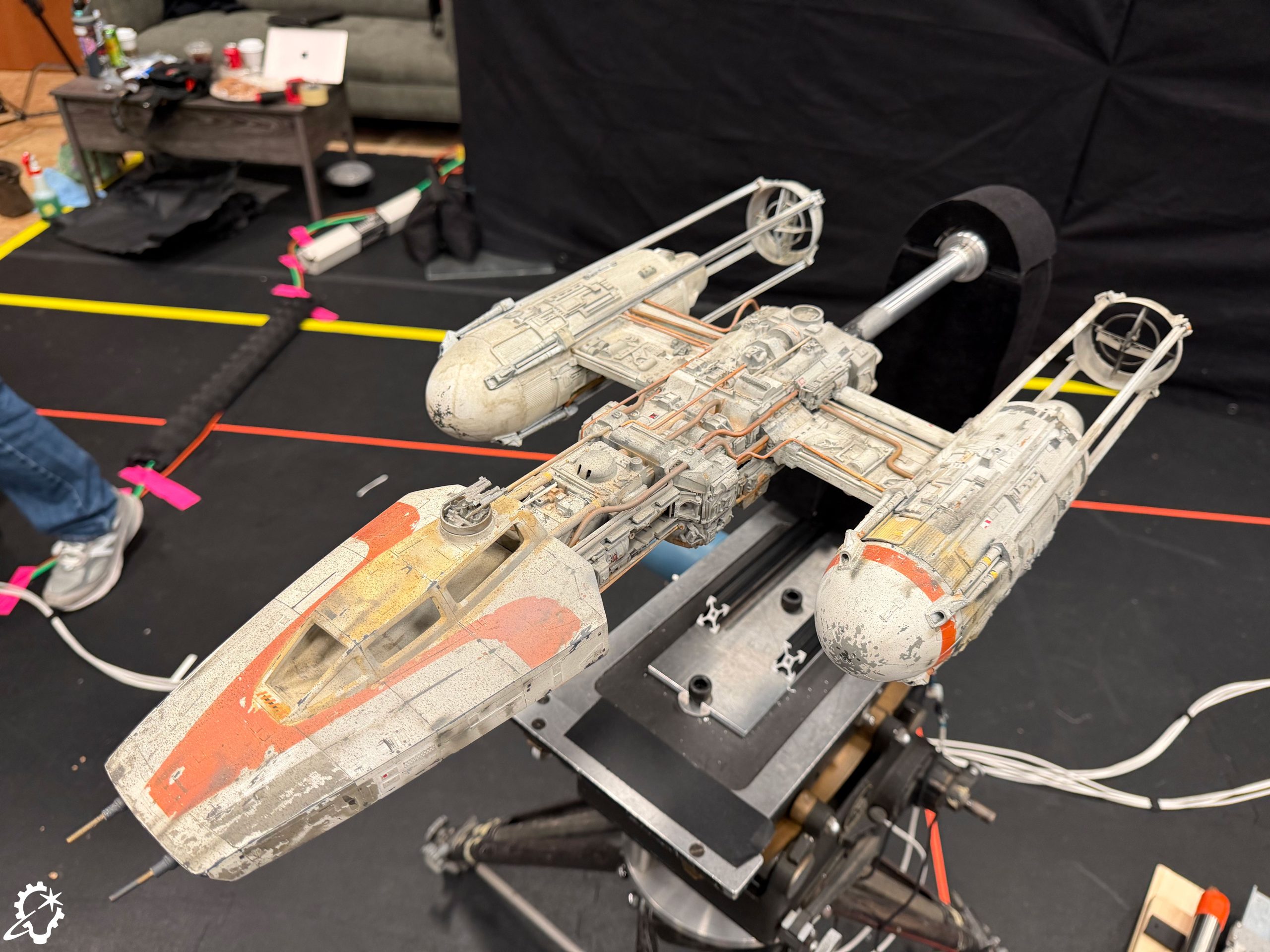
There are two shots in the film featuring a miniature Y-wing. One of them depicts the ship firing its missile. And the model in those shots is the “Red Jammer,” an almost legendary reference model built by ILM in 1976 for Star Wars: A New Hope (1977) that has never previously appeared on screen. Borrowed from the Lucas Museum of Narrative Art for a single day of photography,The Mandalorian and Grogu marks its official on-screen debut.
“You know, there’s nothing about the shots where you’d look at and go, ‘Hey, that’s a miniature,’” Knoll says. “But I know it’s one of the original models of the show. It’s in two shots of the movie – and it just made me happy.” Two representatives from the Lucas Museum were on set for the entire shoot, he adds, just to make sure the model-turned-historical artifact was carefully handled.
It’s a small thing in the context of a film of this scale. But it quietly says something about the spirit of the whole enterprise. The handmade and the modern aren’t in opposition. The best tool for the job might sometimes be a 50-year-old piece of physical craft. And the gap between A New Hope and an IMAX theatrical release in 2026 is, in some ways, smaller than it looks.
–
Jamie Benning is a filmmaker, author, and podcaster specialising in sci-fi and fantasy cinema, and the host of The Filmumentaries Podcast. Find him at Filmumentaries.com and @filmumentaries across social media.