Hal Hickel, Dave Logan, Meg Grube, Yohan Ng, and Masa Narita from the ILM team go into detail about crafting an enormous gladiatorial arena for the big screen.
Less than 30 seconds. There is perhaps no better example of quiet, confident world-building in the original Star Wars: A New Hope (1977) than a hairy Wookiee and a grimy droid playing a heated game of chess. They each deploy several small holographic creatures to battle one another – a brief, colorful interlude that showcases a galaxy that is even wilder than the audience initially believed.
From start to finish, these “Dejarik” chess monsters are on display for less than 30 seconds of screentime.
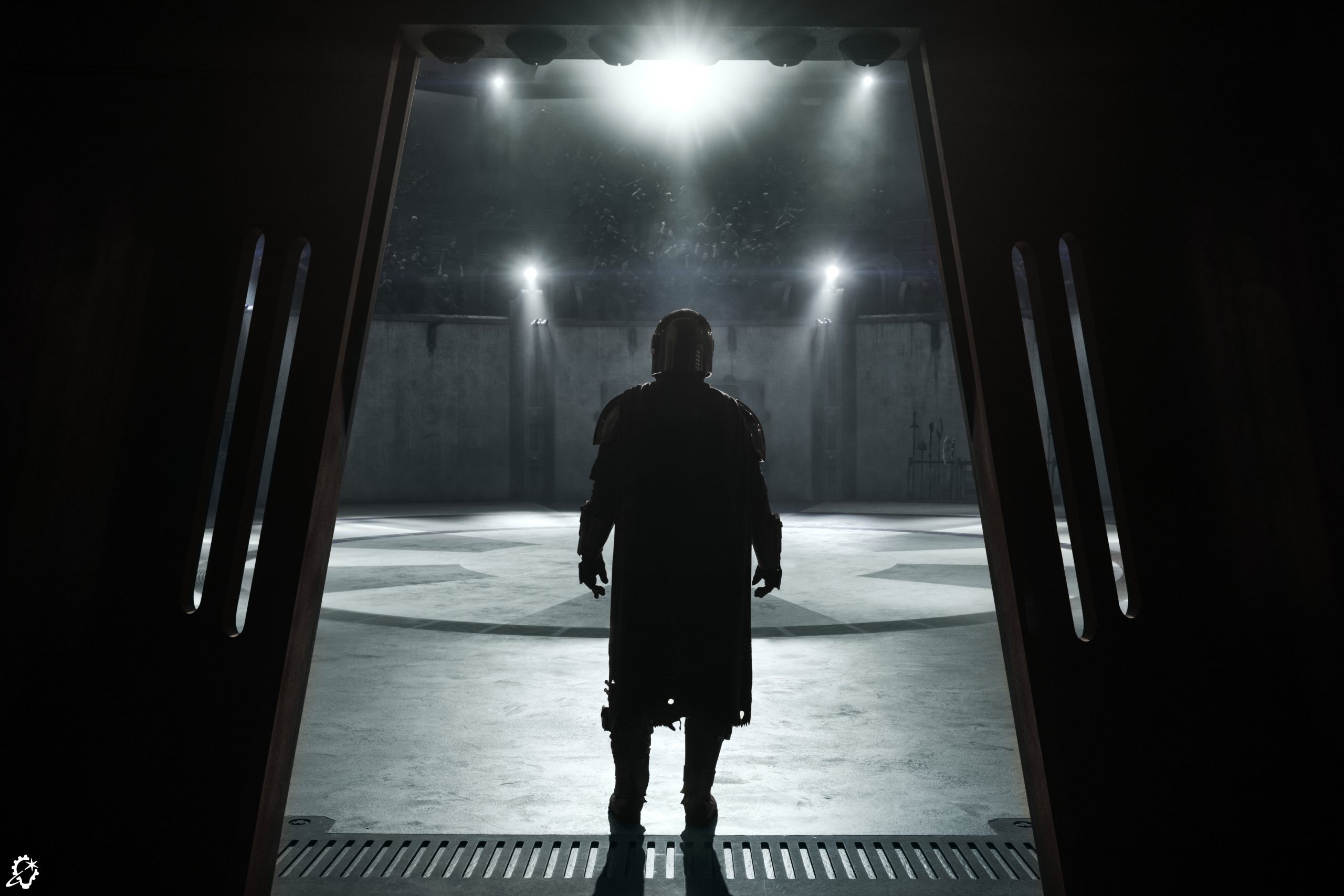
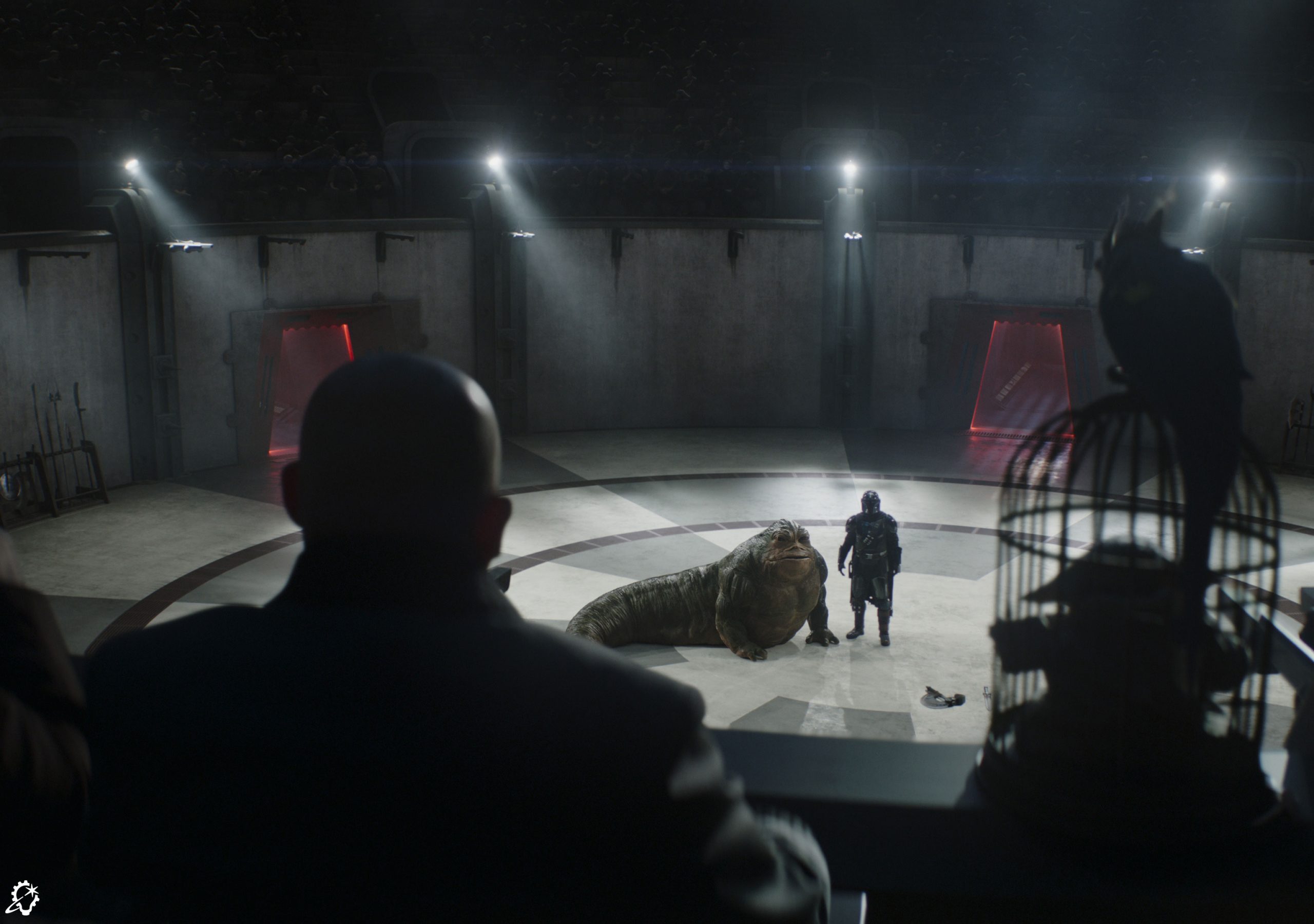
Nearly 50 years later, those same chess monsters return to the big screen once again – this time jumping off the Dejarik board and into the “real” world for an intense action sequence in the latest Star Wars theatrical film: 2026’s The Mandalorian and Grogu. Huge, monstrous, and on screen for much longer than those initial 30 seconds, these iconic aliens were brought to life by an enormous team at Industrial Light & Magic, led by production animation supervisor Hal Hickel and ILM animation supervisor Rick O’Connor.
The notion to bring back Dejarik started with director Jon Favreau. As Hickel recounts “It was Jon’s idea that the holochess figures that you saw in the original Star Wars were just meant to be the Happy Meal toy version of an actual battling creature somewhere in the galaxy. You had seen them as a little game figure, almost like a trading card, of a famous gladiator, and now you’re getting to see the real creature in an actual bloodsport pit fight with everything that entails.”
The original holochess scene had been developed by Phil Tippett, the renowned stop-motion animator and a founding member of Industrial Light & Magic, alongside fellow ILM animator Jon Berg. Director George Lucas had initially planned to film it with actors in costume, but at the last minute, spoke to Tippett about achieving the result in stop-motion.
“Phil had to come up with these creatures very quickly,” Hickel recounts. “He actually already had Savrip as a figure, so he showed that to George, who loved it. But then Phil had to make seven others. They were all done in this classic, weird Tippett style, and there wasn’t a lot of time to refine or to give notes. He just dreamed up these creatures.” The holographic creatures have re-appeared several times since 1977, animated once again by Tippett and his team in some of the more recent Star Wars sequel films, as well as Solo: A Star Wars Story in 2018.
“So that was our starting point,” continues Hickel, “these very ephemeral, of-the-moment, straight-out-of-Phil’s-imagination creatures, which were shown in very simple form as holograms. And now we had to say, ‘Alright look, here’s this biped, green lizard man with a leather vest and belt. What would he look like as a living, breathing thing?”
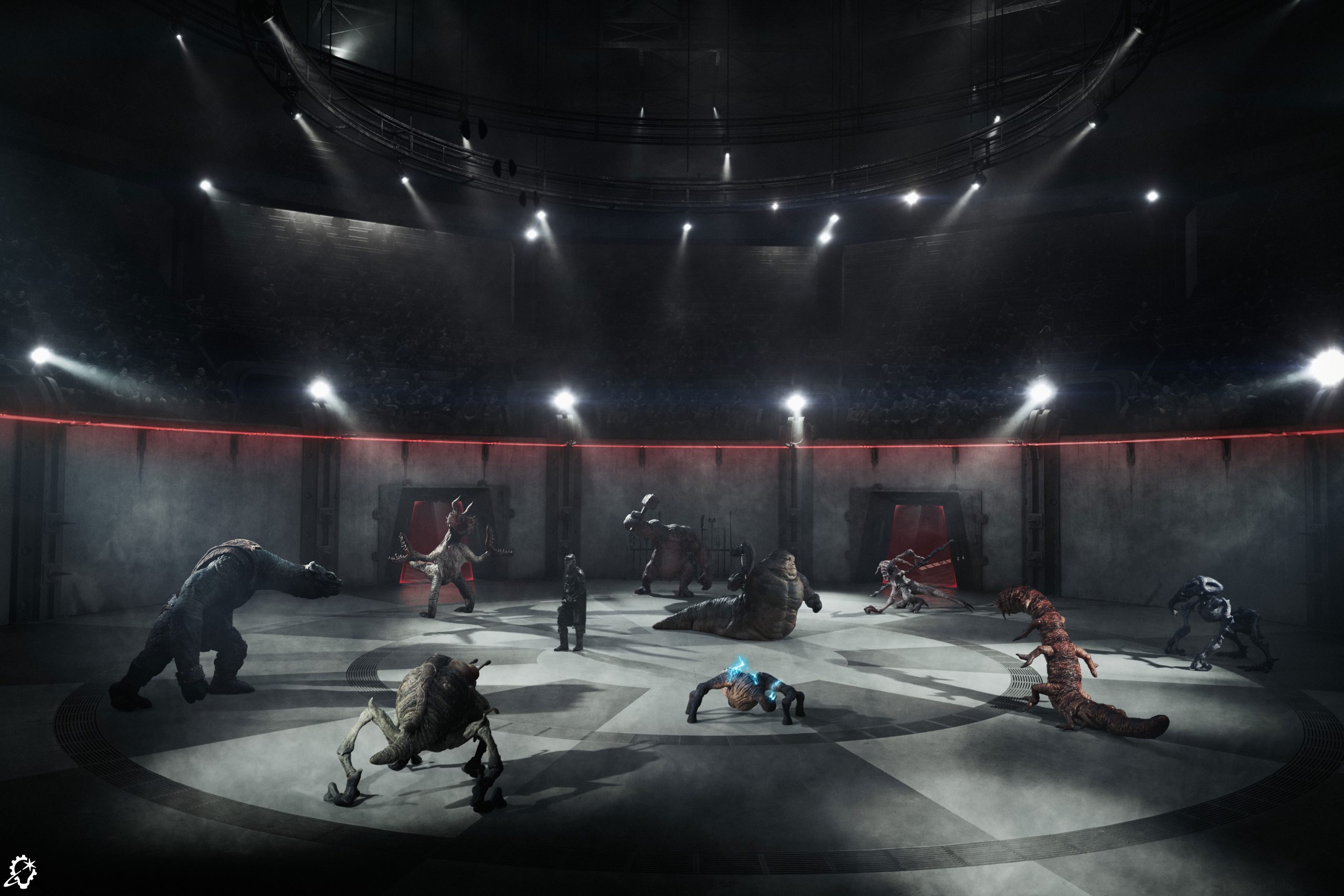
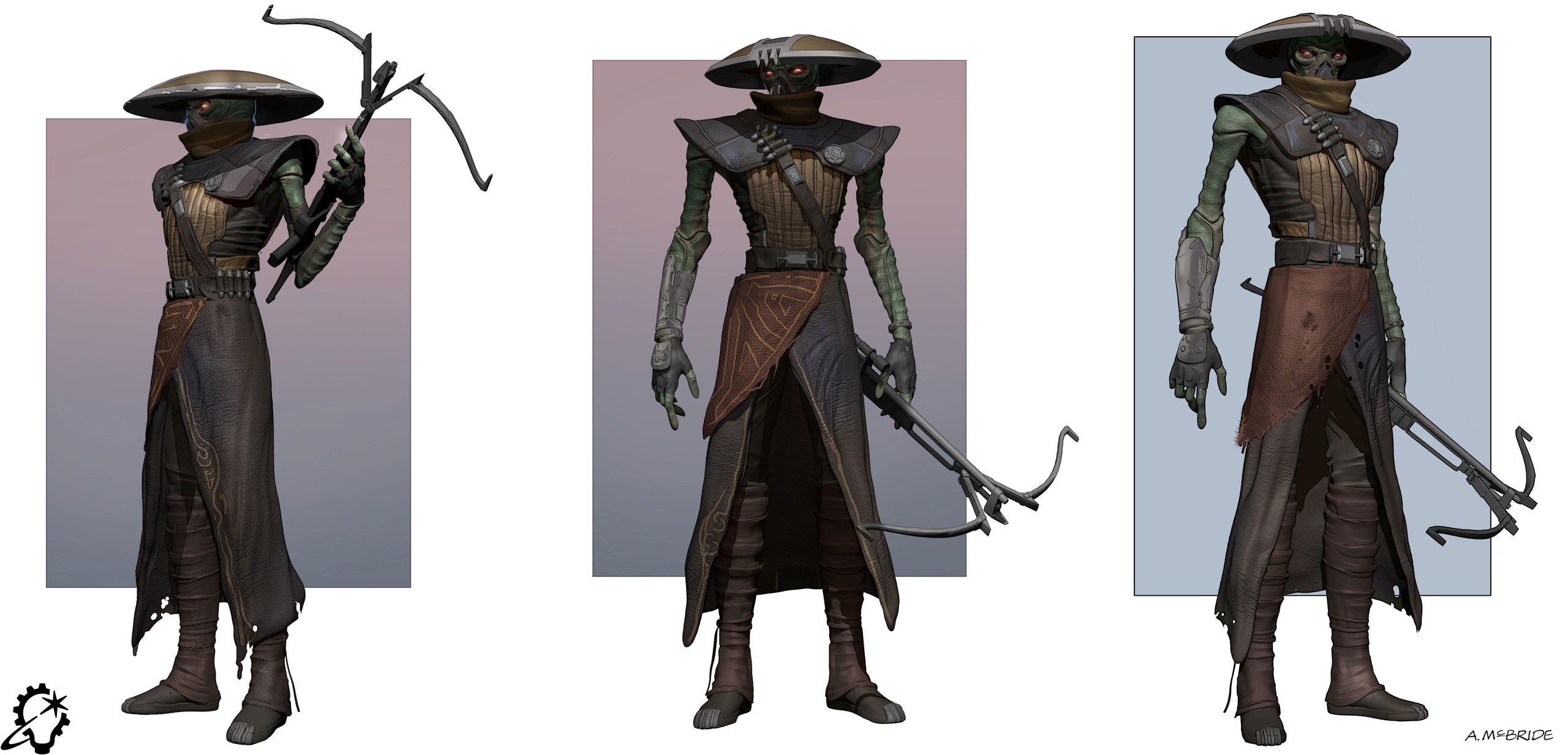
The journey to making Savrip and the rest of his scaly friends look real began with production designer Doug Chiang and the Lucasfilm Art Department. They worked through dozens of designs riffing on the original characters, elevating them into something that the audience could believe were ten feet tall, with all the necessary detail and realism. The variety inherent in Tippett’s original designs had already given the team completely unique silhouettes and colors. From those designs, the work passed to ILM and artists like Masa Narita, lead CG modeler for all the creature characters in the film. He and his team of five modelers brought the monsters into three-dimensions.
“It was a dream come true,” says Narita. “They are such iconic parts of Star Wars history. And, since those characters originally appeared only briefly on screen, we had the opportunity to expand on their designs and add much more detail, still keeping their classic look.”
Narita’s team had the varied skillsets needed to take on the job. “Some of my artists focused on building the models, while others worked on correcting anatomy and refine character shapes after animation and simulation to keep the characters looking consistent on screen,” explains Narita. The ILM artists went to work modeling the creatures and texturing them, trying to make them large and real-looking, with all the scales and detail that you would expect in creatures that size.
Hickel expands on their thought process: “When audiences finally see them onscreen, we hope they can imagine what their breath smells like or what it would feel like to put their hand on them. We wanted them each to be tactile and real.”
The process was based on copious amounts of research, and all from rather unlikely places for otherworldly aliens. “No matter how fantastical a CG creature is, we tried to anchor them in things that people are familiar with in real life,” continues Hickel. “We studied. For instance, we poured through loads of animal texture references: scaled animals like rhinoceroses, alligators, snakes, furry critters, or wrinkly creatures.”
They also went through the same process for movement. “With the Kintan Strider and Savrip, we were looking at everything from gorillas to professional wrestlers, just big, bipedal, and massively powerful characters. With K’lor’slug, we were looking at Randall from Monsters Inc. [2001], who had this great way of scampering along in a horizontal mode very quickly and then springing up vertically. There wasn’t a lot of real-world reference for Ghhhk, that big green bug, but surprisingly there was something for Molator, who looks like a sort of bony exoskeleton. His proportions made one of the animators do a sort of sideways run with his arms that looked almost like a primate, like an orangutan. It wasn’t something that we would have necessarily said, ‘Oh yes, that should be simian-like,’ when just looking at the design. But it looked perfect. It just fit.”
For story and dynamic purposes, some design elements even differed slightly from the original stop-motion puppets. “We took some liberties,” admits Hickel. “For instance, along the way, we decided to make the Houjix quite small. Originally he was big, like all the others, but we decided to make him almost a comedy element in the sequence. He is still dangerous, but he’s more of an electric eel zapping when it bites. He’s like a little vicious chihuahua compared to the others.”
“And then,” adds Hickel, “we get to the most fun part for me: animating them.”
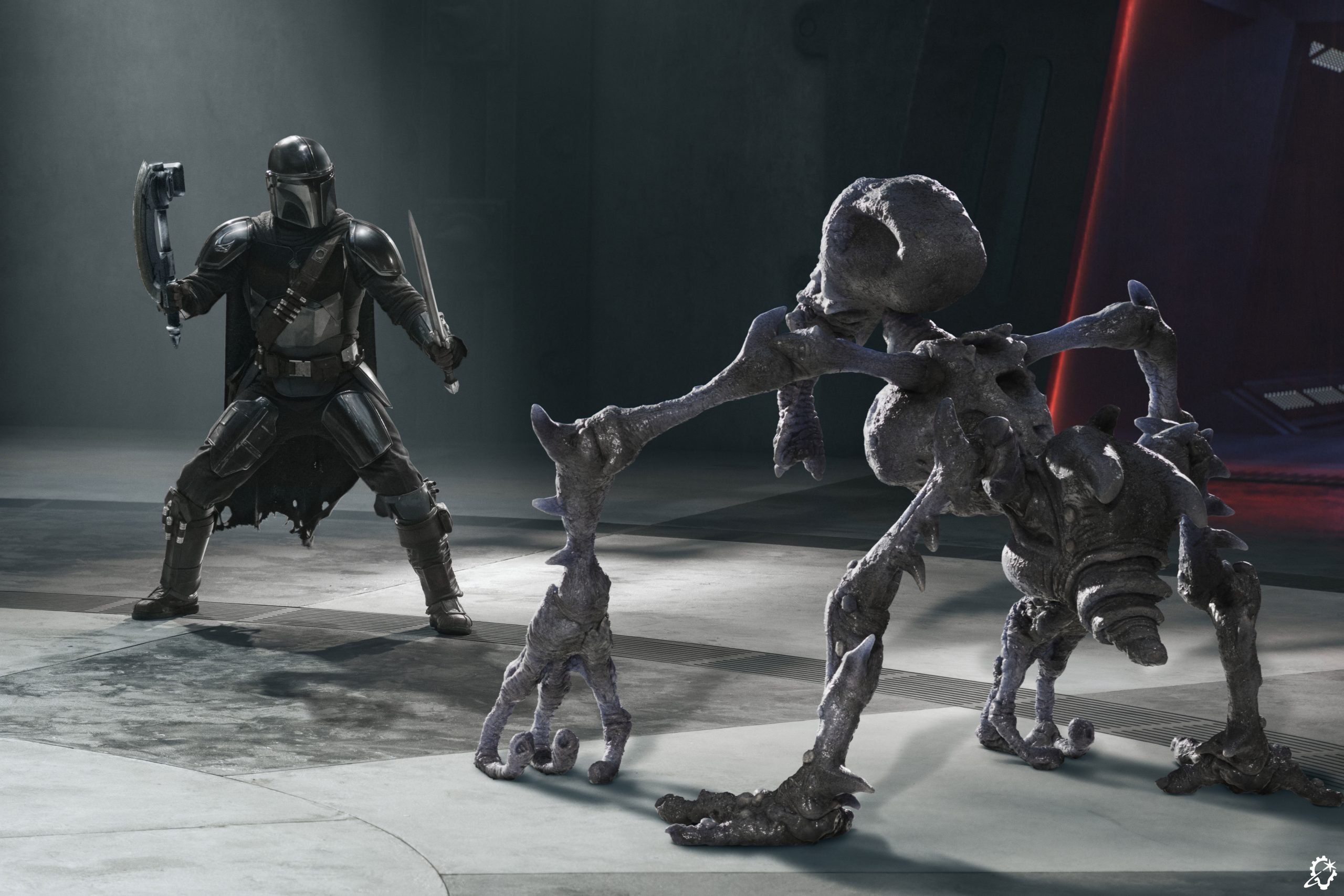
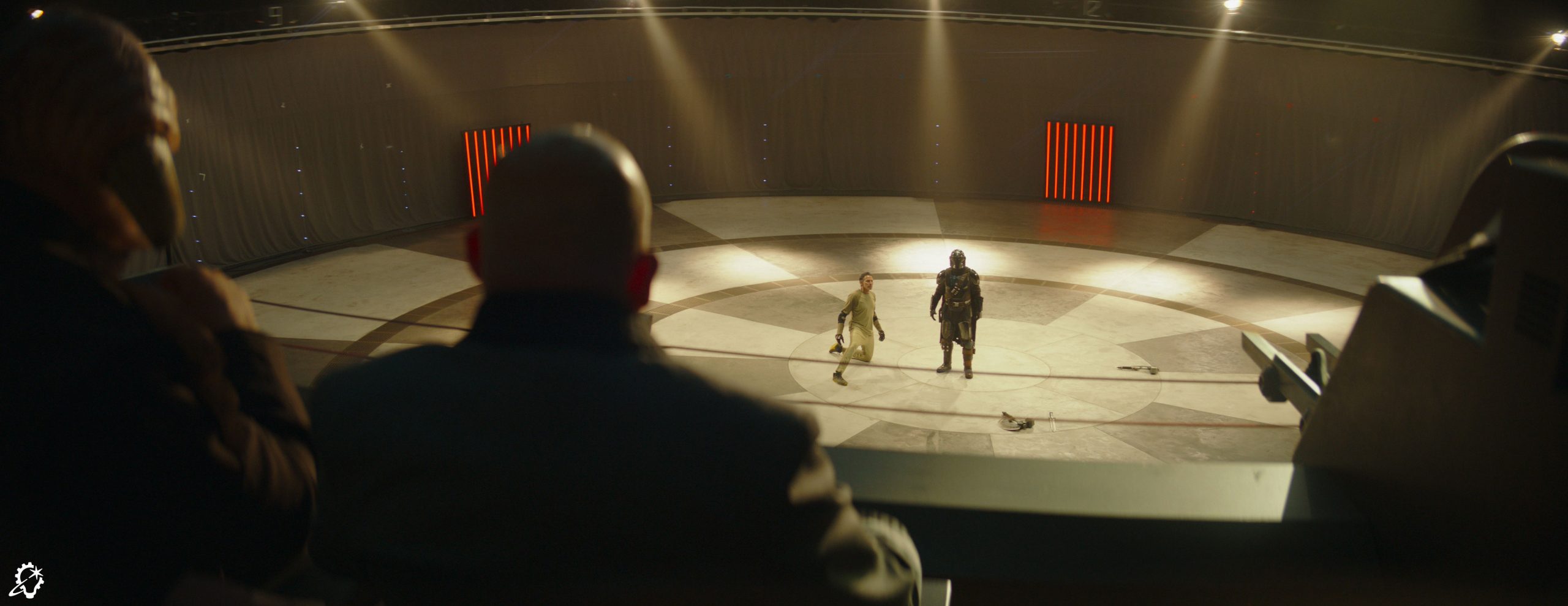
In Hickel’s mind, the sequence was largely an animated one. Yes, there were live action components: one segment of a picture-ready wall set had been constructed, as well as a luxury box for the bad guy, Lord Janu Coin, and his henchman. But the rest of the stage was just a neutral gray, to be replaced digitally.
Before shooting began, the sequence was planned in rather detailed pre-vis. “In essence,” Hickel explains, “we pre-animated the sequence as a way to work out the gags that we wanted to happen. It was very rough animation, not polished at all, but it gave us a sense of the shape of the sequence ahead of shooting.”
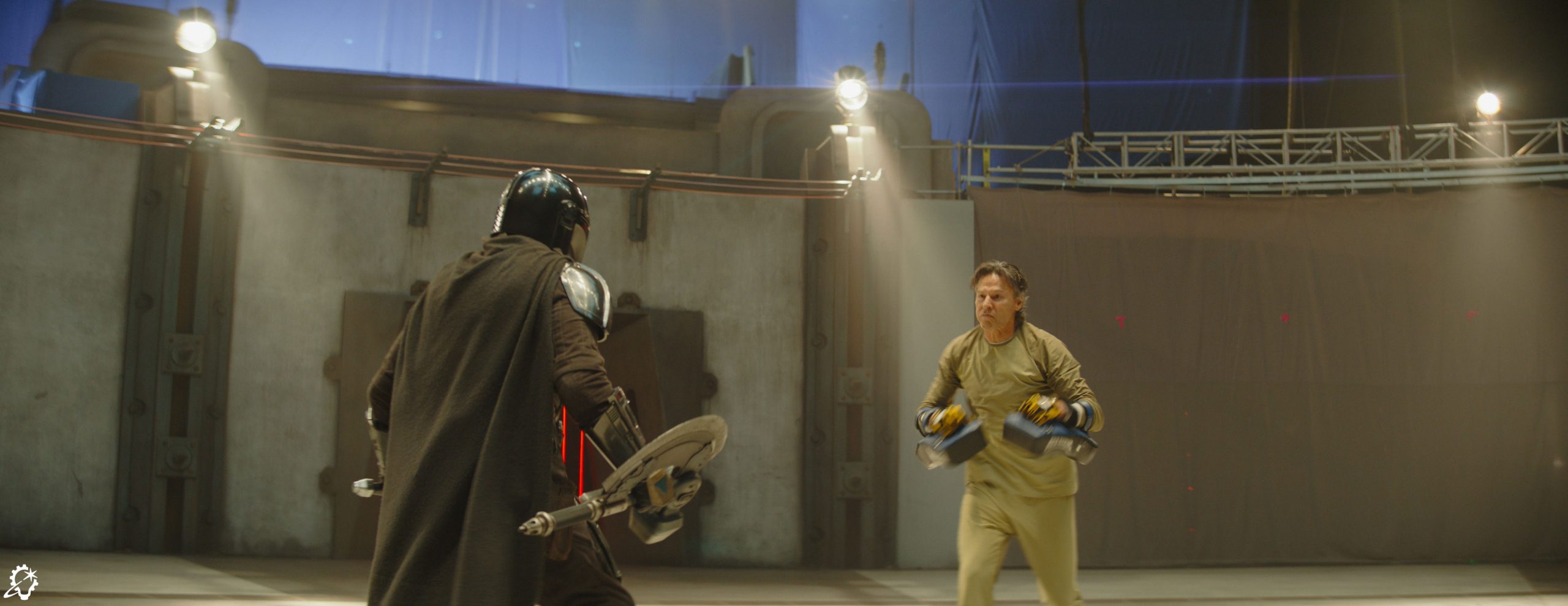
Going in, the team now knew what to shoot with the stunt team, working closely with stunt coordinator JJ Dashnaw and Lateef Crowder, who donned the Din Djarin dome for brawling purposes. Hickel continues: “As we got closer to shooting, JJ’s stunt team got involved, looked at our previs and then started to work through choreography. It was one thing to animate something, it was quite another thing to actually have a stunt performer do that action.”
Mando wasn’t the only one to be physically on the set, though. The monsters had to be represented somehow. “When the scene was finally filmed, we also had a stunt performer for each creature, each in a kind of color-coded outfit (because they each had a general color). We also had pictures of the creatures pinned to their chest so that you could easily look at them and think, ‘That person’s supposed to be K’lor’slug. That person’s supposed to be Molator,’ as they would run around.” It was meant to be a guide, rather than an exact science. The exact action of each creature on set was less important than just seeing how they occupied the space in the frame.
“We also had another individual playing Rotta the Hutt, Richard Cetrone, as well as a full-size head that was sculpted and painted by Legacy Effects,” remembers Hickel. “It served as a lighting reference but also helped with framing, especially for close-up shots of Rotta. It ended up being a pretty strange first cut.” Before animation started, the next step was actually doing a postvis pass: the previs animators then worked very quickly again to do kind of rough versions of the animation to make sure the team still liked all of their initial ideas.
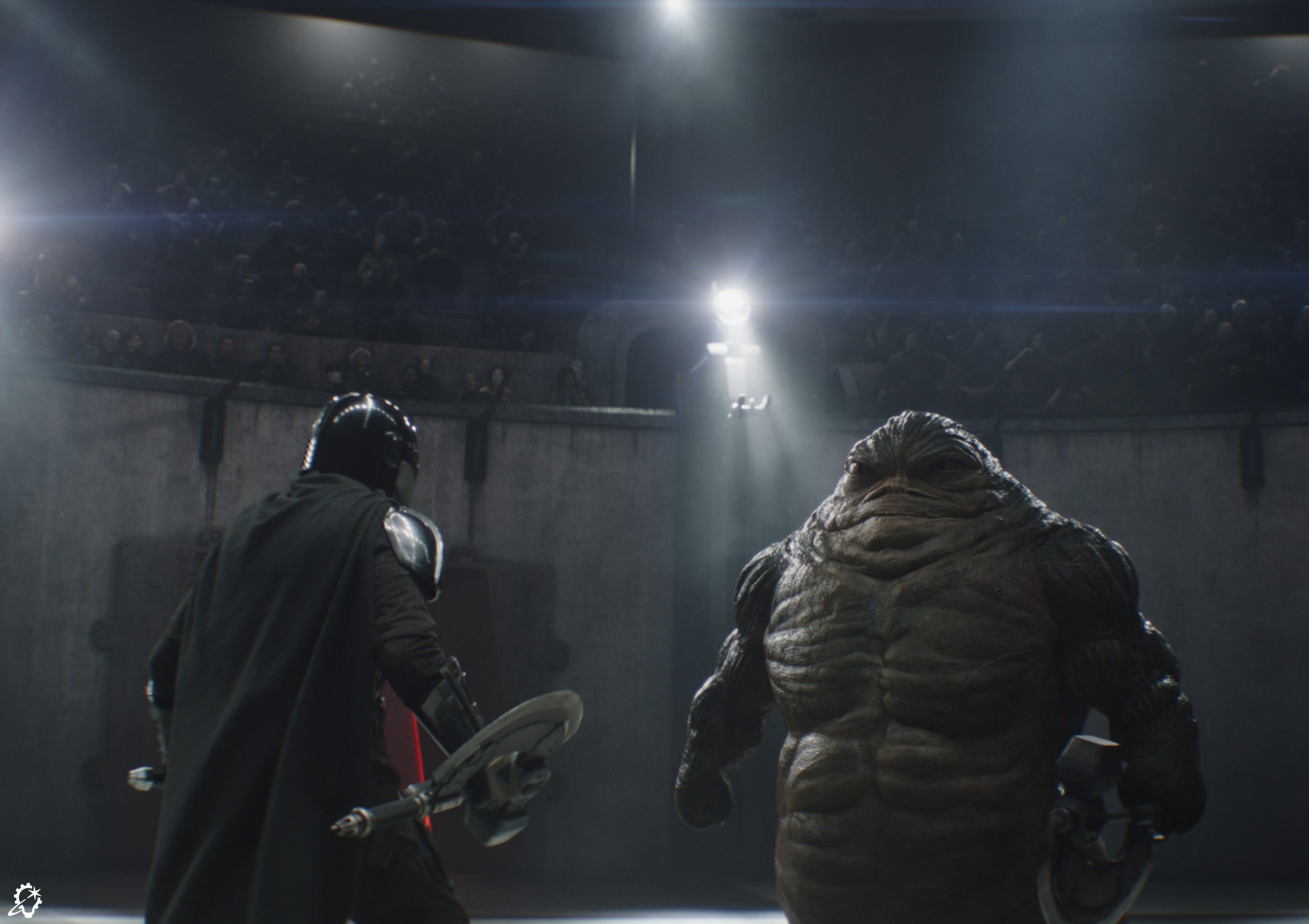
For Hickel and O’Connor’s team, including lead animator Dave Logan and senior animators Meg Grube and Yuhon Ng, there was one major element that differed from their previous work on the “Mandoverse” TV shows: time.
No longer encumbered by the quick timelines of television, the ILM crew had some breathing room to focus on making each shot as cinematic and as connected as possible. Hickel credits a lot to O’Connor’s eye for consistency: “Rick did an amazing job at constantly keeping an eye on the sequence to make sure we had all the connective tissue we needed. From foreground action to background action, he made sure that we kept the frame alive and active, so that it always seemed like stuff was happening everywhere in the arena, not just the little fight you were seeing. It was important to keep ideas consistent across shots, so that something doesn’t just get forgotten the moment it goes out. In the next shot you should see it continuing in the background.”
As Logan adds, “Rick likes to operate by giving people little beats of action, three shots in a row that they can really kind of own, something with motion that carries between shots. It makes more sense efficiency-wise to do it that way, and gives animators more ownership. We can really sink our teeth into it and get excited about it.”
Grube has taken that methodology to heart, explaining: “After coming to ILM, I started to approach the work more like a filmmaker as opposed to solely an animator. It’s not just, ‘What is the purpose of this shot?’ and ‘Is this shot getting its point across?’ but now also, ‘How is this shot composed? Where is the audience’s eye going? What is the context of the sequence?’
Yuhon Ng adds: “It’s always part of a bigger picture. We work on our small part, our small shots or sequences. Personally, my workflow when I was younger used to be, ‘It’s got to be awesome.’ These days, I’ve tried to tone my animation down to, ‘Is it photoreal? Is it going to integrate properly with the background plate that they shot?’ A lot of times that means that my animation isn’t going to be as big or as attention-getting. Sometimes it will be super subtle. It has to fit in. It has to be believable with the actors or the extras or whatever they shot on the real parts of the set.”
This carried through the entire production. As Grube notes, “This environment, and this production in particular, was such a supportive time. Rick, Hal, Jon, and Dave [Logan] were all so open to anything pitched to them. You felt really good approaching them with any ideas.”
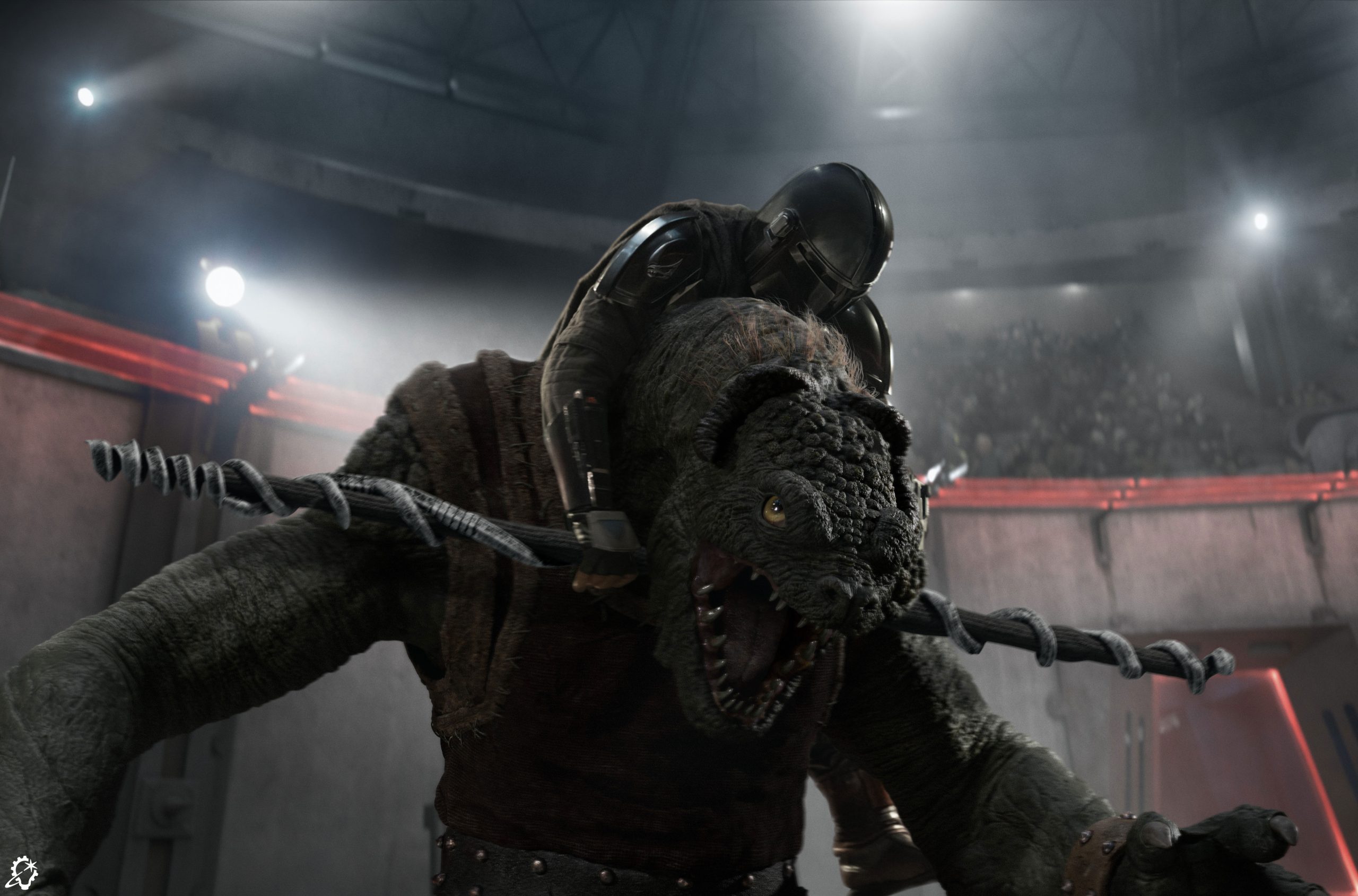
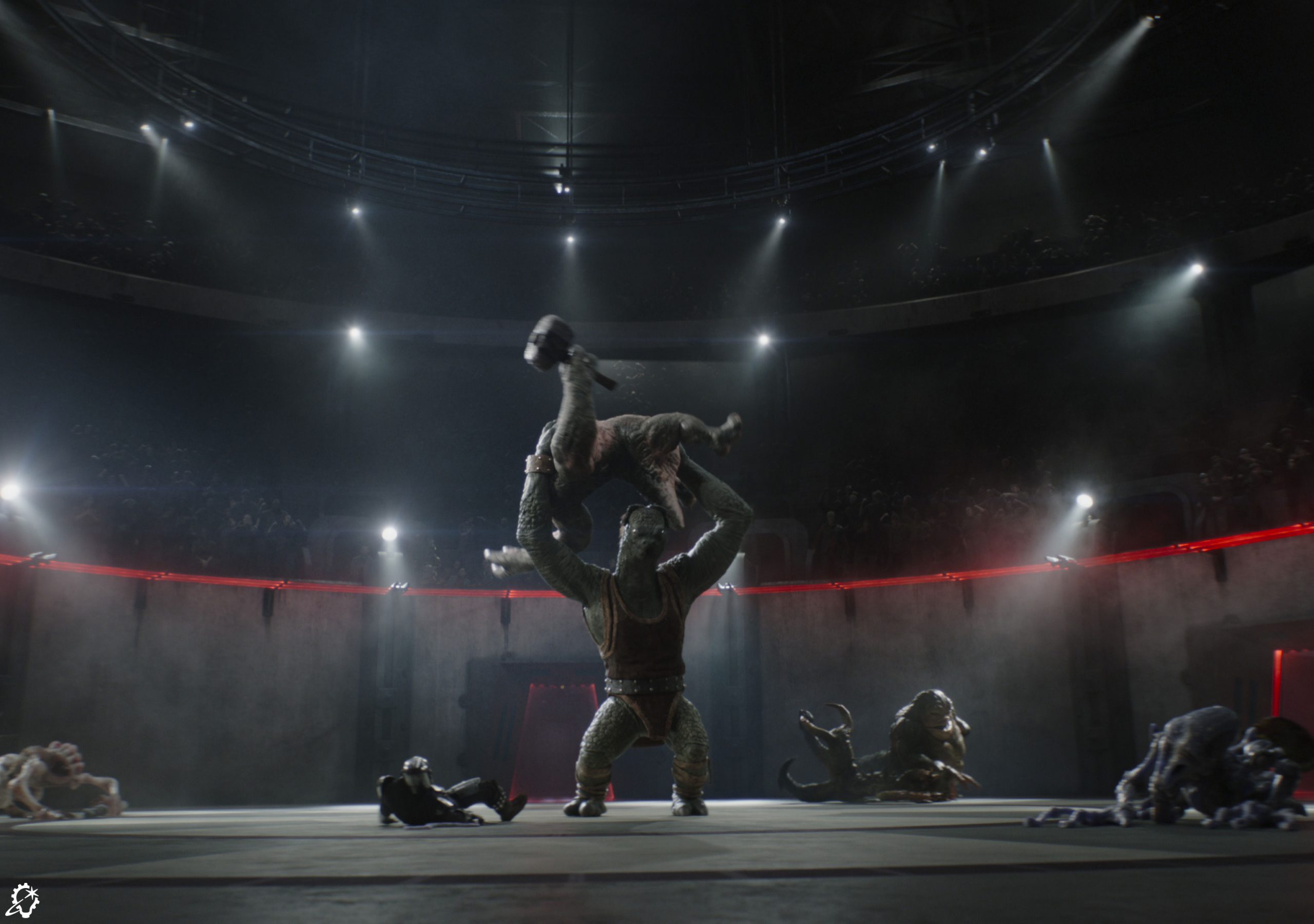
We all knew it was coming. Near the climax of The Mandalorian and Grogu’s breathless arena fight, the Mantellian Savrip lifts the Kintan Strider and throws him down, roaring in a mix of pleasure and rage. It is a moment first glimpsed on those tiny holoprojections in 1977, now brought to life once more. In terms of callbacks “the body slam was the one we knew had to get in there,” says Hickel.
But then more finishing moves began to emerge, steeped from the entire crew being fluent in various forms of visual effects and monster movies. “When Rotta is fighting with the K’lor’slug, it wraps itself around him. Then a shot or two later you see him hit it with his fist, pull it off his body, and slam it down. That was very much a nod to King Kong fighting the serpent in the cave in the original King Kong [1933]. It’s not a 1:1 match to any shot, but it’s just the vibe and Jon Favreau got it immediately. The first time he saw it, he said, ‘Oh my god, it’s King Kong.’
Like Jon, I grew up on a lot of stop motion creature movies,” Hickel continues. “Seeing the original King Kong and all of Ray Harryhausen’s films was my first introduction to stop motion, and into movie special effects. Jon is very much the same, and has a lot of the same influences. He loves infusing his version of Star Wars with a lot of creatures, more than you ever saw in the original trilogy. It’s really maybe a similar amount to what George started to do with, say, the arena battle in Attack of the Clones [2002]. For an animator like me, especially someone who started in stop motion, it’s a dream come true.”
—
Brandon Wainerdi is a writer and interviewer, whose work can be found in Star Wars Insider, on StarWars.com, and inside the iconic horror magazine, FANGORIA. He is the author of two Star Wars books, including the recent Star Wars Encyclopedia of Starfighters and Other Vehicles. He is also the host of Talking Bay 94, a long-running behind-the-scenes podcast that interviews the cast and crew of the Star Wars saga. You can find him on Twitter and Instagram.
Brandon Wainerdi is a writer and interviewer, whose work can be found in Star Wars Insider, on StarWars.com, and inside the iconic horror magazine, FANGORIA. He is the author of two Star Wars books, including the recent Star Wars Encyclopedia of Starfighters and Other Vehicles. He is also the host of Talking Bay 94, a long-running behind-the-scenes podcast that interviews the cast and crew of the Star Wars saga. You can find him on Twitter and Instagram.