Vancouver News

50 Years | 500+ Film and TV credits | 135+ Awards

SINCE 1975

The ILM Vancouver artist details her globe-trotting career path from special make-up effects to art direction to effects supervision.

By Lucas O. Seastrom


For decades, a significant aspect of Industrial Light & Magic’s company culture has been defined by the atmosphere in dailies. These routine sessions where the effects team reviews work-in-progress and provides feedback are common across the industry, but ILM has always prided itself on its distinct style that encourages open and equal communication. Tania Richard had spent some 15 years working in visual effects before she joined ILM in 2018 as an art director at the Vancouver studio. And as she puts it, “ILM’s collaborative dynamic really shines in dailies.”

While working on Space Jam: A New Legacy (2021), Richard was at first surprised when visual effects supervisor Grady Cofer would call on her in dailies, seemingly at random. “Grady wouldn’t hesitate to call my name out and ask me what I thought about something, even if it wasn’t something I was working directly on,” Richard explains. “He valued everyone’s opinion, and made you feel part of the overall process. Earlier in my career at other studios, dailies was pretty quiet and you didn’t speak up very often. Everyone has their own way of approaching things in dailies, but at ILM it’s always with the intent of creating a collaborative experience.”

As ILM has continued its global expansion – which now includes studios in Vancouver, London, Sydney, and Mumbai, in addition to its San Francisco headquarters – seasoned professionals from across the effects industry have joined the ranks. Each brings their unique experience working on diverse projects and often in many different types of roles. Richard is no different. 

Growing up in Sarnia on the southern border of Ontario, Canada, Richard had what she describes as a creative upbringing. Both of her parents had their own artistic pursuits, and her mother in particular encouraged Richard and her brother (now a storyboard artist) to make careers out of their passions. Though she aspired to work in filmmaking from her time in high school, Richard chose to study traditional fine art while studying at McMaster University southwest of Toronto. “But I was lucky in that the university also had film theory courses,” she notes, “so I studied film theory as well as fine art.”

With this unusual blend of disciplines, Richard was able to both learn academic theories and create artworks that attempted to realize them in aesthetic form. She studied sculpture, drawing, print-making, art history, and painting, as well as film theory. Her fascination with the concept of film spectatorship inspired her to focus in painting. “There was a film theorist, Laura Mulvey, who talked a lot about the male gaze in spectatorship,” Richard explains. “I studied her a lot, as well as Cindy Sherman, who would often photograph herself in these film-looking environments and settings. I ended up doing something similar where I’d start by creating these film stills, photographing myself dressed up in various situations, and using that as reference for my paintings.”

To this day, Richard is fascinated by the intersections of artistic craft and theory, in particular the way that filmmakers code their works. “It can almost be a language, a communication between the filmmaker and the audience,” she says. “Somebody like [Andrei] Tarkovsky puts these little codes throughout his filmmaking, whether it’s sound like dripping water or a cuckoo, or a visual like apples. They were all meaningful to him on a personal level. You see and hear these codes throughout all of his films, and if you were familiar enough with them, it was almost as if he was talking to you in a way, on another level.” 

At ILM, Richard has worked with director Shannon Tindle on both Lost Ollie (2022) and Ultraman: Rising (2024), and she describes the filmmaker along similar lines. “He’ll reference the same films in his creative process, like Kramer vs. Kramer [1979], for example. He loves that film, and I’m aware of that because I’ve worked with him long enough and had enough discussions with him to know that when I see something in the way a frame is composed or an animation performance in one of his films, I can understand where his influence is coming from. It’s special. It makes you feel like you’re connecting with the filmmaker on another level.”

As she finished her undergraduate studies, Richard jumped into work at Toronto-based FXSMITH, a special effects company founded by innovative makeup designer, Gordon Smith. Initially thinking she’d be working on a local television show, Richard soon discovered their team’s assignment was the feature film X-Men (2000). Initially, Smith had his new hire drawing concepts for characters requiring prosthetics, and as production commenced, Richard was part of the on-set team creating the extensive make-up for Rebecca Romijn as Mystique. 

“It was a great experience and I had my foot in the door,” says Richard. “But this was back around 1999, and the transition from practical effects to computer effects was happening. For X-Men, we worked closely with the visual effects team on set because they had to pick up a lot of our work in post-production and refine it. In talking to some of the crew there, they encouraged me to move into visual effects.”

Concept art by Richard for Mystique (Rebecca Romijn) in X-Men (2000) from 20th Century Studios (Credit: Tania Richard).

Richard’s brother was then studying classical animation at Toronto’s Sheridan College, a school that had graduated a number of artists later hired by ILM. “If the Sheridan opportunity hadn’t worked out, I might’ve gone for a PhD in film theory,” Richard notes. Joining the school’s postgraduate visual effects program, her main professor was Richard Cohen, recently returned from a stint at ILM as a CG artist on Terminator 2: Judgment Day (1991) and Death Becomes Her (1992).

“There were about 12 of us in the class, and Richard [Cohen] felt that rather than having us all isolated and doing our own thing, we should make a short film together,” says Richard. “If I had not done that, I might’ve focused more on the animation side. But on the group project, we leaned into each other’s strengths, and because I had a painting background, it was clear that I was the concept artist, matte painter, and designer on the team. I did do some animation, but I learned that it wasn’t my strength.” She adds that although she intended to create traditional matte paintings for their film (ultimately titled The Artist of the Beautiful), Cohen urged her to learn Photoshop and embrace the emerging computer-based tools.

As she finished her studies at Sheridan, Richard had already begun professional work, initially as a concept designer for 2003’s Blizzard under production designer Tamara Deverell. She then became a digital matte painter at Toybox, a local effects house that was soon acquired by Technicolor. Eventually, a former colleague invited her to come to Sydney, Australia where Animal Logic was developing the animated feature Happy Feet (2006). “I was young and up for the big move, so I said yes,” Richard comments. “That was back when ‘2 ½ D’ projections were the thing, so I did a number of those mattes on that feature.”

During this period, Richard encountered a number of important mentors, among whom was the late visual effects producer Diana Giorgiutti, with whom Richard served as a concept artist on Baz Luhrmann’s Australia (2008). “We were on location in Darwin and Bowen for something like seven to nine weeks,” Richard explains. “Di had me working directly with [production designer] Catherine Martin. She had me sitting with editor Dody Dorn for a week. Dody had cut Memento [2000]. We were together early on when she had voice recordings of the actors reading the script and she wanted some images to cut in with them. I’d be mocking up frames for her and she explained to me the compositions they needed. She was really generous with her time.”

Soon, London-based Double Negative came calling, and Richard spent nearly a decade in the United Kingdom working on everything from Harry Potter and the Deathly Hallows: Part 2 (2011) to Interstellar (2014). As visual effects art director on Fantastic Beasts and Where to Find Them (2016), she again found an important mentor in production designer Stuart Craig, who’d overseen the visual development of the entire Potter franchise. After creating elevation and sectional drawings for sets, Craig tasked Richard with building digital mock-ups, and together they’d determine the preferred camera angles for which Richard then created detailed concepts.

“Stuart had worked with set designer Stephanie McMillan for many years,” says Richard, “and they would often go onto set together and shoot the space in black and white. That helped them analyze the composition before they started adding color and texture, which only came after they were happy with the black and white composition. When I built my models, I rendered them in black and white as well, so I was approaching it instinctively in a similar way. Stuart loved it and helped me understand why it was a good approach. Rather than going full-tilt and adding lots of texture and detail right from the beginning, you start to learn that actually you might never see a particular area because of the way it’s being lit, or something like that. You learn to focus in an efficient way on where to add that structural detail, where to hit the image with color to have the most impact. It was a brilliant lesson from Stuart.”


A return to Animal Logic for 2018’s Peter Rabbit was Richard’s ultimate springboard to ILM. With the opportunity to work closely with director Will Gluck, visual effects supervisor Will Reichelt, and associate visual effects supervisor Matt Middleton (the latter of whom are both with ILM now), she came to realize that effects supervision was her chosen path. “Will [Reichelt] had me run lighting dailies and look after the assets while he was busy on set,” Richard explains. “I was also really involved in the DI process and had a team of artists who I delegated a lot of design work to, so in many ways, it felt like a natural transition.”

In early 2018, the ILM Art Department’s creative director David Nakabayashi and senior producer Jennifer Coronado convinced Richard to make another move, this time back to her native Canada to work at ILM’s Vancouver studio. It was a significant decision, as Richard was then considering a move to New Zealand for a brief respite from active work. But the opportunity to join ILM was too important to pass up. 

“ILM was the pinnacle,” Richard says frankly. “For anybody who is around my age and grew up with Star Wars, you see ILM as the height of where you want to be in the industry. But I wasn’t sure I had what it took to be a part of the company, so it was a surprise when they reached out. I barely took any time off between working on Peter Rabbit and coming to ILM.”

Initially working as an art director, Richard describes her first impressions of ILM as “overwhelming, exciting, and different.” After assisting Vancouver’s creative director Jeff White on some initial project bids, she was soon working on Disney’s Aladdin (2019). “The ILM Art Department is incredibly talented and is really the best of the best,” Richard notes. “There’s so much you can learn from them.” She continued as an art director on Space Jam: A New Legacy, for which ILM was responsible for integrating the classic Warner Brothers animated characters with live action footage. 

“There was a lot of artwork created at the beginning of Space Jam,” Richard explains. “The spirit of it evolved quite a lot over the course of the show. I had a wonderful team, and I really loved working on Bugs Bunny! [laughs] Grady Cofer had me doing paint-overs on some of the characters, which I really enjoyed. The whole team was involved in refining the final looks of each character, including the textures crew, the groom artists, the modeling team, and the animators. I’m always blown away when I see animation come through.”

It was after Space Jam that Richard made the transition to associate visual effects supervisor on Lost Ollie. “I’m a bit like the righthand person or wingman for the visual effects supervisor,” she elaborates. “We work very closely with production and our department leads and supes to help establish looks, refine shots, and execute what needs to be done in post to maintain a certain level of quality and consistency. I had been slowly navigating into an effects supervisor-type role for a while, but I wasn’t sure if I had all the skillsets to be able to do it. I talked to Jenn and Nak about it, and they were very supportive and helped to guide me into this position along with Jeff White and [executive in charge] Spencer Kent.

Lost Ollie (Credit: Netflix).

“I think I just got really lucky,” Richard continues. “I believe that Jeff had Ultraman in mind for me, but it wasn’t quite ready yet. [Visual effects supervisor] Hayden [Jones] and [visual effects executive producer] Stefan [Drury] were working with Shannon Tindle on Lost Ollie, so I had a chance to establish a relationship with the same client. I think that’s why they thought it might be a good starting point for me. It was a smaller project, and I love the hybrid between live action and CG characters. It’s probably what I’m best at and what I love to do the most. I ended up diving in heavily on two episodes, and then I stayed in the background on the final two because that was when I started transitioning to Ultraman: Rising.”

The move into supervision has allowed Richard to focus more on refining her approach to communication and collaboration between the artists and the clients. “On Ultraman, Hayden was great at encouraging the team to ask questions and offer up suggestions with Shannon,” she notes. “What’s great about Shannon is that he creates an environment where it’s okay to suggest something that might not ultimately be the right idea, but it’s great to put it out there and see if it works. [ILM executive creative director] John Knoll is very similar. He embraces that exploration and isn’t afraid to try something.”

Richard emphasizes that “part of being a supervisor is having an ability to read the room and understand the personalities of the artists and how they like to communicate.” And as an artist herself, Richard brings her own unique blend of experiences. “I’ve been lucky to have had a toe in the practical side of things very early on. I’ve also worked with some really talented people who come from an earlier generation of filmmakers. I hope that some of that knowledge translates in my communication with the artists. Both Grady and Hayden like to do quick paint-overs on things in dailies, and that’s something I like to do as well. If words don’t quite explain something, sometimes a quick drawing or paint-over can act as a visual reference. Many supes like to do that.”

As so many have attested, it’s the people that have truly made the difference at ILM in its 50 years of storytelling. “Have curiosity about the people you’re working with,” Richard says, “and have empathy for them. Try to understand where your colleagues may be at a certain point in time. You can use that to develop relationships throughout your career, which is so important.”

Ultraman: Rising (Credit: Netflix).

Read more about Richard’s work on Ultraman: Rising here on ILM.com.

Lucas O. Seastrom is the editor of ILM.com and a contributing writer & historian for Lucasfilm.


Take a closer look at how the ILM Vancouver team built a new world of stylized action for Japanese icon Ken Sato, also known as Ultraman, and how they pushed the visual envelope with a bold aesthetic as ILM steps back into animated features with Netflix’s Ultraman: Rising.

By Adam Berry

Netflix Ultraman: Rising marks the first fully animated feature production for Industrial Light & Magic (ILM) since 2011’s Rango. The story chronicles the adventures of Ken Sato, and his superpowered alter ego known to the world as Ultraman. The film is a love letter to the 1966 Japanese superhero television show Ultraman, with the heart of the story exploring the importance of family in all of its forms as Sato takes on the responsibility of raising a baby kaiju named Emi. 

A tender family moment shared between Emi, Mina and Ken Sato.
A tender family moment shared between Emi, Mina and Ken Sato (Credit: Netflix).

The monster-sized task of taking Japan’s beloved superhero, transforming the character to be fully animated and introducing him to a global audience was a dream come true for the film’s directors Shannon Tindle and John Aoshima, who had always been fans of the Japanese franchise.

With production on Ultraman: Rising beginning in the spring of 2021, the film required 1,578 visual effects shots and over 1,300 assets to be built. All 165,169 frames of the entire 108 minute feature were created by over 650 ILM artists across three of their global studios in London, Vancouver, and the former location in Singapore.

With London acting as the hub for the show, led by visual effects supervisor Hayden Jones, and Singapore providing support, it was actually ILM Vancouver that contributed the majority of work done on the film with over 300 artists assigned to the project. Every asset seen in the film, from the monstrous kaijus to Ultraman himself, with an additional 600-plus shots from the film’s total count were all built in Vancouver.

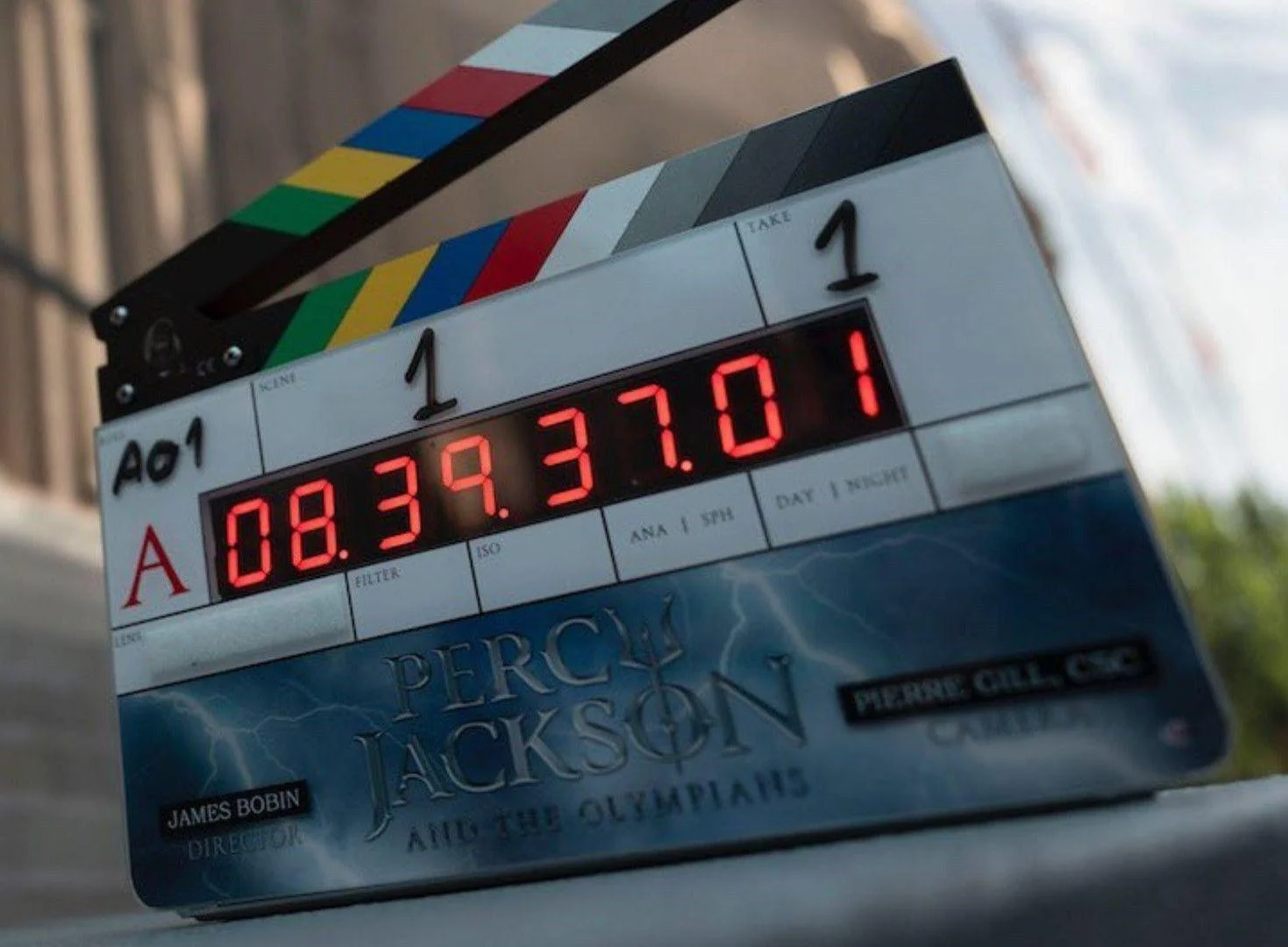
The Vancouver studio first opened its doors back in 2012 in the heart of Hollywood North’s historic neighborhood known as Gastown. ILM has led the visual effects industry in Vancouver over the past decade having worked on many large scale productions locally such as the epic Percy Jackson and the Olympians (2023).

Leading the Vancouver team was associate visual effects supervisor, Tania Richard who tells ILM.com, “the work consisted of a global initiative to repurpose ILM visual effects toolsets into a robust feature animation pipeline that would provide  flexibility and a stylistic consistency throughout the production. ILM Vancouver was responsible for building the character and environment assets on the show, working closely with the London and Singapore teams to refine and streamline elements that could be shared across multiple sites, along with producing a large scope of shot-work.”

Ultraman meets a baby kaijou that he comes to call Emi for the first time.
Ultraman meets a baby kaijou that he comes to call Emi for the first time (Credit: Netflix).

Having already worked closely with one of the film’s directors, Shannon Tindle on Netflix feature Lost Ollie (2022), the Vancouver team attributes the key to their success on Ultraman: Rising to their close collaboration with Netflix. This project provided them with the opportunity to build upon their relationship with Tindle, and to engage with him creatively. This close collaboration both inspired and empowered the team to share their ideas on a level that not all artists are given the chance to experience. 

“The Ultraman clients were one of the best I’ve ever worked with,” shares final layout lead, Hayley Kim.“There were many opportunities to exchange creative ideas with the directors. The clients even visited the Vancouver studio in person to talk one-on-one with the artists.” 

Directors Tindle and Aoshima came into the project with a clear vision, but entrusted ILM to bring fresh ideas and creative solutions that would enhance the work. “They valued the team’s input; empowered us with the belief that collective creativity would elevate the overall quality of the film. They achieved this without delaying decision making, or production time,” says CG supervisor Jeeyun Sung, who expressed her gratitude for having the directors readily available, which provided a valuable learning experience for the team and helped to speed up the production process. 

The creative collaboration between both the Netflix and ILM teams inspired the use of new techniques that are not usually embraced in visual effects. With a hero this big, and a new global audience to be introduced to, the film needed a fresh new approach to the animation not yet seen in a feature film. Having other hit animated superhero feature films already on the audience’s radars, such as Sony’s Spiderman: Into the Spiderverse (2018), meant finding a new look for Ultraman.

Ultimately, a painterly approach to shape the film’s aesthetic was decided upon, and as you can see when watching the film, every frame looks like it came straight off of a canvas. “Finding a painterly approach to our assets needed a certain amount of testing and collaboration between departments at the start of the project,” explains Tania Richard. “Implying detail and form when and where mattered; this meant leaning into more traditional artistic approaches and embracing individual instincts. Once a look was agreed upon, it was important to lock down methodology early enough to execute what was an ambitious schedule and volume of work.” 

The Netflix art department team, led by art director Sunmin Inn and production designer Marcos Mateu-Mestre, brought their creative vision and thrilling concepts early on in the production process, generously offering the ILM team stylistic guidance as they developed the look and feel for the direction that the animation would ultimately go.

Sung shares, “The one thing that will always stick with me is a quote from the art director, Sunmin at Netflix, ‘just use illegal colors’. As production neared completion, those illegal colors were the norm and we could hardly believe all of our eyes had adjusted to the vision.” The beautiful color scripts and art direction allowed the team space to explore bold and vibrant color palettes to tell Ultraman’s story. 

Mecha Gigantron, Emi, Ultradad and Ultraman form the ultimate team up to finish the fight with Dr. Onda.
Mecha Gigantron, Emi, Ultradad and Ultraman form the ultimate team up to finish the fight with Dr. Onda (Credit: Netflix).

With all 1,300-plus assets being built in Vancouver, one of the biggest challenges on the show was creating a robust animation pipeline that would maintain stylistic uniformity, be shared across multiple sites, have various artists working on shots simultaneously and have the work be executed with consistency. There needed to be enough flexibility for addressing creative notes and refinement. It needed to be built in so that the workflow remained efficient, with stylized techniques such as cross-hatching and linework being developed in toolsets to be shared with the London and Singapore sites. 

“Embracing a more creative, painterly approach to building assets was key, such as understanding the balance between suggestive and refined detail, as well as developing stylistic tools that referenced the visual graphic language often seen in anime and manga,” details Richard. 

Additional research and development time was required for each team across every part of the workflow; the team’s objective being to find the right balance between 2-dimensional (2D) graphic elements, such as outlines, texture details, cross hatching and the more realistic 3-dimensional (3D) rendering, a process with many possible directions. 

“Once we achieved the imagery that became the look of our film, we adhered to the ground rules and shared the know-how between sites and sequence teams to avoid reinventing the wheel; revisiting the questions we had already answered,” says Sung.

Ultimately, a significant part of the ILM Vancouver team’s task was to explore the concepts that would define the film’s style, establish a look that would not only stand out among other animated features, while also being robust enough for the crew to carry through 1,600-plus shots. In the end, the challenge of building the beautiful world of Ultraman: Rising was worth the long days as every magnificent pixel of the film are generated assets created internally and exclusively by ILM. 

The stylized animation needed to showcase every magnificent detail of the ultra-sized action sequences and spectacle that a hero like Ultraman brings to the big screen as he battles the larger than life kaijus through the streets of Tokyo. For the ILM Vancouver team, one of the highlights was working on the film’s opening sequences where Ultraman faces off against a kaiju called Neronga, which was ironically one of the last beats of the film to be executed.

“The dynamic battle sequences definitely stand out in my memory, particularly the fight scene between Ultraman and Neronga,” shares Kim, who was inspired to study classic Japanese monster films to pull ideas from scenes, like this one and Ultraman’s fight with Gigantron. 

The battle with Neronga sequence, known internally as MUL (Meet Ultraman), consisted of nearly 60 action-packed shots with dynamic moving cameras, set against the colorful and complex streets of Akihabara, a bustling section of Tokyo adorned with vibrant lights, billboards, and crowds. All of these elements had to embrace a certain amount of interaction between our hero and his monstrous adversary, who are entangled in a clumsily destructive confrontation. Richard says, “It was important in the development of our environment assets for each neighborhood to reflect reality, from the elevation of buildings to details such as street signs and road markings, and our Akihabara set was no exception.”

Ultraman battles with Gigantron.
Ultraman battles with Gigantron (Credit: Netflix).

ILM Vanouver’s model supervisor, Mark Keetch, led the environment build, paying close attention to references provided by the Netflix Art Department, along with detailed research by the ILM team. The lighting and compositing teams, led by our CG supervisor Jeeyun Sung and comp supervisor Aaron Brown, also implemented various techniques developed throughout the production to create the exciting and highly stylized feast of imagery which were key components to the success of this sequence.

Sung shares, “The result exceeded our expectations. Every artist brought so much creativity to each of their shots, and by then we had built a Swiss army knife’s worth of knowledge of how to handle the style. Everyone was truly having fun! The energy was palpable, and I believe it contributed to creating stunning visuals!”

The action only grew larger and more epic from one battle sequence to the next; enhanced by the imaginative work and creative solutions that the ILM team worked tirelessly to innovate. Much like Ken Sato’s relationships with Emi and his father throughout, the Vancouver team were united in their efforts and passion to bring this epic story to audiences across the world, and truly capture the spirit of the character that directors Tindle and Aoshima care so deeply for. ILM’s team spirit can be felt with every frame as their own experience working on the film was just as meaningful.

“Working on the Ultraman team was filled with nothing but positive memories from start to finish,” shares Hayley Kim, who was given her first leadership opportunity at ILM on Ultraman: Rising.“It was incredibly fulfilling to see the final result at the screening, knowing that ILM was involved from beginning to end. I hope there will be more opportunities in the future to work on such creative projects.” 

Ultraman was a relatively rare feature animation project for ILM after a long time had passed since Rango,” explains Jeeyun Sung, who resides in New York, USA, but worked intimately with the ILM Vancouver team over the course of the project.  This created an exciting energy for all crew members, from the bottom to the top. We faced new pipeline issues to solve, had new roles and language that needed reshaping. But the prospect of carving a new path for future animation projects at ILM kept us all abuzz. We felt incredibly happy and fortunate to have this opportunity.”

“Our Vancouver team was a delight to work with, and the collaboration between ILM globally was a  unique experience,” concludes Tania Richard, who led the Vancouver team through a memorable creative journey which produced one of the most beautiful animated features to ever be seen on screen. “Everyone embraced the creative challenges on the show in a way that continually inspired the team to go above and beyond what was expected, and the resulting body of work is beautiful.”

There are over 7,500 kilometers between Ken Sato’s home in Tokyo and the team in Vancouver that built the vibrant new world seen in Ultraman: Rising. It took two years, and countless hours, but the final product is a breathtaking addition to the Ultraman franchise, and a bold new direction for ILM as they begin to expand their catalog of animated projects, including the recently released Transformers One (2024). Two worlds came together across great distances to bring this story to life by ILM’s passionate artists who knew the magic it would take to to effectively showcase the heart of Ultraman: Rising

Ultraman punches his fist into the air.
(Credit: Netflix).


Adam Berry is the Studio Operations Manager for the ILM Vancouver studio. His passion for film led Adam to ILM in 2022, coming from an extensive career across different sectors of the hospitality industry including cruise ships, luxury hotels and resorts. If he’s not at the movies or traveling to new destinations, you can find Adam staying active and exploring Vancouver. 

ILM’s Vancouver & London studios realized everything from ingenious facial replacements to a challenging plate composite for one cohesive action shot.

By Adam Berry

After the events of Marvel’s Hawkeye left Maya Lopez in an intense standoff with the powerful Kingpin, she finds herself now on the run from her criminal life, returning to her roots where she must confront her past and discover her true power; becoming the hero known as Echo (Alaqua Cox). 

As with any Marvel production, big action set pieces and storytelling are promised elements that bring the massive scope of these heroes’ lives from page to screen. As Echo is a formidable hand-to-hand combatant, with unique abilities not yet seen in the Marvel Cinematic Universe (MCU), the action needed to deliver.

Industrial Light & Magic was called upon to create some of the biggest action sequences in the show, with work being shared between the London and Vancouver studios. All together, ILM contributed an amazing 467 shots, from start to finish, with a fast turnaround of only six months.

ILM was awarded some really fun sequences to work on. From a thrilling train heist with a full CG environment, digidoubles and CG train; to a roller rink brawl requiring many face replacements and fight enhancements; a huge warehouse explosion and a photoreal CG woodpecker.”

Steven Godfrey, Visual Effects Supervisor
Daredevil joins the fight in an epic faceoff against Maya during “The Oner”.
Daredevil joins the fight in an epic faceoff against Maya during “The Oner”. 

Echo is the first MCU project to be released under the TV-MA rating for mature audiences, so the visual effects team had a lot of freedom to play around with the blood and gore for the fight sequences. At the client’s request, the stylistic violence and gore from the John Wick films were used as a reference for the show.

One pivotal action sequence that ILM was tasked with creating, known as “The Oner,” was particularly complex for the team. The work on this sequence was to stitch together multiple plates and takes as the action progresses. The scene follows Maya as she makes her way along a series of hallways, fighting off a group of security guards; knocking them to the ground one by one, showcasing her martial arts capabilities. As the security guards lay unconscious, Maya is led into a larger room by a mysterious new adversary, resulting in the main fight. The action intensifies and reveals her new opponent as none other than the man without fear, another Marvel favorite, Daredevil (Charlie Cox). The two then face off in an epic duel that moves between a large open space and a tighter caged area full of weapons.

To make the scene as visceral as possible, there was a combination of making multiple plates blend seamlessly between takes. With multiple face replacement shots for the actors, blood spurts and destruction added to the environment, “The Oner” is among the most exciting sequences from the whole show. 

It was challenging work for the team to get the plates to stitch together seamlessly; to hide transition points while ensuring that the action is still flowing throughout. By using a combination of wipes, warps, retimes and some manual tracking of multiple takes, ILM was able to stitch together all of these elements to form one cohesive shot.

Maya sends a deadly message to Kingpin’s army that ends with an explosive warehouse scene during Episode 2.
Maya sends a deadly message to Kingpin’s army that ends with an explosive warehouse scene during Episode 2. 

The biggest challenge for the team on this sequence, and others throughout the show, was face replacement work. The shots required would be fairly close to the camera and require a lot of facial performance during the intense fighting sequences. ILM became involved with the project after principal photography on Echo had wrapped, so there was limited data capture available to work with. Face replacements were especially needed for the fight sequences involving Alaqua Cox. As she is relatively new to the industry, there wasn’t a lot of data available to reference, or a Facial Action Coding System (FACS) session to capture her facial expressions, so only the footage taken during filming could be utilized. 

In total, there were about 35 shots of face replacement work throughout the show. There were different approaches taken to emulate Cox’s likeness, such as trying a 2D replacement, building a 3D digidouble and using ILM’s FaceSwap.

There wasn’t enough coverage from takes to use a 2D replacement; not enough time to build a digidouble to the standard that the showrunners wanted, and not enough footage of Cox to use for an accurate Face Swap. With limited data, there was some experimentation required to figure out how to best achieve the most accurate facial performance possible.

This was vital because Cox is very expressive during the action sequences, so the facial expressions needed to have the same energy otherwise it might feel lifeless jumping between cuts.

The plan came down to using a 3D digidouble while training a Face Swap in the background, just in case it could provide anything of use. The Face Swap took three weeks to build, and was based on only 20 minutes of footage of Cox.

After some experimentation, the solution was for ILM to utilize a combination of Face Swap with a traditional digi-base setup to accurately replicate Cox’s likeness.

The results were great and provided a better likeness of the actress, adding a photographic level of realism that was difficult to achieve using only the digidouble.

“I feel like the work done here to overcome this challenge has strengthened, or expanded how we can implement something like this again.” – Tristan Myles, Visual Effects Supervisor

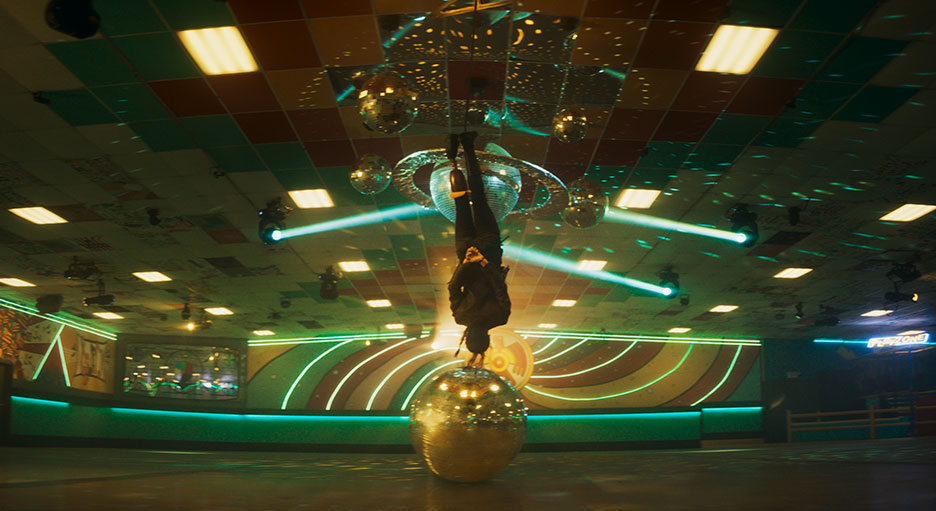
In Episode 3 Maya faces off against some of Kingpin’s assassins in a chaotic roller rink melee.
In Episode 3 Maya faces off against some of Kingpin’s assassins in a chaotic roller rink melee. 

ILM’s contributions brought the explosive action sequences to life, while also making them feel grounded and realistic. The action continued onto a roller rink brawl, involving work to remove cables for stunt rigging, crash mattes and tricky crew removal from reflective surfaces, such as a giant disco ball; to an epic fight on a moving train, which needed extensive environment and animation work; then finally, a warehouse explosion calling for the team to replace the skyline, create explosions and augment explosion element plates. 

The fight sequences and action only got bigger throughout the show, delivering some of the most thrilling sequences from any MCU project yet. The vision of bringing the pulse-pounding action of this iconic character to life was fully realized by the talented crew with artistry that only visual effects can create.

Maya sabotages a train car by planting a bomb during a heist that sends her flying to escape before it’s too late.

Adam Berry is the Studio Operations Manager for the ILM Vancouver studio. His passion for film led Adam to ILM in 2022, coming from an extensive career across different sectors of the hospitality industry including cruise ships, luxury hotels and resorts. If he’s not at the movies or traveling to new destinations, you can find Adam staying active and exploring Vancouver. 

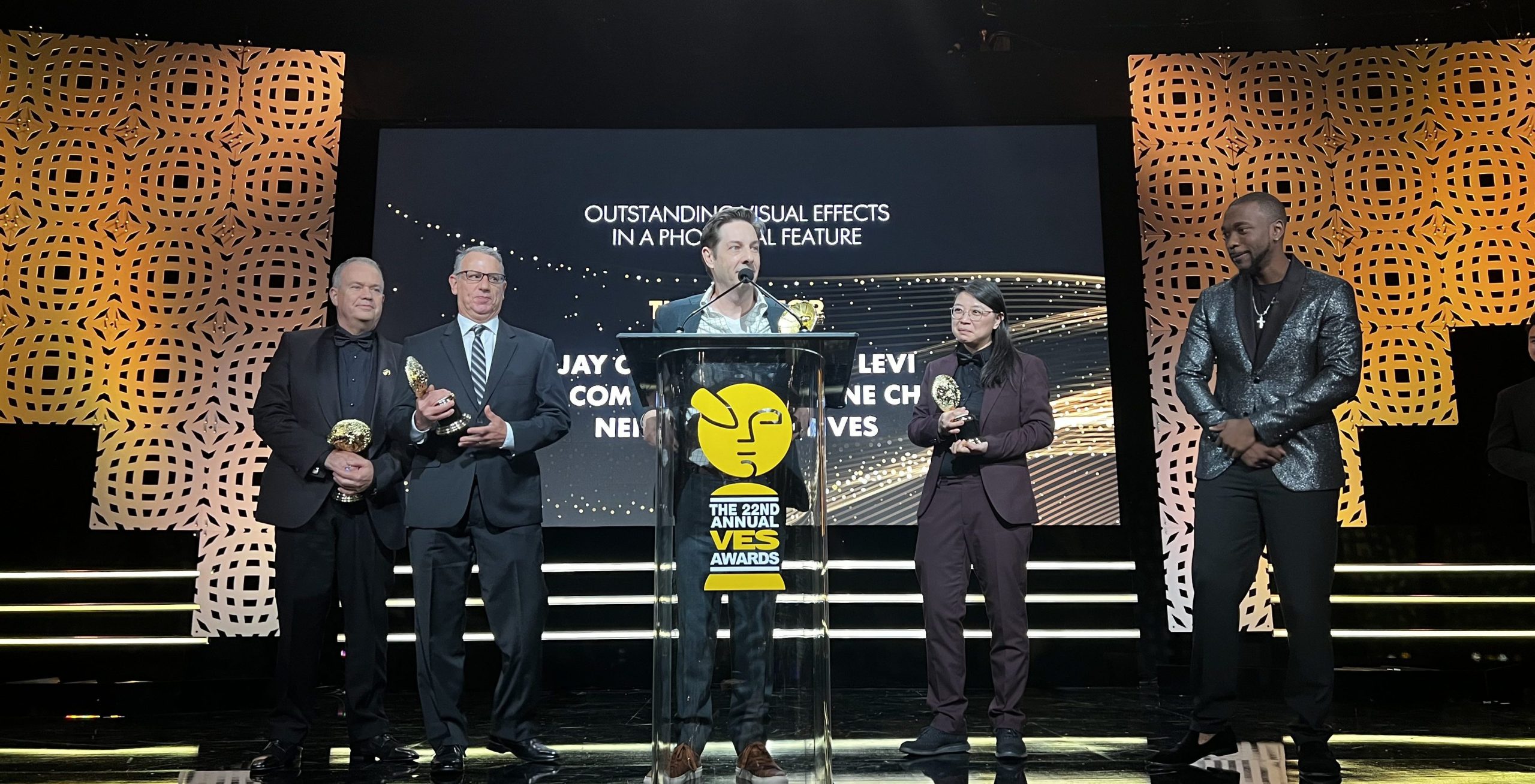
Wednesday evening, the Visual Effects Society (VES), the industry’s global professional honorary society, held the 22nd Annual VES Awards, the prestigious yearly celebration that recognizes outstanding visual effects artistry, and innovation in film, animation, television, commercials, video games, and special venues.

ILM’s work on The Creator earned six nominations and won four awards including the coveted top prize Outstanding Visual Effects in a Photoreal Feature, Outstanding Created Environment in a Photoreal Feature, Outstanding Model in a Photoreal of Animated Project, and Outstanding Effects Simulations in a Photoreal Feature, with a partner company winning a fifth award for the film for Outstanding Compositing and Lighting in a Feature.

ILM’s work on Darren Aronofsky’s groundbreaking film Postcard from Earth won for Outstanding Visual Effects in a Special Venue Project while The Mandalorian (Season 3) won for Outstanding Effects Simulations in an Episode, Commercial, Game, Cinematic or Real-Time Project.

“It’s a true testament to our amazing global teams that our work was honored by our industry colleagues on the winning shows noted above as well as the ILM shows that were nominated, including Indiana Jones & The Dial of Destiny, Ahsoka, Willow, Mission: Impossible, Dead Reckoning Part One, Dungeons & Dragons: Honor Among Thieves, Napolean, Killers of the Flower Moon and Guardians of the Galaxy, Vol. 3” said Janet Lewin, ILM General Manager, “I couldn’t be more proud of our teams.” 

Gareth Edwards’ The Creator leads the feature film field with seven nominations six of which are for ILM work.

In all, ILM visual effects artistry was recognized with 19 nominations including those for The Creator. Indiana Jones and the Dial of Destiny, and Dungeons & Dragons: Honor Among Thieves joining it in the top category, outstanding Visual Effects in a Photoreal Feature. Napoleon and Killers of the Flower Moon were each nominated for Outstanding Supporting Visual Effects, and Ahsoka and The Mandalorian were each nominated for Outstanding Visual Effects in a Photoreal Episode. Darren Aronofsky’s Postcard from Earth received a nomination for Outstanding Visual Effects in a Special Venue Project while Willow, Indiana Jones and the Dial of Destiny, The Creator, Napoleon, Loki, and The Mandalorian, also received craft category nominations.

“We are seeing best-in-class work that elevates the art of storytelling and exemplifies the spirit of innovation. The VES Awards is the only venue that showcases and honors these outstanding artists across a wide range of disciplines, and we are extremely proud of our nominees,” said VES chair Kim Davidson.

The VES is a global honorary society dedicated to “advancing the arts, sciences and applications of visual effects and to upholding the highest standards and procedures for the visual effects profession.”

Awards will be presented at the 22nd Annual VES Awards on Feb. 21 at The Beverly Hilton Hotel in Los Angeles. 

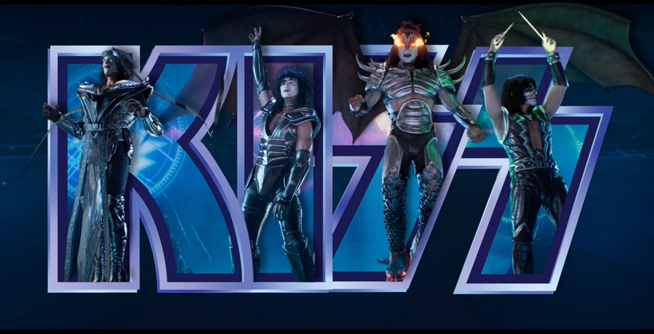
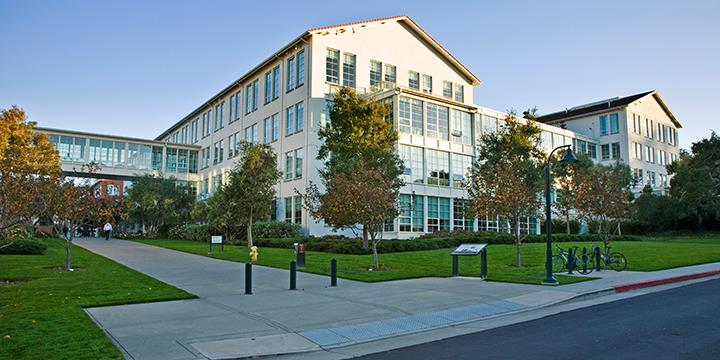
The end is only the beginning. KISS have been immortalized and reborn as avatars to rock forever. Created by Industrial Light & Magic (ILM) in collaboration with the band and Pophouse Entertainment Group, the avatars portray each of the four band members in an idealized, and at times superhuman form. Months before the supergroup’s final show which would take place on December 2, 2023, KISS joined ILM’s visual effects team at its San Francisco headquarters to get measured, scanned, and photographed before slipping into sleek motion capture suits so the crew could record every nuance of their final performance. ILM’s StageCraft virtual production team would then simultaneously capture each band member’s performance from their facial expressions to their fingertips as they played in “God Gave Rock ’N’ Roll to You II” in unison.

The KISS Avatars

The KISS avatars showcase ILM’s unique creative expertise and artistry using their advanced performance-capture technology. The team was led by Academy Award® nominated Visual Effects Supervisor Grady Cofer. Cofer has over 20 years of experience supervising groundbreaking visual effects projects. Cofer is currently nominated for an Emmy Award for Outstanding Special Visual Effects in a Season for his work on The Mandalorian. Prior, he served as Overall Visual Effects Supervisor on Space Jam: A New Legacy and earned an Academy and BAFTA nomination for his contributions to Steven Spielberg’s Ready Player One. Cofer’s three-year collaboration with Spielberg utilized cutting-edge virtual production tools to bring the OASIS, the project’s vast virtual world, to the big screen.  

“This is the sneak peek as the band crosses over from the physical world to the digital. We want to give fans a sense of the many forms this band could take in the future.”

Grady Cofer, ILM visual effects supervisor

Cofer’s ILM team leveraged the company’s decades-long experience to push the capabilities of performance capture, gathering every nuance of KISS band members’ face and body performance in exacting detail. This data would in turn become the basis for the motion of the band’s virtual avatars. The raw facial capture data was processed in real-time via ILM’s advanced machine learning algorithms for instantaneous feedback on stage and later passed through the ILM pipeline to be augmented by the artists to ensure the resulting performances were exactly as the band intended for their new digital personas enabling KISS’s creative output to continue to enthrall audiences well into the future.  

As the band’s final concert drew to a close, lead singer Paul Stanley’s avatar proudly exclaimed “KISS Army, your love, your power has made us immortal! A new KISS era starts now.” The digital group then performed its hit single “God Gave Rock ’N’ Roll to You II” to the delight of the concertgoers who filled the sold-out Madison Square Garden.

The filmmaker and Lucasfilm legend talks to ILM.com to reflect on what drew him to tell the story of the hit Disney+ series, “Light & Magic”.

Screenwriter and director Lawrence Kasdan.

How did you get involved with Light & Magic?
Several years ago my wife and I made a short documentary about a little diner that we used to eat at all the time that suddenly closed. In making that documentary with her, and cutting it with terrific people, it made me realize how much I liked the documentary format. I had never done that. We set out to meet some documentary people and I met Justin Wilkes at Imagine Entertainment. He asked me what I was interested in doing and I suggested a history of visual effects, because even though I had been around visual effects throughout my career, it occurred to me that I didn’t know much about them. The second thing that interested me were the people of Industrial Light & Magic that I had been working around for over forty years. So we both agreed that that would be a great story to tell: the history of visual effects, and the personal stories of these people. What drove these people, what was their life like, what made them want to stay at ILM as long as they did? Everyone loved the idea, so we went to work.

Lawrence Kasdan, center, on the set of Star Wars: The Empire Strikes Back.

What was your vision for the documentary?
From my very first film until today, I’ve always considered myself a humanist filmmaker. I’m interested in what happens between people, and why people make certain decisions in their lives. What chance is involved? What fate? What luck? So from the very beginning of this I was interested in learning what brought these people to this work. What were the relationships that they made when they arrived? Why did they continue to work there much longer than they expected, some for nearly half a century? What has all that meant to these amazing advancements in technology? It’s about people, and their gifts, and out of those gifts came technological advancements that boggle the mind.

Dennis Muren, left, and Phil Tippett, right, review images with Joe Johnston.

Why did you think this story should be told?
Because it’s great to see artists at work. The commitment of great craftsmen. I love to see people that have mastered a skill, and try to make it better, and don’t settle. I think it’s great to see expertise and this pure devotion to discipline, and that is always a good story to see. Dennis Muren, left, and Phil Tippett, right, review images with Joe Johnston.

John Dykstra and a fleet of miniature TIE, X-wing, and Y-wing starfighters.

How did you approach the research, and what resources did you use?
We had a fabulous team that Imagine Documentaries put together, some internal to the company, and some that were freelancers. They really knew their stuff, so it was a great luxury for me as a director. There were so many things that I wanted to ask during interviews, but the input from this incredible group of producers and writers and editors stimulated me all of the time to go in different directions during interviews.

ILM’s Paul Huston and Larry Tan on the set of Star Wars: Return of the Jedi.

For those that have yet to watch it, can you tell readers what the timeline of the series is?
Over the six hours we see the very birth of ILM, what happened as it came together during the production of Star Wars: A New Hope, and then off of the success of that film, how it was launched into a nearly fifty-year enterprise. We mainly follow it chronologically, but we do jump around a bit to serve the story. Part of the kick for me was that we had such a trove of archival footage, so these people might be talking about something from forty or fifty years ago, and we had stills from that moment in their career. It was incredible to be able to cut from one to the other across time, to hear them talking about a problem, and then see footage of them finding a solution. A huge part of ILM’s legacy is finding solutions to problems.

Peter Kuran, Rose Duignan, and George Lucas review effects shots for Star Wars: A New Hope.

How did you select the filmmakers that were featured in the documentary?
They are all giants, and they have all used ILM in the most expressive and innovative ways. They put pressure on themselves and then turned to ILM and said, “can you do this? Can you create something for me that I have never seen before?” ILM would always say yes. And sometimes it might be a struggle, and sometimes it might be a long process, and sometimes it might be an instantaneous solution where one of these genius people that work there would say, “I know what we could do”. These are major filmmakers that have contributed to the zeitgeist. Jim Cameron, Steven Spielberg, Bob Zemeckis, J.J. Abrams, and at the heart of it, of course, is George Lucas.

Lawrence Kasdan and J.J. Abrams on the set of Star Wars: The Force Awakens.

What was the most interesting thing you learned throughout the process of creating Light & Magic?
I think I learned what goes into creating something new, working with people you respect and depend on, and how this personal relationship then impacts the professional work. There is something beautiful about the generosity of the people that work at ILM, and through that generosity they are able to discover new frontiers and break new grounds that no one has ever been able to do.

All episodes of Light & Magic are streaming now on Disney+.

ILM | A legacy of innovative and iconic storytelling.

“I wanted to make sure we brought the magic back to the ILM logo,” noted John Knoll, Industrial Light & Magic’s Executive Creative Director, participating in one of the dozens of interviews completed over the course of the fourteen-month rebranding project for the renowned visual effects and animation studio founded by George Lucas. 

“We wanted our new branding to pair closely with ILM’s mission statement, We are visual storytellers who create iconic moments to inspire the imagination”, explained Janet Lewin, SVP General Manager, ILM, “At ILM, we prioritize our culture of collaboration and community and we truly value innovation and quality. These core ideals allow us to confidently take risks and embrace the unknown on the challenging projects we seek out.”

Knoll was one of over a thousand ILM employees who provided input to twin sisters Amy and Jen Hood who own the Southern California brand identity and type design studio, Hoodzpah. As part of their exploration of ILM, its employees, its legacy, and its values, the interviews revealed fascinating insights into the company and how it has managed to keep both its creative team inspired and its technology on the cutting edge of innovation for nearly five decades. Knolls’ sentiment struck a chord and it became an oft-referred phrase as the Hoodzpah team collaborated with a core group of ILM leaders on how best to capture the company’s incredible legacy while building a unique identity system that would serve it well into the future.

“ILM has several different logos in the past forty-eight years,” explained Rob Bredow, SVP and Chief Creative Officer for ILM, “and all have incorporated the core elements from the company’s original logo, the famous wand-wielding magician framed by a large gear with the letters ‘ILM’ originally illustrated by Michael Pangrazio in the late 1970s and later finalized in a painting by renowned artist, Drew Struzan. The company and the industry have evolved substantially in the past eighteen years and we felt the time was right to develop a new brand identity that captured the global studio we’ve become.”

Now with six global studios—San Francisco, Singapore, Vancouver, London, Sydney, and Mumbai—ILM has not only revolutionized the field of visual effects with groundbreaking innovations in digital effects, performance capture, previsualization, and digital humans, and has most recently innovated in areas as diverse as real-time rendering, immersive entertainment, and virtual production with it’s Emmy Award-winning StageCraft platform.

Hoodzpah began the assignment by getting to know the company through individual and group interviews with key members of ILM’s leadership team and representatives of the employee base across all strata of the studio and each of ILM’s globe locations. Then came the task of distilling the information into key learnings. “It was remarkable given the sheer number of people we interviewed that there was such cohesion in terms of what the employees felt the brand represented and where they aspired to be,” said Jen Hood.

The new dynamic glyph and custom wordmark combine to draw from the company’s illustrious legacy while carrying it into the future. Amy Hood, explained, “The mark utilizes negative space within the silhouette of a gear giving the impression of a lightbulb contained within, both elements existed in the company’s original logo by Pangrazio and Struzan. We incorporated a swoosh trailing a spark of magic in the new mark which represents the global nature of ILM’s talent base and studios. Paired with the mark is the Industrial Light & Magic wordmark designed and set in a bold customized serif face evocative of the abbreviated type in the company’s original logo.” The team also developed updated logos for sub-brands ILM Art, ILM StageCraft, ILM Technoprops, and ILM Immersive (formerly ILMxLAB). The supporting visual identity uses cinematic colors inspired by ILM projects over the years, as well as bold type, and stark minimal layouts. The rebrand scope spanned deck templates, social media assets, a new homepage redesign, logo animations, swag, and more.

Now in its 48th year of existence, ILM continues to be a creative partner to storytellers and filmmakers alike. The talented artists, technicians, and production teams ensure that the company remains on the cutting edge as they continue to develop new techniques and technologies that allow audiences the world over to be immersed in the visuals and experiences the company helps to create.