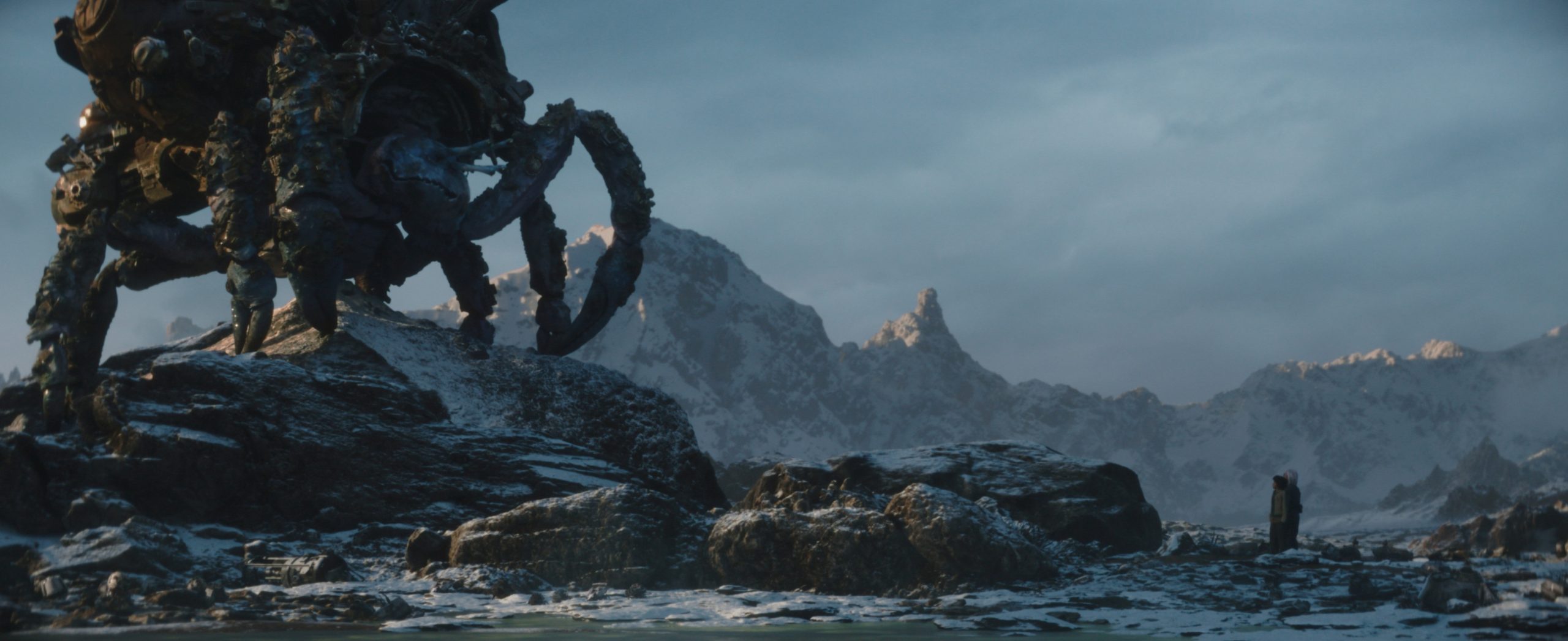
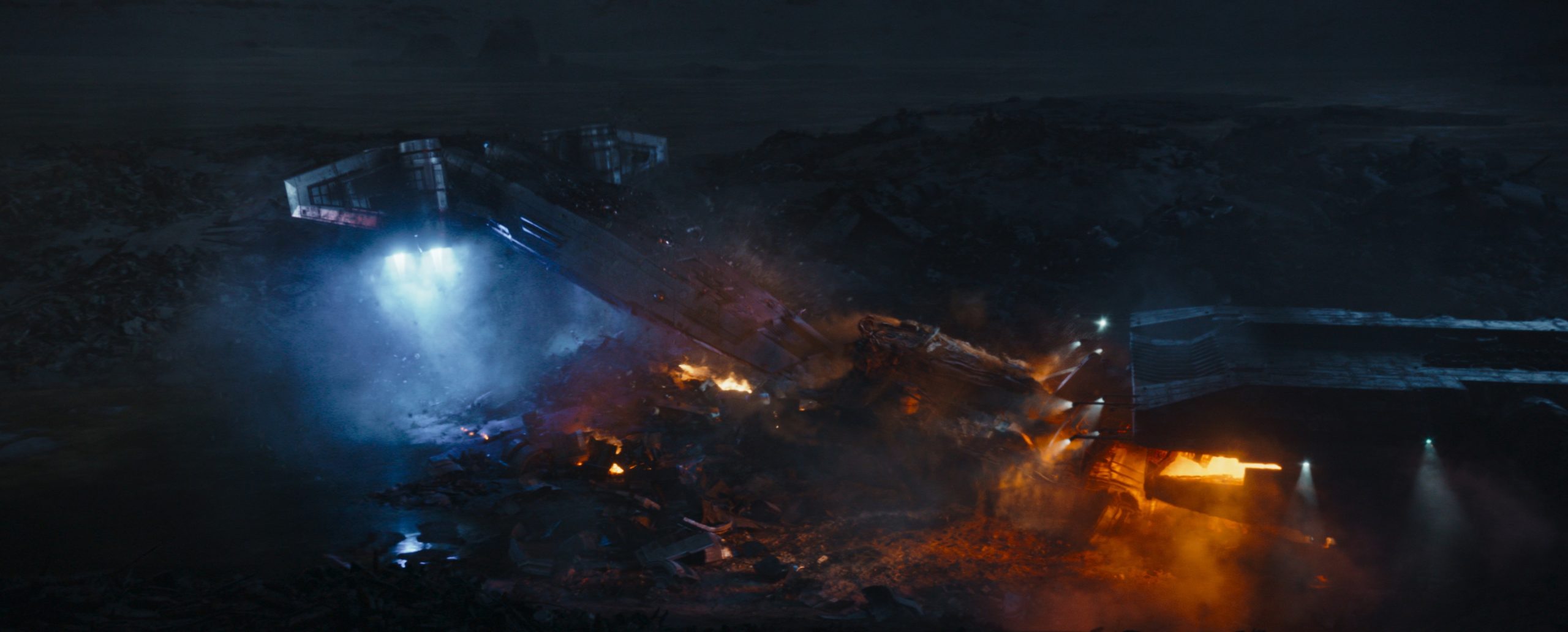
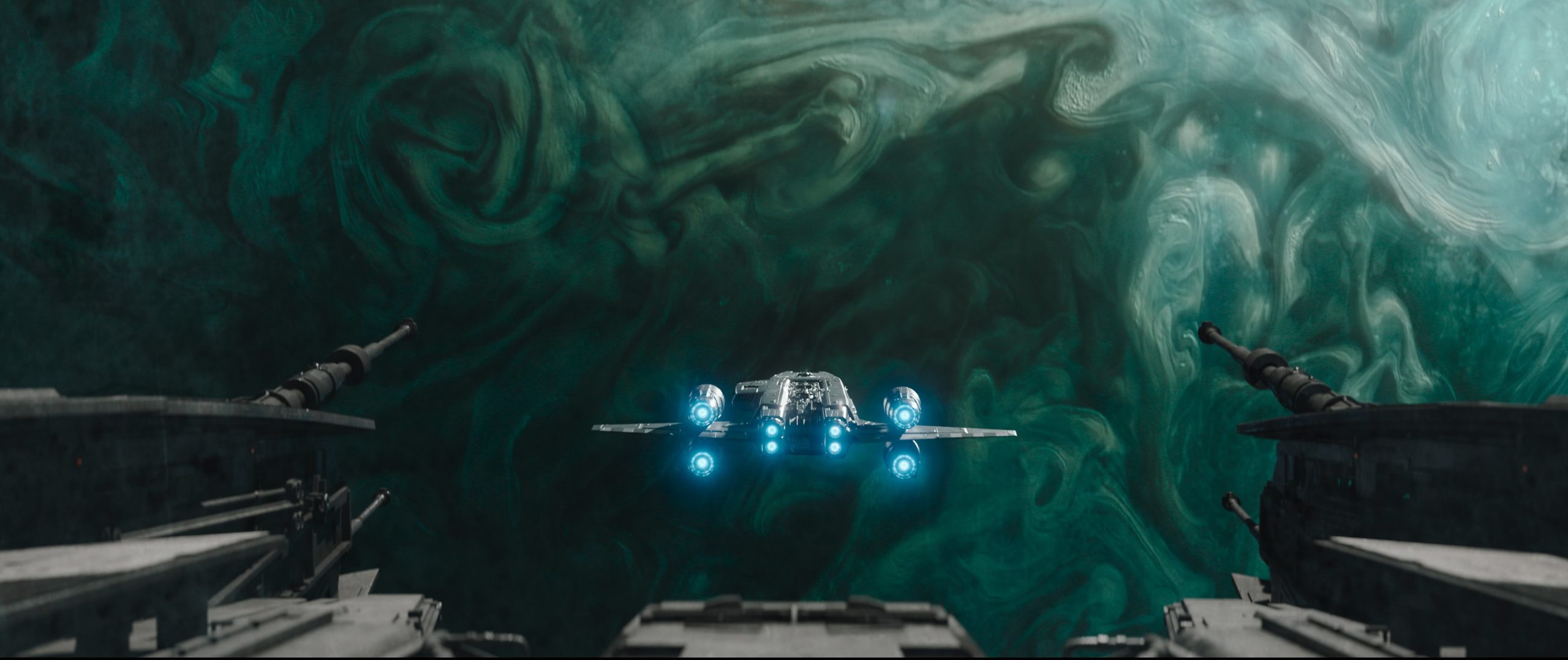
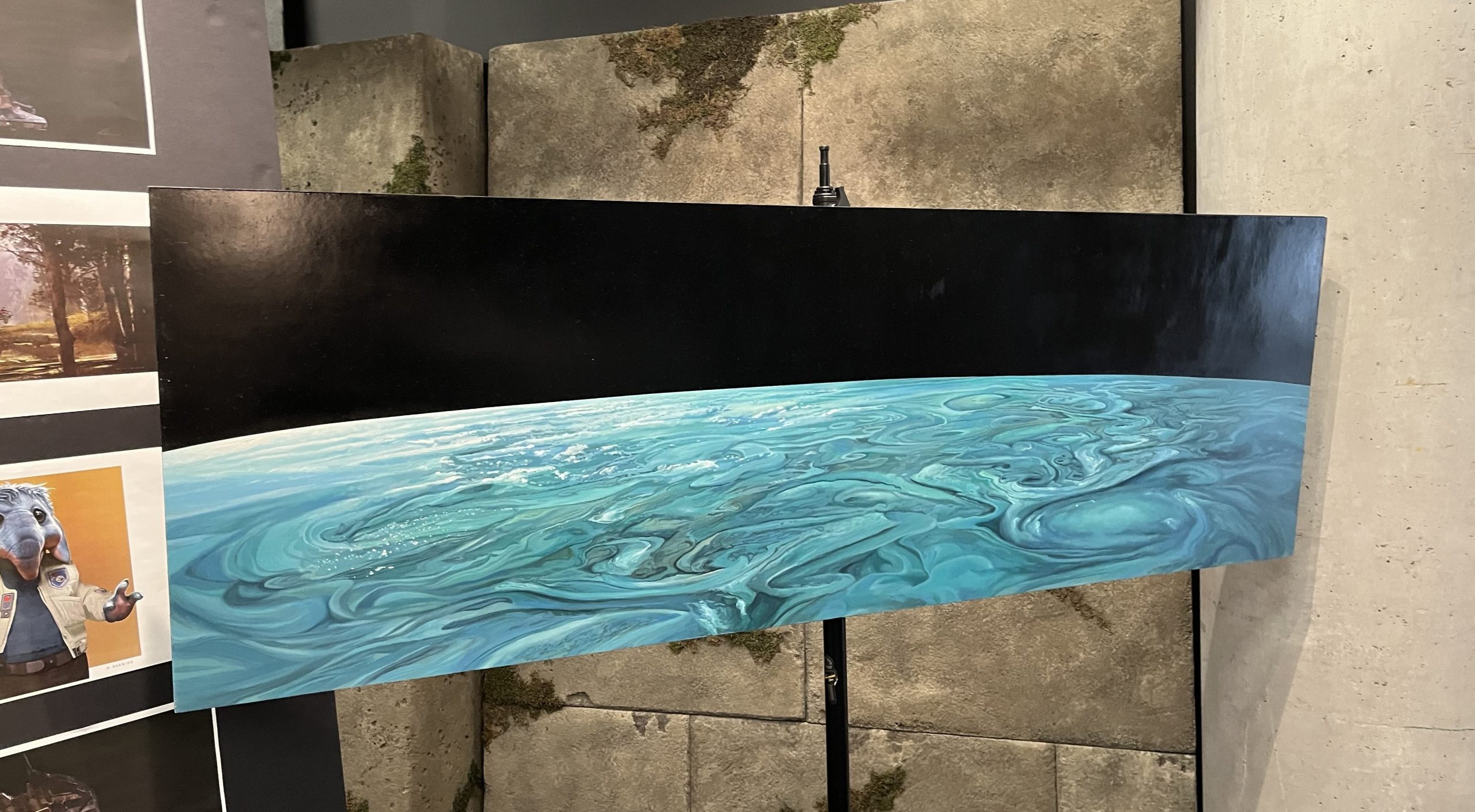
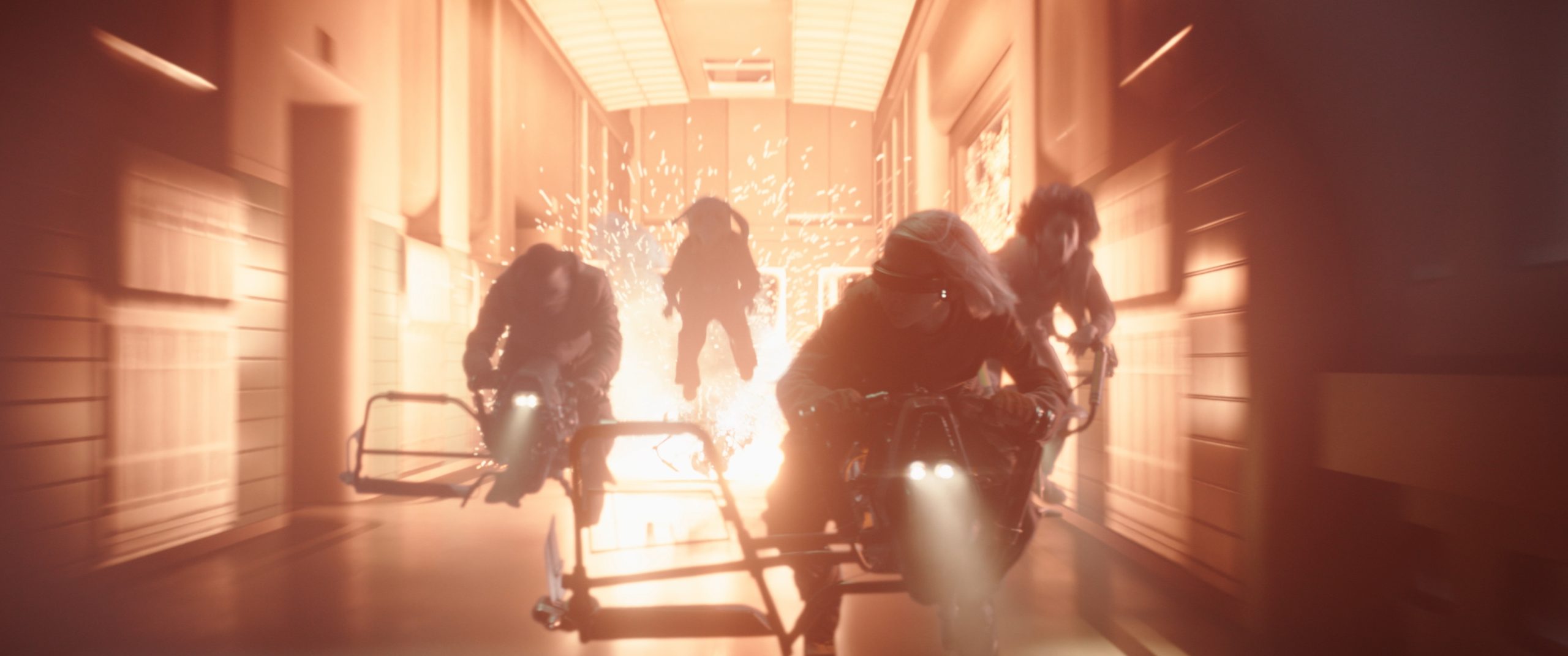
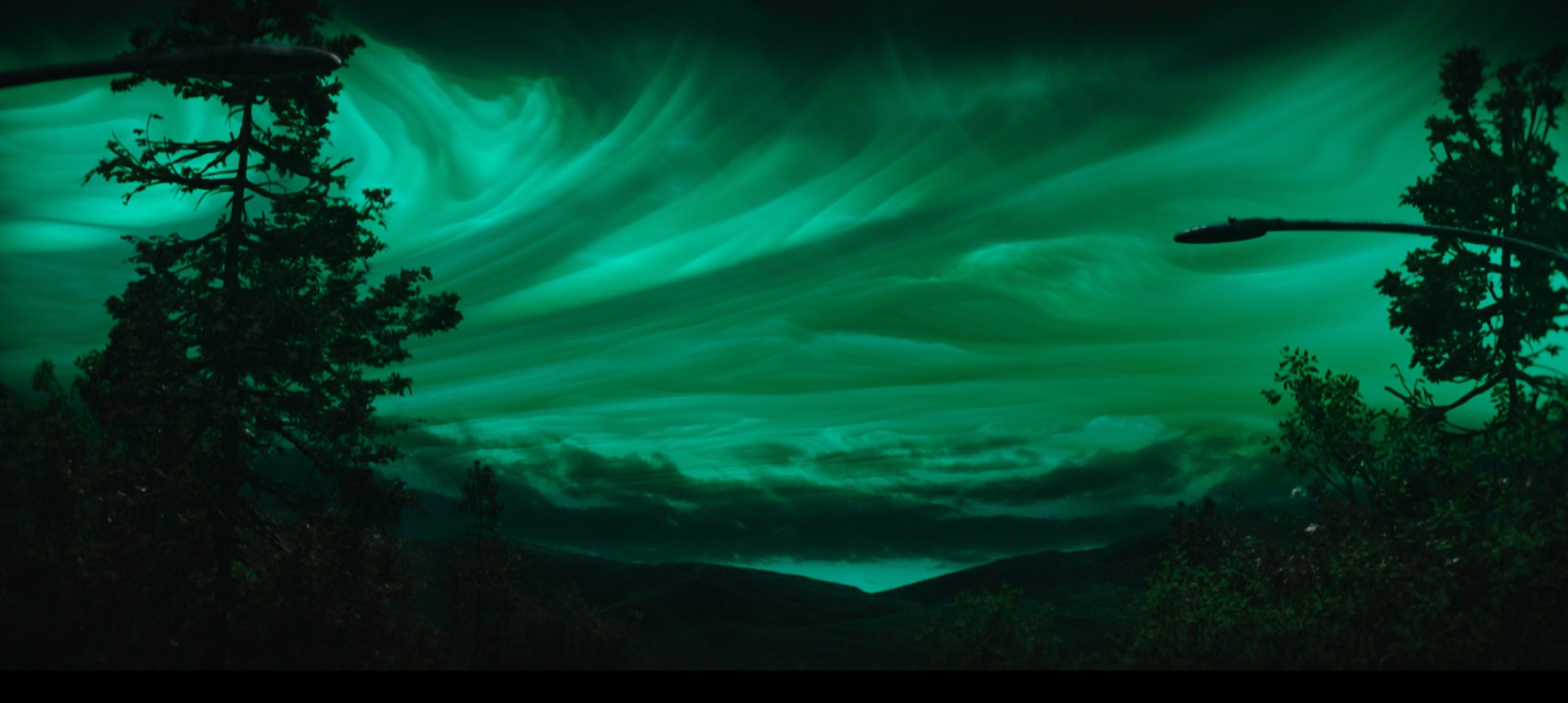
The final part of ILM.com’s discussion with Andor‘s overall visual effects producer and production visual effects supervisor covers the influence of Rogue One, collaborating with Tony Gilroy, their favorite moments from season two, and more.
By Mark Newbold
In part one of our conversation, TJ Falls (vice president of visual effects at Lucasfilm and Andor’s visual effects producer) and Mohen Leo (Andor’sproduction visual effects supervisor) discussed location shooting and the logistics of bringing Andor (2022-25) to audiences worldwide. Now, we continue our dive into the Emmy-nominated second season and the teamwork required to shepherd the story from the page to the screen.
It takes an army to bring a film or TV series from the imagination of the writers to screens around the world, and that means teamwork is key, as Mohen Leo explains.
“This project was somewhat unique in terms of how collaborative people were. You have certain projects where the director’s attitude is, ‘This is what I want, I don’t care how you do it, just figure it out.’ This was a case of everyone collectively understanding that we were trying to get as much value on screen as possible. That meant I could go to [editor] John Gilroy and say, ‘Hey, that choice you made will cost a lot of money; is it really worth it? It doesn’t feel like this is where we want to put all the effort.’ There were specific instances where he would say, ‘Okay, give me some time, I’ll have a look. If there’s a different way to cut this, I’ll let you know.’ Sometimes he came back and said, ‘Yep, I’ve managed to get rid of the shot and it feels just as good.’ That allows us to take those funds and put them elsewhere to make something else bigger and more exciting.”
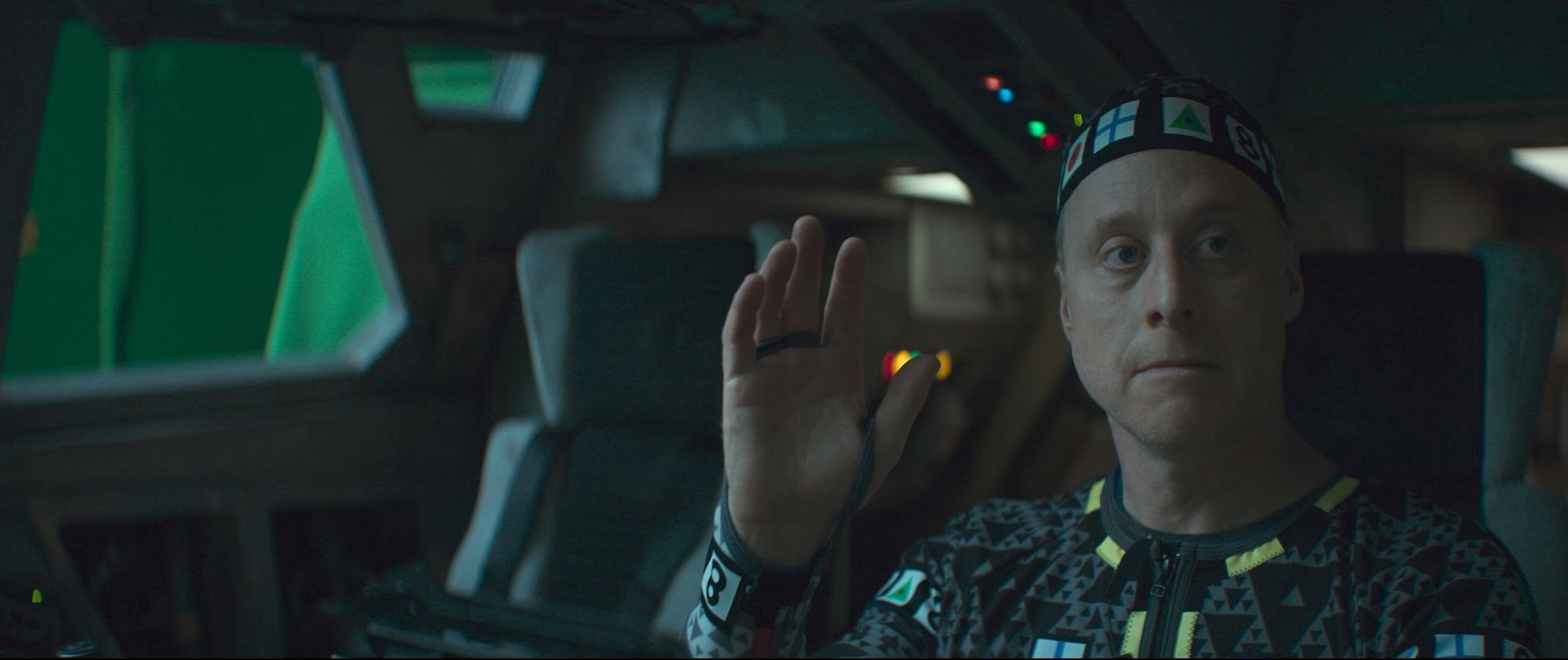
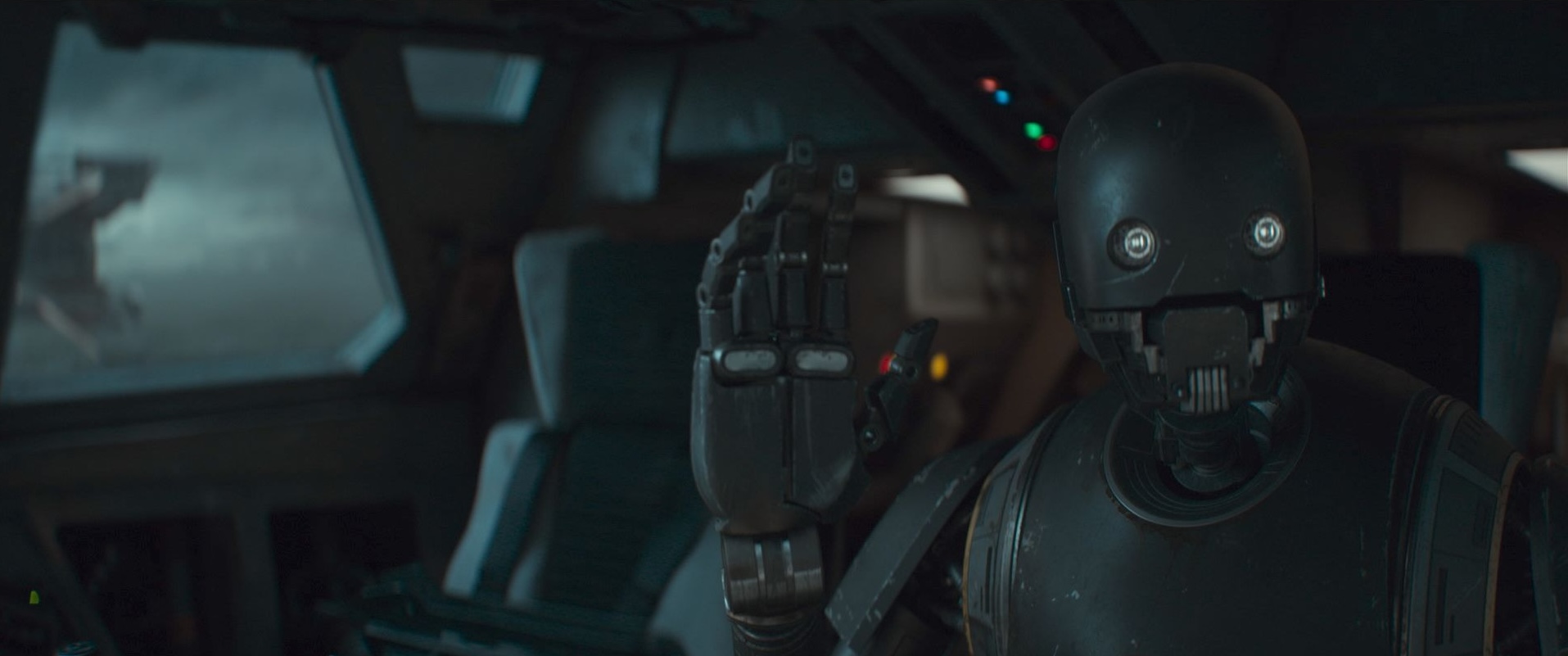
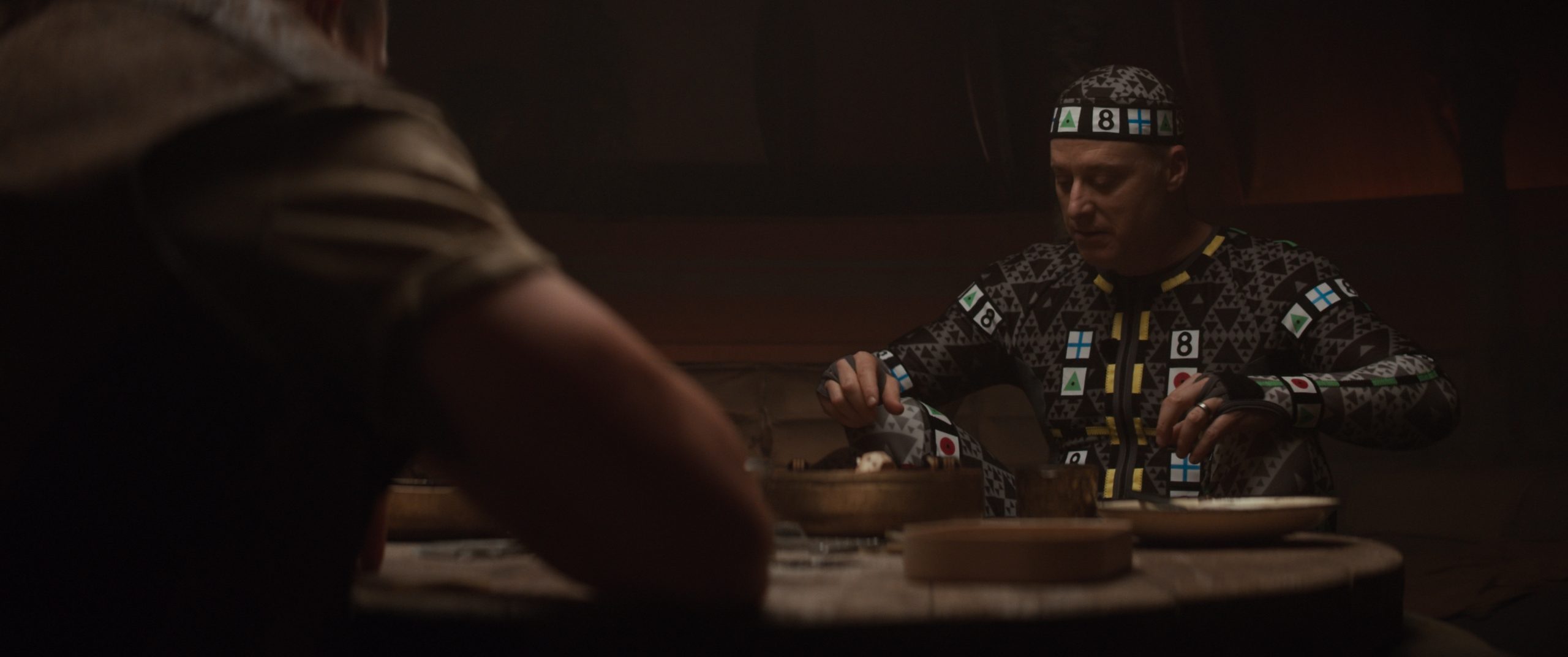
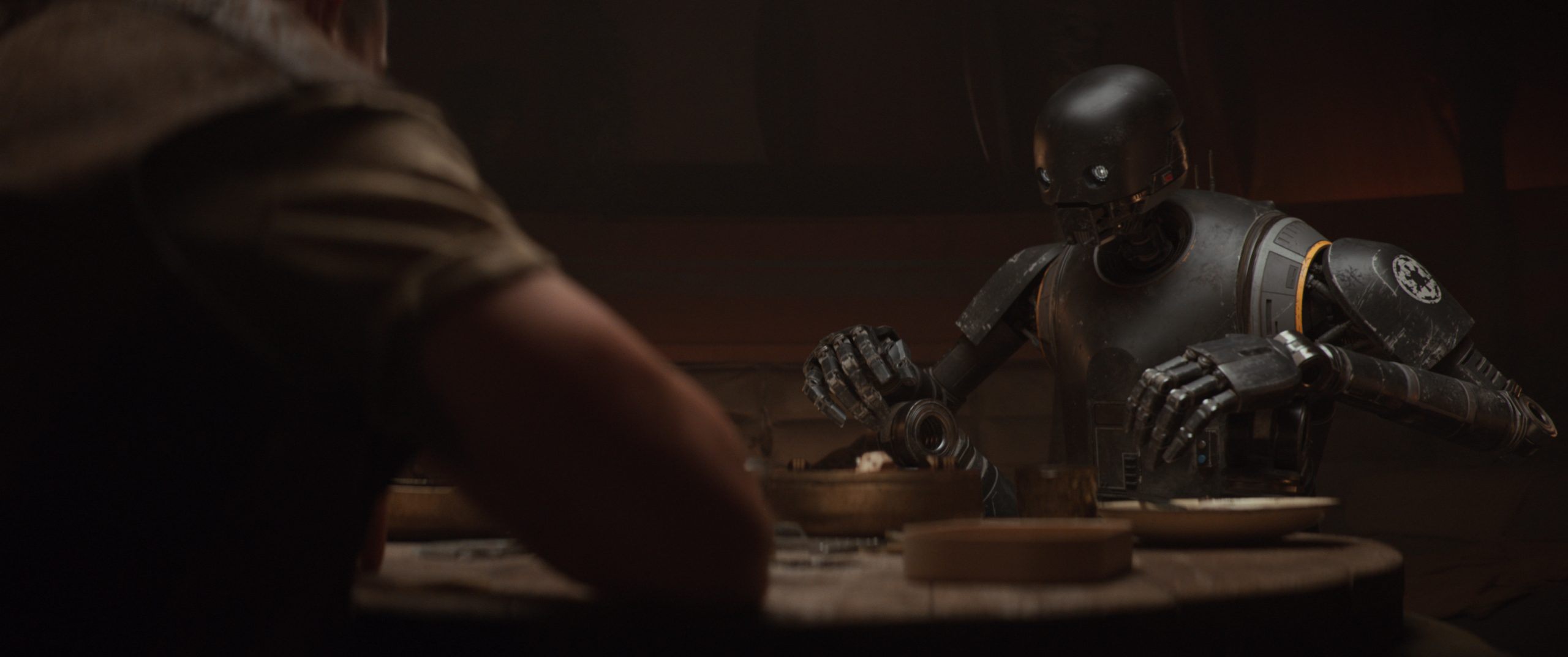
Alan Tudyk (top) performs as K-2SO with motion capture (Credit: ILM & Lucasfilm).
Flexibility, trust, and an understanding of team dynamics meant that the Andor team could make required adjustments and pivot, making the most of the skills at hand and sharing the load across departments, something that started at the very beginning of the series.
“That comes from the partnership we had through season one to season two,” TJ Falls notes. “It was an intentionally designed paradigm between [showrunner] Tony Gilroy and our producer, Sanne Wohlenberg. Our brain trust [Tony Gilroy, John Gilroy, Wohlenberg, Falls, Leo, and production designer Luke Hull] was involved in every key decision. As the show moved from start to finish, we were involved in those conversations, so it wasn’t the top brass dictating what the need was; it was a collaboration of ideas to make sure that it was the best version possible for Tony.”
Leo shares an example. “The Yavinian doodar, the creature at the end of episode two [‘Sagrona Teema,’ directed by Ariel Kleiman], that came through the trees, snatched the two rebels, and carried them off into the jungle. There was a lot of handwringing at the beginning because, from a visual effects perspective, you question whether we really want to build a fully computer graphics creature just for one shot. That’s a big ask.
“It’s also in the back of your mind that it’s going to turn into something much bigger,” Leo continues. “Then you try to cover yourself to make sure that it works for all these other things, but throughout, Tony kept saying, ‘I just need the one shot.’ Tony wants this, but we can’t spend too much money on this creature, so how do we make it possible? Ultimately, everyone worked together with the director [Ariel Kleiman], the director of photography [Christophe Nuyens], and the editor [Craig Ferreira] to make it possible to have this creature in there for one shot, and it worked out great. On many other projects, you would have abandoned it because there would have been this fear that it spirals out of control.”
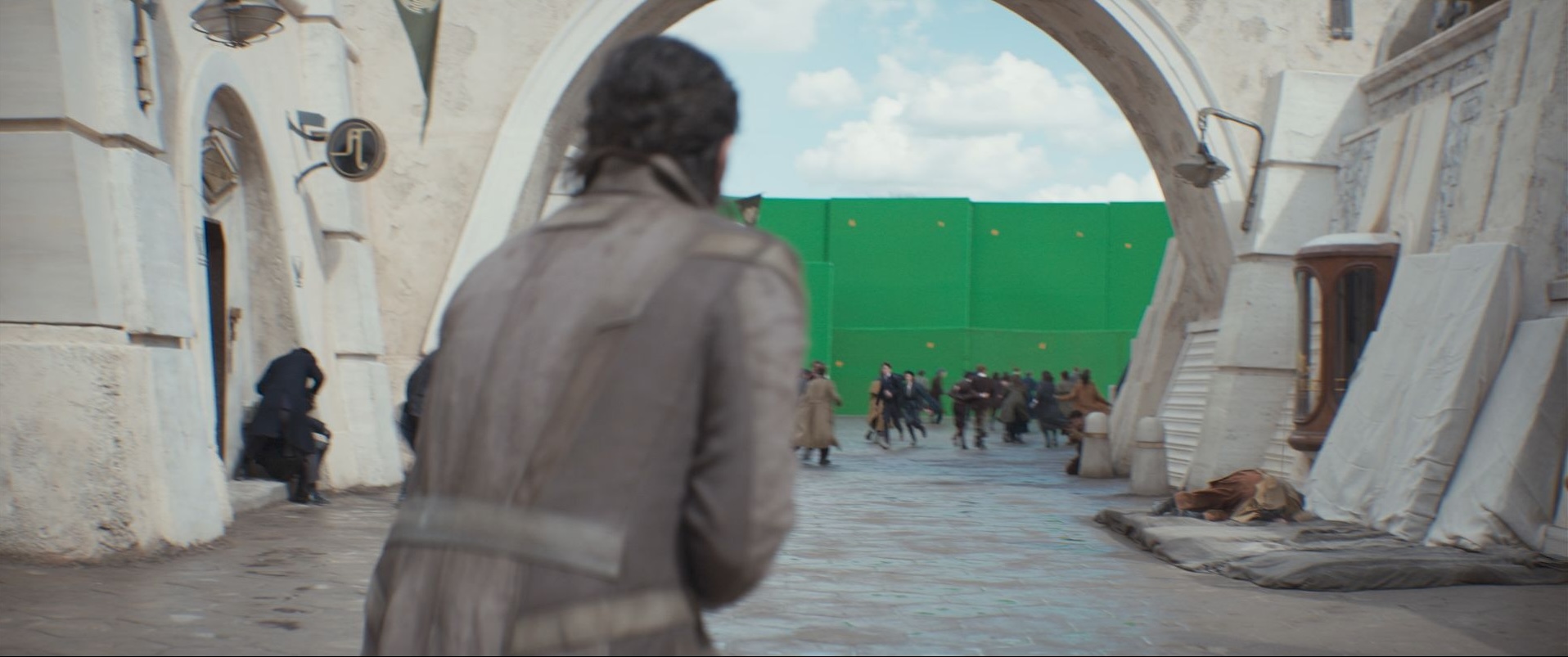
Green screen was utilized at an exterior location in the United Kingdom to portray a view on Coruscant (Credit: ILM & Lucasfilm).
“In a number of situations, we were the first stop in terms of Star Wars lore, where Tony would ask, ‘How do I do this kind of thing in Star Wars? How does that work in Star Wars?’ We’re able to help there. Same with Luke Hull. However, knowledge of our own world was equally as important for a show as grounded as Andor. For me, a big part of it was using things that were not just from Star Wars, but from other films, documentaries, and news clips.
“There’s a shot in episode three [‘Harvest,’ directed by Kleiman] where we see the troop transport on Mina-Rau and the TIE fighter appears low behind it,” Leo continues. “There’s a fly by as they’re all looking at it. Watching reference of Apache helicopters was one of our inspirations, and I found this incredible shot of a troop transport driving through the desert, and out of the dust cloud, came this helicopter, which goes right by them. I showed it to the director and I said, ‘Can we do this shot?’ And Ariel was like, ‘Oh yeah, absolutely. Let’s do it.’”
Sometimes, as in this case, previsualization from reference material is a huge part of the process, giving form to the action and allowing the production to have a rough version of the episode to build from.
“Tony and the director would quite often call on the visual effects team to pitch ideas for shots,” says Leo, “so Jennifer Kitching, our previs supervisor at The Third Floor, would dig around for reference and try things out. Even on big establishing shots, we were always trying to find something real, so [ILM visual effects supervisor] Scott Pritchard and I identified shots of Manhattan, Tokyo, and Hong Kong, very specific shots. Then we could determine the feel of the shots, but we’re ultimately doing it on Coruscant rather than New York or Hong Kong.”
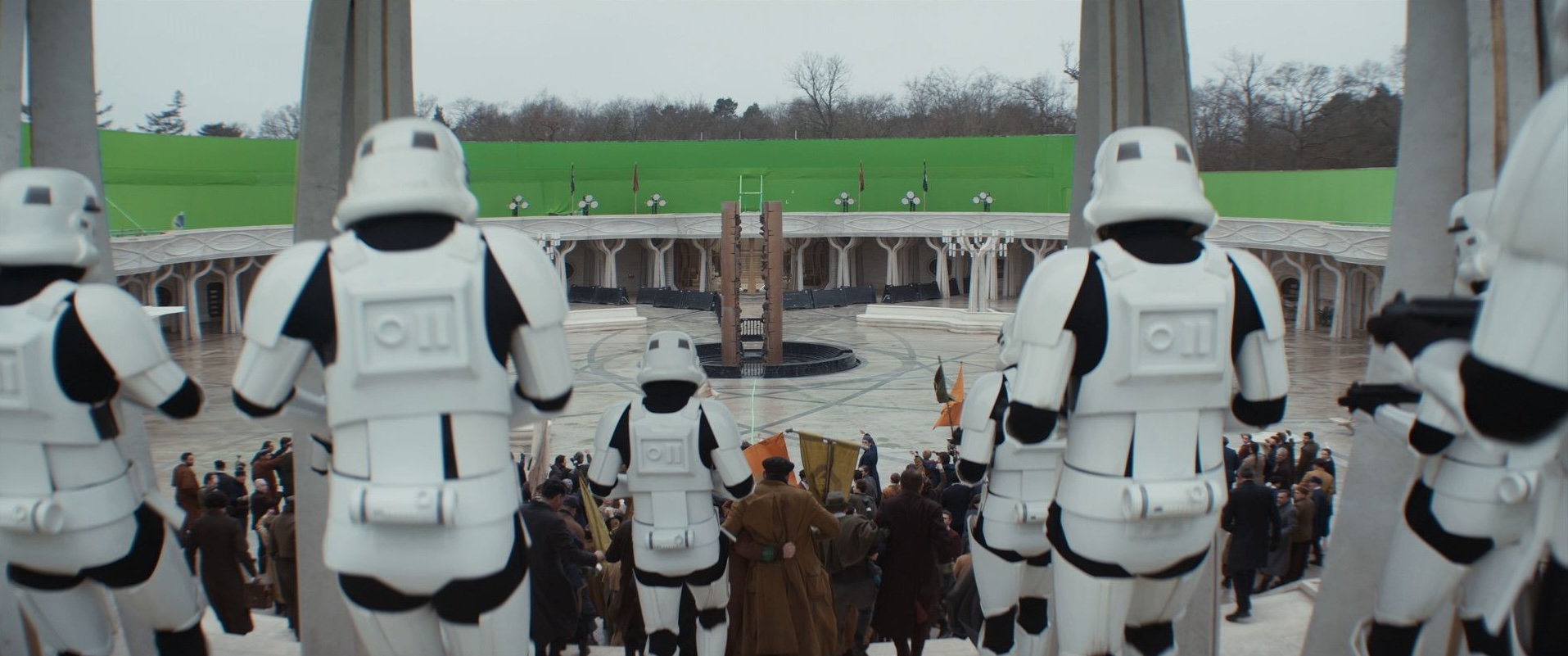
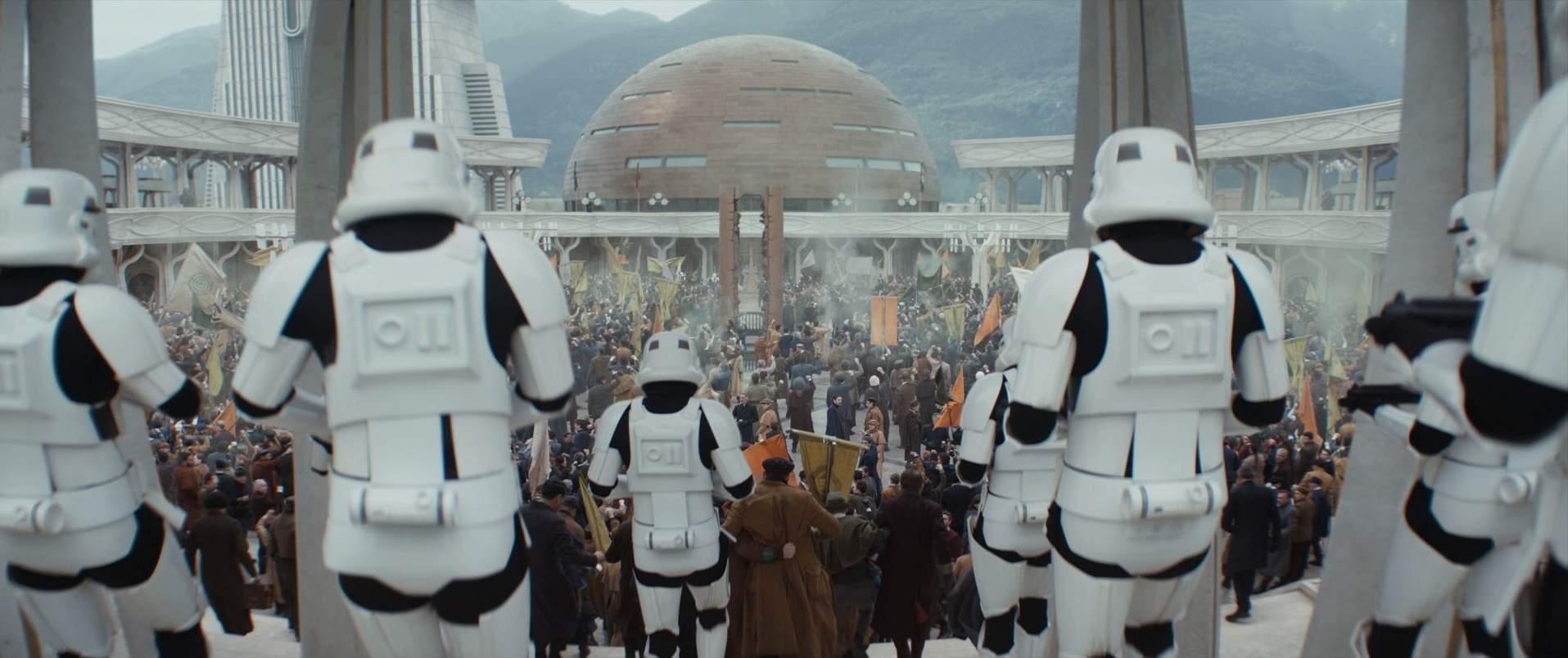
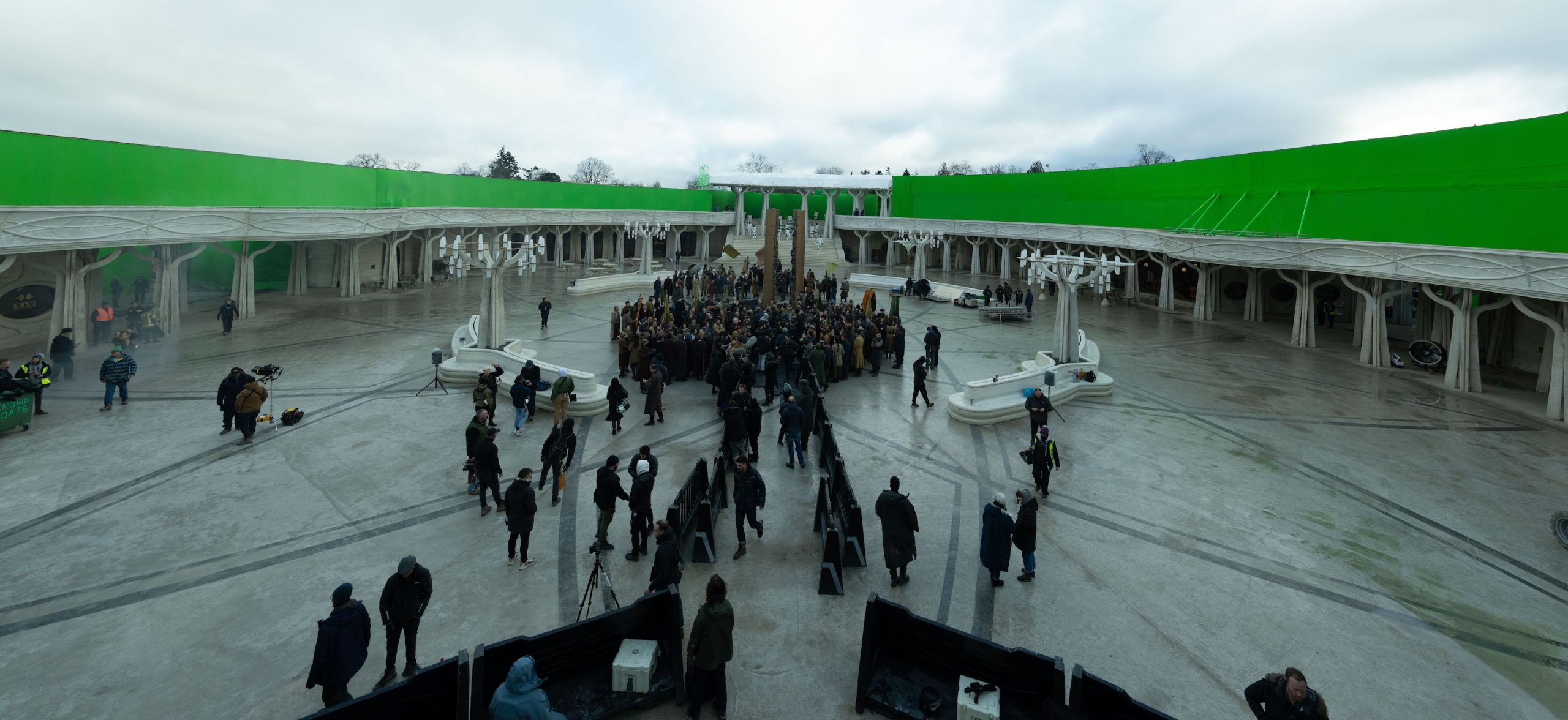
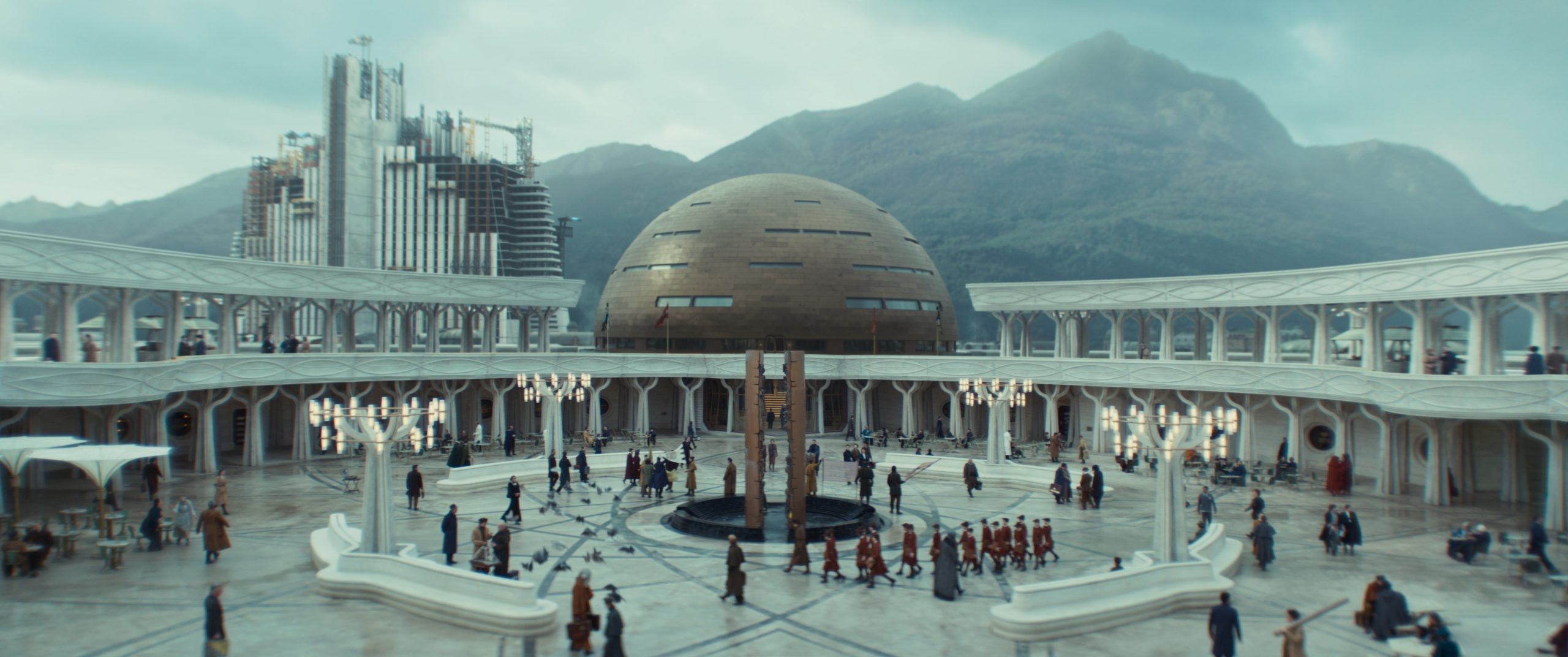
Palmo City’s central plaza on Ghorman was shot as a backlot set at Pinewood Studios with digital extensions (Credit: ILM & Lucasfilm).
Famously, in the 1970s and 80s, ILM used traditional matte paintings to establish new locations, the principle of which is still at the core of creating an establishing shot. The technique, however, now resides in the digital realm, often with the aid of live-action background plates. Andor treats viewers to a number of establishing shots on Ghorman and Coruscant, a process that takes a considerable amount of time and effort, depending on the requirements of the shot.
“If you’re travelling through the digital location and have a bunch of different angles on it, we will build a full 360-degree environment,” explains Leo. “But if it’s for a single shot, we may do it as a bespoke shot. What worked really well on season one and into season two was that we based things on real cities. You can find open-source 3D street maps of Tokyo or New York, and we would basically fly around and find an angle and think, ‘Okay, that’s a cool angle; this feels organic. Now take that but replace all of the buildings with Coruscant buildings.’ You end up with something that feels organic and real.”
It’s an approach Leo picked up from the director of Rogue One.
“I have to give credit for having learned this approach to Gareth Edwards,” he explains. “When we built the city of Jedha, we had blocks of neighborhoods based on layouts from parts of Morocco. Then, Gareth asked us to do something which seemed really strange at the time. He said, ‘I want you to drop 300 random cameras into the CG model of the city, anywhere you like, and show me the pictures.’ We wrote a script that dropped a camera at every intersection and then rendered a view in every direction. We sent those to Gareth, and he picked from those, the idea being that rather than artificially building a view to the camera, you would scout the artificial city just as you would scout a real location and go, ‘I found this really cool angle here.’ That way, you ended up with compositions that felt much more interesting than if you simply asked someone to put some buildings in the background.”
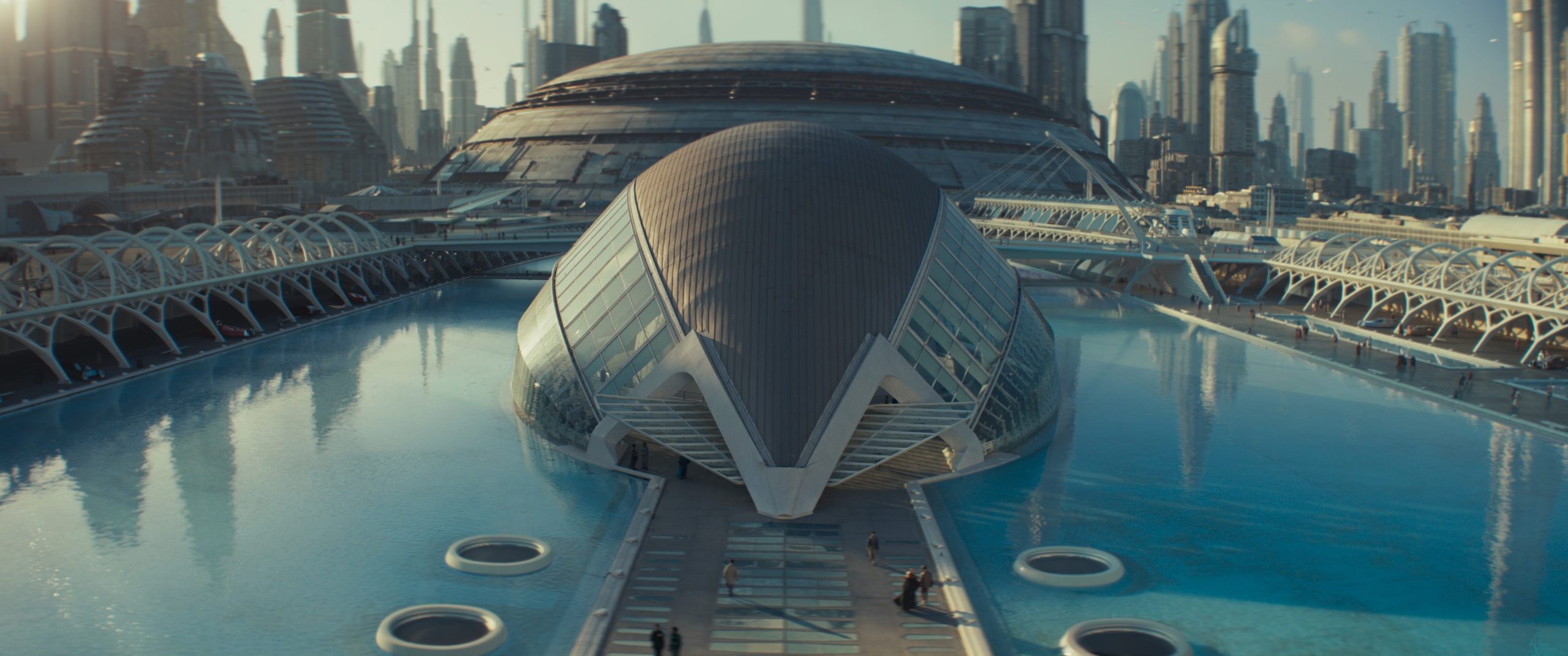
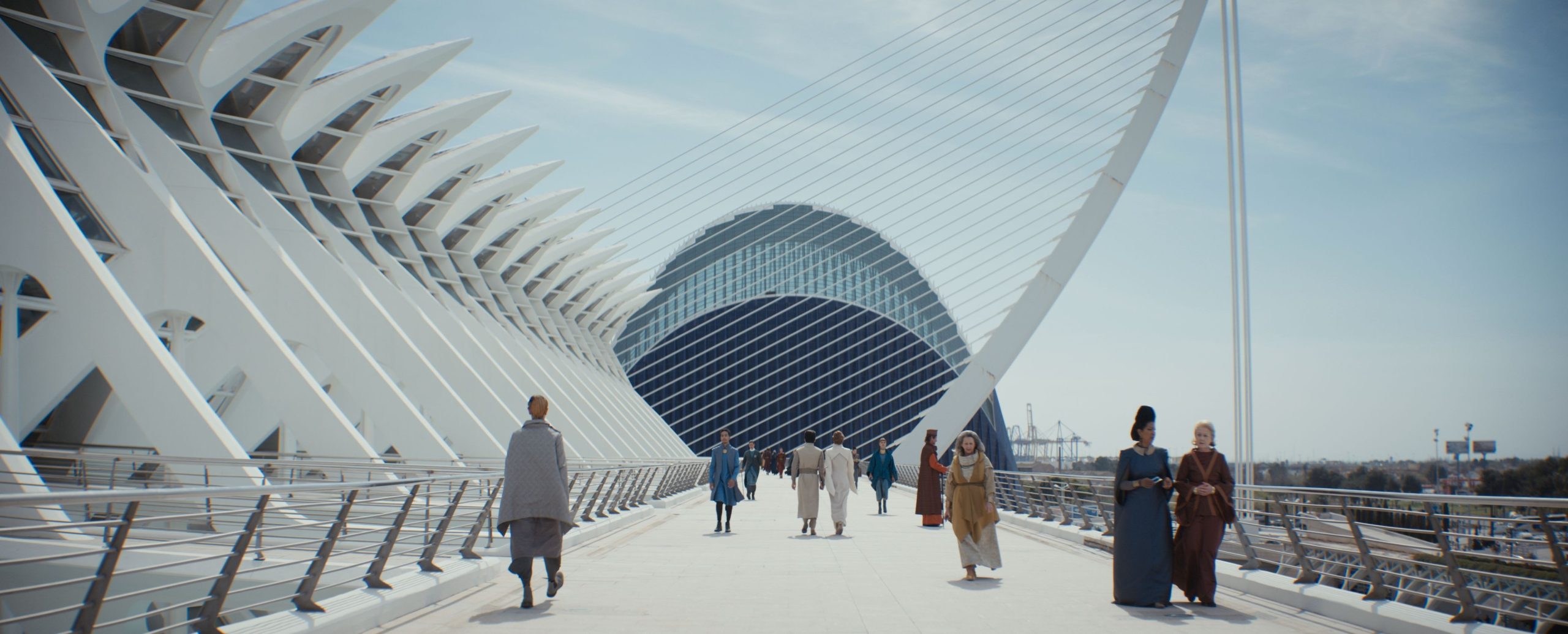
Elements of the City of Arts and Sciences in Valencia, Spain were utilized for Coruscant (Credit: ILM & Lucasfilm).
Coming from a visual effects background as Edwards does – as most recently evidenced by his work with ILM on 2025’s Jurassic World Rebirth – his fluency in the language of visual effects gave the crew a tremendous advantage on Rogue One.
“What I really appreciate about Gareth is that he has this really disciplined approach to thinking about whether you could have done a visual effects shot in the real world, and would it have felt the same way?” Leo continues. “I took that forward into our approach to Andor. Quite often, if we did a layout of visual effects and everything fit neatly into frame, Gareth would say, ‘That feels artificial. Make it so that something uncomfortably sticks out of frame, and as the shot progresses, I have to pan and tilt from one thing to the other, because both of them won’t fit in the frame at the same time.’ That makes it feel real and organic. I always appreciate how much I learned from Gareth about shot design.”
“That ethos fits really well with the aesthetic that Tony wanted for Andor,” adds Falls. “It was a constant conversation that we would have with our directors and DPs to make sure things weren’t too pretty. Mohen would often say, ‘It’s too clean, how do we make it look not as good, so that it looks even better?’ That was a lot of fun, and it really maintained that beautiful look from Rogue One as part of a storytelling thread that was done visually.”
With Andor now delighting viewers both old and new, the look and feel of the show has become one of its most celebrated talking points. Given that, could – or should – that aesthetic be carried over to the next Star Wars project or not? Mohen Leo has his own thoughts on that.
“Andor took inspiration from Rogue One, but Rogue One is primarily a war film, whereas Andor is a spy drama, so Luke Hull made the aesthetic even more grounded. What does this world look like from the perspective of an ordinary person who lives in it? I certainly hope that as we move forward, every project develops its own look. I wouldn’t want everything to look like Andor because that would be boring. The joy that I got out of working on this series is that it proves that you can make something that looks very different but still feels like it belongs in the same galaxy, so I hope that future projects will strike out in different directions and try different things.”
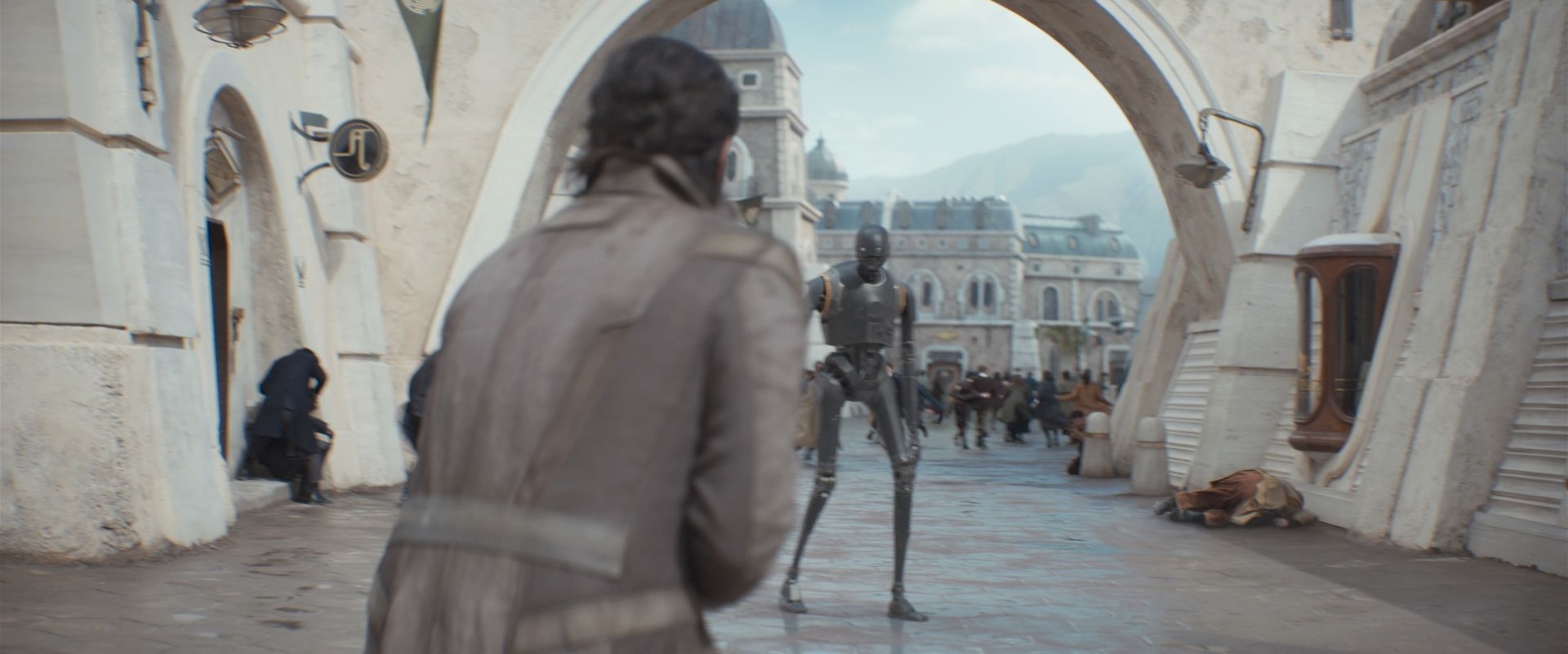
Cassian’s first encounter with the deadly Imperial security droid on Ghorman, later reprogrammed as his companion, K-2SO (Credit: ILM & Lucasfilm).
Understanding that each project needs and deserves its own visual identity within the broader Star Wars galaxy has changed the people who worked on Andor. As he moves on to new projects, TJ Falls reflects on one of the most important lessons he learned from the show.
“It was Tony and Sanne who said, ‘Let the experts be the experts.’ Because of that, every artist felt incredibly valued, and their contribution was fully appreciated. That message was constantly sent down from Tony: Let the best idea win. If an artist had something cool to contribute, it made its way up and it was credited and talked about.”
“The thing that I hope we can take forward is collaboration across departments,” says Leo. “Andor was completely generous in that everyone would happily let someone else do something if it made the result better, so there were no fiefdoms. We were able to put so much value on the screen because every problem was solved together, and that’s something that comes from the top down, in this case, from Tony.
“When there isn’t a sense of shared ownership and a clear creative direction, sometimes the frustration can trickle all the way down through the process,” Leo continues, “not just through the shoot and on the client side, but into the visual effects work and with the artists. Someone can change their mind at any minute and tell you to do something differently. For me, that was the most positive difference about Andor. It’s a culture that says there are no egos; it’s not about anyone standing out and making a name for themselves; it’s all about the collaboration. So I hope that’s something I encounter again on future projects.”
Tudyk performs as K-2SO alongside a final frame created by ILM (Credit: ILM & Lucasfilm).
When pondering each of their favorite moments in season two, Leo is quick to answer, “Cassian stealing the TIE Avenger and escaping in episode one [‘One Year Later,’ directed by Ariel Kleiman] was certainly the one I was involved in the longest, all the way from the beginning pitching storyboards for the action, right down to it being the last thing we shot with Diego.
“What I like about it is that on the one hand it’s a very classic Star Wars sequence with the spaceship and a dogfight,” Leo continues, “but we found a way to still make it fit within Andor by designing it in a way that it starts very practical in a real hangar with a real ship and stunts, and bit by bit we transition into something that’s pure computer graphics, but it all fit into the style the show, so I’m really pleased with that.”
Falls is equally quick to respond. “My favorite is the opening shot from episode eight [‘Who Are You?’ directed by Janus Metz], which is a long lens establishing shot of Ghorman, orbiting around the city. We had Hybride [Ubisoft’s visual effects branch] working on the look of the plaza, and ILM took on the high establishing shots of Ghorman from the air. The shot went through a number of rounds of honing it into what Mohen was thinking, pitching the idea without the visual was tricky, trying to get everyone to understand what it was that was being described. Once we started to get the visuals into motion with previs, it started to click with everybody. Then it came alive in shot production. I think it’s absolutely gorgeous.”
—
Mark Newbold has contributed to Star Wars Insider magazine since 2006, is a 4-time Star Wars Celebration stage host, avid podcaster, and the Editor-in-Chief of FanthaTracks.com. Online since 1996. You can find this Hoopy frood online @Prefect_Timing.
In part one of a two-part story, the production’s visual effects producer and visual effects supervisor discuss the effort to create over 4,000 effects shots for the Emmy-nominated Lucasfilm series.
By Mark Newbold
“It was a good opportunity to expand our horizons,” says TJ Falls, vice president of visual effects at Lucasfilm, about the team’s work to create a grounded aesthetic for both seasons of Andor (2022-25). After Rogue One: A Star Wars Story (2016) established the tone for the adventures of Cassian Andor (Diego Luna), the Andor production opted to utilize a number of existing locations for filming in the United Kingdom and around the world. It was a tactic previous Star Wars productions also chose (for example, 1999’s Star Wars: The Phantom Menace traveled to Italy and the Caserta Palace for the interior of the Theed Palace on Naboo), but integrating these locations to such a degree was something new for Industrial Light & Magic, a choice Falls appreciates.
“It allowed us to go out in the world and find a real base reference,” explains Falls, who was also the overall visual effects producer for Andor. “That was something the team worked hard to capture. We’re actually there in the city or in the mountains, so it was wonderful to be able to tie real-world locations into our digital work.”
The debut season of Andor leaned heavily into this physical integration. But, with a very real-world, global pandemic happening around the production, season one had its international travel wings clipped, as Falls explains.
“We couldn’t travel, but we still managed to gather reference material, including some for the ship-breaking yards on Ferrix. For season two, we were fortunate enough to finally be able to travel, so we flew to Lake Como and the Italian Alps to capture plates for Ghorman, among other locations.”
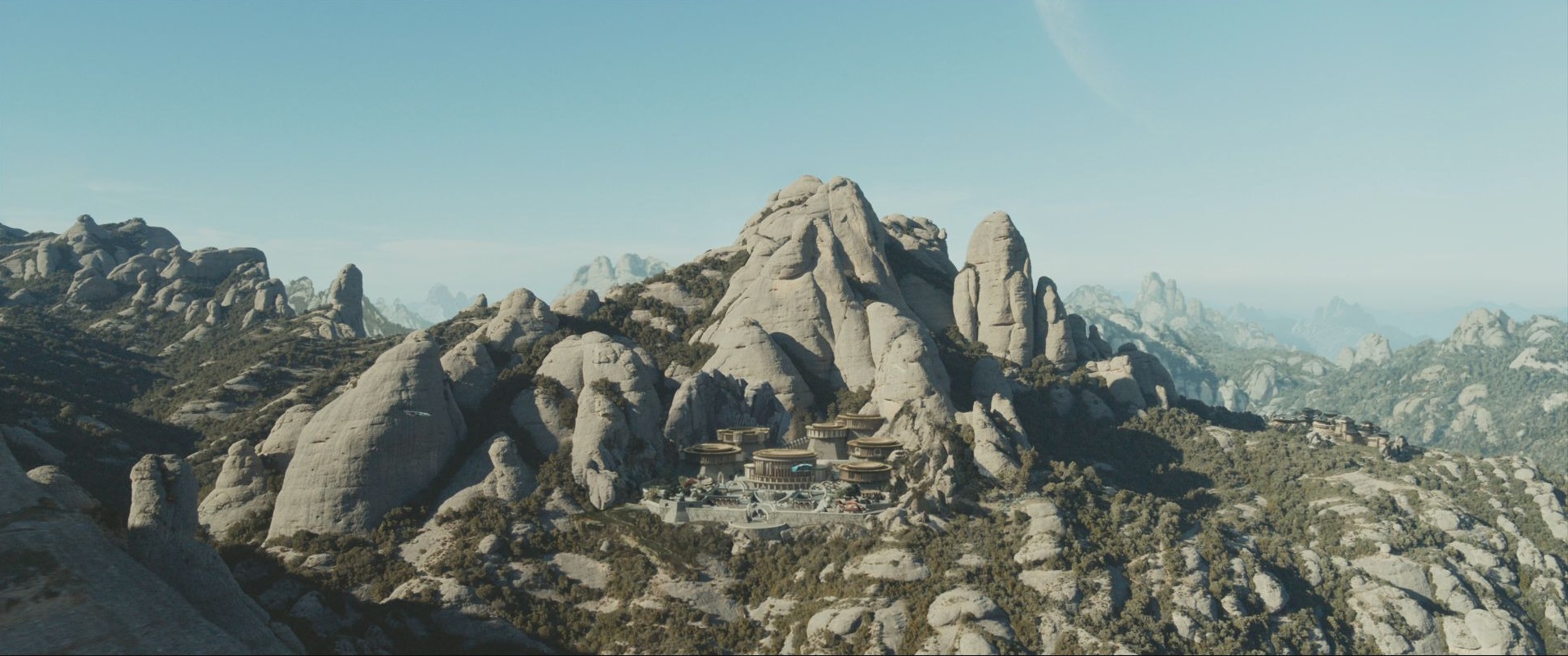
The Mothma estate on Chandrilla utilized aerial plates shot in Spain (Credit: ILM & Lucasfilm).
Joining Falls, production visual effects supervisor Mohen Leo picks up the conversation.
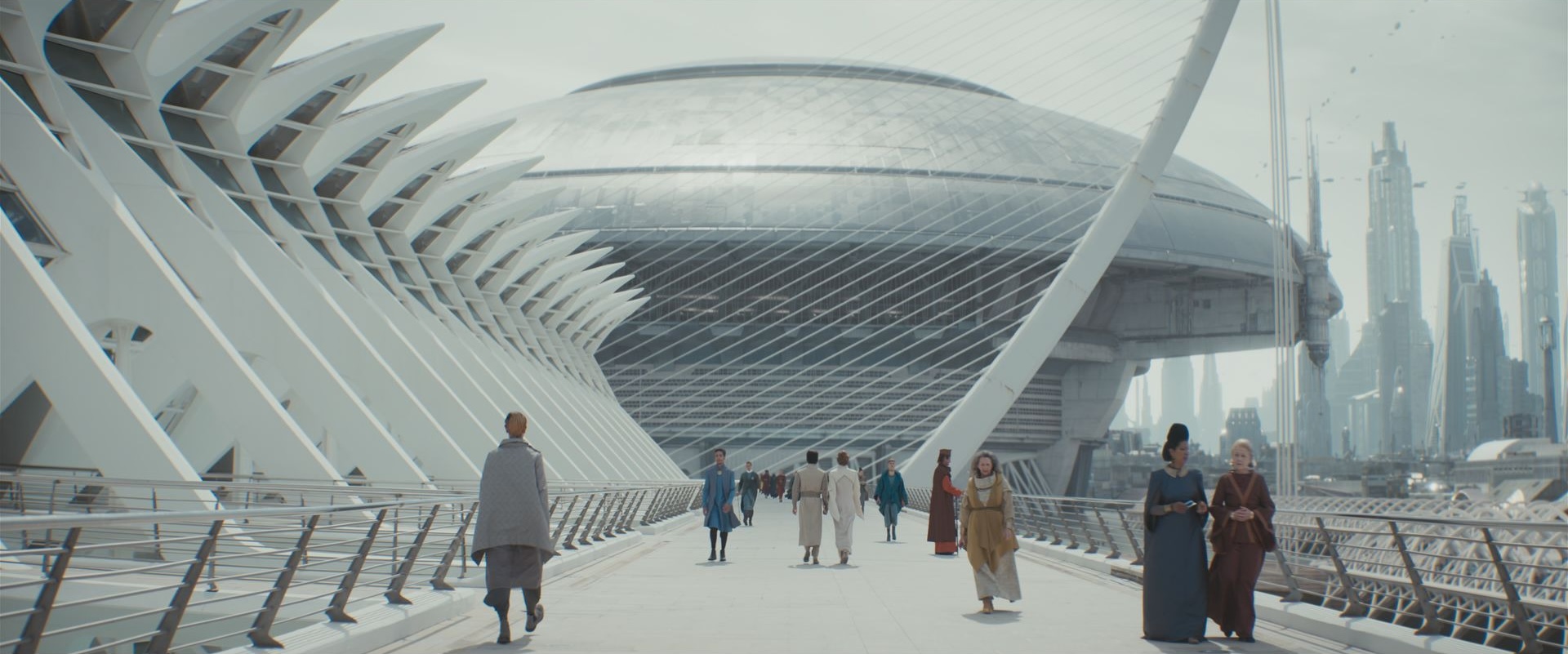
“Being able to travel to Spain for a variety of locations on season two allowed [production designer and executive producer] Luke Hull to rely much more heavily on the look of existing locations that were compatible, particularly the Senate building. Once we did the first location scout at the City of Arts and Sciences in Valencia, we were looking around, thinking, ‘Wow, it looks like Coruscant already.’ That made a huge difference, having that basis, both for interior and exterior spaces, so we could then use visual effects to build on and make it feel like Star Wars.”
The practicalities of having a ready-built set in the form of an existing building clearly had their benefits. Still, the broader task of adding visual effects presented its own challenges, as Leo explains.
“One thing I took away from the project is to push as much as possible for real locations,” he says. “Using an existing building during a shoot allows people to make informed decisions that stick, because if you have something that already looks 50%, 60%, or 70% the way you want it to, everyone has the confidence to say ‘Okay, this is the frame that we want, and we understand that we’re going to put this building in the background. Also, you have the composition of the lighting and the weight of the architecture, which makes it much easier, rather than having a blank canvas in post-production and then debating what it should look like.
“For example,” Leo continues, “there were the mountains around Ghorman. A couple of people from the production team and I went to Italy and did a two-day helicopter shoot. We felt strongly that even those locations where we would never actually shoot with a full crew or with actors should be based very specifically on real landscapes. That allowed us to put the Star Wars architecture in there and have that foundation.”
With the tremendous amount of work required to bring these locations to life, the balance between real locations and visual effects is a delicate one, based on story requirements, budget, and time.
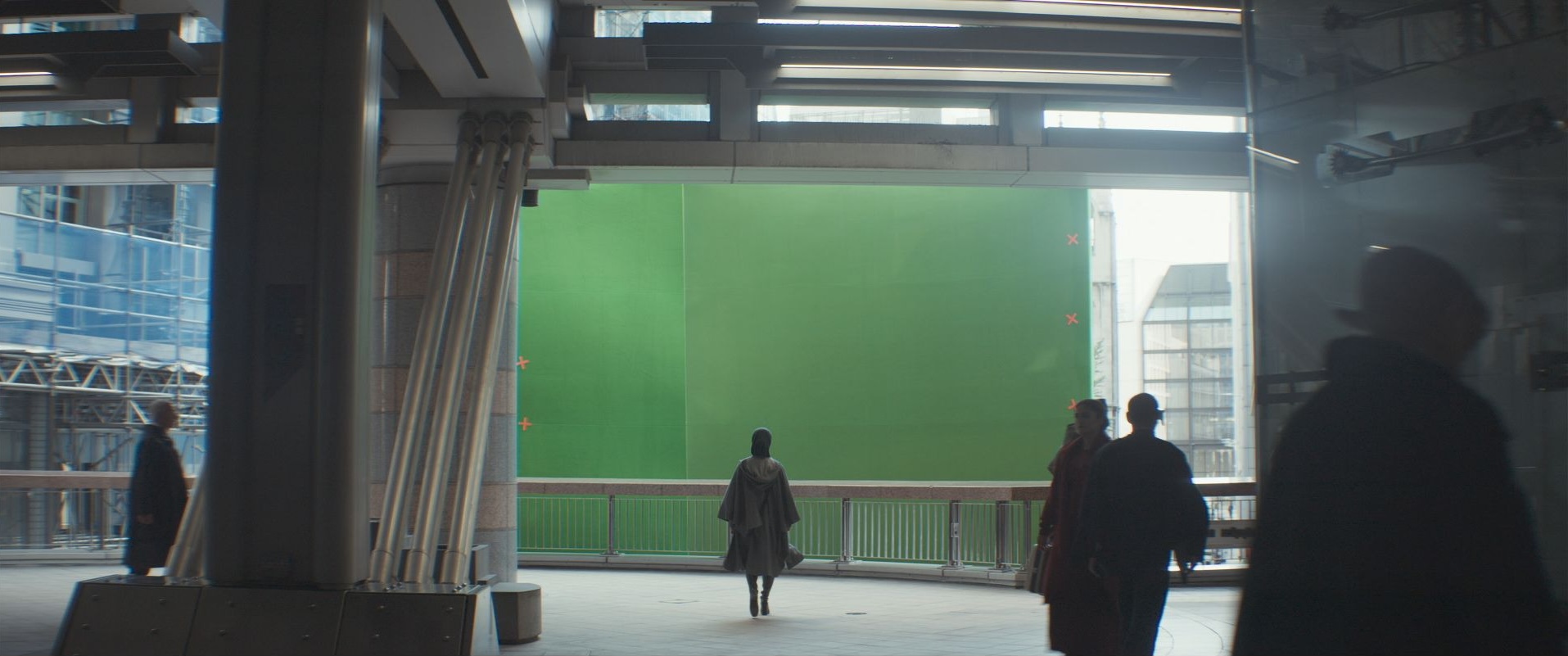
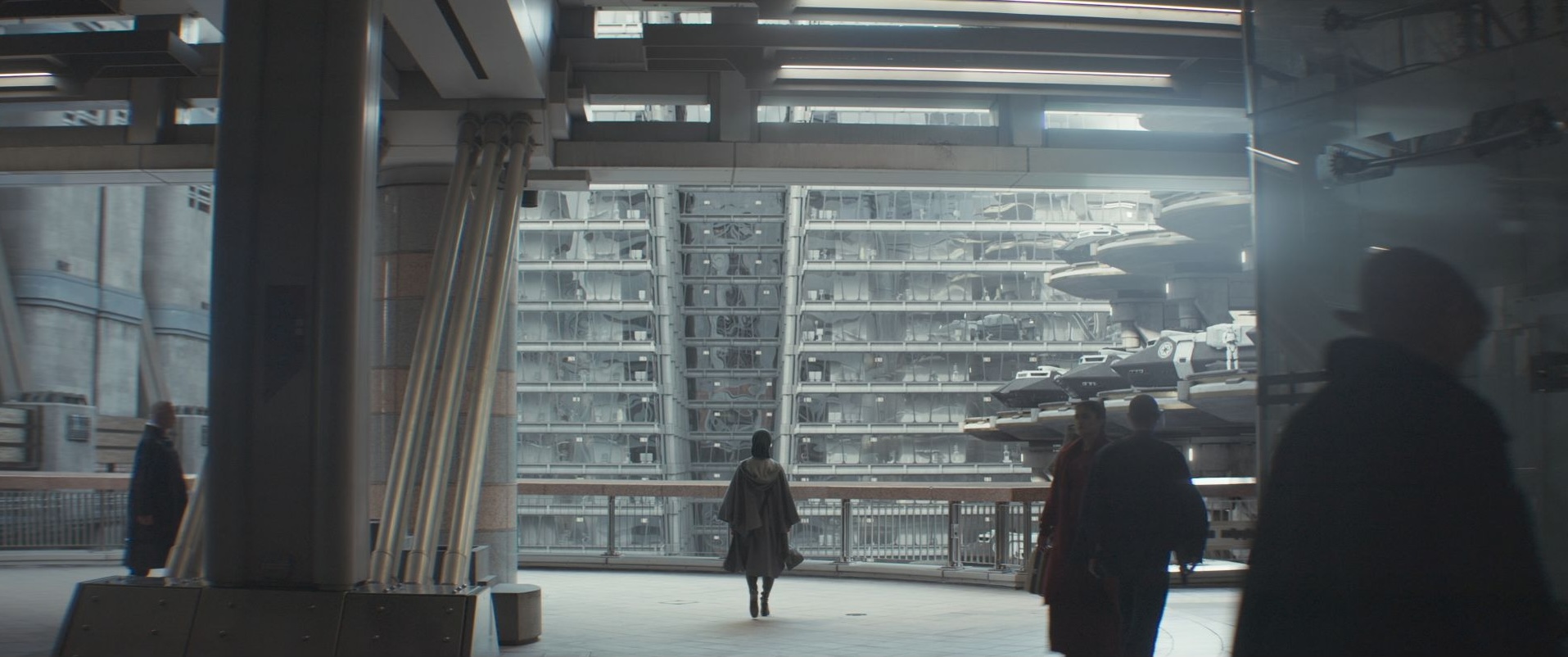
“When we go location scouting, I always ask the director of photography [for season two, Damián García, Christophe Nuyens, and Mark Patten], ‘What are we keeping from the location?’” says Leo. “Because there has to be value in us being there. We were on location in Spain, and a Coruscant scene was discussed, which involved two people standing by a railing, looking out across the fictional cityscape. If we’re going to replace the whole city, then we don’t need to shoot that in Spain.”If you want that view, we can shoot that back in London on a green screen set because it’s easier, and we’ll have more control over the lighting. That, for me, is the main thing, having a clear idea when you go on location of what we keep from the location, and why we are there?”
The original location plate (top) shot at the City of Arts and Sciences in Valencia, Spain opposite the final shot (bottom) with the Coruscant skyline (Credit: ILM & Lucasfilm).
The use of natural light throughout the series is even more impressive when considering the balance between physical structures and digital extensions. Bathing the action in brightness or shadow, regardless of where and how it was shot, Leo explains, is how this integration was managed.
“We work very closely with the DP on that,” says Leo. “There are scenes where people walk directly from a stage set in London onto something that’s on location in Valencia. In the context of the story, it feels like one continuous location, even though they were shot months apart in two different countries. Obviously, we take lots of photographic reference. We have the plates of the one side at hand when we’re doing the other, and we’re constantly checking to make sure things fit together. On this project, we had a plan for each of those things before we went on location and shot it. We’re not trying to force things together in post; they’re meant to go together.”
“That’s exactly it,” adds Falls. “It’s the collaboration with the DP and lighting team, but also with previs, with techvis, and knowing that we’re going from studio space to location space. We had the opportunity to plan that out very specifically, each step of the way. And what helped us succeed is that we had a plan, and we were able to push it through to the best of each department’s abilities to deliver on it.”
Having a plan is essential to any well-run production, and on a visual effects-heavy series like Andor,it’s even more vital. Managing the process requires unique skills and systems to marshal all the information and elements into one place, as Falls explains.
“You’ve got to manage all these people and figure out who’s doing what, breaking it down to what the responsibilities of each person are. You start with something that’s massive, and we start to split things up between our teams and vendors. Ghorman is primarily a Hybride sequence; we’ve got Scanline VFX dealing with Mina-Rau, and we work with [ILM visual effects supervisor] Scott Pritchard to ask how we’re going to slice up this pie.
“It’s like eating an elephant one bite at a time,” Falls adds with a smile. “That translates from the production side into post and dealing with our vendors, and it’s all about clear communication, having people that you can build a shorthand with and have trust with, and then let them do what they do and not overmanage it.”
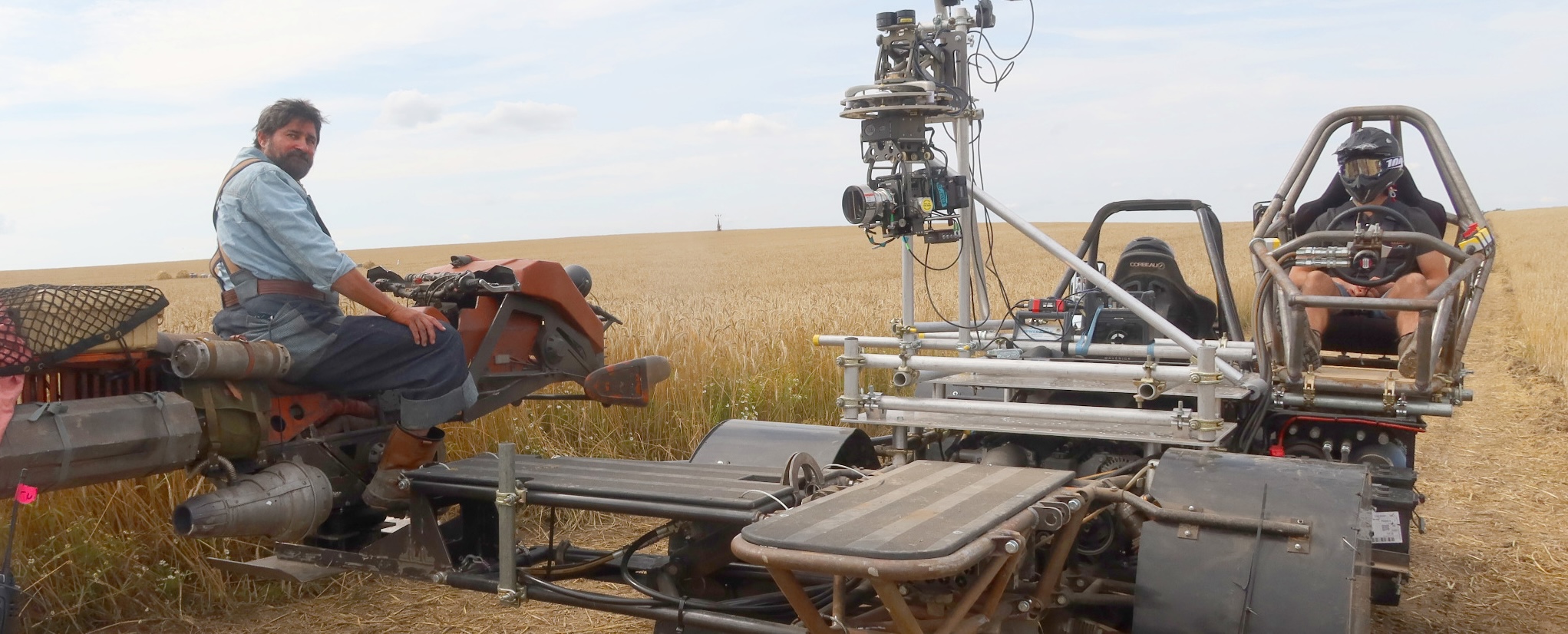
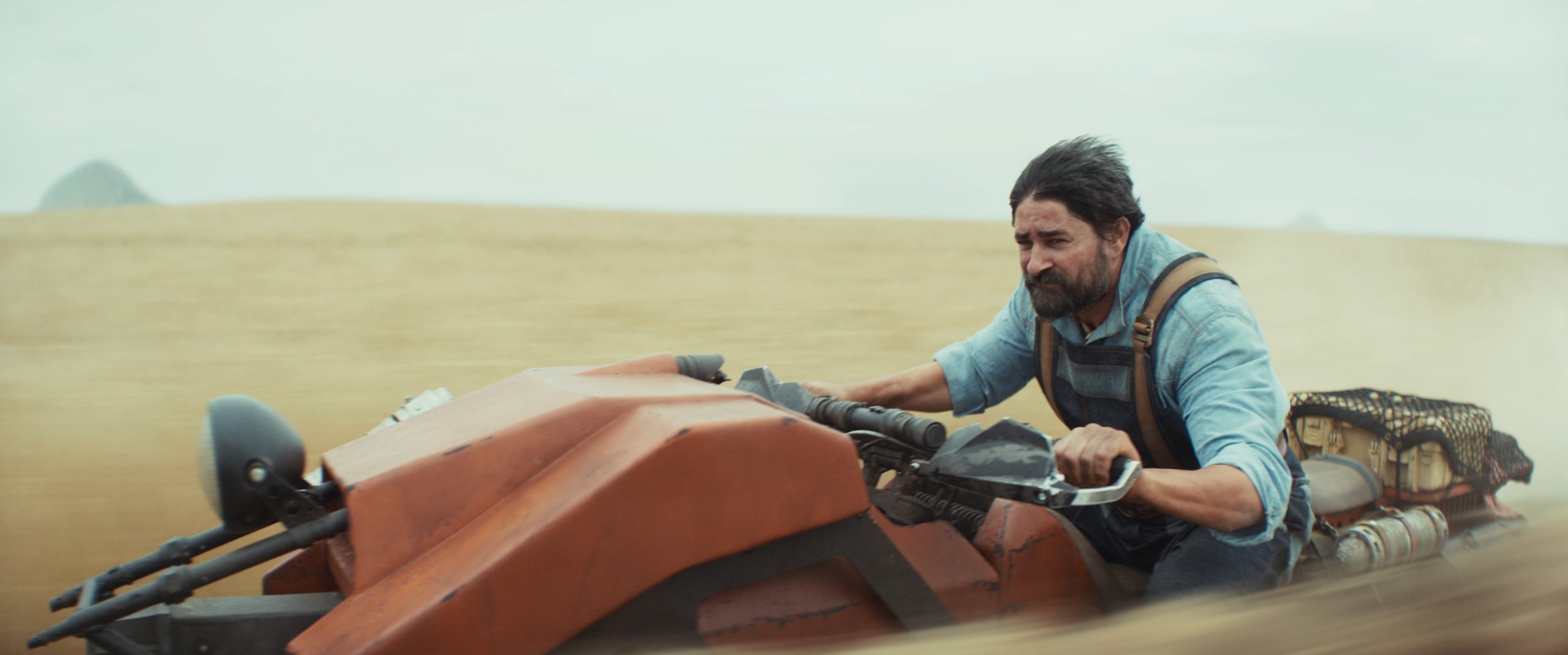
Actor Joplin Sibtain (Brasso) atop the speeder prop rigged to a camera vehicle (top) with a final frame from Mina-Rau (below) (Credit: ILM & Lucasfilm).
Truly a mammoth task, but that’s just the start of it. “Then, each individual team brings their expertise to build it right back up the mountain,” Falls continues, “so that Mohen has the opportunity to have that creative outlook over everything, I make sure it’s moving at the pace that it’s supposed to and that we’re hitting our schedule and staying on budget while making sure that [creator and showrunner] Tony Gilroy is getting what he wants for his vision of the show.”
There are many unsung heroes on any production, and amongst those are the production managers (including Frédérique Dupuis and Alyssa Cabaltera from ILM and Anina Walas from Lucasfilm, among others), who, on the visual effects team, juggle countless shots and give structure to the process for both the production and the partner studios. In its completed form, Andor might appear to be a graceful swan, but under the water’s surface, its legs are furiously kicking to propel it forward, as Mohen Leo elaborates.
“The visual effects production team has to keep track of over 4,000 shots, and each one of those shots has dozens and dozens of assets, be it art and reference or photography and scans, and they have to funnel all of that to where it needs to land and then send any questions back to me in a manageable way. I answer the creative questions. The logistical and organizational work is done by a team of incredibly diligent people without whom none of this would be possible.”
Along with this beehive of activity tracking all the elements, a database system, unique to each production, needs to be put in place.
“We find on each show that you have similar tool sets and similar ways of databasing things,” Falls says, “but you have to build it around the specific challenge of the show and the personalities involved. It’s about what Mohen likes and the types of data that we’re getting in.
“You have people like [on-set visual effects supervisor] Marcus Dryden, who was on set managing that side of things. His role was specific to season two, and it worked really well, that marriage of supervision responsibilities between me and our Lucasfilm production team and our production manager, and the coordinators building the database. That worked well for Mohen to get the notes in and out and track the scans and the data, but presenting it in forms that fit the specific way we were working with our vendors on this show. It wasn’t groundbreaking, but it was specific to what we needed.”
Palmo City’s central plaza on Ghorman utilized the massive backlot Pinewood Studios (top), and was later completed with visual effects (bottom) (Credit: ILM & Lucasfilm).
The database is set up, a system is in place, production managers have a process, and the elements are tracked as they come in. “It’s absolutely critical because it gives me the luxury to say, ‘Hey, where’s that scan from that location that we shot in that scene six months ago in Valencia?’” explains Falls. “And within 10 seconds, somebody will go, ‘Here it is.’ That shouldn’t be taken for granted because I’ve been on many shows where that can turn into an archaeological dig that can take days, or sometimes you don’t find it at all.”
With this bespoke Andor structure in place for season one, Leo could then take that and refine it even further for season two, a huge advantage, especially considering episodic television wasn’t a familiar environment for him.
“Season one was a big learning experience,” explains Leo. “I’d never done episodic television before; I’d only done movies, so dealing with that much content in such a compressed time was challenging. Also, the interaction with editorial is slightly different on episodic television. With every project, there’s an element of adjustment, but, there’s also an element of learning.”
“We had the luxury of a number of production staff carrying over from season one to season two,” says Falls. “So we learned in real time and adjusted things to fit. You could port it, but it wouldn’t necessarily work as succinctly as it does when it’s crafted around the group, and for season two in particular, I felt that we ended up crafting a really great system. The team was unbelievably adept in making sure that every person got exactly what they needed as quickly as humanly possible.”
The script is the tramline for everything that ends up on-screen, but in the realm of visual effects and working with the rest of the crew, there needs to be a clear understanding of what’s required and how to do it, something that comes from the top, as Leo explains.
“When we’re planning a shoot, we sit down with the director, the cinematographer, and the assistant director and ask, ‘What are you trying to achieve, what do we need to contribute in terms of the visual effects, and how do we make sure we get what we need during the shoot?’ Then we take meticulous notes.”
However, it doesn’t always go as smoothly as planned. “We’re staring at the monitor as they’re shooting, but then somebody drops the microphone into frame, so that’s something we have to paint out,” Leo continues. “Maybe we have to do a set extension that we didn’t expect. Then there’s a step in post-production where, along with editorial, we’re looking at the early versions of the cuts, and that’s where we do something called the statement of work, where we look at each individual shot and go, ‘Okay, here’s all of the things we need to do for this particular shot across the various disciplines in order to complete it.”
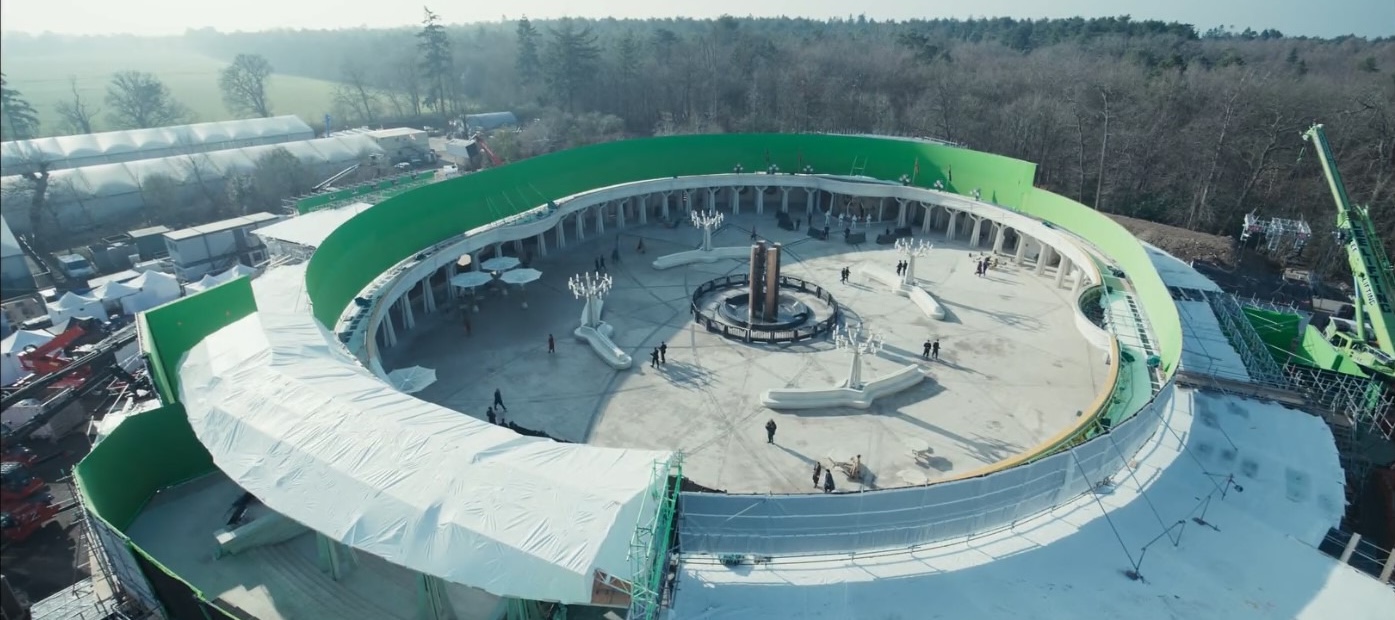
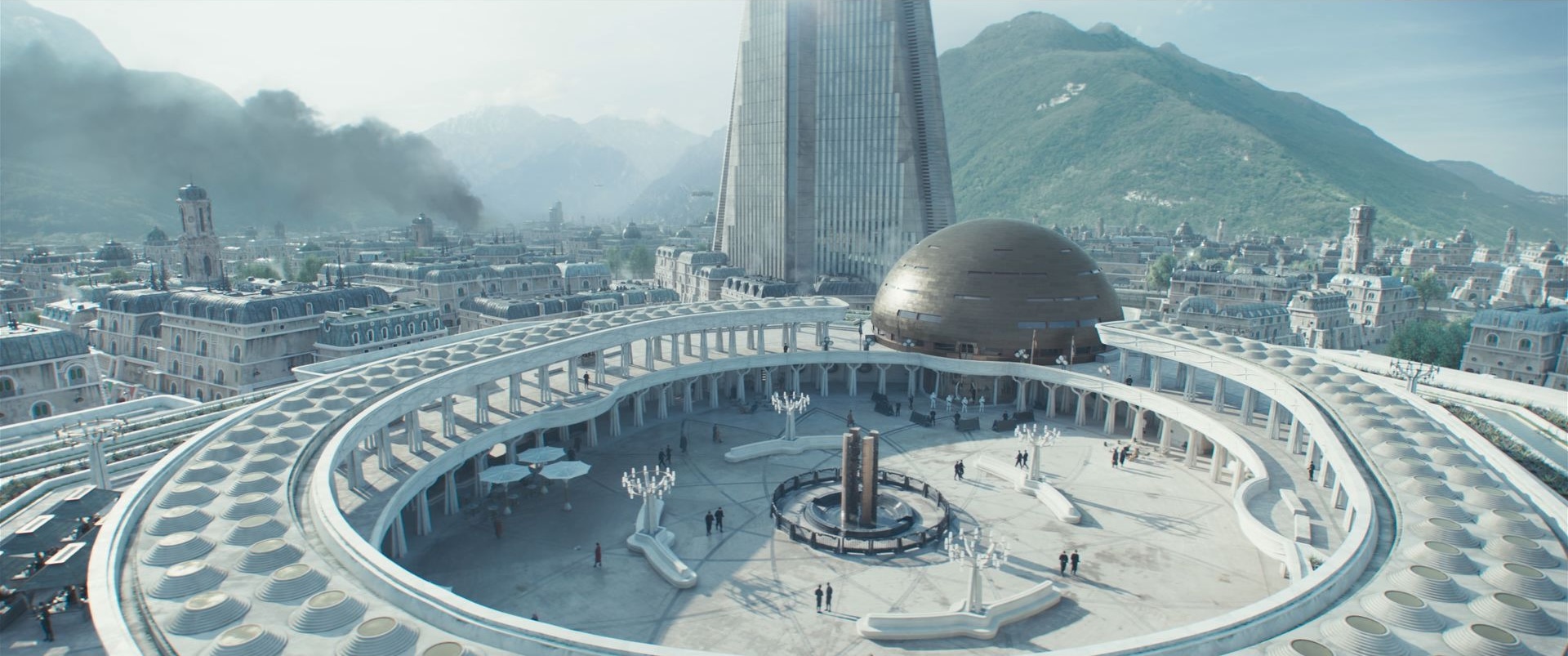
An aerial view of the Ghorman set on the backlot (top) and final frame (bottom) (Credit: ILM & Lucasfilm).
Like all aspects of a production, visual effects come at a cost, with so many highly skilled experts putting their time and craft into a project. The team is responsible for both managing costs and ensuring that additional required effects can be covered within the allotted budget.
“There’s a constant ebb and flow of evaluation, so we work closely with editorial, seeing the working cuts,” Falls notes. “We go in with [editor] John Gilroy and they show us little pieces, and that allows the opportunity for some give and take as we evaluate things and look at shots and go, ‘Well, this is more than we had planned, or maybe there’s another sequence where they’re using less than what we had planned,’ and so there’s a little bit of horse-trading that happens.
“What we strive for,” Falls continues, “is to not say we can’t do something because it wasn’t planned. If there are 10 additional seconds needed in the show, how can we do it? Can we find a way that still delivers everything that’s needed, but also in line with the number of resources we allotted? Then, we’re back on budget, or I have to figure out how to take care of it, but we always start with what is the creative desire for the scene. How is it furthering the story? We don’t want anything that’s egregious or over the top just for the sake of being something flashy, so we have to make sure that everybody is in agreement that ‘Okay, it’s more than expected but it serves the story, it does what Tony needs, and now it’s our job to figure out how can we make it work.’ I think we did a pretty good job of that.”
Mark Newbold has contributed to Star Wars Insider magazine since 2006, is a 4-time Star Wars Celebration stage host, avid podcaster, and the Editor-in-Chief of FanthaTracks.com. Online since 1996. You can find this Hoopy frood online @Prefect_Timing.
SDCC’s hottest ticket brought the first-time Comic-Con guest and friends to preview the Lucas Museum of Narrative Art, and ILM.com was there in the room.
By Clayton Sandell
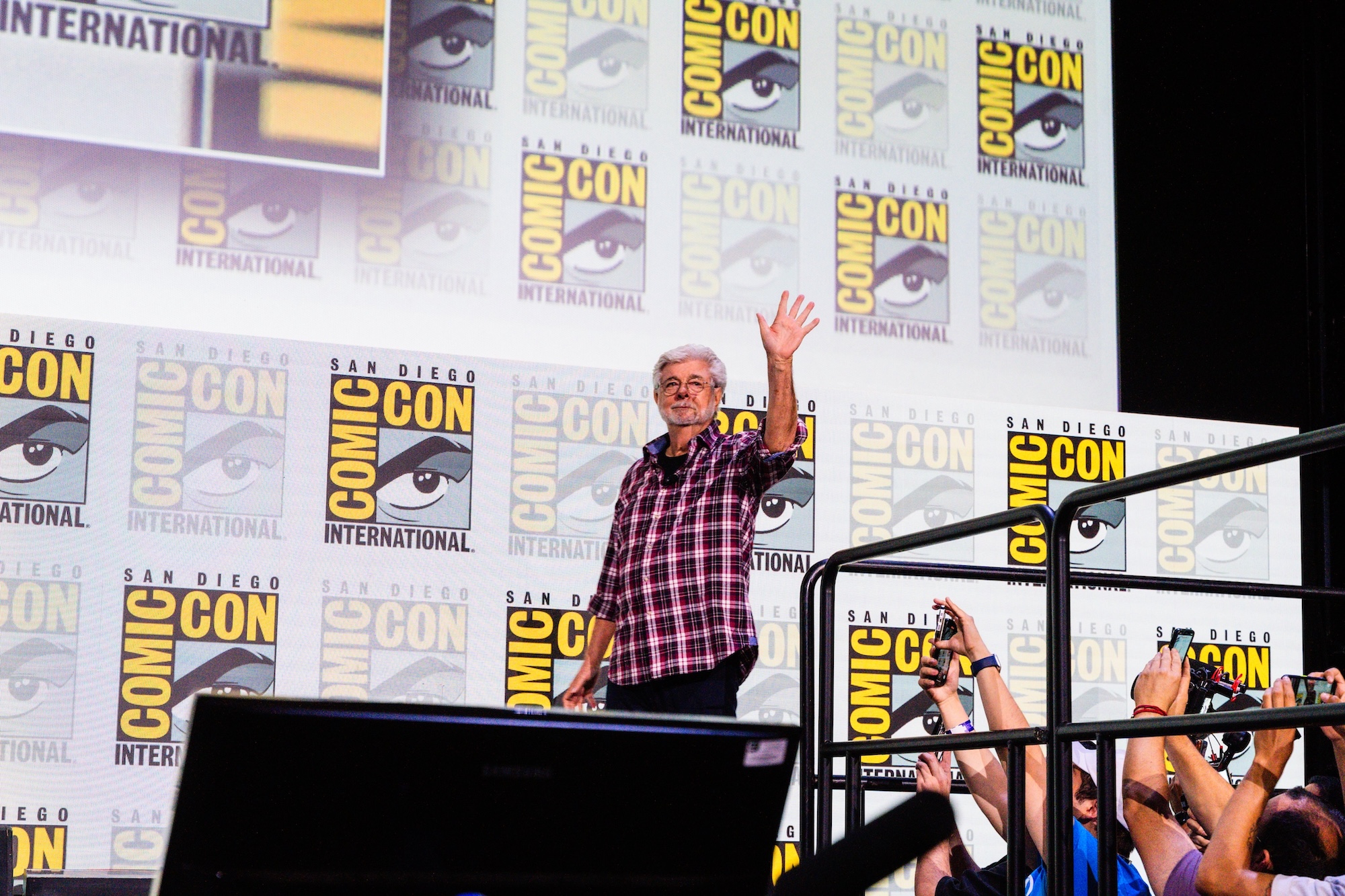
George Lucas takes the stage at San Diego Comic-Con (Credit: Lucasfilm).
Star Wars creator and Industrial Light & Magic founder George Lucas recently made his San Diego Comic-Con debut, but the Force has been strong at the show for decades.
Inside the convention center’s massive Hall H, a record Sunday crowd of 6,500 screaming and cheering fans greeted Lucas as he walked onstage to give the first public preview of the Lucas Museum of Narrative Art.
Co-founded by Lucas and his spouse, Mellody Hobson, the museum is set to open in Los Angeles in 2026. Lucas describes the building as a “temple to the people’s art.”
“This museum is dedicated to the idea that stories and mythology are extremely important to society in creating community,” Lucas told the crowd. “Art illustrates that story.
“It’s mythology,” he continued. “People believe it, and it binds them together with a common belief system. And what we’re doing here with the museum is to try to make people aware of the mythology that we live by. And at the same time, let them have an emotional experience looking at art.”
Lucas was joined by two Academy Award-winning filmmakers: director Guillermo del Toro and Lucasfilm’s senior vice president and executive design director Doug Chiang. Actor and artist Queen Latifah moderated the panel.
“What is amazing about this collection is that it will give you a step-by-step look at how a form of expression came to inform what we are today,” said del Toro, a Lucas Museum board member and longtime ILM collaborator on films includingPacific Rim (2013) and the upcomingFrankenstein (2025).
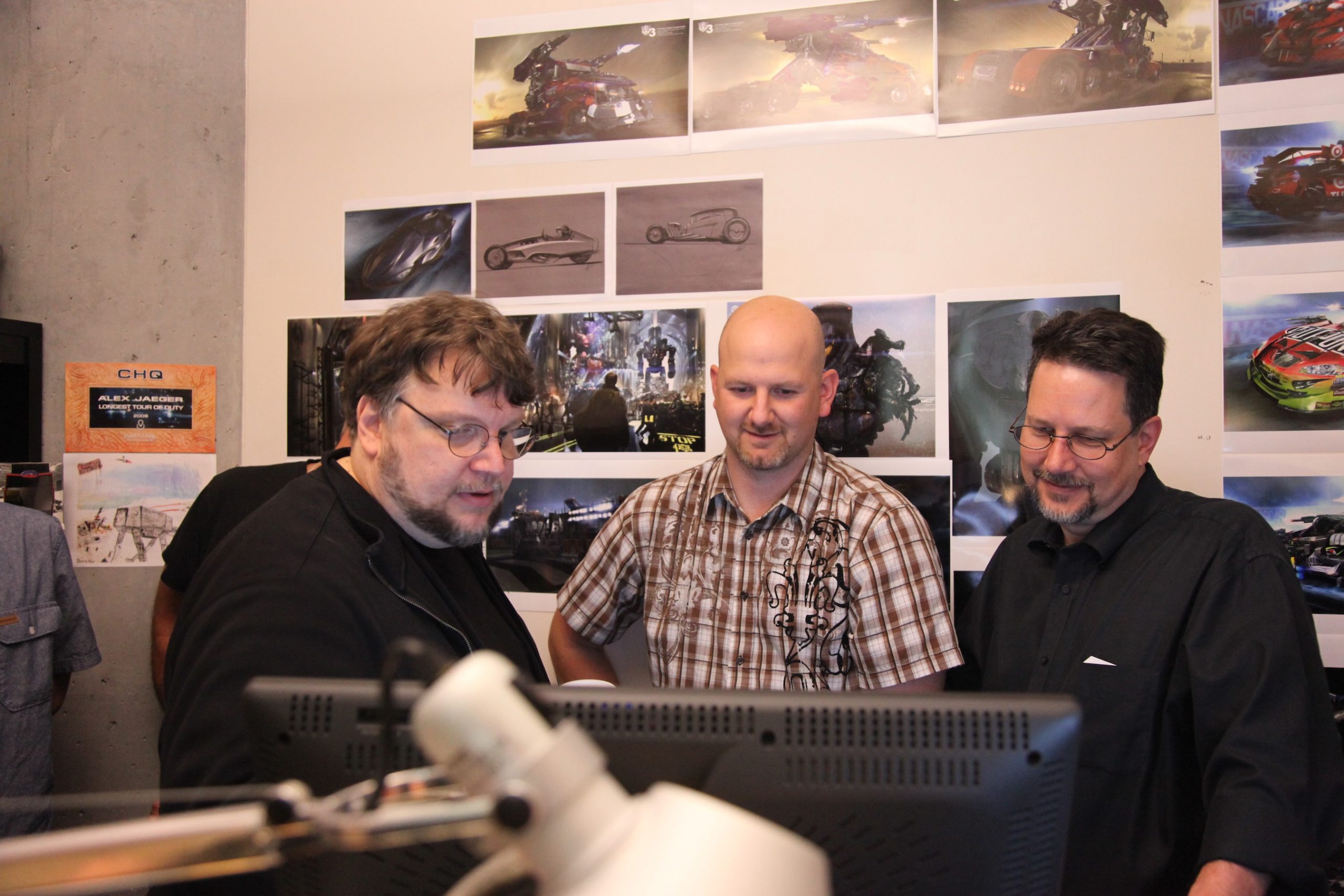
Director Guillermo del Toro (left) at ILM’s San Francisco studio during work on Pacific Rim (2013) with visual effects art director Alex Jaeger (center) and visual effects supervisor John Knoll (Credit: ILM & Greg Grusby).
The Lucas Museum’s renowned collection includes items from both the original and prequel trilogy eras of Star Wars, including filming miniatures created by the ILM Model Shop, concept art, creature maquettes, costumes, a full-scale version of Anakin Skywalker’s N-1 starfighter fromStar Wars: The Phantom Menace (1999), speeder bikes fromStar Wars: Return of the Jedi (1983), and Luke Skywalker’s X-34 landspeeder fromStar Wars: A New Hope (1977).
The pieces will share exhibit space with an eclectic mix of visual art: paintings by artists including Norman Rockwell, Frida Kahlo, and Maxfield Parrish; original art created for Iron Man’s first comic cover in 1968; the first-ever 1934 Flash Gordon comic strip drawing; and Peanuts illustrations drawn by Charles M. Schulz.
“These are all very emotional pieces,” said del Toro. “This is celebrating things that speak to all of us, collectively or individually.”
Lucas says his art collecting began in college when he bought his first comic illustrations. His multifaceted collection today has grown to around 40,000 items.
“I’ve been doing this for 50 years now. And then it occurred to me: ‘What am I going to do with it all? Because I refuse to sell it,’” Lucas explained. “I said I could never do that. It’s just it’s not what I think art is. I think it’s more about an emotional connection with the work.”
Lucas’s first appearance at San Diego Comic-Con brings an association that began a long time ago full circle. In 1976 – ten months before his space fantasy adventure Star Wars hit theaters – a few dozen lucky attendees got a preview of the comic book adaptation of the film led by Marvel’s Roy Thomas and Howard Chaykin. They were joined by Charles Lippincott, Lucasfilm’s vice president of advertising, publicity, promotion, and merchandising. During a panel that didn’t start until 8 p.m. on Thursday, July 22, the trio also revealed a few still images from the upcoming movie to a room that had plenty of empty seats.
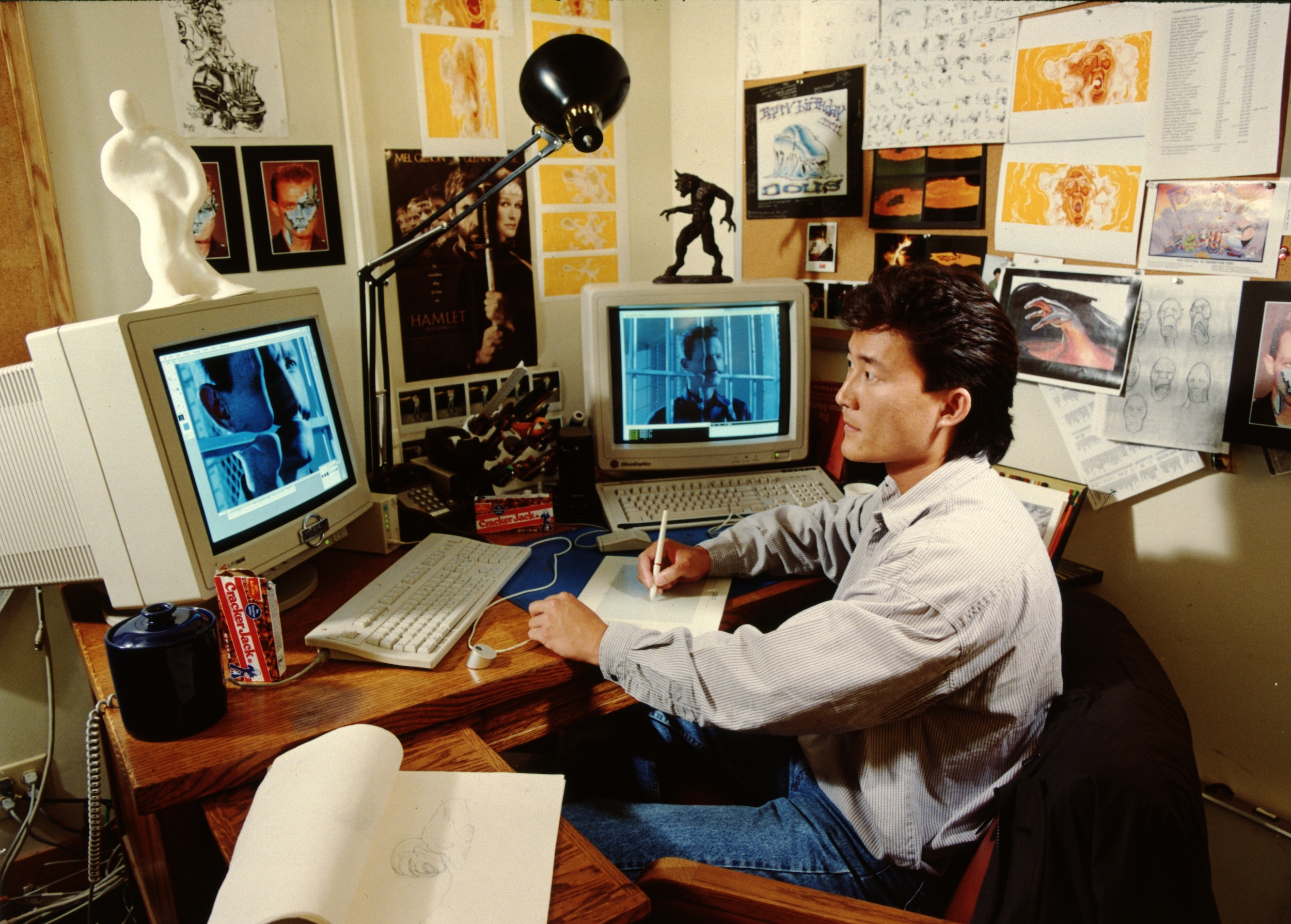
Visual effects art director Doug Chiang at work on Terminator 2: Judgment Day (1991) (Credit: ILM).
Chiang, a celebrated artist himself who first joined Lucasfilm as creative director at ILM in 1991, described growing up loving comic books at a time when comic book art didn’t get much respect.
“I think what’s remarkable about George is that he leads from the heart, and this museum is him. It’s his gift to help celebrate this,” said Chiang. “Narrative art is a way to educate kids and say, ‘It’s okay to draw your fantasy, draw things from your mind, embrace comic books.’ It shouldn’t be left out of art. What’s fantastic is that I think the museum will inspire the next Norman Rockwell or Frank Frazetta.”
—
Clayton Sandell is a Star Wars author and enthusiast, TV storyteller, and a longtime fan of the creative people who keep Industrial Light & Magic and Skywalker Sound on the leading edge of visual effects and sound design. Follow him on Instagram (@claytonsandell) Bluesky (@claytonsandell.com) or X (@Clayton_Sandell).
Teams from across ILM’s global studios are recognized for their innovative work for television this past year.
Among the 14 nominations for the second season of Lucasfilm’s Andorseries on Disney+, ILM and their collaborators have earned one for “Special Visual Effects in a Season or a Movie.” The nominees include production visual effects supervisor Mohen Leo, visual effects producer TJ Falls, special effects supervisor Luke Murphy, creature effects and droid supervisor Neal Scanlan, ILM visual effects supervisor Scott Pritchard, Hybride visual effects supervisor Joseph Kasparian, Scanline visual effects supervisor Sue Row, MidasVFX visual effects supervisor Paolo D’Arco, and digital colorist Jean-Clément Soret.
Alongside the Andor nomination for “Special Visual Effects in a Season or a Movie” is season two of The Lord of the Rings: The Rings of Power on Amazon Prime. The nominees among ILM artists and their partners include production visual effects supervisor Jason Smith, visual effects producer Tim Keene, visual effects producer Ann Podlozny, visual effects co-producer James Yeoman, ILM visual effects supervisor Daniele Bigi, DNEG visual effects supervisor Greg Butler, Rodeo FX visual effects supervisor Ara Khanikian, The Yard visual effects supervisor Laurens Ehrmann, and special effects supervisor Ryan Conder.
Earning a nomination for “Special Visual Effects in a Single Episode” is the premiere entry from season two of the Apple TV+ series Severance, “Hello, Ms. Cobel.” The nominated ILM artists and their collaborators include production visual effects supervisor Eric Leven, production visual effects producer Sean Findley, ILM visual effects associate supervisor Shawn Hillier, ILM visual effects associate supervisor Radost Ridlen, ILM environments lead Martin Kolejak, ILM producer Brian Holligan, ESE visual effects supervisor Alex Lemke, ESE visual effects supervisor Michael Huber, and on-set visual effects supervisor Djuna Wahlrab.
New series exploring ILM’s 50-year legacy kicks off with new interviews featuring original Star Wars animator Chris Cassidy and current ILM animation supervisors Rob Coleman and Hal Hickel.
By Jamie Benning
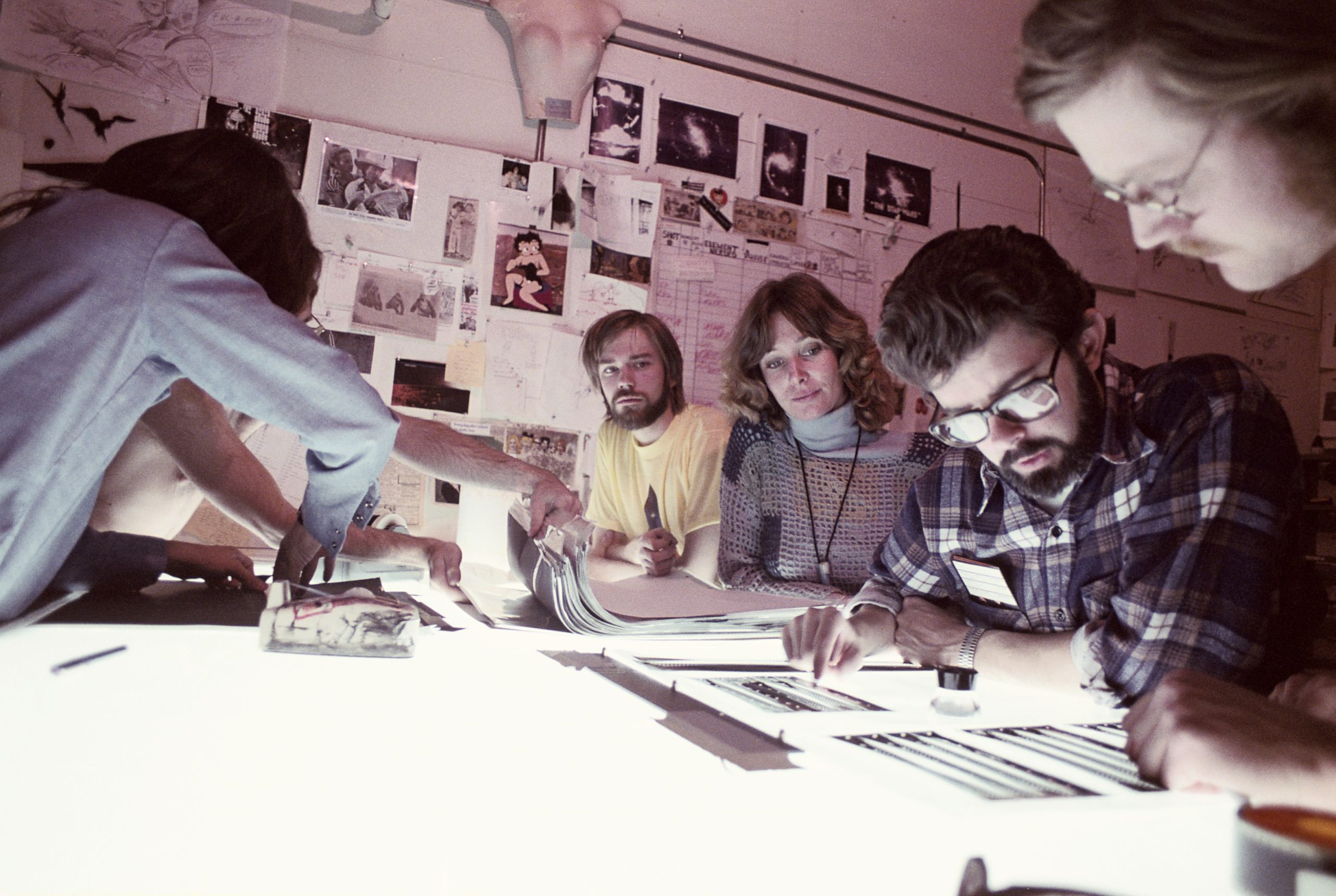
From left: animator Peter Kuran, production coordinator Rose Duignan, director George Lucas, animation and rotoscope supervisor Adam Beckett during production of Star Wars: A New Hope (1977) (Credit: ILM & Lucasfilm).
“ILM Evolutions” is an ILM.com exclusive series exploring a range of visual effects disciplines and highlights from Industrial Light & Magic’s first 50 years of innovative storytelling.
Animation has been woven into the DNA of Industrial Light & Magic’s story since its earliest days. From utilizing legacy techniques in Star Wars: A New Hope (1977) to the groundbreaking blend of live-action and animation in Who Framed Roger Rabbit (1988), ILM has continually redefined the possibilities of visual storytelling.
In this two-part article, we explore ILM’s journey from early work with rotoscoping, stop-motion, and go-motion to the development of sophisticated digital character animation in Jurassic Park (1993), the Star Wars prequel trilogy, and beyond. Part one focuses on the key innovations that culminated in Rango (2011), ILM’s first fully animated feature film. Part two examines how the studio expanded on these foundations in Transformers One and Ultraman: Rising(both 2024), solidifying its role as a leader not only in visual effects but also in feature animation.
Early Innovations and Handcrafted Beginnings
In 1975, as Star Wars, later retitled Star Wars: A New Hope, entered production, Industrial Light & Magic was a fledgling outfit assembled to help realize George Lucas’s ambitious vision. Animation quickly proved essential to the storytelling – Lucas’s needs were varied, including spaceship models firing laser bolts, glowing lightsaber blades, a holographic chess game, and stylized targeting displays.
To create the signature blaster bolts, California Institute of the Arts graduate Adam Beckett was hired in July 1975 to lead a small team in creating the animation and rotoscoping – including a young Peter Kuran. “I was initially shooting wedges and different colors for the laser beams and stuff like that. I was learning to use the equipment. We all were,” Kuran told The Filmumentaries Podcast.
“I actually did the first perspective beams,” said Kuran. “What was being tested was just kind of like back and forth – no perspective on it. I had suggested that we try that, and I actually got a very chilly response. So I decided to stay late one night and do a test and took it to the lab myself. It ran as a daily the next day, and [visual effects supervisor] John Dykstra liked it, so I wound up being the chief of that, at least for the time being.”
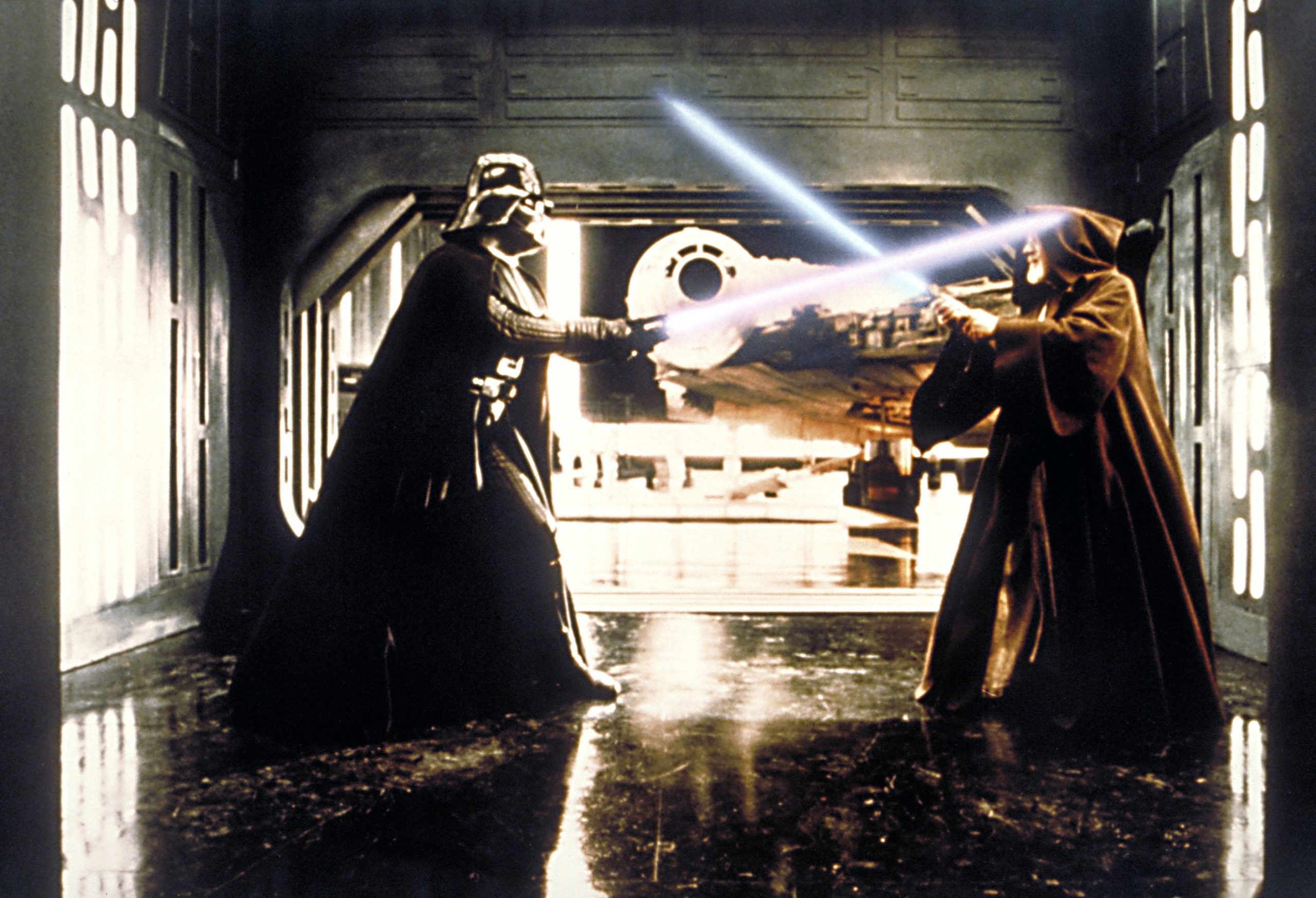
The iconic lightsaber effects were outsourced to Van Der Veer Photo Effects for the first film but later brought in-house at ILM. The process began by generating mattes from the live-action prop blades. Early experiments with retroreflective material and spinning poles proved too complex and were eventually streamlined. The mattes were rephotographed and colored frame by frame, with hues used to help audiences distinguish between each character’s weapon – blue for Obi-Wan Kenobi, red for Darth Vader – setting the look for the Star Wars saga for decades to come.
Lightsabers were created with hand-drawn animation in the original Star Wars trilogy, as seen here with Obi-Wan Kenobi (right, Alec Guinness) and Darth Vader (Bob Anderson/James Earl Jones) in Star Wars: A New Hope (Credit: ILM & Lucasfilm).
“At first, ILM didn’t have the resources to do all the opticals themselves,” animator Chris Casady tells ILM.com. “They sent shots out to Van Der Veer, Cinema Research, and Modern Film Effects. Those places were the old guard – they’d done work on Logan’s Run (1976), Soylent Green (1973), that kind of thing.
“But the goal was always to bring everything in-house,” Casady adds. “And once ILM got the optical department up and running in Van Nuys, the quality jumped. We had more control, and it just looked better.”
Beckett, as described by Casady, “was without a doubt a genius. Adam was extremely brilliant. He wanted to be able to put some of his psychedelic style into Star Wars. He thought it was almost an obligation to one-up 2001: A Space Odyssey [1968]. But Lucas wanted something more realistic.”
Casady noted Beckett’s work on the Death Star superlaser charging sequence, explaining that “Adam did a tremendous amount of work putting together that Death Star laser tunnel shot – all those rings and green things flashing down the middle. It’s built up of multiple passes, multiple exposures, multiple pieces of artwork.” The platform on which the live-action actors were standing was completely hand-drawn by Peter Kuran.
Casady added that “Adam’s signature work is the electrocution of R2-D2,” an entirely hand-drawn effect requiring precision to make the electricity feel convincing on screen.
“I really was brought in at a grunt level to make garbage mattes on the animation stand at night to free up the VistaVision cameras in the daytime,” Casady explained. “Every time they filmed the spaceship on stage … everything outside the blue is considered garbage; it’s got to be masked out. So, my job was to make this matte and block out the garbage.
“On film, my mattes fell below the threshold of black, so it became black,” Casady continues. “Famously, when the film was first released on VHS … my mattes were visible in the negative. … The audience saw my garbage mattes as irregular shapes that jumped every six or eight frames. So that’s the only time people got to see my work on the film!”The animation team also solved another subtle but crucial challenge: making the miniature spaceship models feel more plausible in their scenes.
“There was a shot of a TIE Fighter flying past the camera, and they were concerned it looked too flat,” said Casady. “So they asked if we could paint in some reflections – highlights that would suggest the ship was catching light from the environment. It wasn’t baked into the model photography, so we had to add those glints manually, frame by frame, right onto the animation cels. Just little touches of light to make it feel like the ship belonged in that space.”
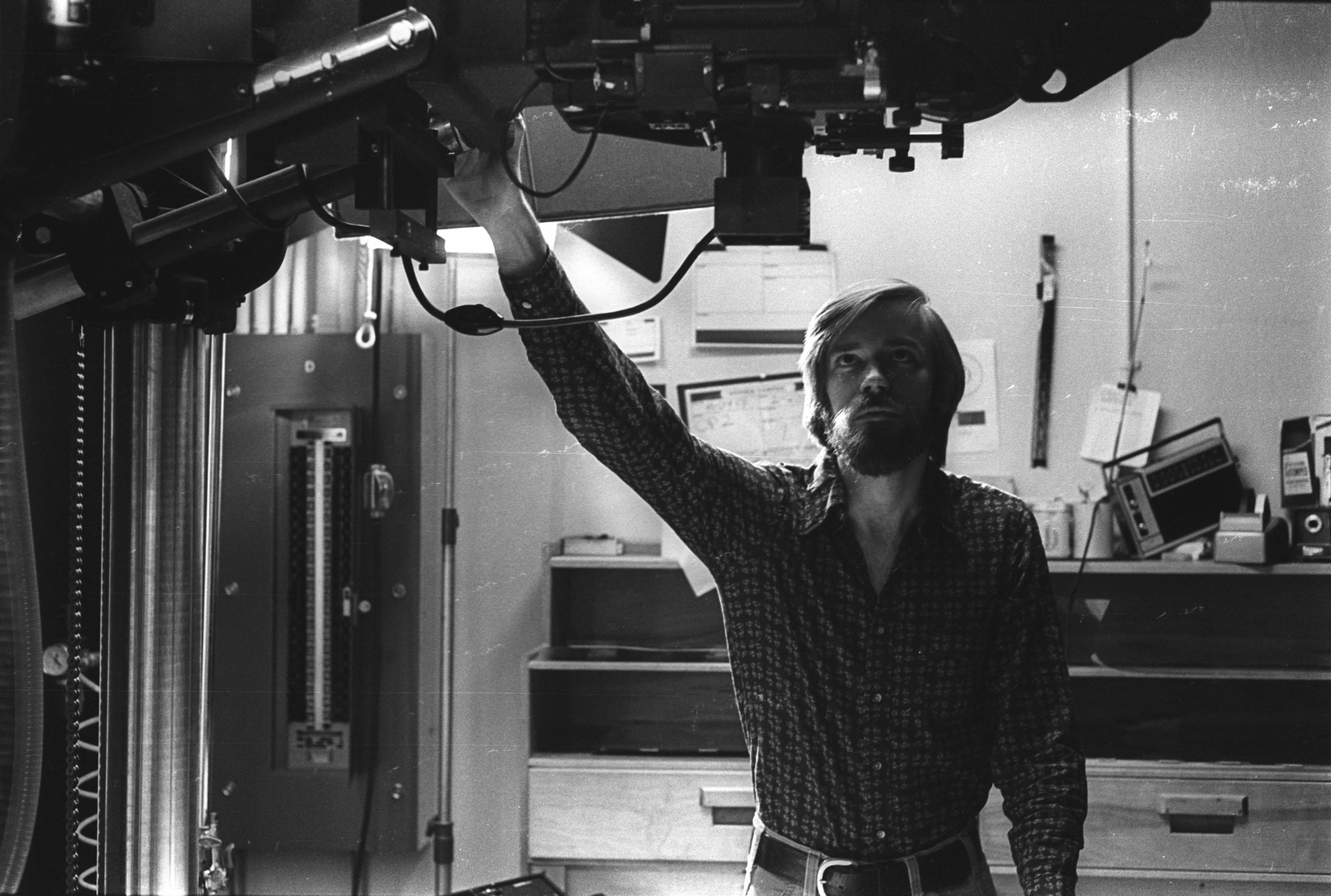
Animation and rotoscope supervisor Peter Kuran works with an animation camera during production of Star Wars: The Empire Strikes Back (1980) (Credit: Terry Chostner & ILM).
Kuran told The Filmumentaries Podcast, “I just thought that that was something that was needed.”
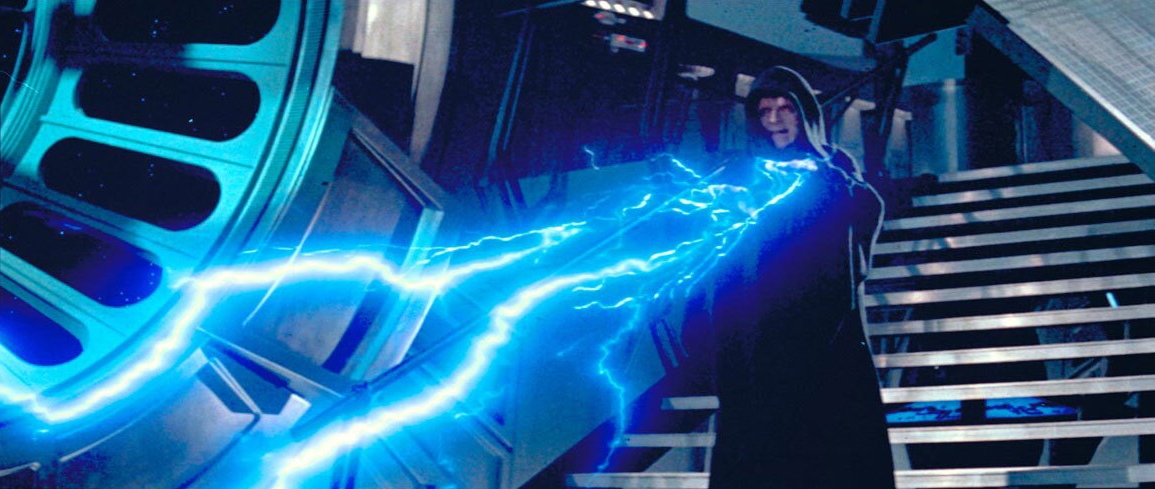
By the time Star Wars: Return of the Jedi (1983) came around, ILM was called on to create yet another iconic animated visual effect: Emperor Palpatine’s Force lightning. Composed of hand-drawn electrical arcs, the effect required animator Terry Windell to conjure a sense of living, dangerous energy – a visual shorthand for the raw power of the dark side. During his career, Windell brought his animation skills to Poltergeist (1982) and Ghostbusters (1984), among many others.
Though Peter Kuran had since left ILM, his company, Visual Concept Engineering, took on the painstaking task of rotoscoping each frame of the lightsaber combat between Luke and Vader. In total, 102 lightsaber shots were completed for the final film in the trilogy.
While rotoscoping and hand-drawn animation effects remained essential throughout the early 1980s, ILM was already looking ahead, seeking ways to evolve another time-honored technique: stop-motion animation.
As with the lightsabers and blaster bolts, the Emperor’s “Force lightning” in Star Wars: Return of the Jedi (1983) was also created with hand-drawn animation (Credit: ILM & Lucasfilm).
The Rise of Go-Motion
Before work began on Return of the Jedi, “Go-Motion” – a breakthrough in dimensional animation pioneered by ILM’s Dennis Muren, Phil Tippett, Stuart Ziff, and Tom St. Amand – offered a major refinement to traditional stop-motion by introducing motion blur, an effect crucial to achieving realistic movement. Unlike standard stop-motion, where models remain static during each frame’s exposure, go-motion employs stepper motors driven by a motion-control system. These motors subtly shift the puppet during the open-shutter phase, simulating the kind of motion blur found in live-action 24fps cinematography.
“The significance is that we got it working,” Ziff told Cinefex, downplaying the complexity of a system that required months of development before the first usable shot could be captured.
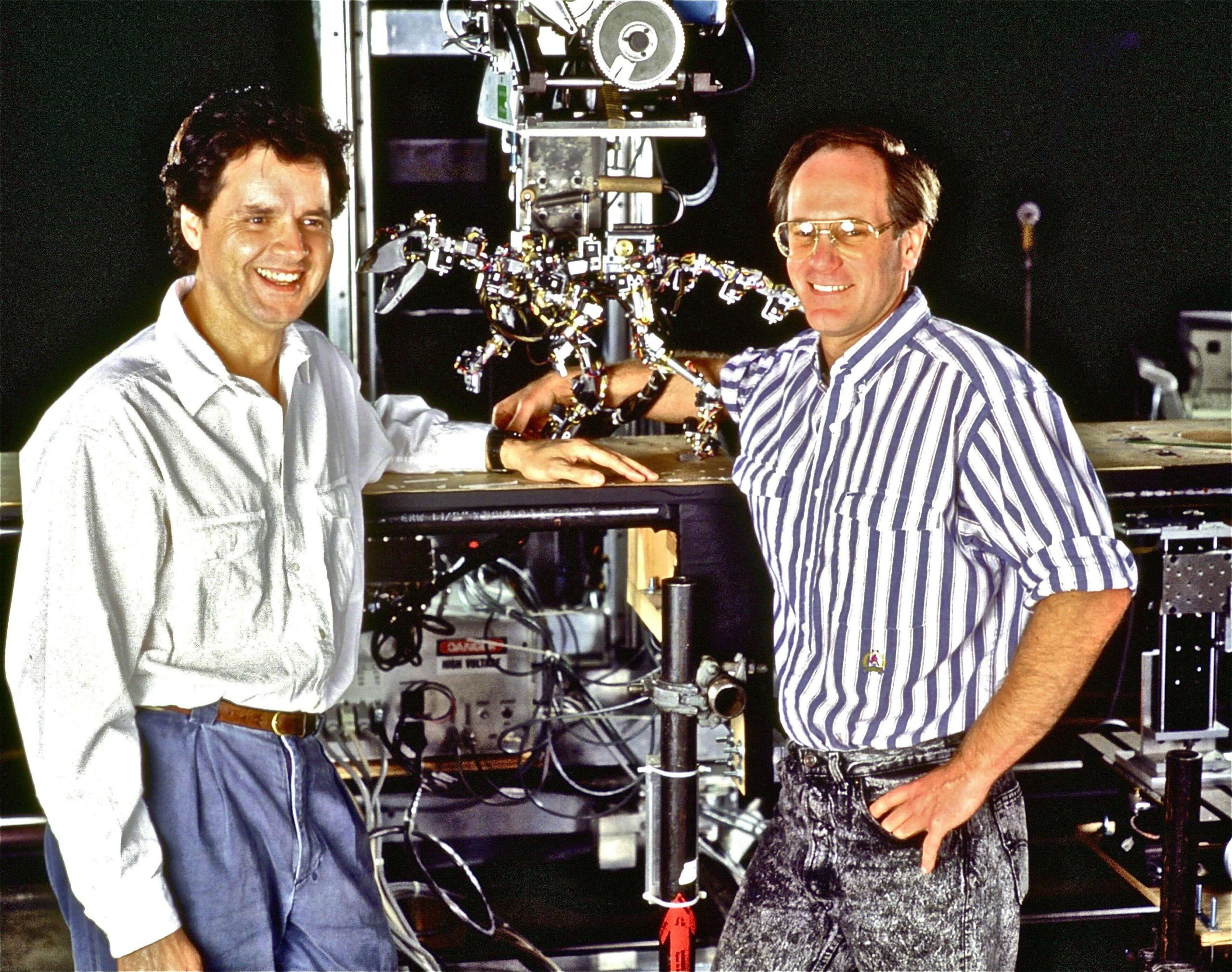
Ziff’s engineering expertise led to the development of a modular rig dubbed the “Dragon Mover,” which connected to the model’s limbs via rods and enabled precise, repeatable motion sequences. Tippett, St. Amand, and Ken Ralston meticulously animated both walking and flying versions of the puppet, blending mechanical precision with handcrafted nuance.
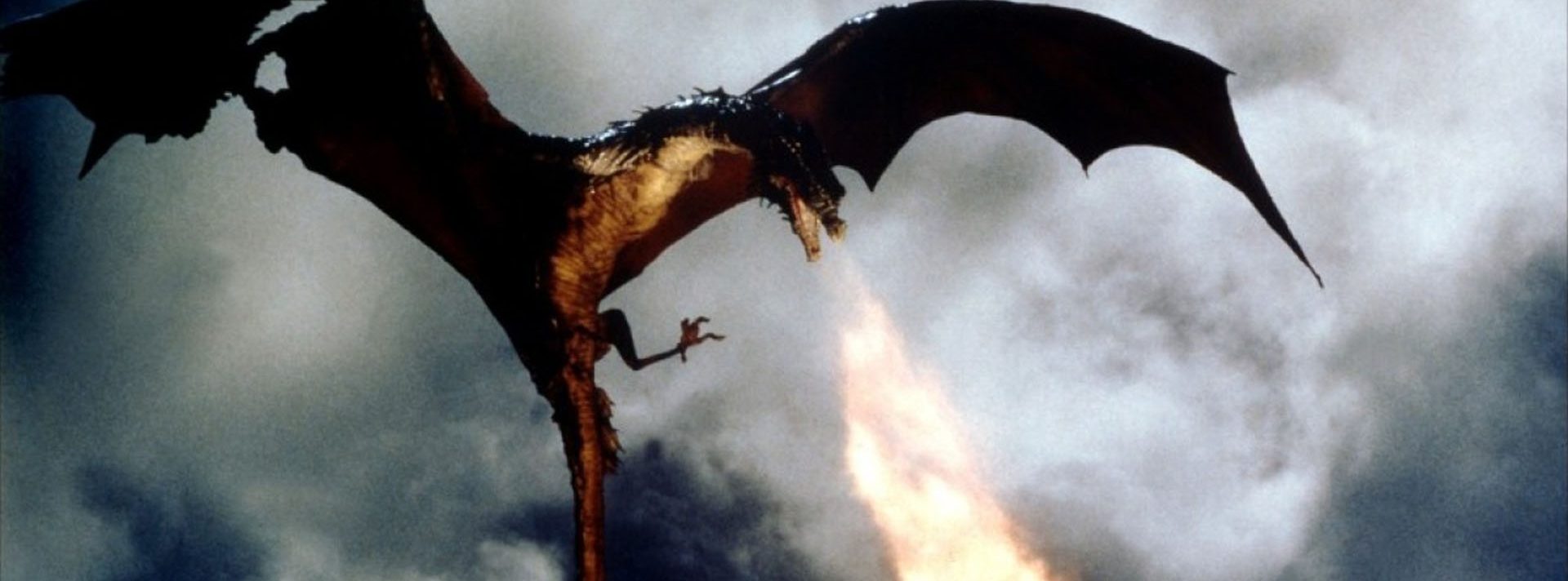
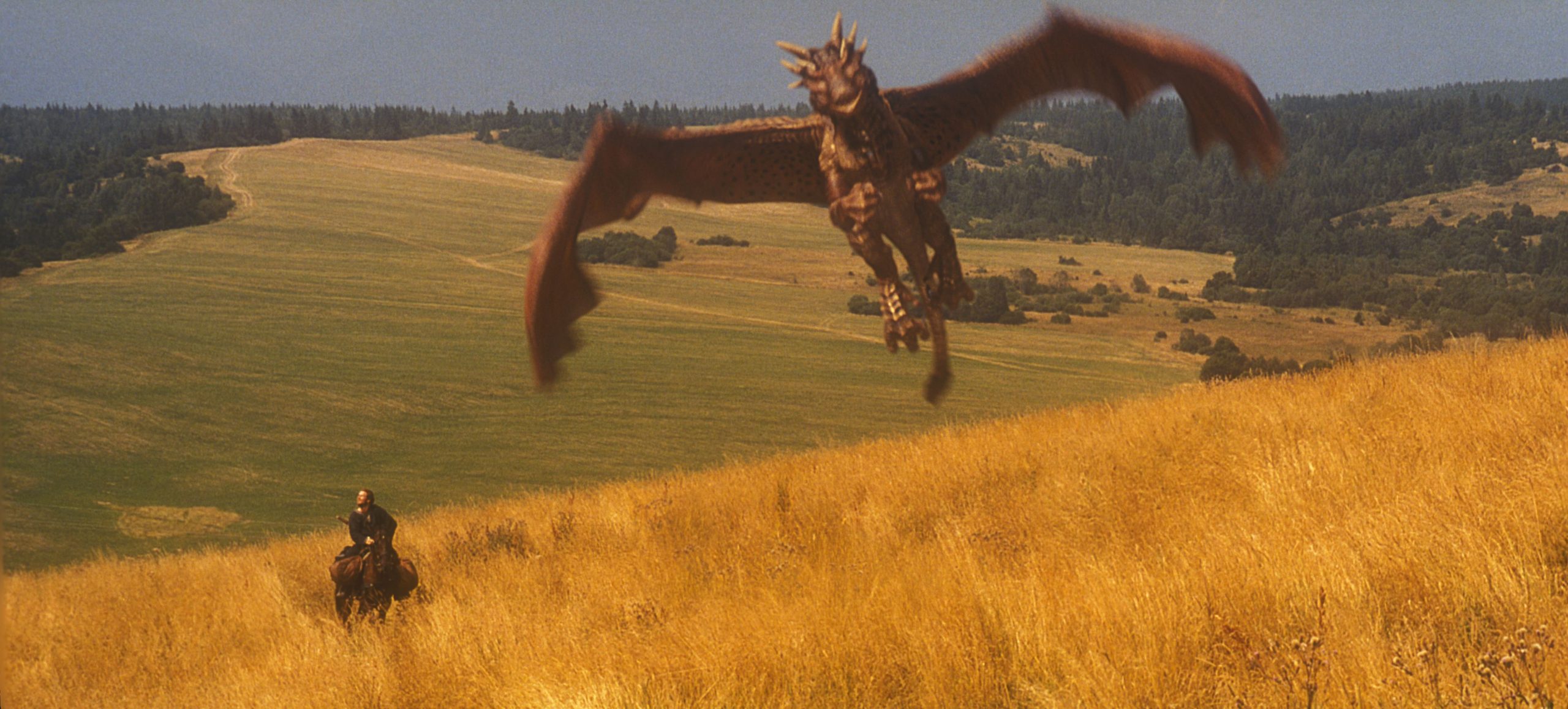
“We started off with some of the more complicated shots,” Tippett told Cinefex, recalling the weeks spent programming movement cycles before finally achieving a fluid, natural gait. This meant that the process became easier over time, a testament to the artists’ dual roles as problem solvers. The result was a new level of fluidity and realism, particularly evident in the scenes featuring the film’s dragon, Vermithrax Pejorative.
The Vermithrax Pejorative in Dragonslayer (1981) (Credit: ILM & Paramount).
Blending Animation with Live-Action: A New Frontier
ILM’s reputation for innovation took a significant leap forward with Who Framed Roger Rabbit. Directed by Robert Zemeckis, the film demanded the seamless integration of hand-drawn, cel-animated characters with live-action performances and practical on-set effects. ILM’s task was to anchor the animated characters convincingly in the real world.
Visual effects supervisor Ken Ralston oversaw the technical and creative challenges of making cartoon characters interact believably with real environments. “The animation had to exist in a real world, with real lighting, perspective, and interaction. That had never been done before at this level,” Ralston told Cinefex.
“It was great for me because I am a huge fan of those early cartoons by the great Warner Brothers directors, Tex Avery and Chuck Jones. And when that showed up with the intent that Bob [Zemeckis] wanted for it, man, that was a match made in heaven. And it was brutal, but it was great at the same time. It keeps you going. And when you see results on something that’s finally coming together, it’s a blast,” Ralston explained to The Filmumentaries Podcast.
Marking a turning point in hybrid filmmaking, they also decided to discard the traditional locked-off camera in favor of dynamic movement. To support this, ILM developed new methods to track live-action camera motion and translate it into data that animators could use to maintain consistent character positioning and perspective. “The opening camera crane shot proved to be historic. … No one had ever done a crane drop with a live-action camera and planted an animated character firmly on the ground,” Zemeckis recalled to Cinefex.
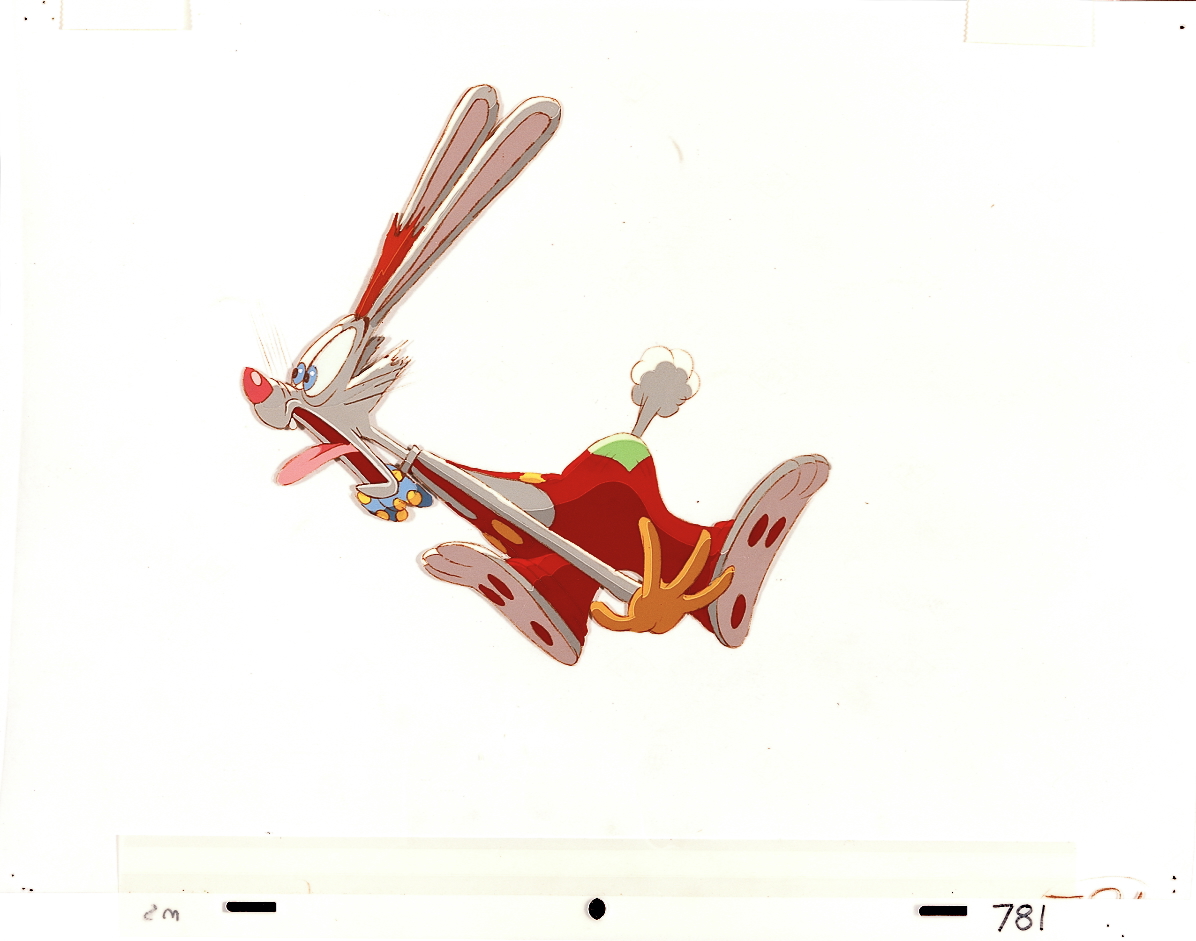
An animation cel from Who Framed Roger Rabbit (1988), created by the team supervised by Richard Williams. ILM was then responsible for compositing the animated characters with the live-action footage (Credit: ILM & Disney).
ILM and the special effects team constructed practical rigs to simulate interactions between live-action props and invisible cartoon characters. In one sequence, when Roger Rabbit turns a water faucet, a hidden mechanism releases a perfectly timed spray – a practical effect used to sell the interaction.
To match the shifting light within live-action environments, ILM tracked moving shadows and highlights, ensuring the animated characters were illuminated just like the actors. “If a light in the scene was swinging, … then the Toon characters would have to be lit in exactly the same way,” said Ralston. Animators relied on detailed lighting references to maintain visual consistency frame by frame.
Performance presented its own challenges. Bob Hoskins, cast as Eddie Valiant, was required to act opposite characters that weren’t physically present. “What I had to do was spend hours developing a technique to actually see, hallucinate, virtually to conjure these characters up,” he told Cinefex. To assist, Charles Fleischer, the voice of Roger Rabbit, wore a full Roger costume off-camera and delivered his lines live. “Although he was on the other side of the camera, I was able to talk to him as if he were right next to me. We could even ad-lib together,” Hoskins said.
After principal photography wrapped, ILM tackled the complex process of optical compositing while Richard Williams’s animation team in London produced the character animation. ILM integrated those elements into the live-action footage. “Every frame had to go through multiple passes to create tone mattes, shadow mattes, and interactive lighting effects. It wasn’t just a matter of drawing the character,” explained optical supervisor Edward Jones. “Every single frame had to be drawn, rechecked, and composited with multiple elements to make sure the animation fit seamlessly into the live-action,” Zemeckis recalled.
The result was a groundbreaking fusion of animation and visual effects that redefined the possibilities in cinematic storytelling. It was a winning combination of traditional techniques and innovation that was widely praised. The film won Best Visual Effects and a Special Achievement Award at the 1989 Academy Awards. Many saw the film as the zenith of the photochemical era, even to the extent that it was perceived as too complex to repeat.
In fact, it wasn’t until a decade later that ILM revisited this hybrid format with The Adventures of Rocky and Bullwinkle (2000), applying many of the same techniques with enhanced digital compositing tools to a new generation of animated characters.
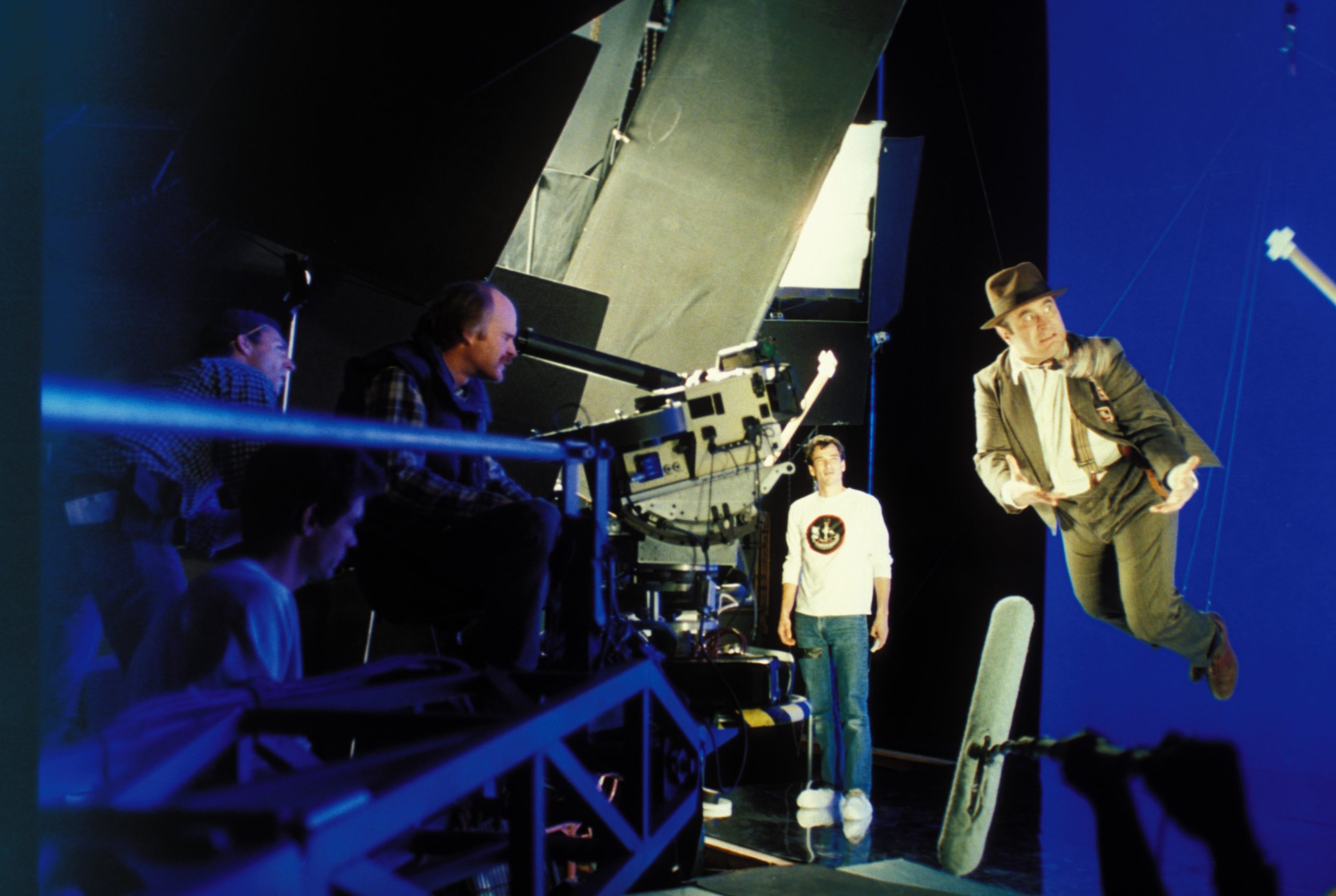
Actor Bob Hoskins (Eddie Valiant) is suspended before a blue screen on ILM’s main stage. In this sequence, his character interacts with animated co-stars Bugs Bunny and Mickey Mouse (Credit: ILM).
When Dinosaurs Ruled the Visual Effects World
While go-motion had proven a valuable innovation throughout the 1980s, it was the advent of computer graphics (CG) character animation that truly revolutionized ILM’s approach in the 1990s. In the last year of the decade, ILM laid the groundwork on James Cameron’s The Abyss (1989), animating the fully CG pseudopod – a water-based, tentacle-like entity. For Cameron’s next film, Terminator 2: Judgment Day (1991), ILM once again raised the bar with the liquid metal T-1000.
It was the digital dinosaurs in Jurassic Park that marked a true turning point – not just in terms of spectacle – but as a clear signal that traditional methods like stop-motion and go-motion were being eclipsed by a new era of photorealistic CG. ILM animator Steve Williams, who had previously worked with Mark Dippé on The Abyss and Terminator 2, pushed the idea of fully computer-rendered dinosaurs further. The results were astonishing. Steven Spielberg’s action-horror hybrid delivered creatures that felt real. Animals that moved and breathed with skin that stretched and muscles that flexed.
As a veteran stop-motion animator, Phil Tippett famously quipped at the time: “I’ve just become extinct.” The line – part joke, part reality – captured the profound shift unfolding across visual effects departments. Tippett’s line was given to the film’s Dr. Malcom, played by Jeff Goldblum.
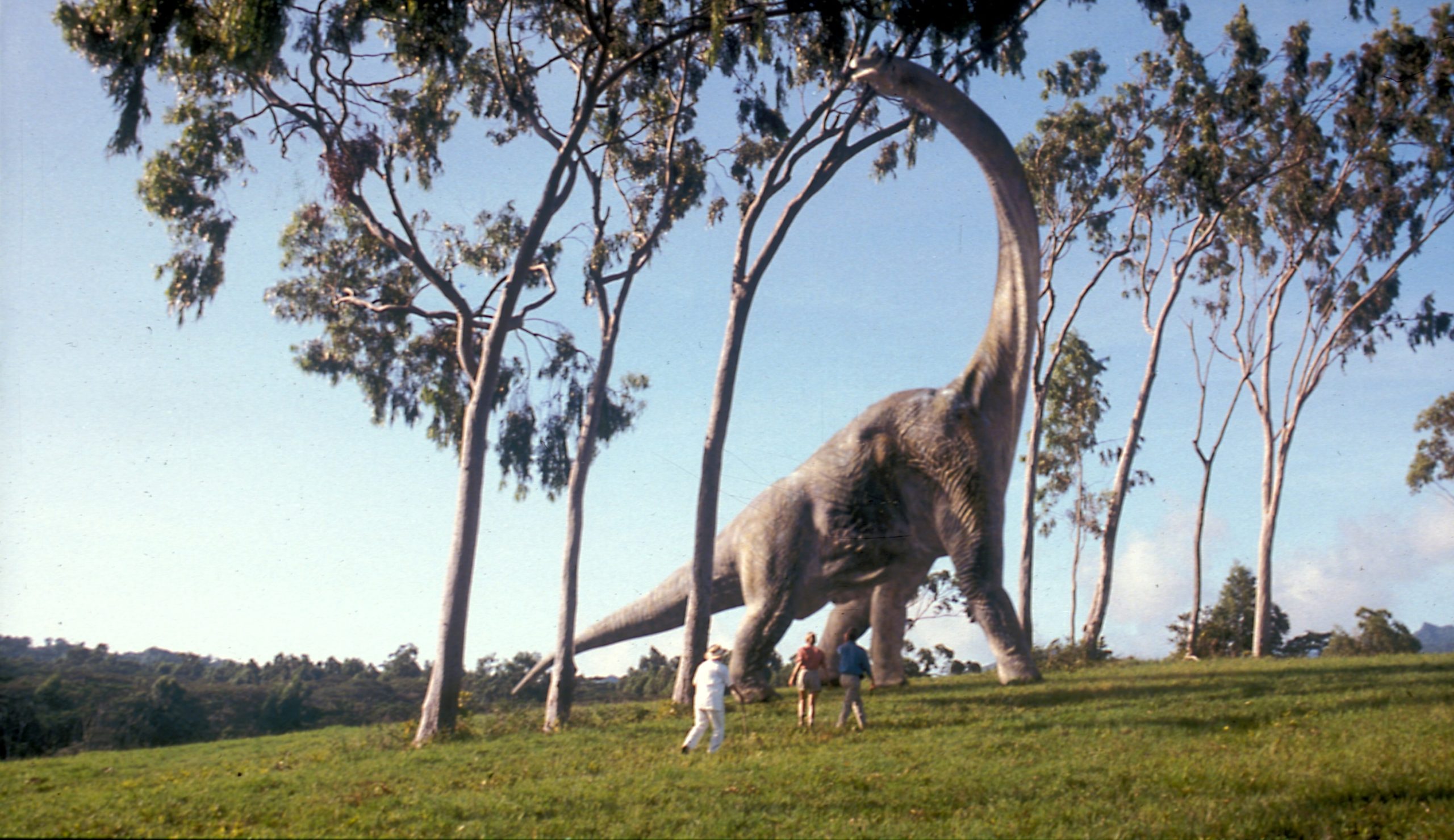
A computer-graphics Brachiosaurus seen with live-action actors in the foreground in Jurassic Park (1993) (Credit: ILM & Universal).
By the time Jurassic Park hit screens, the industry had begun pivoting decisively toward digital techniques, a shift witnessed firsthand by animator Rob Coleman.
“There were only 6 animators at ILM for Jurassic Park,” he tells ILM.com. “It was the film that inspired me to cut my reel and send it in. … And I came in as ILM’s animator number 9 in October of ‘93 (4 months after the film’s release) when it was still very early days for computer graphics.”
To bridge the gap between stop-motion and computer animation, the team developed a hybrid technique known as the Dinosaur Input Device or D.I.D. This setup used a dinosaur armature fitted with sensors and encoders, allowing animators to physically manipulate the model while their movements were captured and translated into digital data. The goal was to combine the skill and experience of the traditional animators and strengths of the computer artists and technicians. While the results weren’t always ideal – much of the animation still had to be keyframed in the computer – it marked a pivotal step. The future of filmmaking was taking shape, frame by frame.
Animator Tom St. Amand (left) and lead animator Randy Dutra of the Tippett Studio pose with the Dinosaur Input Device (D.I.D.) used on Jurassic Park (Credit: ILM & Tippett Studio).
The Challenge of Digital Characters: The Star Wars Prequels
Following ILM’s work in the 1990s on films like The Flintstones (1994), Casper (1995), Forrest Gump (1994), and Jumanji (1995), George Lucas was getting ready to revisit the galaxy far, far away. This time, with a vision that demanded unprecedented integration of digital characters and live-action performances. The Star Wars prequels would become a proving ground for ILM’s rapidly expanding digital animation capabilities.
Leading that charge was Rob Coleman, by then an animation supervisor at ILM. He found himself tasked with something the company had never fully tackled before: nuanced, verbal performances from fully digital characters who needed to share the screen – and emotional space – with real actors.
“It was all those things, plus we didn’t have a staff that actually had spent their time learning how to do nuanced performances,” Coleman recalls. He would tell director Joe Johnston for Light & Magic Season 2 that it was Dragonheart (1996) that really set the groundwork. “That was a huge leap for us. George was watching, and when he saw Dragonheart, he said, … ‘We are ready to go.’
Draco the dragon (voiced by Sean Connery) flies towards Bowen (Dennis Quaid) in Dragonheart (1996) (Credit: ILM & Universal).
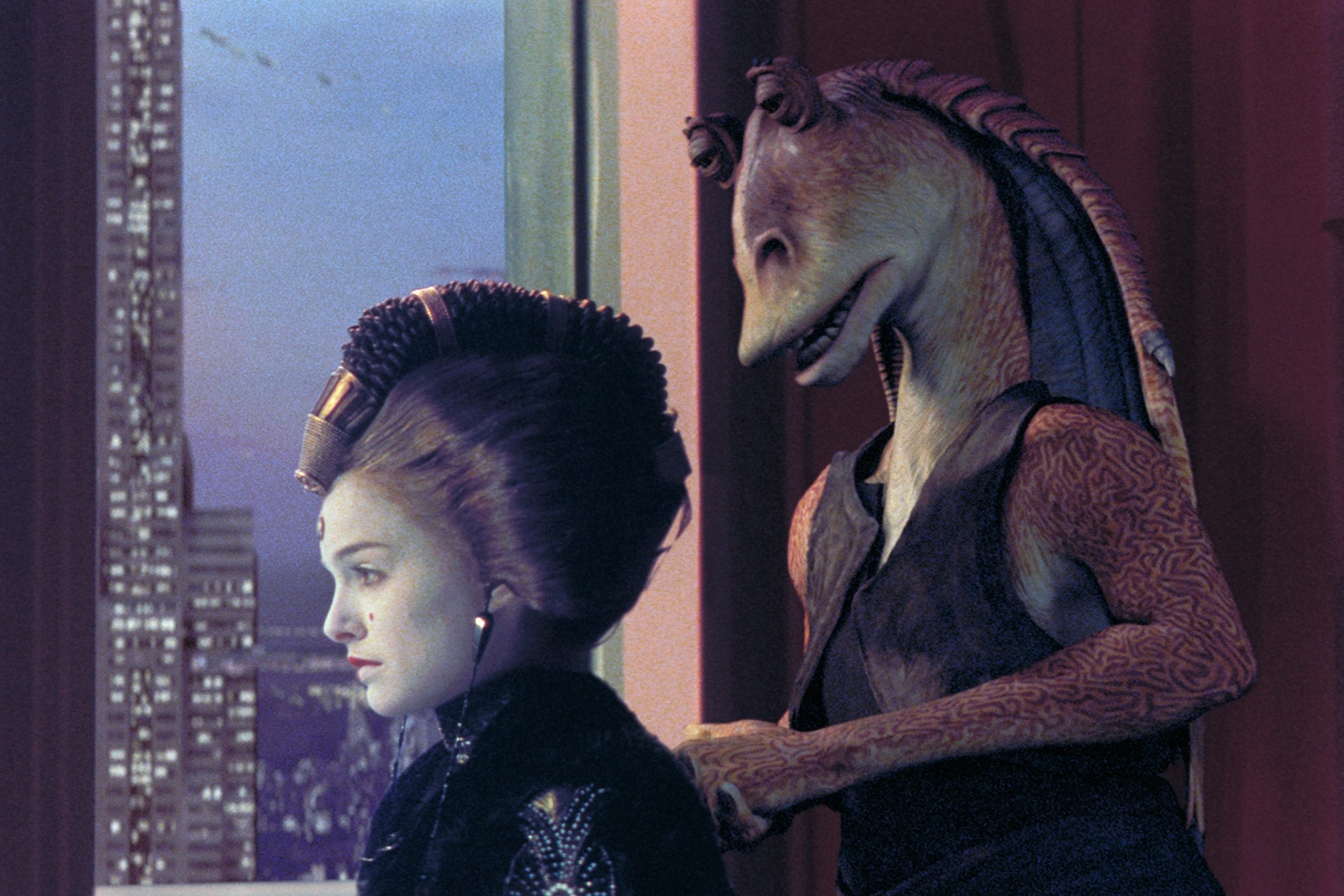
“Most of the people at ILM had been flying spaceships and doing robots and maybe having dinosaurs smash around,” Coleman adds, “but they weren’t doing verbal performances where they were to hold their own with Natalie Portman and Liam Neeson and Ewan McGregor.” And to bring multiple CG characters like Jar Jar Binks, Watto, and Sebulba to life in Star Wars: The Phantom Menace (1999), Coleman had to shift the team’s mindset. His growing team of 65 animators needed to think less like technicians and more like performers.
“We videotaped our actors so we had what they were doing physically, and we could look at them speaking to work out the lip sync. But pretty early on in Phantom Menace, I knew that I wanted to get into the subtext, not just the text. What’s going on inside the heads of the characters. If we could achieve that, we were gonna have believable performances, and the audience would have a connection with Watto, Jar Jar, Sebulba, and Boss Nass in that first film.”
The next major test came with Star Wars: Attack of the Clones (2002) and the digital resurrection of a beloved character: Yoda. Unlike Jar Jar or Watto, Yoda had already been established in the original trilogy as a practical puppet, sculpted by Stuart Freeborn and brought to life by puppeteer Frank Oz. Coleman’s team needed to preserve that legacy while updating the character with a broader range of expression.
“I went back and looked at Empire and it was nothing like I remembered because I’d grown up. It had changed what we expected,” Coleman says. “So what I was trying to achieve is what I remembered Yoda doing in terms of expressiveness and honoring how Frank moved him. Frank actually came by ILM, held up his hand, showed me the position of his fingers inside Yoda’s head. I had him pantomime some Yoda with me so I could see what he was doing.”
To ensure authenticity, Coleman and his team rigorously tested Yoda’s new digital incarnation. He recalls the moment he shared the first test with George Lucas. “There is footage of me presenting the first digital Yoda on the From Puppets to Pixels [2002] documentary. That is the real footage of me doing that, even though I asked the documentary not to shoot it. I’m so happy they did. I was really nervous, and I presented three speaking shots and three non-speaking shots on purpose because I was trying to show them that we could maintain performance without the crutch of dialogue. That was a focused decision because I knew from watching countless movies and TV, editors routinely cut to their action shots – the non-verbal reaction shot. I wanted to earn one of those, and we did.”
Jar Jar Binks (right, Ahmed Best) performs opposite Queen Amidala (Natalie Portman) in Star Wars: The Phantom Menace (1999) (Credit: ILM & Lucasfilm).
That approach paid off. One of Yoda’s most effective digital moments came not during a battle or speech but in a quiet reaction. “There’s a shot of Yoda in Palpatine’s office where Palpatine says something, Yoda’s leaving, and he turns, and he looks over his shoulder, and you can tell he doesn’t trust him,” Coleman notes. “And that’s all in facial performance, all keyframe, frame-by-frame animation. It ended up on the movie poster.”
Coleman’s work continued into Star Wars: Revenge of the Sith (2005), by which point ILM had solidified its reputation as a pioneer in digital character animation. The scope of the prequel work, in retrospect, still feels enormous to the animation director.“I kind of got swept up in it all. Jim Morris [ILM’s general manager from 1993 to 2005] had put me forward for the role. Jim had taken me aside, and he said, ‘I think you’ve got the right temperament to work with George.’ So he sent me over … and dropped me off in London for a two-week interview with George Lucas, which I passed.”
Decades later, Coleman is reflective about the experience. Even as ILM continued to push forward in their abilities to mimic life, it was paradoxically the artists themselves that felt like the imposters. “Twenty-five years on, it’s kind of surreal to think back that I actually did that. I know that’s me. There are pictures of a younger me doing it. And I have all the memories, but sometimes it feels like it was someone else.”
Animation director Rob Coleman at work on The Phantom Menace (Credit: ILM).
Cursed Flesh and Living Tentacles: The Pirates Breakthrough
When Pirates of the Caribbean: The Curse of the Black Pearl (2003) set sail, ILM faced a major challenge. Bringing the cursed crew of the Black Pearl to life wasn’t just about creating convincing skeletons – it was about making them believable next to live-action characters.
Hal Hickel, animation supervisor, explains to ILM.com that “It was a really complicated problem because the idea was that under moonlight these guys are skeletons, but in shadow, they’re flesh and blood.” Each shot became a complex blend of live-action photography and animation, requiring seamless transitions between the two. “You couldn’t just cut to them and show them in full skeletal form under neutral lighting,” he said. “It all had to be motivated by the lighting in the scene.”
The work paid off, but it was only the beginning. For the sequel, Pirates of the Caribbean: Dead Man’s Chest (2006), director Gore Verbinski raised the bar with Davy Jones and his crew. These characters were fully digital – and fully expected to carry the emotional weight of their scenes.
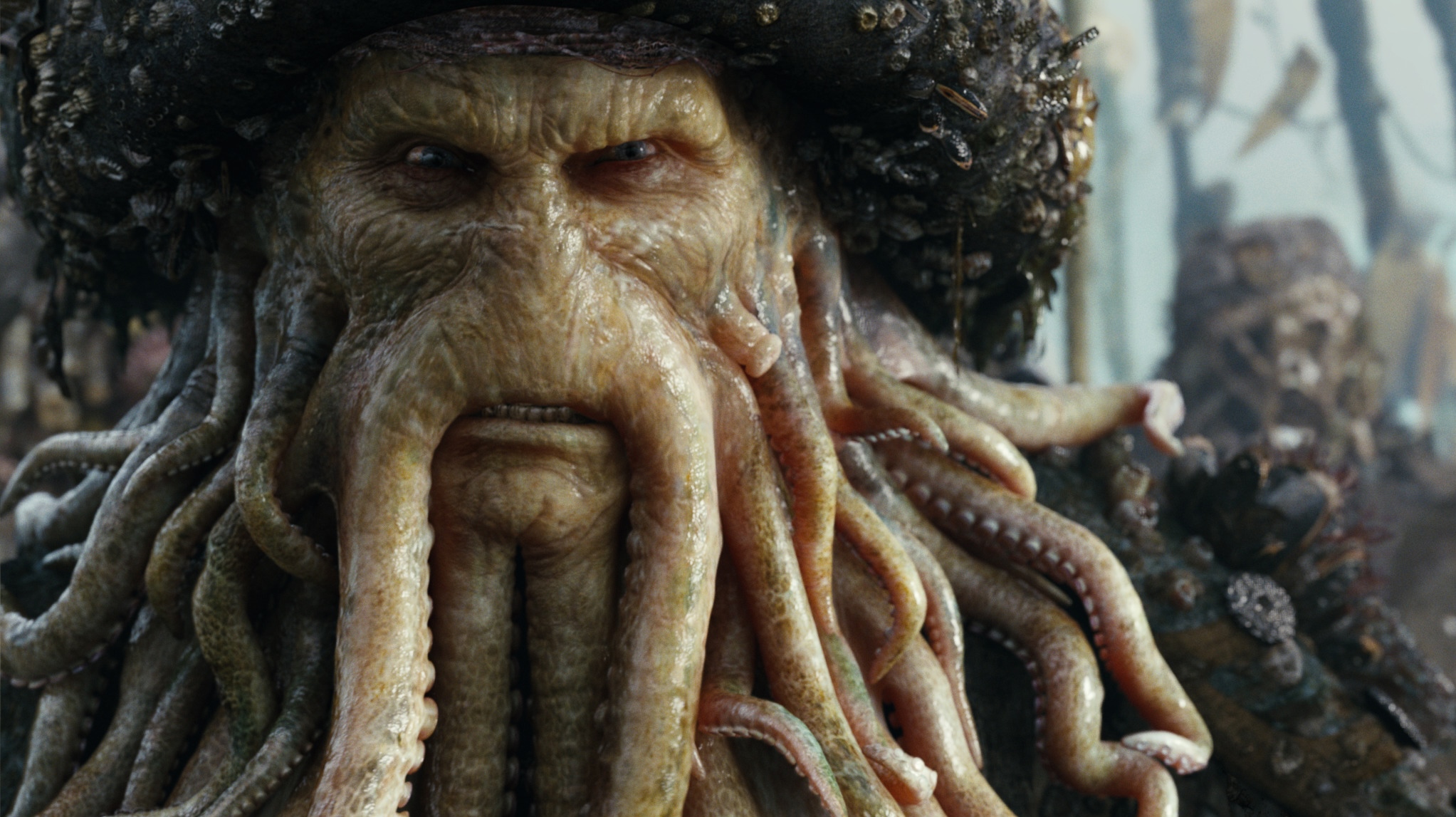
Speaking about Bill Nighy’s portrayal of Davy Jones, Hickel notes that “Bill gave such a brilliant performance. We didn’t want to lose any of the little stuff. The slight squint of an eye, the tiny sneer.” Rather than relying solely on motion capture, the team blended Nighy’s reference footage with keyframe animation, ensuring that none of his subtle acting choices were lost. “We wanted the tentacles to feel alive but they had to support the emotion in his face, not steal focus.”
Davy Jones (Bill Nighy) in Pirates of the Caribbean: Dead Man’s Chest (2006) (Credit: ILM & Disney).
Animating Davy Jones’s tentacle beard posed its own technical challenges. “It was a mix of hand animation and simulation,” Hickel explains. “We animated parts of it for performance reasons, but we also let physics take over for the secondary motion, so it didn’t look fake or overly choreographed.” This approach required close collaboration between animators, rigging artists, and the simulation team to keep everything feeling realistic and responsive.
The complexity of Davy Jones and his crew pushed ILM to overhaul their pipeline. “We had to rethink a lot of how we built and rendered these characters,” Hickel says. Advances made for Pirates laid the foundation for ILM’s later work on projects like Transformers (2007) and The Avengers (2012).
Beyond the technical achievements, Pirates also marked a shift in how digital characters were treated on screen. As Hickel puts it, “It wasn’t just about creating spectacle. Gore trusted us to handle real character beats with these CG characters. It was an amazing opportunity.” Through a mix of performance, artistry, and cutting-edge technology, ILM helped create one of cinema’s most memorable digital villains. They had steered animation into entirely new waters.
The Leap to Full-Length Animation: Rango
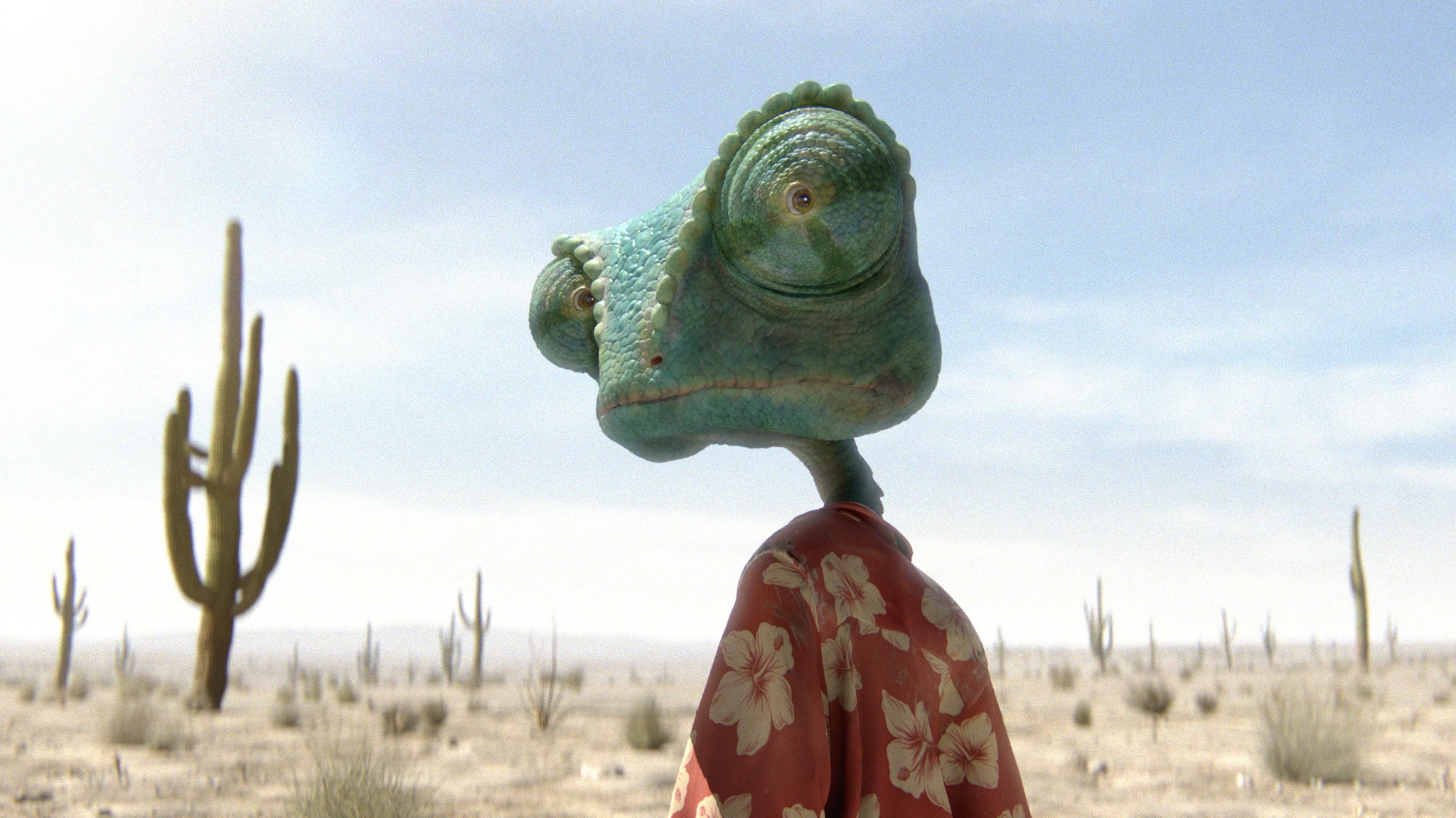
After working with Industrial Light & Magic on three Pirates of the Caribbean films, director Gore Verbinski approached the studio with an ambitious proposal: to produce a fully animated feature. He had been particularly impressed by ILM’s work on Davy Jones and believed the studio could bring that same level of sophistication to Rango – a surreal Western populated by anthropomorphic desert creatures.
“We approached Rango the way we approach live-action visual effects,” visual effects supervisor John Knoll told Cinefex, “building out environments with a cinematic mindset rather than adhering to the rigid, modular workflow of conventional animated features.”
A defining innovation was the film’s approach to lighting and cinematography. Renowned director of photography Roger Deakins consulted on the project, bringing principles of real-world filmmaking into the animated space. “We lit Rango the way we’d light a live-action film, with practical principles of cinematography in mind,” Deakins told Cinefex.
Rango‘s (2011) namesake, as voiced by Johnny Depp (Credit: ILM & Paramount).
ILM’s animation director, Hal Hickel, emphasized that they wanted the characters to inhabit their world with mass and texture. “We didn’t want our characters to feel overly polished or weightless,” he told Cinefex. “Gore wanted them to move with a slight awkwardness as if they truly existed in this dusty, unpredictable world.”
“He didn’t want to go head to head with Pixar or Disney or DreamWorks or Illumination. If they’re all over here, he wanted to go over there, aesthetically, in every way,” Hickel tells ILM.com. “Gore understood that the look of the film that he wanted to do was what we ended up calling ‘photographic.’ So not photoreal, but definitely not cartoony – the shot glass with whiskey in it, those kinds of things all had this patina of realism. So that seemed like a really good fit with us at ILM.”
Rather than using motion capture, Verbinski shot sessions with the actors performing together in a theatrical setting simply to inspire the animation. “It wasn’t about mapping motion one-to-one,” says Hickel. “It was about understanding the rhythm, the beats, the subtle mannerisms that would inform the final animated characters.” The result was a film that felt authored – visually distinct and emotionally resonant. For ILM, Rango marked another turning point.
“We knew this was an experiment,” said Knoll, “but we also knew it was an opportunity to redefine what ILM could do. Looking back, I think we did just that.”
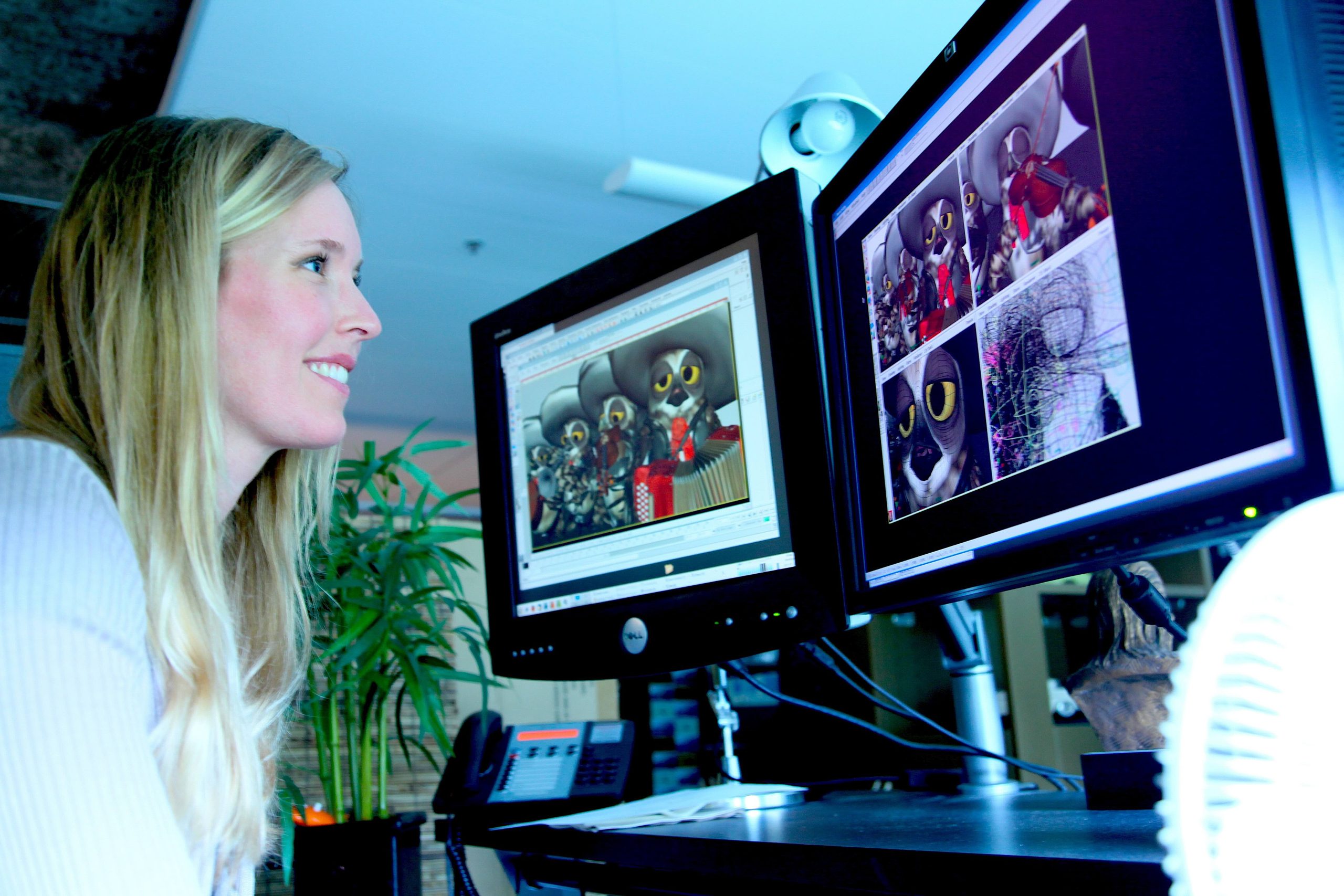
Lead animator Maia Kayser at work on Rango (Credit: ILM).
Having left ILM before production on the film, Rob Coleman is still captivated by Rango. “It came about because John Knoll and Hal Hickel built a fantastic relationship with Gore Verbinski,” he says, “and they demonstrated to him through Pirates of the Caribbean that ILM had acting animators, and Gore is an actor’s director. They needed the right director with the right focus and the right mixture of talents and just bravado to say, ‘Yeah, we’re going to do this.’ And to hit ILM at the right time to make it, I think it’s still a marvel. I went back and watched it a couple years ago. It’s incredible what they did and what they achieved.”
“Every animator I know who worked on Rango had a ball and tells me continuously, ‘Gosh. Let’s get another Gore film going,’” says Hickel. “Yeah, they ate it up. He just really wanted people to feel like we were all filmmakers. You’re not the visual effects people up there, and I’m the filmmaker down here. We’re all filmmakers. We’re making this movie together.” That sense of collaboration was an ethos that ILM started in 1975 and continues to carry forward to this day.
Rango went on to win the Academy Award for Best Animated Feature in 2012.
Jamie Benning is a filmmaker, author, and podcaster with a lifelong passion for sci-fi and fantasy cinema. He hosts The Filmumentaries Podcast, featuring twice-monthly interviews with behind-the-scenes artists. Visit Filmumentaries.com or find him on X (@jamieswb) and @filmumentaries on Threads, Instagram, and Facebook.
Guided by visual effects supervisor John Knoll, ILM embraced continually evolving methodologies to craft breathtaking visual effects for the iconic space battles in First Contact and Rogue One.
By Jay Stobie
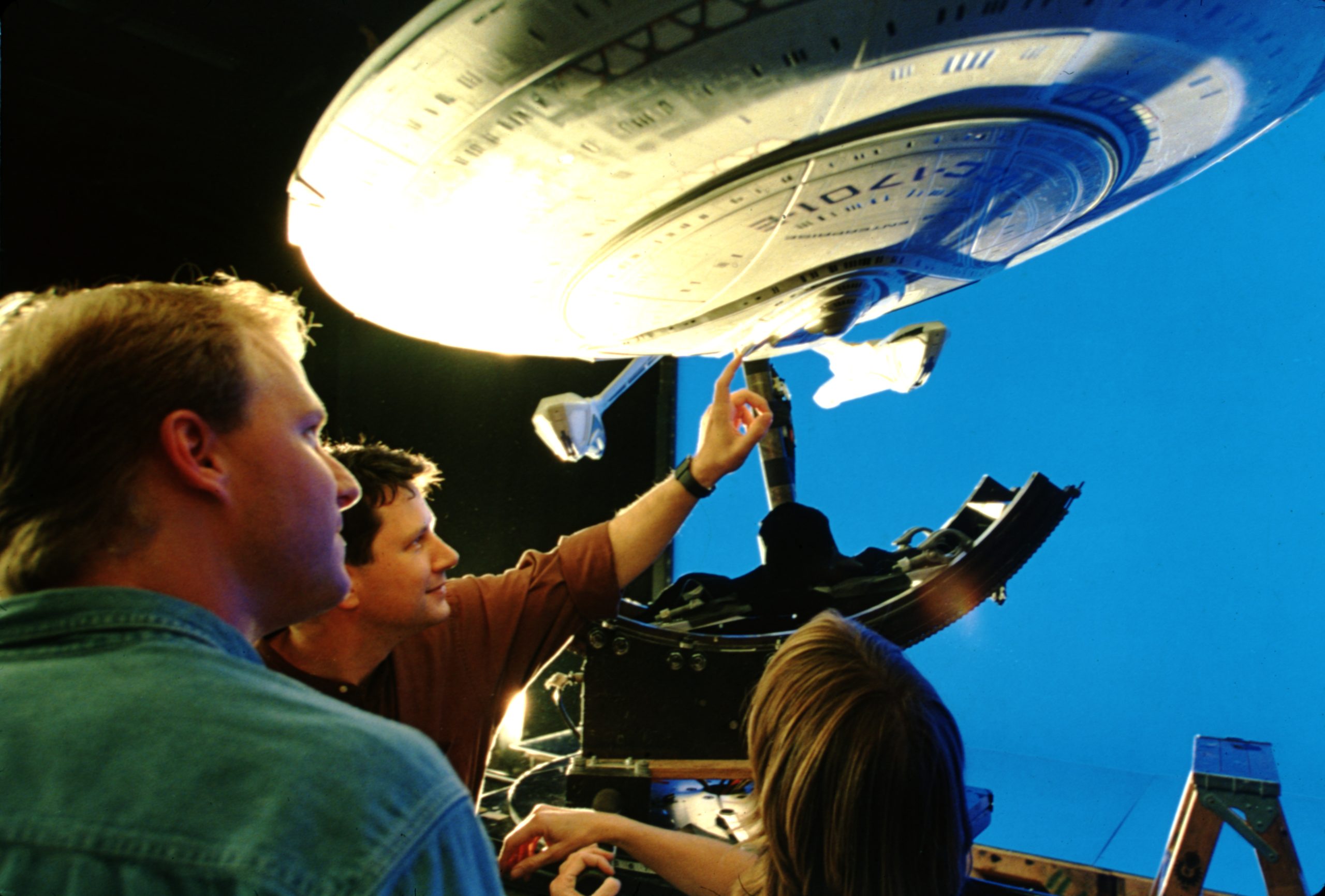
Visual effects supervisor John Knoll (right) confers with modelmakers Kim Smith and John Goodson with the miniature of the U.S.S. Enterprise-E during production of Star Trek: First Contact (Credit: ILM).
Bolstered by visual effects from Industrial Light & Magic, Star Trek: First Contact (1996) andRogue One: A Star Wars Story (2016) propelled their respective franchises to new heights. WhileStar Trek Generations (1994) welcomed Captain Jean-Luc Picard’s (Patrick Stewart) crew to the big screen, First Contact stood as the first Star Trek feature that did not focus on its original captain, the legendary James T. Kirk (William Shatner). Similarly, though Rogue One immediately preceded the events ofStar Wars: A New Hope (1977), it was set apart from the episodic Star Wars films and launched an era of storytelling outside of the main Skywalker saga that has gone on to include Solo: A Star Wars Story (2018), The Mandalorian (2019-23), Andor (2022-25), Ahsoka (2023), The Acolyte (2024), and more.
The two films also shared a key ILM contributor, John Knoll, who served as visual effects supervisor on both projects, as well as an executive producer on Rogue One. Currently, ILM’s executive creative director and senior visual effects supervisor, Knoll – who also conceived the initial framework for Rogue One’s story – guided ILM as it brought its talents to bear on these sci-fi and fantasy epics. The work involved crafting two spectacular starship-packed space clashes – First Contact’s Battle of Sector 001 and Rogue One’s Battle of Scarif. Although these iconic installments were released roughly two decades apart, they represent a captivating case study of how ILM’s approach to visual effects has evolved over time. With this in mind, let’s examine the films’ unforgettable space battles through the lens of fascinating in-universe parallels and the ILM-produced fleets that face off near Earth and Scarif.
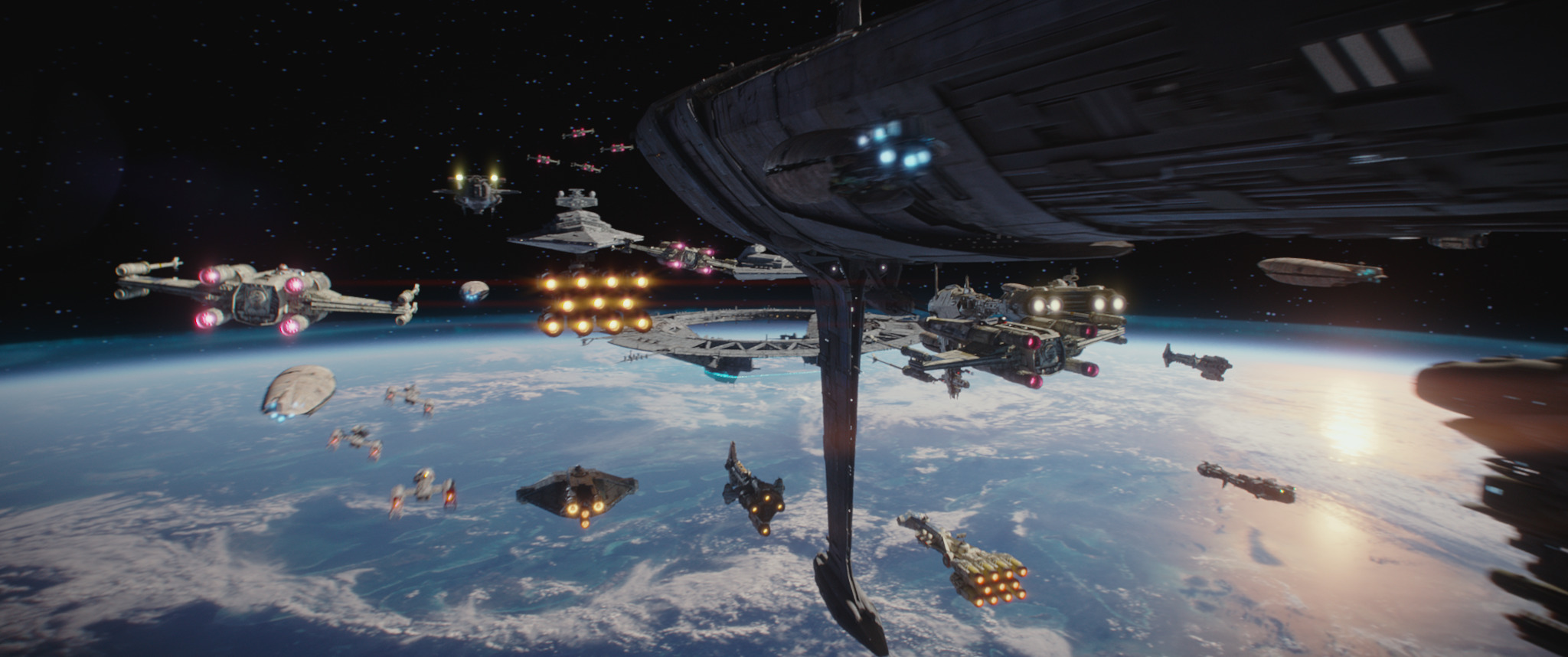
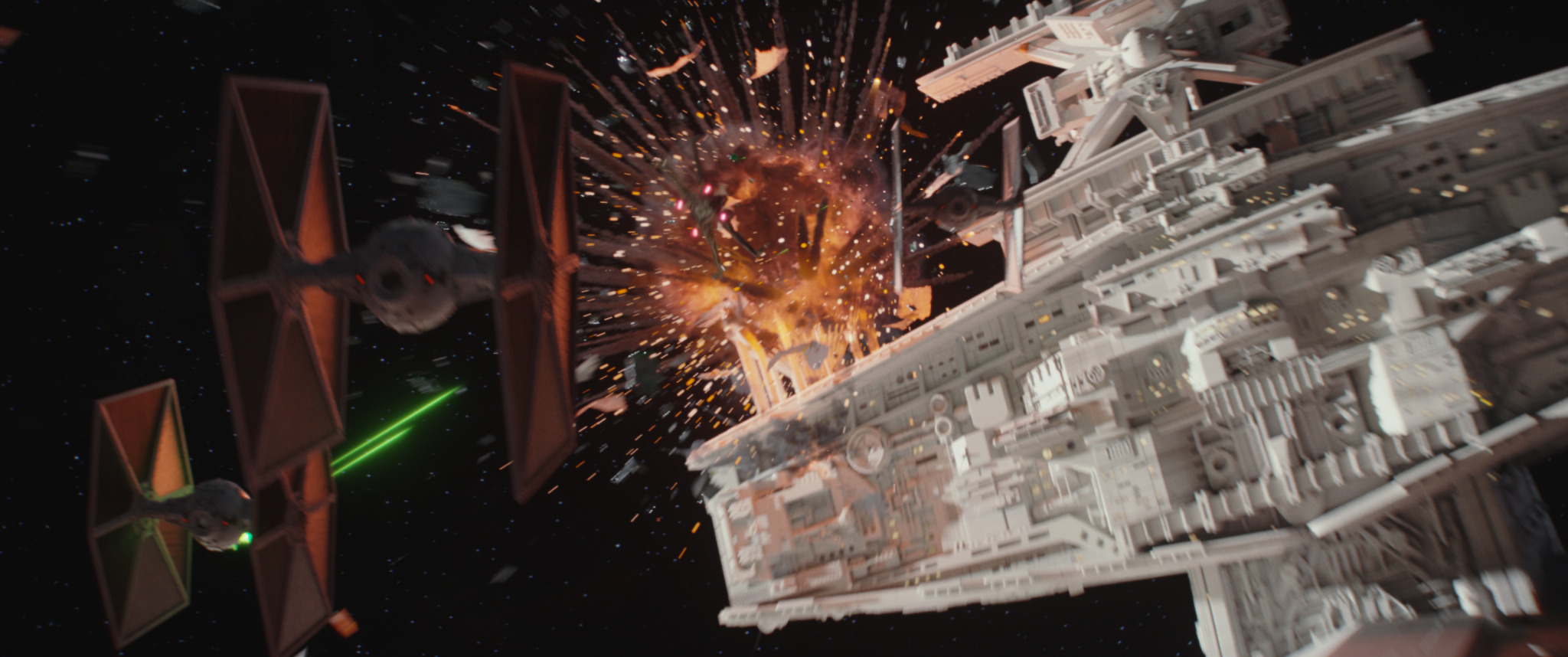
A final frame from the Battle of Scarif in Rogue One: A Star Wars Story (Credit: ILM & Lucasfilm).
A Context for Conflict
In First Contact, the United Federation of Planets – a 200-year-old interstellar government consisting of more than 150 member worlds – braces itself for an invasion by the Borg – an overwhelmingly powerful collective composed of cybernetic beings who devastate entire planets by assimilating their biological populations and technological innovations. The Borg only send a single vessel, a massive cube containing thousands of hive-minded drones and their queen, pushing the Federation’s Starfleet defenders to Earth’s doorstep. Conversely, in Rogue One, the Rebel Alliance – a fledgling coalition of freedom fighters – seeks to undermine and overthrow the stalwart Galactic Empire – a totalitarian regime preparing to tighten its grip on the galaxy by revealing a horrifying superweapon. A rebel team infiltrates a top-secret vault on Scarif in a bid to steal plans to that battle station, the dreaded Death Star, with hopes of exploiting a vulnerability in its design.
On the surface, the situations could not seem to be more disparate, particularly in terms of the Federation’s well-established prestige and the Rebel Alliance’s haphazardly organized factions. Yet, upon closer inspection, the spaceborne conflicts at Earth and Scarif are linked by a vital commonality. The threat posed by the Borg is well-known to the Federation, but the sudden intrusion upon their space takes its defenses by surprise. Starfleet assembles any vessel within range – including antiquated Oberth-class science ships – to intercept the Borg cube in the Typhon Sector, only to be forced back to Earth on the edge of defeat. The unsanctioned mission to Scarif with Jyn Erso (Felicity Jones) and Cassian Andor (Diego Luna) and the sudden need to take down the planet’s shield gate propels the Rebel Alliance fleet into rushing to their rescue with everything from their flagship Profundity to GR-75 medium transports. Whether Federation or Rebel Alliance, these fleets gather in last-ditch efforts to oppose enemies who would embrace their eradication – the Battles of Sector 001 and Scarif are fights for survival.
From Physical to Digital
By the time Jonathan Frakes was selected to direct First Contact, Star Trek’s reliance on constructing traditional physical models (many of which were built by ILM) for its features was gradually giving way to innovative computer graphics (CG) models, resulting in the film’s use of both techniques. “If one of the ships was to be seen full-screen and at length,” associate visual effects supervisor George Murphy told Cinefex’s Kevin H. Martin, “we knew it would be done as a stage model. Ships that would be doing a lot of elaborate maneuvers in space battle scenes would be created digitally.” In fact, physical and CG versions of the U.S.S. Enterprise-E appear in the film, with the latter being harnessed in shots involving the vessel’s entry into a temporal vortex at the conclusion of the Battle of Sector 001.
Despite the technological leaps that ILM pioneered in the decades between First Contact and Rogue One, they considered filming physical miniatures for certain ship-related shots in the latter film. ILM considered filming physical miniatures for certain ship-related shots in Rogue One. The feature’s fleets were ultimately created digitally to allow for changes throughout post-production. “If it’s a photographed miniature element, it’s not possible to go back and make adjustments. So it’s the additional flexibility that comes with the computer graphics models that’s very attractive to many people,” John Knoll relayed to writer Jon Witmer atAmerican Cinematographer’s TheASC.com.
However, Knoll aimed to develop computer graphics that retained the same high-quality details as their physical counterparts, leading ILM to employ a modern approach to a time-honored modelmaking tactic. “I also wanted to emulate the kit-bashing aesthetic that had been part of Star Wars from the very beginning, where a lot of mechanical detail had been added onto the ships by using little pieces from plastic model kits,” explained Knoll in his chat with TheASC.com. For Rogue One, ILM replicated the process by obtaining such kits, scanning their parts, building a computer graphics library, and applying the CG parts to digitally modeled ships. “I’m very happy to say it was super-successful,” concluded Knoll. “I think a lot of our digital models look like they are motion-control models.”
John Knoll (second from left) confers with Kim Smith and John Goodson with the miniature of the U.S.S. Enterprise-E during production of Star Trek: First Contact (Credit: ILM).
Legendary Lineages
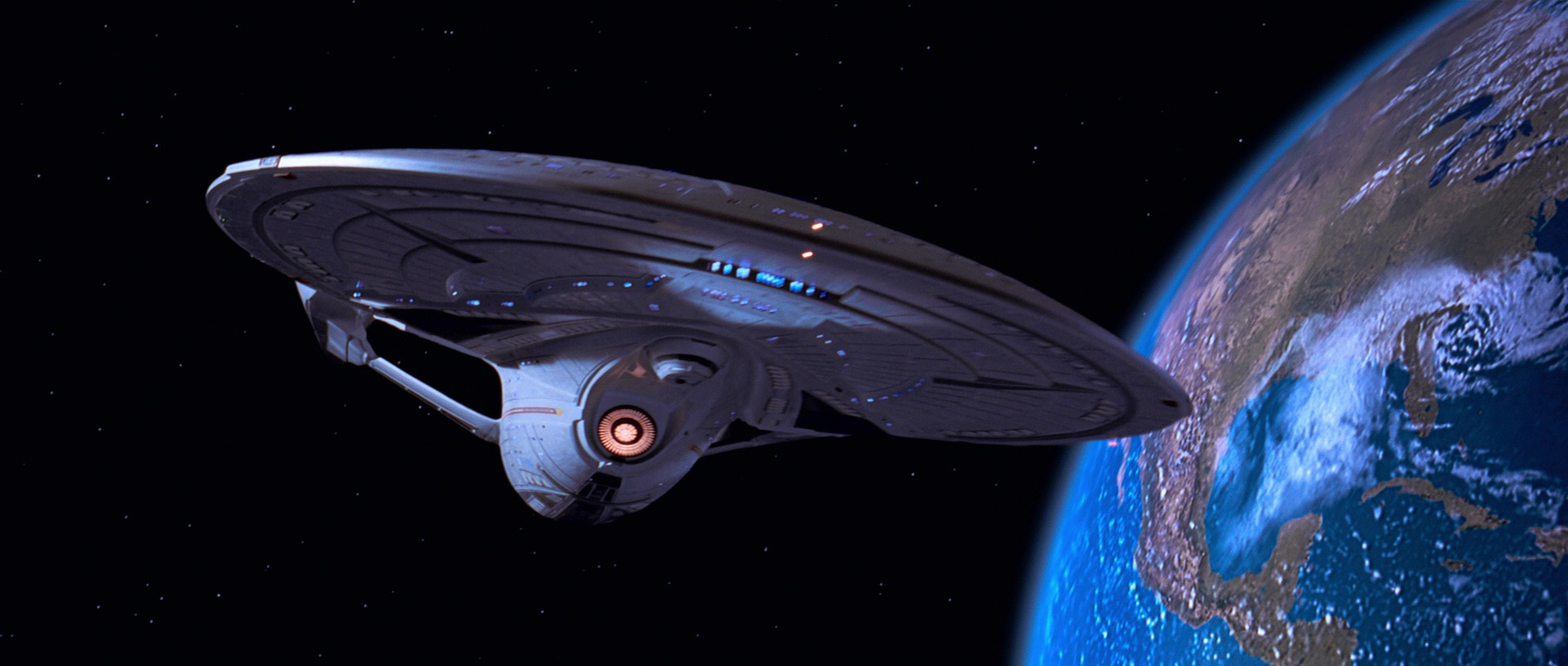
In First Contact, Captain Picard commanded a brand-new vessel, the Sovereign-class U.S.S. Enterprise-E, continuing the celebrated starship’s legacy in terms of its famous name and design aesthetic. Designed by John Eaves and developed into blueprints by Rick Sternbach, the Enterprise-E was built into a 10-foot physical model by ILM model project supervisor John Goodson and his shop’s talented team. ILM infused the ship with extraordinary detail, including viewports equipped with backlit set images from the craft’s predecessor, the U.S.S. Enterprise-D. For the vessel’s larger windows, namely those associated with the observation lounge and arboretum, ILM took a painstakingly practical approach to match the interiors shown with the real-world set pieces. “We filled that area of the model with tiny, micro-scale furniture,” Goodson informed Cinefex, “including tables and chairs.”
Rogue One’s rebel team initially traversed the galaxy in a U-wing transport/gunship, which, much like the Enterprise-E, was a unique vessel that nonetheless channeled a certain degree of inspiration from a classic design. Lucasfilm’s Doug Chiang, a co-production designer for Rogue One, referred to the U-wing as the film’s “Huey helicopter version of an X-wing” in theDesigning Rogue One bonus featurette on Disney+ before revealing that, “Towards the end of the design cycle, we actually decided that maybe we should put in more X-wing features. And so we took the X-wing engines and literally mounted them onto the configuration that we had going.” Modeled by ILM digital artist Colie Wertz, the U-wing’s final computer graphics design subtly incorporated these X-wing influences to give the transport a distinctive feel without making the craft seem out of place within the rebel fleet.
While ILM’s work on the Enterprise-E’s viewports offered a compelling view toward the ship’s interior, a breakthrough LED setup for Rogue One permitted ILM to obtain realistic lighting on actors as they looked out from their ships and into the space around them. “All of our major spaceship cockpit scenes were done that way, with the gimbal in this giant horseshoe of LED panels we got from [equipment vendor] VER, and we prepared graphics that went on the screens,” John Knoll shared with American Cinematographer’s Benjamin B and Jon D. Witmer. Furthermore, in Disney+’s Rogue One: Digital Storytelling bonus featurette, visual effects producer Janet Lewin noted, “For the actors, I think, in the space battle cockpits, for them to be able to see what was happening in the battle brought a higher level of accuracy to their performance.”
The U.S.S. Enterprise-E in Star Trek: First Contact (Credit: Paramount).
Familiar Foes
To transport First Contact’s Borg invaders, John Goodson’s team at ILM resurrected the Borg cube design previously seen in Star Trek: The Next Generation (1987) and Star Trek: Deep Space Nine (1993), creating a nearly three-foot physical model to replace the one from the series. Art consultant and ILM veteran Bill George proposed that the cube’s seemingly straightforward layout be augmented with a complex network of photo-etched brass, a suggestion which produced a jagged surface and offered a visual that was both intricate and menacing. ILM also developed a two-foot motion-control model for a Borg sphere, a brand-new auxiliary vessel that emerged from the cube. “We vacuformed about 15 different patterns that conformed to this spherical curve and covered those with a lot of molded and cast pieces. Then we added tons of acid-etched brass over it, just like we had on the cube,” Goodson outlined to Cinefex’s Kevin H. Martin.
As for Rogue One’s villainous fleet, reproducing the original trilogy’s Death Star and Imperial Star Destroyers centered upon translating physical models into digital assets. Although ILM no longer possessed A New Hope’s three-foot Death Star shooting model, John Knoll recreated the station’s surface paneling by gathering archival images, and as he spelled out to writer Joe Fordham in Cinefex, “I pieced all the images together. I unwrapped them into texture space and projected them onto a sphere with a trench. By doing that with enough pictures, I got pretty complete coverage of the original model, and that became a template upon which to redraw very high-resolution texture maps. Every panel, every vertical striped line, I matched from a photograph. It was as accurate as it was possible to be as a reproduction of the original model.”
Knoll’s investigative eye continued to pay dividends when analyzing the three-foot and eight-foot Star Destroyer motion-control models, which had been built for A New Hope andStar Wars: The Empire Strikes Back (1980), respectively. “Our general mantra was, ‘Match your memory of it more than the reality,’ because sometimes you go look at the actual prop in the archive building or you look back at the actual shot from the movie, and you go, ‘Oh, I remember it being a little better than that,’” Knoll conveyed to TheASC.com. This philosophy motivated ILM to combine elements from those two physical models into a single digital design. “Generally, we copied the three-footer for details like the superstructure on the top of the bridge, but then we copied the internal lighting plan from the eight-footer,” Knoll explained. “And then the upper surface of the three-footer was relatively undetailed because there were no shots that saw it closely, so we took a lot of the high-detail upper surface from the eight-footer. So it’s this amalgam of the two models, but the goal was to try to make it look like you remember it from A New Hope.”
A final frame from Rogue One: A Star Wars Story (Credit: ILM & Lucasfilm).
Forming Up the Fleets
In addition to the U.S.S. Enterprise-E, the Battle of Sector 001 debuted numerous vessels representing four new Starfleet ship classes – the Akira, Steamrunner, Saber, and Norway – all designed by ILM visual effects art director Alex Jaeger. “Since we figured a lot of the background action in the space battle would be done with computer graphics ships that needed to be built from scratch anyway, I realized that there was no reason not to do some new designs,” John Knoll told American Cinematographer writer Ron Magid. Used in previous Star Trek projects, older physical models for the Oberth and Nebula classes were mixed into the fleet for good measure, though the vast majority of the armada originated as computer graphics.
Over at Scarif, ILM portrayed the Rebel Alliance forces with computer graphics models of fresh designs (the MC75 cruiser Profundity and U-wings), live-action versions ofStar WarsRebels’ VCX-100 light freighter Ghost and Hammerhead corvettes, and Star Wars staples (Nebulon-B frigates, X-wings, Y-wings, and more). These ships face off against two Imperial Star Destroyers and squadrons of TIE fighters, and – upon their late arrival to the battle – Darth Vader’s Star Destroyer and the Death Star. The Tantive IV, a CR90 corvette more popularly referred to as a blockade runner, made its own special cameo at the tail end of the fight. As Princess Leia Organa’s (Carrie Fisher and Ingvild Deila) personal ship, the Tantive IV received the Death Star plans and fled the scene, destined to be captured by Vader’s Star Destroyer at the beginning of A New Hope. And, while we’re on the subject of intricate starship maneuvers and space-based choreography…
Although the First Contact team could plan visual effects shots with animated storyboards, ILM supplied Gareth Edwards with a next-level virtual viewfinder that allowed the director to select his shots by immersing himself among Rogue One’s ships in real time. “What we wanted to do is give Gareth the opportunity to shoot his space battles and other all-digital scenes the same way he shoots his live-action. Then he could go in with this sort of virtual viewfinder and view the space battle going on, and figure out what the best angle was to shoot those ships from,” senior animation supervisor Hal Hickel described in the Rogue One: Digital Storytelling featurette. Hickel divulged that the sequence involving the dish array docking with the Death Star was an example of the “spontaneous discovery of great angles,” as the scene was never storyboarded or previsualized.
Visual effects supervisor John Knoll with director Gareth Edwards during production of Rogue One: A Star Wars Story (Credit: ILM & Lucasfilm).
Tough Little Ships
The Federation and Rebel Alliance each deployed “tough little ships” (an endearing description Commander William T. Riker [Jonathan Frakes] bestowed upon the U.S.S. Defiant in First Contact) in their respective conflicts, namely the U.S.S. Defiant from Deep Space Nine and the Tantive IV from A New Hope. VisionArt had already built a CG Defiant for the Deep Space Nine series, but ILM upgraded the model with images gathered from the ship’s three-foot physical model. A similar tactic was taken to bring the Tantive IV into the digital realm for Rogue One. “This was the Blockade Runner. This was the most accurate 1:1 reproduction we could possibly have made,” model supervisor Russell Paul declared to Cinefex’s Joe Fordham. “We did an extensive photo reference shoot and photogrammetry re-creation of the miniature. From there, we built it out as accurately as possible.” Speaking of sturdy ships, if you look very closely, you can spot a model of the Millennium Falcon flashing across the background as the U.S.S. Defiant makes an attack run on the Borg cube at the Battle of Sector 001!
Exploration and Hope
The in-universe ramifications that materialize from the Battles of Sector 001 and Scarif are monumental. The destruction of the Borg cube compels the Borg Queen to travel back in time in an attempt to vanquish Earth before the Federation can even be formed, but Captain Picard and the Enterprise-E foil the plot and end up helping their 21st century ancestors make “first contact” with another species, the logic-revering Vulcans. The post-Scarif benefits take longer to play out for the Rebel Alliance, but the theft of the Death Star plans eventually leads to the superweapon’s destruction. The Galactic Civil War is far from over, but Scarif is a significant step in the Alliance’s effort to overthrow the Empire.
The visual effects ILM provided for First Contact and Rogue One contributed significantly to the critical and commercial acclaim both pictures enjoyed, a victory reflecting the relentless dedication, tireless work ethic, and innovative spirit embodied by visual effects supervisor John Knoll and ILM’s entire staff. While being interviewed for The Making of Star Trek: First Contact, actor Patrick Stewart praised ILM’s invaluable influence, emphasizing, “ILM was with us, on this movie, almost every day on set. There is so much that they are involved in.” And, regardless of your personal preferences – phasers or lasers, photon torpedoes or proton torpedoes, warp speed or hyperspace – perhaps Industrial Light & Magic’s ability to infuse excitement into both franchises demonstrates that Star Trek and Star Wars encompass themes that are not competitive, but compatible. After all, what goes together better than exploration and hope?
–
Jay Stobie (he/him) is a writer, author, and consultant who has contributed articles to ILM.com, Skysound.com, Star Wars Insider, StarWars.com, Star Trek Explorer, Star Trek Magazine, and StarTrek.com. Jay loves sci-fi, fantasy, and film, and you can learn more about him by visiting JayStobie.com or finding him on Twitter, Instagram, and other social media platforms at @StobiesGalaxy.
On this day in 1975, Industrial Light & Magic was officially signed into existence by George Lucas.
By Lucas O. Seastrom
ILM’s original crew for Star Wars: A New Hope (1977) poses in the front lot of their original studio (Credit: ILM & Lucasfilm).
50 years ago today on May 28, 1975, George Lucas signed a legal certificate issuing his formal shares of stock ownership in a new company: Industrial Light & Magic. It’s likely the founder affixed his signature without pomp or ceremony. There was too much to do. ILM, as it would come to be known for short, had less than two years to build a visual effects studio from scratch and create nearly 400 shots in a new space fantasy film called Star Wars.
By that time in late May, Lucas had hired John Dykstra to supervise the film’s visual effects. The director had an audacious vision for creating dynamic images of spaceships dogfighting with each other. Lucas wanted the camera to move with the ships, as if the camera operators were up there to capture the action by hand. The idea broke many of the traditional rules in visual effects that typically required locked off cameras to allow for separate elements to be carefully blended together.
Visual effects supervisor John Dykstra poses on the stage next to a TIE fighter miniature (Credit: ILM & Lucasfilm).
John Dykstra was practically the only effects artist in Hollywood willing to buy into Lucas’s plans on the existing terms. He’d gained experience with the type of equipment that would be needed to realize the elaborate shots of custom-built miniatures. Dykstra was also a free thinker with a sense of adventure. There were only a handful of effects companies still operating, and none at a major studio. Most balked at the proposal, decrying its limited budget, tight schedule, and seemingly unattainable goals. So Dykstra was tasked with establishing a new operation.
Lucas was a Northern Californian and planned to base the editorial side of post-production near his San Francisco Bay Area home. He wanted to do the same for visual effects. Dykstra argued otherwise, deciding to keep the new facility in Southern California where he had access to a network of talent and close proximity to third party film processing labs. So it was at some point in late May that Dykstra located and then leased a warehouse in Van Nuys, one of a number of towns that sprawled across the San Fernando Valley, a ways north of Hollywood proper, and conveniently removed from the overbearing presence of the established studios.
Located in an industrial park on Valjean Avenue, just a block from the south end of the Van Nuys Airport, ILM rented a building for $2,300 a month from owner Bill Hanna. It was two stories, made largely of stacked cinder blocks, with a large asphalt lot in front. Inside were a handful of unfurnished offices and open warehouse space with high ceilings ideal for hanging lights. Early on, Dykstra would drive his motorcycle through the building, leaving skid marks on the floor. It was often oppressively hot, even more so once the tungsten film lights were switched on, and Dykstra initially planned to construct a pool onsite, but later compromised with a cold tub that could hold multiple people.
The exterior of ILM’s original studio in Van Nuys, CA. An explosion on the surface of the Death Star is photograped in the foreground (Credit: ILM & Lucasfilm).
“It just popped into my head,” Lucas would recall about the name “Industrial Light & Magic.” “We were sitting in an industrial park and using light to create magic. That’s what they were going to do.”
Initially, Dykstra worked out of Lucasfilm’s offices in a bungalow on the Universal Studios lot, a few minutes drive from Van Nuys. Soon he’d moved to Valjean, working off the floor before furniture was acquired. He was busy recruiting. By early June, modelmakers Grant McCune and Bill and Jamie Shourt were hired, as were production manager Bob Shepherd, technician Jerry Greenwood, first cameraman Richard Edlund, electronics designer Al Miller, and machinists Richard Alexander and Don Trumbull.
As former Lucasfilm executive editor J.W. Rinzler would note in The Making of Star Wars, “They all knew one another and had worked together before.” They’d worked on feature films with Douglas Trumbull (son of Don), or on commercials and other projects with Robert Abel and Associates. A later group would come from another commercial house, Cascade Pictures. Others came straight from universities where they’d studied everything from animation to industrial design. They brought with them aspects of the culture and methodology from these other places, together making something new and unique.
Optical composite photography supervisor Robert Blalack’s Praxis Printer is loaded into the new ILM space (Credit: ILM & Lucasfilm).A view of one of ILM’s shooting stages in the rear of the original Van Nuys studio (Credit: ILM & Lucasfilm).
Before anything else could happen, the Valjean warehouse needed to be converted into production space and workshops. Over six weeks into the summer, they first taped out sections and then constructed the designated areas themselves. On the first floor would be the optical and rotoscope departments, a model shop, machine shop, wood shop, two shooting stages in the rear, and production offices in the front. Upstairs would be home to the animation department, editorial, a screening room, and the art department.
By July, optical composite photography supervisor Robert Blalack and animation and rotoscope supervisor Adam Beckett had been hired, as had a sound recordist and designer who would use ILM’s space as a sometime home base, Ben Burtt. By early August, artist Joe Johnston was setting up the art department (concept artists Colin Cantwell and Ralph McQuarrie had started much earlier, but each worked from home). Within a few months, a dozen people were on board, many of them attracted to join the project out of admiration for George Lucas, whose American Graffiti (1973) had made waves upon its release two years before.
The second floor art department, with storyboard and concept artist Joe Johnston working at a desk in the background as modelmaker Paul Huston looks on (Credit: ILM & Lucasfilm).Film control coordinator Mary Lind in the upstairs editorial department (Credit: ILM & Lucasfilm).
The spaces were ready by mid-summer, but ILM’s work had only just begun. It would take them nearly a year to successfully design and construct an entire visual effects facility and workflow, including miniatures, motion-control camera systems, optical printers, animation cameras, and blue screens. “There’s a significant difference between coming up with a good idea and executing it,” Dykstra would say. ILM’s initial budget was roughly $1.2 million. Although time was of the essence to build the various equipment, distributor 20th Century Fox was slow to provide any initial funds ahead of the main shoot, which would commence in the spring of 1976. So for much of its first year, ILM operated with George Lucas’s personal finances, thanks to the momentous commercial success of American Graffiti.
Former ILM general manager Thomas G. Smith would explain in his 1986 book, The Art of Special Effects, how “Outside, it looked like all the other industrial-style buildings in the valley. Inside, it was staffed with very young technicians, some barely out of college, few over 30, some even under 20 years old…. The doors at ILM were open 24 hours a day; technicians and artists worked without regard to time clocks or job classifications. They were children of the ’60s, and many rebelled against authority figures and traditional work rules. There were no dress codes and no specified work hours; designers built models, and modelmakers ran cameras. But there was a strong esprit de corps and feeling of purpose in the building…. The involvement was with the cause rather than with the money; somehow the group felt they were a part of something really important.”
John Dykstra inspects miniatures of X-wings, TIE fighters, and Y-wings (Credit: ILM & Lucasfilm).The first floor model shop in ILM’s original Van Nuys, CA studio (Credit: ILM & Lucasfilm).
What this group was about to accomplish in less than two years was anything but certain that late spring of 1975. If anything, it was “a long shot,” as Dykstra himself would admit. “It was very, very hard to say specifically what was and what wasn’t going to work before we built it,” he told Cinefantastique in 1977. “So we just had to take a shot at it and all I could do was bluff it and say, ‘Oh yeah, everything’s gonna be fine!’”
As would become the defining element of ILM’s success and endurance, it was the people who made all the difference. “It would be very hard to do Star Wars just by setting up an independent facility unless you had the personnel to do it,” Dykstra said. “The people who designed the equipment and constructed it made it all happen. Not only was it independent of studios but the people who were doing it are the best people in the industry right now.”
What began quietly with a handful of people in a hot, mostly empty warehouse would ultimately do the impossible, not just in the sense of its accomplishments on screen or the resulting accolades, but in its ability to grow, adapt, and continue innovating time and again. That story continues today at the company’s studios around the world. Though ILM has long since outgrown its original warehouse, it still attracts the same intrepid, curious people who bring their passion for image-making and problem-solving to multiple art forms.
Watch ILM’s new celebratory reel in honor of the company’s 50th anniversary:
—
Lucas O. Seastrom is the editor of ILM.com and a contributing writer and historian for Lucasfilm.
The second, and final, part of an extensive look behind the scenes of the visual effects production for Lucasfilm’s pirate-themed Star Wars adventure series.
Still searching for At Attin’s coordinates, Jod (Jude Law) and the kids land the Onyx Cinder on the Observatory Moon, seeking help from an alien, owl-like astronomer named Kh’ymm (voiced by Alia Shawkat). The group treks from the ship to the observatory, a striking sequence that includes visuals of the characters silhouetted against a night sky dominated by a nearby planet.
The scenes were all captured in camera on the StageCraft volume, with the actors walking across a practically built dirt mound and the background displayed on the LED screens. “That was another one of our more successful volume shoots,” ILM visual effects supervisor Eddie Pasquarello says. “Perfect use of that, in my opinion.”
The volume also helped create the illusion of the observatory center rotating within the outer walls.
“That one was the most technically challenging,” says ILM virtual production supervisor Chris Balog. “We had to figure out multiple ways of tracking the camera to make sure that the wall was moving in conjunction with it. For some shots they had a circular dolly moving around the set. So we had to make sure that the wall was moving correctly too.”
The volume was used in 1,565 shots in all, Balog says, and 900 of those shots were in-camera finals.
Like Neel (Robert Timothy Smith), Kh’ymm was also realized using a combination of digital and practical techniques, depending on the scene. In some shots, a practical puppet created by Legacy Effects captured her performance entirely in camera. In other scenes, ILM collaborator Important Looking Pirates created a full computer graphics head composited on top of the puppeteered body or utilized a fully digital replica carefully animated to closely match the movements of the puppet.
The episode concludes with the arrival of a pair of familiar New Republic ships summoned by Kh’ymm. “Of course, we see our first X-wings,” Pasquarello smiles. “That was right in our wheelhouse and fun for everyone to do.”
(Credit: ILM & Lucasfilm)
Can’t Say I Remember No At Attin
The Onyx Cinder arrives at a world that initially looks a lot like At Attin but is actually the conflict-battered sister planet At Achrann, a place where children are trained as soldiers in a war between the Troik and Hattan clans. The kids hike through the decayed remains of a neighborhood and city that once looked like their own. Live-action scenes were shot with minimal sets against blue screen backgrounds and completed with extensive environments created by ILM partner DNEG, including dilapidated buildings and streets, a fully-digital armored assault tank, and a small herd of horned eopie creatures.
The heroes are challenged by a Troik warlord named General Strix (Mathieu Kassovitz) to prove their strength in battle. In exchange, Strix’s daughter Hayna (Hala Finley) takes them to an abandoned tower that may have the coordinates they need to get home. Inside the tower – another set that utilized the StageCraft volume – SM-33 (voiced by Nick Frost) reveals that his previous captain ordered him to destroy the coordinates to At Attin. Fern attempts to override his memory, triggering a hostile response and transformation sequence that required significant digital work by ILM’s Sydney studio.
“Whenever SM-33 goes into attack mode, he’s more CG versus the puppeteered, less-docile version of him,” Pasquarello explains. “When he has those armored plates on, or whenever he grows, that’s all CG.”
The abandoned tower set utilized a mix of 3D elements and backgrounds in the volume along with practical columns, floor, and set dressing.
“I thought it had a really amazing photographic feel to it,” says Balog. “Some of the biggest challenges are blending the volume with the real set. And that’s why the virtual art department is such a key factor, because they have to work hand-in-hand with the set department and the 3D content to make sure the textures on everything look the same.”
“ILM had a really great content team led by [visual effects associate supervisor] Dan Lobl, creating content that is believable and looks real,” Balog says. “We’re not successful unless they’re successful.”
The setting also provides subtle foreshadowing to events that unfold inside the At Attin Supervisor’s Tower in episode eight,” says Pasquarello. “The environment was unique and custom,” he explains. “There’s a deliberate tilt up to the ceiling, and you can see some cables hanging. Those are the remnants of their Supervisor, who’s been totally gutted and ripped out. I think it’ll be fun for people to watch the series again, and they’ll understand.”
(Credit: ILM & Lucasfilm)
Lanupa’s Luxury and Peril
Next stop is a mountain on the planet Lanupa, the site of an old pirate lair that SM-33 believes contains At Attin’s coordinates. It’s also the site of a lavish hotel and spa occupied by high-end patrons, including a Hutt who swallows a Troglof mud bath attendant and a massive, tentacled creature called Cthallops, both achieved digitally with the help of Important Looking Pirates.
Jod is captured by the pirate horde and sentenced to death. He’s allowed a few remaining minutes for a final appeal, measured by an hourglass filled with churning blue plasma. “It wasn’t a fully fleshed-out idea on set. We knew we needed an hourglass, and we would be doing it, but it was just kind of a fun adventure to figure out,” Pasquarello says. “We were trying to do some fun ideas with how the plasma would show the passage of time.”
Successfully navigating a series of booby traps, the children, Jod, and SM-33 enter the subterranean treasure lair of pirate captain Tak Rennod, another set that relied heavily on the StageCraft volume.
“They built the big skull throne that the pirate king sat on,” says Balog. “They had all the treasure in the room, four big columns, and the stairs and the rock when they walked in. Everything else in the cave was created with the volume.”
After finally discovering At Attin’s secret, as well as its location, Jod betrays the children, who escape the lair by sliding down a series of tunnels to the base of the mountain. As Wim (Ravi Cabot-Conyers), Neel, Fern (Ryan Kiera Armstrong), and KB (Kyriana Kratter) figure out how to get back to the Onyx Cinder, they encounter a cast of curious trash crabs.
“They’re not droids,” explains Pasquarello. “They’re literally crabs with garbage on their backs. And that was a lot of work to make that understandable. They’re not synthetic. It’s one of those sequences that is very rich in detail, and there’s a lot going on.”
While the baby crabs are digital, a massive mama crab was created as a detailed stop-motion puppet by Tippett Studio, the production company founded by original Star Wars animator and creature designer Phil Tippett. The beast’s jagged, rusty, junk-laden look prompted the Tippett crew to nickname it “Tet’niss.”
(Credit: ILM & Lucasfilm)
“We generally did the rough blocking of the shots at ILM first,” production visual effects supervisor John Knoll explains. “We figured out what the shots wanted to be, the pace, and how big the creature was going to be. Once we got all those layouts approved, it went to Tippett’s, including all the camera info so they could figure out where the camera was positioned relative to the set and the puppet.”
A low-resolution, untextured 3D model of the mama crab also helped animators work out the creature’s speed and movement in advance of shooting on the stop-motion stage.
“Since stop-motion is very labor intensive, you don’t want to have to go back and reshoot things,” Knoll says. “So we got approval on their preliminary animation, and then they would go in and do the detailed stop-motion. And that was a particularly complicated character because there are so many moving parts on it. Obviously, there are the eight legs, but then there are all kinds of little pieces on it that bounce and move when it starts to walk. I’m impressed that they were able to keep that all straight in their heads.”
The mama crab puppet weighed in at about 15 pounds, requiring support from a mechanical harness that was digitally erased in post-production.
(Credit: ILM & Lucasfilm)
Onyx Cinder Metamorphosis
The kids reach the Onyx Cinder just as an enormous scrapper barge closes in, threatening to pulverize the ship and ingest the remains into its fiery maw. “There’s sort of a tug-of-war between the ship and this garbage muncher,” Knoll explains. When the ship is snagged by one of the muncher’s claw-like arms, Fern decides their only hope for an escape is by triggering the emergency hull demolition sequencer.
A series of rapid explosions ripple down the hull, causing the Onyx Cinder to shed its worn outer shell. A smaller, silver-colored version of the ship is freed and rises out of the debris. “Our code was the ‘ironclad’ and the ‘sleek ship,’” Pasquarello says of the two Onyx Cinder variants. “We went around a lot with the shedding of the hull. We didn’t want it to all blow off and just be conveniently revealed. It had to come off like a snake’s skin.
“And the effects are just dialed up to 11,” continues Pasquarello, who hopes that fans notice a key storytelling detail of the ship’s metamorphosis. “One cool thing that I don’t think everybody knows is that when you transition between the ships, we don’t share all the same engines, but the engines that we do share between the ships change from a warm color to blue.
“One of our challenges was that the sleek Onyx Cinder is a cleaner-burning ship,” Pasquarello says. “The whole conceit was that the engines were that orange color because they were dirty and running bad oil. We kept debating: ‘When would it turn blue?’ The sequence is a very elegant transition shot where you see it sputtering away all of that oil and dirt to the cleaner burning blue that we got.”
Knoll says the transformation was one of the more “complicated” scenes to pull off. “There are a lot of simulation layers that are in there, and the sleek ship doesn’t actually fit inside the armored hull, so there was some sleight of hand that had to happen to make that appear to work,” he explains.
The end result is one of Pasquarello’s favorite sequences. “Every time I watch it, I still get chills,” he says. “It just speaks to the detail that the creators had about this show. They thought of everything. [Jon] Watts was very clear with us that this is why this is happening. And we just had to figure out how to execute that.”
(Credit: ILM & Lucasfilm)
The Return to AtAttin
At Attin’s coordinates in hand, Wim, Fern, KB, and Neel arrive at their home planet aboard the transformed Onyx Cinder. A horde of pirates led by Captain Brutus (portrayed by Fred Tatasciore and performance artist Stephen Oyoung) are not far behind. But the pirates are stopped by the planet’s protective, nebula-like barrier. “Going through the barrier for us was a really big endeavor,” says Pasquarello. “It’s something that started early because it’s so effects-driven and heavy and large scale, and there’s a lot of story to be told in there.”
An array of satellites protect At Attin, blasting deadly arcs of lightning toward unauthorized ships. SM-33 reveals the Onyx Cinder is an At Attin vessel, which allows it to pass safely. The design and function of the satellites – crafted by ILM’s digital modeling department – evolved over time, says Pasquarello. “At one point, the satellites were actually emitting atmosphere. There were versions where you could literally see atmosphere coming out of them to create that cloudy environment,” he explains.
Pirate ships pursue the Onyx Cinder through a toxic swirl of greenish-blue gasses but are destroyed by the satellites. “There’s a lot of heavy, heavy sims [simulations] and work that went into that sequence, and then the landing on At Attin,” Pasquarello says, giving credit to ILM’s compositing and effects teams.
One element featured in the return to At Attin came along late in the production process. With shot delivery deadlines approaching faster than a ship in hyperspace, John Knoll got an email from Jon Watts. “He said, ‘We’ve done animatronic creatures, we’ve done rubber monsters, we’ve done stop-motion creatures. We did miniature and motion control. The only thing we haven’t really done from the old days is a traditionally-painted matte painting. Is it too late to do one?’” Knoll recalls.
With only two months to make it happen, Knoll reached out to former ILM artist Jett Green at her home in Hawaii and asked if she’d like to put her brushes to work creating a traditional oil matte painting of At Attin. Using paint instead of pixels to compose a matte image is something ILM hadn’t done in about 30 years, according to Knoll.
“I love being part of this history,” Green tells ILM.com. “John and I had this conversation about it being a planet. He had the references already, and he told me what he needed. I even built the Masonite panel for it, and it just felt really good.” Knoll now has the roughly six-by-two-foot painting displayed in his ILM office.
At Attin matte painting created by Jett Green (Credit: ILM & Lucasfilm)
Another ILM veteran, modelmaker Bill George, is also credited on Skeleton Crew. George first worked for ILM building models forStar Trek II: The Wrath of Kahn (1982). For fun, he once built a mashup of two similar ship designs: the concept for Han Solo’s original “pirate ship” from Star Wars: A New Hope (1977), and the Eagle from the sci-fi series Space 1999 (1975-1977). He called it the Millennium Eagle.
“Somebody at Lucasfilm saw it,” George says. “I got a request saying, ‘Hey, can you bring that model in? We want to scan it.’”
The computer graphics version of George’s Millennium Eagle model now appears among the ships docked at Port Borgo.
It’s not the first time one of George’s homemade models ended up in a galaxy far, far away. During production of Star Wars:Return of the Jedi (1983) ILM was in desperate need of a new Y-wing model. George offered to bring in the one he’d built years earlier. It was so good, it ended up being used in the film.
Posing as an emissary from the New Republic, Jod gains access to At Attin’s bountiful treasure: 1,139 subterranean, credit-filled vaults. The vault is an entirely digital environment that DNEG populated with security droids, industrial robotic arms, and a seemingly endless supply of golden computer graphics credits that line the walls and spill into Jod’s rapacious hands.
Jod, Fern, and her mother, Fara (Kerry Condon), ascend the Supervisor’s Tower. The Supervisor is revealed to be a large, domed droid with a red eye. Only a small part of the Supervisor droid was constructed physically, with the StageCraft volume completing the illusion.
“Virtual production is the future of visual effects,” says Chris Balog, a 20-year ILM veteran with a background as a digital compositing artist. “It’s where the next evolution is going. And if you can do it successfully, it’s an amazing tool.”
Jod destroys the Supervisor with a lightsaber, triggering a citywide power outage and disabling the barrier satellites, clearing the way for the massive pirate frigate to reach the planet’s surface.
The enormous frigate survives the barrier and floats ominously over the city. “The great effects work done with the frigate coming through the clouds was Travis Harkleroad, our effects supervisor,” Pasquarello says. “Those explosions all come from him and his people.”
The all-computer graphics frigate’s arrival is meant to evoke the alien-arrival feeling of films like Close Encounters of the Third Kind (1977) and Independence Day (1996). “There was no practical frigate,” Pasquarello says. “It’s a gorgeous ship. It’s a very complex-looking ship, and there’s a lower and upper deck that was built inside, and ships and skiffs that come out of that.”
Wim, Neel, and KB devise a two-part plan to rescue Fern and call Kh’ymm for help. Jumping on speeder bikes and pursued by skiffs loaded with angry pirates, the kids – along with Wim’s dad, Wendel (Tunde Adebimpe), make their way across the city.
For close-up shots, the actors were shot on a blue screen stage, with the more dangerous action – like a perilous jump across a canyon – requiring the use of digital doubles. “The speeder bikes on this show were a real challenge in the sense that we can’t put kids into a lot of heavy stunt work,” says Pasquarello. “So there was a lot of work done to help the dynamics and the physics of that chase.”
The action continues through an all-computer graphics forest, through the city, to the school. Pasquarello praises ILM’s animation, layout, simulation, and environments teams for the extensive 3D build. “They’re going through an entirely CG environment, created by the environments team that you just don’t question,” he says. “Not one thing that they fly over or go through is real.”
Summoned by Kh’ymm, New Republic forces arrive at At Attin, attacking the pirate frigate and saving the day. The squadron of X-wings is backed up by B-wings, another fan-favorite fighter that first appeared in Star Wars: Return of the Jedi (1983) and later in Star Wars: Rebels (2014-2018).
“The B-wings were a favorite of mine as a kid, so I did my best to try to get them featured in some big, heroic moments,” says ILM animation supervisor Shawn Kelly. “Initially, we had them dropping bombs on the pirate ship, but [Lucasfilm chief creative officer] Dave Filoni had the great suggestion to try the ‘composite laser’ weapon. Honestly, I had no idea what that was at first. As soon as the meeting was over, I looked it up and realized it’s the ridiculously cool quadruple-beam attack seen in Rebels. I got so excited by the idea that I stayed up late and designed a new shot that could really show off that attack. I felt like I was 10 years old again, playing with my B-wing toy in the backyard!”
Balog would composite the B-wing shot himself, working in collaboration with the FX team to evoke the feeling of the laser as seen in Rebels, but with a more realistic style appropriate for live-action.
The battle-wounded pirate frigate makes a spectacular crash landing, a completely computer graphics sequence that Pasquarello says was carefully designed to depict minimal casualties. “The conceit is that everyone’s been rounded up to a specific space, so we know that everybody evacuated,” he explains. “You notice it doesn’t really tear into buildings as the frigate crashes; it’s just pulling up the street and abandoned cars. It crashes gently into the waterway.”
(Credit: ILM & Lucasfilm)
Galactic Global Effort
Bringing Skeleton Crew to life with its creative mix of old and new took a tremendous amount of effort from artists around the globe. “I worked with a team of 50 animators that were in San Francisco, Vancouver, Singapore, Sydney, and Mumbai,” says Pasquarello. “A big team. We’re one big happy family; we’re all working together to bring these characters to life.”
Knoll and veteran ILM modelmaker John Goodson say they feel lucky to still be bringing old-school ILM effects expertise to new productions. “You know, there’s only a few of us that still know how to do this stuff,” says Knoll. “And part of this for me was, I want to bring some younger people who are exposed to what we’re doing, who are trained up to use the gear so that when I’m not available to do this stuff there are people who know how to do it.”
“We both came here because we wanted to shoot spaceship models,” Goodson adds. “And we’re still getting this opportunity. It’s a phenomenal experience to be able to do this, to take advantage of some of the newer technologies, and revisit this stuff from our past, which is the reason we got in the business to begin with.”
For Shawn Kelly, a 28-year ILM veteran, working on Skeleton Crew was a career highlight. “Our review sessions on this project were by far the most enjoyable, fun, collaborative,” he says. “Watts and Ford are awesome. They have tons of great ideas. They’re really collaborative and open to ideas. It felt like a family just trying to make the best thing we can make all together.”
(Credit: ILM & Lucasfilm)
–
Clayton Sandell is a Star Wars author and enthusiast, TV storyteller, and a longtime fan of the creative people who keep Industrial Light & Magic and Skywalker Sound on the leading edge of visual effects and sound design. Follow him on Instagram (@claytonsandell) Bluesky (@claytonsandell.com) or X (@Clayton_Sandell).