ILM

50 Years | 500+ Film and TV credits | 135+ Awards

SINCE 1975

The second, and final, part of an extensive look behind the scenes of the visual effects production for Lucasfilm’s pirate-themed Star Wars adventure series.
By Clayton Sandell

If you missed part one of our deep dive into Star Wars: Skeleton Crew, read it here on ILM.com.

(Credit: ILM & Lucasfilm)

The Observatory Moon

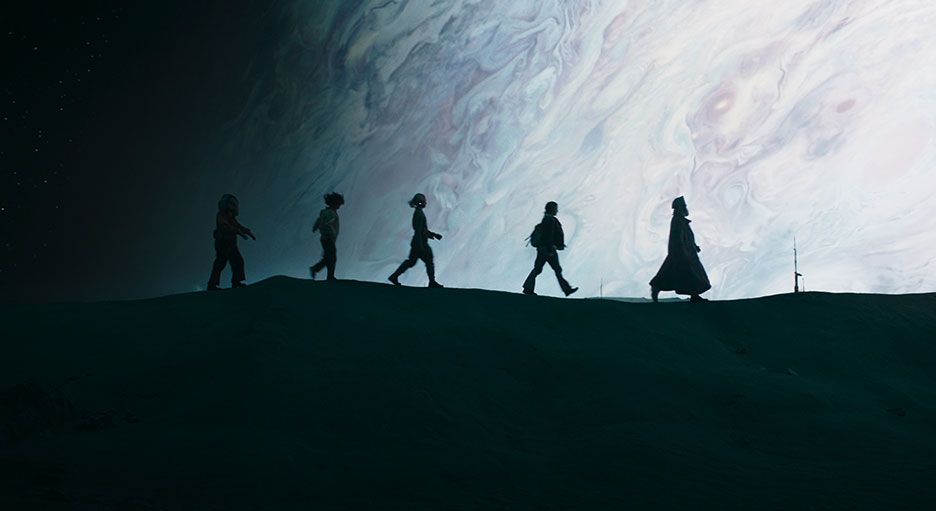
Still searching for At Attin’s coordinates, Jod (Jude Law) and the kids land the Onyx Cinder on the Observatory Moon, seeking help from an alien, owl-like astronomer named Kh’ymm (voiced by Alia Shawkat). The group treks from the ship to the observatory, a striking sequence that includes visuals of the characters silhouetted against a night sky dominated by a nearby planet.

The scenes were all captured in camera on the StageCraft volume, with the actors walking across a practically built dirt mound and the background displayed on the LED screens. “That was another one of our more successful volume shoots,” ILM visual effects supervisor Eddie Pasquarello says. “Perfect use of that, in my opinion.”

The volume also helped create the illusion of the observatory center rotating within the outer walls.

“That one was the most technically challenging,” says ILM virtual production supervisor Chris Balog. “We had to figure out multiple ways of tracking the camera to make sure that the wall was moving in conjunction with it. For some shots they had a circular dolly moving around the set. So we had to make sure that the wall was moving correctly too.”

The volume was used in 1,565 shots in all, Balog says, and 900 of those shots were in-camera finals.

Like Neel (Robert Timothy Smith), Kh’ymm was also realized using a combination of digital and practical techniques, depending on the scene. In some shots, a practical puppet created by Legacy Effects captured her performance entirely in camera. In other scenes, ILM collaborator Important Looking Pirates created a full computer graphics head composited on top of the puppeteered body or utilized a fully digital replica carefully animated to closely match the movements of the puppet.

The episode concludes with the arrival of a pair of familiar New Republic ships summoned by Kh’ymm. “Of course, we see our first X-wings,” Pasquarello smiles. “That was right in our wheelhouse and fun for everyone to do.”

(Credit: ILM & Lucasfilm)

Can’t Say I Remember No At Attin

The Onyx Cinder arrives at a world that initially looks a lot like At Attin but is actually the conflict-battered sister planet At Achrann, a place where children are trained as soldiers in a war between the Troik and Hattan clans. The kids hike through the decayed remains of a neighborhood and city that once looked like their own. Live-action scenes were shot with minimal sets against blue screen backgrounds and completed with extensive environments created by ILM partner DNEG, including dilapidated buildings and streets, a fully-digital armored assault tank, and a small herd of horned eopie creatures.

The heroes are challenged by a Troik warlord named General Strix (Mathieu Kassovitz) to prove their strength in battle. In exchange, Strix’s daughter Hayna (Hala Finley) takes them to an abandoned tower that may have the coordinates they need to get home. Inside the tower – another set that utilized the StageCraft volume – SM-33 (voiced by Nick Frost) reveals that his previous captain ordered him to destroy the coordinates to At Attin. Fern attempts to override his memory, triggering a hostile response and transformation sequence that required significant digital work by ILM’s Sydney studio.

“Whenever SM-33 goes into attack mode, he’s more CG versus the puppeteered, less-docile version of him,” Pasquarello explains. “When he has those armored plates on, or whenever he grows, that’s all CG.”

The abandoned tower set utilized a mix of 3D elements and backgrounds in the volume along with practical columns, floor, and set dressing.

“I thought it had a really amazing photographic feel to it,” says Balog. “Some of the biggest challenges are blending the volume with the real set. And that’s why the virtual art department is such a key factor, because they have to work hand-in-hand with the set department and the 3D content to make sure the textures on everything look the same.”

“ILM had a really great content team led by [visual effects associate supervisor] Dan Lobl, creating content that is believable and looks real,” Balog says. “We’re not successful unless they’re successful.”

The setting also provides subtle foreshadowing to events that unfold inside the At Attin Supervisor’s Tower in episode eight,” says Pasquarello. “The environment was unique and custom,” he explains. “There’s a deliberate tilt up to the ceiling, and you can see some cables hanging. Those are the remnants of their Supervisor, who’s been totally gutted and ripped out. I think it’ll be fun for people to watch the series again, and they’ll understand.”

(Credit: ILM & Lucasfilm)

Lanupa’s Luxury and Peril

Next stop is a mountain on the planet Lanupa, the site of an old pirate lair that SM-33 believes contains At Attin’s coordinates. It’s also the site of a lavish hotel and spa occupied by high-end patrons, including a Hutt who swallows a Troglof mud bath attendant and a massive, tentacled creature called Cthallops, both achieved digitally with the help of Important Looking Pirates.

Jod is captured by the pirate horde and sentenced to death. He’s allowed a few remaining minutes for a final appeal, measured by an hourglass filled with churning blue plasma. “It wasn’t a fully fleshed-out idea on set. We knew we needed an hourglass, and we would be doing it, but it was just kind of a fun adventure to figure out,” Pasquarello says. “We were trying to do some fun ideas with how the plasma would show the passage of time.”

Successfully navigating a series of booby traps, the children, Jod, and SM-33 enter the subterranean treasure lair of pirate captain Tak Rennod, another set that relied heavily on the StageCraft volume.

“They built the big skull throne that the pirate king sat on,” says Balog. “They had all the treasure in the room, four big columns, and the stairs and the rock when they walked in. Everything else in the cave was created with the volume.”

After finally discovering At Attin’s secret, as well as its location, Jod betrays the children, who escape the lair by sliding down a series of tunnels to the base of the mountain. As Wim (Ravi Cabot-Conyers), Neel, Fern (Ryan Kiera Armstrong), and KB (Kyriana Kratter) figure out how to get back to the Onyx Cinder, they encounter a cast of curious trash crabs.

“They’re not droids,” explains Pasquarello. “They’re literally crabs with garbage on their backs. And that was a lot of work to make that understandable. They’re not synthetic. It’s one of those sequences that is very rich in detail, and there’s a lot going on.”

While the baby crabs are digital, a massive mama crab was created as a detailed stop-motion puppet by Tippett Studio, the production company founded by original Star Wars animator and creature designer Phil Tippett. The beast’s jagged, rusty, junk-laden look prompted the Tippett crew to nickname it “Tet’niss.”

(Credit: ILM & Lucasfilm)

“We generally did the rough blocking of the shots at ILM first,” production visual effects supervisor John Knoll explains. “We figured out what the shots wanted to be, the pace, and how big the creature was going to be. Once we got all those layouts approved, it went to Tippett’s, including all the camera info so they could figure out where the camera was positioned relative to the set and the puppet.”

A low-resolution, untextured 3D model of the mama crab also helped animators work out the creature’s speed and movement in advance of shooting on the stop-motion stage.

“Since stop-motion is very labor intensive, you don’t want to have to go back and reshoot things,” Knoll says. “So we got approval on their preliminary animation, and then they would go in and do the detailed stop-motion. And that was a particularly complicated character because there are so many moving parts on it. Obviously, there are the eight legs, but then there are all kinds of little pieces on it that bounce and move when it starts to walk. I’m impressed that they were able to keep that all straight in their heads.”

The mama crab puppet weighed in at about 15 pounds, requiring support from a mechanical harness that was digitally erased in post-production.

(Credit: ILM & Lucasfilm)

Onyx Cinder Metamorphosis

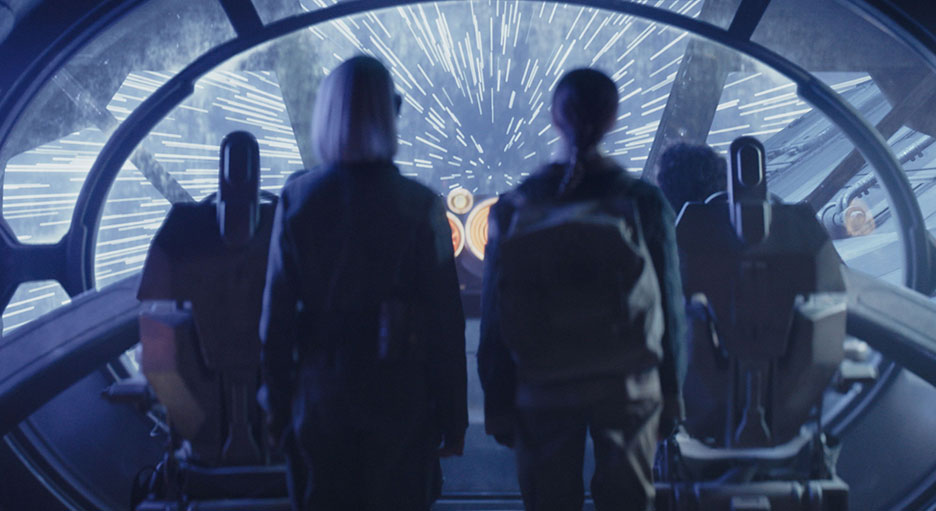
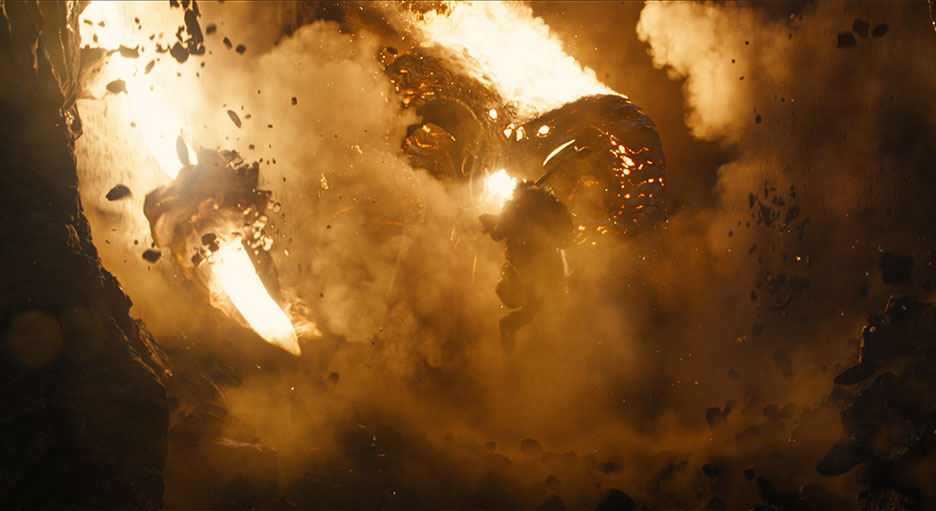
The kids reach the Onyx Cinder just as an enormous scrapper barge closes in, threatening to pulverize the ship and ingest the remains into its fiery maw. “There’s sort of a tug-of-war between the ship and this garbage muncher,” Knoll explains. When the ship is snagged by one of the muncher’s claw-like arms, Fern decides their only hope for an escape is by triggering the emergency hull demolition sequencer.

A series of rapid explosions ripple down the hull, causing the Onyx Cinder to shed its worn outer shell. A smaller, silver-colored version of the ship is freed and rises out of the debris. “Our code was the ‘ironclad’ and the ‘sleek ship,’” Pasquarello says of the two Onyx Cinder variants. “We went around a lot with the shedding of the hull. We didn’t want it to all blow off and just be conveniently revealed. It had to come off like a snake’s skin.

“And the effects are just dialed up to 11,” continues Pasquarello, who hopes that fans notice a key storytelling detail of the ship’s metamorphosis. “One cool thing that I don’t think everybody knows is that when you transition between the ships, we don’t share all the same engines, but the engines that we do share between the ships change from a warm color to blue.

“One of our challenges was that the sleek Onyx Cinder is a cleaner-burning ship,” Pasquarello says. “The whole conceit was that the engines were that orange color because they were dirty and running bad oil. We kept debating: ‘When would it turn blue?’ The sequence is a very elegant transition shot where you see it sputtering away all of that oil and dirt to the cleaner burning blue that we got.”

Knoll says the transformation was one of the more “complicated” scenes to pull off. “There are a lot of simulation layers that are in there, and the sleek ship doesn’t actually fit inside the armored hull, so there was some sleight of hand that had to happen to make that appear to work,” he explains.

The end result is one of Pasquarello’s favorite sequences. “Every time I watch it, I still get chills,” he says. “It just speaks to the detail that the creators had about this show. They thought of everything. [Jon] Watts was very clear with us that this is why this is happening. And we just had to figure out how to execute that.”

(Credit: ILM & Lucasfilm)

The Return to At Attin

At Attin’s coordinates in hand, Wim, Fern, KB, and Neel arrive at their home planet aboard the transformed Onyx Cinder. A horde of pirates led by Captain Brutus (portrayed by Fred Tatasciore and performance artist Stephen Oyoung) are not far behind. But the pirates are stopped by the planet’s protective, nebula-like barrier. “Going through the barrier for us was a really big endeavor,” says Pasquarello. “It’s something that started early because it’s so effects-driven and heavy and large scale, and there’s a lot of story to be told in there.”

An array of satellites protect At Attin, blasting deadly arcs of lightning toward unauthorized ships. SM-33 reveals the Onyx Cinder is an At Attin vessel, which allows it to pass safely. The design and function of the satellites – crafted by ILM’s digital modeling department – evolved over time, says Pasquarello. “At one point, the satellites were actually emitting atmosphere. There were versions where you could literally see atmosphere coming out of them to create that cloudy environment,” he explains.

Pirate ships pursue the Onyx Cinder through a toxic swirl of greenish-blue gasses but are destroyed by the satellites. “There’s a lot of heavy, heavy sims [simulations] and work that went into that sequence, and then the landing on At Attin,” Pasquarello says, giving credit to ILM’s compositing and effects teams.

One element featured in the return to At Attin came along late in the production process. With shot delivery deadlines approaching faster than a ship in hyperspace, John Knoll got an email from Jon Watts. “He said, ‘We’ve done animatronic creatures, we’ve done rubber monsters, we’ve done stop-motion creatures. We did miniature and motion control. The only thing we haven’t really done from the old days is a traditionally-painted matte painting. Is it too late to do one?’” Knoll recalls.

With only two months to make it happen, Knoll reached out to former ILM artist Jett Green at her home in Hawaii and asked if she’d like to put her brushes to work creating a traditional oil matte painting of At Attin. Using paint instead of pixels to compose a matte image is something ILM hadn’t done in about 30 years, according to Knoll.

Green – with a long list of credits as a traditional matte painter on films including Indiana Jones and the Temple of Doom (1984), Labyrinth (1986), and Willow (1988) – says she was honored to be asked.

“I love being part of this history,” Green tells ILM.com. “John and I had this conversation about it being a planet. He had the references already, and he told me what he needed. I even built the Masonite panel for it, and it just felt really good.” Knoll now has the roughly six-by-two-foot painting displayed in his ILM office.

At Attin matte painting created by Jett Green (Credit: ILM & Lucasfilm)

Another ILM veteran, modelmaker Bill George, is also credited on Skeleton Crew. George first worked for ILM building models for Star Trek II: The Wrath of Kahn (1982). For fun, he once built a mashup of two similar ship designs: the concept for Han Solo’s original “pirate ship” from Star Wars: A New Hope (1977), and the Eagle from the sci-fi series Space 1999 (1975-1977). He called it the Millennium Eagle.

“Somebody at Lucasfilm saw it,” George says. “I got a request saying, ‘Hey, can you bring that model in? We want to scan it.’”

The computer graphics version of George’s Millennium Eagle model now appears among the ships docked at Port Borgo.

It’s not the first time one of George’s homemade models ended up in a galaxy far, far away. During production of Star Wars: Return of the Jedi (1983) ILM was in desperate need of a new Y-wing model. George offered to bring in the one he’d built years earlier. It was so good, it ended up being used in the film.

Posing as an emissary from the New Republic, Jod gains access to At Attin’s bountiful treasure: 1,139 subterranean, credit-filled vaults. The vault is an entirely digital environment that DNEG populated with security droids, industrial robotic arms, and a seemingly endless supply of golden computer graphics credits that line the walls and spill into Jod’s rapacious hands.

Jod, Fern, and her mother, Fara (Kerry Condon), ascend the Supervisor’s Tower. The Supervisor is revealed to be a large, domed droid with a red eye. Only a small part of the Supervisor droid was constructed physically, with the StageCraft volume completing the illusion.

“Virtual production is the future of visual effects,” says Chris Balog, a 20-year ILM veteran with a background as a digital compositing artist. “It’s where the next evolution is going. And if you can do it successfully, it’s an amazing tool.”

Jod destroys the Supervisor with a lightsaber, triggering a citywide power outage and disabling the barrier satellites, clearing the way for the massive pirate frigate to reach the planet’s surface. 

The enormous frigate survives the barrier and floats ominously over the city. “The great effects work done with the frigate coming through the clouds was Travis Harkleroad, our effects supervisor,” Pasquarello says. “Those explosions all come from him and his people.”

The all-computer graphics frigate’s arrival is meant to evoke the alien-arrival feeling of films like Close Encounters of the Third Kind (1977) and Independence Day (1996). “There was no practical frigate,” Pasquarello says. “It’s a gorgeous ship. It’s a very complex-looking ship, and there’s a lower and upper deck that was built inside, and ships and skiffs that come out of that.”

Wim, Neel, and KB devise a two-part plan to rescue Fern and call Kh’ymm for help. Jumping on speeder bikes and pursued by skiffs loaded with angry pirates, the kids – along with Wim’s dad, Wendel (Tunde Adebimpe), make their way across the city.

For close-up shots, the actors were shot on a blue screen stage, with the more dangerous action – like a perilous jump across a canyon – requiring the use of digital doubles. “The speeder bikes on this show were a real challenge in the sense that we can’t put kids into a lot of heavy stunt work,” says Pasquarello. “So there was a lot of work done to help the dynamics and the physics of that chase.”

The action continues through an all-computer graphics forest, through the city, to the school. Pasquarello praises ILM’s animation, layout, simulation, and environments teams for the extensive 3D build. “They’re going through an entirely CG environment, created by the environments team that you just don’t question,” he says. “Not one thing that they fly over or go through is real.”

Summoned by Kh’ymm, New Republic forces arrive at At Attin, attacking the pirate frigate and saving the day. The squadron of X-wings is backed up by B-wings, another fan-favorite fighter that first appeared in Star Wars: Return of the Jedi (1983) and later in Star Wars: Rebels (2014-2018).

“The B-wings were a favorite of mine as a kid, so I did my best to try to get them featured in some big, heroic moments,” says ILM animation supervisor Shawn Kelly. “Initially, we had them dropping bombs on the pirate ship, but [Lucasfilm chief creative officer] Dave Filoni had the great suggestion to try the ‘composite laser’ weapon. Honestly, I had no idea what that was at first. As soon as the meeting was over, I looked it up and realized it’s the ridiculously cool quadruple-beam attack seen in Rebels. I got so excited by the idea that I stayed up late and designed a new shot that could really show off that attack. I felt like I was 10 years old again, playing with my B-wing toy in the backyard!”

Balog would composite the B-wing shot himself, working in collaboration with the FX team to evoke the feeling of the laser as seen in Rebels, but with a more realistic style appropriate for live-action.

The battle-wounded pirate frigate makes a spectacular crash landing, a completely computer graphics sequence that Pasquarello says was carefully designed to depict minimal casualties. “The conceit is that everyone’s been rounded up to a specific space, so we know that everybody evacuated,” he explains. “You notice it doesn’t really tear into buildings as the frigate crashes; it’s just pulling up the street and abandoned cars. It crashes gently into the waterway.”

(Credit: ILM & Lucasfilm)

Galactic Global Effort

Bringing Skeleton Crew to life with its creative mix of old and new took a tremendous amount of effort from artists around the globe. “I worked with a team of 50 animators that were in San Francisco, Vancouver, Singapore, Sydney, and Mumbai,” says Pasquarello. “A big team. We’re one big happy family; we’re all working together to bring these characters to life.”

Knoll and veteran ILM modelmaker John Goodson say they feel lucky to still be bringing old-school ILM effects expertise to new productions. “You know, there’s only a few of us that still know how to do this stuff,” says Knoll. “And part of this for me was, I want to bring some younger people who are exposed to what we’re doing, who are trained up to use the gear so that when I’m not available to do this stuff there are people who know how to do it.”

“We both came here because we wanted to shoot spaceship models,” Goodson adds. “And we’re still getting this opportunity. It’s a phenomenal experience to be able to do this, to take advantage of some of the newer technologies, and revisit this stuff from our past, which is the reason we got in the business to begin with.”

For Shawn Kelly, a 28-year ILM veteran, working on Skeleton Crew was a career highlight. “Our review sessions on this project were by far the most enjoyable, fun, collaborative,” he says. “Watts and Ford are awesome. They have tons of great ideas. They’re really collaborative and open to ideas. It felt like a family just trying to make the best thing we can make all together.”

(Credit: ILM & Lucasfilm)

Clayton Sandell is a Star Wars author and enthusiast, TV storyteller, and a longtime fan of the creative people who keep Industrial Light & Magic and Skywalker Sound on the leading edge of visual effects and sound design. Follow him on Instagram (@claytonsandell) Bluesky (@claytonsandell.com) or X (@Clayton_Sandell).

The Lord of the Rings: The Rings of Power wins for Special, Visual & Graphic Effects in Season 2 of the Amazon MGM Studios series.
This past weekend, the British Academy of Film and Television Arts hosted the 2025 BAFTA Television Craft Awards, where The Lord of the Rings: The Rings of Power won for Special, Visual & Graphic Effects. ILM’s Jason Smith, who served as production visual effects supervisor, received the award alongside his collaborators Richard Bain, Ryan Conder, and Chris Rodgers. Watch their acceptance speech below:

ILM teams in London, Sydney, and the former studio in Singapore delivered over 500 visual effects shots to Rings of Power Season 2. Hubbed in London, the effort was led by ILM visual effects supervisor Daniele Bigi, visual effects producer Christine Lemon, and visual effects executive producer Lee Briggs. 

Congratulations to Jason and our ILM crew! 

Read more about ILM’s work on Rings of Power Season 2 right here on ILM.com.

Clothing and accessories featuring a new commemorative logo designed by Hoodzpah are available for purchase on Amazon.com.
By Mark Newbold

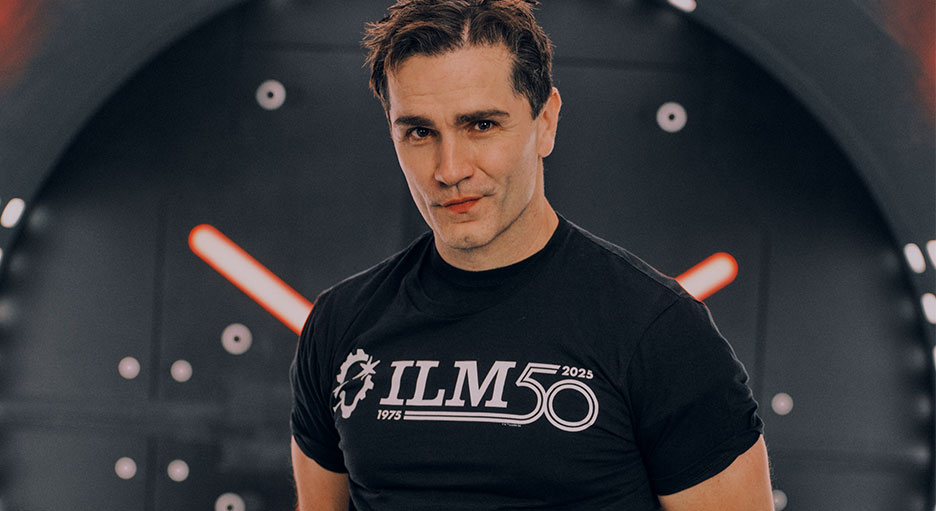
Actor Sam Witwer sports a new ILM 50th t-shirt at Star Wars Celebration Japan (Credit: Wes Ellis).

In a world of innovation, skill, and ingenuity, no company has shone as bright or lasted as long in its field as Industrial Light & Magic. First incorporated in May 1975, ILM has led the way in the realm of visual effects for half a century. This iconic brand is as much a marque of quality as “Music by John Williams,” “Conceptual Design by Ralph McQuarrie,” or “Directed by George Lucas.”

To celebrate the 50th anniversary (a first for any visual effects company) Hoodzpahthe team behind the ILM logo redesigns in 2023 — were asked to adapt their work for a fresh new ILM 50th logo, which is featured in a line of new merchandise recently unveiled at Star Wars Celebration Japan and now available on Amazon.com.

ILM.com had the opportunity to chat with the team about this exciting new project and how they decided on the tone for the 50th anniversary logo.

“When you work with a storied company like ILM, there is a wealth of visual inspiration and history to reference,” explains the Hoodzpah team, “so the hard part is narrowing in on one vision when there are so many ways you could take it. We cast a wide net and tried many different directions before landing on this retro-modern celebration that feels quintessentially ILM.”

ILM has an incredible history, not only with its groundbreaking work on-screen but also its branding, going back to the classic Michael Pangrazio-designed magician logo illustrated by Drew Struzan and through a variety of changes to today. Given that lineage, Hoozpah decided on the mix between the 2023 redesign and the ’70s-style piping in the new logo, a blend that marries ILM’s ’70s vintage with the modernity of the current branding.

“With an anniversary logo, you’re trying to balance two things: celebrating the history and accomplishments and legacy, but also reminding folks that there’s always more horizon to conquer,” Hoodzpah says. “This is just the first 50 years, and there’s so much more to come. Since the execution of the primary logo icon feels modern and intrepid, we wanted to embrace a ’70s vibe from the early ILM days. It felt so right as a nod to where it all started.”

In the world of marketing, there are numerous rules and tricks to designing a great logo that catches the eye and sits in the memory. With ILM and all the history that goes with it, there remains a need to find the right focus for such an emblem.

“When a logo really resonates, it’s because it feels true to the brand,” notes the Hoodzpah team. “There are so many styles and means of execution, but the question should always be, ‘What feels right for this brand?’ People love to look at trademark logo books with hundreds of logo icons shown on a white page. It’s inspiring to see all the styles of execution. But we’re always left wondering, ‘What’s the context?’ It’s not about a logo looking good in isolation because one is rarely used that way. It’s about a logo feeling perfect in context. It was the same for this project. We tested the 50th anniversary logo in key applications and then used it in a suite of anniversary merch designs as well.”

Collaboration is key in everything ILM does, from the core team pulling together on new projects to working hand-in-glove with vendors and creatives behind the films, TV shows, and immersive entertainment projects ILM works with. Given that, it was important for Hoodzpah to spitball ideas with the ILM team themselves because clearly they revel in the spirit of collaboration in the same way that ILM does.

“There’s a reason we didn’t end up choosing fine arts as a career path, even though we really loved it,” Hoodzpah explains. “We like working within the limitations of a prompt and pushing and flexing boundaries to see how far we can take it. Design is a team sport. We all get together and try to push this idea up the field. When we work with ILM, we are keenly aware that everyone we work with is a creative powerhouse in their own right. We’d be fools not to tap into that ‘creative brain trust,’ as [director of PR and communications] Greg Grusby calls it, and gather as many ideas and as much feedback as we can to make this logo as true to the ILM legacy as possible. After all, the people of ILM make ILM what it is. It’s like, why would we want just one violin when we could work with a full symphony orchestra?”

The work on the logo continued with the creation of distinct products now available in the new merchandise line.

“Taking the logo and spinning it off into 50th anniversary merch was so much fun,” Hoodzpah says. “The ILM crew were so game to dream big and really have fun with it. Each piece leans into a different vein of the ILM personality. We have a retro ’70s poster of a magician conjuring new worlds, which is what ILMers do every day. We celebrated all the innovation and milestones ILM has accomplished over 50 years in an infographic T-shirt. We even made custom-scented candles to celebrate the different departments and locations over the years. Our favorite is the Model Shop candle which has notes of sawdust and cedar. There’s truly something for everyone.”

With their work on the ILM logo, Hoozpah has become a key part of ILM’s identity and history, which makes the team proud.

“Getting to work with a cultural icon like ILM once was incredible,” they conclude. “Being trusted by such talented creatives to work with them again was even better. It’s great to be able to pick up where we left off, having already become embedded with the team and learning so much about the brand in our last project. Working on the rebrand was one of those bucket list jobs you continually remind yourself, ‘Wow, we really got to be a part of that.’ It felt like getting the band back together for the sequel.”

New apparel and a tumbler celebrating the 50th anniversary of Industrial Light & Magic are now available on Amazon.com.

Read more about ILM’s 50th anniversary, including a newly announced book, on ILM.com.

Light & Magic 
Season 2 is streaming now on Disney+
.

Mark Newbold has contributed to Star Wars Insider magazine since 2006, is a 4-time Star Wars Celebration stage host, avid podcaster, and the Editor-in-Chief of FanthaTracks.com. Online since 1996. You can find this Hoopy frood online @Prefect_Timing.

Industrial Light & Magic: 50 Years of Innovation by Ian Failes will be released in January 2026 by Lucasfilm Publishing and Abrams.

By Lucas O. Seastrom

It all began in May of 1975 with a handshake between director George Lucas and visual effects supervisor John Dykstra. Industrial Light & Magic formed as Lucasfilm’s visual effects division to work specifically on one project: Star Wars: A New Hope (1977). 50 years later, ILM now spans the globe with studios in five countries and hundreds of productions to its credit.

Now in 2025, the 50th anniversary festivities have kicked off at an appropriate venue: Star Wars Celebration. ILM leadership and artists gathered at the beloved fan event near Tokyo, Japan to reflect on the storied occasion, as well as announce a new book: Industrial Light & Magic: 50 Years of Innovation, written by Ian Failes and coming January 2026 from Lucasfilm Publishing and Abrams.

A New Book Charting ILM’s Continuing Legacy

Industrial Light & Magic: 50 Years of Innovation takes readers from day one at ILM in 1975 up to some of the latest projects and innovations at the company today. Packed with hundreds of rare archival images, author Ian Failes – the noted visual effects journalist at befores & afters – weaves insightful technical history with the beloved stories of ILM’s people. 

“ILM has been part of my visual effects life for a long time,” Failes tells ILM.com. “I first ‘discovered’ so much about visual effects just as I left high school when I happened upon two things…. One was the industry magazine Cinefex, and the other was the incredible book, Industrial Light & Magic: Into the Digital Realm, by Mark Cotta Vaz and Patricia Rose Duignan. I read that ILM book from cover to cover multiple times. It really was one of the things that inspired me to become a visual effects journalist.

“So, getting the opportunity to go deeper into ILM’s history with this new book, but now with all the knowledge I’ve gained from time spent covering the industry, is just so rewarding—and fun,” Failes adds.

Readers can look forward to many untold stories in 50 Years of Innovation. Failes identifies the transition from photochemical optical compositing to digital methods as a particularly fascinating era in the company’s history. “In the book there are some great details shared by key ILMers who were there at the time about many different aspects of the move to digital in terms of other areas like film scanning and digital compositing,” the author says.

“Also, readers have never been able to explore so many exclusive behind-the-scenes photos from ILM’s history before,” Failes continues. “Having images from all different fields that highlight what is essentially the history of visual effects like modelmaking, optical effects, puppets, stop-motion, matte paintings, hand-animation, CG animation, virtual production, etc., all in one place, is something very special. I especially love some of the photographs that showcase the various VistaVision and motion control camera systems that ILM developed.”

At the heart of ILM’s story is the spirit of creativity and innovation which has been defined by the company’s people over the decades. “Even back to its beginnings, George Lucas started ILM after identifying that no existing facility could deliver what he imagined for Star Wars,” Failes concludes. “It feels to me that a unique innovative spirit was born during the making of that first film, and never left the company. I think that goes both for technological developments and also cultural ones. ILM helped establish modern workflows inside a visual effects facility, and I think, really importantly, further set the standard for how to collaborate with filmmakers and other creatives.”

Industrial Light & Magic: 50 Years of Innovation by Ian Failes is coming January 2026 from Lucasfilm Publishing and Abrams.

On the Stage at Star Wars Celebration

As a special live recording of Lighter Darker: The ILM Podcast, the Star Wars Celebration panel included president and general manager of Lucasfilm business, Lynwen Brennan; head of ILM and general manager Janet Lewin; ILM executive creative director and senior visual effects supervisor John Knoll, ILM Sydney creative director and senior animation supervisor Rob Coleman; ILM lead CG modeler Masa Narita; and former ILM modelmaker Fon Davis. Lucasfilm’s senior vice president of creative innovation, digital production & technology Rob Bredow moderated.

Lynwen Brennan came to ILM 27 years ago as the company ramped up for production of Star Wars: The Phantom Menace (1999). Like many, she’d been inspired to join ILM after seeing Jurassic Park (1993) a few years earlier. “The minute I walked through the door, I just fell in love,” Brennan told the audience. “I knew I’d found my people…. It’s an incredibly spirited place. We have a lot of fun. There’s something so special about a place that attracts these mavericks who are not scared of doing anything new…. Sometimes when you find people who are real risk-takers, they’re not necessarily great team players, right? But this…is a place where you’ve got people who love taking those risks but do it in such a collaborative way. That’s a thing that really got me.”

Janet Lewin started her ILM career some 30 years ago and has had a front row seat to the continuing changes and evolutions in the visual effects industry, much of it driven by ILM. “Back then, we were one studio in San Rafael, just a couple of hundred people, mostly working in the Model Shop and on the stage,” Lewin explained. “It was an exciting time right at that digital revolution. It was a big deal for us to juggle four shows at one time, and a big show was a couple hundred shots. And over my 30-year trajectory, the company has massively grown. We now have 3,500 employees, five global studios, and…we do visual effects work across every possible medium.”

For Masa Narita, appearing onstage at Celebration in his native Japan was a full circle moment. A lifelong visual effects fan, he’d watched Star Wars as a teenager during its original Japanese release in 1978. But as he reached adulthood, Narita first chose a career in finance. 

“I used to be a businessman, worked for a Japanese brokerage firm for over 20 years,” Narita said. “But I always loved movies and visual effects because I grew up with special effects pioneers like Ultraman and Godzilla. So my first childhood dream was to wear a kaiju suit and to smash miniature towns. Actually, I still want to do that. [laughs] As I got older, I realized that I wanted to create something special like spaceships and characters [that] I saw in the movies. So at the age of 45, I decided to follow my passion. I quit my financial job and moved to Hollywood and started at a CG school. So that was my biggest gamble in my life, taken with my loving wife and two children. Fortunately, one year later…I got [my] very first CG job, and eventually I came to my dream company, ILM.”

Narita has since worked at the company for over a decade, contributing to productions like Solo: A Star Wars Story (2018), The Mandalorian (2019-23), Indiana Jones and the Dial of Destiny (2023), and Deadpool & Wolverine (2024).

“ILM puts a lot of focus on innovation that makes the impossible possible,” Narita added. “So I feel inspired every day walking in a place with so much creativity and skill. I love what I’m doing and I feel I really achieved my dream. People say life is short, but I don’t think so. We have plenty of time to start over. It’s never too late to chase something new.”

Onstage at Star Wars Celebration Japan, L to R: Fon Davis, Masa Narita, Rob Coleman, John Knoll, Janet Lewin, Lynwen Brennan, and Rob Bredow (Credit: ILM).

You can hear these stories and many more on Episode 17 of Lighter Darker: The ILM Podcast.

Watch the ILM.com Newsroom for the latest information about how you can purchase a copy of Industrial Light & Magic: 50 Years of Innovation, coming to bookstores everywhere January 2026.

Light & Magic Season 2 is streaming now on Disney+.

New apparel and a tumbler celebrating the 50th anniversary of Industrial Light & Magic are now available on Amazon.com.

Lucas O. Seastrom is the editor of ILM.com and a contributing writer and historian for Lucasfilm.

The first part of an extensive look behind-the-scenes of the visual effects process for Lucasfilm’s pirate-themed Star Wars adventure series.

By Clayton Sandell

(Credit: ILM & Lucasfilm)

The sprawling, live-action series Star Wars: Skeleton Crew (2024-25) is like a map leading to a visual effects treasure chest. Open it, and you’ll find a trove of 3,200 visual effects shots that seamlessly blend the latest digital artistry along with traditional techniques that both innovate and honor the unique legacy of Industrial Light & Magic.

In creating a new adventure story set in our favorite galaxy far, far away, Skeleton Crew creators and executive producers Jon Watts and Christopher Ford set a delightfully retro tone for the series, which directly informed ILM’s approach to the visual effects.

“Very early on, it was apparent that a big part of the intended charm of the show was that it was going to have this sort of Amblin, ’80s movie sort of vibe to it,” Skeleton Crew production visual effects supervisor John Knoll tells ILM.com. “That extends to more than just how you tell the stories. It also extends to choices like embracing animatronics, monsters, and building miniatures and stop-motion creatures.”

Pulling it off would involve hundreds of talented artists at ILM studios around the globe, including San Francisco, Sydney, Mumbai, and Vancouver, along with a few outside visual effects partners. 

Over eight episodes, Skeleton Crew follows the adventures of Wim (Ravi Cabot-Conyers), Neel (Robert Timothy Smith), Fern (Ryan Kiera Armstrong), and KB (Kyriana Kratter)—four kids living a peaceful, if mundane, life on their home world of At Attin. After discovering a mysterious buried space cruiser, the four friends unintentionally launch themselves into hyperspace and must find their way home by navigating a dangerous galaxy of allies, enemies, pirates, and monsters.

Early in preproduction on Skeleton Crew, Knoll says the ILM team had to determine the best way to approach the show’s varied visual effects needs. “It just read like an expensive show because of all of the different planets we go to, all the different types of creatures, and the different environments,” explains Knoll, who also serves as ILM’s executive creative director and senior visual effects supervisor. “Trying to figure out how to make that affordable was one of the first things that faced the visual effects team.”

Following a methodology first established during The Mandalorian (2019-2023), Knoll says Skeleton Crew production was divided roughly into thirds. “About one-third of it was shot in our StageCraft LED volume, one-third was shot on soundstages with conventional sets, and then one-third was shot on a backlot,” Knoll reports.

Galactic Planet-hopping

Skeleton Crew unfolds across multiple worlds that are brand new to Star Wars, beginning with At Attin. The planet’s suburban-like residential neighborhoods utilized a minimal exterior set located near the California State University Dominguez Hills campus in Carson, California. “There was an undeveloped lot that was just adjacent to the campus that was available. So we shot on that,” Knoll says. The practical parts of the set consisted of only the street, a sidewalk, parts of a few houses, and a small patch of grass surrounded by a large blue screen background, says ILM visual effects supervisor Eddie Pasquarello.

“We added all the trees, houses, skies, and trams,” Pasquarello reveals. Even the street was narrowed. “Some things are not seen, and those are the ones that are the most impressive in my opinion, because you’re not saying, ‘Oh, that’s visual effects.’ We’re hoping people watch the actors and enjoy the story versus worrying about the environment.” 

Wim and Neel board a tram for the ride to school, a sequence that introduces the more urban areas of At Attin. Artists digitally extended the school’s exterior—shot on another minimal set—and helped create an expansive cityscape designed to suggest At Attin’s backstory.

“[Jon] Watts wanted it to feel like a place that was built some time ago, but it’s been mostly kept up pretty well. And it’s a place where everyone more or less follows the rules,” says ILM animation supervisor Shawn Kelly.

On the ride to school, Wim stares out the tram’s back window as the vehicle drops into an underground tunnel. After the scene was shot, artists were asked to enhance the movement of both the tram and the camera, requiring complex digital layering work to achieve the right perspective. “We had to split apart all the kids inside the bus to get the proper parallax,” Pasquarello explains. “There’s a ton of artists that helped in layout, and comp and environment—all across the board—that made the shot work.”

Pasquarello says a number of ILM teams also worked throughout the production to develop the right look for At Attin’s city architecture. “This was a really Herculean effort,” he notes. “This is a huge environment build from the team. But it also takes the disciplines of animation and lighting.”

In one shot where a malfunctioning hoverbike leaves Fern and KB stranded on the side of the road, Jon Watts asked ILM to enhance the background with a custom building. “He sent us a photo of a mall,” Pasquarello says. “He said, ‘I kind of want it to look like the mall that I remember as a kid.’ And that’s what that is inspired by. We basically took that photo and ‘Star Wars-ified’ it.”

Neel Nation

One of the earliest discussions among the Skeleton Crew creative team was how to bring Wim’s best friend Neel to the screen. “Neel was a fun and interesting challenge,” Kelly tells ILM.com, noting that the blue elephant-like character is a three-way creative partnership combining Smith’s voice and performance, the work of performance artist Kacie Borrowman, and extensive digital creativity.

“The production was feeling like Neel probably needed to be computer graphics throughout,” Knoll says, explaining that the hours spent applying makeup or prosthetics to Smith would have cut into the child performer’s limited shooting window. “Just seeing how often Neel was going to be on screen—he’s on every other page of every script—he was potentially going to be the most expensive part of the entire show,” recounts Knoll, who set a goal of reducing the all-digital Neel shots by half. “I thought, ‘there’s got to be some practical version of Neel that we can do, at least for over-the-shoulder and wide shots.’”

For that mission, ILM turned to Legacy Effects, a frequent collaborator on Star Wars projects including Ahsoka (2023 – present) and Obi-Wan Kenobi (2022). “Neel’s head was built by Legacy as a fully animatronic puppet and was meant to do a lot of the heavy lifting of the performance,” says Pasquarello.

Credit: (ILM & Lucasfilm)

Neel’s many facial expressions developed from an innovative fusion between the Legacy puppet and considerable digital augmentation. “As they started filming the show, everyone fell in love with how the practical puppet face works,” Kelly recalls. “It’s very charming.”

Digital animation took over in scenes where the story called for subtle emotional expressions that were beyond the capability of the puppet, Kelly says, noting that roughly half of Neel’s shots are either digitally augmented or completely digital. “We came up with a bunch of facial expressions,” he explains. “There’s ‘worried.’ We’ve got ‘scared.’ We’ve got ‘sad’ Neel and ‘happy’ Neel, the Neel that we love. Sometimes we just really need to scrunch up his face and we could scrunch it up with or without his ears, things like that.”

Even in shots where the practical puppet head was used on-set, artists digitally erased a small mesh screen on Neel’s trunk that had allowed the performers inside to see and breathe more easily. ILM lead creature modeler Jonathan Sabella also helped digitally sculpt the computer graphics version of Neel to make sure it was identical to the puppet. “That might just be adjusting neck wrinkles or the trunk, and he can shape it back and make it just right or push the emotion even a little further than our out-of-the-box controls could do. Jonathan was a really key part of bringing this together,” says Kelly.

During shooting, facial capture technology created by ILM Technoprops was used to record Smith’s performance. “In the end, we didn’t use the facial capture directly,” Kelly says, explaining that Neel’s expressions were instead crafted by animators in order to more closely match the style of the puppet.

“We could have gone with a bigger performance,” Pasquarello adds, “but a lot of it was really leaning in and matching the aesthetic that was established. If we were to do something beyond that, it felt wrong because we were losing that kind of simple on-set practical aesthetic, which is a very Star Wars aesthetic. It’s always best to have this mix of different techniques happening at once. It creates the best illusion for the audience. It’s hard to pin down what’s going on if some of it’s real and some of it’s not.”

Rise of the Onyx Cinder

At the bottom of a forest ravine, the kids discover the entrance to a long-buried, hidden starship called the Onyx Cinder. Wim unwittingly activates the dormant vessel, causing it to lurch skyward with the four kids still on board. As massive layers of soil, rocks and trees cascade off the rising ship, the kids try unsuccessfully to escape. “This was a sequence that went on for a while for us,” says Pasquarello. “Just moving all that earth and lifting that ship and having it turn over was a big challenge.”

Live action plates of the four young actors standing on a small set were completed with an entirely digital environment. “The hatch and the four kids. That’s all we had to work with,” Pasquarello remembers. “They were just standing on a small practical piece of the ship, and then everything else was added around them.”

Digital doubles were also created for all the characters and used throughout the sequence, especially useful for shots that might have been perilous for the young actors. “Sometimes when they’re hanging out of the open porthole, they’re animated,” Kelly says. “The animated Wim is waving to his dad.”

Various simulations—from tree leaves, to swirling embers, dust, and engine vortices kicking up dirt—help complete the sequence. “I think this really shows off the world-class effects team and environment team. I’m just always blown away by this sequence,” says Kelly, noting that many of the forest scenes were created with the help of artists in ILM’s Vancouver studio.

Once in space, the kids discover the ship’s first mate, a droid named SM-33 (voiced by Nick Frost). The character was realized using a Bunraku-style puppet (operated by performance artist Rob Ramsdell) and fully-digital versions, depending on the scene.

The Onyx Cinder first came to life as a 3D computer model built by Rene Garcia and Jay Machado and textured by Kim Vongbunyong. Veteran ILM modelmaker John Goodson then crafted a practical version that included rotating sections and flickering LED lights in the engines. “It’s very old school. It’s all handmade. There are a handful of model kit parts on it for detail. But even a lot of those are handmade,” Goodson says. “It’s styrene and acrylic with an aluminum armature inside of it.” Modelmaker Dan Patrascu also helped build the Onyx Cinder chassis and mounted motors inside the model.

“It gets designed in the art department,” Knoll says. “Then you validate the design, so everybody’s happy with it. John builds his version of it. And then we true up our computer graphics model to match what John did. Something I really liked about the model John built was that the paint finish was beautiful on it. And so that was very extensively photographed and then we re-textured the CG model, based on what John had done.”

The practical model was then mounted on a motion-control rig at ILM’s San Francisco studio, reminiscent of the original Dykstraflex system first pioneered during production of Star Wars: A New Hope (1977).

“[Executive producer] Jon Favreau was pretty enthusiastic about wanting to do this back for season one of The Mandalorian, and I was one of the few people still left at the company that used to do motion-control,” says Knoll. “And we figured, ‘We can make this work.’ Probably the biggest obstacle was budget. The reason that we don’t do this as often as we used to is that it’s more expensive than computer graphics. And the best way that I could figure out how to make this affordable for the show was if this was being done as a garage operation.”

Credit: (ILM & Lucasfilm)

Knoll repurposed the motion-control rig he built in his garage for The Mandalorian, adding the capability to drive more motors on the Onyx Cinder. “The system that I built for season one and two of Mando could drive eight motors,” Knoll recalls. “That gave me track, pan, tilt, and focus, and yaw-pitch-roll on the model. That was sufficient for everything we needed to do with the Razor Crest. But all the engines pivot on the Onyx Cinder, so there are four motorized axes built into the ship. Eight axes isn’t enough to drive all of that. So I expanded the electronics to drive 16 channels.”

Camera moves were first plotted out in Autodesk Maya, approved by the filmmakers, then translated to the motion-control system with a goal of matching a long-established Star Wars aesthetic. “Our approach for the shots that were going to be a miniature is, first—we animate it in the computer, and we figure out, ‘what’s the best way to tell this story?’” says Shawn Kelly. “What’s the coolest camera move that still feels like an original trilogy camera move that tells the story and has the mood that we want, and the ship has the motion that we need, in the path that we need?”

The motion-control system was operated by Lindsay Oikawa Pflum and utilized Canon DSLR camera technology. Each shot required a dozen or so passes to capture varieties in exposure and lighting to give compositing teams more options when layering the final image. And in another throwback to ILM’s early days, converters allowed the use of older Nikon lenses that were used to film models for Star Wars: Return of the Jedi (1983). The final result is a flawless collaboration between the real-world model and digital model, all paying homage to ILM’s legacy.

First Stop: Starport Borgo

The Onyx Cinder docks at a nefarious pirate hideaway, a wretched hive called Starport Borgo where the kids hope to find directions back to At Attin. Built into an Outer Rim asteroid overlooking a sea-blue nebula, Borgo is filled with a host of untrustworthy pirates, creatures, and scoundrels. “It’s just a really beautiful, new place for Star Wars,” says Pasquarello. “Everything outside is computer graphics. When we’re inside in Port Borgo, it’s practical. There’s a lot of storytelling in a very small amount of space.”

Port Borgo scenes relied heavily on ILM’s StageCraft LED volume – located at the MBS Media Campus in Southern California. The environment came to life using a combination of practical sets and virtual backgrounds displayed on the volume screens. The virtual production team relied on two real-time rendering engines, depending on the scene: Unreal Engine from Epic Games and ILM’s proprietary software, Helios.

Skeleton Crew also took advantage of two powerful new StageCraft volume advancements: virtual depth of field and real-time virtual lighting. “Previously, when you used depth of field, the camera didn’t actually make the content go out of focus correctly when the depth of field changed as it just defocused the wall global,” says ILM virtual production supervisor Chris Balog. “Now we’ve added virtual depth of field. So when you change focus, the content defocuses in depth. So virtually now if the camera is focusing on something close to the wall, the 3D content in virtual space close to the stage will be sharper like the set in front of it, and everything in 3D space past that will defocus correctly in depth based on the lens’ focal length.”

The new depth of field capability came with the challenge of how to accurately represent the “bokeh” effect – the quality and appearance of blurred light sources in out-of-focus areas of a shot.

“It gives it more realism because it actually defocuses the way it should. Before, it would just get really soft,” Balog explains. “And now, we are able to do this in a way where it would photographically bokeh like real light sources.”

Real-time virtual lighting gave the Skeleton Crew cinematographers greater flexibility and speed when adjusting practical lights on set, making it easier to match their digital counterparts. “It used to be a much more labor-intensive process, because originally we were baking all the lighting into the original content,” Balog says. “Now, the DPs can get on set that day and say, ‘You know what? I just want to move that light a little bit.’ So we just move the virtual light to work in conjunction with it.”

Creating the content for the volume walls happened near the beginning of a production.

“There’s a team of generalists, or gen artists, who are talented in a lot of different aspects of computer graphics,” Shawn Kelly says. “And while they are working on the environments, me and a few other people are working on populating those environments.” 

Wim, Fern, KB, and Neel disembark the Onyx Cinder and hitch a ride on a bubble-like dinghy piloted by a furry Teek ferryman. Dockside, the Teek jumps on Fern’s shoulder to demand payment—a sequence that demonstrates an invisible combination of digital and practical methods.

“He’s mostly a practical puppet up on her shoulder, but his arm is animated. His arm is computer graphics so we can do more delicate kinds of gestures with his fingers and hands,” explains Kelly, “but we still try to animate it in a way that feels like a puppet.”

“We have a great paint team here,” adds Pasquarello. “It was not a big deal to remove that arm and replace it.”

Once the Teek gets his money, he jumps down to leave—a shot that features a flawless “Texas Switch” between the practical and fully digital version of the character. “At the beginning, he’s a puppet. And once he goes behind Fern’s back, he’s animated,” Kelly reveals. The shot concludes with the ferryman scurrying away, mimicking the speedy movements of the original Teek that first appeared in Lucasfilm’s TV movie, Ewoks: The Battle for Endor (1985).

“He’s this little, very fast-moving kind of funny guy,” says Kelly. “It was really endearing and fun, especially when I was a kid. So we wanted to put a little bit of that fast movement into him. And this is a little example of how we kept that flavor.”

Credit: (ILM & Lucasfilm)

Motion Capture Cameos

Motion capture performers help populate the expansive setting with hundreds of pirates. “A place like Port Borgo needs to be a bustling port of pirates doing stuff,” says Kelly. “So we spent months at the beginning getting mocap performances and animating on top of those, and also key-framing guys selling stuff at stalls, or shopping at stalls. You’ll see guys in the background unloading a ship, and there’s a chain of guys throwing boxes to each other, stuff like that.”

The children pass by a seedy nightclub where four-armed aliens are dancing in reddish silhouette through frosted windows. It was Kelly’s job to direct the scene’s motion capture performers, including two unexpected names: Daniel Kwan and Daniel Scheinert, collectively known as The Daniels.

At the time, the directors were helming the fourth episode of Skeleton Crew and would soon win an Academy Award for Best Picture for their film Everything Everywhere All at Once (2022). “The Daniels wanted to perform the dance,” Kelly laughs, recalling how it became his job to direct two of his cinematic heroes on how to be better exotic dancers. “I’d say, ‘I think they want it to be sexier.’ They’d just burst out laughing, and do it again,” Kelly says. “They were really fun and funny.”

Credit: (ILM & Lucasfilm)

Escape from Port Borgo

Reluctantly teaming up with the mysterious Jod Na Nawood (Jude Law), the children escape from the pirate brig and navigate their way back to the Onyx Cinder. As the ship pulls away. it’s snagged by a refueling line connecting it to a floating buoy, snapping it back like a balloon on a string. Jod tries desperately to maneuver away, dragging several pirate vessels with it.

“They’re creating havoc,” Pasquarello says. “The whole idea of the pile up and pulling those ships together was a really fun sequence, because even Jon Favreau chimed in. Everyone had some ideas about how to make that really successful.”

The colliding ships are all-digital creations, with the action handled by a team of artists who are now part of ILM’s Sydney studio. “All of these ships are computer graphics, and the environment itself as well,” Pasquarello says. “These didn’t exist as models from a practical standpoint.”

As the pirates take aim at the Onyx Cinder with a tower cannon, Jod sends the ship into hyperspace. The fuel line snaps violently, whipping back and crashing into the crowded port. “You can see our animated pirates getting knocked down and running away,” Kelly says. Effects passes helped complete the shot with a variety of explosions, fire, and sparks.

The pileup sequence also gives eagle-eyed viewers a chance to catch a special Easter egg—a Starspeeder 1000 transport, well known to fans of the Star Tours attraction at the Disney Parks.

ILM.com’s behind-the-scenes journey through the creation of Star Wars: Skeleton Crew continues in part two….

This story was updated with additional information on May 2, 2025.

Clayton Sandell is a Star Wars author and enthusiast, TV storyteller, and a longtime fan of the creative people who keep Industrial Light & Magic and Skywalker Sound on the leading edge of visual effects and sound design. Follow him on Instagram (@claytonsandell) Bluesky (@claytonsandell.com) or X (@Clayton_Sandell).

The new experience for the Meta Quest headset will be introduced to fans at Star Wars Celebration Japan.
Industrial Light & Magic and StarWars.com have revealed the newest immersive experience coming to the galaxy far, far away…

Star Wars: Beyond Victory – A Mixed Reality Playset is currently in development for Meta Quest headsets and takes players into the fast-paced, high stakes life of a podracer. Sporting various modes of play, the experience will be introduced to fans at Star Wars Celebration Japan from April 18-20 at the Makuhari Messe Convention Center near Tokyo.

“We’re beyond excited to share an early look at this new experience with the incredible Star Wars community at Star Wars Celebration this year,” says director Jose Perez III. “Our goal at ILM has always been to find new and exciting ways for players to experience Star Wars stories. Focusing on mixed reality has opened several fascinating doors from an immersion standpoint and allows us to literally bring a galaxy far, far away right into the comfort of players’ homes in a way that’s unlike anything we’ve done before.”

Star Wars: Beyond Victory is the latest initiative in ILM’s continued efforts to fully integrate immersive storytelling and interactive experiences across the entire company.

Fans attending Star Wars Celebration will find the ILM/Meta activation at Hall 4, Booth #20-5. Along with an introduction to Beyond Victory, they can pick up an exclusive giveaway Marvel comic of the same name. The prequel story to the mixed reality playset is written by Ethan Sacks with cover art (pictured below) by Phil Noto and interior illustrations by Will Sliney, Steven Cummings, and Shogo Aoki.

The Marvel comic book cover for Star Wars: Beyond Victory, featuring new podracer characters.

To learn more about Star Wars: Beyond Victory – A Mixed Reality Playset, visit StarWars.com, and for the latest about ILM’s work in immersive entertainment, visit ILM.com/Immersive.

With ILM as a lead contributor, the Disney+ series took home the award for Outstanding Visual Effects for a Live Action Program at the 3rd Annual Children’s & Family Emmy Awards.
The logo of the 3rd Annual Children's and Family Emmy Awards.

Based on the popular books by Rick Riordan, the Disney+ series Percy Jackson and the Olympians earned eight wins on 16 nominations at the 3rd Annual Children’s & Family Emmy Awards in Los Angeles on March 15. Among them was “Outstanding Visual Effects for a Live Action Program,” for which Industrial Light & Magic was a lead contributor.

ILM’s Emmy winners include visual effects supervisors Jose Burgos and Jeff White, visual effects producer Katherine Chambers, executive visual effects producer Adele Jones-Venables, virtual production supervisor Sonia Contreras, associate visual effects supervisors Donny Rausch and Daniel Schmid, and associate visual effects producer Shawn Smolensky.

Percy Jackson’s senior visual effects supervisor Erik Henry accepted the award on behalf of the visual effects team, thanking ILM and other contributing effects houses MPC, Hybride, and Raynault. The 3rd Annual Children’s & Family Awards is available to stream from the National Academy of Television Arts & Sciences.

Congratulations to our ILM Emmy winners! Watch the trailer for Percy Jackson and the Olympians:

Industrial Light & Magic’s immersive entertainment team will be fully integrated with the rest of the company to inspire new innovations in cross-platform storytelling.

50 years since its founding, Industrial Light & Magic has never rested on its laurels. A hallmark of ILM’s endurance over half a century and counting has been its knack for adapting to change and embracing new creative opportunities. “ILM was created by George Lucas because there was no other way for him to realize his vision for Star Wars,” senior vice president and general manager Janet Lewin tells ILM.com. “From the beginning, our mission has been to make the impossible a reality.”

The ILM spirit that’s evolved over five decades and at studios in as many different countries is “motivated by the opportunity for reinvention, evolution, innovation, and resilience,” as Lewin puts it. ILM’s ability to “react and adapt to the changing dynamics” of an ever-changing industry has been key. Time and again, ILM has increasingly broadened its creative output. “We’re known for our work-for-hire visual effects in feature films,” says Lewin, “but we’ve also branched out into streaming series, feature animation, and of course, the incredible work that Vicki Dobbs Beck has championed with immersive storytelling.”

“ILM was created by George Lucas because there was no other way for him to realize his vision for Star Wars. From the beginning, our mission has been to make the impossible a reality.” -Janet Lewin, Senior Vice President & General Manager, ILM

As vice president of immersive content for ILM and Lucasfilm, Beck co-founded ILMxLAB (later ILM Immersive) some 10 years ago. What was initially a move to experiment with storytelling in the emerging fields of virtual reality, augmented reality, and mixed reality has since yielded broader implications for the way ILM will do business. “This opportunity allowed us to participate directly in the success of a project and drive these experiences from concept to launch, delivery, and support,” notes Beck.

Building on work first pioneered by Lucasfilm’s Advanced Development Group, the immersive team leveraged the highest quality visuals and sounds combined with meaningful interactive principles to create stories with groundbreaking potential. These have included productions like PGA Innovation Award winner Vader Immortal: A Star Wars VR Series and Emmy-winning “What If…? – An Immersive Story,” as well as projects made with creative partners like Alejandro González Iñárritu’s Academy Award®-winning CARNE y ARENA. 

“We see opportunities for social experiences that are associated with our stories,” explains Beck. “We started by inviting audiences to ‘Step Inside Our Stories’ in ways they’d thought were impossible. We’re now transitioning from storytelling to storyliving, which is a much bigger idea. You’re in a world and you’re making meaningful choices that drive the narrative forward. That’s the gateway to take advantage of new technologies that are coming on the scene.”

ILM is now “seizing the moment,” as Lewin puts it, to include all of ILM in this undertaking. “Immersive storytelling is becoming more and more relevant to our audiences and our partners. On the visual effects side, ILM has been involved in projects like ABBA Voyage – a first-of-its-kind – and the content we made for Sphere Las Vegas. We started to see that the projects coming out of our immersive line of business had a natural convergence of techniques, talent, and opportunity with those of our visual effects business. 

“We’re now transitioning from storytelling to storyliving, which is a much bigger idea. You’re in a world and you’re making meaningful choices that drive the narrative forward. That’s the gateway to take advantage of new technologies that are coming on the scene.” -Vicki Dobbs Beck, Vice President, Immersive Content, ILM & Lucasfilm

“We can proactively leverage the strengths of our visual effects artists, pipeline, and storytelling passion with those of our immersive artists who are true experts in interactivity,” Lewin continues. “We see this ‘storyliving’ concept as the key growth opportunity. Not only do we want to market ourselves as one brand for audiences and clients, but we also want to empower our artists. This will allow for more cross-pollination of techniques, more opportunities for artists to move between types of projects, whether it’s an animated feature or our collaboration, “What If…? – An Immersive Story,” with Marvel Studios. If we can provide those opportunities, it allows us to keep attracting the very best talent in the industry.”

With every group now aligned under the ILM brand, the company will pursue an integrated portfolio that includes film, television, attractions, interactive products, and live events. For the immersive team, it’s a milestone following a decade of concerted effort, and for ILM as a whole, it’s the newest chapter in the company’s pioneering story. “We are poised for the next 50 years of ILM’s existence,” says Beck. 

ILM’s position as a storied entity with a globe-spanning team of artists, designers, and engineers opens up limitless possibilities. “The world is our oyster,” as Lewin puts it. “This is a time for growth and expansion. I’m really excited about the ideas that we’re exploring. This is a moment when we can redefine who ILM is in the market, be more consumer-facing, and continue to be the industry leader. I also love the idea of having more efficiency and refining a better process. These moments allow us to examine the way we work and improve it. We can bring fresh, new ideas to the table.”

And as Beck describes, this is not only an opportunity to position ILM as the best creative partners and visual storytellers, but also as “aspirational leaders” who will inspire the next generation of storytellers. “This is a way for ILM to drive its destiny in a way that has not been possible in the past. To embrace cross-platform storytelling is what we are uniquely positioned to do. If we can take advantage of that capability and build ecosystems of experiences that cross different types of media, it gives us an incredible canvas to paint on.”

“This is a time for growth and expansion…. This is a moment when we can redefine who ILM is in the market, be more consumer-facing, and continue to be the industry leader.” -Janet Lewin, Senior Vice President & General Manager, ILM


To discover more about ILM’s work in immersive storytelling, visit ILM.com/Immersive. And for all the latest news and stories from the company, visit the ILM.com Newsroom.