On this day in 1975, Industrial Light & Magic was officially signed into existence by George Lucas.
By Lucas O. Seastrom
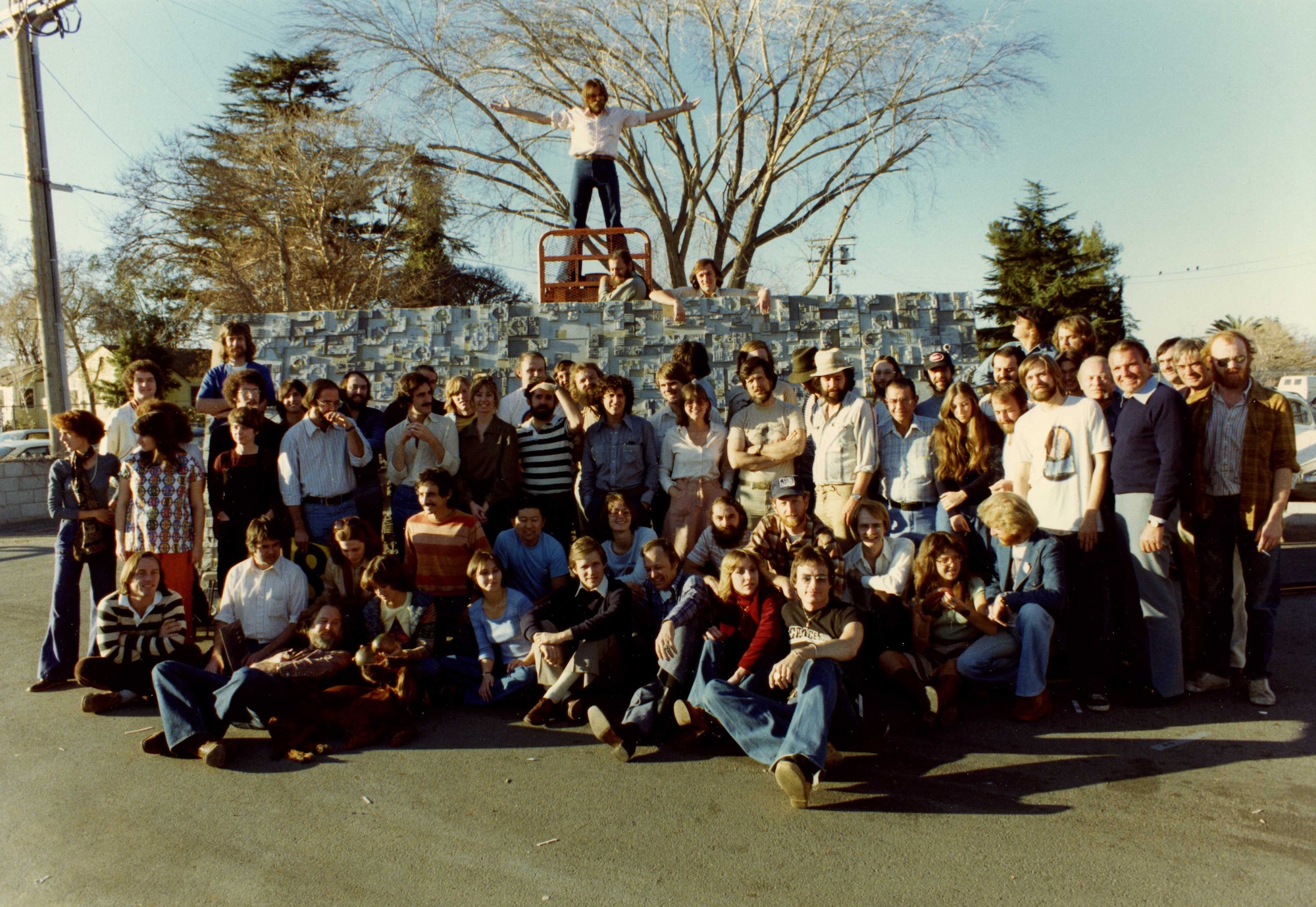
ILM’s original crew for Star Wars: A New Hope (1977) poses in the front lot of their original studio (Credit: ILM & Lucasfilm).
50 years ago today on May 28, 1975, George Lucas signed a legal certificate issuing his formal shares of stock ownership in a new company: Industrial Light & Magic. It’s likely the founder affixed his signature without pomp or ceremony. There was too much to do. ILM, as it would come to be known for short, had less than two years to build a visual effects studio from scratch and create nearly 400 shots in a new space fantasy film called Star Wars.
By that time in late May, Lucas had hired John Dykstra to supervise the film’s visual effects. The director had an audacious vision for creating dynamic images of spaceships dogfighting with each other. Lucas wanted the camera to move with the ships, as if the camera operators were up there to capture the action by hand. The idea broke many of the traditional rules in visual effects that typically required locked off cameras to allow for separate elements to be carefully blended together.
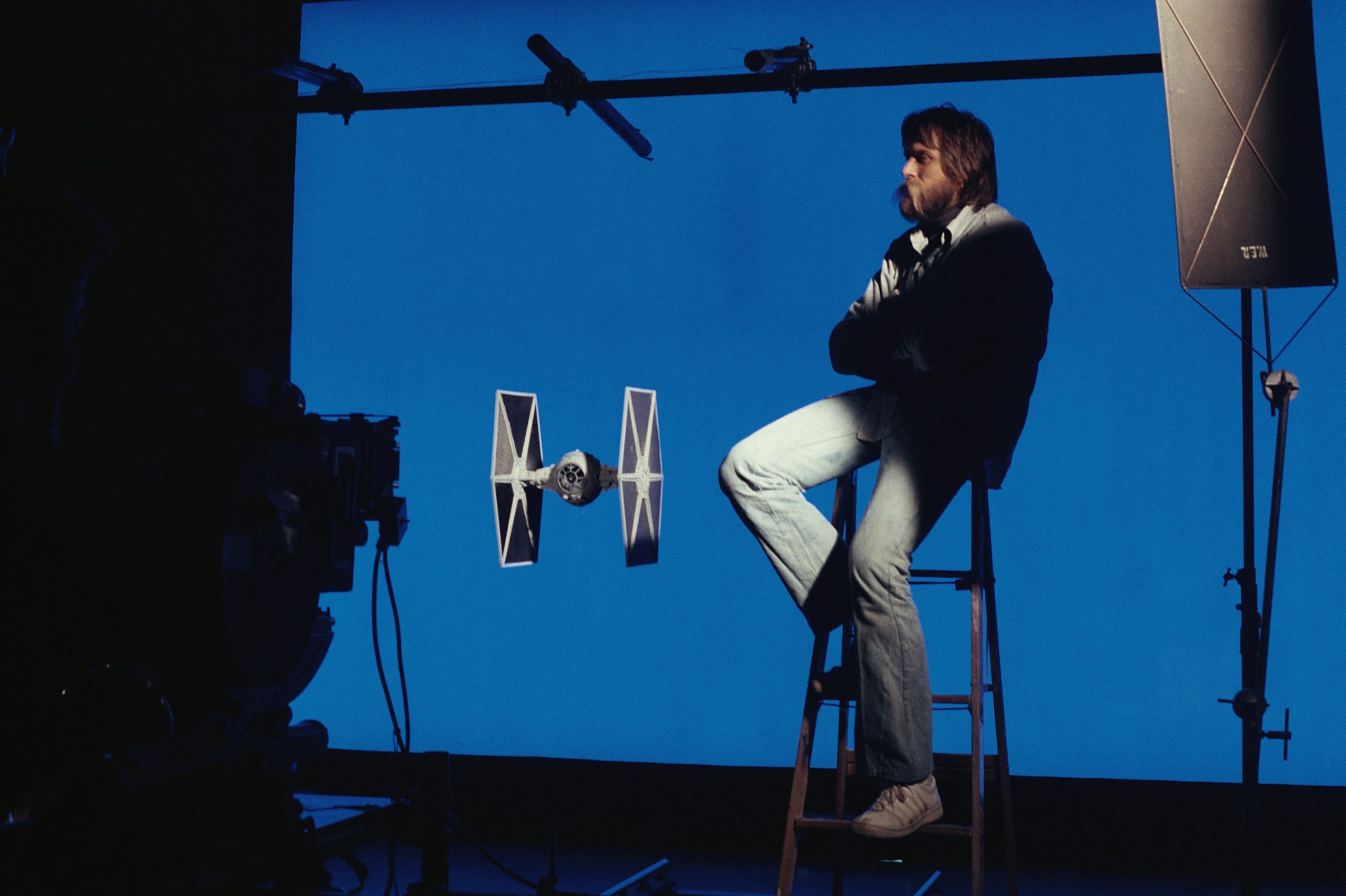
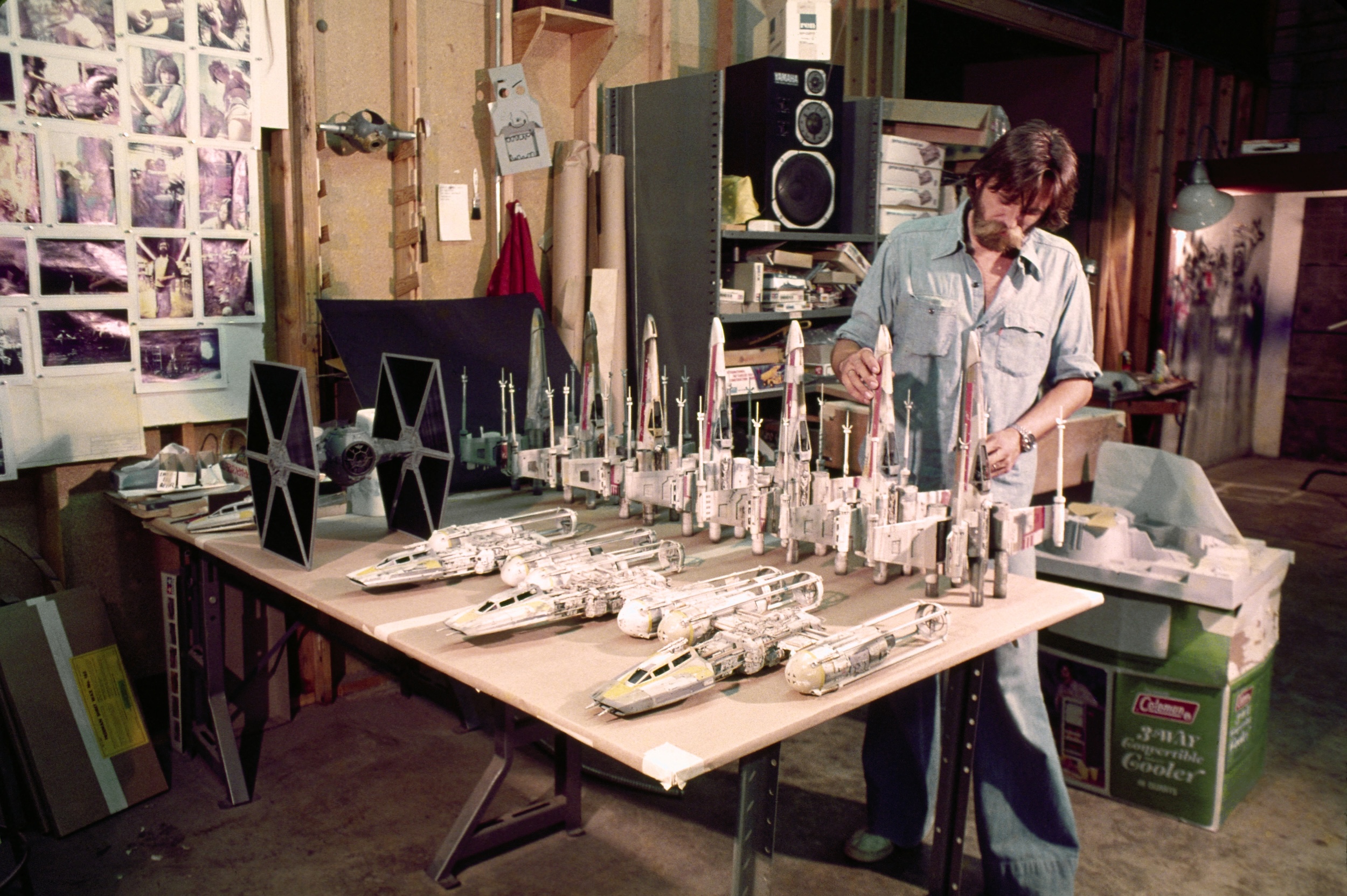
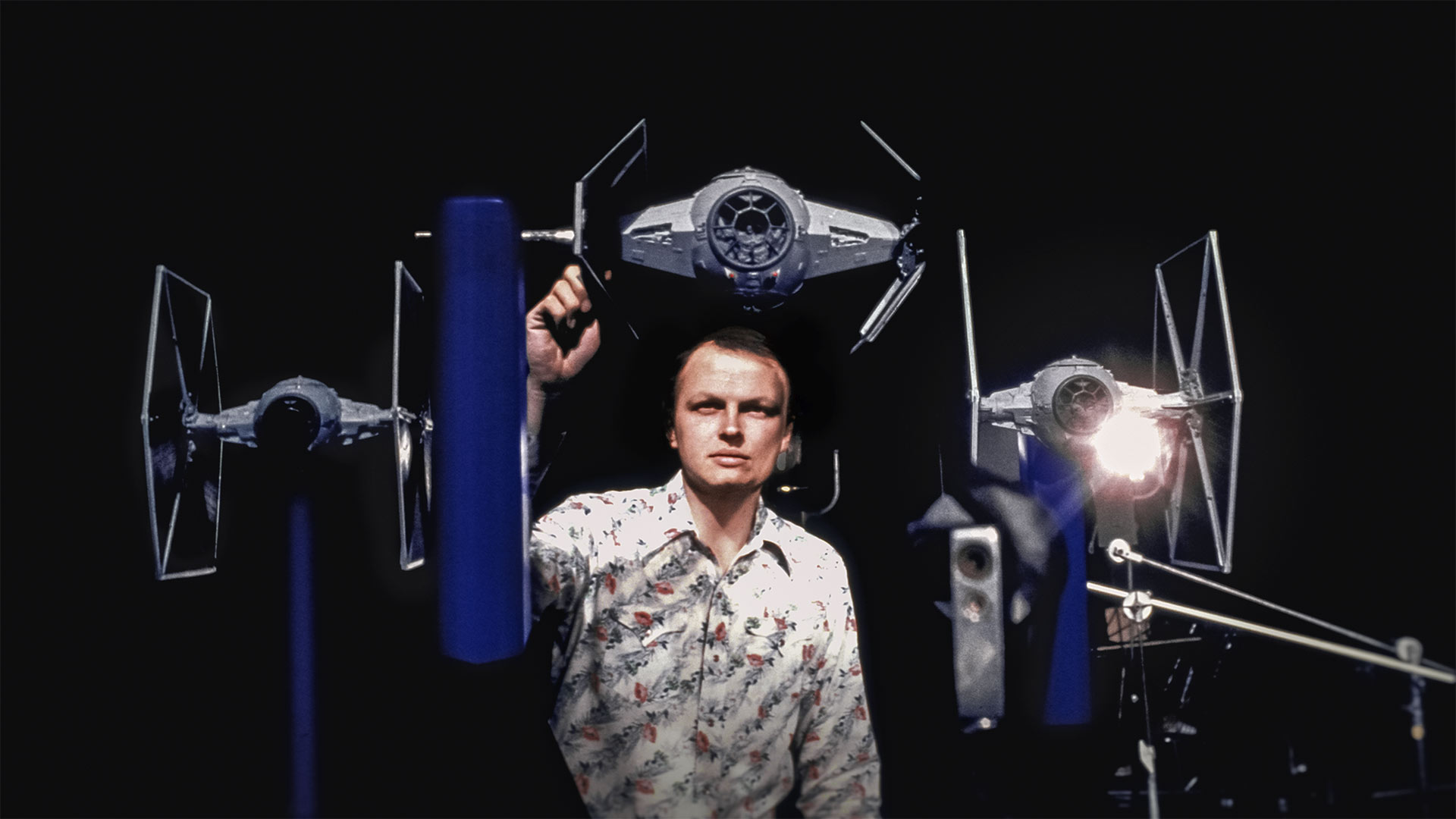
Visual effects supervisor John Dykstra poses on the stage next to a TIE fighter miniature (Credit: ILM & Lucasfilm).
John Dykstra was practically the only effects artist in Hollywood willing to buy into Lucas’s plans on the existing terms. He’d gained experience with the type of equipment that would be needed to realize the elaborate shots of custom-built miniatures. Dykstra was also a free thinker with a sense of adventure. There were only a handful of effects companies still operating, and none at a major studio. Most balked at the proposal, decrying its limited budget, tight schedule, and seemingly unattainable goals. So Dykstra was tasked with establishing a new operation.
Lucas was a Northern Californian and planned to base the editorial side of post-production near his San Francisco Bay Area home. He wanted to do the same for visual effects. Dykstra argued otherwise, deciding to keep the new facility in Southern California where he had access to a network of talent and close proximity to third party film processing labs. So it was at some point in late May that Dykstra located and then leased a warehouse in Van Nuys, one of a number of towns that sprawled across the San Fernando Valley, a ways north of Hollywood proper, and conveniently removed from the overbearing presence of the established studios.
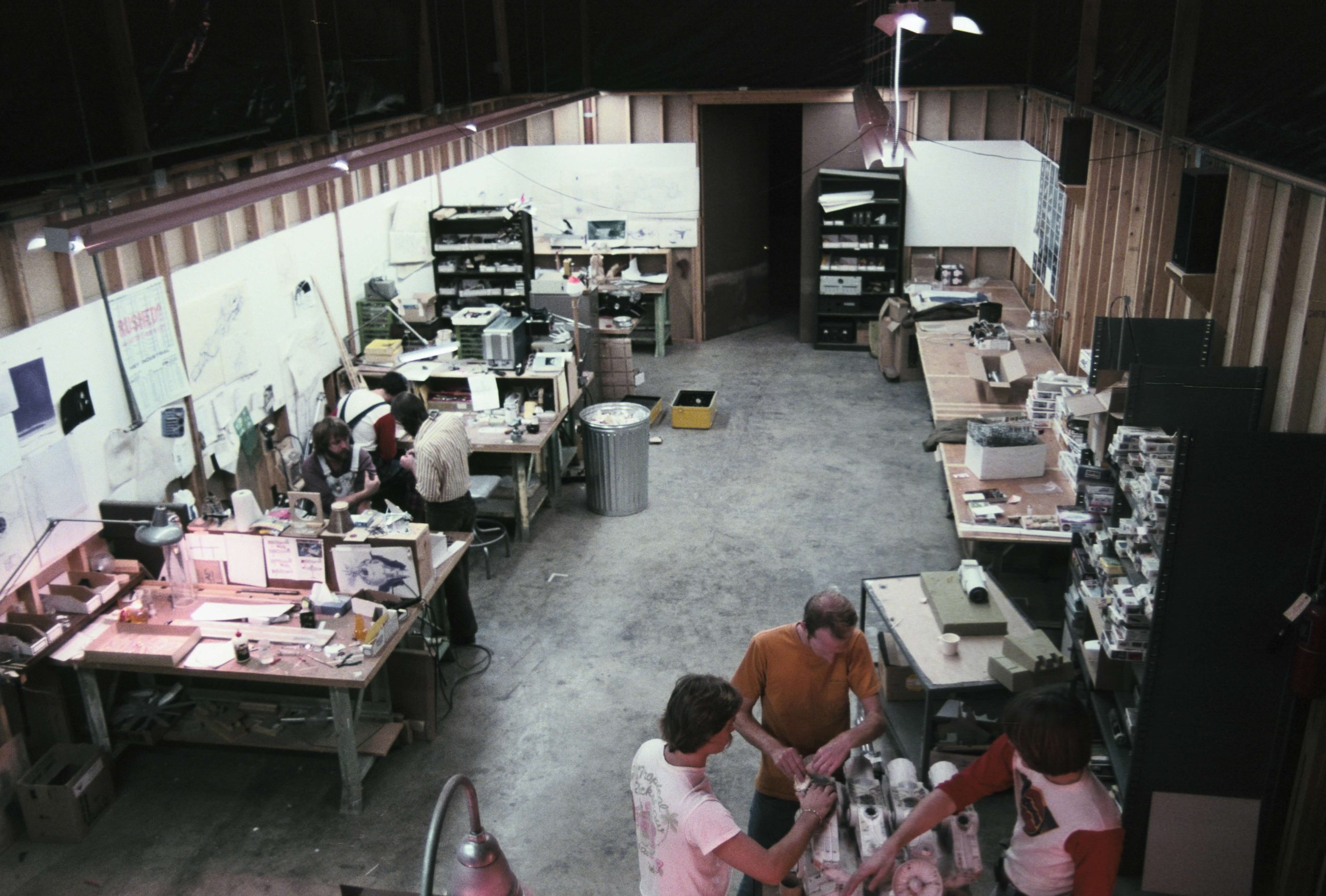
Located in an industrial park on Valjean Avenue, just a block from the south end of the Van Nuys Airport, ILM rented a building for $2,300 a month from owner Bill Hanna. It was two stories, made largely of stacked cinder blocks, with a large asphalt lot in front. Inside were a handful of unfurnished offices and open warehouse space with high ceilings ideal for hanging lights. Early on, Dykstra would drive his motorcycle through the building, leaving skid marks on the floor. It was often oppressively hot, even more so once the tungsten film lights were switched on, and Dykstra initially planned to construct a pool onsite, but later compromised with a cold tub that could hold multiple people.
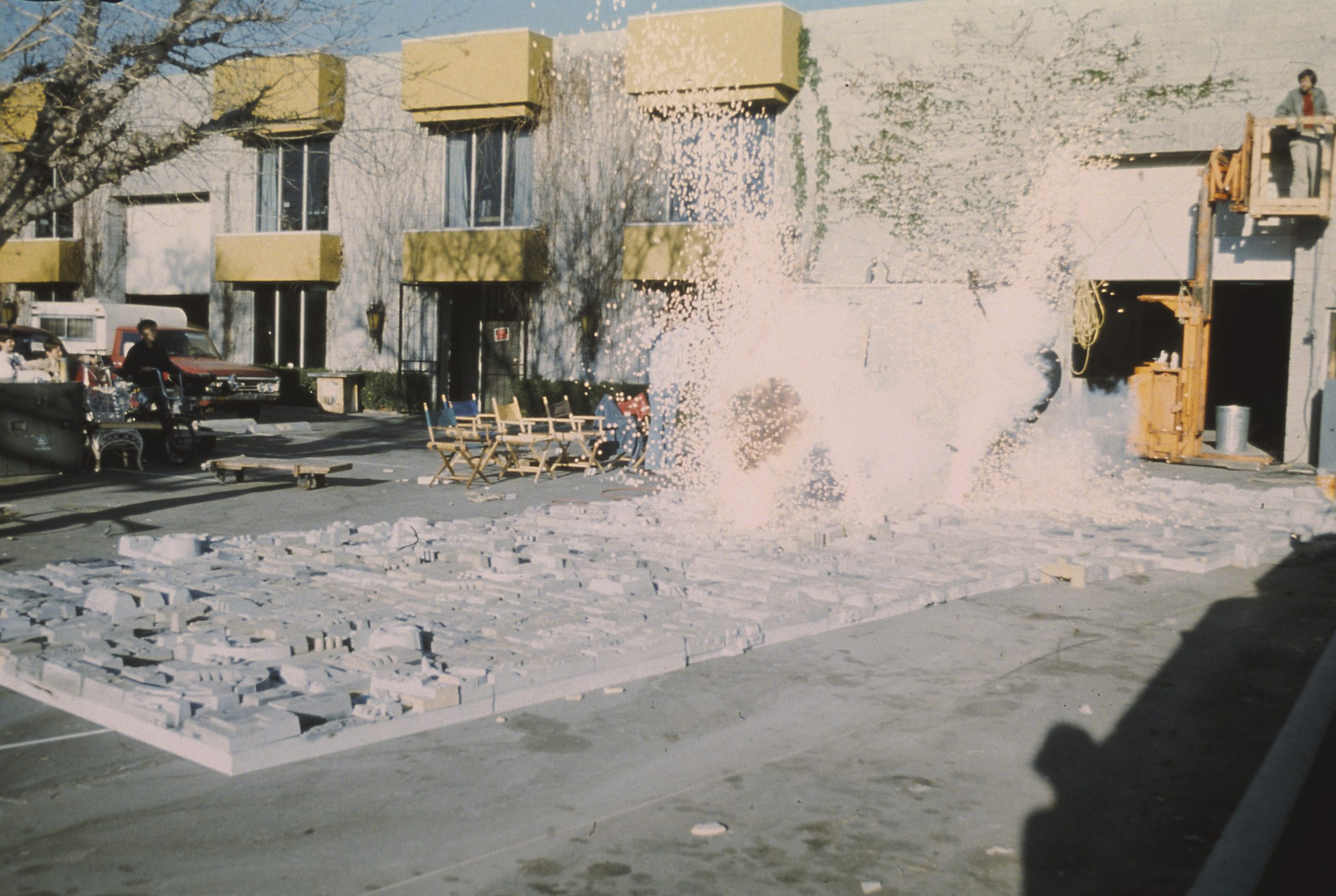
The exterior of ILM’s original studio in Van Nuys, CA. An explosion on the surface of the Death Star is photograped in the foreground (Credit: ILM & Lucasfilm).
“It just popped into my head,” Lucas would recall about the name “Industrial Light & Magic.” “We were sitting in an industrial park and using light to create magic. That’s what they were going to do.”
Initially, Dykstra worked out of Lucasfilm’s offices in a bungalow on the Universal Studios lot, a few minutes drive from Van Nuys. Soon he’d moved to Valjean, working off the floor before furniture was acquired. He was busy recruiting. By early June, modelmakers Grant McCune and Bill and Jamie Shourt were hired, as were production manager Bob Shepherd, technician Jerry Greenwood, first cameraman Richard Edlund, electronics designer Al Miller, and machinists Richard Alexander and Don Trumbull.
As former Lucasfilm executive editor J.W. Rinzler would note in The Making of Star Wars, “They all knew one another and had worked together before.” They’d worked on feature films with Douglas Trumbull (son of Don), or on commercials and other projects with Robert Abel and Associates. A later group would come from another commercial house, Cascade Pictures. Others came straight from universities where they’d studied everything from animation to industrial design. They brought with them aspects of the culture and methodology from these other places, together making something new and unique.
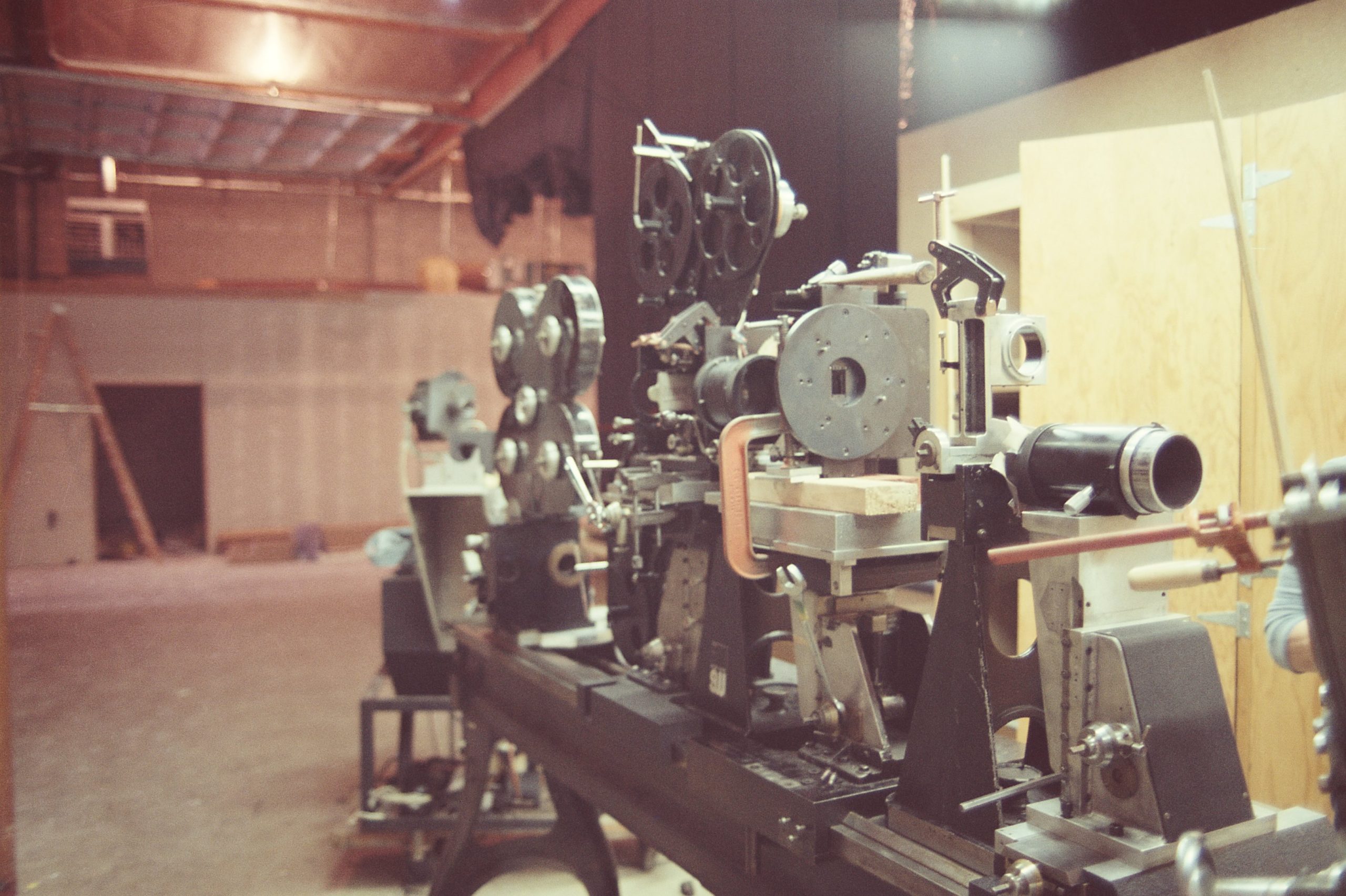
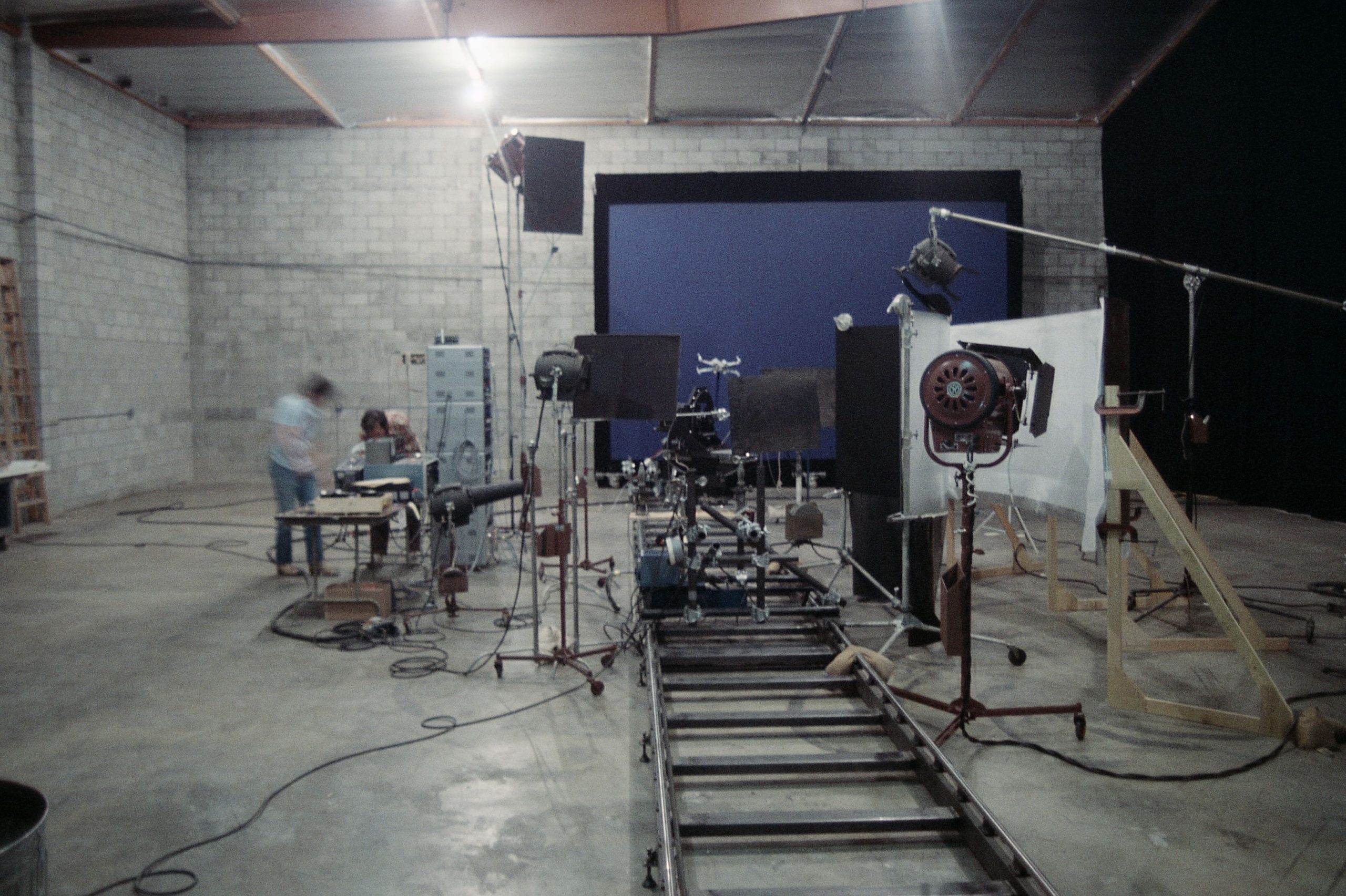
Optical composite photography supervisor Robert Blalack’s Praxis Printer is loaded into the new ILM space (Credit: ILM & Lucasfilm).A view of one of ILM’s shooting stages in the rear of the original Van Nuys studio (Credit: ILM & Lucasfilm).
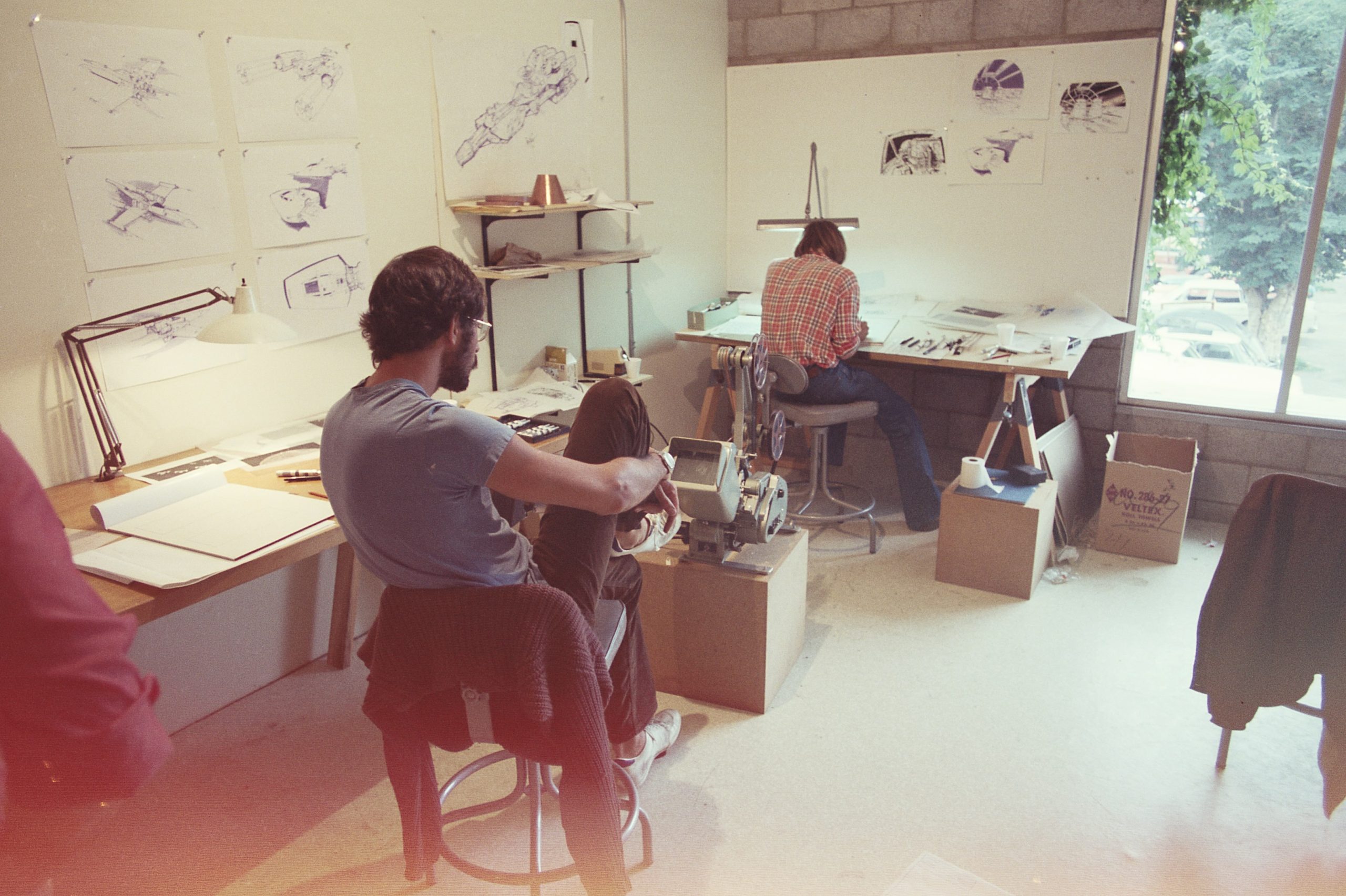
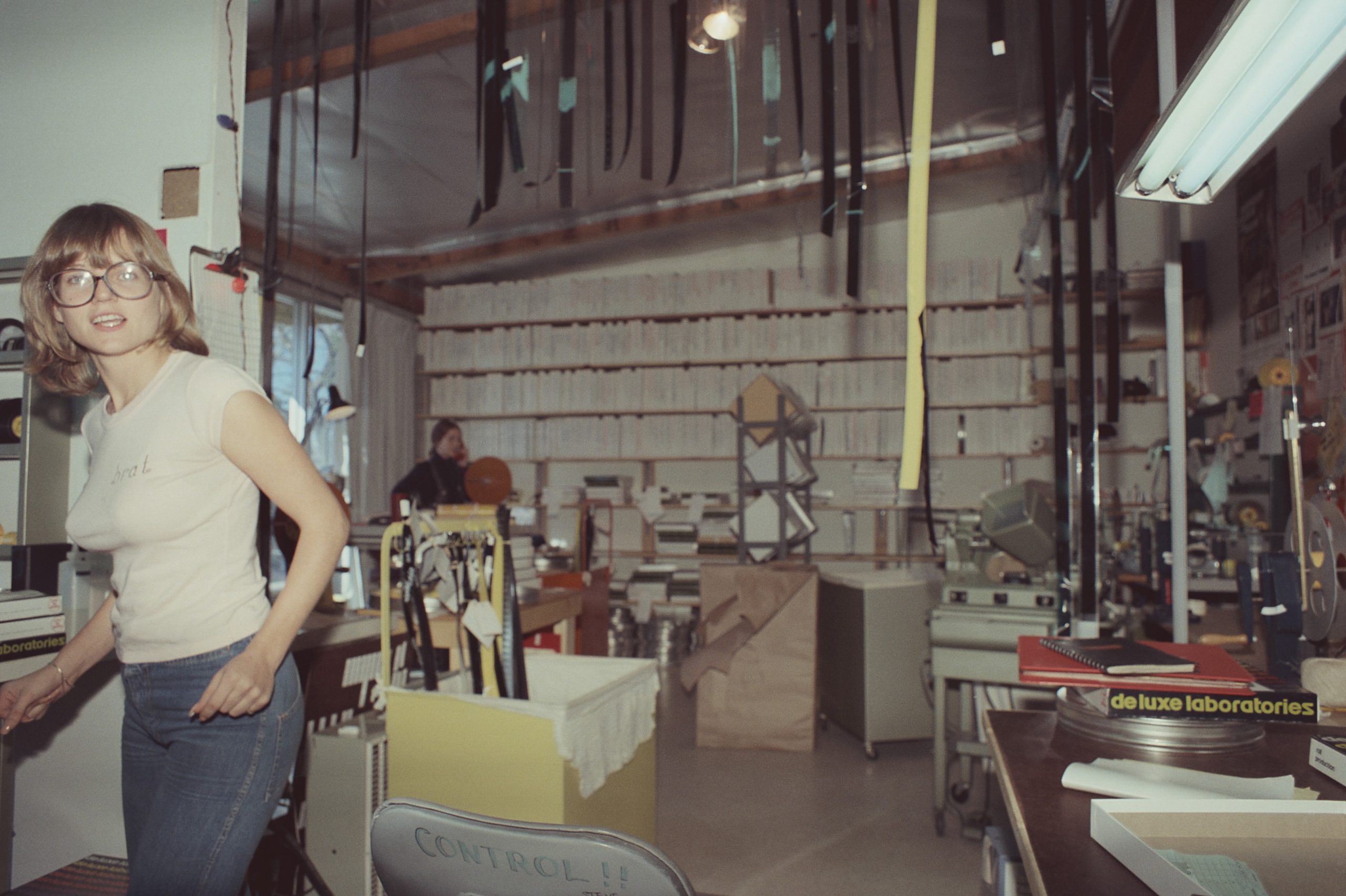
Before anything else could happen, the Valjean warehouse needed to be converted into production space and workshops. Over six weeks into the summer, they first taped out sections and then constructed the designated areas themselves. On the first floor would be the optical and rotoscope departments, a model shop, machine shop, wood shop, two shooting stages in the rear, and production offices in the front. Upstairs would be home to the animation department, editorial, a screening room, and the art department.
By July, optical composite photography supervisor Robert Blalack and animation and rotoscope supervisor Adam Beckett had been hired, as had a sound recordist and designer who would use ILM’s space as a sometime home base, Ben Burtt. By early August, artist Joe Johnston was setting up the art department (concept artists Colin Cantwell and Ralph McQuarrie had started much earlier, but each worked from home). Within a few months, a dozen people were on board, many of them attracted to join the project out of admiration for George Lucas, whose American Graffiti (1973) had made waves upon its release two years before.
The second floor art department, with storyboard and concept artist Joe Johnston working at a desk in the background as modelmaker Paul Huston looks on (Credit: ILM & Lucasfilm).Film control coordinator Mary Lind in the upstairs editorial department (Credit: ILM & Lucasfilm).
The spaces were ready by mid-summer, but ILM’s work had only just begun. It would take them nearly a year to successfully design and construct an entire visual effects facility and workflow, including miniatures, motion-control camera systems, optical printers, animation cameras, and blue screens. “There’s a significant difference between coming up with a good idea and executing it,” Dykstra would say. ILM’s initial budget was roughly $1.2 million. Although time was of the essence to build the various equipment, distributor 20th Century Fox was slow to provide any initial funds ahead of the main shoot, which would commence in the spring of 1976. So for much of its first year, ILM operated with George Lucas’s personal finances, thanks to the momentous commercial success of American Graffiti.
Former ILM general manager Thomas G. Smith would explain in his 1986 book, The Art of Special Effects, how “Outside, it looked like all the other industrial-style buildings in the valley. Inside, it was staffed with very young technicians, some barely out of college, few over 30, some even under 20 years old…. The doors at ILM were open 24 hours a day; technicians and artists worked without regard to time clocks or job classifications. They were children of the ’60s, and many rebelled against authority figures and traditional work rules. There were no dress codes and no specified work hours; designers built models, and modelmakers ran cameras. But there was a strong esprit de corps and feeling of purpose in the building…. The involvement was with the cause rather than with the money; somehow the group felt they were a part of something really important.”
John Dykstra inspects miniatures of X-wings, TIE fighters, and Y-wings (Credit: ILM & Lucasfilm).The first floor model shop in ILM’s original Van Nuys, CA studio (Credit: ILM & Lucasfilm).
What this group was about to accomplish in less than two years was anything but certain that late spring of 1975. If anything, it was “a long shot,” as Dykstra himself would admit. “It was very, very hard to say specifically what was and what wasn’t going to work before we built it,” he told Cinefantastique in 1977. “So we just had to take a shot at it and all I could do was bluff it and say, ‘Oh yeah, everything’s gonna be fine!’”
As would become the defining element of ILM’s success and endurance, it was the people who made all the difference. “It would be very hard to do Star Wars just by setting up an independent facility unless you had the personnel to do it,” Dykstra said. “The people who designed the equipment and constructed it made it all happen. Not only was it independent of studios but the people who were doing it are the best people in the industry right now.”
What began quietly with a handful of people in a hot, mostly empty warehouse would ultimately do the impossible, not just in the sense of its accomplishments on screen or the resulting accolades, but in its ability to grow, adapt, and continue innovating time and again. That story continues today at the company’s studios around the world. Though ILM has long since outgrown its original warehouse, it still attracts the same intrepid, curious people who bring their passion for image-making and problem-solving to multiple art forms.
Watch ILM’s new celebratory reel in honor of the company’s 50th anniversary:
—
Lucas O. Seastrom is the editor of ILM.com and a contributing writer and historian for Lucasfilm.
The second, and final, part of an extensive look behind the scenes of the visual effects production for Lucasfilm’s pirate-themed Star Wars adventure series.
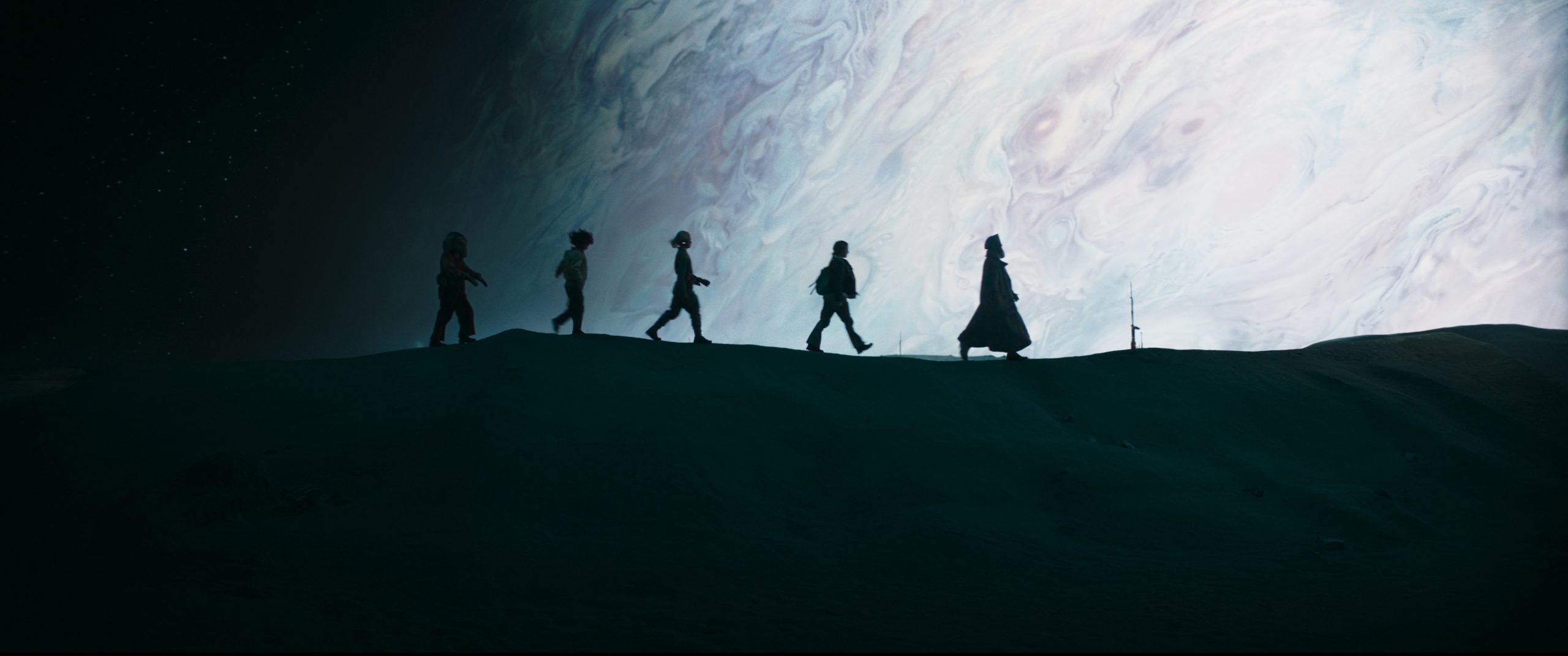
Still searching for At Attin’s coordinates, Jod (Jude Law) and the kids land the Onyx Cinder on the Observatory Moon, seeking help from an alien, owl-like astronomer named Kh’ymm (voiced by Alia Shawkat). The group treks from the ship to the observatory, a striking sequence that includes visuals of the characters silhouetted against a night sky dominated by a nearby planet.
The scenes were all captured in camera on the StageCraft volume, with the actors walking across a practically built dirt mound and the background displayed on the LED screens. “That was another one of our more successful volume shoots,” ILM visual effects supervisor Eddie Pasquarello says. “Perfect use of that, in my opinion.”
The volume also helped create the illusion of the observatory center rotating within the outer walls.
“That one was the most technically challenging,” says ILM virtual production supervisor Chris Balog. “We had to figure out multiple ways of tracking the camera to make sure that the wall was moving in conjunction with it. For some shots they had a circular dolly moving around the set. So we had to make sure that the wall was moving correctly too.”
The volume was used in 1,565 shots in all, Balog says, and 900 of those shots were in-camera finals.
Like Neel (Robert Timothy Smith), Kh’ymm was also realized using a combination of digital and practical techniques, depending on the scene. In some shots, a practical puppet created by Legacy Effects captured her performance entirely in camera. In other scenes, ILM collaborator Important Looking Pirates created a full computer graphics head composited on top of the puppeteered body or utilized a fully digital replica carefully animated to closely match the movements of the puppet.
The episode concludes with the arrival of a pair of familiar New Republic ships summoned by Kh’ymm. “Of course, we see our first X-wings,” Pasquarello smiles. “That was right in our wheelhouse and fun for everyone to do.”
(Credit: ILM & Lucasfilm)
Can’t Say I Remember No At Attin
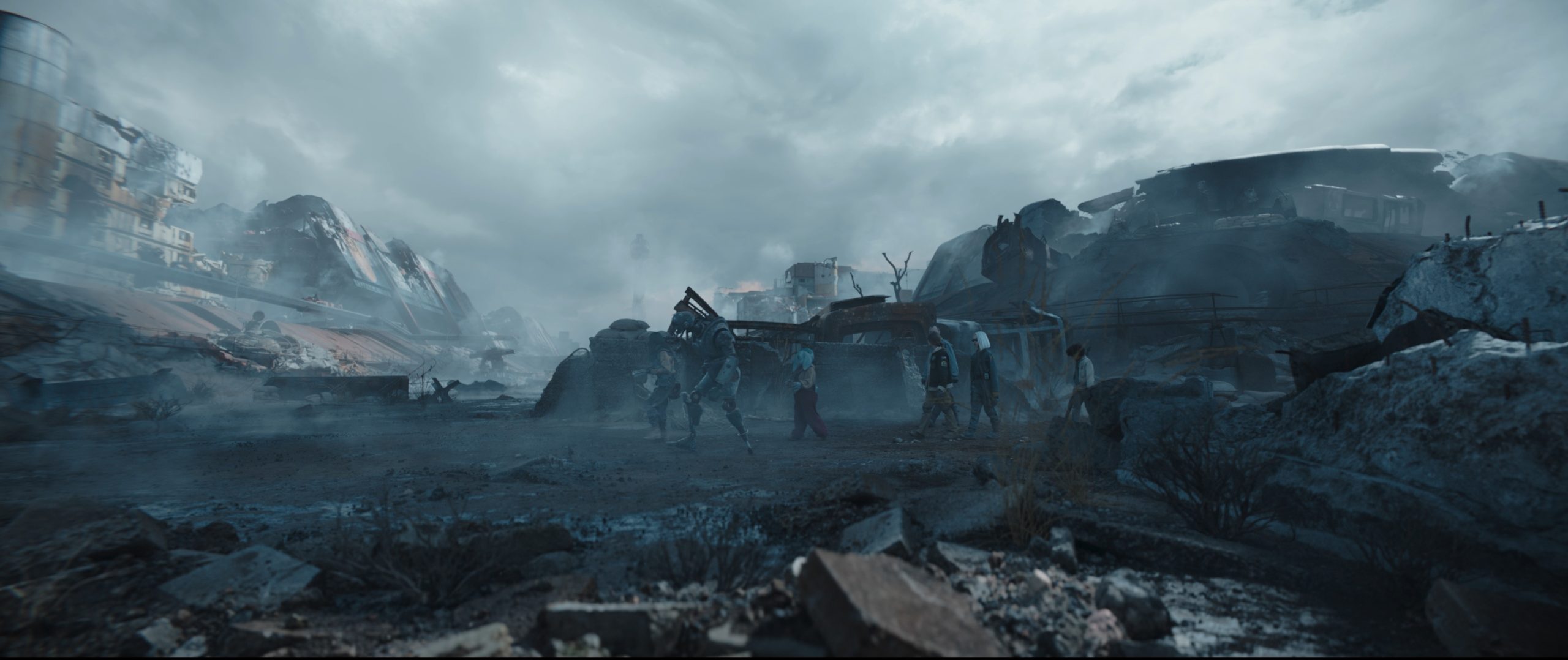
The Onyx Cinder arrives at a world that initially looks a lot like At Attin but is actually the conflict-battered sister planet At Achrann, a place where children are trained as soldiers in a war between the Troik and Hattan clans. The kids hike through the decayed remains of a neighborhood and city that once looked like their own. Live-action scenes were shot with minimal sets against blue screen backgrounds and completed with extensive environments created by ILM partner DNEG, including dilapidated buildings and streets, a fully-digital armored assault tank, and a small herd of horned eopie creatures.
The heroes are challenged by a Troik warlord named General Strix (Mathieu Kassovitz) to prove their strength in battle. In exchange, Strix’s daughter Hayna (Hala Finley) takes them to an abandoned tower that may have the coordinates they need to get home. Inside the tower – another set that utilized the StageCraft volume – SM-33 (voiced by Nick Frost) reveals that his previous captain ordered him to destroy the coordinates to At Attin. Fern attempts to override his memory, triggering a hostile response and transformation sequence that required significant digital work by ILM’s Sydney studio.
“Whenever SM-33 goes into attack mode, he’s more CG versus the puppeteered, less-docile version of him,” Pasquarello explains. “When he has those armored plates on, or whenever he grows, that’s all CG.”
The abandoned tower set utilized a mix of 3D elements and backgrounds in the volume along with practical columns, floor, and set dressing.
“I thought it had a really amazing photographic feel to it,” says Balog. “Some of the biggest challenges are blending the volume with the real set. And that’s why the virtual art department is such a key factor, because they have to work hand-in-hand with the set department and the 3D content to make sure the textures on everything look the same.”
“ILM had a really great content team led by [visual effects associate supervisor] Dan Lobl, creating content that is believable and looks real,” Balog says. “We’re not successful unless they’re successful.”
The setting also provides subtle foreshadowing to events that unfold inside the At Attin Supervisor’s Tower in episode eight,” says Pasquarello. “The environment was unique and custom,” he explains. “There’s a deliberate tilt up to the ceiling, and you can see some cables hanging. Those are the remnants of their Supervisor, who’s been totally gutted and ripped out. I think it’ll be fun for people to watch the series again, and they’ll understand.”
(Credit: ILM & Lucasfilm)
Lanupa’s Luxury and Peril
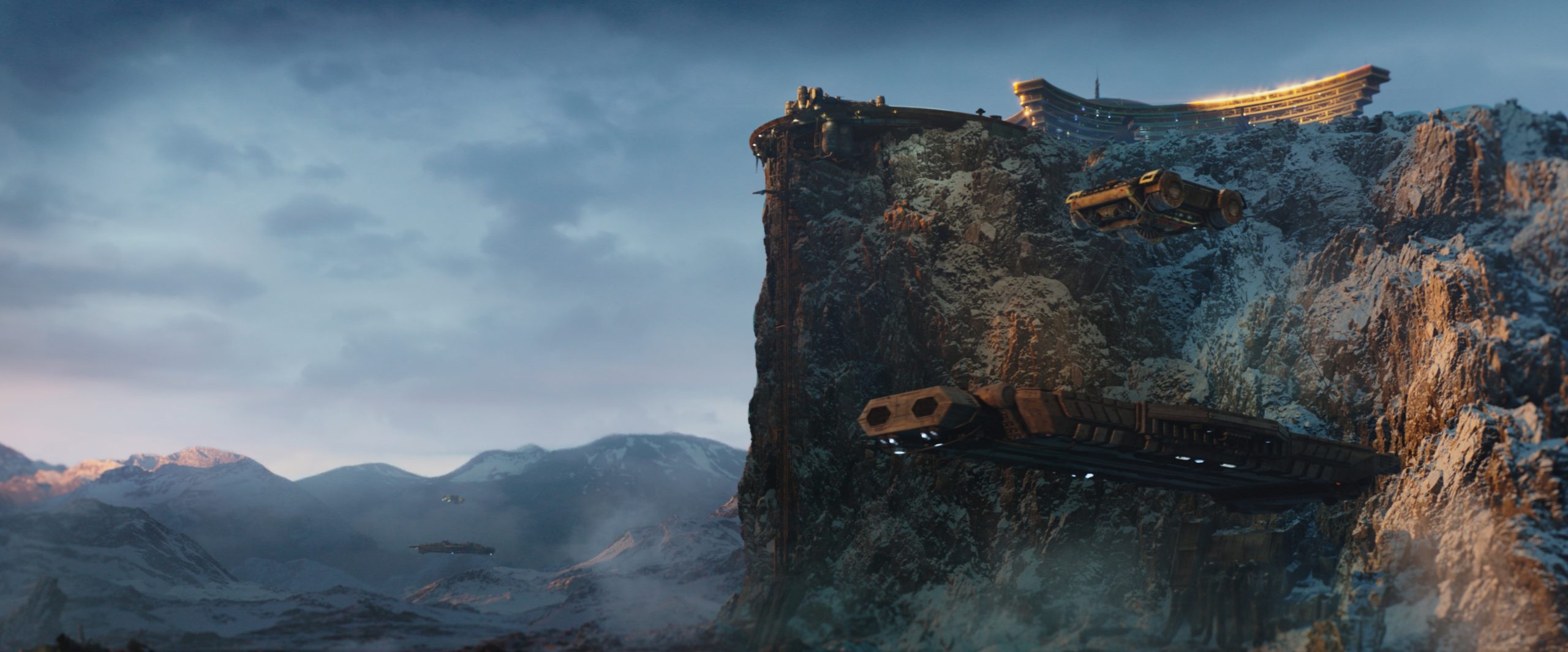
Next stop is a mountain on the planet Lanupa, the site of an old pirate lair that SM-33 believes contains At Attin’s coordinates. It’s also the site of a lavish hotel and spa occupied by high-end patrons, including a Hutt who swallows a Troglof mud bath attendant and a massive, tentacled creature called Cthallops, both achieved digitally with the help of Important Looking Pirates.
Jod is captured by the pirate horde and sentenced to death. He’s allowed a few remaining minutes for a final appeal, measured by an hourglass filled with churning blue plasma. “It wasn’t a fully fleshed-out idea on set. We knew we needed an hourglass, and we would be doing it, but it was just kind of a fun adventure to figure out,” Pasquarello says. “We were trying to do some fun ideas with how the plasma would show the passage of time.”
Successfully navigating a series of booby traps, the children, Jod, and SM-33 enter the subterranean treasure lair of pirate captain Tak Rennod, another set that relied heavily on the StageCraft volume.
“They built the big skull throne that the pirate king sat on,” says Balog. “They had all the treasure in the room, four big columns, and the stairs and the rock when they walked in. Everything else in the cave was created with the volume.”
After finally discovering At Attin’s secret, as well as its location, Jod betrays the children, who escape the lair by sliding down a series of tunnels to the base of the mountain. As Wim (Ravi Cabot-Conyers), Neel, Fern (Ryan Kiera Armstrong), and KB (Kyriana Kratter) figure out how to get back to the Onyx Cinder, they encounter a cast of curious trash crabs.
“They’re not droids,” explains Pasquarello. “They’re literally crabs with garbage on their backs. And that was a lot of work to make that understandable. They’re not synthetic. It’s one of those sequences that is very rich in detail, and there’s a lot going on.”
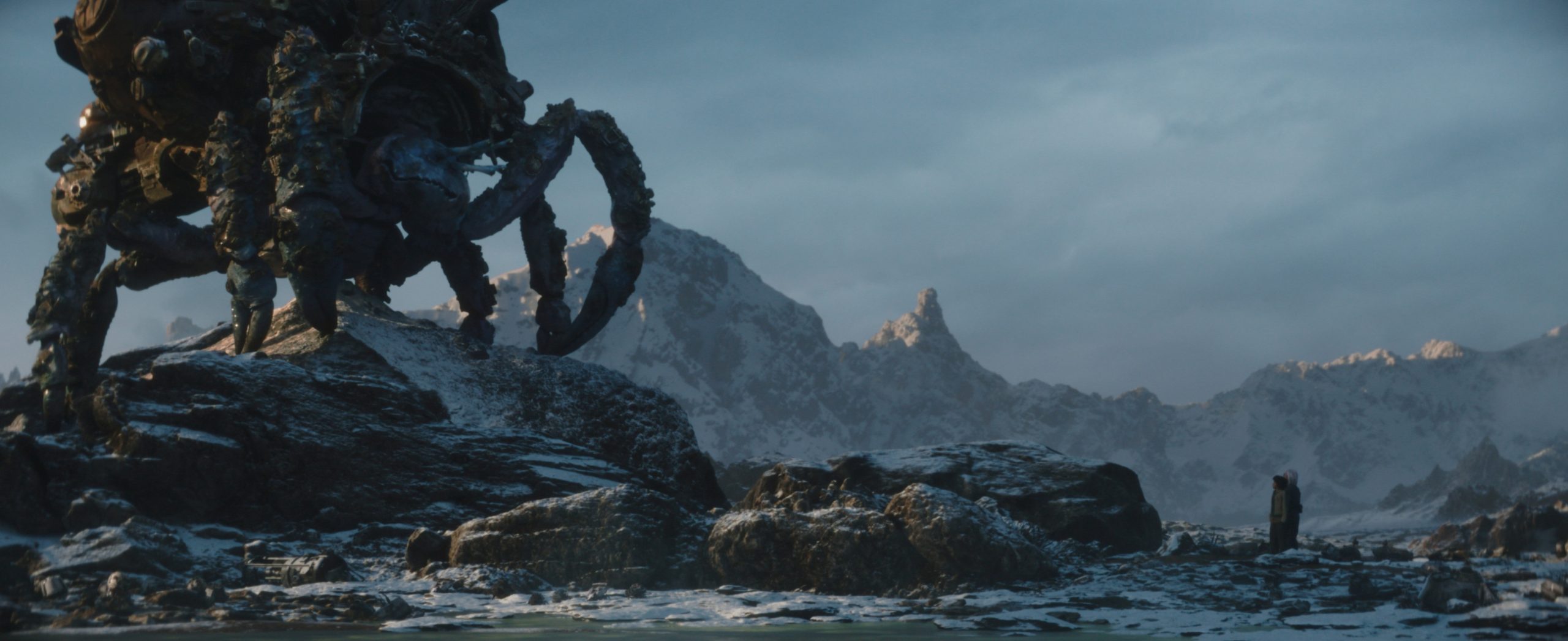
While the baby crabs are digital, a massive mama crab was created as a detailed stop-motion puppet by Tippett Studio, the production company founded by original Star Wars animator and creature designer Phil Tippett. The beast’s jagged, rusty, junk-laden look prompted the Tippett crew to nickname it “Tet’niss.”
(Credit: ILM & Lucasfilm)
“We generally did the rough blocking of the shots at ILM first,” production visual effects supervisor John Knoll explains. “We figured out what the shots wanted to be, the pace, and how big the creature was going to be. Once we got all those layouts approved, it went to Tippett’s, including all the camera info so they could figure out where the camera was positioned relative to the set and the puppet.”
A low-resolution, untextured 3D model of the mama crab also helped animators work out the creature’s speed and movement in advance of shooting on the stop-motion stage.
“Since stop-motion is very labor intensive, you don’t want to have to go back and reshoot things,” Knoll says. “So we got approval on their preliminary animation, and then they would go in and do the detailed stop-motion. And that was a particularly complicated character because there are so many moving parts on it. Obviously, there are the eight legs, but then there are all kinds of little pieces on it that bounce and move when it starts to walk. I’m impressed that they were able to keep that all straight in their heads.”
The mama crab puppet weighed in at about 15 pounds, requiring support from a mechanical harness that was digitally erased in post-production.
(Credit: ILM & Lucasfilm)
Onyx Cinder Metamorphosis
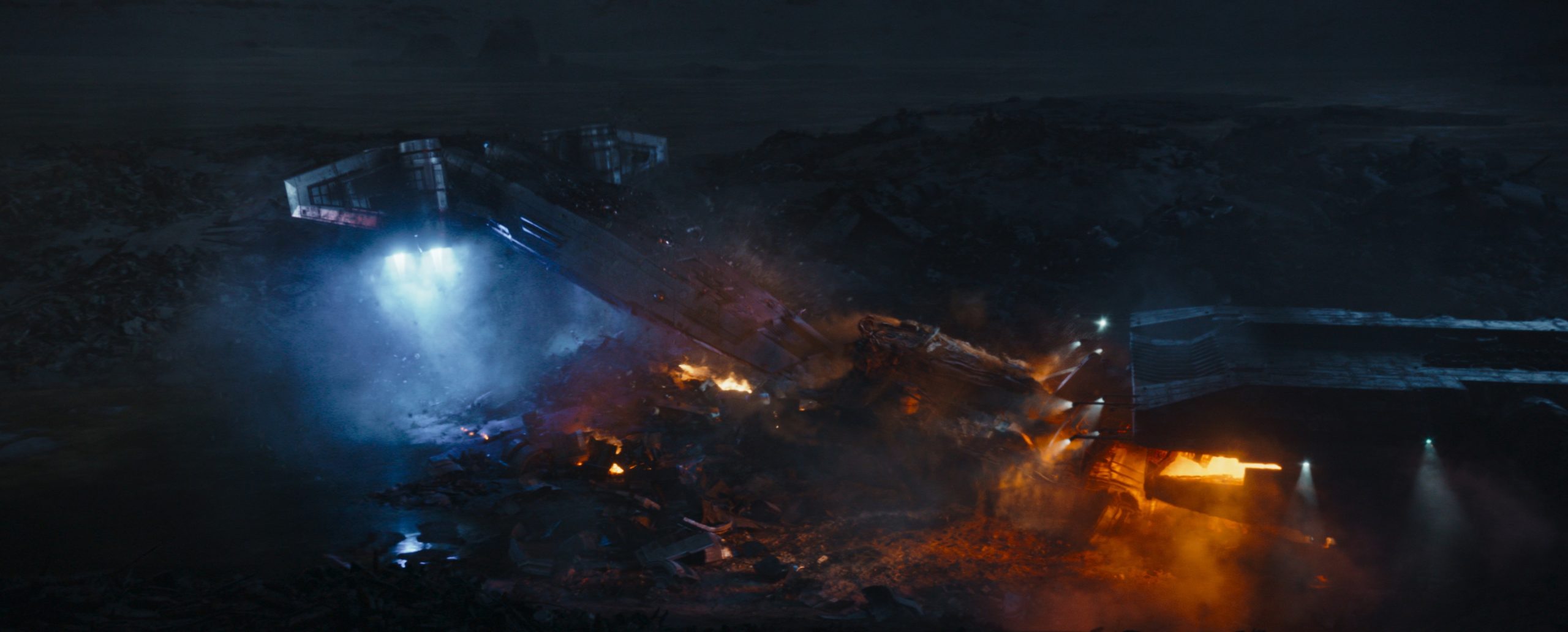
The kids reach the Onyx Cinder just as an enormous scrapper barge closes in, threatening to pulverize the ship and ingest the remains into its fiery maw. “There’s sort of a tug-of-war between the ship and this garbage muncher,” Knoll explains. When the ship is snagged by one of the muncher’s claw-like arms, Fern decides their only hope for an escape is by triggering the emergency hull demolition sequencer.
A series of rapid explosions ripple down the hull, causing the Onyx Cinder to shed its worn outer shell. A smaller, silver-colored version of the ship is freed and rises out of the debris. “Our code was the ‘ironclad’ and the ‘sleek ship,’” Pasquarello says of the two Onyx Cinder variants. “We went around a lot with the shedding of the hull. We didn’t want it to all blow off and just be conveniently revealed. It had to come off like a snake’s skin.
“And the effects are just dialed up to 11,” continues Pasquarello, who hopes that fans notice a key storytelling detail of the ship’s metamorphosis. “One cool thing that I don’t think everybody knows is that when you transition between the ships, we don’t share all the same engines, but the engines that we do share between the ships change from a warm color to blue.
“One of our challenges was that the sleek Onyx Cinder is a cleaner-burning ship,” Pasquarello says. “The whole conceit was that the engines were that orange color because they were dirty and running bad oil. We kept debating: ‘When would it turn blue?’ The sequence is a very elegant transition shot where you see it sputtering away all of that oil and dirt to the cleaner burning blue that we got.”
Knoll says the transformation was one of the more “complicated” scenes to pull off. “There are a lot of simulation layers that are in there, and the sleek ship doesn’t actually fit inside the armored hull, so there was some sleight of hand that had to happen to make that appear to work,” he explains.
The end result is one of Pasquarello’s favorite sequences. “Every time I watch it, I still get chills,” he says. “It just speaks to the detail that the creators had about this show. They thought of everything. [Jon] Watts was very clear with us that this is why this is happening. And we just had to figure out how to execute that.”
(Credit: ILM & Lucasfilm)
The Return to AtAttin
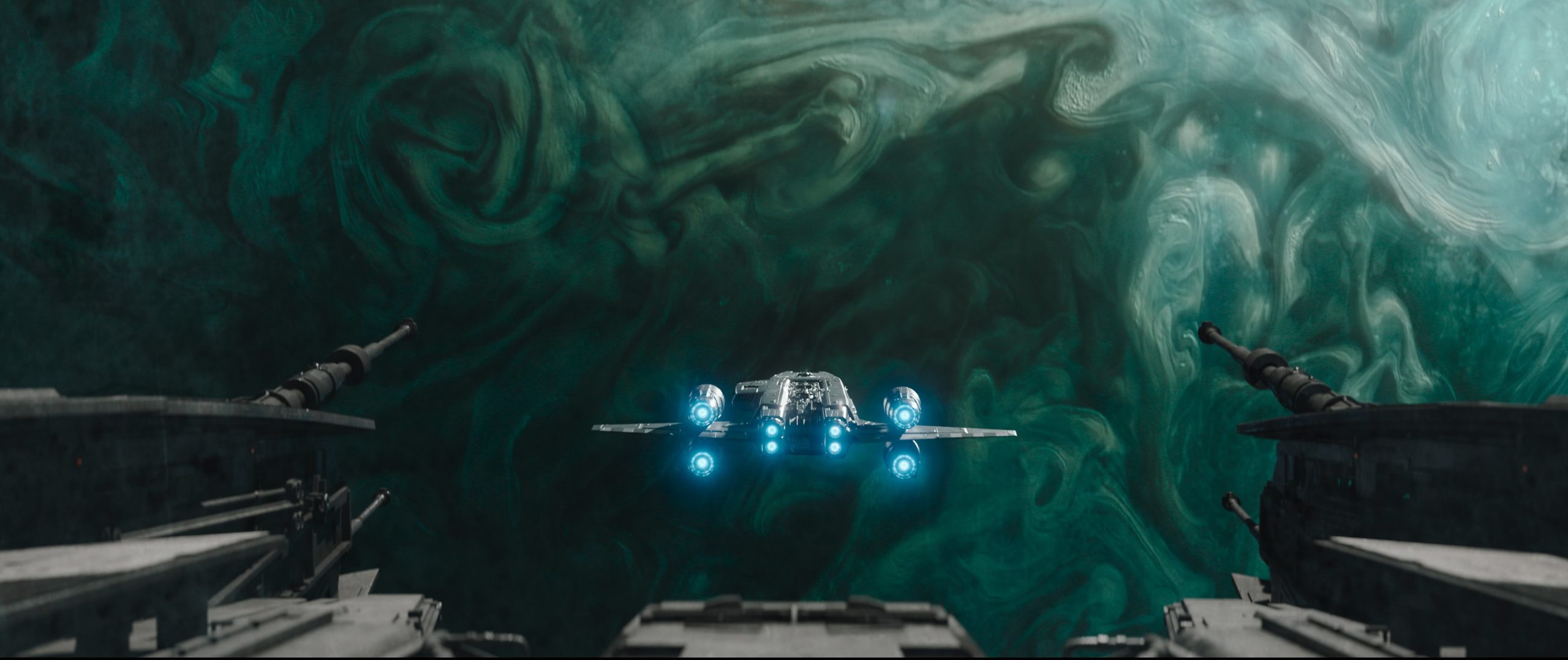
At Attin’s coordinates in hand, Wim, Fern, KB, and Neel arrive at their home planet aboard the transformed Onyx Cinder. A horde of pirates led by Captain Brutus (portrayed by Fred Tatasciore and performance artist Stephen Oyoung) are not far behind. But the pirates are stopped by the planet’s protective, nebula-like barrier. “Going through the barrier for us was a really big endeavor,” says Pasquarello. “It’s something that started early because it’s so effects-driven and heavy and large scale, and there’s a lot of story to be told in there.”
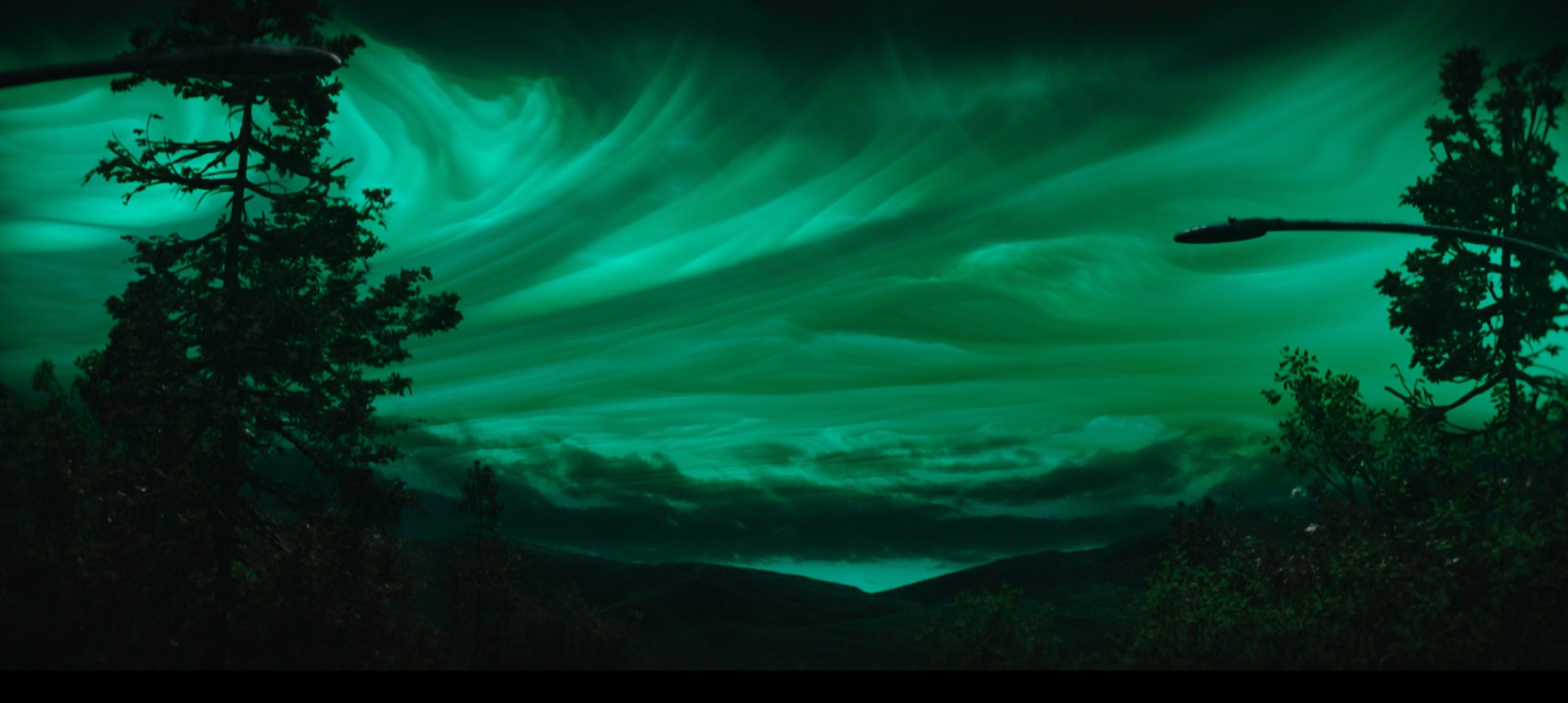
An array of satellites protect At Attin, blasting deadly arcs of lightning toward unauthorized ships. SM-33 reveals the Onyx Cinder is an At Attin vessel, which allows it to pass safely. The design and function of the satellites – crafted by ILM’s digital modeling department – evolved over time, says Pasquarello. “At one point, the satellites were actually emitting atmosphere. There were versions where you could literally see atmosphere coming out of them to create that cloudy environment,” he explains.
Pirate ships pursue the Onyx Cinder through a toxic swirl of greenish-blue gasses but are destroyed by the satellites. “There’s a lot of heavy, heavy sims [simulations] and work that went into that sequence, and then the landing on At Attin,” Pasquarello says, giving credit to ILM’s compositing and effects teams.
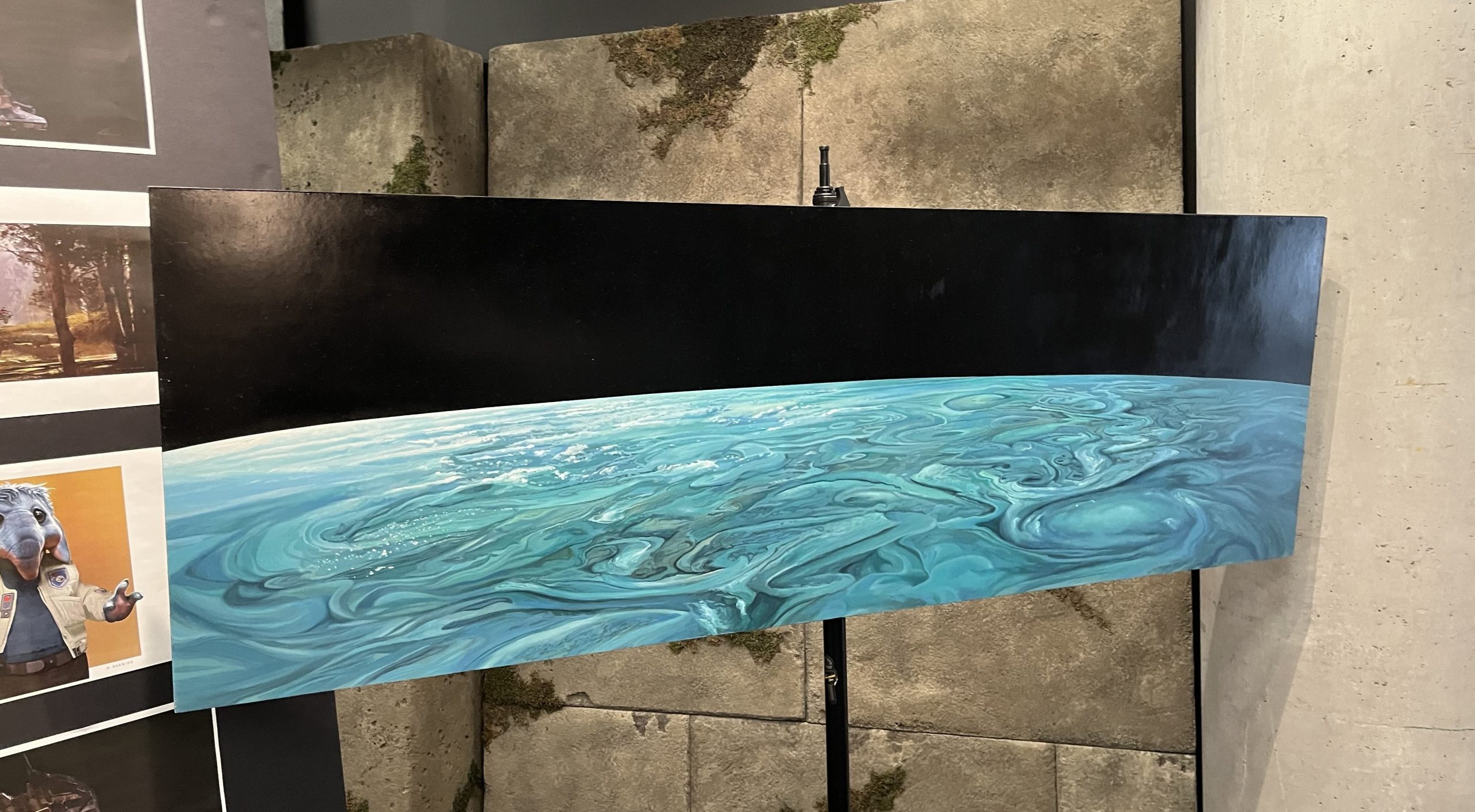
One element featured in the return to At Attin came along late in the production process. With shot delivery deadlines approaching faster than a ship in hyperspace, John Knoll got an email from Jon Watts. “He said, ‘We’ve done animatronic creatures, we’ve done rubber monsters, we’ve done stop-motion creatures. We did miniature and motion control. The only thing we haven’t really done from the old days is a traditionally-painted matte painting. Is it too late to do one?’” Knoll recalls.
With only two months to make it happen, Knoll reached out to former ILM artist Jett Green at her home in Hawaii and asked if she’d like to put her brushes to work creating a traditional oil matte painting of At Attin. Using paint instead of pixels to compose a matte image is something ILM hadn’t done in about 30 years, according to Knoll.
“I love being part of this history,” Green tells ILM.com. “John and I had this conversation about it being a planet. He had the references already, and he told me what he needed. I even built the Masonite panel for it, and it just felt really good.” Knoll now has the roughly six-by-two-foot painting displayed in his ILM office.
At Attin matte painting created by Jett Green (Credit: ILM & Lucasfilm)
Another ILM veteran, modelmaker Bill George, is also credited on Skeleton Crew. George first worked for ILM building models forStar Trek II: The Wrath of Kahn (1982). For fun, he once built a mashup of two similar ship designs: the concept for Han Solo’s original “pirate ship” from Star Wars: A New Hope (1977), and the Eagle from the sci-fi series Space 1999 (1975-1977). He called it the Millennium Eagle.
“Somebody at Lucasfilm saw it,” George says. “I got a request saying, ‘Hey, can you bring that model in? We want to scan it.’”
The computer graphics version of George’s Millennium Eagle model now appears among the ships docked at Port Borgo.
It’s not the first time one of George’s homemade models ended up in a galaxy far, far away. During production of Star Wars:Return of the Jedi (1983) ILM was in desperate need of a new Y-wing model. George offered to bring in the one he’d built years earlier. It was so good, it ended up being used in the film.
Posing as an emissary from the New Republic, Jod gains access to At Attin’s bountiful treasure: 1,139 subterranean, credit-filled vaults. The vault is an entirely digital environment that DNEG populated with security droids, industrial robotic arms, and a seemingly endless supply of golden computer graphics credits that line the walls and spill into Jod’s rapacious hands.
Jod, Fern, and her mother, Fara (Kerry Condon), ascend the Supervisor’s Tower. The Supervisor is revealed to be a large, domed droid with a red eye. Only a small part of the Supervisor droid was constructed physically, with the StageCraft volume completing the illusion.
“Virtual production is the future of visual effects,” says Chris Balog, a 20-year ILM veteran with a background as a digital compositing artist. “It’s where the next evolution is going. And if you can do it successfully, it’s an amazing tool.”
Jod destroys the Supervisor with a lightsaber, triggering a citywide power outage and disabling the barrier satellites, clearing the way for the massive pirate frigate to reach the planet’s surface.
The enormous frigate survives the barrier and floats ominously over the city. “The great effects work done with the frigate coming through the clouds was Travis Harkleroad, our effects supervisor,” Pasquarello says. “Those explosions all come from him and his people.”
The all-computer graphics frigate’s arrival is meant to evoke the alien-arrival feeling of films like Close Encounters of the Third Kind (1977) and Independence Day (1996). “There was no practical frigate,” Pasquarello says. “It’s a gorgeous ship. It’s a very complex-looking ship, and there’s a lower and upper deck that was built inside, and ships and skiffs that come out of that.”
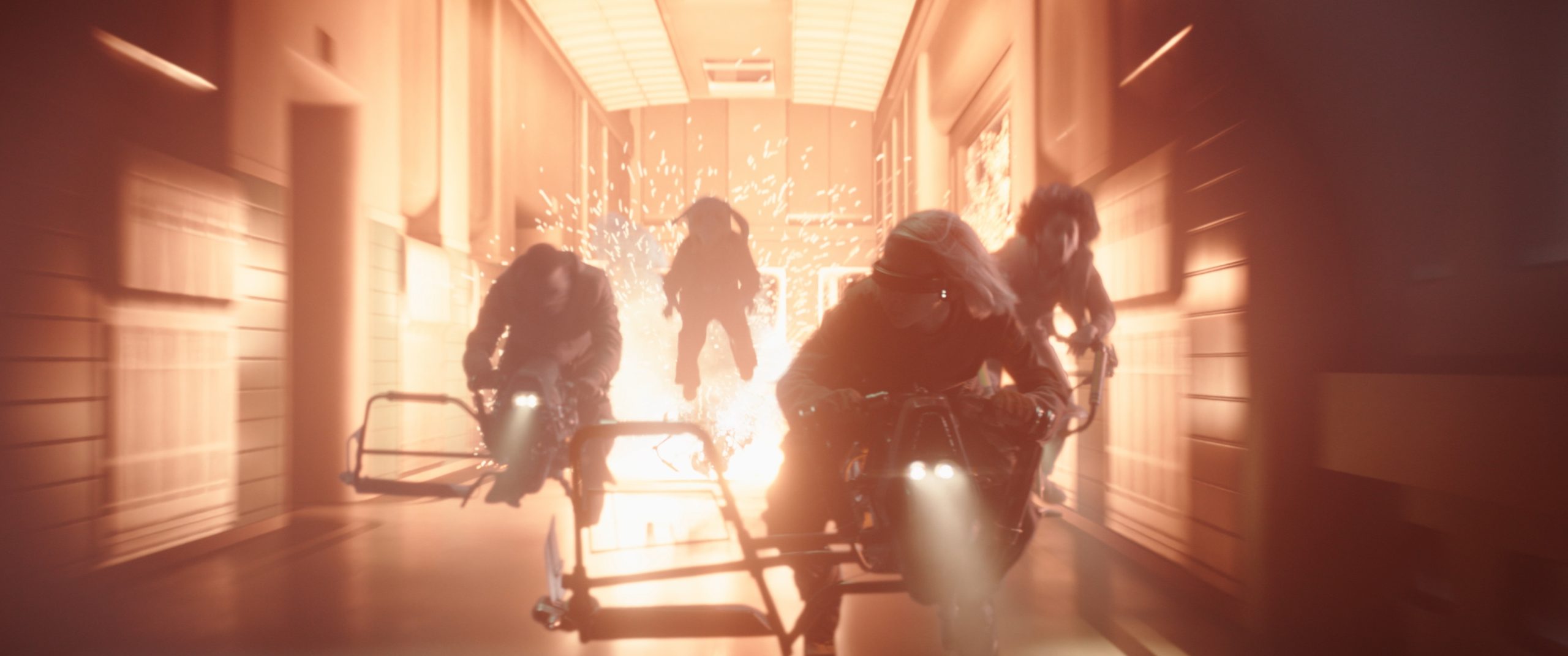
Wim, Neel, and KB devise a two-part plan to rescue Fern and call Kh’ymm for help. Jumping on speeder bikes and pursued by skiffs loaded with angry pirates, the kids – along with Wim’s dad, Wendel (Tunde Adebimpe), make their way across the city.
For close-up shots, the actors were shot on a blue screen stage, with the more dangerous action – like a perilous jump across a canyon – requiring the use of digital doubles. “The speeder bikes on this show were a real challenge in the sense that we can’t put kids into a lot of heavy stunt work,” says Pasquarello. “So there was a lot of work done to help the dynamics and the physics of that chase.”
The action continues through an all-computer graphics forest, through the city, to the school. Pasquarello praises ILM’s animation, layout, simulation, and environments teams for the extensive 3D build. “They’re going through an entirely CG environment, created by the environments team that you just don’t question,” he says. “Not one thing that they fly over or go through is real.”
Summoned by Kh’ymm, New Republic forces arrive at At Attin, attacking the pirate frigate and saving the day. The squadron of X-wings is backed up by B-wings, another fan-favorite fighter that first appeared in Star Wars: Return of the Jedi (1983) and later in Star Wars: Rebels (2014-2018).
“The B-wings were a favorite of mine as a kid, so I did my best to try to get them featured in some big, heroic moments,” says ILM animation supervisor Shawn Kelly. “Initially, we had them dropping bombs on the pirate ship, but [Lucasfilm chief creative officer] Dave Filoni had the great suggestion to try the ‘composite laser’ weapon. Honestly, I had no idea what that was at first. As soon as the meeting was over, I looked it up and realized it’s the ridiculously cool quadruple-beam attack seen in Rebels. I got so excited by the idea that I stayed up late and designed a new shot that could really show off that attack. I felt like I was 10 years old again, playing with my B-wing toy in the backyard!”
Balog would composite the B-wing shot himself, working in collaboration with the FX team to evoke the feeling of the laser as seen in Rebels, but with a more realistic style appropriate for live-action.
The battle-wounded pirate frigate makes a spectacular crash landing, a completely computer graphics sequence that Pasquarello says was carefully designed to depict minimal casualties. “The conceit is that everyone’s been rounded up to a specific space, so we know that everybody evacuated,” he explains. “You notice it doesn’t really tear into buildings as the frigate crashes; it’s just pulling up the street and abandoned cars. It crashes gently into the waterway.”
(Credit: ILM & Lucasfilm)
Galactic Global Effort
Bringing Skeleton Crew to life with its creative mix of old and new took a tremendous amount of effort from artists around the globe. “I worked with a team of 50 animators that were in San Francisco, Vancouver, Singapore, Sydney, and Mumbai,” says Pasquarello. “A big team. We’re one big happy family; we’re all working together to bring these characters to life.”
Knoll and veteran ILM modelmaker John Goodson say they feel lucky to still be bringing old-school ILM effects expertise to new productions. “You know, there’s only a few of us that still know how to do this stuff,” says Knoll. “And part of this for me was, I want to bring some younger people who are exposed to what we’re doing, who are trained up to use the gear so that when I’m not available to do this stuff there are people who know how to do it.”
“We both came here because we wanted to shoot spaceship models,” Goodson adds. “And we’re still getting this opportunity. It’s a phenomenal experience to be able to do this, to take advantage of some of the newer technologies, and revisit this stuff from our past, which is the reason we got in the business to begin with.”
For Shawn Kelly, a 28-year ILM veteran, working on Skeleton Crew was a career highlight. “Our review sessions on this project were by far the most enjoyable, fun, collaborative,” he says. “Watts and Ford are awesome. They have tons of great ideas. They’re really collaborative and open to ideas. It felt like a family just trying to make the best thing we can make all together.”
(Credit: ILM & Lucasfilm)
–
Clayton Sandell is a Star Wars author and enthusiast, TV storyteller, and a longtime fan of the creative people who keep Industrial Light & Magic and Skywalker Sound on the leading edge of visual effects and sound design. Follow him on Instagram (@claytonsandell) Bluesky (@claytonsandell.com) or X (@Clayton_Sandell).
Muren celebrates ILM’s 50th anniversary at the place where it all began.
By Clayton Sandell
Dennis Muren was there at the beginning.
As one of the first employees of George Lucas’s fledgling visual effects company, Industrial Light & Magic, Muren spent many long and intense hours working inside a nondescript industrial building in Van Nuys, California, helping bring the director’s Star Wars vision to life.
Through their groundbreaking effects work on Star Wars:A New Hope (1977), Muren and his colleagues pioneered modern filmmaking from this former warehouse on Valjean Avenue, not far from a noisy airport.
“It was a long time ago, but I remember everybody. All the people and making the film and the excitement of it not being a Hollywood movie – not a home movie – but it was a big movie,” Muren tells ILM.com. “And we were all on the same team working to get it done.”
Dennis Muren at work on Star Wars: A New Hope at ILM’s original studio in Van Nuys, California (Credit: ILM & Lucasfilm).
For the first time in about 50 years, the nine-time Academy Award winner recently came back for a tour of ILM’s original home to help celebrate the company’s golden anniversary. A lot has changed.
“There’s a wall here I don’t even remember being there, dividing the two parts,” Muren points as he looks around the warehouse floor, a few steps from where the ILM model shop was set up back in the day.
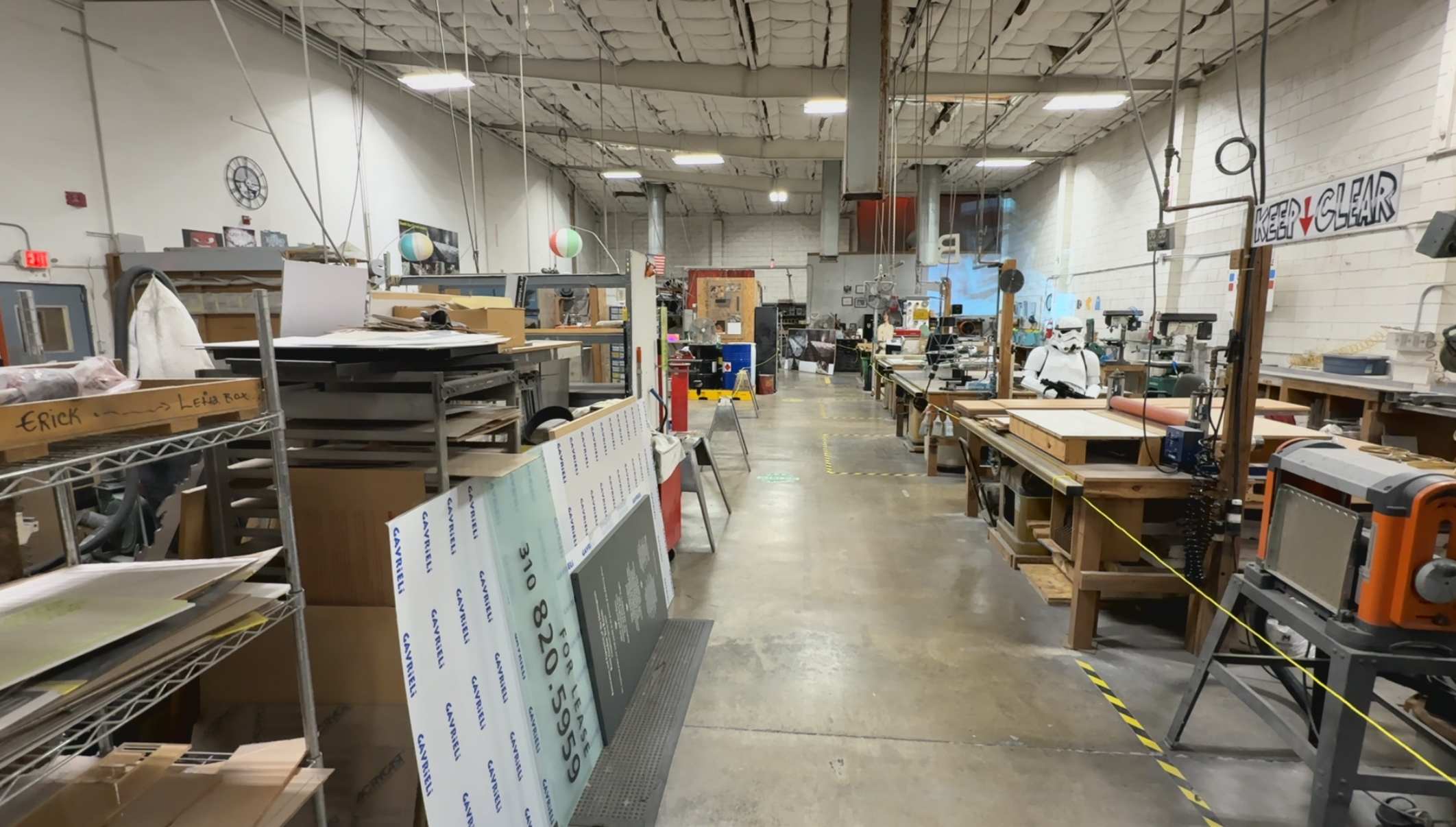
The floor plan of the building today – now home to a commercial sign company – is roughly the same as it was in 1975. As Muren walks the halls with his wife Zara, one second-floor room in particular brings back a galaxy of emotions.
“That’s very memorable. Going back to the screening room,” Muren says. “It just brought back a flood of memories of the dailies. George would often come to the dailies, and he’d be looking at the shots over and over and deciding what’s going to work and what needs to be redone.”
Muren is also reminded of the stress that faced the ILM crew as they rushed to finish the visual effects shots on time.
“‘Are we going to get the show done on time?’” he remembers being a frequent worry. “We’d go over the storyboards there too, and the schedule was on the wall of the dailies room. We would say, ‘Look, we’ve got to get these shots this week or else we’re in trouble.’”
The interior of ILM’s original facility, now a commercial sign company (Credit: Clayton Sandell).
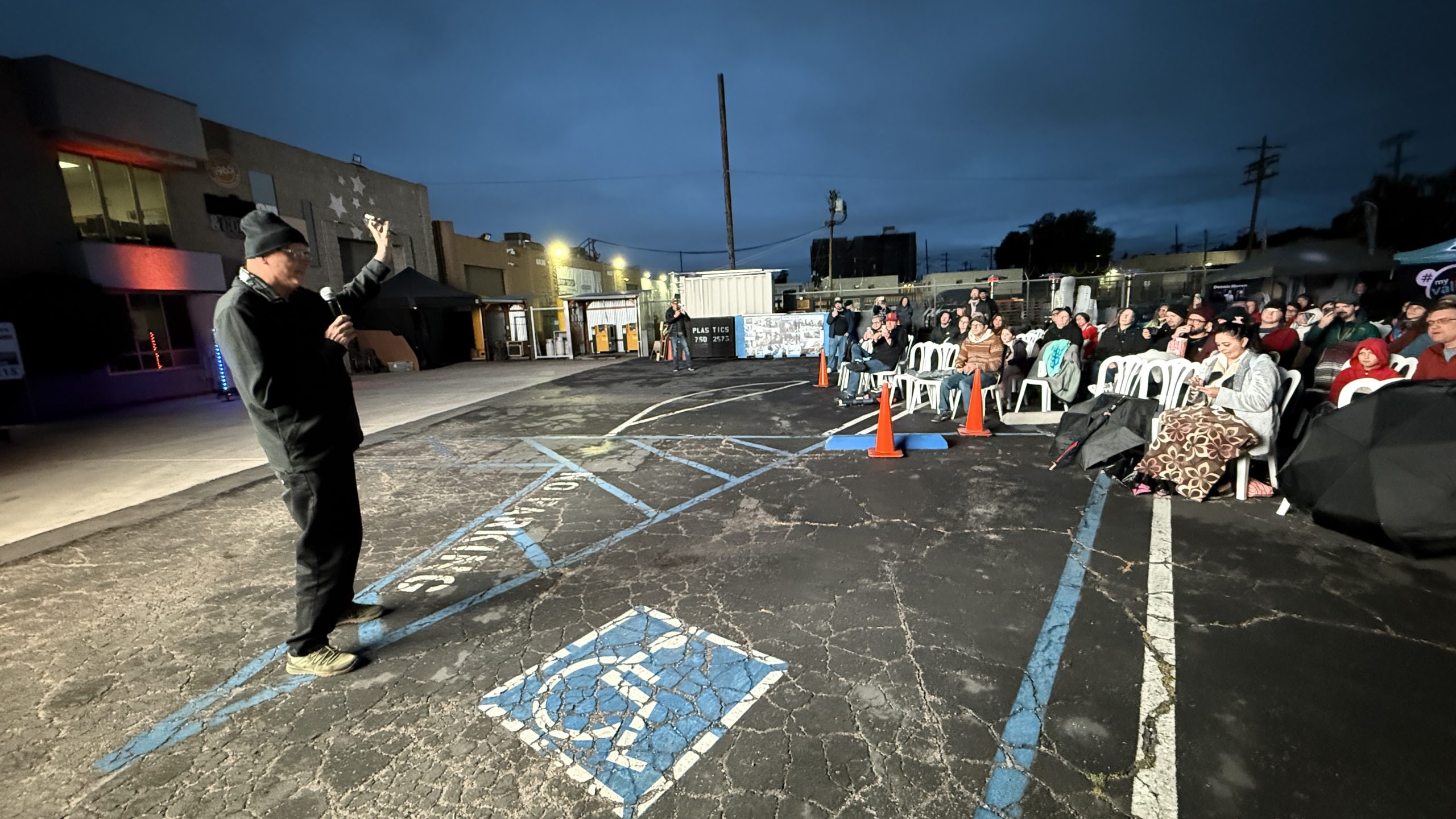
After his tour, Muren signs autographs and poses for pictures with fans who gather to sing “Happy Birthday” to ILM. He blows out candles on a special Darth Vader cake before introducing a screening of A New Hope for an audience seated in the same parking lot where some of the film’s most iconic shots were filmed.
“Right here, [ILM modelmaker] Steve Gawley’s pickup truck would race by as fast as it could go, with [miniature and optical effects cameraman] Richard Edlund on the back of it with a VistaVision camera shooting the [surface of the] Death Star as pyro was blowing up,” Muren tells the crowd.
“That was a typical day,” he smiles.
Muren attended the celebration over Star Wars Day weekend as a guest of the event organizers, My Valley Pass and On Location with Jared Cowan, a podcast hosted by movie location expert Jared Cowan.
Dennis Muren greets fans in the original ILM facility’s parking lot, where some effects shots were created (Credit: Clayton Sandell).
Clayton Sandell is a Star Wars author and enthusiast, TV storyteller, and a longtime fan of the creative people who keep Industrial Light & Magic and Skywalker Sound on the leading edge of visual effects and sound design. Follow him on Instagram (@claytonsandell) Bluesky (@claytonsandell.com) or X (@Clayton_Sandell).
By Patrick Doyle
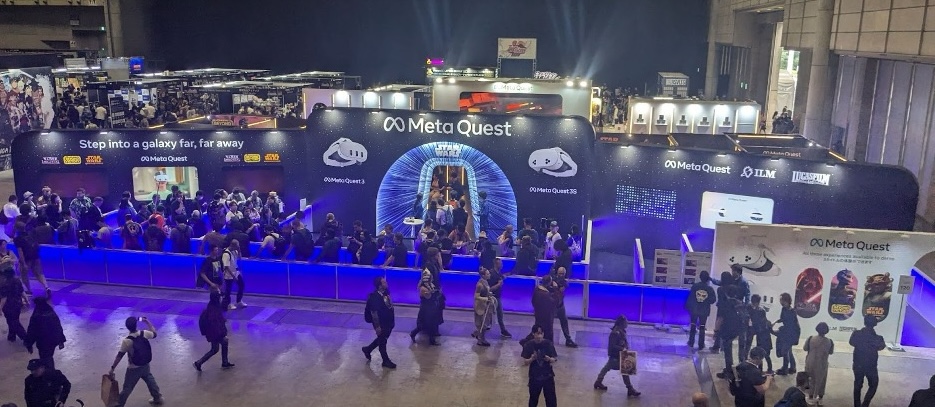
Fans from all over the world gathered in Japan from April 18-20 for Star Wars Celebration 2025. In honor of this monumental event, ILM and Meta shared a special first look at their upcoming virtual and mixed reality experience Star Wars: Beyond Victory – A Mixed Reality Playset, currently in development for Meta Quest headsets.
Additionally, demos for award-winning titles Vader Immortal: A Star Wars VR Series and Star Wars: Tales from the Galaxy’s Edge were available at the booth.
Here’s a recap of everything that went down at the ILM & Meta booth.
The Booth: Step Inside the Star Wars Galaxy
The ILM & Meta booth was a sensory playground inside the Makuhari Messe convention center. Massive screens played cinematic trailers, customized demo pods housed players during their sessions, and photo walls for each title were available for fans to snap a pic after going through the experience of their choice. With wait times of up to three hours, the booth also offered unique fixtures, like an interactive button wall, and a crew of knowledgeable staff were around to answer questions and help fans prepare for the adventures ahead.
Creative director Joe Perez III and executive producer Alyssa Finley.
To help set the tone, key representatives from the ILM team behind Star Wars: Beyond Victory,Jose Perez III, creative director, and Alyssa Finley, executive producer, were onsite to guide fans through the experiences and talk about the creative inspirations behind each title.
The Experiences: Three Unique Star Wars Adventures
The ILM & Meta booth brought three unique experiences to Celebration, each telling their own story within the Star Wars galaxy:
Connect with new and beloved Star Wars characters in a thrilling and creative experience. Through virtual and mixed reality, fans will get to adventure, race, and play in three modes. In development now.
A three-part series that combines immersive cinematic storytelling with dramatic interactive play. Explore the world of Darth Vader and complete your journey to determine Mustafar’s fate. Available now.
Experience action in the Batuu wilds with Star Wars: Tales from the Galaxy’s Edge and the Last Call add-on. Fight alongside classic characters like R2-D2 and C-3PO and take on unexpected alliances and deadly enemies. Available now.
The Comic: An Original Story Written by Ethan Sacks
As a special bonus to the fans at Celebration, an exclusive Marvel comic was available at the booth. Written by Ethan Sacks, it tells an original story about Volo Bolus before the events of Star Wars: Beyond Victory.
Sacks and interior illustrators Steven Cummings & Shogo Aoki also stopped by the booth to meet fans and sign copies of the comic during the show.
Beyond the Booth
During Celebration, Alyssa and Jose were honored to go up on the Star Wars Celebration LIVE! Stage to talk about Star Wars: Beyond Victory, the ILM and Meta booth and, of course, to throw some t-shirts out to the audience.
With long lines, enthusiastic crowds and countless fans coming out thrilled/terrified to have seen Darth Vader up close or Sebulba atop a podracer after all these years, it’s clear that the virtual and mixed reality mediums offer completely new ways for fans to experience Star Wars storytelling.
Whether you were honing your lightsaber skills in the dojo, tossing some repulsor darts at Seezelslak’s Cantina or testing your wits as a podracer, this booth offered exactly what we came to Celebration to do – showcase a different way to experience the galaxy we all love.
We’ll have more information to share on Star Wars: Beyond Victory – A Mixed Reality Playset at a later date and, in honor of May the 4th, Vader Immortal: A Star Wars VR Series and Star Wars: Tales from the Galaxy’s Edge are on sale for 66% off from now until 11:59PM PT on Monday, May 5 at the Meta Store and from Friday, May 2 until 11:59PM PT on Monday, May 5 on the PlayStation Store.
We can’t thank all the fans enough for making this a Celebration to remember and we hope to see you all in Los Angeles in 2027!
New apparel and a tumbler celebrating the 50th anniversary of Industrial Light & Magic are now available on Amazon.com.
—
Patrick Doyle is a senior publicity manager at Industrial Light & Magic.
The Lord of the Rings: The Rings of Power wins for Special, Visual & Graphic Effects in Season 2 of the Amazon MGM Studios series.
This past weekend, the British Academy of Film and Television Arts hosted the 2025 BAFTA Television Craft Awards, where The Lord of the Rings: The Rings of Power won for Special, Visual & Graphic Effects. ILM’s Jason Smith, who served as production visual effects supervisor, received the award alongside his collaborators Richard Bain, Ryan Conder, and Chris Rodgers. Watch their acceptance speech below:
ILM teams in London, Sydney, and the former studio in Singapore delivered over 500 visual effects shots to Rings of Power Season 2. Hubbed in London, the effort was led by ILM visual effects supervisor Daniele Bigi, visual effects producer Christine Lemon, and visual effects executive producer Lee Briggs.
Clothing and accessories featuring a new commemorative logo designed by Hoodzpah are available for purchase on Amazon.com.
By Mark Newbold
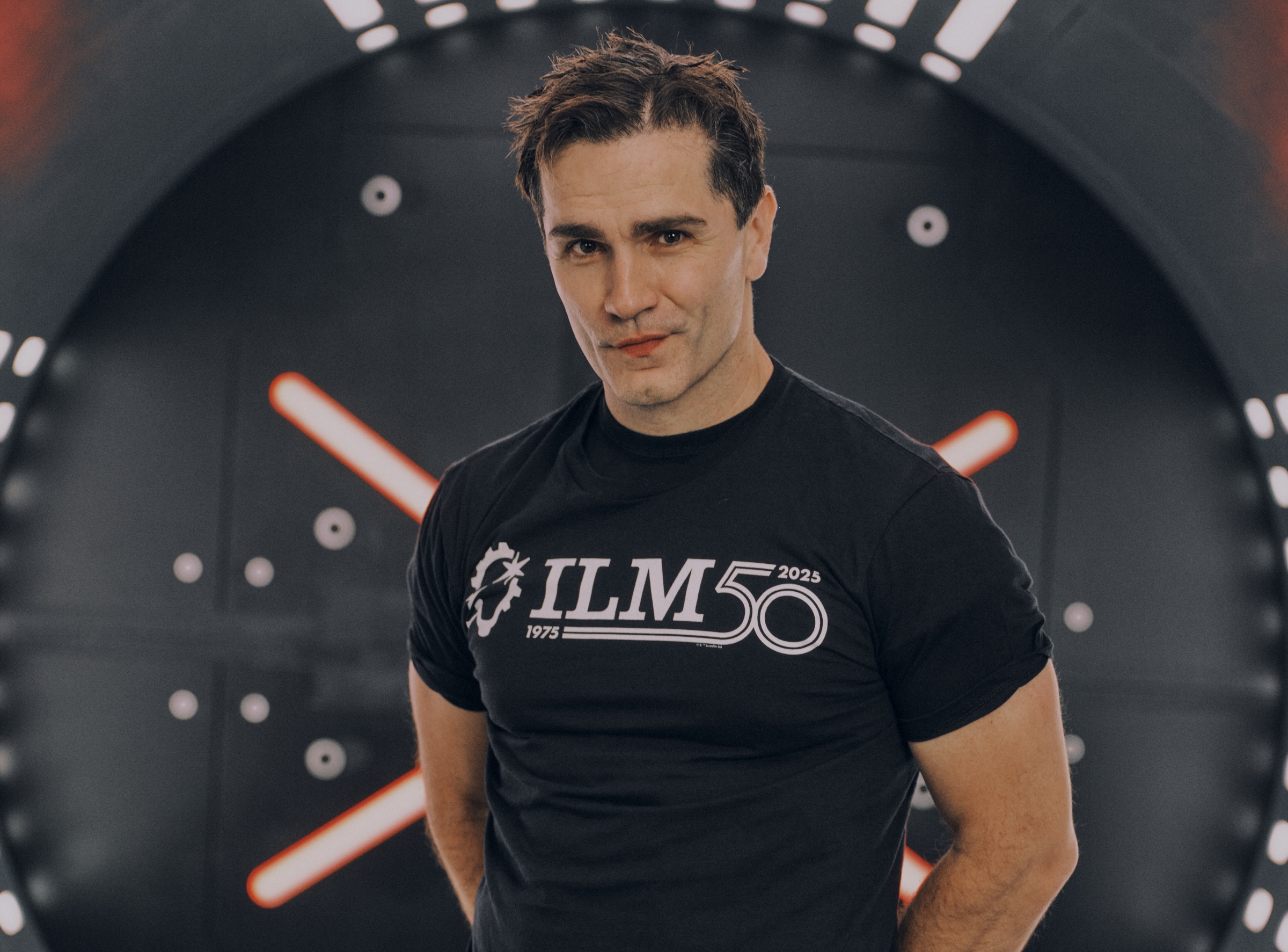
Actor Sam Witwer sports a new ILM 50th t-shirt at Star Wars Celebration Japan (Credit: Wes Ellis).
In a world of innovation, skill, and ingenuity, no company has shone as bright or lasted as long in its field as Industrial Light & Magic. First incorporated in May 1975, ILM has led the way in the realm of visual effects for half a century. This iconic brand is as much a marque of quality as “Music by John Williams,” “Conceptual Design by Ralph McQuarrie,” or “Directed by George Lucas.”
ILM.com had the opportunity to chat with the team about this exciting new project and how they decided on the tone for the 50th anniversary logo.
“When you work with a storied company like ILM, there is a wealth of visual inspiration and history to reference,” explains the Hoodzpah team, “so the hard part is narrowing in on one vision when there are so many ways you could take it. We cast a wide net and tried many different directions before landing on this retro-modern celebration that feels quintessentially ILM.”
ILM has an incredible history, not only with its groundbreaking work on-screen but also its branding, going back to the classic Michael Pangrazio-designed magician logo illustrated by Drew Struzan and through a variety of changes to today. Given that lineage, Hoozpah decided on the mix between the 2023 redesign and the ’70s-style piping in the new logo, a blend that marries ILM’s ’70s vintage with the modernity of the current branding.
“With an anniversary logo, you’re trying to balance two things: celebrating the history and accomplishments and legacy, but also reminding folks that there’s always more horizon to conquer,” Hoodzpah says. “This is just the first 50 years, and there’s so much more to come. Since the execution of the primary logo icon feels modern and intrepid, we wanted to embrace a ’70s vibe from the early ILM days. It felt so right as a nod to where it all started.”
In the world of marketing, there are numerous rules and tricks to designing a great logo that catches the eye and sits in the memory. With ILM and all the history that goes with it, there remains a need to find the right focus for such an emblem.
“When a logo really resonates, it’s because it feels true to the brand,” notes the Hoodzpah team. “There are so many styles and means of execution, but the question should always be, ‘What feels right for this brand?’ People love to look at trademark logo books with hundreds of logo icons shown on a white page. It’s inspiring to see all the styles of execution. But we’re always left wondering, ‘What’s the context?’ It’s not about a logo looking good in isolation because one is rarely used that way. It’s about a logo feeling perfect in context. It was the same for this project. We tested the 50th anniversary logo in key applications and then used it in a suite of anniversary merch designs as well.”
Collaboration is key in everything ILM does, from the core team pulling together on new projects to working hand-in-glove with vendors and creatives behind the films, TV shows, and immersive entertainment projects ILM works with. Given that, it was important for Hoodzpah to spitball ideas with the ILM team themselves because clearly they revel in the spirit of collaboration in the same way that ILM does.
“There’s a reason we didn’t end up choosing fine arts as a career path, even though we really loved it,” Hoodzpah explains. “We like working within the limitations of a prompt and pushing and flexing boundaries to see how far we can take it. Design is a team sport. We all get together and try to push this idea up the field. When we work with ILM, we are keenly aware that everyone we work with is a creative powerhouse in their own right. We’d be fools not to tap into that ‘creative brain trust,’ as [director of PR and communications] Greg Grusby calls it, and gather as many ideas and as much feedback as we can to make this logo as true to the ILM legacy as possible. After all, the people of ILM make ILM what it is. It’s like, why would we want just one violin when we could work with a full symphony orchestra?”
The work on the logo continued with the creation of distinct products now available in the new merchandise line.
“Taking the logo and spinning it off into 50th anniversary merch was so much fun,” Hoodzpah says. “The ILM crew were so game to dream big and really have fun with it. Each piece leans into a different vein of the ILM personality. We have a retro ’70s poster of a magician conjuring new worlds, which is what ILMers do every day. We celebrated all the innovation and milestones ILM has accomplished over 50 years in an infographic T-shirt. We even made custom-scented candles to celebrate the different departments and locations over the years. Our favorite is the Model Shop candle which has notes of sawdust and cedar. There’s truly something for everyone.”
With their work on the ILM logo, Hoozpah has become a key part of ILM’s identity and history, which makes the team proud.
“Getting to work with a cultural icon like ILM once was incredible,” they conclude. “Being trusted by such talented creatives to work with them again was even better. It’s great to be able to pick up where we left off, having already become embedded with the team and learning so much about the brand in our last project. Working on the rebrand was one of those bucket list jobs you continually remind yourself, ‘Wow, we really got to be a part of that.’ It felt like getting the band back together for the sequel.”
New apparel and a tumbler celebrating the 50th anniversary of Industrial Light & Magic are now available on Amazon.com.
Mark Newbold has contributed to Star Wars Insider magazine since 2006, is a 4-time Star Wars Celebration stage host, avid podcaster, and the Editor-in-Chief of FanthaTracks.com. Online since 1996. You can find this Hoopy frood online @Prefect_Timing.
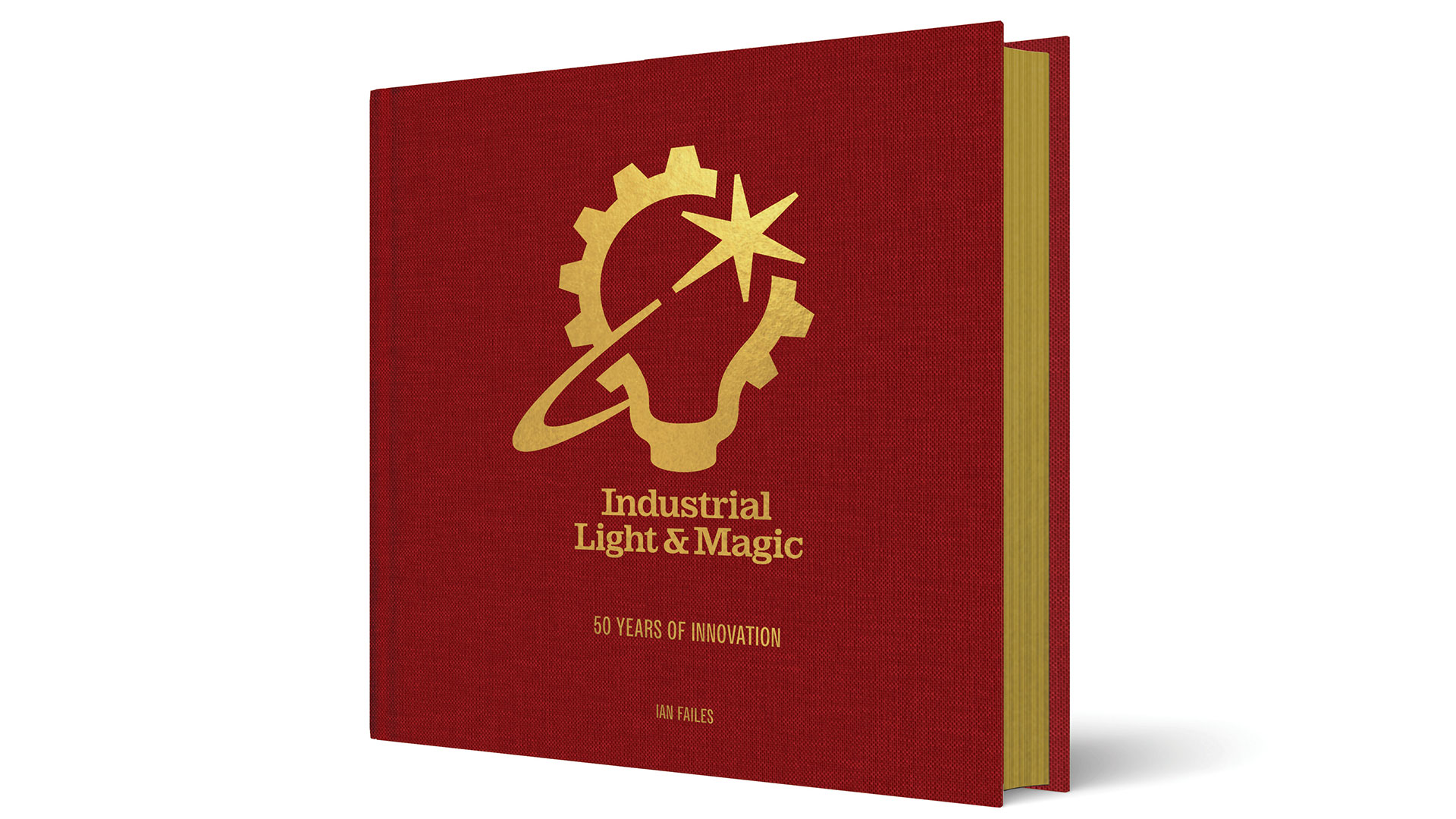
Industrial Light & Magic: 50 Years of Innovation by Ian Failes will be released in January 2026 by Lucasfilm Publishing and Abrams.
By Lucas O. Seastrom
It all began in May of 1975 with a handshake between director George Lucas and visual effects supervisor John Dykstra. Industrial Light & Magic formed as Lucasfilm’s visual effects division to work specifically on one project: Star Wars: A New Hope (1977). 50 years later, ILM now spans the globe with studios in five countries and hundreds of productions to its credit.
Now in 2025, the 50th anniversary festivities have kicked off at an appropriate venue: Star Wars Celebration. ILM leadership and artists gathered at the beloved fan event near Tokyo, Japan to reflect on the storied occasion, as well as announce a new book: Industrial Light & Magic: 50 Years of Innovation, written by Ian Failes and coming January 2026 from Lucasfilm Publishing and Abrams.
A New Book Charting ILM’s Continuing Legacy
Industrial Light & Magic: 50 Years of Innovation takes readers from day one at ILM in 1975 up to some of the latest projects and innovations at the company today. Packed with hundreds of rare archival images, author Ian Failes – the noted visual effects journalist at befores & afters – weaves insightful technical history with the beloved stories of ILM’s people.
“ILM has been part of my visual effects life for a long time,” Failes tells ILM.com. “I first ‘discovered’ so much about visual effects just as I left high school when I happened upon two things…. One was the industry magazine Cinefex, and the other was the incredible book, Industrial Light & Magic: Into the Digital Realm, by Mark Cotta Vaz and Patricia Rose Duignan. I read that ILM book from cover to cover multiple times. It really was one of the things that inspired me to become a visual effects journalist.
“So, getting the opportunity to go deeper into ILM’s history with this new book, but now with all the knowledge I’ve gained from time spent covering the industry, is just so rewarding—and fun,” Failes adds.
Readers can look forward to many untold stories in 50 Years of Innovation. Failes identifies the transition from photochemical optical compositing to digital methods as a particularly fascinating era in the company’s history. “In the book there are some great details shared by key ILMers who were there at the time about many different aspects of the move to digital in terms of other areas like film scanning and digital compositing,” the author says.
“Also, readers have never been able to explore so many exclusive behind-the-scenes photos from ILM’s history before,” Failes continues. “Having images from all different fields that highlight what is essentially the history of visual effects like modelmaking, optical effects, puppets, stop-motion, matte paintings, hand-animation, CG animation, virtual production, etc., all in one place, is something very special. I especially love some of the photographs that showcase the various VistaVision and motion control camera systems that ILM developed.”
At the heart of ILM’s story is the spirit of creativity and innovation which has been defined by the company’s people over the decades. “Even back to its beginnings, George Lucas started ILM after identifying that no existing facility could deliver what he imagined for Star Wars,” Failes concludes. “It feels to me that a unique innovative spirit was born during the making of that first film, and never left the company. I think that goes both for technological developments and also cultural ones. ILM helped establish modern workflows inside a visual effects facility, and I think, really importantly, further set the standard for how to collaborate with filmmakers and other creatives.”
Industrial Light & Magic: 50 Years of Innovation by Ian Failes is coming January 2026 from Lucasfilm Publishing and Abrams.
On the Stage at Star Wars Celebration
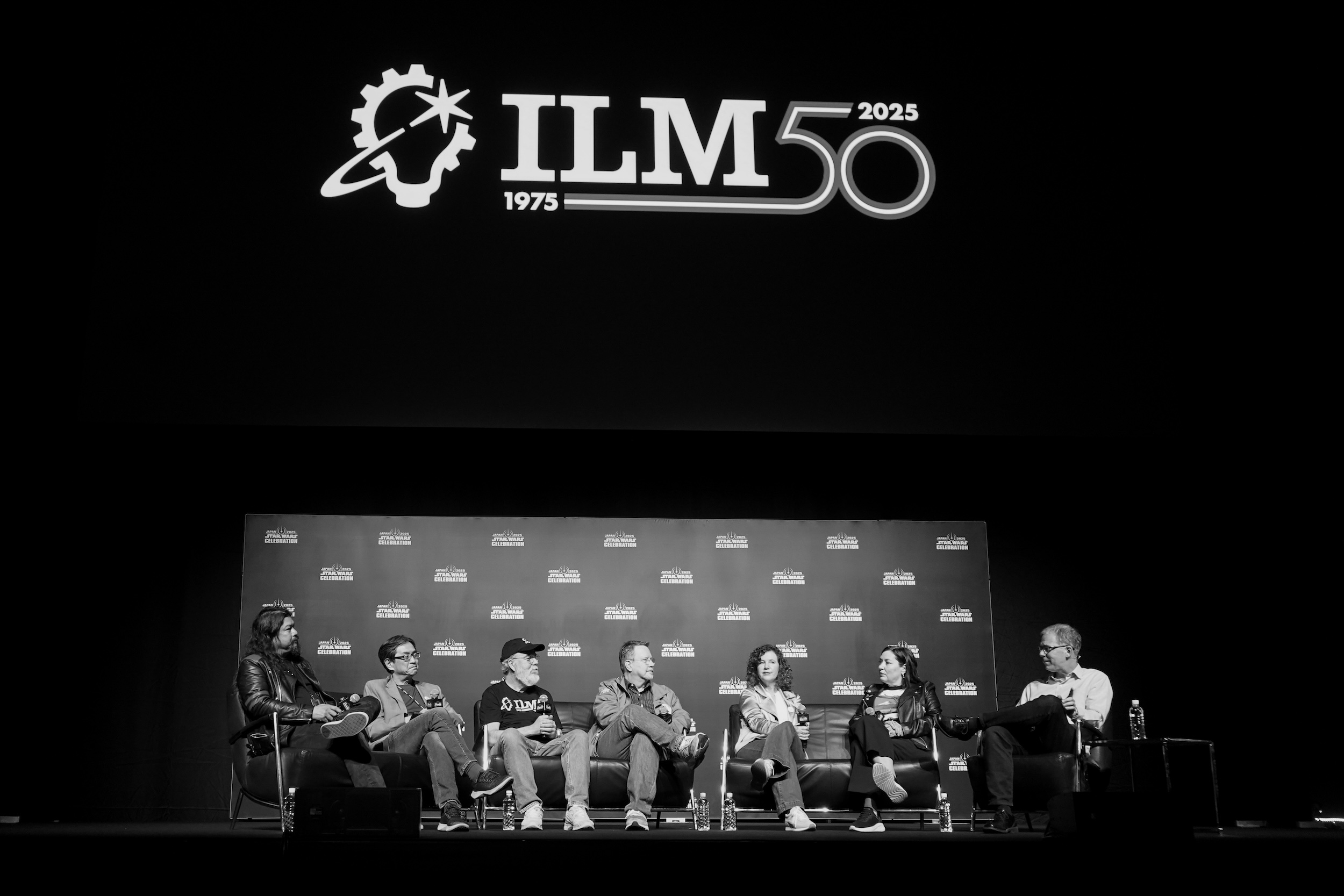
As a special live recording of Lighter Darker: The ILM Podcast, the Star Wars Celebration panel included president and general manager of Lucasfilm business, Lynwen Brennan; head of ILM and general manager Janet Lewin; ILM executive creative director and senior visual effects supervisor John Knoll, ILM Sydney creative director and senior animation supervisor Rob Coleman; ILM lead CG modeler Masa Narita; and former ILM modelmaker Fon Davis. Lucasfilm’s senior vice president of creative innovation, digital production & technology Rob Bredow moderated.
Lynwen Brennan came to ILM 27 years ago as the company ramped up for production of Star Wars: The Phantom Menace (1999). Like many, she’d been inspired to join ILM after seeing Jurassic Park (1993) a few years earlier. “The minute I walked through the door, I just fell in love,” Brennan told the audience. “I knew I’d found my people…. It’s an incredibly spirited place. We have a lot of fun. There’s something so special about a place that attracts these mavericks who are not scared of doing anything new…. Sometimes when you find people who are real risk-takers, they’re not necessarily great team players, right? But this…is a place where you’ve got people who love taking those risks but do it in such a collaborative way. That’s a thing that really got me.”
Janet Lewin started her ILM career some 30 years ago and has had a front row seat to the continuing changes and evolutions in the visual effects industry, much of it driven by ILM. “Back then, we were one studio in San Rafael, just a couple of hundred people, mostly working in the Model Shop and on the stage,” Lewin explained. “It was an exciting time right at that digital revolution. It was a big deal for us to juggle four shows at one time, and a big show was a couple hundred shots. And over my 30-year trajectory, the company has massively grown. We now have 3,500 employees, five global studios, and…we do visual effects work across every possible medium.”
For Masa Narita, appearing onstage at Celebration in his native Japan was a full circle moment. A lifelong visual effects fan, he’d watched Star Wars as a teenager during its original Japanese release in 1978. But as he reached adulthood, Narita first chose a career in finance.
“I used to be a businessman, worked for a Japanese brokerage firm for over 20 years,” Narita said. “But I always loved movies and visual effects because I grew up with special effects pioneers like Ultraman and Godzilla. So my first childhood dream was to wear a kaiju suit and to smash miniature towns. Actually, I still want to do that. [laughs] As I got older, I realized that I wanted to create something special like spaceships and characters [that] I saw in the movies. So at the age of 45, I decided to follow my passion. I quit my financial job and moved to Hollywood and started at a CG school. So that was my biggest gamble in my life, taken with my loving wife and two children. Fortunately, one year later…I got [my] very first CG job, and eventually I came to my dream company, ILM.”
“ILM puts a lot of focus on innovation that makes the impossible possible,” Narita added. “So I feel inspired every day walking in a place with so much creativity and skill. I love what I’m doing and I feel I really achieved my dream. People say life is short, but I don’t think so. We have plenty of time to start over. It’s never too late to chase something new.”
Onstage at Star Wars Celebration Japan, L to R: Fon Davis, Masa Narita, Rob Coleman, John Knoll, Janet Lewin, Lynwen Brennan, and Rob Bredow (Credit: ILM).
Watch the ILM.com Newsroom for the latest information about how you can purchase a copy of Industrial Light & Magic: 50 Years of Innovation, coming to bookstores everywhere January 2026.
New apparel and a tumbler celebrating the 50th anniversary of Industrial Light & Magic are now available on Amazon.com.
—
Lucas O. Seastrom is the editor of ILM.com and a contributing writer and historian for Lucasfilm.
The ILM veteran and accomplished feature filmmaker enters the documentary space to tell the story of ILM and Lucasfilm’s digital filmmaking odyssey.
By Lucas O. Seastrom
Warning: This article contains spoilers from Light & Magic Season 2
Among the first group hired at Industrial Light & Magic in 1975, Joe Johnston began his career as a storyboard artist and concept designer. After 10 years with ILM on three Star Wars and two Indiana Jones films, among others, he went to the University of Southern California film school under George Lucas’ sponsorship. He’d go on to direct classics as varied as Honey, I Shrunk the Kids (1989), October Sky (1999), and Captain America: The First Avenger (2011).
Johnston’s directorial debut in the documentary medium, however, comes today, with the Season 2 premiere of Light & Magic on Disney+. The non-fiction series charts the storied legacy of Industrial Light & Magic, now celebrating its 50th anniversary, an unprecedented achievement in the history of visual effects.
“I don’t have any experience in documentary or non-fiction filmmaking,” Johnston tells ILM.com. “When I was at Cal State Long Beach, I worked on a documentary that was directed by Tony Brennan called Hitler’s Secret Weapon. It was about the V2 rocket. Basically, my job was to do illustrations that explained some of the ideas he was trying to get across. That was my entire experience with documentary filmmaking, almost nil.”
But Johnston does have experience as a storyteller. “While I had never worked on a documentary, I had a pretty good idea of how to tell a story, whether it’s real or fictional,” he says. “And you have to remember, especially with a project like this, though it’s true of all filmmaking, I had so much help. I had a supervising producer [Nicole Pusateri], story producer [Carly Baggett], a line producer [Andrew Hafnor], three great editors [Mike Long, Jennifer McGarrity, and Robinson Eng], and an archivist [Eugen Bräunig] whose job it was to go through thousands of hours of footage from ILM. It was more like a steering process, and I steered that process toward an ultimate goal. It was a real team effort all the way through.”
Finding the Story
After a successful first season directed by veteran screenwriter Lawrence Kasdan, Lucasfilm and Imagine Entertainment agreed to produce a second. It was then that Imagine producer Christopher St. John gave Johnston a call. The latter was surprised by the inquiry, thinking they wanted him to appear in Season 2 as an interview subject. “I said, ‘Guys, I’ve said everything I have to say about it in Season 1.’ And Chris said, ‘No, no, we want you to direct it.’ Well, okay. I had to think about that for a while. It sort of came out of nowhere. I wasn’t expecting it.”
Johnston’s relatively distinct point-of-view helped motivate him to accept the offer. “Having been an insider for the first 10 years during the original Star Wars trilogy, maybe I could have a unique perspective on what Season 2 might look like, having not been around for any of that. I left in 1985, came back for a couple of projects afterwards, but the whole shift toward digital was all new to me. Once I was onboard, it was a matter of guiding it in the direction I thought it should, one goal of which was to tell George Lucas’ story as much as possible.”
That story emerged as Johnston and team reviewed thousands of hours of archival footage preserved in ILM’s collection. “I recognized that one of the stories that needed to be told was how George Lucas had basically steered the entire motion picture industry – in a way he sort of dragged it kicking and screaming – into the digital age,” the director explains. “That was a story that I didn’t think had really been told before. Here was a chance to feature that aspect of ILM and Lucasfilm.”
This would chiefly center around the production of the Star Wars prequel trilogy, released between 1999 and 2005. The first entry, Star Wars: The Phantom Menace (1999), was the most ambitious visual effects project ever undertaken up to that time, counting more than 2,000 shots produced entirely within ILM. The middle entry, Star Wars: Attack of the Clones (2002), was the first blockbuster feature film made in a completely digital format and workflow. Surrounding these Lucasfilm productions were a bevy of groundbreaking achievements for client productions as varied as environmental effects in Twister (1996) and The Perfect Storm (2000) to performance capture in The Pirates of Caribbean trilogy (2003-07) and a fully-animated feature with Rango (2011).
Master Yoda first appeared as an all-digital character in Star Wars: Attack of the Clones (Credit: Lucasfilm & ILM).
Always a Student
“What also appealed to me was the chance to interview these people, a lot of whom I’d known over the years, but hadn’t worked with,” Johnston adds. “Hearing their personal stories…. It was an education for me. I don’t know that much about visual effects, so it was interesting to learn how effects had evolved since my involvement in the 1980s.”
Indeed, Johnston is keen to note that, although he’s had a reputation “as a visual effects person, I have to always remind people that I’m not at all. I was a designer, storyboard artist, sequence director, and stuff like that,” as he explains, “but I never really got involved in the visual effects. I was surrounded by people who could do that. My designs were used in those sequences, but once I was happy with the design, I’d hand it off to people like Richard Edlund and Dennis Muren to make it work.”
As a feature film director, Johnston collaborated with ILM on The Rocketeer (1991), Jumanji (1995), and Jurassic Park III (2001), providing him with first-person, client-side experience during the era covered in Light & Magic Season 2. He describes how Jumanji, for example, took place during a transitional moment “where it wasn’t always cheaper to do it digitally, or it wasn’t necessarily cheaper to do something with an analog solution. We had to figure out which method was the best to achieve a certain effect.” Johnston worked alongside visual effects supervisor Ken Ralston on that film, a former colleague from the original trilogy.
“I am a proponent of the idea that any film should not have one more visual effect than it needs,” Johnston comments. “You have the minimal number to help you tell the story and move on. I don’t like films that are all about the visual effects; spectacle for the sake of spectacle. It’s such a waste. You’re not telling the story; you’re just trying to impress people.”
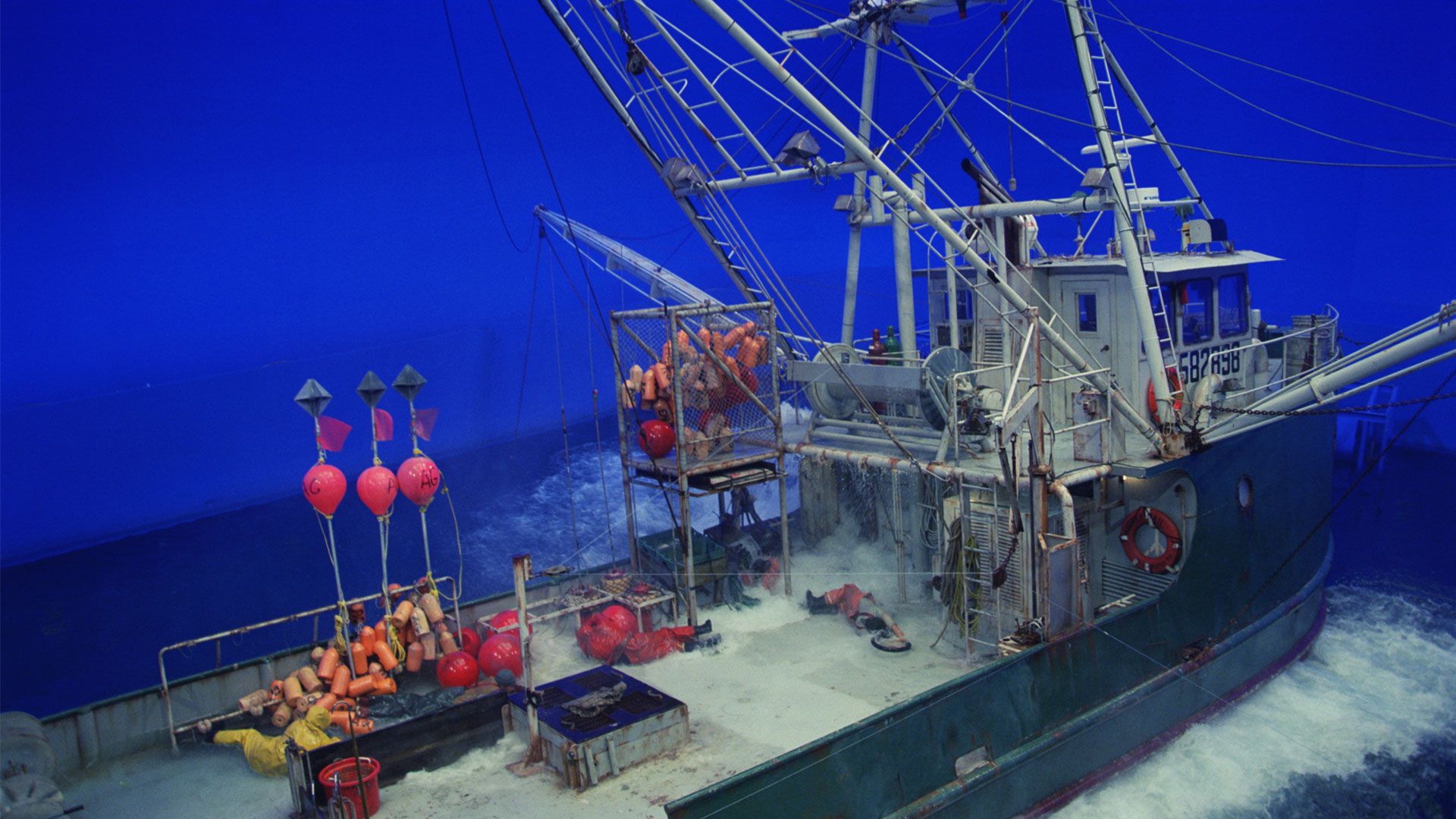
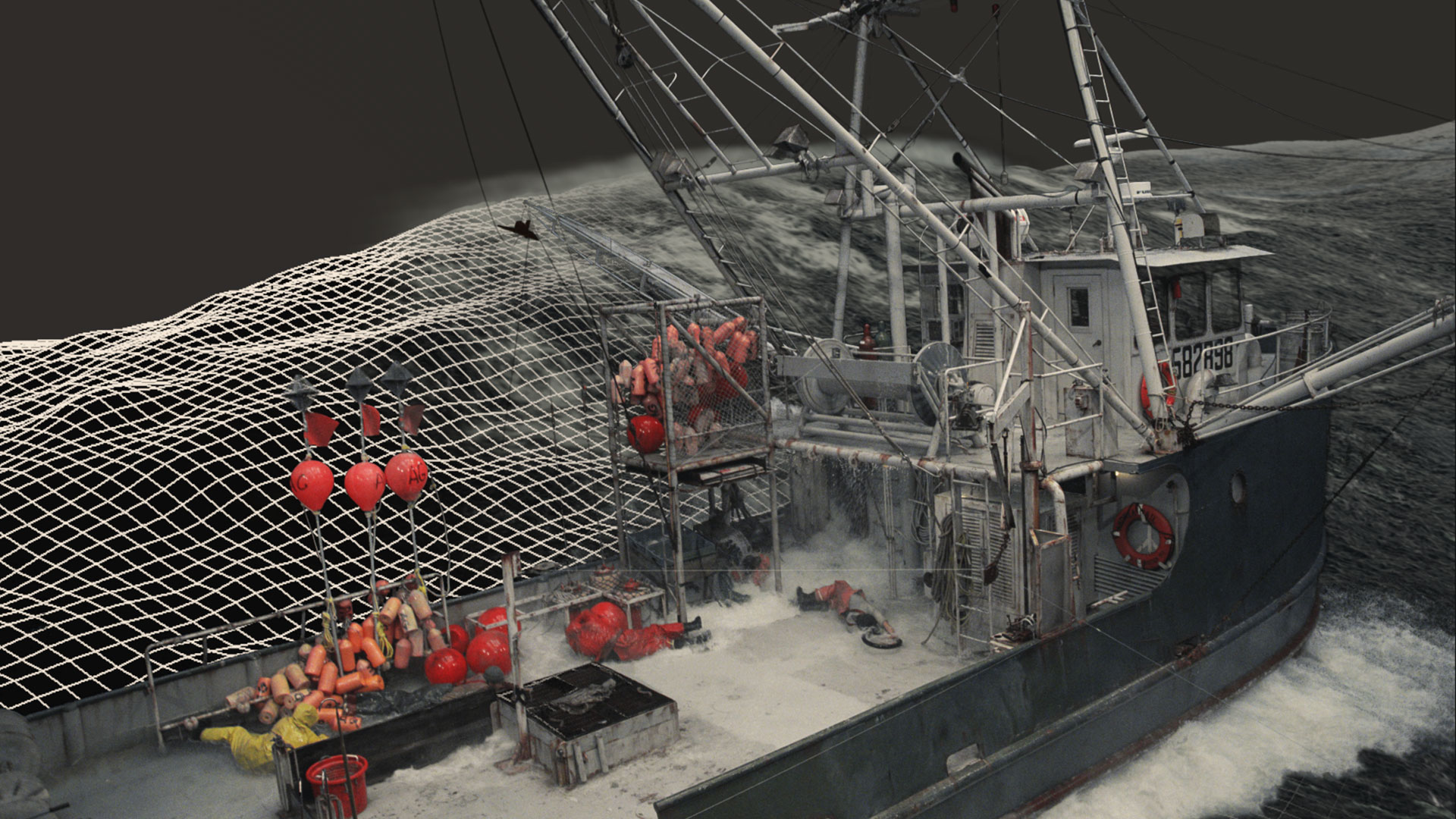
Effects progression from The Perfect Storm (Credit: Warner Bros. & ILM).
The People Come First
Working across three one-hour episodes, each with its own editor, Johnston followed a number of the precedents established by Kasdan in Season 1, not least of which was the emphasis on individual stories of the artists, filmmakers, and other talent involved in ILM’s work.
“I hope the audience will recognize that these people at ILM who are revered by visual effects fans are basically just like anybody else,” Johnston says. “They grew up making models or loving technology or whatever it was, and they found a way to make their dreams come true by coming to ILM. It’s interesting because that’s not the way it was on the original trilogy. Nobody knew what they were doing. They didn’t know what they would do when they got hired. That in itself was a voyage of discovery for people. ‘Why am I here, what am I doing? Oh you want me to do that – I guess I better figure it out and learn how.’”
But despite the generational distinction, Johnston does identify the central constant in ILM’s story. “There is an attitude of ‘I know you can do it because it’s impossible.’ That was the spirit in the original trilogy, analog days, and it was during the start of the digital era as well. ‘How are we going to do this? Let’s jump in and figure it out.’ I find that story appealing and interesting. Several of the interviewees talk about it. ‘We didn’t know how we were going to do it. We were running out of time. We’ve got this deadline, we’re working seven days a week, but somehow, we figured it out.’ I think that’s a great story to tell. It’s fun. It’s scary. Scary is good.”
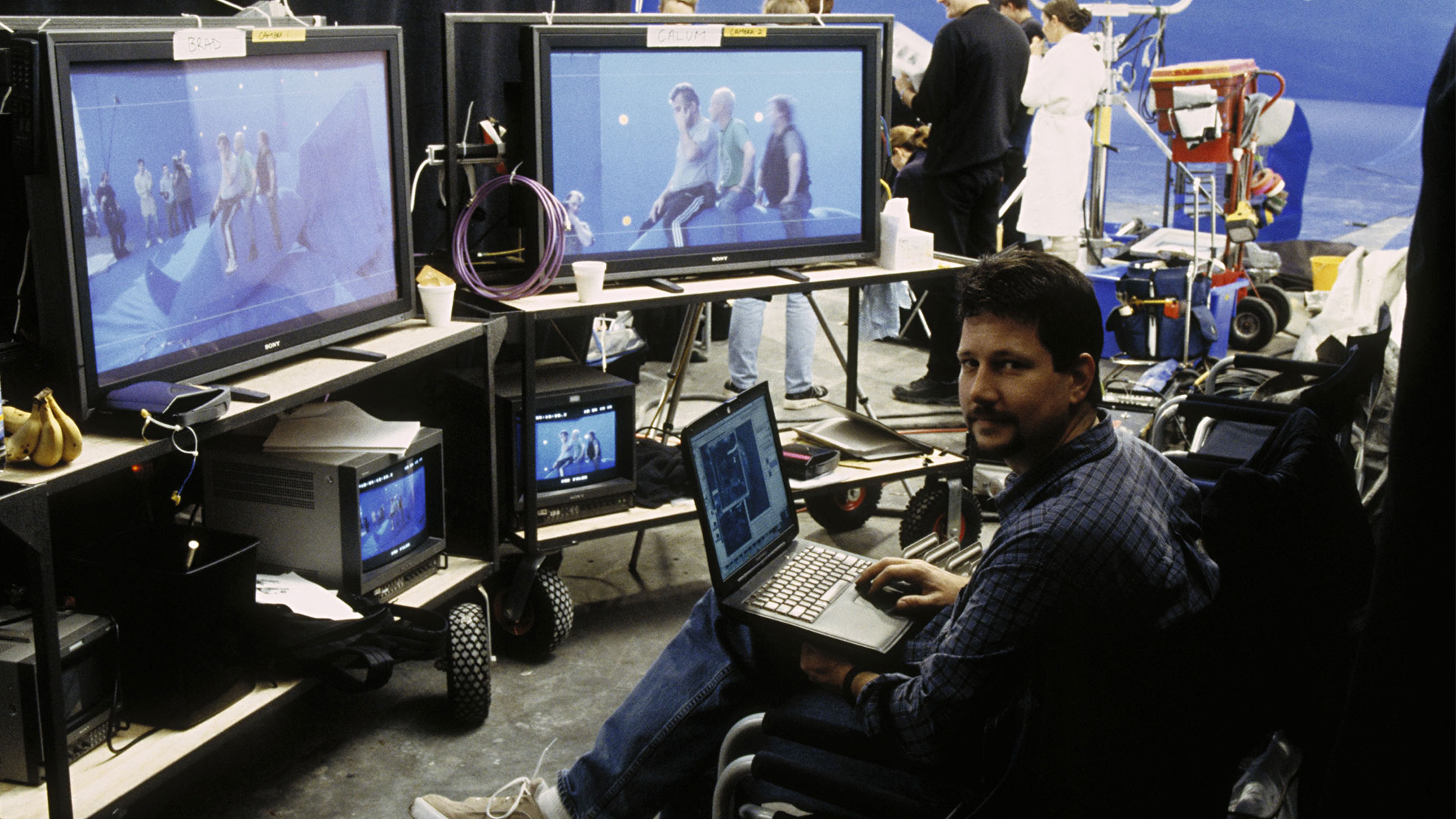
Visual effects supervisor John Knoll with high definition monitors on the set of Star Wars: Attack of the Clones (Credit: Lucasfilm & ILM).
Piecing the Story Together
“Like a lot of feature films, this project was definitely made in the cutting room. You’re assembling so much footage from the last 20 years and beyond,” says Johnston. Documentary filmmakers often have very distinct processes in terms of assembling their narrative elements. For Johnston, this meant close collaboration with the editors to help realize the story he wanted to tell. “I can’t give the editors enough credit. A lot of the ideas came up in the cutting room. They did a fantastic job. They’re semi-sung heroes.”
Johnston also found ways to collaborate more directly with his interview subjects. “At one point, we decided that we needed someone to help tie all of these loose ends together. So we did a second interview with [former ILM general manager] Jim Morris and explained the story we were trying to tell. He got it, of course, being who he is, and he really helped us to cement some of these ideas into a story. It’s always like that in my limited experience. You don’t write a script beforehand like a feature; you write a script in the making of the film itself.”
Johnston was adamant about leaning into the drama of the story, including the challenges that ILM, Lucasfilm, and Jar Jar Binks actor Ahmed Best faced during the release of The Phantom Menace. In Jar Jar, the creative team had pioneered what was the first all-digital main character in a feature film using performance capture technology, which later became industry standard. But some in the press and the audience struggled to accept Jar Jar’s role in the film’s story.
“The whole Jar Jar Binks thing was probably the most controversial feature of the prequels,” Johnston says. “As with any filmmaking project, without conflict there is no drama. I wanted to highlight that.” It was important to be honest about the creative process, which is full of discussion and compromise.
“Interviewing [Star Wars producer] Rick McCallum was a similar choice,” Johnston adds. “Rick played a huge role in getting the prequels produced. Most people had a problem with Rick McCallum at some point because he was trying to get everything done as cheaply as he possibly could. He’s an interesting character. I wanted to hear his story.”
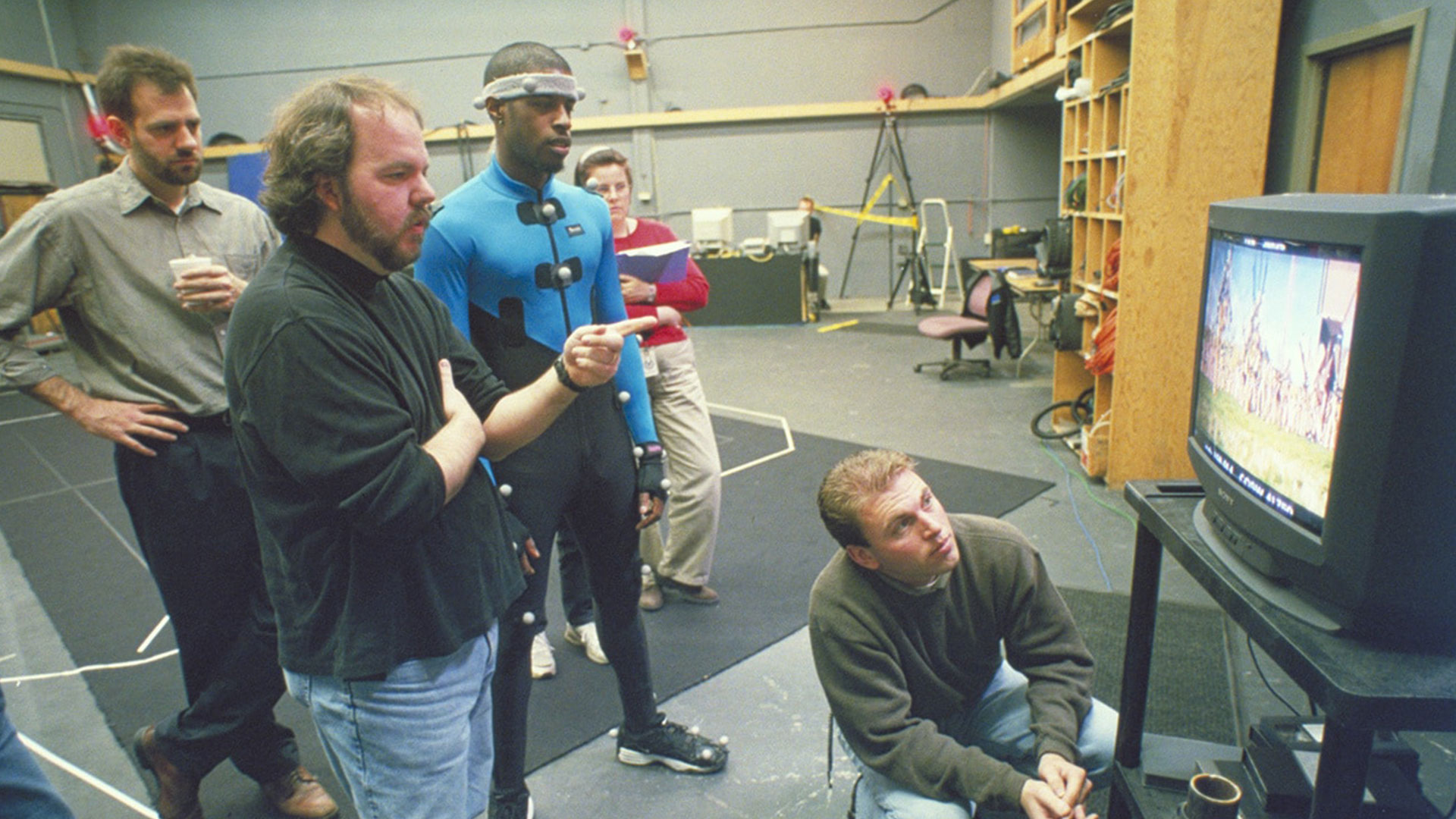
Animation Rob Coleman (second from left) and actor Ahmed Best (third from right) with the ILM crew while shooting performance capture for Jar Jar Binks in Star Wars: The Phantom Menace (Credit: Lucasfilm & ILM).
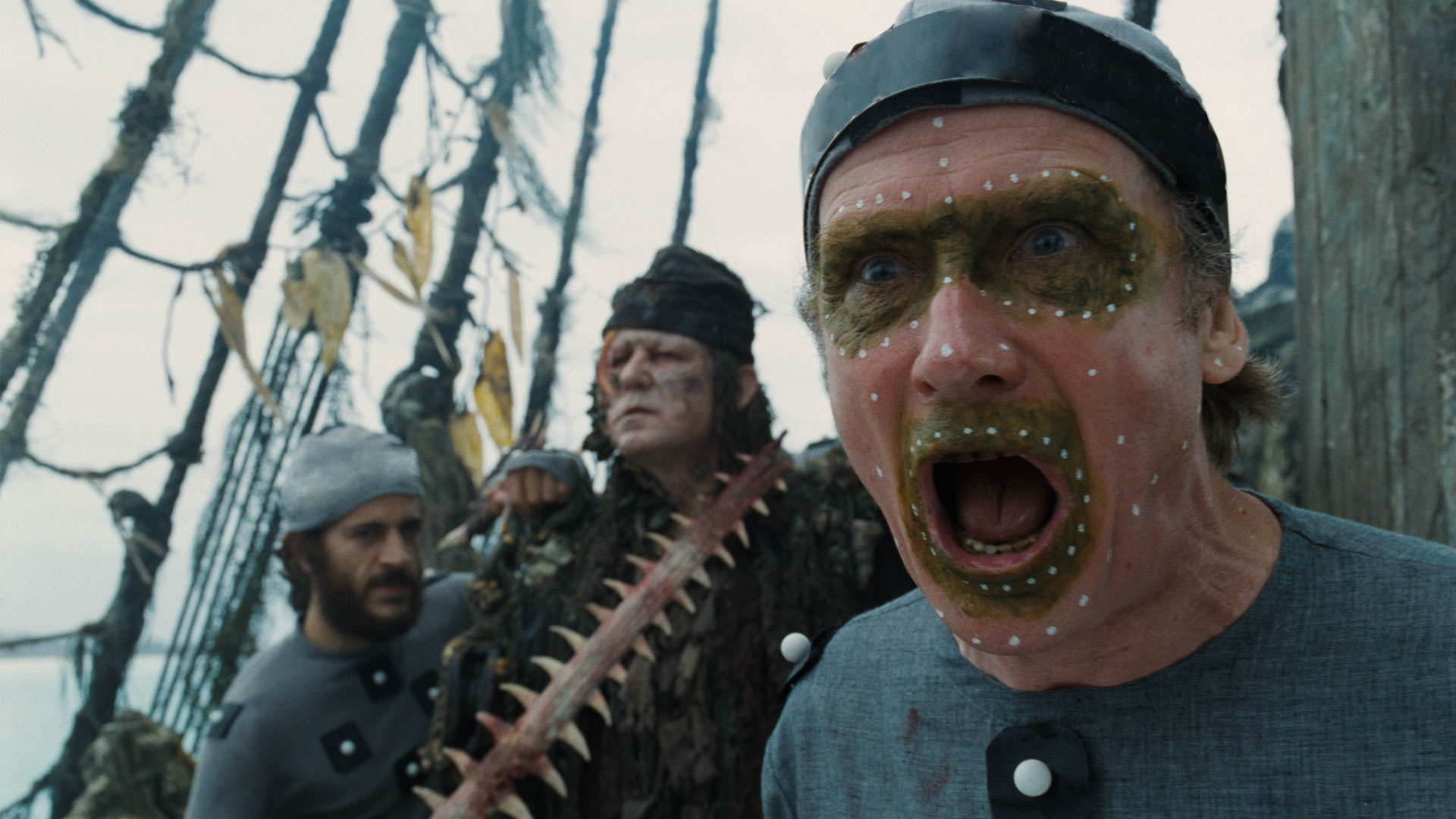
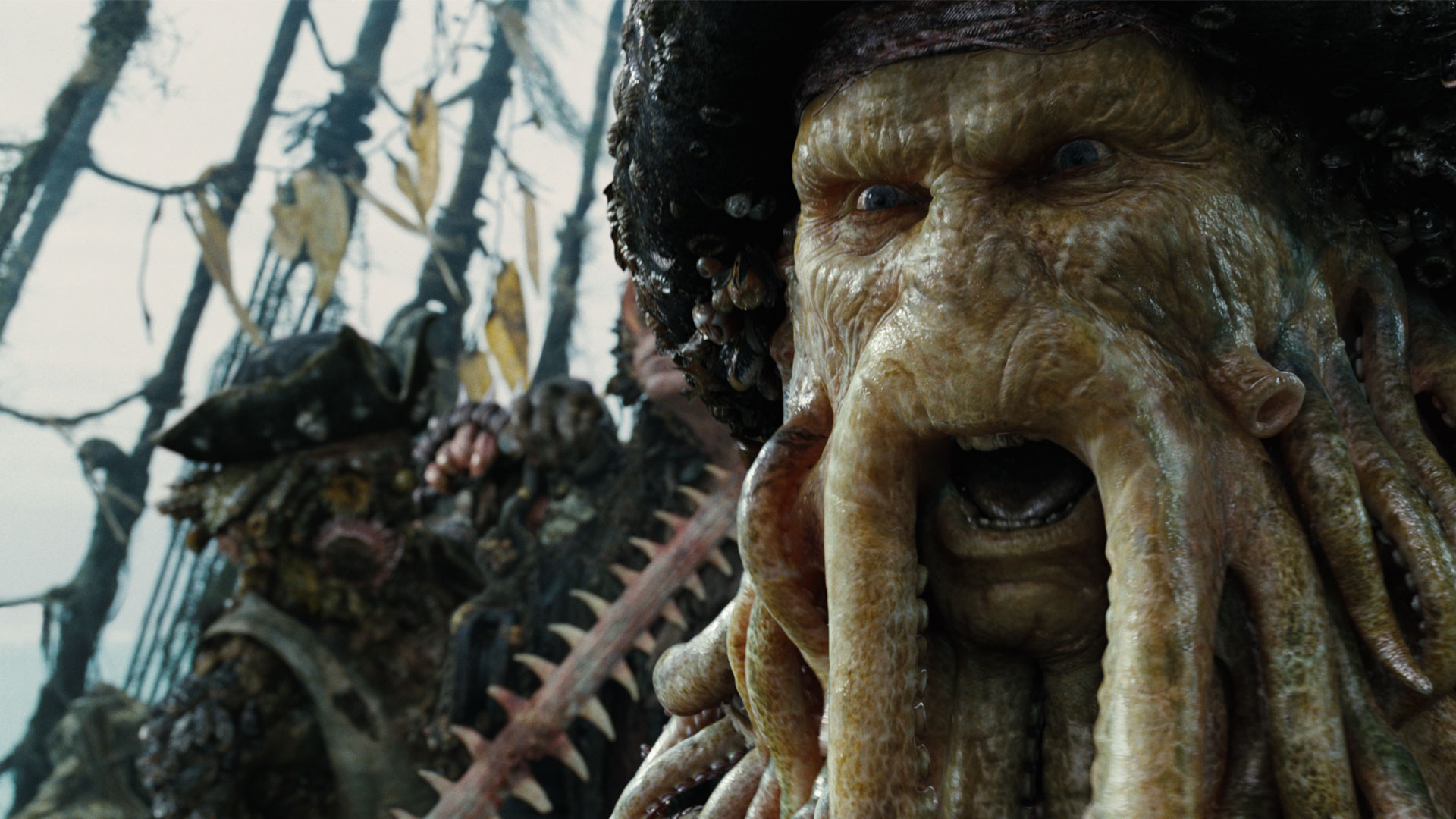
In addition to interviewing George Lucas, Johnston chose director Gore Verbinski as one of Light & Magic Season 2’s other filmmaker interview subjects. Verbinski collaborated with ILM on a watershed string of features, including three Pirates films and Rango. “The Pirates films that he directed were interesting because ILM had to keep besting themselves, and Gore tells that story quite well.
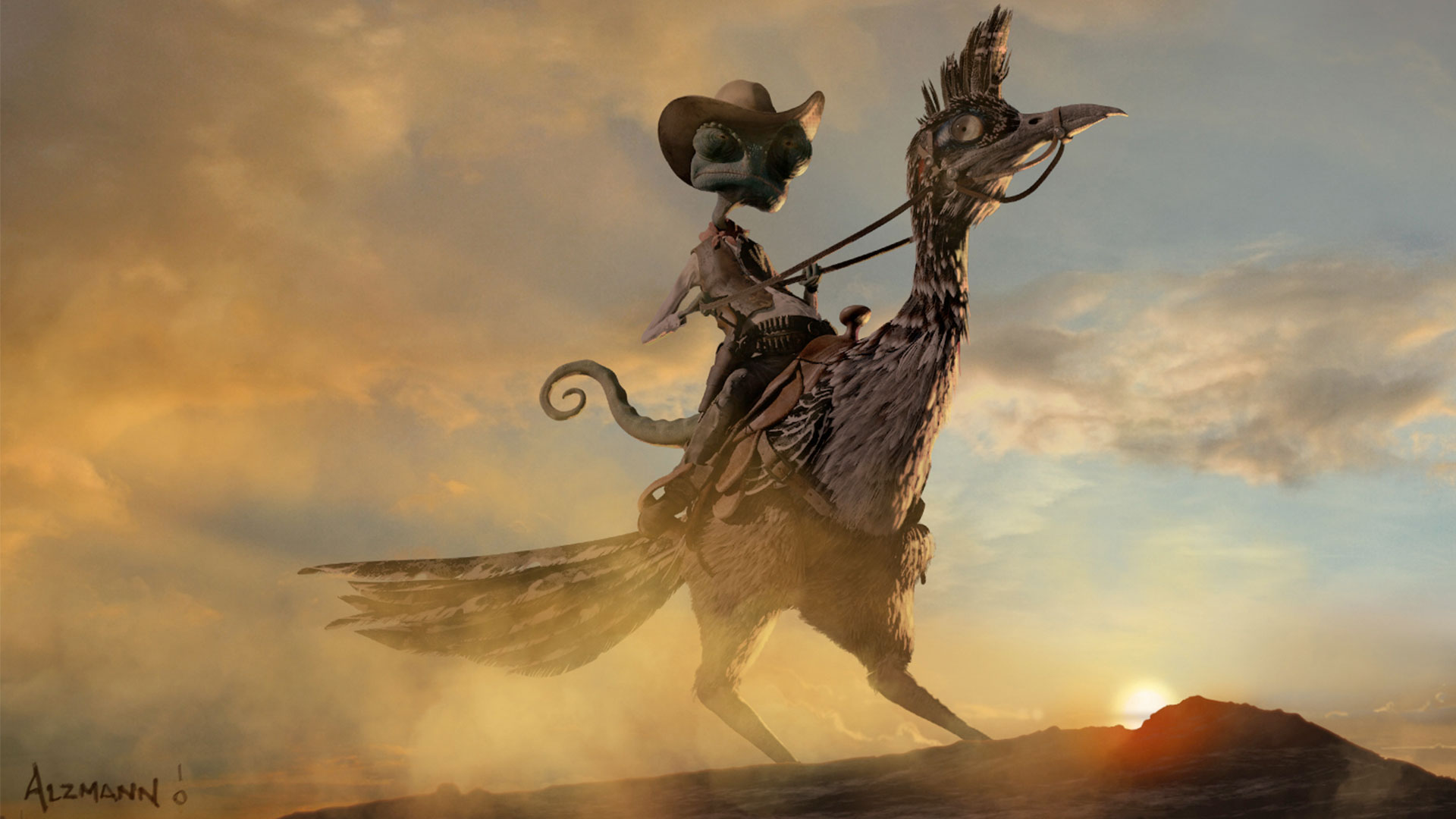
“I wanted to feature Rango for the very reasons that Gore says in the interview, which is that ILM always had the ability but never the opportunity to be part of a project where they’re actually telling the whole story,” Johnston continues. “That was unique to ILM, and unique to that project. I came away, personally, hoping that ILM gets more opportunities to do things like that. Having experienced the situation that Gore explains where ILM does a shot, and they don’t know exactly where it’s going to cut in, they’re basically working on something in isolation. For them to be able to not think that way and tell the whole story was groundbreaking for ILM. That’s another story that was important to tell.”
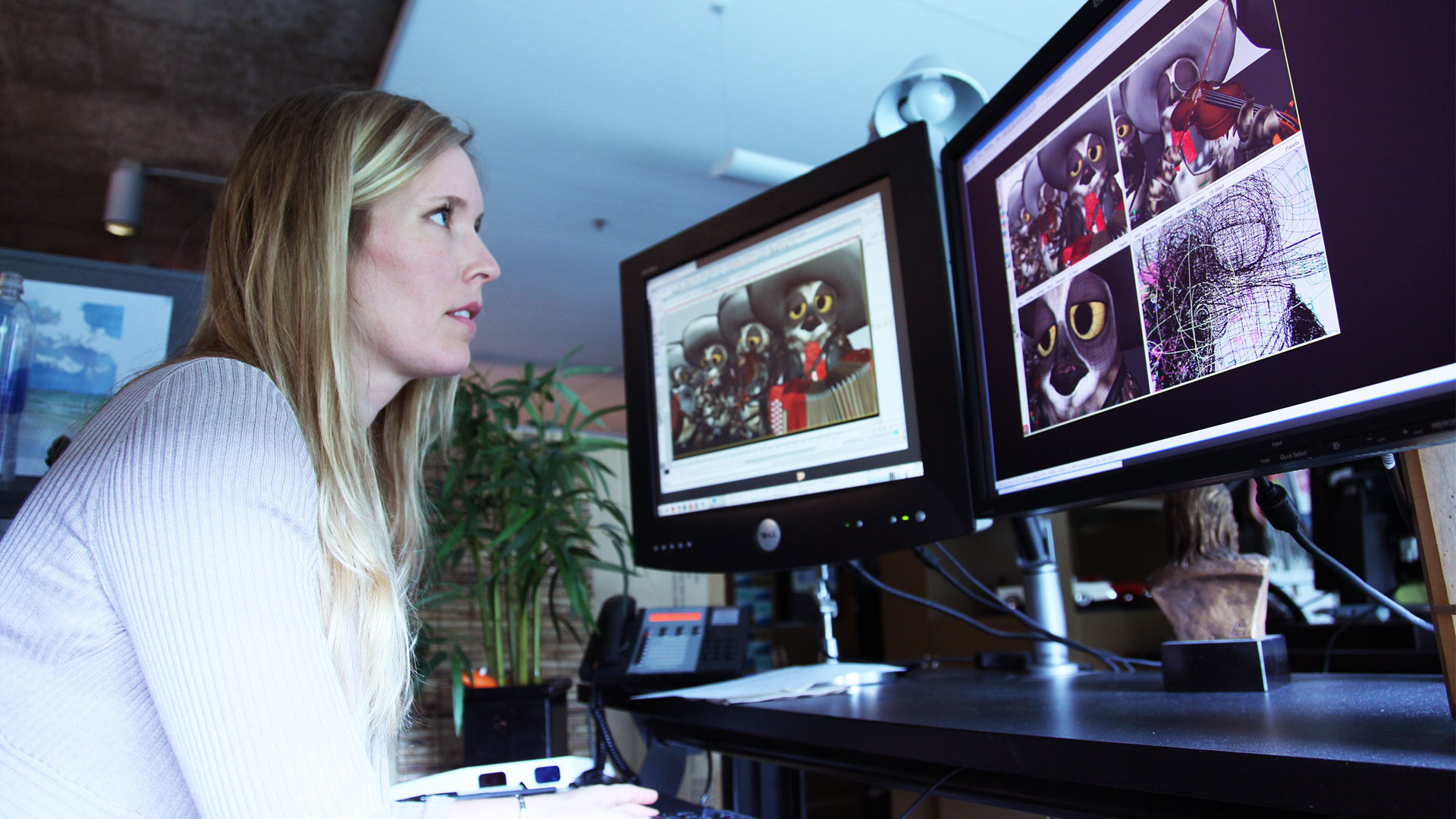
Animator Maia Kayser during production of Rango (Credit: ILM).Concept art of Rango by Christian Alzmann (Credit: Paramount & ILM).
Finding Inspiration
With the open mind of an artist, Johnston reiterates that he “never walked into an interview or the cutting room knowing exactly what something was going to be. It was a process. There were tons of surprises, things I didn’t know. It was refreshing, in a way. It made me have a newfound love of documentary filmmaking.”
As Johnston looks ahead to future non-fiction stories of his own, he shares his hopes that Light & Magic Season 2 will help to inspire the coming generation of storytellers.
“I would hope that a lot of young, potential filmmakers or visual effects artists would watch this series and say, ‘That person who I really admire had no idea how they were going to get to ILM. They did this thing that they were good at, it was recognized, and they got a call.’ If this is something that people want to pursue, they should recognize that it’s possible. There’s a route to success. There might not necessarily be a formula for success, but there’s a way to find your path if that’s your dream.”
Effects progression from Pirates of the Caribbean: Dead Man’s Chest with actor Bill Nighy as Davy Jones (Credit: Disney & ILM).