Lucasfilm announces the full cast for the Star Wars feature directed by Shawn Levy and coming to theaters in May, 2027.
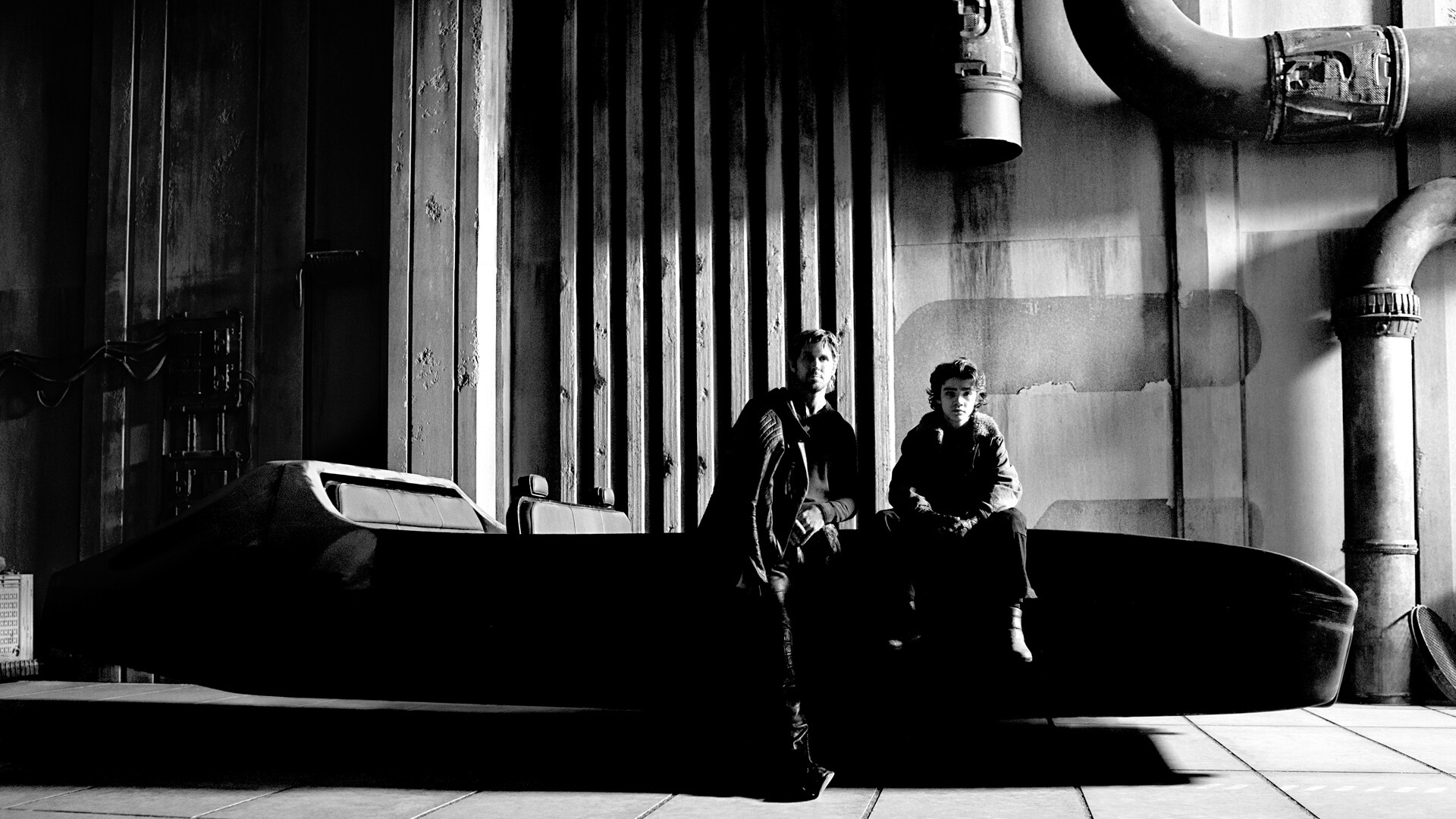
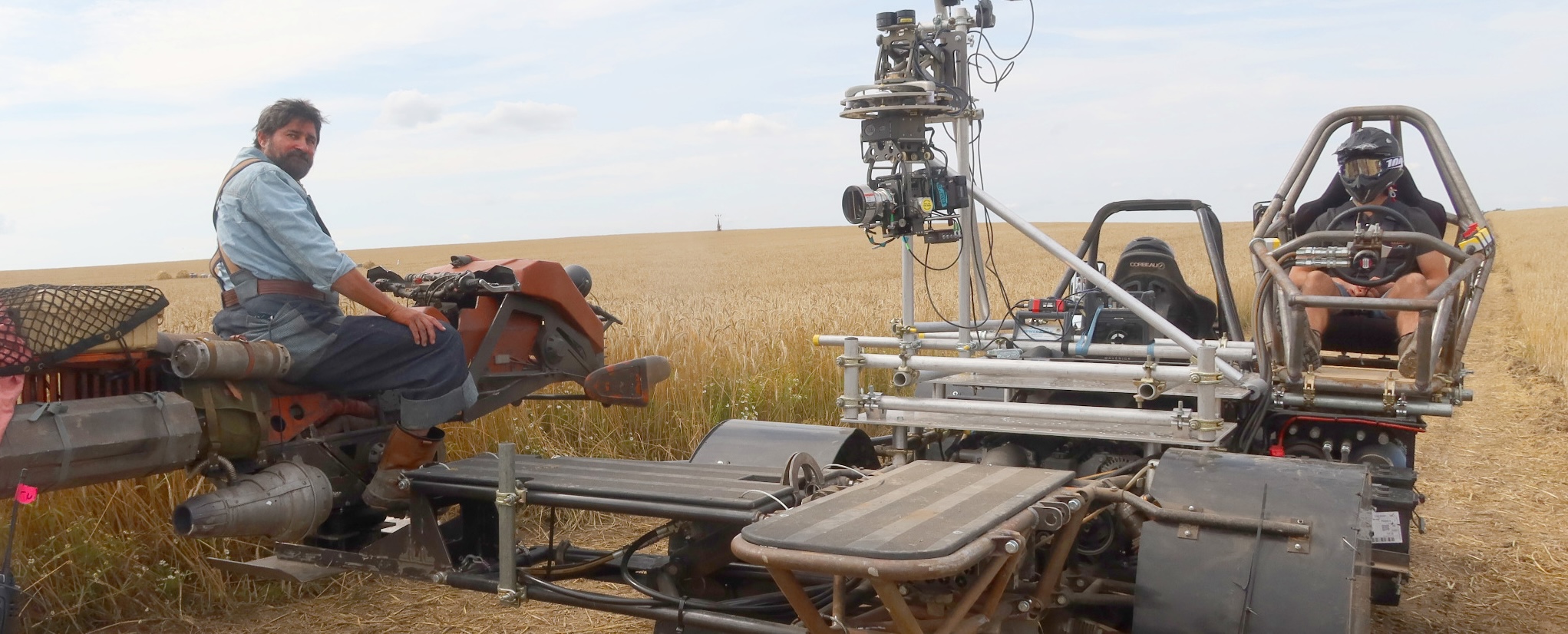
Ryan Gosling (left) and Flynn Gray on set for Star Wars: Starfighter (Credit: Lucasfilm & Ed Miller).
Production of Star Wars: Starfighteris officially underway with a newly-revealed cast alongside Ryan Gosling that includes Flynn Gray, Matt Smith, Mia Goth, Aaron Pierre, Simon Bird, Jamael Westman, Daniel Ings, and Amy Adams.
“To join this storytelling galaxy with such brilliant collaborators onscreen and off, is the thrill of a lifetime,” director Shawn Levy told StarWars.com. Levy joins Lucasfilm president Kathleen Kennedy as producer on Starfighter, with a screenplay by Jonathan Tropper.
Learn the inspiring story of a group of dedicated ILM and Lucasfilm employees who turned their dreams into a reality….
By Lucas O. Seastrom
“It is a period of intrigue,” begins the opening text crawl of a little-known Star Wars story. “Imperial outposts scattered across the galaxy search for signs of the fledgling rebellion. Intrepid rebel agents have infiltrated the Empire’s Logistics, Deployment, and Allotment Center – LDAC – on planet Yerbana. From the heart of this Imperial base, the rebels have carved out a secret outpost to monitor enemy activity, contact other rebels, and recharge all the while avoiding the eyes of the Empire….”
No, it’s not an outline for a future Star Wars movie. It is, in fact, a playful backstory imagined by a passionate group of Industrial Light & Magic and Lucasfilm employees to contextualize a unique gathering place deep within the company’s San Francisco headquarters.
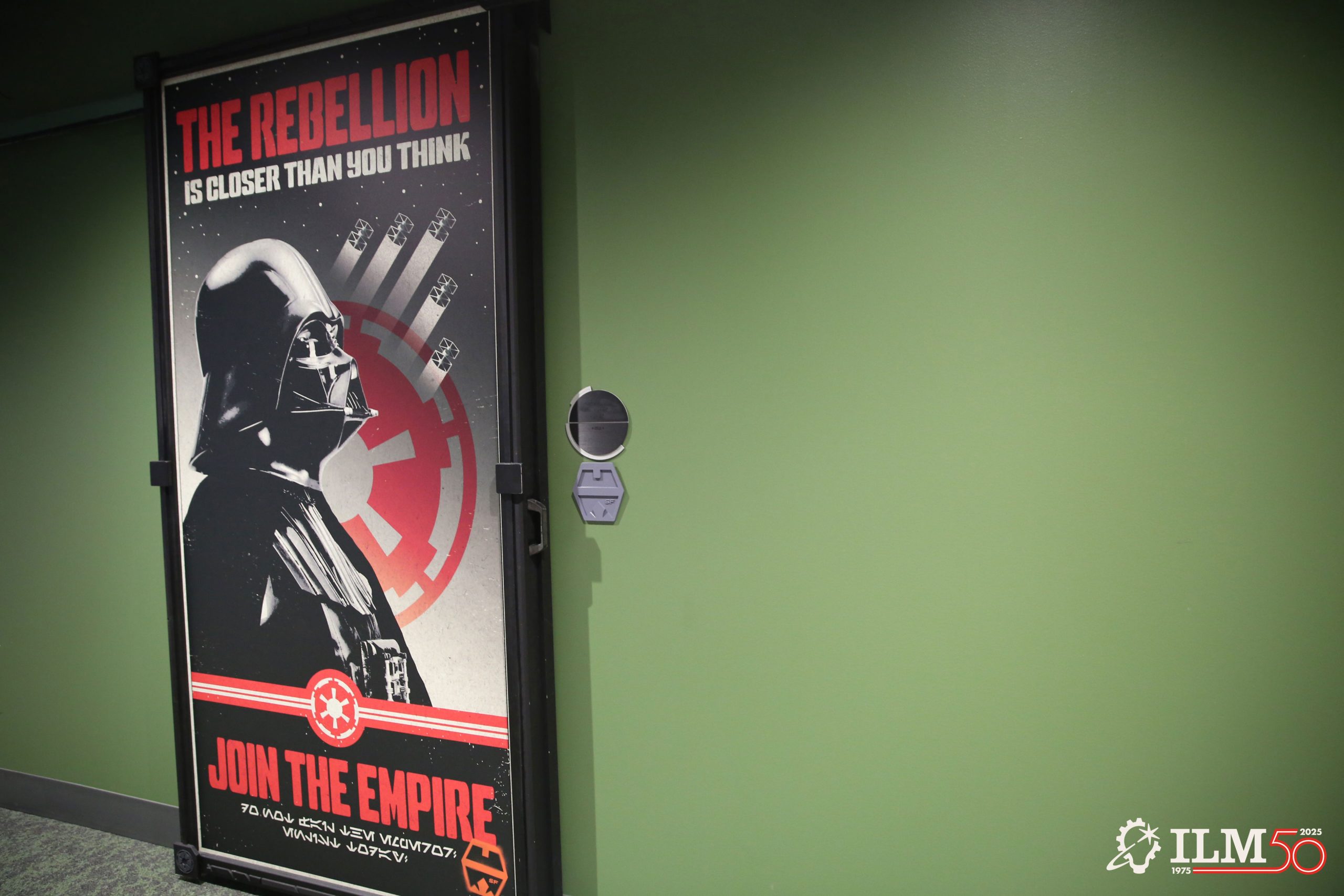
Not far from ILM’s performance capture stage and IT department, a massive, Imperial propaganda poster hangs on the wall.
Careful observers may discover that the poster is, in fact, a door. A gentle nudge to the left reveals a secret hideout straight from a galaxy far, far away…
(Credit: ILM).
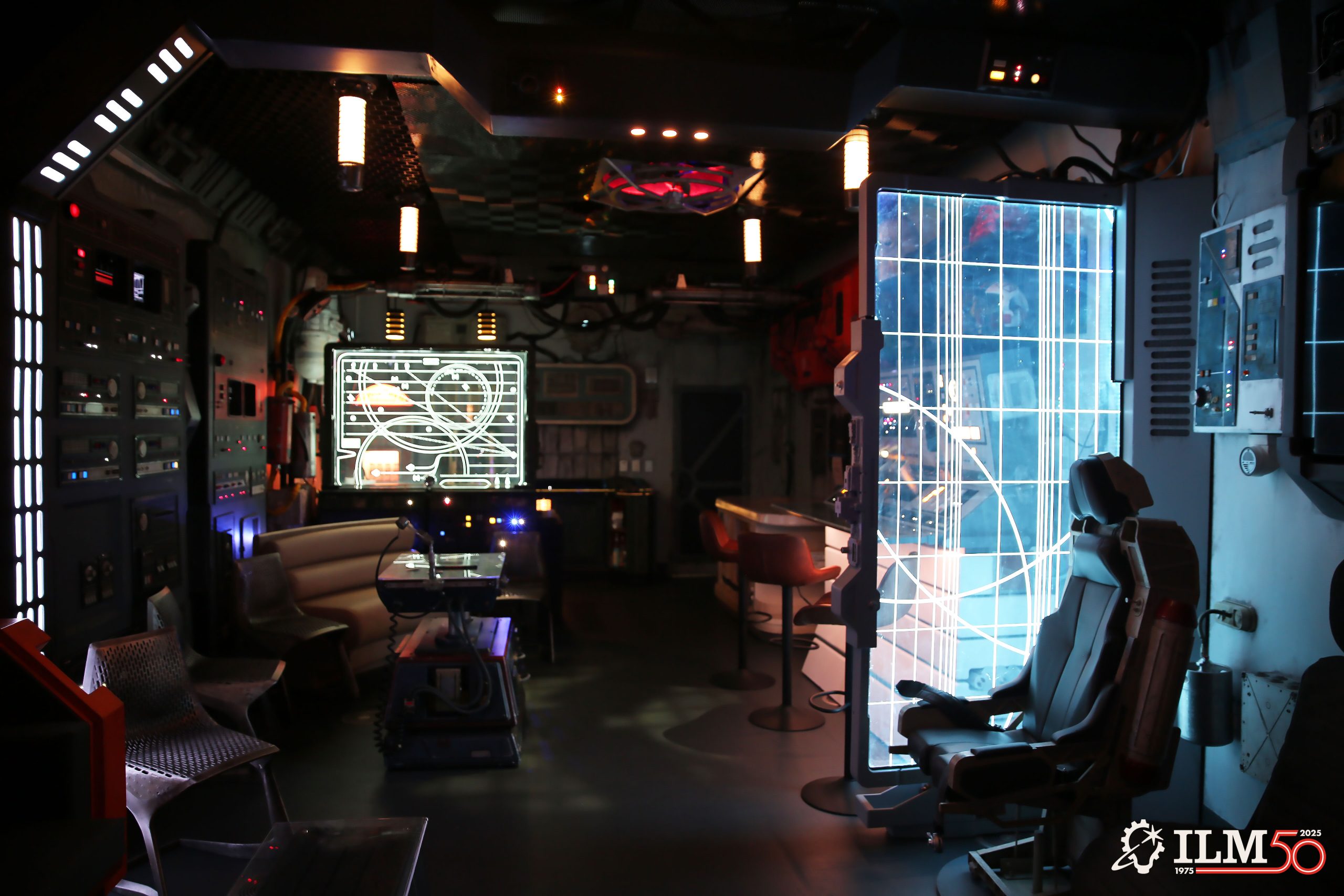
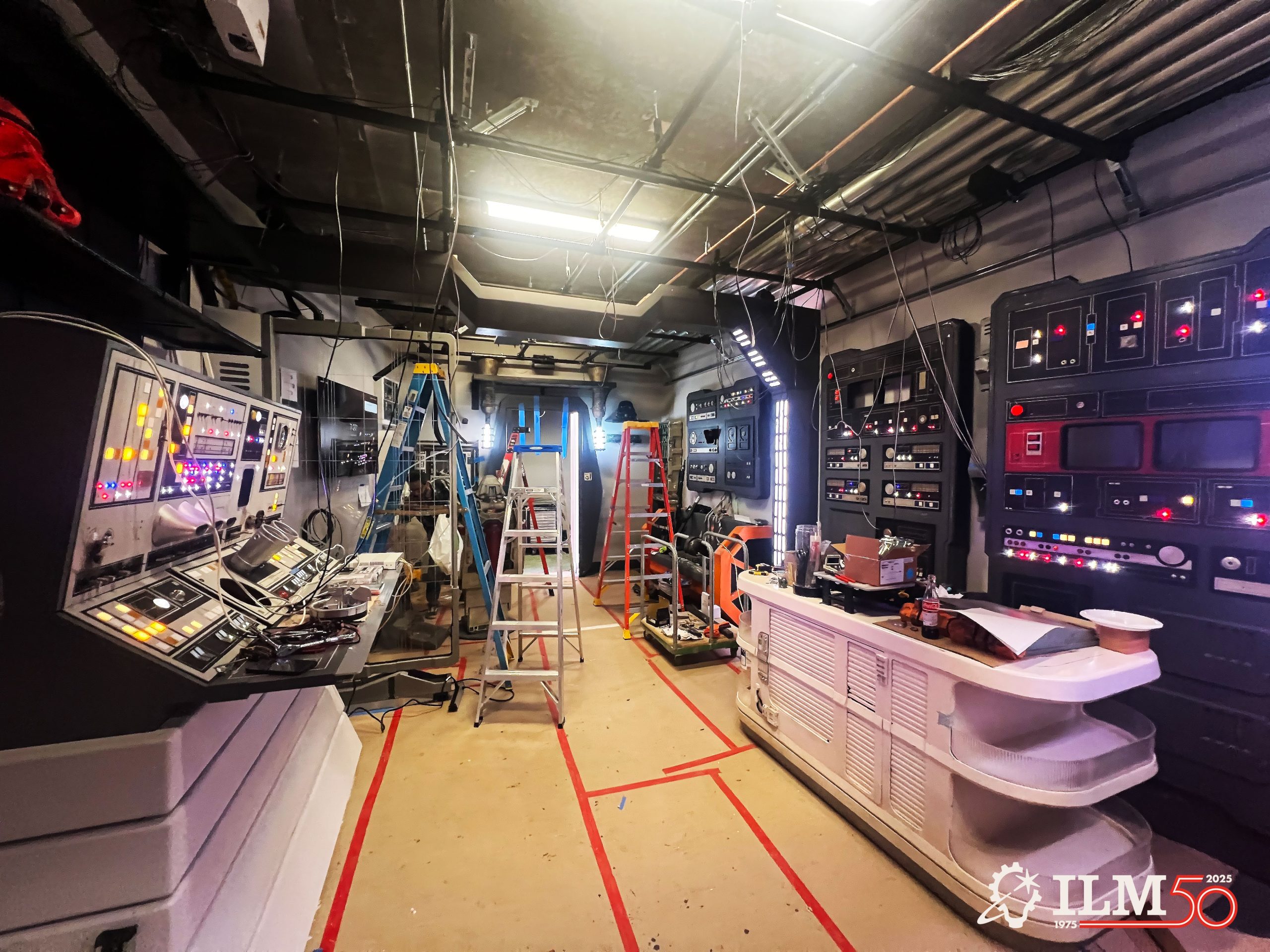
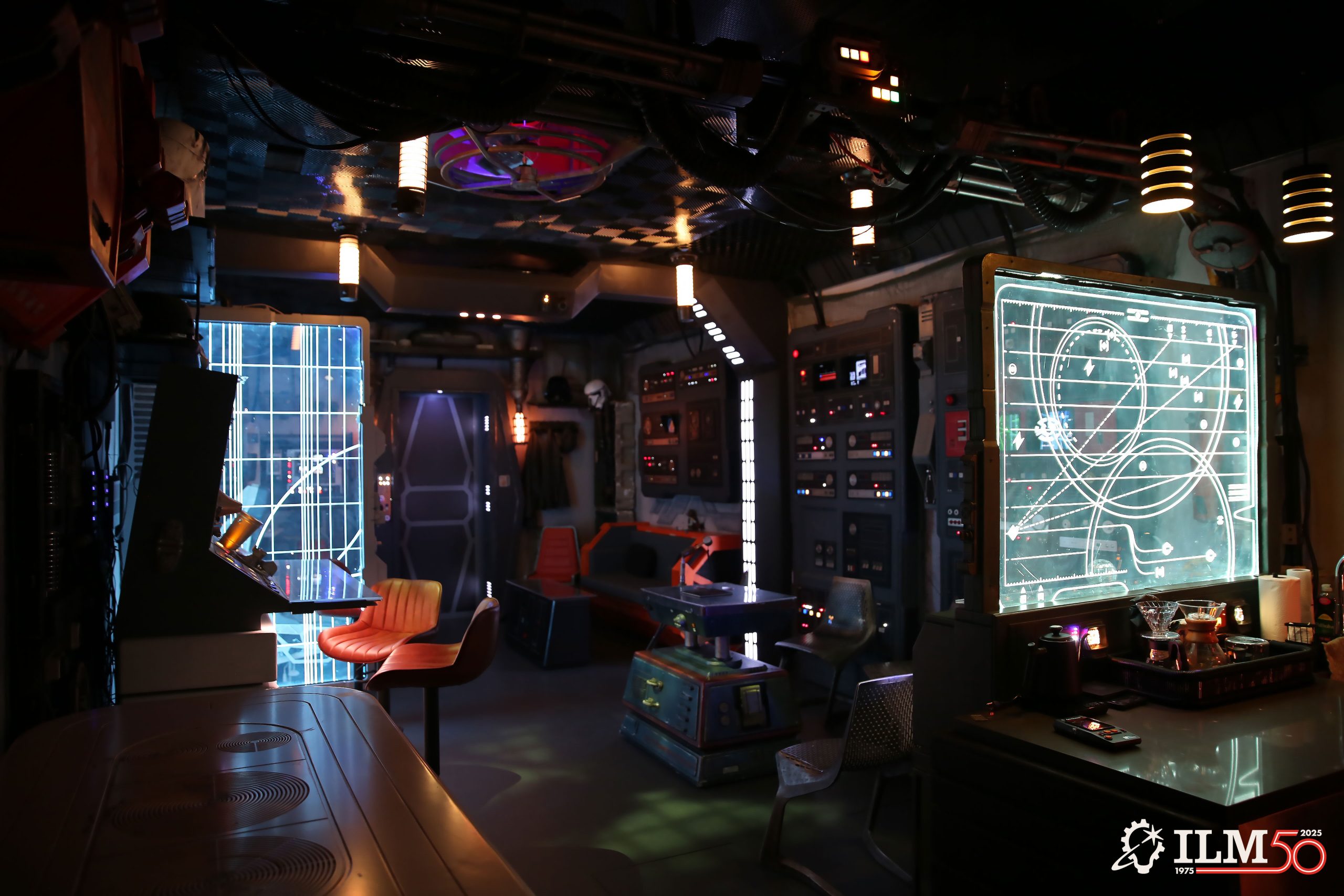
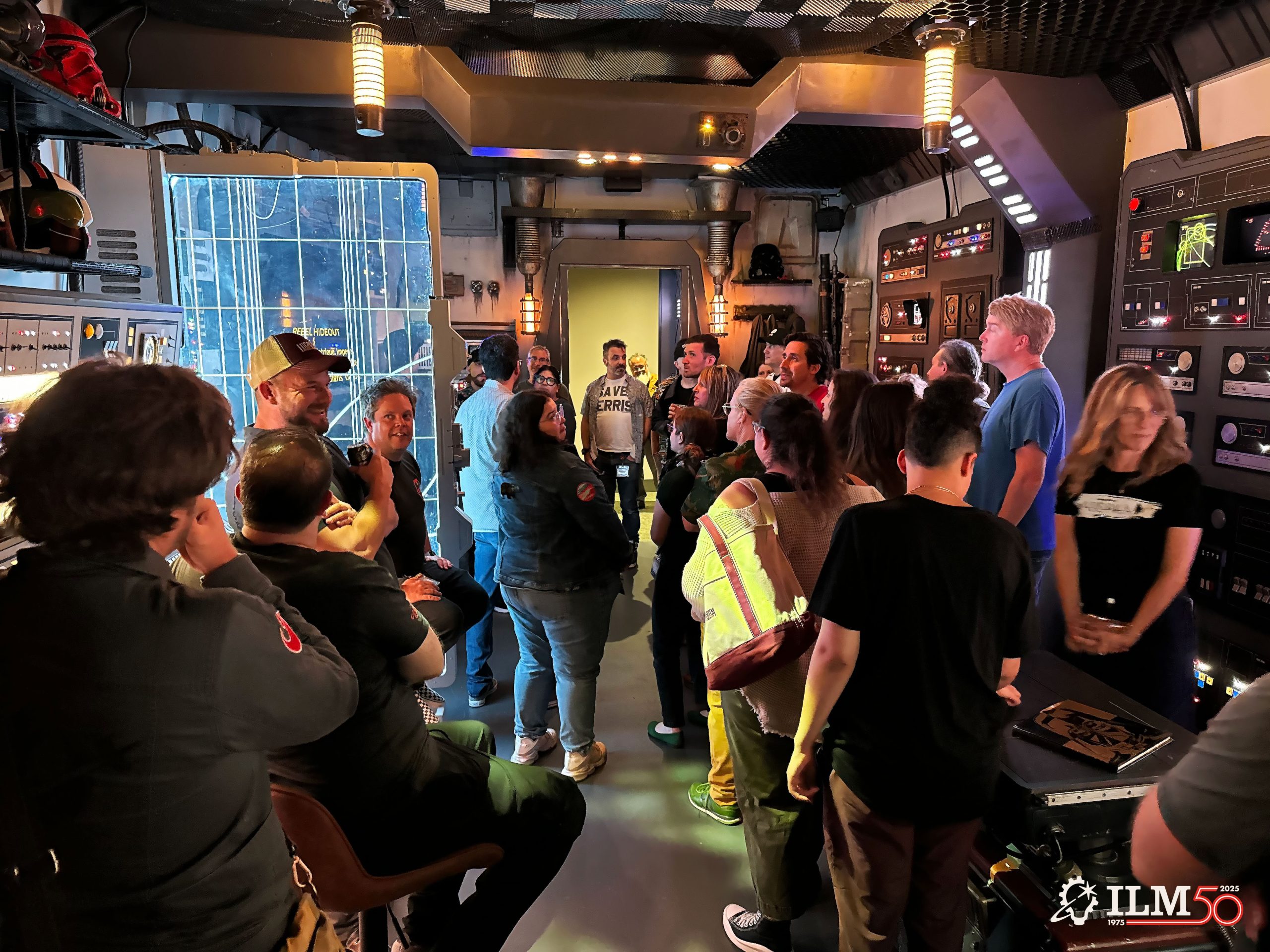
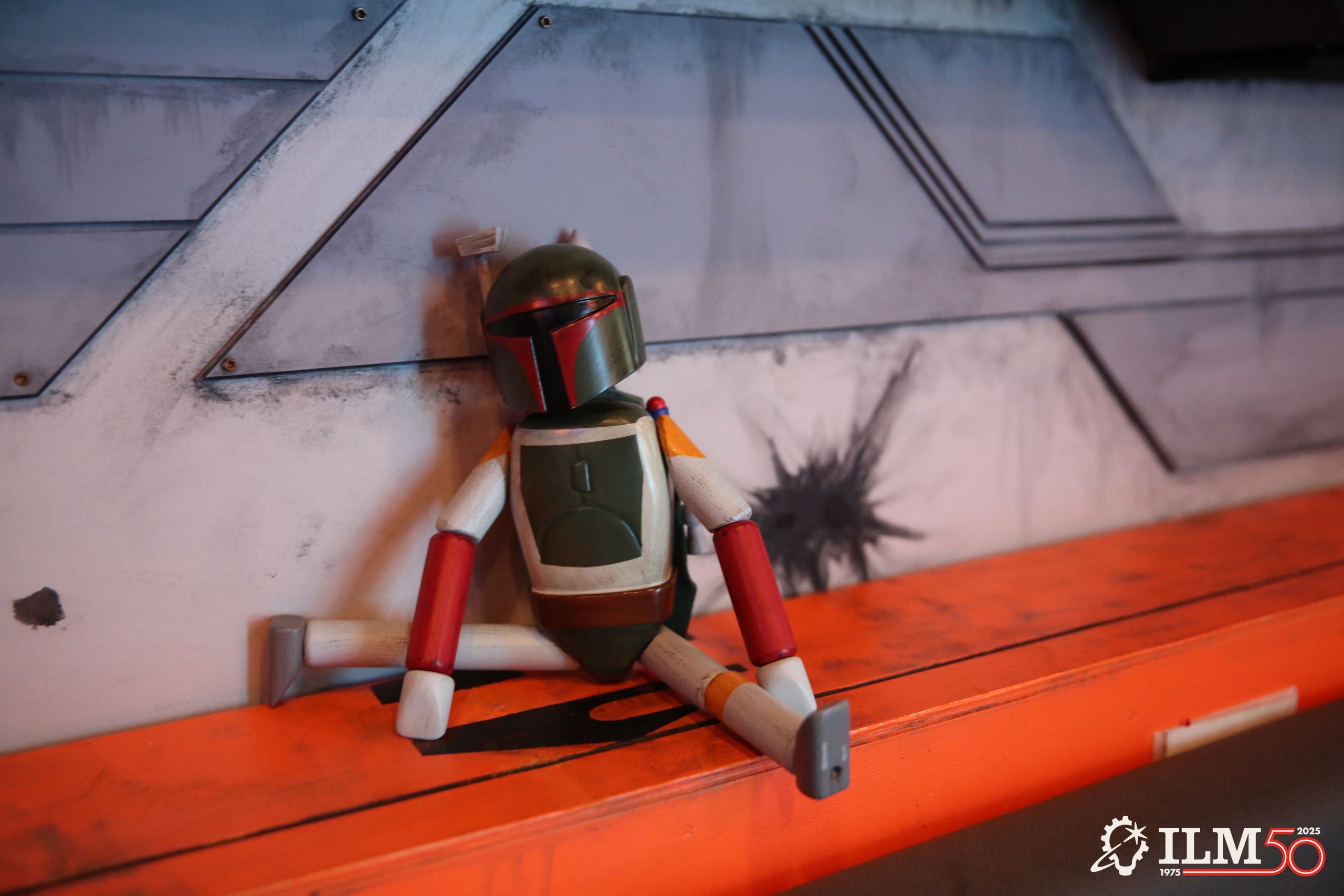
The “Rebel Hideout,” as it is formally known, is presented as a makeshift refuge for hidden operatives, tucked away inside an Imperial base (its acronym, LDAC, “coincidentally” the same as the former name of Lucasfilm’s headquarters, Letterman Digital Arts Center). Pieces of furniture, equipment, and technology from across the galaxy have been requisitioned and adapted into the relatively cozy space. At times, sirens blare a warning, or the roar of a spaceship’s engines is heard overhead. Monitors allow the rebels to spy on Imperial activities, all the while enjoying a well-stocked snack bar and most impressive music system (the room even sports a “disco mode”).
The result of more than a decade of committed planning and effort from a passionate group of employees, the Rebel Hideout is a homemade lounge designed specifically as a fun-filled gathering place. “The fact that this is employee-created is the most joyous part of the entire thing,” notes staff R&D engineer Mike Jutan, one of the project’s originators.
“We’re not bragging about this room,” adds ILM’s head of CG, Michael DiComo, another project lead. “We are as amazed as anyone. How in the world did it get this good? We had dreams, and we’re so happy to be part of it, but we couldn’t have guessed it would be this great because everyone went so over the top. It’s the ILM spirit of everyone collaborating, doing more, and asking, ‘What do you need me to do?’”
The story of the Hideout’s creation has as many twists and turns, trials and triumphs, as any Star Wars movie….
The Early Concepts
Before joining ILM in 2007, Mike Jutan interned at Pixar Animation Studios, just across San Francisco Bay in Emeryville. The company was already well-known for its playful, collaborative culture in a space designed for casual interactions between employees. Its campus even featured “secret” lounge areas, often with elaborate theming, including one located inside a compact air duct only accessible via a crawl space.
“At Pixar they talk about the central atrium in the building,” Jutan tells ILM.com, “and how Steve Jobs designed the space with the bathrooms in the center of the building so that everyone has to cross paths with each other, and when you do, you strike up random conversations. Just the idea of artists and engineers unintentionally crossing paths was really captivating to me.”
Arriving at ILM’s San Francisco office, an enthusiastic Jutan was eager to help introduce more of these like-minded spaces at the Letterman campus. It was a poignant vision, considering that Pixar had originally took inspiration from ILM’s former home at the Kerner facility in nearby San Rafael, where the Lucasfilm Computer Division (from which Pixar spun off in 1986) was once fully integrated within the visual effects company’s stimulating, creative work setting, where casual “hallway meetings,” employee band performances, and Friday afternoon “ergo parties” were regular occurrences.
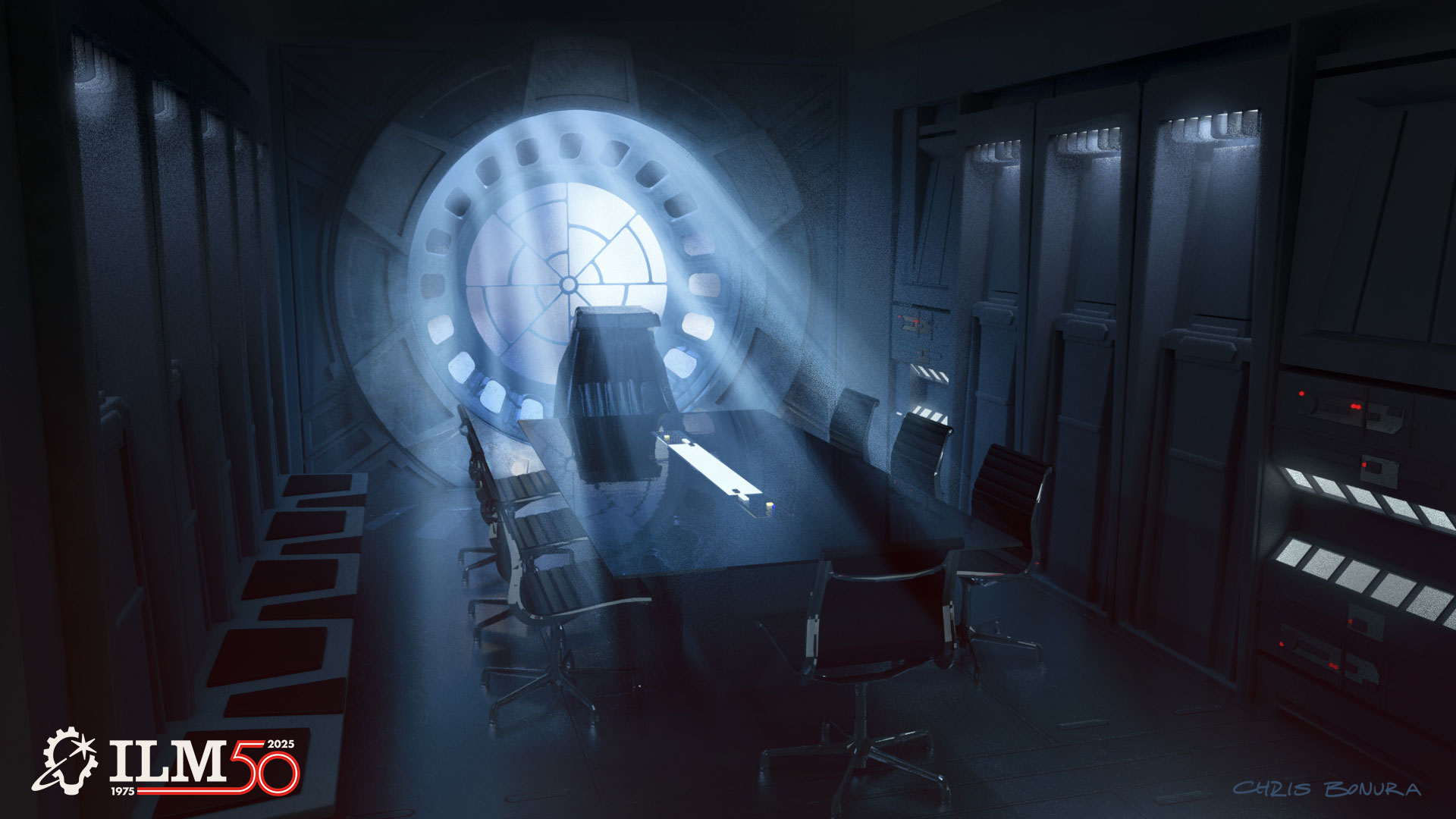
An early concept for an employee lounge by Chris Bonura took on a fully Imperial theme (Credit: ILM & Chris Bonura).
“It all started when we asked for $50.00 to retouch the pool cues,” Jutan reflects with a laugh. Pool tables were one amenity in what he describes as a “multipurpose room” that existed on the Letterman campus, where employees often played games, relaxed, or held art classes. Jutan wanted to find ways to improve the space with specific theming.
By 2013, a small group of ILMers, including Jutan and DiComo, had originated a concept for a Star Wars lounge designed to evoke the Mos Eisley Cantina. An early proposal detailed a space that “represents our company personality” and facilitated “casual, collaborative conversation.” They were soon meeting with Lynwen Brennan, then ILM’s general manager and today Lucasfilm’s president and general manager. “We explained a concept where we could scrounge together some different items to make a little lounge space,” recalls DiComo. “And she told us, ‘No, dream big. How great could this be?’”
The group broadened their ambitions. Current day real-time principal creative Landis Fields produced a digital walkthrough of an elaborate space that felt like an immersive, Star Wars movie set. Soon they organized a lunchtime event with over 100 employees to introduce the concept, exchange ideas, and recruit volunteers to help create it. “This was going to be a crowd-sourced, employee-driven project,” as DiComo notes. New contributors, like senior R&D engineer David Hirschfield, became involved at this stage.
Stay on Target
Over a period of more than five years, the cantina lounge concept was met with enthusiasm but was ultimately delayed. Availability of time, resources, and an adequate space shifted repeatedly due to business priorities. Then the global pandemic changed not only the prospects of building such a lounge, but the entire landscape of collaborative work in general.
The concept might’ve been abandoned during such a transformative period. But in the wake of the pandemic, the small group that had envisioned the cantina became only more committed to finding a way to bring people back together in person, and ILM and Lucasfilm’s leadership took notice. With new plans to renovate the San Francisco workspace, the lounge team was given a dedicated room and a small budget to build something new.
“Lynwen and the Lucasfilm leadership team were kind enough to help us do it,” Jutan explains. “We were prepared to rally the troops and have everyone there to make it happen. Our chance finally came, and we were going to take full advantage of it. We spun up again as if nothing had ever paused.”
With the new opportunity came a new concept for another type of Star Wars setting. A “hidden room” was discussed, and once again, Landis Fields created a digital walkthrough. From outside, a bookcase full of Imperial volumes and trinkets hid a small, sliding window where a Rebel inside ensured you were clear to enter. The case then moved across the wall to reveal a space that greatly resembled the ultimate creation.
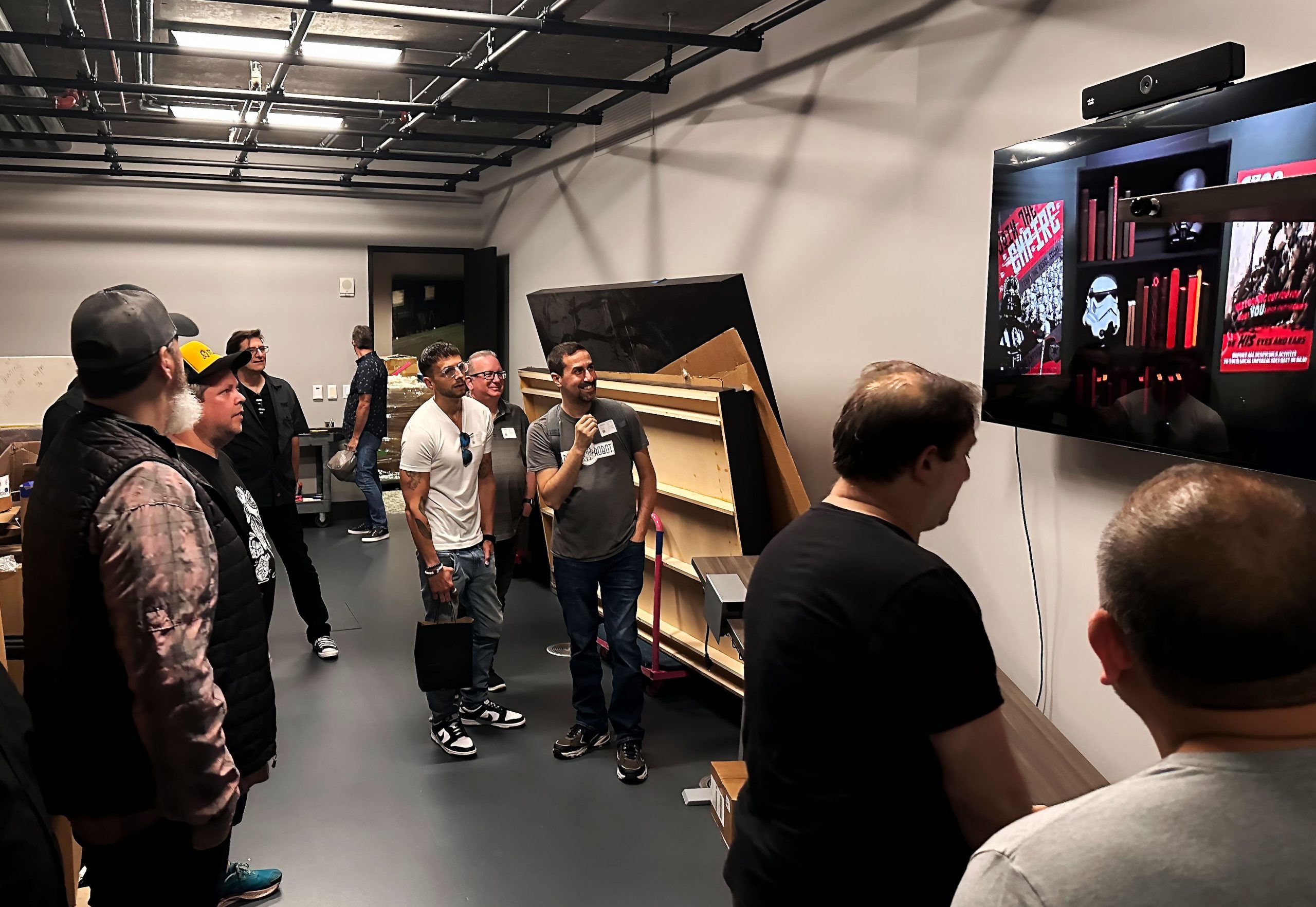
Members of the team and special guests Tom Spina (center) and friends visit the space early in development (Credit: ILM).
“Landis sort of kit-bashed all of these different Star Wars ideas into the design to see what might be possible,” DiComo recalls. The group shifted from an explicit speakeasy concept to something more inclusive. “This is a place where you can come get coffee, take a quick break, have a meeting, enjoy some music, read a book, or sit around and work on your laptop,” notes Jutan. “There’s no ‘one size fits all.’ People want different things out of a space like this, but the common thread is bringing people together.”
By 2023, production manager Julie Stallone had joined the team as project producer, handling daily logistical needs, coordinating a schedule, and ensuring the team stayed on budget. They proceeded with an initial plan to construct some furniture and design elements on their own and collect licensed prop replicas and toys to provide accents. They would also partner with an independent replica maker, Tom Spina, for additional features. But a fortunate surprise caused yet another change of course.
From the Set to the Hideout
Learning about the Hideout project, Lucasfilm archivist Portia Fontes contacted the team offering use of a number of screen-used props and set pieces from recent productions, including Rogue One: A Star Wars Story (2016), Solo: A Star Wars Story (2018), Star Wars: The Rise of Skywalker (2019), and Andor (2022-25). The group’s response was a collective “WHAT?!” “We could never have built anything as amazing as these set pieces with the time and budget available,” says DiComo.
Fontes collaborated with Colin Merchant, a member of the Andor Props Department in England, to curate a selection of pieces. Soon after, senior producer John Harper and the Lucasfilm Online team offered additional, custom-made furniture from their livestream stage at a recent Star Wars Celebration, as well as additional screen-used props from Star Wars productions. “It was another spit-take moment,” as Jutan quips.
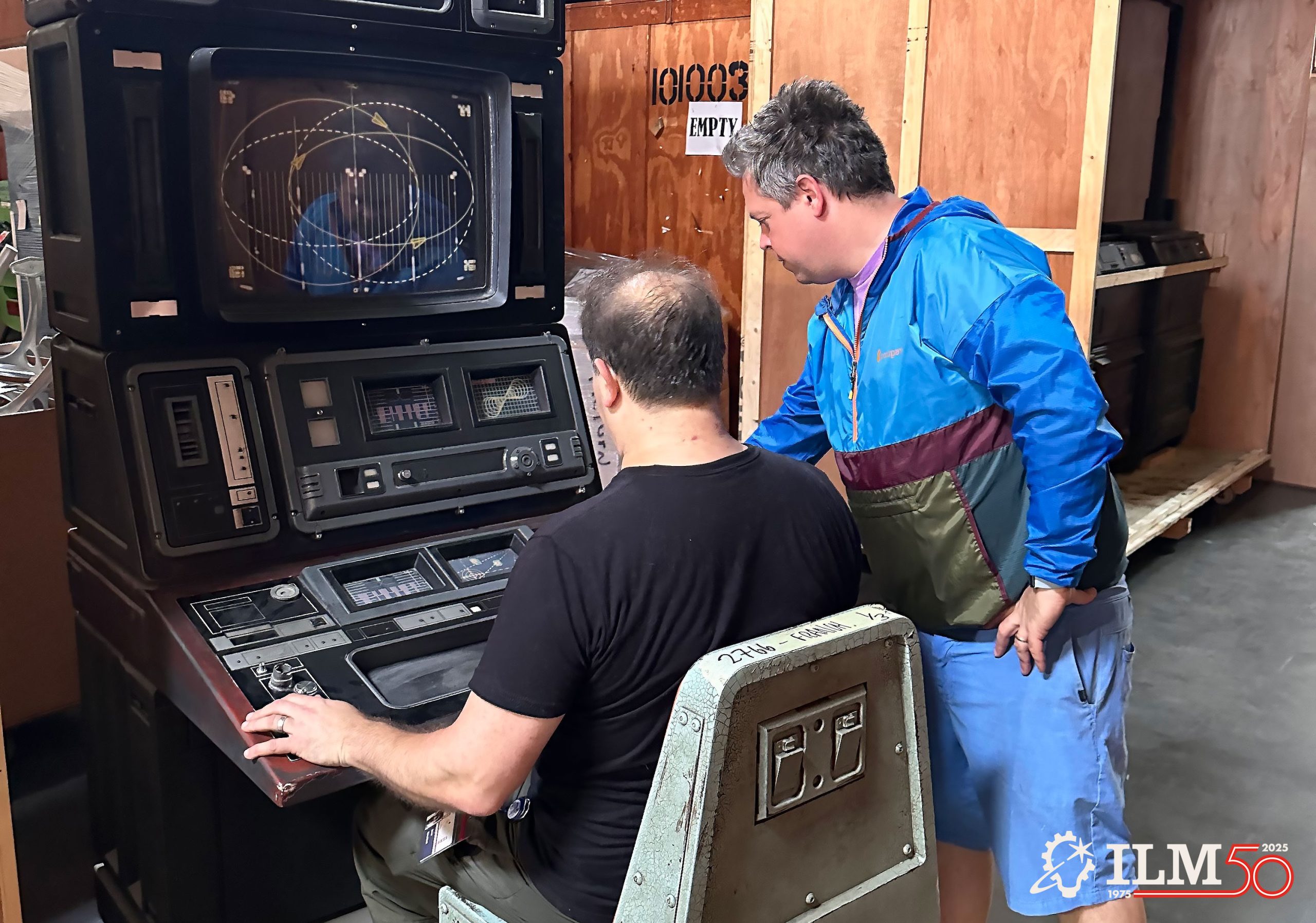
Mike Jutan (standing) and David Hirschfield inspect original props from a Star Wars production (Credit: ILM).
These developments would define the Rebel Hideout’s ultimate design and layout. Lucasfilm director of franchise content and strategy, Pablo Hidalgo, helped the group refine the room’s specific context within the Star Wars storyline, ultimately writing the Hideout’s “opening crawl” and related notes.
“When we realized that we had all sorts of different props available to us, having a specific story structure helped limit what items we would use,” Hidalgo explains. “Some things fit the story, and some didn’t. From there, we built out the story that fit the context of this room and aligned with the characteristics of being rebels. It’s in the classic trilogy era, with the Rebellion and Empire. We also use some sequel trilogy props from the Resistance and First Order if they have a timeless character to them.”
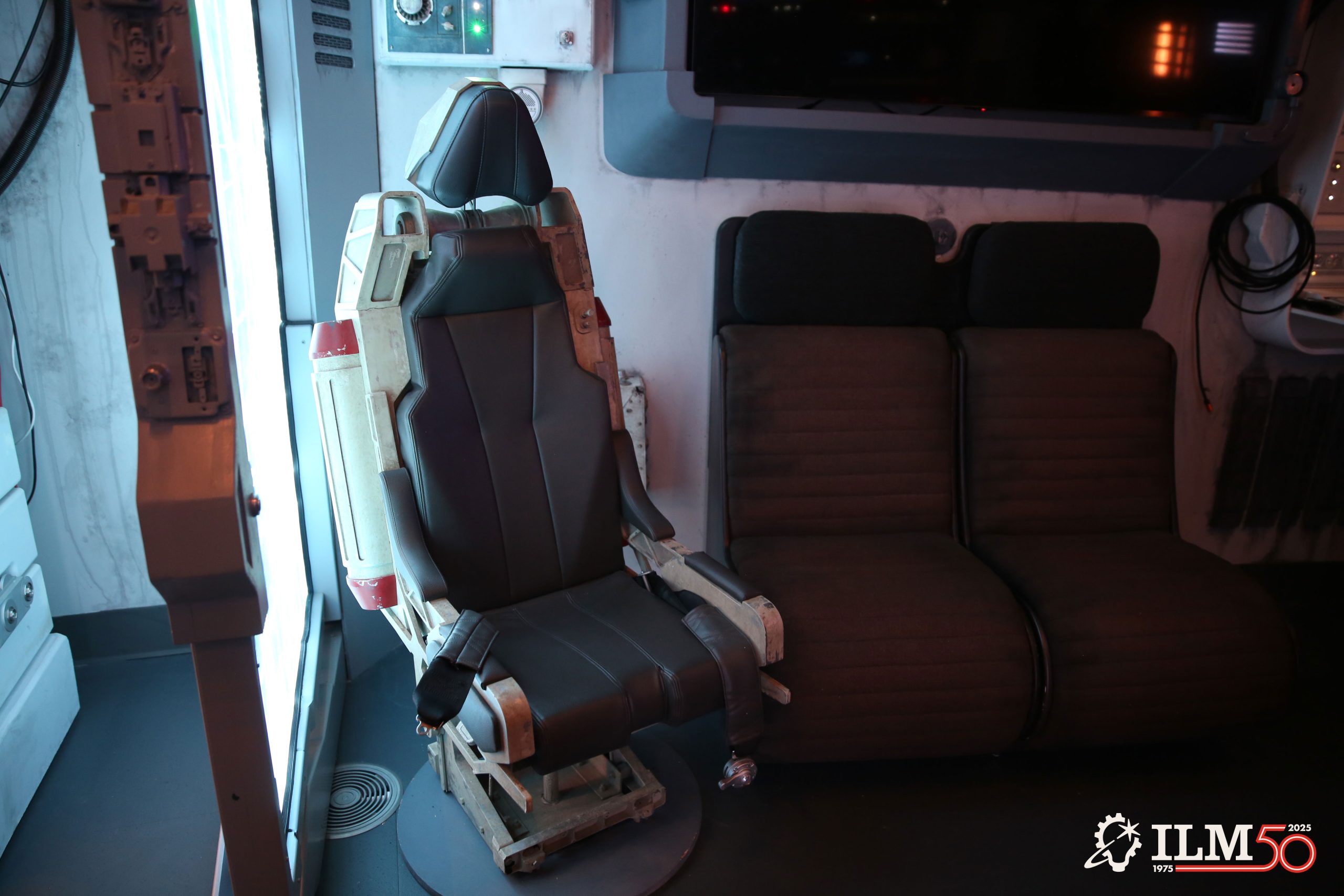
A group, including Jutan, Hirschfield, and Hidalgo, reviewed prop lists and visited an off-site storage facility to consider their options. They chose everything from a Hammerhead Corvette pilot’s chair seen in Rogue One to an Imperial security camera from Andor. Other set pieces included Babu Frik’s work table and part of a Star Destroyer workstation, both from The Rise of Skywalker, a tactical screen divider from the Yavin 4 base in Rogue One, and wall panels from the Aldhani garrison in Andor.
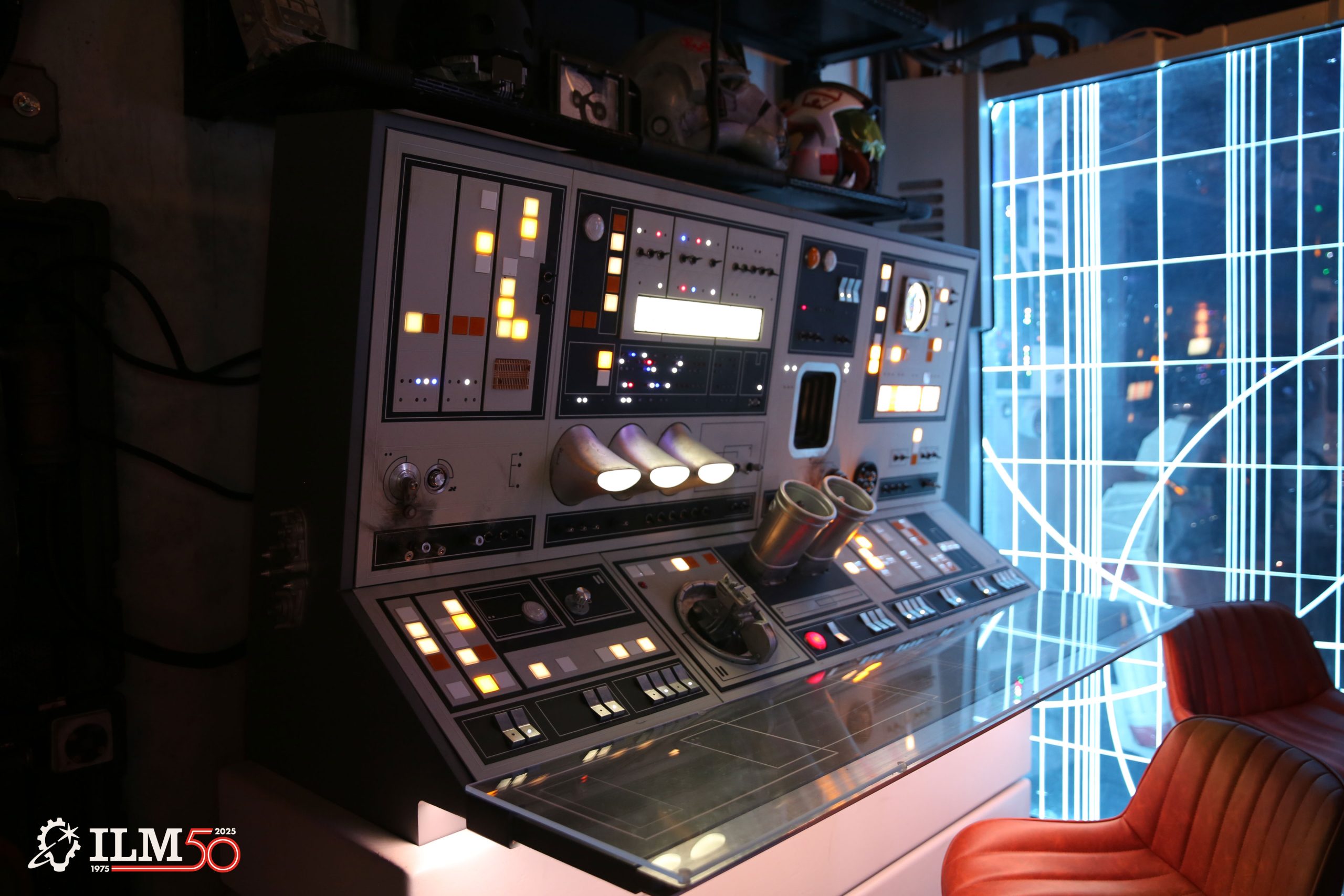
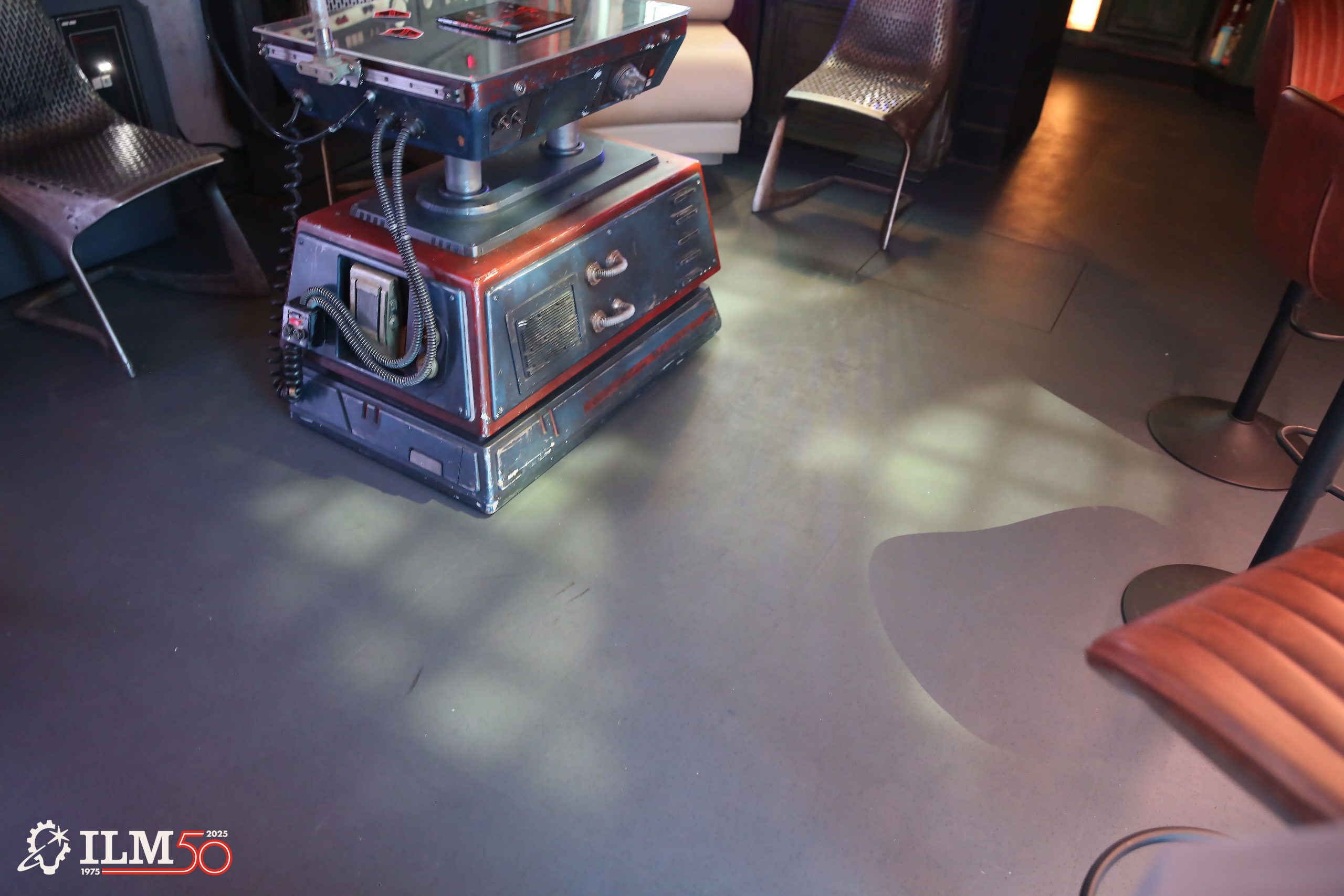
A major discovery was the Millennium Falcon’s own tech station as seen in its original form when Lando Calrissian (Donald Glover) owned the ship in Solo. “As soon as we found the console, it just looked incredible, and it wasn’t even lit up yet,” recalls Hirschfield. “I was smitten. It was pretty big, but we had to use it.” Some balked at the size, wondering how it could fit into the already tight space, but Hirschfield insisted, suggesting it could be outfitted as a control for different room functions.
The tech station from the Millennium Falcon as it appeared in Solo: A Star Wars Story (2018) (Credit: ILM).
“An Integration Challenge”
The team created a top-down rendering of the room with accurately-scaled pieces for furniture and components, which Jutan and Hirschfield call “dollhousing.” Space was key, both in terms of packing in as many authentic details as possible and for maintaining appropriate room for access and flow. Some items, like a giant vaporator, were cut during this phase due to limitations.
“We liked the basic layout, but it still looked like a conference room where we were stashing Star Wars stuff,” recalls DiComo. “How do we make it look like an actual Star Wars room? It became an integration challenge. We needed to make everything fit into the room and look as if it had always been there. We’d use tubes, hoses, weathering, grime, and greeblies on the wall to help blend it together. We moved the panels into place; the couch didn’t fit, so we cut the back off; we turned one of the radar screens on its side to help separate the rooms; and then that allowed room for the Millennium Falcon station.”
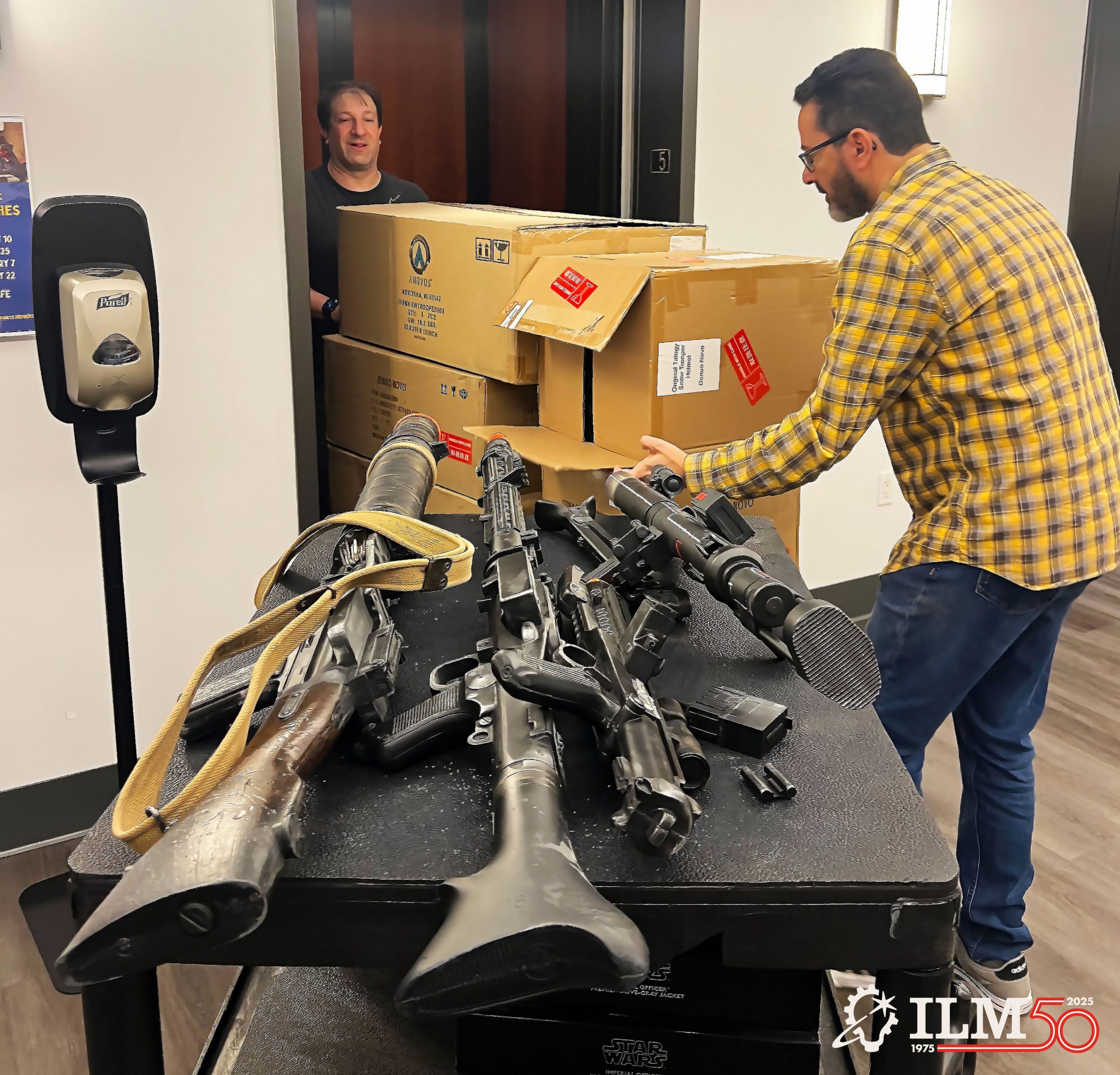
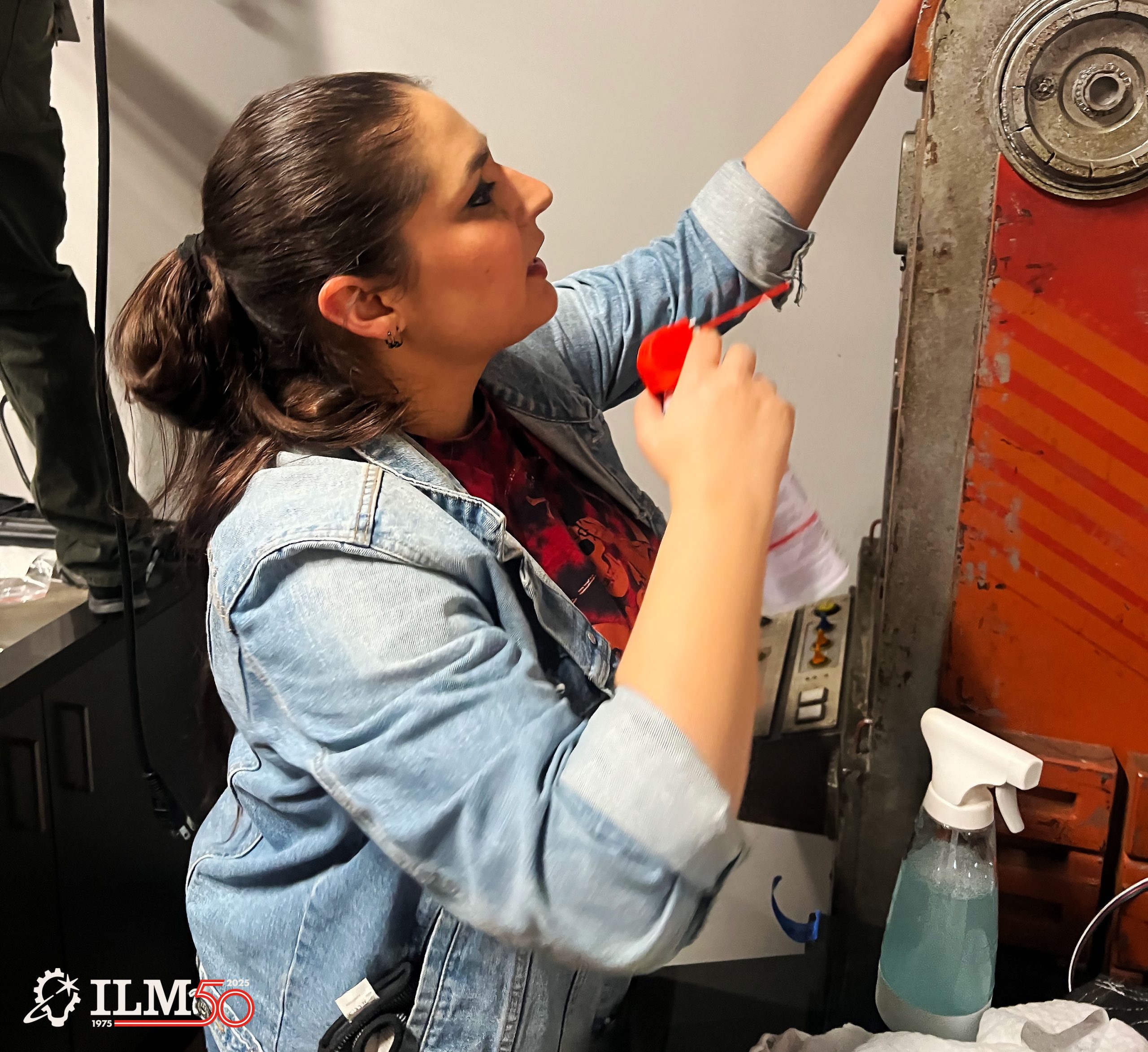
Michael DiComo (right) and David Hirschfield move licensed prop replicas donated by Lucasfilm’s licensing team (Credit: ILM).Rebecca Forth at work restoring a screen-used prop (Credit: ILM).
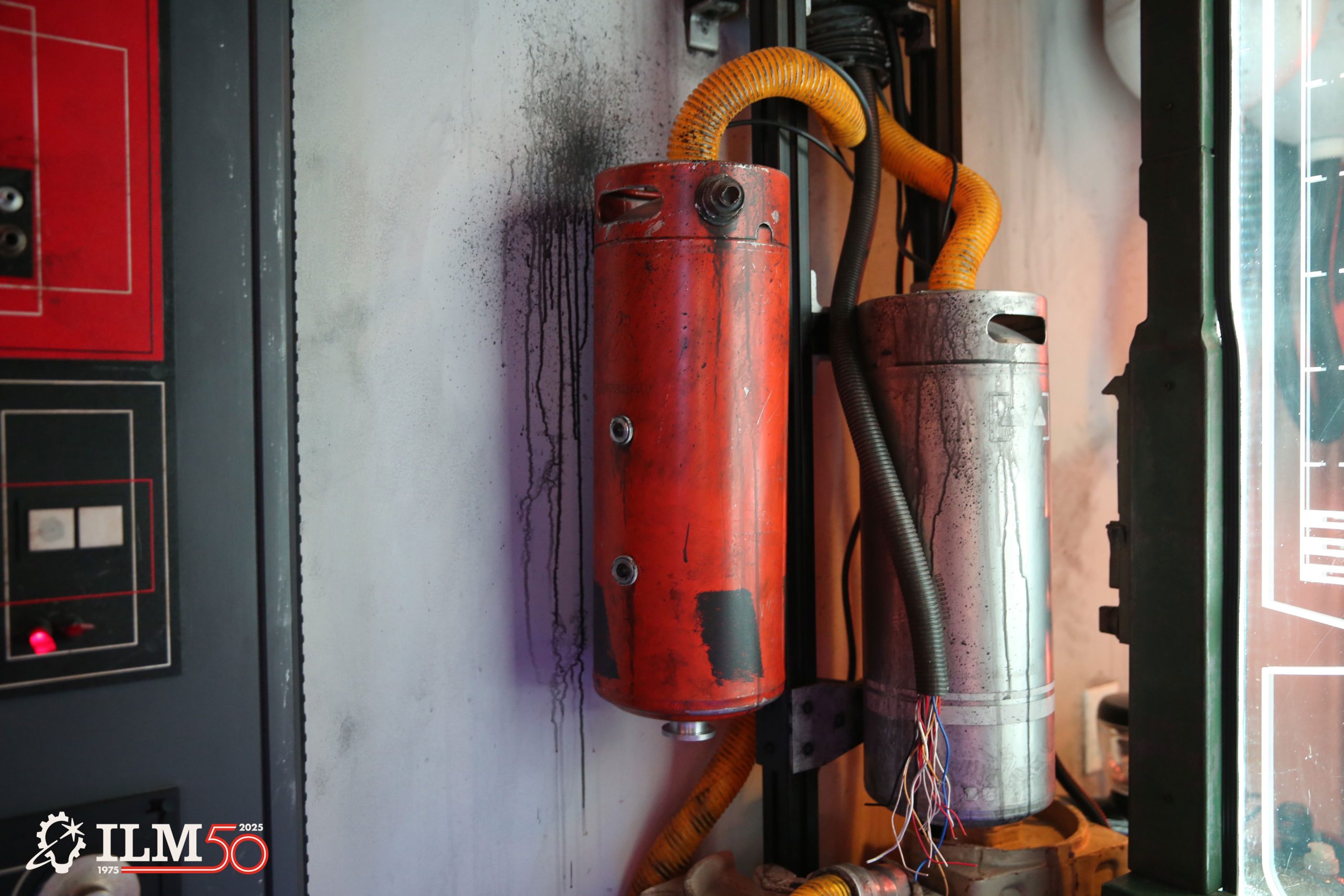
The couch was a former Star Wars Celebration prop, designed to look like a kyber crystal crate as seen in Rogue One. As they prepared to cut off the detailed back portion to allow it to sit flush with the wall, DiComo had an idea. “I thought, ‘We can’t get rid of the back part of this couch!!’” he explains. “It had giant hinges on it and an awesome shape and Star Wars greeblies all over it. So I suggested that we mount it on the wall in the kitchen, almost like it was this waste retrieval or energy storage system. All of the tubes and hoses go inside it. What would’ve been scrap became this amazing piece on the wall.”
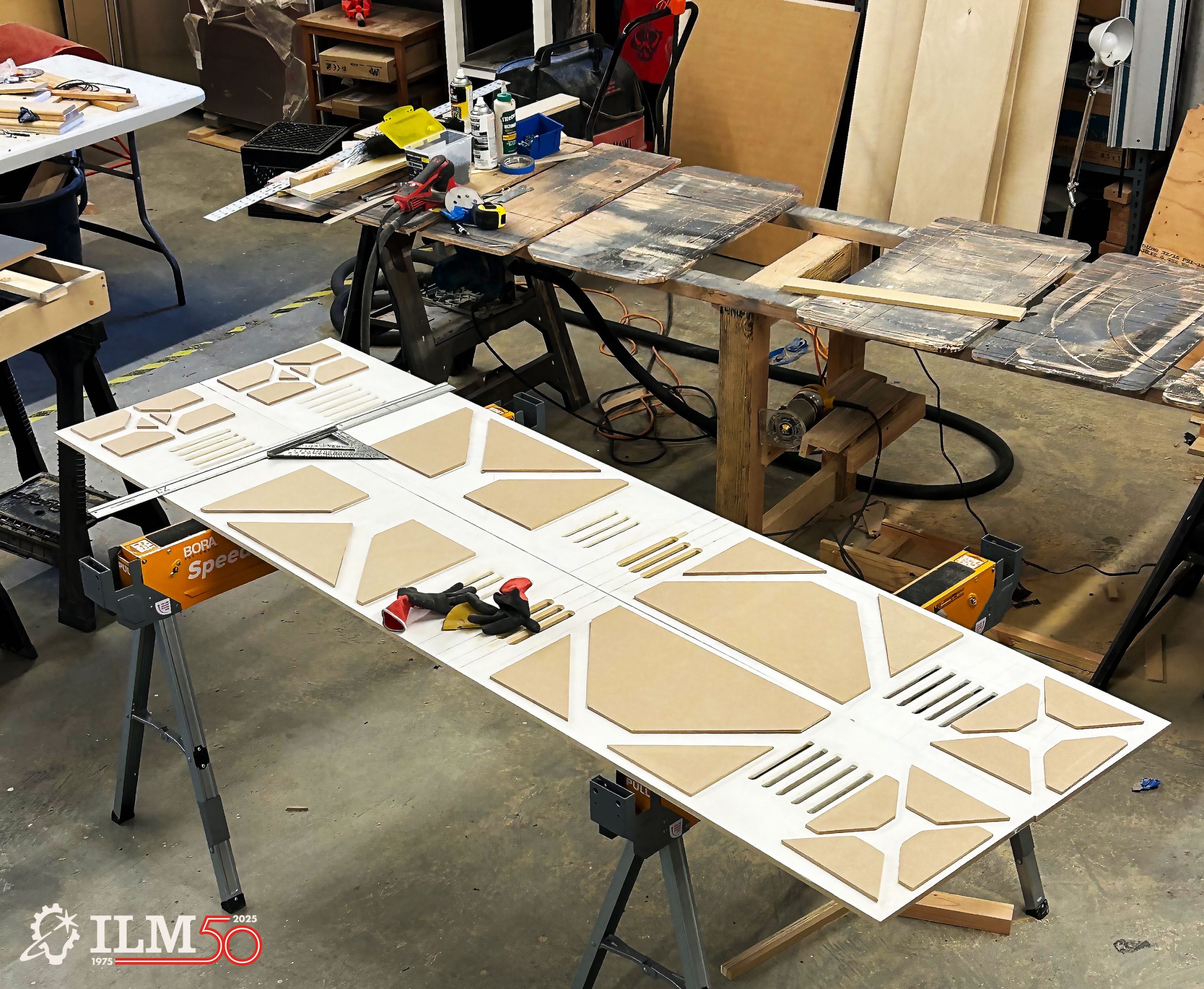
By this stage, Kyle Johnson, a former workplace services specialist with Lucasfilm, had become an integral member of the team, whom they call their “secret weapon.” An experienced craftsman, designer, and set builder, Johnson took the lead in rebuilding, fabricating, and installing a number of details throughout the room, not least of which included a massive Imperial archway that forms a key focal point, helping to break up the standard 90-degree angles in the space.
“We had to make everything actually work together in the room where people could sit on something, bump into something, or push the buttons on something,” Johnson says. “How do we cut everything down to make it fit well in the space? Doing traditional set work, you can position things all over the place so long as it looks good in the shot. With this, you have to make it work with a purpose that fits in with the rest of the room, and it has to look really good.”
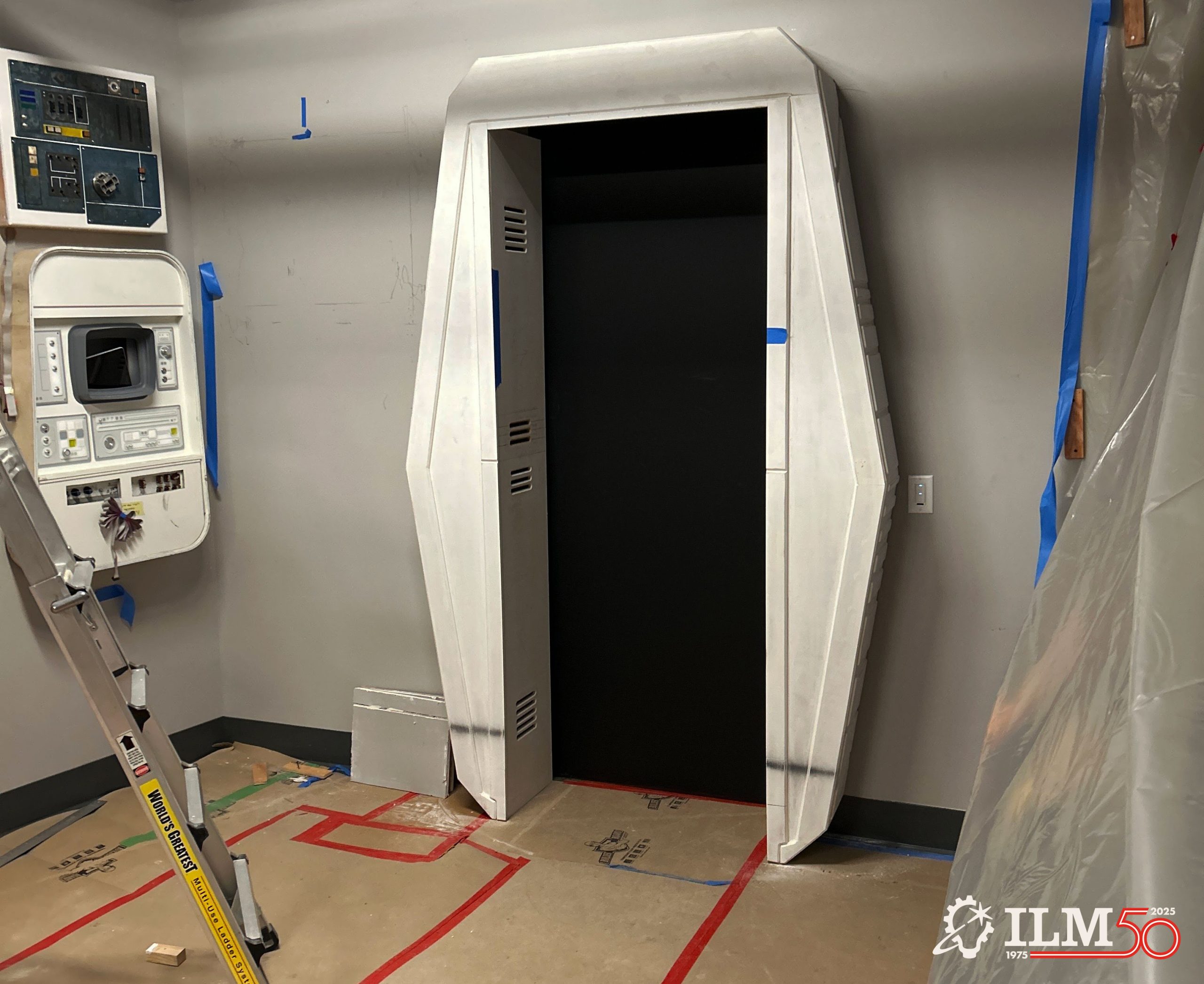
The Hideout’s entryway, custom-designed and built by Kyle Johnson (Credit: ILM).Panel sections under construction in the facility’s workshop. (Credit: ILM).
Johnson also developed the Hideout’s entryway. The original bookcase concept was adapted into a sliding door concealed as an Imperial propaganda poster, which Johnson designed in collaboration with Hidalgo, concept artist Katarina Kushin, and the Lucasfilm Art Department. The poster slides open to reveal a custom-made Imperial doorway. “You get the feeling like you’re entering another place, not just going through a door,” Johnson notes. “It’s 18 inches deep with lights on the side. You’re moving through a narrow tunnel, almost.”
Bringing the Room to Life
Another critical step in creating the Hideout was building and installing an electronic system to run lighting, sound, and video. Members of the ILM Electronics Club would take the lead for a number of these tasks, including systems engineer Trent Bateman and layout supervisor Tim Dobbert.
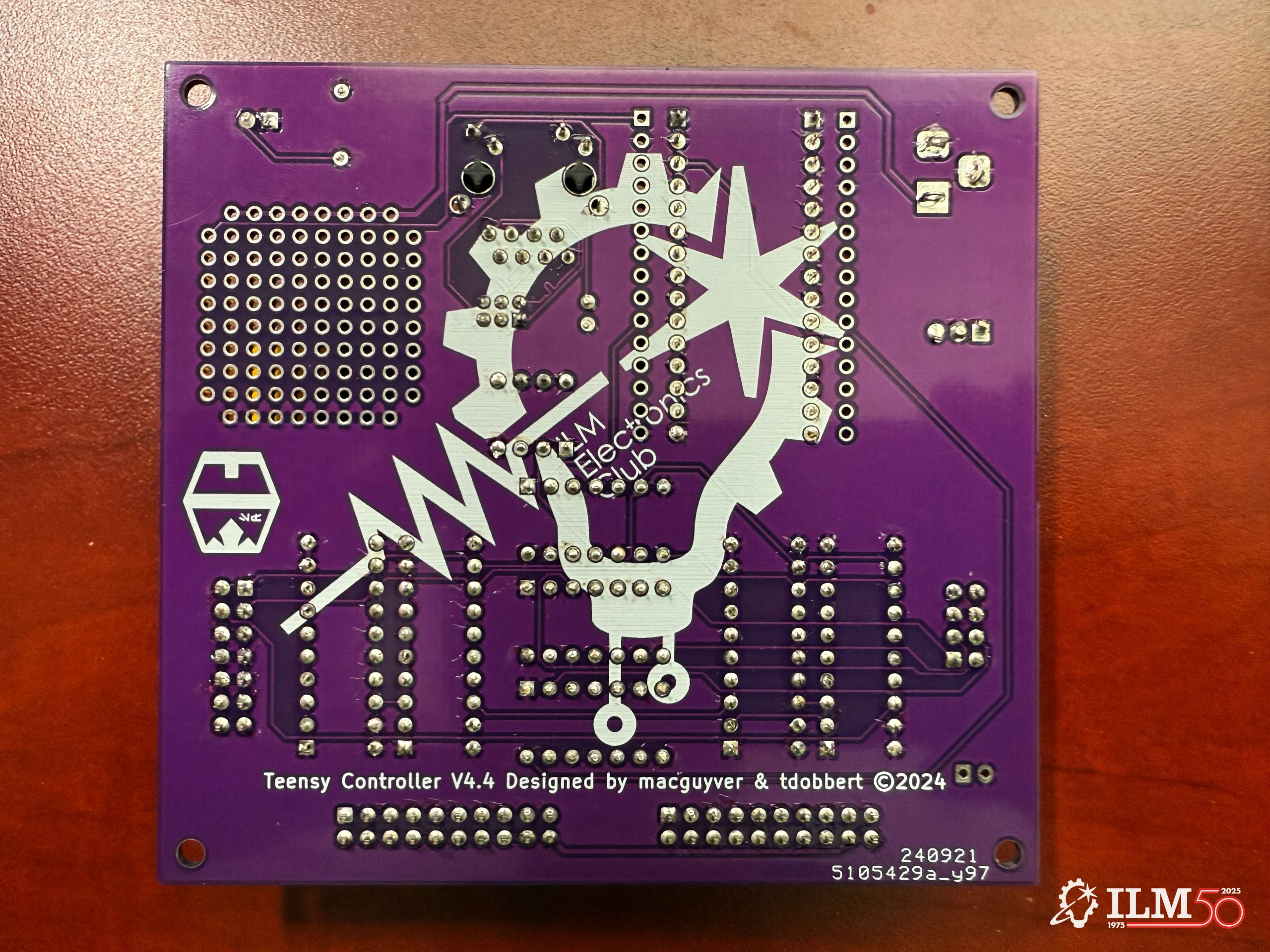
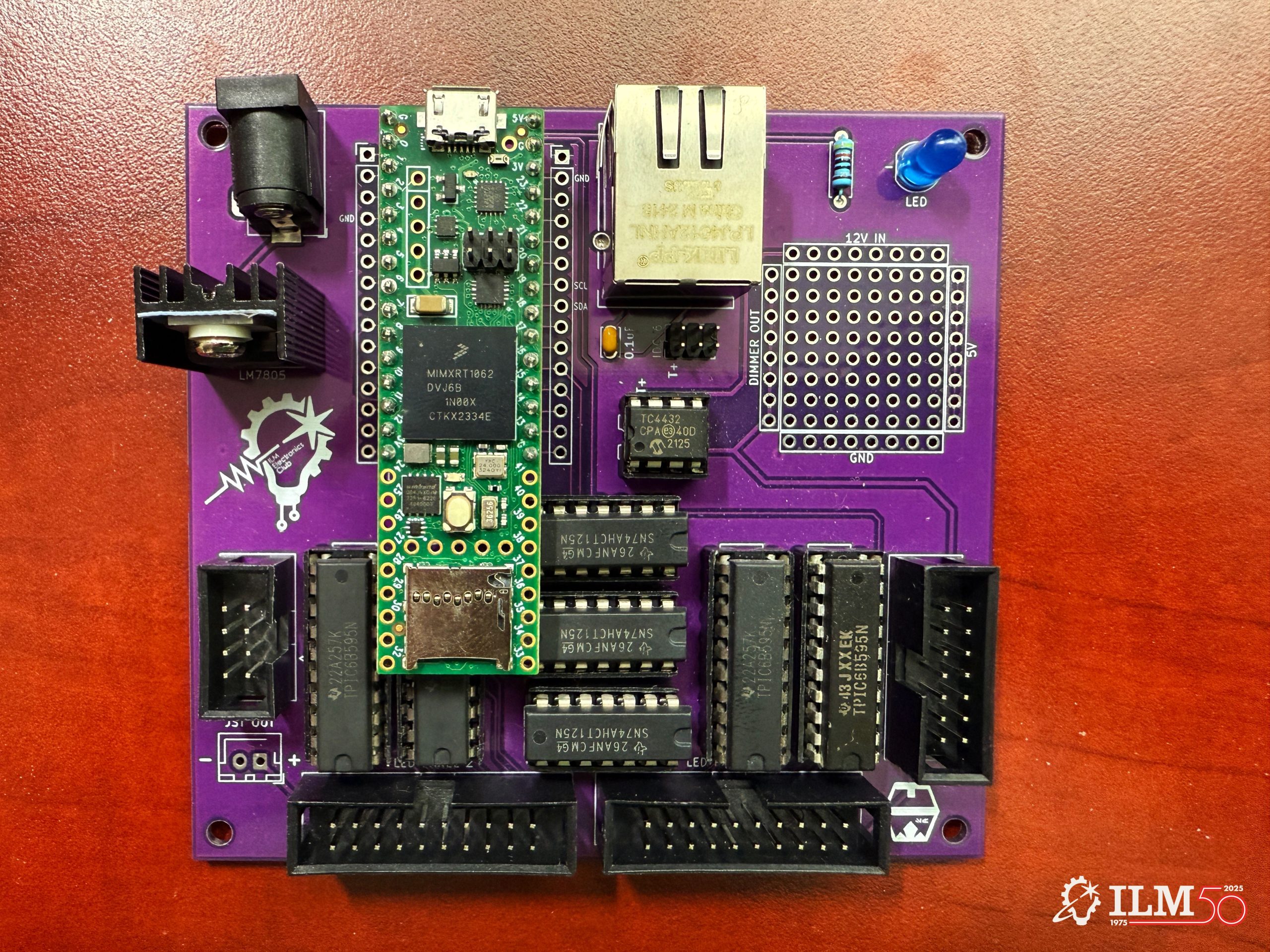
“My first project was helping to get the Millennium Falcon console online,” says Bateman. “Tim and I came in to figure out how to get the lights to simply work. We tried lots of different methods and couldn’t figure it out. Tim suggested that maybe these props were wired differently because they were made in the United Kingdom. So then we got it to light up, and we determined what the right voltages were. From there, we had to figure out how to make everything work. We developed several iterations of the circuit boards to find the best way to light everything without blowing the circuits or frying the micro-controllers. We had to build a network so that everything could talk to each other. That took about two months. Once that was in place, we replicated and grew the system across the entire room.”
An example of the custom circuit boards (both front and back) designed by Trent Bateman and Tim Dobbert for the Hideout (Credit: ILM).
Head of the Visual Effects Editorial Department for ILM’s San Francisco and Vancouver studios, Lorelei David, had joined the Electronics Club with no prior experience in the field. Mentored by her colleagues, she joined the Hideout team to help lead the hardware creation.
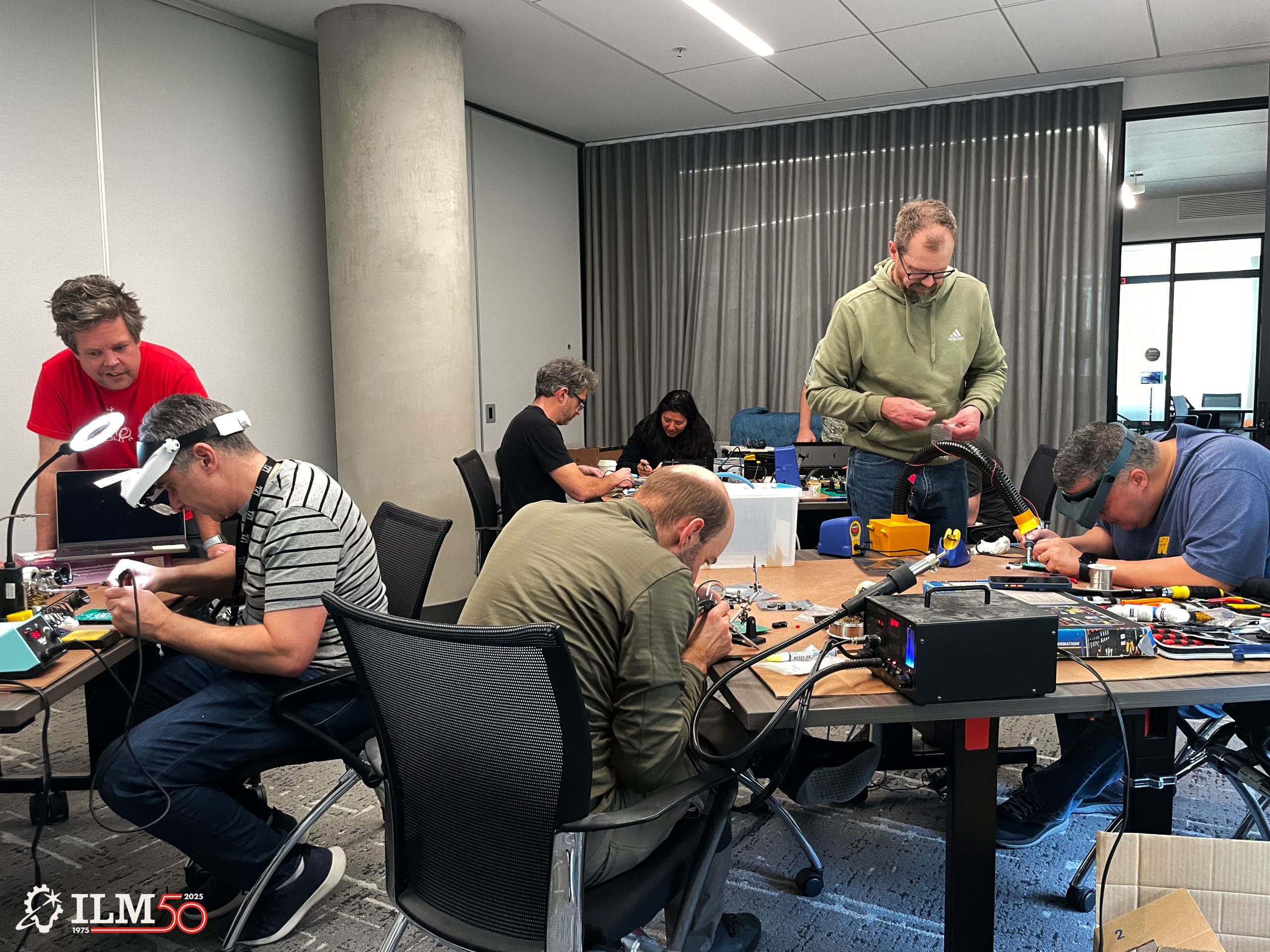
“Trent had the micro-controllers, and he designed these beautiful, custom circuit boards,” David says. “We realized it needed a lot of soldering, more than we could do on our own. That’s when we decided to have a ‘soldering party’ in a big conference room at the office. We invited anyone in the company who wanted to learn. We provided instructions, references on a screen, and examples for them to look at. It was a great opportunity to meet a bunch of people from across the company.”
Employees gather for a “soldering party” to help create the many circuit boards needed throughout the Hideout (Credit: ILM).
Media systems engineer Paul DeBaun, R&D principal engineer and architect Nick Rasmussen, and former AV design engineer Greg St. Germain took the lead on the audio and video systems, equipping iPads throughout the room to run everything from graphic displays to location views to static (all authentically sourced from Star Wars films). In addition to ship flybys and music features, the Hideout also includes a standard ambient soundtrack with various technological effects.
“We built a 10-channel speaker system out of old parts that we had on hand, including two subwoofers,” DeBaun notes. “We ran the wiring for the system throughout the ceiling and used QLab to run everything. We also worked on the dimmer packs for the lighting. There are about 36 channels of adjustable lighting patterns throughout the room.” Hirschfield adds, “We were perfectly willing to beg and borrow as much as we could. We had a budget, but we also kept finding these opportunities to adapt existing tools to make the room better.”
It’s All in the Details
Senior lighting artist Rebecca Forth had been leading set decoration since the beginning of the year, and now her sub-group worked to paint and detail props out in the hallway. “For me, this project felt similar to what it must’ve felt like to work in the ILM Model Shop back in the day,” Forth comments. “It felt like this was the closest I’d ever get to that tactile experience of putting your hands on everything, and making little mistakes that actually turn into a great feature. It was about having everyone together and trying to figure out how things would function.”
One of the last major steps for integrating details in the room involved a weekend visit from Robb De Nicola, Patrick Louie, and Max Frey from the Tom Spina Designs crew. They brought their expertise in custom design, painting, and weathering to help boost the team on their final push.
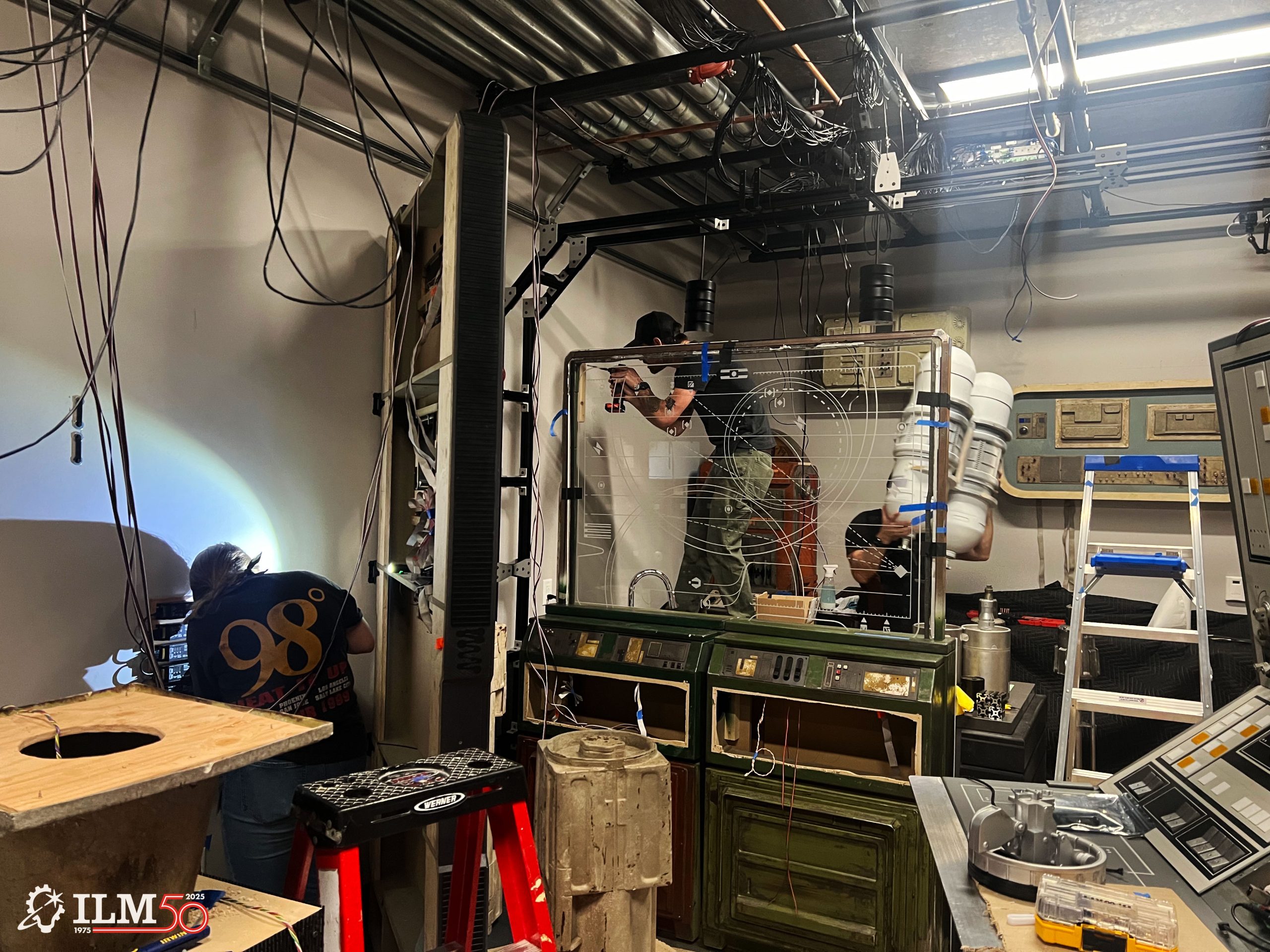
The crew at work installing set pieces, electronics, and other features (Credit: ILM).
Among the dozens of minute tasks the Spina artists performed was taking a snowtrooper helmet (one of many replica props donated by Lucasfilm’s licensing team) and aging it. “They spent maybe 30 minutes and came back with this snowtrooper helmet and had a wampa slash across the face, it was painted and weathered with dirt,” Jutan says. “Their skill was nuts.” Throughout their visit, they assisted the Hideout team in mining their leftover set pieces for greeblies and details that could be adapted into features for the room. “The lesson from that is we can use anything,” says DiComo. “If you mix things together the right way, it has that Rebel, scavenged vibe.”
“For the most part, we wanted to restore each item to look as it did on screen, as well as give it a longer life,” Forth explains about the many screen-used props incorporated into the room. “Many of these were built to last for the length of the shoot. One of the tougher projects was the pilot’s chair from Rogue One. There were some wooden pieces that had shattered, which we had to carefully glue back together. The cushions had been adhered with glue tape that was disintegrating, so we put in new velcro strips that could last much longer. The headrest had some missing hardware that needed to attach it to the base.
“We didn’t want to remove any intentional dirt or weathering from the items,” Forth continues. “This stuff had been in storage, so it had some real dirt and dust, but then it also had intentional dirt. You had to be really careful when you were cleaning so that you didn’t take that off. It was about restoring the piece and keeping intact the initial intention and craft of the artist who’d put it together.”
An example of the weathering detail applied throughout the Hideout (Credit: ILM).An original pilot’s chair from the Hammerhead Corvette that appeared in Rogue One: A Star Wars Story (2016). Its restoration was led by Rebecca Forth (Credit: ILM).
Practically everything, save one Andor piece dubbed “Admiral Snackbar” by the team, required extensive reconstruction or modification. “It’s all MDF [medium-density fibreboard] and staples,” notes Johnson. “There were a lot of weird structural requirements involved to make things durable and functional. We had to tear stuff apart and reframe it to support more weight.”
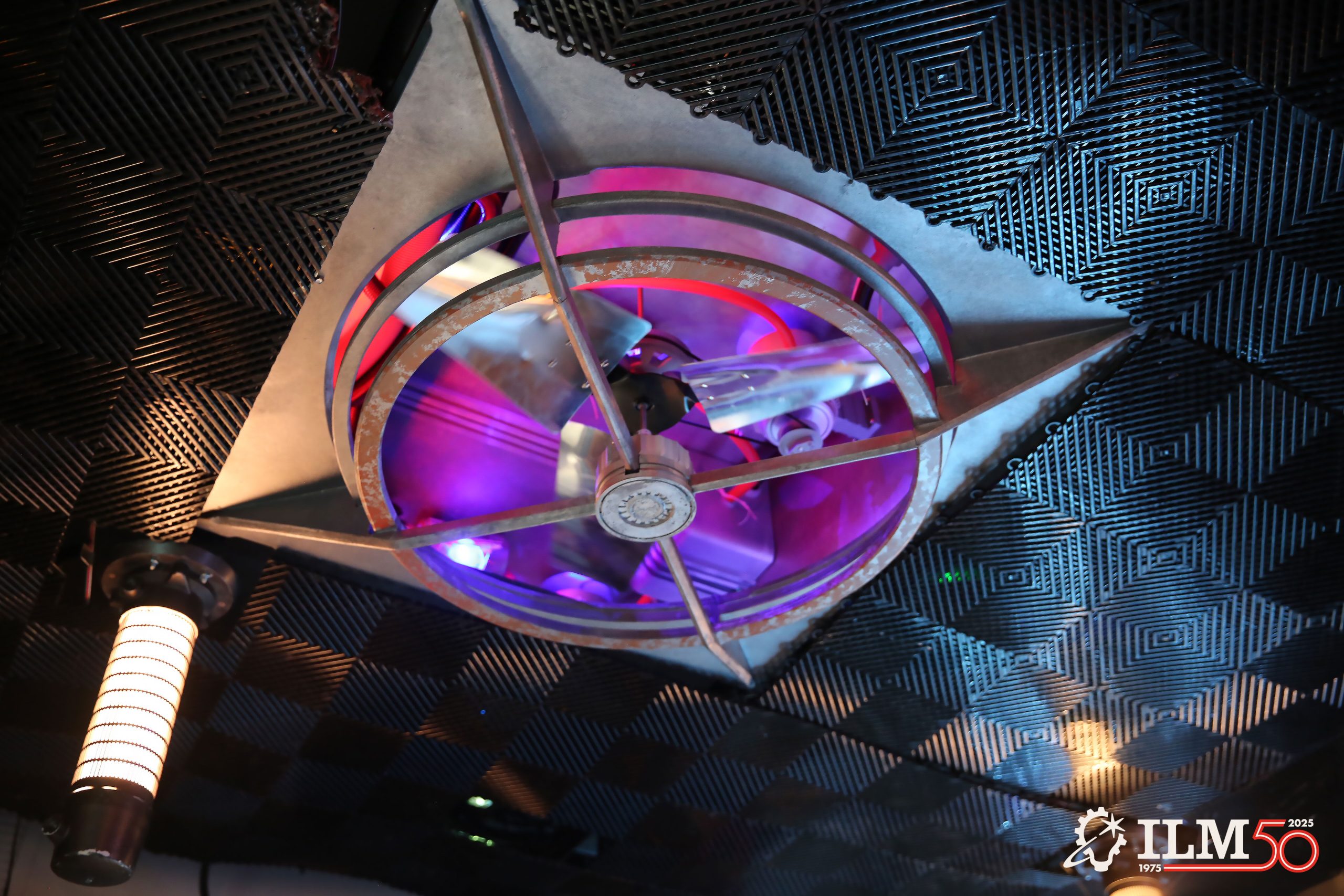
An entirely original piece in the Hideout was an industrial-style fan in the ceiling, an idea that dated all the way back to Field’s original safehouse concept. “I really wanted to make sure that something was moving,” says DeBaun. “Most everything in the room is still, except for the fan.” Using a fan acquired by Hirschfield and a cover made by Johnson, DeBaun mechanized the piece to spin gently, adding tubing and related detail inside the fan’s housing. As an accompaniment, he went to even greater lengths to create a self-described “impossible shadow” on the floor.
“We can’t physically make that shadow in the space because of the height of the ceiling,” DeBaun explains. “So we project the shadow to spin in time with the fan’s rotation position so that it matches.” The result is a subtle but poignant accent that pulls the room’s many details together in a believable way. “It has a lot of capability to tell a story,” DeBaun notes, who hopes to incorporate a new passing shadow effect within the year. “No one talked about doing all of that,” adds DiComo. “Paul just dreamed it up and did it. A rudimentary sketch became this unbelievable thing.”
The rotating industrial fan and its projected “impossible shadow” effect (right) were chiefly created by Paul DeBaun (Credit: ILM).
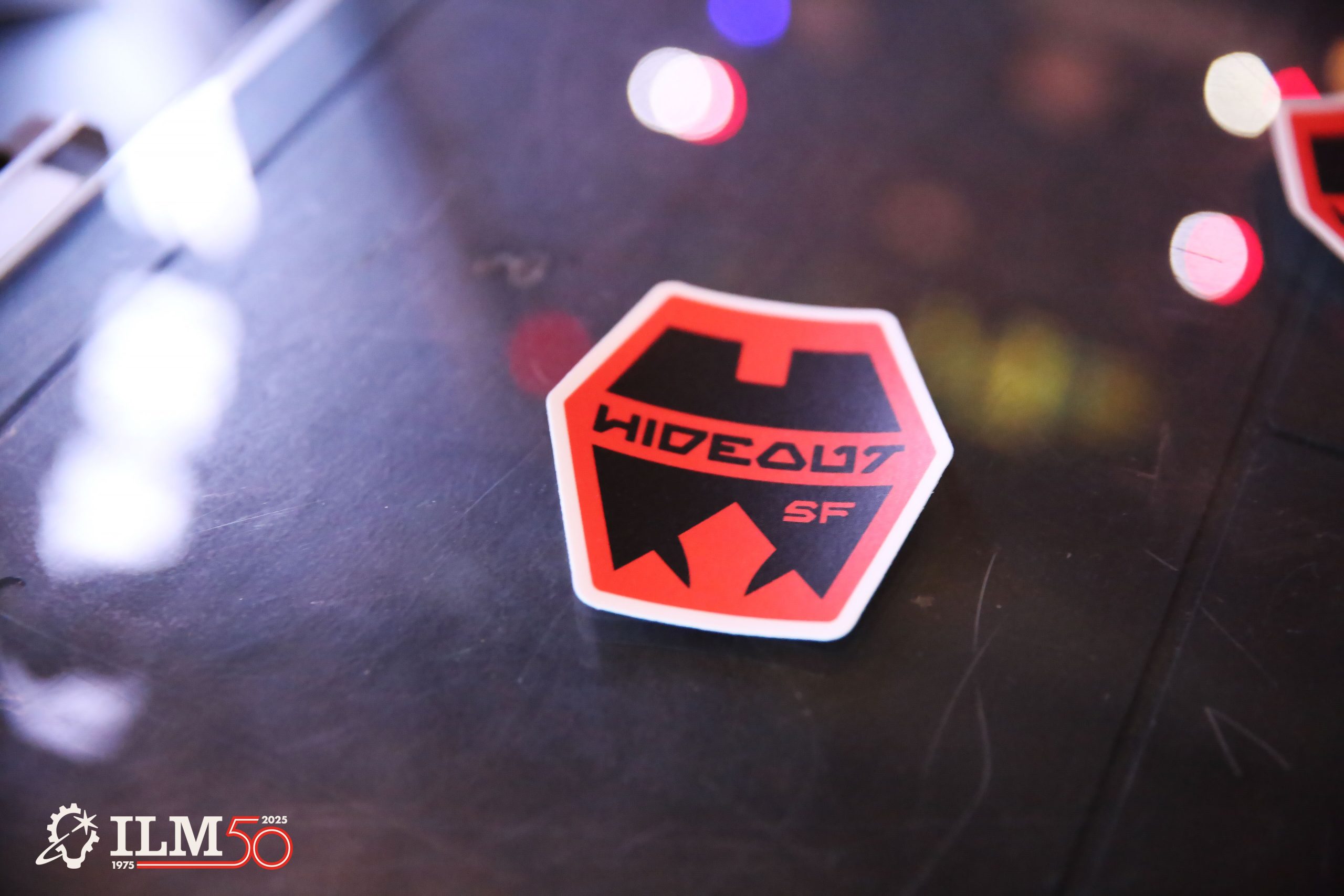
The Hideout team also knew that they wanted a unique insignia for their space, another project that Johnson took the lead on, working with associate producer Michelle Thieme, executive design director Doug Chiang, and other members of the Lucasfilm Art Department. Inspired by the shape and silhouette of the iconic Yoda Fountain at the entrance to the Letterman campus, Johnson describes it as “our signet,” in reference to the icons used by characters in The Mandalorian (2019-23). (Jennifer Foley, manager of Lucasfilm’s Company Store, even ensured that special crew shirts would be available for the team within a matter of days.)
The Rebel Hideout’s emblem (Credit: ILM).
The Circle is Now Complete
Over weekends, late nights, and even the morning of the Hideout’s debut, the team worked tirelessly to complete the room. After many unexpected challenges and a massive amount of work – all accomplished in addition to the team’s regular day jobs – the Hideout’s opening in May 2024 was a resounding success. Since then, it’s hosted not only casual meetings and hangouts for employees, but interviews, portrait shoots, family tours, and parties. “Sometimes parents are more excited to see the Hideout than kids are,” says David with a laugh. “On one tour, we had a group of kids, and they were running all over, pushing all of the buttons. It was a good way of testing out the room’s durability.”
(Credit: ILM).
“We don’t want this to feel like a museum where you can look but not touch,” Bateman adds, explaining various updates that continue to be incorporated into the room. “We want visitors to feel like they are actually in Star Wars, and that means allowing them to not only play with the props, but for the props to play back. To that end, we’ve worked together to come up with various Easter eggs throughout the room (like a ‘Red Alert’ siren and ‘Disco Mode’), as well as more involved additions like a ‘Rebel DJ’ activity where guests can use switches on the Millennium Falcon console to compose music.” Updates and revisions have continued, and have even inspired ideas for entirely new themed rooms.
Employees gather during the Hideout’s unveiling in May of 2024 (Credit: ILM).
Channeling the spirit of ILM’s fun-infused, creative culture that has endured for half a century, the Rebel Hideout is a full-circle achievement, maintaining the company’s storied identity in a brand-new way. “‘Ego-less collaboration’ is the phrase we use all the time,” DiComo adds. “It’s who we are. When you have something special like the Hideout, it amplifies the whole feeling. This is why I’ve been here for 30 years – the spirit of these people.”
“This has been like an old-fashioned barn-raising,” Jutan concludes. “Everyone pulls together to create something that’s much more amazing than its individual parts. It’s like every movie and visual effect that we make. One of the first times we toured [Lucasfilm senior vice president of creative innovation, digital production and technology] Rob Bredow through the room, he said that the project was done purely in ILM’s style: If a project is worth doing, it’s worth over-doing.”
(Credit: ILM.com).
—
Lucas O. Seastrom is the editor of ILM.com, Skysound.com, and a contributing writer and historian for Lucasfilm.
New details from ILM’s new 50th anniversary book written by Ian Failes have been unveiled.
Packed with hundreds of rare behind-the-scenes photographs and archival artwork, 50 Years of Innovation combines ILM’s distinct history of artistic and technical achievement with the inspiring stories of the people who’ve made it all possible. Dozens of both historic and newly-conducted interviews bring rich insight into ILM’s unique process that has shaped the visual effects art form and global filmmaking industry for half a century.
ILM’s story is one of equal parts change and consistency. Through constant evolutions in tools, techniques, and stories, the company’s artists and engineers have maintained their dedication to the highest standards in quality and innovation. 50 Years of Innovation sheds light on the characteristics that have empowered ILM to reach the half-century mark, and that will continue to guide the company into the next 50 years.
Celebrating Ten Years of Immersive Entertainment at ILM
By Amy Richau
“ILM Evolutions” is an ILM.com exclusive series exploring a range of visual effects disciplines and highlights from Industrial Light & Magic’s 50 years of innovative storytelling.
In immersive stories, the fan is the hero.
Industrial Light & Magic (ILM) has always been at the forefront of innovation, drawing audiences into new worlds by pushing technological boundaries. As part of our special series, “ILM Evolutions,” ILM.com talked with Vicki Dobbs Beck (vice president, immersive content innovation), Julie Peng (director of production), Tim Alexander (visual design director), Ben Snow (senior visual effects supervisor), and Shereif Fattouh (executive producer) about the past, present, and future of ILM’s immersive storytelling.
ILM’s LiveCGX team, including visual effects supervisor Mohen Leo (bottom).
A New Way to Tell Stories
“Let’s invite our fans to step inside our stories in ways that had never before been possible.”
– Vicki Dobbs Beck
While ILMxLAB was formally established in 2015 to explore the possibilities of immersive storytelling, the seeds of this endeavor actually began much earlier for Vicki Dobbs Beck. In the 1990s, Beck worked at Lucasfilm Learning, where a certain prototype caught her attention. “It was called Paul Parkranger and the Mystery of the Disappearing Ducks,” Beck tells ILM.com. “And what was really cool about all of the projects we were doing at that time is they really did sit at the intersection of storytelling, interactivity, and high-fidelity media – such that it was back then – all through an educational lens.”
Fast-forward to Beck’s time at ILM as head of strategic planning, she started bringing together talent from ILM and LucasArts (now Lucasfilm Games). “It was kind of this little rebel unit that was doing some pioneering R&D [research and development] in high-fidelity, real-time graphics,” says Beck. “Their success gave us confidence that the foundation was in place to build an immersive storytelling studio, expanding on the R&D work done by teams like the Lucasfilm Advanced Development Group (ADG).”
In 2015, ILM and Lucasfilm announced the formation of ILM’s Experience Lab (ILMxLAB) – a new division that would combine the talents of Lucasfilm, ILM, and Skywalker Sound. Lynwen Brennan, then Lucasfilm executive vice president and ILM president, announced that “The combination of ILM, Skywalker Sound, and Lucasfilm’s story group is unique and that creative collaboration will lead to captivating immersive experiences in the Star Wars universe and beyond. ILMxLAB brings together an incredible group of creatives and technologists together to push the boundaries and explore new ways to tell stories. We have a long history of collaborating with the most visionary filmmakers and storytellers, and we look forward to continuing these partnerships in this exciting space.”
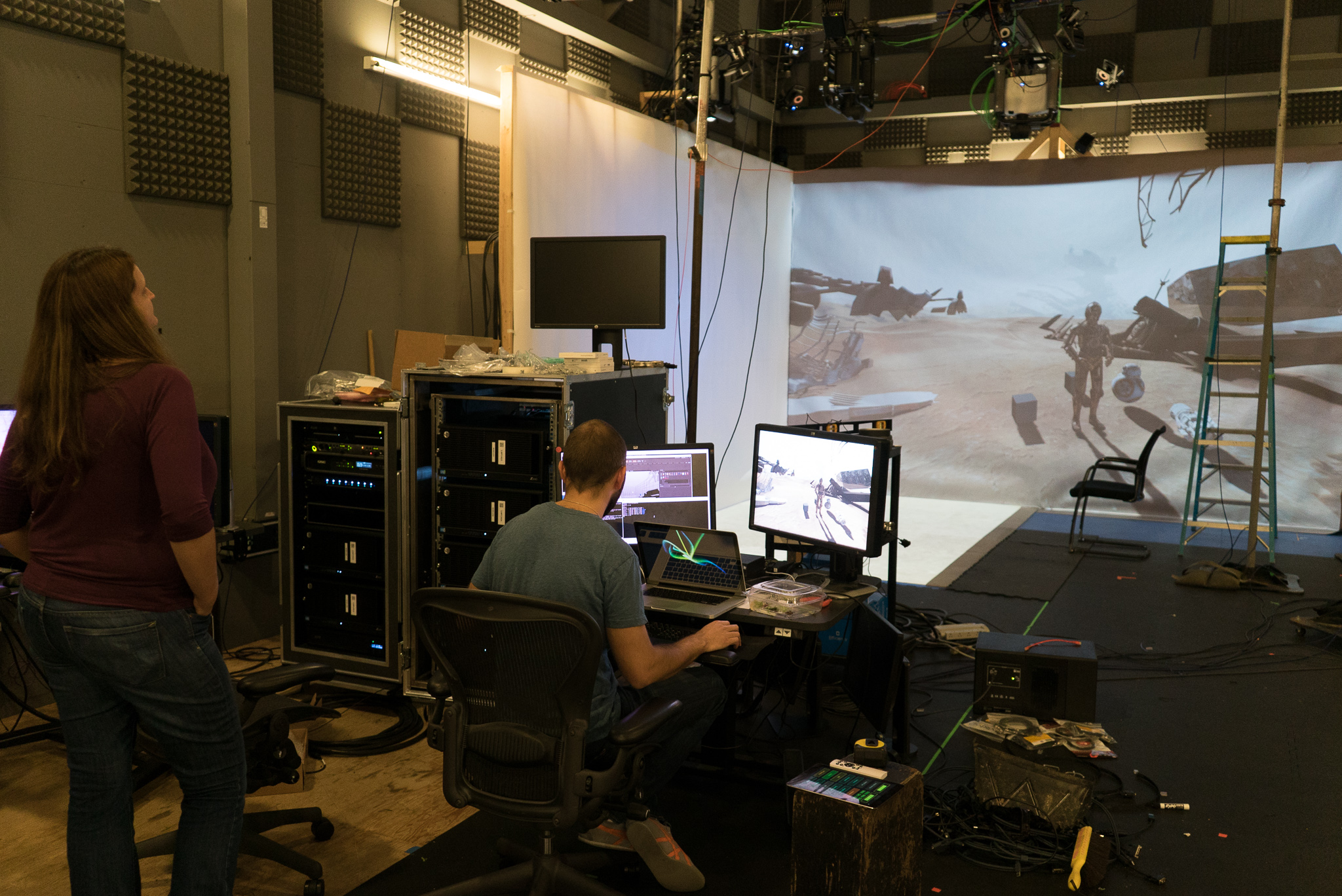
The Holocinema team.
From its inception, a studio telling immersive stories with emerging technology platforms made ILMxLAB an appealing destination. Julie Peng, who worked in Lucasfilm Animation as a production manager for projects like Star Wars: The Clone Wars (2008-13) and Strange Magic (2015), was looking to break into the emerging interactive storytelling space when she received a call about a new ILM division that would focus on technology like augmented and virtual reality. “When we started, we were five people,” remembers Peng. “I did my best to take care of any need that arose, big and small, from developing the production infrastructure to writing job descriptions, to ordering pizza and running to the store for batteries. It was about doing whatever was needed to build a team and start exploring what we could bring to the immersive entertainment space.”
In 2016, the studio debuted its first VR experience, Star Wars: Trials on Tatooine, where the Millennium Falcon lands in front of players, and they help R2-D2 and Han Solo with repairs. This was an important step in the studio’s goal of creating a living world. “Everybody was just so blown away by the scale,” says Beck, “because that’s something that VR is so good at – delivering scope and scale.”
Looking to the future was also always a part of the plan. “Because we were so early in the whole immersive storytelling space, we really wanted to help drive the industry,” says Beck. “So we actually very consciously shared our prototypes in public. We spoke about them. We made them available to people because we wanted to actively inspire others to create in this space alongside us.”
Over time, the team evolved into a mix of creatives from the film industry and people with backgrounds in games and interactive development. While bringing in developers with both backgrounds was essential, it also brought challenges for Peng in her role as production manager. “Early on, I realized that they spoke two different dialects,” says Peng. “They used similar terminology, but their approaches to making a creative product were quite different in terms of process and priorities. I found myself becoming a bridge, translating concepts and driving the development of a common language so we could all communicate effectively.”
The team also had to be comfortable with fluidity as the technology they were working with was constantly evolving. Peng noted staying abreast of what was going on in the industry was key, as well as the leadership team being willing to take some risks. “I always call it ‘holding hands and jumping off the cliff together’.”
The First Big Leaps
“It [VR] really is like stepping into a different world, and it feels totally natural once you’re there.”
– Julie Peng
Visual effects supervisor Tim Alexander became involved with ILMxLAB after a history in traditional visual effects, including the 2015 blockbuster Jurassic World. He was also a lifelong gamer intrigued by the work ADG was pioneering at the time: bringing real-time, game engine-type techniques into visual effects. When director Alejandro G. Iñárritu approached ILM about a collaboration on a virtual reality project, Alexander came aboard as visual effects supervisor. The result was CARNE y ARENA, which debuted in 2017.
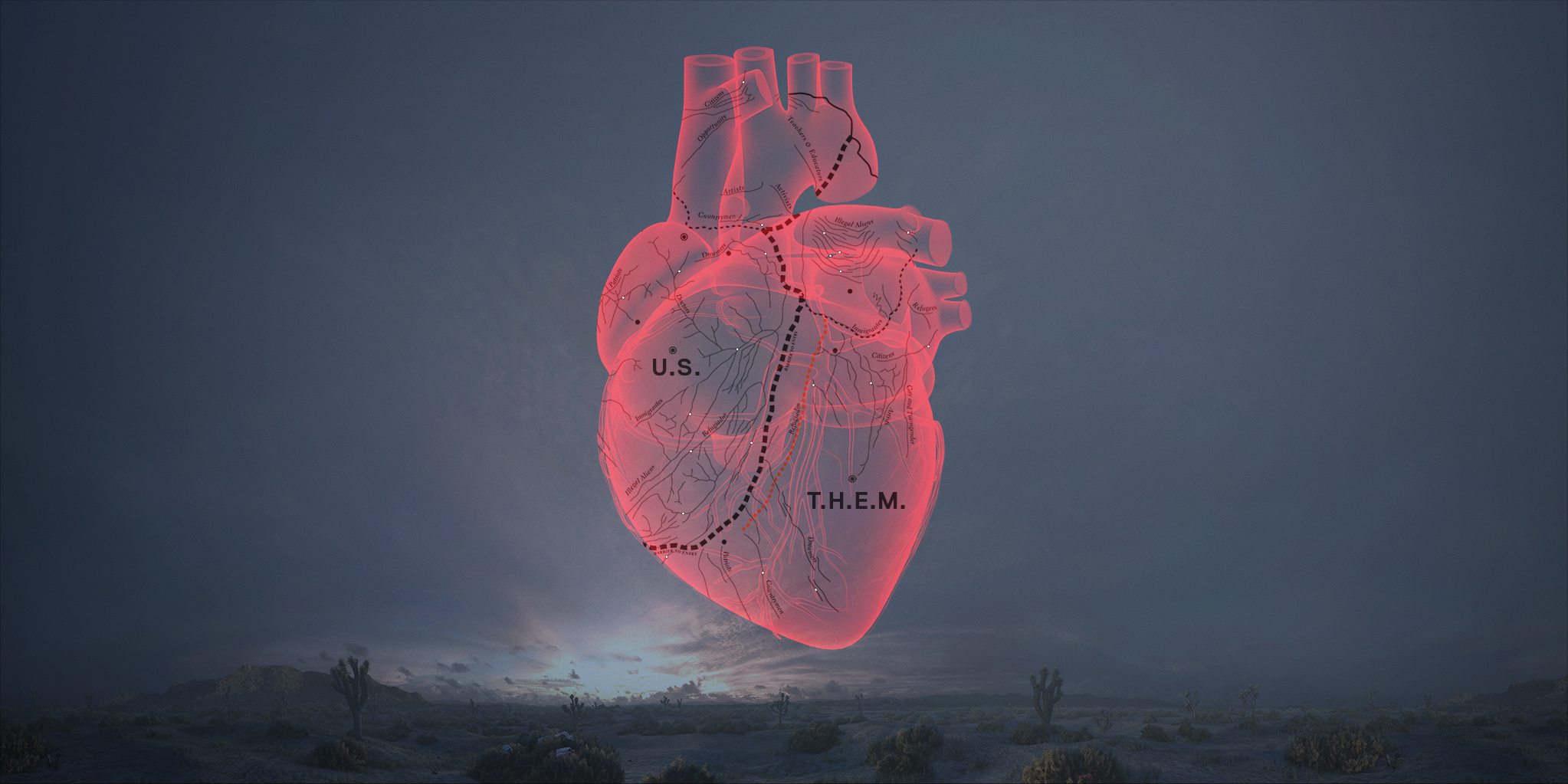
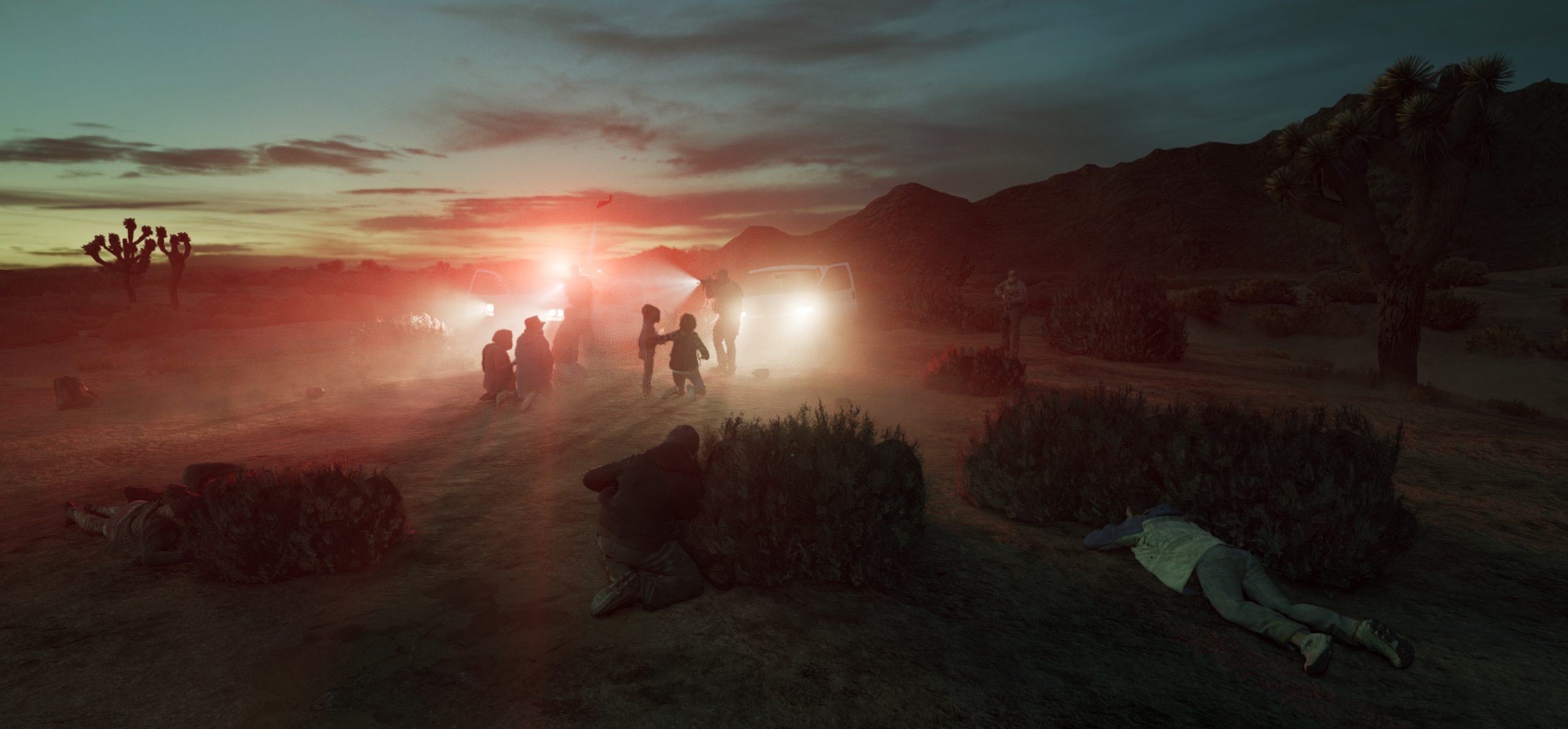
Still early in ILMxLAB’s history, CARNE was an ambitious project involving a short VR piece bookended by physical experiential rooms that put the audience into a story of immigrants being detained while crossing the border from Mexico to the United States. At the beginning of the experience, participants are brought into a physical holding cell (where the temperature inside is cold) where they have to remove their shoes and items like backpacks. “There are ambient noises and real artifacts like abandoned shoes that have been found in the desert, from people crossing,” notes Alexander.
The key art for CARNE y ARENA.
Participants are fitted with a VR headset and led barefoot into a 50-foot-by-50-foot room full of sand. In the VR portion of the experience, they assume the role of a group of immigrants attempting to cross the U.S.-Mexico border at night when they are stopped by U.S. Border Patrol agents. After the VR story, participants exit and are led down a hallway where video monitors play interviews of the real people CARNE is based on. “He [Iñárritu] cast people that had crossed the border as the people within this experience and wove a story around that, so you actually see the real people and hear their experiences,” says Alexander.
CARNE was a challenge from an artistic and engineering standpoint. What Iñárritu and Alexander wanted to do was sometimes hindered by the current technology. Wanting the images to appear as photoreal as possible, the team realized the immersive film’s computing requirements outweighed what was possible in headsets at the time, so Lutz Latta, ADG graphics engineer, designed a supercomputer with four high-end GPUs (graphics processing unit) to handle work such as calculating shadows in the film.
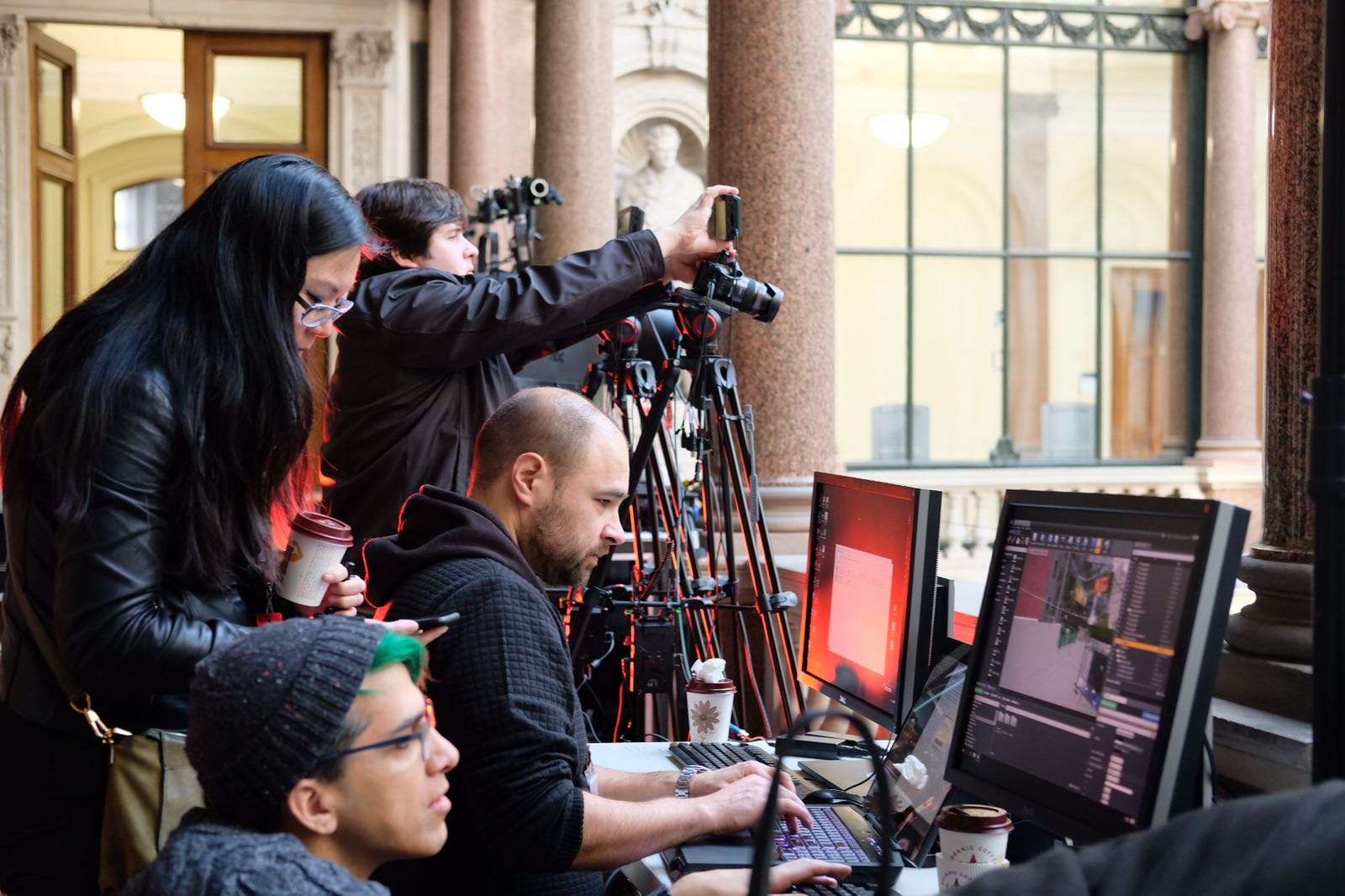
Other challenges included allowing participants to traverse and turn around in a 50-foot-by-50-foot room. “At the time, there was no way to really run a VR headset over more than 100 feet. You were lucky if you could get five feet away because of the HDMI cables and all kinds of things,” remembers Alexander. VR tracking abilities at the time were also far below where ILM’s engineers wanted them to be. “So then we started mixing in stuff that we know from visual effects of how to track cameras in large spaces. A motion capture stage was built to track the headset instead of what we would usually track the camera in. So it started becoming a mixture of different things that we knew how to do for different reasons, and kind of applying it to this situation.”
A final frame from CARNE y ARENA.
The newness of the technology and the goals the team wanted to achieve with CARNE meant everyone had to adapt and be ready for anything. “It was the first project in my career that I was actually concerned that I would not be able to deliver,” says Peng. “Because in all of my past projects, I would have a production plan, A, B and C, D and E in my back pocket. We were working with new technology and making something that had never been created before. There was no model of how to do that, which made me feel like I was operating without a parachute. That can be very nerve-wracking but also exhilarating when you actually finish the project. That sense of completion and accomplishment was huge.”
Audience reactions to the very visceral experience were all over the map. “We had people that really wanted to get into the middle of it, and they would look at every character and perhaps even jump behind a virtual bush to hide, while others might hang back to observe the scene, whether due to fear or other emotions that came up,” says Alexander. “The overall sense that I got was that people really understood what Alejandro was trying to say,” notes Alexander. “They heard it, and they understood what he was trying to express through that story.”
The studio’s debut with The VOID, Star Wars: Secrets of the Empire, also took place in 2017. At The VOID, up to four fans would suit up with their gear: a VR headset connected to a backpack laptop and haptic vest. From there, teams of fans were immersed in ILM’s digital world; in this case, Secrets connected to Rogue One: A Star Wars Story (2016), giving fans an adventure of a lifetime on Mustafar near Vader’s castle. While infiltrating an Imperial base, they would traverse the facility together and try to recover a key artifact.
Dropping Into the Story
“If we’re creating an experience, we want people to feel like they’re genuinely in a Star Wars project.”
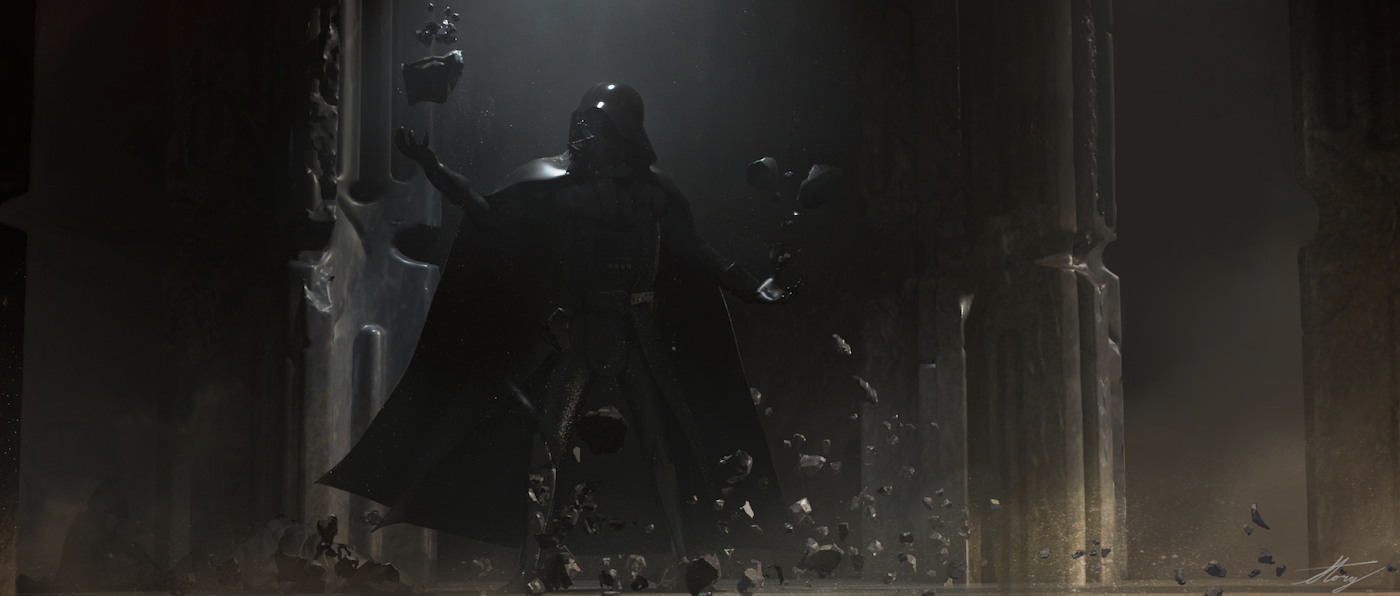
While working on Secrets of the Empire, Ben Snow (visual effects supervisor for Star Wars: Attack of the Clones [2002] and Iron Man [2008]) was recruited to work on a connected story that was in development for home use, Vader Immortal. In the project’s early days, a prototype was put together to see what it was like to be in the same (virtual) space as Darth Vader – spoiler: it’s terrifying. At the same time, Oculus was quietly working on the first Quest headset, revolutionary with its tetherless execution, which ultimately influenced the amount of lightsaber play in the story. The stars and companies aligned, and Oculus Quest became the platform partner for release.
In Vader Immortal, fans take the role of an unnamed pilot who finds themself inside Darth Vader’s castle on Mustafar. The fan’s interactions with Vader were, of course, key to the success of the project. “Mustafar should be scary,” notes Snow. “The confrontation of meeting Vader should be scary. Because that’s what he is.” The Immortal team used scans of Vader’s costume from Rogue One (based on the original 1977’s Star Wars: A New Hope) and built on them with new scans to push the realism even further.
Concept art from Vader Immortal: A Star Wars VR Series by Russell Story.
The team worked internally with Lucasfilm to develop story ideas for three episodes. David S. Goyer,screenwriter of The Dark Knight Rises (2012), wrote scripts around them, injecting his own characters. These were similar to traditional film scripts, which then had to be made more interactive by adding lines of dialogue for the fan to perform certain tasks. The production brought together the film and games world as they put it all together. “In film visual effects, you get a script, you break it down. These are the assets you have to build,” explains Snow. “Interactive entertainment is much more free form and evolutionary. It was an interesting blend between those two mediums.”
The goal with Immortal was always the same: create an experience unique to virtual reality that you couldn’t experience by watching a movie. “One of the things that excited us,” says Snow, “was this was a chance to eavesdrop on Vader a little bit. We had the moment where Vader takes off his helmet, and he’s looking at a memory, almost, of Padmé. You’ve been climbing around, find yourself in Vader’s chamber, and you’re peering through these walls at him. We felt that moment of actually being an interloper, and seeing a side of the character you hadn’t seen before was something that was unique to what we could do in VR.”
Another element distinct to Immortal was making Vader the fan’s own teacher during the experience. The Sith Lord’s introduction is fittingly terrifying for such an iconic character. Initially, when Vader stepped up to the fan, he had a few lines of dialogue. But those lines were eventually cut after some internal tests of the experience. “Vader’s in the distance, and he comes toward you, and you hear the heavy breathing and footfalls,” says Beck, “and he keeps walking toward you, and it becomes more and more intimidating. Almost no one heard the dialogue because you’re so overwhelmed by his presence that it’s all that you can absorb.” Adding to the power of that moment was the eye-tracking in the experience, so no matter the height of the fan, Vader was looking right at you. “And the fact that you’re being acknowledged by a character like Vader is just mind-blowing,” adds Beck.
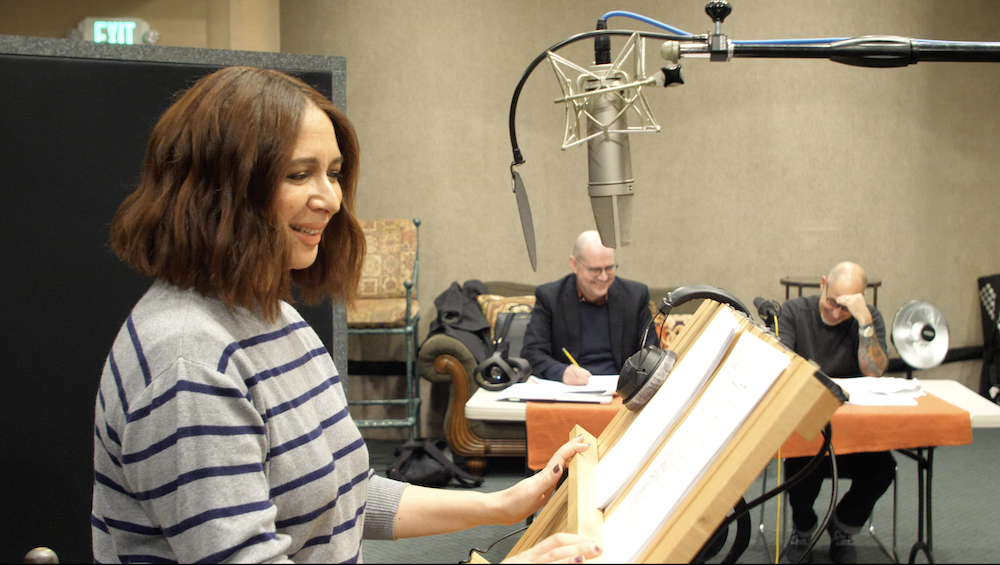
Actor Maya Rudolph (left) performs the voice ZOE-3 in Vader Immortal as director Ben Snow (middle) and writer and executive producer David S. Goyer look on.
Shereif Fattouh came to ILM from an AAA games (high-budget, high-profile games from large studios) background, working on titles like Battlefield and Dead Space at Electronic Arts. Interested in story-driven projects, Fattouh worked on The VOID projects Ralph Breaks VR (2018) and Avengers: Damage Control (2019). The development of a new headset, the Apple Vision Pro, led to Fattouh’s involvement in What If…? – An Immersive Story (2024), an experience that uses both mixed reality and virtual reality in addition to hand and eye-tracking through Apple’s innovative headset technology.
Marvel Studios’ What If…? series gave the developers a great amount of freedom in one of the most popular story worlds on the planet – the Marvel Cinematic Universe. “What If…? is such a great vehicle from the comic books and then to the animated show, where you get to just play in a sandbox,” says Fattouh. “What if this happened, and it’s a completely different version of it, and that kind of creative freedom just allowed us to tell the story that we wanted.”
Similar to previous ILM projects,the What If…? team was working on a project without the tech they would need to bring the experience to fans, as the Apple Vision Pro was being created in parallel. “We started development really early on,” says Fattouh. “It was a great collaboration with Marvel Studios, Disney+, and Apple, but we were definitely doing early, early testing and kind of figuring it out as we went.”
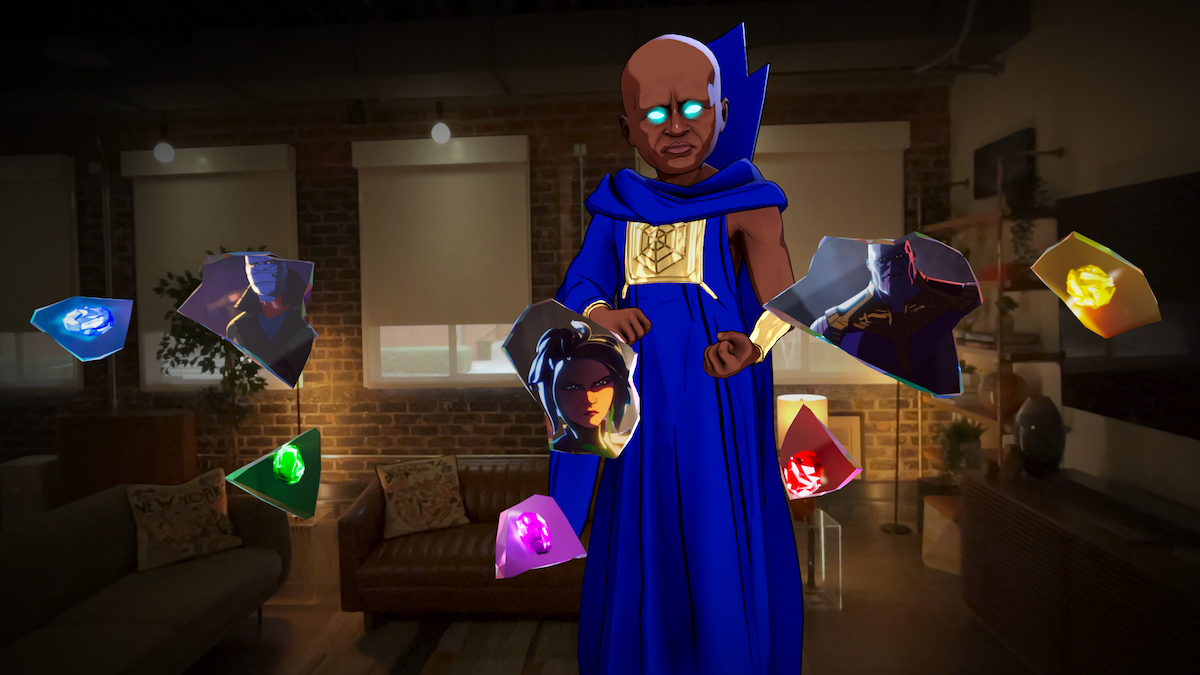
A final frame from What If…? – An Immersive Story.
What If…? – An Immersive Story took about 18 months from the conception of this particular idea as an experience to arriving in fans’ hands. Getting there involved finding the balance between the fans watching the story unfold and directly engaging with the characters and environments. “It’s really subjective,” says Fattouh. “There’s no right answer. How much do we want the audience to really observe this amazing story that’s being told and being kind of talked at versus going in and doing things and impacting the narrative? So that was really one of the biggest challenges throughout the whole life cycle. Playtesting it and figuring out, ‘Okay, is it feeling right? Is this beat too long? Is it too short? Do we want to have people jump in and get into the action a little bit faster?’”
During What If…? – An Immersive Story,the Watcher enters the room where a fan is situated. Throughout the story, fans see and interact with versions of some of their favorite Marvel heroes and villains, including Wong, Thanos, Hela, and Wanda. Fans are active participants in the story and get to use iconic items from the Marvel universe, like the Time Stone, to move the story forward.
Fattouh also notes how What If…? gives fans a unique way to experience a familiar Marvel moment near the beginning of the experience. “You don’t really know what’s going on because it starts with a disembodied voice, and you’re in space,” says Fattouh, “and then we kind of kick off in a very Marvel way, where it has that iconic Marvel logo flip book entry. But we did a very 3D spatialized version, where it’s coming into your living room. Just getting to see the smile on people’s faces when they saw something they’ve seen a lot in the films, but to see it really coming out in your living room … it set the right tone of, ‘Oh, this is something different.’”
Marvel director Dave Bushore (center) confers with Immersive crew members during production of What If…?, including: Maya Ramsey, Patrick Conran, Marissa Martinez-Hoadley, Indira Guerrieri, and Joe Ching.
What the Future Holds
After ten years, the team remains small, retaining its nimbleness on a quest for innovative excellence. Working with multiple partner studios and collaborators, the immersive team staggers projects, with typically two in production at a time, and with a production timeline of between 12 to 24 months. “I think over time, our goal will be to expand that capacity and capability,” says Beck. “It might mean expanding it in other studio locations – maybe in London or in Vancouver. The size of the team we have is really nice because everybody knows each other. We can iterate together, and that’s a really important part of interactive, immersive experience development.”
The immersive team has high hopes looking to the future as the technology reaches a wider group of people. “Venues like Star Wars Celebration are always amazing,” says Peng, “because the technology is still growing, and it gives us a chance to share our stories directly with fans. It’s also rewarding to see the accessibility of our experiences making it feel entirely organic and inclusive for everyone.”
Beck looks forward to hands-free AR glasses that can deliver a high-fidelity image with a wide field of view. “We are very excited about this idea of storyliving at city or world scale,” says Beck. “Geo-located content where you could be out in the world in your glasses and little story moments would unfold in the real world.” Beck also sees more people who don’t consider themselves gamers gravitate towards immersive stories. “And I think that’s really great for us because we’re interested in that intersection of story and interactivity and putting you at the center of that experience.”
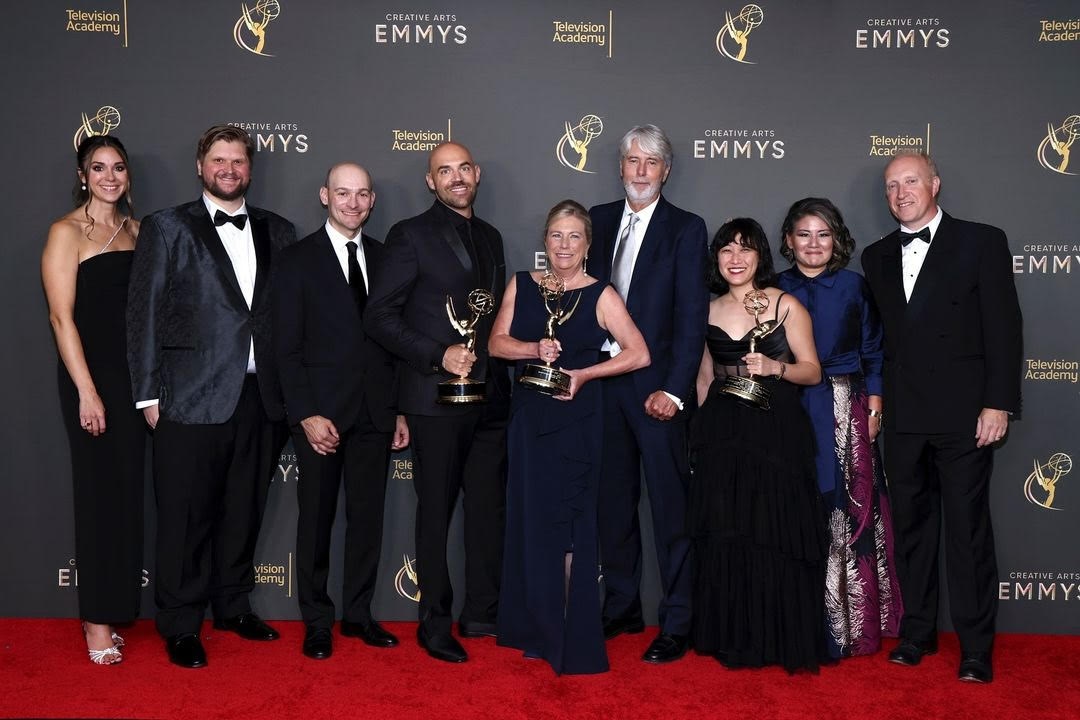
ILM’s team on What If…? won an Emmy for Outstanding Innovation In Emerging Media Programming. From left: Elizabeth Walker, Ian Bowie, Lutz Latta, Marvel’s Dave Bushore, Vicki Dobbs Beck, Mark Miller, My-Linh Le, Julie Peng, Pat Conran.
Looking ahead, the future of immersive stories is limited only by the imaginations of writers, designers, and engineers devoted to bringing these experiences to audiences. “I think that there’s a huge opportunity for ILM in immersive entertainment broadly defined,” notes Beck. “When we first started, the word “immersive” almost always meant virtual reality, then it included augmented reality, and eventually mixed reality. But now, it’s being used to include linear content or pre-rendered content, but that’s very immersive through screen technology, like Abba Voyage (2022), as an example. The opportunity is to take our talents across the global studios, which include the highest quality visuals and sound, and couple that with the real-time understanding and capability, bringing those things together. I think that we’re going to start to see an increasing desire for interaction, where you are actually in an experience, doing something meaningful that makes the overall experience even more personal. And beginning to understand what that is and taking steps toward a storyliving future. I think that’s the big opportunity for ILM.”
– Amy Richau is a freelance writer and editor with a background in film preservation. She’s the author of several pop culture reference books including Star Wars Timelines, LEGO Marvel Visual Dictionary, and Star Wars: The Phantom Menace: A Visual Archive. She is also the founder of the 365 Star Wars Women Project – that includes over 90 interviews with women who have worked on Star Wars productions. Find her on Bluesky or Instagram.
ILM visual effects supervisors Mohen Leo and Scott Pritchard, along with members of their talented crew, discuss the process behind building the TIE Avenger as it journeyed from concept to screen.
By Jay Stobie
(Credit: ILM & Lucasfilm).
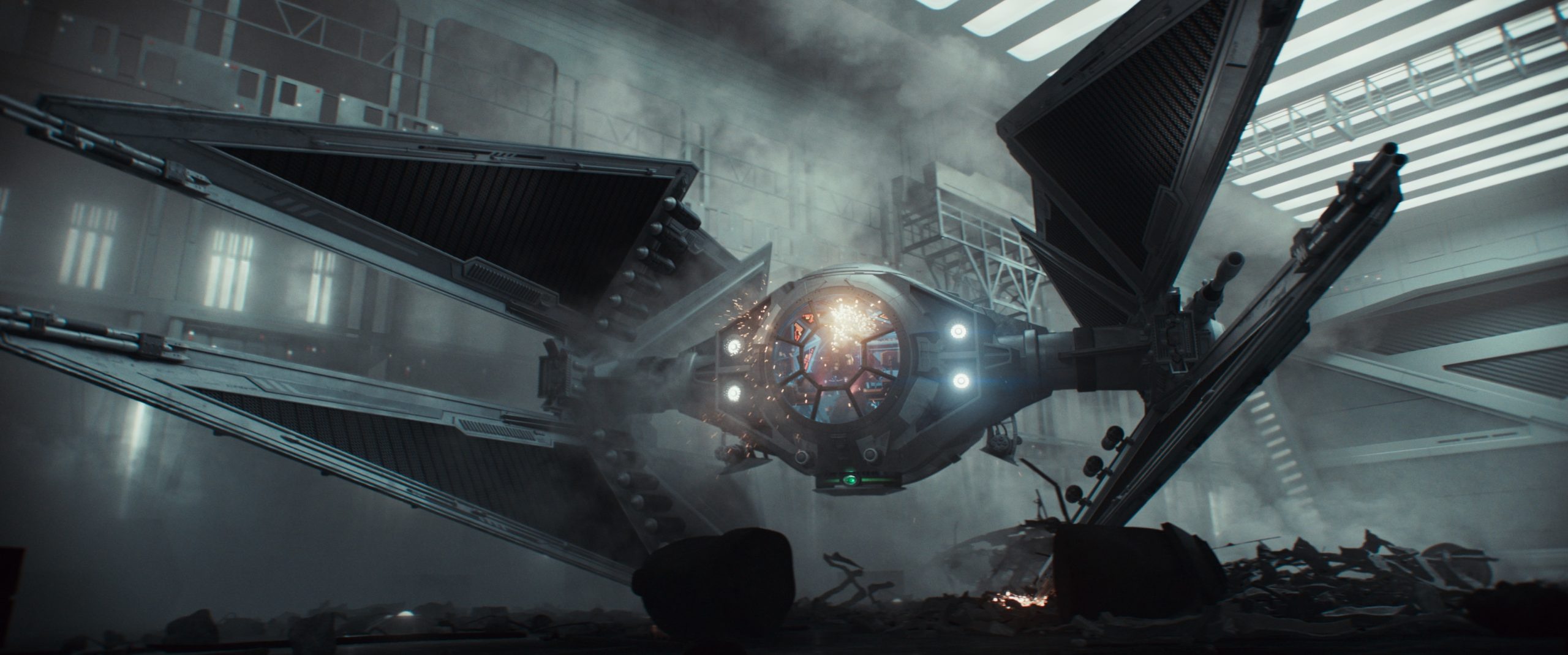
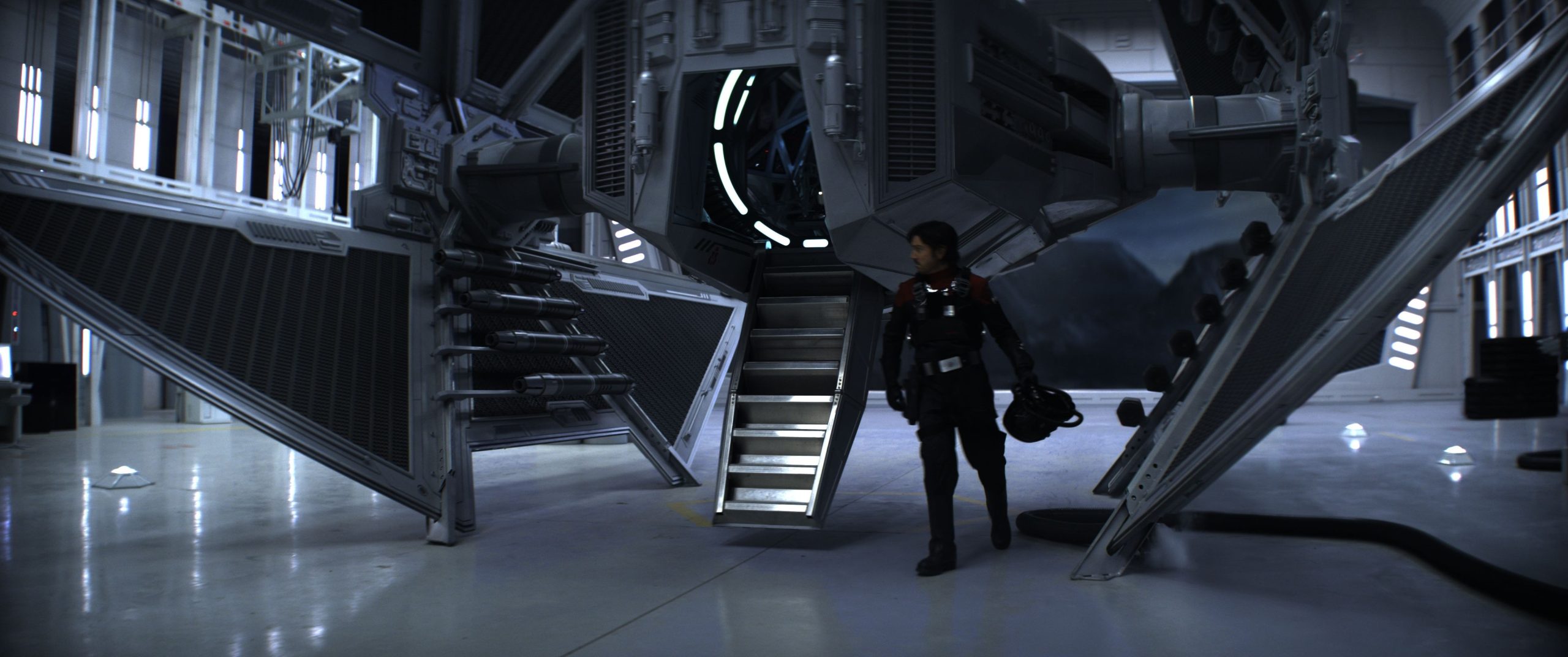
For many Star Wars enthusiasts, the word “avenger” conjures up images of Captain Needa’s Imperial Star Destroyer Avenger, the TIE Avenger starfighter featured in Lucasfilm Games’s Star Wars: TIE Fighter (1994) video game, or even Marvel’s prestigious superhero collective. The second season of Andor (2022-2025) has now pushed its own TIE Avenger to the forefront of that list, as the epic series chronicled Cassian Andor’s (Diego Luna) theft of the prototype craft from a Sienar Fleet Systems test facility. Outfitted with advanced armaments and a hyperdrive, the TIE Avenger transported Cassian to Yavin 4 before playing a key role in rescuing Bix Caleen (Adria Arjona) and Wilmon Paak (Muhannad Ben Amor) from Imperial forces on Mina-Rau.
Industrial Light & Magic’s Mohen Leo, whose resume boasts projects like Ant-Man (2015), The Martian (2015), and Rogue One: A Star Wars Story (2016), served as Andor’s production visual effects supervisor for both seasons of the series, while ILM visual effects supervisor Scott Pritchard (Star Wars: The Force Awakens [2015], Avengers: Infinity War [2018], Avengers: Endgame [2019]) oversaw the creative output of the work across ILM’s global studios in London, Vancouver, and Mumbai. Leo and Pritchard gathered alongside CG supervisor Laurent Hugueniot, modeler Owen Rachel, texture artist Emma Ellul, look development artist Renato Suetake, animation supervisor Mathieu Vig, and compositing supervisor Claudio Bassi to chart the TIE Avenger’s course from conceptualization to the completed sequences seen in season two.
Constructing the Concept
The TIE Avenger prototype is first unveiled at the beginning of season two, resting in its Sienar hangar bay before being commandeered by Cassian and embarking on a dramatic escape. “The idea for the opening sequence began with [showrunner] Tony Gilroy wanting to start season two off with a big, classic Star Wars action sequence,” Mohen Leo tells ILM.com. “That initially came out of an outline that Tony gave us in 2022. Early on, a big story point became that Cassian doesn’t know how to fly it, so the Avenger had to have completely unfamiliar controls, and the interior had to look different from any TIE fighter or ship that you’ve ever seen before.”
When it came to the Avenger’s look and layout, Leo worked closely with production designer Luke Hull. “Luke explored various prototype airplanes, and then we played around with the idea of what the ship needed to do in terms of the chase sequence. We wanted something that wasn’t just a dogfight. If he immediately jumps in and it’s just a chase, it’d be difficult to do something original with that,” adds Leo. “Luke had already decided to build a full-sized practical TIE Avenger. As far as its physical construction, the wings were inspired a bit by the TIE interceptor.” While Andor’s Avenger shares a name with the craft from the TIE Fighter game, it maintains its own design lineage. “I don’t think the previous ship was a strong influence,” Leo begins. “When we were designing our Avenger, how the ship functioned became something Luke and I reverse-engineered based on what we wanted the ship to do. That dictated the look.
(Credit: ILM & Lucasfilm).
“I put together a pitch deck for the Avenger before we got into previs when the directors weren’t even on yet,” Leo continues. “I wanted to make sure that the ship and the weaponry, in particular, were based on real weapons and felt both dangerous and aggressive. The team based the TIE’s fold-out Gatling-like cannons on the United States military’s M61 Vulcan rotary cannon. Hull wanted the Sienar base itself to feel like a Skunk Works test facility or NASA’s Jet Propulsion Laboratory.
“It was a back-and-forth between previs and Luke Hull and the art department in terms of the ship’s design,” Leo notes. “We’d say, ‘We need guns that fold out,’ and then Luke would go, ‘Let me see where we can fit those in.’ It was almost as much driven by the necessity of the functionality as it was by the aesthetics.” Once the additional armaments, including external launchers and a powerful cannon below the cockpit, were set, the team pitched the action sequence to Tony Gilroy. “We blocked the whole sequence with a temp model, and Tony generally really liked it.”
Assembling the Avenger
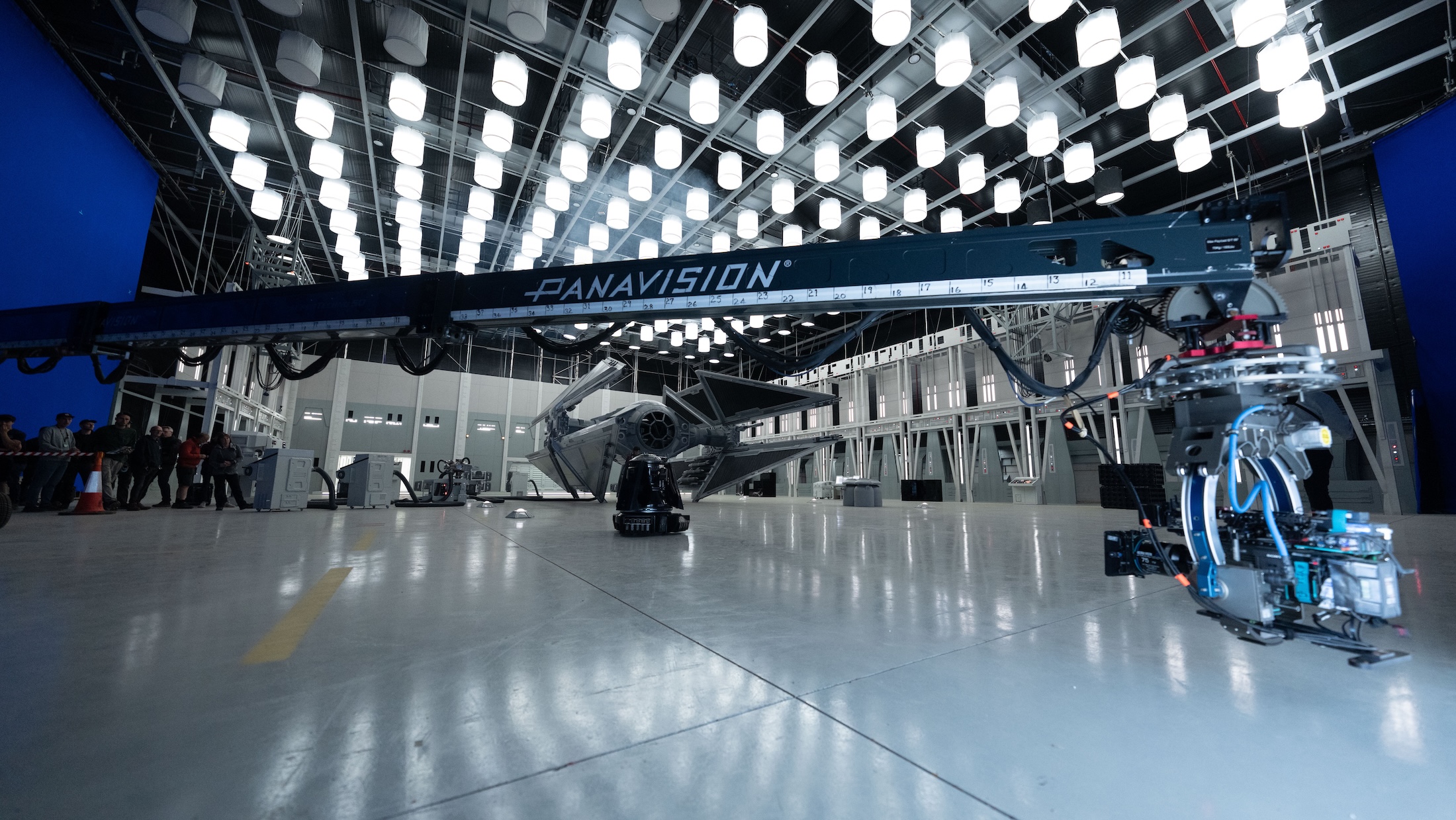
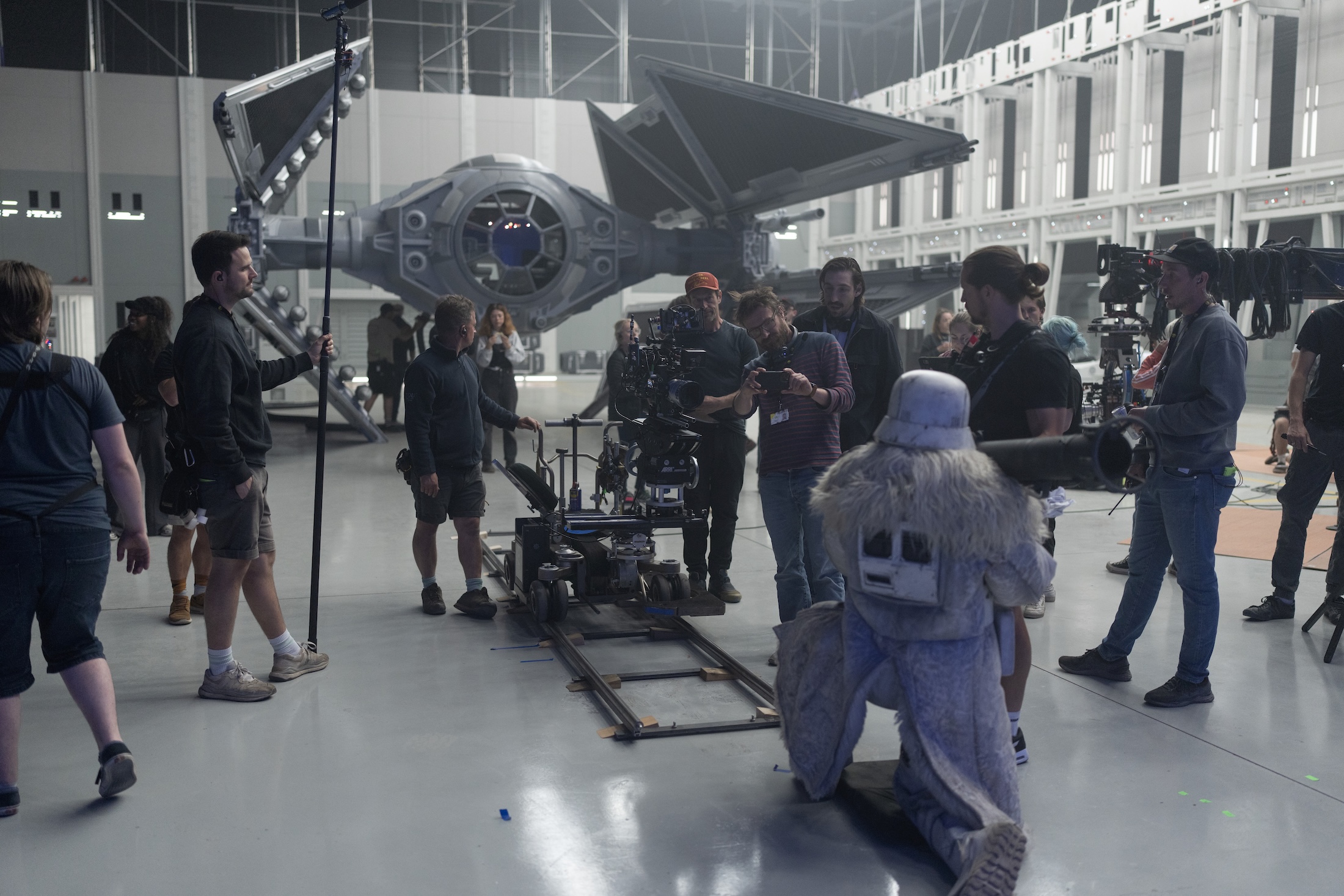
“As the studio-side visual effects supervisor, I was involved in pre-production through to the end,” Leo shares. “I also guided the previs development with The Third Floor’s Jennifer Kitching and collaborated with Luke Hull on how we would make the practical build service what we needed to do in the visual effects sequence.” The creative dialogue between the ILM visual effects team and the production designer was vital in ensuring that the computer graphics (CG) starfighter built by ILM would be identical to the full-sized practical ship that was constructed to be used on the Sienar hangar, Yavin 4, and Mina-Rau sets.
“Because we had a practical version of the Avenger during the shoot, we were able to scan that and provide lots of references,” Leo details. As such, the full-scale Avenger proved beneficial for Owen Rachel, the ILM modeler responsible for building the CG Avenger. “My job was to take [the practical model] and replicate it as a digital version. There wasn’t much design work that we had to do other than replace some structural bits, like the Gatling guns as they come down,” Rachel outlines. “We did have to create the laser cannon that comes out from underneath the cockpit. It’s an intricate design because it’s both delicate and powerful at the same time. It felt a bit like the inside of a watch,” recalls CG supervisor Laurent Hugueniot, who was in charge of the team’s 3D output.
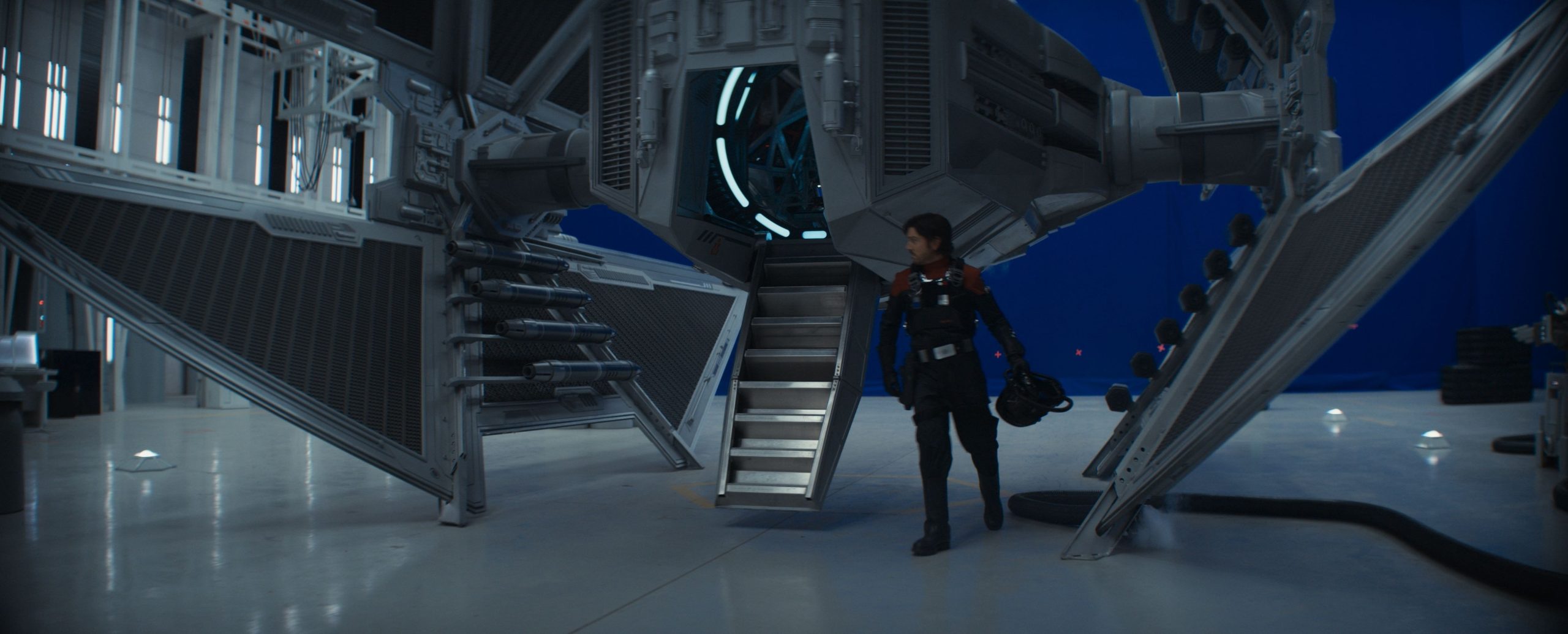
The practical TIE Avenger prop on set at Pinewood Studios (Credit: ILM & Lucasfilm).
Texture artist Emma Ellul tackled the job of texturing the TIE Avenger. “We had great reference images, which was super helpful. I tried to focus on real-life objects, too, such as stealth planes. They’re quite smooth and angular, and I’d see how specularity affects the metal. Not every sheet of metal is made the same, so it has a slightly different bend or warping to it. I incorporated that, especially on the paneling on the outside of the wings,” Ellul relays. “There were a lot of nooks and crannies to look at and a lot of small decals everywhere, which I had to match one-to-one with the practical model. It was an awesome asset to texture. Who doesn’t want to texture a TIE fighter? And then I had to destroy it and chuck laser blasts all over it [laughs].”
Look development on the Avenger was handled by Renato Suetake, who asserts, “As a look dev artist, I get the model and textures so I can put them together and make the shaders. I make sure the shaders and materials react precisely like the reference we have in any situation or lighting condition. Certain shots jumped between the prop filmed on set and the CG version, so the digital Avenger had to be identical. At the same time, because the prop wasn’t made of metal, we still had to make it believable as an actual spaceship that flies.” From the Avenger’s weapons to the hangar explosions to the collapsing ice arch, Leo also credits the effects artists who contributed to the sequence, revealing, “In general, all of those things are just massive, complex simulation work.”
Pairing Computer Graphics and Practical Effects
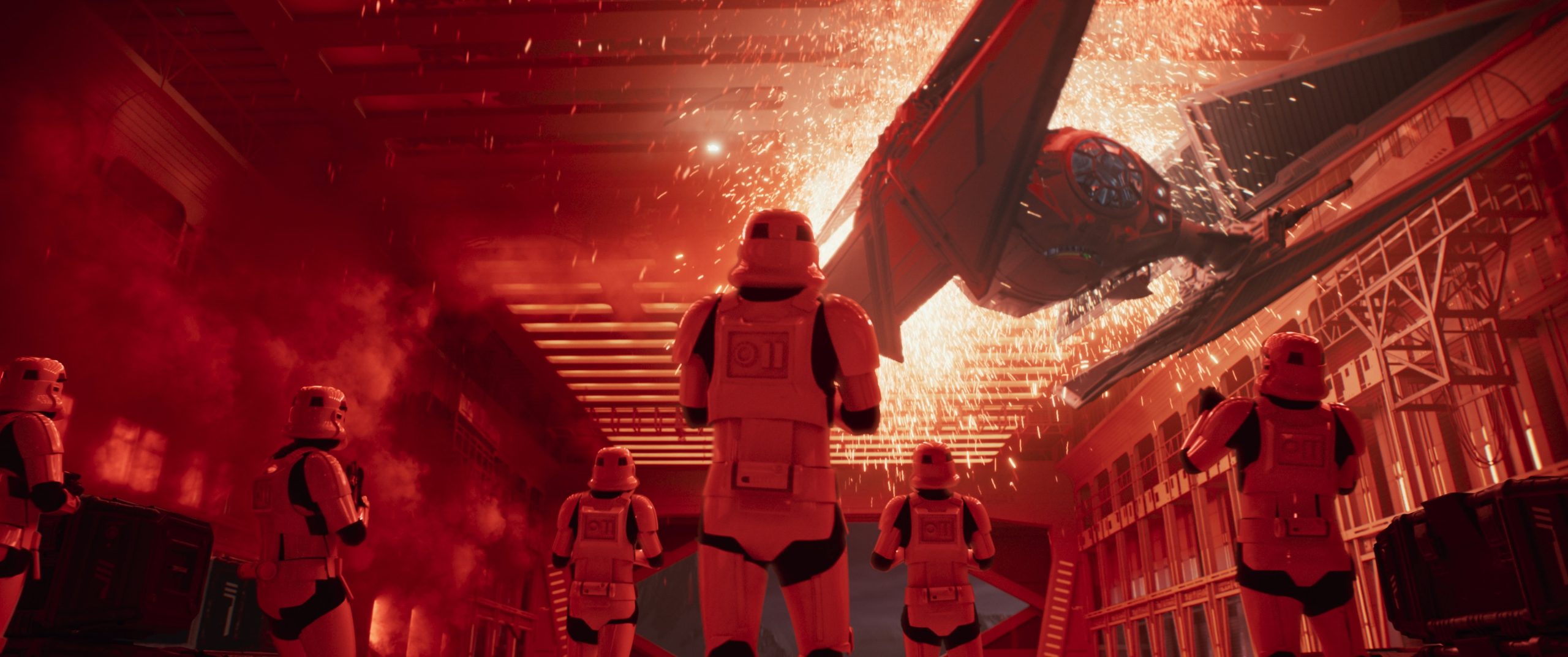
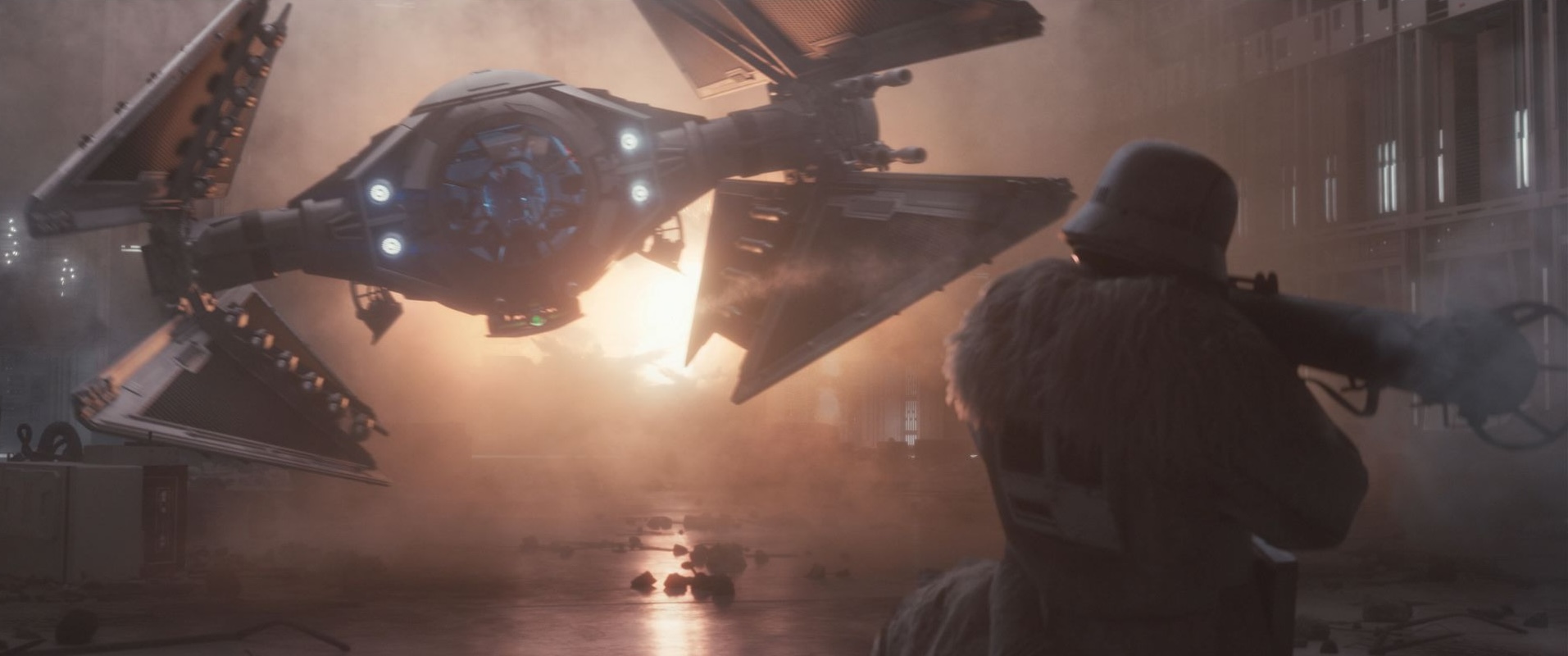
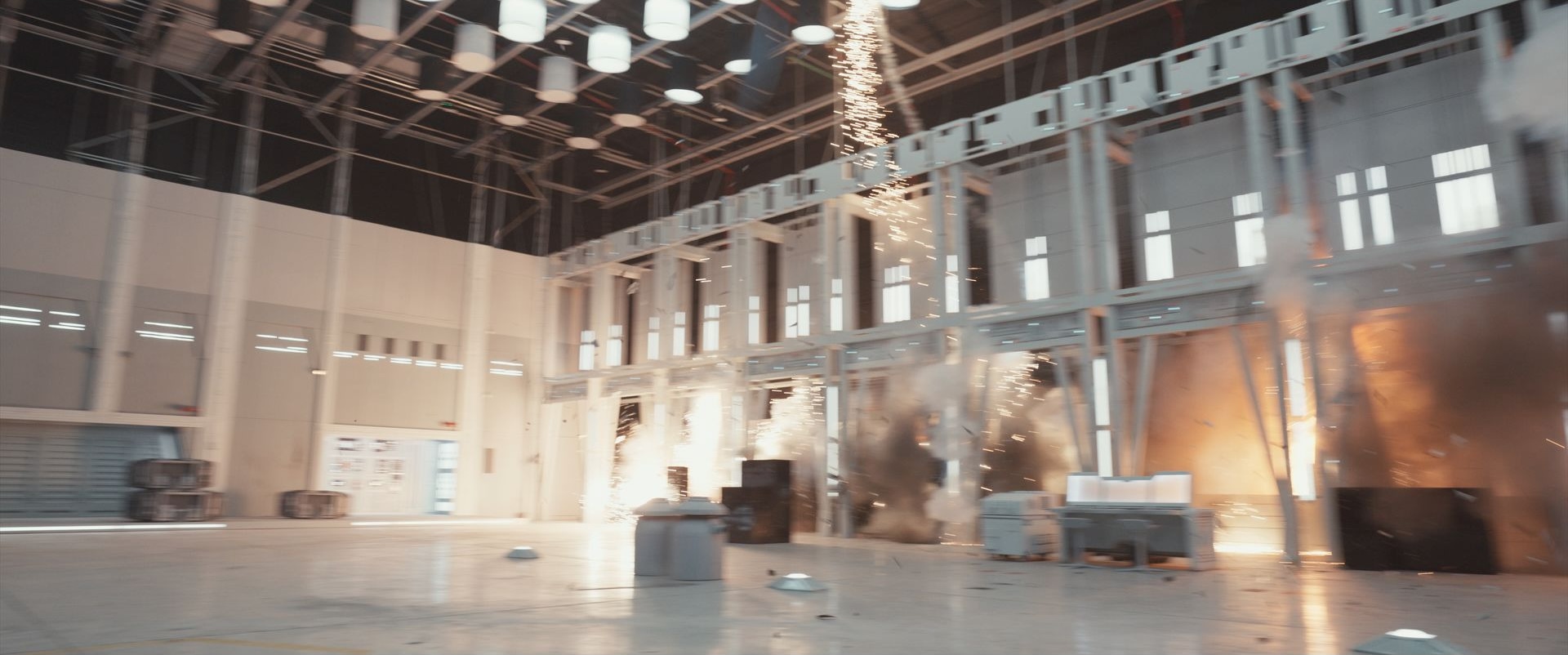
As Andor’s ILM visual effects supervisor, Scott Pritchard helmed his team at ILM’s London studio, while coordinating the work at ILM’s studios in Vancouver and Mumbai. When it came to the Avenger’s breakout from the Sienar hangar, Pritchard observes that the production sought to use the “best tool for the job,” often pairing ILM’s CG expertise alongside special effects supervisor Luke Murphy’s practical effects. Highlighting a shot where an Imperial range trooper takes aim at the Avenger, Pritchard beams, “There’s a huge staged explosion along the back wall that was done by hanging a line of charges. They explode in sequence, so they explode outwards from the center. That in itself is impressive because it gives us some great visual reference to go on and actual practical elements to incorporate into the final comp.
(Credit: ILM & Lucasfilm).
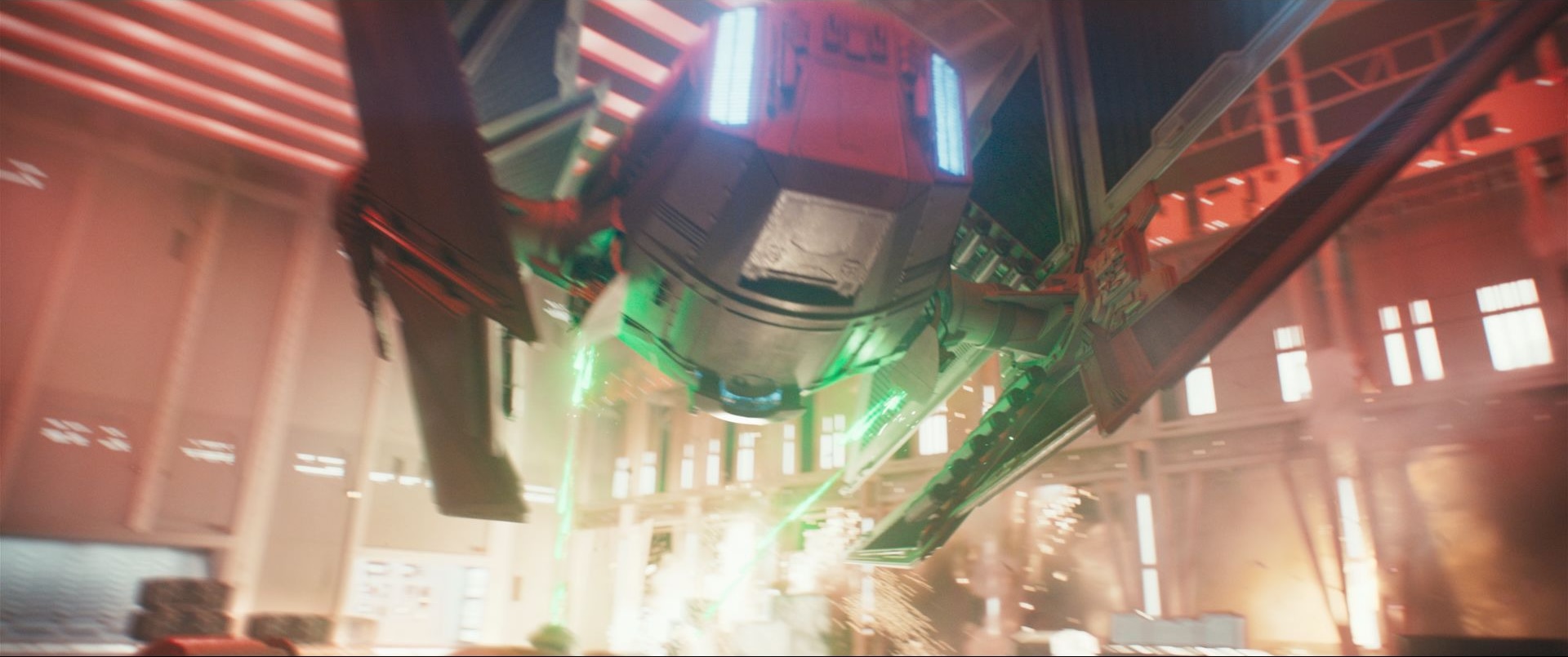
“There’s a significant amount of work involved in painting out the actual charges and all the little fragments that get blown off properly, as well. It gives you such a great base to work off when you’re putting together a shot like that,” continues Pritchard, who then shifts focus to the Avenger’s weapons blasting through the hangar. “A lot of these explosions are practical, but we’ve enhanced them by adding sparks and additional explosions in CG. Making all this work seamlessly is a great testament to the comp and effects team.”
Compositing supervisor Claudio Bassi concurs, believing that the practical effects supplied ILM with valuable reference for lighting purposes. Bassi also states that, despite the presence of the practical Avenger, the TIE’s wings during Niya’s (Rachelle Diedericks) inspection are actually CG. “The hangar set didn’t have a roof, so we often replaced the wings as it was easier to integrate the CG roof.” Although the hangar set was extremely large, Pritchard highlights the fact that ILM had to extend the hangar to an even greater width, and the entirety of the front section that opens toward the snowy exterior is also CG.
Maintaining a Match
Of course, having both a practical and digital Avenger presented its own challenges when it came to assuring that the details matched, particularly regarding how much damage the CG version sustained at Sienar in comparison to the practical model that was filmed on the Yavin 4 set. “Working with the art department, we knew that the Avenger had gone through the dogfight at Sienar base and should have scorch marks where lasers had hit it,” Leo remembers. “We counted the number of rockets it fired in the first sequence because there’s no way for him to restock in space. We took four specific missiles off the practical build, which we then reversed in digital effects to choose the four that he fires in the opening sequence.”
Hugueniot emphasizes that the same held true for the havoc wrought upon the Sienar hangar itself, commenting, “Not all shots are worked on one after another in story order. There’s a big job of keeping track of what’s going on in every shot. All the scorch marks on the walls, everything that’s been knocked down from the ceiling, and which lights are working in each shot. That was quite a job [laughs].” Bassi agrees, divulging, “We kept track of the marks where the Avenger scratched the floor and which lights broke, and we had a system to recognize them in shot order.”
(Credit: ILM & Lucasfilm).
That level of realism was reflected in animation supervisor Mathieu Vig’s mission to make the Avenger look “heavy and dangerous, and as if it’s made of metal, not just pixels.” Having the Avenger scrape along the deck helped achieve this. “We’re used to seeing them [TIE fighters] flying very gracefully,” Vig explains. “Usually, we don’t animate them bumping around, so setting the weight is harder than you might think. In a hangar setting, there are so many physical elements to consider, such as the actor in the cockpit doing specific movements that we have to take into account. All of this is a carefully interlocking puzzle.”
Diving Into the Details
While analyzing the projectiles under the practical Avenger’s wings to model them for its digital counterpart, Owen Rachel recognized an intriguing connection. “When we were trying to work out how the missiles fire, we realized the design on the set was similar to those seen in Star Wars: A New Hope [1977], as they go into the exhaust port on the Death Star,” conveys Rachel. As it turns out, the design was a one-to-one match, so Rachel subsequently modeled the Avenger’s projectiles after the proton torpedoes that Luke Skywalker (Mark Hamill) fired at the first Death Star. Effort was also invested in preventing the Avenger’s Gatling-style spray of laser fire from appearing as though it simply hovered in mid-air. “We gave them a bit of an offset and some randomness in both their position in the stream and in their x- and y-axis, so we could get more chaos into that stream,” Pritchard elaborates.
Even the red light that flashes along with the hangar’s klaxon alarm was not nearly as simple as one might assume. ILM had to maintain a perfect rhythm between the flashing lights and klaxon, occasionally analyzing where the visual effects team needed to extend or shift the red light so it all remained in sync. “Compositing is basically the last step in the visual effects pipeline that ensures that all elements are integrated and the CG matches with the plate that has been shot on set,” describes Bassi, who worked alongside Pritchard to successfully pitch the idea that the overall light energy of the hangar would get progressively darker and moodier as the Avenger knocked lights off the ceiling.
A live-action plate (top) was captured on the set with practical explosion elements, which were later integrated with ILM’s work (Credit: ILM & Lucasfilm).
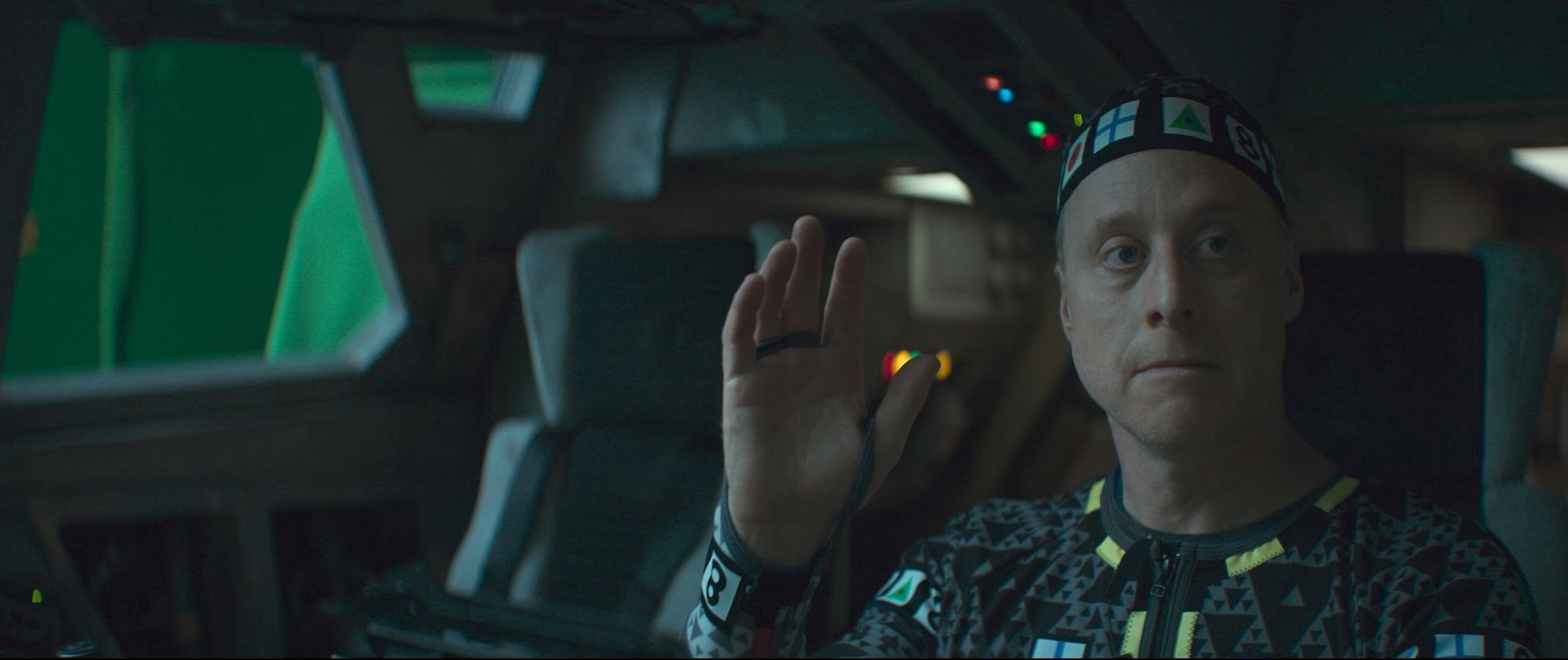
Matching the interior views of the practical and CG Avenger cockpits proved to be another challenge. “ILM’s Vancouver studio did a hologram of Cassian in season one that was absolutely fantastic and so lifelike. We reused that for Cassian’s head,” Hugueniot recounts. Filming Diego Luna in the practical cockpit occurred toward the end of the shoot, as Leo clarifies, “That was the very last thing we shot on the whole project—Diego in a motion base cockpit that we could move around and rattle. I think Diego had a really good time shooting those bits [laughs].”
In Awe of the Avenger
With season two now streaming on Disney+, the visual effects team has been able to view the completed episodes and finally share their work on the TIE Avenger prototype with the world. “I couldn’t even tell which Avenger was CG and which wasn’t,” laughs Emma Ellul, referring to the Sienar sequence. “The blend between the hangar, the ship taking off, and the chaos unfolding is so seamless. It was such an exciting bit to watch.”
The audience’s overwhelmingly positive response to the opening scenes has been equally uplifting for ILM, as the sequence fulfilled what the team set out to do. “When we were talking in previs, part of the idea was that it should feel breathless. Every time Cassian has solved one problem, the next problem comes up. There should never be a moment for him to relax until it’s over,” says Mohen Leo, who praises the sound design provided by Skywalker Sound. “One of the things that always happens after we’re done but makes such an impact is the sound. The sound that Skywalker put to the engines, weapons, and all of that makes such a huge difference.”
The TIE Avenger’s action-packed escape consists of a relatively small amount of screen time—but as Leo and his team have outlined, ILM imbued each facet of the Avenger and its accompanying environments with an extraordinary amount of time, energy, and expertise. So, the next time you rewatch Andor, don’t be afraid to press pause amidst the thrilling moments and soak up the wonders that ILM worked to allow the Avenger to ascend to the stars.
Discover more about the visual effects of Andor on ILM.com:
Jay Stobie (he/him) is a writer, author, and consultant who has contributed articles to ILM.com, Skysound.com, Star Wars Insider, StarWars.com, Star Trek Explorer, Star Trek Magazine, and StarTrek.com. Jay loves sci-fi, fantasy, and film, and you can learn more about him by visiting JayStobie.com or finding him on Twitter, Instagram, and other social media platforms at @StobiesGalaxy.
The final part of ILM.com’s discussion with Andor‘s overall visual effects producer and production visual effects supervisor covers the influence of Rogue One, collaborating with Tony Gilroy, their favorite moments from season two, and more.
By Mark Newbold
In part one of our conversation, TJ Falls (vice president of visual effects at Lucasfilm and Andor’s visual effects producer) and Mohen Leo (Andor’sproduction visual effects supervisor) discussed location shooting and the logistics of bringing Andor (2022-25) to audiences worldwide. Now, we continue our dive into the Emmy-nominated second season and the teamwork required to shepherd the story from the page to the screen.
It takes an army to bring a film or TV series from the imagination of the writers to screens around the world, and that means teamwork is key, as Mohen Leo explains.
“This project was somewhat unique in terms of how collaborative people were. You have certain projects where the director’s attitude is, ‘This is what I want, I don’t care how you do it, just figure it out.’ This was a case of everyone collectively understanding that we were trying to get as much value on screen as possible. That meant I could go to [editor] John Gilroy and say, ‘Hey, that choice you made will cost a lot of money; is it really worth it? It doesn’t feel like this is where we want to put all the effort.’ There were specific instances where he would say, ‘Okay, give me some time, I’ll have a look. If there’s a different way to cut this, I’ll let you know.’ Sometimes he came back and said, ‘Yep, I’ve managed to get rid of the shot and it feels just as good.’ That allows us to take those funds and put them elsewhere to make something else bigger and more exciting.”
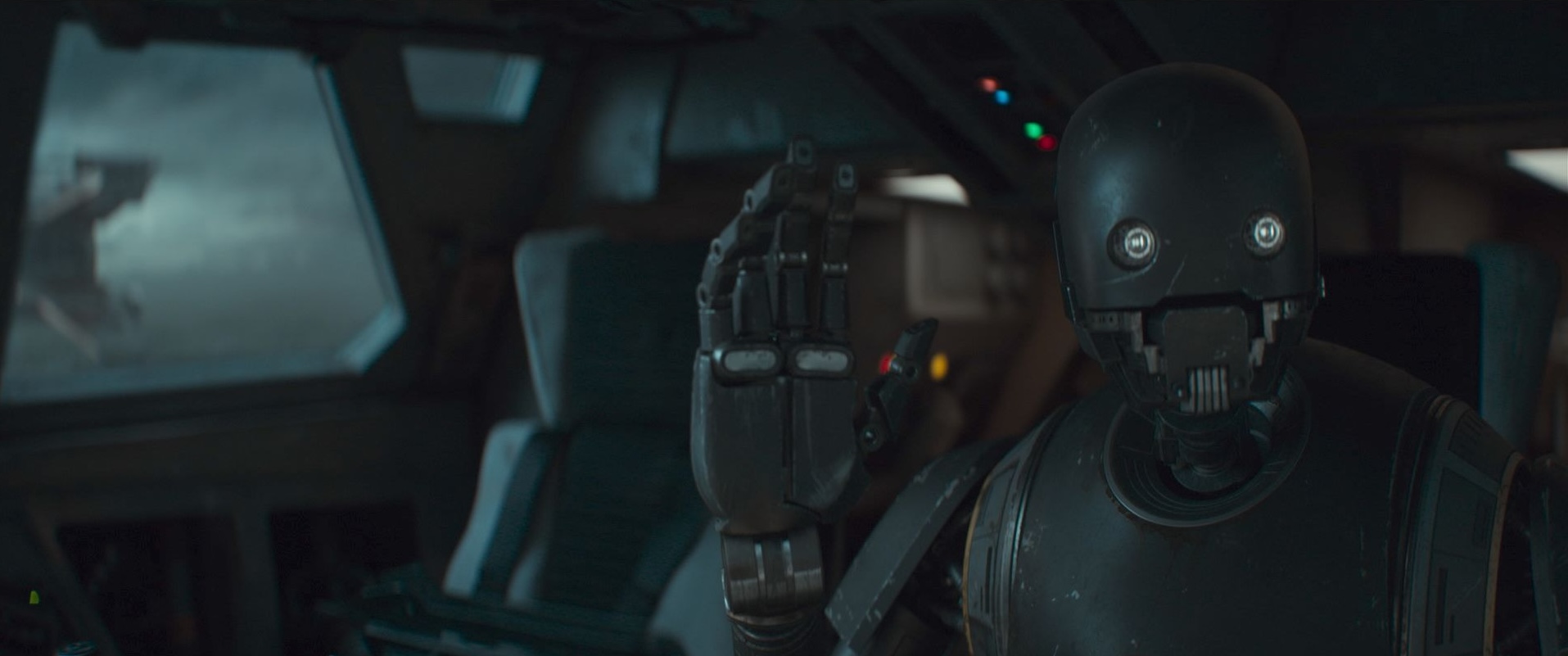
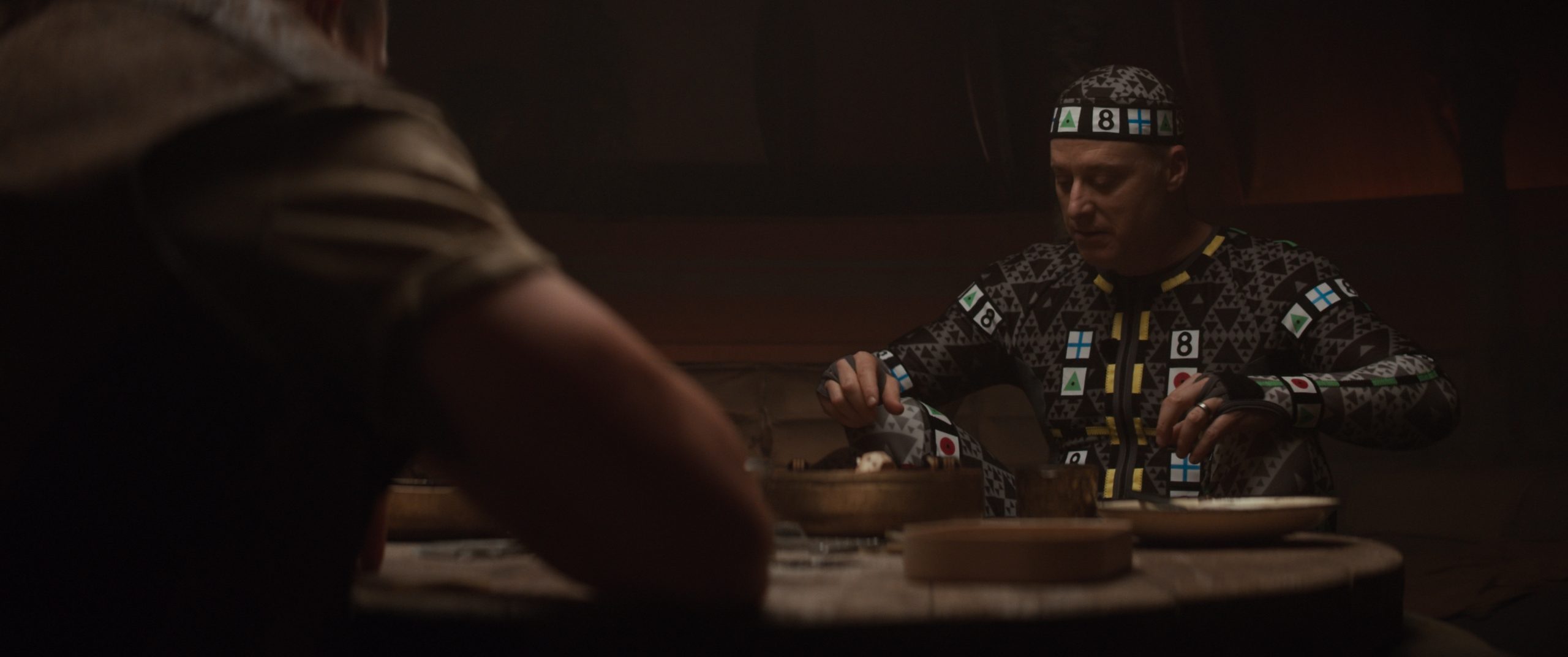
Alan Tudyk (top) performs as K-2SO with motion capture (Credit: ILM & Lucasfilm).
Flexibility, trust, and an understanding of team dynamics meant that the Andor team could make required adjustments and pivot, making the most of the skills at hand and sharing the load across departments, something that started at the very beginning of the series.
“That comes from the partnership we had through season one to season two,” TJ Falls notes. “It was an intentionally designed paradigm between [showrunner] Tony Gilroy and our producer, Sanne Wohlenberg. Our brain trust [Tony Gilroy, John Gilroy, Wohlenberg, Falls, Leo, and production designer Luke Hull] was involved in every key decision. As the show moved from start to finish, we were involved in those conversations, so it wasn’t the top brass dictating what the need was; it was a collaboration of ideas to make sure that it was the best version possible for Tony.”
Leo shares an example. “The Yavinian doodar, the creature at the end of episode two [‘Sagrona Teema,’ directed by Ariel Kleiman], that came through the trees, snatched the two rebels, and carried them off into the jungle. There was a lot of handwringing at the beginning because, from a visual effects perspective, you question whether we really want to build a fully computer graphics creature just for one shot. That’s a big ask.
“It’s also in the back of your mind that it’s going to turn into something much bigger,” Leo continues. “Then you try to cover yourself to make sure that it works for all these other things, but throughout, Tony kept saying, ‘I just need the one shot.’ Tony wants this, but we can’t spend too much money on this creature, so how do we make it possible? Ultimately, everyone worked together with the director [Ariel Kleiman], the director of photography [Christophe Nuyens], and the editor [Craig Ferreira] to make it possible to have this creature in there for one shot, and it worked out great. On many other projects, you would have abandoned it because there would have been this fear that it spirals out of control.”
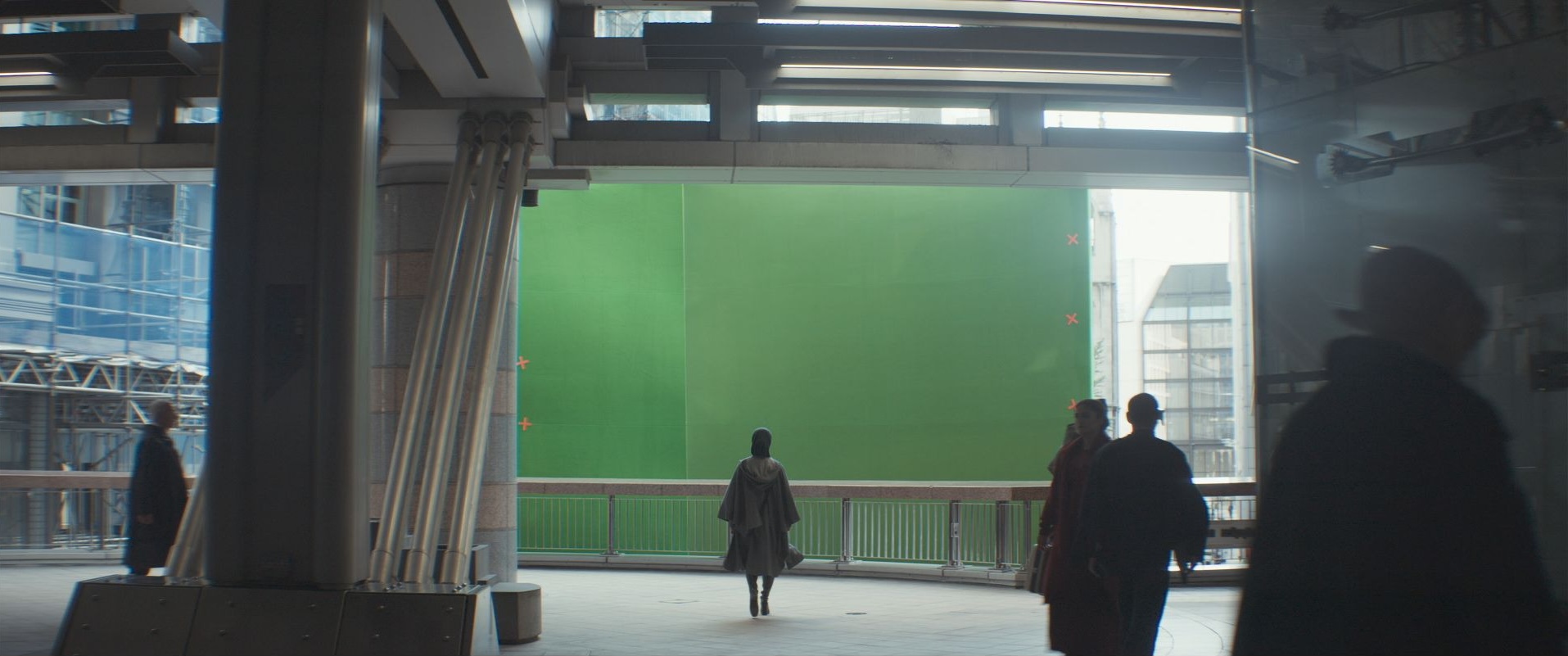
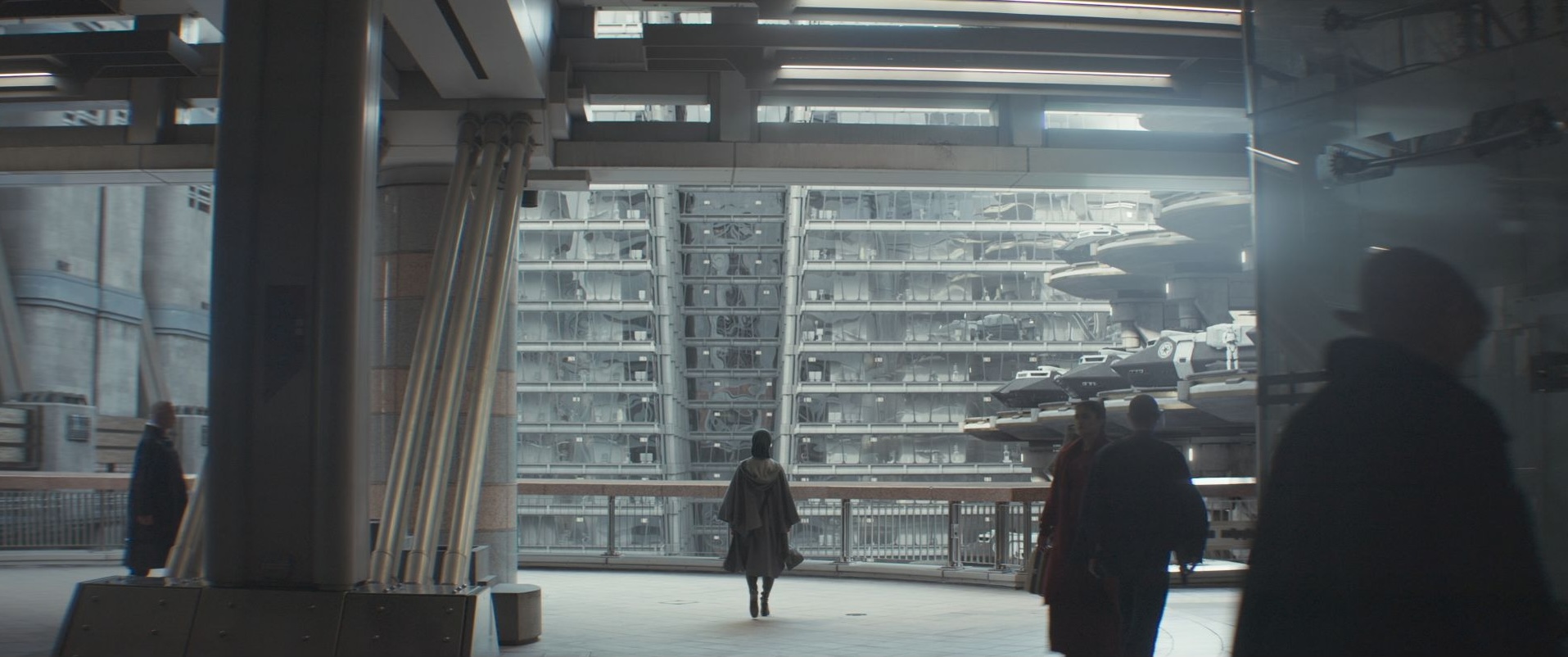
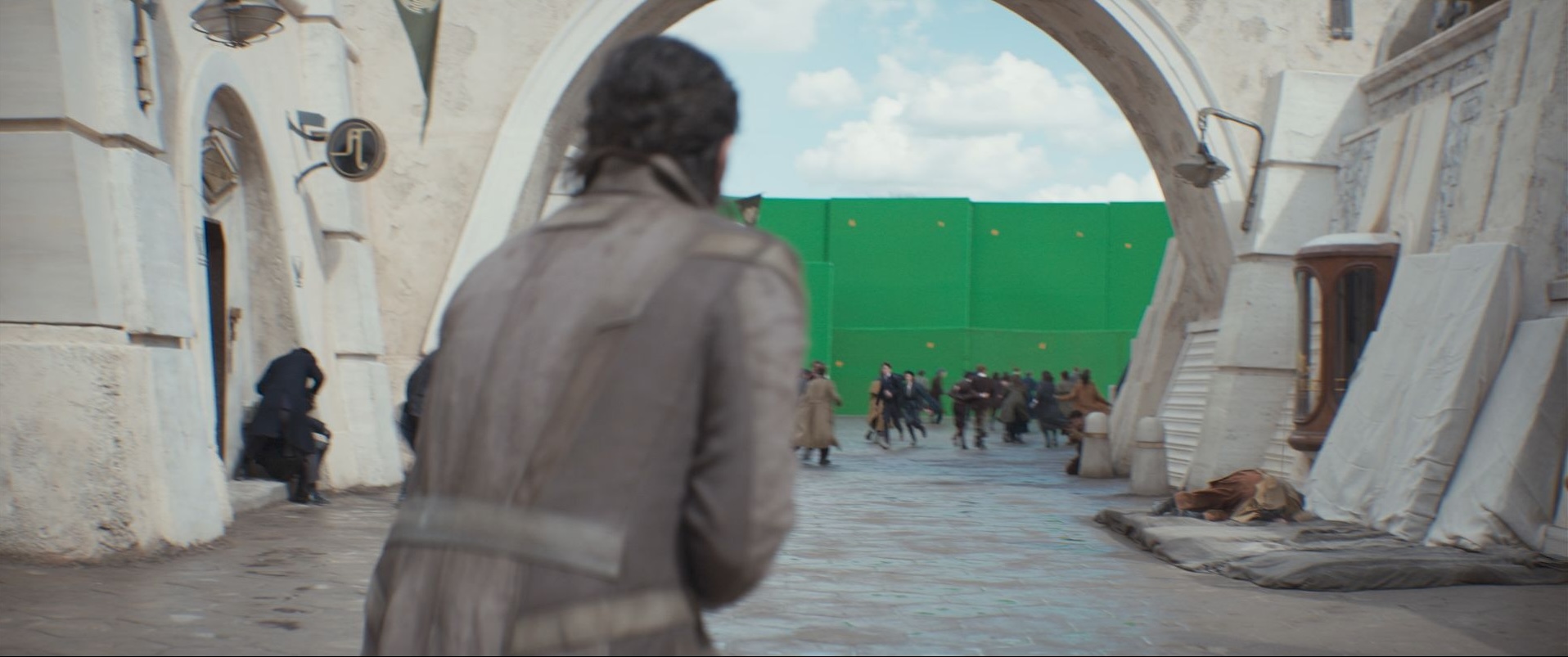
Green screen was utilized at an exterior location in the United Kingdom to portray a view on Coruscant (Credit: ILM & Lucasfilm).
“In a number of situations, we were the first stop in terms of Star Wars lore, where Tony would ask, ‘How do I do this kind of thing in Star Wars? How does that work in Star Wars?’ We’re able to help there. Same with Luke Hull. However, knowledge of our own world was equally as important for a show as grounded as Andor. For me, a big part of it was using things that were not just from Star Wars, but from other films, documentaries, and news clips.
“There’s a shot in episode three [‘Harvest,’ directed by Kleiman] where we see the troop transport on Mina-Rau and the TIE fighter appears low behind it,” Leo continues. “There’s a fly by as they’re all looking at it. Watching reference of Apache helicopters was one of our inspirations, and I found this incredible shot of a troop transport driving through the desert, and out of the dust cloud, came this helicopter, which goes right by them. I showed it to the director and I said, ‘Can we do this shot?’ And Ariel was like, ‘Oh yeah, absolutely. Let’s do it.’”
Sometimes, as in this case, previsualization from reference material is a huge part of the process, giving form to the action and allowing the production to have a rough version of the episode to build from.
“Tony and the director would quite often call on the visual effects team to pitch ideas for shots,” says Leo, “so Jennifer Kitching, our previs supervisor at The Third Floor, would dig around for reference and try things out. Even on big establishing shots, we were always trying to find something real, so [ILM visual effects supervisor] Scott Pritchard and I identified shots of Manhattan, Tokyo, and Hong Kong, very specific shots. Then we could determine the feel of the shots, but we’re ultimately doing it on Coruscant rather than New York or Hong Kong.”
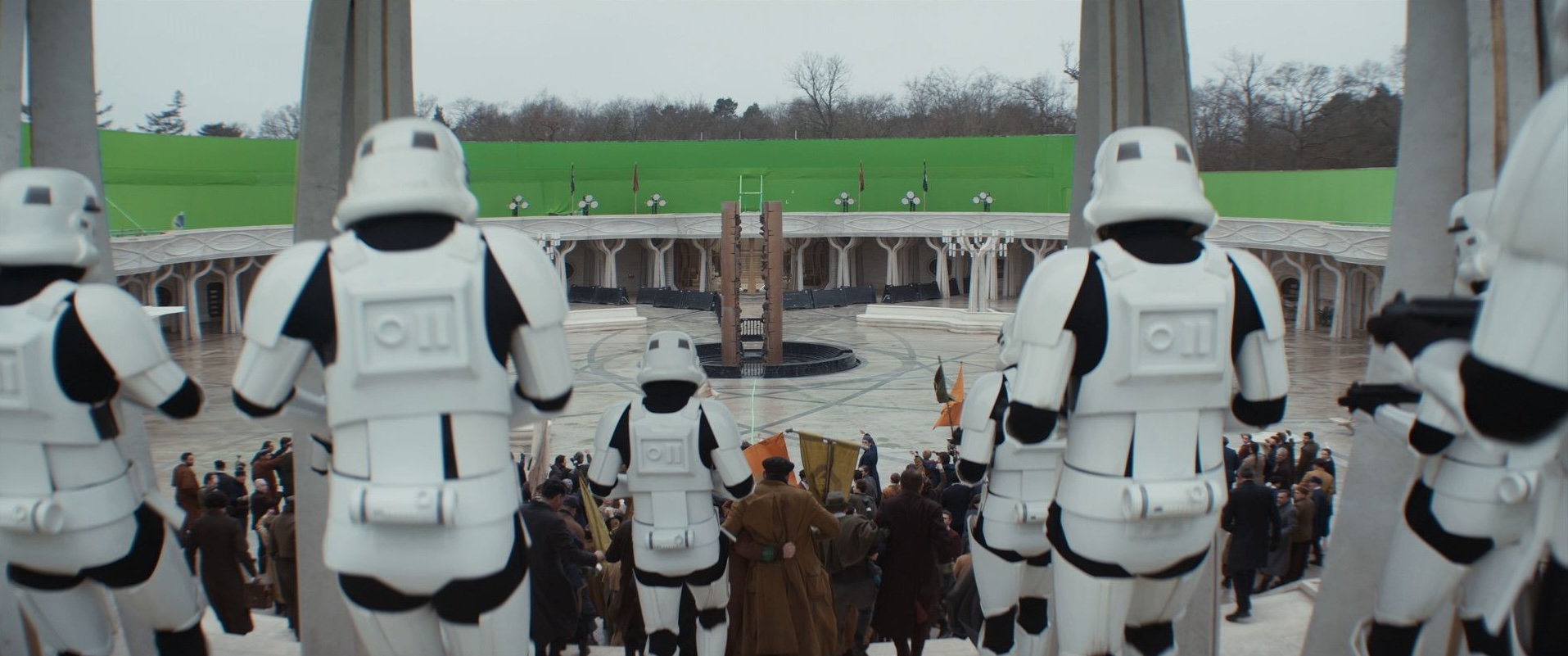
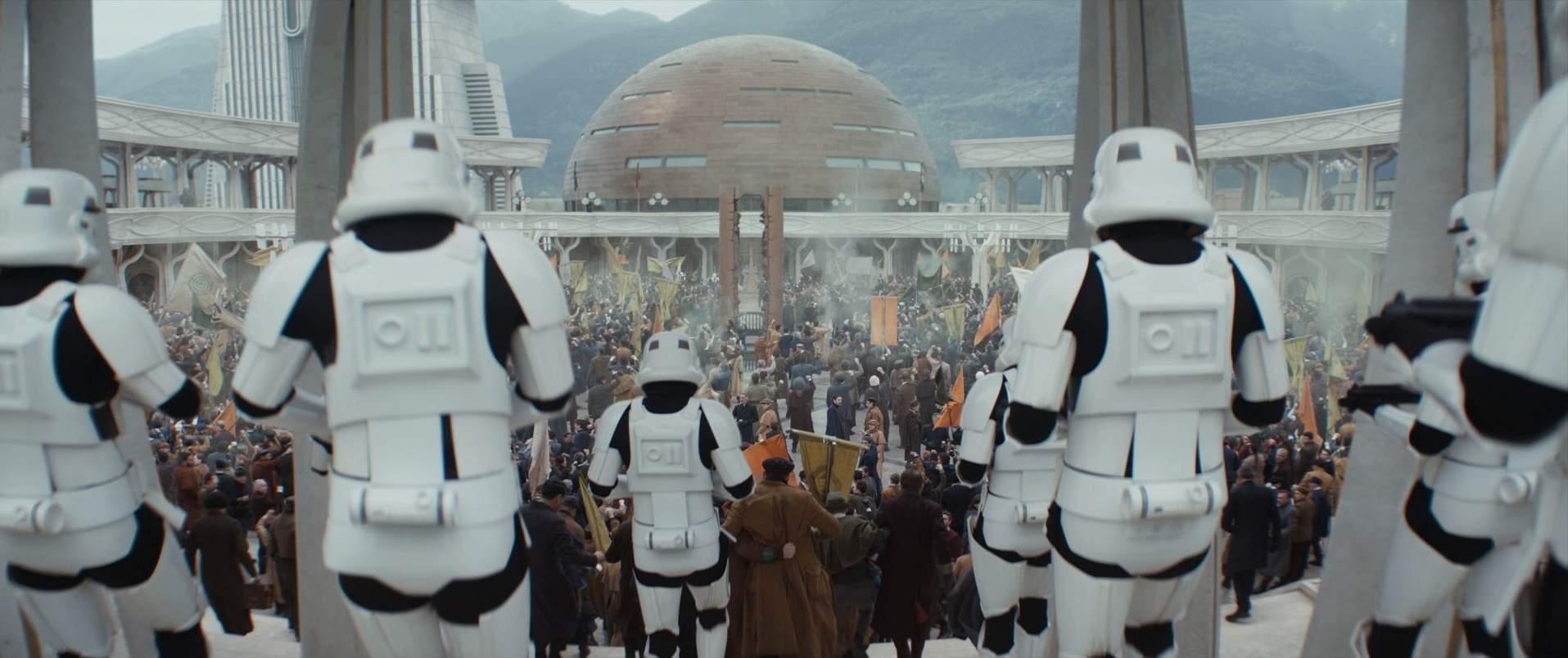
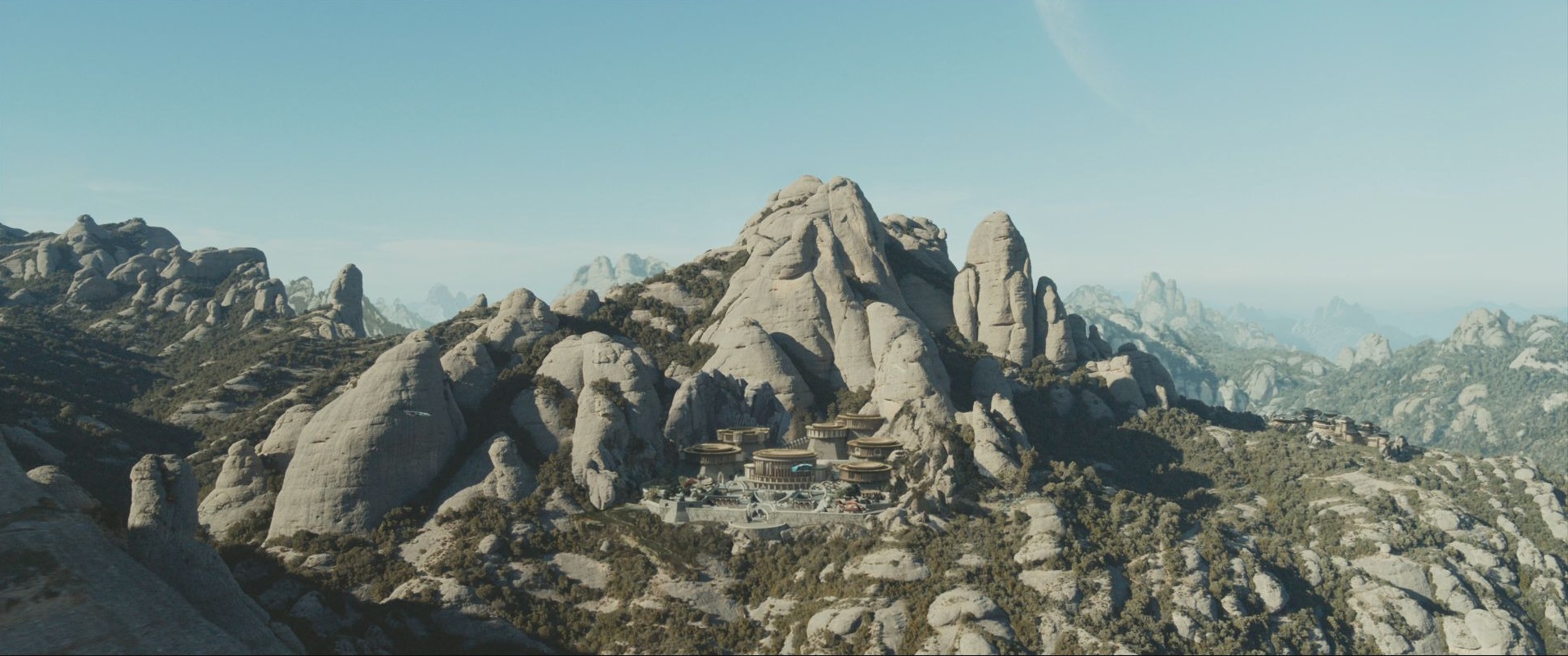
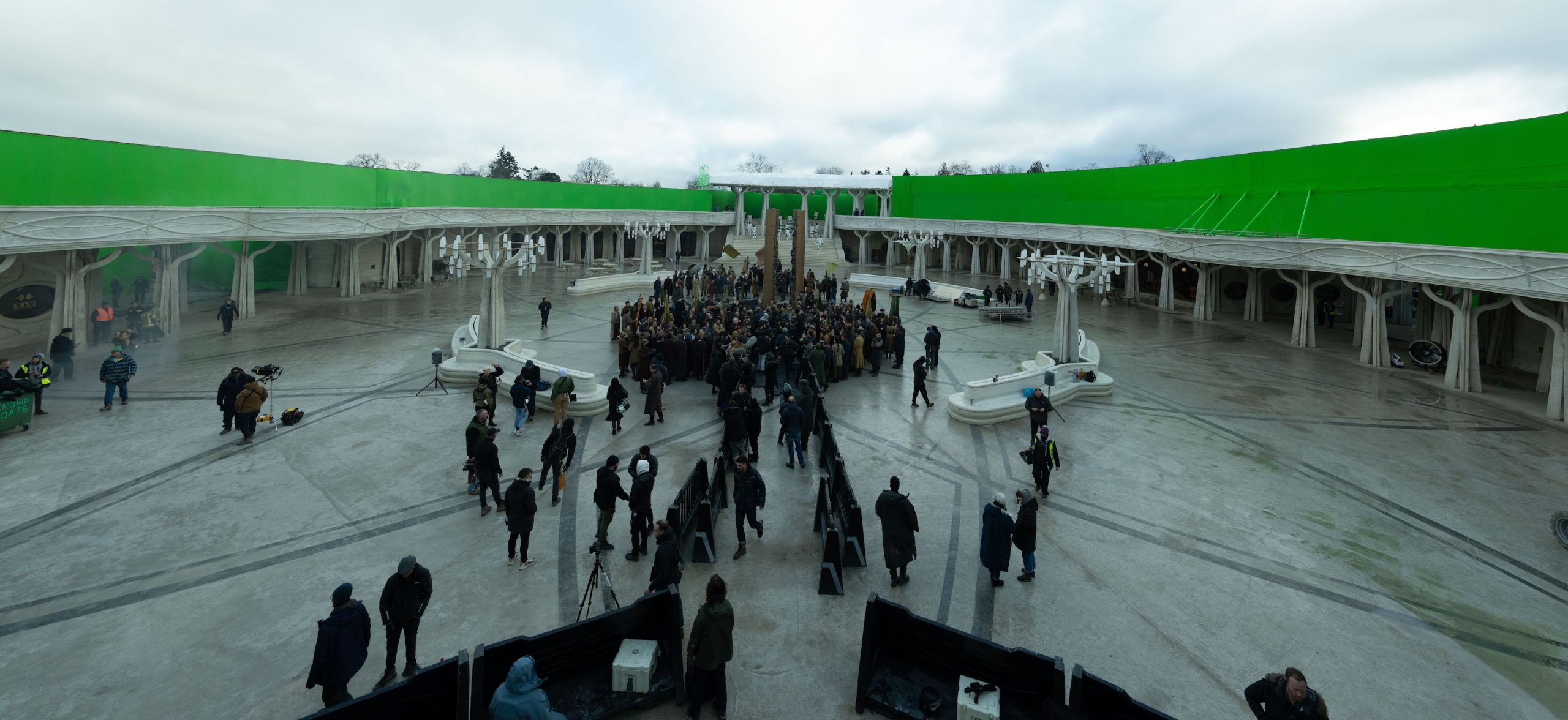
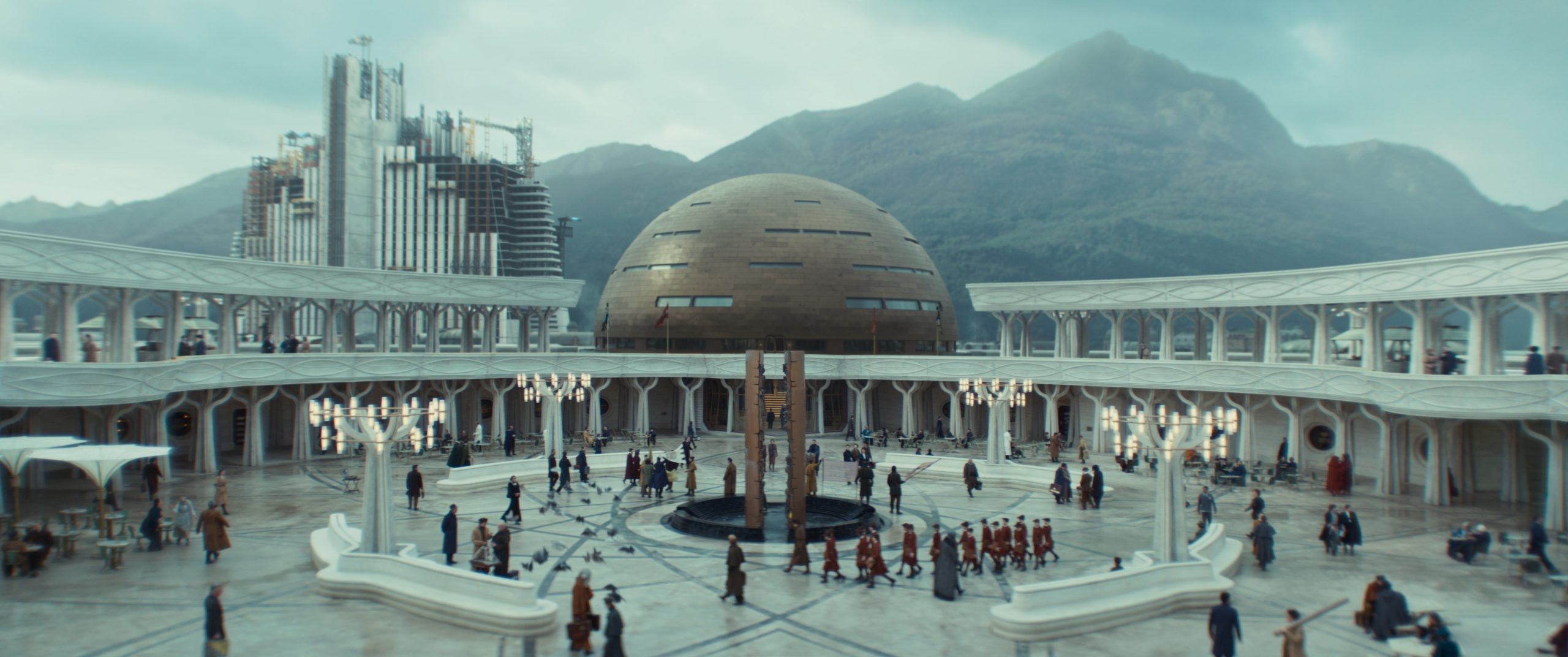
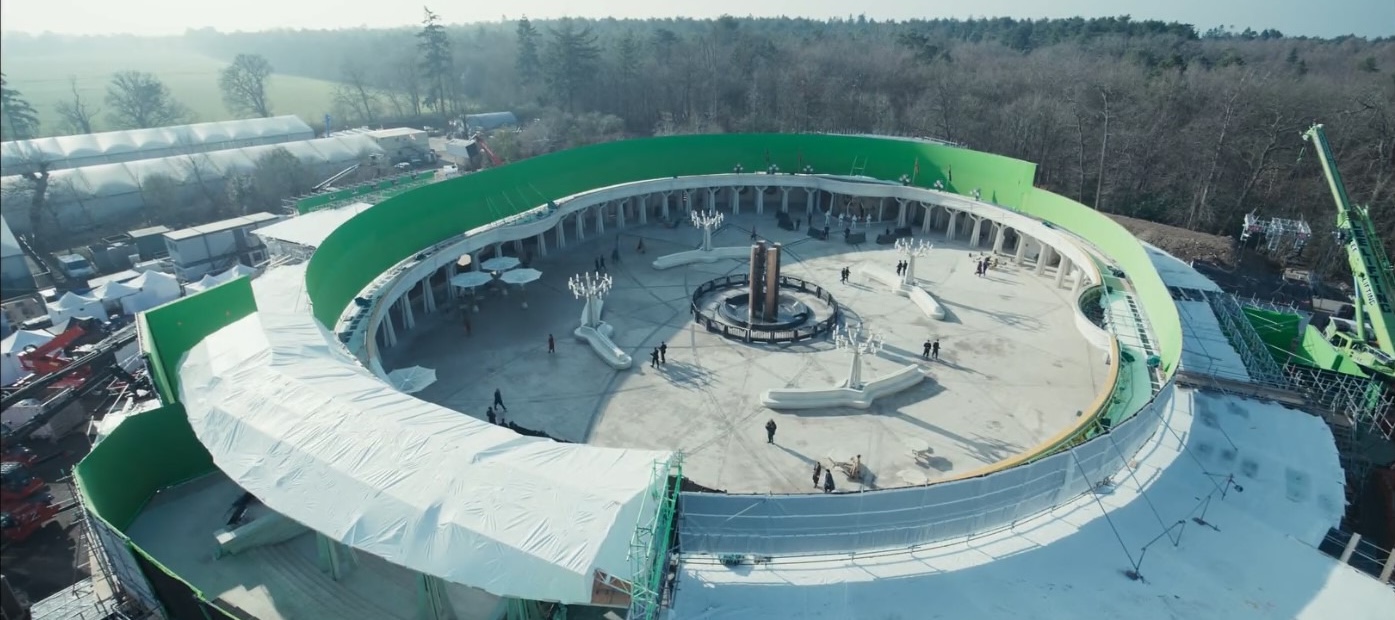
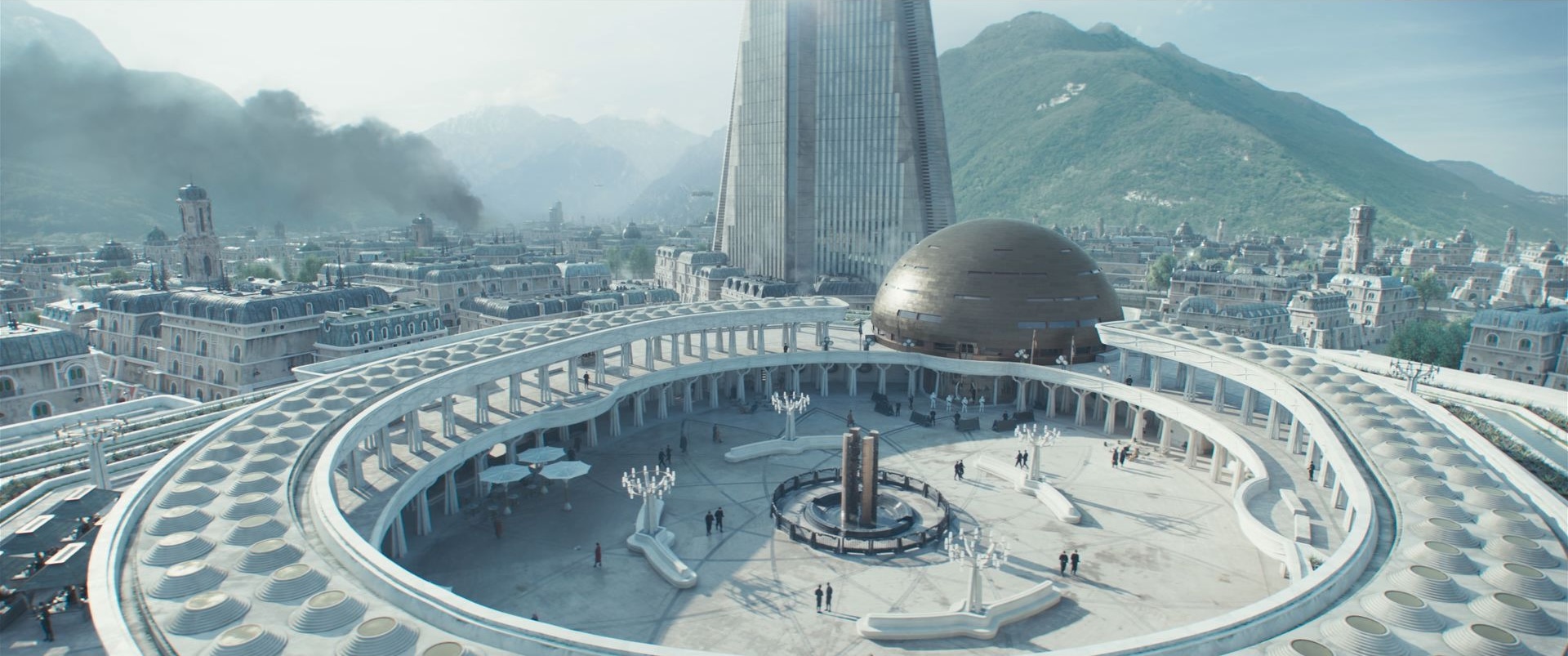
Palmo City’s central plaza on Ghorman was shot as a backlot set at Pinewood Studios with digital extensions (Credit: ILM & Lucasfilm).
Famously, in the 1970s and 80s, ILM used traditional matte paintings to establish new locations, the principle of which is still at the core of creating an establishing shot. The technique, however, now resides in the digital realm, often with the aid of live-action background plates. Andor treats viewers to a number of establishing shots on Ghorman and Coruscant, a process that takes a considerable amount of time and effort, depending on the requirements of the shot.
“If you’re travelling through the digital location and have a bunch of different angles on it, we will build a full 360-degree environment,” explains Leo. “But if it’s for a single shot, we may do it as a bespoke shot. What worked really well on season one and into season two was that we based things on real cities. You can find open-source 3D street maps of Tokyo or New York, and we would basically fly around and find an angle and think, ‘Okay, that’s a cool angle; this feels organic. Now take that but replace all of the buildings with Coruscant buildings.’ You end up with something that feels organic and real.”
It’s an approach Leo picked up from the director of Rogue One.
“I have to give credit for having learned this approach to Gareth Edwards,” he explains. “When we built the city of Jedha, we had blocks of neighborhoods based on layouts from parts of Morocco. Then, Gareth asked us to do something which seemed really strange at the time. He said, ‘I want you to drop 300 random cameras into the CG model of the city, anywhere you like, and show me the pictures.’ We wrote a script that dropped a camera at every intersection and then rendered a view in every direction. We sent those to Gareth, and he picked from those, the idea being that rather than artificially building a view to the camera, you would scout the artificial city just as you would scout a real location and go, ‘I found this really cool angle here.’ That way, you ended up with compositions that felt much more interesting than if you simply asked someone to put some buildings in the background.”
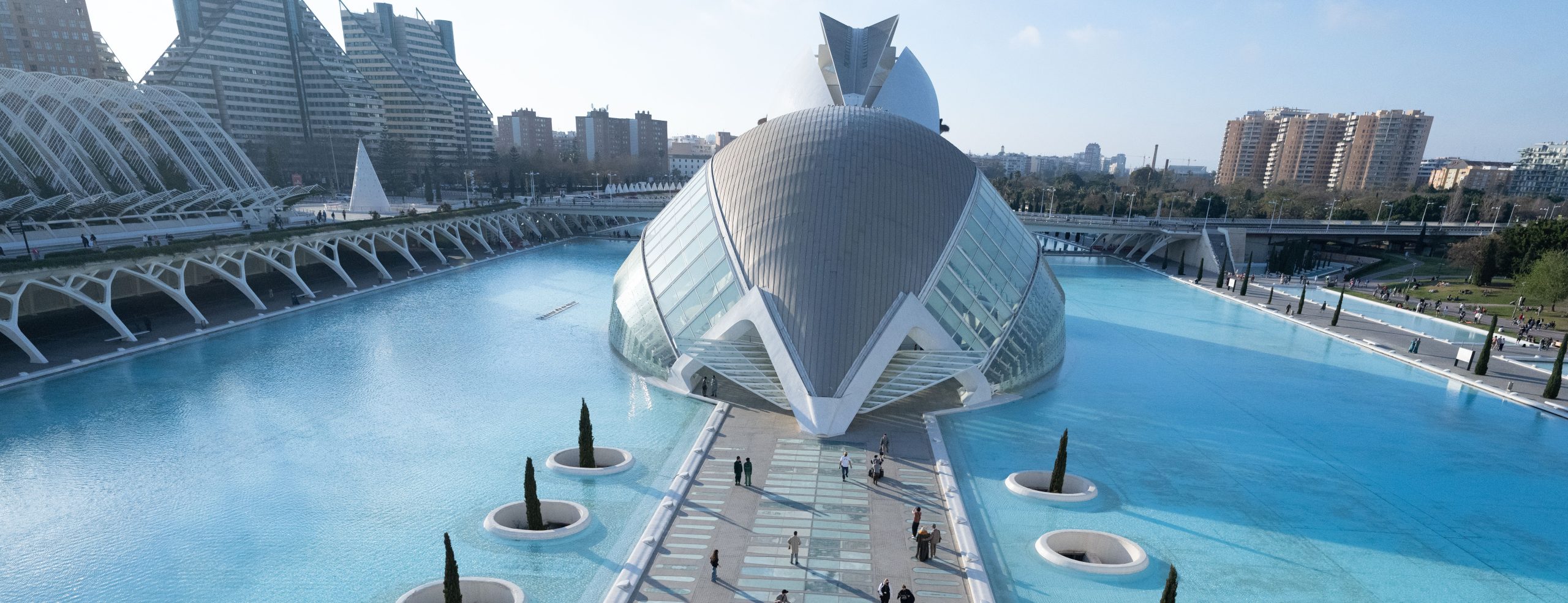
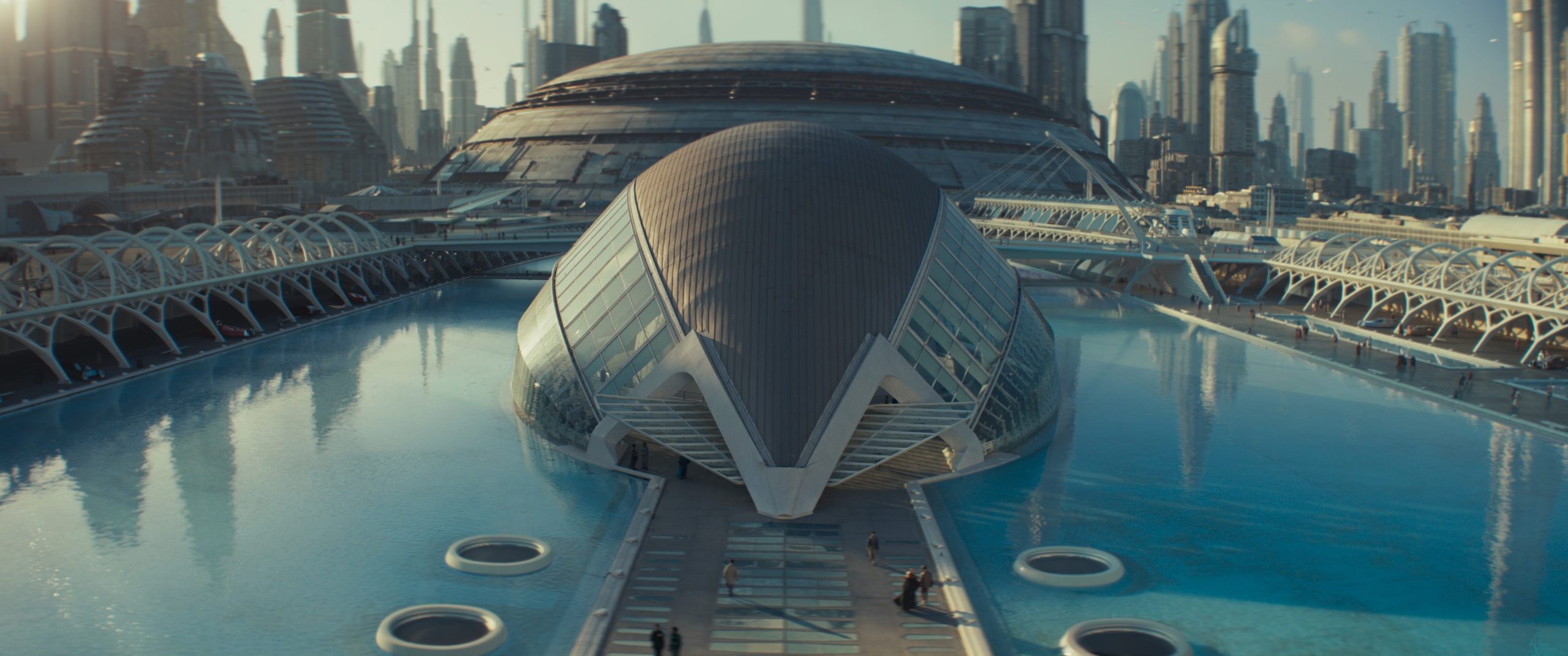
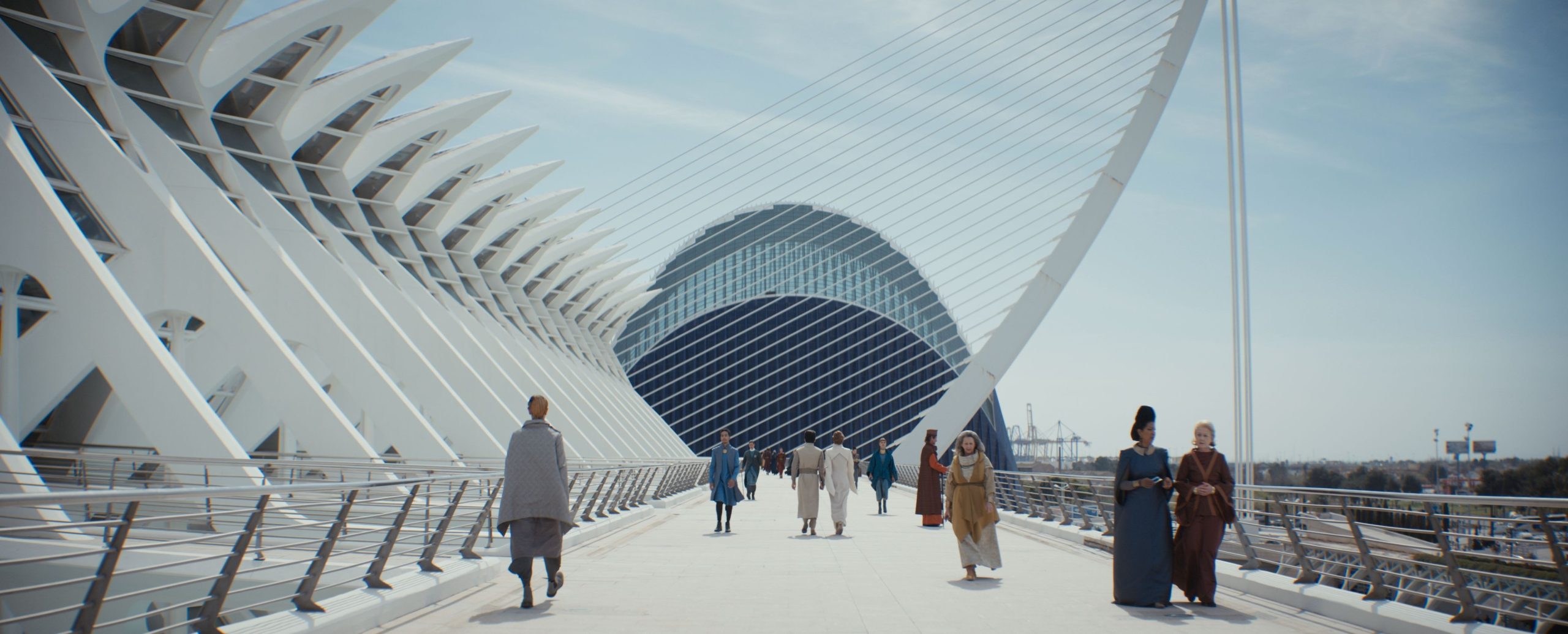
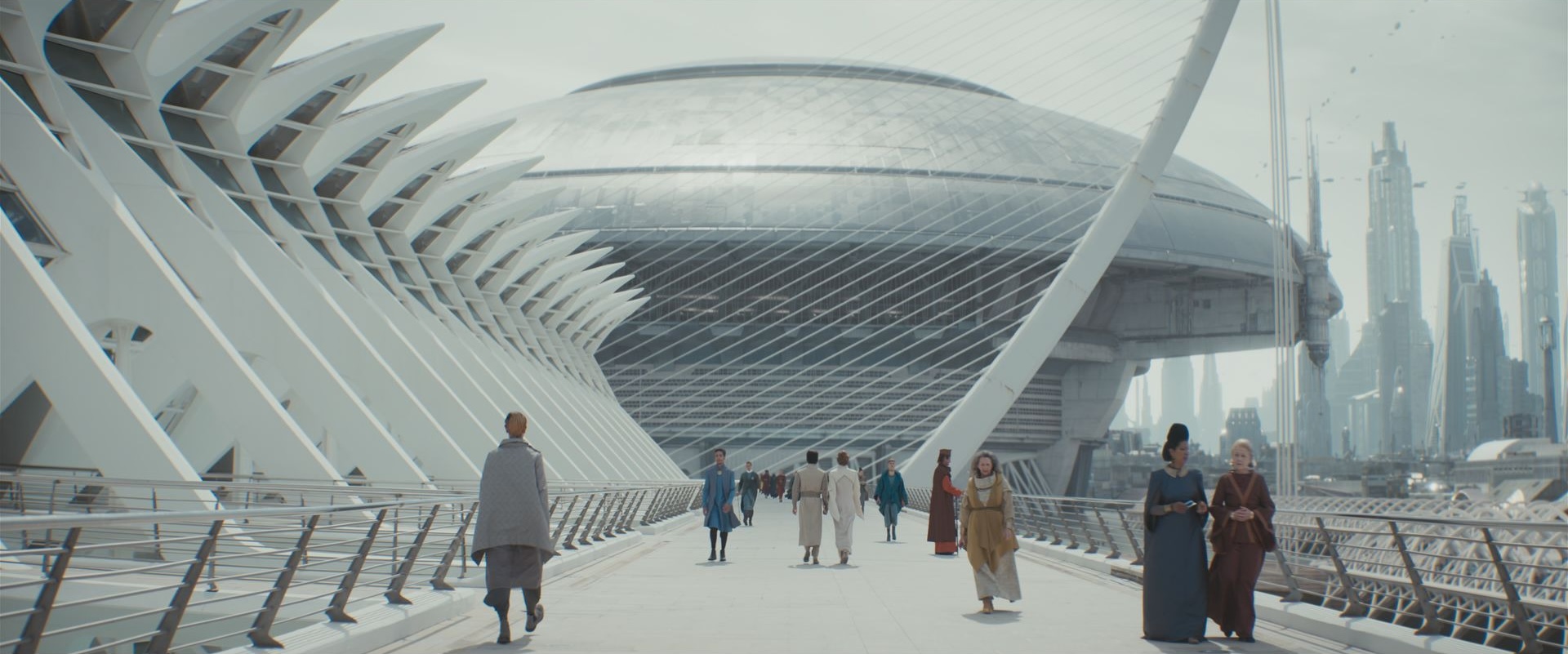
Elements of the City of Arts and Sciences in Valencia, Spain were utilized for Coruscant (Credit: ILM & Lucasfilm).
Coming from a visual effects background as Edwards does – as most recently evidenced by his work with ILM on 2025’s Jurassic World Rebirth – his fluency in the language of visual effects gave the crew a tremendous advantage on Rogue One.
“What I really appreciate about Gareth is that he has this really disciplined approach to thinking about whether you could have done a visual effects shot in the real world, and would it have felt the same way?” Leo continues. “I took that forward into our approach to Andor. Quite often, if we did a layout of visual effects and everything fit neatly into frame, Gareth would say, ‘That feels artificial. Make it so that something uncomfortably sticks out of frame, and as the shot progresses, I have to pan and tilt from one thing to the other, because both of them won’t fit in the frame at the same time.’ That makes it feel real and organic. I always appreciate how much I learned from Gareth about shot design.”
“That ethos fits really well with the aesthetic that Tony wanted for Andor,” adds Falls. “It was a constant conversation that we would have with our directors and DPs to make sure things weren’t too pretty. Mohen would often say, ‘It’s too clean, how do we make it look not as good, so that it looks even better?’ That was a lot of fun, and it really maintained that beautiful look from Rogue One as part of a storytelling thread that was done visually.”
With Andor now delighting viewers both old and new, the look and feel of the show has become one of its most celebrated talking points. Given that, could – or should – that aesthetic be carried over to the next Star Wars project or not? Mohen Leo has his own thoughts on that.
“Andor took inspiration from Rogue One, but Rogue One is primarily a war film, whereas Andor is a spy drama, so Luke Hull made the aesthetic even more grounded. What does this world look like from the perspective of an ordinary person who lives in it? I certainly hope that as we move forward, every project develops its own look. I wouldn’t want everything to look like Andor because that would be boring. The joy that I got out of working on this series is that it proves that you can make something that looks very different but still feels like it belongs in the same galaxy, so I hope that future projects will strike out in different directions and try different things.”
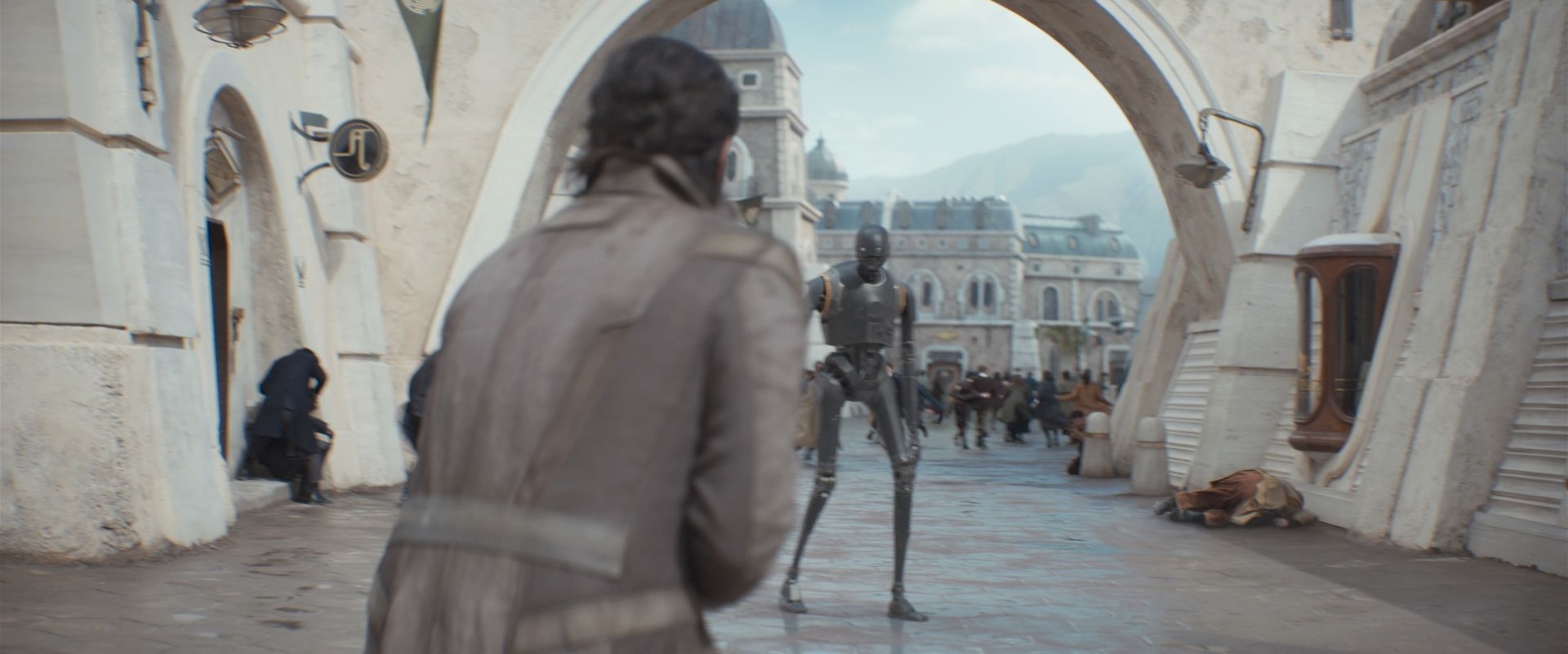
Cassian’s first encounter with the deadly Imperial security droid on Ghorman, later reprogrammed as his companion, K-2SO (Credit: ILM & Lucasfilm).
Understanding that each project needs and deserves its own visual identity within the broader Star Wars galaxy has changed the people who worked on Andor. As he moves on to new projects, TJ Falls reflects on one of the most important lessons he learned from the show.
“It was Tony and Sanne who said, ‘Let the experts be the experts.’ Because of that, every artist felt incredibly valued, and their contribution was fully appreciated. That message was constantly sent down from Tony: Let the best idea win. If an artist had something cool to contribute, it made its way up and it was credited and talked about.”
“The thing that I hope we can take forward is collaboration across departments,” says Leo. “Andor was completely generous in that everyone would happily let someone else do something if it made the result better, so there were no fiefdoms. We were able to put so much value on the screen because every problem was solved together, and that’s something that comes from the top down, in this case, from Tony.
“When there isn’t a sense of shared ownership and a clear creative direction, sometimes the frustration can trickle all the way down through the process,” Leo continues, “not just through the shoot and on the client side, but into the visual effects work and with the artists. Someone can change their mind at any minute and tell you to do something differently. For me, that was the most positive difference about Andor. It’s a culture that says there are no egos; it’s not about anyone standing out and making a name for themselves; it’s all about the collaboration. So I hope that’s something I encounter again on future projects.”
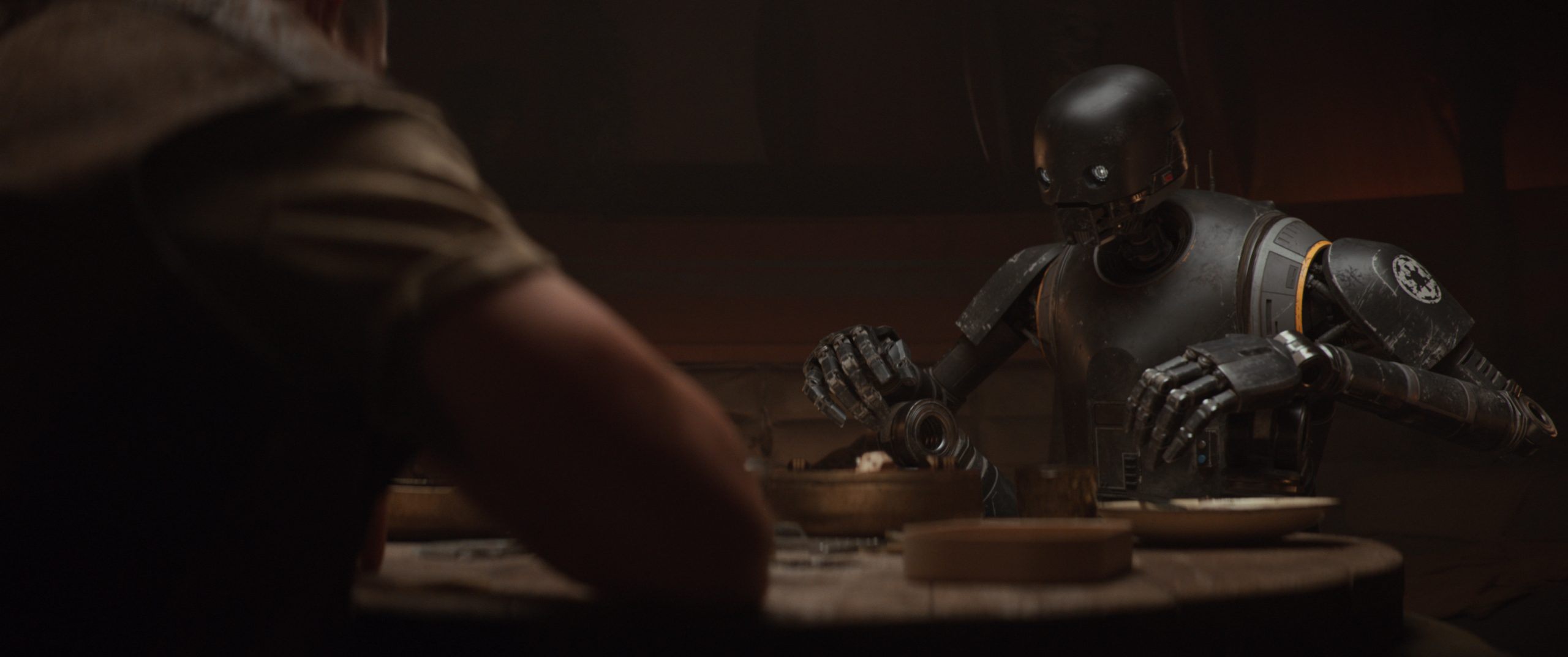
Tudyk performs as K-2SO alongside a final frame created by ILM (Credit: ILM & Lucasfilm).
When pondering each of their favorite moments in season two, Leo is quick to answer, “Cassian stealing the TIE Avenger and escaping in episode one [‘One Year Later,’ directed by Ariel Kleiman] was certainly the one I was involved in the longest, all the way from the beginning pitching storyboards for the action, right down to it being the last thing we shot with Diego.
“What I like about it is that on the one hand it’s a very classic Star Wars sequence with the spaceship and a dogfight,” Leo continues, “but we found a way to still make it fit within Andor by designing it in a way that it starts very practical in a real hangar with a real ship and stunts, and bit by bit we transition into something that’s pure computer graphics, but it all fit into the style the show, so I’m really pleased with that.”
Falls is equally quick to respond. “My favorite is the opening shot from episode eight [‘Who Are You?’ directed by Janus Metz], which is a long lens establishing shot of Ghorman, orbiting around the city. We had Hybride [Ubisoft’s visual effects branch] working on the look of the plaza, and ILM took on the high establishing shots of Ghorman from the air. The shot went through a number of rounds of honing it into what Mohen was thinking, pitching the idea without the visual was tricky, trying to get everyone to understand what it was that was being described. Once we started to get the visuals into motion with previs, it started to click with everybody. Then it came alive in shot production. I think it’s absolutely gorgeous.”
—
Mark Newbold has contributed to Star Wars Insider magazine since 2006, is a 4-time Star Wars Celebration stage host, avid podcaster, and the Editor-in-Chief of FanthaTracks.com. Online since 1996. You can find this Hoopy frood online @Prefect_Timing.
In part one of a two-part story, the production’s visual effects producer and visual effects supervisor discuss the effort to create over 4,000 effects shots for the Emmy-nominated Lucasfilm series.
By Mark Newbold
“It was a good opportunity to expand our horizons,” says TJ Falls, vice president of visual effects at Lucasfilm, about the team’s work to create a grounded aesthetic for both seasons of Andor (2022-25). After Rogue One: A Star Wars Story (2016) established the tone for the adventures of Cassian Andor (Diego Luna), the Andor production opted to utilize a number of existing locations for filming in the United Kingdom and around the world. It was a tactic previous Star Wars productions also chose (for example, 1999’s Star Wars: The Phantom Menace traveled to Italy and the Caserta Palace for the interior of the Theed Palace on Naboo), but integrating these locations to such a degree was something new for Industrial Light & Magic, a choice Falls appreciates.
“It allowed us to go out in the world and find a real base reference,” explains Falls, who was also the overall visual effects producer for Andor. “That was something the team worked hard to capture. We’re actually there in the city or in the mountains, so it was wonderful to be able to tie real-world locations into our digital work.”
The debut season of Andor leaned heavily into this physical integration. But, with a very real-world, global pandemic happening around the production, season one had its international travel wings clipped, as Falls explains.
“We couldn’t travel, but we still managed to gather reference material, including some for the ship-breaking yards on Ferrix. For season two, we were fortunate enough to finally be able to travel, so we flew to Lake Como and the Italian Alps to capture plates for Ghorman, among other locations.”
The Mothma estate on Chandrilla utilized aerial plates shot in Spain (Credit: ILM & Lucasfilm).
Joining Falls, production visual effects supervisor Mohen Leo picks up the conversation.
“Being able to travel to Spain for a variety of locations on season two allowed [production designer and executive producer] Luke Hull to rely much more heavily on the look of existing locations that were compatible, particularly the Senate building. Once we did the first location scout at the City of Arts and Sciences in Valencia, we were looking around, thinking, ‘Wow, it looks like Coruscant already.’ That made a huge difference, having that basis, both for interior and exterior spaces, so we could then use visual effects to build on and make it feel like Star Wars.”
The practicalities of having a ready-built set in the form of an existing building clearly had their benefits. Still, the broader task of adding visual effects presented its own challenges, as Leo explains.
“One thing I took away from the project is to push as much as possible for real locations,” he says. “Using an existing building during a shoot allows people to make informed decisions that stick, because if you have something that already looks 50%, 60%, or 70% the way you want it to, everyone has the confidence to say ‘Okay, this is the frame that we want, and we understand that we’re going to put this building in the background. Also, you have the composition of the lighting and the weight of the architecture, which makes it much easier, rather than having a blank canvas in post-production and then debating what it should look like.
“For example,” Leo continues, “there were the mountains around Ghorman. A couple of people from the production team and I went to Italy and did a two-day helicopter shoot. We felt strongly that even those locations where we would never actually shoot with a full crew or with actors should be based very specifically on real landscapes. That allowed us to put the Star Wars architecture in there and have that foundation.”
With the tremendous amount of work required to bring these locations to life, the balance between real locations and visual effects is a delicate one, based on story requirements, budget, and time.
“When we go location scouting, I always ask the director of photography [for season two, Damián García, Christophe Nuyens, and Mark Patten], ‘What are we keeping from the location?’” says Leo. “Because there has to be value in us being there. We were on location in Spain, and a Coruscant scene was discussed, which involved two people standing by a railing, looking out across the fictional cityscape. If we’re going to replace the whole city, then we don’t need to shoot that in Spain.”If you want that view, we can shoot that back in London on a green screen set because it’s easier, and we’ll have more control over the lighting. That, for me, is the main thing, having a clear idea when you go on location of what we keep from the location, and why we are there?”
The original location plate (top) shot at the City of Arts and Sciences in Valencia, Spain opposite the final shot (bottom) with the Coruscant skyline (Credit: ILM & Lucasfilm).
The use of natural light throughout the series is even more impressive when considering the balance between physical structures and digital extensions. Bathing the action in brightness or shadow, regardless of where and how it was shot, Leo explains, is how this integration was managed.
“We work very closely with the DP on that,” says Leo. “There are scenes where people walk directly from a stage set in London onto something that’s on location in Valencia. In the context of the story, it feels like one continuous location, even though they were shot months apart in two different countries. Obviously, we take lots of photographic reference. We have the plates of the one side at hand when we’re doing the other, and we’re constantly checking to make sure things fit together. On this project, we had a plan for each of those things before we went on location and shot it. We’re not trying to force things together in post; they’re meant to go together.”
“That’s exactly it,” adds Falls. “It’s the collaboration with the DP and lighting team, but also with previs, with techvis, and knowing that we’re going from studio space to location space. We had the opportunity to plan that out very specifically, each step of the way. And what helped us succeed is that we had a plan, and we were able to push it through to the best of each department’s abilities to deliver on it.”
Having a plan is essential to any well-run production, and on a visual effects-heavy series like Andor,it’s even more vital. Managing the process requires unique skills and systems to marshal all the information and elements into one place, as Falls explains.
“You’ve got to manage all these people and figure out who’s doing what, breaking it down to what the responsibilities of each person are. You start with something that’s massive, and we start to split things up between our teams and vendors. Ghorman is primarily a Hybride sequence; we’ve got Scanline VFX dealing with Mina-Rau, and we work with [ILM visual effects supervisor] Scott Pritchard to ask how we’re going to slice up this pie.
“It’s like eating an elephant one bite at a time,” Falls adds with a smile. “That translates from the production side into post and dealing with our vendors, and it’s all about clear communication, having people that you can build a shorthand with and have trust with, and then let them do what they do and not overmanage it.”
Actor Joplin Sibtain (Brasso) atop the speeder prop rigged to a camera vehicle (top) with a final frame from Mina-Rau (below) (Credit: ILM & Lucasfilm).
Truly a mammoth task, but that’s just the start of it. “Then, each individual team brings their expertise to build it right back up the mountain,” Falls continues, “so that Mohen has the opportunity to have that creative outlook over everything, I make sure it’s moving at the pace that it’s supposed to and that we’re hitting our schedule and staying on budget while making sure that [creator and showrunner] Tony Gilroy is getting what he wants for his vision of the show.”
There are many unsung heroes on any production, and amongst those are the production managers (including Frédérique Dupuis and Alyssa Cabaltera from ILM and Anina Walas from Lucasfilm, among others), who, on the visual effects team, juggle countless shots and give structure to the process for both the production and the partner studios. In its completed form, Andor might appear to be a graceful swan, but under the water’s surface, its legs are furiously kicking to propel it forward, as Mohen Leo elaborates.
“The visual effects production team has to keep track of over 4,000 shots, and each one of those shots has dozens and dozens of assets, be it art and reference or photography and scans, and they have to funnel all of that to where it needs to land and then send any questions back to me in a manageable way. I answer the creative questions. The logistical and organizational work is done by a team of incredibly diligent people without whom none of this would be possible.”
Along with this beehive of activity tracking all the elements, a database system, unique to each production, needs to be put in place.
“We find on each show that you have similar tool sets and similar ways of databasing things,” Falls says, “but you have to build it around the specific challenge of the show and the personalities involved. It’s about what Mohen likes and the types of data that we’re getting in.
“You have people like [on-set visual effects supervisor] Marcus Dryden, who was on set managing that side of things. His role was specific to season two, and it worked really well, that marriage of supervision responsibilities between me and our Lucasfilm production team and our production manager, and the coordinators building the database. That worked well for Mohen to get the notes in and out and track the scans and the data, but presenting it in forms that fit the specific way we were working with our vendors on this show. It wasn’t groundbreaking, but it was specific to what we needed.”
Palmo City’s central plaza on Ghorman utilized the massive backlot Pinewood Studios (top), and was later completed with visual effects (bottom) (Credit: ILM & Lucasfilm).
The database is set up, a system is in place, production managers have a process, and the elements are tracked as they come in. “It’s absolutely critical because it gives me the luxury to say, ‘Hey, where’s that scan from that location that we shot in that scene six months ago in Valencia?’” explains Falls. “And within 10 seconds, somebody will go, ‘Here it is.’ That shouldn’t be taken for granted because I’ve been on many shows where that can turn into an archaeological dig that can take days, or sometimes you don’t find it at all.”
With this bespoke Andor structure in place for season one, Leo could then take that and refine it even further for season two, a huge advantage, especially considering episodic television wasn’t a familiar environment for him.
“Season one was a big learning experience,” explains Leo. “I’d never done episodic television before; I’d only done movies, so dealing with that much content in such a compressed time was challenging. Also, the interaction with editorial is slightly different on episodic television. With every project, there’s an element of adjustment, but, there’s also an element of learning.”
“We had the luxury of a number of production staff carrying over from season one to season two,” says Falls. “So we learned in real time and adjusted things to fit. You could port it, but it wouldn’t necessarily work as succinctly as it does when it’s crafted around the group, and for season two in particular, I felt that we ended up crafting a really great system. The team was unbelievably adept in making sure that every person got exactly what they needed as quickly as humanly possible.”
The script is the tramline for everything that ends up on-screen, but in the realm of visual effects and working with the rest of the crew, there needs to be a clear understanding of what’s required and how to do it, something that comes from the top, as Leo explains.
“When we’re planning a shoot, we sit down with the director, the cinematographer, and the assistant director and ask, ‘What are you trying to achieve, what do we need to contribute in terms of the visual effects, and how do we make sure we get what we need during the shoot?’ Then we take meticulous notes.”
However, it doesn’t always go as smoothly as planned. “We’re staring at the monitor as they’re shooting, but then somebody drops the microphone into frame, so that’s something we have to paint out,” Leo continues. “Maybe we have to do a set extension that we didn’t expect. Then there’s a step in post-production where, along with editorial, we’re looking at the early versions of the cuts, and that’s where we do something called the statement of work, where we look at each individual shot and go, ‘Okay, here’s all of the things we need to do for this particular shot across the various disciplines in order to complete it.”
An aerial view of the Ghorman set on the backlot (top) and final frame (bottom) (Credit: ILM & Lucasfilm).
Like all aspects of a production, visual effects come at a cost, with so many highly skilled experts putting their time and craft into a project. The team is responsible for both managing costs and ensuring that additional required effects can be covered within the allotted budget.
“There’s a constant ebb and flow of evaluation, so we work closely with editorial, seeing the working cuts,” Falls notes. “We go in with [editor] John Gilroy and they show us little pieces, and that allows the opportunity for some give and take as we evaluate things and look at shots and go, ‘Well, this is more than we had planned, or maybe there’s another sequence where they’re using less than what we had planned,’ and so there’s a little bit of horse-trading that happens.
“What we strive for,” Falls continues, “is to not say we can’t do something because it wasn’t planned. If there are 10 additional seconds needed in the show, how can we do it? Can we find a way that still delivers everything that’s needed, but also in line with the number of resources we allotted? Then, we’re back on budget, or I have to figure out how to take care of it, but we always start with what is the creative desire for the scene. How is it furthering the story? We don’t want anything that’s egregious or over the top just for the sake of being something flashy, so we have to make sure that everybody is in agreement that ‘Okay, it’s more than expected but it serves the story, it does what Tony needs, and now it’s our job to figure out how can we make it work.’ I think we did a pretty good job of that.”
Mark Newbold has contributed to Star Wars Insider magazine since 2006, is a 4-time Star Wars Celebration stage host, avid podcaster, and the Editor-in-Chief of FanthaTracks.com. Online since 1996. You can find this Hoopy frood online @Prefect_Timing.
SDCC’s hottest ticket brought the first-time Comic-Con guest and friends to preview the Lucas Museum of Narrative Art, and ILM.com was there in the room.
By Clayton Sandell
George Lucas takes the stage at San Diego Comic-Con (Credit: Lucasfilm).
Star Wars creator and Industrial Light & Magic founder George Lucas recently made his San Diego Comic-Con debut, but the Force has been strong at the show for decades.
Inside the convention center’s massive Hall H, a record Sunday crowd of 6,500 screaming and cheering fans greeted Lucas as he walked onstage to give the first public preview of the Lucas Museum of Narrative Art.
Co-founded by Lucas and his spouse, Mellody Hobson, the museum is set to open in Los Angeles in 2026. Lucas describes the building as a “temple to the people’s art.”
“This museum is dedicated to the idea that stories and mythology are extremely important to society in creating community,” Lucas told the crowd. “Art illustrates that story.
“It’s mythology,” he continued. “People believe it, and it binds them together with a common belief system. And what we’re doing here with the museum is to try to make people aware of the mythology that we live by. And at the same time, let them have an emotional experience looking at art.”
Lucas was joined by two Academy Award-winning filmmakers: director Guillermo del Toro and Lucasfilm’s senior vice president and executive design director Doug Chiang. Actor and artist Queen Latifah moderated the panel.
“What is amazing about this collection is that it will give you a step-by-step look at how a form of expression came to inform what we are today,” said del Toro, a Lucas Museum board member and longtime ILM collaborator on films includingPacific Rim (2013) and the upcomingFrankenstein (2025).
Director Guillermo del Toro (left) at ILM’s San Francisco studio during work on Pacific Rim (2013) with visual effects art director Alex Jaeger (center) and visual effects supervisor John Knoll (Credit: ILM & Greg Grusby).
The Lucas Museum’s renowned collection includes items from both the original and prequel trilogy eras of Star Wars, including filming miniatures created by the ILM Model Shop, concept art, creature maquettes, costumes, a full-scale version of Anakin Skywalker’s N-1 starfighter fromStar Wars: The Phantom Menace (1999), speeder bikes fromStar Wars: Return of the Jedi (1983), and Luke Skywalker’s X-34 landspeeder fromStar Wars: A New Hope (1977).
The pieces will share exhibit space with an eclectic mix of visual art: paintings by artists including Norman Rockwell, Frida Kahlo, and Maxfield Parrish; original art created for Iron Man’s first comic cover in 1968; the first-ever 1934 Flash Gordon comic strip drawing; and Peanuts illustrations drawn by Charles M. Schulz.
“These are all very emotional pieces,” said del Toro. “This is celebrating things that speak to all of us, collectively or individually.”
Lucas says his art collecting began in college when he bought his first comic illustrations. His multifaceted collection today has grown to around 40,000 items.
“I’ve been doing this for 50 years now. And then it occurred to me: ‘What am I going to do with it all? Because I refuse to sell it,’” Lucas explained. “I said I could never do that. It’s just it’s not what I think art is. I think it’s more about an emotional connection with the work.”
Lucas’s first appearance at San Diego Comic-Con brings an association that began a long time ago full circle. In 1976 – ten months before his space fantasy adventure Star Wars hit theaters – a few dozen lucky attendees got a preview of the comic book adaptation of the film led by Marvel’s Roy Thomas and Howard Chaykin. They were joined by Charles Lippincott, Lucasfilm’s vice president of advertising, publicity, promotion, and merchandising. During a panel that didn’t start until 8 p.m. on Thursday, July 22, the trio also revealed a few still images from the upcoming movie to a room that had plenty of empty seats.
Visual effects art director Doug Chiang at work on Terminator 2: Judgment Day (1991) (Credit: ILM).
Chiang, a celebrated artist himself who first joined Lucasfilm as creative director at ILM in 1991, described growing up loving comic books at a time when comic book art didn’t get much respect.
“I think what’s remarkable about George is that he leads from the heart, and this museum is him. It’s his gift to help celebrate this,” said Chiang. “Narrative art is a way to educate kids and say, ‘It’s okay to draw your fantasy, draw things from your mind, embrace comic books.’ It shouldn’t be left out of art. What’s fantastic is that I think the museum will inspire the next Norman Rockwell or Frank Frazetta.”
—
Clayton Sandell is a Star Wars author and enthusiast, TV storyteller, and a longtime fan of the creative people who keep Industrial Light & Magic and Skywalker Sound on the leading edge of visual effects and sound design. Follow him on Instagram (@claytonsandell) Bluesky (@claytonsandell.com) or X (@Clayton_Sandell).