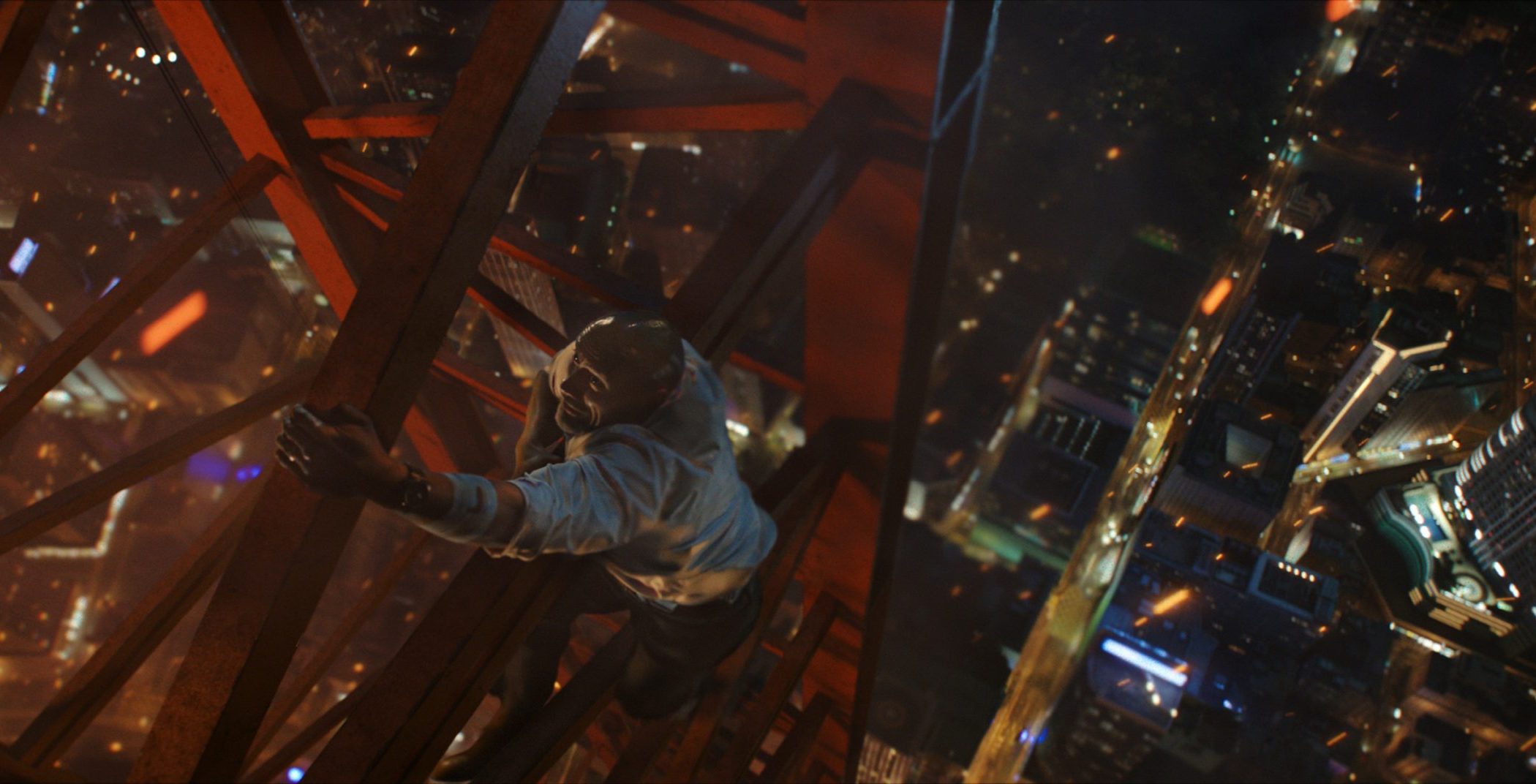
Visual Effects Supervisors Craig Hammack and Eddie Pasqurello led ILM’s visual effects team on the creation of the seamless visual effects work on Rawson Marshall Thurber’s, thriller Skyscraper. ILM contributed the film’s primary environment, the skyscraper itself known as ‘The Pearl’, massive fire and explosions, as well as a host of invisible effects work. The main goal of the visual effects effort was to create the sense of scale, the terrifying feeling of vertigo, and overwhelming sense of danger to the film’s climactic scenes.
ILM split the body of work between its San Francisco and Vancouver studios. The building was our biggest undertaking. The title of the film says it all. The entire story takes place in and around this CG structure so we knew it would need to be well-thought out and executed. Luckily, production designer Jim Bissell and his team also recognized the challenge and gave us a tremendous head start. We received initial artwork and a blocking art model from them. Then our modeling team launched into a build that would continue to evolve over the course of the entire show. Since the Pearl was a massive structure which would have specific sections that need to hold up to extreme detail, we often split it into subsections which could easily be loaded or unloaded dynamically for the combination of detailed close-up work and wide establishing shots.
Outside of the creation of the Pearl which was 1Km tall and had roughly 220 floors, the most challenging work we contributed was the fire and destruction of the building itself. Our artists and engineers had to create large source fires, smouldering surface smoke, embers, ash, paper debris, and large scale debris… all affected by wind and inserted into a burnt-out husk of a building with broken windows, fully furnished interior rooms with collapsing structural pieces, and floor-to-floor collisions as structure gave way.
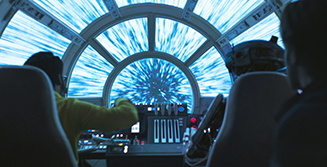
Directed by Ron Howard, Solo consisted of some 1,800 visual effects shots of nearly every variety. From seamlessly integrating CG elements with liveaction plates, to complete CG environments, to real-time visual effects implemented on set, and the use of LED screens, every effect plays in service to the greater story.
Given that quite a bit of the story takes place in the iconic Millennium Falcon, it was decided the production would construct a highly-detailed set of the ship’s cockpit. To create convincing shots from within the cockpit the crew constructed an articulated practical set piece filming. The set which was elevated was then surrounded by a massive 160-degree wraparound screen that could playback ILM StageCraft effects content in real-time at the tap of an interface. This allowed filmmakers to capture the light reflecting off the face of Solo himself (Alden Ehrenreich) but also playing off every facet of the set itself.
Another interesting sequence is the heist of the scarce fuel, coaxium, in the snow covered mountains of Vandor. Under the leadership of visual effects supervisor Rob Bredow, a small unit from the effects team, performed both ground-based and aerial photography surveys of a large swath of the Dolomites in Italy to create the mountainous environment. Some 80,000 images were captured and from those, a point cloud is generated and processed into renderable geometry that the crew would then add CG cameras in order to create the sequence. The sequence culminates in a massive explosion which literally destroys a mountain when the theft of a cargo container of coaxium goes terribly wrong. Here again the effects team took an unorthodox approach to creating the effect. Bredow and team 3D printed a section of the mountain created from the survey data at a small scale which was then submerged in a tank and rigged with miniature pyrotechnics. The pyrotechnics were triggered while a high-speed camera captured the resulting explosion at 120,000 frames a second. ILM artists then combined the resulting footage with simulations and other CG elements to create the final dramatic shot which looks unlike any other onscreen explosion we’ve seen before.
The visual effects work on Solo: A Star Wars Story was recognized with an Academy Award® nomination, and 3 Visual Effects Society Award nominations.
Monster Hunt 2 is an upcoming Chinese film directed by Raman Hui, starring Bai Baihe and Jing Boran and a sequel to 2015’s Monster Hunt.
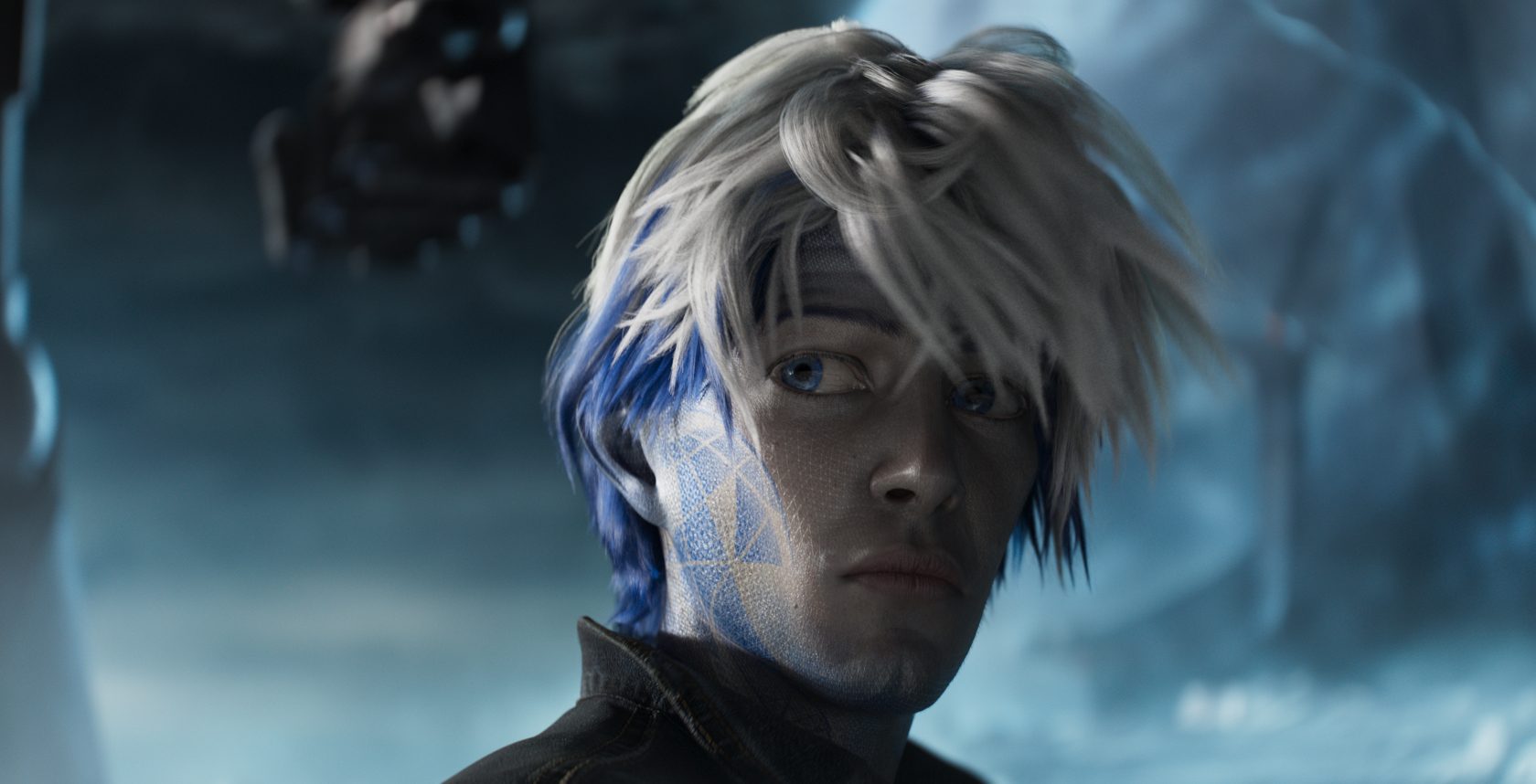
Ready Player One is set in 2045, the planet is on the brink of chaos and collapse, but people find salvation in the OASIS: an expansive virtual reality universe that filmmaker Steven Spielberg challenged ILM to bring to life. Production Visual Effects Supervisor Roger Guyett, Animation Supervisor David Shirk, and the ILM visual effects teams in San Francisco, Singapore, Vancouver, and London consisting of some 2,000 artists ultimately created over 90 minutes of almost entirely digital VFX work to bring the immersive world of the OASIS to the screen. The visual effects work would receive nominations for Best Visual Effects from both The Academy and BAFTA, in addition to four Visual Effects Society Award nominations and two wins.
The challenge began with the vibrant multi-dimensional world that would carry much of the story environments that make up the OASIS but equally challenging was designing and creating performances for the film’s five lead characters, the ‘High Five’ as they are known and the primary antagonists Nolan Sorrento and “I-r0K”. Under the watchful eye of Production Designer, Adam Stockhausen and ILM Visual Effects Art Director Alex Jaeger, those characters and the likes of the sixers, King Kong, Chucky, and many others were all visualized and brought to life.
Perhaps the single most daunting challenge was how to populate the OASIS. Aside from the huge range of 1980s characters, gaming characters, cartoon characters, and heroes we knew we had to build, the team also needed thousands upon thousands of other background characters. To achieve this a new crowd system called ARCADE was developed. The system was both highly directable when necessary but also leveraged a layer of artificial intelligence making it indispensable. The system not only designed and created characters of all types – based on predetermined design specifications and artistic choices – but it also created behaviors appropriate to the sequence including fighting and interaction in the battles and using all sorts of weapons depending on the unique characteristics of the character. Perhaps the best example of the system in action is the scene in the third act where more than half a million Gunter characters attack the castle in the end battle.
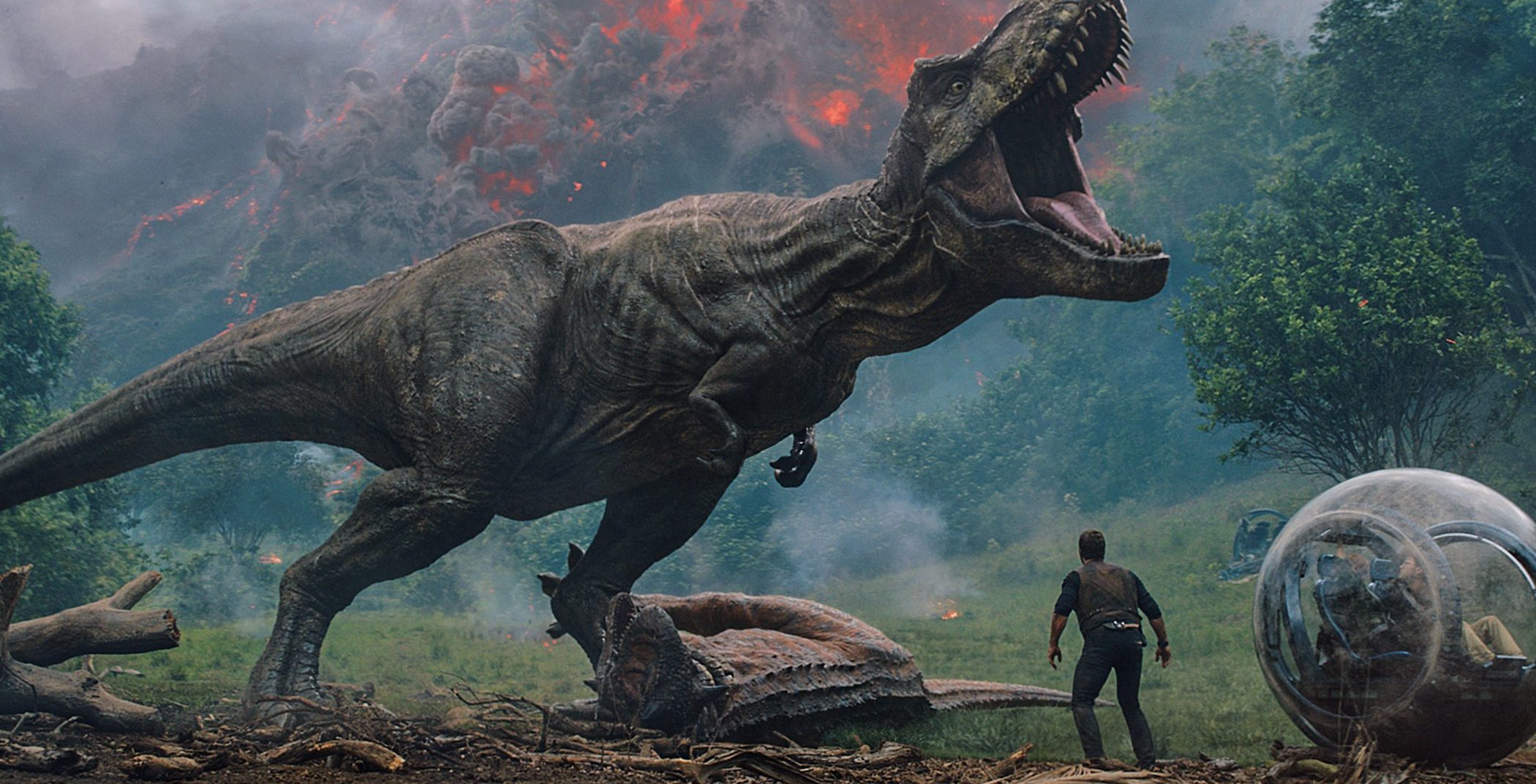
ILM got involved in Fallen Kingdom early in pre production and served as a linchpin of the production, due to the virtual production services provided to the filmmakers. ILM Stagecraft was used early on to plan the shoot and again during the shoot to refine shots director J.A. Bayona wanted a hand-held look to the camera operation.
Production visual effects supervisor David Vickery and his ILM effects team worked with creature effects supervisor Neal Scanlan on dinosaur designs for the film’s menacing genetically-engineered creature the Indoraptor. Rather than creating camera-finished animatronic dinosaurs, Scanlan’s team would take ILM’s dino model and create a hybrid full-size 1:1 head that could interact with the director and actors on set, with the knowledge that it would be fully replaced in post. This would give the actors a realistic dinosaur head to perform against and serve as a great lighting reference for the visual effects team when they replaced the stand-in head with it’s digital likeness.
ILM animation supervisor Jance Rubinchik oversaw the work of a team of 52 animators contributing to the various dinosaurs on the film. While Blue and the Indoraptor are the lead characters in terms of the digital creatures, there was also a herd of stampeding dinos, and the beloved T-rex. Even in cases where the full size animatronic raptor was used the visual effects team augmented the performance to add complexity of motion making the hybrid performance a seamless blend of animatronics and CG. The team also had to contend with digital doubles, and Gyrospheres but in true Jurassic fashion, it was the dinosaurs that everyone connected with the most.
Fallen Kingdom was nominated for 3 Visual Effects Society (VES) Awards and the Satellite Awards for BEst Visual Effects.
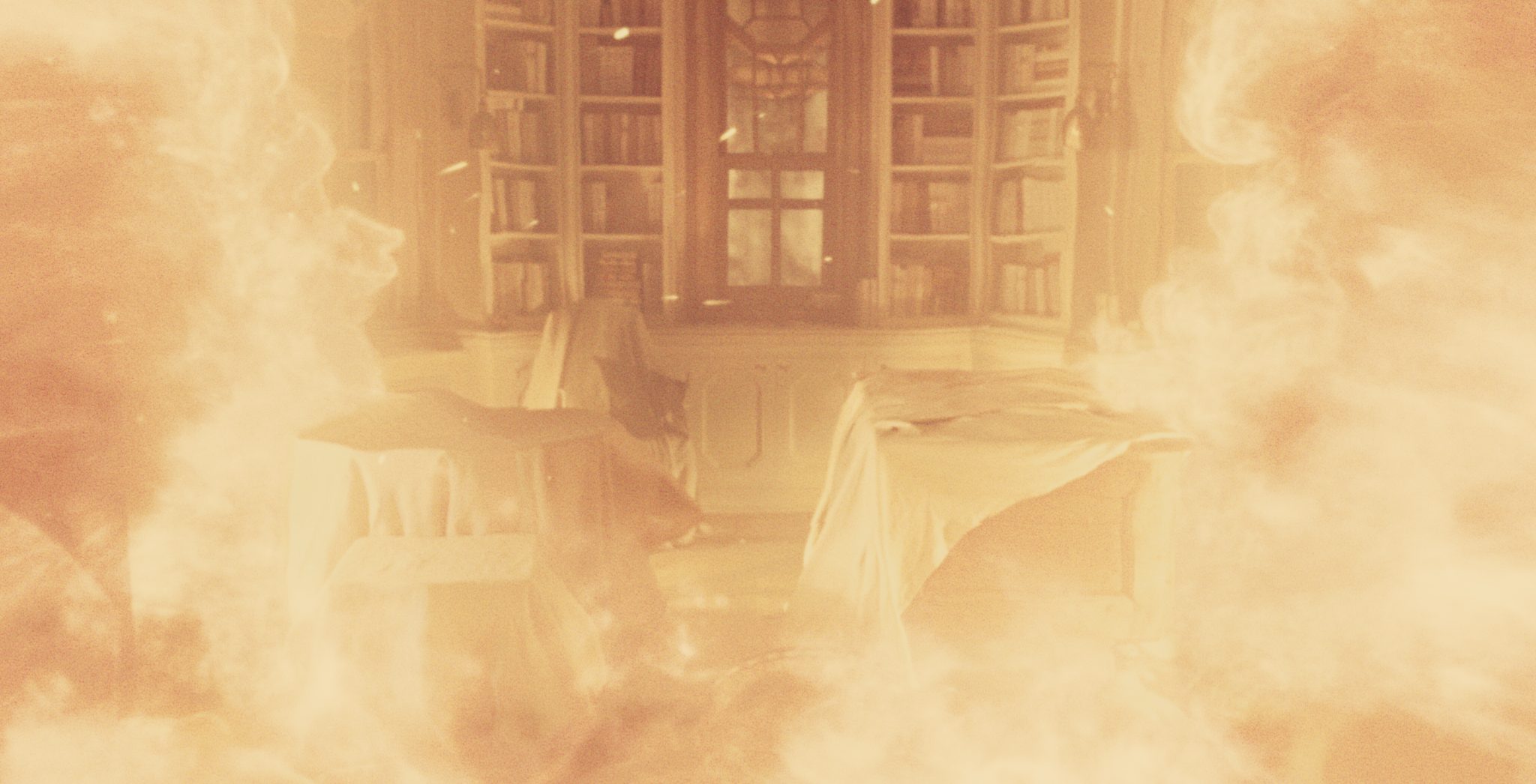
Mother! centers on a couple whose relationship is tested when uninvited guests arrive at their home, disrupting their tranquil existence.
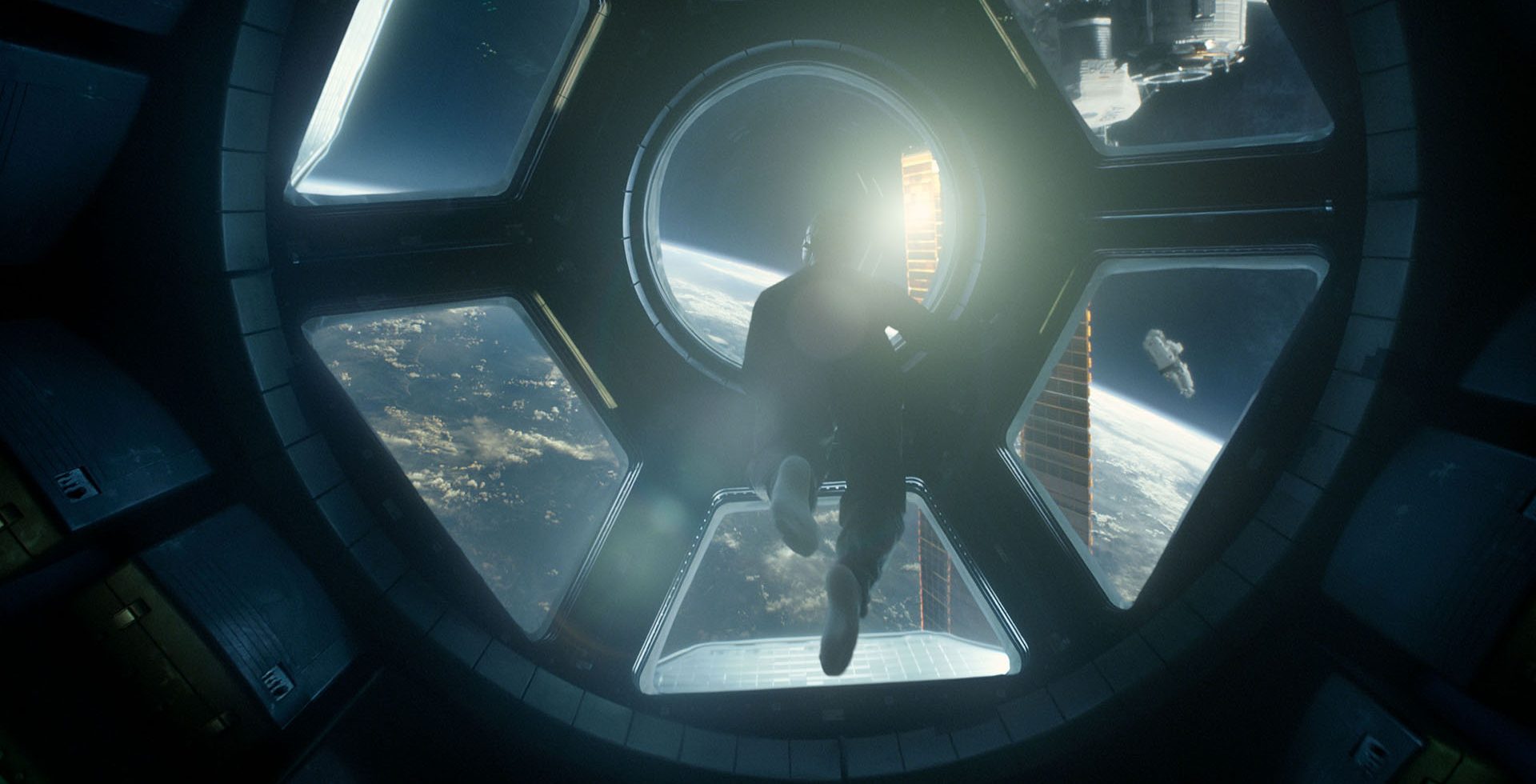
Life is a terrifying sci-fi thriller about a team of scientists aboard the International Space Station whose mission of discovery turns to one of primal fear when they find a rapidly evolving life form that caused extinction on Mars, and now threatens the crew and all life on Earth.
ILM worked on two key sequences, one of which incorporated a 10,000-frame shot that focused on showing the astronauts at work in zero gravity inside the International Space Station. This 5-and-a-half-minute-long shot served as the opening sequence of the film. To create the shot, ILM’s effects team seamlessly stitched together 17 disparate live-action plates, adding many strategic floating items along the way. The team also did extensive wire removal and plate reconstruction throughout.
The second sequence was dominated by a 1,000-frame shot where the camera reveals the ISS in low Earth orbit. ILM’s visual effects team generated lens flare elements to stand in for the sun, and a detailed matte painting completed the illusion.
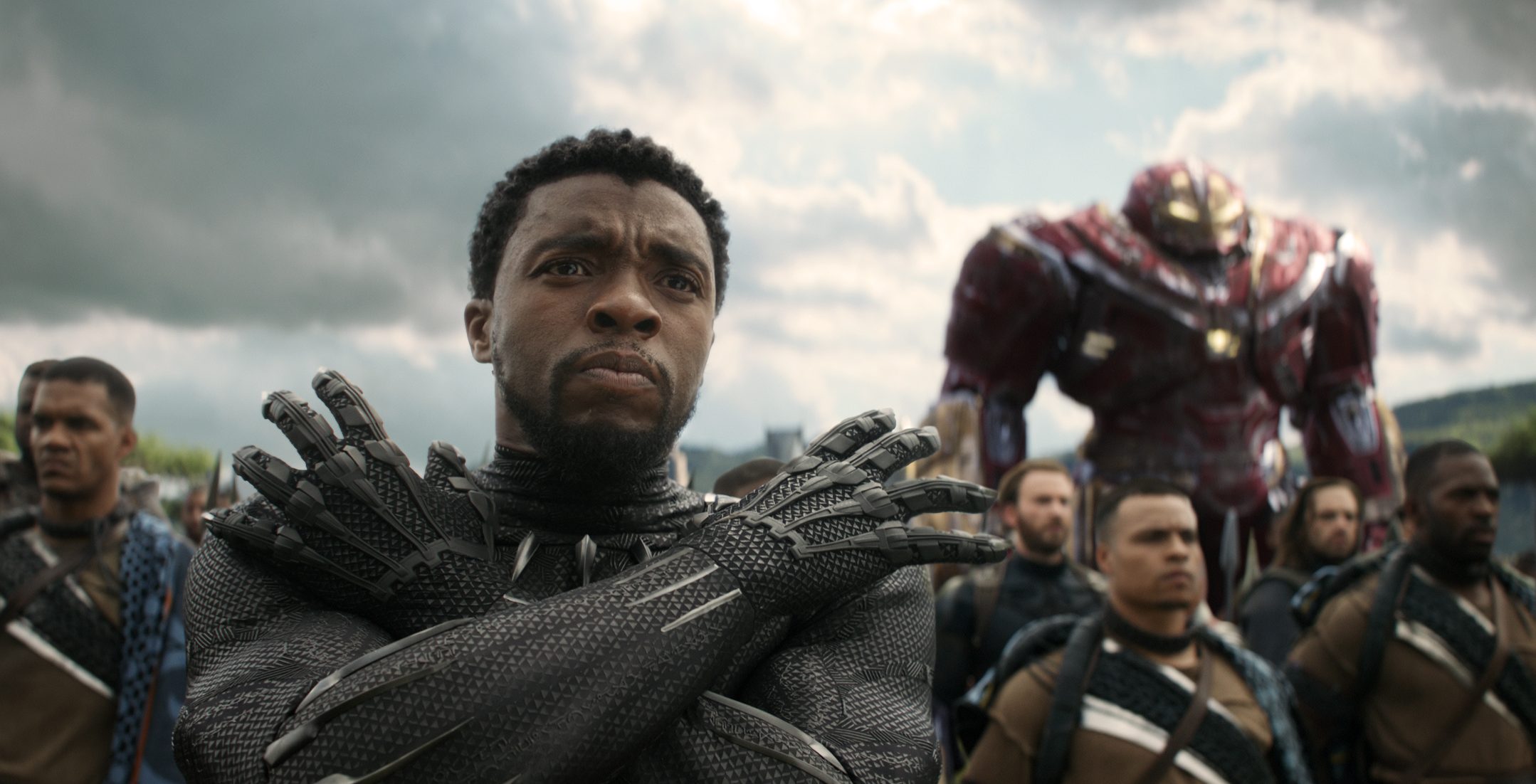
Avengers: Infinity War contained over 2,700 shots, just 80 of which were non-visual effects shots. Meaning just 3% of the shots in the film went untouched by the film’s massive global visual effects team. Under the supervision of production visual effects supervisor Dan DeLeeuw, ILM visual effects supervisor Russell Earl, and ILM animation supervisor Kevin Martel, ILM was primarily responsible for creating Wakanda, the Wakandan army and the massive battle with the invading hoards of Outriders. The team was also tasked with creating full CG characters like Hulkbuster, War Machine, Iron Man and digital versions of characters such as Black Panther, Thor, Captain America, and Falcon.
The visual effects on Avengers Infinity War was recognized with a nomination for Best Visual Effects from the Academy, BAFTA, as well as three Visual Effects Society Awards nominations. The work also won 4 additional VES Awards and the Hollywood Film Award for Visual Effects of the Year.