
One of ILM’s first visual effects supervisors looks back at the film’s mix of practical methods and revolutionary digital effects 40 years later.
By Amy Richau
“The game is afoot!”
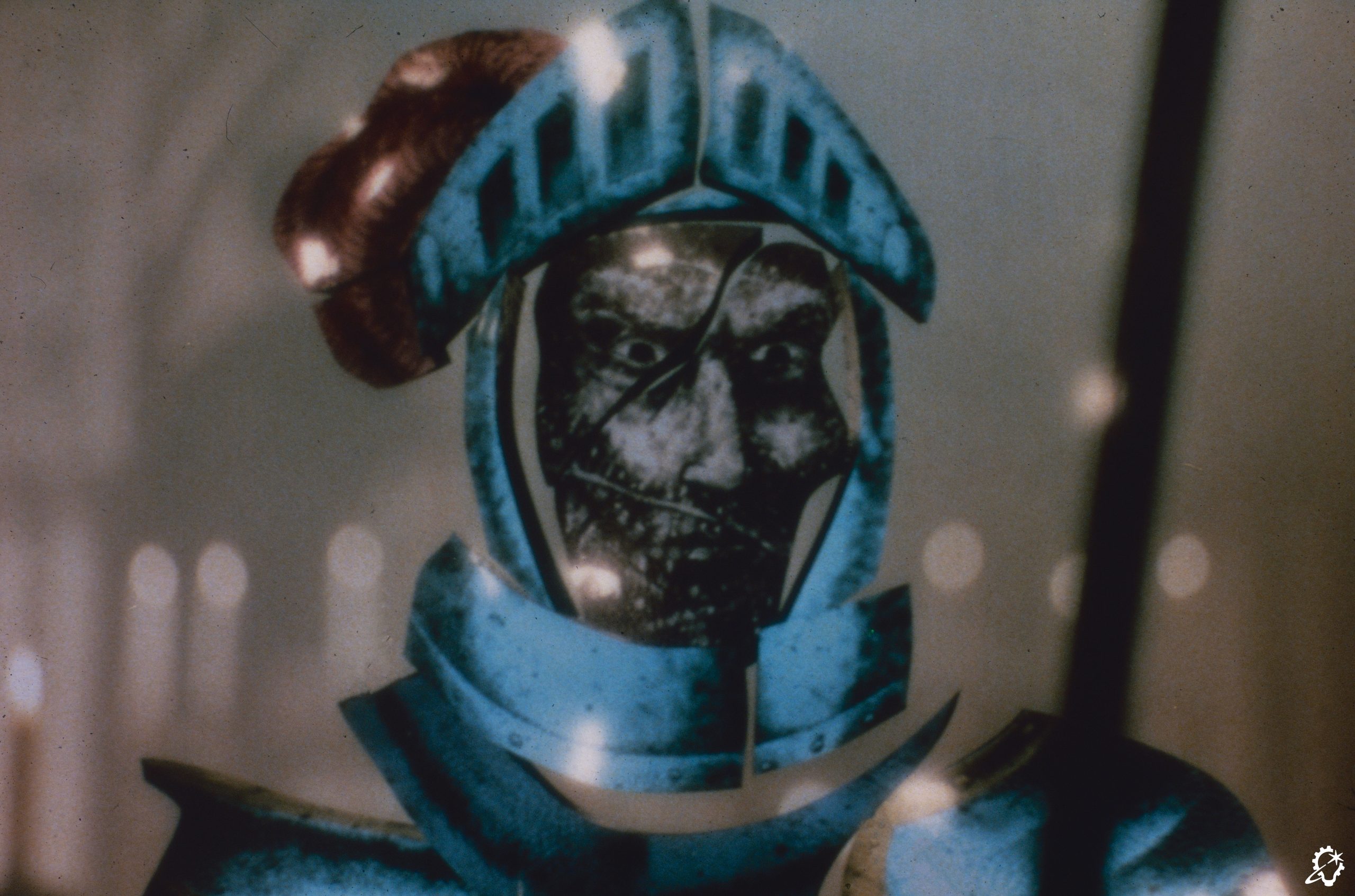
In 1985, director Barry Levinson and writer Chris Columbus brought a new tale centered around a teenage Sherlock Holmes to audiences with Young Sherlock Holmes. The film’s effects team, led by visual effects supervisor Dennis Muren, ASC (Star Wars: A New Hope, 1977), that included Kit West (Raiders of the Lost Ark, 1981), John Ellis (The Goonies, 1985), and David Allen (Willow, 1988), was nominated for an Academy Award for Best Visual Effects the following year. The film holds a unique place in Industrial Light & Magic’s history. It includes an abundance of practical visual effects methods the company had developed and perfected over its first ten years, as well as the first fully digital character ever depicted in a feature film, a stained glass knight.
Young Sherlock Holmes arrived in theaters the same year as The Goonies, Cocoon, Explorers, and Back to the Future, when ILM was increasingly working on more projects outside of Lucasfilm. Muren recently spoke to ILM.com about the making of Holmes and its unique mix of old-school and groundbreaking visual effects.
Many of ILM’s biggest breakthroughs occurred during the making of epic blockbusters like Star Wars, The Abyss (1989), Terminator 2: Judgment Day (1991), or Jurassic Park (1993). However, because Young Sherlock Holmes was a smaller film, it became the perfect vehicle for testing onscreen photoreal computer graphics (CG) effects. Also key was ILM’s proximity at the time to a smaller group ILM founder George Lucas was running a few hundred feet from their offices – the Lucasfilm Computer Division, a portion of which would later become Pixar Animation Studios.
The Height of Practical Effects
The story of Young Sherlock Holmes follows its teenage namesake (Nicholas Rowe) and newly arrived John Watson (Alan Cox) during a year at a London boarding school. The duo discovers a series of mysterious murders that lead them to a secret cult in Victorian London.
The snow that appears in many sequences of the film, which today might be created with CG effects, was accomplished with practical, old-school methods. Kit West, who was in charge of many of the film’s physical effects, needed the snow to both look real and leave no trace after shooting wrapped. West, who died in 2016, told Cinefex that despite filming on location in the United Kingdom at Eton College, Belvoir Castle, and Oxford University during the winter, all of the snow seen in the film was made by the production.
For snow on the ground, West’s team used 150 tons of dendritic salt. Snow on the buildings was made from over 100 tons of magnesium sulfate that had “a glint to it just as real snow,” said West. High-expansion foam that evaporated after about three hours was used in larger areas to mimic snow, while falling snow was made from a biodegradable insulation material that consisted of finely chopped paper, deployed by agricultural grain blowers.
One of the quirkier characters in the film, retired professor Rupert Waxflatter (Nigel Stock), spends much of his time on-screen trying to perfect his flying machine design. Surprisingly, none of the shots of the flying machine in Young Sherlock Holmes include miniatures. West recounted to Cinefex that an aviation company that worked on the film Those Magnificent Men and Their Flying Machines (1965) built a full-scale flying machine with a 25-foot wingspan, which production then tinkered with to make it functional.
Getting the flying machine in the air included two 120-foot cranes. “They were tower cranes,” West told Cinefex, “like those used for building skyscrapers, one on either end of the flight path. We had a stretch cable between them, and the machine was on runners. We attached all our own runners and rails, as well as the raising and lowering mechanisms.”
A Whole New World
One thing was clear from the beginning with Young Sherlock Holmes: Muren and the creative team behind the film wanted the effects to look as photoreal as possible. A challenge that, in the mid 1980s, even Sherlock Holmes could appreciate.
While many of the Computer Division’s projects at the time were focused on animation, Muren wanted to see if their technology could make the jump to photoreal effects. As Muren tells ILM.com, “I just needed to see if this technology had the controls necessary to make something look 100% real or not.” The sequences in Holmes that needed heavy visual effects were mostly split into discrete sections where characters experienced hallucinations, giving Muren the opportunity to use different methods throughout the film.
CG effects had been used in films by ILM before, most notably the Genesis sequence in Star Trek: The Wrath of Khan (1982), another collaboration with the Computer Division. But that sequence was intentionally not photoreal, and Muren knew from seeing other tests that in many cases reflections were too high, edges were too sharp, or the shots were missing essential shading and shadows to achieve a more realistic feel.
A CG test done by Triple-I ahead of Star Wars: The Empire Strikes Back (1980) involving five X-wings in flight increased Muren’s desire to play around with this emerging tech. “Triple-I’s test didn’t look photoreal, but they did a camera maneuver with the ship that there’s no way we could have done, and it looked pretty neat,” says Muren. “So it’s another temptation. This thing was out there, and I wanted to get it on a show and figure out how to do it.”
Muren decided to tackle the effects-heavy sequences as a bake-off, doing each one in a different way and seeing if a clear winner emerged. “With the stained glass man, that looks small enough, so let’s try CG, right?” Muren recalls, “If we find out in two months it’s not working, we can back off and do it another way.” For other hallucination sequences, Muren planned to use rod puppets in front of a blue screen and utilize Go-Motion with motion blurs.
Bringing Hallucinations to Life
The hallucinations in the film result from poisonous darts the cult’s leader, Professor Rathe (Anthony Higgins), uses as he seeks revenge against enemies from his past.
In one hallucination sequence that opens the film, an accountant, Bentley Bobster (Patrick Newell), sees his pheasant dinner attack him in a restaurant. After retreating to his home, Bobster sees the serpent handles on his coatrack turn into actual snakes that wrap around him and bite at his face. After the lamps in the room appear to start spitting out fire, Bobster leaps from his window to escape the flames.
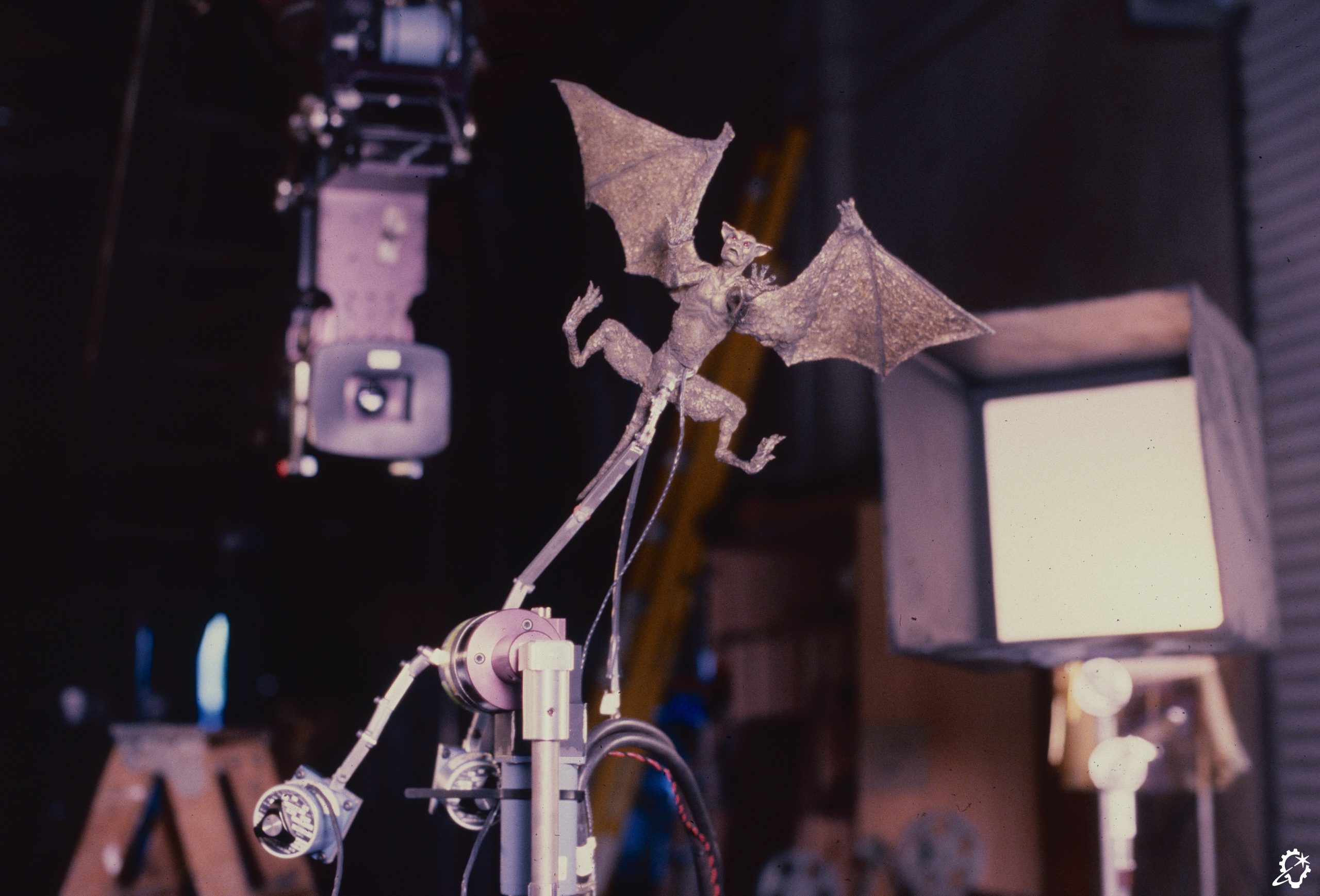
In other hallucination sequences later in the film, Professor Waxflatter is attacked by harpy statues in an antique store. His niece, Elizabeth Hardy (Sophie Ward), finds herself fighting off skeletons at the bottom of a grave. Cameraman Michael Owens handled the motion-control programming and lighting for the harpy sequence, and the Go-Motion animation performed by Tom St. Amand.
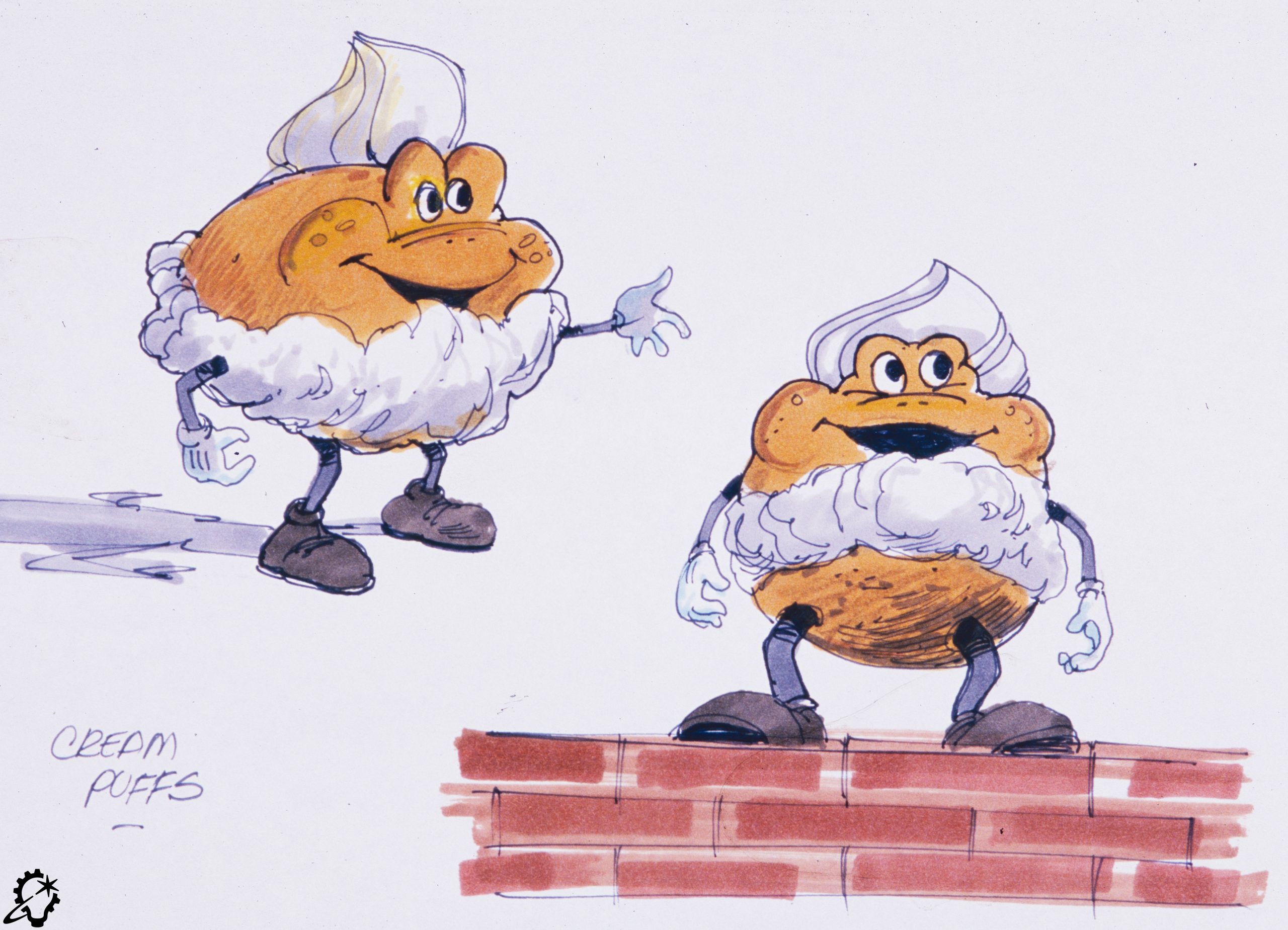
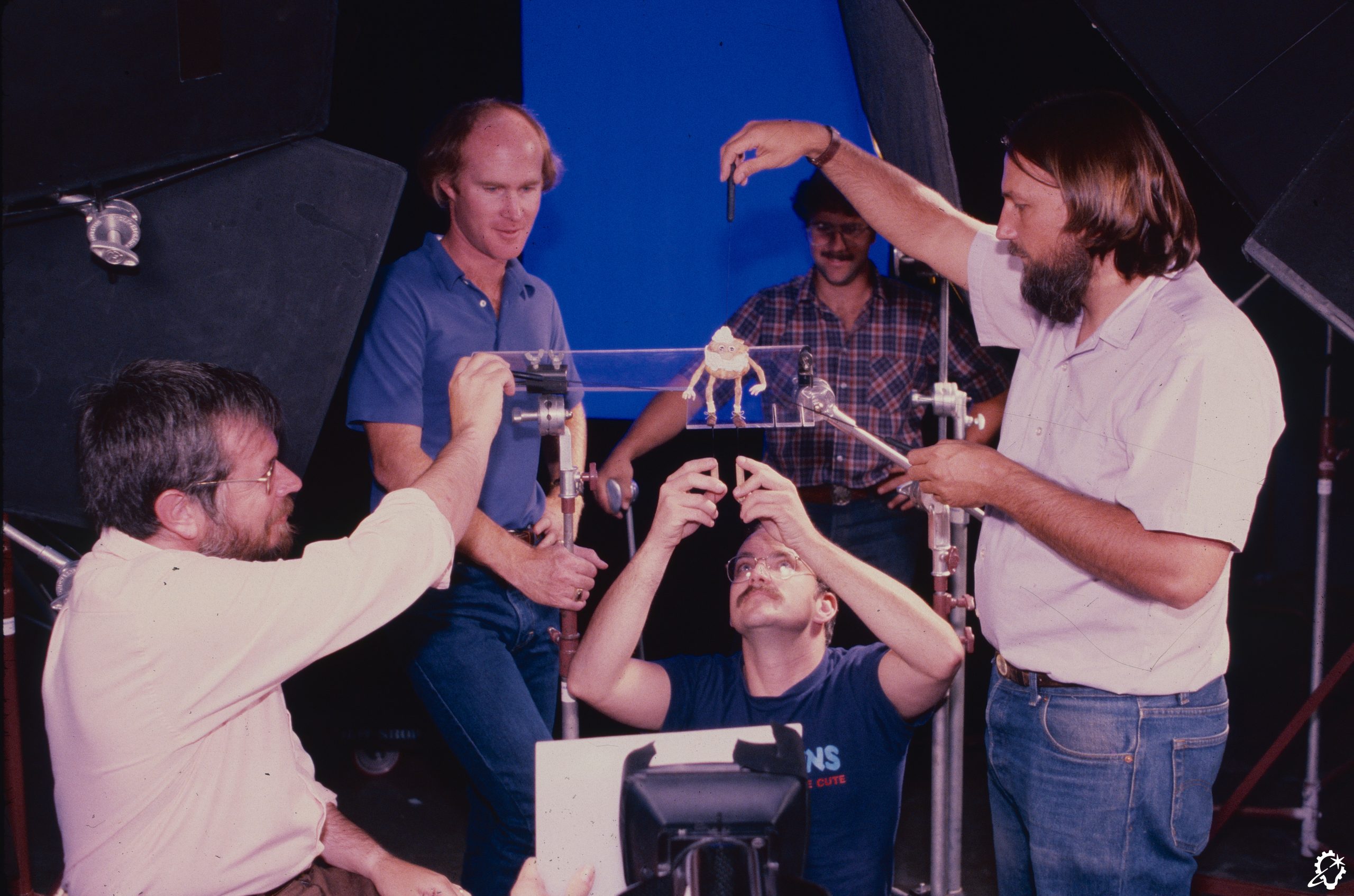
David Allen supervised the startling hallucination that young Watson experiences in a cemetery, which manages to be equally hilarious and disturbing. After being shot with a toxic dart, the ever-peckish Watson sees a wall of pastries. After he grabs one to eat, it comes to life in his hands and wraps a vine around him, knocking him to the ground. The other pastries soon leap off the shelves and start shoving whipped cream into his mouth.
Muren directed Allen and his crew to use rod puppets to bring these pesky, chaotic, and downright naughty desserts to life. The individual puppets were made of rubber and were approximately eight inches high. Each puppet had rods coming out of their elbows, torsos, heads, and legs with three or four puppeteers moving them in unison. Notes Muren, “Each element was shot in front of a blue screen, so when we combined them, twelve pastries would be in the same shot.” Since each puppet was shot separately, it took two to three days to shoot the eight to twelve pastries that would appear in each shot with Watson.
According to Muren, the pastry sequence in Holmes is a throwback of sorts to the mouse puppet Topo Gigio, who was manipulated by black rods in front of a black background in the early days of television. “It’s all how you angle it,” says Muren, “how you frame the shot. If you shoot the wrong way, you can have a rod go in front of the carrier’s face. So all the performances have to be manipulated to make sure the rods don’t go in front of the figures, or else you’ll see this black thing that will tip off audiences. It’s not using Go-Motion. It was all done by hand and mostly at real speed. I think at times we slowed it down to make it look a little more staccato from what the puppeteers could do. Adding a little more whimsy to it.”
Before sending the shots to the rotoscope department to remove the rods and the puppeteers, they stacked black-and-white footage of the multiple puppets and viewed the scene on a Moviola to make sure the performance had worked out as expected. Shots then went to optical for matting work and printing. “It was complicated. It’s not against black like the spaceships in Star Wars, so it was pretty difficult stuff,” adds Muren.
Six Months for Seven Shots
The Lucasfilm Computer Division, via its graphics group, had previously created a terraforming planet simulation, better known as the “Genesis demo sequence,” for The Wrath of Khan and a CG spinning hologram of the Death Star in Star Wars: Return of the Jedi (1983).
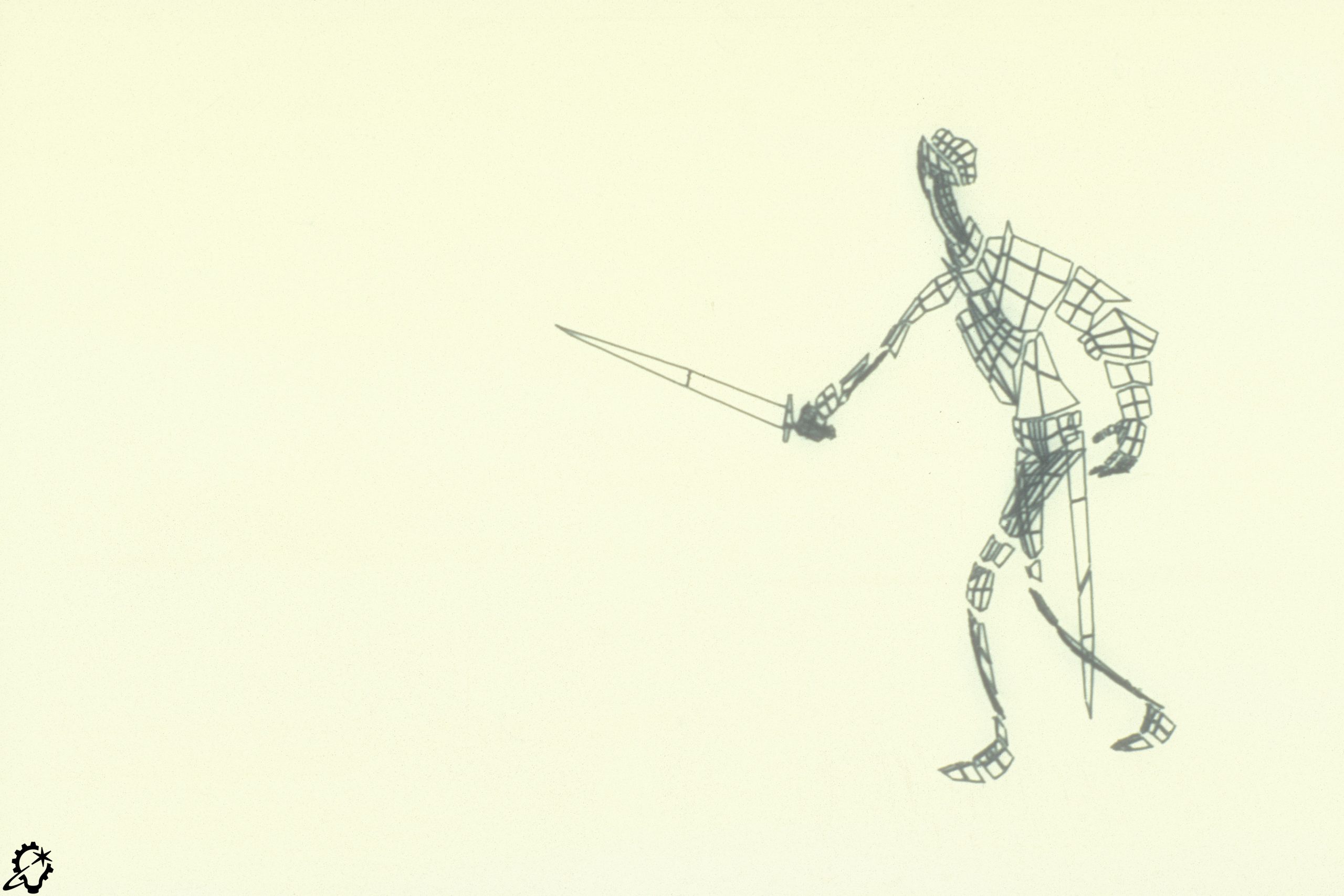
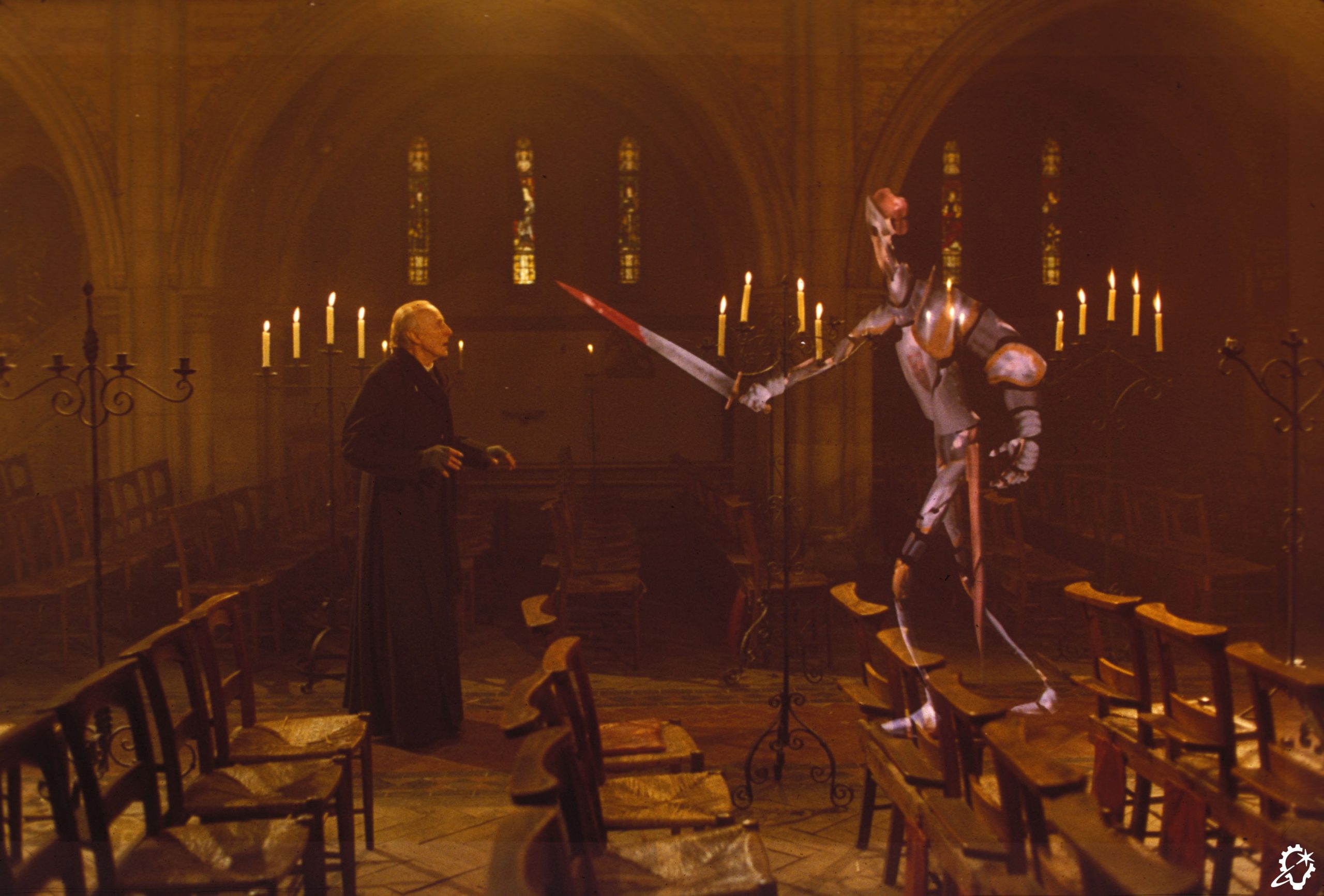
Muren went into the stained glass knight sequence – where a knight jumps out of a stained glass window in a church and walks towards a priest experiencing a hallucination – knowing that creating it digitally may not work. They had to have a backup. And Muren had to sort out how a walking CG character might look. “Should it look like the knight is a walking, full-size, flat glass figure, simply cutout from the window? That didn’t seem very threatening and too literal for a nightmarish hallucination. What if it wasn’t flat but a man-sized three-dimensional glass figure of the knight? Maybe. We also tried some other ideas but nothing really popped.”
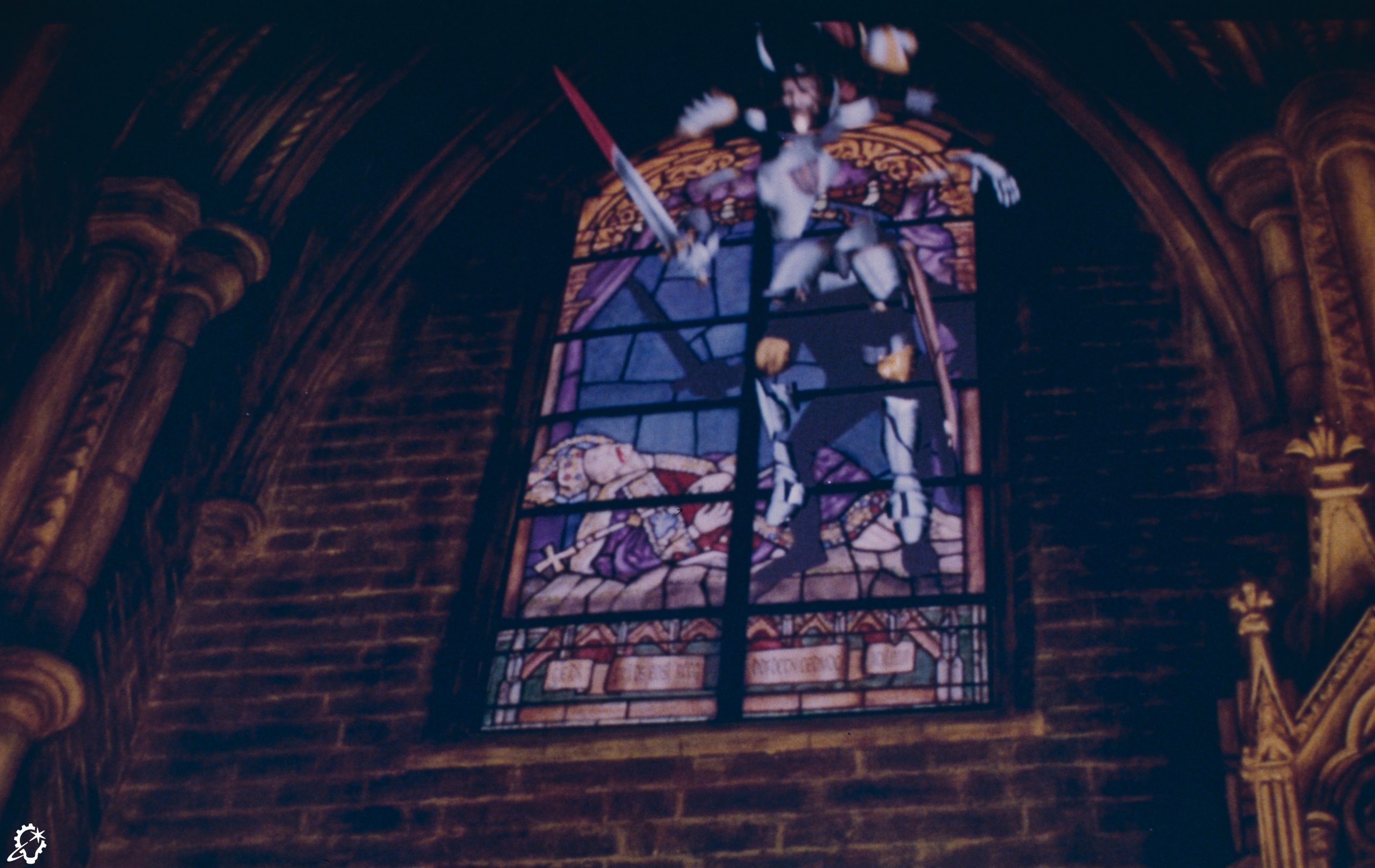
The one design that did pop came from Muren’s wife, Zara, who suggested that the knight could jump out of the window in its many individual glass pieces that magically reassemble without touching each other when they land, making something like a hanging mobile but without the strings. Each of the pieces could twist and turn to make up the knight’s figure which could be moved and animated as one menacing figure.
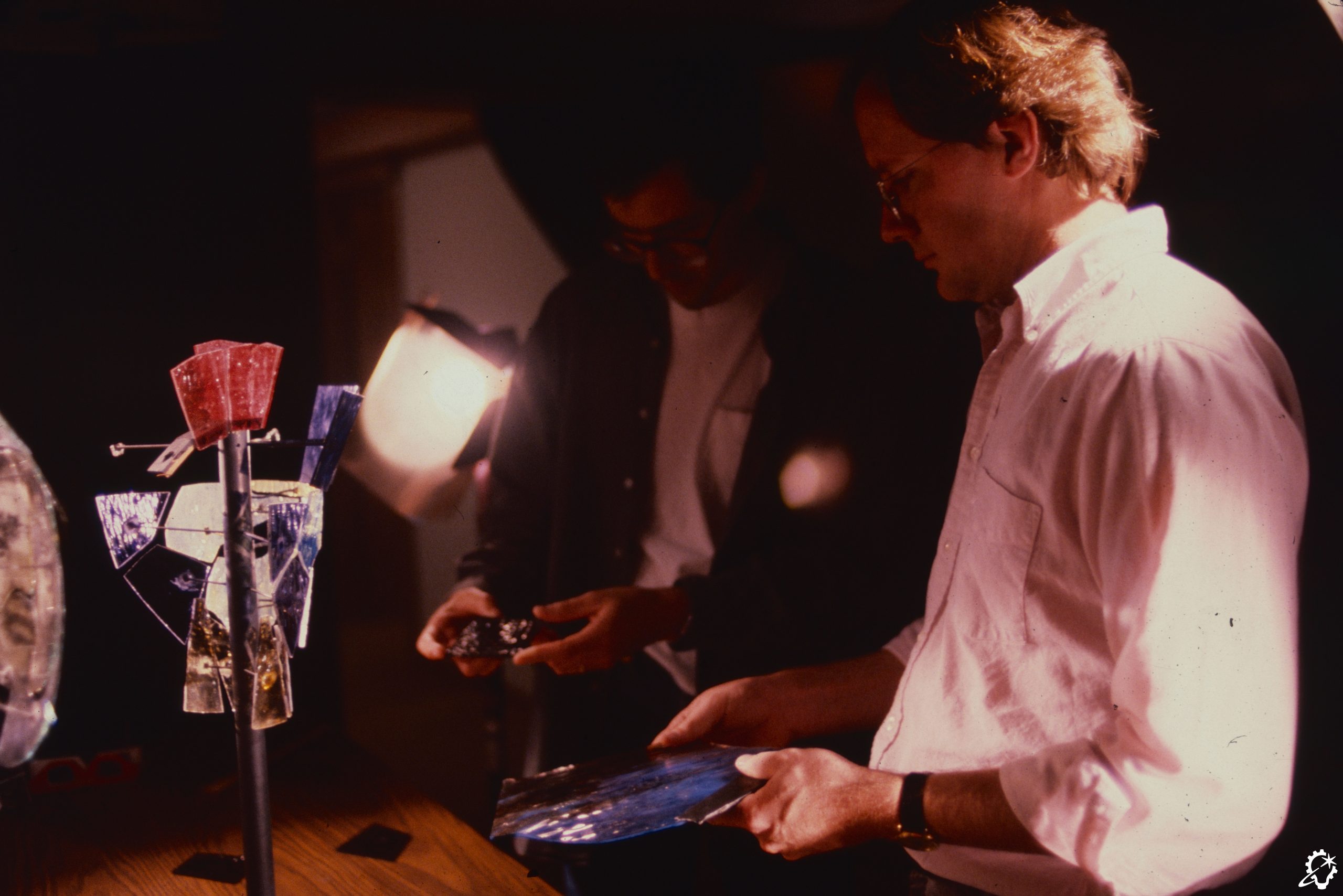
To make the knight even more menacing, Muren asked the visual effects artists to make each piece of glass of an inch thick with sharp jagged edges. Some of the pieces were bowed in the middle, convex pushing out from behind, so they were domed and coming towards the priest, making it appear more aggressive. “Everything in movies is feelings,” notes Muren. “And if I didn’t feel it, and the audience didn’t feel it, then you’re just telling a story, and you might as well be doing it by telephone.”
This was all done before shading and motion blur in CG shots were the norm, and Muren leaned on the fact that the knight was a hallucination, so it didn’t have to be as real-looking as ships flying through space. The seven shots of the knight took about six months to complete and included some of the first digital composites.
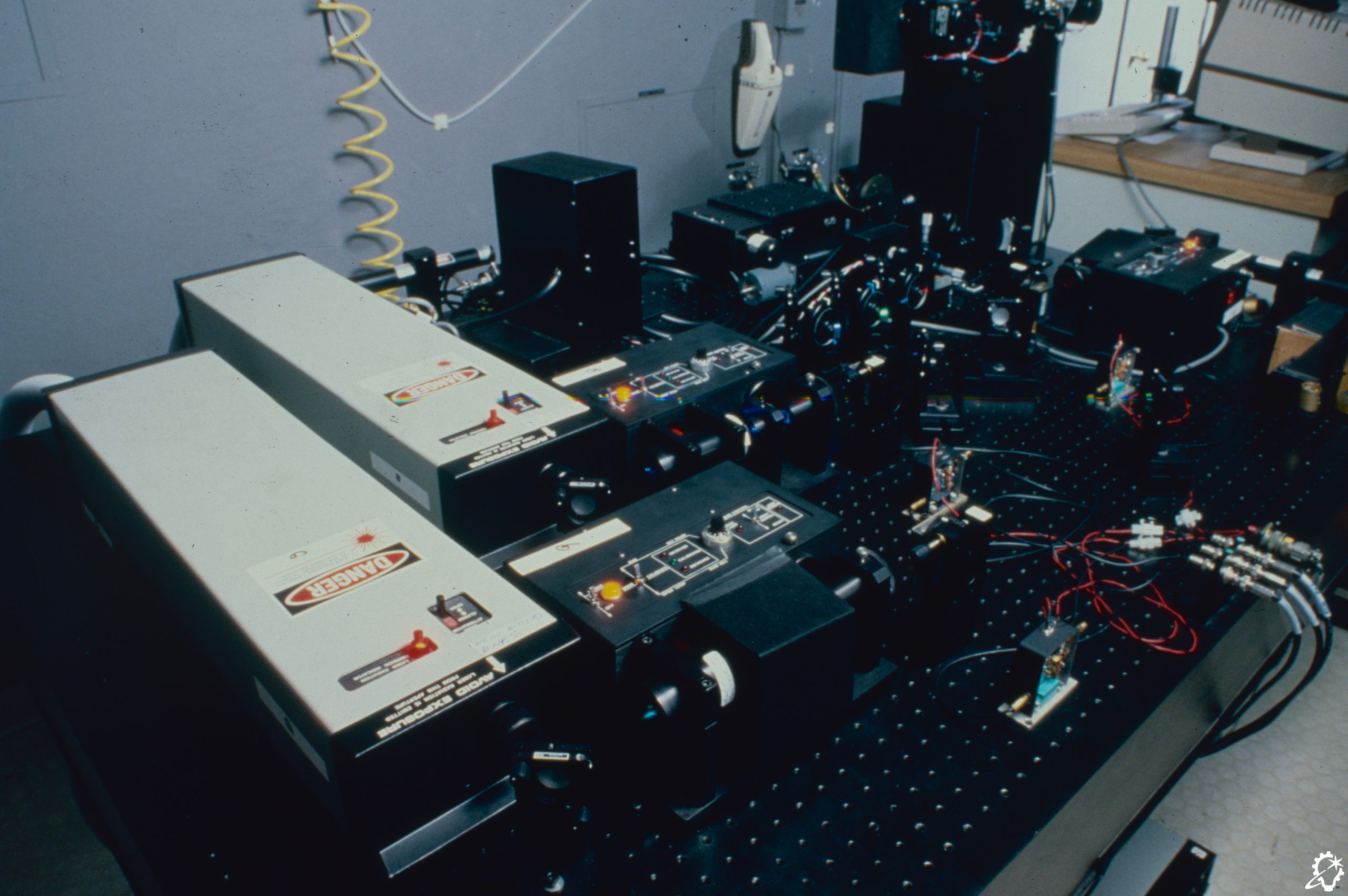
“George’s graphics group had been making an input-output scanner as a prototype,” said Muren, “and that was so troublesome because it was so cutting-edge that it would often break down unexpectedly. I think out of every input scan, it was 10 or more times before it would make it through as few as 120 frames.”
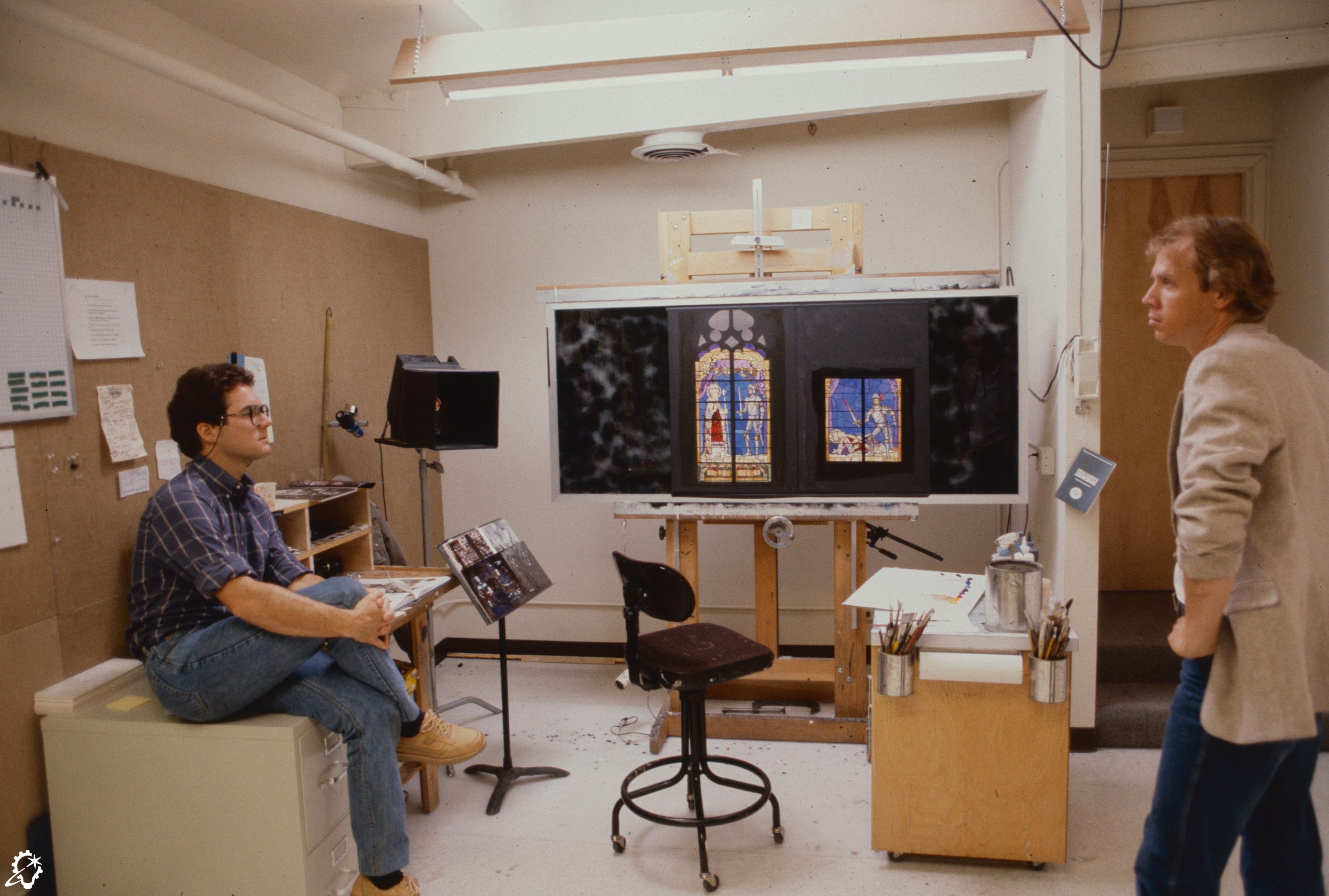
The entire knight sequence lasts less than a minute in the finished film. It starts with a wide shot showing the church’s stained glass window bowing a bit before the knight breaks out and lands on the ground. While many traditional matte paintings made with oil paints were used in Young Sherlock Holmes to recreate exteriors of Victorian London and a pyramid temple, for the opening shot of the knight sequence, matte artist Chris Evans created the first CG image used as a film background. “I remember,” says Muren, “it took him a really long time to do it because the tools were so hard to use. The paint program was in existence, but it was very slow to use, to be able to paint and get the brush strokes right.”
After breaking out of the window, the knight’s 100-plus pieces reassemble as he lands on his feet, holding up a large sword. The next few shots depict the knight walking menacingly towards the priest. As the knight walks past the camera, audiences can see through the backside of the knight’s glass.
“It was all shot very traditionally,” explains Muren. “I shot a lot of plate backgrounds of the church.” In addition to footage of the priest, the location also had several candles and mist. When Muren returned from shooting, he still wasn’t sure exactly how they were going to pull this off or if it was going to work at all. “It could all hit a limit where the blacks or the whites never match. There were all sorts of things that could go wrong. I didn’t know what was going to work and what wasn’t. So I shot for any technique we were going to use.”
The next step in the process was getting the digital technicians to constrain their tools to what the eye sees on film. “A lot of what’s made for software manipulation, whether it’s brightness, camera movements, or distance, go to infinity,” said Muren. “So part of the process is constraining it down to what film records. We don’t want to go above or below what film records as black and white, even though the software could go beyond that. When it is constrained to the world of photography, then I can start to understand it again.”
Muren and his team also “cheated” what audiences saw through the glass of the knight at times. “What you see through the glass, let’s say a yellow piece of the knight, is brightening up the color that’s on the glass, not what you would really see if you held up all those color pieces where parts of the background of a yellow piece were blue and yellow. That would appear grey, which would take you out of the drama of the scene. So the whole transmission through the glass, what you see on the other side, is black and white. You can’t tell because it’s got this yellow, but it’s a cheat, just black and white to light it up. We did a lot of that later in The Abyss with the water snake, all the refractions in the rooms, we cheated all the way through.”
All About the Blur
A key element to achieving realism in the stained glass knight sequence was understanding the importance of motion blur, where objects on-screen shot at 24 frames per second appear blurry as they are in motion. The problem was that at the time, ILM had yet to develop the ability to digitally render blurs. “We’re used to what those blurs look like,” says Muren. “They make things look fluid. That’s very important for an effect to look real because the rest of the movie has got that in it. I didn’t want the stained glass knight to look like it came from ILM, that it was stuck onto the background.”
To help achieve the blur effect, every frame in the knight sequence was rendered nine times in slightly different positions. As the render time in 1985 was so long, one primary frame would be rendered at a higher resolution than the rest to save time. The result was a blur made up of a number of static pictures. “So you put them all together, and you’re doing this 24 times a second, and each of these blurs has eight pictures in it that are kind of similar, but some are weaker on the outside, and some are strong in the middle – then it all looks like a normal blur.”
This experience pushed Muren and the Lucasfilm Computer Division to learn more and create the tools to execute their vision for the finished shots. “It was an introduction to them and to me,” explains Muren, “about what you could do. Motion blur, overexposure, underexposure, tracking or hanging the camera around. I hadn’t really thought about how you have to track the camera with the background. For a camera guy like me, who understands filmmaking technically, I could go in there and say, ‘Can we get this tool?’ ‘We need that one too.’ And they would 99% or 100% of the time come up with it in either hours, or they already had it, and they just adjusted something, or they could write something for it, within a few days.”
A Wealth of New Tricks and Tools
It’s almost impossible to list all of the innovations and challenges the Young Sherlock Holmes effects crew faced during postproduction. The film not only includes the first CG character but also broke ground in developing digital matte paintings and digital compositing. In order for ILM artists to match camera movements from the live-action set into a computer’s 3D space, they projected footage shot on location in England with gridlines over it onto a computer screen. A new preview system gave creators the chance to work with a simple black-and-white wireframe of an image, so they didn’t have to wait for an image to be completely rendered to continue working on the shot.
To record the computer animation back to film, a laser scanner was used that could only print approximately one frame a minute, so each second of footage would take 24 minutes to complete. “I don’t think I rendered anything at 4K or even scanned it out because it was just taking too long,” recalls Muren. “We just did everything at either 1 or 2K. At least the tool was able to change and wasn’t locked into 4K, or we’d still be working on the film today.”
Among the most challenging shots to finish in the film was a panning shot of the knight coming toward the audience. “I think John [Lasseter] came up with the idea of panning the camera,” says Muren. “I didn’t even know if we could match the camera’s pan in the computer. When we shot it, I had somebody walk by and the operator followed as a reference. Then they shot the actual plate without the person in there. It took a while to get that, but it wasn’t hard once we figured out we could do it. It was somebody trying to track it manually every frame in 3D space because we didn’t want the stained glass knight to be locked into a candle that’s seven feet farther back. It had to be locked into them, closer to the camera.”
The final shot was a side view of the priest and the knight raising his sword above his head in a threatening way. Muren asked engineer Bill Reeves if they could add a glint of light to the sword blade for a dramatic end to the shot. “They didn’t know how to do that, how to put a light to reflect a certain thing, but they had all of the spatial information.” Muren suggested they track the shot backward, look at where the camera was, the angle of the sword, and then put a digital light there. “No one’s going to know that you cheated that light and it didn’t take a lot of time,” explains Muren. “That’s what we always do in moviemaking. What you care about is what the camera sees.”
Shortly after Holmes hit theaters, the Lucasfilm Computer Division was spun off into two pieces – one half funded by Apple co-founder Steve Jobs as Pixar, the other half as the digital editing company known as DroidWorks. In Young Sherlock Holmes’s 1 hour and 49 minute running time, ILM artists used just about every tool they had access to at the time, including a few newly invented ones. The seeds planted during their effects work would pay off in the ensuing years with a computer-generated water creature in The Abyss, the T-1000 in Terminator 2: Judgment Day, and the dinosaurs in Jurassic Park, the latter directed by one of Holmes’s executive producers, Steven Spielberg.
–
Amy Richau is a freelance writer and editor with a background in film preservation. She’s the author of several pop culture reference books including Star Wars Timelines, LEGO Marvel Visual Dictionary, and Star Wars: The Phantom Menace: A Visual Archive. She is also the founder of the 365 Star Wars Women Project – that includes over 90 interviews with women who have worked on Star Wars productions. Find her on Bluesky or Instagram.