
Industrial Light & Magic’s immersive entertainment team will be fully integrated with the rest of the company to inspire new innovations in cross-platform storytelling.

50 years since its founding, Industrial Light & Magic has never rested on its laurels. A hallmark of ILM’s endurance over half a century and counting has been its knack for adapting to change and embracing new creative opportunities. “ILM was created by George Lucas because there was no other way for him to realize his vision for Star Wars,” senior vice president and general manager Janet Lewin tells ILM.com. “From the beginning, our mission has been to make the impossible a reality.”
The ILM spirit that’s evolved over five decades and at studios in as many different countries is “motivated by the opportunity for reinvention, evolution, innovation, and resilience,” as Lewin puts it. ILM’s ability to “react and adapt to the changing dynamics” of an ever-changing industry has been key. Time and again, ILM has increasingly broadened its creative output. “We’re known for our work-for-hire visual effects in feature films,” says Lewin, “but we’ve also branched out into streaming series, feature animation, and of course, the incredible work that Vicki Dobbs Beck has championed with immersive storytelling.”
“ILM was created by George Lucas because there was no other way for him to realize his vision for Star Wars. From the beginning, our mission has been to make the impossible a reality.” -Janet Lewin, Senior Vice President & General Manager, ILM
As vice president of immersive content for ILM and Lucasfilm, Beck co-founded ILMxLAB (later ILM Immersive) some 10 years ago. What was initially a move to experiment with storytelling in the emerging fields of virtual reality, augmented reality, and mixed reality has since yielded broader implications for the way ILM will do business. “This opportunity allowed us to participate directly in the success of a project and drive these experiences from concept to launch, delivery, and support,” notes Beck.
Building on work first pioneered by Lucasfilm’s Advanced Development Group, the immersive team leveraged the highest quality visuals and sounds combined with meaningful interactive principles to create stories with groundbreaking potential. These have included productions like PGA Innovation Award winner Vader Immortal: A Star Wars VR Series and Emmy-winning “What If…? – An Immersive Story,” as well as projects made with creative partners like Alejandro González Iñárritu’s Academy Award®-winning CARNE y ARENA.
“We see opportunities for social experiences that are associated with our stories,” explains Beck. “We started by inviting audiences to ‘Step Inside Our Stories’ in ways they’d thought were impossible. We’re now transitioning from storytelling to storyliving, which is a much bigger idea. You’re in a world and you’re making meaningful choices that drive the narrative forward. That’s the gateway to take advantage of new technologies that are coming on the scene.”
ILM is now “seizing the moment,” as Lewin puts it, to include all of ILM in this undertaking. “Immersive storytelling is becoming more and more relevant to our audiences and our partners. On the visual effects side, ILM has been involved in projects like ABBA Voyage – a first-of-its-kind – and the content we made for Sphere Las Vegas. We started to see that the projects coming out of our immersive line of business had a natural convergence of techniques, talent, and opportunity with those of our visual effects business.
“We’re now transitioning from storytelling to storyliving, which is a much bigger idea. You’re in a world and you’re making meaningful choices that drive the narrative forward. That’s the gateway to take advantage of new technologies that are coming on the scene.” -Vicki Dobbs Beck, Vice President, Immersive Content, ILM & Lucasfilm
“We can proactively leverage the strengths of our visual effects artists, pipeline, and storytelling passion with those of our immersive artists who are true experts in interactivity,” Lewin continues. “We see this ‘storyliving’ concept as the key growth opportunity. Not only do we want to market ourselves as one brand for audiences and clients, but we also want to empower our artists. This will allow for more cross-pollination of techniques, more opportunities for artists to move between types of projects, whether it’s an animated feature or our collaboration, “What If…? – An Immersive Story,” with Marvel Studios. If we can provide those opportunities, it allows us to keep attracting the very best talent in the industry.”
With every group now aligned under the ILM brand, the company will pursue an integrated portfolio that includes film, television, attractions, interactive products, and live events. For the immersive team, it’s a milestone following a decade of concerted effort, and for ILM as a whole, it’s the newest chapter in the company’s pioneering story. “We are poised for the next 50 years of ILM’s existence,” says Beck.
ILM’s position as a storied entity with a globe-spanning team of artists, designers, and engineers opens up limitless possibilities. “The world is our oyster,” as Lewin puts it. “This is a time for growth and expansion. I’m really excited about the ideas that we’re exploring. This is a moment when we can redefine who ILM is in the market, be more consumer-facing, and continue to be the industry leader. I also love the idea of having more efficiency and refining a better process. These moments allow us to examine the way we work and improve it. We can bring fresh, new ideas to the table.”
And as Beck describes, this is not only an opportunity to position ILM as the best creative partners and visual storytellers, but also as “aspirational leaders” who will inspire the next generation of storytellers. “This is a way for ILM to drive its destiny in a way that has not been possible in the past. To embrace cross-platform storytelling is what we are uniquely positioned to do. If we can take advantage of that capability and build ecosystems of experiences that cross different types of media, it gives us an incredible canvas to paint on.”
“This is a time for growth and expansion…. This is a moment when we can redefine who ILM is in the market, be more consumer-facing, and continue to be the industry leader.” -Janet Lewin, Senior Vice President & General Manager, ILM
—
To discover more about ILM’s work in immersive storytelling, visit ILM.com/Immersive. And for all the latest news and stories from the company, visit the ILM.com Newsroom.
Visual effects supervisor Nelson Sepulveda-Fauser discusses the collaborative effort to make Alien fans scream once more.
By Dan Brooks
(Credit: 20th Century Studios)
Nelson Sepulveda-Fauser remembers it well. It was summer 1979. He was 12 years old. Two years prior, Star Wars: A New Hopehad been the talk of his school, but now a new sci-fi movie was garnering all the recess buzz. It was called Alien and he was dying to see it, though he was too young to buy a ticket and his parents refused to take him. As such, Sepulveda-Fauser did what any underage cinema-obsessed kid would: he snuck in to see it at Los Angeles’ vaunted Egyptian Theatre.
“I remember the impact that it had on me,” he tells ILM.com. “It was the first movie that I saw where I said, ‘Oh my God, that’s what a real alien movie is about.’”
Cut to 2024, and Sepulveda-Fauser is now a visual effects supervisor at Industrial Light & Magic, having led the company’s Sydney studio in work on Alien: Romulus. For him, Alien will always be about the feeling of Ridley Scott’s original film and, thankfully, Alien: Romulus director Fede Álvarez thought the same.
“When Fede described his idea of making it like the original, it was just one of those realizations where it’s like, man, I get to recreate that childhood moment, in a way,” Sepulveda-Fauser says. “The result was a 40-year full circle for me.”
Alien: Romulus arrived in theaters August 16 and quickly became a bona-fide box-office hit; as the movie continued its impressive run, Sepulveda-Fauser spoke with ILM.com about his approach to Romulus’ visual effects and the secrets behind some of its most memorable sequences.
Concept art by Amy Beth Christenson (Credit: ILM & 20th Century Studios)
Back to basics
The seventh film in the Alien series, Alien: Romulus takes place between the events of the original film and Aliens (1986), and follows a group of young Weyland-Yutani colony workers eager to abscond to a better life. At the heart of Alien: Romulus are Rain (Cailee Spaeny) and her adopted brother, Andy (David Jonsson), who just happens to be a kind-hearted but damaged robot. A chance at escape leads the crew to an abandoned spacecraft, but instead of freedom they find unexpected terrors — including our old friend, the xenomorph.
Romulus leans into the series’ horror roots and, from the beginning, Álvarez and Sepulveda-Fauser were in alignment on how it all should look.
“From the get-go, from the day that I met him, one of the very first things that he said was, ‘I don’t want this thing to feel CG. I want this creature to feel real. If it doesn’t feel real, it’s not going to be scary.’ So the goal was to get as many practical elements in camera as we could. Everything else that we needed to build in computer graphics had to work around that, and integrate into photography seamlessly.” This would be a stark contrast to 2017’s Alien: Covenant, the last film in the series, which relied heavily on digital effects and creatures. For Romulus, Legacy Effects was on board to handle the practical elements, with ILM and Weta FX creating the visual effects for various sequences.
Director Fede Álvarez. Photo by Murray Close. (Credit: 20th Century Studios)
Under this ethos, the main challenge for Sepulveda-Fauser, as well as production visual effects supervisor Eric Barba, was matching ILM’s visual effects to Legacy’s practical work; if they were successful, audiences would not be able to tell where one stopped and the other started. This includes not just creatures, but sets and starships. Álvarez had the model shop create miniatures of the Corbelan ship, research center, and the EV, which Sepulveda-Fauser used to create digital replicas for the movie. “The tricky part was keeping the character of a practical model in the close-ups,” he notes.
First and foremost, however, was bringing the xenomorph back to life.
Bigger Chap
When it came to realizing the xenomorph, Alien: Romulus used just about every trick in the book. There was a man-in-a-suit version, a bunraku puppet, and an electronic build. Scenes requiring more fluid movement, however, meant ILM would have to work its magic.
“The Legacy puppets are beautiful up close. They hold up really well. But as soon as we have to incorporate specific body movements, we have to jump in with visual effects,” Sepulveda-Fauser says. “When the xenomorph is in motion, we can’t get a practical creature of that size to perform some of the movements required for an action sequence. In the elevator shaft sequence, for example, when he’s getting shot or when he catches Rain or he’s coming toward her, those scenes are a blend of our wide and medium close-ups with practical effects. We had to match the xenomorph model perfectly so we could have closeups cut between practical and CG.”
(Credit: 20th Century Studios)
Still, Sepulveda-Fauser and his team took care not to overdo it, always looking at the original “Big Chap,” as the xenomorph was called during production of Alien, as a guide, as well as those in James Cameron’s Aliens for reference.
“Fede always said, ‘I want this alien to be creepy.’ He didn’t want over-exaggerated motion on the creature,” Sepulveda-Fauser explains. “His concern was that as soon as it moves too much or too fast, we take the audience out of the movie. We start feeling that CG on the screen. He wanted creepier movements. That’s why there’s the slow crawling on the walls. The slower movements make it feel creepier, strange. The creature is doing something impossible — it’s crawling on a wall — yet we had to make it feel possible, ominous, and weird.”
Ultimately, having Legacy’s new builds proved to be the best reference.
“I mean, seeing a practical creature on set is inspiring. You’re seeing it under real, live conditions and in real action,” he says. “You see it and think, ‘We know exactly what this xeno needs to look like,’ and we did. We replicated it as faithfully as we could to a real living creature.”
Facehugger stroll
One of the more tense sequences of Alien: Romulus finds Rain, Andy, and friends tip-toeing through a frigid corridor, hoping to avoid the attention of the craft’s resident Facehuggers. Throughout, the creepy crawlies move slowly, tapping their finger-like appendages, before finally becoming alert to their guests’ presence and launching a spine-tingling attack.
“That’s funny, because that sequence was shot in a couple of different spots,” Sepulveda-Fauser notes. “I shot a lot of that second unit, and that was in conjunction with some puppet work for the Facehuggers. There were Facehuggers that were set up in crates by the Weta puppeteers and the actors performed through the rest of the set imagining the CG huggers that we would fill in. When you look at that sequence, it’s a combination of, again, jumping from practicals to all CG. The Facehugger was another creature that we had to match absolutely perfectly.”
(Credit: 20th Century Studios)
Animating the Facehuggers is one case where ILM broke a bit from the original films, feeling the creatures could use a bit more fluidity to satisfy Fede’s vision.
“In some cases when we saw that action of the Facehugger on set, it was obvious that it was a puppet. Although that was desirable in many cases, after a while the director realized this sequence was not going to be super exciting with things on wheels rolling along chasing these guys,” Sepulveda-Fauser says. “So we had to work out different Hugger run cycles for the chase. That took some time and experimentation, because it needed to both look like a mechanical thing, so it could pass as practical, and also it needed to follow this very specific action that the director wanted. We went through tons and tons of experimentation on how to make that work and, finally, we landed on something that Fede was really happy with, because they still look like they could be animatronic. We always kept it to some grounded reality.”
The x-ray
Featured prominently in the movie’s trailer is a particularly disturbing scene: the crew’s pilot, Navarro, uses an x-ray wand to scan her own chest, and finds something alive inside. It’s a clever spin on the series’ classic chestburster scenes of old and, to work, it had to look both believable and creepy.
“When the creature guys came on to do the chestburster, everybody was really excited because they were doing tests on the side and it was the first time we were seeing something so iconic to Alien in a scene,” recalls Sepulveda-Fauser. “It was a good feeling, ‘We’re going to do it like they did in the original.’ When Fede came up with the idea of the x-ray, it was even more exciting because we’ve never seen what this looks like from the inside. How exactly do we do that? So we digitally-built all of Navarro’s skeletal, muscular, circulatory structure, as well as organs. We researched the look of an x-ray, and we worked up the ideas in compositing, with animation to match the original puppet, broke some ribs, and popped it through. It was a quick moment but pretty neat.”
(Credit: 20th Century Studios)
Considering its heavy use in promoting Alien: Romulus, I submit to Sepulveda-Fauser that this scene played a large role in getting fans new and old excited for the movie.
“It was a new take on the chestbuster and he made it terrifying in a different way,” Sepulveda-Fauser says. “I remember the original movie. You didn’t know what was going to happen, then all of a sudden, blam! This guy’s on the table and the alien pops out of his chest and everybody in the audience goes bonkers. You couldn’t do that again. If you recreate it, it’s not going to be as effective. So setting it up with Navarro, again feeling sick, you kind of know what’s going to happen, but you actually don’t know what’s going to happen. The reveal of the creature from the inside was a great idea. That was the scary moment. Understanding this thing is ready to pop out. We weren’t repeating the original, we’re scaring you in a slightly different way, and I thought that was really cool.”
Zero-G journey
In a movie filled with action set pieces, this might be the standout. Following a shootout with a xenomorph swarm, Rain must navigate from one end of a hall to another — all in zero gravity — while the creatures’ acid blood floats dangerously around her. Initially, however, it was meant to be a much smaller sequence.
“That was an interesting one because Fede had a really specific idea of what he wanted,” explains Sepulveda-Fauser. “In the beginning when we were first understanding the effect, it was a lot more subdued. It was going to be some alien blood in zero-g. But it’s a big action sequence and Rain’s had this big fight. There was a lot going on. The acid effect needed to have more character and quickly developed into, ‘No, the acid is an actor in this scene.’ This is a very, very scary moment. It’s got to be something else, it needs to be frightening, turbulent, it’s got to be an immediate danger that they can’t pass. And it needs to perform with intensity and visual impact.”
To achieve the intensity of the redesigned sequence, Sepulveda-Fauser’s Sydney team worked closely with ILM’s San Francisco studio.
(Credit: 20th Century Studios)
“We worked hard with the team in San Francisco to put all this together,” he says. “There were a lot of requirements there. We were in zero-g, it needed to be terrifying, it needed to come toward our actors, to look impassable, but they still needed to be able to somehow make it through. We also needed a moving air current to affect the acid swirling in zero-g. So there was a lot of choreography needed. It took a lot of development and experimentation to get the recipe for realism so that it didn’t feel magical as in a Harry Potter movie. It was easy to go into a fantasy world really quick with this effect. We finally came to a setup that I believe was successful, so that it sold the idea that this was possible as kind of a funnel of real acid happening within the set.”
Signing off
Thanks to the success of Alien: Romulus, now the highest-grossing horror film of the year, the future seems bright for the xenomorph and our favorite space horror franchise. Though it’s gratifying for Sepulveda-Fauser, the reward is in the work on-screen.
“It makes me really proud to say that the Sydney team put this together,” Sepulveda-Fauser concludes. “I’m a little older now. I’ve been at ILM for 20 years and in the industry for 30-plus years. A lot of the people that I worked with are of course a bit younger and very, very excited about what we do. To see that new generation of talent embracing traditional methods of filmmaking and adding to it is inspiring. This was one of those shows where you’re looking back at film history, looking back at a historic movie, and having to produce something new that still touches back to that with fidelity. This team really put in a thousand percent to make that happen. We achieved something memorable, hopefully for the audiences but even more so for us as big fans. It was a difficult task and it was an easy thing to not get right. But the crew got it right. They worked so hard and put so much care and love into it, that it worked. I really am proud of this work. It’s likely one of the best projects that I’ve ever worked on.”
Concept art by Mathilde Marion (Credit: ILM & 20th Century Studios).
–
Dan Brooks is a writer who loves movies, comics, video games, and sports. A member of the Lucasfilm Online team for over a decade, Dan served as senior editor of both StarWars.com and Lucasfilm.com, and is a co-author of DK Publishing’s Star Wars Encyclopedia. Follow him on Instagram at @therealdanbrooks and X at @dan_brooks.
Heads still roll 25 years later in the Tim Burton classic Sleepy Hollow(1999). Revisit all of the eerie magic behind Industrial Light & Magic’s work that brought Washington Irving’s folktale to life and reintroduced audiences to one of cinema’s greatest on-screen monsters, the headless horseman.
By Adam Berry
The headless horseman pursuing Ichabod Crane in the Western Woods. (Credit: Paramount)
On October 5th, 1949, the Walt Disney Studios released a feature film that reimagined two classic pieces of literature through the guise of The Adventures of Ichabod and Mr. Toad (1949). While the first half retells the whimsical story of Kenneth Grahame’s The Wind in the Willows (1908), it is the second half that left a long-lasting impression on young audiences as they were introduced to American writer Washington Irving’s eerie folktale, The Legend of Sleepy Hollow (1820).
Released just in time for Halloween that year, this feature would go on to be recognized as one of Disney’s classics due to its memorable songs, beautiful animation, and the unforgettable visualization of Irving’s ghostly antagonist, the headless horseman. The unsettling imagery of a headless man riding horseback with a sword in one hand and a flaming jack-o’lantern in the other allowed the legend to evolve as film versions were passed down to new generations. 50 years later, The Legend of Sleepy Hollow would once again evolve on screen, and explore the story in new ways, re-introducing audiences to Irving’s horrific tale of the undead horseman.
To take this classic into a tangible world, a highly imaginative and visual mind was necessary to capture the fantastical elements of this story while rooting it in a sense of reality. Tim Burton, director of such films as Beetlejuice (1988)and Edward Scissorhands (1990),was keen to step in as he was a fan of the Disney film. Burton told American Cinematographer, “I was really familiar with the original story because I’d seen the Disney cartoon…. I actually didn’t read the source novel until after I had read the script.” Burton’s own history with Disney, including attending the California Institute of the Arts on a Disney scholarship, and working at Walt Disney Studios as an animator on projects such as The Black Cauldron (1985),destined him to take on the challenge of creating a fresh retelling of Sleepy Hollow.
Concept art by Scott Leberecht depicts an eerie atmosphere shrouded in fog on the road to Sleepy Hollow. (Credit: Paramount & ILM)
Burton’s vision was to create a fantasy world that felt real in which the headless horseman could exist. The aesthetic needed to emulate, but not copy, the atmosphere of the classic Hammer Studios horror films such as Dracula (1931)or Frankenstein (1931) with their moody and gothic tones that left the audience in a state of unease. With that being said, Italian director Mario Bava’s Black Sunday (1960) was the core inspiration for the film, giving Sleepy Hollow (1999) a classic movie feel while adding elements that were pictorial and synthetic.
To achieve his vision of what Sleepy Hollow needed to look like, Burton knew there had to be a balance between the use of traditional special effects and digital visual effects. “Digital technology is very interesting and certainly has its place in filmmaking, but when you’re watching a movie like Black Sunday you really feel as if you’re there,” said Burton. While he was resistant to using visual effects at first, he relied on the artists at Industrial Light & Magic (ILM) to help realize the full scope of his vision, particularly when it came to bringing the headless horseman into existence as a living, breathing creature.
ILM visual effects supervisor Jim Mitchell was tasked with solving how the horseman could exist in the film as a real man without having to rely on older methods. Tricks like having the coat propped up on the actor’s shoulders didn’t work as the proportions were wrong, eliminating the appearance that the horseman was indeed a man. Mitchell said, “Tim and I knew that something just wasn’t going to be right with that approach. We eventually decided that our Headless Horseman would be an actual person riding the horse and flailing his axe around, except that we’d just digitally erase his head.”
The most complex shots for ILM involved removing the horseman’s head. There were about 300 horseman shots altogether, with ILM creating 220 and London’s Computer Film Company contributing the rest. To convincingly convey that the horseman was real, the ILM team innovated a special blue hood for stunt actor Ray Park to wear during action sequences that the ILM artists could later isolate and erase from the shot. Blue was used as it is easily keyed from the plate so the effects team could restore the background in place of the head.
The headless horseman claims his next victim. (Credit: Paramount)
To fill the space where the actor’s head was taken out, a clean background plate of the sequence was shot, but the artists noticed that one element was still missing as the horseman has a large cape with a collar around his neck. “It was not only necessary to replace the background where his head would have been, but to also make a digital collar in the computer that was then matched to his movements,” shared computer graphics artist Sean Schur in Paramount Pictures’ Behind the Legend documentary. By using actors and replacing heads digitally, the horseman presents as a living and breathing creature.
Achieving this effect was particularly challenging during fight sequences with actors Johnny Depp and Casper Van Dien as their faces would be blocked out by the horseman actor’s blue hood. Once ILM erased the horseman’s head, they would also have to go back and eliminate the other actors’ heads as well. Mitchell shared, “I would have Johnny or Casper go through the same actions without the Horseman in there, and we’d just put their head into any frames where the horseman’s head was blocking theirs. It’s a tricky process, but it was actually pretty effective.”
Equally as challenging were the beheading scenes throughout the film. Creature effects artist Kevin Yagher created prosthetic heads of the actors for use in these pivotal moments while ILM was able to digitally recreate the scene using a series of three plates to blend together and form one cohesive shot. Using the scene in which the menacing Lady Van Tassel (Miranda Richardson) decapitates her bewitching sister as an example, Richardson would be filmed going through the motions of swinging her axe to dead air, then the prosthetic head flying off the body of her sister would be filmed separately, and finally the digital capture of that scene would be created. Once all three plates were finished, ILM would blend these together to make a seamless sequence for each beheading, making it feel all the more real for the audience. This was not an easy task for the artists as the film has ten decapitation sequences.
Concept art by Scott Leberecht shows ILM’s approach to depicting the headless horseman’s return to hell. (Credit: Paramount & ILM)
Burton wanted to convey suspense and a sense of impending doom throughout the film and tasked ILM with a series of subtle visual effects shots that added to the unsettling feeling when the horseman would appear. Most notable is the disturbing scene where the horseman pursues a family at their home. Killian (Steven Waddington) sits at his table with a crackling fire, which spontaneously erupts into larger flames seconds before the horseman crashes down the door. Sequence Supervisor Joel Aron shared, “I took the skull, which is the headless horseman’s skull, so I pulled up the eyebrows giving it this demonic look with a strong forehead, curling up the corners of the mouth and bringing the jaw around to continue to sculpt what would be the fire so that I knew when the fire would come off it would have an irregular shape.” It’s a blink-and-you-will-miss-it effect, but if you look closely you can see 13 demonic faces emerge within the flames in a quick flash which is meant to indicate that evil is present. It’s so subtle that it was intended for audiences to question whether they really saw the faces or not.
Natural elements were also added and utilized to punctuate the horseman’s presence. The subtle introduction of thick fog and flashes of lightning appear every time the horseman gallops toward his next victim in pure cinematic fashion. Sleepy Hollow was shot mostly on location in a small town called Marlow, just outside of London, which meant the environment presented Burton with an ideal setting for the gloomy atmosphere. These elements could be viewed by some as cheap tricks in a major film but the use of heavy smoke for fog makes the atmosphere more haunting and interesting. “In the Western Woods set and at some of the other locations, you can definitely see the smoke – it looks like the fog they used in the old Frankenstein and Mummy movies,” said director of photography Emmanuel Lubezki.
While using smoke allowed the filmmakers to get a consistent movie look, it presented challenges for the ILM team as once they were finished adding actors’ heads back into the shots they would also have to build back in the foggy backgrounds and natural elements in each scene. “The big problem for us was [that] every shot involving the horseman also had lightning and fog,” explained Jim Mitchell, “which was constantly moving and always changing, as opposed to trees and buildings, which are rigid. Whenever lightning hit the Horseman, we had to make sure that when we replaced his collar or any other parts of his suit that his head was blocking, we put the same lighting effect on it.”
To simplify this, Mitchell asked Burton and Lubezki to shoot the scenes as though the actors’ heads were already removed despite the level of complexity it would add for the ILM team to ensure the elements moved organically with the actors as they rushed through the fog, or horse hooves galloped through the settled leaves on the ground. “There are all kinds of things we’d prefer to stay away from when we’re doing this type of work, but if you lose those [atmospheric] touches, all of a sudden it’s not the same sort of visual, and it doesn’t have the same power,” concluded Mitchell.
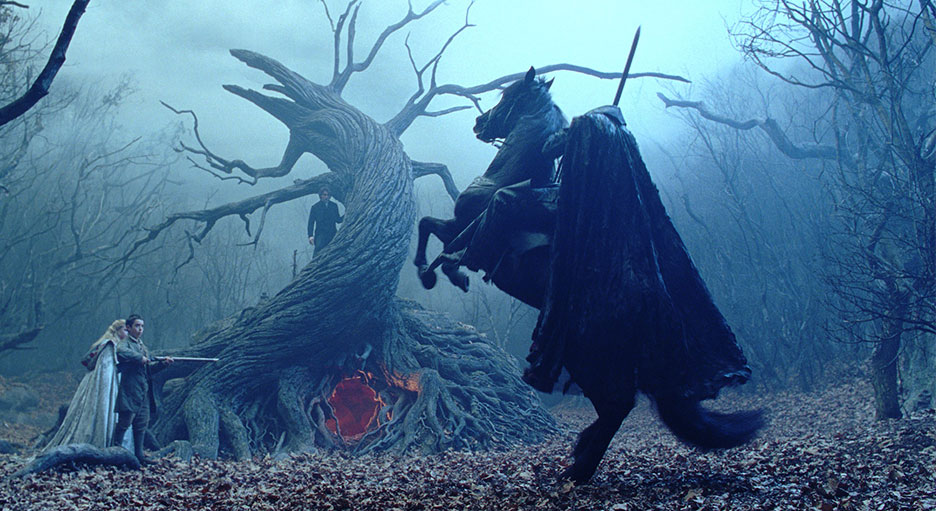
The headless horseman emerges from the tree of the dead. (Credit: Paramount)
This is especially apparent during a highly intense scene mid-film when the protagonists discover the tree of the dead, which is the horseman’s resting place and gateway to hell. The combination of the natural elements like fog and tree leaves with digital effects cemented the believability of this scene as the horseman enters from the base of the tree in a bloody and terrifying fashion. There were multiple plates used to build this effect. Firstly, a blue screen plate of the horse and jumping rider was shot. Next, a background shot of the forest environment, with the tree of the dead and actors standing close to where the horse emerges. Finally, a shot of the fog and leaves being disturbed creates the effect of the horseman jumping out of the tree. ILM didn’t have a bluescreen shot of an actual horse, so they had to create one in the computer, as well as the headless horseman, which are both digital elements. Similarly to the decapitation sequences, artists layered all of these separate plates on top of each other to form the singular shot making a scene that might have been unrealistic feel very believable instead.
It has been 25 years since its initial theatrical release, and rewatching Sleepy Hollow you can witness firsthand how ILM’s work remains timeless and able to reach new generations. The eerie and suspenseful atmosphere that Sleepy Hollow pulls audiences in and stands as a formidable achievement of classic Hollywood filmmaking, adding another iconic cinematic monster with the headless horseman, who is equally as feared standing next to other horror icons such as the unnerving Count Dracula, and misunderstood Frankenstein monster. Washington Irving’s The Legend of Sleepy Hollow lives on through the visionary work of artists from each generation. For Burton’s retelling, ILM wielded the eerie magic that gave life to the undying legend of the headless horseman.
—
Adam Berry is the Studio Operations Manager for the ILM Vancouver studio. His passion for film led Adam to ILM in 2022, coming from an extensive career across different sectors of the hospitality industry including cruise ships, luxury hotels and resorts. If he’s not at the movies or traveling to new destinations, you can find Adam staying active and exploring Vancouver.
After 38 years, the veteran effects artist is retiring.
By Lucas O. Seastrom
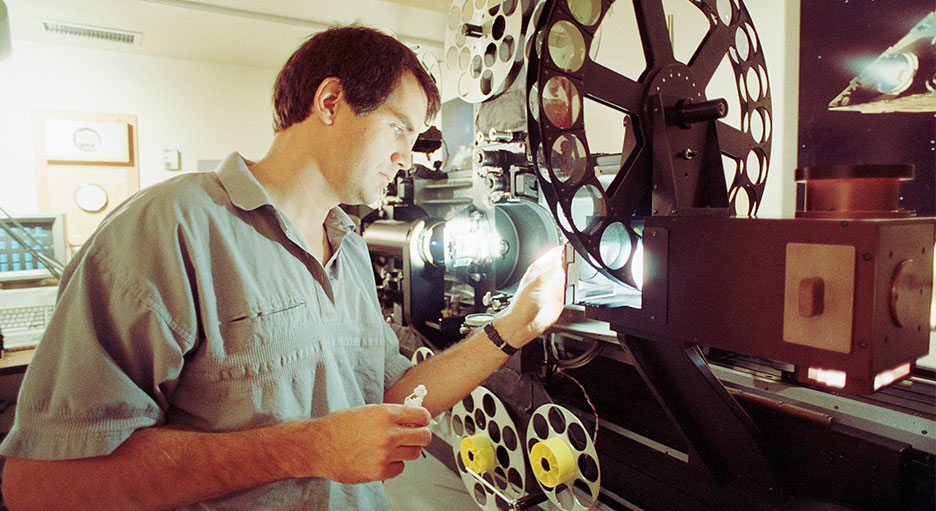
First opening in 1987, the original Star Tours attraction at Disneyland included what was the most complex optical composite created at Industrial Light & Magic up to that time. A “view” out the window of a starspeeder was in fact a state-of-the-art flight simulator developed by Walt Disney Imagineering (WDI) and Rediffusion Simulation with miniature effects by ILM. Among the thrilling encounters for passengers onboard was a harrowing trip through a cluster of icy comets which the crew dubbed “ice-teroids.”
Compositing in this photochemical era involved a piece of equipment known as an optical printer. With iterations dating back to the earliest days of cinema, optical printers combined separately-photographed elements by recapturing them – one frame and one layer at a time – onto a new roll of film negative. Optical printers and the artists who operated them created the final effect one viewed onscreen with everything carefully (and painstakingly) blended together. Going back to Star Wars: A New Hope (1977), ILM had developed the most sophisticated compositing techniques yet seen, allowing for even greater refinement and finesse.
The ice-teroid shot in Star Tours combined some 60 elements of individual sections of film. By comparison, the most complex shot of a space battle in Star Wars: Return of the Jedi (1983) just a few years earlier had little more than half the number. One of the two optical printer operators to work on the new shot for Star Tours was Jon Alexander, hired only that year in 1986.
“Don Clark and I worked on the shot together on the Anderson Optical Printer,” Alexander tells ILM.com, “and once you started, you couldn’t stop. Once you started a shot all the motors warmed up and they needed to stay on. If they were turned off you risked the machine cooling down and settling into a misalignment of the earlier passes. It took 24 hours to make all the elements so we split 12 hour shifts.
“The Anderson was an old-style optical printer,” Alexander continues, “where if you wanted to add any movement to the shot you had to crank little knobs by hand with an accuracy at best of a couple hundreds of an inch. Some years later ILM acquired the MC [motion-control] printer which was accurate to within a couple ten-thousandths of an inch, which is crazy. It’s like throwing a baseball from here in San Francisco and hitting the Empire State Building in New York.”
38 years later, Jon Alexander has now decided to retire, and ILM is celebrating his storied tenure with the company that stretches over dozens of films, series, attractions, and special venue projects – not to mention quite a lot of technological change.
Back in the late 1970s, Alexander had what he calls “a wandering college career” while studying at Ohio State University. With a background in both engineering and cinematography, he arrived in Southern California in 1980 to work at Calico Creations, an active commercial house. There, Alexander gained experience with motion-control camera systems, innovative tools that combined the latest computer technology with mechanical engineering. “This was before personal computers were readily available,” he notes. “We were doing programming with machine tools to create motion graphics for around 50 commercials a year. Everyone wanted something like 2001: A Space Odyssey [1968], the slit-scan style. It was a very manual process.”
These tools were used for everything from photographing miniatures to shooting hand-drawn cels on an animation stand. In conjunction with the team at Calico was Bill Tondreau, an accomplished engineer who designed his own motion-control systems, which Alexander learned to use.
“The system that ILM used on Star Wars was very analog,” Alexander explains. “You could speed up or slow down, but it was very hard to hit specific points. It was an art for those guys to get used to. They were flying in space so it didn’t have to be as precise. They got really good at it, but it wasn’t as adaptable as what Bill Tondreau later developed, which used stepper motors. ILM was switching over to this style, and my colleague Rob Burton at Calico was hired by ILM for Howard the Duck [1986], and they had so much work that they needed more operators. They had to be Tondreau-system operators, so they recommended me. They were looking for someone to do this specific thing, and hired me for three months. I have milked that for 38 years.”
Alexander works at an animation stand on one of his early ILM productions, The Witches of Eastwick (1987).
Initially, Alexander worked in the animation department, photographing cels with a down-shooting system. Among these projects was The Witches of Eastwick (1987), for which Alexander shot a tennis ball as a lone element for a scene involving a doubles match. This was required because, as Alexander recalls it, only the actress Cher knew how to play tennis, so the cast mimed the game without a ball.
“It was while working on this camera for Eastwick that I met Michael Jackson,” Alexander says. “I was working late and no one else was in the back of D Building [at ILM’s Kerner facility]. I was leaning over and adjusting the tennis ball when I got this feeling someone was right behind me. I turned my head and he was about three feet away with two of the biggest men – security guards – I’d ever seen. [Producer] Patty Blau popped around the guards and said, ‘Hi, this is Michael. He was wondering what you were doing.’ This was around the time ILM was finishing up [Disneyland attraction] Captain EO.”
Alexander’s technical experience once again necessitated a move, this time to the optical department, where a new optical printer was being refined. The aforementioned “MC,” or motion-control printer had been developed by Los Angeles-based Mechanical Concepts as a first of its kind device.
“It was a motion-control printer, but when it got here, it didn’t work,” Alexander explains. “Everything was project to project in those days, but optical was always going and it looked like they needed more folks. When I heard about this new printer, I went up to Kenneth Smith, who was running optical at the time, and explained that I could put a Tondreau system on it. I had done some optical work in L.A., so it wasn’t entirely foreign, but ILM was off the charts in terms of the people and equipment they had.”
Alexander collaborated with machinist Udo Pampel to reconfigure the MC printer to run on the system. The result was arguably ILM’s most sophisticated optical printer that allowed artists to create not only incredibly precise composites, but recreate shots entirely by adding movements or zooms. An early assignment for the Academy Award-winning Innerspace (1987) required Alexander to simulate the bouncing undulations of the camera “inside” the body of actor Martin Short.
“They were cutting back and forth between Martin Short running and this smooth motion-control inside the body, and [visual effects supervisor] Dennis [Muren] thought it looked weird,” Alexander says. “But at that point they couldn’t go back out on stage and reshoot everything. Dennis asked me if I could do something that had the same up and down motion of running. It was a tough thing to do on the stage, but it wasn’t particularly tough on the MC Printer because I could project onto the wall, track something specific like a button at the center of his chest, which then provided a curve like someone running along. So when I did the composite, it matched up. It was no problem to do that because of the way the printer was set up. I used to do a lot of that kind of match-moving stuff to project onto the wall and track something in a minute way. That’s entry-level now, but to do that in post at the time was almost impossible because there were so few motion-control printers around. We had one of the first.”
Alexander at work on the motion-control or “MC” optical printer.
As Alexander notes, for a handful of years, his position was among the most significant in ILM’s pipeline, considering that most everything had to be funneled through the MC printer. “Looking back at these things, it wasn’t a big deal to accomplish,” he admits. “It was just that people hadn’t done it before. Supervisors like Dennis or Ken Ralston could expand what they wanted to do creatively, and people like me were a great set of hands to help them.”
Change was in the air, however, and computer graphics (CG) effects were steadily on the rise. At a time when many traditional artists and technicians were making decisions about whether to embrace the change, Alexander lept in headfirst. “At that time, there were no BFA’s in computer graphics,” he explains. “You had to come out of an engineering school just to do anything. It fostered this new kind of collaboration. We on the film side knew what the final product had to look like and the programmers knew the math and physics to make it possible.”
Alexander remains very matter-of-fact about the transition. “CG helped eliminate the painful aspects of working on film. You’d work for hours on something, moving and adjusting things. It was so choreographed that you had to put the filters in the exact same order each time to get the same result. Then after you shot it, you’d go to the dark room, turn the lights out, unload the magazine and put the film in a can, and then you’d turn the lights on and realize you’d forgotten to close the can…and what you just shot was gone. In CG, if you make a mistake, you press ‘Undo.’”
Among Alexander’s first CG projects were Fire in the Sky (1993), The Flintstones (1994), and Forrest Gump (1994). A personal standout shot came in 1998’s Meet Joe Black when he had to help create the shocking death of actor Brad Pitt’s character, a young man who is hit by two cars while crossing a street. “They shot the different elements with bluescreen,” Alexander says. “The cars came in slow because it was too dangerous to go fast and I timed everything to match it all together. The director [Martin Brest] asked to make him flip in the air, which I then did.” A compositing supervisor at that stage, he enjoyed the opportunity to “test things and try out ideas,” from large elements to minuscule details.
Alexander at work on a digital composite for Star Wars: The Phantom Menace (1999).
Alexander’s last major shift came around 2008 when visual effects supervisor Bill George organized a unit to assist WDI with a reimagined Star Tours, ultimately opening in 2011 with 3D digital imagery. Eventually, Alexander stayed with George’s rides unit full-time, contributing to everything from Disney’s Soarin’ Over the World and Star Wars: Rise of the Resistance to Universal’s Race Through New York Starring Jimmy Fallon. In every case, he was able to work in a diverse array of image and presentation formats. More recently, Alexander has contributed to special venue projects for the Sphere in Las Vegas, including Dead & Co.’s Dead Forever concert series (2024) and Darren Aronofsky’s Postcard from Earth (2023).
“The Sphere is like being in a VR headset but massive,” Alexander says. “Something like 17,000 people can interact with the screen at one time. I was talking with Darren Aronofsky about how it opens up the possibilities about how to tell a story. You no longer set the direction for people to look. Something could be going on in one area, and then you put something up in another area. Maybe some people notice and others don’t. It’s a different way of thinking about it, like in a game, where you influence the way the story goes. To me, it’s really cool to move into this new space where you’re not limited by being in a movie theater where you can only look in a certain direction.”
As his ILM journey comes to a close, it’s poignant to consider that Star Tours in particular has formed bookends to the many productions Alexander has been involved with. In fact, he and Imagineer Tom Fitzgerald are the only two people to have worked on every iteration of Star Tours to date. Just recently, Alexander spent six months with WDI to help oversee the installations of the ride’s latest update in Disney Parks in California, Florida, and France. With characteristic humility, he’s keen to point out that he made a small mistake way back on that fabled ice-teroid shot in the original 1987 version. A matte for one of the dozens of ice-teroids was slightly misaligned, a detail too small for most viewers to even notice, but something that Alexander’s children would never fail to mention, much to his own amusement.
Alexander at work in 3D for an update to the Disney Parks attraction, Star Tours.
“I came into this with different expectations, like we all do,” Alexander reflects. “You think they’ll write a book about you one day. No one’s going to write a book about me. Then you think, maybe I’ll get a chapter in the book. But most of us just become footnotes. We’re part of a team. My dad and my uncles were all sergeants in the military. I got an appointment to the Air Force Academy. When I went there for induction a just-graduated 2nd Lieutenant was showing us around, and the Master Sergeant came by, an older guy with the stripes on his arm, and gave a crisp salute to this new 2nd Lieutenant as he walked by.
“The Lieutenant said, ‘There’s a lesson for you,’” Alexander continues. “‘This guy has to salute me because I’m his superior officer, but he’s a sergeant and he does everything. I can’t do anything that he does. He organizes all of the enlisted men to do what we need, so I have to listen to him and trust him to get it done.’ I kind of feel like I’m a Master Sergeant. I’m fortunate enough to have gotten to the point where I’m involved at this level, and I feel like there’s not a shot that I can’t fix. It’s not just me; it’s my position. That’s what a compositing supervisor is supposed to do. If there’s a shot with a problem, and you can’t go back and change anything, yes I can fix it for you. I find that particularly gratifying. I’ve stayed at this level in part because it’s about life-balance. If I were to go higher, I’d be away for four months at a time, and I didn’t want to do that to my family. I’ve got like five Oscars on the family side of stuff.
“George Lucas chose people really well, and those people chose their hires really well,” Alexander concludes. “George trusted people like Dennis Muren to get anything done for him, and Dennis trusted people like me to get him whatever he needed. George and Dennis and those types of people were magnanimous enough to let people like me in the room. Because of that, I’ve tried to share as much as I can when new folks come in so they feel like they’re part of it. To me that’s the most important thing, making people feel like they’re part of a team. The beauty of this place has been how collaborative it is.”
—
Lucas O. Seastrom is a writer and historian at Lucasfilm.
Exploring the technical innovations and behind-the-scenes stories that brought Slimer to life in Ghostbusters 2, reaching new heights in animatronics and practical effects at Industrial Light & Magic.

By Jamie Benning
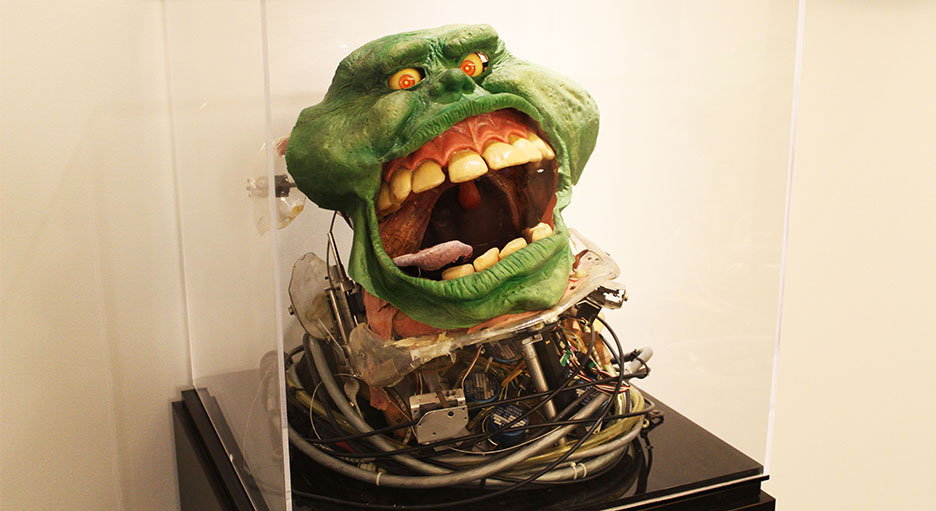
The original Slimer head on display at Lucasfilm headquarters in San Francisco.
When Ghostbusters (1984) premiered, it became an instant classic. With a star-studded cast—Bill Murray, Dan Aykroyd, Harold Ramis, and Ernie Hudson—alongside Sigourney Weaver, Rick Moranis, and Annie Potts, the film combined supernatural elements with groundbreaking visual effects and perfect comedic timing, captivating audiences worldwide. The film grossed $282 million in its initial theatrical run, cementing its place in film history.
Beyond the popular human cast, one standout element was the ghost originally named “Onionhead.” Special effects artist Steve Johnson, credited as the sculptor, likely drew inspiration for the name from its vegetable-like appearance. This gluttonous green ghost, classified as a Class 5 Full-Roaming Vapor, made a brief but memorable appearance that delighted audiences. Designed to be grotesque and chaotic, Onionhead unexpectedly became a fan favorite. Bill Murray’s famous line, “He slimed me!” as Peter Venkman, became one of the most quoted phrases of 1984. Onionhead’s popularity only grew with The Real Ghostbusters (1986) animated series, where he was reimagined as a mischievous yet lovable, pet-like character.
In the eleventh episode of The Real Ghostbusters, titled “Citizen Ghost,” which first aired in November 1986, Onionhead finally got his new name. The episode’s flashback shows how the Ghostbusters became friends with the little green ghost, with Ray Stantz giving him the fitting nickname “Slimer.” The name endured, becoming a permanent fixture in all subsequent Ghostbusters projects. Ghostbusters 2 (1989) sought to bring the evolved version of Slimer to the big screen, balancing the charm of the original character with the expectations of younger fans familiar with the cartoon. With the baton passed from Boss Film Studios to ILM for the sequel, visual effects supervisor Dennis Muren described the task ahead of them to Cinefex. “We had the opportunity to create a whole new array of ghostly images,” he explained, using all the tools at their disposal. An early idea of using a rod puppet was quickly dismissed, with Muren preferring to opt for a fresh take on the “man in a suit” approach.
With the technological advances made in the five years since the original film, the goal was not just to capture the original magic but to push the boundaries of animatronics, puppetry, and practical effects.
Slimer concept art for Ghostbusters 2 by Henry Mayo. (Credit: Columbia/Sony & ILM)
Reimagining Slimer
For the sequel, Slimer needed to embody the more playful, cartoonish persona.“[Executive Producer] Michael [C. Gross] wanted elements from the cartoon version incorporated as well, and to this end he had Thom [Enriquiez] do the new series of drawings – which were fabulous,” creature and makeup designer Tim Lawrence explained to Cinefex.
Mark Siegel, a key contributor to Slimer’s original creation, was brought to ILM for Ghostbusters 2 to resculpt the character and adapt him for the film’s lighter tone. Siegel had been deeply involved in the creation of the original Onionhead ghost, sculpting his teeth, tongue, and inner mouth, as well as the complete replacement head for a second puppet with a wider, more frightened look to the mouth. He also puppeteered the tongue and eyebrows for the majority of the shots.
The sculpting process for the design maquette was a collaborative effort, with Siegel primarily handling Slimer’s body, head, and face while fellow crew member and performer Howie Weed focused on the arms and hands. For the full-sized puppet Siegel sculpted the head and the arms.
The character of Onionhead in Ghostbusters wasn’t just an arbitrary creation. His mannerisms and chaotic energy were directly inspired by the late John Belushi, specifically his portrayal of Bluto in Animal House (1978). This connection was not merely symbolic; it was a tangible part of his design and performance. Mark Siegel recalls how Harold Ramis and Dan Aykroyd made it clear to the team that Slimer was a representation of their close friend Belushi’s comedic spirit.
The team didn’t just envision this; they meticulously pored over Belushi’s scenes. “We studied frame by frame old VHS tapes of Belushi’s Animal House scenes, focusing on his expressions,” Siegel elaborates. This analysis allowed them to incorporate Belushi’s signature movements and broad, exaggerated physicality into Slimer’s performance for the first film. According to Siegel, it was Belushi’s expressive style that truly captured the blend of charm and grotesqueness that defined Slimer’s character.
“When I first started sculpting the new Slimer, I thought, ‘Well, that’s cute,'” Siegel admits. But the evolution of the character, from disgusting blob to family-friendly ghost, presented some challenges. “I felt we were losing some of the raw, chaotic energy that made Slimer memorable in the first film.”
The sculpting process was a collaborative effort, with Siegel primarily handling Slimer’s body, head and face while fellow crew member and performer Howie Weed focused on the arms and hands.
Scenes originally envisioned for Slimer in Ghostbusters 2 included him eating various types of food around the station house while Louis (Rick Moranis) tried in vain to catch him. Then later, when Louis straps on a backpack and tries to help the Ghostbusters, he finds Slimer driving a bus. Louis hitches a ride and the two eventually become friends. An early storyboard also shows Slimer flying around the Statue of Liberty for the final shot of the movie, mirroring the first film’s finale. But, as is often the case in artistic pursuits, things were adapted, changed, and even removed along the way, all for a multitude of reasons.
The original Slimer head on display at Lucasfilm headquarters in San Francisco.
Technical Innovations: Pioneering Animatronics
One of the key advancements in Ghostbusters 2 was the shift from manual cable-controlled puppetry to the use of radio-controlled servos for Slimer’s facial expressions. Al Coulter, an ILM animatronics engineer, led the effort to remotely automate Slimer’s face, allowing for more nuanced performances. “Al wanted to mechanize Slimer’s expressions,” Siegel says. “The SNARK system (reported as both Serial Networked Actuator Relay Kit and Synthetic Neuro-Animation Repeating Kinetics module) allowed us to control multiple servos simultaneously, meaning that expressions could be achieved more easily, with fewer people.” This system was a technological leap forward, offering new possibilities for nuanced expressions, though it brought its own set of challenges.
One of the key motivations for this advancement was to streamline post-production, which had been a challenge in the original film. “In Ghostbusters, we had to deal with puppeteers in the frame, which meant removing them during post-production,” Siegel recalls. That was both time consuming and costly.
Coulter notes that while the servos were originally designed for consumer RC airplanes, significant customization was required to make them work for Slimer’s facial movements. “The joystick stuff from Hobby World caused a lot of problems when we went onstage, because there was so much interference from all the lights and the wires and the machinery…that we needed to be able to connect our character to something direct, hardwired. So we had this guy build control boards which we bundled together and plugged into a PC. And that PC would then have software on it, custom again, and it would record our performance.” It was a major advancement for the time, in a way following in the footsteps of the leaps ILM had made in motion-control in the mid 1970s for the spaceships in George Lucas’ Star Wars: A New Hope (1977).
Coulter reflects that working with the technology of the time, particularly the slow computing speeds, was a challenge in itself. “We were working with computers that ran at 24 MHz—slow by today’s standards, but cutting edge at the time.” Despite this, the SNARK system was a pioneering achievement in real-time, computer-controlled puppetry, allowing for repeatable and detailed performances. “The facial expression, eyebrows, eyes, I think we had a nose wiggle…being updated to radio control servos, that was a great idea,” Siegel adds.
Behind-the-scenes videos posted by William Forsche (another crew member) show the incredible range of facial contortions that could be achieved with the new Slimer, from sad to happy to curious in a matter of seconds. While motion-control’s precision was essential for the spaceships in Star Wars, it wasn’t yet clear how well the recording and playback of Slimer’s facial movements would work.
Ultimately the servos introduced their own set of challenges. While the system allowed for greater control, it limited some of the more exaggerated movements that defined the original Slimer. As Siegel explains, “In the first film, Slimer’s jaw was controlled manually, allowing for more exaggerated, chaotic movements. The sculpture was extremely soft and flexible. There was no structure in the lower jaw at all. Just a little metal rod in the lower lip and a puppeteer down below could pull it, just stretch that rubber way wide, twist it from side to side and get a whole variety of expressions, make him chew and stuff…. While the servos and pneumatics we used in Ghostbusters 2 gave us more precise control over the facial expressions, they also introduced limitations in terms of flexibility and range.”
The head wasn’t the only challenge. In trying to replicate the exaggerated, cartoon-like appearance and movements of Slimer’s body from the animated series, the crew encountered more hurdles.
The original Slimer head on display at Lucasfilm headquarters in San Francisco.
Innovating Slimer’s Body Design
While the animatronics used for Slimer’s facial expressions were groundbreaking, if beginning to become troublesome, the team also had to experiment with new ways to animate Slimer’s body. Tim Lawrence proposed constructing the body out of spandex with bean-bag-like filling, aiming to give Slimer a more fluid, exaggerated range of motion similar to the stretch-and-squash effect seen in his cartoon form.
However, this idea quickly ran into practical issues, as Siegel explains. “It might have been a couple of days before we were shooting and Dennis Muren came in and looked at the whole puppet assembled, and he wisely said well that spandex is going to look entirely different on camera than that rubber head. For some reason that had never occurred to anyone before. So in a mad rush we took that spandex bean bag body into our spray ventilation booth, and I had to mix up big batches of foam latex and we actually spatulated it onto that entire body. And that’s really hard to do because the foam latex has a limited time before it sets. And then it had to be baked in an oven. So it was thrown together at short notice in less than one day. When the rubber was cured over the bean bag it made the body a lot less stretchy and flexible than Tim had intended it to be.” The problems were beginning to mount.
Robin Shelby tests the Slimer body costume. (Credit: Columbia/Sony & ILM)
Robin Shelby: The Heart Inside Slimer
While ILM envisioned the technological advancements to play a key role in bringing the reimagined Slimer to life in Ghostbusters 2, it was Robin Shelby (then Robin Navlyt), the performer inside the suit, who truly embodied the character’s spirit.
Previously known by ILM for her role as a troll in Ron Howard’s Willow (1988), she took over the role of Slimer for Ghostbusters 2 after the original actor, Bobby Porter, became unavailable. As Shelby recalls, “They had someone cast, then they wrote Slimer out of the script…and then they wrote him back in, but the original actor had taken on another project.” At just 20 years old, Shelby was tasked with bringing a new version of Slimer to life, despite the suit’s heavy and cumbersome design. But she was up for the challenge!
“I grew up doing musical theater, a lot of dance. So I was very aware of my body…and that helped a lot. I didn’t have any stunt experience at the time, but a lot of movement and dance experience,” remarks Shelby. Reflecting on her first impression of the suit, she adds, “They were still building it when I came in. It wasn’t all painted and set. They had to do a cast of my face and head so they could fit it to me. But when I first saw it with the motors, it was a little scary. The weight was extraordinary. But, the crew was amazing.”
With Shelby performing inside the suit and the expressions operated remotely, production became more efficient. By using a bluescreen and having Shelby wear a black leotard, ILM eliminated the need for puppeteer removal in post-production, just as originally planned.
Shelby and the team had about five to six weeks of rehearsal to help her adjust to the suit and coordinate with the puppeteers operating the animatronic features. The suit itself came in three interlocking segments: the main body, the gloves for the hands and arms, and the head. “I couldn’t see anything really. So what we would do is rehearse, they would shoot it, and then they would have me watch it. So I could see what it was all looking like. So, I knew in my head what we were all doing,” Shelby explains.
The physical demands of the suit were intense. Al Coulter praises her resilience, noting that the weight of the suit left marks on her nose: “As soon as you said action, she was right back there, just banging it out every time. Amazing!”
“The suit was probably over a third of my own body weight,” Shelby recalls. “I probably weighed like 95 pounds when we shot that, and it was probably 35 pounds. People ask, was it hot? It was hot, but probably the worst part of it was the weight.”
Michael C. Gross, the executive producer, visited the set to see how Shelby’s performance was going. “He said, ‘Don’t be the dancer that I know you are, just get in there and be gritty and be mean. Just go out and have fun.’ So I was just trying to rough it up a lot on the set, make it not so dainty or perfect or dance-like, just to try and make it work for the character. It was so much fun, and they really allowed me to play with it,” Shelby enthuses.
Still, even enthusiasm has its limits. “We’d worked for about an hour, and they’d say, okay, we’re gonna take a break. They’d take the head off. I wouldn’t get out of the costume, but they’d take the head off so I could have water, get some air, and sit down. There was a time that I pushed it because we were in the middle of the scene and I didn’t want to stop. They’re like, ‘Are you okay? You’re alright?’ I’d say, ‘Yeah, yeah, let’s just keep shooting. We’re almost done.’ And then Tim is directing me, ‘Okay, Robin, we need you to turn around and go left. Robin? Robin!!’ And I wasn’t even answering. ‘Get her out,’ they shouted.
“You try to be the trooper…when you’re new and just want to please everybody. But lesson learned, yeah, absolutely,” Shelby admitted. “But I’d do it all again,” she adds.
Despite the technical challenges and physical demands, there were plenty of lighthearted moments on set as well.
Robin Shelby in costume on the bluescreen stage. (Credit: Columbia/Sony & ILM)Robin Shelby prepares to don Slimer’s head. (Credit: Columbia/Sony & ILM)
Bill Murray’s Antics
Bill Murray was known to be an unpredictable presence on set, providing some much-needed levity during the intense production process. One day, he arrived at the effects shop. “I didn’t realize how tall Bill Murray is (he’s 6’ 2”),” says Siegel. “And he was messing around with Robin, who’s tiny (4′ 11″), and he was picking her up like a child, and dancing around with her. He was hilarious.” For Shelby it was a surreal moment, “I was a big Saturday Night Live fan, I still am. And so he was one of my heroes at the time…so it was pretty amazing…. He asked if he could pick me up. And he picked me up over his head…. He was actually very sweet to me. You just never knew what he was going to do next.”
Effort vs. Outcome
With the crew rehearsals helping them find the limitations of the suit and the animatronic head, they began to hone the performance with some impressive results.
As Tim Lawrence told Cinefex, “Once we saw the subtlety of the expression that was possible, Slimer suddenly had an incredible life to him that I had never seen in such a character before. To see his face light up from very sad to very happy was a wonderful thing. The scene I was most happy with was one that they just threw at us. I wasn’t sure we could even do it because it was a 30-second shot without a cutaway. In it, Louis gets off the bus and heads off down the sidewalk. At this point, Slimer and he are on friendlier terms. Suddenly, Slimer enters frame, rushes intently up to Louis and pats him on the shoulder. From his motions, it is obvious he wants to go with Louis really badly, but Louis tells him he can’t and Slimer gets all sad. Then Louis tells him something that makes him happy, and Slimer gives Louis a big wet kiss with his tongue coming out and licking him. Then he does a spin and flies off. Well, we did that all in one cut and it looked wonderful. I had never seen a rubber character do what Slimer had done.” “For that scene, they gave me a tape of it because it was shot in New York. And I had to listen to the dialogue so I could know the exact timing. I had probably listened to that hundreds of times just to get Rick Moranis’ dialogue and timing,” explains Shelby.
“Michael just flipped – he thought the performance was excellent. But at the same time, he told us that they might not be able to use the shot – and ultimately it did not make it into the film,” Lawrence had noted.
Despite completing all of the storyboarded shots, Slimer’s role in the final cut of the film was indeed scaled back considerably. Gross again explained in Cinefex: “Whenever he was in there, it seemed like he was really an intrusion. At first we thought the answer was to add more of him, so we had an ongoing confrontation between Louis and Slimer in which Louis was constantly trying to catch him. We thought it would be funny and at screenings we expected the audience to cheer and laugh when they saw him again. But nothing. No reaction. The audience was looking at it as a fresh movie. There were a lot of kids who loved to see him, so we knew we could not abandon him completely, but he never really worked with the audience the way we expected. Ultimately we decided less was better, and in the final film we limited him to two very quick shots.”
Siegel takes a philosophical approach, “From my own experience working in the business as long as I have, I just assume that some of the work’s gonna be cut…. His presence in the movie was questionable from the beginning. So again, I wasn’t surprised if some of his shots were removed.”
The disappointment is palpable for Shelby. “I think that’s probably the most bummed out I was…. Everybody just did such a great job on putting that all together.” But for the 20-year-old, little did she know that one day she’d get a call from Paul Feig to reprise the role in the 2016 reboot Ghostbusters: Answer the Call, this time providing the voice for “Lady Slimer.”
The original Slimer head on display at Lucasfilm headquarters in San Francisco.
A Legacy of Experimentation
The experience of working on Ghostbusters 2, was always about the spirit of experimentation. Slimer’s evolution from the chaotic “ugly little spud” in the original Ghostbusters to a more cartoonish, mechanized character in Ghostbusters 2 stands as a testament to ILM’s relentless pursuit for innovation. Despite the technological limitations of the time, Slimer’s creation helped pave the way for future advancements in animatronics and practical effects. As Siegel concludes, “Every project has its challenges, but the lessons you learn set the stage for the next big breakthrough.”
While ILM pushed the envelope with cutting-edge animatronics, the process also highlighted the enduring importance of human performers. As Coulter reflects, “We overreached a bit. The software itself was very rudimentary. Everything was so experimental back then.” He highlighted that, despite the ability to program precise facial movements, human performers remained more adaptable and agile in responding to the creative needs of a scene. “At one point they brought the director and he looked at it and kind of went, ‘Could you make him incredulous at this one point?’ Er…. We don’t have an incredulous button here. It’s like turn the computer off, bring the puppeteers back in, and off we go again. A computer is not going to have any idea how to convey anger or emotion,” Coulter remarks, noting that even today, animators still rely heavily on human actors for motion capture, using them as the source for animation.
An Ongoing Partnership Between Practical and Digital
ILM’s current director of research and development Cary Phillips explains that physical puppets still hold a vital role in modern productions. “We often get called on to build digital models of physical puppets that perform on set, to execute performances that the physical models can’t. Grogu [from The Mandalorian] is a recent example. Physical models are an inspiration for the actors and everyone on set, as well as for animators who bring the digital version to life.”
He adds that some directors also prefer digital puppets that retain the movement style of their physical counterparts. “I think our human eyes are attuned to certain qualities of movement that we find appealing and comfortable because they suggest a physical medium at work. But that’s done by hand; there’s usually no automatic connection between the physical model and the digital.”
The challenge remains how to make a puppet, digital or physical, feel alive. “A frequent criticism of computer animation, sometimes legit and sometimes not, is that it can look too polished and smooth,” says Phillips, “lacking the spontaneity of a live performance, the unintentional quirks that make a character seem alive. Great animators can create this, but it’s hard. That’s one of the lasting appeals of motion capture, although it also introduces an entirely new set of technical challenges and limitations. Ideally, capture devices are simply an alternative to the keyboard and mouse as a way of describing movement, for use when appropriate.”
Phillips further reflects on the legacy of those who came before him and the evolving boundaries, or lack thereof, in modern visual effects. “Discovery is a vital part of the creative process. Something might feel like a mistake while it’s happening but turn out afterwards to have an appealing quality. The best tools let artists experiment quickly and work iteratively. One of the benefits of a computer graphics model is that it can do things that a physical model can’t, and we often get asked to make models and characters move in ways that violate the laws of physics. Leap tall buildings in a single bound. Cheat to get the action in the frame. So, there are no absolute boundaries—you can make it do anything. Even move in a way that would rip a real person apart. It’s an awesome power, but it takes real artistry to keep it looking plausible and appealing, even if it doesn’t look technically ‘real.’”
At Lucasfilm and ILM’s headquarters at the Presidio in San Francisco are halls lined with artifacts from the company’s rich history—matte paintings, spaceship models, and optical effects equipment. And around one corner, encased in acrylic, lies Slimer from Ghostbusters 2. His still vibrant green latex skin, now shrunken with age, reveals the servos and pneumatic cylinders beneath. It serves as a poignant reminder to all who pass by that character animation has deep roots in the physical world.
–
Jamie Benning is a filmmaker, author, podcaster and life-long fan of sci-fi and fantasy movies. Visit Filmumentaries.com and listen to The Filmumentaries podcast for twice-monthly interviews with behind the scenes artists. Find Jamie on X @jamieswb and as @filmumentaries on Threads, Instagram and Facebook.
Take a closer look at how the ILM Vancouver team built a new world of stylized action for Japanese icon Ken Sato, also known as Ultraman, and how they pushed the visual envelope with a bold aesthetic as ILM steps back into animated features with Netflix’s Ultraman: Rising.
By Adam Berry
Netflix Ultraman: Risingmarks the first fully animated feature production for Industrial Light & Magic (ILM) since 2011’s Rango. The story chronicles the adventures of Ken Sato, and his superpowered alter ego known to the world as Ultraman. The film is a love letter to the 1966 Japanese superhero television show Ultraman, with the heart of the story exploring the importance of family in all of its forms as Sato takes on the responsibility of raising a baby kaiju named Emi.
A tender family moment shared between Emi, Mina and Ken Sato (Credit: Netflix).
The monster-sized task of taking Japan’s beloved superhero, transforming the character to be fully animated and introducing him to a global audience was a dream come true for the film’s directors Shannon Tindle and John Aoshima, who had always been fans of the Japanese franchise.
With production on Ultraman: Rising beginning in the spring of 2021, the film required 1,578 visual effects shots and over 1,300 assets to be built. All 165,169 frames of the entire 108 minute feature were created by over 650 ILM artists across three of their global studios in London, Vancouver, and the former location in Singapore.
With London acting as the hub for the show, led by visual effects supervisor Hayden Jones, and Singapore providing support, it was actually ILM Vancouver that contributed the majority of work done on the film with over 300 artists assigned to the project. Every asset seen in the film, from the monstrous kaijus to Ultraman himself, with an additional 600-plus shots from the film’s total count were all built in Vancouver.
The Vancouver studio first opened its doors back in 2012 in the heart of Hollywood North’s historic neighborhood known as Gastown. ILM has led the visual effects industry in Vancouver over the past decade having worked on many large scale productions locally such as the epicPercy Jackson and the Olympians (2023).
Leading the Vancouver team was associate visual effects supervisor, Tania Richard who tells ILM.com, “the work consisted of a global initiative to repurpose ILM visual effects toolsets into a robust feature animation pipeline that would provide flexibility and a stylistic consistency throughout the production. ILM Vancouver was responsible for building the character and environment assets on the show, working closely with the London and Singapore teams to refine and streamline elements that could be shared across multiple sites, along with producing a large scope of shot-work.”
Ultraman meets a baby kaijou that he comes to call Emi for the first time(Credit: Netflix).
Having already worked closely with one of the film’s directors, Shannon Tindle on Netflix feature Lost Ollie (2022), the Vancouver team attributes the key to their success on Ultraman: Rising to their close collaboration with Netflix. This project provided them with the opportunity to build upon their relationship with Tindle, and to engage with him creatively. This close collaboration both inspired and empowered the team to share their ideas on a level that not all artists are given the chance to experience.
“The Ultraman clients were one of the best I’ve ever worked with,” shares final layout lead, Hayley Kim.“There were many opportunities to exchange creative ideas with the directors. The clients even visited the Vancouver studio in person to talk one-on-one with the artists.”
Directors Tindle and Aoshima came into the project with a clear vision, but entrusted ILM to bring fresh ideas and creative solutions that would enhance the work. “They valued the team’s input; empowered us with the belief that collective creativity would elevate the overall quality of the film. They achieved this without delaying decision making, or production time,” says CG supervisor Jeeyun Sung, who expressed her gratitude for having the directors readily available, which provided a valuable learning experience for the team and helped to speed up the production process.
The creative collaboration between both the Netflix and ILM teams inspired the use of new techniques that are not usually embraced in visual effects. With a hero this big, and a new global audience to be introduced to, the film needed a fresh new approach to the animation not yet seen in a feature film. Having other hit animated superhero feature films already on the audience’s radars, such as Sony’s Spiderman: Into the Spiderverse (2018), meant finding a new look for Ultraman.
Ultimately, a painterly approach to shape the film’s aesthetic was decided upon, and as you can see when watching the film, every frame looks like it came straight off of a canvas. “Finding a painterly approach to our assets needed a certain amount of testing and collaboration between departments at the start of the project,” explains Tania Richard. “Implying detail and form when and where mattered; this meant leaning into more traditional artistic approaches and embracing individual instincts. Once a look was agreed upon, it was important to lock down methodology early enough to execute what was an ambitious schedule and volume of work.”
The Netflix art department team, led by art director Sunmin Inn and production designer Marcos Mateu-Mestre, brought their creative vision and thrilling concepts early on in the production process, generously offering the ILM team stylistic guidance as they developed the look and feel for the direction that the animation would ultimately go.
Sung shares, “The one thing that will always stick with me is a quote from the art director, Sunmin at Netflix, ‘just use illegal colors’. As production neared completion, those illegal colors were the norm and we could hardly believe all of our eyes had adjusted to the vision.” The beautiful color scripts and art direction allowed the team space to explore bold and vibrant color palettes to tell Ultraman’s story.
Mecha Gigantron, Emi, Ultradad and Ultraman form the ultimate team up to finish the fight with Dr. Onda (Credit: Netflix).
With all 1,300-plus assets being built in Vancouver, one of the biggest challenges on the show was creating a robust animation pipeline that would maintain stylistic uniformity, be shared across multiple sites, have various artists working on shots simultaneously and have the work be executed with consistency. There needed to be enough flexibility for addressing creative notes and refinement. It needed to be built in so that the workflow remained efficient, with stylized techniques such as cross-hatching and linework being developed in toolsets to be shared with the London and Singapore sites.
“Embracing a more creative, painterly approach to building assets was key, such as understanding the balance between suggestive and refined detail, as well as developing stylistic tools that referenced the visual graphic language often seen in anime and manga,” details Richard.
Additional research and development time was required for each team across every part of the workflow; the team’s objective being to find the right balance between 2-dimensional (2D) graphic elements, such as outlines, texture details, cross hatching and the more realistic 3-dimensional (3D) rendering, a process with many possible directions.
“Once we achieved the imagery that became the look of our film, we adhered to the ground rules and shared the know-how between sites and sequence teams to avoid reinventing the wheel; revisiting the questions we had already answered,” says Sung.
Ultimately, a significant part of the ILM Vancouver team’s task was to explore the concepts that would define the film’s style, establish a look that would not only stand out among other animated features, while also being robust enough for the crew to carry through 1,600-plus shots. In the end, the challenge of building the beautiful world of Ultraman: Rising was worth the long days as every magnificent pixel of the film are generated assets created internally and exclusively by ILM.
The stylized animation needed to showcase every magnificent detail of the ultra-sized action sequences and spectacle that a hero like Ultraman brings to the big screen as he battles the larger than life kaijus through the streets of Tokyo. For the ILM Vancouver team, one of the highlights was working on the film’s opening sequences where Ultraman faces off against a kaiju called Neronga, which was ironically one of the last beats of the film to be executed.
“The dynamic battle sequences definitely stand out in my memory, particularly the fight scene between Ultraman and Neronga,” shares Kim, who was inspired to study classic Japanese monster films to pull ideas from scenes, like this one and Ultraman’s fight with Gigantron.
The battle with Neronga sequence, known internally as MUL (Meet Ultraman), consisted of nearly 60 action-packed shots with dynamic moving cameras, set against the colorful and complex streets of Akihabara, a bustling section of Tokyo adorned with vibrant lights, billboards, and crowds. All of these elements had to embrace a certain amount of interaction between our hero and his monstrous adversary, who are entangled in a clumsily destructive confrontation. Richard says, “It was important in the development of our environment assets for each neighborhood to reflect reality, from the elevation of buildings to details such as street signs and road markings, and our Akihabara set was no exception.”
Ultraman battles with Gigantron (Credit: Netflix).
ILM Vanouver’s model supervisor, Mark Keetch, led the environment build, paying close attention to references provided by the Netflix Art Department, along with detailed research by the ILM team. The lighting and compositing teams, led by our CG supervisor Jeeyun Sung and comp supervisor Aaron Brown, also implemented various techniques developed throughout the production to create the exciting and highly stylized feast of imagery which were key components to the success of this sequence.
Sung shares, “The result exceeded our expectations. Every artist brought so much creativity to each of their shots, and by then we had built a Swiss army knife’s worth of knowledge of how to handle the style. Everyone was truly having fun! The energy was palpable, and I believe it contributed to creating stunning visuals!”
The action only grew larger and more epic from one battle sequence to the next; enhanced by the imaginative work and creative solutions that the ILM team worked tirelessly to innovate. Much like Ken Sato’s relationships with Emi and his father throughout, the Vancouver team were united in their efforts and passion to bring this epic story to audiences across the world, and truly capture the spirit of the character that directors Tindle and Aoshima care so deeply for. ILM’s team spirit can be felt with every frame as their own experience working on the film was just as meaningful.
“Working on the Ultraman team was filled with nothing but positive memories from start to finish,” shares Hayley Kim, who was given her first leadership opportunity at ILM on Ultraman: Rising.“It was incredibly fulfilling to see the final result at the screening, knowing that ILM was involved from beginning to end. I hope there will be more opportunities in the future to work on such creative projects.”
“Ultraman was a relatively rare feature animation project for ILM after a long time had passed since Rango,” explains Jeeyun Sung, who resides in New York, USA, but worked intimately with the ILM Vancouver team over the course of the project. This created an exciting energy for all crew members, from the bottom to the top. We faced new pipeline issues to solve, had new roles and language that needed reshaping. But the prospect of carving a new path for future animation projects at ILM kept us all abuzz. We felt incredibly happy and fortunate to have this opportunity.”
“Our Vancouver team was a delight to work with, and the collaboration between ILM globally was a unique experience,” concludes Tania Richard, who led the Vancouver team through a memorable creative journey which produced one of the most beautiful animated features to ever be seen on screen. “Everyone embraced the creative challenges on the show in a way that continually inspired the team to go above and beyond what was expected, and the resulting body of work is beautiful.”
There are over 7,500 kilometers between Ken Sato’s home in Tokyo and the team in Vancouver that built the vibrant new world seen in Ultraman: Rising. It took two years, and countless hours, but the final product is a breathtaking addition to the Ultraman franchise, and a bold new direction for ILM as they begin to expand their catalog of animated projects, including the recently released Transformers One (2024). Two worlds came together across great distances to bring this story to life by ILM’s passionate artists who knew the magic it would take to to effectively showcase the heart of Ultraman: Rising.
(Credit: Netflix).
–
Adam Berry is the Studio Operations Manager for the ILM Vancouver studio. His passion for film led Adam to ILM in 2022, coming from an extensive career across different sectors of the hospitality industry including cruise ships, luxury hotels and resorts. If he’s not at the movies or traveling to new destinations, you can find Adam staying active and exploring Vancouver.
ILM’s Sydney studio took on everything from digital creatures to CG environments for this adaptation of a beloved Disney Parks attraction.
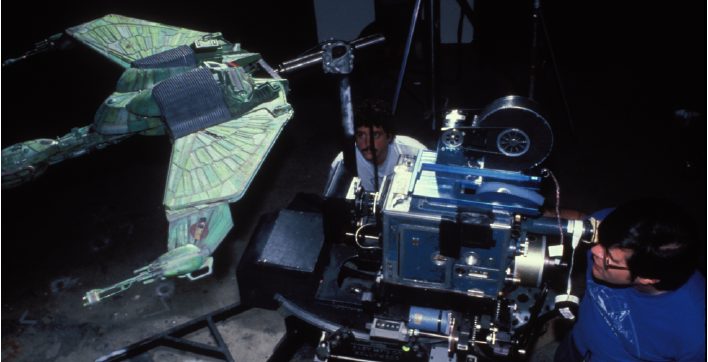
By Lucas O. Seastrom
The Hatbox Ghost, performed by Jared Leto. (Credit: Disney)
For nearly 40 years, Industrial Light & Magic has had a close relationship with Disney Parks. They have not only created visual effects for attractions themselves, from Captain EO and Star Tours in the 1980s to Star Wars: Rise of the Resistance and Guardians of the Galaxy: Cosmic Rewind in recent years, but have also worked on feature film adaptations of attractions such as Pirates of the Caribbean: Curse of the Black Pearl (2003) and Jungle Cruise (2021).
2023’s Haunted Mansion is another adaptation of a beloved attraction, which first premiered at Disneyland in 1969 and later at Walt Disney World in 1971. Director Justin Simien brought distinctly apt qualifications to the project, having worked as a Disneyland Resort cast member during his film school days at Chapman University. “Whenever I was in Disneyland, it was like being inside of a movie,” he tells ILM.com. “I would go on the rides over and over again, and I’d get chills in the same spots and catch my breath in the same places. I realized that this was cinema. It’s a theme park that’s physically happening around me, but the tools of the trade are the same.
“There’s production design, sound design, lighting, dialogue, character, and story,” Simien continues. “It sounds like something you’d say in a press interview, but it’s true – I remember going on The Haunted Mansion and Pirates of the Caribbean and thinking, ‘I need to figure out how to translate this to what I want to do as a filmmaker.’ Walt Disney and his artists brought us into these fantasy places. That’s the art. That’s the thing I needed to figure out. So for me, it all felt very complementary. Working at Disneyland was just another way of escaping into the movies.”
Simien’s approach to bringing Haunted Mansion to the screen was as complex as the vision of the attraction’s original creators. “I was really fascinated by the constant conversation that the Imagineers had about how scary it should be or how funny it should be,” Simien comments. “It was such an interesting way to make something unique. It’s not horror in the traditional sense. You’re not walking through a haunted house at Universal Horror Nights or something like that. But it’s not straightforward Disney either. It’s very subversive and there’s a lot of hidden, kind of dark stuff going on.”
Jamie Lee Curtis as Madame Leota approaches the Mansion’s front door with a bluescreen extension behind her. (Credit: Justin Simien/Disney)
Simien and his team were able to visit the Disneyland Haunted Mansion in the off-hours, where current Imagineers helped them to understand its distinct narrative brilliance. “When you’ve made your way up through the Mansion, you’ve turned a corner, and you’re looking down into the dining room,” Simien explains. “All of the swirling dancing ghosts are there and ghost heads are coming out of the organ. It’s a culmination of all the different effects in the ride, the Pepper’s Ghost effect in particular. Even as an adult, when I know how it’s done, it takes my breath away. There are a couple of moments in the movie where we’re working from the same point of view. We pay homage. The ride has this build-up with specific timing and pacing.”
Simien took his cinematic leads from works in the 1980s and ‘90s, such as Ghostbusters (1984) and Little Shop of Horrors (1986) and the films of Tim Burton. He also went back to source material shared by the Disney Imagineers, including Robert Wise’s The Haunting from 1963. “There are so many parallels in the production design of that movie and the attraction,” he notes. “You see very subtle elements in our movie that are like that. There are slanted mirrors and shots where you look through a doorway and it’s a kind of off-angle. You get a claustrophobic ‘things are not right with the world’ feeling without really doing anything, just designing things a certain way.”
From a visual effects standpoint, Simien envisioned a mix of practical and digital techniques. “I wanted as many practical effects as I could get,” he says, “which I knew was always going to be a battle [laughs]. The movie is so fantastical. This wasn’t a typical horror movie where you hide the monster. It’s a Disney movie. There’s an expectation that you’ll get to see the ghosts. I wanted them to have a physicality, to be people in make-up and costumes moving on wires. We needed to ground the movie as much as possible in those things.”
ILM was one of multiple effects vendors on the project, and initially planned to contribute a modest sum of around 400 shots, overseen by Sydney-based visual effects supervisor Bill Georgiou and visual effects producer Arwen Munro. American-born, Georgiou spent nearly 15 years at Rhythm & Hues, climbing the ranks from rotoscope artist to compositing supervisor and sequence supervisor. He later worked as the onset visual effects supervisor on the DisneyXD program, Mighty Med, before joining ILM and moving to Australia in October 2021.
Coincidentally, Georgiou was an apt choice for Haunted Mansion, having known production visual effects supervisor Edwin Rivera for many years at Rhythm & Hues, not to mention Justin Simien himself. They had met through a mutual friend, editor Phillip Bartell, who cut Simien’s Dear White People (2014), as well as Haunted Mansion. “Edwin is very supportive and collaborative,” Georgiou tells ILM.com. “At the beginning, we were doing mostly set extensions, which is pretty straightforward. I think that he and Justin were impressed by the level of photorealism we were able to achieve, especially with the Mansion. Every shot of the Mansion has some CG, including the grounds around it. Another vendor, DNEG, was also doing some interior work, and we’d help create the views out the windows.”
A first-floor exterior of the Mansion was constructed onset. (Credit: Justin Simien/Disney)A final frame shows the complete Mansion with ILM’s extensions. (Credit: Disney)
Initially, Georgiou’s Sydney team worked only with ILM’s former Singapore studio, which being closer in time zones, shared the same schedule. “ILM has the best of the best,” Georgiou says. “Everyone was an amazing collaborator and shared their opinions. It was very open.” Principal photography had taken place in Georgia back in the United States, where ILM’s Andrew Roberts acted as onset visual effects supervisor. Georgiou and Munro also made a visit to Los Angeles to meet directly with the client, something Georgiou describes as essential to their continued partnership as the workload grew unexpectedly.
Reshoots would require further effects work involving an elaborate scene at the movie’s climax, where Ben (LaKeith Stanfield) confronts the villainous Hatbox Ghost (Jared Leto). “All of a sudden, we had more than twice as many shots as we started with,” Georgiou explains, “a CG human-like ghost character, and digi-doubles. It became an immense project, with over 1,000 shots. With a very short schedule, I think ILM knocked it out of the park. We had about 700 new shots, and Sydney became the hub for London, Vancouver, and San Francisco, as well as an additional vendor, Whiskytree. It became a global team. For my first real experience starting a project from the beginning at ILM, it was one of the best.
“When I first started on Stuart Little in 1998,” Georgiou continues, “one of the compositors who came in was R. Jay Williams, and he ended up being a senior compositor on Haunted Mansion [out of ILM San Francisco]. He had taught me so many things as a young roto artist, one of which was how to be nice to everybody. He always said hello and goodbye to everybody, one of the nicest, classiest people I’ve met in the industry, and I was able to finally tell him that on this project. It was so cool.”
During principal photography, a large portion of the Mansion was constructed as a physical set. “Mentally, psychologically, it was important to have a real mansion to shoot in,” Simien explains. “We could all get used to that physical space.” Other portions of the house incorporated bluescreen, including the sequence when Ben enters the ghost realm, a sort of alternate dimension within the Mansion where the hallways shift and rotate. This was amongst the work ILM received in the additional batch.
Actors Chase Dillon (left) and LaKeith Stanfield onset behind the first-floor exterior of the Mansion. (Credit: Justin Simien/Disney)
“It was quite interesting work,” Georgiou says. “Not only were we matching scans of the hallway reference that had been captured onset, but we were also matching the look to some of the previous work that DNEG had done. We then created animation for the rotations and how they would section off. The way they’d filmed onset with bluescreen was really well done, which made our work easier. The lighting was a challenge because there are candles and sconces on the wall, so you have these pools of light. The D.P. [Jeffrey Waldron] had very specific notes about how it should look. The chandeliers are swinging. Many puzzles to figure out, which is one of the best parts of visual effects. Overall, that sequence was one of the most successful, and it’s so cool that they used it in the poster.”
Of course, the appearance of 999 happy haunts would be the core element of Haunted Mansion’svisual effects. “Edwin Rivera used this term, ‘ectoplasmic effervescence’ for the ghosts, which has a Ghostbusters feel to it,” explains Georgiou. “It was fun to look through the history of cinema to find inspiration, but also figure out how we wanted to do things differently and create something that was fresh. Justin has such an incredible cinematic vocabulary. He’s looking at Kubrick and Hitchcock, and you can see that in how he’s framing shots. I felt like I was gaining plenty of knowledge.”
Another reference for Georgiou was Poltergeist (1982), one of ILM’s first client productions. “Poltergeist was very influential for me, especially when we were creating these skeletal ghosts that fly around. That was all connected to Poltergeist and the style they used for the ghost who comes right to camera. It feels really light-based but then there’s a skeleton face. Also, the way they use flares in Poltergeist was very influential for the last sequence of Haunted Mansion.”
A number of the prominently featured ghosts were performed by actors in costume and make-up. At times, ILM used digital doubles to replace them, each of which had to be modeled and textured. Others were entirely created with computer graphics, including the swarm of skeletal ghosts in the finale, which were original designs by the ILM Art Department. “The ghosts had a sort of x-ray feel to them,” says Georgiou. “It wasn’t a straightforward bone texture. We had to come up with how they glowed, both in day and night environments. They all had various types of clothing. Some had armor, or robes, or hoods. With all that comes a lot of creature work to get the costumes flowing properly. Then there are shots with hundreds and hundreds of them, as many as 600 or 700 at a time, which required crowd work. Our animation crew did hero shots, and they had the best time animating them. When they flank the Hatbox Ghost, they aren’t just standing there, but they’re chomping their teeth or doing little things with their hands. It’s subtle but it’s all there.”
A CG ghost moves through the Mansion’s library. (Credit: Disney)
The fan-favorite Hatbox Ghost is part of the lore of the Disney Parks attraction, and as the film’s chief villain, many different components went into his creation. “On the set, we had a great stuntperson named Colin Follenweider,” explains Simien. “We spent a lot of time discussing the physicality of the Hatbox Ghost, why he would walk a certain way. So he was in a suit on the set with a blue face. Then with Jared [Leto], we captured his voice. Then all of that goes into a blender at ILM where we have a team of animators fine-tuning every aspect of the performance. It’s a real amalgamation of a few different traditions.”
Georgiou explains that ILM’s fellow vendor, DNEG, had created the initial character model to produce an early batch of shots. “But it was never meant to be seen in bright lighting or anything like that,” he continues. “Every plate had the stunt actor. A human face with flesh and skin is very different from a more skeletal face. We had to figure out things like, how does the neck work? A skeletal neck wouldn’t fit around the wide neck of a human stunt performer. We were able to hide a lot of that behind the scarf he’s wearing. We had to figure out how the hat sat on his head. Onset, it was a little too low, but if it was too high, it looked more like a cowboy hat. There were a lot of challenges.
“Then there’s the clothing,” Georgiou continues. “In that final sequence, the earth is breaking apart, all of these ghosts are rising up. He has 999 ghosts, and he’s trying to get the last one so he can bring the ghost realm into the human realm. There’s a lot of shaking and wind. The stunt actor was on wires, and the clothing didn’t have much movement. In some shots, we kept the body and clothing and did a face and hat replacement. For around half of the shots we used a fully-CG Hatbox Ghost. The look development team worked very hard to match it to the actor onset. It’s pretty seamless.”
The Hatbox Ghost attempts to pull Ben into his ghostly realm. (Credit: Disney)
Georgiou explains how the character model was given new animation controls for his expanded performance. “We built that whole rig and made small controls for the wrinkles under the eyes, really small details in the face. It was really exciting. Our animation supervisor, Chris Marshall, helped us develop a lot of the facial performance for the Hatbox Ghost. I can’t wait to do another character like that.
“I kind of grew up doing shows like Garfield, Scooby-Doo, The Lion, the Witch, and the Wardrobe, and The Golden Compass where there are so many different types of visual effects,” Georgiou continues. “Haunted Mansion is very similar. We had ocean surfaces, a tsunami wave in an apartment along with its destruction, both interior and exterior. There were various effects elements, set extensions, digital doubles, crowd work, so many different kinds of shots. The Hatbox Ghost was a dream come true. Doing CG characters and placing them in live action was what I was raised on. It was a great opportunity to work on it. I’m so proud of our entire team. We have some incredible artists and I was the one who was lucky to be able to work with them.”
For Simien, the chance to tell a fantasy story laden with visual effects fulfilled his childhood dreams. “I grew up on effects-heavy films,” he says. “I’d lose myself in Star Wars, Star Trek, and X-Men. There wasn’t language for being a filmmaker when I was a kid. No one in my family talked about being a director. But what I would do is get home with the house to myself (I was a latch-key kid), put on a John Williams soundtrack, and pick up action figures and make them fight in these epic battles. I’d keep one eye closed to control the depth of field [laughs]!
“I didn’t know that I was directing,” Simien concludes. “I didn’t know that was a thing you could get paid for, but that’s what I did for fun. Having that big canvas is just part of my DNA. My first film was made for just over a million dollars, but it looks like it was made for more. To me, scale and cinematic spectacle is part of the fun of it. No matter what kind of story I’m telling, whether it’s something small and emotional or big and crazy like Haunted Mansion, I’m always going to push to see more in the world.”
The Hatbox Ghost takes his final plunge. (Credit: Disney)
Lucas O. Seastrom is a writer and historian at Lucasfilm.
Take a deep dive into the history and lore behind the starship designs created by ILM and introduced 40 years ago in The Search for Spock.
By Jay Stobie
Written and produced by Harve Bennett, Star Trek III: The Search for Spock (1984) afforded actor Leonard Nimoy his first opportunity to direct a Star Trek feature. With Ken Ralston as visual effects supervisor, the film also supplied Industrial Light & Magic with the chance to leave its own indelible legacy on the Star Trek franchise. ILM’s work on Star Trek II: The Wrath of Khan (1982) had included a collaboration with the Lucasfilm Computer Division which yielded the first all-CG sequence in a feature film, yet the company had an even greater impact on the film series’ third installment.
Among its many contributions to Star Trek III, ILM tackled the monumental task of designing and building five major starship and space station models that were introduced in the film. Though crafted specifically for this project, those steadfast exterior designs became staples in the Star Trek universe and appeared in prominent scenes across numerous films and television series. As we celebrate The Search for Spock’s 40th anniversary, let’s examine the long-lasting nature of ILM’s iconic creations and explore the circumstances in which they were employed in later Star Trek productions.
The Merchantman in Star Trek III: The Search for Spock. (Credit: Paramount Pictures)
The Merchantman: A Criminal Craft
A small, boxy vessel with a curved forward section lurked in deep space during the first act of Star Trek III, referred to as a merchantman by the film’s script. The ship carried a Klingon passenger (Cathie Shirriff) who had purchased intelligence related to the terraforming device known as Genesis. A much larger Klingon ship (more on that in a moment) lowered its cloaking device, becoming visible long enough to receive the data. Unfortunately, the Klingon operative had glanced at the information, prompting the vessel to swoop around and obliterate the merchantman with its weaponry.
From the earliest stages of pre-production on Star Trek III, the team at ILM — including Ralston, visual effects art directors Nilo Rodis and David Carson, supervising modelmaker Steve Gawley, and modelmaker Bill George — presented their creations to Nimoy and Bennett, who suggested alterations before final approval. Rodis and Carson generated concepts, while Gawley and George offered input and spearheaded model construction. The meticulous process was adaptable to each model’s role in the script, as the merchantman’s brief appearance meant it was fabricated in a relatively short amount of time. “The merchant ship was a design we threw together in a couple of weeks from a bunch of model parts,” visual effects cameraman Donald Dow told writer Brad Munson in Cinefex. “It was going to be blown up right at the very start, so there was no sense putting a lot of time into it.”
Camera operator Selwyn Eddy photographs the Merchantman miniature using ILM’s “Rama” motion-control camera. (Credit: Industrial Light & Magic)
Yet, for a vessel not expected to see much screen time, the merchantman ultimately proved to be a testament to ILM’s dedication to quality, as the ship fulfilled its purpose in the film and went on to experience a revitalized livelihood in future productions. Boasting slight modifications in each instance, the merchantman reappeared as different vessels on six occasions. From a Sheliak transport carrying colonists in Star Trek: The Next Generation’s (1987) “The Ensigns of Command” to a Cardassian freighter targeted by saboteurs in Star Trek: Deep Space Nine’s (1993) “The Maquis, Part I,” the merchantman turned into a reliable resource for both series, as well as for Star Trek: Voyager (1995). In an intriguing twist, the merchantman — best known for being destroyed by a Klingon Bird-of-Prey in The Search for Spock — was even reconfigured to become a Klingon vessel in Deep Space Nine’s “Rules of Engagement.”
The Klingon Bird-of-Prey in Star Trek III: The Search for Spock. (Credit: Paramount Pictures)
The Klingon Bird-of-Prey: A Fearsome Fighter
An imposing warship with a head-like bridge section and angled wings, the Klingon Bird-of-Prey easily outmatched the merchantman. Commanded by a Klingon named Kruge (Christopher Lloyd), the Bird-of-Prey was armed with a cloaking device that concealed it from its enemy’s scanners. Kruge sought the power of the Genesis device, traveling to the Genesis Planet and making quick work of the U.S.S. Grissom. Despite its swift victories over lesser foes, the Bird-of-Prey soon found itself squared off against the legendary U.S.S. Enterprise. Of course, unbeknownst to Kruge, James T. Kirk’s famed vessel had been severely damaged in Star Trek II and only maintained a skeleton crew on its bridge.
Modelmaker Bill George at work on the Bird-of-Prey miniature. (Credit: Industrial Light & Magic)
Perhaps the most distinctive starship ILM assembled for Star Trek III, the Klingon Bird-of-Prey model featured an intimidating green color scheme and motorized wings that could be raised above its primary hull. On top of bringing the vessel’s exterior to life, ILM pioneered the visual effect that permitted the Bird-of-Prey to decloak and become visible. “[Optical photography supervisor] Ken Smith came up with the optical effect,” Ralston shared with Nora Lee in American Cinematographer. “By using a ripple glass he threw the color sync off on each separation, so that everything is just a little out of whack. Then it all gets in sync and forms the ship.” The design impressed creatives to such a degree that, following the U.S.S. Enterprise’s destruction (yet another visual effect executed by ILM) in The Search for Spock, Kruge’s captured Bird-of-Prey — playfully renamed the H.M.S. Bounty by Kirk’s defiant crew — inherited the role of hero ship in the film’s Nimoy-directed sequel, Star Trek IV: The Voyage Home (1986).
Camera operator Selwyn Eddy (right) shoots the Bird-of-Prey miniature while camera operator Ray Gilberti (left) looks on. (Credit: Industrial Light & Magic)
However, the Bird-of-Prey’s prolific career was only just beginning. The ship’s signature profile played key parts as other nefarious Klingon vessels across the next three Star Trek films — Star Trek V: The Final Frontier (1989), Star Trek VI: The Undiscovered Country (1991), and Star Trek Generations (1994) — and popped up in numerous The Next Generation, Deep Space Nine, and Voyager episodes. As with many starships that began as physical models, the Bird-of-Prey was ultimately supplemented with a CG build in the latter stages of Deep Space Nine’s seven-season run. The craft even ended up in animated configurations for Star Trek: Lower Decks (2020) and Star Trek: Prodigy (2021). Nevertheless, all the Bird-of-Prey models that followed were based on the look established by ILM’s initial build. Furthermore, the 22nd century iterations of the Bird-of-Prey and Klingon D5-class variants which debuted in Star Trek: Enterprise (2001), a prequel series set over 100 years before The Search for Spock, were tailored to reflect their lineage as in-universe predecessors to ILM’s original Bird-of-Prey from Star Trek III.
Earth Spacedock in Star Trek III: The Search for Spock. (Credit: Paramount Pictures)
Earth Spacedock: A Safe Haven in Space
As the U.S.S. Enterprise glided through the solar system on its way to a much-deserved respite from action, it was greeted by the sight of Earth Spacedock. With a mushroom-shaped upper section atop a stem extending downward, the gargantuan space station permitted entire starships to enter its massive superstructure and dock at a central core complete with repair facilities. Abuzz with ships and various shuttles, the lively starbase watched over Earth and kept the Federation’s fleet ready to serve missions of exploration and defense.
ILM’s Spacedock assignment necessitated three separate builds; namely the station’s illuminated exterior, its cavernous interior docking bay, and an interior view through the windows of a small, lounge-type set. Approximately five feet tall and three-and-a-half feet in diameter, the exterior model relied on a complex lighting system, which Ralston described in American Cinematographer. “[The Spacedock exterior] had lights inside after the door opens up and running lights that go inside. Sometimes it is hard to sync up all those functions with the motion control system. But I think it worked nicely.”
The issue of conveying the sheer size of a docking area able to house a multitude of starships received ILM’s innovative attention and expertise. “We found that the interior demanded some degree of atmospheric haze, even though there probably wouldn’t be any in outer space. It just needed help to look slightly degraded — not so crisp and clean,” visual effects cameraman Scott Farrar shared in Cinefex. “We ended up using blue gels on the lights and shooting in smoke for the basic fill look. Then, when we went to the light passes, we used a diffusion filter.”
ILM modelmakers work on the lighting components of the Earth Spacedock miniature. (Credit: Industrial Light & Magic)
As timeless as Earth Spacedock’s inaugural performance turned out to be, the station’s unveiling soon led to its return to the big-screen. In addition to being featured in the three Star Trek films which followed immediately after The Search for Spock, Earth Spacedock appeared as several other Federation starbases — Starbase 74, Lya Station Alpha, Starbase 133, and Starbase 84 — in The Next Generation via the use of stock footage. A version of Earth Spacedock seemed to be in the midst of orbital construction in the Star Trek: Discovery (2017) episode “Will You Take My Hand?,” while the design was translated into animated form to represent Douglas Station in Lower Decks. According to in-universe lore, Earth Spacedock was retired from service and transported to Athan Prime, where it was last seen as the central hub of the Fleet Museum in Star Trek: Picard’s (2020) third season.
The U.S.S. Excelsior in Star Trek III: The Search for Spock. (Credit: Paramount Pictures)
U.S.S. Excelsior: The Transwarp Testbed
Dubbed “The Great Experiment,” the U.S.S. Excelsior acted as a testbed for an advanced faster-than-light propulsion system known as the transwarp drive. The Excelsior was spotted while berthed in Earth Spacedock, though the starship soon found itself attempting to engage its experimental engines as it pursued Admiral Kirk’s unauthorized departure aboard the Enterprise. Unfortunately for the Excelsior, Montgomery Scott (James Doohan) — the Enterprise’s chief engineer — had sabotaged the transwarp system, causing the vessel’s trial run to stall out in an abrupt and unflattering fashion.
As outlined in Star Trek: The Official Starships Collection, early U.S.S. Excelsior concepts devised by Nilo Rodis and David Carson led to Bill George’s own distinctive study model and a 7 ½-foot studio model constructed with the oversight of Steve Gawley.Our first encounter with the starship coincided with the Enterprise’s arrival at Earth Spacedock, resulting in an arduous challenge for ILM — Excelsior needed to appear stationary within the confines of the station’s interior. “[The Excelsior] was shot separately from everything else. [Visual effects cameraman] Sel Eddy shot that stuff,” Ralston told American Cinematographer. “We had to match the moves so that it looked like it was locked right into the space dock. It was a pain. We had to cheat on some of the shots where there was so much trouble with the moves.” Their diligence paid off, as the majestic sequence endures as one of The Search for Spock’s most awe-inducing visuals.
The Excelsior returned in The Voyage Home and The Final Frontier, but it received its biggest chance to shine in The Undiscovered Country, which also featured visual effects by ILM. Now captained by Hikaru Sulu (George Takei), the U.S.S. Excelsior rescued the U.S.S. Enterprise-A during a crucial battle against a rogue Klingon Bird-of-Prey. The model was heavily modified for fresh cinematic escapades in Star Trek Generations, then bearing the legendary registry of the U.S.S. Enterprise-B. The Enterprise-B variant was also utilized as the U.S.S. Lakota, an upgraded Excelsior-class vessel, in Deep Space Nine’s “Paradise Lost.”
ILM’s Excelsior design prevailed via cameos in The Next Generation, as exterior shots of the vessel — now deployed to represent an entire line of Excelsior-class starships — debuted in the show’s first and second season premieres, “Encounter at Farpoint” and “The Child.” These views were subsequently reused as stock footage to depict various Excelsior-class ships in no less than ten additional episodes of the series. As with the Klingon Bird-of-Prey, ILM’s original Excelsior model served as the basis from which all future Excelsior-class physical and CGI builds stemmed. Deep Space Nine aficionados will point to the abundance of Excelsior-class vessels dispersed throughout Dominion War-era battles in “Sacrifice of Angels,” “Tears of the Prophets,” and the series’ finale, “What You Leave Behind,” as evidence that the starships were an integral part of Starfleet’s defense armada. In fact, at least three Excelsior-class vessels stayed in active service long enough to have been prepared to confront the vaunted Borg Collective in Voyager’s own season finale, “Endgame.”
The U.S.S. Grissom in Star Trek III: The Search for Spock. (Credit: Paramount Pictures)
U.S.S. Grissom: A Scientific Scout
On a research mission to study the Genesis Planet, the U.S.S. Grissom was classified as a relatively small science vessel. After detecting an anomalous lifeform on the planet’s surface and beaming down a landing party consisting of Lieutenant Saavik (Robin Curtis) and Doctor David Marcus (Merritt Butrick), the Grissom remained tragically unaware as Kruge’s Klingon Bird-of-Prey approached under cloak and jammed all outgoing transmissions. The Bird-of-Prey dropped its invisibility field and coalesced into view, pouncing on the Grissom and destroying the Starfleet ship with a single blast.
The Roddenberry Archive notes the U.S.S. Grissom was yet another Star Trek III design conceived of by Nilo Rodis and David Carson and built by Steve Gawley and Bill George. The Grissom stood as a departure from the traditional Starfleet aesthetic in which a ship’s primary saucer was affixed to its secondary hull by a neck-like connection. A gap separated the two elements on the Grissom, with the only structures linking them being thin pylons extending from the vessel’s warp nacelles. The ship’s tragic fate didn’t merely come down to creating the biggest explosion, as plot considerations factored into ILM’s take on the Grissom’s destruction. “I didn’t think we should do something flamboyant at that point,” Ralston pointed out in Cinefex. “If we played all our best cards at the start, we’d have nothing left to show when it came time to blow up the Enterprise.”
The Grissom’s grizzly demise did not spell the end for the distinctive vessel, as the model functioned as the template for what would become known as the Oberth-class starship line. The design reemerged as a different ship of the same class berthed within Earth Spacedock in Star Trek IV before earning a recurring spot as a variety of Oberth-class ships that encountered the U.S.S. Enterprise-D in seven episodes of The Next Generation. The design garnered a great deal of attention in “The Pegasus,” an episode in which it was presented as the U.S.S. Pegasus, a testbed for an illegal Federation cloaking device. One Oberth-class ship assisted in the rescue of the Enterprise-D’s surviving crew at Veridian III in Star Trek Generations, while others could be found in the background at the Battle of Wolf 359 in Deep Space Nine’s “Emissary” and the ILM-orchestrated Battle of Sector 001 in Star Trek: First Contact. Like Earth Spacedock and the Klingon Bird-of-Prey, the Oberth-class design found itself turned into animated form for Lower Decks, this time in the episode “First First Contact.”
Director Leonard Nimoy (center) confers with visual effects supervisor Ken Ralston (left) and visual effects art director David Carson (right) during a visit to ILM’s Kerner facility. (Credit: Industrial Light & Magic)
The Search for Spock’s Legacy
Crafting memorable starships and space stations for any production is a tremendous responsibility, yet Industrial Light & Magic’s contributions to Star Trek III: The Search for Spock accomplished this lofty goal and so much more. Having not one, but five major designs go on to resurface in significant roles is an achievement beyond all expectations. A recent scene in Star Trek: Picard’s third season exemplified ILM’s incredible feat, as Kruge’s Klingon Bird-of-Prey and the U.S.S. Excelsior were both positioned around Earth Spacedock as part of the Fleet Museum’s honorary assemblage of classic starships. The everlasting nature of the designs speaks to the eternal appeal of ILM’s work. Whether the new studio models that ILM designed and built for Star Trek III were reused as they were originally constructed, recreated by other visual effects companies at a later date, or called upon by future artists to inspire their own takes on starships, the original models’ extensive influence on the Star Trek universe cannot be overstated.
_
Jay Stobie (he/him) is a writer, author, and consultant who has contributed articles to ILM.com, Skysound.com, Star Wars Insider, StarWars.com, Star Trek Explorer, Star Trek Magazine, and StarTrek.com. Jay loves sci-fi, fantasy, and film, and you can learn more about him by visiting JayStobie.com or finding him on Twitter, Instagram, and other social media platforms at @StobiesGalaxy.