vfx

50 Years | 500+ Film and TV credits | 135+ Awards

SINCE 1975

ILM’s Sydney studio took on everything from digital creatures to CG environments for this adaptation of a beloved Disney Parks attraction.
By Lucas O. Seastrom

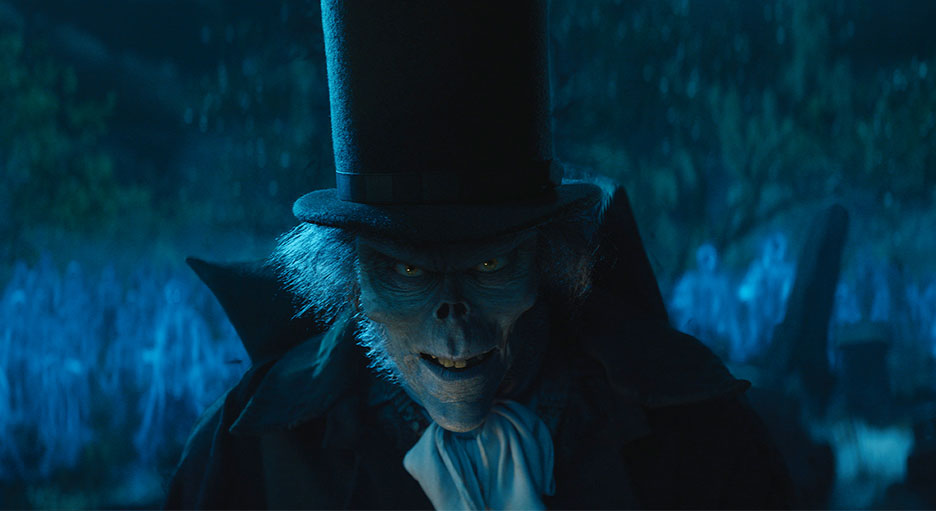
The Hatbox Ghost in Haunted Mansion.
The Hatbox Ghost, performed by Jared Leto. (Credit: Disney)

For nearly 40 years, Industrial Light & Magic has had a close relationship with Disney Parks. They have not only created visual effects for attractions themselves, from Captain EO and Star Tours in the 1980s to Star Wars: Rise of the Resistance and Guardians of the Galaxy: Cosmic Rewind in recent years, but have also worked on feature film adaptations of attractions such as Pirates of the Caribbean: Curse of the Black Pearl (2003) and Jungle Cruise (2021).

2023’s Haunted Mansion is another adaptation of a beloved attraction, which first premiered at Disneyland in 1969 and later at Walt Disney World in 1971. Director Justin Simien brought distinctly apt qualifications to the project, having worked as a Disneyland Resort cast member during his film school days at Chapman University. “Whenever I was in Disneyland, it was like being inside of a movie,” he tells ILM.com. “I would go on the rides over and over again, and I’d get chills in the same spots and catch my breath in the same places. I realized that this was cinema. It’s a theme park that’s physically happening around me, but the tools of the trade are the same.

“There’s production design, sound design, lighting, dialogue, character, and story,” Simien continues. “It sounds like something you’d say in a press interview, but it’s true – I remember going on The Haunted Mansion and Pirates of the Caribbean and thinking, ‘I need to figure out how to translate this to what I want to do as a filmmaker.’ Walt Disney and his artists brought us into these fantasy places. That’s the art. That’s the thing I needed to figure out. So for me, it all felt very complementary. Working at Disneyland was just another way of escaping into the movies.”

Simien’s approach to bringing Haunted Mansion to the screen was as complex as the vision of the attraction’s original creators. “I was really fascinated by the constant conversation that the Imagineers had about how scary it should be or how funny it should be,” Simien comments. “It was such an interesting way to make something unique. It’s not horror in the traditional sense. You’re not walking through a haunted house at Universal Horror Nights or something like that. But it’s not straightforward Disney either. It’s very subversive and there’s a lot of hidden, kind of dark stuff going on.”

Jamie Lee Curtis as Madame Leota approaches the Mansion’s front door with a bluescreen extension behind her.
 Jamie Lee Curtis as Madame Leota approaches the Mansion’s front door with a bluescreen extension behind her. (Credit: Justin Simien/Disney)

Simien and his team were able to visit the Disneyland Haunted Mansion in the off-hours, where current Imagineers helped them to understand its distinct narrative brilliance. “When you’ve made your way up through the Mansion, you’ve turned a corner, and you’re looking down into the dining room,” Simien explains. “All of the swirling dancing ghosts are there and ghost heads are coming out of the organ. It’s a culmination of all the different effects in the ride, the Pepper’s Ghost effect in particular. Even as an adult, when I know how it’s done, it takes my breath away. There are a couple of moments in the movie where we’re working from the same point of view. We pay homage. The ride has this build-up with specific timing and pacing.”

Simien took his cinematic leads from works in the 1980s and ‘90s, such as Ghostbusters (1984) and Little Shop of Horrors (1986) and the films of Tim Burton. He also went back to source material shared by the Disney Imagineers, including Robert Wise’s The Haunting from 1963. “There are so many parallels in the production design of that movie and the attraction,” he notes. “You see very subtle elements in our movie that are like that. There are slanted mirrors and shots where you look through a doorway and it’s a kind of off-angle. You get a claustrophobic ‘things are not right with the world’ feeling without really doing anything, just designing things a certain way.”

From a visual effects standpoint, Simien envisioned a mix of practical and digital techniques. “I wanted as many practical effects as I could get,” he says, “which I knew was always going to be a battle [laughs]. The movie is so fantastical. This wasn’t a typical horror movie where you hide the monster. It’s a Disney movie. There’s an expectation that you’ll get to see the ghosts. I wanted them to have a physicality, to be people in make-up and costumes moving on wires. We needed to ground the movie as much as possible in those things.”

ILM was one of multiple effects vendors on the project, and initially planned to contribute a modest sum of around 400 shots, overseen by Sydney-based visual effects supervisor Bill Georgiou and visual effects producer Arwen Munro. American-born, Georgiou spent nearly 15 years at Rhythm & Hues, climbing the ranks from rotoscope artist to compositing supervisor and sequence supervisor. He later worked as the onset visual effects supervisor on the DisneyXD program, Mighty Med, before joining ILM and moving to Australia in October 2021.

Coincidentally, Georgiou was an apt choice for Haunted Mansion, having known production visual effects supervisor Edwin Rivera for many years at Rhythm & Hues, not to mention Justin Simien himself. They had met through a mutual friend, editor Phillip Bartell, who cut Simien’s Dear White People (2014), as well as Haunted Mansion. “Edwin is very supportive and collaborative,” Georgiou tells ILM.com. “At the beginning, we were doing mostly set extensions, which is pretty straightforward. I think that he and Justin were impressed by the level of photorealism we were able to achieve, especially with the Mansion. Every shot of the Mansion has some CG, including the grounds around it. Another vendor, DNEG, was also doing some interior work, and we’d help create the views out the windows.”

Initially, Georgiou’s Sydney team worked only with ILM’s former Singapore studio, which being closer in time zones, shared the same schedule. “ILM has the best of the best,” Georgiou says. “Everyone was an amazing collaborator and shared their opinions. It was very open.” Principal photography had taken place in Georgia back in the United States, where ILM’s Andrew Roberts acted as onset visual effects supervisor. Georgiou and Munro also made a visit to Los Angeles to meet directly with the client, something Georgiou describes as essential to their continued partnership as the workload grew unexpectedly.

Reshoots would require further effects work involving an elaborate scene at the movie’s climax, where Ben (LaKeith Stanfield) confronts the villainous Hatbox Ghost (Jared Leto). “All of a sudden, we had more than twice as many shots as we started with,” Georgiou explains, “a CG human-like ghost character, and digi-doubles. It became an immense project, with over 1,000 shots. With a very short schedule, I think ILM knocked it out of the park. We had about 700 new shots, and Sydney became the hub for London, Vancouver, and San Francisco, as well as an additional vendor, Whiskytree. It became a global team. For my first real experience starting a project from the beginning at ILM, it was one of the best.

“When I first started on Stuart Little in 1998,” Georgiou continues, “one of the compositors who came in was R. Jay Williams, and he ended up being a senior compositor on Haunted Mansion [out of ILM San Francisco]. He had taught me so many things as a young roto artist, one of which was how to be nice to everybody. He always said hello and goodbye to everybody, one of the nicest, classiest people I’ve met in the industry, and I was able to finally tell him that on this project. It was so cool.”

During principal photography, a large portion of the Mansion was constructed as a physical set. “Mentally, psychologically, it was important to have a real mansion to shoot in,” Simien explains. “We could all get used to that physical space.” Other portions of the house incorporated bluescreen, including the sequence when Ben enters the ghost realm, a sort of alternate dimension within the Mansion where the hallways shift and rotate. This was amongst the work ILM received in the additional batch.

Actors Chase Dillon (left) and LaKeith Stanfield onset behind the first-floor exterior of the Mansion.
Actors Chase Dillon (left) and LaKeith Stanfield onset behind the first-floor exterior of the Mansion. (Credit: Justin Simien/Disney)

“It was quite interesting work,” Georgiou says. “Not only were we matching scans of the hallway reference that had been captured onset, but we were also matching the look to some of the previous work that DNEG had done. We then created animation for the rotations and how they would section off. The way they’d filmed onset with bluescreen was really well done, which made our work easier. The lighting was a challenge because there are candles and sconces on the wall, so you have these pools of light. The D.P. [Jeffrey Waldron] had very specific notes about how it should look. The chandeliers are swinging. Many puzzles to figure out, which is one of the best parts of visual effects. Overall, that sequence was one of the most successful, and it’s so cool that they used it in the poster.”

Of course, the appearance of 999 happy haunts would be the core element of Haunted Mansion’s visual effects. “Edwin Rivera used this term, ‘ectoplasmic effervescence’ for the ghosts, which has a Ghostbusters feel to it,” explains Georgiou. “It was fun to look through the history of cinema to find inspiration, but also figure out how we wanted to do things differently and create something that was fresh. Justin has such an incredible cinematic vocabulary. He’s looking at Kubrick and Hitchcock, and you can see that in how he’s framing shots. I felt like I was gaining plenty of knowledge.”

Another reference for Georgiou was Poltergeist (1982), one of ILM’s first client productions. “Poltergeist was very influential for me, especially when we were creating these skeletal ghosts that fly around. That was all connected to Poltergeist and the style they used for the ghost who comes right to camera. It feels really light-based but then there’s a skeleton face. Also, the way they use flares in Poltergeist was very influential for the last sequence of Haunted Mansion.”

A number of the prominently featured ghosts were performed by actors in costume and make-up. At times, ILM used digital doubles to replace them, each of which had to be modeled and textured. Others were entirely created with computer graphics, including the swarm of skeletal ghosts in the finale, which were original designs by the ILM Art Department. “The ghosts had a sort of x-ray feel to them,” says Georgiou. “It wasn’t a straightforward bone texture. We had to come up with how they glowed, both in day and night environments. They all had various types of clothing. Some had armor, or robes, or hoods. With all that comes a lot of creature work to get the costumes flowing properly. Then there are shots with hundreds and hundreds of them, as many as 600 or 700 at a time, which required crowd work. Our animation crew did hero shots, and they had the best time animating them. When they flank the Hatbox Ghost, they aren’t just standing there, but they’re chomping their teeth or doing little things with their hands. It’s subtle but it’s all there.”

A CG ghost moves through the Mansion’s library.
A CG ghost moves through the Mansion’s library. (Credit: Disney)

The fan-favorite Hatbox Ghost is part of the lore of the Disney Parks attraction, and as the film’s chief villain, many different components went into his creation. “On the set, we had a great stuntperson named Colin Follenweider,” explains Simien. “We spent a lot of time discussing the physicality of the Hatbox Ghost, why he would walk a certain way. So he was in a suit on the set with a blue face. Then with Jared [Leto], we captured his voice. Then all of that goes into a blender at ILM where we have a team of animators fine-tuning every aspect of the performance. It’s a real amalgamation of a few different traditions.”

Georgiou explains that ILM’s fellow vendor, DNEG, had created the initial character model to produce an early batch of shots. “But it was never meant to be seen in bright lighting or anything like that,” he continues. “Every plate had the stunt actor. A human face with flesh and skin is very different from a more skeletal face. We had to figure out things like, how does the neck work? A skeletal neck wouldn’t fit around the wide neck of a human stunt performer. We were able to hide a lot of that behind the scarf he’s wearing. We had to figure out how the hat sat on his head. Onset, it was a little too low, but if it was too high, it looked more like a cowboy hat. There were a lot of challenges.

“Then there’s the clothing,” Georgiou continues. “In that final sequence, the earth is breaking apart, all of these ghosts are rising up. He has 999 ghosts, and he’s trying to get the last one so he can bring the ghost realm into the human realm. There’s a lot of shaking and wind. The stunt actor was on wires, and the clothing didn’t have much movement. In some shots, we kept the body and clothing and did a face and hat replacement. For around half of the shots we used a fully-CG Hatbox Ghost. The look development team worked very hard to match it to the actor onset. It’s pretty seamless.”

The Hatbox Ghost attempts to pull Ben into his ghostly realm.
The Hatbox Ghost attempts to pull Ben into his ghostly realm. (Credit: Disney)

Georgiou explains how the character model was given new animation controls for his expanded performance. “We built that whole rig and made small controls for the wrinkles under the eyes, really small details in the face. It was really exciting. Our animation supervisor, Chris Marshall, helped us develop a lot of the facial performance for the Hatbox Ghost. I can’t wait to do another character like that.

“I kind of grew up doing shows like Garfield, Scooby-Doo, The Lion, the Witch, and the Wardrobe, and The Golden Compass where there are so many different types of visual effects,” Georgiou continues. “Haunted Mansion is very similar. We had ocean surfaces, a tsunami wave in an apartment along with its destruction, both interior and exterior. There were various effects elements, set extensions, digital doubles, crowd work, so many different kinds of shots. The Hatbox Ghost was a dream come true. Doing CG characters and placing them in live action was what I was raised on. It was a great opportunity to work on it. I’m so proud of our entire team. We have some incredible artists and I was the one who was lucky to be able to work with them.”

For Simien, the chance to tell a fantasy story laden with visual effects fulfilled his childhood dreams. “I grew up on effects-heavy films,” he says. “I’d lose myself in Star Wars, Star Trek, and X-Men. There wasn’t language for being a filmmaker when I was a kid. No one in my family talked about being a director. But what I would do is get home with the house to myself (I was a latch-key kid), put on a John Williams soundtrack, and pick up action figures and make them fight in these epic battles. I’d keep one eye closed to control the depth of field [laughs]!

“I didn’t know that I was directing,” Simien concludes. “I didn’t know that was a thing you could get paid for, but that’s what I did for fun. Having that big canvas is just part of my DNA. My first film was made for just over a million dollars, but it looks like it was made for more. To me, scale and cinematic spectacle is part of the fun of it. No matter what kind of story I’m telling, whether it’s something small and emotional or big and crazy like Haunted Mansion, I’m always going to push to see more in the world.”

The Hatbox Ghost takes his final plunge.
The Hatbox Ghost takes his final plunge. (Credit: Disney)

Read about Skywalker Sound’s work on Haunted Mansion, including more from director Justin Simien.

_

Lucas O. Seastrom is a writer and historian at Lucasfilm.

Take a deep dive into the history and lore behind the starship designs created by ILM and introduced 40 years ago in The Search for Spock.
By Jay Stobie

Written and produced by Harve Bennett, Star Trek III: The Search for Spock (1984) afforded actor Leonard Nimoy his first opportunity to direct a Star Trek feature. With Ken Ralston as visual effects supervisor, the film also supplied Industrial Light & Magic with the chance to leave its own indelible legacy on the Star Trek franchise. ILM’s work on Star Trek II: The Wrath of Khan (1982) had included a collaboration with the Lucasfilm Computer Division which yielded the first all-CG sequence in a feature film, yet the company had an even greater impact on the film series’ third installment.

Among its many contributions to Star Trek III, ILM tackled the monumental task of designing and building five major starship and space station models that were introduced in the film. Though crafted specifically for this project, those steadfast exterior designs became staples in the Star Trek universe and appeared in prominent scenes across numerous films and television series. As we celebrate The Search for Spock’s 40th anniversary, let’s examine the long-lasting nature of ILM’s iconic creations and explore the circumstances in which they were employed in later Star Trek productions.

The Merchantman starship flies through space in Star Trek III.
The Merchantman in Star Trek III: The Search for Spock. (Credit: Paramount Pictures)

The Merchantman: A Criminal Craft

A small, boxy vessel with a curved forward section lurked in deep space during the first act of Star Trek III, referred to as a merchantman by the film’s script. The ship carried a Klingon passenger (Cathie Shirriff) who had purchased intelligence related to the terraforming device known as Genesis. A much larger Klingon ship (more on that in a moment) lowered its cloaking device, becoming visible long enough to receive the data. Unfortunately, the Klingon operative had glanced at the information, prompting the vessel to swoop around and obliterate the merchantman with its weaponry.

From the earliest stages of pre-production on Star Trek III, the team at ILM — including Ralston, visual effects art directors Nilo Rodis and David Carson, supervising modelmaker Steve Gawley, and modelmaker Bill George — presented their creations to Nimoy and Bennett, who suggested alterations before final approval. Rodis and Carson generated concepts, while Gawley and George offered input and spearheaded model construction. The meticulous process was adaptable to each model’s role in the script, as the merchantman’s brief appearance meant it was fabricated in a relatively short amount of time. “The merchant ship was a design we threw together in a couple of weeks from a bunch of model parts,” visual effects cameraman Donald Dow told writer Brad Munson in Cinefex. “It was going to be blown up right at the very start, so there was no sense putting a lot of time into it.”

Camera operator Selwyn Eddy photographs the Merchantman miniature using ILM’s “Rama” motion-control camera.
Camera operator Selwyn Eddy photographs the Merchantman miniature using ILM’s “Rama” motion-control camera. (Credit: Industrial Light & Magic)

Yet, for a vessel not expected to see much screen time, the merchantman ultimately proved to be a testament to ILM’s dedication to quality, as the ship fulfilled its purpose in the film and went on to experience a revitalized livelihood in future productions. Boasting slight modifications in each instance, the merchantman reappeared as different vessels on six occasions. From a Sheliak transport carrying colonists in Star Trek: The Next Generation’s (1987) “The Ensigns of Command” to a Cardassian freighter targeted by saboteurs in Star Trek: Deep Space Nine’s (1993) “The Maquis, Part I,” the merchantman turned into a reliable resource for both series, as well as for Star Trek: Voyager (1995). In an intriguing twist, the merchantman — best known for being destroyed by a Klingon Bird-of-Prey in The Search for Spock — was even reconfigured to become a Klingon vessel in Deep Space Nine’s “Rules of Engagement.”

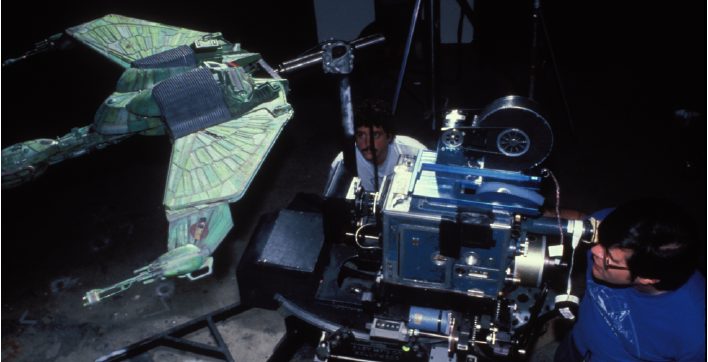
The Klingon Bird-of-Prey in Star Trek III: The Search for Spock.
The Klingon Bird-of-Prey in Star Trek III: The Search for Spock. (Credit: Paramount Pictures)

The Klingon Bird-of-Prey: A Fearsome Fighter

An imposing warship with a head-like bridge section and angled wings, the Klingon Bird-of-Prey easily outmatched the merchantman. Commanded by a Klingon named Kruge (Christopher Lloyd), the Bird-of-Prey was armed with a cloaking device that concealed it from its enemy’s scanners. Kruge sought the power of the Genesis device, traveling to the Genesis Planet and making quick work of the U.S.S. Grissom. Despite its swift victories over lesser foes, the Bird-of-Prey soon found itself squared off against the legendary U.S.S. Enterprise. Of course, unbeknownst to Kruge, James T. Kirk’s famed vessel had been severely damaged in Star Trek II and only maintained a skeleton crew on its bridge.

Modelmaker Bill George at work on the Bird-of-Prey miniature.
Modelmaker Bill George at work on the Bird-of-Prey miniature. (Credit: Industrial Light & Magic)

Perhaps the most distinctive starship ILM assembled for Star Trek III, the Klingon Bird-of-Prey model featured an intimidating green color scheme and motorized wings that could be raised above its primary hull. On top of bringing the vessel’s exterior to life, ILM pioneered the visual effect that permitted the Bird-of-Prey to decloak and become visible. “[Optical photography supervisor] Ken Smith came up with the optical effect,” Ralston shared with Nora Lee in American Cinematographer. “By using a ripple glass he threw the color sync off on each separation, so that everything is just a little out of whack. Then it all gets in sync and forms the ship.” The design impressed creatives to such a degree that, following the U.S.S. Enterprise’s destruction (yet another visual effect executed by ILM) in The Search for Spock, Kruge’s captured Bird-of-Prey — playfully renamed the H.M.S. Bounty by Kirk’s defiant crew — inherited the role of hero ship in the film’s Nimoy-directed sequel, Star Trek IV: The Voyage Home (1986).

Camera operator Selwyn Eddy shoots the Bird-of-Prey miniature while camera operator Ray Gilberti looks on.
Camera operator Selwyn Eddy (right) shoots the Bird-of-Prey miniature while camera operator Ray Gilberti (left) looks on. (Credit: Industrial Light & Magic)

However, the Bird-of-Prey’s prolific career was only just beginning. The ship’s signature profile played key parts as other nefarious Klingon vessels across the next three Star Trek films — Star Trek V: The Final Frontier (1989), Star Trek VI: The Undiscovered Country (1991), and Star Trek Generations (1994) — and popped up in numerous The Next Generation, Deep Space Nine, and Voyager episodes. As with many starships that began as physical models, the Bird-of-Prey was ultimately supplemented with a CG build in the latter stages of Deep Space Nine’s seven-season run. The craft even ended up in animated configurations for Star Trek: Lower Decks (2020) and Star Trek: Prodigy (2021). Nevertheless, all the Bird-of-Prey models that followed were based on the look established by ILM’s initial build. Furthermore, the 22nd century iterations of the Bird-of-Prey and Klingon D5-class variants which debuted in Star Trek: Enterprise (2001), a prequel series set over 100 years before The Search for Spock, were tailored to reflect their lineage as in-universe predecessors to ILM’s original Bird-of-Prey from Star Trek III.

Earth Spacedock in Star Trek III: The Search for Spock.
Earth Spacedock in Star Trek III: The Search for Spock. (Credit: Paramount Pictures)

Earth Spacedock: A Safe Haven in Space

As the U.S.S. Enterprise glided through the solar system on its way to a much-deserved respite from action, it was greeted by the sight of Earth Spacedock. With a mushroom-shaped upper section atop a stem extending downward, the gargantuan space station permitted entire starships to enter its massive superstructure and dock at a central core complete with repair facilities. Abuzz with ships and various shuttles, the lively starbase watched over Earth and kept the Federation’s fleet ready to serve missions of exploration and defense.

ILM’s Spacedock assignment necessitated three separate builds; namely the station’s illuminated exterior, its cavernous interior docking bay, and an interior view through the windows of a small, lounge-type set. Approximately five feet tall and three-and-a-half feet in diameter, the exterior model relied on a complex lighting system, which Ralston described in American Cinematographer. “[The Spacedock exterior] had lights inside after the door opens up and running lights that go inside. Sometimes it is hard to sync up all those functions with the motion control system. But I think it worked nicely.”

The issue of conveying the sheer size of a docking area able to house a multitude of starships received ILM’s innovative attention and expertise. “We found that the interior demanded some degree of atmospheric haze, even though there probably wouldn’t be any in outer space. It just needed help to look slightly degraded — not so crisp and clean,” visual effects cameraman Scott Farrar shared in Cinefex. “We ended up using blue gels on the lights and shooting in smoke for the basic fill look. Then, when we went to the light passes, we used a diffusion filter.”

ILM modelmakers work on the lighting components of the Earth Spacedock miniature.
ILM modelmakers work on the lighting components of the Earth Spacedock miniature. (Credit: Industrial Light & Magic)

As timeless as Earth Spacedock’s inaugural performance turned out to be, the station’s unveiling soon led to its return to the big-screen. In addition to being featured in the three Star Trek films which followed immediately after The Search for Spock, Earth Spacedock appeared as several other Federation starbases — Starbase 74, Lya Station Alpha, Starbase 133, and Starbase 84 — in The Next Generation via the use of stock footage. A version of Earth Spacedock seemed to be in the midst of orbital construction in the Star Trek: Discovery (2017) episode “Will You Take My Hand?,” while the design was translated into animated form to represent Douglas Station in Lower Decks. According to in-universe lore, Earth Spacedock was retired from service and transported to Athan Prime, where it was last seen as the central hub of the Fleet Museum in Star Trek: Picard’s (2020) third season.

The U.S.S. Excelsior in Star Trek III: The Search for Spock.
The U.S.S. Excelsior in Star Trek III: The Search for Spock. (Credit: Paramount Pictures)

U.S.S. Excelsior: The Transwarp Testbed

Dubbed “The Great Experiment,” the U.S.S. Excelsior acted as a testbed for an advanced faster-than-light propulsion system known as the transwarp drive. The Excelsior was spotted while berthed in Earth Spacedock, though the starship soon found itself attempting to engage its experimental engines as it pursued Admiral Kirk’s unauthorized departure aboard the Enterprise. Unfortunately for the Excelsior, Montgomery Scott (James Doohan) — the Enterprise’s chief engineer — had sabotaged the transwarp system, causing the vessel’s trial run to stall out in an abrupt and unflattering fashion.

As outlined in Star Trek: The Official Starships Collection, early U.S.S. Excelsior concepts devised by Nilo Rodis and David Carson led to Bill George’s own distinctive study model and a 7 ½-foot studio model constructed with the oversight of Steve Gawley. Our first encounter with the starship coincided with the Enterprise’s arrival at Earth Spacedock, resulting in an arduous challenge for ILM — Excelsior needed to appear stationary within the confines of the station’s interior. “[The Excelsior] was shot separately from everything else. [Visual effects cameraman] Sel Eddy shot that stuff,” Ralston told American Cinematographer. “We had to match the moves so that it looked like it was locked right into the space dock. It was a pain. We had to cheat on some of the shots where there was so much trouble with the moves.” Their diligence paid off, as the majestic sequence endures as one of The Search for Spock’s most awe-inducing visuals.

The Excelsior returned in The Voyage Home and The Final Frontier, but it received its biggest chance to shine in The Undiscovered Country, which also featured visual effects by ILM. Now captained by Hikaru Sulu (George Takei), the U.S.S. Excelsior rescued the U.S.S. Enterprise-A during a crucial battle against a rogue Klingon Bird-of-Prey. The model was heavily modified for fresh cinematic escapades in Star Trek Generations, then bearing the legendary registry of the U.S.S. Enterprise-B. The Enterprise-B variant was also utilized as the U.S.S. Lakota, an upgraded Excelsior-class vessel, in Deep Space Nine’s “Paradise Lost.”

ILM’s Excelsior design prevailed via cameos in The Next Generation, as exterior shots of the vessel — now deployed to represent an entire line of Excelsior-class starships — debuted in the show’s first and second season premieres, “Encounter at Farpoint” and “The Child.” These views were subsequently reused as stock footage to depict various Excelsior-class ships in no less than ten additional episodes of the series. As with the Klingon Bird-of-Prey, ILM’s original Excelsior model served as the basis from which all future Excelsior-class physical and CGI builds stemmed. Deep Space Nine aficionados will point to the abundance of Excelsior-class vessels dispersed throughout Dominion War-era battles in “Sacrifice of Angels,” “Tears of the Prophets,” and the series’ finale, “What You Leave Behind,” as evidence that the starships were an integral part of Starfleet’s defense armada. In fact, at least three Excelsior-class vessels stayed in active service long enough to have been prepared to confront the vaunted Borg Collective in Voyager’s own season finale, “Endgame.”

The U.S.S. Grissom in Star Trek III: The Search for Spock.
The U.S.S. Grissom in Star Trek III: The Search for Spock. (Credit: Paramount Pictures)

U.S.S. Grissom: A Scientific Scout

On a research mission to study the Genesis Planet, the U.S.S. Grissom was classified as a relatively small science vessel. After detecting an anomalous lifeform on the planet’s surface and beaming down a landing party consisting of Lieutenant Saavik (Robin Curtis) and Doctor David Marcus (Merritt Butrick), the Grissom remained tragically unaware as Kruge’s Klingon Bird-of-Prey approached under cloak and jammed all outgoing transmissions. The Bird-of-Prey dropped its invisibility field and coalesced into view, pouncing on the Grissom and destroying the Starfleet ship with a single blast.

The Roddenberry Archive notes the U.S.S. Grissom was yet another Star Trek III design conceived of by Nilo Rodis and David Carson and built by Steve Gawley and Bill George. The Grissom stood as a departure from the traditional Starfleet aesthetic in which a ship’s primary saucer was affixed to its secondary hull by a neck-like connection. A gap separated the two elements on the Grissom, with the only structures linking them being thin pylons extending from the vessel’s warp nacelles. The ship’s tragic fate didn’t merely come down to creating the biggest explosion, as plot considerations factored into ILM’s take on the Grissom’s destruction. “I didn’t think we should do something flamboyant at that point,” Ralston pointed out in Cinefex. “If we played all our best cards at the start, we’d have nothing left to show when it came time to blow up the Enterprise.”

The Grissom’s grizzly demise did not spell the end for the distinctive vessel, as the model functioned as the template for what would become known as the Oberth-class starship line. The design reemerged as a different ship of the same class berthed within Earth Spacedock in Star Trek IV before earning a recurring spot as a variety of Oberth-class ships that encountered the U.S.S. Enterprise-D in seven episodes of The Next Generation. The design garnered a great deal of attention in “The Pegasus,” an episode in which it was presented as the U.S.S. Pegasus, a testbed for an illegal Federation cloaking device. One Oberth-class ship assisted in the rescue of the Enterprise-D’s surviving crew at Veridian III in Star Trek Generations, while others could be found in the background at the Battle of Wolf 359 in Deep Space Nine’s “Emissary” and the ILM-orchestrated Battle of Sector 001 in Star Trek: First Contact. Like Earth Spacedock and the Klingon Bird-of-Prey, the Oberth-class design found itself turned into animated form for Lower Decks, this time in the episode “First First Contact.”

Director Leonard Nimoy confers with visual effects supervisor Ken Ralston (and visual effects art director David Carson during a visit to ILM’s Kerner facility.
Director Leonard Nimoy (center) confers with visual effects supervisor Ken Ralston (left) and visual effects art director David Carson (right) during a visit to ILM’s Kerner facility. (Credit: Industrial Light & Magic)

The Search for Spock’s Legacy

Crafting memorable starships and space stations for any production is a tremendous responsibility, yet Industrial Light & Magic’s contributions to Star Trek III: The Search for Spock accomplished this lofty goal and so much more. Having not one, but five major designs go on to resurface in significant roles is an achievement beyond all expectations. A recent scene in Star Trek: Picard’s third season exemplified ILM’s incredible feat, as Kruge’s Klingon Bird-of-Prey and the U.S.S. Excelsior were both positioned around Earth Spacedock as part of the Fleet Museum’s honorary assemblage of classic starships. The everlasting nature of the designs speaks to the eternal appeal of ILM’s work. Whether the new studio models that ILM designed and built for Star Trek III were reused as they were originally constructed, recreated by other visual effects companies at a later date, or called upon by future artists to inspire their own takes on starships, the original models’ extensive influence on the Star Trek universe cannot be overstated.

_

Jay Stobie (he/him) is a writer, author, and consultant who has contributed articles to ILM.com, Skysound.com, Star Wars Insider, StarWars.com, Star Trek Explorer, Star Trek Magazine, and StarTrek.com. Jay loves sci-fi, fantasy, and film, and you can learn more about him by visiting JayStobie.com or finding him on Twitter, Instagram, and other social media platforms at @StobiesGalaxy.

ILM’s Vancouver & London studios realized everything from ingenious facial replacements to a challenging plate composite for one cohesive action shot.

By Adam Berry

After the events of Marvel’s Hawkeye left Maya Lopez in an intense standoff with the powerful Kingpin, she finds herself now on the run from her criminal life, returning to her roots where she must confront her past and discover her true power; becoming the hero known as Echo (Alaqua Cox). 

As with any Marvel production, big action set pieces and storytelling are promised elements that bring the massive scope of these heroes’ lives from page to screen. As Echo is a formidable hand-to-hand combatant, with unique abilities not yet seen in the Marvel Cinematic Universe (MCU), the action needed to deliver.

Industrial Light & Magic was called upon to create some of the biggest action sequences in the show, with work being shared between the London and Vancouver studios. All together, ILM contributed an amazing 467 shots, from start to finish, with a fast turnaround of only six months.

ILM was awarded some really fun sequences to work on. From a thrilling train heist with a full CG environment, digidoubles and CG train; to a roller rink brawl requiring many face replacements and fight enhancements; a huge warehouse explosion and a photoreal CG woodpecker.”

Steven Godfrey, Visual Effects Supervisor
Daredevil joins the fight in an epic faceoff against Maya during “The Oner”.
Daredevil joins the fight in an epic faceoff against Maya during “The Oner”. 

Echo is the first MCU project to be released under the TV-MA rating for mature audiences, so the visual effects team had a lot of freedom to play around with the blood and gore for the fight sequences. At the client’s request, the stylistic violence and gore from the John Wick films were used as a reference for the show.

One pivotal action sequence that ILM was tasked with creating, known as “The Oner,” was particularly complex for the team. The work on this sequence was to stitch together multiple plates and takes as the action progresses. The scene follows Maya as she makes her way along a series of hallways, fighting off a group of security guards; knocking them to the ground one by one, showcasing her martial arts capabilities. As the security guards lay unconscious, Maya is led into a larger room by a mysterious new adversary, resulting in the main fight. The action intensifies and reveals her new opponent as none other than the man without fear, another Marvel favorite, Daredevil (Charlie Cox). The two then face off in an epic duel that moves between a large open space and a tighter caged area full of weapons.

To make the scene as visceral as possible, there was a combination of making multiple plates blend seamlessly between takes. With multiple face replacement shots for the actors, blood spurts and destruction added to the environment, “The Oner” is among the most exciting sequences from the whole show. 

It was challenging work for the team to get the plates to stitch together seamlessly; to hide transition points while ensuring that the action is still flowing throughout. By using a combination of wipes, warps, retimes and some manual tracking of multiple takes, ILM was able to stitch together all of these elements to form one cohesive shot.

Maya sends a deadly message to Kingpin’s army that ends with an explosive warehouse scene during Episode 2.
Maya sends a deadly message to Kingpin’s army that ends with an explosive warehouse scene during Episode 2. 

The biggest challenge for the team on this sequence, and others throughout the show, was face replacement work. The shots required would be fairly close to the camera and require a lot of facial performance during the intense fighting sequences. ILM became involved with the project after principal photography on Echo had wrapped, so there was limited data capture available to work with. Face replacements were especially needed for the fight sequences involving Alaqua Cox. As she is relatively new to the industry, there wasn’t a lot of data available to reference, or a Facial Action Coding System (FACS) session to capture her facial expressions, so only the footage taken during filming could be utilized. 

In total, there were about 35 shots of face replacement work throughout the show. There were different approaches taken to emulate Cox’s likeness, such as trying a 2D replacement, building a 3D digidouble and using ILM’s FaceSwap.

There wasn’t enough coverage from takes to use a 2D replacement; not enough time to build a digidouble to the standard that the showrunners wanted, and not enough footage of Cox to use for an accurate Face Swap. With limited data, there was some experimentation required to figure out how to best achieve the most accurate facial performance possible.

This was vital because Cox is very expressive during the action sequences, so the facial expressions needed to have the same energy otherwise it might feel lifeless jumping between cuts.

The plan came down to using a 3D digidouble while training a Face Swap in the background, just in case it could provide anything of use. The Face Swap took three weeks to build, and was based on only 20 minutes of footage of Cox.

After some experimentation, the solution was for ILM to utilize a combination of Face Swap with a traditional digi-base setup to accurately replicate Cox’s likeness.

The results were great and provided a better likeness of the actress, adding a photographic level of realism that was difficult to achieve using only the digidouble.

“I feel like the work done here to overcome this challenge has strengthened, or expanded how we can implement something like this again.” – Tristan Myles, Visual Effects Supervisor

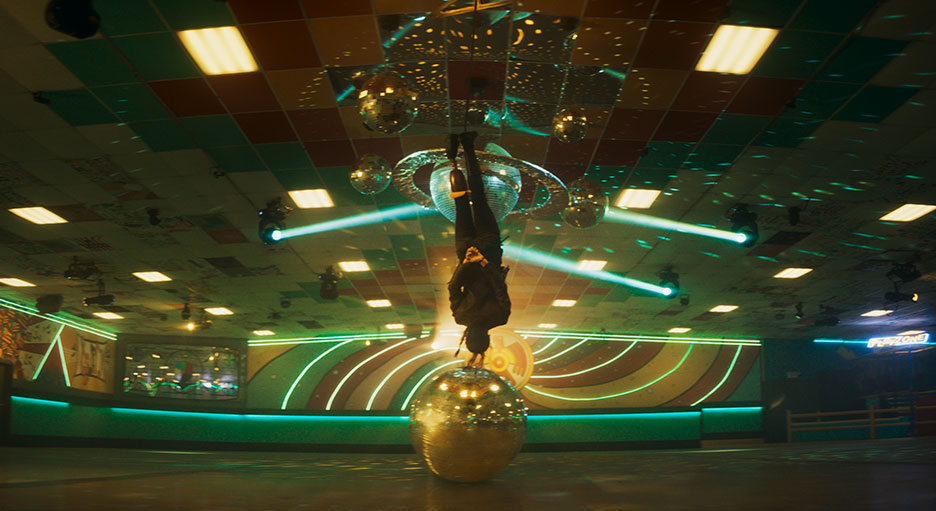
In Episode 3 Maya faces off against some of Kingpin’s assassins in a chaotic roller rink melee.
In Episode 3 Maya faces off against some of Kingpin’s assassins in a chaotic roller rink melee. 

ILM’s contributions brought the explosive action sequences to life, while also making them feel grounded and realistic. The action continued onto a roller rink brawl, involving work to remove cables for stunt rigging, crash mattes and tricky crew removal from reflective surfaces, such as a giant disco ball; to an epic fight on a moving train, which needed extensive environment and animation work; then finally, a warehouse explosion calling for the team to replace the skyline, create explosions and augment explosion element plates. 

The fight sequences and action only got bigger throughout the show, delivering some of the most thrilling sequences from any MCU project yet. The vision of bringing the pulse-pounding action of this iconic character to life was fully realized by the talented crew with artistry that only visual effects can create.

Maya sabotages a train car by planting a bomb during a heist that sends her flying to escape before it’s too late.

Adam Berry is the Studio Operations Manager for the ILM Vancouver studio. His passion for film led Adam to ILM in 2022, coming from an extensive career across different sectors of the hospitality industry including cruise ships, luxury hotels and resorts. If he’s not at the movies or traveling to new destinations, you can find Adam staying active and exploring Vancouver. 

We are pleased to announce Lighter Darker: The ILM Podcast, where we focus on the creative process of filmmaking and the art of visual storytelling. Hosted by ILM Chief Creative Officer Rob Bredow and ILM Compositing Supervisor Todd Vaziri, and produced by Jenny Ely, we share behind-the-scenes stories that illustrate the many crafts that come together to create a motion picture, TV series, or special venue project.

Subscribe Now: Spotify | Apple Podcasts | YouTube | Amazon Music | iHeart Radio | SiriusXM | Pandora | RSS

Whether you’re a seasoned professional, an aspiring filmmaker, or a fan of immersive experiences, Lighter Darker provides valuable insights, inspiration, and a deeper appreciation for the artists behind the projects we undertake at ILM in visual effects, animation, and immersive entertainment. We have a terrific lineup of special guest filmmakers who join the team for upcoming episodes to discuss the creative process of filmmaking and the art of visual storytelling.

The premiere episode drops on Tuesday, September 3, 2024, and will be available wherever finer podcasts are offered.

Subscribe Now: Spotify | Apple Podcasts | YouTube | Amazon Music | iHeart Radio | SiriusXM | Pandora | RSS

After 25 years at ILM, Cooper has earned a reputation for seeking out the most efficient solutions to creative problems.

By Lucas O. Seastrom

Back in 2002, Industrial Light & Magic’s Jay Cooper was a compositing sequence supervisor on Master and Commander: The Far Side of the World (2003). For a time, director Peter Weir joined the ILM crew at their offices on Kerner Boulevard in San Rafael, California. “We had a shot when the mast of one of the ships falls over,” Cooper tells ILM.com. “There’s all this gunfire. It’s completely enshrouded in smoke. As I’m working on it, Weir comes to my desk and he says, ‘I want it to look like a beautiful nightmare.’ I was like, ‘Wow, that’s cool. Now what does that look like?’ [laughs]”

Over the past two decades, Cooper has moved into the visual effects supervisor role, working on projects as varied as Eternals (2021) and Babylon (2022). Most recently, he partnered with writer/director Gareth Edwards on The Creator (2023), a science-fiction tale with an unconventional visual effects methodology. As he and the ILM crew navigated the challenges of integrating effects into location photography with minimal reference data, Cooper managed to connect with Edwards in a way that reminded him of his experience with Peter Weir.

“Normally, as a visual effects supervisor, you’re being much more granular in your notes, lots of technical conversations,” Cooper says. “You don’t usually engage with artists in an emotional way. That’s what is really wonderful when you’re exposed to working with directors. That’s my favorite part of being a supervisor: you’re not always in the weeds talking about those details, you’re trying to engage with it at a story level. That’s the part that artists love. Gareth partnered with us in that way, and people got really excited about the project. Fun things happen when people get excited. They sneak in extra takes. They devote themselves in a huge way. We asked people to do really hard stuff without all of the support materials. If they know what we’re trying to achieve and we’re all pulling together, it can help make up for those shortcomings.”

At the beginning of the project, ILM’s chief creative officer Rob Bredow asked Cooper to meet with Edwards and producer Kiri Hart. “Gareth said, ‘Hey, I’ve got this movie and I hear you’re the guy who likes to cheat,’” Cooper says with a laugh. “He said that probably in the most affectionate way. I’m not really a devotee of any sort of process. I worship at the altar of whatever we can do as quickly and as simply as we can do it. As an artist, that was my forte. I did lighting and compositing, and I would try to navigate as many shortcuts as I could. I guess my reputation as a visual effects supervisor was that I’d work on shows with really small budgets and we’d try to wring out whatever production value we could. I think that’s why Rob put us together.”

Director Gareth Edwards operating the camera on location in Asia during production on The Creator.

Edwards’ vision and Cooper’s style were in tandem. In terms of workload, The Creator would be Cooper’s biggest project to date as a visual effects supervisor. “One of the best pieces of advice that [ILM executive creative director] John Knoll ever gave me,” Cooper notes, “was that you take big problems, break them into smaller problems, and smaller and smaller. So we created teams to hit different problems. We knew that we were going to be behind the 8-ball. We knew that Gareth had a smaller-than-desired budget, and he came to us wanting to partner in a different way.”

Edwards had been a visual effects artist himself before taking the director’s chair full-time. In his 2010 feature directorial debut, Monsters, he famously created many of the visual effects on his own. For Cooper, this practical experience helped define ILM’s approach to crafting visual effects with a “scrappy” sensibility. Shooting primarily on location in Thailand, Edwards focused on capturing his actors and the dramatic landscapes where they played out their scenes. Traditional effects tools like bluescreens and tracking markers would be almost completely avoided, and ILM would need to integrate their CG elements without the normal reference tools.

Looking into the ILM StageCraft volume during production on The Creator.

“Most of the time doing visual effects work, it’s very much a spreadsheet problem. You have seven robots at this amount of money, or fifteen environments at this scale at this amount of money. Even at the bidding stage for The Creator, we were instead asking what we could do for a certain amount of money. Just as a scrappy filmmaker, Gareth wanted to know what was possible in visual effects if we used different techniques and structured the show differently. 

“If we take a whole sequence,” Cooper continues, “Gareth would explain how there’s only so much information you can take in during one shot, so let’s put everything together, bring it all up, and water the one element that’s dying. If you didn’t feel like there were enough robots here, how much do you need to add? Where’s your eye going to go? If a frame feels empty, what can we add? Is there a way to add something that avoids a roto-nightmare? Can we structure it so we don’t see the element in one shot but we do see it in the next two shots so that you sort of complete what the image is? Loosely, that’s how we went off and did the work.”

Much of that questioning and analysis was open to the larger visual effects crew. Initially, Edwards had planned to embed himself within ILM’s studio to personally oversee the work. Although pandemic concerns ultimately scratched that idea, he still welcomed artists from deeper in the ranks to present their work directly and share ideas. 

Gareth Edwards discusses a scene with John David Washinton in the ILM StageCraft volume.

“It takes a rare person to be comfortable enough to share your feedback openly with artists on the production,” Cooper notes. “It’s really wonderful. You get a level of engagement that you may not always find. Sometimes working on blockbusters, you can feel like you’re just punching numbers. But if you expose the artists to the reasoning behind something, the filmmaking intent, you get a huge level of engagement.”

As visual effects supervisor for the entire production, Cooper was busy overseeing work not only at ILM’s studios in San Francisco, London, Sydney, and Vancouver but also the assortment of smaller vendor studios enlisted to assist on the project. The initial shot count estimate had more than doubled by the time Edwards shared his initial cut. As he points out, ILM contributed “about 95% of the asset work and the lion’s share of the shot work” with the support of the vendors. 

“As a supervisor, I’m sort of tapping the boat,” Cooper says. “You can’t be in every single file to model the rivets. You can’t go into every composite to add the elements. You’re asking for degrees of one thing or another, and there are a lot of places where people are volunteering an idea. They’re doing it in a way that they understand what the stylistic or aesthetic goal is.”

Overall, Cooper’s experience on The Creator felt like a return to an earlier era in visual effects, one that speaks directly to ILM’s can-do spirit. “ILM tries to find projects that are outside of the comfort zone of what has happened previously. It must have been wonderful in the late ‘80s or early ‘90s when the question wasn’t ‘can you do this?’ It was, ‘is this even possible?’ Those times have ended in many different ways. You do it enough times, and there’s a cost structure around it. So it’s interesting to be on a project where you chuck a lot of that away and get back to the basest level. We have a pot of money and a director with some big ideas. That’s the launching point. It’s cool and exciting to be in that world again.”


Read more about ILM’s work on The Creator with more from Cooper and his team.

Lucas O. Seastrom is a writer and historian at Lucasfilm.

The nominations for the 2023 Emmy Awards have been revealed, and three ILM projects were recognized with nominations. Lucasfilm’s The Mandalorian, Andor, and Amazon Studios’ The Lord of the Rings: The Rings of Power were each nominated in the Special Visual Effects category. This marks the third time that The Mandalorian has been nominated in the category having won the award each of its first two seasons.

The Mandalorian visual effects supervisor Grady Cofer shared, “It is such an honor to be recognized. The nomination is a testament to Jon Favreau’s commitment to excellence, and to the passion and dedication of the entire VFX team. Thanks to all the Television Academy members who have supported The Mandalorian through the years.” Nominated alongside Cofer were visual effects producer Abbigail Keller; animation supervisor Paul Kavanagh; Assoc. Visual Effects Supervisor, Cameron Neilson, special effects supervisor, Scott Fisher; Animation Supervisor Hal Hickel; Legacy Effects Supervisor, J. Alan Scott; ILM visual effects supervisor Victor Schutz IV; and ILP visual effects supervisor, Bobo Skipper

Andor visual effects producer TJ Falls said, “I’m very excited that Andor was recognized with a nomination for Outstanding Special Visual Effects. It’s a testament to the collaboration of the team and the incredibly remarkable talents of each of our nominated members, as well as those around the world who contributed to the project.” Falls was joined by fellow nominees visual effects supervisor, Mohen Leo; ILM visual effects supervisor, Scott Pritchard; Richard Van Den Bergh, special effects supervisor; Neal Scanlan, creature effects & Droid supervisor; Liana Mansor, lead visual effects editor; Joseph Kasparian, Hybride visual effects supervisor; Jelmer Boskma, Scanline visual effects supervisor; and Colorist, Jean-Clément Soret.

The Lord of the Rings: The Rings of Power nominees include Ron Ames, visual effects producer; Jason Smith, visual effects supervisor; Nigel Sumner, ILM visual effects supervisor; Ara Khanikian, Rodeo FX visual effects supervisor; Dean Clarke, SFX supervisor; Ken McGaugh, Weta FX visual effects supervisor; Tom Proctor, DNEG visual effects supervisor; Greg Butler, Method Studios visual effects supervisor, Joe Henderson, visualization creative supervisor, The Third Floor, Inc.

The 75th Emmy Awards is currently scheduled to broadcast live on FOX on Monday, September 18, (8:00-11:00 PM EDT/5:00-8:00 PM PDT) from the Peacock Theater at L.A. LIVE.

The filmmaker and Lucasfilm legend talks to ILM.com to reflect on what drew him to tell the story of the hit Disney+ series, “Light & Magic”.

Screenwriter and director Lawrence Kasdan.

How did you get involved with Light & Magic?
Several years ago my wife and I made a short documentary about a little diner that we used to eat at all the time that suddenly closed. In making that documentary with her, and cutting it with terrific people, it made me realize how much I liked the documentary format. I had never done that. We set out to meet some documentary people and I met Justin Wilkes at Imagine Entertainment. He asked me what I was interested in doing and I suggested a history of visual effects, because even though I had been around visual effects throughout my career, it occurred to me that I didn’t know much about them. The second thing that interested me were the people of Industrial Light & Magic that I had been working around for over forty years. So we both agreed that that would be a great story to tell: the history of visual effects, and the personal stories of these people. What drove these people, what was their life like, what made them want to stay at ILM as long as they did? Everyone loved the idea, so we went to work.

Lawrence Kasdan, center, on the set of Star Wars: The Empire Strikes Back.

What was your vision for the documentary?
From my very first film until today, I’ve always considered myself a humanist filmmaker. I’m interested in what happens between people, and why people make certain decisions in their lives. What chance is involved? What fate? What luck? So from the very beginning of this I was interested in learning what brought these people to this work. What were the relationships that they made when they arrived? Why did they continue to work there much longer than they expected, some for nearly half a century? What has all that meant to these amazing advancements in technology? It’s about people, and their gifts, and out of those gifts came technological advancements that boggle the mind.

Dennis Muren, left, and Phil Tippett, right, review images with Joe Johnston.

Why did you think this story should be told?
Because it’s great to see artists at work. The commitment of great craftsmen. I love to see people that have mastered a skill, and try to make it better, and don’t settle. I think it’s great to see expertise and this pure devotion to discipline, and that is always a good story to see. Dennis Muren, left, and Phil Tippett, right, review images with Joe Johnston.

John Dykstra and a fleet of miniature TIE, X-wing, and Y-wing starfighters.

How did you approach the research, and what resources did you use?
We had a fabulous team that Imagine Documentaries put together, some internal to the company, and some that were freelancers. They really knew their stuff, so it was a great luxury for me as a director. There were so many things that I wanted to ask during interviews, but the input from this incredible group of producers and writers and editors stimulated me all of the time to go in different directions during interviews.

ILM’s Paul Huston and Larry Tan on the set of Star Wars: Return of the Jedi.

For those that have yet to watch it, can you tell readers what the timeline of the series is?
Over the six hours we see the very birth of ILM, what happened as it came together during the production of Star Wars: A New Hope, and then off of the success of that film, how it was launched into a nearly fifty-year enterprise. We mainly follow it chronologically, but we do jump around a bit to serve the story. Part of the kick for me was that we had such a trove of archival footage, so these people might be talking about something from forty or fifty years ago, and we had stills from that moment in their career. It was incredible to be able to cut from one to the other across time, to hear them talking about a problem, and then see footage of them finding a solution. A huge part of ILM’s legacy is finding solutions to problems.

Peter Kuran, Rose Duignan, and George Lucas review effects shots for Star Wars: A New Hope.

How did you select the filmmakers that were featured in the documentary?
They are all giants, and they have all used ILM in the most expressive and innovative ways. They put pressure on themselves and then turned to ILM and said, “can you do this? Can you create something for me that I have never seen before?” ILM would always say yes. And sometimes it might be a struggle, and sometimes it might be a long process, and sometimes it might be an instantaneous solution where one of these genius people that work there would say, “I know what we could do”. These are major filmmakers that have contributed to the zeitgeist. Jim Cameron, Steven Spielberg, Bob Zemeckis, J.J. Abrams, and at the heart of it, of course, is George Lucas.

Lawrence Kasdan and J.J. Abrams on the set of Star Wars: The Force Awakens.

What was the most interesting thing you learned throughout the process of creating Light & Magic?
I think I learned what goes into creating something new, working with people you respect and depend on, and how this personal relationship then impacts the professional work. There is something beautiful about the generosity of the people that work at ILM, and through that generosity they are able to discover new frontiers and break new grounds that no one has ever been able to do.

All episodes of Light & Magic are streaming now on Disney+.

ILM | A legacy of innovative and iconic storytelling.

New Mumbai studio to provide full visual effects and animation services for film & television

Cassian Andor (Diego Luna) in Lucasfilm’s ANDOR, exclusively on Disney+. ©2022 Lucasfilm Ltd. & TM. All Rights Reserved.

Industrial Light & Magic (ILM), the award-winning visual effects division of Lucasfilm Ltd., announced today that the company is expanding its global operations. The studio, which is headquartered in San Francisco and has existing studios in Vancouver, London, Singapore and Sydney, will open a new full pipeline studio in Mumbai to gain access to the incredible talent base in the region. The Mumbai studio will be led by Kiran ‘KP’ Prasad, who was formerly head of studio at DNEG Bangalore & Chennai. Prasad will report to ILM SVP and General Manager, Janet Lewin.

Kiran Prasad, Executive in charge, Mumbai studio.

“With five global studios consistently operating at capacity and continuing to grow, the time was right for ILM to expand once again to meet the industry’s increasing demand for high-caliber visual effects,” explained Lewin. “This new full-fledged visual effects studio in India will allow us to offer even greater capacity while ensuring that we always meet the high-quality bar that our clients expect of us.” 

Rob Bredow, SVP and chief creative officer of ILM noted, “We’re excited to be building our ILM Studio in India where we can recruit the top artistic and technical talent from the visual effects industry now in India. This is the perfect time for ILM to form our sixth studio where artists will leverage our full pipeline of disciplines working across a wide variety of exciting shows – at the top quality and reliability our creative partners have come to expect from ILM.”

“ILM has always been at the forefront of technological and creative innovation in the visual effects industry and there is no better time to start our studio in India than now, as the Indian VFX industry is poised for spectacular growth in the coming years,” said Prasad. “It is exciting and an honor to be part of the ILM team at such a key moment in the VFX industry with technological developments pushing the boundaries of visual storytelling. I look forward to working with the executive team to set up the studio from the ground up, building a world-class facility, and bringing the best of the diverse Indian talent together for  an opportunity with endless possibilities.”

ILM’s last expansion effort came in 2019 with the company’s Sydney studio. That studio is currently 400 people strong and growing. Combined, the ILM global studios will grow to over 2,500 artists and will continue to offer award-winning visual effects and animation as well as concept design and development, and virtual production, with the artistry, innovation, and creative problem-solving that is the hallmark of the company. As with the other studios, ILM’s Mumbai studio will work on all projects of all shapes and sizes, including live-action and animated feature films, television, streaming, and themed attractions.

ILM will be hiring leadership, technology, support, production, and artist roles over the coming months, openings will be posted on https://www.ilm.com/careers.