Star Trek

50 Years | 500+ Film and TV credits | 135+ Awards

SINCE 1975

Guided by visual effects supervisor John Knoll, ILM embraced continually evolving methodologies to craft breathtaking visual effects for the iconic space battles in First Contact and Rogue One.

By Jay Stobie

Visual effects supervisor John Knoll (right) confers with modelmakers Kim Smith and John Goodson with the miniature of the U.S.S. Enterprise-E during production of Star Trek: First Contact (Credit: ILM).

Bolstered by visual effects from Industrial Light & Magic, Star Trek: First Contact (1996) and Rogue One: A Star Wars Story (2016) propelled their respective franchises to new heights. While Star Trek Generations (1994) welcomed Captain Jean-Luc Picard’s (Patrick Stewart) crew to the big screen, First Contact stood as the first Star Trek feature that did not focus on its original captain, the legendary James T. Kirk (William Shatner). Similarly, though Rogue One immediately preceded the events of Star Wars: A New Hope (1977), it was set apart from the episodic Star Wars films and launched an era of storytelling outside of the main Skywalker saga that has gone on to include Solo: A Star Wars Story (2018), The Mandalorian (2019-23), Andor (2022-25), Ahsoka (2023), The Acolyte (2024), and more.

The two films also shared a key ILM contributor, John Knoll, who served as visual effects supervisor on both projects, as well as an executive producer on Rogue One. Currently, ILM’s executive creative director and senior visual effects supervisor, Knoll – who also conceived the initial framework for Rogue One’s story – guided ILM as it brought its talents to bear on these sci-fi and fantasy epics. The work involved crafting two spectacular starship-packed space clashes – First Contact’s Battle of Sector 001 and Rogue One’s Battle of Scarif. Although these iconic installments were released roughly two decades apart, they represent a captivating case study of how ILM’s approach to visual effects has evolved over time. With this in mind, let’s examine the films’ unforgettable space battles through the lens of fascinating in-universe parallels and the ILM-produced fleets that face off near Earth and Scarif.
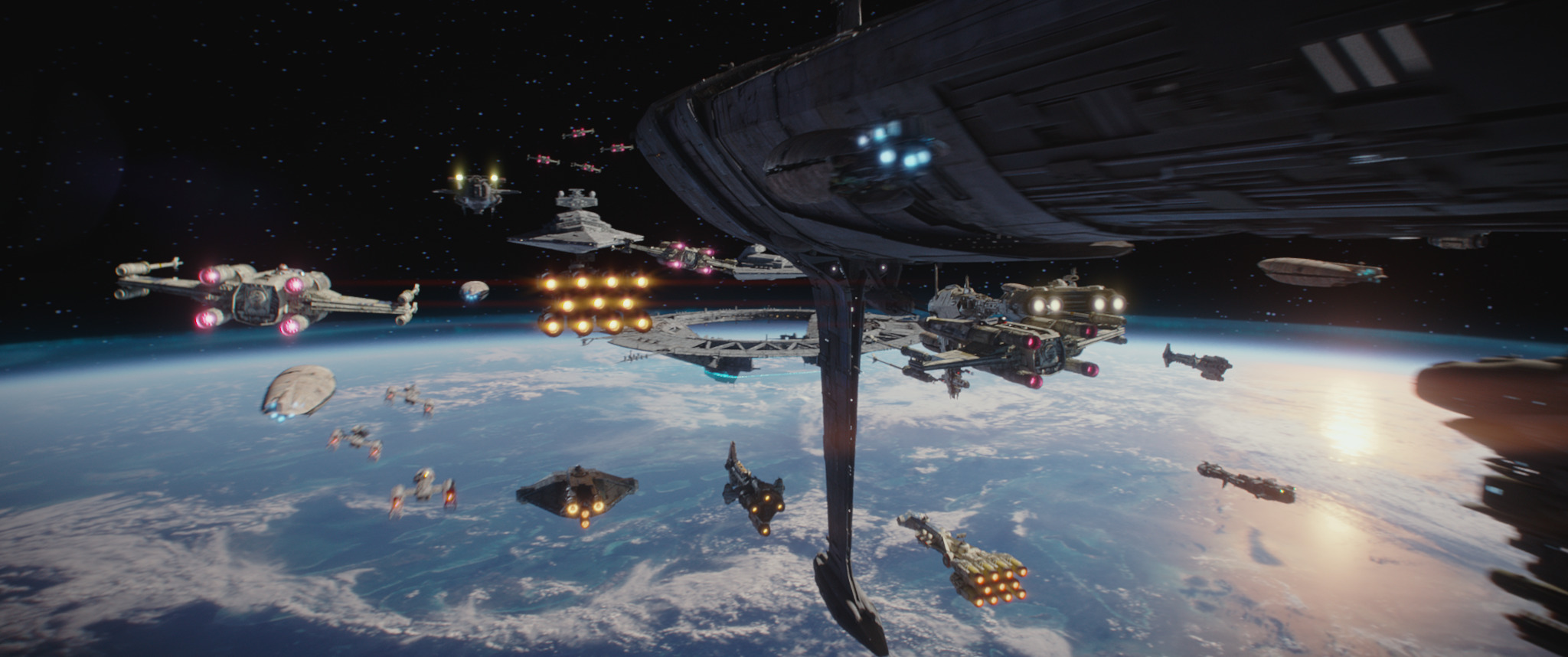
A final frame from the Battle of Scarif in Rogue One: A Star Wars Story (Credit: ILM & Lucasfilm).

A Context for Conflict

In First Contact, the United Federation of Planets – a 200-year-old interstellar government consisting of more than 150 member worlds – braces itself for an invasion by the Borg – an overwhelmingly powerful collective composed of cybernetic beings who devastate entire planets by assimilating their biological populations and technological innovations. The Borg only send a single vessel, a massive cube containing thousands of hive-minded drones and their queen, pushing the Federation’s Starfleet defenders to Earth’s doorstep. Conversely, in Rogue One, the Rebel Alliance – a fledgling coalition of freedom fighters – seeks to undermine and overthrow the stalwart Galactic Empire – a totalitarian regime preparing to tighten its grip on the galaxy by revealing a horrifying superweapon. A rebel team infiltrates a top-secret vault on Scarif in a bid to steal plans to that battle station, the dreaded Death Star, with hopes of exploiting a vulnerability in its design.

On the surface, the situations could not seem to be more disparate, particularly in terms of the Federation’s well-established prestige and the Rebel Alliance’s haphazardly organized factions. Yet, upon closer inspection, the spaceborne conflicts at Earth and Scarif are linked by a vital commonality. The threat posed by the Borg is well-known to the Federation, but the sudden intrusion upon their space takes its defenses by surprise. Starfleet assembles any vessel within range – including antiquated Oberth-class science ships – to intercept the Borg cube in the Typhon Sector, only to be forced back to Earth on the edge of defeat. The unsanctioned mission to Scarif with Jyn Erso (Felicity Jones) and Cassian Andor (Diego Luna) and the sudden need to take down the planet’s shield gate propels the Rebel Alliance fleet into rushing to their rescue with everything from their flagship Profundity to GR-75 medium transports. Whether Federation or Rebel Alliance, these fleets gather in last-ditch efforts to oppose enemies who would embrace their eradication – the Battles of Sector 001 and Scarif are fights for survival.

From Physical to Digital

By the time Jonathan Frakes was selected to direct First Contact, Star Trek’s reliance on constructing traditional physical models (many of which were built by ILM) for its features was gradually giving way to innovative computer graphics (CG) models, resulting in the film’s use of both techniques. “If one of the ships was to be seen full-screen and at length,” associate visual effects supervisor George Murphy told Cinefex’s Kevin H. Martin, “we knew it would be done as a stage model. Ships that would be doing a lot of elaborate maneuvers in space battle scenes would be created digitally.” In fact, physical and CG versions of the U.S.S. Enterprise-E appear in the film, with the latter being harnessed in shots involving the vessel’s entry into a temporal vortex at the conclusion of the Battle of Sector 001.

Despite the technological leaps that ILM pioneered in the decades between First Contact and Rogue One, they considered filming physical miniatures for certain ship-related shots in the latter film. ILM considered filming physical miniatures for certain ship-related shots in Rogue One. The feature’s fleets were ultimately created digitally to allow for changes throughout post-production. “If it’s a photographed miniature element, it’s not possible to go back and make adjustments. So it’s the additional flexibility that comes with the computer graphics models that’s very attractive to many people,” John Knoll relayed to writer Jon Witmer at American Cinematographer’s TheASC.com.

However, Knoll aimed to develop computer graphics that retained the same high-quality details as their physical counterparts, leading ILM to employ a modern approach to a time-honored modelmaking tactic. “I also wanted to emulate the kit-bashing aesthetic that had been part of Star Wars from the very beginning, where a lot of mechanical detail had been added onto the ships by using little pieces from plastic model kits,” explained Knoll in his chat with TheASC.com. For Rogue One, ILM replicated the process by obtaining such kits, scanning their parts, building a computer graphics library, and applying the CG parts to digitally modeled ships. “I’m very happy to say it was super-successful,” concluded Knoll. “I think a lot of our digital models look like they are motion-control models.”
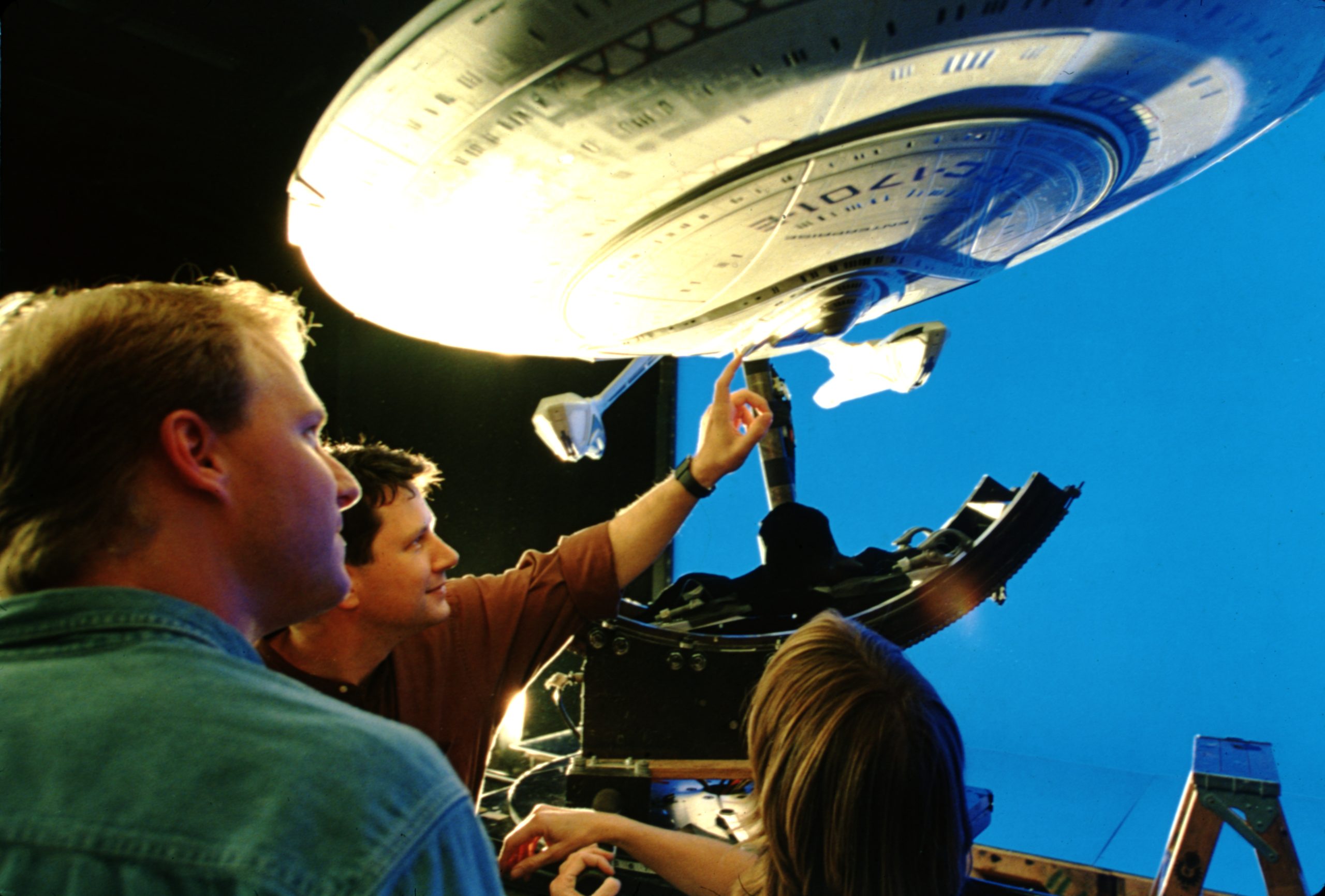
John Knoll (second from left) confers with Kim Smith and John Goodson with the miniature of the U.S.S. Enterprise-E during production of Star Trek: First Contact (Credit: ILM).

Legendary Lineages

In First Contact, Captain Picard commanded a brand-new vessel, the Sovereign-class U.S.S. Enterprise-E, continuing the celebrated starship’s legacy in terms of its famous name and design aesthetic. Designed by John Eaves and developed into blueprints by Rick Sternbach, the Enterprise-E was built into a 10-foot physical model by ILM model project supervisor John Goodson and his shop’s talented team. ILM infused the ship with extraordinary detail, including viewports equipped with backlit set images from the craft’s predecessor, the U.S.S. Enterprise-D. For the vessel’s larger windows, namely those associated with the observation lounge and arboretum, ILM took a painstakingly practical approach to match the interiors shown with the real-world set pieces. “We filled that area of the model with tiny, micro-scale furniture,” Goodson informed Cinefex, “including tables and chairs.”

Rogue One’s rebel team initially traversed the galaxy in a U-wing transport/gunship, which, much like the Enterprise-E, was a unique vessel that nonetheless channeled a certain degree of inspiration from a classic design. Lucasfilm’s Doug Chiang, a co-production designer for Rogue One, referred to the U-wing as the film’s “Huey helicopter version of an X-wing” in the Designing Rogue One bonus featurette on Disney+ before revealing that, “Towards the end of the design cycle, we actually decided that maybe we should put in more X-wing features. And so we took the X-wing engines and literally mounted them onto the configuration that we had going.” Modeled by ILM digital artist Colie Wertz, the U-wing’s final computer graphics design subtly incorporated these X-wing influences to give the transport a distinctive feel without making the craft seem out of place within the rebel fleet.

While ILM’s work on the Enterprise-E’s viewports offered a compelling view toward the ship’s interior, a breakthrough LED setup for Rogue One permitted ILM to obtain realistic lighting on actors as they looked out from their ships and into the space around them. “All of our major spaceship cockpit scenes were done that way, with the gimbal in this giant horseshoe of LED panels we got from [equipment vendor] VER, and we prepared graphics that went on the screens,” John Knoll shared with American Cinematographer’s Benjamin B and Jon D. Witmer. Furthermore, in Disney+’s Rogue One: Digital Storytelling bonus featurette, visual effects producer Janet Lewin noted, “For the actors, I think, in the space battle cockpits, for them to be able to see what was happening in the battle brought a higher level of accuracy to their performance.”
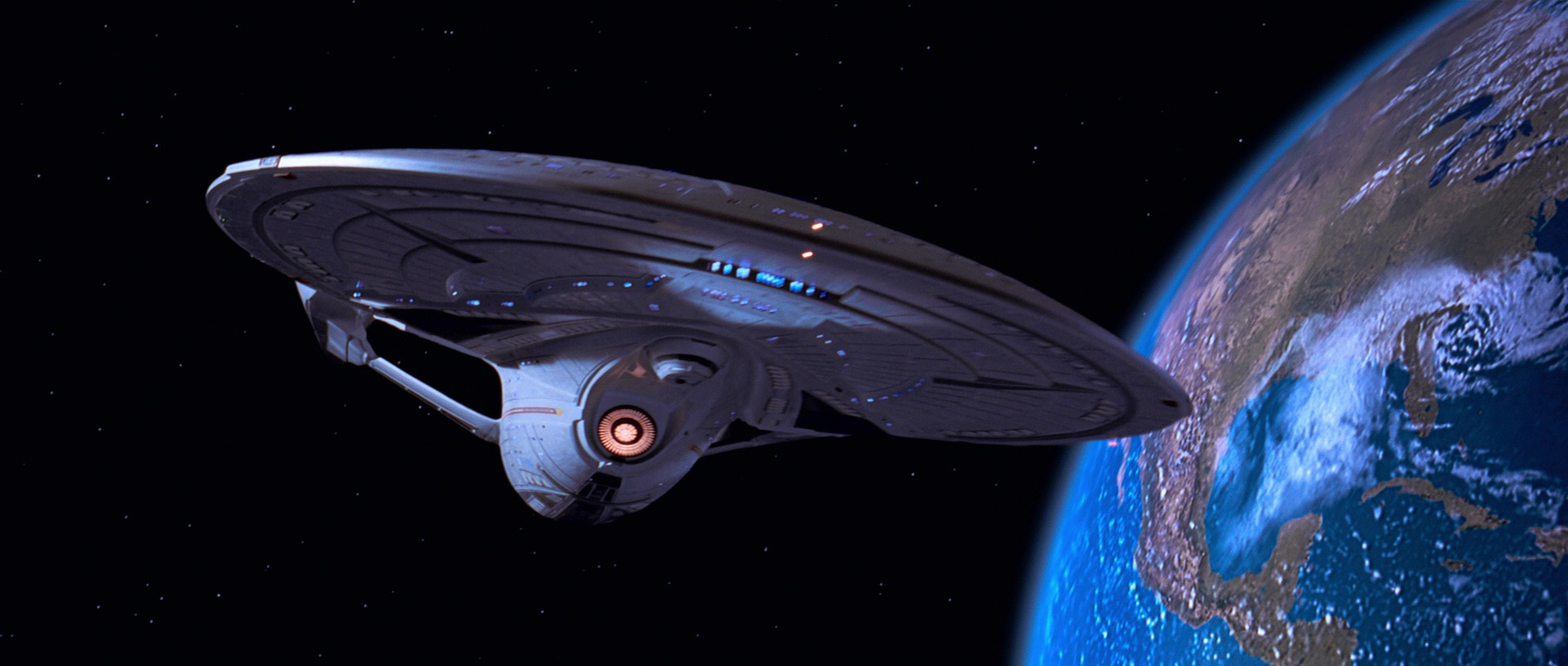
The U.S.S. Enterprise-E in Star Trek: First Contact (Credit: Paramount).

Familiar Foes

To transport First Contact’s Borg invaders, John Goodson’s team at ILM resurrected the Borg cube design previously seen in Star Trek: The Next Generation (1987) and Star Trek: Deep Space Nine (1993), creating a nearly three-foot physical model to replace the one from the series. Art consultant and ILM veteran Bill George proposed that the cube’s seemingly straightforward layout be augmented with a complex network of photo-etched brass, a suggestion which produced a jagged surface and offered a visual that was both intricate and menacing. ILM also developed a two-foot motion-control model for a Borg sphere, a brand-new auxiliary vessel that emerged from the cube. “We vacuformed about 15 different patterns that conformed to this spherical curve and covered those with a lot of molded and cast pieces. Then we added tons of acid-etched brass over it, just like we had on the cube,” Goodson outlined to Cinefex’s Kevin H. Martin.

As for Rogue One’s villainous fleet, reproducing the original trilogy’s Death Star and Imperial Star Destroyers centered upon translating physical models into digital assets. Although ILM no longer possessed A New Hope’s three-foot Death Star shooting model, John Knoll recreated the station’s surface paneling by gathering archival images, and as he spelled out to writer Joe Fordham in Cinefex, “I pieced all the images together. I unwrapped them into texture space and projected them onto a sphere with a trench. By doing that with enough pictures, I got pretty complete coverage of the original model, and that became a template upon which to redraw very high-resolution texture maps. Every panel, every vertical striped line, I matched from a photograph. It was as accurate as it was possible to be as a reproduction of the original model.”

Knoll’s investigative eye continued to pay dividends when analyzing the three-foot and eight-foot Star Destroyer motion-control models, which had been built for A New Hope and Star Wars: The Empire Strikes Back (1980), respectively. “Our general mantra was, ‘Match your memory of it more than the reality,’ because sometimes you go look at the actual prop in the archive building or you look back at the actual shot from the movie, and you go, ‘Oh, I remember it being a little better than that,’” Knoll conveyed to TheASC.com. This philosophy motivated ILM to combine elements from those two physical models into a single digital design. “Generally, we copied the three-footer for details like the superstructure on the top of the bridge, but then we copied the internal lighting plan from the eight-footer,” Knoll explained. “And then the upper surface of the three-footer was relatively undetailed because there were no shots that saw it closely, so we took a lot of the high-detail upper surface from the eight-footer. So it’s this amalgam of the two models, but the goal was to try to make it look like you remember it from A New Hope.”
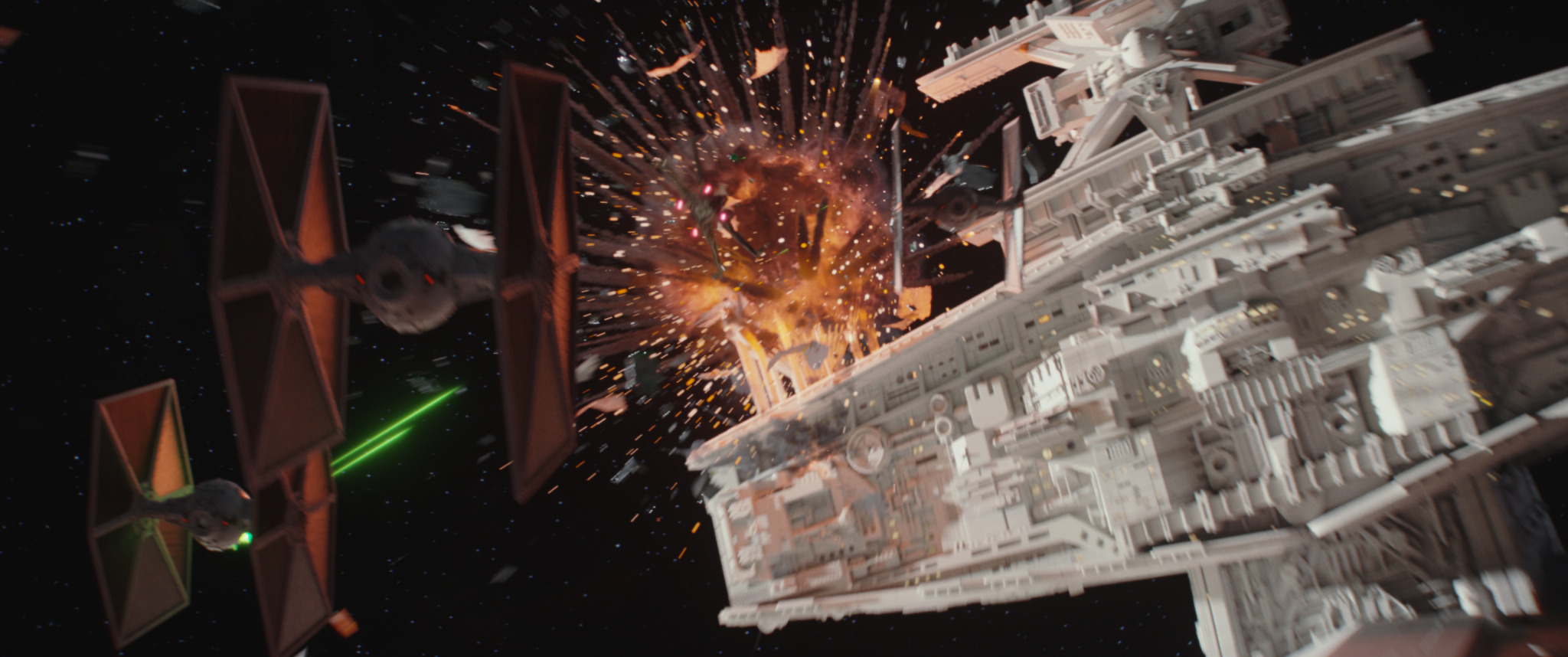
A final frame from Rogue One: A Star Wars Story (Credit: ILM & Lucasfilm).

Forming Up the Fleets

In addition to the U.S.S. Enterprise-E, the Battle of Sector 001 debuted numerous vessels representing four new Starfleet ship classes – the Akira, Steamrunner, Saber, and Norway – all designed by ILM visual effects art director Alex Jaeger. “Since we figured a lot of the background action in the space battle would be done with computer graphics ships that needed to be built from scratch anyway, I realized that there was no reason not to do some new designs,” John Knoll told American Cinematographer writer Ron Magid. Used in previous Star Trek projects, older physical models for the Oberth and Nebula classes were mixed into the fleet for good measure, though the vast majority of the armada originated as computer graphics.

Over at Scarif, ILM portrayed the Rebel Alliance forces with computer graphics models of fresh designs (the MC75 cruiser Profundity and U-wings), live-action versions of Star Wars Rebels VCX-100 light freighter Ghost and Hammerhead corvettes, and Star Wars staples (Nebulon-B frigates, X-wings, Y-wings, and more). These ships face off against two Imperial Star Destroyers and squadrons of TIE fighters, and – upon their late arrival to the battle – Darth Vader’s Star Destroyer and the Death Star. The Tantive IV, a CR90 corvette more popularly referred to as a blockade runner, made its own special cameo at the tail end of the fight. As Princess Leia Organa’s (Carrie Fisher and Ingvild Deila) personal ship, the Tantive IV received the Death Star plans and fled the scene, destined to be captured by Vader’s Star Destroyer at the beginning of A New Hope. And, while we’re on the subject of intricate starship maneuvers and space-based choreography…

Although the First Contact team could plan visual effects shots with animated storyboards, ILM supplied Gareth Edwards with a next-level virtual viewfinder that allowed the director to select his shots by immersing himself among Rogue One’s ships in real time. “What we wanted to do is give Gareth the opportunity to shoot his space battles and other all-digital scenes the same way he shoots his live-action. Then he could go in with this sort of virtual viewfinder and view the space battle going on, and figure out what the best angle was to shoot those ships from,” senior animation supervisor Hal Hickel described in the Rogue One: Digital Storytelling featurette. Hickel divulged that the sequence involving the dish array docking with the Death Star was an example of the “spontaneous discovery of great angles,” as the scene was never storyboarded or previsualized.
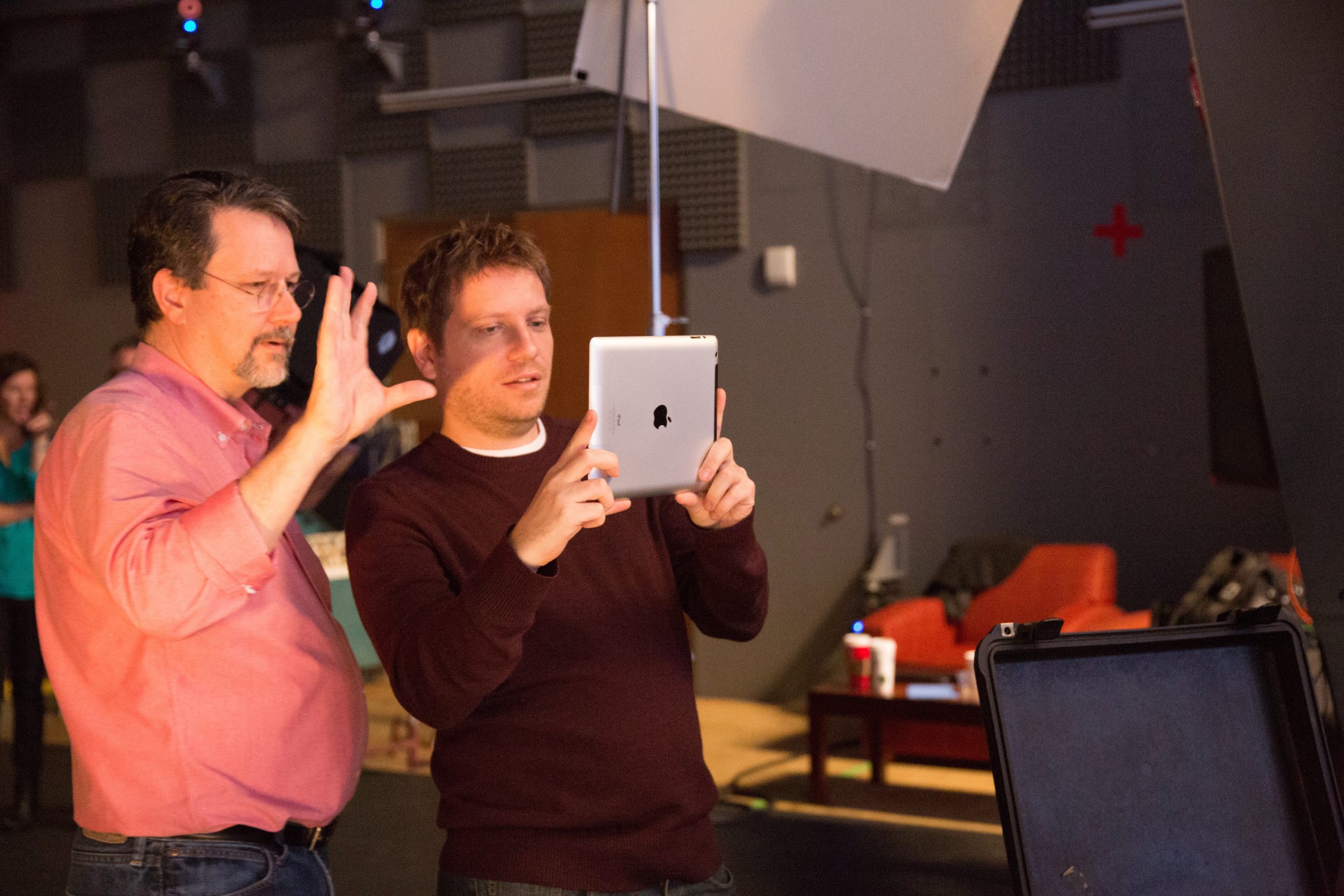
Visual effects supervisor John Knoll with director Gareth Edwards during production of Rogue One: A Star Wars Story (Credit: ILM & Lucasfilm).

Tough Little Ships

The Federation and Rebel Alliance each deployed “tough little ships” (an endearing description Commander William T. Riker [Jonathan Frakes] bestowed upon the U.S.S. Defiant in First Contact) in their respective conflicts, namely the U.S.S. Defiant from Deep Space Nine and the Tantive IV from A New Hope. VisionArt had already built a CG Defiant for the Deep Space Nine series, but ILM upgraded the model with images gathered from the ship’s three-foot physical model. A similar tactic was taken to bring the Tantive IV into the digital realm for Rogue One. “This was the Blockade Runner. This was the most accurate 1:1 reproduction we could possibly have made,” model supervisor Russell Paul declared to Cinefex’s Joe Fordham. “We did an extensive photo reference shoot and photogrammetry re-creation of the miniature. From there, we built it out as accurately as possible.” Speaking of sturdy ships, if you look very closely, you can spot a model of the Millennium Falcon flashing across the background as the U.S.S. Defiant makes an attack run on the Borg cube at the Battle of Sector 001!

Exploration and Hope

The in-universe ramifications that materialize from the Battles of Sector 001 and Scarif are monumental. The destruction of the Borg cube compels the Borg Queen to travel back in time in an attempt to vanquish Earth before the Federation can even be formed, but Captain Picard and the Enterprise-E foil the plot and end up helping their 21st century ancestors make “first contact” with another species, the logic-revering Vulcans. The post-Scarif benefits take longer to play out for the Rebel Alliance, but the theft of the Death Star plans eventually leads to the superweapon’s destruction. The Galactic Civil War is far from over, but Scarif is a significant step in the Alliance’s effort to overthrow the Empire.

The visual effects ILM provided for First Contact and Rogue One contributed significantly to the critical and commercial acclaim both pictures enjoyed, a victory reflecting the relentless dedication, tireless work ethic, and innovative spirit embodied by visual effects supervisor John Knoll and ILM’s entire staff. While being interviewed for The Making of Star Trek: First Contact, actor Patrick Stewart praised ILM’s invaluable influence, emphasizing, “ILM was with us, on this movie, almost every day on set. There is so much that they are involved in.” And, regardless of your personal preferences – phasers or lasers, photon torpedoes or proton torpedoes, warp speed or hyperspace – perhaps Industrial Light & Magic’s ability to infuse excitement into both franchises demonstrates that Star Trek and Star Wars encompass themes that are not competitive, but compatible. After all, what goes together better than exploration and hope?

Jay Stobie (he/him) is a writer, author, and consultant who has contributed articles to ILM.com, Skysound.com, Star Wars Insider, StarWars.com, Star Trek Explorer, Star Trek Magazine, and StarTrek.com. Jay loves sci-fi, fantasy, and film, and you can learn more about him by visiting JayStobie.com or finding him on Twitter, Instagram, and other social media platforms at @StobiesGalaxy.
Take a deep dive into the history and lore behind the starship designs created by ILM and introduced 40 years ago in The Search for Spock.

By Jay Stobie

Written and produced by Harve Bennett, Star Trek III: The Search for Spock (1984) afforded actor Leonard Nimoy his first opportunity to direct a Star Trek feature. With Ken Ralston as visual effects supervisor, the film also supplied Industrial Light & Magic with the chance to leave its own indelible legacy on the Star Trek franchise. ILM’s work on Star Trek II: The Wrath of Khan (1982) had included a collaboration with the Lucasfilm Computer Division which yielded the first all-CG sequence in a feature film, yet the company had an even greater impact on the film series’ third installment.

Among its many contributions to Star Trek III, ILM tackled the monumental task of designing and building five major starship and space station models that were introduced in the film. Though crafted specifically for this project, those steadfast exterior designs became staples in the Star Trek universe and appeared in prominent scenes across numerous films and television series. As we celebrate The Search for Spock’s 40th anniversary, let’s examine the long-lasting nature of ILM’s iconic creations and explore the circumstances in which they were employed in later Star Trek productions.

The Merchantman starship flies through space in Star Trek III.
The Merchantman in Star Trek III: The Search for Spock. (Credit: Paramount Pictures)

The Merchantman: A Criminal Craft

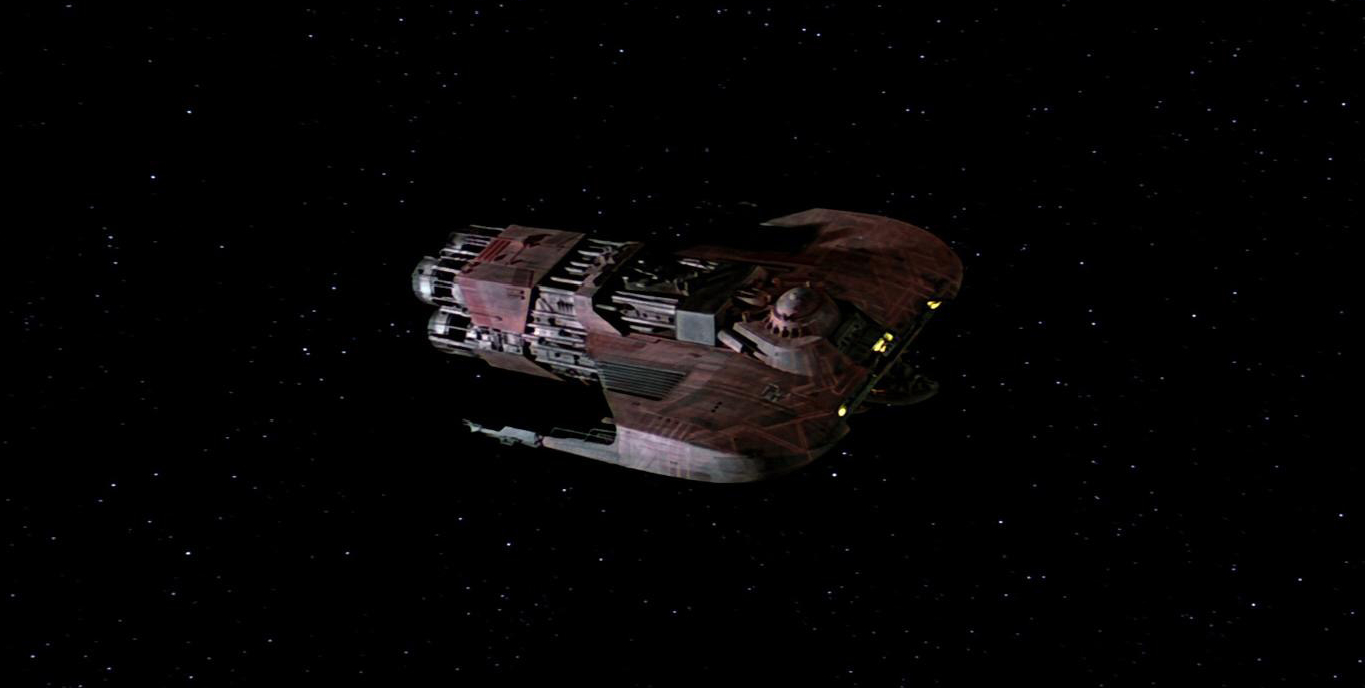
A small, boxy vessel with a curved forward section lurked in deep space during the first act of Star Trek III, referred to as a merchantman by the film’s script. The ship carried a Klingon passenger (Cathie Shirriff) who had purchased intelligence related to the terraforming device known as Genesis. A much larger Klingon ship (more on that in a moment) lowered its cloaking device, becoming visible long enough to receive the data. Unfortunately, the Klingon operative had glanced at the information, prompting the vessel to swoop around and obliterate the merchantman with its weaponry.

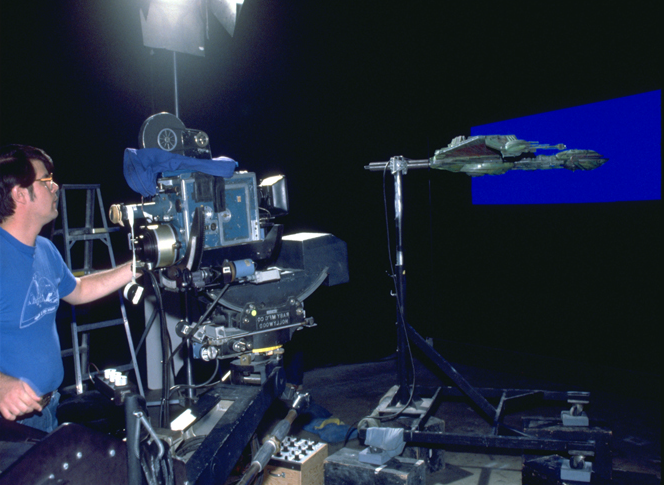
From the earliest stages of pre-production on Star Trek III, the team at ILM — including Ralston, visual effects art directors Nilo Rodis and David Carson, supervising modelmaker Steve Gawley, and modelmaker Bill George — presented their creations to Nimoy and Bennett, who suggested alterations before final approval. Rodis and Carson generated concepts, while Gawley and George offered input and spearheaded model construction. The meticulous process was adaptable to each model’s role in the script, as the merchantman’s brief appearance meant it was fabricated in a relatively short amount of time. “The merchant ship was a design we threw together in a couple of weeks from a bunch of model parts,” visual effects cameraman Donald Dow told writer Brad Munson in Cinefex. “It was going to be blown up right at the very start, so there was no sense putting a lot of time into it.”

Camera operator Selwyn Eddy photographs the Merchantman miniature using ILM’s “Rama” motion-control camera.
Camera operator Selwyn Eddy photographs the Merchantman miniature using ILM’s “Rama” motion-control camera. (Credit: Industrial Light & Magic)

Yet, for a vessel not expected to see much screen time, the merchantman ultimately proved to be a testament to ILM’s dedication to quality, as the ship fulfilled its purpose in the film and went on to experience a revitalized livelihood in future productions. Boasting slight modifications in each instance, the merchantman reappeared as different vessels on six occasions. From a Sheliak transport carrying colonists in Star Trek: The Next Generation’s (1987) “The Ensigns of Command” to a Cardassian freighter targeted by saboteurs in Star Trek: Deep Space Nine’s (1993) “The Maquis, Part I,” the merchantman turned into a reliable resource for both series, as well as for Star Trek: Voyager (1995). In an intriguing twist, the merchantman — best known for being destroyed by a Klingon Bird-of-Prey in The Search for Spock — was even reconfigured to become a Klingon vessel in Deep Space Nine’s “Rules of Engagement.”

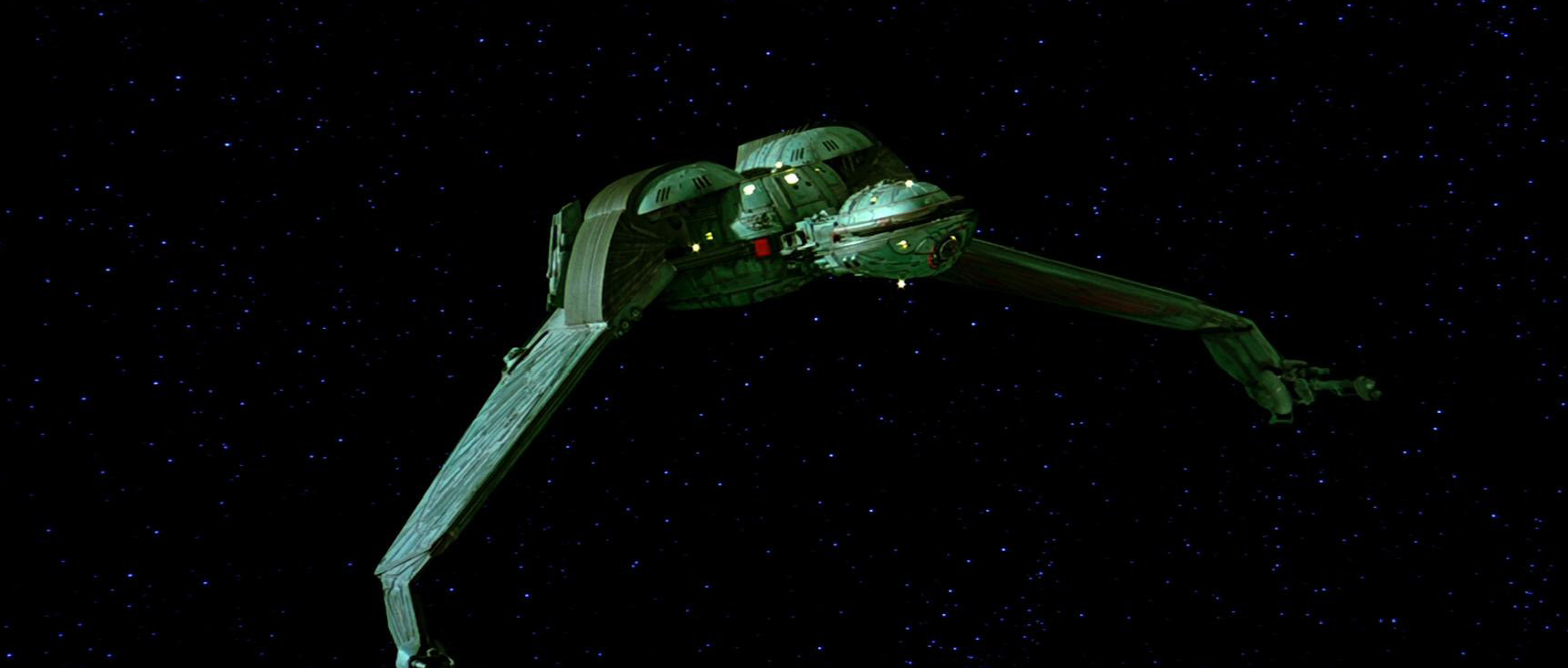
The Klingon Bird-of-Prey in Star Trek III: The Search for Spock.
The Klingon Bird-of-Prey in Star Trek III: The Search for Spock. (Credit: Paramount Pictures)

The Klingon Bird-of-Prey: A Fearsome Fighter

An imposing warship with a head-like bridge section and angled wings, the Klingon Bird-of-Prey easily outmatched the merchantman. Commanded by a Klingon named Kruge (Christopher Lloyd), the Bird-of-Prey was armed with a cloaking device that concealed it from its enemy’s scanners. Kruge sought the power of the Genesis device, traveling to the Genesis Planet and making quick work of the U.S.S. Grissom. Despite its swift victories over lesser foes, the Bird-of-Prey soon found itself squared off against the legendary U.S.S. Enterprise. Of course, unbeknownst to Kruge, James T. Kirk’s famed vessel had been severely damaged in Star Trek II and only maintained a skeleton crew on its bridge.

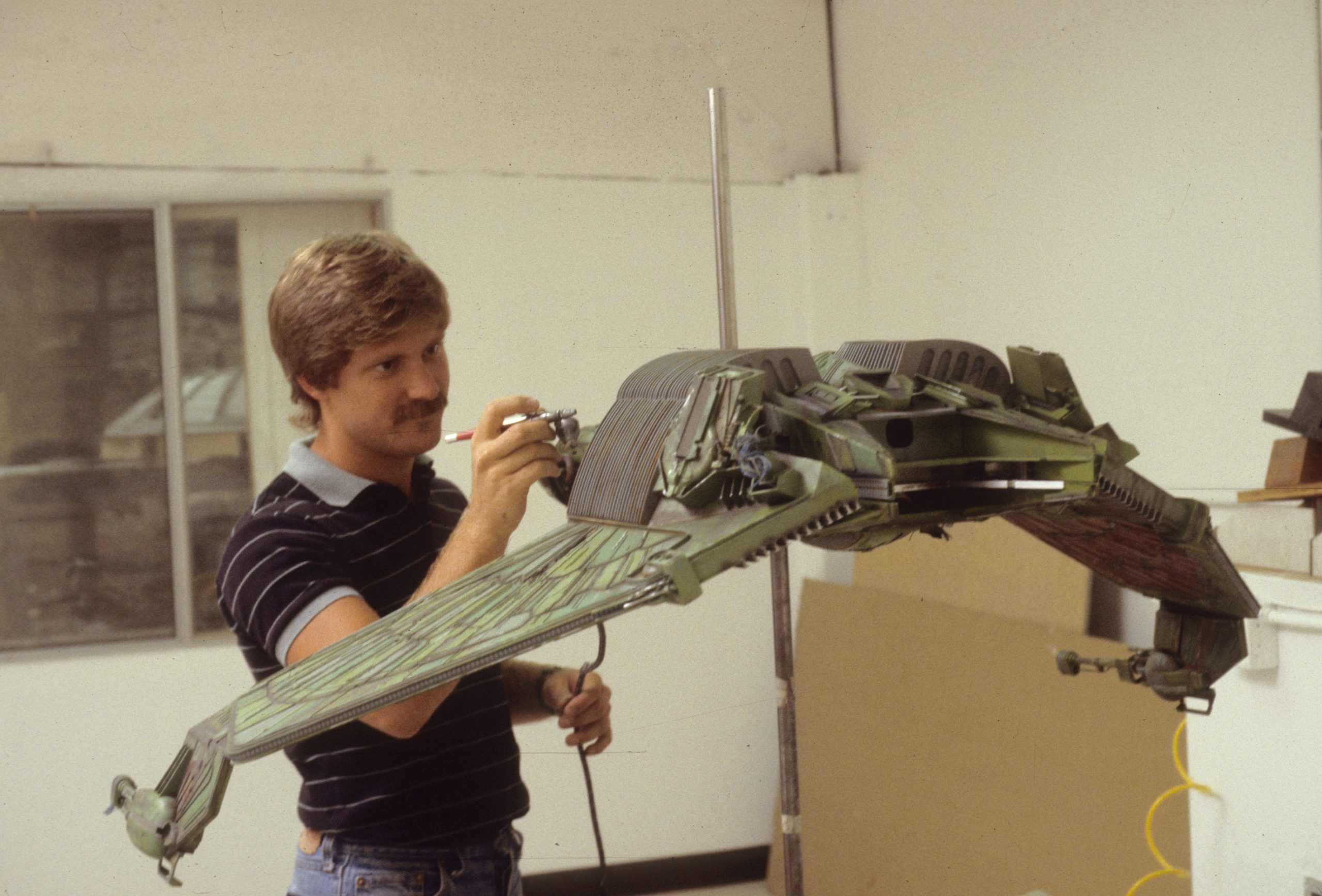
Modelmaker Bill George at work on the Bird-of-Prey miniature.
Modelmaker Bill George at work on the Bird-of-Prey miniature. (Credit: Industrial Light & Magic)

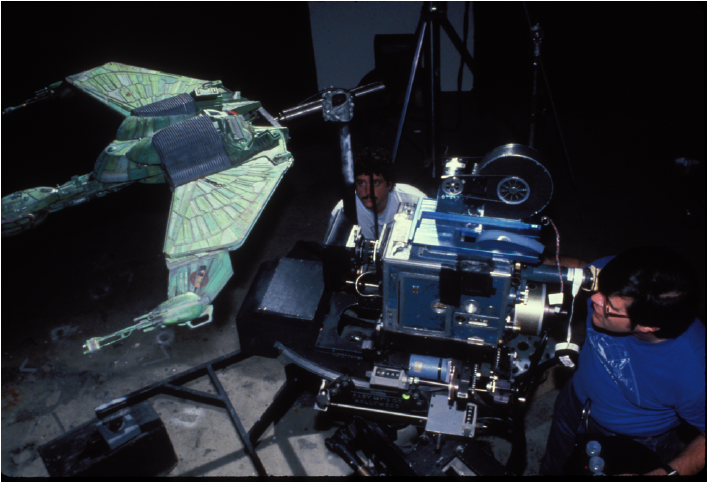
Perhaps the most distinctive starship ILM assembled for Star Trek III, the Klingon Bird-of-Prey model featured an intimidating green color scheme and motorized wings that could be raised above its primary hull. On top of bringing the vessel’s exterior to life, ILM pioneered the visual effect that permitted the Bird-of-Prey to decloak and become visible. “[Optical photography supervisor] Ken Smith came up with the optical effect,” Ralston shared with Nora Lee in American Cinematographer. “By using a ripple glass he threw the color sync off on each separation, so that everything is just a little out of whack. Then it all gets in sync and forms the ship.” The design impressed creatives to such a degree that, following the U.S.S. Enterprise’s destruction (yet another visual effect executed by ILM) in The Search for Spock, Kruge’s captured Bird-of-Prey — playfully renamed the H.M.S. Bounty by Kirk’s defiant crew — inherited the role of hero ship in the film’s Nimoy-directed sequel, Star Trek IV: The Voyage Home (1986).

Camera operator Selwyn Eddy shoots the Bird-of-Prey miniature while camera operator Ray Gilberti looks on.
Camera operator Selwyn Eddy (right) shoots the Bird-of-Prey miniature while camera operator Ray Gilberti (left) looks on. (Credit: Industrial Light & Magic)

However, the Bird-of-Prey’s prolific career was only just beginning. The ship’s signature profile played key parts as other nefarious Klingon vessels across the next three Star Trek films — Star Trek V: The Final Frontier (1989), Star Trek VI: The Undiscovered Country (1991), and Star Trek Generations (1994) — and popped up in numerous The Next Generation, Deep Space Nine, and Voyager episodes. As with many starships that began as physical models, the Bird-of-Prey was ultimately supplemented with a CG build in the latter stages of Deep Space Nine’s seven-season run. The craft even ended up in animated configurations for Star Trek: Lower Decks (2020) and Star Trek: Prodigy (2021). Nevertheless, all the Bird-of-Prey models that followed were based on the look established by ILM’s initial build. Furthermore, the 22nd century iterations of the Bird-of-Prey and Klingon D5-class variants which debuted in Star Trek: Enterprise (2001), a prequel series set over 100 years before The Search for Spock, were tailored to reflect their lineage as in-universe predecessors to ILM’s original Bird-of-Prey from Star Trek III.

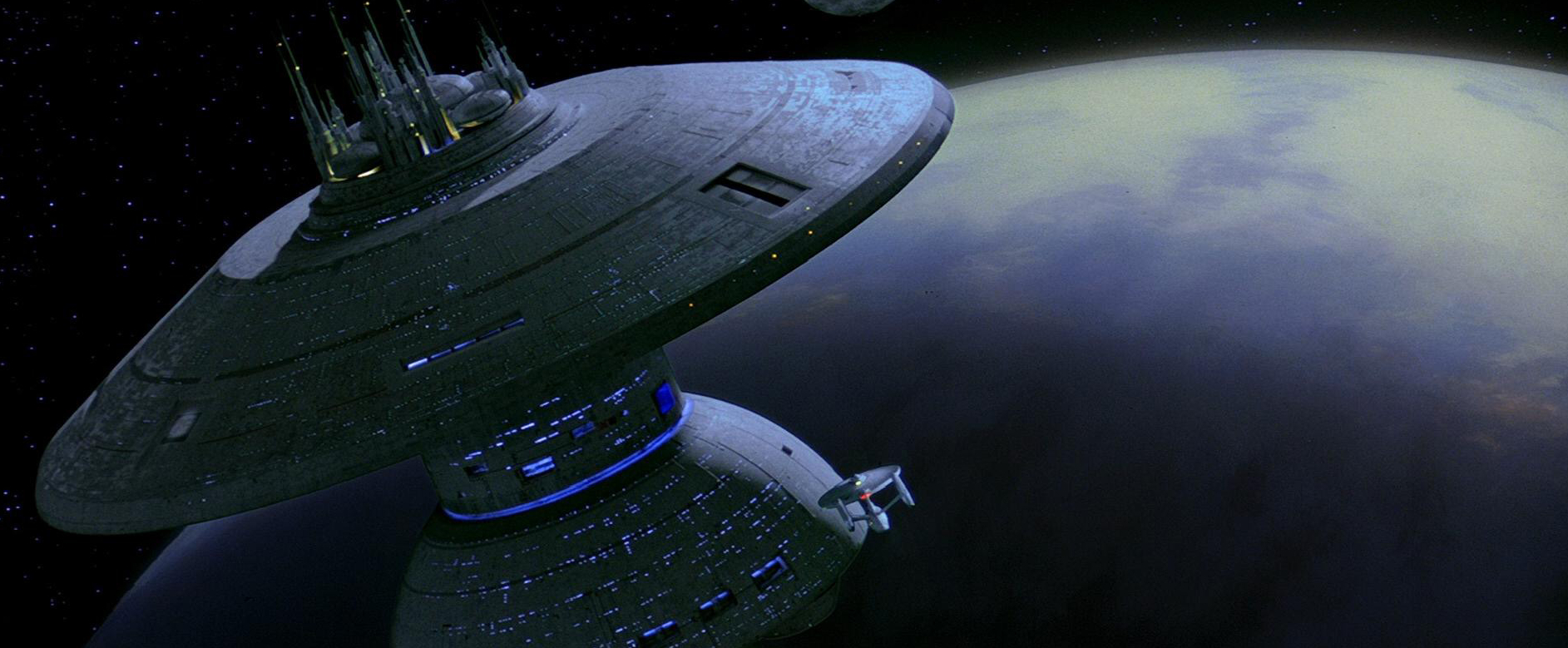
Earth Spacedock in Star Trek III: The Search for Spock.
Earth Spacedock in Star Trek III: The Search for Spock. (Credit: Paramount Pictures)

Earth Spacedock: A Safe Haven in Space

As the U.S.S. Enterprise glided through the solar system on its way to a much-deserved respite from action, it was greeted by the sight of Earth Spacedock. With a mushroom-shaped upper section atop a stem extending downward, the gargantuan space station permitted entire starships to enter its massive superstructure and dock at a central core complete with repair facilities. Abuzz with ships and various shuttles, the lively starbase watched over Earth and kept the Federation’s fleet ready to serve missions of exploration and defense.

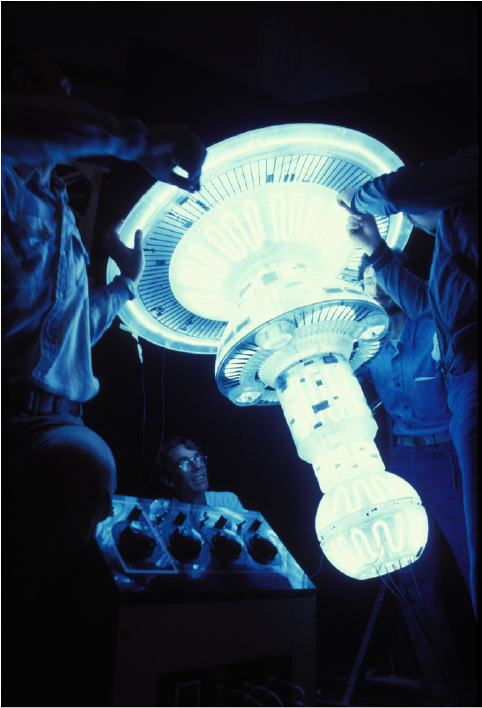
ILM’s Spacedock assignment necessitated three separate builds; namely the station’s illuminated exterior, its cavernous interior docking bay, and an interior view through the windows of a small, lounge-type set. Approximately five feet tall and three-and-a-half feet in diameter, the exterior model relied on a complex lighting system, which Ralston described in American Cinematographer. “[The Spacedock exterior] had lights inside after the door opens up and running lights that go inside. Sometimes it is hard to sync up all those functions with the motion control system. But I think it worked nicely.”

The issue of conveying the sheer size of a docking area able to house a multitude of starships received ILM’s innovative attention and expertise. “We found that the interior demanded some degree of atmospheric haze, even though there probably wouldn’t be any in outer space. It just needed help to look slightly degraded — not so crisp and clean,” visual effects cameraman Scott Farrar shared in Cinefex. “We ended up using blue gels on the lights and shooting in smoke for the basic fill look. Then, when we went to the light passes, we used a diffusion filter.”

ILM modelmakers work on the lighting components of the Earth Spacedock miniature.
ILM modelmakers work on the lighting components of the Earth Spacedock miniature. (Credit: Industrial Light & Magic)

As timeless as Earth Spacedock’s inaugural performance turned out to be, the station’s unveiling soon led to its return to the big-screen. In addition to being featured in the three Star Trek films which followed immediately after The Search for Spock, Earth Spacedock appeared as several other Federation starbases — Starbase 74, Lya Station Alpha, Starbase 133, and Starbase 84 — in The Next Generation via the use of stock footage. A version of Earth Spacedock seemed to be in the midst of orbital construction in the Star Trek: Discovery (2017) episode “Will You Take My Hand?,” while the design was translated into animated form to represent Douglas Station in Lower Decks. According to in-universe lore, Earth Spacedock was retired from service and transported to Athan Prime, where it was last seen as the central hub of the Fleet Museum in Star Trek: Picard’s (2020) third season.

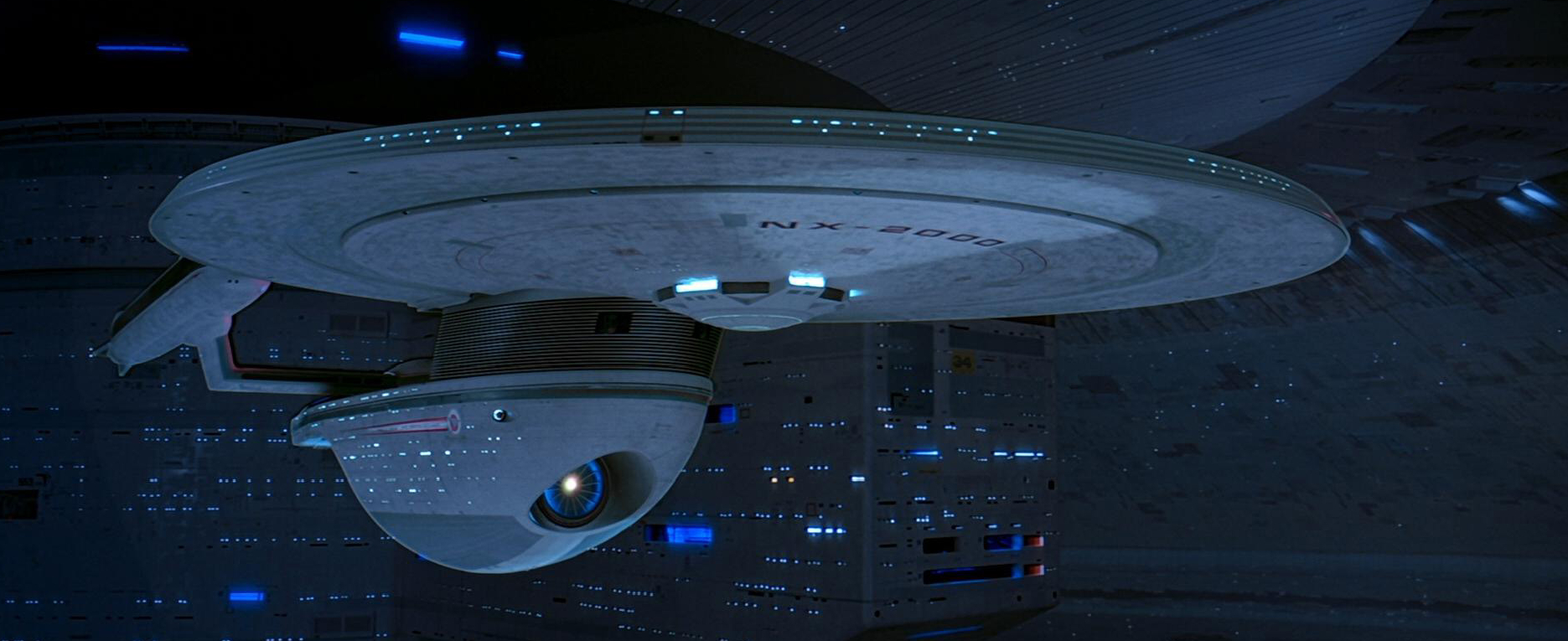
The U.S.S. Excelsior in Star Trek III: The Search for Spock.
The U.S.S. Excelsior in Star Trek III: The Search for Spock. (Credit: Paramount Pictures)

U.S.S. Excelsior: The Transwarp Testbed

Dubbed “The Great Experiment,” the U.S.S. Excelsior acted as a testbed for an advanced faster-than-light propulsion system known as the transwarp drive. The Excelsior was spotted while berthed in Earth Spacedock, though the starship soon found itself attempting to engage its experimental engines as it pursued Admiral Kirk’s unauthorized departure aboard the Enterprise. Unfortunately for the Excelsior, Montgomery Scott (James Doohan) — the Enterprise’s chief engineer — had sabotaged the transwarp system, causing the vessel’s trial run to stall out in an abrupt and unflattering fashion.

As outlined in Star Trek: The Official Starships Collection, early U.S.S. Excelsior concepts devised by Nilo Rodis and David Carson led to Bill George’s own distinctive study model and a 7 ½-foot studio model constructed with the oversight of Steve Gawley. Our first encounter with the starship coincided with the Enterprise’s arrival at Earth Spacedock, resulting in an arduous challenge for ILM — Excelsior needed to appear stationary within the confines of the station’s interior. “[The Excelsior] was shot separately from everything else. [Visual effects cameraman] Sel Eddy shot that stuff,” Ralston told American Cinematographer. “We had to match the moves so that it looked like it was locked right into the space dock. It was a pain. We had to cheat on some of the shots where there was so much trouble with the moves.” Their diligence paid off, as the majestic sequence endures as one of The Search for Spock’s most awe-inducing visuals.

The Excelsior returned in The Voyage Home and The Final Frontier, but it received its biggest chance to shine in The Undiscovered Country, which also featured visual effects by ILM. Now captained by Hikaru Sulu (George Takei), the U.S.S. Excelsior rescued the U.S.S. Enterprise-A during a crucial battle against a rogue Klingon Bird-of-Prey. The model was heavily modified for fresh cinematic escapades in Star Trek Generations, then bearing the legendary registry of the U.S.S. Enterprise-B. The Enterprise-B variant was also utilized as the U.S.S. Lakota, an upgraded Excelsior-class vessel, in Deep Space Nine’s “Paradise Lost.”

ILM’s Excelsior design prevailed via cameos in The Next Generation, as exterior shots of the vessel — now deployed to represent an entire line of Excelsior-class starships — debuted in the show’s first and second season premieres, “Encounter at Farpoint” and “The Child.” These views were subsequently reused as stock footage to depict various Excelsior-class ships in no less than ten additional episodes of the series. As with the Klingon Bird-of-Prey, ILM’s original Excelsior model served as the basis from which all future Excelsior-class physical and CGI builds stemmed. Deep Space Nine aficionados will point to the abundance of Excelsior-class vessels dispersed throughout Dominion War-era battles in “Sacrifice of Angels,” “Tears of the Prophets,” and the series’ finale, “What You Leave Behind,” as evidence that the starships were an integral part of Starfleet’s defense armada. In fact, at least three Excelsior-class vessels stayed in active service long enough to have been prepared to confront the vaunted Borg Collective in Voyager’s own season finale, “Endgame.”

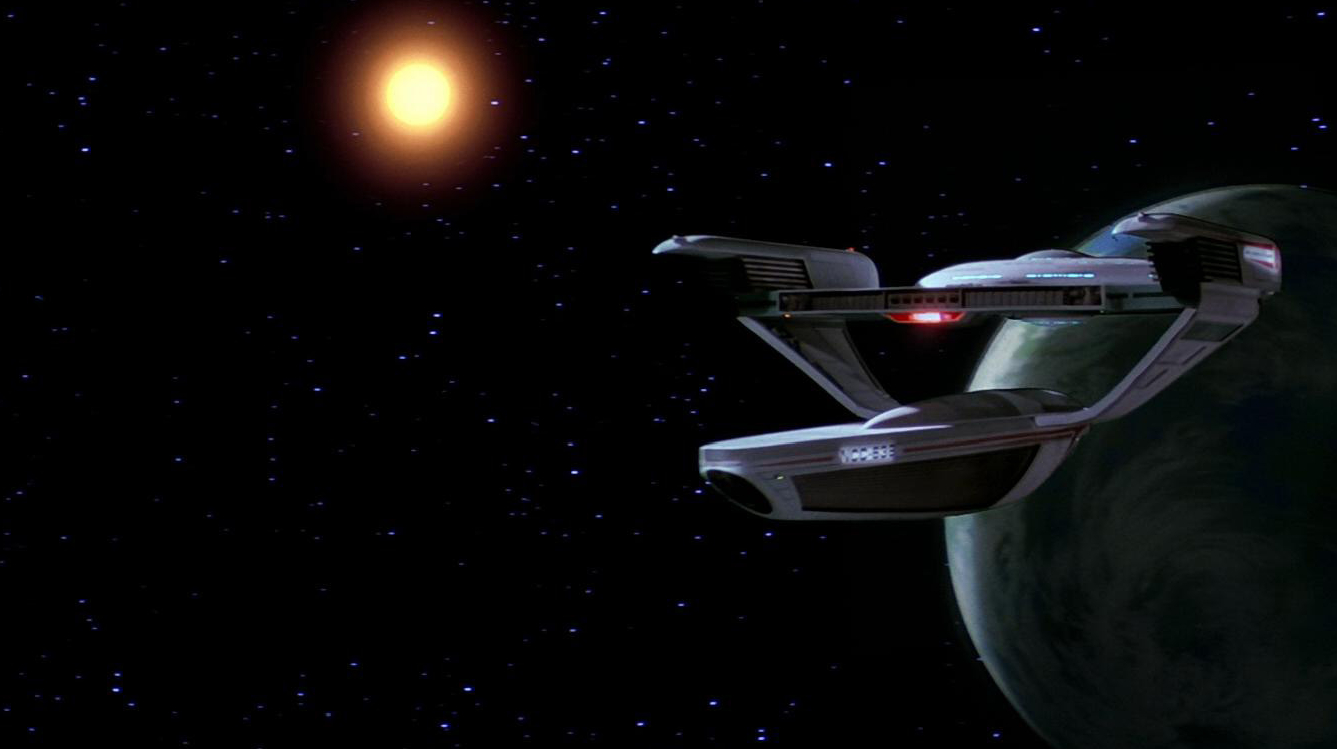
The U.S.S. Grissom in Star Trek III: The Search for Spock.
The U.S.S. Grissom in Star Trek III: The Search for Spock. (Credit: Paramount Pictures)

U.S.S. Grissom: A Scientific Scout

On a research mission to study the Genesis Planet, the U.S.S. Grissom was classified as a relatively small science vessel. After detecting an anomalous lifeform on the planet’s surface and beaming down a landing party consisting of Lieutenant Saavik (Robin Curtis) and Doctor David Marcus (Merritt Butrick), the Grissom remained tragically unaware as Kruge’s Klingon Bird-of-Prey approached under cloak and jammed all outgoing transmissions. The Bird-of-Prey dropped its invisibility field and coalesced into view, pouncing on the Grissom and destroying the Starfleet ship with a single blast.

The Roddenberry Archive notes the U.S.S. Grissom was yet another Star Trek III design conceived of by Nilo Rodis and David Carson and built by Steve Gawley and Bill George. The Grissom stood as a departure from the traditional Starfleet aesthetic in which a ship’s primary saucer was affixed to its secondary hull by a neck-like connection. A gap separated the two elements on the Grissom, with the only structures linking them being thin pylons extending from the vessel’s warp nacelles. The ship’s tragic fate didn’t merely come down to creating the biggest explosion, as plot considerations factored into ILM’s take on the Grissom’s destruction. “I didn’t think we should do something flamboyant at that point,” Ralston pointed out in Cinefex. “If we played all our best cards at the start, we’d have nothing left to show when it came time to blow up the Enterprise.”

The Grissom’s grizzly demise did not spell the end for the distinctive vessel, as the model functioned as the template for what would become known as the Oberth-class starship line. The design reemerged as a different ship of the same class berthed within Earth Spacedock in Star Trek IV before earning a recurring spot as a variety of Oberth-class ships that encountered the U.S.S. Enterprise-D in seven episodes of The Next Generation. The design garnered a great deal of attention in “The Pegasus,” an episode in which it was presented as the U.S.S. Pegasus, a testbed for an illegal Federation cloaking device. One Oberth-class ship assisted in the rescue of the Enterprise-D’s surviving crew at Veridian III in Star Trek Generations, while others could be found in the background at the Battle of Wolf 359 in Deep Space Nine’s “Emissary” and the ILM-orchestrated Battle of Sector 001 in Star Trek: First Contact. Like Earth Spacedock and the Klingon Bird-of-Prey, the Oberth-class design found itself turned into animated form for Lower Decks, this time in the episode “First First Contact.”

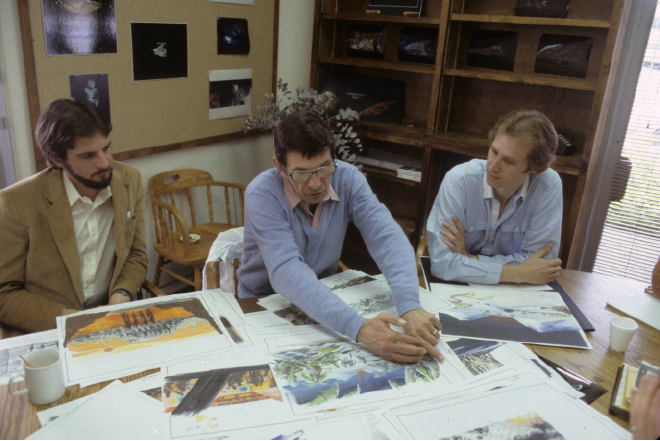
Director Leonard Nimoy confers with visual effects supervisor Ken Ralston (and visual effects art director David Carson during a visit to ILM’s Kerner facility.
Director Leonard Nimoy (center) confers with visual effects supervisor Ken Ralston (left) and visual effects art director David Carson (right) during a visit to ILM’s Kerner facility. (Credit: Industrial Light & Magic)

The Search for Spock’s Legacy

Crafting memorable starships and space stations for any production is a tremendous responsibility, yet Industrial Light & Magic’s contributions to Star Trek III: The Search for Spock accomplished this lofty goal and so much more. Having not one, but five major designs go on to resurface in significant roles is an achievement beyond all expectations. A recent scene in Star Trek: Picard’s third season exemplified ILM’s incredible feat, as Kruge’s Klingon Bird-of-Prey and the U.S.S. Excelsior were both positioned around Earth Spacedock as part of the Fleet Museum’s honorary assemblage of classic starships. The everlasting nature of the designs speaks to the eternal appeal of ILM’s work. Whether the new studio models that ILM designed and built for Star Trek III were reused as they were originally constructed, recreated by other visual effects companies at a later date, or called upon by future artists to inspire their own takes on starships, the original models’ extensive influence on the Star Trek universe cannot be overstated.

_

Jay Stobie (he/him) is a writer, author, and consultant who has contributed articles to ILM.com, Skysound.com, Star Wars Insider, StarWars.com, Star Trek Explorer, Star Trek Magazine, and StarTrek.com. Jay loves sci-fi, fantasy, and film, and you can learn more about him by visiting JayStobie.com or finding him on Twitter, Instagram, and other social media platforms at @StobiesGalaxy.