ILM

50 Years | 500+ Film and TV credits | 135+ Awards

SINCE 1975

The visual effects supervisor was practically a one-man operation as he joined director Gareth Edwards and crew in Thailand and the United Kingdom.
By Lucas O. Seastrom

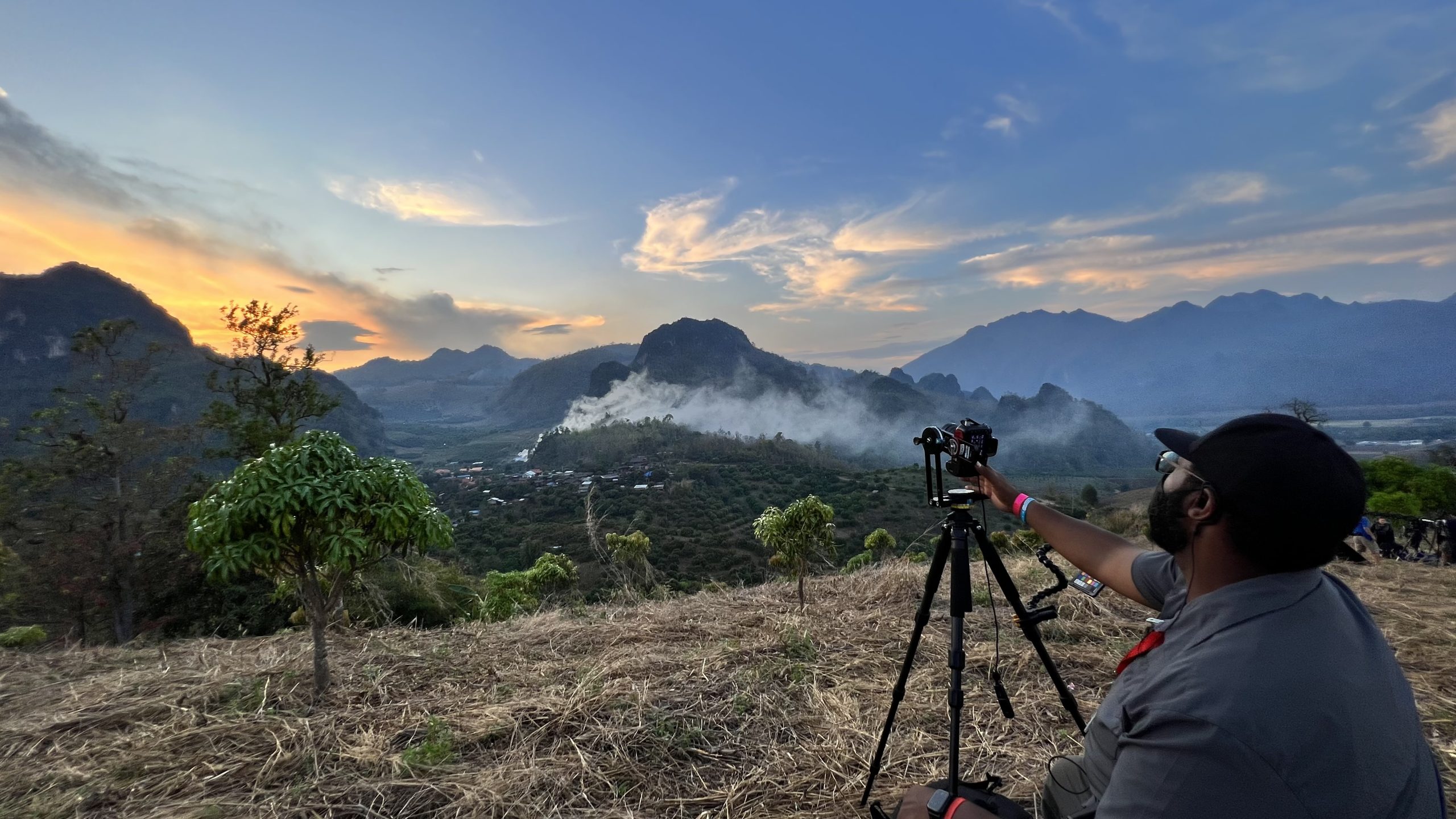
Andrew Roberts captures an image at sunset on location of The Creator.
Roberts captures an HDRI at sunset while on location in Thailand.

Industrial Light & Magic visual effects supervisor Andrew Roberts was already a fan of writer/director Gareth Edwards when the opportunity to work on The Creator came knocking. In 2022, Roberts would join the crew on location in Thailand as ILM’s onset visual effects supervisor. Edwards had organized a streamlined team to work quickly and efficiently. 

“Originally, Gareth explained that he was hoping for it to be a small team, maybe six vans driving around Thailand,” Roberts tells ILM.com. “His hope was that we’d see a location, jump out and film it. There might not be time to capture all of the typical reference material and photography that you normally would, but we’d get certain things before moving on to the next location. It was quite a guerrilla, lightweight, indie approach.”

Although The Creator did require more infrastructure than Edwards’ dream of a six-van guerrilla unit, the principle remained the same, and Roberts was the only visual effects representative onset. “There wasn’t the typical visual effects support where you have someone focusing on HDRIs, and a wrangler keeping track of the data, and a coordinator,” explains Roberts. “I would fulfill all of those responsibilities. For anything onset, I’d be there to advise and give recommendations to Gareth. But then at the same time, I was also trying to capture as much information as I could to provide a snapshot for the visual effects team. I recorded the lens, distance from the characters, lighting conditions and so forth.

“I spoke to [ILM chief creative officer] John Knoll before I went onset,” Roberts continues, “and he discussed his experiences on Rogue One [Edwards’ previous collaboration with ILM]. He said it would be lean, pretty indie-style, and you won’t get everything. So be prepared to accept that and trust that the team will be able to execute the shots and use whatever you can gather for them. That was reassuring, though obviously I agonized and wanted to get everything. But I had to let things go. My primary role was to be there for Gareth and make sure he had the support he needed.”

A final frame from The Creator.

Admittedly, it was a lot to manage, but an assignment that kept Roberts constantly engaged with the director, cinematographers Greig Fraser and Oren Soffer, and other crew members from departments as varied as makeup and special effects. And his work continued  with the end of each shooting day. 

“Each night I’d transfer everything into a folder structure that listed the relevant information for each image,” Roberts says. “There were prop scans, weapons, environments, vehicles, locations, even just a plate behind an actor. It was all organized. So when I returned to L.A., I cleaned it up so that it could work inside ILM’s structure and enable people to easily find the information.” Using FilemakerPro for his information structure, Roberts had captured some six terabytes of reference single-handedly over the course of production, which wrapped around May of 2022. 

Before starting on The Creator, Roberts had a long career in visual effects across film and television, including stints at Pixomondo, Scanline VFX, and Digital Dimension, among others. He joined ILM to work on Obi-Wan Kenobi (2022) as part of the ILM StageCraft virtual production team. He’d also done onset work for projects like Babylon (2022)Haunted Mansion (2023) and Killers of the Flower Moon (2023). It was during his work on Mansion that he began preparation for The Creator. “Knowing that I was going to be the only visual effects person onset, observing the Haunted Mansion team was really helpful,” Roberts says. “They were very efficient. I watched them, asked questions and took lots of notes. They were doing a lot of shooting in low light, which I knew would also be the case for The Creator. I was able to learn which settings worked well, particularly when capturing HDRI’s.”


As was the case with the ILM crew in general, one of Roberts’ earliest concerns was how to tackle the full-body replacement of live actors with artificially-intelligent robots. “Integrating photoreal robots seemed to be the biggest challenge,” he explains. “There were storyboards, but Gareth didn’t want anyone to get pigeon-holed in following them. They were  aspirational, a general sketch. We’d ultimately find the shot  on the day. Actors would be fulfilling the roles of these robots, and they needed to be removed from the footage, and replaced with digital robots. In environments where there is a lot of smoke, that can be really difficult. The convincing integration of the robots was something I was talking to [visual effects supervisor] Jay Cooper about a lot.”

Production designer (and former ILM concept artist) James Clyne worked with Edwards throughout production to revise the look and mechanics of both the full-body A.I. robots and simulants. The latter – A.I. beings who appear human, save for a bundle of gadgetry at the back of their heads – were another key challenge for ILM, in particular for Roberts onset. “We only had a sketch of what the mechanics in the simulants’ heads would eventually look like,” he notes. “It was also described in the script, how it would reflect the character’s emotions. How to track where that geometry sat and ensure it was convincingly integrated was another thing we spent time thinking about how to achieve.”

Edwards was unwilling to let his actors be covered in elaborate tracking markers, especially in the case of Madeleine Yuna Voyles, a child actor who plays the central character, Alphie. “The makeup department assisted me with the placement of just a handful of subtle tracking dots,” Roberts explains. “We thought about creating a template so that the marks would be in the same position for everyone. But because the actors were different sizes, it was more about just observing the individual and placing the dots where it worked best for them. That was a daily process whenever there was a simulant on the call sheet.”

Alphie the simulant child in The Creator, played by Madeleine Yuna Voyles.
A final frame of Madeleine Yuna Voyles as Alphie.

Of less concern were a number of traditional, hard-surface sci-fi elements including tanks, aerial vehicles, and environments which the ILM team would incorporate into plates captured on location. “That’s ILM’s bread and butter,” as Roberts says. “Based on James Clyne’s designs, we’d end up with beautiful shots.” Among these was an elaborate sequence when a large American tank attacks a village along with a mix of supporting vehicles and soldiers, including automated bombs programmed to run into the enemy fray and detonate. 

“The tank battle was a situation where I was able to assist,” Roberts points out. “We had storyboards that described eight to ten-feet tall bomb robots. There was a stuntman, and we found a pole that was about five feet tall. We strapped it to his upper body so it was sticking out above his head, making him closer to ten feet. Gareth could frame for the larger character. We also added some tracking marks to the stuntman’s limbs in case we needed to track his movement. We didn’t know if the robot would be running like a person or a dog. The animation team ended up developing a great run.”

Alphie attempts to stop a running a bomb robot in The Creator.
Alphie has an encounter with one of the running bomb robots.

Throughout principal photography, Roberts covered a lot of ground, often more than the main crew, which itself typically shot at more than one location per day. “During a given day we’d be at the farmhouse, and then at night we’d move to the location where the soldiers raid the A.I. base,” he explains. “There were occasions like that when Gareth would finish, the crew would start preparing a company move, and it was my opportunity to do a scan, take measurements, but then I’d hear on the radio that Gareth needed me. So we’d go and talk about the next setup and what was needed. But I still needed all those measurements! I would catch a ride back to the previous location to finish gathering as much as I could, then rush back to where Gareth was shooting. There were some moments when it was triage – what’s the one thing I can get that the artist will need the most?”

Among Roberts’ favorite locations was an abandoned industrial plant used as a facility that destroys A.I. robots. “It was really grungy, with rusty steps,” he recalls. “It had so much history to it. There were holes in the ceiling and lots of dust, so shafts of light would come through.” Another was a mining quarry used as ground zero, the location of a nuclear blast back on American soil. Roberts describes a “huge place where you’d drive this spiral road down into a quarry. Big gray walls, very stark, almost alien. There was a physical set of a few destroyed cars, which ILM then extended. The Thai crew mentioned a number of times that they’d never been there before. Gareth was the first person to shoot in a number of those locations.”

At times, “some last-minute things would come up, and you learned to pivot and adjust,” as Roberts says. “This included some of the driving scenes, like when Allison Janney [Colonel Howell] and Marc Menchaca [McBride] are in the police van and they overhear on the radio the suspects they’re pursuing have been seen. For those types of scenes, we shot on  a soundstage and used a poor man’s process. We had a 4K projector, put some screens up, and Gareth selected some stock driving footage for the specific locations. Oren realized that the running time on the plate was only two minutes, but Gareth needed it to run for ten. So I took that material, loaded it into Adobe After Effects, and set it to loop, blend, and dissolve at the best points. I connected my laptop to the projector, they angled the screen to sit outside the van window, and special effects had a little hose where they sprayed rain on the windows which helped with refraction and really sold those driving shots.”

Roberts points out that “Gareth is very scrappy and that’s the ILM ethos as well. We go with the flow and are there as a creative partner, whether it’s high-concept, high-tech, or just using duct tape and bamboo sticks. Whatever the filmmaker needs, we’re there.”

Andrew Roberts deploys a drone on location for The Creator.
Roberts deploying a drone on location to capture plate elements.

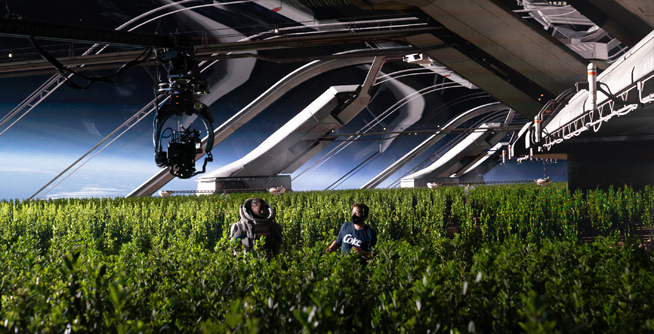
Near the end of the main shoot, cast and crew assembled at Pinewood Studios in Roberts’ native United Kingdom where they primarily shot on the ILM StageCraft virtual production volume for scenes aboard the suborbital craft, NOMAD. “Having worked on Obi-Wan Kenobi, getting back on the StageCraft stage was very refreshing and familiar,” Roberts says. “The environments were created in Helios, our real-time rendering system. The team works on measurements of the physical set and then do the layout and tracking to extend from the physical into the digital. 

“For me, it was interesting to be on the client side this time,” Roberts continues. “For Obi-Wan, I was on the stage team. We’d get in early before the director, cast and crew. They’d bring their material in and we’d accommodate, making adjustments based on what the D.P. and director needed. Then they shoot for the day and leave. On The Creator, I was on that crew coming in. It was interesting seeing things from that perspective and observing what ILM provided, not only in terms of the technical and creative wizardry of the Stagecraft volume, but also in their meticulous planning and careful communication, ensuring every department had  what they needed.”

Before they had completed work in Thailand and moved to England, Roberts had an opportunity to direct second unit work on The Creator, which he describes as “a blessing” and “something I did not anticipate. We were in Northern Thailand, at the location where Joshua’s getaway car broke down at the crossroads. While Gareth was shooting conversations, there were these beautiful hills in the background. He came to me and explained that he needed background footage for the jetcopters when they’re flying, taking off, and landing, and could I take the drone team and shoot that material? It was wonderful to see some of that material make it into the film.”

After the main unit wrapped, Roberts collaborated with CG supervisor Adam Watkins in organizing all the reference information and preparing summary documents for the incoming visual effects crew. Before leaving the project, he even had the chance to contribute to a few early shots aboard the NOMAD, pulling on his skills developed in earlier roles as a generalist artist. “We had a version of that set created with Unreal Engine, which Gareth used to plan camera moves and framing,” Roberts notes. “I was able to import that real-time model into 3ds Max, and using gen tools I painted textures and got it into a good starting position. I didn’t finish any shots, but enjoyed working  on a couple of those angles.”

Looking back on the experience, Roberts explains that it “really changed me in a number of ways. I was able to observe Gareth, who made the transition from visual effects artist to director, has maintained his love for sci-fi, and creates great works of art. It’s inspirational to get to know someone like that. He’s very down to earth and remains close to the art and craft of visual effects. The experience has improved my confidence in my own abilities. There were areas when I was stretched beyond what I had anticipated, more than anything I’d done before. In the past, I’d expected to have support from a couple of people, but seeing what I was able to do myself, and seeing what beautiful work ILM was able to achieve without the full compliment of resources, will stay with me. 

“It’s not ideal, of course,” Roberts continues, “but it is possible to get shots done without all of the information, which is sort of the old school way. It recalibrates what is absolutely necessary for me. It’s also made me look at filmmaking slightly differently. Gareth often said that he didn’t want all of those instruments and accouterments to get in the way of the director and the actors. On other film sets, people might be watching from a video village, the signal goes down and they tell the director to stop. Gareth didn’t want any external factors to interfere with his process, so if the signal stopped, he kept shooting to maintain that pure moment with the actors. He often kept the video village out of sight so that he could rotate 360°. There were times when Oren, myself and a few crew members would be shuffling behind Gareth so he could perform a sweeping 180° camera move.

“It was really refreshing to see this approach,” Roberts concludes. “I’ve opened up my mind to what’s possible. Those ideas of being scrappy and not thinking there’s only one way to do things will keep informing me on future projects.”

Andrew Roberts captures location data on location for The Creator, including with actor Ken Watanabe.
Roberts capturing onset data while on location in Thailand, including with actor Ken Watanabe.

Read more from Roberts and his fellow ILM crew members on The Creator.

Lucas O. Seastrom is a writer and historian at Lucasfilm.

Join creator Dave Filoni, Production Visual Effects Supervisor Richard Bluff, Animation Supervisor Paul Kavanagh, and Visual Effects Supervisor Enrico Damm for a roundtable discussion on the visual effects of Lucasfilm’s hit Disney+ series ‘Ahsoka’.
After 25 years at ILM, Cooper has earned a reputation for seeking out the most efficient solutions to creative problems.

By Lucas O. Seastrom

Back in 2002, Industrial Light & Magic’s Jay Cooper was a compositing sequence supervisor on Master and Commander: The Far Side of the World (2003). For a time, director Peter Weir joined the ILM crew at their offices on Kerner Boulevard in San Rafael, California. “We had a shot when the mast of one of the ships falls over,” Cooper tells ILM.com. “There’s all this gunfire. It’s completely enshrouded in smoke. As I’m working on it, Weir comes to my desk and he says, ‘I want it to look like a beautiful nightmare.’ I was like, ‘Wow, that’s cool. Now what does that look like?’ [laughs]”

Over the past two decades, Cooper has moved into the visual effects supervisor role, working on projects as varied as Eternals (2021) and Babylon (2022). Most recently, he partnered with writer/director Gareth Edwards on The Creator (2023), a science-fiction tale with an unconventional visual effects methodology. As he and the ILM crew navigated the challenges of integrating effects into location photography with minimal reference data, Cooper managed to connect with Edwards in a way that reminded him of his experience with Peter Weir.

“Normally, as a visual effects supervisor, you’re being much more granular in your notes, lots of technical conversations,” Cooper says. “You don’t usually engage with artists in an emotional way. That’s what is really wonderful when you’re exposed to working with directors. That’s my favorite part of being a supervisor: you’re not always in the weeds talking about those details, you’re trying to engage with it at a story level. That’s the part that artists love. Gareth partnered with us in that way, and people got really excited about the project. Fun things happen when people get excited. They sneak in extra takes. They devote themselves in a huge way. We asked people to do really hard stuff without all of the support materials. If they know what we’re trying to achieve and we’re all pulling together, it can help make up for those shortcomings.”

At the beginning of the project, ILM’s chief creative officer Rob Bredow asked Cooper to meet with Edwards and producer Kiri Hart. “Gareth said, ‘Hey, I’ve got this movie and I hear you’re the guy who likes to cheat,’” Cooper says with a laugh. “He said that probably in the most affectionate way. I’m not really a devotee of any sort of process. I worship at the altar of whatever we can do as quickly and as simply as we can do it. As an artist, that was my forte. I did lighting and compositing, and I would try to navigate as many shortcuts as I could. I guess my reputation as a visual effects supervisor was that I’d work on shows with really small budgets and we’d try to wring out whatever production value we could. I think that’s why Rob put us together.”

Director Gareth Edwards operating the camera on location in Asia during production on The Creator.

Edwards’ vision and Cooper’s style were in tandem. In terms of workload, The Creator would be Cooper’s biggest project to date as a visual effects supervisor. “One of the best pieces of advice that [ILM executive creative director] John Knoll ever gave me,” Cooper notes, “was that you take big problems, break them into smaller problems, and smaller and smaller. So we created teams to hit different problems. We knew that we were going to be behind the 8-ball. We knew that Gareth had a smaller-than-desired budget, and he came to us wanting to partner in a different way.”

Edwards had been a visual effects artist himself before taking the director’s chair full-time. In his 2010 feature directorial debut, Monsters, he famously created many of the visual effects on his own. For Cooper, this practical experience helped define ILM’s approach to crafting visual effects with a “scrappy” sensibility. Shooting primarily on location in Thailand, Edwards focused on capturing his actors and the dramatic landscapes where they played out their scenes. Traditional effects tools like bluescreens and tracking markers would be almost completely avoided, and ILM would need to integrate their CG elements without the normal reference tools.

Looking into the ILM StageCraft volume during production on The Creator.

“Most of the time doing visual effects work, it’s very much a spreadsheet problem. You have seven robots at this amount of money, or fifteen environments at this scale at this amount of money. Even at the bidding stage for The Creator, we were instead asking what we could do for a certain amount of money. Just as a scrappy filmmaker, Gareth wanted to know what was possible in visual effects if we used different techniques and structured the show differently. 

“If we take a whole sequence,” Cooper continues, “Gareth would explain how there’s only so much information you can take in during one shot, so let’s put everything together, bring it all up, and water the one element that’s dying. If you didn’t feel like there were enough robots here, how much do you need to add? Where’s your eye going to go? If a frame feels empty, what can we add? Is there a way to add something that avoids a roto-nightmare? Can we structure it so we don’t see the element in one shot but we do see it in the next two shots so that you sort of complete what the image is? Loosely, that’s how we went off and did the work.”

Much of that questioning and analysis was open to the larger visual effects crew. Initially, Edwards had planned to embed himself within ILM’s studio to personally oversee the work. Although pandemic concerns ultimately scratched that idea, he still welcomed artists from deeper in the ranks to present their work directly and share ideas. 

Gareth Edwards discusses a scene with John David Washinton in the ILM StageCraft volume.

“It takes a rare person to be comfortable enough to share your feedback openly with artists on the production,” Cooper notes. “It’s really wonderful. You get a level of engagement that you may not always find. Sometimes working on blockbusters, you can feel like you’re just punching numbers. But if you expose the artists to the reasoning behind something, the filmmaking intent, you get a huge level of engagement.”

As visual effects supervisor for the entire production, Cooper was busy overseeing work not only at ILM’s studios in San Francisco, London, Sydney, and Vancouver but also the assortment of smaller vendor studios enlisted to assist on the project. The initial shot count estimate had more than doubled by the time Edwards shared his initial cut. As he points out, ILM contributed “about 95% of the asset work and the lion’s share of the shot work” with the support of the vendors. 

“As a supervisor, I’m sort of tapping the boat,” Cooper says. “You can’t be in every single file to model the rivets. You can’t go into every composite to add the elements. You’re asking for degrees of one thing or another, and there are a lot of places where people are volunteering an idea. They’re doing it in a way that they understand what the stylistic or aesthetic goal is.”

Overall, Cooper’s experience on The Creator felt like a return to an earlier era in visual effects, one that speaks directly to ILM’s can-do spirit. “ILM tries to find projects that are outside of the comfort zone of what has happened previously. It must have been wonderful in the late ‘80s or early ‘90s when the question wasn’t ‘can you do this?’ It was, ‘is this even possible?’ Those times have ended in many different ways. You do it enough times, and there’s a cost structure around it. So it’s interesting to be on a project where you chuck a lot of that away and get back to the basest level. We have a pot of money and a director with some big ideas. That’s the launching point. It’s cool and exciting to be in that world again.”


Read more about ILM’s work on The Creator with more from Cooper and his team.

Lucas O. Seastrom is a writer and historian at Lucasfilm.

The nominations for the 2023 Emmy Awards have been revealed, and three ILM projects were recognized with nominations. Lucasfilm’s The Mandalorian, Andor, and Amazon Studios’ The Lord of the Rings: The Rings of Power were each nominated in the Special Visual Effects category. This marks the third time that The Mandalorian has been nominated in the category having won the award each of its first two seasons.

The Mandalorian visual effects supervisor Grady Cofer shared, “It is such an honor to be recognized. The nomination is a testament to Jon Favreau’s commitment to excellence, and to the passion and dedication of the entire VFX team. Thanks to all the Television Academy members who have supported The Mandalorian through the years.” Nominated alongside Cofer were visual effects producer Abbigail Keller; animation supervisor Paul Kavanagh; Assoc. Visual Effects Supervisor, Cameron Neilson, special effects supervisor, Scott Fisher; Animation Supervisor Hal Hickel; Legacy Effects Supervisor, J. Alan Scott; ILM visual effects supervisor Victor Schutz IV; and ILP visual effects supervisor, Bobo Skipper

Andor visual effects producer TJ Falls said, “I’m very excited that Andor was recognized with a nomination for Outstanding Special Visual Effects. It’s a testament to the collaboration of the team and the incredibly remarkable talents of each of our nominated members, as well as those around the world who contributed to the project.” Falls was joined by fellow nominees visual effects supervisor, Mohen Leo; ILM visual effects supervisor, Scott Pritchard; Richard Van Den Bergh, special effects supervisor; Neal Scanlan, creature effects & Droid supervisor; Liana Mansor, lead visual effects editor; Joseph Kasparian, Hybride visual effects supervisor; Jelmer Boskma, Scanline visual effects supervisor; and Colorist, Jean-Clément Soret.

The Lord of the Rings: The Rings of Power nominees include Ron Ames, visual effects producer; Jason Smith, visual effects supervisor; Nigel Sumner, ILM visual effects supervisor; Ara Khanikian, Rodeo FX visual effects supervisor; Dean Clarke, SFX supervisor; Ken McGaugh, Weta FX visual effects supervisor; Tom Proctor, DNEG visual effects supervisor; Greg Butler, Method Studios visual effects supervisor, Joe Henderson, visualization creative supervisor, The Third Floor, Inc.

The 75th Emmy Awards is currently scheduled to broadcast live on FOX on Monday, September 18, (8:00-11:00 PM EDT/5:00-8:00 PM PDT) from the Peacock Theater at L.A. LIVE.

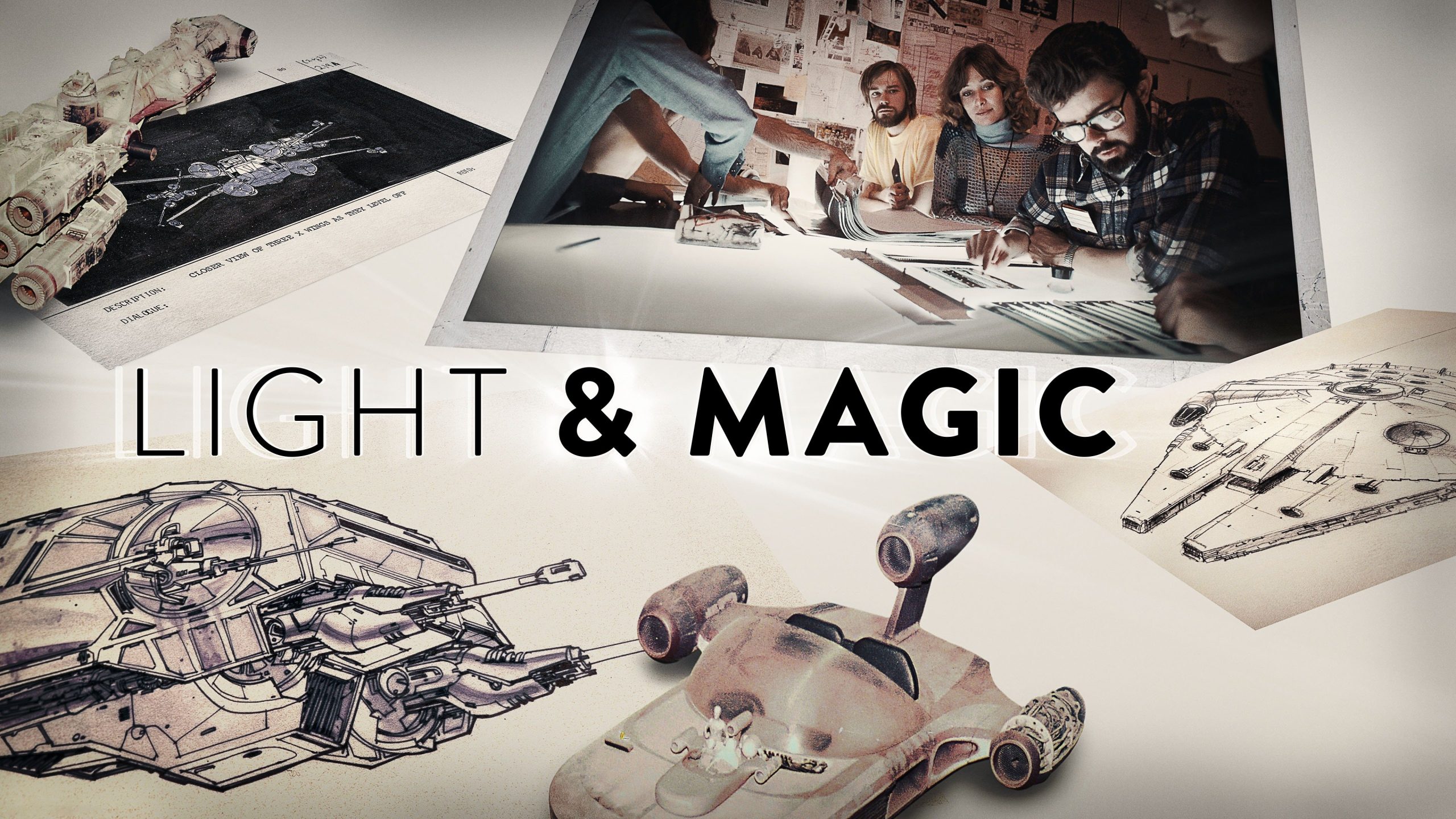
The filmmaker and Lucasfilm legend talks to ILM.com to reflect on what drew him to tell the story of the hit Disney+ series, “Light & Magic”.
Screenwriter and director Lawrence Kasdan.

How did you get involved with Light & Magic?
Several years ago my wife and I made a short documentary about a little diner that we used to eat at all the time that suddenly closed. In making that documentary with her, and cutting it with terrific people, it made me realize how much I liked the documentary format. I had never done that. We set out to meet some documentary people and I met Justin Wilkes at Imagine Entertainment. He asked me what I was interested in doing and I suggested a history of visual effects, because even though I had been around visual effects throughout my career, it occurred to me that I didn’t know much about them. The second thing that interested me were the people of Industrial Light & Magic that I had been working around for over forty years. So we both agreed that that would be a great story to tell: the history of visual effects, and the personal stories of these people. What drove these people, what was their life like, what made them want to stay at ILM as long as they did? Everyone loved the idea, so we went to work.

Lawrence Kasdan, center, on the set of Star Wars: The Empire Strikes Back.

What was your vision for the documentary?
From my very first film until today, I’ve always considered myself a humanist filmmaker. I’m interested in what happens between people, and why people make certain decisions in their lives. What chance is involved? What fate? What luck? So from the very beginning of this I was interested in learning what brought these people to this work. What were the relationships that they made when they arrived? Why did they continue to work there much longer than they expected, some for nearly half a century? What has all that meant to these amazing advancements in technology? It’s about people, and their gifts, and out of those gifts came technological advancements that boggle the mind.

Dennis Muren, left, and Phil Tippett, right, review images with Joe Johnston.

Why did you think this story should be told?
Because it’s great to see artists at work. The commitment of great craftsmen. I love to see people that have mastered a skill, and try to make it better, and don’t settle. I think it’s great to see expertise and this pure devotion to discipline, and that is always a good story to see. Dennis Muren, left, and Phil Tippett, right, review images with Joe Johnston.

John Dykstra and a fleet of miniature TIE, X-wing, and Y-wing starfighters.

How did you approach the research, and what resources did you use?
We had a fabulous team that Imagine Documentaries put together, some internal to the company, and some that were freelancers. They really knew their stuff, so it was a great luxury for me as a director. There were so many things that I wanted to ask during interviews, but the input from this incredible group of producers and writers and editors stimulated me all of the time to go in different directions during interviews.

ILM’s Paul Huston and Larry Tan on the set of Star Wars: Return of the Jedi.

For those that have yet to watch it, can you tell readers what the timeline of the series is?
Over the six hours we see the very birth of ILM, what happened as it came together during the production of Star Wars: A New Hope, and then off of the success of that film, how it was launched into a nearly fifty-year enterprise. We mainly follow it chronologically, but we do jump around a bit to serve the story. Part of the kick for me was that we had such a trove of archival footage, so these people might be talking about something from forty or fifty years ago, and we had stills from that moment in their career. It was incredible to be able to cut from one to the other across time, to hear them talking about a problem, and then see footage of them finding a solution. A huge part of ILM’s legacy is finding solutions to problems.

Peter Kuran, Rose Duignan, and George Lucas review effects shots for Star Wars: A New Hope.

How did you select the filmmakers that were featured in the documentary?
They are all giants, and they have all used ILM in the most expressive and innovative ways. They put pressure on themselves and then turned to ILM and said, “can you do this? Can you create something for me that I have never seen before?” ILM would always say yes. And sometimes it might be a struggle, and sometimes it might be a long process, and sometimes it might be an instantaneous solution where one of these genius people that work there would say, “I know what we could do”. These are major filmmakers that have contributed to the zeitgeist. Jim Cameron, Steven Spielberg, Bob Zemeckis, J.J. Abrams, and at the heart of it, of course, is George Lucas.

Lawrence Kasdan and J.J. Abrams on the set of Star Wars: The Force Awakens.

What was the most interesting thing you learned throughout the process of creating Light & Magic?
I think I learned what goes into creating something new, working with people you respect and depend on, and how this personal relationship then impacts the professional work. There is something beautiful about the generosity of the people that work at ILM, and through that generosity they are able to discover new frontiers and break new grounds that no one has ever been able to do.

All episodes of Light & Magic are streaming now on Disney+.

ILM | A legacy of innovative and iconic storytelling.

Today, teams across Industrial Light & Magic (ILM) and Lucasfilm mourn the loss of our former colleague Richard Miller, who recently passed away at the age of 80.

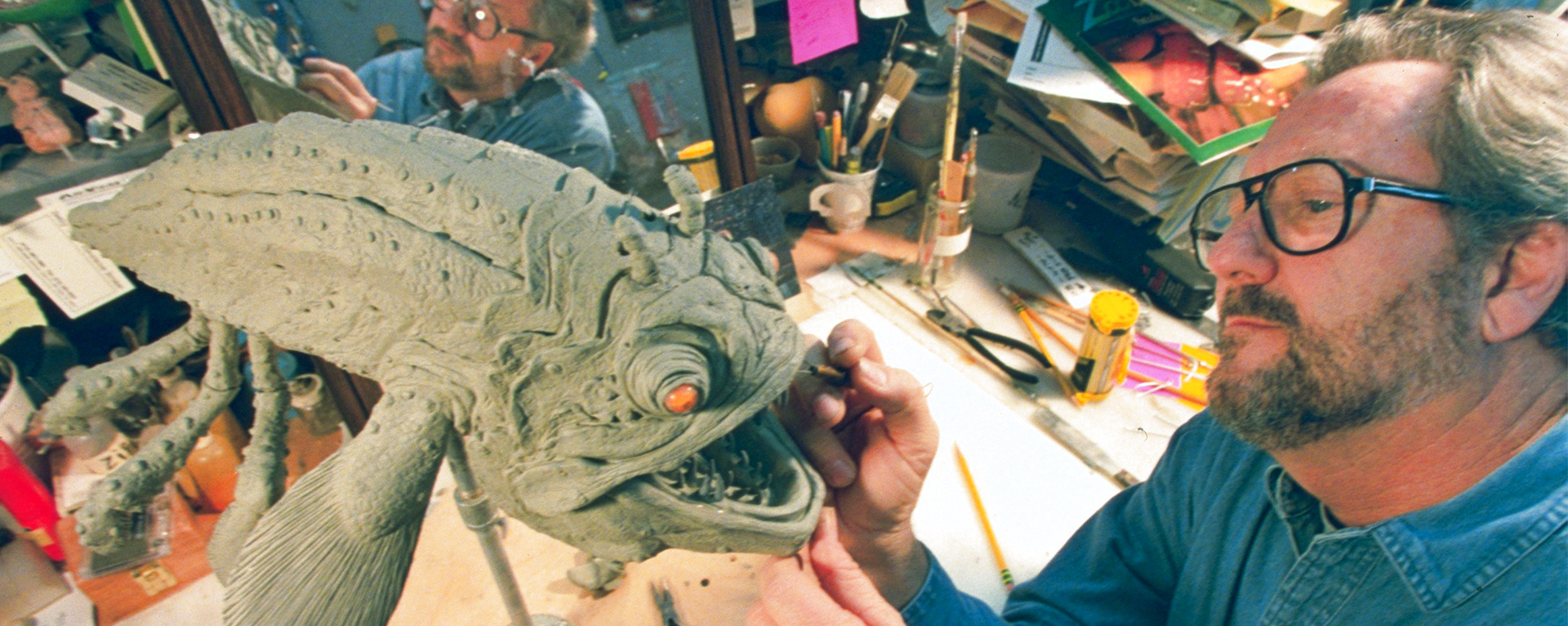
Before he was hired at ILM in 1981, Miller worked as a freelance sculptor and jeweler, developing a unique style of sculpting characters that fused modern flair and classical elegance. Yet another in a succession of Long Beach State University alumni to join ILM, his first task was to sculpt an elaborate metal bikini worn by Princess Leia in Star Wars: Return of the Jedi (1983). The almost inflexible piece had to carefully fit actress Carrie Fisher. That unique assignment grew into an ILM career spanning nearly 30 years.

“I worked with Richard on a great many projects over the years,” says visual effects supervisor and executive creative director John Knoll, “and his warm and gentle disposition combined with his terrific talent and artistry made him always a joy to work with. I’ll miss that easy smile.”

Miller found his place in the company’s hallowed model shop, where some of the world’s most devoted artisans plied their craft on hundreds of visual effects projects. As sculptor, he contributed to dozens of films, helping make countless figures and characters.

Just some examples are serene whales in Star Trek IV: The Voyage Home (1986), the Statue of Liberty for Ghostbusters 2 (1989), the iconic helmet in The Rocketeer (1990), a rhinoceros and elephant in Jumanji (1995), and Davy Jones in Pirates of the Caribbean: Dead Man’s Chest (2006). Among many Star Wars creations, Miller sculpted towering statues for the Jedi Temple and a frieze depicting an ancient battle between the Jedi and Sith visible in Chancellor Palpatine’s office.

“Richard was the ultimate collaborator,” says creative director David Nakabayashi. “Every day on AI: Artificial Intelligence he would say, ‘What are we doing today!’ You would have very little to say as his work spoke for itself. He always made things better than you imagined. He was a true artist and loved to teach others. His workshops were always full of students who loved to learn from him and hear his stories.”

As revered as he was for his artistry, Miller was also beloved as a teacher and mentor. For years he led workshops and classes at ILM, sharing his knowledge and experience with new generations of artists. A number of Miller’s works remain in ILM’s collection, and have been admired by countless visitors to Letterman Digital Arts Center.

With an ILM career paralleling changes in visual effects as practical techniques evolved into digital ones, Miller is a shining example of how timeless artistic principles remain at the core of any artist’s work, no matter the tools or the medium.

“Richard was one of my closest coworkers, my teacher and an endearing and unique part of the model shop family,” says texture supervisor Jean Bolte. “He taught me a lot, about sculpting, about living well, and occasionally about patience, as good friends do. Farewell Richard. I’ll miss you.”

New Mumbai studio to provide full visual effects and animation services for film & television

Cassian Andor (Diego Luna) in Lucasfilm’s ANDOR, exclusively on Disney+. ©2022 Lucasfilm Ltd. & TM. All Rights Reserved.

Industrial Light & Magic (ILM), the award-winning visual effects division of Lucasfilm Ltd., announced today that the company is expanding its global operations. The studio, which is headquartered in San Francisco and has existing studios in Vancouver, London, Singapore and Sydney, will open a new full pipeline studio in Mumbai to gain access to the incredible talent base in the region. The Mumbai studio will be led by Kiran ‘KP’ Prasad, who was formerly head of studio at DNEG Bangalore & Chennai. Prasad will report to ILM SVP and General Manager, Janet Lewin.

Kiran Prasad, Executive in charge, Mumbai studio.

“With five global studios consistently operating at capacity and continuing to grow, the time was right for ILM to expand once again to meet the industry’s increasing demand for high-caliber visual effects,” explained Lewin. “This new full-fledged visual effects studio in India will allow us to offer even greater capacity while ensuring that we always meet the high-quality bar that our clients expect of us.” 

Rob Bredow, SVP and chief creative officer of ILM noted, “We’re excited to be building our ILM Studio in India where we can recruit the top artistic and technical talent from the visual effects industry now in India. This is the perfect time for ILM to form our sixth studio where artists will leverage our full pipeline of disciplines working across a wide variety of exciting shows – at the top quality and reliability our creative partners have come to expect from ILM.”

“ILM has always been at the forefront of technological and creative innovation in the visual effects industry and there is no better time to start our studio in India than now, as the Indian VFX industry is poised for spectacular growth in the coming years,” said Prasad. “It is exciting and an honor to be part of the ILM team at such a key moment in the VFX industry with technological developments pushing the boundaries of visual storytelling. I look forward to working with the executive team to set up the studio from the ground up, building a world-class facility, and bringing the best of the diverse Indian talent together for  an opportunity with endless possibilities.”

ILM’s last expansion effort came in 2019 with the company’s Sydney studio. That studio is currently 400 people strong and growing. Combined, the ILM global studios will grow to over 2,500 artists and will continue to offer award-winning visual effects and animation as well as concept design and development, and virtual production, with the artistry, innovation, and creative problem-solving that is the hallmark of the company. As with the other studios, ILM’s Mumbai studio will work on all projects of all shapes and sizes, including live-action and animated feature films, television, streaming, and themed attractions.

ILM will be hiring leadership, technology, support, production, and artist roles over the coming months, openings will be posted on https://www.ilm.com/careers.

Six-Part Docuseries Debuts Exclusively on Disney+ July 27

Disney+ released the trailer and key art for Lucasfilm and Imagine Documentaries’ “Light & Magic,” an immersive series that chronicles the untold history of world-renDisney+ released the trailer and key art for Lucasfilm and Imagine Documentaries’ “Light & Magic,” an immersive series that chronicles the untold history of world-renowned Industrial Light & Magic (ILM), the special visual effects, animation and virtual production division of Lucasfilm.

Granted unparalleled access, Academy Award®-nominated filmmaker Lawrence Kasdan takes viewers on an adventure behind the curtain of Industrial Light & Magic. Learn about the pioneers of modern filmmaking as we go on a journey to bring George Lucas’ vision to life. These filmmakers would then go on to inspire the entire industry of visual effects.  

The series is directed by Lawrence Kasdan, and the executive producers are Ron Howard, Brian Grazer, Justin Wilkes, Lawrence Kasdan, Kathleen Kennedy and Michelle Rejwan. 

All six episodes of “Light & Magic” premiere on July 27, exclusively on Disney+.

Twitter@DisneyPlus@ILMVFX
Instagram@DisneyPlus@ILMVFX
Facebook@DisneyPlus@ILMVFX
TikTok@DisneyPlus
Hashtag: #DisneyPlus

ABOUT DISNEY+

Disney+ is the dedicated streaming home for movies and shows from Disney, Pixar, Marvel, Star Wars, and National Geographic, along with The Simpsons and much more. In select international markets, it also includes the new general entertainment content brand, Star. The flagship direct-to-consumer streaming service from The Walt Disney Company, Disney+ is part of the Disney Media & Entertainment Distribution segment. The service offers commercial-free streaming alongside an ever-growing collection of exclusive originals, including feature-length films, documentaries, live-action and animated series, and short-form content. With unprecedented access to Disney’s long history of incredible film and television entertainment, Disney+ is also the exclusive streaming home for the newest releases from The Walt Disney Studios. Disney+ is available as a standalone streaming service or as part of The Disney Bundle that gives subscribers access to Disney+, Hulu, and ESPN+. For more, visit disneyplus.com, or find the Disney+ app on most mobile and connected TV devices.

MEDIA CONTACTS

Disney+ Media Relations
Shelby Cotten
Shelby.b.cotten@disney.com

Walt Disney Studios Global Publicity
Global Publicity (NY)
Derek Del Rossi        
derek.del.rossi@disney.com

Lucasfilm Publicity
Ian Kintzle 
ikintzle@ilm.com