
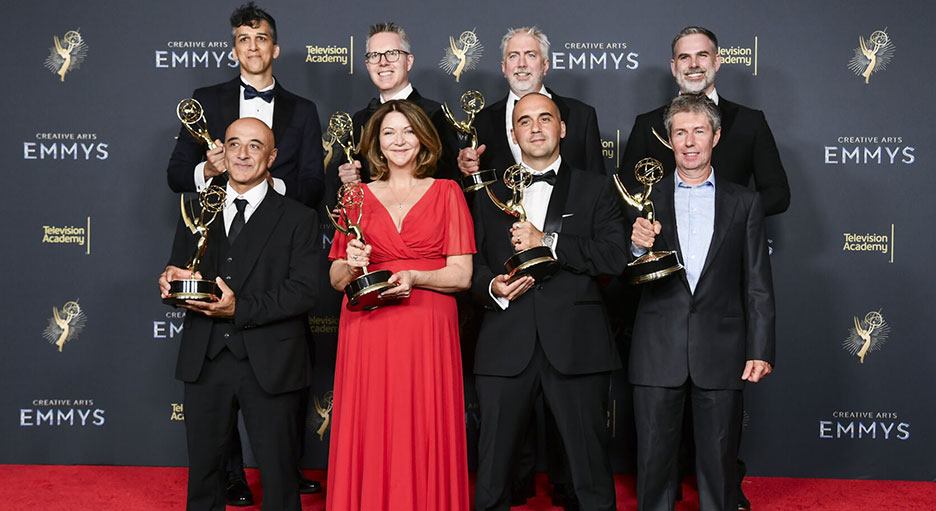
ILM’s Mohen Leo and Scott Pritchard and Lucasfilm’s TJ Falls are among the winners for “Outstanding Special Visual Effects in a Season or a Movie.”
The team from Andor pose in the press room with the award for outstanding special visual effects in a season or a movie during night one of the Creative Arts Emmy Awards on Saturday, Sept. 6, 2025, in Los Angeles. (Credit: Richard Shotwell/Invision/AP)
The 2025 Creative Arts Emmy Awards took place on September 6, and Lucasfilm’s Andorseries took home four wins, including “Outstanding Special Visual Effects in a Season or a Movie.” Industrial Light & Magic’s Mohen Leo – who served as Andor‘s production visual effects supervisor – took home the award along with ILM visual effects supervisor Scott Pritchard and Lucasfilm’s visual effects producer TJ Falls.
The other Emmy recipients for “Outstanding Special Visual Effects in a Season or a Movie” include special effects supervisor Luke Murphy, special creature effects lead Neal Scanlan, Hybride visual effects supervisor Joseph Kasparian, Scanline visual effects supervisor Sue Rowe, In-House visual effects supervisor Paolo D’Arco, and digital colorist Jean-Clément Soret.
ILM’s Mohen Leo, production visual effects supervisor of Andor, attends the Governors Gala at the 2025 Creative Arts Emmy Awards (Credit: Invision/AP).
—
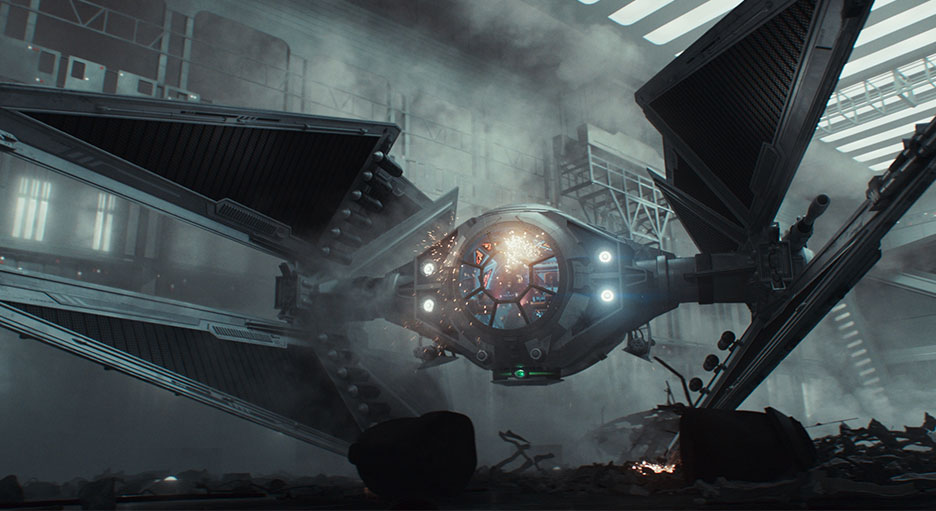
ILM visual effects supervisors Mohen Leo and Scott Pritchard, along with members of their talented crew, discuss the process behind building the TIE Avenger as it journeyed from concept to screen.
By Jay Stobie
(Credit: ILM & Lucasfilm).
For many Star Wars enthusiasts, the word “avenger” conjures up images of Captain Needa’s Imperial Star Destroyer Avenger, the TIE Avenger starfighter featured in Lucasfilm Games’s Star Wars: TIE Fighter (1994) video game, or even Marvel’s prestigious superhero collective. The second season of Andor (2022-2025) has now pushed its own TIE Avenger to the forefront of that list, as the epic series chronicled Cassian Andor’s (Diego Luna) theft of the prototype craft from a Sienar Fleet Systems test facility. Outfitted with advanced armaments and a hyperdrive, the TIE Avenger transported Cassian to Yavin 4 before playing a key role in rescuing Bix Caleen (Adria Arjona) and Wilmon Paak (Muhannad Ben Amor) from Imperial forces on Mina-Rau.
Industrial Light & Magic’s Mohen Leo, whose resume boasts projects like Ant-Man (2015), The Martian (2015), and Rogue One: A Star Wars Story (2016), served as Andor’s production visual effects supervisor for both seasons of the series, while ILM visual effects supervisor Scott Pritchard (Star Wars: The Force Awakens [2015], Avengers: Infinity War [2018], Avengers: Endgame [2019]) oversaw the creative output of the work across ILM’s global studios in London, Vancouver, and Mumbai. Leo and Pritchard gathered alongside CG supervisor Laurent Hugueniot, modeler Owen Rachel, texture artist Emma Ellul, look development artist Renato Suetake, animation supervisor Mathieu Vig, and compositing supervisor Claudio Bassi to chart the TIE Avenger’s course from conceptualization to the completed sequences seen in season two.
Constructing the Concept
The TIE Avenger prototype is first unveiled at the beginning of season two, resting in its Sienar hangar bay before being commandeered by Cassian and embarking on a dramatic escape. “The idea for the opening sequence began with [showrunner] Tony Gilroy wanting to start season two off with a big, classic Star Wars action sequence,” Mohen Leo tells ILM.com. “That initially came out of an outline that Tony gave us in 2022. Early on, a big story point became that Cassian doesn’t know how to fly it, so the Avenger had to have completely unfamiliar controls, and the interior had to look different from any TIE fighter or ship that you’ve ever seen before.”
When it came to the Avenger’s look and layout, Leo worked closely with production designer Luke Hull. “Luke explored various prototype airplanes, and then we played around with the idea of what the ship needed to do in terms of the chase sequence. We wanted something that wasn’t just a dogfight. If he immediately jumps in and it’s just a chase, it’d be difficult to do something original with that,” adds Leo. “Luke had already decided to build a full-sized practical TIE Avenger. As far as its physical construction, the wings were inspired a bit by the TIE interceptor.” While Andor’s Avenger shares a name with the craft from the TIE Fighter game, it maintains its own design lineage. “I don’t think the previous ship was a strong influence,” Leo begins. “When we were designing our Avenger, how the ship functioned became something Luke and I reverse-engineered based on what we wanted the ship to do. That dictated the look.
(Credit: ILM & Lucasfilm).
“I put together a pitch deck for the Avenger before we got into previs when the directors weren’t even on yet,” Leo continues. “I wanted to make sure that the ship and the weaponry, in particular, were based on real weapons and felt both dangerous and aggressive. The team based the TIE’s fold-out Gatling-like cannons on the United States military’s M61 Vulcan rotary cannon. Hull wanted the Sienar base itself to feel like a Skunk Works test facility or NASA’s Jet Propulsion Laboratory.
“It was a back-and-forth between previs and Luke Hull and the art department in terms of the ship’s design,” Leo notes. “We’d say, ‘We need guns that fold out,’ and then Luke would go, ‘Let me see where we can fit those in.’ It was almost as much driven by the necessity of the functionality as it was by the aesthetics.” Once the additional armaments, including external launchers and a powerful cannon below the cockpit, were set, the team pitched the action sequence to Tony Gilroy. “We blocked the whole sequence with a temp model, and Tony generally really liked it.”
Assembling the Avenger
“As the studio-side visual effects supervisor, I was involved in pre-production through to the end,” Leo shares. “I also guided the previs development with The Third Floor’s Jennifer Kitching and collaborated with Luke Hull on how we would make the practical build service what we needed to do in the visual effects sequence.” The creative dialogue between the ILM visual effects team and the production designer was vital in ensuring that the computer graphics (CG) starfighter built by ILM would be identical to the full-sized practical ship that was constructed to be used on the Sienar hangar, Yavin 4, and Mina-Rau sets.
“Because we had a practical version of the Avenger during the shoot, we were able to scan that and provide lots of references,” Leo details. As such, the full-scale Avenger proved beneficial for Owen Rachel, the ILM modeler responsible for building the CG Avenger. “My job was to take [the practical model] and replicate it as a digital version. There wasn’t much design work that we had to do other than replace some structural bits, like the Gatling guns as they come down,” Rachel outlines. “We did have to create the laser cannon that comes out from underneath the cockpit. It’s an intricate design because it’s both delicate and powerful at the same time. It felt a bit like the inside of a watch,” recalls CG supervisor Laurent Hugueniot, who was in charge of the team’s 3D output.
The practical TIE Avenger prop on set at Pinewood Studios (Credit: ILM & Lucasfilm).
Texture artist Emma Ellul tackled the job of texturing the TIE Avenger. “We had great reference images, which was super helpful. I tried to focus on real-life objects, too, such as stealth planes. They’re quite smooth and angular, and I’d see how specularity affects the metal. Not every sheet of metal is made the same, so it has a slightly different bend or warping to it. I incorporated that, especially on the paneling on the outside of the wings,” Ellul relays. “There were a lot of nooks and crannies to look at and a lot of small decals everywhere, which I had to match one-to-one with the practical model. It was an awesome asset to texture. Who doesn’t want to texture a TIE fighter? And then I had to destroy it and chuck laser blasts all over it [laughs].”
Look development on the Avenger was handled by Renato Suetake, who asserts, “As a look dev artist, I get the model and textures so I can put them together and make the shaders. I make sure the shaders and materials react precisely like the reference we have in any situation or lighting condition. Certain shots jumped between the prop filmed on set and the CG version, so the digital Avenger had to be identical. At the same time, because the prop wasn’t made of metal, we still had to make it believable as an actual spaceship that flies.” From the Avenger’s weapons to the hangar explosions to the collapsing ice arch, Leo also credits the effects artists who contributed to the sequence, revealing, “In general, all of those things are just massive, complex simulation work.”
Pairing Computer Graphics and Practical Effects
As Andor’s ILM visual effects supervisor, Scott Pritchard helmed his team at ILM’s London studio, while coordinating the work at ILM’s studios in Vancouver and Mumbai. When it came to the Avenger’s breakout from the Sienar hangar, Pritchard observes that the production sought to use the “best tool for the job,” often pairing ILM’s CG expertise alongside special effects supervisor Luke Murphy’s practical effects. Highlighting a shot where an Imperial range trooper takes aim at the Avenger, Pritchard beams, “There’s a huge staged explosion along the back wall that was done by hanging a line of charges. They explode in sequence, so they explode outwards from the center. That in itself is impressive because it gives us some great visual reference to go on and actual practical elements to incorporate into the final comp.
(Credit: ILM & Lucasfilm).
“There’s a significant amount of work involved in painting out the actual charges and all the little fragments that get blown off properly, as well. It gives you such a great base to work off when you’re putting together a shot like that,” continues Pritchard, who then shifts focus to the Avenger’s weapons blasting through the hangar. “A lot of these explosions are practical, but we’ve enhanced them by adding sparks and additional explosions in CG. Making all this work seamlessly is a great testament to the comp and effects team.”
Compositing supervisor Claudio Bassi concurs, believing that the practical effects supplied ILM with valuable reference for lighting purposes. Bassi also states that, despite the presence of the practical Avenger, the TIE’s wings during Niya’s (Rachelle Diedericks) inspection are actually CG. “The hangar set didn’t have a roof, so we often replaced the wings as it was easier to integrate the CG roof.” Although the hangar set was extremely large, Pritchard highlights the fact that ILM had to extend the hangar to an even greater width, and the entirety of the front section that opens toward the snowy exterior is also CG.
Maintaining a Match
Of course, having both a practical and digital Avenger presented its own challenges when it came to assuring that the details matched, particularly regarding how much damage the CG version sustained at Sienar in comparison to the practical model that was filmed on the Yavin 4 set. “Working with the art department, we knew that the Avenger had gone through the dogfight at Sienar base and should have scorch marks where lasers had hit it,” Leo remembers. “We counted the number of rockets it fired in the first sequence because there’s no way for him to restock in space. We took four specific missiles off the practical build, which we then reversed in digital effects to choose the four that he fires in the opening sequence.”
Hugueniot emphasizes that the same held true for the havoc wrought upon the Sienar hangar itself, commenting, “Not all shots are worked on one after another in story order. There’s a big job of keeping track of what’s going on in every shot. All the scorch marks on the walls, everything that’s been knocked down from the ceiling, and which lights are working in each shot. That was quite a job [laughs].” Bassi agrees, divulging, “We kept track of the marks where the Avenger scratched the floor and which lights broke, and we had a system to recognize them in shot order.”
(Credit: ILM & Lucasfilm).
That level of realism was reflected in animation supervisor Mathieu Vig’s mission to make the Avenger look “heavy and dangerous, and as if it’s made of metal, not just pixels.” Having the Avenger scrape along the deck helped achieve this. “We’re used to seeing them [TIE fighters] flying very gracefully,” Vig explains. “Usually, we don’t animate them bumping around, so setting the weight is harder than you might think. In a hangar setting, there are so many physical elements to consider, such as the actor in the cockpit doing specific movements that we have to take into account. All of this is a carefully interlocking puzzle.”
Diving Into the Details
While analyzing the projectiles under the practical Avenger’s wings to model them for its digital counterpart, Owen Rachel recognized an intriguing connection. “When we were trying to work out how the missiles fire, we realized the design on the set was similar to those seen in Star Wars: A New Hope [1977], as they go into the exhaust port on the Death Star,” conveys Rachel. As it turns out, the design was a one-to-one match, so Rachel subsequently modeled the Avenger’s projectiles after the proton torpedoes that Luke Skywalker (Mark Hamill) fired at the first Death Star. Effort was also invested in preventing the Avenger’s Gatling-style spray of laser fire from appearing as though it simply hovered in mid-air. “We gave them a bit of an offset and some randomness in both their position in the stream and in their x- and y-axis, so we could get more chaos into that stream,” Pritchard elaborates.
Even the red light that flashes along with the hangar’s klaxon alarm was not nearly as simple as one might assume. ILM had to maintain a perfect rhythm between the flashing lights and klaxon, occasionally analyzing where the visual effects team needed to extend or shift the red light so it all remained in sync. “Compositing is basically the last step in the visual effects pipeline that ensures that all elements are integrated and the CG matches with the plate that has been shot on set,” describes Bassi, who worked alongside Pritchard to successfully pitch the idea that the overall light energy of the hangar would get progressively darker and moodier as the Avenger knocked lights off the ceiling.
A live-action plate (top) was captured on the set with practical explosion elements, which were later integrated with ILM’s work (Credit: ILM & Lucasfilm).
Matching the interior views of the practical and CG Avenger cockpits proved to be another challenge. “ILM’s Vancouver studio did a hologram of Cassian in season one that was absolutely fantastic and so lifelike. We reused that for Cassian’s head,” Hugueniot recounts. Filming Diego Luna in the practical cockpit occurred toward the end of the shoot, as Leo clarifies, “That was the very last thing we shot on the whole project—Diego in a motion base cockpit that we could move around and rattle. I think Diego had a really good time shooting those bits [laughs].”
In Awe of the Avenger
With season two now streaming on Disney+, the visual effects team has been able to view the completed episodes and finally share their work on the TIE Avenger prototype with the world. “I couldn’t even tell which Avenger was CG and which wasn’t,” laughs Emma Ellul, referring to the Sienar sequence. “The blend between the hangar, the ship taking off, and the chaos unfolding is so seamless. It was such an exciting bit to watch.”
The audience’s overwhelmingly positive response to the opening scenes has been equally uplifting for ILM, as the sequence fulfilled what the team set out to do. “When we were talking in previs, part of the idea was that it should feel breathless. Every time Cassian has solved one problem, the next problem comes up. There should never be a moment for him to relax until it’s over,” says Mohen Leo, who praises the sound design provided by Skywalker Sound. “One of the things that always happens after we’re done but makes such an impact is the sound. The sound that Skywalker put to the engines, weapons, and all of that makes such a huge difference.”
The TIE Avenger’s action-packed escape consists of a relatively small amount of screen time—but as Leo and his team have outlined, ILM imbued each facet of the Avenger and its accompanying environments with an extraordinary amount of time, energy, and expertise. So, the next time you rewatch Andor, don’t be afraid to press pause amidst the thrilling moments and soak up the wonders that ILM worked to allow the Avenger to ascend to the stars.
Discover more about the visual effects of Andor on ILM.com:
Jay Stobie (he/him) is a writer, author, and consultant who has contributed articles to ILM.com, Skysound.com, Star Wars Insider, StarWars.com, Star Trek Explorer, Star Trek Magazine, and StarTrek.com. Jay loves sci-fi, fantasy, and film, and you can learn more about him by visiting JayStobie.com or finding him on Twitter, Instagram, and other social media platforms at @StobiesGalaxy.
The final part of ILM.com’s discussion with Andor‘s overall visual effects producer and production visual effects supervisor covers the influence of Rogue One, collaborating with Tony Gilroy, their favorite moments from season two, and more.
By Mark Newbold
In part one of our conversation, TJ Falls (vice president of visual effects at Lucasfilm and Andor’s visual effects producer) and Mohen Leo (Andor’sproduction visual effects supervisor) discussed location shooting and the logistics of bringing Andor (2022-25) to audiences worldwide. Now, we continue our dive into the Emmy-nominated second season and the teamwork required to shepherd the story from the page to the screen.
It takes an army to bring a film or TV series from the imagination of the writers to screens around the world, and that means teamwork is key, as Mohen Leo explains.
“This project was somewhat unique in terms of how collaborative people were. You have certain projects where the director’s attitude is, ‘This is what I want, I don’t care how you do it, just figure it out.’ This was a case of everyone collectively understanding that we were trying to get as much value on screen as possible. That meant I could go to [editor] John Gilroy and say, ‘Hey, that choice you made will cost a lot of money; is it really worth it? It doesn’t feel like this is where we want to put all the effort.’ There were specific instances where he would say, ‘Okay, give me some time, I’ll have a look. If there’s a different way to cut this, I’ll let you know.’ Sometimes he came back and said, ‘Yep, I’ve managed to get rid of the shot and it feels just as good.’ That allows us to take those funds and put them elsewhere to make something else bigger and more exciting.”
Alan Tudyk (top) performs as K-2SO with motion capture (Credit: ILM & Lucasfilm).
Flexibility, trust, and an understanding of team dynamics meant that the Andor team could make required adjustments and pivot, making the most of the skills at hand and sharing the load across departments, something that started at the very beginning of the series.
“That comes from the partnership we had through season one to season two,” TJ Falls notes. “It was an intentionally designed paradigm between [showrunner] Tony Gilroy and our producer, Sanne Wohlenberg. Our brain trust [Tony Gilroy, John Gilroy, Wohlenberg, Falls, Leo, and production designer Luke Hull] was involved in every key decision. As the show moved from start to finish, we were involved in those conversations, so it wasn’t the top brass dictating what the need was; it was a collaboration of ideas to make sure that it was the best version possible for Tony.”
Leo shares an example. “The Yavinian doodar, the creature at the end of episode two [‘Sagrona Teema,’ directed by Ariel Kleiman], that came through the trees, snatched the two rebels, and carried them off into the jungle. There was a lot of handwringing at the beginning because, from a visual effects perspective, you question whether we really want to build a fully computer graphics creature just for one shot. That’s a big ask.
“It’s also in the back of your mind that it’s going to turn into something much bigger,” Leo continues. “Then you try to cover yourself to make sure that it works for all these other things, but throughout, Tony kept saying, ‘I just need the one shot.’ Tony wants this, but we can’t spend too much money on this creature, so how do we make it possible? Ultimately, everyone worked together with the director [Ariel Kleiman], the director of photography [Christophe Nuyens], and the editor [Craig Ferreira] to make it possible to have this creature in there for one shot, and it worked out great. On many other projects, you would have abandoned it because there would have been this fear that it spirals out of control.”
Green screen was utilized at an exterior location in the United Kingdom to portray a view on Coruscant (Credit: ILM & Lucasfilm).
“In a number of situations, we were the first stop in terms of Star Wars lore, where Tony would ask, ‘How do I do this kind of thing in Star Wars? How does that work in Star Wars?’ We’re able to help there. Same with Luke Hull. However, knowledge of our own world was equally as important for a show as grounded as Andor. For me, a big part of it was using things that were not just from Star Wars, but from other films, documentaries, and news clips.
“There’s a shot in episode three [‘Harvest,’ directed by Kleiman] where we see the troop transport on Mina-Rau and the TIE fighter appears low behind it,” Leo continues. “There’s a fly by as they’re all looking at it. Watching reference of Apache helicopters was one of our inspirations, and I found this incredible shot of a troop transport driving through the desert, and out of the dust cloud, came this helicopter, which goes right by them. I showed it to the director and I said, ‘Can we do this shot?’ And Ariel was like, ‘Oh yeah, absolutely. Let’s do it.’”
Sometimes, as in this case, previsualization from reference material is a huge part of the process, giving form to the action and allowing the production to have a rough version of the episode to build from.
“Tony and the director would quite often call on the visual effects team to pitch ideas for shots,” says Leo, “so Jennifer Kitching, our previs supervisor at The Third Floor, would dig around for reference and try things out. Even on big establishing shots, we were always trying to find something real, so [ILM visual effects supervisor] Scott Pritchard and I identified shots of Manhattan, Tokyo, and Hong Kong, very specific shots. Then we could determine the feel of the shots, but we’re ultimately doing it on Coruscant rather than New York or Hong Kong.”
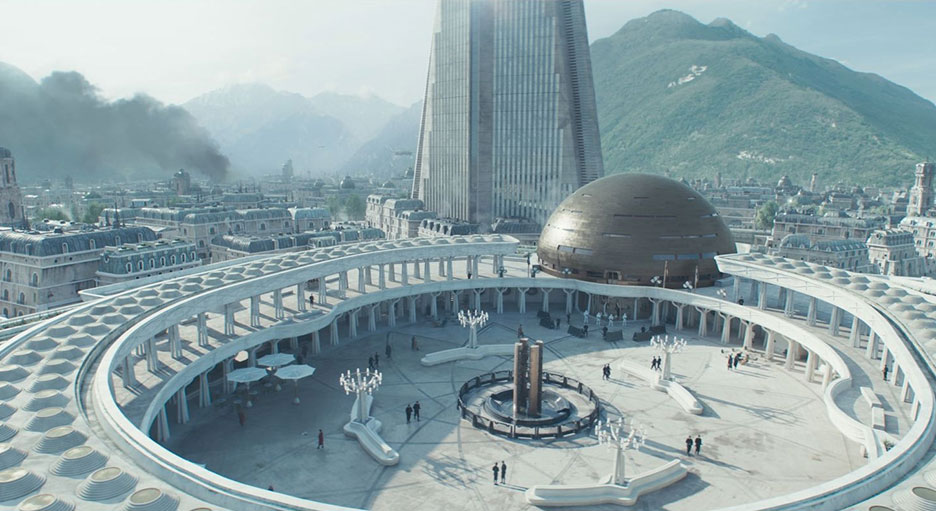
Palmo City’s central plaza on Ghorman was shot as a backlot set at Pinewood Studios with digital extensions (Credit: ILM & Lucasfilm).
Famously, in the 1970s and 80s, ILM used traditional matte paintings to establish new locations, the principle of which is still at the core of creating an establishing shot. The technique, however, now resides in the digital realm, often with the aid of live-action background plates. Andor treats viewers to a number of establishing shots on Ghorman and Coruscant, a process that takes a considerable amount of time and effort, depending on the requirements of the shot.
“If you’re travelling through the digital location and have a bunch of different angles on it, we will build a full 360-degree environment,” explains Leo. “But if it’s for a single shot, we may do it as a bespoke shot. What worked really well on season one and into season two was that we based things on real cities. You can find open-source 3D street maps of Tokyo or New York, and we would basically fly around and find an angle and think, ‘Okay, that’s a cool angle; this feels organic. Now take that but replace all of the buildings with Coruscant buildings.’ You end up with something that feels organic and real.”
It’s an approach Leo picked up from the director of Rogue One.
“I have to give credit for having learned this approach to Gareth Edwards,” he explains. “When we built the city of Jedha, we had blocks of neighborhoods based on layouts from parts of Morocco. Then, Gareth asked us to do something which seemed really strange at the time. He said, ‘I want you to drop 300 random cameras into the CG model of the city, anywhere you like, and show me the pictures.’ We wrote a script that dropped a camera at every intersection and then rendered a view in every direction. We sent those to Gareth, and he picked from those, the idea being that rather than artificially building a view to the camera, you would scout the artificial city just as you would scout a real location and go, ‘I found this really cool angle here.’ That way, you ended up with compositions that felt much more interesting than if you simply asked someone to put some buildings in the background.”
Elements of the City of Arts and Sciences in Valencia, Spain were utilized for Coruscant (Credit: ILM & Lucasfilm).
Coming from a visual effects background as Edwards does – as most recently evidenced by his work with ILM on 2025’s Jurassic World Rebirth – his fluency in the language of visual effects gave the crew a tremendous advantage on Rogue One.
“What I really appreciate about Gareth is that he has this really disciplined approach to thinking about whether you could have done a visual effects shot in the real world, and would it have felt the same way?” Leo continues. “I took that forward into our approach to Andor. Quite often, if we did a layout of visual effects and everything fit neatly into frame, Gareth would say, ‘That feels artificial. Make it so that something uncomfortably sticks out of frame, and as the shot progresses, I have to pan and tilt from one thing to the other, because both of them won’t fit in the frame at the same time.’ That makes it feel real and organic. I always appreciate how much I learned from Gareth about shot design.”
“That ethos fits really well with the aesthetic that Tony wanted for Andor,” adds Falls. “It was a constant conversation that we would have with our directors and DPs to make sure things weren’t too pretty. Mohen would often say, ‘It’s too clean, how do we make it look not as good, so that it looks even better?’ That was a lot of fun, and it really maintained that beautiful look from Rogue One as part of a storytelling thread that was done visually.”
With Andor now delighting viewers both old and new, the look and feel of the show has become one of its most celebrated talking points. Given that, could – or should – that aesthetic be carried over to the next Star Wars project or not? Mohen Leo has his own thoughts on that.
“Andor took inspiration from Rogue One, but Rogue One is primarily a war film, whereas Andor is a spy drama, so Luke Hull made the aesthetic even more grounded. What does this world look like from the perspective of an ordinary person who lives in it? I certainly hope that as we move forward, every project develops its own look. I wouldn’t want everything to look like Andor because that would be boring. The joy that I got out of working on this series is that it proves that you can make something that looks very different but still feels like it belongs in the same galaxy, so I hope that future projects will strike out in different directions and try different things.”
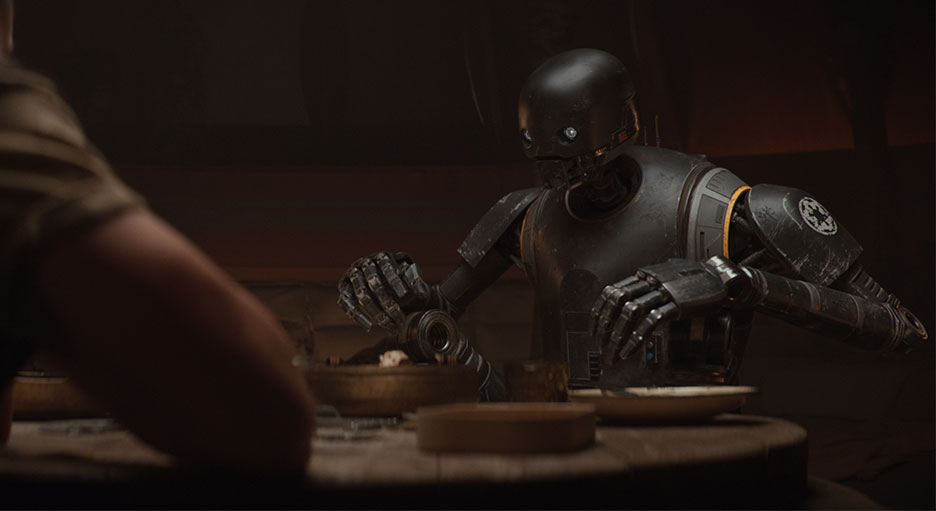
Cassian’s first encounter with the deadly Imperial security droid on Ghorman, later reprogrammed as his companion, K-2SO (Credit: ILM & Lucasfilm).
Understanding that each project needs and deserves its own visual identity within the broader Star Wars galaxy has changed the people who worked on Andor. As he moves on to new projects, TJ Falls reflects on one of the most important lessons he learned from the show.
“It was Tony and Sanne who said, ‘Let the experts be the experts.’ Because of that, every artist felt incredibly valued, and their contribution was fully appreciated. That message was constantly sent down from Tony: Let the best idea win. If an artist had something cool to contribute, it made its way up and it was credited and talked about.”
“The thing that I hope we can take forward is collaboration across departments,” says Leo. “Andor was completely generous in that everyone would happily let someone else do something if it made the result better, so there were no fiefdoms. We were able to put so much value on the screen because every problem was solved together, and that’s something that comes from the top down, in this case, from Tony.
“When there isn’t a sense of shared ownership and a clear creative direction, sometimes the frustration can trickle all the way down through the process,” Leo continues, “not just through the shoot and on the client side, but into the visual effects work and with the artists. Someone can change their mind at any minute and tell you to do something differently. For me, that was the most positive difference about Andor. It’s a culture that says there are no egos; it’s not about anyone standing out and making a name for themselves; it’s all about the collaboration. So I hope that’s something I encounter again on future projects.”
Tudyk performs as K-2SO alongside a final frame created by ILM (Credit: ILM & Lucasfilm).
When pondering each of their favorite moments in season two, Leo is quick to answer, “Cassian stealing the TIE Avenger and escaping in episode one [‘One Year Later,’ directed by Ariel Kleiman] was certainly the one I was involved in the longest, all the way from the beginning pitching storyboards for the action, right down to it being the last thing we shot with Diego.
“What I like about it is that on the one hand it’s a very classic Star Wars sequence with the spaceship and a dogfight,” Leo continues, “but we found a way to still make it fit within Andor by designing it in a way that it starts very practical in a real hangar with a real ship and stunts, and bit by bit we transition into something that’s pure computer graphics, but it all fit into the style the show, so I’m really pleased with that.”
Falls is equally quick to respond. “My favorite is the opening shot from episode eight [‘Who Are You?’ directed by Janus Metz], which is a long lens establishing shot of Ghorman, orbiting around the city. We had Hybride [Ubisoft’s visual effects branch] working on the look of the plaza, and ILM took on the high establishing shots of Ghorman from the air. The shot went through a number of rounds of honing it into what Mohen was thinking, pitching the idea without the visual was tricky, trying to get everyone to understand what it was that was being described. Once we started to get the visuals into motion with previs, it started to click with everybody. Then it came alive in shot production. I think it’s absolutely gorgeous.”
—
Mark Newbold has contributed to Star Wars Insider magazine since 2006, is a 4-time Star Wars Celebration stage host, avid podcaster, and the Editor-in-Chief of FanthaTracks.com. Online since 1996. You can find this Hoopy frood online @Prefect_Timing.
In part one of a two-part story, the production’s visual effects producer and visual effects supervisor discuss the effort to create over 4,000 effects shots for the Emmy-nominated Lucasfilm series.

By Mark Newbold
“It was a good opportunity to expand our horizons,” says TJ Falls, vice president of visual effects at Lucasfilm, about the team’s work to create a grounded aesthetic for both seasons of Andor (2022-25). After Rogue One: A Star Wars Story (2016) established the tone for the adventures of Cassian Andor (Diego Luna), the Andor production opted to utilize a number of existing locations for filming in the United Kingdom and around the world. It was a tactic previous Star Wars productions also chose (for example, 1999’s Star Wars: The Phantom Menace traveled to Italy and the Caserta Palace for the interior of the Theed Palace on Naboo), but integrating these locations to such a degree was something new for Industrial Light & Magic, a choice Falls appreciates.
“It allowed us to go out in the world and find a real base reference,” explains Falls, who was also the overall visual effects producer for Andor. “That was something the team worked hard to capture. We’re actually there in the city or in the mountains, so it was wonderful to be able to tie real-world locations into our digital work.”
The debut season of Andor leaned heavily into this physical integration. But, with a very real-world, global pandemic happening around the production, season one had its international travel wings clipped, as Falls explains.
“We couldn’t travel, but we still managed to gather reference material, including some for the ship-breaking yards on Ferrix. For season two, we were fortunate enough to finally be able to travel, so we flew to Lake Como and the Italian Alps to capture plates for Ghorman, among other locations.”
The Mothma estate on Chandrilla utilized aerial plates shot in Spain (Credit: ILM & Lucasfilm).
Joining Falls, production visual effects supervisor Mohen Leo picks up the conversation.
“Being able to travel to Spain for a variety of locations on season two allowed [production designer and executive producer] Luke Hull to rely much more heavily on the look of existing locations that were compatible, particularly the Senate building. Once we did the first location scout at the City of Arts and Sciences in Valencia, we were looking around, thinking, ‘Wow, it looks like Coruscant already.’ That made a huge difference, having that basis, both for interior and exterior spaces, so we could then use visual effects to build on and make it feel like Star Wars.”
The practicalities of having a ready-built set in the form of an existing building clearly had their benefits. Still, the broader task of adding visual effects presented its own challenges, as Leo explains.
“One thing I took away from the project is to push as much as possible for real locations,” he says. “Using an existing building during a shoot allows people to make informed decisions that stick, because if you have something that already looks 50%, 60%, or 70% the way you want it to, everyone has the confidence to say ‘Okay, this is the frame that we want, and we understand that we’re going to put this building in the background. Also, you have the composition of the lighting and the weight of the architecture, which makes it much easier, rather than having a blank canvas in post-production and then debating what it should look like.
“For example,” Leo continues, “there were the mountains around Ghorman. A couple of people from the production team and I went to Italy and did a two-day helicopter shoot. We felt strongly that even those locations where we would never actually shoot with a full crew or with actors should be based very specifically on real landscapes. That allowed us to put the Star Wars architecture in there and have that foundation.”
With the tremendous amount of work required to bring these locations to life, the balance between real locations and visual effects is a delicate one, based on story requirements, budget, and time.
“When we go location scouting, I always ask the director of photography [for season two, Damián García, Christophe Nuyens, and Mark Patten], ‘What are we keeping from the location?’” says Leo. “Because there has to be value in us being there. We were on location in Spain, and a Coruscant scene was discussed, which involved two people standing by a railing, looking out across the fictional cityscape. If we’re going to replace the whole city, then we don’t need to shoot that in Spain.”If you want that view, we can shoot that back in London on a green screen set because it’s easier, and we’ll have more control over the lighting. That, for me, is the main thing, having a clear idea when you go on location of what we keep from the location, and why we are there?”
The original location plate (top) shot at the City of Arts and Sciences in Valencia, Spain opposite the final shot (bottom) with the Coruscant skyline (Credit: ILM & Lucasfilm).
The use of natural light throughout the series is even more impressive when considering the balance between physical structures and digital extensions. Bathing the action in brightness or shadow, regardless of where and how it was shot, Leo explains, is how this integration was managed.
“We work very closely with the DP on that,” says Leo. “There are scenes where people walk directly from a stage set in London onto something that’s on location in Valencia. In the context of the story, it feels like one continuous location, even though they were shot months apart in two different countries. Obviously, we take lots of photographic reference. We have the plates of the one side at hand when we’re doing the other, and we’re constantly checking to make sure things fit together. On this project, we had a plan for each of those things before we went on location and shot it. We’re not trying to force things together in post; they’re meant to go together.”
“That’s exactly it,” adds Falls. “It’s the collaboration with the DP and lighting team, but also with previs, with techvis, and knowing that we’re going from studio space to location space. We had the opportunity to plan that out very specifically, each step of the way. And what helped us succeed is that we had a plan, and we were able to push it through to the best of each department’s abilities to deliver on it.”
Having a plan is essential to any well-run production, and on a visual effects-heavy series like Andor,it’s even more vital. Managing the process requires unique skills and systems to marshal all the information and elements into one place, as Falls explains.
“You’ve got to manage all these people and figure out who’s doing what, breaking it down to what the responsibilities of each person are. You start with something that’s massive, and we start to split things up between our teams and vendors. Ghorman is primarily a Hybride sequence; we’ve got Scanline VFX dealing with Mina-Rau, and we work with [ILM visual effects supervisor] Scott Pritchard to ask how we’re going to slice up this pie.
“It’s like eating an elephant one bite at a time,” Falls adds with a smile. “That translates from the production side into post and dealing with our vendors, and it’s all about clear communication, having people that you can build a shorthand with and have trust with, and then let them do what they do and not overmanage it.”
Actor Joplin Sibtain (Brasso) atop the speeder prop rigged to a camera vehicle (top) with a final frame from Mina-Rau (below) (Credit: ILM & Lucasfilm).
Truly a mammoth task, but that’s just the start of it. “Then, each individual team brings their expertise to build it right back up the mountain,” Falls continues, “so that Mohen has the opportunity to have that creative outlook over everything, I make sure it’s moving at the pace that it’s supposed to and that we’re hitting our schedule and staying on budget while making sure that [creator and showrunner] Tony Gilroy is getting what he wants for his vision of the show.”
There are many unsung heroes on any production, and amongst those are the production managers (including Frédérique Dupuis and Alyssa Cabaltera from ILM and Anina Walas from Lucasfilm, among others), who, on the visual effects team, juggle countless shots and give structure to the process for both the production and the partner studios. In its completed form, Andor might appear to be a graceful swan, but under the water’s surface, its legs are furiously kicking to propel it forward, as Mohen Leo elaborates.
“The visual effects production team has to keep track of over 4,000 shots, and each one of those shots has dozens and dozens of assets, be it art and reference or photography and scans, and they have to funnel all of that to where it needs to land and then send any questions back to me in a manageable way. I answer the creative questions. The logistical and organizational work is done by a team of incredibly diligent people without whom none of this would be possible.”
Along with this beehive of activity tracking all the elements, a database system, unique to each production, needs to be put in place.
“We find on each show that you have similar tool sets and similar ways of databasing things,” Falls says, “but you have to build it around the specific challenge of the show and the personalities involved. It’s about what Mohen likes and the types of data that we’re getting in.
“You have people like [on-set visual effects supervisor] Marcus Dryden, who was on set managing that side of things. His role was specific to season two, and it worked really well, that marriage of supervision responsibilities between me and our Lucasfilm production team and our production manager, and the coordinators building the database. That worked well for Mohen to get the notes in and out and track the scans and the data, but presenting it in forms that fit the specific way we were working with our vendors on this show. It wasn’t groundbreaking, but it was specific to what we needed.”
Palmo City’s central plaza on Ghorman utilized the massive backlot Pinewood Studios (top), and was later completed with visual effects (bottom) (Credit: ILM & Lucasfilm).
The database is set up, a system is in place, production managers have a process, and the elements are tracked as they come in. “It’s absolutely critical because it gives me the luxury to say, ‘Hey, where’s that scan from that location that we shot in that scene six months ago in Valencia?’” explains Falls. “And within 10 seconds, somebody will go, ‘Here it is.’ That shouldn’t be taken for granted because I’ve been on many shows where that can turn into an archaeological dig that can take days, or sometimes you don’t find it at all.”
With this bespoke Andor structure in place for season one, Leo could then take that and refine it even further for season two, a huge advantage, especially considering episodic television wasn’t a familiar environment for him.
“Season one was a big learning experience,” explains Leo. “I’d never done episodic television before; I’d only done movies, so dealing with that much content in such a compressed time was challenging. Also, the interaction with editorial is slightly different on episodic television. With every project, there’s an element of adjustment, but, there’s also an element of learning.”
“We had the luxury of a number of production staff carrying over from season one to season two,” says Falls. “So we learned in real time and adjusted things to fit. You could port it, but it wouldn’t necessarily work as succinctly as it does when it’s crafted around the group, and for season two in particular, I felt that we ended up crafting a really great system. The team was unbelievably adept in making sure that every person got exactly what they needed as quickly as humanly possible.”
The script is the tramline for everything that ends up on-screen, but in the realm of visual effects and working with the rest of the crew, there needs to be a clear understanding of what’s required and how to do it, something that comes from the top, as Leo explains.
“When we’re planning a shoot, we sit down with the director, the cinematographer, and the assistant director and ask, ‘What are you trying to achieve, what do we need to contribute in terms of the visual effects, and how do we make sure we get what we need during the shoot?’ Then we take meticulous notes.”
However, it doesn’t always go as smoothly as planned. “We’re staring at the monitor as they’re shooting, but then somebody drops the microphone into frame, so that’s something we have to paint out,” Leo continues. “Maybe we have to do a set extension that we didn’t expect. Then there’s a step in post-production where, along with editorial, we’re looking at the early versions of the cuts, and that’s where we do something called the statement of work, where we look at each individual shot and go, ‘Okay, here’s all of the things we need to do for this particular shot across the various disciplines in order to complete it.”
An aerial view of the Ghorman set on the backlot (top) and final frame (bottom) (Credit: ILM & Lucasfilm).
Like all aspects of a production, visual effects come at a cost, with so many highly skilled experts putting their time and craft into a project. The team is responsible for both managing costs and ensuring that additional required effects can be covered within the allotted budget.
“There’s a constant ebb and flow of evaluation, so we work closely with editorial, seeing the working cuts,” Falls notes. “We go in with [editor] John Gilroy and they show us little pieces, and that allows the opportunity for some give and take as we evaluate things and look at shots and go, ‘Well, this is more than we had planned, or maybe there’s another sequence where they’re using less than what we had planned,’ and so there’s a little bit of horse-trading that happens.
“What we strive for,” Falls continues, “is to not say we can’t do something because it wasn’t planned. If there are 10 additional seconds needed in the show, how can we do it? Can we find a way that still delivers everything that’s needed, but also in line with the number of resources we allotted? Then, we’re back on budget, or I have to figure out how to take care of it, but we always start with what is the creative desire for the scene. How is it furthering the story? We don’t want anything that’s egregious or over the top just for the sake of being something flashy, so we have to make sure that everybody is in agreement that ‘Okay, it’s more than expected but it serves the story, it does what Tony needs, and now it’s our job to figure out how can we make it work.’ I think we did a pretty good job of that.”
Mark Newbold has contributed to Star Wars Insider magazine since 2006, is a 4-time Star Wars Celebration stage host, avid podcaster, and the Editor-in-Chief of FanthaTracks.com. Online since 1996. You can find this Hoopy frood online @Prefect_Timing.
Teams from across ILM’s global studios are recognized for their innovative work for television this past year.
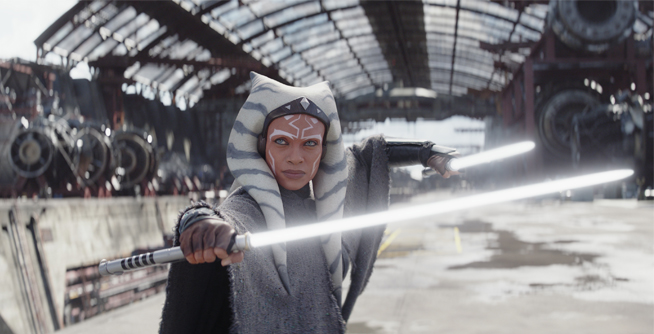
Among the 14 nominations for the second season of Lucasfilm’s Andorseries on Disney+, ILM and their collaborators have earned one for “Special Visual Effects in a Season or a Movie.” The nominees include production visual effects supervisor Mohen Leo, visual effects producer TJ Falls, special effects supervisor Luke Murphy, creature effects and droid supervisor Neal Scanlan, ILM visual effects supervisor Scott Pritchard, Hybride visual effects supervisor Joseph Kasparian, Scanline visual effects supervisor Sue Row, MidasVFX visual effects supervisor Paolo D’Arco, and digital colorist Jean-Clément Soret.
Alongside the Andor nomination for “Special Visual Effects in a Season or a Movie” is season two of The Lord of the Rings: The Rings of Power on Amazon Prime. The nominees among ILM artists and their partners include production visual effects supervisor Jason Smith, visual effects producer Tim Keene, visual effects producer Ann Podlozny, visual effects co-producer James Yeoman, ILM visual effects supervisor Daniele Bigi, DNEG visual effects supervisor Greg Butler, Rodeo FX visual effects supervisor Ara Khanikian, The Yard visual effects supervisor Laurens Ehrmann, and special effects supervisor Ryan Conder.
Earning a nomination for “Special Visual Effects in a Single Episode” is the premiere entry from season two of the Apple TV+ series Severance, “Hello, Ms. Cobel.” The nominated ILM artists and their collaborators include production visual effects supervisor Eric Leven, production visual effects producer Sean Findley, ILM visual effects associate supervisor Shawn Hillier, ILM visual effects associate supervisor Radost Ridlen, ILM environments lead Martin Kolejak, ILM producer Brian Holligan, ESE visual effects supervisor Alex Lemke, ESE visual effects supervisor Michael Huber, and on-set visual effects supervisor Djuna Wahlrab.
Join creator Dave Filoni, Production Visual Effects Supervisor Richard Bluff, Animation Supervisor Paul Kavanagh, and Visual Effects Supervisor Enrico Damm for a roundtable discussion on the visual effects of Lucasfilm’s hit Disney+ series ‘Ahsoka’.

The nominations for the 2023 Emmy Awards have been revealed, and three ILM projects were recognized with nominations. Lucasfilm’s The Mandalorian, Andor, and Amazon Studios’ The Lord of the Rings: The Rings of Power were each nominated in the Special Visual Effects category. This marks the third time that The Mandalorian has been nominated in the category having won the award each of its first two seasons.
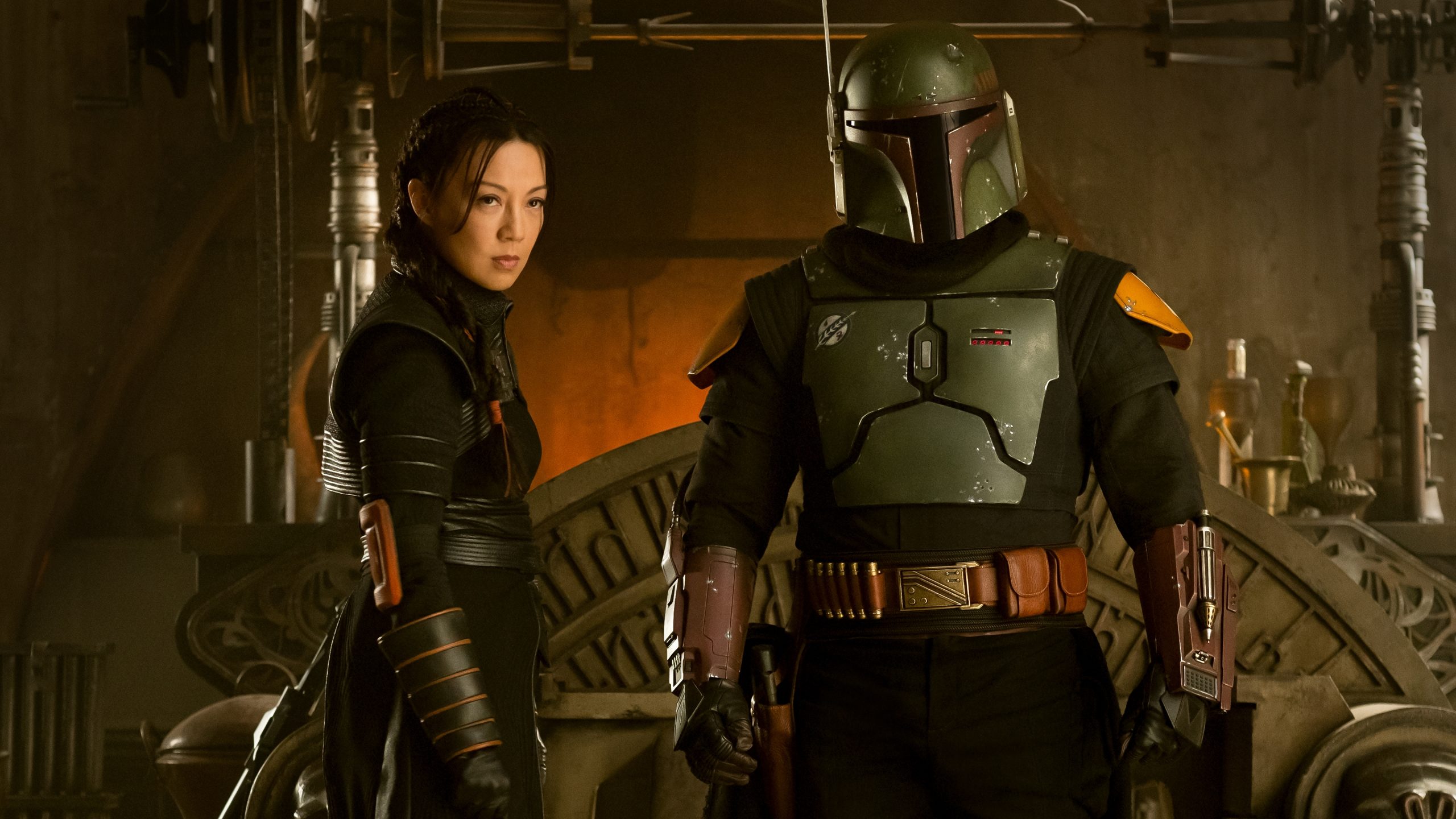
The Mandalorian visual effects supervisor Grady Cofer shared, “It is such an honor to be recognized. The nomination is a testament to Jon Favreau’s commitment to excellence, and to the passion and dedication of the entire VFX team. Thanks to all the Television Academy members who have supported The Mandalorian through the years.” Nominated alongside Cofer were visual effects producer Abbigail Keller; animation supervisor Paul Kavanagh; Assoc. Visual Effects Supervisor, Cameron Neilson, special effects supervisor, Scott Fisher; Animation Supervisor Hal Hickel; Legacy Effects Supervisor, J. Alan Scott; ILM visual effects supervisor Victor Schutz IV; and ILP visual effects supervisor, Bobo Skipper
Andor visual effects producer TJ Falls said, “I’m very excited that Andor was recognized with a nomination for Outstanding Special Visual Effects. It’s a testament to the collaboration of the team and the incredibly remarkable talents of each of our nominated members, as well as those around the world who contributed to the project.” Falls was joined by fellow nominees visual effects supervisor, Mohen Leo; ILM visual effects supervisor, Scott Pritchard; Richard Van Den Bergh, special effects supervisor; Neal Scanlan, creature effects & Droid supervisor; Liana Mansor, lead visual effects editor; Joseph Kasparian, Hybride visual effects supervisor; Jelmer Boskma, Scanline visual effects supervisor; and Colorist, Jean-Clément Soret.
The Lord of the Rings: The Rings of Power nominees include Ron Ames, visual effects producer; Jason Smith, visual effects supervisor; Nigel Sumner, ILM visual effects supervisor; Ara Khanikian, Rodeo FX visual effects supervisor; Dean Clarke, SFX supervisor; Ken McGaugh, Weta FX visual effects supervisor; Tom Proctor, DNEG visual effects supervisor; Greg Butler, Method Studios visual effects supervisor, Joe Henderson, visualization creative supervisor, The Third Floor, Inc.
The 75th Emmy Awards is currently scheduled to broadcast live on FOX on Monday, September 18, (8:00-11:00 PM EDT/5:00-8:00 PM PDT) from the Peacock Theater at L.A. LIVE.
The Television Academy announced its winners for the 74th Annual Primetime Creative Arts Emmy® Awards over the weekend, celebrating today’s talent and their groundbreaking work. ILM’s creative teams were honored with an award for Outstanding Special Visual Effects in a Season or a Movie for The Book of Boba Fett, alongside nominations for their work on The Witcher. This is third win for a Lucasfilm series in this category, a testament to the cutting edge work that ILM is known for.
The Television Academy today announced the recipients of the 74th Engineering, Science & Technology Emmy® Awards honoring an individual, company, or organization for developments in broadcast technology. Industrial Light & Magic is proud to be the recipient of an Emmy Award for its StageCraft™ virtual production tool suite. StageCraft has been used on such series as The Mandalorian, The Book of Boba Fett, How I met your Father, Obi-Wan Kenobi, and The Old Man.
“Innovation is a vital part of television production; and the talented engineers, scientists and technologists we have recognized are essential to the growth of our industry,” said Frank Scherma, chairman and CEO of the Television Academy. “These pioneering companies and visionaries have leveraged the power of technology to elevate television and storytelling in fundamental ways.”
ILM StageCraft is an end-to-end virtual production tool suite that bridges the gap between practical physical production methodologies and traditional digital post-production visual effects by providing the ability to design, scout and light environments in advance of the shoot and then capture that vision in camera during principal photography. StageCraft brings together a real-time engine, a real-time renderer, high-quality color management, physical camera equipment, LED displays, motion-capture technologies, synchronization methodologies and tailored on-set user interfaces to digitally create the illusion of 3D backgrounds for live-action sets.
“Earlier this year the Academy formed the Science & Technology Peer Group representing members who are involved in the strategy and development of technologies that enable or advance the storytelling process for the television industry,” said Committee Chair John Leverence. “Under the leadership of the new peer group’s governors and co-chairs Wendy Aylsworth and Barry Zegel, this year’s newly constituted Engineering Emmy Awards Committee honors a wide range of innovative solutions to once seemingly intractable technical problems.”
The Television Academy announced its winners for the 73rd Annual Primetime Creative Arts Emmy® Awards over the weekend, celebrating a diverse group of talent from across television. ILM’s creative teams were honored with an award for Outstanding Special Visual Effects in a Season or a Movie for The Mandalorian, alongside nominations for their contributions on The Boys, WandaVision, and The Falcon and the Winter Soldier. This is the second year in a row that the hit Lucasfilm series has received the Emmy Award for Special Visual Effects, a testament to the groundbreaking work that the show is known for.
Animation Supervisor Hal Hickel, VFX Producer Abbigail Keller, VFX Supervisor Joseph Kasparian (Hybride), and Environments Supervisor Enrico Damm in attendance at the 73rd Annual Primetime Creative Arts Emmy® Awards.
The visual effects team representing this win, included: Joe Bauer, Richard Bluff, Abbigail Keller, Hal Hickel, Roy K. Cancino, John Knoll, Enrico Damm, John Rosengrant, and Joseph Kasparian. Special recognition is also in order for ILM Producer Stacy Bissell, ILM Animation Supervisor Paul Kavanagh, and the entire StageCraft team for their incredible contributions.
Richard Bluff, Visual Effects Supervisor on The Mandalorian, added, “I want to take this opportunity on behalf of the visual effects team to congratulate all the artists, production, and the technical support staff who contributed to the Visual and Special Effects on season two of The Mandalorian. We continue to be in awe of the spectacular work and the effortless partnerships we enjoy with all of our vendor partners. The time and effort invested in the visuals by ILM, Hybride, Image Engine, Important Looking Pirates, Ghost VFX, Lola, Stereo D, Tippett Studios, Base FX, Raynault, Virtuous, and Yannix has been exceptional and this recognition is fully deserved. Everyone associated with the show couldn’t be happier or more grateful for what we all achieved together.”
In addition, The Mandalorian was also recognized with Emmys in the following categories: Sound Mixing, Cinematography, Prosthetic Makeup, Stunt Coordination, Stunt Performance, and Music Composition.
The 73rd Emmy Awards will be hosted by Cedric the Entertainer at L.A. Live in Downtown Los Angeles, California. Executive Producers Reginald Hudlin and Ian Stewart and Director Hamish Hamilton have been selected to helm the show for production companies Done+Dusted and Hudlin Entertainment. Highlights from the 73rd Annual Creative Arts Emmy Awards will be broadcast on Saturday, Sept. 18 (8:00 PM ET/PT) on FXX. The 73rd Primetime Emmy Awards will be broadcast live on Sunday, Sept. 19 (5:00-8:00 PM, PST) on the CBS Television Network, and as well as streaming live and on-demand on Paramount+.
The Television Academy announced its nominations for the 73rd annual Emmy® Awards today recognizing a wealth of innovative storytelling, exceptional new programs, and a robust and diverse group of talent nominees. ILM is honored to have contributed to 4 of the 5 nominated shows in the Special Visual Effects category and is named on the nominations of 3 of them. ILM’s creative teams were recognized on the nominations for The Boys, The Mandalorian, and WandaVision. Additionally, the studio contributed work to The Falcon and the Winter Soldier.
Richard Bluff, Visual Effects Supervisor for The Mandalorian noted, “despite the unprecedented global pandemic Jon Favreau and Dave Filoni knew it was important to bring Season 2 of The Mandalorian to Disney+ on time to help give a lift to our expectant and loyal Star Wars fans,” adding, “to achieve this and ultimately be rewarded with a Visual Effects Emmy Nomination is a testament to the talent and leadership at Industrial Light & Magic and our vendor partners worldwide who continue to astound us with their exceptional artistry and dedication. We want to congratulate all those visual effects companies and every individual artist, production member, and support staff who stayed with us on this journey and delivered a remarkable series.”
Rob Bredow, ILM SVP, Chief Creative Officer noted, “I’d like to recognize the entire crews of The Mandalorian, The Boys, WandaVision and The Falcon and the Winter Soldier. Their hard work, creativity, and flawless execution did not go unnoticed and it’s truly rewarding to see the Academy recognize these projects.”
ILM was awarded the 2020 Emmy Award for Special Visual Effects for its groundbreaking effects and virtual production work on the first season of the hit Lucasfilm series, The Mandalorian.
The 73rd Emmy Awards will be hosted by Cedric the Entertainer. Executive Producers Reginald Hudlin and Ian Stewart and Director Hamish Hamilton have been selected to helm the show for production companies Done+Dusted and Hudlin Entertainment. The Emmys will be broadcast on Sunday, Sept. 19 (8:00-11:00 PM, live ET/5:00-8:00 PM, live PT) on the CBS Television Network and will be available to stream live and on-demand on Paramount+. The 2021 Creative Arts Awards will be broadcast on Saturday, Sept. 18 (8:00 PM ET/PT) on FXX.