
awards

50 Years | 500+ Film and TV credits | 135+ Awards

SINCE 1975

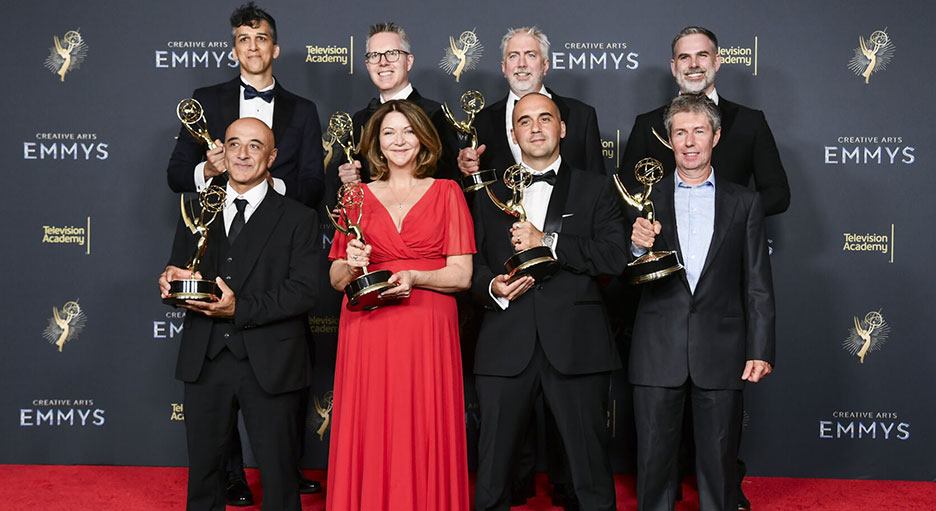
ILM’s Mohen Leo and Scott Pritchard and Lucasfilm’s TJ Falls are among the winners for “Outstanding Special Visual Effects in a Season or a Movie.”
The team from Andor pose in the press room with the award for outstanding special visual effects in a season or a movie during night one of the Creative Arts Emmy Awards on Saturday, Sept. 6, 2025, in Los Angeles. (Credit: Richard Shotwell/Invision/AP)

The 2025 Creative Arts Emmy Awards took place on September 6, and Lucasfilm’s Andor series took home four wins, including “Outstanding Special Visual Effects in a Season or a Movie.” Industrial Light & Magic’s Mohen Leo – who served as Andor‘s production visual effects supervisor – took home the award along with ILM visual effects supervisor Scott Pritchard and Lucasfilm’s visual effects producer TJ Falls.

The other Emmy recipients for “Outstanding Special Visual Effects in a Season or a Movie” include special effects supervisor Luke Murphy, special creature effects lead Neal Scanlan, Hybride visual effects supervisor Joseph Kasparian, Scanline visual effects supervisor Sue Rowe, In-House visual effects supervisor Paolo D’Arco, and digital colorist Jean-Clément Soret.

Congratulations to all of our Andor winners! Visit StarWars.com to see the full list of recipients.

Learn more about ILM’s work on Andor here on ILM.com:

“Like Eating an Elephant One Bite at a Time”: TJ Falls and Mohen Leo on the Visual Effects of ‘Andor’ Season 2

“Let the Experts Be the Experts”: TJ Falls and Mohen Leo on the Visual Effects of ‘Andor’ Season 2

Assembling a Starfighter: Exploring ILM’s Role in Creating the TIE Avenger from ‘Andor’

ILM’s Mohen Leo, production visual effects supervisor of Andor, attends the Governors Gala at the 2025 Creative Arts Emmy Awards (Credit: Invision/AP).

In part one of a two-part story, the production’s visual effects producer and visual effects supervisor discuss the effort to create over 4,000 effects shots for the Emmy-nominated Lucasfilm series.
By Mark Newbold

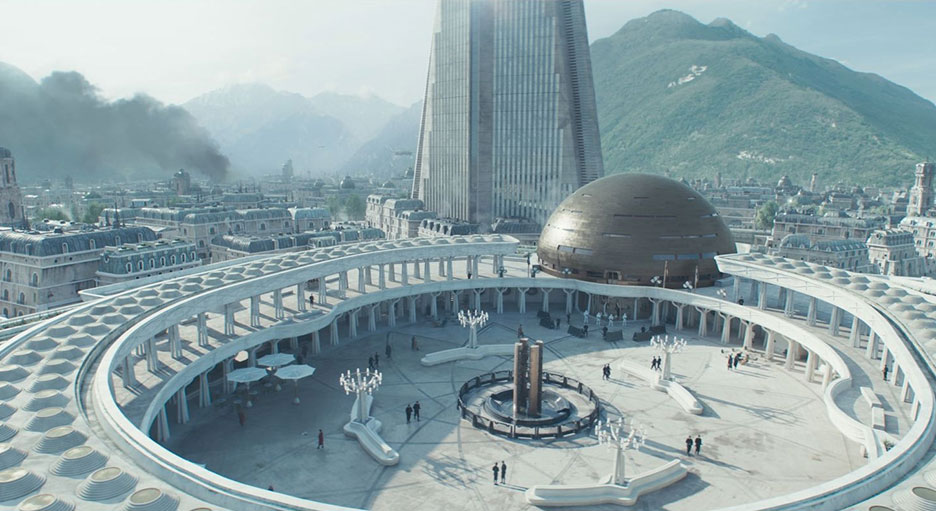
“It was a good opportunity to expand our horizons,” says TJ Falls, vice president of visual effects at Lucasfilm, about the team’s work to create a grounded aesthetic for both seasons of Andor (2022-25). After Rogue One: A Star Wars Story (2016) established the tone for the adventures of Cassian Andor (Diego Luna), the Andor production opted to utilize a number of existing locations for filming in the United Kingdom and around the world. It was a tactic previous Star Wars productions also chose (for example, 1999’s Star Wars: The Phantom Menace traveled to Italy and the Caserta Palace for the interior of the Theed Palace on Naboo), but integrating these locations to such a degree was something new for Industrial Light & Magic, a choice Falls appreciates.

“It allowed us to go out in the world and find a real base reference,” explains Falls, who was also the overall visual effects producer for Andor. “That was something the team worked hard to capture. We’re actually there in the city or in the mountains, so it was wonderful to be able to tie real-world locations into our digital work.”

The debut season of Andor leaned heavily into this physical integration. But, with a very real-world, global pandemic happening around the production, season one had its international travel wings clipped, as Falls explains.

“We couldn’t travel, but we still managed to gather reference material, including some for the ship-breaking yards on Ferrix. For season two, we were fortunate enough to finally be able to travel, so we flew to Lake Como and the Italian Alps to capture plates for Ghorman, among other locations.”

The Mothma estate on Chandrilla utilized aerial plates shot in Spain (Credit: ILM & Lucasfilm).

Joining Falls, production visual effects supervisor Mohen Leo picks up the conversation.

“Being able to travel to Spain for a variety of locations on season two allowed [production designer and executive producer] Luke Hull to rely much more heavily on the look of existing locations that were compatible, particularly the Senate building. Once we did the first location scout at the City of Arts and Sciences in Valencia, we were looking around, thinking, ‘Wow, it looks like Coruscant already.’ That made a huge difference, having that basis, both for interior and exterior spaces, so we could then use visual effects to build on and make it feel like Star Wars.”

The practicalities of having a ready-built set in the form of an existing building clearly had their benefits. Still, the broader task of adding visual effects presented its own challenges, as Leo explains.

“One thing I took away from the project is to push as much as possible for real locations,” he says. “Using an existing building during a shoot allows people to make informed decisions that stick, because if you have something that already looks 50%, 60%, or 70% the way you want it to, everyone has the confidence to say ‘Okay, this is the frame that we want, and we understand that we’re going to put this building in the background. Also, you have the composition of the lighting and the weight of the architecture, which makes it much easier, rather than having a blank canvas in post-production and then debating what it should look like.

“For example,” Leo continues, “there were the mountains around Ghorman. A couple of people from the production team and I went to Italy and did a two-day helicopter shoot. We felt strongly that even those locations where we would never actually shoot with a full crew or with actors should be based very specifically on real landscapes. That allowed us to put the Star Wars architecture in there and have that foundation.”

With the tremendous amount of work required to bring these locations to life, the balance between real locations and visual effects is a delicate one, based on story requirements, budget, and time.

“When we go location scouting, I always ask the director of photography [for season two, Damián García, Christophe Nuyens, and Mark Patten], ‘What are we keeping from the location?’” says Leo. “Because there has to be value in us being there. We were on location in Spain, and a Coruscant scene was discussed, which involved two people standing by a railing, looking out across the fictional cityscape. If we’re going to replace the whole city, then we don’t need to shoot that in Spain.” If you want that view, we can shoot that back in London on a green screen set because it’s easier, and we’ll have more control over the lighting. That, for me, is the main thing, having a clear idea when you go on location of what we keep from the location, and why we are there?”

The original location plate (top) shot at the City of Arts and Sciences in Valencia, Spain opposite the final shot (bottom) with the Coruscant skyline (Credit: ILM & Lucasfilm).

The use of natural light throughout the series is even more impressive when considering the balance between physical structures and digital extensions. Bathing the action in brightness or shadow, regardless of where and how it was shot, Leo explains, is how this integration was managed.

“We work very closely with the DP on that,” says Leo. “There are scenes where people walk directly from a stage set in London onto something that’s on location in Valencia. In the context of the story, it feels like one continuous location, even though they were shot months apart in two different countries. Obviously, we take lots of photographic reference. We have the plates of the one side at hand when we’re doing the other, and we’re constantly checking to make sure things fit together. On this project, we had a plan for each of those things before we went on location and shot it. We’re not trying to force things together in post; they’re meant to go together.”

“That’s exactly it,” adds Falls. “It’s the collaboration with the DP and lighting team, but also with previs, with techvis, and knowing that we’re going from studio space to location space. We had the opportunity to plan that out very specifically, each step of the way. And what helped us succeed is that we had a plan, and we were able to push it through to the best of each department’s abilities to deliver on it.”

Having a plan is essential to any well-run production, and on a visual effects-heavy series like Andor, it’s even more vital. Managing the process requires unique skills and systems to marshal all the information and elements into one place, as Falls explains.

“You’ve got to manage all these people and figure out who’s doing what, breaking it down to what the responsibilities of each person are. You start with something that’s massive, and we start to split things up between our teams and vendors. Ghorman is primarily a Hybride sequence; we’ve got Scanline VFX dealing with Mina-Rau, and we work with [ILM visual effects supervisor] Scott Pritchard to ask how we’re going to slice up this pie.

“It’s like eating an elephant one bite at a time,” Falls adds with a smile. “That translates from the production side into post and dealing with our vendors, and it’s all about clear communication, having people that you can build a shorthand with and have trust with, and then let them do what they do and not overmanage it.”

Actor Joplin Sibtain (Brasso) atop the speeder prop rigged to a camera vehicle (top) with a final frame from Mina-Rau (below) (Credit: ILM & Lucasfilm).

Truly a mammoth task, but that’s just the start of it. “Then, each individual team brings their expertise to build it right back up the mountain,” Falls continues, “so that Mohen has the opportunity to have that creative outlook over everything, I make sure it’s moving at the pace that it’s supposed to and that we’re hitting our schedule and staying on budget while making sure that [creator and showrunner] Tony Gilroy is getting what he wants for his vision of the show.”

There are many unsung heroes on any production, and amongst those are the production managers (including Frédérique Dupuis and Alyssa Cabaltera from ILM and Anina Walas from Lucasfilm, among others), who, on the visual effects team, juggle countless shots and give structure to the process for both the production and the partner studios. In its completed form, Andor might appear to be a graceful swan, but under the water’s surface, its legs are furiously kicking to propel it forward, as Mohen Leo elaborates.

“The visual effects production team has to keep track of over 4,000 shots, and each one of those shots has dozens and dozens of assets, be it art and reference or photography and scans, and they have to funnel all of that to where it needs to land and then send any questions back to me in a manageable way. I answer the creative questions. The logistical and organizational work is done by a team of incredibly diligent people without whom none of this would be possible.”

Along with this beehive of activity tracking all the elements, a database system, unique to each production, needs to be put in place.

“We find on each show that you have similar tool sets and similar ways of databasing things,” Falls says, “but you have to build it around the specific challenge of the show and the personalities involved. It’s about what Mohen likes and the types of data that we’re getting in.

“You have people like [on-set visual effects supervisor] Marcus Dryden, who was on set managing that side of things. His role was specific to season two, and it worked really well, that marriage of supervision responsibilities between me and our Lucasfilm production team and our production manager, and the coordinators building the database. That worked well for Mohen to get the notes in and out and track the scans and the data, but presenting it in forms that fit the specific way we were working with our vendors on this show. It wasn’t groundbreaking, but it was specific to what we needed.”

Palmo City’s central plaza on Ghorman utilized the massive backlot Pinewood Studios (top), and was later completed with visual effects (bottom) (Credit: ILM & Lucasfilm).

The database is set up, a system is in place, production managers have a process, and the elements are tracked as they come in. “It’s absolutely critical because it gives me the luxury to say, ‘Hey, where’s that scan from that location that we shot in that scene six months ago in Valencia?’” explains Falls. “And within 10 seconds, somebody will go, ‘Here it is.’ That shouldn’t be taken for granted because I’ve been on many shows where that can turn into an archaeological dig that can take days, or sometimes you don’t find it at all.”

With this bespoke Andor structure in place for season one, Leo could then take that and refine it even further for season two, a huge advantage, especially considering episodic television wasn’t a familiar environment for him.

“Season one was a big learning experience,” explains Leo. “I’d never done episodic television before; I’d only done movies, so dealing with that much content in such a compressed time was challenging. Also, the interaction with editorial is slightly different on episodic television. With every project, there’s an element of adjustment, but, there’s also an element of learning.”

“We had the luxury of a number of production staff carrying over from season one to season two,” says Falls. “So we learned in real time and adjusted things to fit. You could port it, but it wouldn’t necessarily work as succinctly as it does when it’s crafted around the group, and for season two in particular, I felt that we ended up crafting a really great system. The team was unbelievably adept in making sure that every person got exactly what they needed as quickly as humanly possible.”

The script is the tramline for everything that ends up on-screen, but in the realm of visual effects and working with the rest of the crew, there needs to be a clear understanding of what’s required and how to do it, something that comes from the top, as Leo explains.

“When we’re planning a shoot, we sit down with the director, the cinematographer, and the assistant director and ask, ‘What are you trying to achieve, what do we need to contribute in terms of the visual effects, and how do we make sure we get what we need during the shoot?’ Then we take meticulous notes.” 

However, it doesn’t always go as smoothly as planned. “We’re staring at the monitor as they’re shooting, but then somebody drops the microphone into frame, so that’s something we have to paint out,” Leo continues. “Maybe we have to do a set extension that we didn’t expect. Then there’s a step in post-production where, along with editorial, we’re looking at the early versions of the cuts, and that’s where we do something called the statement of work, where we look at each individual shot and go, ‘Okay, here’s all of the things we need to do for this particular shot across the various disciplines in order to complete it.”

An aerial view of the Ghorman set on the backlot (top) and final frame (bottom) (Credit: ILM & Lucasfilm).

Like all aspects of a production, visual effects come at a cost, with so many highly skilled experts putting their time and craft into a project. The team is responsible for both managing costs and ensuring that additional required effects can be covered within the allotted budget.

“There’s a constant ebb and flow of evaluation, so we work closely with editorial, seeing the working cuts,” Falls notes. “We go in with [editor] John Gilroy and they show us little pieces, and that allows the opportunity for some give and take as we evaluate things and look at shots and go, ‘Well, this is more than we had planned, or maybe there’s another sequence where they’re using less than what we had planned,’ and so there’s a little bit of horse-trading that happens.

“What we strive for,” Falls continues, “is to not say we can’t do something because it wasn’t planned. If there are 10 additional seconds needed in the show, how can we do it? Can we find a way that still delivers everything that’s needed, but also in line with the number of resources we allotted? Then, we’re back on budget, or I have to figure out how to take care of it, but we always start with what is the creative desire for the scene. How is it furthering the story? We don’t want anything that’s egregious or over the top just for the sake of being something flashy, so we have to make sure that everybody is in agreement that ‘Okay, it’s more than expected but it serves the story, it does what Tony needs, and now it’s our job to figure out how can we make it work.’ I think we did a pretty good job of that.”

Join us as we continue our conversation with TJ Falls and Mohen Leo to delve into the logistics of making Andor, the teamwork required to bring Cassian’s world to the screen, and their favorite moments from the second season.

Mark Newbold has contributed to Star Wars Insider magazine since 2006, is a 4-time Star Wars Celebration stage host, avid podcaster, and the Editor-in-Chief of FanthaTracks.com. Online since 1996. You can find this Hoopy frood online @Prefect_Timing.

Teams from across ILM’s global studios are recognized for their innovative work for television this past year.
The 77th Primetime Emmy Award nominations were announced this week, and Industrial Light & Magic artists have earned three of them. 

Among the 14 nominations for the second season of Lucasfilm’s Andor series on Disney+, ILM and their collaborators have earned one for “Special Visual Effects in a Season or a Movie.” The nominees include production visual effects supervisor Mohen Leo, visual effects producer TJ Falls, special effects supervisor Luke Murphy, creature effects and droid supervisor Neal Scanlan, ILM visual effects supervisor Scott Pritchard, Hybride visual effects supervisor Joseph Kasparian, Scanline visual effects supervisor Sue Row, MidasVFX visual effects supervisor Paolo D’Arco, and digital colorist Jean-Clément Soret.

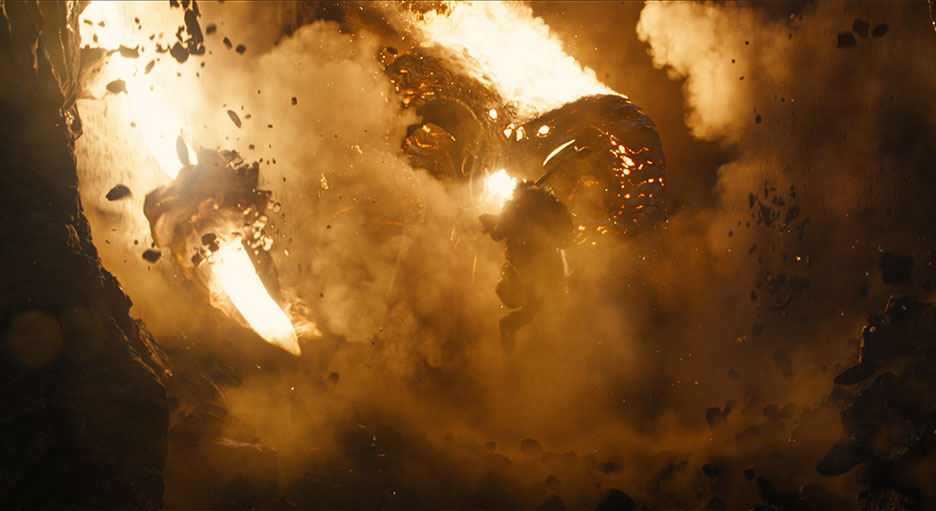
Alongside the Andor nomination for “Special Visual Effects in a Season or a Movie” is season two of The Lord of the Rings: The Rings of Power on Amazon Prime. The nominees among ILM artists and their partners include production visual effects supervisor Jason Smith, visual effects producer Tim Keene, visual effects producer Ann Podlozny, visual effects co-producer James Yeoman, ILM visual effects supervisor Daniele Bigi, DNEG visual effects supervisor Greg Butler, Rodeo FX visual effects supervisor Ara Khanikian, The Yard visual effects supervisor Laurens Ehrmann, and special effects supervisor Ryan Conder.

The Balrog in Rings of Power Season 2.

Earning a nomination for “Special Visual Effects in a Single Episode” is the premiere entry from season two of the Apple TV+ series Severance, “Hello, Ms. Cobel.” The nominated ILM artists and their collaborators include production visual effects supervisor Eric Leven, production visual effects producer Sean Findley, ILM visual effects associate supervisor Shawn Hillier, ILM visual effects associate supervisor Radost Ridlen, ILM environments lead Martin Kolejak, ILM producer Brian Holligan, ESE visual effects supervisor Alex Lemke, ESE visual effects supervisor Michael Huber, and on-set visual effects supervisor Djuna Wahlrab.

Congratulations to all of our ILM nominees!

The 77th Emmy Awards air on September 14, 2025 at 5 PM PST on CBS and Paramount+.

The Lord of the Rings: The Rings of Power wins for Special, Visual & Graphic Effects in Season 2 of the Amazon MGM Studios series.
This past weekend, the British Academy of Film and Television Arts hosted the 2025 BAFTA Television Craft Awards, where The Lord of the Rings: The Rings of Power won for Special, Visual & Graphic Effects. ILM’s Jason Smith, who served as production visual effects supervisor, received the award alongside his collaborators Richard Bain, Ryan Conder, and Chris Rodgers. Watch their acceptance speech below:

ILM teams in London, Sydney, and the former studio in Singapore delivered over 500 visual effects shots to Rings of Power Season 2. Hubbed in London, the effort was led by ILM visual effects supervisor Daniele Bigi, visual effects producer Christine Lemon, and visual effects executive producer Lee Briggs. 

Congratulations to Jason and our ILM crew! 

Read more about ILM’s work on Rings of Power Season 2 right here on ILM.com.

With ILM as a lead contributor, the Disney+ series took home the award for Outstanding Visual Effects for a Live Action Program at the 3rd Annual Children’s & Family Emmy Awards.
The logo of the 3rd Annual Children's and Family Emmy Awards.

Based on the popular books by Rick Riordan, the Disney+ series Percy Jackson and the Olympians earned eight wins on 16 nominations at the 3rd Annual Children’s & Family Emmy Awards in Los Angeles on March 15. Among them was “Outstanding Visual Effects for a Live Action Program,” for which Industrial Light & Magic was a lead contributor.

ILM’s Emmy winners include visual effects supervisors Jose Burgos and Jeff White, visual effects producer Katherine Chambers, executive visual effects producer Adele Jones-Venables, virtual production supervisor Sonia Contreras, associate visual effects supervisors Donny Rausch and Daniel Schmid, and associate visual effects producer Shawn Smolensky.

Percy Jackson’s senior visual effects supervisor Erik Henry accepted the award on behalf of the visual effects team, thanking ILM and other contributing effects houses MPC, Hybride, and Raynault. The 3rd Annual Children’s & Family Awards is available to stream from the National Academy of Television Arts & Sciences.

Congratulations to our ILM Emmy winners! Watch the trailer for Percy Jackson and the Olympians:

For over two decades, Wicked has transported theatre audiences into the untold story behind The Wizard of Oz (1939). Bringing its magic to the screen required a spectacle that not only honoured its Broadway origins but expanded beyond them. Among the many key collaborators in this transformation was Industrial Light & Magic’s Pablo Helman, production visual effects supervisor. In a recent conversation, Helman shares with ILM.com the challenges and triumphs of adapting this theatrical phenomenon for film, seamlessly blending practical techniques with cutting-edge visual effects to create an enchanting cinematic experience.

By Jamie Benning

(Credit: Universal)

The Musical Challenge

Helman admits that working on Wicked (2024) was an entirely new experience for him compared to his experiences on films like the Star Wars prequels (1999-2005), The Irishman (2019) and The Fabelmans (2022). “I think I was ignorant, in that I thought for the last 30 years that my job started with the images and ended with the images,” he tells ILM.com. “Normally music is something that happens later on. But with this movie, not only is there pre-recorded material but there is live singing. And there’s connections that are being made between the actors while they sing. Things that change between them that makes them elicit other reactions. And you’re there three feet from the action with the music happening. That translated into how we approached the visual effects. It makes all the difference.”

But understanding how to integrate those effects meant first understanding director Jon M. Chu’s vision.

Getting into Jon M. Chu’s Head

Helman is known for his thorough preparation when working with directors, and his collaboration with Jon M. Chu on Wicked was no exception. “It’s my job to get into the director’s head,” he says. “When I first interviewed with him just to see how we would click, I did a lot of research on him as a filmmaker. How does he use the cameras, camera movement, lighting, sequencing, editing—all of it. So we basically had the same language because I kind of cheated a little bit. I made it my business to understand how he goes about his process.”

He explains that Chu’s methodology is unique. “He has an incredible vision for the movie, and then he’s open enough to let the movie happen to him. Sometimes the movie develops in a way that is unexpected, and it grows in a specific way or something happens, and then he says, ‘I never thought of it this way. Look, that’s great. We have options.’

“The funny thing about it is that once the project concludes,” Helman continues, “a little bit of their filmmaking stays with me as a kind of a tool set of things, that once in a while I pull out, and that helps me with something else. Every director is different. Everybody has a different process of understanding the storytelling.”

Unlike directors who rely heavily on previsualization, Chu prefers a more fluid, organic approach, embracing spontaneity throughout the filmmaking process. “He doesn’t use pre-vis the way some directors do,” Helman says. “We’d sit at a table with the heads of department, with Alice Brooks (Director of Photography), Myron Kerstein (Editor), with Nathan Crowley (Production Designer), Paul Corbould (Special Effects Supervisor), Jo McLaren (Stunt Coordinator) with a model of the set for that scene. And then we give him a little stick with a little Elphaba and other characters and he goes in and shows us what the scene is about. And when there is music, he plays the music from his phone. Then he does the movement of the actors with Chris Scott, the choreographer. And so we video those sessions and then we all go away and try to figure out how we’re going to achieve Jon’s vision—between all of us.

“I did a lot of listening, because I hadn’t worked with Jon before,” Helman continues “And Jon and Alice and Myron kind of grew up together from school, and they have been working together. And so for me to come in, it’s like, are they going to let me in? And they opened their arms and let me in. And it was a wonderful experience.”

Building Oz: The Role of Practical Sets and the Practicalities of Shooting a Musical

Nathan Crowley’s elaborate practical sets played a crucial role in grounding Wicked’s fantastical world. Helman reflects on how these sets benefited both the cast and the visual effects team. “You want to chase the truth as much as possible,” he says. “Yes, there were nine million tulips planted, but they were planted a hundred miles from the set. But there are benefits.”

He elaborates on the process of blending the practical and digital elements. “There’s a shot in the beginning, of kids running through the tulips towards Munchkinland, and the matte line is around the kids. You know, after that, it’s all visual effects. Is it useful? Yes, for the actors, they have something there. But we changed the lighting, added the sun, and completed the tulips in post. The final look is a collaboration.”

The barley fields posed another challenge. “We planted real barley, but during the first take, you couldn’t run through it—it was too dense. We had to shave it down and then digitally replace everything to maintain the illusion.”

Helman explains that the scale of the production meant nearly every frame of the film required some level of visual effects intervention. “There are 2,200 visual effects shots in the movie. So every shot is a visual effects shot. Because this is a musical, all the actors are wearing really big earpieces that had to be replaced in 3D. There were also mics on their chests.”

The scale of the sets also dictated when practical elements could give way to digital enhancements. “The interior sets go up to 25 feet and the exterior sets go up to 55 feet and then after that we take over as visual effects,” says Helman. “Special effects were really big too.Paul Corbould and his team built a huge train. But the gears were not moving. So that’s where visual effects lends a hand. And the gears under the train are visual effects. And the inside of the train is visual effects because there was a small section built, but not the whole thing.

“And then the train was very reflective,” Helman continues “So if the camera follows it, then you have the reflection of all the lights and everything else that had to be recreated and painted out. So yes, there is a combination of reality and not reality. It’s a realization that we are creating an illusion, all of us. And we all contribute little by little to that illusion. And then in post, we put it all together and complete it.”

Striving for Authenticity: Cynthia Erivo’s Green Transformation

Helman and his team explored multiple approaches to achieving Elphaba’s distinctive green skin, testing a range of methods to determine the best solution. “Yes, we did a lot of testing,” he recalls. “We did different tests of what would happen if we used green makeup, what would happen if she didn’t have makeup, but we were there to fix everything that couldn’t be done.”

Ultimately, it was actor Cynthia Erivo herself who made the final decision. “Cynthia said, ‘I need to be green. I think I need to be that person,’” Helman explains. “And I know it’s three hours in the chair, but I need to put in that time to become that character. And it made a difference, I think.”

Even with practical makeup, the visual effects team played a crucial role in refining the look throughout the film. “We still have visual effects in every shot,” Helman says, citing the long shooting days, the strain of makeup on Cynthia’s skin, and even the challenges of contact lenses. “She had contacts. And I knew from other experiences like The Irishman that after a while the contacts start moving and the actor starts looking cross-eyed. So we had to fix all kinds of things.”

Additionally, subtle digital enhancements were required for continuity. “The makeup went to the middle of the lip, but not into her mouth, for obvious reasons. So, as I said, we had to adjust every shot,” he adds.

Flying Monkeys and Magical Transformations

One of the many visually striking sequences in Wicked is the transformation of the flying monkeys. Helman describes the scene as both challenging and rewarding. “It’s almost a horror scene. The monkeys are in pain, their wings breaking through their backs. It’s unnatural, which adds to the horror,” he explains. “We used feathers flying around to give a sense of atmosphere and depth. The horror of it had to be mitigated somehow. So there were times when we went too far. There were times when we didn’t go far enough. And then we all kind of adjusted.”

Helman emphasizes the importance of storytelling in visual effects. “There’s the fact that these monkeys need to fly away in like four shots. So how do you tell that story in its specifics in four shots? They need to get the wings, try them, and then be either successful or not. And so all that stuff is storytelling. It’s part of what we do in visual effects. The animation team led by David Shirk did a great job.”

(Credit: Universal)

Grounded Magic

Magic is, of course, central to Wicked, and Helman’s team took a deliberately subtle approach to its visualization. The Grimmerie posed unique challenges. “It wasn’t really thought out when we were shooting,” he admits. “Most of the time, Cynthia was in front of a blue square, gesturing as directed. But we ultimately made it so that the words became golden, with pages moving. It feels tactile and grounded, not over-the-top. We weren’t going for that kind of fantastical thing, because it’s been done before. Even if we were doing a visual effect, it had to look practical.”

Elphaba’s imperfect spellcasting in this scene also adds another layer to her character. “Due to her inexperience, she’s not very good at casting spells. Every time she does, something bad happens,” Helman says. “It’s relatable—magic grounded in imperfection, just like life.”

Defying Gravity: A Pivotal Sequence

The “Defying Gravity” sequence is a pivotal scene bridging the two films, requiring a seamless blend of practical stunts and digital effects. “Cynthia performed many of her own stunts, including being flown on wires and complex rigs,” says Helman “We’ve seen people flying before. You could just have somebody being wired in and you can say to that person, now you’re moving right, now you’re moving left, left to right and right to left. But those kinds of things don’t work. Cynthia was being flown 200 feet around the blue-screen set, singing! She is really trying to keep herself from the forces that are trying to throw her in different directions. And you can really see that she’s doing it. That contributes to the reality of the visual effects work we do.”

Helman also highlights Elphaba’s emotional arc in her final scene through the use of light and symbolism. “You start from the bottom in the darkness towards the light and you go out on the balcony towards the sun, and then the sun starts coming down throughout that sequence towards the end of the movie. If you have seen the play, you know that at the end of the first act, the cape gets bigger and bigger. So the question is, how do we translate that? Do we do it? Is it going to be laughable? The cape is a visual effect, because we couldn’t use a real one due to the wires. Throughout that sequence, everything becomes pictorial. And by the time we get to that shot, basically, it’s a spiritual, religious picture. The clouds are very Renaissance Italian, with the sun behind them and there’s all kinds of volume shadows and volume light coming through. And then all of a sudden you realize, oh my goodness, the cape is huge. What happened? Are you inside her mind, or is that a literal thing? Probably not. And then she does the war cry and the camera pulls back out and you think the movie ends, but she turns around and goes away flying. And then the audience is thinking, ‘wait, wait, where are you going?’ Then the movie ends to get them ready for part two.

“But all those kinds of things are not by coincidence,” Helman adds “They’re each thought out in terms of structural storytelling, building expectations.”

The Collaborative Spirit

The scale of Wicked was immense, involving contributions from more than 1,000 visual effects artists across five countries, ILM in San Francisco and Sydney as well as teams at Framestore, OPSIS, Lola, Outpost and TPO. Helman is quick to credit the teamwork behind the film’s ambitious visual effects. “We’re working together for three years to make these movies. And so I’m really grateful to all of them. Robert Weaver and Anthony Smith were the ILM visual effects supervisors, and David Shirk was the animation supervisor. Great collaboration and lots of fun.”

Helman is philosophical about the creative challenge. “On set sometimes you get into some arguments or differences. Or as Jon calls them, ‘offerings.’ Sometimes you say, ‘I’m offering you this solution, or you can go this way or we can go another way.’”

This cooperative effort was essential on a production as challenging as Wicked. “It’s 2,200 visual effects shots, but every department played a role in making the world of Wicked believable,” Helman explains. He highlights the importance of working closely with Nathan Crowley, Alice Brooks, Paul Corbould, and the rest of the team.

“Alice, Jon, and I talked a lot about it,” Helman says. He describes how lighting played a crucial role in integrating visual effects with the cinematography. “The lights were on the set, but we removed them. If you look at a movie that was shot in the ‘50s, there’s a certain look to it, but you have to achieve a certain look from behind the camera. But that’s not so anymore. You can put light sources wherever you want. And if you’re careful with them, when you remove them, there is no such thing as unjustified lighting.”

By ensuring that visual effects supported rather than dictated the cinematography, the team was able to create a seamless blend of practical and digital elements.

A Lesson in Artistry

For Helman, Wicked reinforced his philosophy that “visual effects shouldn’t be impeding anything. Whatever the director wants to do, wherever they want to put the camera—that’s what we’re there for, to encourage that kind of storytelling.”

The grueling 155-day shoot, filmed in continuity across both parts, pushed the cast and crew to their limits. Helman acknowledges the toll such a long production can take: “After day 70, it’s like everybody’s done. It’s like, elbows are out—‘Get out of my way, why are you looking at me like that?’ Those kinds of things happen.” But despite the fatigue, the shared vision kept the team pushing forward. It is a long project, but it’s a good thing because it gives you kind of a sense of not worrying about anything else, but what you have in front of you.”

The audience’s response helped reaffirm the purpose behind the work. “It’s one of those pictures that I had to go to the theater to hear the people’s reactions. I usually don’t do that. But this one I did, and it reminded me of why we do what we do, which is to make art that is being shared.”

Reflecting on the experience, Helman expresses gratitude for the people who made it possible. “You can have a great project, great people, or great financial satisfaction—if you’re lucky, you get two out of three. But the most rewarding part is the collaboration. At the end of the day, it’s about the people you work with.”

As Wicked continues to enchant audiences worldwide, Industrial Light & Magic’s artistry stands as a testament to the power of collaboration and innovation in storytelling.

Learn more about ILM and Wicked on Lighter Darker: The ILM Podcast.

Jamie Benning is a filmmaker, author, podcaster and lifelong fan of sci-fi and fantasy movies. Visit Filmumentaries.com and listen to The Filmumentaries Podcast for twice-monthly interviews with behind-the-scenes artists. Find Jamie on X @jamieswb and as @filmumentaries on Threads, Instagram, Bluesky and Facebook.


ILM visual effects supervisors are honored in the Special Visual Effects Category.
Today, BAFTA announced their 2025 nominees of which two Industrial Light & Magic productions received nominations in the Special Visual Effects category. Gladiator II and Wicked were each nominated alongside Better Man, Dune: Part Two, and Kingdom of the Planet of the Apes

Congratulations to production visual effects supervisor Mark Bakowski and ILM visual effects supervisor Pietro Ponti on their nomination for Gladiator II, and to production visual effects supervisor Pablo Helman and ILM visual effects supervisor Anthony Smith for Wicked. And congratulations to everyone at ILM who contributed to these incredible films.

The EE BAFTA Film Awards ceremony will be held at the Southbank Centre’s Royal Festival Hall in central London, and broadcast on Sunday 16 February 2025. Click here for a complete list of the BAFTA nominations.

ILM teams from around the world earn recognition for projects as diverse as Wicked, Gladiator II, Ultraman: Rising, Deadpool & Wolverine, and What If…? – An Immersive Story.

Today, the Visual Effects Society announced their nominations for the 23rd Annual VES Awards, recognizing visual effects artistry and innovation in features, animation, television, commercials, games, and new media. Both ILM and ILM Immersive received 20 nominations in total. 

Nominations in the overall film and television categories include Outstanding Visual Effects In A Photoreal Feature for Twisters, Outstanding Visual Effects In an Animated Feature for Transformers One and Ultraman: Rising, and Outstanding Visual Effects In A Photoreal Episode for Star Wars: Skeleton Crew and The Lord of the Rings: The Rings of Power (Season 2). Additionally, Blitz was nominated for Outstanding Supporting Visual Effects in a Photoreal Feature.

In the Outstanding Visual Effects in a Real-Time Project category, ILM Immersive received a nomination for What If…? – An Immersive Story and the D23 Real-Time Rocket

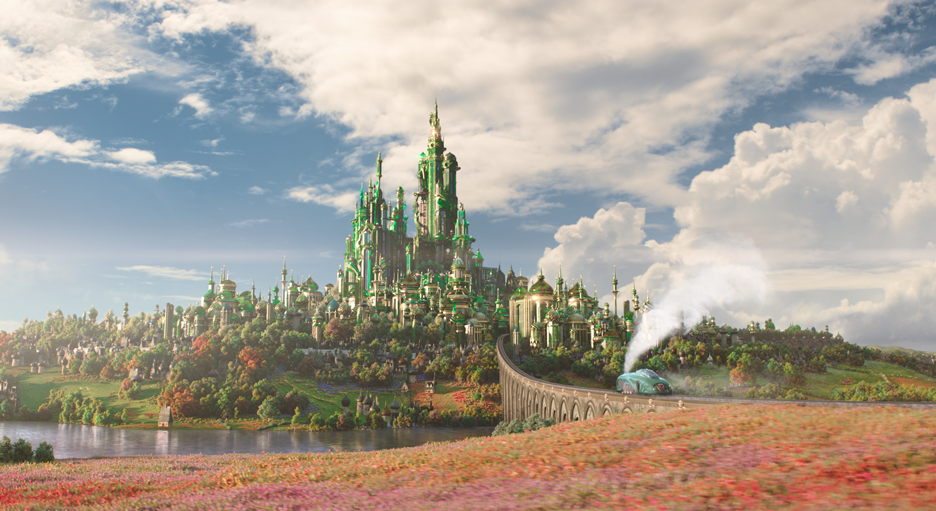
ILM has received nominations in many other categories including Outstanding Environment in a Photoreal Feature for Rome in Gladiator II and the Emerald City in Wicked, as well as Outstanding Environment in an Animated Feature for Transformers One’s Iacon City. Alien: Romulus, Deadpool & Wolverine, and Gladiator II have each picked up nominations for Outstanding Model in a Photoreal or Animated Project, while Venom: The Last Dance joins Twisters with nominations for Outstanding Effects Simulations in a Photoreal Feature.

A complete list of all of the VES nominations may be viewed at this link. The VES Awards will be held on February 11, 2025, at The Beverly Hilton Hotel in Los Angeles. Congratulations to our ILM and ILM Immersive teams!