Make room for some stellar content and southern hospitality from Industrial Light & Magic in the heart of Texas at SXSW 2025! Find us on the schedule from March 7-15, where we are teaming up with the minds behind ABBA Voyage, alongside the Dead & Company and U2:UV’s Las Vegas Sphere experiences. We’ll explore how performing artists can leverage cinematic and filmed entertainment to drive forward the artform and meet evolving audience expectations. You’ll learn about the creative and practical challenges posed by different physical spaces as well as the crucial role of cross-functional team collaboration in crafting extraordinary communal experiences. It’s an opportunity for music fans to ask questions about the future of live entertainment.
This morning the Hollywood Professional Association unveiled the HPA Award Creative Category nominees and ILM received seven nominations across three categories. In the Outstanding Visual Effects – Live Action Feature category, ILM received four of the five nominations.
For the Live Action Feature category, ILM was nominated for Alien: Romulus (Nelson Sepulveda-Fauser, Ale’ Melendez, Sebastian Ravagnani, Nicolas Caillier, Steven Denyer), The Creator (James Clyne, Trevor Hazel, Keith Anthony-Brown, Danielle Legovich, David Dally), Deadpool & Wolverine (Vincent Papaix, Georg Kaltenbrunner, Alexander Poei, Ziad Shureih, Russell Lum), and A Quiet Place: Day One (Malcolm Humphreys, Jordan Harding, Charmaine Chan, Michael Lum, Steve Hardy).
For Outstanding Visual Effects – Animated Feature, ILM received a nomination for Ultraman: Rising (Hayden Jones, Stefan Drury, Sean M. Murphy, Mathieu Vig, Kyle Winkelman). This nomination was one of just two in this category; our friends at Pixar received the other nomination for Inside Out 2.
In the Outstanding Visual Effects – Live Action Episode or Series Season category, ILM received two of the five nominations for: Loki – Season 2 (Steve Moncur, Christian Waite, Jeremy Sawyer, Ben Aickin, Pieter Warmington) and Percy Jackson and the Olympians – Season 1 (Erik Henry, Matt Robken, Jeff White, Jose Burgos, Donny Rausch).
The HPA Awards Gala will take place on November 7, 2024, at the Television Academy’s Wolf Theater in Hollywood.
Take a deep dive into the history and lore behind the starship designs created by ILM and introduced 40 years ago in The Search for Spock.
By Jay Stobie
Written and produced by Harve Bennett, Star Trek III: The Search for Spock (1984) afforded actor Leonard Nimoy his first opportunity to direct a Star Trek feature. With Ken Ralston as visual effects supervisor, the film also supplied Industrial Light & Magic with the chance to leave its own indelible legacy on the Star Trek franchise. ILM’s work on Star Trek II: The Wrath of Khan (1982) had included a collaboration with the Lucasfilm Computer Division which yielded the first all-CG sequence in a feature film, yet the company had an even greater impact on the film series’ third installment.
Among its many contributions to Star Trek III, ILM tackled the monumental task of designing and building five major starship and space station models that were introduced in the film. Though crafted specifically for this project, those steadfast exterior designs became staples in the Star Trek universe and appeared in prominent scenes across numerous films and television series. As we celebrate The Search for Spock’s 40th anniversary, let’s examine the long-lasting nature of ILM’s iconic creations and explore the circumstances in which they were employed in later Star Trek productions.
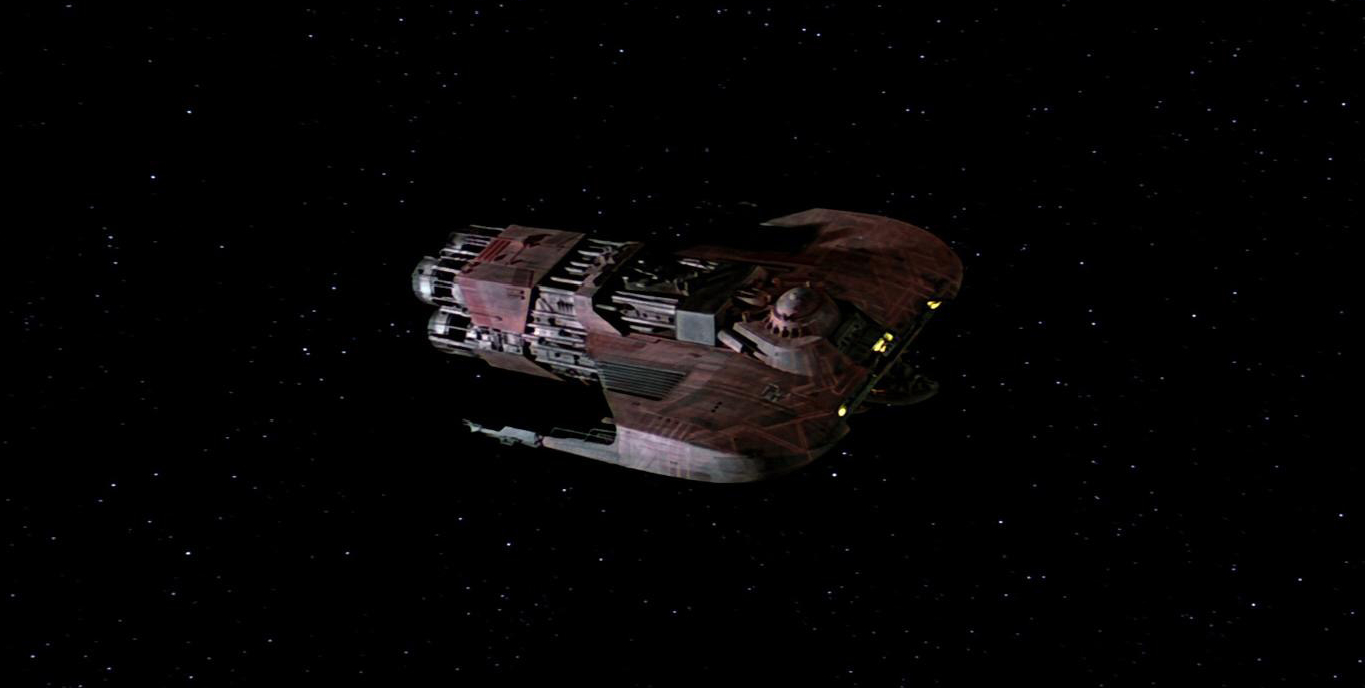
The Merchantman in Star Trek III: The Search for Spock. (Credit: Paramount Pictures)
The Merchantman: A Criminal Craft
A small, boxy vessel with a curved forward section lurked in deep space during the first act of Star Trek III, referred to as a merchantman by the film’s script. The ship carried a Klingon passenger (Cathie Shirriff) who had purchased intelligence related to the terraforming device known as Genesis. A much larger Klingon ship (more on that in a moment) lowered its cloaking device, becoming visible long enough to receive the data. Unfortunately, the Klingon operative had glanced at the information, prompting the vessel to swoop around and obliterate the merchantman with its weaponry.
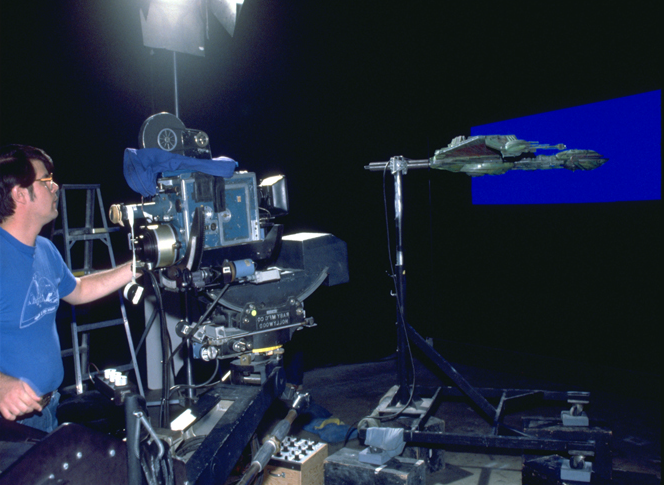
From the earliest stages of pre-production on Star Trek III, the team at ILM — including Ralston, visual effects art directors Nilo Rodis and David Carson, supervising modelmaker Steve Gawley, and modelmaker Bill George — presented their creations to Nimoy and Bennett, who suggested alterations before final approval. Rodis and Carson generated concepts, while Gawley and George offered input and spearheaded model construction. The meticulous process was adaptable to each model’s role in the script, as the merchantman’s brief appearance meant it was fabricated in a relatively short amount of time. “The merchant ship was a design we threw together in a couple of weeks from a bunch of model parts,” visual effects cameraman Donald Dow told writer Brad Munson in Cinefex. “It was going to be blown up right at the very start, so there was no sense putting a lot of time into it.”
Camera operator Selwyn Eddy photographs the Merchantman miniature using ILM’s “Rama” motion-control camera. (Credit: Industrial Light & Magic)
Yet, for a vessel not expected to see much screen time, the merchantman ultimately proved to be a testament to ILM’s dedication to quality, as the ship fulfilled its purpose in the film and went on to experience a revitalized livelihood in future productions. Boasting slight modifications in each instance, the merchantman reappeared as different vessels on six occasions. From a Sheliak transport carrying colonists in Star Trek: The Next Generation’s (1987) “The Ensigns of Command” to a Cardassian freighter targeted by saboteurs in Star Trek: Deep Space Nine’s (1993) “The Maquis, Part I,” the merchantman turned into a reliable resource for both series, as well as for Star Trek: Voyager (1995). In an intriguing twist, the merchantman — best known for being destroyed by a Klingon Bird-of-Prey in The Search for Spock — was even reconfigured to become a Klingon vessel in Deep Space Nine’s “Rules of Engagement.”
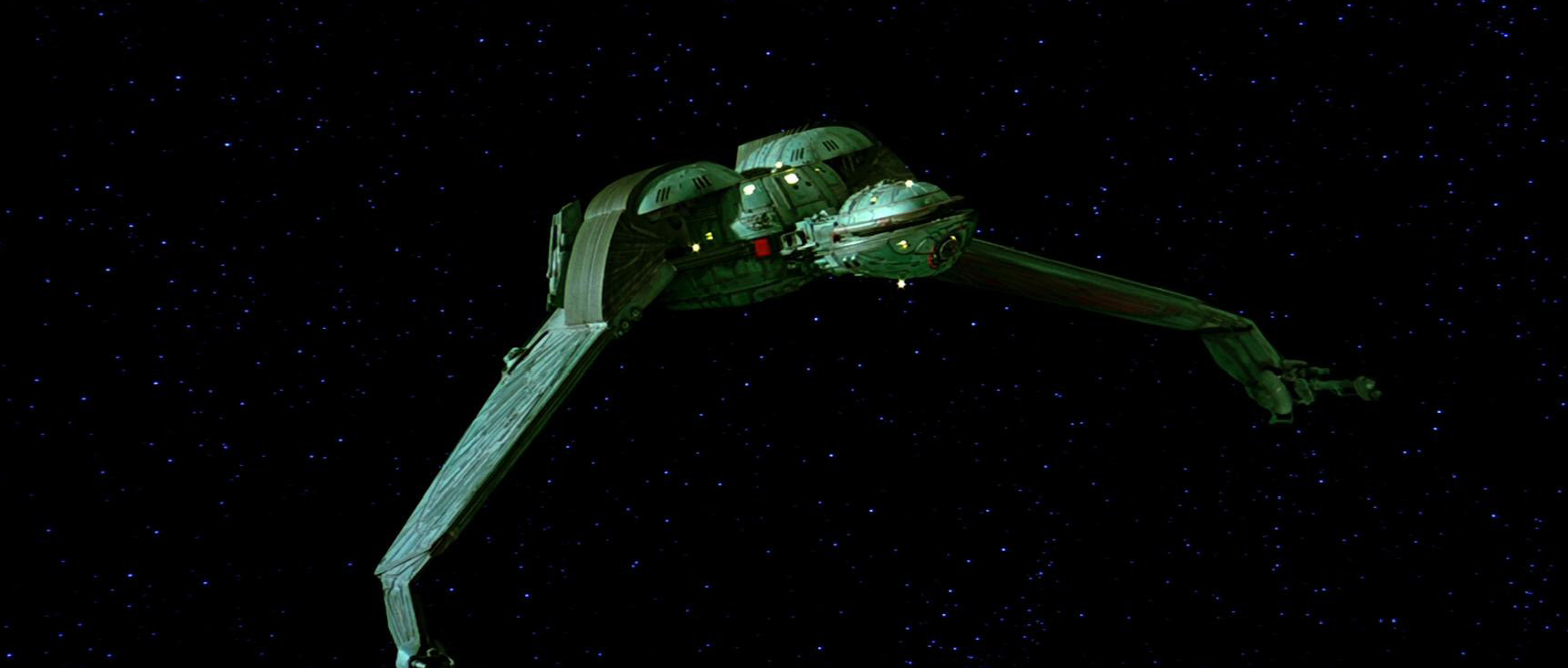
The Klingon Bird-of-Prey in Star Trek III: The Search for Spock. (Credit: Paramount Pictures)
The Klingon Bird-of-Prey: A Fearsome Fighter
An imposing warship with a head-like bridge section and angled wings, the Klingon Bird-of-Prey easily outmatched the merchantman. Commanded by a Klingon named Kruge (Christopher Lloyd), the Bird-of-Prey was armed with a cloaking device that concealed it from its enemy’s scanners. Kruge sought the power of the Genesis device, traveling to the Genesis Planet and making quick work of the U.S.S. Grissom. Despite its swift victories over lesser foes, the Bird-of-Prey soon found itself squared off against the legendary U.S.S. Enterprise. Of course, unbeknownst to Kruge, James T. Kirk’s famed vessel had been severely damaged in Star Trek II and only maintained a skeleton crew on its bridge.
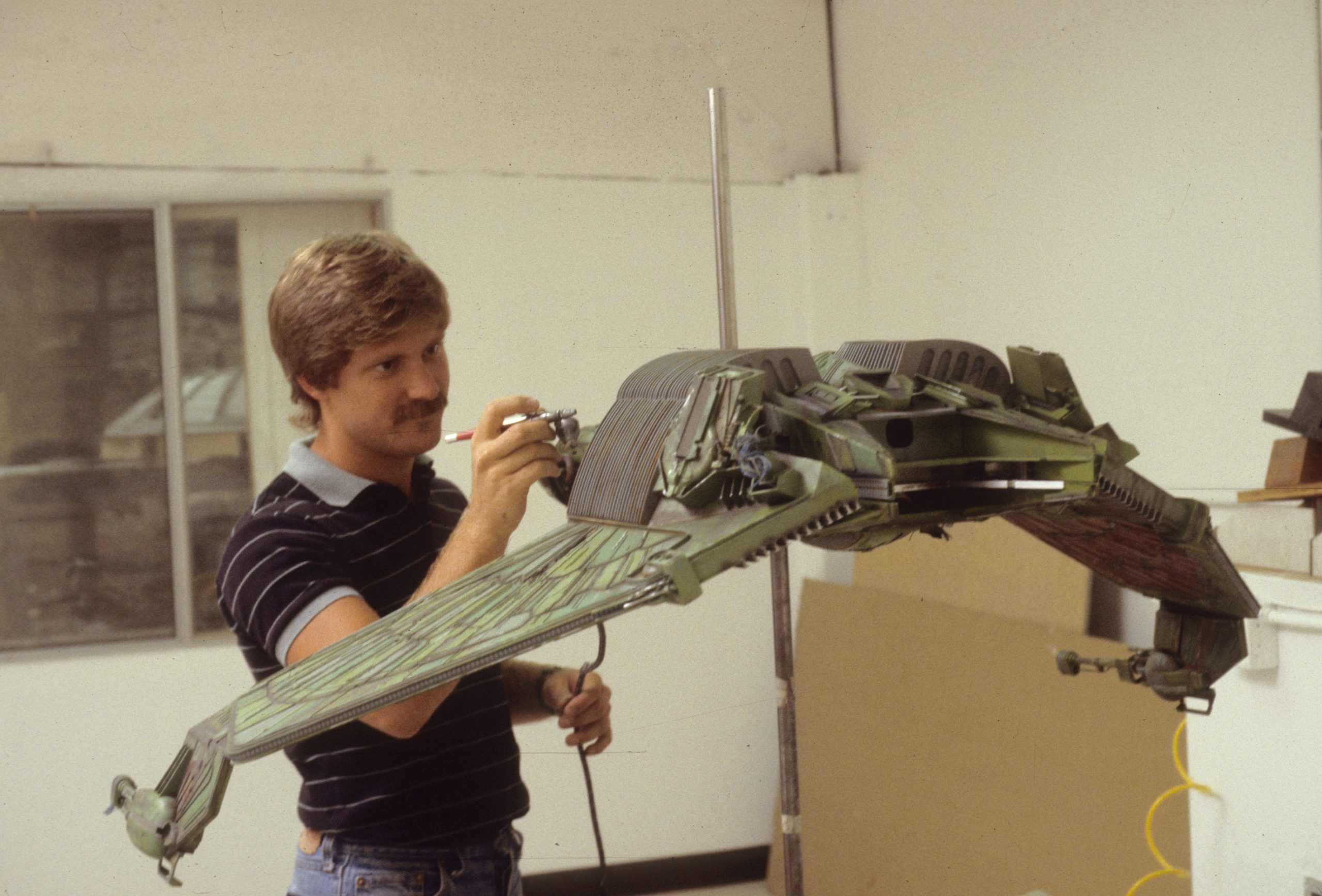
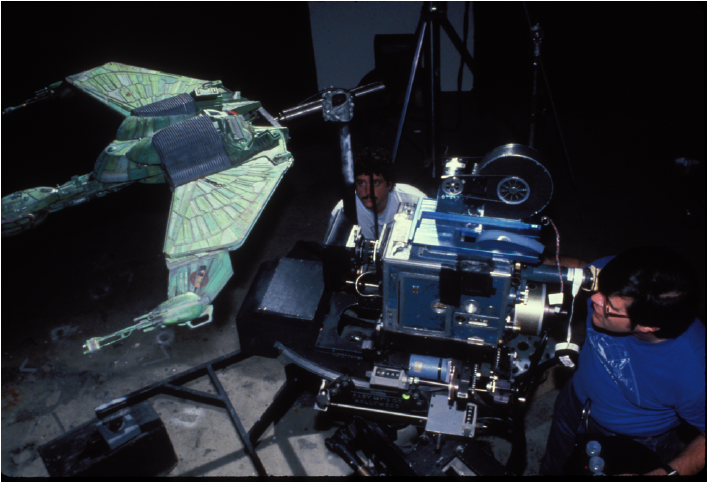
Modelmaker Bill George at work on the Bird-of-Prey miniature. (Credit: Industrial Light & Magic)
Perhaps the most distinctive starship ILM assembled for Star Trek III, the Klingon Bird-of-Prey model featured an intimidating green color scheme and motorized wings that could be raised above its primary hull. On top of bringing the vessel’s exterior to life, ILM pioneered the visual effect that permitted the Bird-of-Prey to decloak and become visible. “[Optical photography supervisor] Ken Smith came up with the optical effect,” Ralston shared with Nora Lee in American Cinematographer. “By using a ripple glass he threw the color sync off on each separation, so that everything is just a little out of whack. Then it all gets in sync and forms the ship.” The design impressed creatives to such a degree that, following the U.S.S. Enterprise’s destruction (yet another visual effect executed by ILM) in The Search for Spock, Kruge’s captured Bird-of-Prey — playfully renamed the H.M.S. Bounty by Kirk’s defiant crew — inherited the role of hero ship in the film’s Nimoy-directed sequel, Star Trek IV: The Voyage Home (1986).
Camera operator Selwyn Eddy (right) shoots the Bird-of-Prey miniature while camera operator Ray Gilberti (left) looks on. (Credit: Industrial Light & Magic)
However, the Bird-of-Prey’s prolific career was only just beginning. The ship’s signature profile played key parts as other nefarious Klingon vessels across the next three Star Trek films — Star Trek V: The Final Frontier (1989), Star Trek VI: The Undiscovered Country (1991), and Star Trek Generations (1994) — and popped up in numerous The Next Generation, Deep Space Nine, and Voyager episodes. As with many starships that began as physical models, the Bird-of-Prey was ultimately supplemented with a CG build in the latter stages of Deep Space Nine’s seven-season run. The craft even ended up in animated configurations for Star Trek: Lower Decks (2020) and Star Trek: Prodigy (2021). Nevertheless, all the Bird-of-Prey models that followed were based on the look established by ILM’s initial build. Furthermore, the 22nd century iterations of the Bird-of-Prey and Klingon D5-class variants which debuted in Star Trek: Enterprise (2001), a prequel series set over 100 years before The Search for Spock, were tailored to reflect their lineage as in-universe predecessors to ILM’s original Bird-of-Prey from Star Trek III.
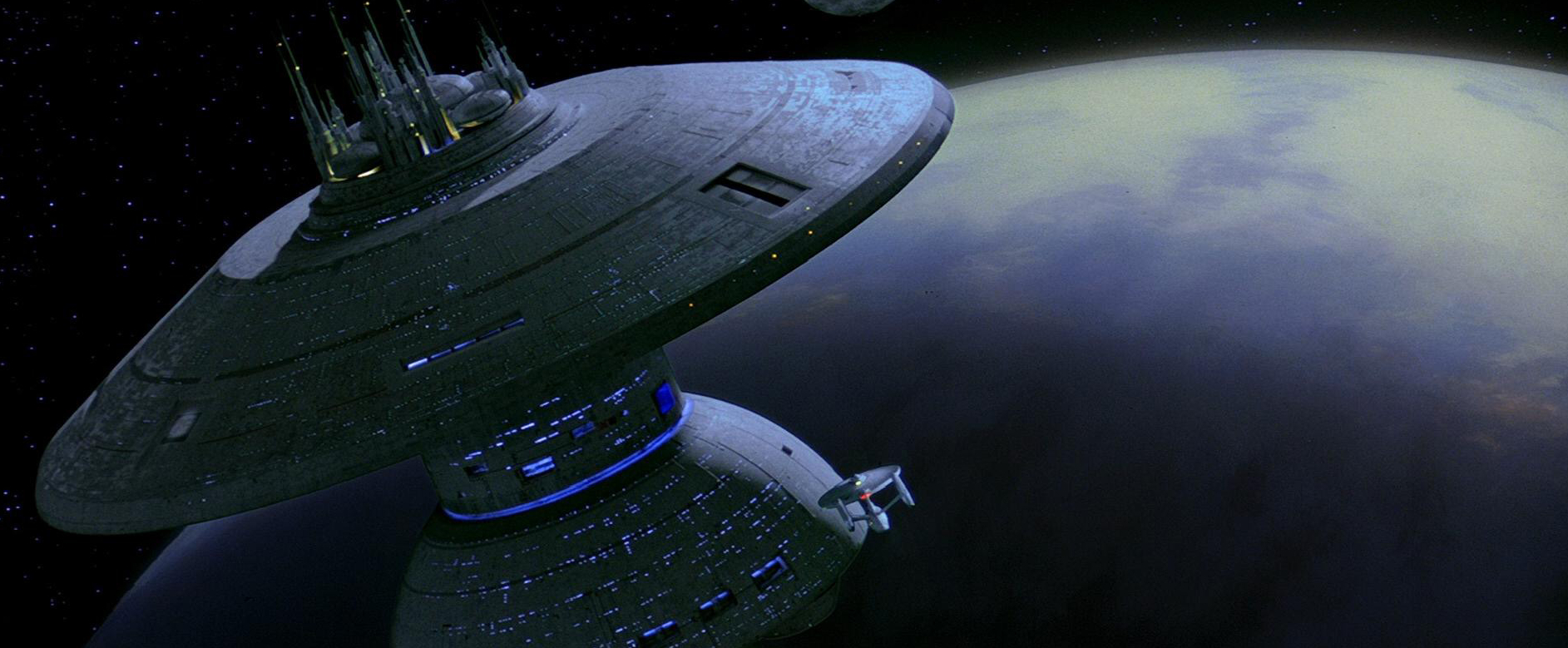
Earth Spacedock in Star Trek III: The Search for Spock. (Credit: Paramount Pictures)
Earth Spacedock: A Safe Haven in Space
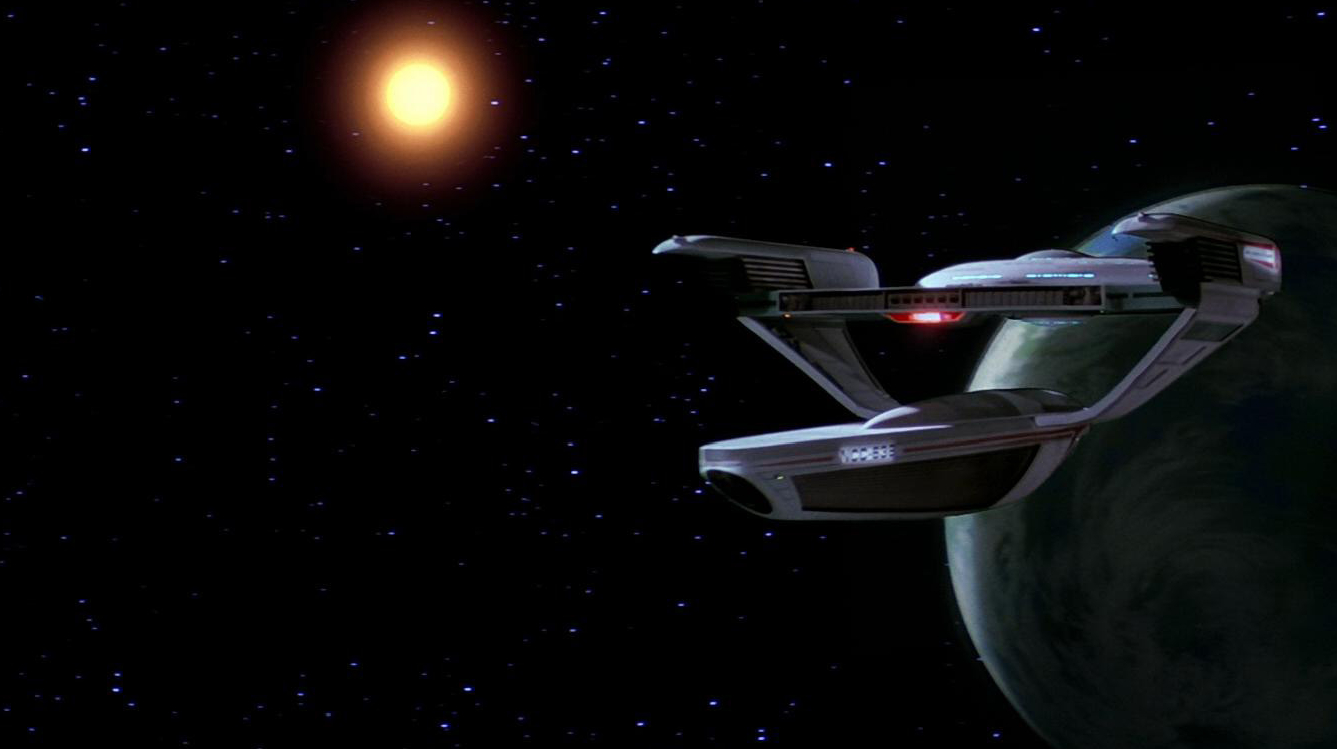
As the U.S.S. Enterprise glided through the solar system on its way to a much-deserved respite from action, it was greeted by the sight of Earth Spacedock. With a mushroom-shaped upper section atop a stem extending downward, the gargantuan space station permitted entire starships to enter its massive superstructure and dock at a central core complete with repair facilities. Abuzz with ships and various shuttles, the lively starbase watched over Earth and kept the Federation’s fleet ready to serve missions of exploration and defense.
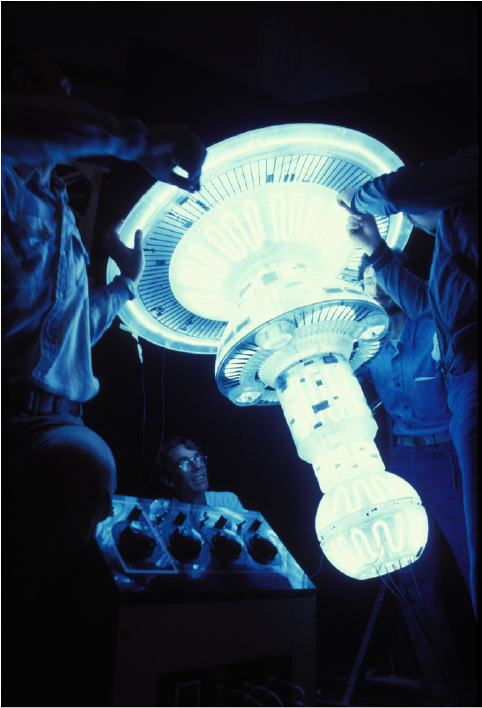
ILM’s Spacedock assignment necessitated three separate builds; namely the station’s illuminated exterior, its cavernous interior docking bay, and an interior view through the windows of a small, lounge-type set. Approximately five feet tall and three-and-a-half feet in diameter, the exterior model relied on a complex lighting system, which Ralston described in American Cinematographer. “[The Spacedock exterior] had lights inside after the door opens up and running lights that go inside. Sometimes it is hard to sync up all those functions with the motion control system. But I think it worked nicely.”
The issue of conveying the sheer size of a docking area able to house a multitude of starships received ILM’s innovative attention and expertise. “We found that the interior demanded some degree of atmospheric haze, even though there probably wouldn’t be any in outer space. It just needed help to look slightly degraded — not so crisp and clean,” visual effects cameraman Scott Farrar shared in Cinefex. “We ended up using blue gels on the lights and shooting in smoke for the basic fill look. Then, when we went to the light passes, we used a diffusion filter.”
ILM modelmakers work on the lighting components of the Earth Spacedock miniature. (Credit: Industrial Light & Magic)
As timeless as Earth Spacedock’s inaugural performance turned out to be, the station’s unveiling soon led to its return to the big-screen. In addition to being featured in the three Star Trek films which followed immediately after The Search for Spock, Earth Spacedock appeared as several other Federation starbases — Starbase 74, Lya Station Alpha, Starbase 133, and Starbase 84 — in The Next Generation via the use of stock footage. A version of Earth Spacedock seemed to be in the midst of orbital construction in the Star Trek: Discovery (2017) episode “Will You Take My Hand?,” while the design was translated into animated form to represent Douglas Station in Lower Decks. According to in-universe lore, Earth Spacedock was retired from service and transported to Athan Prime, where it was last seen as the central hub of the Fleet Museum in Star Trek: Picard’s (2020) third season.
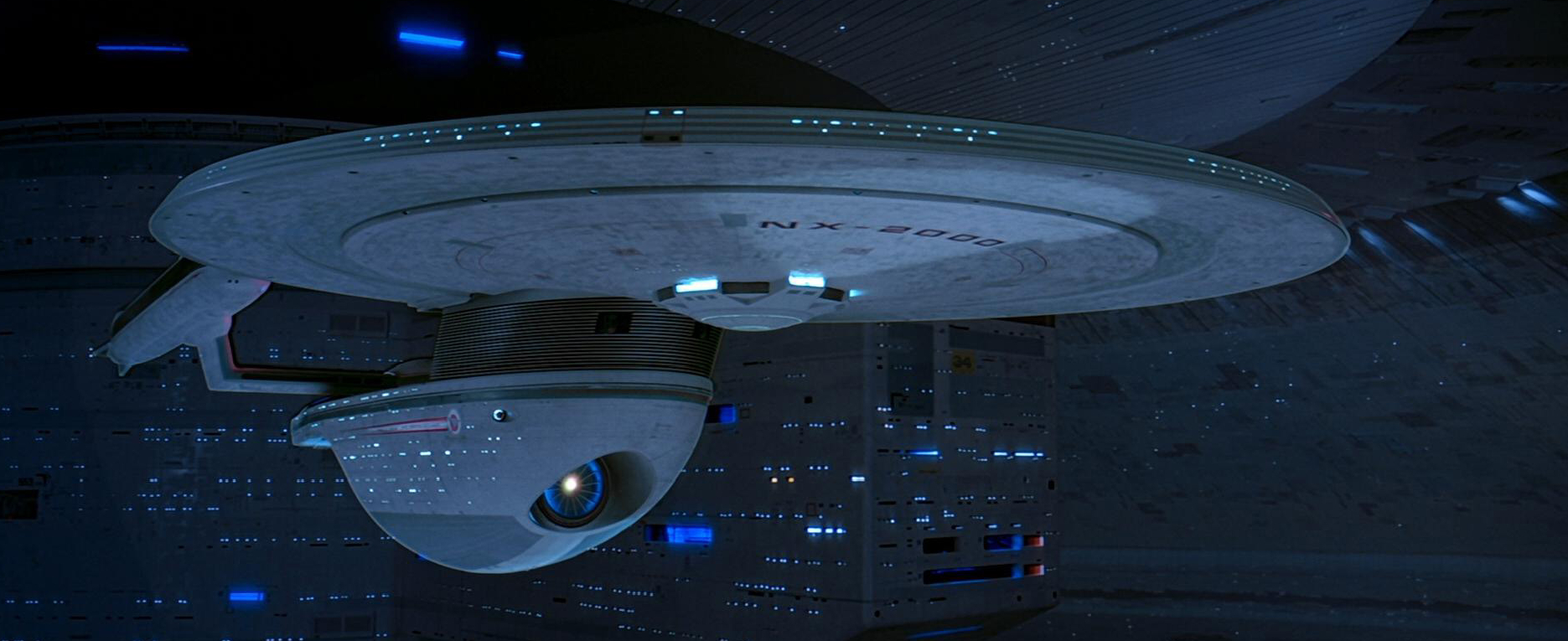
The U.S.S. Excelsior in Star Trek III: The Search for Spock. (Credit: Paramount Pictures)
U.S.S. Excelsior: The Transwarp Testbed
Dubbed “The Great Experiment,” the U.S.S. Excelsior acted as a testbed for an advanced faster-than-light propulsion system known as the transwarp drive. The Excelsior was spotted while berthed in Earth Spacedock, though the starship soon found itself attempting to engage its experimental engines as it pursued Admiral Kirk’s unauthorized departure aboard the Enterprise. Unfortunately for the Excelsior, Montgomery Scott (James Doohan) — the Enterprise’s chief engineer — had sabotaged the transwarp system, causing the vessel’s trial run to stall out in an abrupt and unflattering fashion.
As outlined in Star Trek: The Official Starships Collection, early U.S.S. Excelsior concepts devised by Nilo Rodis and David Carson led to Bill George’s own distinctive study model and a 7 ½-foot studio model constructed with the oversight of Steve Gawley.Our first encounter with the starship coincided with the Enterprise’s arrival at Earth Spacedock, resulting in an arduous challenge for ILM — Excelsior needed to appear stationary within the confines of the station’s interior. “[The Excelsior] was shot separately from everything else. [Visual effects cameraman] Sel Eddy shot that stuff,” Ralston told American Cinematographer. “We had to match the moves so that it looked like it was locked right into the space dock. It was a pain. We had to cheat on some of the shots where there was so much trouble with the moves.” Their diligence paid off, as the majestic sequence endures as one of The Search for Spock’s most awe-inducing visuals.
The Excelsior returned in The Voyage Home and The Final Frontier, but it received its biggest chance to shine in The Undiscovered Country, which also featured visual effects by ILM. Now captained by Hikaru Sulu (George Takei), the U.S.S. Excelsior rescued the U.S.S. Enterprise-A during a crucial battle against a rogue Klingon Bird-of-Prey. The model was heavily modified for fresh cinematic escapades in Star Trek Generations, then bearing the legendary registry of the U.S.S. Enterprise-B. The Enterprise-B variant was also utilized as the U.S.S. Lakota, an upgraded Excelsior-class vessel, in Deep Space Nine’s “Paradise Lost.”
ILM’s Excelsior design prevailed via cameos in The Next Generation, as exterior shots of the vessel — now deployed to represent an entire line of Excelsior-class starships — debuted in the show’s first and second season premieres, “Encounter at Farpoint” and “The Child.” These views were subsequently reused as stock footage to depict various Excelsior-class ships in no less than ten additional episodes of the series. As with the Klingon Bird-of-Prey, ILM’s original Excelsior model served as the basis from which all future Excelsior-class physical and CGI builds stemmed. Deep Space Nine aficionados will point to the abundance of Excelsior-class vessels dispersed throughout Dominion War-era battles in “Sacrifice of Angels,” “Tears of the Prophets,” and the series’ finale, “What You Leave Behind,” as evidence that the starships were an integral part of Starfleet’s defense armada. In fact, at least three Excelsior-class vessels stayed in active service long enough to have been prepared to confront the vaunted Borg Collective in Voyager’s own season finale, “Endgame.”
The U.S.S. Grissom in Star Trek III: The Search for Spock. (Credit: Paramount Pictures)
U.S.S. Grissom: A Scientific Scout
On a research mission to study the Genesis Planet, the U.S.S. Grissom was classified as a relatively small science vessel. After detecting an anomalous lifeform on the planet’s surface and beaming down a landing party consisting of Lieutenant Saavik (Robin Curtis) and Doctor David Marcus (Merritt Butrick), the Grissom remained tragically unaware as Kruge’s Klingon Bird-of-Prey approached under cloak and jammed all outgoing transmissions. The Bird-of-Prey dropped its invisibility field and coalesced into view, pouncing on the Grissom and destroying the Starfleet ship with a single blast.
The Roddenberry Archive notes the U.S.S. Grissom was yet another Star Trek III design conceived of by Nilo Rodis and David Carson and built by Steve Gawley and Bill George. The Grissom stood as a departure from the traditional Starfleet aesthetic in which a ship’s primary saucer was affixed to its secondary hull by a neck-like connection. A gap separated the two elements on the Grissom, with the only structures linking them being thin pylons extending from the vessel’s warp nacelles. The ship’s tragic fate didn’t merely come down to creating the biggest explosion, as plot considerations factored into ILM’s take on the Grissom’s destruction. “I didn’t think we should do something flamboyant at that point,” Ralston pointed out in Cinefex. “If we played all our best cards at the start, we’d have nothing left to show when it came time to blow up the Enterprise.”
The Grissom’s grizzly demise did not spell the end for the distinctive vessel, as the model functioned as the template for what would become known as the Oberth-class starship line. The design reemerged as a different ship of the same class berthed within Earth Spacedock in Star Trek IV before earning a recurring spot as a variety of Oberth-class ships that encountered the U.S.S. Enterprise-D in seven episodes of The Next Generation. The design garnered a great deal of attention in “The Pegasus,” an episode in which it was presented as the U.S.S. Pegasus, a testbed for an illegal Federation cloaking device. One Oberth-class ship assisted in the rescue of the Enterprise-D’s surviving crew at Veridian III in Star Trek Generations, while others could be found in the background at the Battle of Wolf 359 in Deep Space Nine’s “Emissary” and the ILM-orchestrated Battle of Sector 001 in Star Trek: First Contact. Like Earth Spacedock and the Klingon Bird-of-Prey, the Oberth-class design found itself turned into animated form for Lower Decks, this time in the episode “First First Contact.”
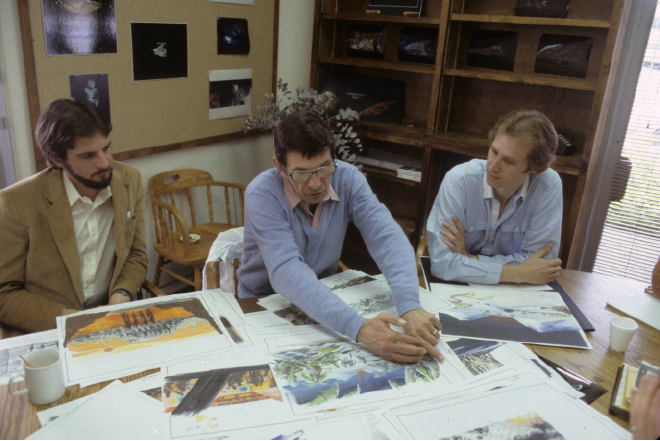
Director Leonard Nimoy (center) confers with visual effects supervisor Ken Ralston (left) and visual effects art director David Carson (right) during a visit to ILM’s Kerner facility. (Credit: Industrial Light & Magic)
The Search for Spock’s Legacy
Crafting memorable starships and space stations for any production is a tremendous responsibility, yet Industrial Light & Magic’s contributions to Star Trek III: The Search for Spock accomplished this lofty goal and so much more. Having not one, but five major designs go on to resurface in significant roles is an achievement beyond all expectations. A recent scene in Star Trek: Picard’s third season exemplified ILM’s incredible feat, as Kruge’s Klingon Bird-of-Prey and the U.S.S. Excelsior were both positioned around Earth Spacedock as part of the Fleet Museum’s honorary assemblage of classic starships. The everlasting nature of the designs speaks to the eternal appeal of ILM’s work. Whether the new studio models that ILM designed and built for Star Trek III were reused as they were originally constructed, recreated by other visual effects companies at a later date, or called upon by future artists to inspire their own takes on starships, the original models’ extensive influence on the Star Trek universe cannot be overstated.
_
Jay Stobie (he/him) is a writer, author, and consultant who has contributed articles to ILM.com, Skysound.com, Star Wars Insider, StarWars.com, Star Trek Explorer, Star Trek Magazine, and StarTrek.com. Jay loves sci-fi, fantasy, and film, and you can learn more about him by visiting JayStobie.com or finding him on Twitter, Instagram, and other social media platforms at @StobiesGalaxy.
The ILM veteran worked on projects like Jurassic Park and The Mask, and helped create a special Halloween poster that inspired the moniker for ILM’s new podcast.
27 years ago in 1997, Industrial Light & Magic was in the midst of the digital renaissance in visual effects, with projects as diverse as Men in Black, Contact, and Titanic being released that year, and others like Deep Impact (1998), Saving Private Ryan (1998), and Star Wars: The Phantom Menace (1999) readily underway. ILM’s then home at the Kerner facility in San Rafael, California was a bustling center of creativity across both digital and practical disciplines, and arguably the most exciting time of year came during Halloween season when hundreds of employees and their families gathered for an annual costume party.
Benton Jew had been with the ILM Art Department since 1988, working as a storyboard and conceptual artist on everything from Memoirs of an Invisible Man (1992) to the fabled television commercial where basketball star Charles Barkley plays one-on-one with Godzilla. Later, his responsibilities grew as he became a visual effects art director on projects like The Mask (1994). But there was always time for side projects in between work for clients, and in 1997, Jew was asked to illustrate that year’s invitation and poster for the fabled ILM Halloween Party.
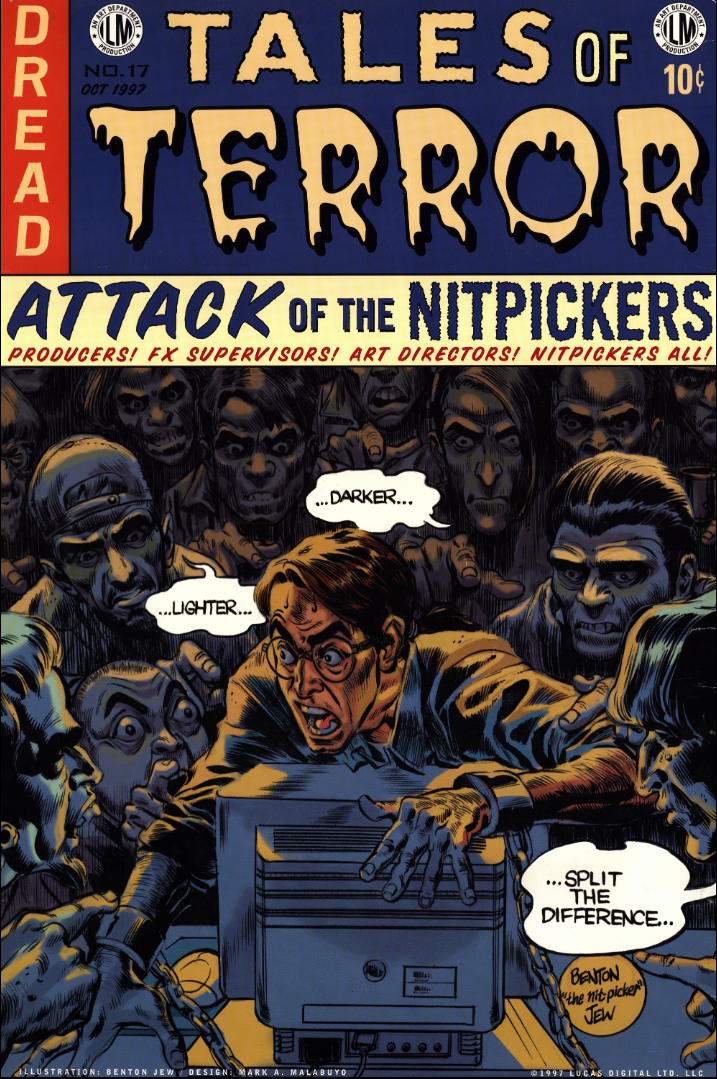
The poster for the 1997 ILM Halloween Party, designed by Mark Malabuyo and illustrated by Benton Jew.
Designed by the late Mark Malabuyo, an in-house graphic designer at the time, the poster was envisioned in the style of the classic EC Comics of the mid-20th Century, known for their horror and science fiction stories. This “issue,” dated from October 1997, is entitled “Tales of Terror: Attack of the Nitpickers,” with the subtitle, “Producers! FX Supervisors! Art Directors! Nitpickers all!” Jew’s illustration below depicts a visual effects artist surrounded by figures caricatured in the horror style. He frightfully grasps his computer as the onlookers share their feedback about his work. “…Lighter…” one says, while someone else contrasts with “…Darker…” Yet another recommends, “…Split the difference…”
This tongue-in-cheek bit of satire about the collaborative process of visual effects would have inspired a chuckle from just about everyone at the company, and two of its word bubbles have now become the namesake of ILM’s new podcast. “I just wanted to capture that look of someone when a person comes by their workstation and points something out, or someone’s expression in dailies,” Benton Jew tells ILM.com. “It seemed like that kind of situation came up a lot in CG. Okay, no one can make a decision, let’s split the difference.
“Especially as an art director, I think I’d been seen as someone who would pick out little things,” Jew continues. “I’d be on The Mask or something, and would tell an artist, ‘Oh those icicles, they’re not quite right,’ or whatever it is. I’m sure that anybody who’s worked in CG can relate to that. People are always pointing and giving you backseat directions.”
Benton Jew
Known within the department for his versatile and prolific output, Jew was also a lifelong comics fan, an attribute that earned him the Halloween Party assignment. “I was sort of the resident comic book geek,” he explains, “and obviously a Halloween piece would have an EC Comics theme to it. I tried to be in the spirit of artists like Jack Davis, Jack Kamen, and Graham Ingels. Mark Malabuyo was the graphic designer on it. He was a wonderful guy, so easy to work with. He was really jovial and friendly. We all miss him. He was set on making sure that the graphics had a fidelity to the old EC stuff. He made it as close as he could, with obviously some differences.”
Growing up, Jew had first aspired to be a comics artist. Then, as he puts it, “Star Wars happened.” The 1977 feature film launched the cinematic dreams of many younger viewers at the time, including Jew and his twin brother (who also became an illustrator). “We saw all the books on the making of Star Wars with Joe Johnston’s storyboards and Ralph McQuarrie’s drawings, and got hooked into amateur filmmaking. For people who grew up in that era when Star Wars came out, it really sparked a craze for people to want to be filmmakers.”
While studying at the Academy of Art in San Francisco with teachers like celebrated poster artist Drew Struzan, Jew was recruited into ILM’s ranks courtesy of storyboard artist Stan Fleming, who’d contributed to projects like Indiana Jones and the Temple of Doom (1984). Jew loved cinema, but never lost his passion for comics and illustration. “When I started working there, most people were from the car design world,” he explains. “They weren’t necessarily drawing figurative work. They were doing architectural or vehicle-driven stuff. As things became more creature-based in visual effects, being a general illustrator worked well for me. I can’t draw a vehicle to save my life.”
From the beginning, Jew worked as a storyboard artist, directly applying his knowledge of comics to another mode of visual storytelling. Among others, he’d eventually board for director George Lucas on The Phantom Menace. “With George, all of us would sit and do thumbnails with him. But I’ve worked with plenty of directors like that where I’ll sit with them and draw lots of tiny thumbnails really quickly, and then I’ll go back and flesh those boards out later. With George, we met with him twice a week for quick little meetings. He’d basically tell us the story, and we’d all draw out different ideas and he’d make suggestions. Then we’d have this huge stack of thumbnails, and we’d get them in correct order, and someone like me or Ed Natividad or Iain McCaig would make finished drawings from those.”
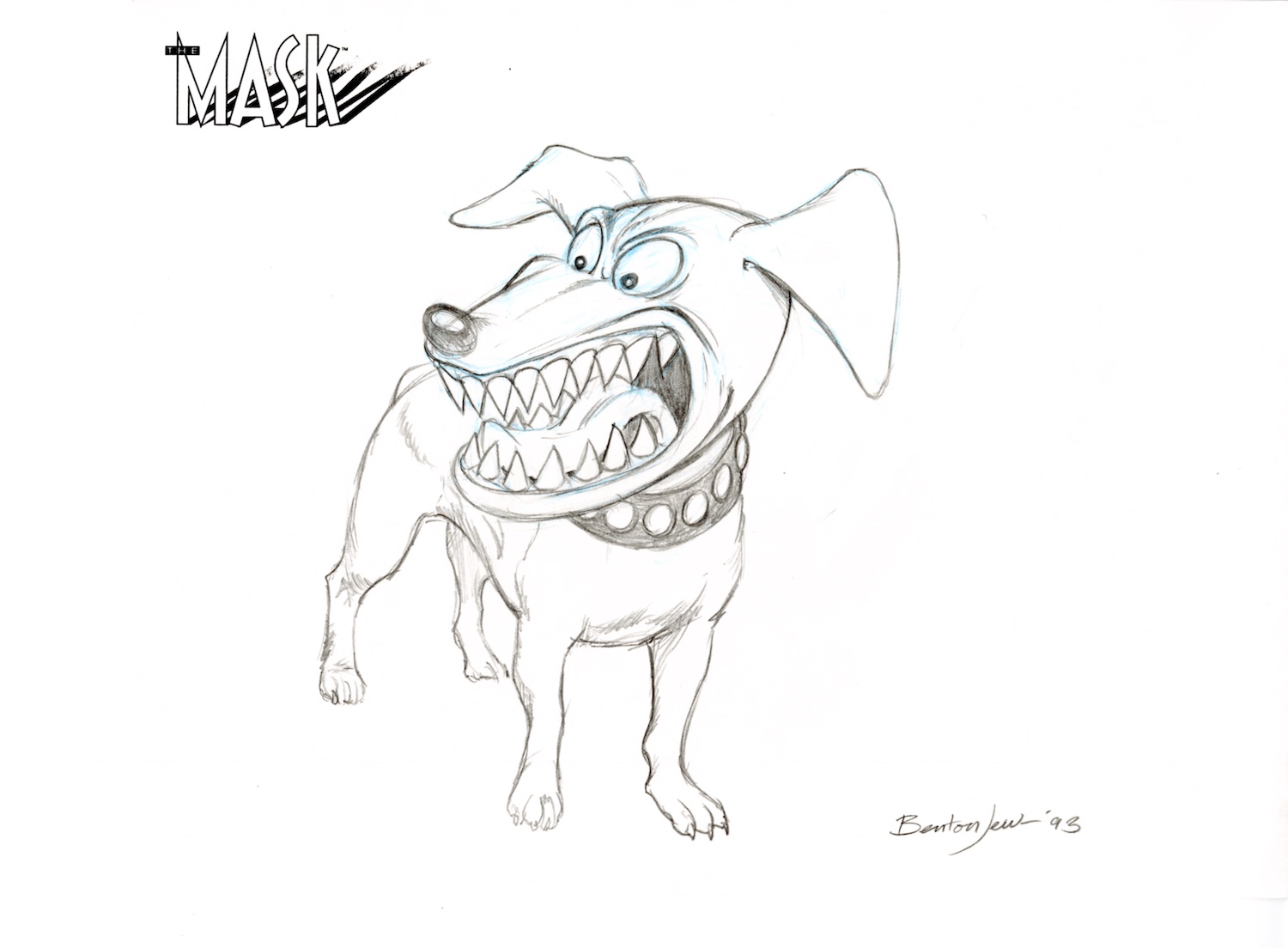
An example of Jew’s concept art, a sketch of Milo the dog from 1994’s The Mask.
The digital renaissance led to a surge in projects requiring CG creature development, from early entries like The Abyss (1989) and Jurassic Park (1993), to even more ambitious projects like Dragonheart (1996) and The Mummy (1999). Jew had a front-row seat during this storied period that introduced new tools and tumultuous change. “My first real film was Ghostbusters 2,” he recalls, “and that was still done with foam and rubber and stuff like that. I got a pretty good idea of what that was like. I could see CG slowly coming into view. It was really a magical time and everything was changing by leaps and bounds.
“I would go down to ‘The Pit’ and watch Spaz [Steve Williams] creating those dinosaurs that he would later show to Spielberg and company,” Jew continues. “It was so weird when Jurassic Park was being made because you had to sit on this and not tell anybody, and you knew it was going to change the world. As the technology kept improving, it wasn’t replacing the artists and filmmakers; it was helping them. It’s about giving them the tools to make something that they couldn’t make with traditional means…. John [Knoll] would come by and ask us what we wanted to see in Photoshop. He meant for it to be a tool for us, not a replacement. Our pallet was growing larger.”
Departing ILM in 2001 after 13 years with the company, Jew headed for Los Angeles where he continues to work on feature films as a storyboard and concept artist. He’s also self-published comic books of his own, as well as contributed to comics for Marvel, among others. Jew still gets questions about the memorable “Tales of Terror” poster (and remains adamant that the terrified artist clutching his machine is not based on anyone in particular). Looking back on his ILM days, Jew values the artistic lessons granted him by the experience of working on so many different assignments.
“Just the idea of having to do a lot of stuff very quickly impacts how you draw,” he concludes. “You learn to do more shortcuts, what to leave in, what to take out, and things like that. Early on, I didn’t do a lot of paintings. Most of my stuff was black and white, but I learned to do more color stuff when they asked me to do it. The volume, speed, and needs always change, so you just stay flexible. As an artist or an art director, the most important thing is not your eyes or your hands, but your ears. To understand what the director or effects supervisor wants, you need to develop your ear more than anything. It’s learning what they want and how to do it correctly. It may not be your own taste, but you need to be able to talk to them and know where they’re trying to go with it.”
–
Lucas O. Seastrom is a writer and historian at Lucasfilm.
We are pleased to announce Lighter Darker: The ILM Podcast, where we focus on the creative process of filmmaking and the art of visual storytelling. Hosted by ILM Chief Creative Officer Rob Bredow and ILM Compositing Supervisor Todd Vaziri, and produced by Jenny Ely, we share behind-the-scenes stories that illustrate the many crafts that come together to create a motion picture, TV series, or special venue project.
Whether you’re a seasoned professional, an aspiring filmmaker, or a fan of immersive experiences, Lighter Darker provides valuable insights, inspiration, and a deeper appreciation for the artists behind the projects we undertake at ILM in visual effects, animation, and immersive entertainment. We have a terrific lineup of special guest filmmakers who join the team for upcoming episodes to discuss the creative process of filmmaking and the art of visual storytelling.
For the first time, ILM’s groundbreaking virtual production technology transports fans inside the Star Wars galaxy.
By Clayton Sandell
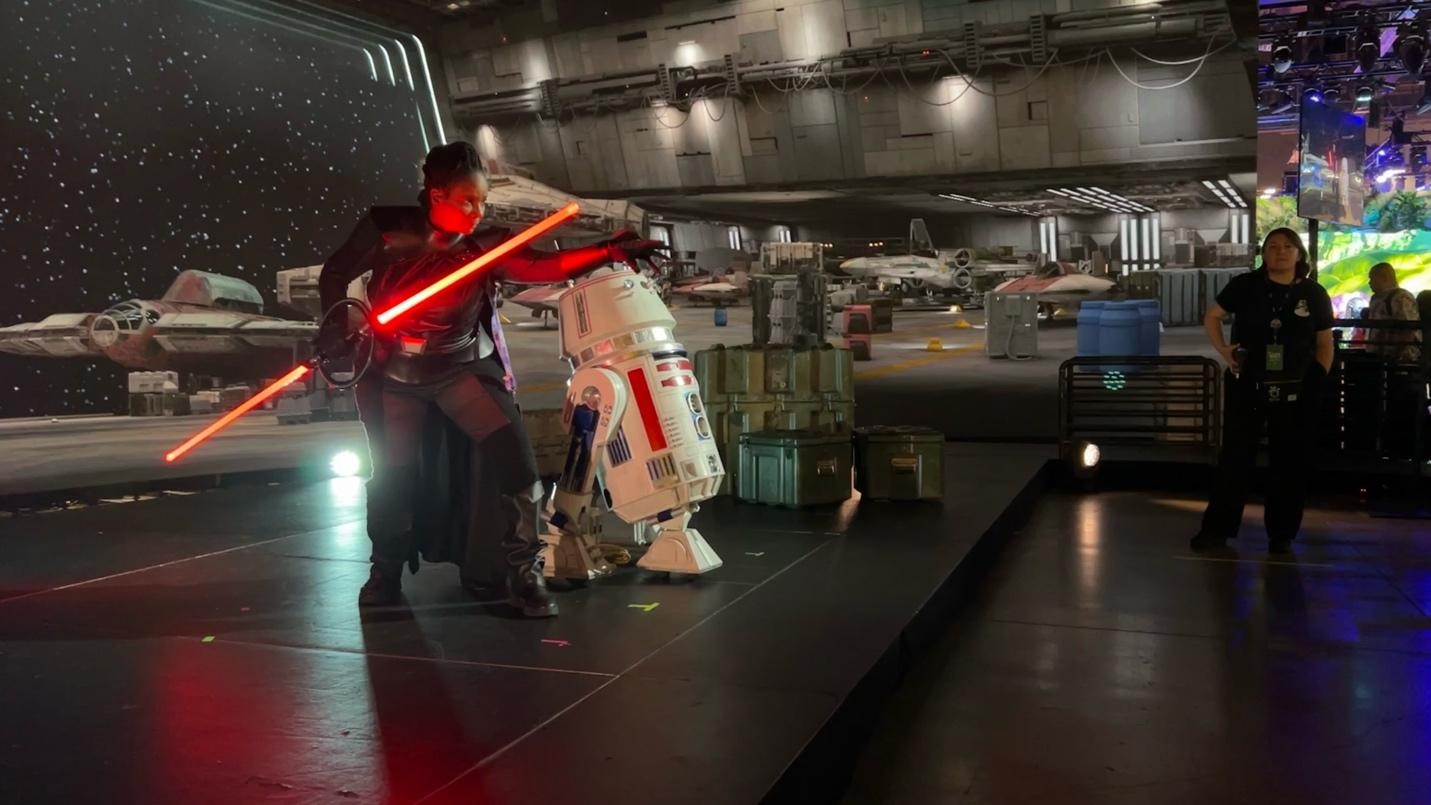
Patricia Burns gets ready for her closeup on the ILM StageCraft volume at D23.
Patricia Burns steps up to her mark.
Dressed in the sleek all-black uniform worn by the Third Sister Reva Sevander from Obi-Wan Kenobi (2022), she ignites her doubled-bladed red lightsaber and waits for her cue.
A nearby stagehand counts her down and calls “Action!”
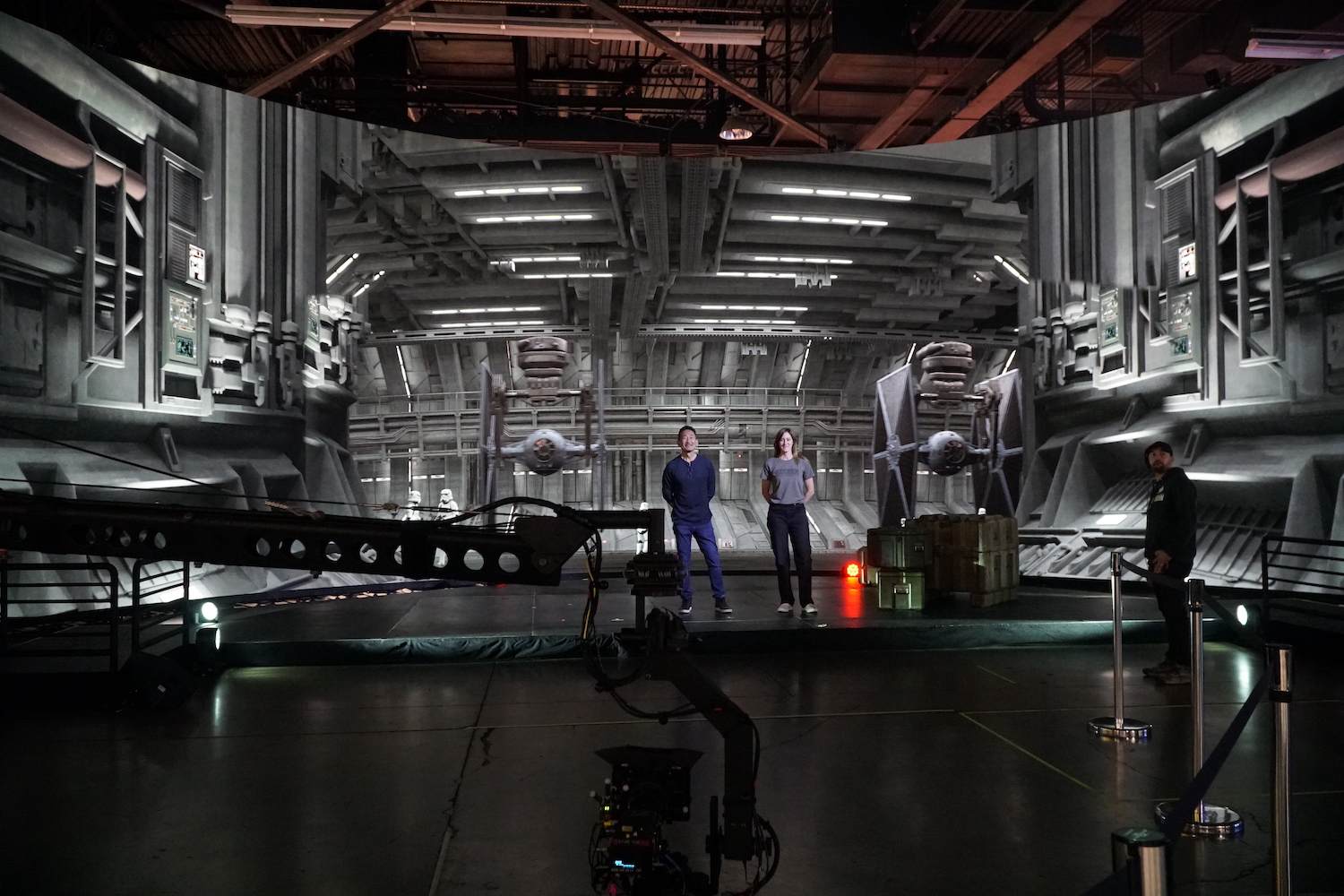
As a crane-mounted camera swoops in, Burns crouches next to R5-D4, a red and white astromech droid, swinging her lightsaber with a fierceness only a Jedi-hunting Inquisitor could conjure. Behind her, a massive wall of LED screens displays the pristine moving image of a busy Rebel hangar.
Monitors around the stage show what the camera sees in real-time: an epic, trailer-worthy shot that makes Burns the star of her own Star Wars story.
“Oh, it was awesome,” Burns tells ILM.com as she walks off the stage, grinning. “A chance of a lifetime.”
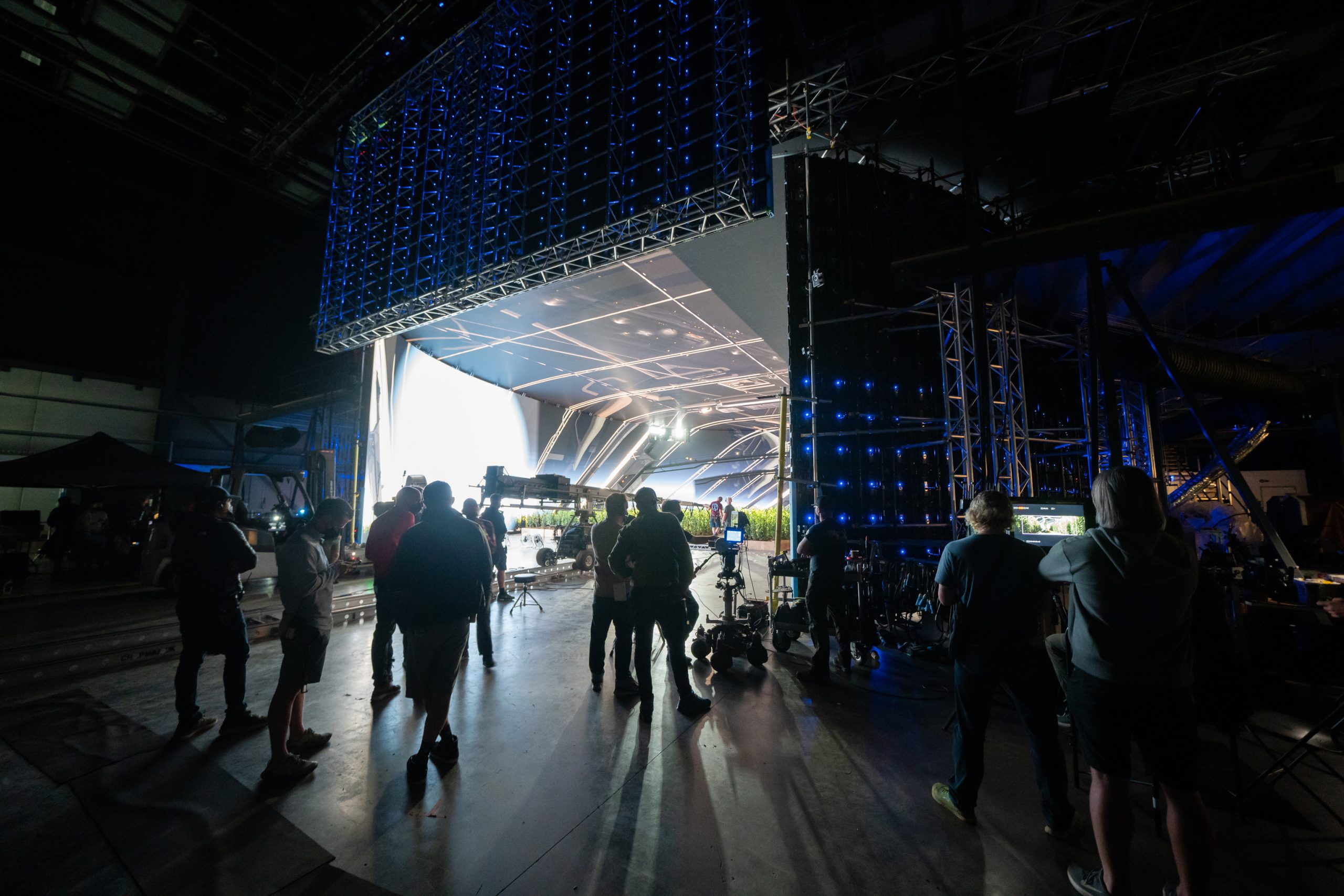
For the first time ever, the ILM crew assembled a volume— something normally sequestered on an off-limits studio soundstage— inside the Anaheim Convention Center just for fans attending D23.
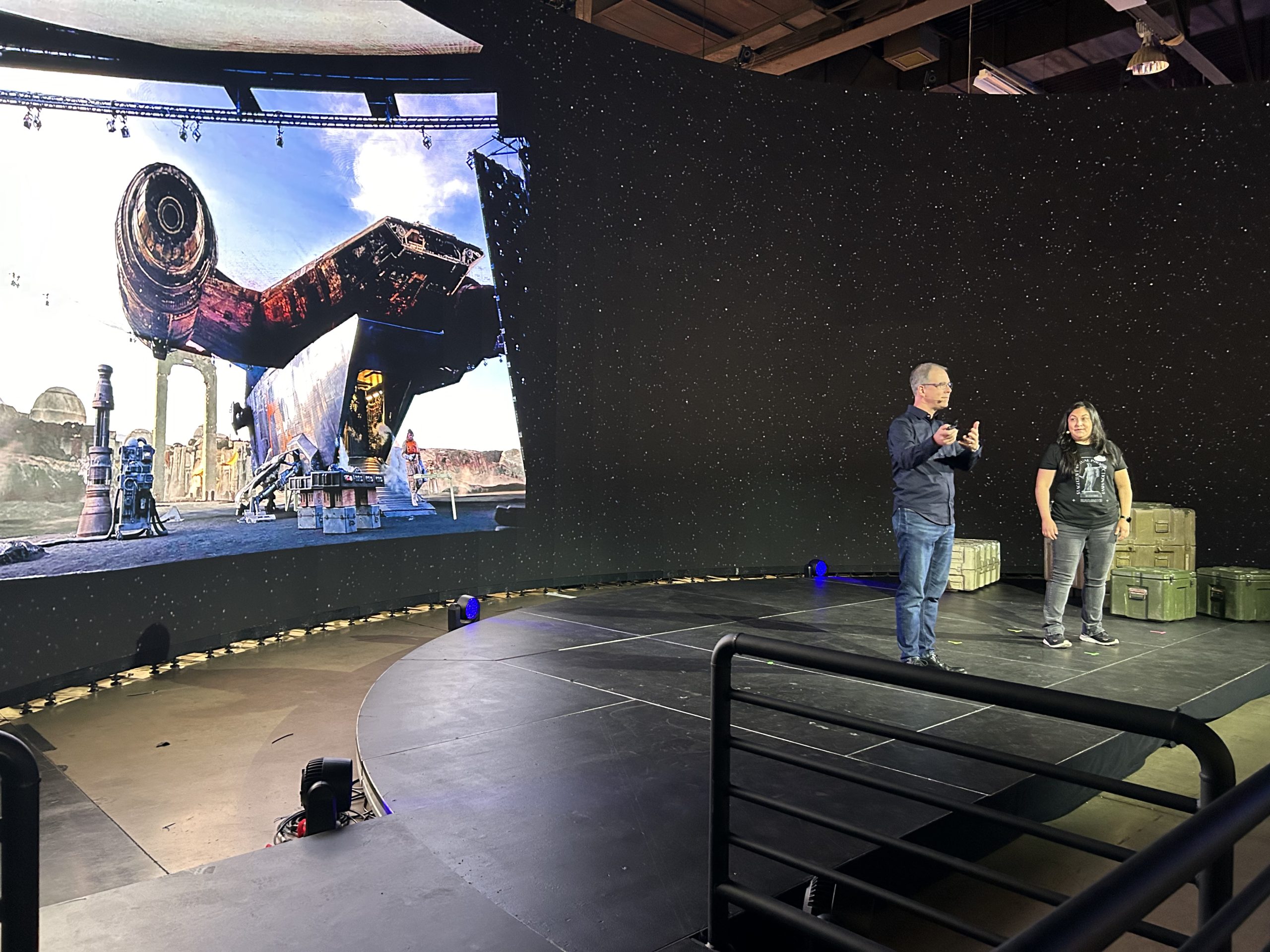
ILM’s chief creative officer Rob Bredow and virtual production supervisor Sonia Contreras host a StageCraft workshop.
“I think everybody is blown away by the scale of this, and how immersive it actually is when you get to see it here on the show floor,” says Rob Bredow, senior vice president, creative innovation for Lucasfilm and chief creative officer of ILM.
During the three-day event, a rotating trio of scenes appeared on the volume’s giant LED panels: an Imperial hangar created for The Mandalorian, a Rebel hangar from Ahsoka (2023) and a vibrant city street on the planet Daiyu seen in Obi-Wan Kenobi.
“You’re looking at over 18-and-a-half million pixels of LED wall and a live-tracked camera,” Bredow tells ILM.com. “Wherever the camera looks, we get a high-fidelity version with exactly the right perspective for the illusion of creating an immersive environment. It looks impressive enough here at the convention center but when we collaborate with the production designer and the art department on one of our productions that’s when the technology really sings. It’s a powerful tool in the filmmaker’s toolbox that we can deploy when building standing sets on a stage or traveling the cast and crew to a far-flung location isn’t feasible.”
For D23, ILM wanted to demonstrate a fully functioning StageCraft volume exactly like the ones used on a real set.
“It’s very fun to not be faking it,” Bredow quips.
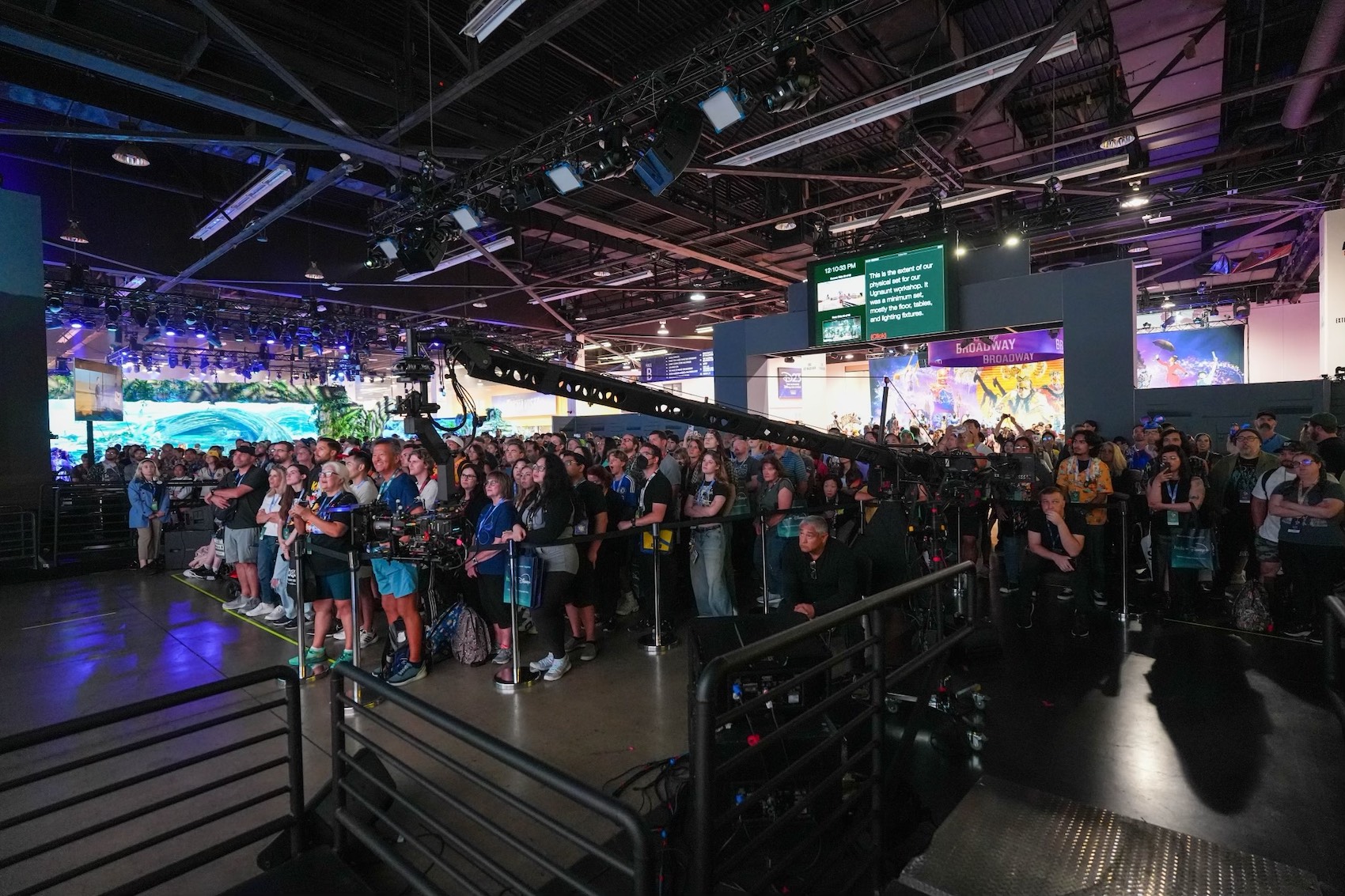
Attendees at D23 take in ILM’s StageCraft volume.
ILM virtual production supervisor Ian Milham says transporting the volume from a studio lot to the convention center took a herculean scheduling and logistical effort involving a busy team of artists, engineers, and crew members. And several large trucks.
“Everybody agreed, ‘yes, we’re really going to do it’,” Milham explains. “But that meant we had to get our real gear and our real crew here. It also meant we couldn’t be making a movie with it at that time.”
The challenge was worth it, Milham says, because it gave the filmmakers a chance to finally show off their pride in StageCraft to a wider audience.
“Film sets are amazing places,” says Milham. “But it’s not like there’s a lot of chances to really share our success. So we’re really happy to be able to show the public for the first time the cool results, but also what it takes to pull off something like this and how much teamwork and technology it takes to do it.”
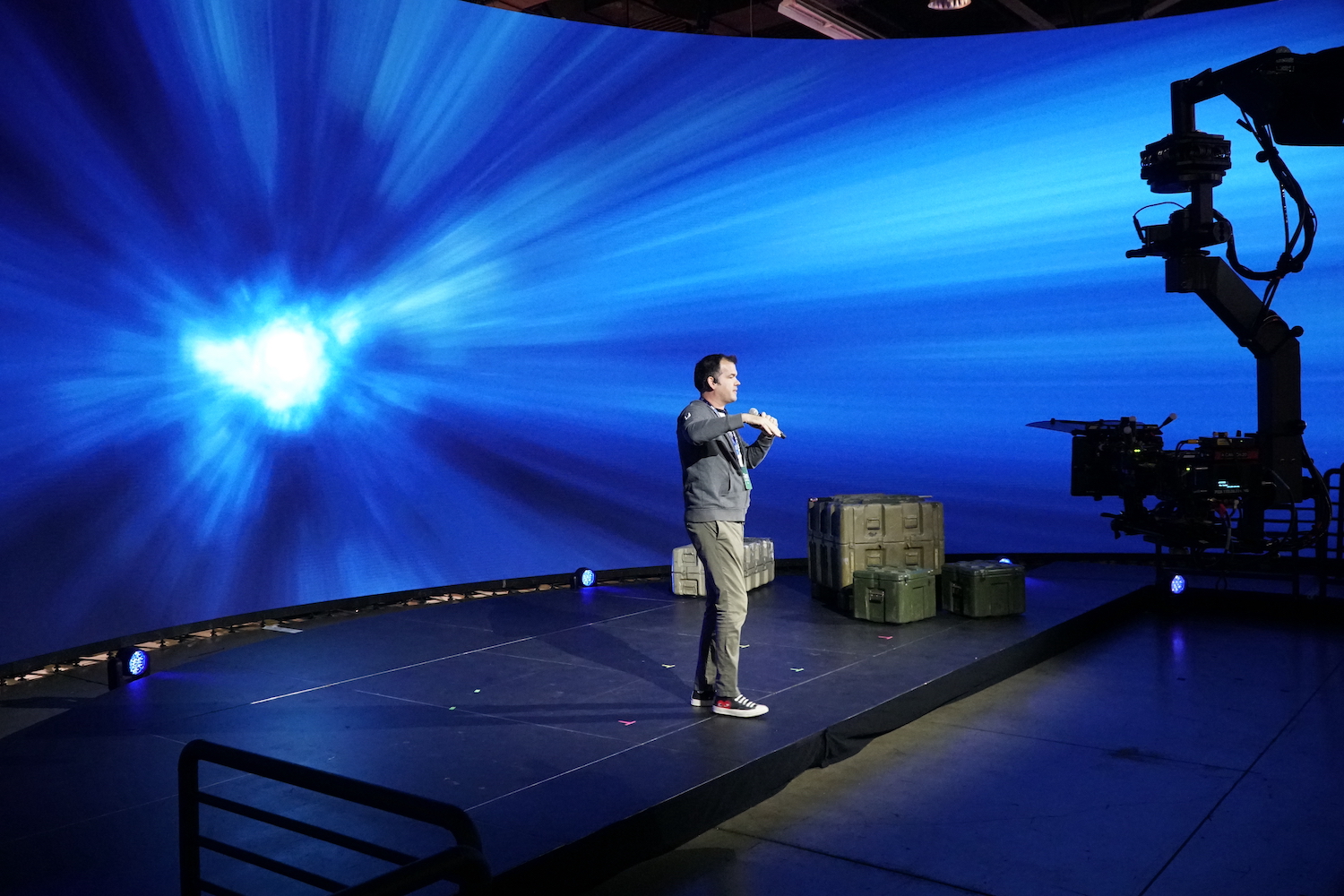
ILM virtual production supervisor Ian Milham demonstrates the volume.
ILM virtual production supervisor Sonia Contreras co-hosted several StageCraft presentations with Bredow. The pair challenged the D23 audience to look at several scenes and guess which elements were created with practical set pieces and props, and which ones were generated by the volume.
“I got about a third of them right,” laughs Ryan Schwartz, who watched the demonstration with his wife Katie and sons Zachary and Jonathan. Katie says she fared slightly better, guessing about half correct.
“I’ve been following ILM for a long time, and I still try and figure it out,” Ryan tells ILM.com. “They’re so amazing in their craft that it’s so hard to really piece together what is real and what is digitally done.”
Contreras says the D23 StageCraft experience is extremely special because even some ILM employees still haven’t been able to see the volume work in person.
“I would hope that people take away that there’s a lot of brains that go into making this happen,” Contreras says, pointing to the setup’s real-time rendering, camera tracking, processing power, and an aptly named “Brain Bar” crew working behind the scenes to help make the scenery so seamlessly realistic.
“The ‘wow’ factor is when you get to see what’s actually happening, all the different things that are getting coordinated in order to make that image work,” Contreras says. “It’s really cool to be able to show it to everybody.”
Lucasfilm senior vice president and executive design director Doug Chiang made a special appearance in front of a packed crowd on Saturday to talk about StageCraft’s contribution to the long history of visual effects filmmaking.
“We rarely get to share it or talk about it, because it’s an evolving technology, and it is just a tool,” says Chiang. “But at an event like this, where we can actually finally get under the hood and share the magic with the audience, it’s just terrific.”
Lucasfilm executive design director Doug Chiang and Lucasfilm Art Department associate producer Michelle Thieme in the volume.
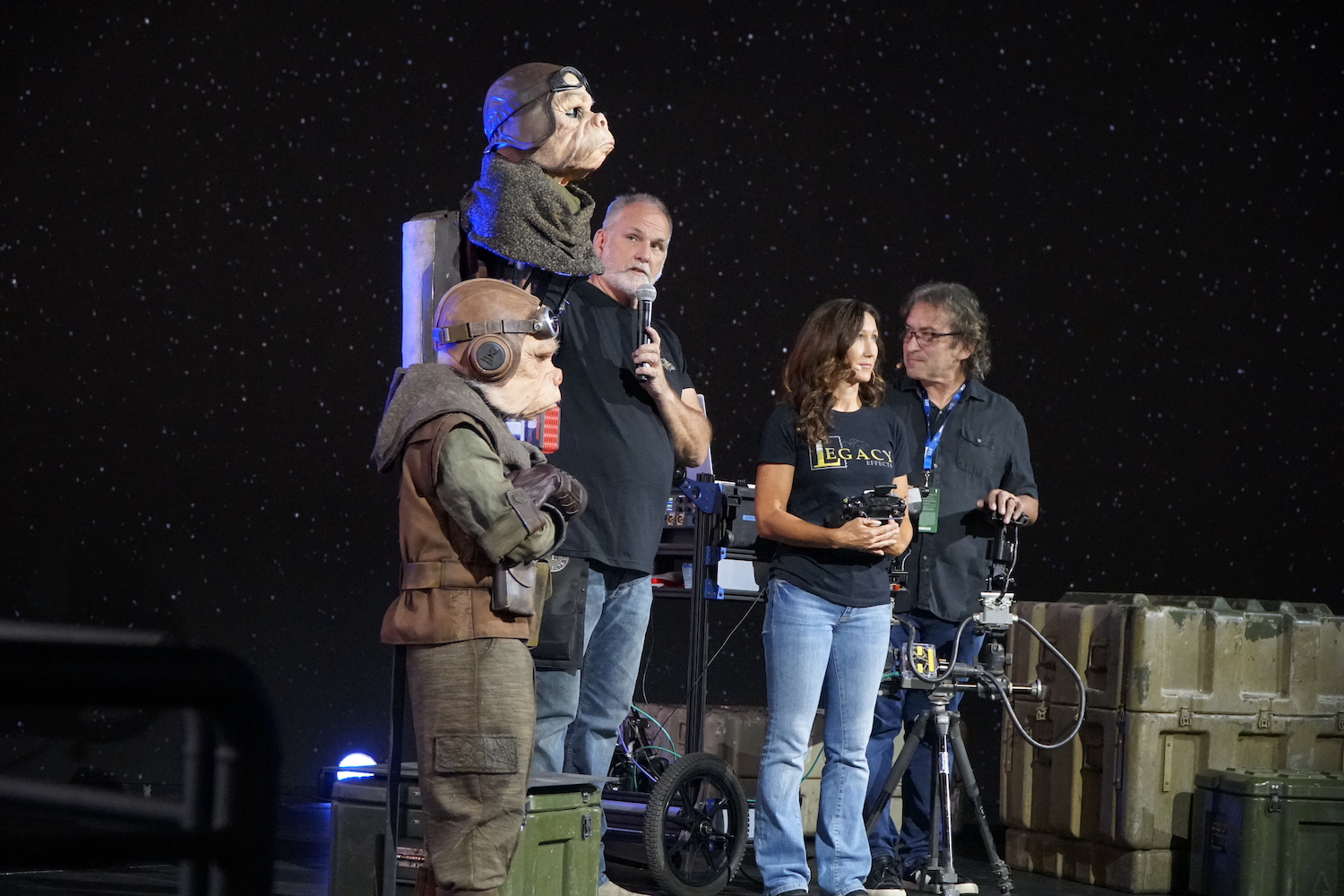
Frequent ILM collaborator Legacy Effects also pulled the curtain back to show how their crew helps create a Star Wars galaxy full of creatures, aliens, and droids.
“When you’ve got leaders like Jon Favreau and Dave Filoni, who just embrace everyone’s contributions, it inspires you to do the best work that you can,” says Legacy Effects co-founder and special effects veteran Alan Scott.
At D23, Scott and the Legacy team explained how they bring life to characters like the silver professor droid Huyang (voiced by David Tennant) and Murley the Loth-cat for Ahsoka. The production relies on a combination of practical puppets along with digital versions inserted later, depending on the requirements of each shot.
“There are things that I think practical can do very well, especially when it comes to the interaction with the performers,” Scott tells ILM.com. “Then there’s a responsibility that says, ‘that would be better if it was done with visual effects.’”
Legacy Effects co-founder Alan Scott (left) demonstrates a character prop with colleagues Dawn Dininger and David Covarrubias.
Bredow hopes that revealing how some of the Star Wars magic is made might inspire others, especially kids, to consider working in visual effects.
“Many people don’t even realize there are these very artistic and very technical and very creative jobs that have to do with working behind the scenes of film and television production,” Bredow explains. “So this is one of the fun things to do. To connect with fans, to connect with people who might want to make this a career.”
Cosplaying as Bastila Shan from the Knights of the Old Republic (2003) video game, Star Wars fan Carly King says she was most impressed by StageCraft’s powerful mix of creativity and engineering.
“It just looked so good on the screen. It’s so interesting to see how this whole conglomeration of electronics and technology comes together. It’s an incredible thing,” King says. “It’s one thing to watch Star Wars, but it’s another thing to be in it.”
—
Clayton Sandell is a television news correspondent, a Star Wars author and longtime fan of the creative people who keep Industrial Light & Magic and Skywalker Sound on the leading edge of visual effects and sound design.
After 25 years at ILM, Cooper has earned a reputation for seeking out the most efficient solutions to creative problems.
By Lucas O. Seastrom
Back in 2002, Industrial Light & Magic’s Jay Cooper was a compositing sequence supervisor on Master and Commander: The Far Side of the World (2003). For a time, director Peter Weir joined the ILM crew at their offices on Kerner Boulevard in San Rafael, California. “We had a shot when the mast of one of the ships falls over,” Cooper tells ILM.com. “There’s all this gunfire. It’s completely enshrouded in smoke. As I’m working on it, Weir comes to my desk and he says, ‘I want it to look like a beautiful nightmare.’ I was like, ‘Wow, that’s cool. Now what does that look like?’ [laughs]”
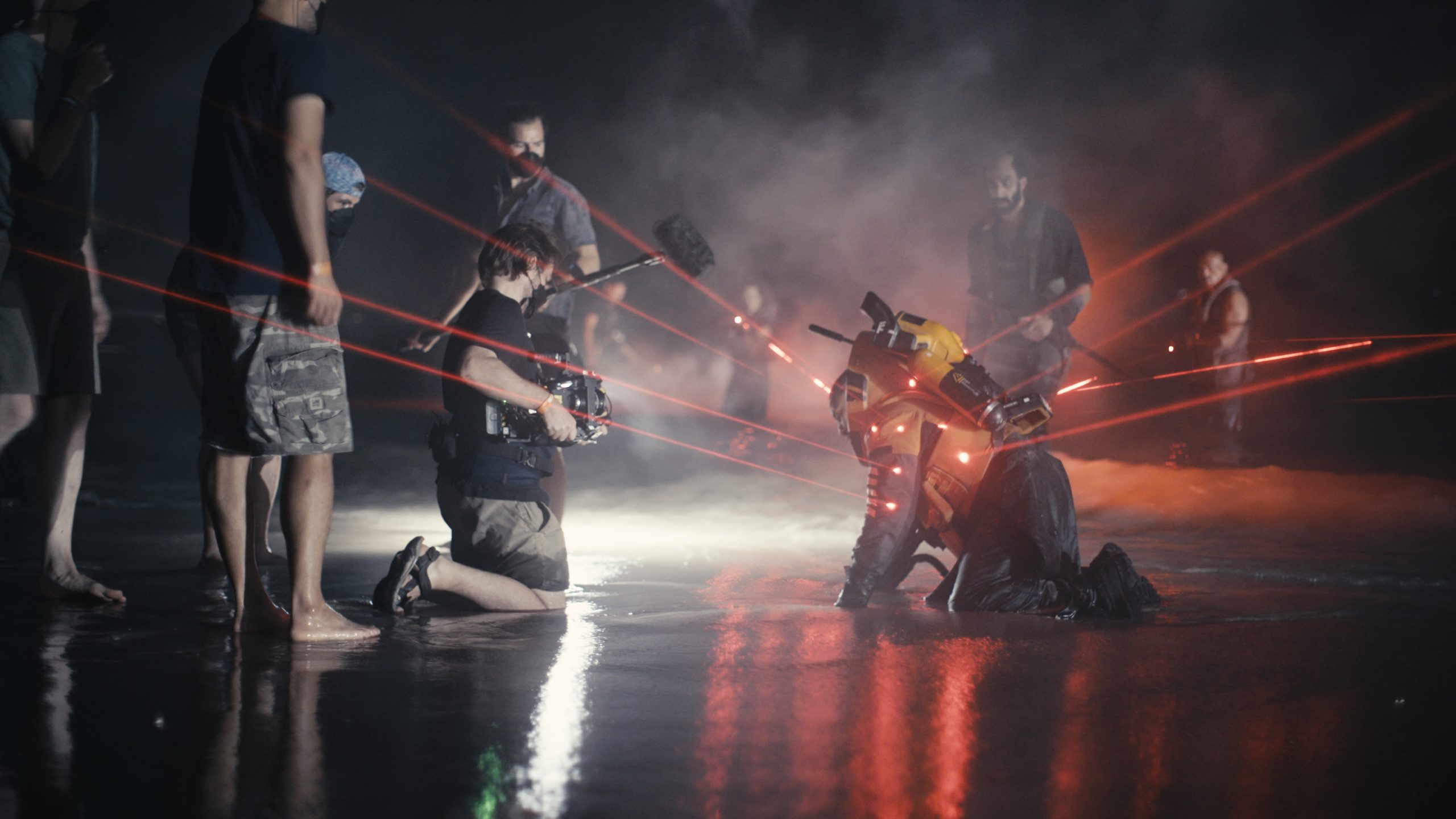
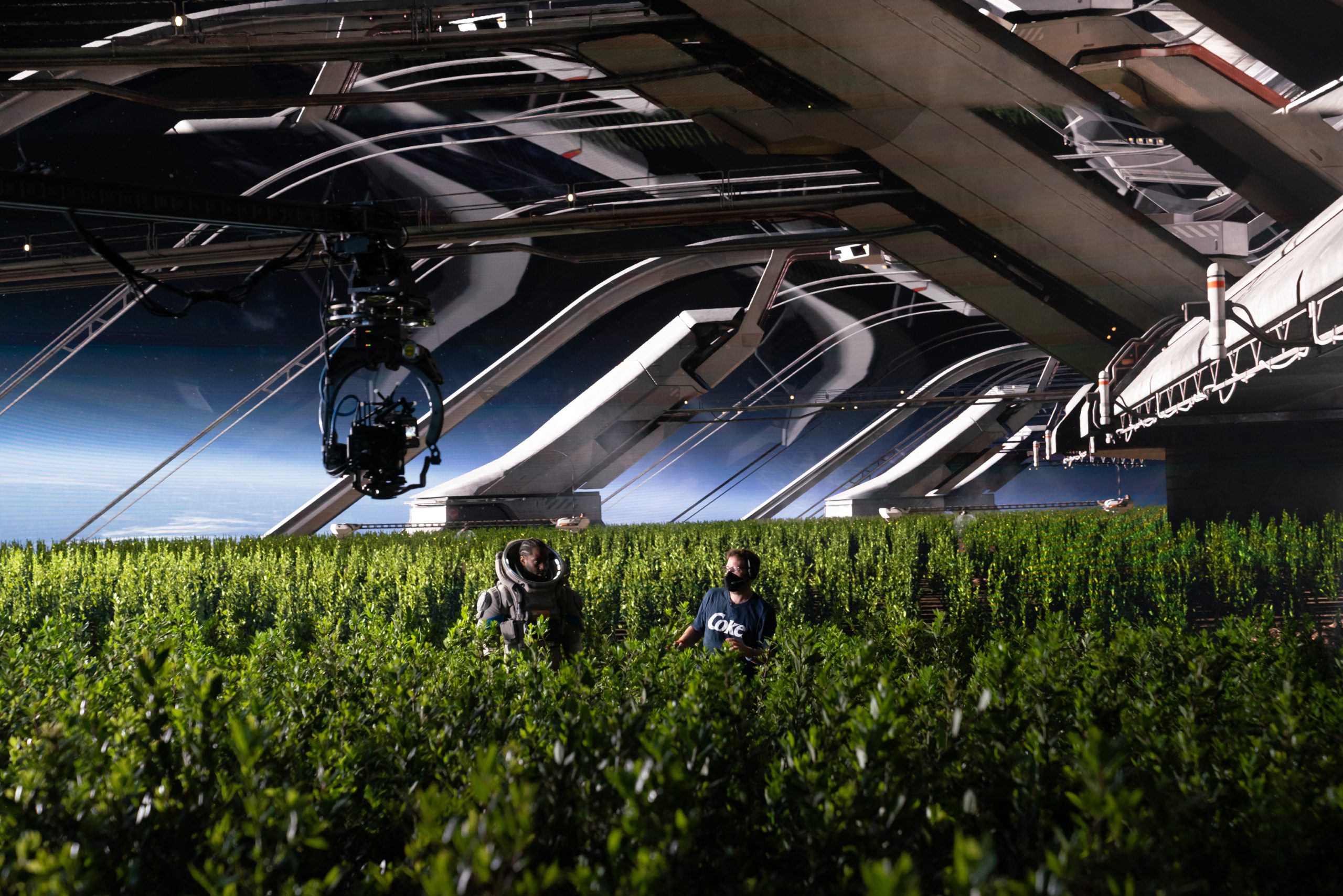
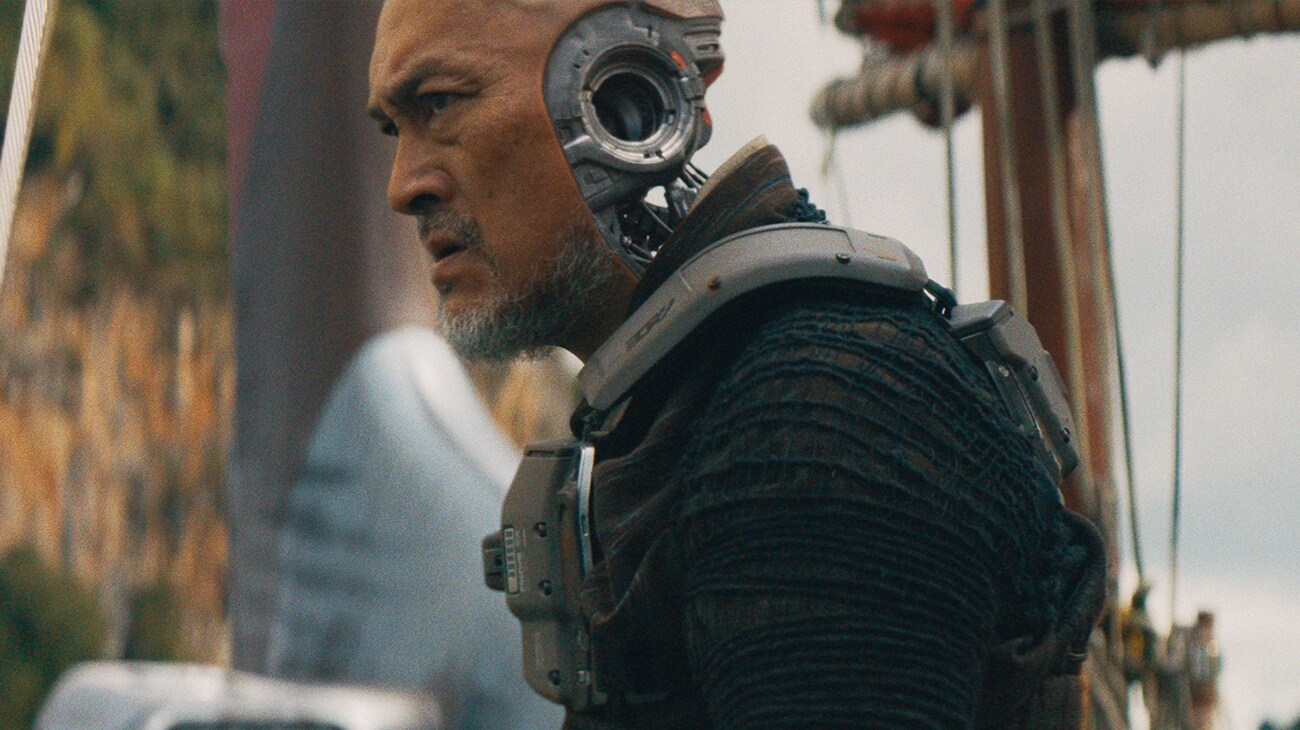
Over the past two decades, Cooper has moved into the visual effects supervisor role, working on projects as varied as Eternals (2021) and Babylon (2022). Most recently, he partnered with writer/director Gareth Edwards on The Creator (2023), a science-fiction tale with an unconventional visual effects methodology. As he and the ILM crew navigated the challenges of integrating effects into location photography with minimal reference data, Cooper managed to connect with Edwards in a way that reminded him of his experience with Peter Weir.
“Normally, as a visual effects supervisor, you’re being much more granular in your notes, lots of technical conversations,” Cooper says. “You don’t usually engage with artists in an emotional way. That’s what is really wonderful when you’re exposed to working with directors. That’s my favorite part of being a supervisor: you’re not always in the weeds talking about those details, you’re trying to engage with it at a story level. That’s the part that artists love. Gareth partnered with us in that way, and people got really excited about the project. Fun things happen when people get excited. They sneak in extra takes. They devote themselves in a huge way. We asked people to do really hard stuff without all of the support materials. If they know what we’re trying to achieve and we’re all pulling together, it can help make up for those shortcomings.”
At the beginning of the project, ILM’s chief creative officer Rob Bredow asked Cooper to meet with Edwards and producer Kiri Hart. “Gareth said, ‘Hey, I’ve got this movie and I hear you’re the guy who likes to cheat,’” Cooper says with a laugh. “He said that probably in the most affectionate way. I’m not really a devotee of any sort of process. I worship at the altar of whatever we can do as quickly and as simply as we can do it. As an artist, that was my forte. I did lighting and compositing, and I would try to navigate as many shortcuts as I could. I guess my reputation as a visual effects supervisor was that I’d work on shows with really small budgets and we’d try to wring out whatever production value we could. I think that’s why Rob put us together.”
Director Gareth Edwards operating the camera on location in Asia during production on The Creator.
Edwards’ vision and Cooper’s style were in tandem. In terms of workload, The Creator would be Cooper’s biggest project to date as a visual effects supervisor. “One of the best pieces of advice that [ILM executive creative director] John Knoll ever gave me,” Cooper notes, “was that you take big problems, break them into smaller problems, and smaller and smaller. So we created teams to hit different problems. We knew that we were going to be behind the 8-ball. We knew that Gareth had a smaller-than-desired budget, and he came to us wanting to partner in a different way.”
Edwards had been a visual effects artist himself before taking the director’s chair full-time. In his 2010 feature directorial debut, Monsters, he famously created many of the visual effects on his own. For Cooper, this practical experience helped define ILM’s approach to crafting visual effects with a “scrappy” sensibility. Shooting primarily on location in Thailand, Edwards focused on capturing his actors and the dramatic landscapes where they played out their scenes. Traditional effects tools like bluescreens and tracking markers would be almost completely avoided, and ILM would need to integrate their CG elements without the normal reference tools.
Looking into the ILM StageCraft volume during production on The Creator.
“Most of the time doing visual effects work, it’s very much a spreadsheet problem. You have seven robots at this amount of money, or fifteen environments at this scale at this amount of money. Even at the bidding stage for The Creator, we were instead asking what we could do for a certain amount of money. Just as a scrappy filmmaker, Gareth wanted to know what was possible in visual effects if we used different techniques and structured the show differently.
“If we take a whole sequence,” Cooper continues, “Gareth would explain how there’s only so much information you can take in during one shot, so let’s put everything together, bring it all up, and water the one element that’s dying. If you didn’t feel like there were enough robots here, how much do you need to add? Where’s your eye going to go? If a frame feels empty, what can we add? Is there a way to add something that avoids a roto-nightmare? Can we structure it so we don’t see the element in one shot but we do see it in the next two shots so that you sort of complete what the image is? Loosely, that’s how we went off and did the work.”
Much of that questioning and analysis was open to the larger visual effects crew. Initially, Edwards had planned to embed himself within ILM’s studio to personally oversee the work. Although pandemic concerns ultimately scratched that idea, he still welcomed artists from deeper in the ranks to present their work directly and share ideas.
Gareth Edwards discusses a scene with John David Washinton in the ILM StageCraft volume.
“It takes a rare person to be comfortable enough to share your feedback openly with artists on the production,” Cooper notes. “It’s really wonderful. You get a level of engagement that you may not always find. Sometimes working on blockbusters, you can feel like you’re just punching numbers. But if you expose the artists to the reasoning behind something, the filmmaking intent, you get a huge level of engagement.”
As visual effects supervisor for the entire production, Cooper was busy overseeing work not only at ILM’s studios in San Francisco, London, Sydney, and Vancouver but also the assortment of smaller vendor studios enlisted to assist on the project. The initial shot count estimate had more than doubled by the time Edwards shared his initial cut. As he points out, ILM contributed “about 95% of the asset work and the lion’s share of the shot work” with the support of the vendors.
“As a supervisor, I’m sort of tapping the boat,” Cooper says. “You can’t be in every single file to model the rivets. You can’t go into every composite to add the elements. You’re asking for degrees of one thing or another, and there are a lot of places where people are volunteering an idea. They’re doing it in a way that they understand what the stylistic or aesthetic goal is.”
Overall, Cooper’s experience on The Creator felt like a return to an earlier era in visual effects, one that speaks directly to ILM’s can-do spirit. “ILM tries to find projects that are outside of the comfort zone of what has happened previously. It must have been wonderful in the late ‘80s or early ‘90s when the question wasn’t ‘can you do this?’ It was, ‘is this even possible?’ Those times have ended in many different ways. You do it enough times, and there’s a cost structure around it. So it’s interesting to be on a project where you chuck a lot of that away and get back to the basest level. We have a pot of money and a director with some big ideas. That’s the launching point. It’s cool and exciting to be in that world again.”
Lucas O. Seastrom is a writer and historian at Lucasfilm.
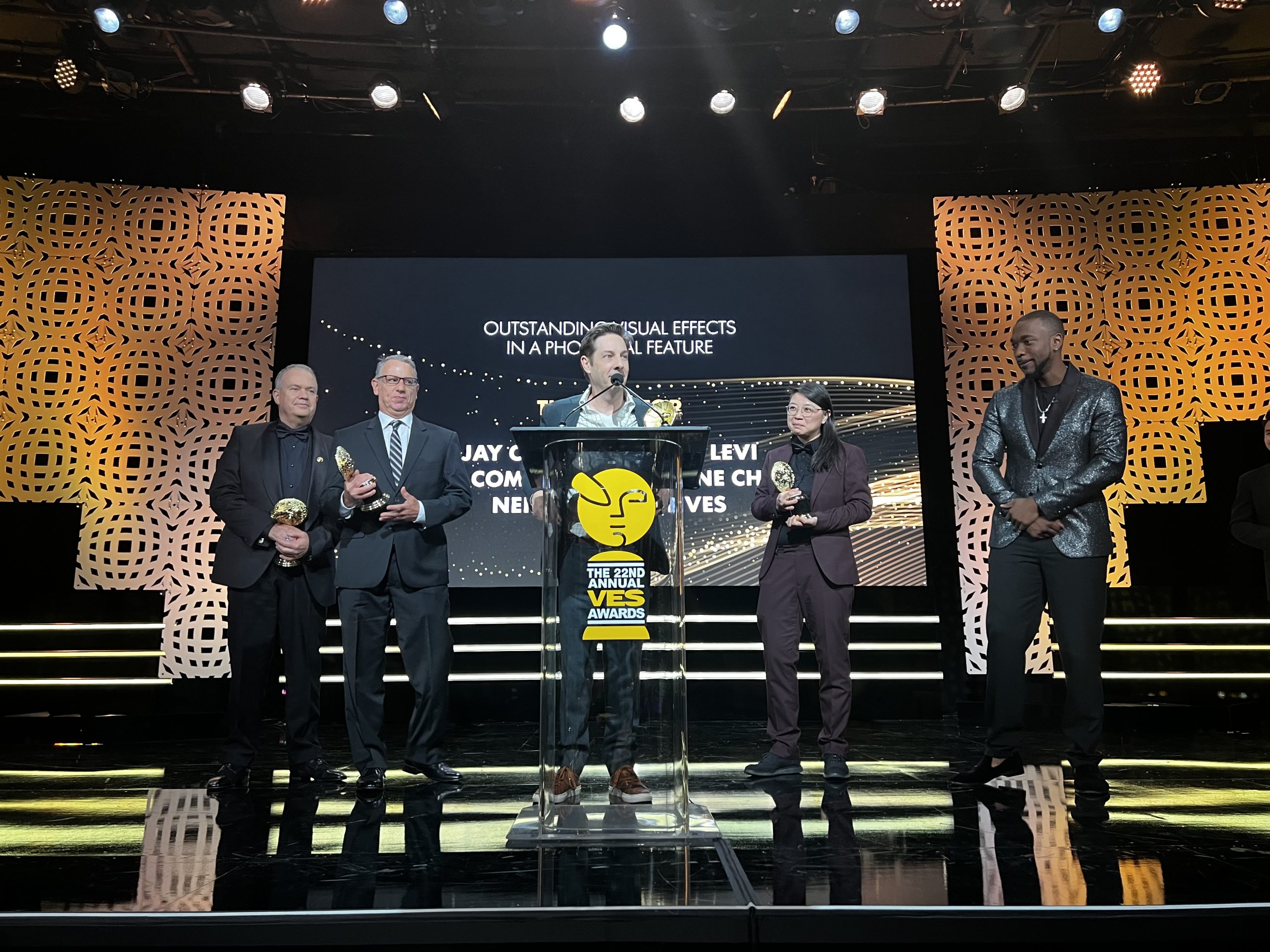
Wednesday evening, the Visual Effects Society (VES), the industry’s global professional honorary society, held the 22nd Annual VES Awards, the prestigious yearly celebration that recognizes outstanding visual effects artistry, and innovation in film, animation, television, commercials, video games, and special venues.
ILM’s work on The Creator earned six nominations and won four awards including the coveted top prize Outstanding Visual Effects in a Photoreal Feature, Outstanding Created Environment in a Photoreal Feature,Outstanding Model in a Photoreal of Animated Project, and Outstanding Effects Simulations in a Photoreal Feature, with a partner company winning a fifth award for the film for Outstanding Compositing and Lighting in a Feature.
ILM’s work on Darren Aronofsky’s groundbreaking film Postcard from Earth won for Outstanding Visual Effects in a Special Venue Project while The Mandalorian (Season 3) won forOutstanding Effects Simulations in an Episode, Commercial, Game, Cinematic or Real-Time Project.
“It’s a true testament to our amazing global teams that our work was honored by our industry colleagues on the winning shows noted above as well as the ILM shows that were nominated, including Indiana Jones & The Dial of Destiny, Ahsoka, Willow, Mission: Impossible, Dead Reckoning Part One,Dungeons & Dragons: Honor Among Thieves, Napolean, Killers of the Flower Moonand Guardians of the Galaxy, Vol. 3” said Janet Lewin, ILM General Manager, “I couldn’t be more proud of our teams.”