2000s

50 Years | 500+ Film and TV credits | 135+ Awards

SINCE 1975

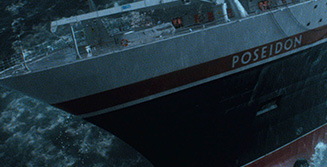
Survivors must fight for their lives when the luxury ocean liner Poseidon capsizes after being swamped by a rogue wave.

Size Matters. Director Wolfgang Petersen wanted to film a 200-foot wave capsizing a 1,200-foot cruise ship and aimed to build the shot in a way that had never been done before: he wanted a dynamic destructive wave hitting the boat from many angles. The boat’s size meant that the ILM crew couldn’t use a miniature boat and real water; they had to create the shot digitally.

Agreeing to do two mind-blowing sequences for this film took a lot of confidence, but ILM delivered those shots and more. In the opening sequence, the camera follows an actor running around the deck of the Poseidon for three minutes in bold, broad daylight. Remarkably, the ship is completely computer generated even in close-ups.

Later in the film, ILM tosses the ship inside a massive digital wave thanks to new multi-processor fluid simulation technology developed by ILM’s R & D department (which worked with Stanford University). As the ship shatters inside the giant wave, it interacts with the roiling water, a feat never before accomplished on such a massive scale. In the end, Petersen got the shot he wanted.

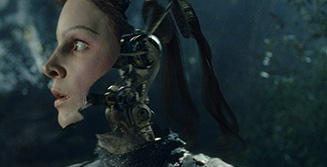
Led by VFX legend Dennis Muren and Scott Farrar, ILM sought to create the insidious Rogue City using a combination of practical and CG effects. Utilizing a commercial game engine, ILM developed the first real-time on-set pre-visualization system, allowing director Stephen Spielberg to see an approximation of the CG set in his viewfinder. The result was the expansive and futuristic world envisioned by Spielberg and the late Stanley Kubrick.

To create the half live-action actors/half CG Mecha, ILM used the Motion and Structure Recovery System (M.A.R.S.) to activate a highly automated camera tracking solution which would enable a CG camera to match its live-action counterpart.

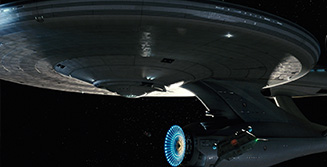
The brash James T. Kirk tries to live up to his father’s legacy with Mr. Spock keeping him in check as a vengeful, time-traveling Romulan creates black holes to destroy the Federation one planet at a time.

As always, ILM was sensitive to the director’s particular vision. In this case (keeping the spirit of the original Star Trek series), much of Director J.J. Abrams’ focus was on the story’s characters and realism. In fact, ILM developed animation tools to replicate Abrams’ style of photography on the set. Animators even applied camera shake by use of a small rotational-motion-capture sensor on a tripod at their workstations.

The black-hole sequence was one of several in the film that combined various visual effects techniques: CG space, elements shot on partial sets at Paramount Studios, and extensive digital-set extensions. On top of the imagery of the black hole itself, the ILM team built layer upon layer of detail into the shots, including the Vulcan planetary destruction which required extensive use of ILM’s simulation software.

There’s a huge history to the Star Trek franchise that people are very connected to, and ILM’s team of artists tried to match the style and color palette of the old show for the final shot of the Enterprise flying off into warp.