2000s

50 Years | 500+ Film and TV credits | 135+ Awards

SINCE 1975

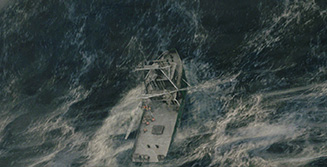
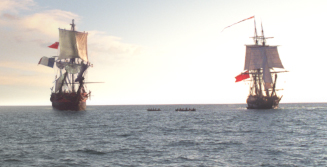
During the Napoleonic Wars, a brash British captain pushes his ship and crew to their limits in pursuit of a formidable French war vessel around South America.

Much of the movie takes place on the high season, often in stormy weather. ILM had proven its ability to create digital water for The Perfect Storm, but for this film, visual effects supervisor, Stefan Fangmeier, (who also supervised the effects in The Perfect Storm) had another idea. Because he had received real ocean footage shot in extreme conditions, he relied primarily on his compositors. To create the ocean surrounding the naval ships, compositors assembled bits and pieces of real water, using digital water only to glue the pieces together.

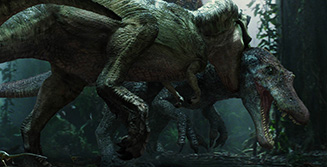
A decidedly odd couple with ulterior motives convince Dr. Alan Grant to go to Isla Sorna (the second InGen dinosaur lab.), resulting in an unexpected landing…and unexpected new inhabitants on the island.
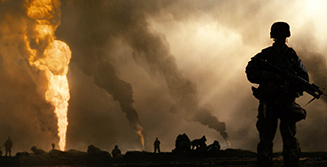
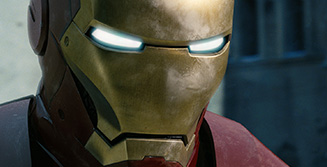
Billionaire industrialist and genius inventor, Tony Stark, is kidnapped and forced to build a devastating weapon. Instead, Tony builds a high-tech suit of armor and escapes captivity.

ILM worked on over 400 shots — with many of them dedicated to creating Iron Man’s suit — and along with director, John Favreau, set flawless photorealism as the standard for the film’s visual effects.

Robert Downey Jr. donned ILM’s patented Imocap suit during principal photography, which would allow the visual-effects team to create a suit of digital armor featured in Stark’s mansion and during captivating battle sequences with Iron Monger and digital F-22 fighter jets

Iron Man’s brushed metal Mark II suit and trademark gold and red Mark III suits came together with a marriage of CG animation and technical wizardry that garnered both a BAFTA and Academy Award® nomination.

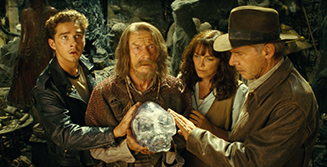
Indiana Jones teams up with the industrious Mutt Williams to find the Crystal Skull of Akator.

In an effort to keep with the themes and feeling of the original trilogy, ILM worked closely with director Steven Spielberg to capture the essence of the action-adventure genre: stunt work, special effects, and visual effects blended together seamlessly to facilitate the filmmaker’s vision.

The crew combined practical effects gags, digital matte paintings, advanced photomapping, CG animation, and large-scale miniatures to achieve the desired results.

An unusually intense storm pattern catches some commercial fishermen unaware and puts them in mortal danger.

Director Woflgang Petersen’s vision for The Perfect Storm was going to require a seamless integration of complex computer-generated simulations and imagery with blue-screen photography that utilized elaborate practical effects. Because the film’s story is largely based on a real event, Peterson emphasized the importance of creating a highly realistic depiction of a severe storm at sea.

The creation of a storm of this magnitude had never been attempted with computer-generated imagery.

The first film to blend real water with CG water, The Perfect Storm needed a significant amount of work on the placement of a digital ocean behind a gimbaled boat. Many of the other shots relied on complex computer-generated boats, characters, and water, including the simulation of several hundred-foot waves. This work was accomplished with a proprietary plug-in tool used with Maya.

In dailies, the ILM crew would often find themselves saying “this doesn’t look right, but why?”

For the answer to questions like these, ILM almost always goes back to reference material, but there is almost no reference point for a storm like this. So, the ILM R&D team, led by Habib Zargapour, identified the essential visual details that needed to be represented and the techniques that had to be developed to achieve the required realism.

Over a six-month period, new software was written for the water surface itself, as well as for the extremely complex particle simulations that would be used to model elements such as spray, crest mist, crest foam, and splashes. John Anderson developed a basic ocean–simulation software that was imported into a commercial 3-D package via proprietary plug-ins.

With more than 80 basic ocean states, this simulation allowed the animation team to select the ocean conditions, position a specific boat within them, and automatically generate accurate boat motion.

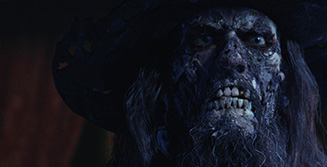
Blacksmith Will Turner teams up with eccentric pirate “Captain” Jack Sparrow to save his love, the governor’s daughter, from Jack’s former pirate allies, who are now undead.

The Curse of the Black Pearl introduced new uses of motion-capture technology to create computer-generated characters.

During various sword fight scenes where actors fight undead pirates, ILM made it possible for Director Gore Verbinski to direct the CG characters’ performances by shooting each scene twice. First they’d shoot a reference take with actors fighting stuntmen standing in for the soon-to-be-skeleton characters, and then they’d do a clean take with the actors fighting no one. They would insert the CG pirates into these clean takes after working with the stuntmen to duplicate the appropriate choreography.

The digital costumes in Curse of the Black Pearl were elaborate and required a lot of work. With 23 people doing nothing but costume simulation, ILM was able to utilize the same-clothing-simulation software to create the realistic looking garb of the undead pirates.

In the past it was extremely difficult to interweave visual effects with the freestyle of handheld camerawork, but by the time Curse of the Black Pearl was produced, match-move tools had evolved to a point where it was no longer necessary to restrict the camera movement for shots requiring visual effects. As a result, ILM “went completely free” on Curse of the Black Pearl, allowing Verbinski to focus more on story. This would put ILM’s team to the test in the scenes when the actors walk into the moonlight and becomes completely CG skeleton characters.

Believably transitioning from real life Geoffrey Rush to CG Geoffrey Rush as he steps into the moonlight revealing his cursed form was one of the most important sequences in the film. ILM accomplished a seamless transition by removing some, but not all of Rush’s features. Specifically, his real eyes remained with the otherwise CG character for just a beat.

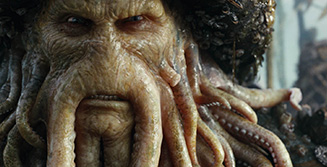
Jack Sparrow races to recover the heart of Davy Jones to avoid enslaving his soul to Jones’ service, as other friends and foes seek the heart for their own agenda as well.
After their experience with motion-capture technology in Pirates of the Caribbean: The Curse of the Black Pearl, ILM knew it was time for something newer and better.
In an effort to allow all the performers to be present on set, ILM developed Imocap, a lightweight, low-footprint, robust, and filmmaker-friendly motion-capture system that could be used anywhere. This technology made it possible for actors to perform motion-capture on location during principal photography. As a result, director Gore Verbinski was able to work with his actors (who would later be replaced by CG characters) on set without having to worry about performing those same scenes at a later date on a mocap stage.
The work didn’t stop there, as Davy Jones’ tentacle beard presented another set of challenges — a big fleshy group of appendages that had to perform like a living creature. The creature development artists put in wonderful animation controls that allowed animators to move the tentacles in very specific ways, and a program was written that would drive the individual joints between the segments of the beard with a whole variety of parameters for high level control that would dictate emotional changes.
Behind the scenes, ILM’s revolutionary new Zeno pipeline moved fully into action, giving artists easy access to more tools than ever before.
In the end, digital Davy Jones was a huge breakthrough in the VFX industry and his realistic complexity garnered ILM the 2006 Academy Award® for Best Visual Effects.