
ILM artists Ian Milham and Shannon Thomas take us behind the scenes of a breakthrough virtual production shoot in the first of a two-part story about the 2024 Summer Olympics and 2026 Winter Olympics.
By Lucas O. Seastrom
American viewers of the Milan Cortina Winter Olympics on NBC and Peacock have experienced a number of striking visual effects created by Industrial Light & Magic, whether they realize it or not.
Dynamic, promotional footage of American athletes in snowy Italian landscapes and on the ground in Milan are in fact all shot in front of an ILM StageCraft virtual production volume. The achievement is part of a continuing story of ILM’s work to broaden the applicability of its virtual production toolset. These latest Olympic games are in fact the second to be showcased in such a way. ILM also partnered with NBC for the earlier 2024 Summer Olympics in Paris, an undertaking that won multiple Emmy Awards.
Paris: The Brief
The story of ILM and NBC’s collaboration for the Olympics actually begins in 2021 with a distinctly American sport: football. “As people were hearing about our virtual production work on The Mandalorian, we talked with lots of different groups and did some work with them, including with NBC Sports for Sunday Night Football,” recalls ILM virtual production supervisor Ian Milham.
With the need to capture singer Carrie Underwood performing in multiple environments and in quick succession, ILM deployed a version of its StageCraft volume, which provided greater flexibility than a traditional blue screen. It proved a meaningful exercise in developing a different kind of story for a client with different needs than a feature filmmaker. “The following year, NBC was exploring ways to level up their work,” Milham explains, “and they reached out and asked if these tools could be put to further use.”
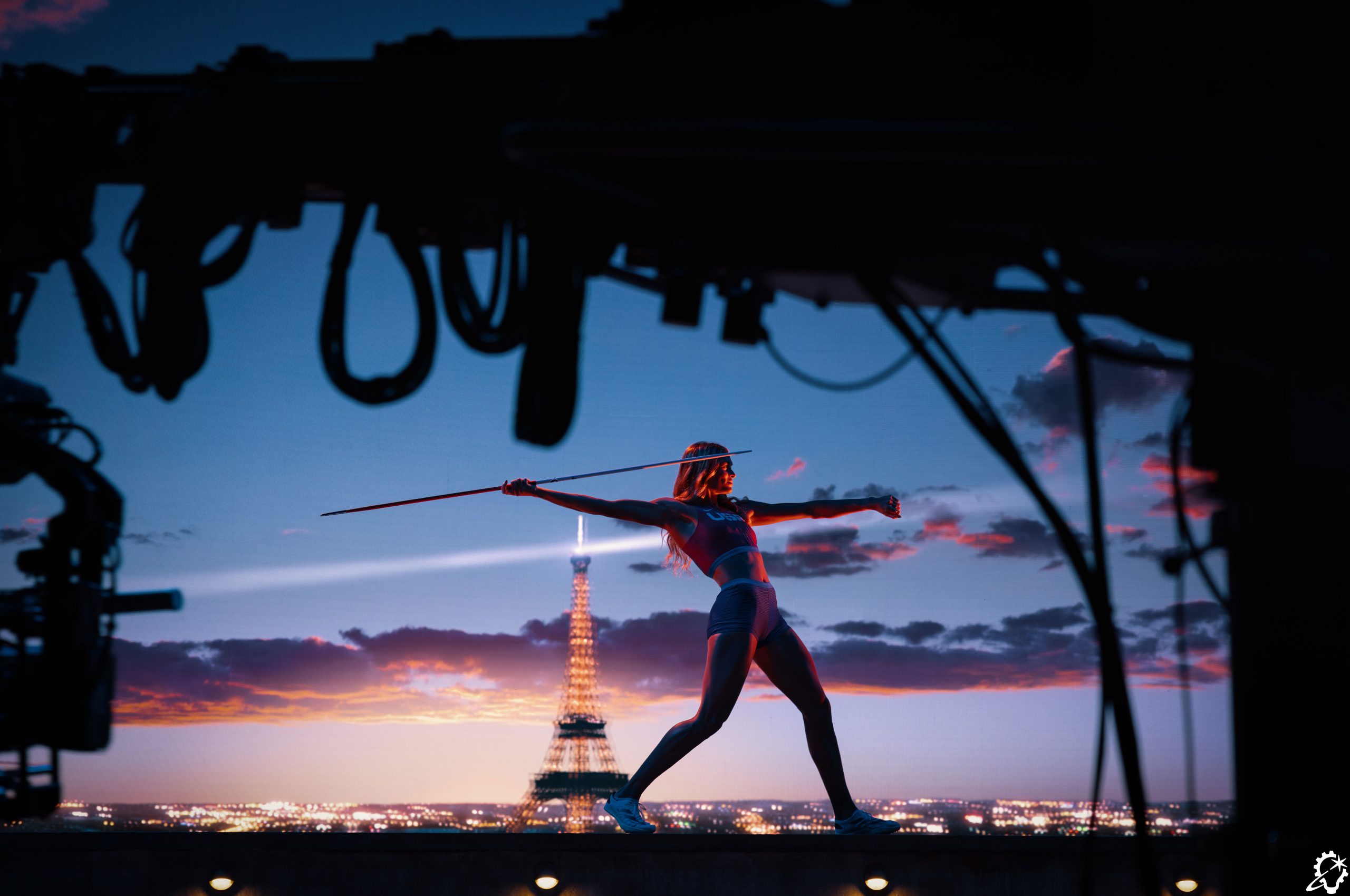
What NBC proposed for the Summer Olympics in Paris was far more ambitious than the Sunday Night Football production. Dozens of athletes – from swimmers to gymnasts to javelin throwers – would be captured in multiple Paris locales at twilight: a street, a riverside, a rooftop, a fashion show-eqsue runway at the foot of the Eiffel Tower, and a virtual trip down the Seine River during the event’s opening ceremonies. The resulting footage would be adapted into short form clips used for promotional spots before and during the Games.
“NBC’s goal was to get a lot of footage in different contexts of all these athletes looking amazing in a world that is aesthetically heightened,” says Milham. “Along with that, the DP/director [Scott Duncan] wanted to continuously run the camera in order to keep things improvisational with the athletes. You have to shoot all the time and capture lots of different things. It’s not like a feature where you’re going to board and previs everything in advance. That was our biggest challenge to deliver on. The director wanted no rules in terms of flexibility with shooting and NBC wanted a large amount of usable footage.”
A Different Kind of Volume
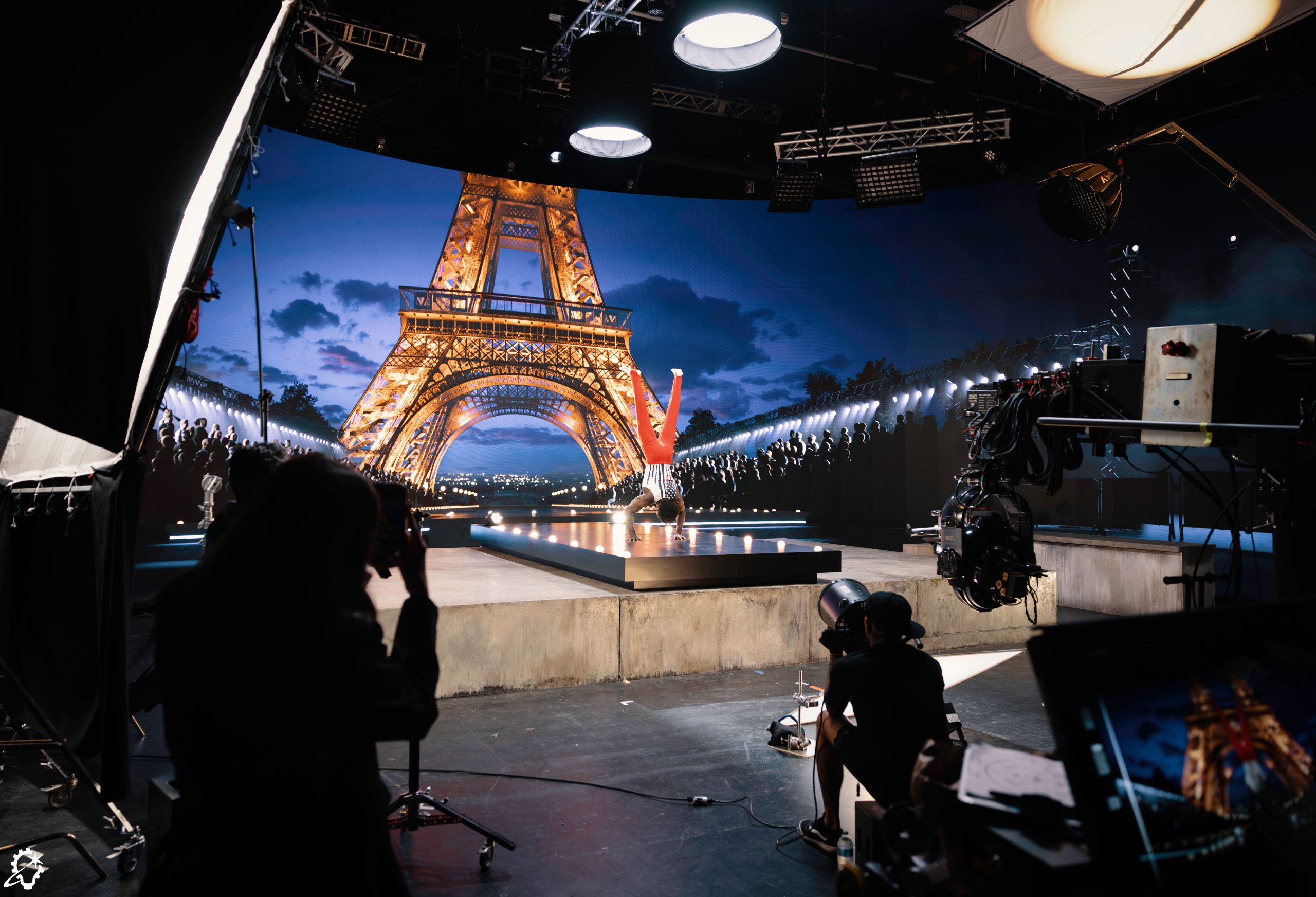
The Summer Olympics production was the debut of a new variation of ILM StageCraft. “We had invented this really cool thing that people wanted to use, but Star Wars was always using it,” says Milham. “So we needed to make another version that wasn’t limited to one place. It would be a huge advantage to bring StageCraft to the client. So we created a mobile system, which was deployed for the first time with the Paris Olympics.”
The volume itself can be adapted to any size, its “tiles” – LED panels – adjusted to the needed shape of a given set. Created by ILM’s virtual production team based in San Francisco, the entire infrastructure is built to move, “like a set-up for a rock concert,” as Milham puts it. For the Paris Olympics, a roughly 180-degree curved wall was constructed to a height of approximately 25 feet. This specific production involved the extensive use of foreground set pieces that needed to blend seamlessly with the virtual background, as did the elaborate practical lighting set-ups.
“StageCraft isn’t just one thing,” Milham adds. “It’s a lot of different tools and techniques. Sometimes we use a little of it or a lot of it, whatever is needed.”
Putting the City of Lights on the Screen
Starting some nine months ahead of the actual shoot in November of 2023 was virtual art department (VAD) supervisor Shannon Thomas and a team of artists responsible for creating the settings visible on the volume’s tiles. A four-year ILM veteran with 20 years across the industry, Thomas brings experience from a number of different effects houses, including Rhythm & Hues and Weta FX.
He “came here for Star Wars,” as he puts it, reflecting on recent projects he contributed to like Star Wars: Skeleton Crew (2024-25) and The Mandalorian and Grogu (2026). “I came here to work on the volume and be involved in real-time virtual production, future-tech projects, and to get back into film work.” But Thomas admits with a smile that he is also a big Olympics fan and was happily surprised to join the team for Paris, it being his favorite city to boot.
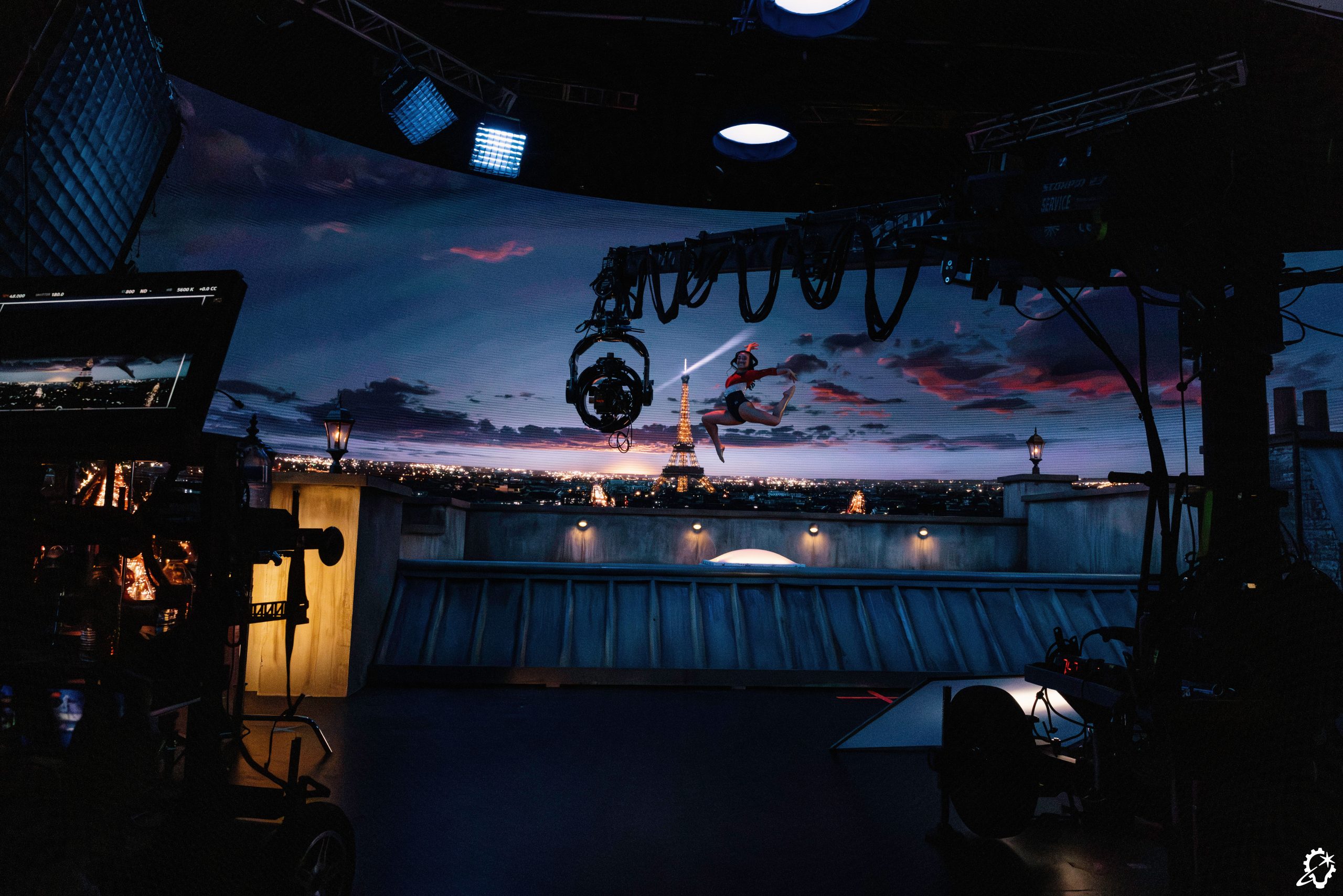
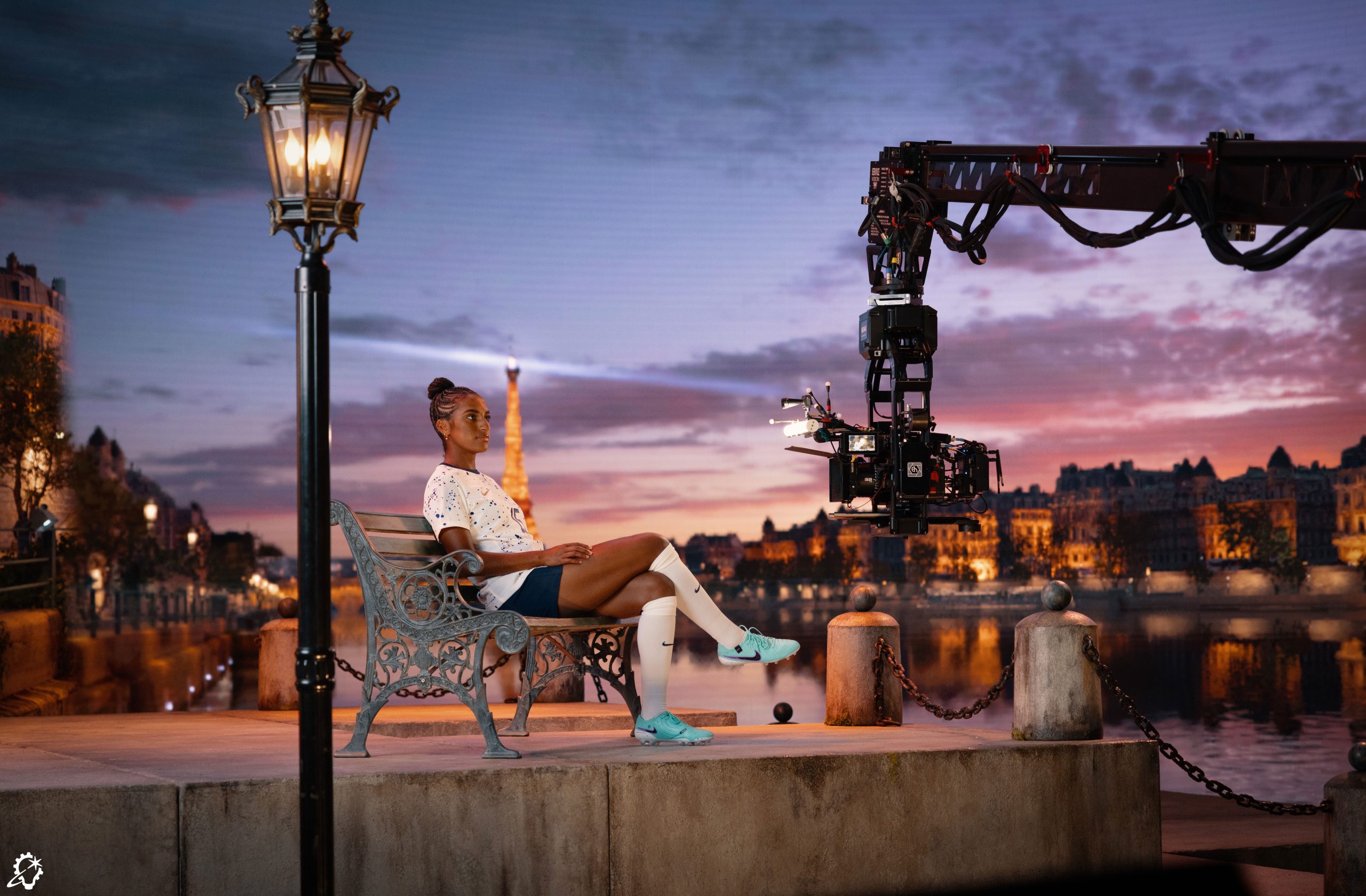
NBC’s brief for the City of Lights was different from a usual feature film in that realistic accuracy was not essential. The ILM artists would not be required to match the layout or appearance of a specific location in Paris, but rather capture “the idea of Paris,” as Thomas notes. “That goes all the way down to what kind of chair we need to have in front of a café. If it feels like Paris, then we have it. It allowed us to work faster as well.”
“We’re not going with photo-realism,” Milham adds. “It’s in a style that’s more like a glamorous photo shoot, a larger than life situation.”
The team spent considerable time determining the best digital skies, ultimately landing on the right blend of pinks and blues during magic hour for each set. For the street setting, former senior VAD artist David Flamburis took ownership and, rather than evoke a specific neighborhood, they created a fictitious location full of Parisian charm, and with fantastical views of the Eiffel Tower. The iconic structure itself was also a subject of considerable study, in particular how best to light it. Existing Eiffel Tower assets from earlier ILM productions were useful for reference. Along the Seine River, ILM changed the water’s width and depth as their artistic needs demanded.
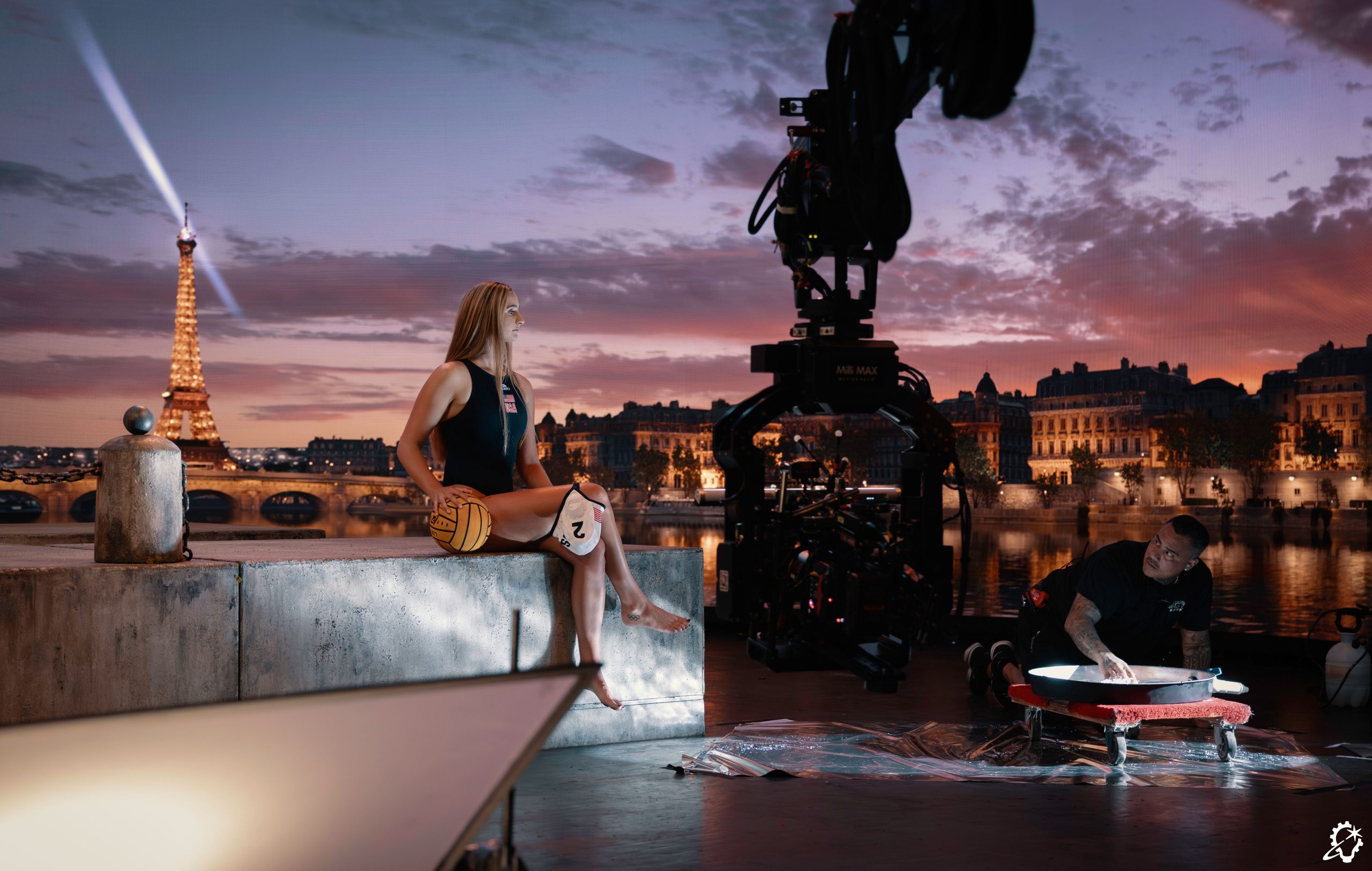
Initially developed with commercial real-time software, the environments were then ported to ILM’s proprietary Helios renderer for volume projection. New advancements allowed for enhanced rippling, refraction, and reflection in the river water, which was sometimes augmented on the live action set by practical techniques, including a small tub of water with shards of glass. It was all in service of what the team dubbed “hyper-realism.”
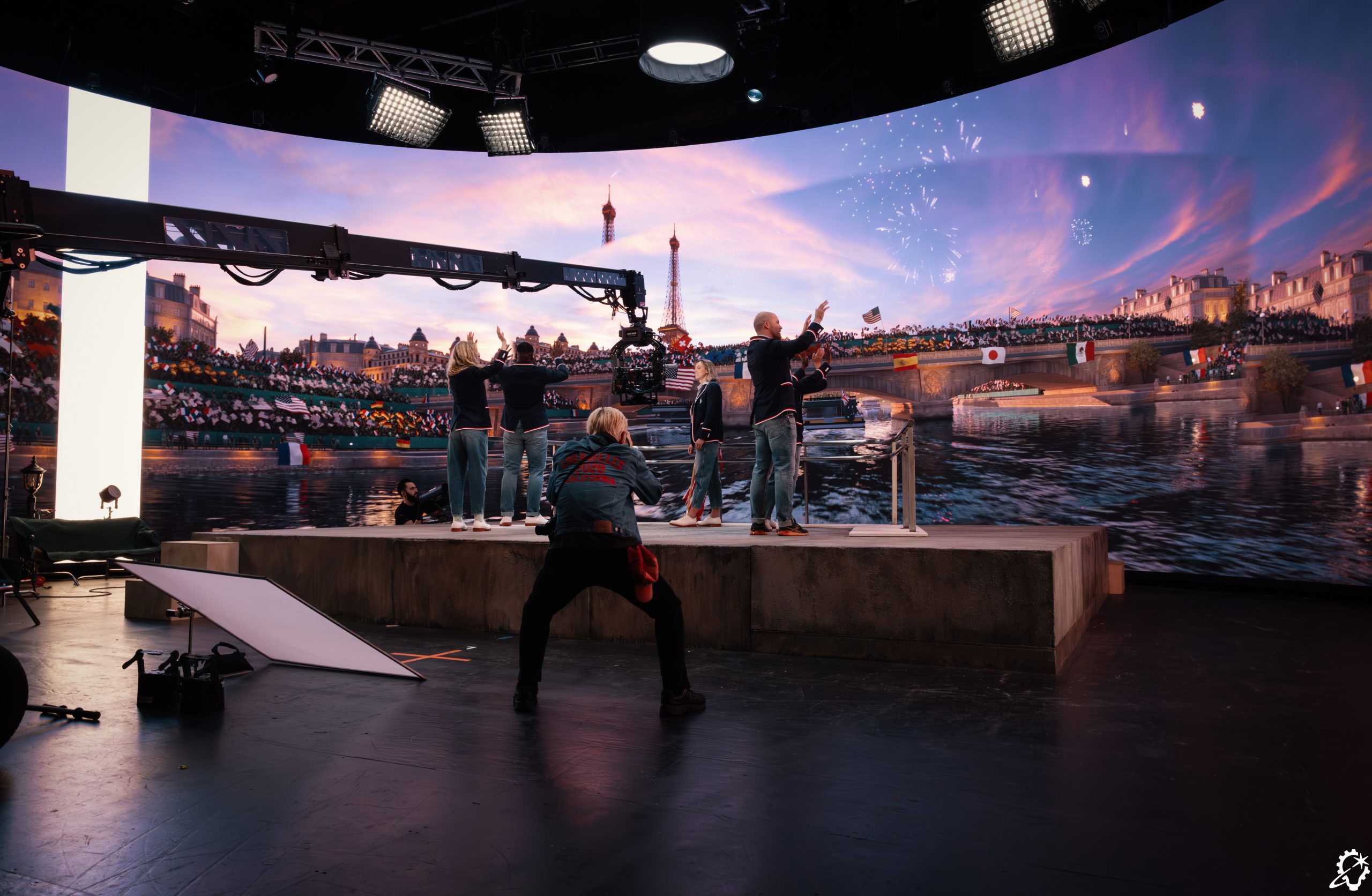
According to Thomas, the opening ceremony load was probably the most challenging to create. “Everyone knew this would involve various boats per each country’s team going down the Seine, which was a very cool idea. The big challenge was the crowds, which is always a tricky thing in real time. We had to figure out the logistics of how many boats, how many people, and those types of things. We had tight resources throughout the project so we had to work very closely together to determine how things needed to be depicted.
“Senior VAD artist Nate Propp came up with a very clever solution for this process here that allowed us to color coordinate the crowds, per country color in sections, as if they were fans per country peppered around the set,” Thomas continues. “The digital crowd also had controls for how much they would cheer, including waving flags, holding signs, etc. For the distance we’d see them from camera and we knew the trick would work.”
ILM created a roughly half-mile stretch of river that was necessarily fictitious in layout. To determine the best speed, Thomas actually contacted a Parisian Bateaux Mouches boat tour company to gather research. “I told them that my parents were planning this trip to Paris, and they wanted to go for a ride on the Seine, but they get really seasick,” he notes with a laugh. “How fast do they go? Is there a lot of motion? And the company wrote me back! About nine to 12 knots was the average speed. Then we could design the movement of the boats that way and it worked really well, as it’s always best to work from reality and adjust from there.”
How to Shoot with Lots of People in Many Places Very Quickly
Compared to a typical day on the StageCraft volume set of The Mandalorian, ILM’s crew for the Summer Olympics had to capture roughly four times the amount of live footage. During a massive production that involved dozens of athletes moving between six different locations on the Universal Studios lot in Hollywood, ILM’s volume stage welcomed 58 individuals over a six-day shoot. Some athletes were only on hand for a matter of minutes, requiring an unprecedented level of flexibility to make quick changes. The ILM crew executed over 120 scene changes on the volume’s wall without any waiting time required.
“The on-set grips were the real heroes with all of those changes,” Milham notes. “They had to move physical sets in and out 120 times. The practical art department worked with us throughout that process.”
The key to ILM’s flexibility was dividing its rendering power into subgroups. Whereas a cinematic-scale production like Star Wars would utilize all of its rendering capacity into one volume load that would be utilized for hours at a time, the rapid pace of the Olympics shoot led the crew to devise a new solution. Three separate renderers, each with its ability to power the entire LED wall, were loaded with distinct settings. When the client requested a scene change, all the ILM team had to do was switch the feed over instantaneously.
“Scott Duncan is an amazing and inspiring person to work, with who films shows like Survivor,” Thomas says about the production’s combined director and cinematographer. “He’d make changes live on the set, and would just pick up the camera and want to shoot something. The stage team would have to keep up. It was a quick, iterative process, very freestyle, like indie filmmaking, which I love. They’d shoot and just keep the camera rolling. Where in a feature film you’re focusing on getting a whole take or a specific scene, in this case they’re looking for just a few seconds of something amazing that they can use to then stitch into their longer marketing narrative.”
Real Time Revisions
Not only could ILM make rapid changes between entire set-ups, but they could even make live alterations with the CG background itself. When the lighting team incorporated the tub of water with shards of glass in the Seine River locale, the stylized, caustic light initially felt jarring, more like a swimming pool. So to help balance the effect, the ILM artists plussed the scene with additional lighting along the riverside.
“We added some bright white lights along the river in the background, just like the lights along the side of a pool,” says Milham. “It helped to fit the swimmer in the scene because you could imagine that one of those lights was right next to her. Do we really care that the Seine doesn’t have those lights? Not in this situation. We’re just trying to make it look awesome. That’s the artifice of it. It’s okay if it looks like a dream.”
Incorporating these details within the Helios environment would have taken a matter of minutes, and all while the scene was still loaded on the volume wall. “The moment is over if it takes hours, so we have to do it right there,” Milham adds. “I’ll be there on the radio calling in the changes and adjustments as the shoot is taking place.”
A Special Guest Introduction
“I had gone up to the stage during the shoot, and everyone seemed really happy with how things were going,” remembers Thomas. “Then our producer, Shivani Jhaveri, just mentioned, ‘Oh, Steven was here yesterday and he loved it.’ I said, ‘Steven?’ and she’s like, ‘Spielberg!’ What?! Laughing, ‘How?’ It was an unexpected surprise to hear he was pleased with the work, what a blessing to have him involved.”
Not long before the shoot was set to begin. NBC arranged for director Steven Spielberg to film a special introduction for the Olympics on ILM’s volume set. The special moment required yet another new way of presenting a scene on the LED wall. Spielberg would walk on from the side, with the blank wall and its surroundings visible behind him, and then as he came to center stage, the Parisian riverside location would load.
“We had just shot The Fabelmans with him, and he understood the process, so I think he trusted that it would work well,” says Milham. “And because this clip involves Steven Spielberg, the ‘filmmaking’ of it all can be part of the story. So Steven began walking outside the volume, as if he were on a movie set, because he was, of course, and then we turned the environment on. It was a relatively unique use of the technology.”
Milham describes the required process as “relatively easy,” an extension of their existing multiload capacity. They simply closed the video feed for the riverside scene to make the wall appear blank, and then turned it on again at the right moment.
Spielberg himself likened the grand show that is the Olympic Games to a great story, something that felt close to home for the ILM team, as Shivani Jhaveri notes. “The theme that Spielberg talks about in his opening is so relevant to StageCraft,” she explains. “There’s a connection in that StageCraft is all about telling a story. It was all about telling the athlete’s stories, where they’ve come from, where they are now, and it was really special to see all that.”
“If something new is needed, we’ll invent it.”
The success of ILM’s work on the Paris Olympics project was thanks to a relatively small team, especially compared to a feature film or episodic series. Along with Milham, Thomas, and Jhaveri, some of the other leading crew members included lead virtual production technical director Rey Reynolds, CG supervisor Sam Wirch, capture supervisor Ted O’Brien, and lead operator Kelly Fan.
“One of the reasons that ILM has been around for 50 years is that we’re not married to the way things are,” says Milham. “If something new is needed, we’ll invent it. If something we’ve been doing forever needs to change, we’ll change it. We will adapt. Even in the short amount of time that this method of shooting has existed, we’ve completely transformed it. One of my favorite things has been working with all sorts of different filmmakers, storytellers, and clients who tell us, ‘That’s great, but it needs to do this…’ or ‘Have you ever thought about trying this?’ And we try it. That happens on every show.”
ILM’s Olympics story continues with the 2026 Winter Games in Milan, Italy. Watch ILM.com for a behind-the-scenes look at this production, which included brand-new innovations.
—
Lucas O. Seastrom is the editor of ILM.com and Skysound.com, as well as a contributing writer and historian for Lucasfilm.