
The acclaimed director of photography discusses collaborating with the visual effects artists at Industrial Light & Magic.
By Mark Newbold
“When I was a kid, I was interested in magic,” remembers Dean Cundey, the Academy Award-nominated cinematographer behind Romancing the Stone (1984) and Who Framed Roger Rabbit (1988), who sat down with us recently to reminisce about another Robert Zemeckis classic, Back to the Future (1985). “When I got my first little magic set for Christmas, I enjoyed the idea of fooling people, using magic to create an illusion of the impossible or the unexpected. I think that mindset coincided perfectly with what I did in film. It was all about making the audience believe something impossible, like traveling in time.”
That mindset married perfectly to the goals of Industrial Light & Magic, which by 1985 had not only won six Academy Awards for their groundbreaking visual effects, but was forging on into the future after the end (for the time being) of Star Wars and into a new realm where the potential of digital visual effects grew more promising by the day. Exciting times, but then as now, technical prowess needed to be married to a strong vision and a story worth telling. ILM was brought in to provide a total of 27 visual effects for a new Steven Spielberg-produced action comedy called Back to the Future, and that innovation and thirst for an engaging audience experience needed to be front and center.
Enter Ken Ralston, one of just five visual effects supervisors at ILM at the time, tasked with helping bring to the screen the unique requirements of a time-travel story that took us from 1985 to 1955 and back again.
“I took the project initially because there were a lot of pyrotechnics in it,” Ralston told American Cinematographer back in 1985. “In the first draft of the script, to get back to the future Marty had to go through one of the first A-bomb testing sites and drive into an A-bomb that’s dropped on him. That really intrigued me because we were going to have to duplicate all the old footage you’ve seen where the blast rips those buildings and houses out of the ground. I thought, great! And, as usual, as soon as I was on the show it changed dramatically.”
Budget and technology led to a number of alterations, but good old-fashioned spitballing brought one of the film’s most memorable concepts to life: the DeLorean ripping through time at 88 miles per hour as it leapt forward or backward in time. ILM animation supervisor Wes Takahashi and his team were handed the task of bringing this concept to life on celluloid. With Zemeckis, the ILM crew explored multiple iterations of a so-called “time slice” created by the vehicle.
“No one can describe what they want in a shot like Bob Zemeckis can,” Ralston told Cinefex.
“He wanted something really powerful – everything in the show had to be very fast and very violent. The way he put it was: ‘Time travel is not pretty.’”
Speaking recently with ILM.com, Dean Cundey agrees with what Ralston said 40 years ago. “Bob Zemeckis was very much a visual storyteller, who was open to suggestions and embellishments on how to implement the vision he had for a scene.”
Cundey explains the cinematographer’s place in the creation of a scene. “I’ve always looked at the cinematographer as the bridge between the technical stuff and telling the story. Typically, the director is at the forefront of storytelling and the emotion that the audience sees and experiences, and the cinematographer is the one who implements that vision using cameras, lights, and so forth. Those two sides have to blend in the middle for the audience to experience the movie. Sometimes the director will rely on the cinematographer for inspiration; how wide is the shot, should the camera move, that kind of stuff.”
That ease of collaboration between director and cinematographer, a partnership that would continue throughout the Back to the Future trilogy, was a creative gold mine that freed up both Zemeckis and Cundey to bring their very best work to the show. “I think Bob realized that I was very much interested in the storytelling as opposed to ‘What’s a cool way to light this shot?’ I’ve always been interested in immersing the audience in the scene as opposed to just creating a striking image.
“One of my techniques is I’d watch a rehearsal,” Cundey continues, “speak with the actors, and have a preliminary conversation with the director about the scene and the images that would tell the story of the scene, as well as evoking the proper emotional response from the audience. Bob would describe a scene to the actors and then work on the staging and how the characters react, and every now and then, he would turn to me and then say, ‘Okay, what do I want to do here?’ Which was a very, very nice way of saying, ‘What suggestions do you have?’”
Cundey continues, “Rather than standing next to the director, I would go and stand off to one side, or in a different spot to see if there was anything from that position that told the story as far as character relationships and movement. I very much appreciated the fact that I could watch and interpret on my own, and then present some of these thoughts and ideas to Bob, so I could understand what he wanted from the scene, the characters, and the storytelling.”
With less than 30 visual effects judiciously placed throughout the movie, the focus in Back to the Future is placed on a trio of key sequences: the parking lot of Twin Pines Mall in 1985 and the initial jump forward when Doc Brown’s dog, Emmett, is successfully sent a minute forward in time without creating a paradox; the iconic clock tower sequence in 1955 as Doc Brown has to connect an elaborately rigged series of events, timed to perfection, to send young Marty McFly back to his present in 1985; and the final scene as Doc returns from the future of 2015 to collect Marty and his girlfriend Jennifer, where we see a future version of the DeLorean fly down the road and turn, roaring towards the camera as the credits roll.
Let’s start in Hill Valley and the parking lot of Twin Pines Mall at 1:15 a.m. on October 26, 1985. Speaking with American Cinematographer back in 1985, Ken Ralston described the process of capturing the moment when Doc Brown and the DeLorean return from a minute in the future.
Twin Pines Mall
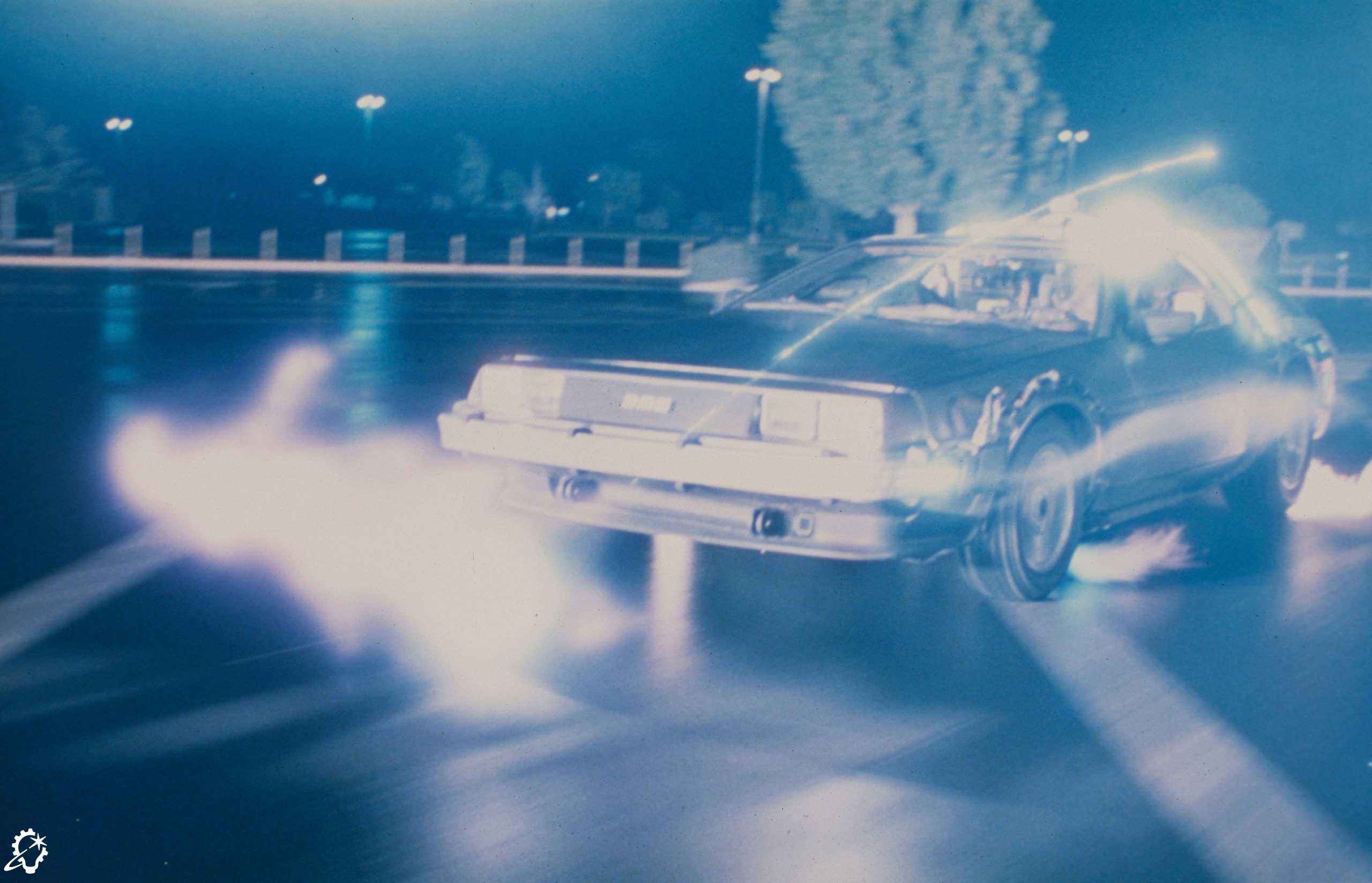
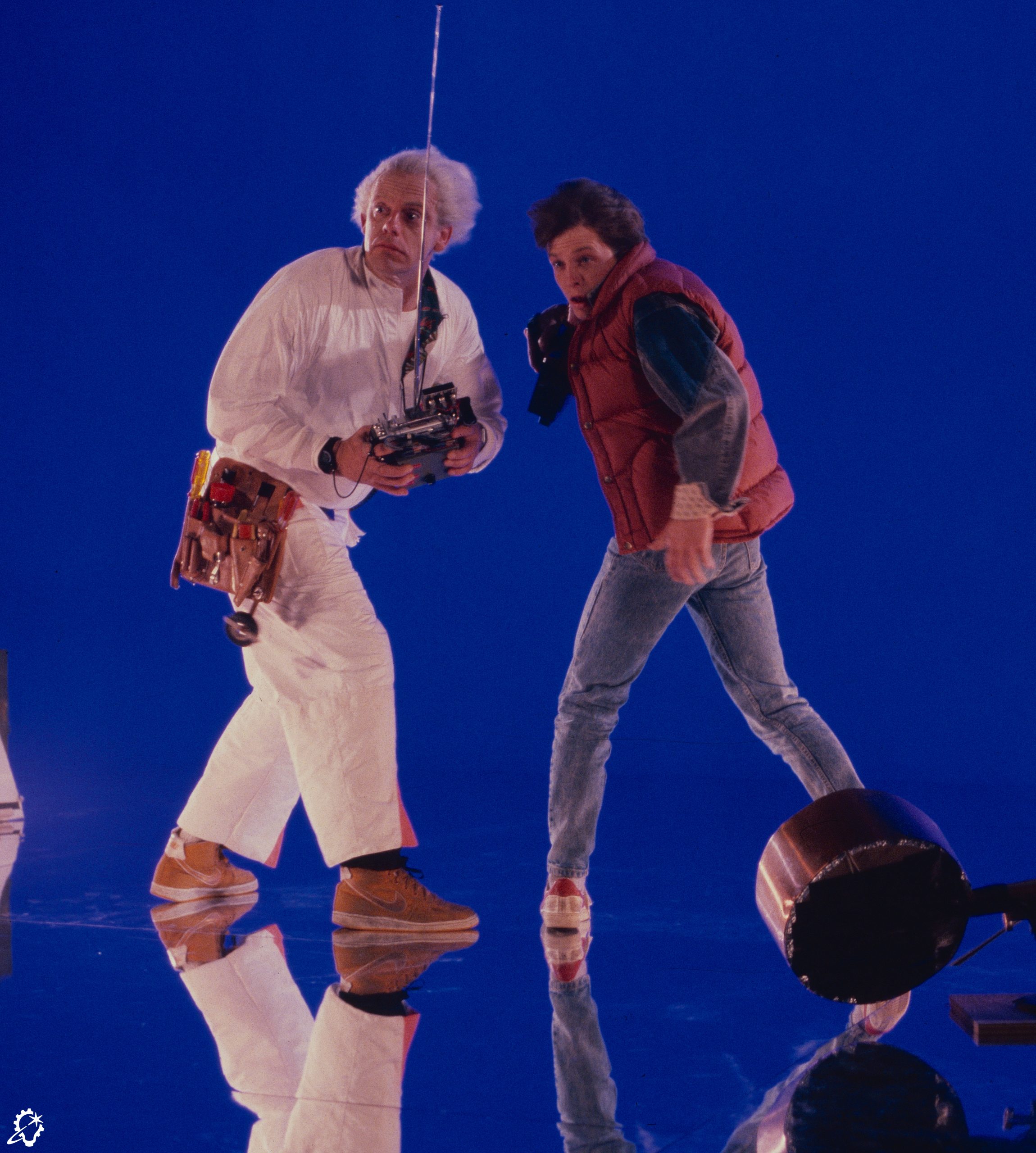
“The professor is talking and suddenly he grabs Marty and starts to spin him out of the way of the camera,” Ralston explained to American Cinematographer. “That’s all blue screen. The actors were blue screened separately from the background. We pan off as the car is forming and skids into the shot and spins around, then it’s frozen as it comes back into the present. That was certainly one of the better blue screen things.”
Ralston continued with Cinefex. “There were lots of little tiny details that no one ever sees. The time slice shots are quick, but that makes them work nicely, too. They don’t feel like effects shots, just kind of like ‘wham’ and suddenly the thing’s going. Bob never wanted the audience to get ahead of what his gags were. He never wanted you to be able to think about what was happening, he wanted the car gone by the time you had figured it all out.”
Forty years later, Dean Cundey thinks back to ILM’s approach, a mindset that has remained consistent for over half a century.
“ILM were so great at finding new ways and even old ways that had been pioneered back in the earliest days of filmmaking, but embellishing and improving it so that it became even more believable. It fooled you completely.”
The Clock Tower
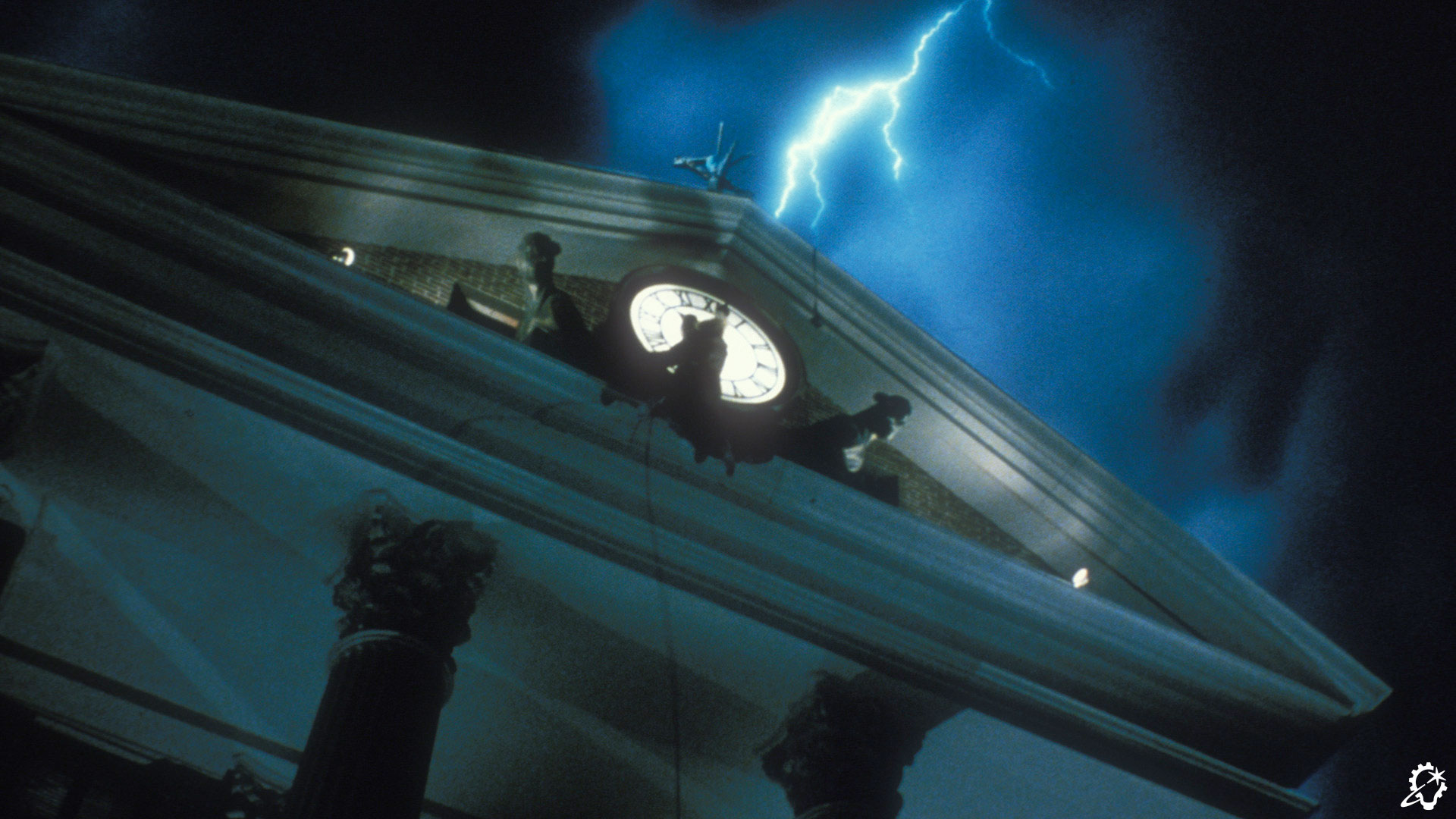
Towards the conclusion of the film, as Doc struggles to ensure Marty returns to 1985, we find Doc hanging off a cable attached to the Hill Valley Clock Tower, waiting for the inevitable bolt of lightning that would strike at 10:04 p.m. on November 12, 1955. Filmed on the Universal backlot on a set designed by production designer Lawrence G. Paull and his crew, Wes Takahashi and ILM’s animation department created the bolts of lightning, something that carried huge expectations.
“The script had called for ‘the largest bolt of lightning in cinematic history,’” explained Takahashi to Cinefex. “It was initially intended that the bolt should last for over a hundred frames, but to have the thing flash over any length of time makes it clear that the shot is obviously animated.”
It was Zemeckis who found the solution, identifying a specific frame from the lightning footage and describing to Takahashi how he wanted the strike to look, “to travel in this S-shape and hit.” And hit it did, landing cinema’s most famous lightning strike.
The Final Scene
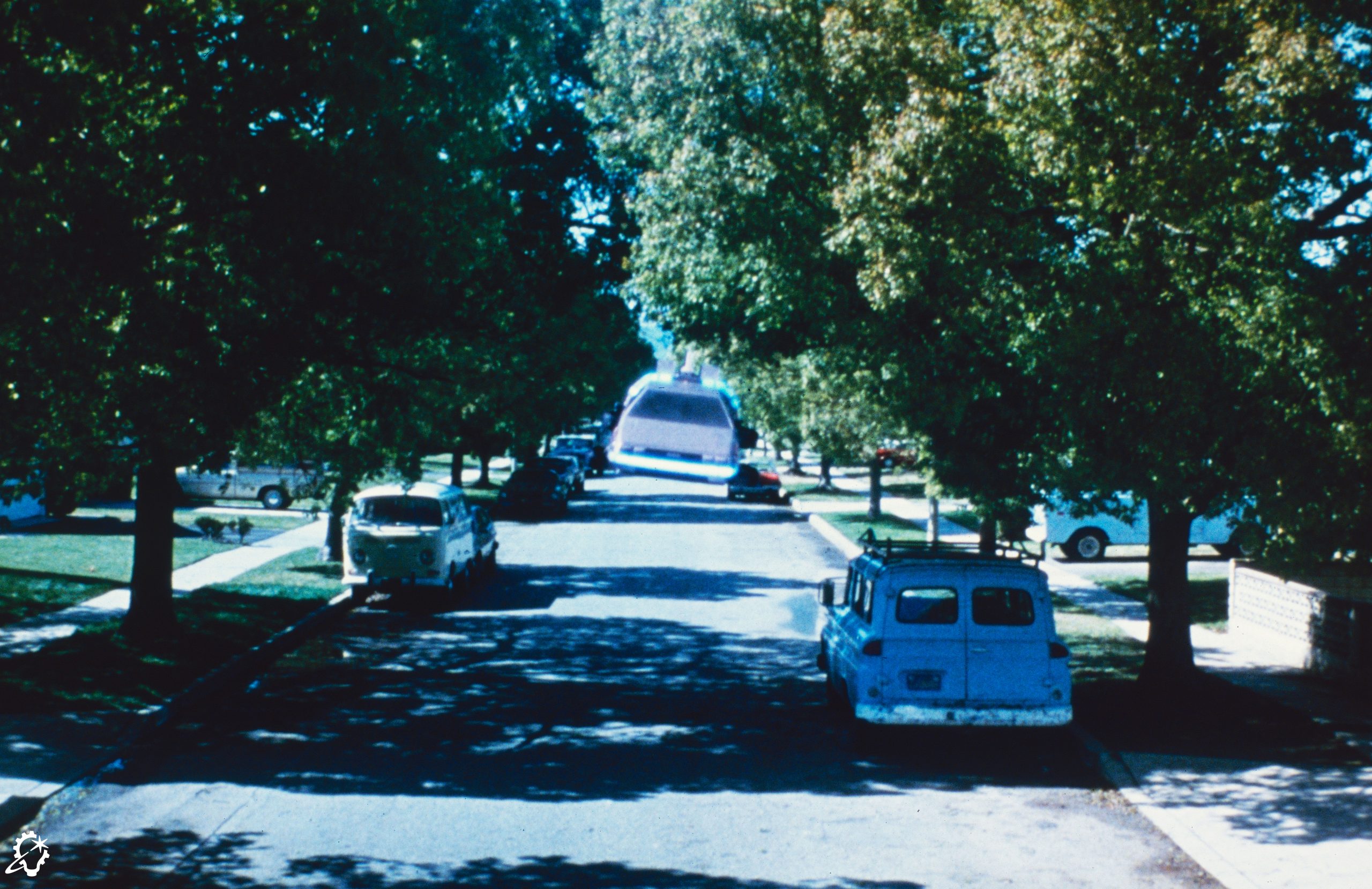
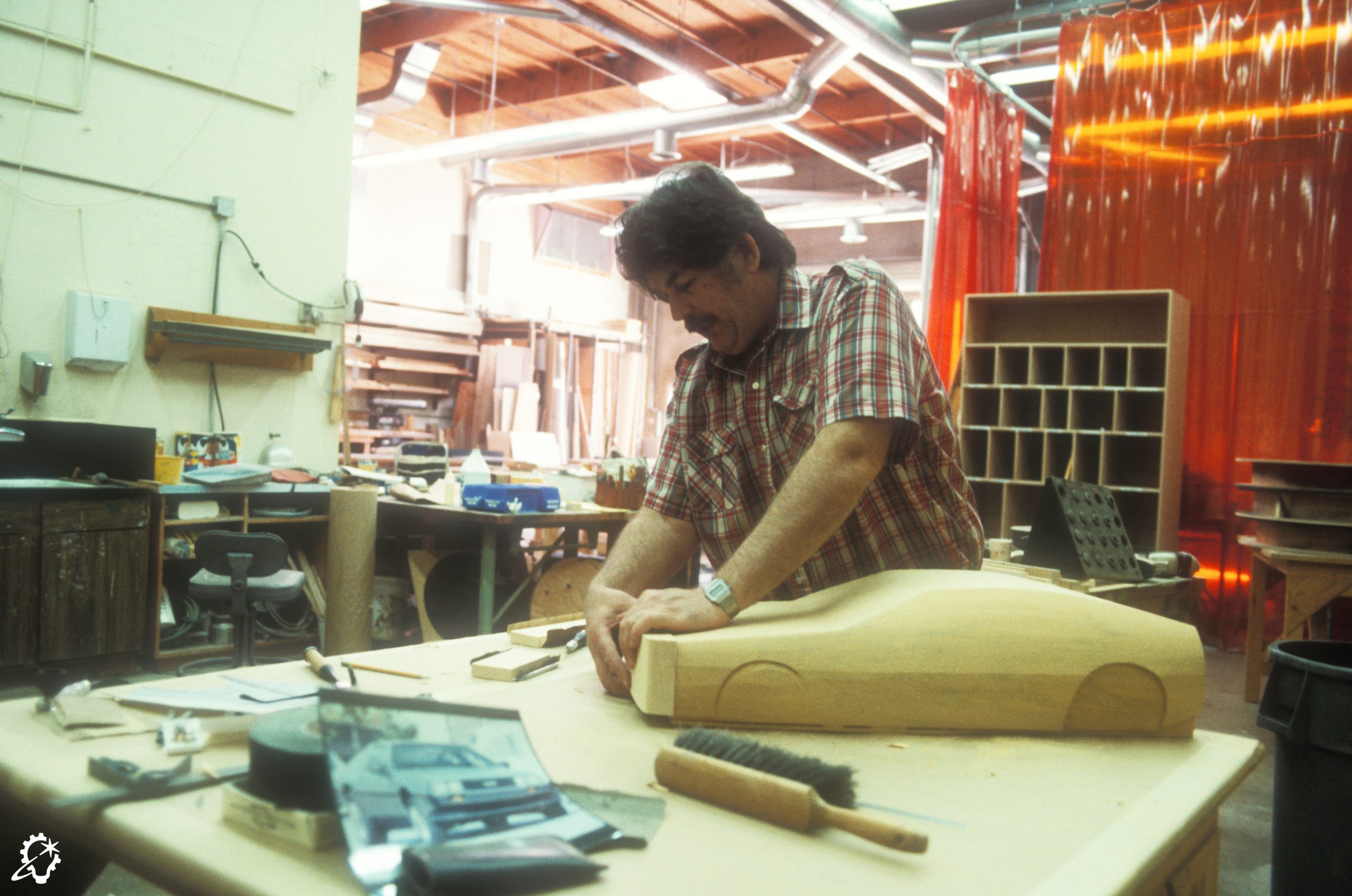
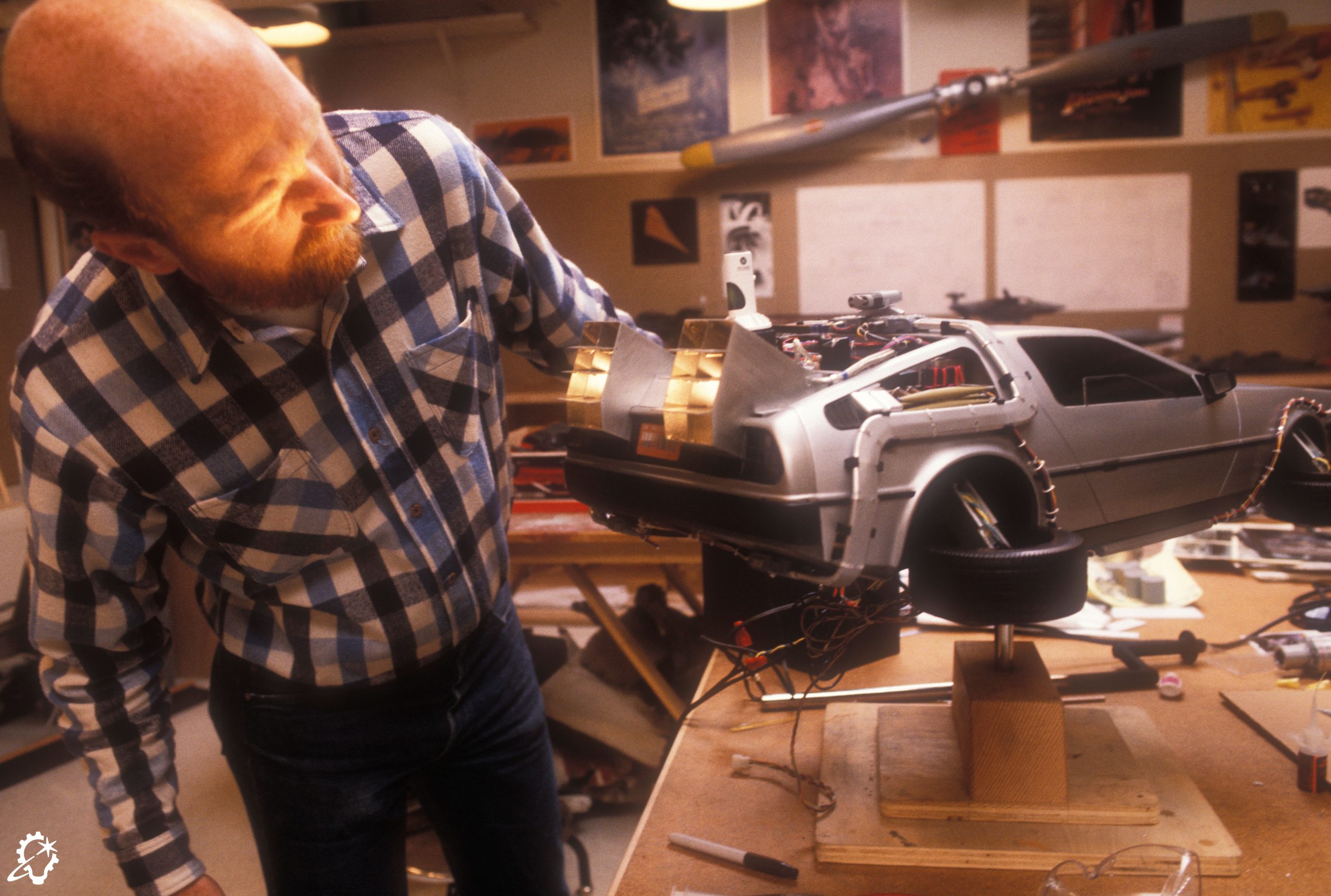
Combining live-action filmed in Arleta, California, miniature work by veteran modelmaker Steve Gawley (with Ira Keeler, Mike Fullmer, and anyone else available to pitch in), ILM’s visual effects, and the cinematography of Dean Cundey, the DeLorean’s flight into 2015 left audiences hungry for more. Steve Gawley explained to Cinefex the process for bringing that model to life and making it fly.
“Because we didn’t have any existing model kits to use, the entire car was built from scratch. We had looked into an eighth-scale Corvette model and perhaps using its tires, but we decided that wasn’t going to work either. So we ultimately built our own model, which turned out to be one-fifth scale of a real DeLorean – about 32 inches – and used the photographs we got from the existing stunt car for reference.”
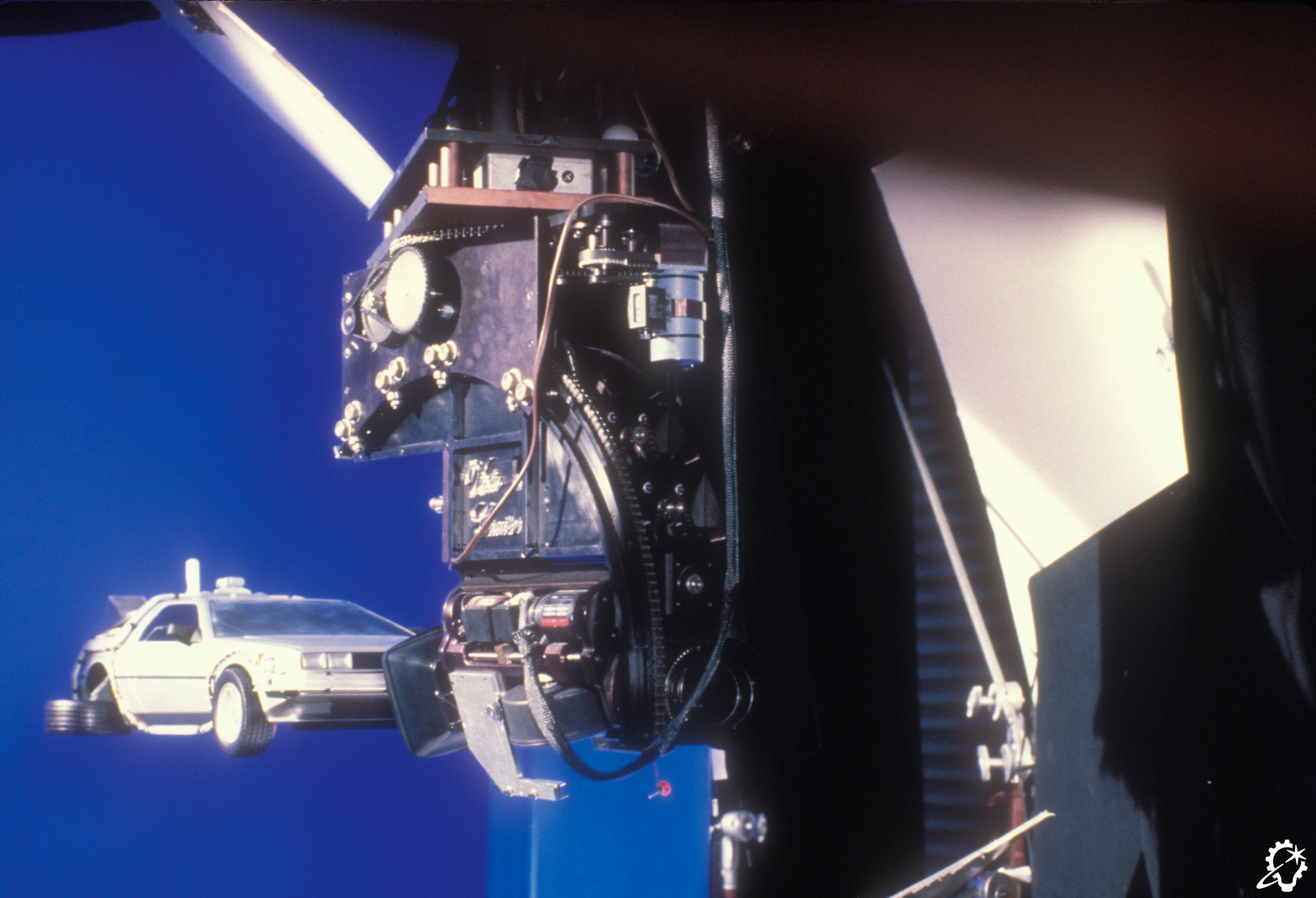
The marriage between background plates shot on ILM’s VistaCruiser motion-control camera system in a windy Arleta, and the ILM model was a hefty undertaking, especially given the less-than-direct route the crane was required to go.
Matching the crane shot was straightforward enough, but plotting out where the car would be in a specific frame required plotting out the move with graph paper on a Movieola and lining up all the points, a process that stretched the rig to its capacity. With the car completely turning around and accelerating back towards the camera, it had to be mounted so audiences never lost sight of the car, right up to the moment it leaps through time towards 2015.
Animator Ellen Lichtwardt explained to Cinefex the intense work that went into that final shot of the DeLorean passing under the trees of Lyon Drive. “About ten people from rotoscope and animation worked day and night on it for about a week, and that was aside from the motion control work.”
With all of these elements brought together for a shot no one would ever forget, there was still time for an 11th-hour idea from Zemeckis to be added in, as Ralston explained to American Cinematographer.
“At the last moment, Bob Zemeckis thought it would be funny to put a little turn signal on the car when it goes back and does the turnaround. I don’t know if anyone sees it, but it’s there – a little tiny thing blinking on and off. It was done in animation because we didn’t have that when the scene was shot.”
The final completed shot was taken from the lab and printed, without the shadows of the trees being added to the car as it flew under them, despite Ralston and his team having the assets to complete the shot. As is often the case, time was the enemy.
Looking back, Dean Cundey remembers the end sequence well. “Ken Ralston came to us one day and said, ‘We think we can make this DeLorean fly, here’s what we’re going to do. Put it on cables, and then we’re going to remove the cables.’ He talked a little bit about it, shooting the shot twice and all of that, but the first film was about the storytelling, as opposed to the effects.”
In terms of ILM matching their miniature photography to the onset look Cundey had established, there was constant collaboration. “I was always interested and paid a lot of attention to the techniques and the technology that ILM was creating, and did my best to understand or keep abreast of the creations that were happening, so it was very much a two-way street of me understanding and then talking to the ILM people that were involved to understand the technology and their techniques. For example, I didn’t have to know how to run an optical printer, but I would understand its purpose.”
The Post-Production Rush
With the film in the can and visual effects work well underway, the comparatively brief but ultimately very efficient post-production period began, with all corners of the production racing to assemble this time-shifting jigsaw puzzle in time to arrive at the film’s release on July 3, 1985. That meant all hands to the pump, even hands belonging to former key ILM team members, like post-production supervisor Art Repola, who’d started at ILM as a production coordinator. With a tight turnaround, the team had roughly eight weeks to complete the film after principal photography wrapped.
Ken Ralston remembered that even more brutal schedule, speaking with American Cinematographer. “They cut about two weeks out of our schedule because they moved up the release date. They handed out thousands of those buttons, “On July 19 we’re going BACK TO THE FUTURE,” but it was really July 3! So we killed ourselves for a few days getting the thing shot.”
Cundey fondly remembers his association with ILM, which also included his part in a monumental leap forward in visual effects on Steven Spielberg’s Jurassic Park (1993). “I really enjoyed working with ILM so often because they’re the people who are most interested in furthering the illusion that cinema could do. If you look at my filmography with ILM, so much of it is all about finding new ways to create the illusion.”
Cundey gives insight into how he explains the collaborative process to film students eager to inhale any knowledge they can from the industry veteran.
“I often say to film students, you can have a canvas and oils, go in your garage and create by yourself, or sit in front of your typewriter and write a novel by yourself, but when you get into feature films, it’s a huge collaboration, it’s one of the artforms that requires a great number of people and visions. You hope that the substance of it – the story, the plot and the characters – are good, and that this ensemble of skilled and talented and hardworking people can contribute and bring together these separate visions under the guidance of the director.”
Back to the Future’s sense of legacy and of making a film of substance was something Cundey was aware of during its production. He also treated it as a learning experience in a career that began over 50 years ago.
“You hope that what you’re working on at the moment is going to be a great success, and you always approach it that way,” he remembers. “Back to the Future was such a unique story, and with Michael J. Fox and Christopher Lloyd, you had such a great set of characters. I thought, ‘We’re really on to something interesting and unique here,’ and here we are 40 years later with so many people still engaged.
“I don’t know how many times I go somewhere and someone says, ‘Oh my gosh, Back to the Future is one of my favorite movies,’” Cundey says. “I just showed it to my kids. They’re passing on this tradition, this adventure, and even though it’s set in a particular time and place where 1955 was the past, well, 1985, that’s the past too, even though it was supposed to be the present when it first came out. They’re willing to overlook the fact that they’re looking at 1985 because there’s something about the characters, the situations, the places that still apply. People can empathize with it.”
Ultimately, as with all great films, be they financial and cultural smashes or overlooked gems, cinema is the canvas that creatives like Cundey, Zemeckis, and the artists at ILM paint on, along with numerous other cast and crew. It’s a magic trick, an illusion not unlike ones found inside that “little magic set” Cundey was gifted for Christmas all those years ago.“
When you think about it, you go into a big room and in front of you is a flat white wall. Then they project moving images on it that so many people have been part of creating, and hopefully the audience get so immersed that they believe what they’re watching. Then, when the film is over, the white wall comes back, and they leave having experienced this magical, intangible thing. Hundreds of people are involved, from the early writing and pre-production through production, post-production, all bringing their best to make that intangible thing. That’s the thing about Back to the Future. The believability of the illusion is there, so people continue to follow it.”
—
Mark Newbold contributed to Star Wars Insider magazine for twenty years, is a 4-time Star Wars Celebration stage host, avid podcaster, and the Editor-in-Chief of FanthaTracks.com. Online since 1996. You can find this Hoopy frood online @Prefect_Timing.