
Tha layered shading system has been the standard at ILM for many years as it continues to impact the wider visual effects and animation industries.
By Lucas O. Seastrom

2026 marks Industrial Light & Magic’s 39th Scientific and Technical Award from the Academy of Motion Picture Arts and Sciences. The recipient innovation “Lama” – its name derived from the first two letters of each word in the term layered materials – is the first modular, production-ready, commercially available layered shading system of its kind in the visual effects and animation industries. Recognized on the award are Lama’s lead originators, including former ILM lookdev supervisor Jonathan Moulin, and former ILM rendering engineers Vincent Dedun and Emmanuel Turquin.
The concept for Lama first emerged ten years ago as a means to solve what had become a common problem with shading and rendering computer graphics imagery. A typical layered material network helps to define how light interacts with a digital surface like metal, wood, or skin. Light can reflect off a surface, but it can also refract between multiple, differing layers. Until 2016, material systems were commonly made specifically for the types of imagery in a given production. They were rigidly designed and often difficult to share between different productions. This inflexibility made it challenging for artists to adjust their work quickly while still maintaining the realistic dimensions of their images.
“In the early days of rendering – i.e. writing shaders to make objects look like real objects that are in fact CG objects – we had purpose-built shaders,” explains principal R&D engineer André Mazzone, who has been involved with Lama since its inception and currently manages the product. “There were shaders for glass, skin, metal and everything else. It was insular and isolated. Then there was a period when we developed general purpose shaders that would combine multiple properties. In certain cases, some parts of an asset might be clear but others might be opaque. For example with an eyeball, there’s a white, cloudy area but then there’s a transition into a transparent region where the lens is focusing light onto the retina. This blending needs to be smooth, so we require an expressive shader that comprises all of these behaviors. General purpose shaders were fixed in their designs as templates. If we wanted additional behavior, we had to jump in and code it. On Rango, they needed more dirt controls, so we had to splice in new pieces of code to make upgrades. That’s how it used to work.”
To eliminate this often cumbersome process, Lama was envisioned as a modular system where materials are layered and combined without the need for customized code. It’s a simple, lean, and artist-friendly method that ensures both physical accuracy and creative flexibility.
“The way Lama decomposes material responses is akin to the historical bespoke shader solutions for different materials, but the glue is now something that an artist can apply instead of an engineer,” explains Mazzone. “The engineering job is to provide all of the building blocks that might be needed, and the artists can make new additions themselves. This is Lama’s true strength. It employs an infrastructure that conserves energy across material layers. We had experimented with this in the past, but not in a way that allowed general arbitrary layering. This commitment to automatic physically-inspired energy conservation while rearranging components is what has made this tool so flexible and useful.”
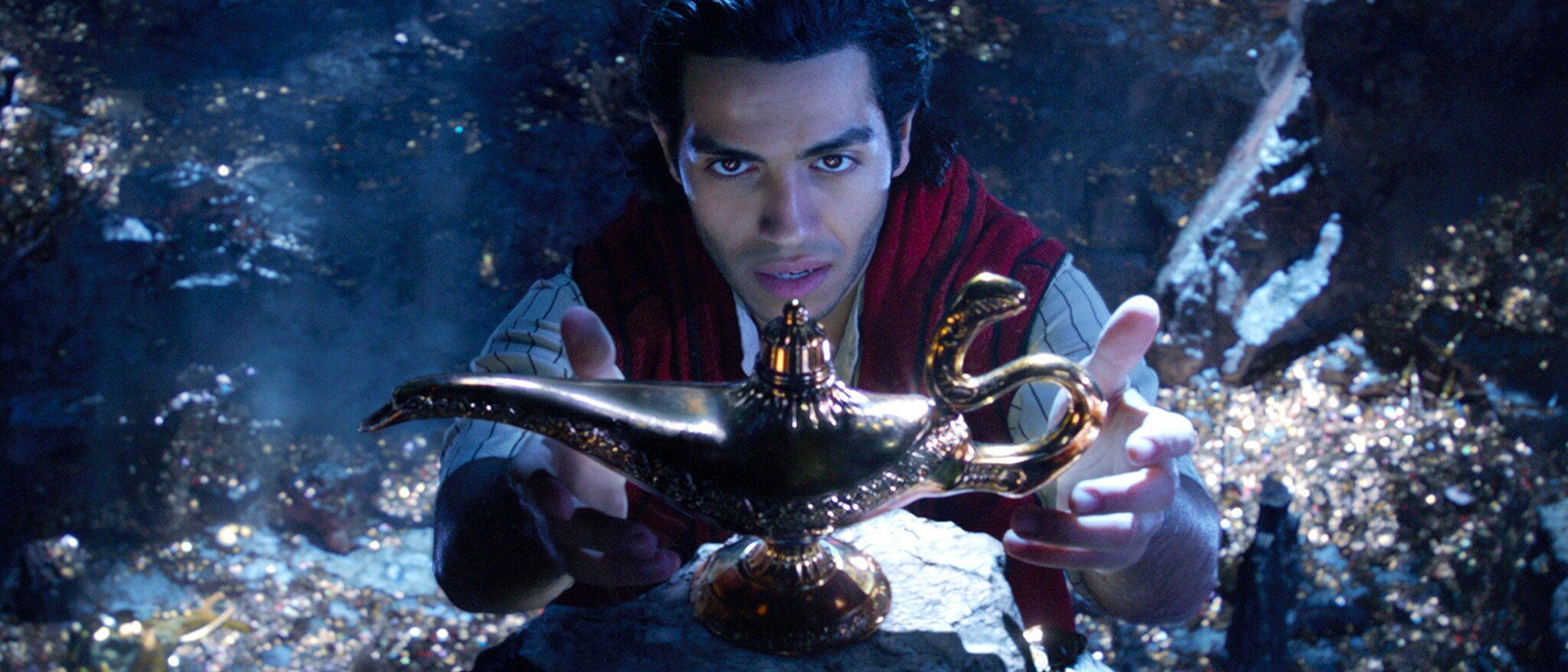
Starting as an incubator project at ILM’s London studio in 2016, by mid-2017 Lama was already being used in productions. Disney’s Aladdin (2019) was the first to receive full Lama deployment to great success, and later, Terminator: Dark Fate (2019) resulted in the tool’s deployment throughout the wider network of ILM’s studios. “Any film that includes CG elements from our main-line pipeline – hero creatures, crowds and environments – has been 100% powered by Lama since 2019,” Mazzone notes. That includes episodic series like The Mandalorian, Skeleton Crew, Andor, and many of the Marvel shows. All main-line assets at ILM now go through Lama.”
However, this was only the beginning of Lama’s impact. At the same time that ILM fully integrated the system, it began sharing Lama’s possibilities with sister companies, Pixar and Walt Disney Animation Studios. Pixar was so taken with it that they chose to adapt the tool into their iconic RenderMan product. Lama first premiered with RenderMan 24 in 2021, and since then, studios across the industry have benefited from this ILM-grown innovation, including Laika, DNEG, and MPC, among others. Pixar’s newest feature Hoppers is just one example, wherein Lama’s workflow for hair, fur, and feathers was utilized to great success.
“Most importantly, Lama shifts the artist’s mindset,” says Mazzone. “Materials are now no longer abstract parameter blends, but substrates and layers, much closer to their real-world counterparts. They can be developed independently and combined later, improving efficiency and giving artists and engineers a clear, shared language. This balance, simplicity at the surface, and complexity through composition, makes Lama both approachable for artists and robust in production, enabling faster iteration and higher quality outcomes.”
Congratulations to Jonathan Moulin, Vincent Dedun, Emmanuel Turquin on their Scientific and Technical Award, and to everyone at ILM who has supported Lama’s continued development, including engineering lead and current product owner André Mazzone, former rendering engineer Henrik Dahlberg, rendering engineers Sam Cordingley, Alain Hostettler, Chong Deng and Khang Ngo, and lookdev supervisors Hugo Debat-Burkarth and Joseph Szokoli.
See the full list of Scientific and Technical Award Winners for 2026.
To learn more about Lama, visit RenderMan’s website.
—
Lucas O. Seastrom is the editor of ILM.com and Skysound.com, as well as a contributing writer and historian for Lucasfilm.