
Visual effects supervisors Pablo Helman and Anthony Smith dive deep into one of ILM’s most challenging shots for the magical sequel.
By Brandon Wainerdi
Even audience members intimately familiar with Wicked’s source material were in for a new experience when they finally sat down to watch Wicked: For Good (2025). “The Girl in the Bubble” was a brand new song written by the original composer, Tony-winner Stephen Schwartz, expressly for the sequel movie – it had never appeared before on stage. And so, with no previous Broadway blocking to use as a jumping off point, how do you then show the inner turmoil of Glinda (played effortlessly once again by Ariana Grande)?
Initially, director Jon M. Chu envisioned the sequence simply: Glinda would deliver the new number while singing to herself in the mirror in her private Ozian abode. One mirror. But it quickly evolved into a much more complex idea, engineered and solidified by director of photography (and longtime Chu collaborator) Alice Brooks. As production visual effects supervisor Pablo Helman recounts to ILM.com, “She [Brooks] used a lot of props like bananas, toys, iPhones, and all sorts of things to understand what we then needed for pre-vis.” Helman’s fellow visual effects supervisor at ILM, Anthony Smith, added, “Alice worked out the concept of the sequence on her breakfast table with everyday objects, which I thought was such a great way to block out the initial idea.”
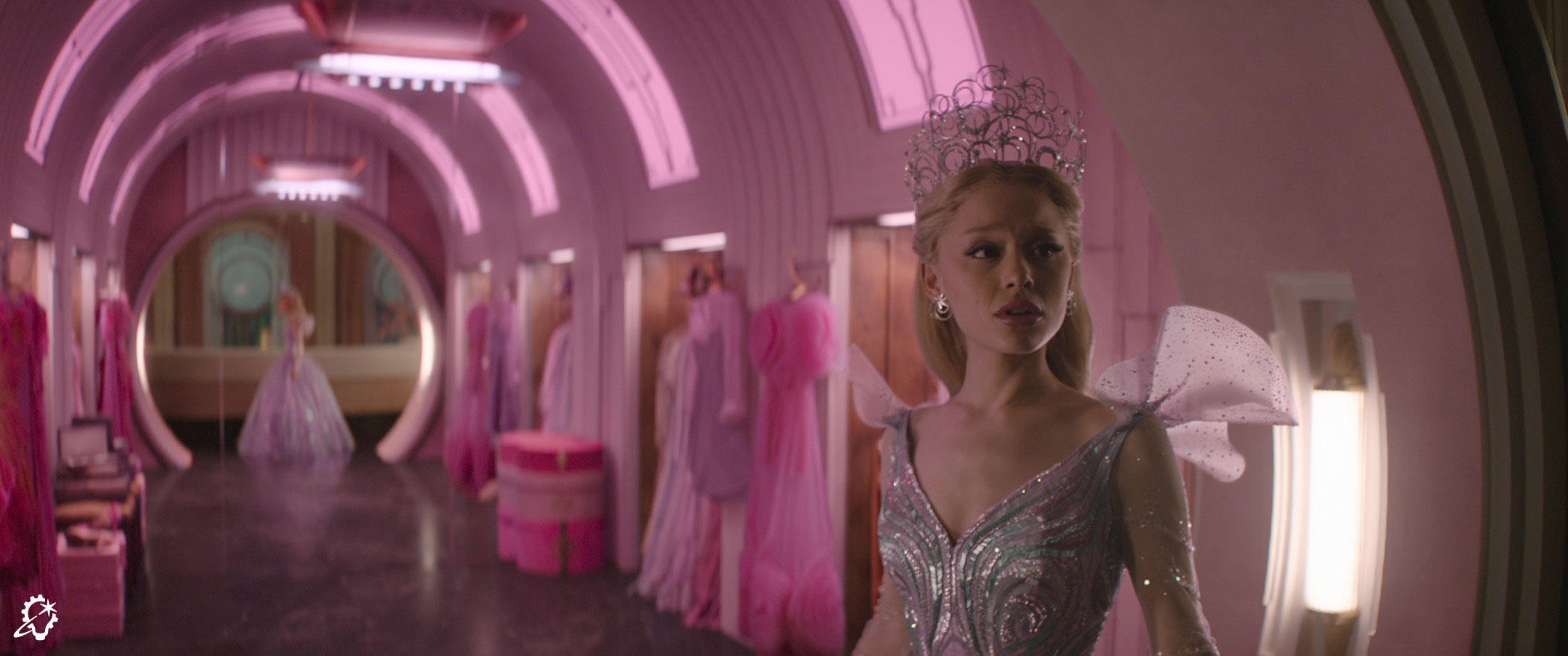
When it was all finally laid out, the mid-movie musical sequence became a “oner,” effortlessly following Glinda across her two-story apartment, through different rooms, and through different mirrors. With multiple mirrors situated around her sprawling home, the camera would need to travel into a mirror’s reflective surface and come out the other side – multiple times.
The seamless, singular appearance of this shot was anything but – it required over three years of work from multiple teams, resulting in a sequence that, for lack of a better word, ended up feeling magical. “It was a real collaboration,” says Helman. “We started that first week by shooting ‘The Girl in the Bubble’ because we knew it was going to take three years to finish.” And, in fact, it did. As Smith notes, “I believe it was one of the longest shots, not just in terms of frame range, but also in terms of production time. It was one of the first things shot at the beginning of the combined principal photography, and it was one of the last things finished for the second movie. It was a very, very long period for a very, very long shot, coming in at 4,767 frames long – 3 minutes and 18.5 seconds.” (For reference, the average visual effects shot is in the 3-4 second range.)
A Brief History
When the shots finally arrived at Industrial Light & Magic, Smith worked closely with Chu to make sure they followed the director’s vision as closely as possible. The brief from the filmmakers to ILM was straightforward: “We were provided with the selected takes and a rough assembly from editorial, which was a great initial brief in itself. Watching the assembly for the first time, I knew it was going to be a special shot. Then, watching it for the second time, my brain started trying to process all the different technical challenges that a oner like this creates, one of them being that, because the shot is a song, the timing is locked. We couldn’t slip the timing of any of the elements to make those transitions easier,” recounts Smith.
The actual nuances about how it should feel were learned along the way through discussions with Chu. “I knew we could solve the technical challenges with the shot, but there were a few key creative choices that I wanted to explore with Jon,” remembers Smith. “I love working with him because he is able to explain his ideas in such vivid detail that it’s easy to visualize what he’s looking for, and trusts that we will execute; but the important thing for me with ‘Girl in the Bubble’ was getting a really good understanding of how Jon wanted the mirror transitions to feel. It was important to him that there was a smooth flow to the shot, that the transitions were subtle, and that the viewer could become so captivated by Ariana’s performance without distractions that those transitions were magically invisible. I absolutely loved this aesthetic, and part of the joy of working on a shot like this was having the opportunity to translate the feeling that Jon described into an actionable to-do list for our artists.”
Of course, tricky “mirror shots” have been attempted throughout much of cinematic history, including one of the most famous and beloved: the early mirror moment from Contact (1997), an ILM project. “I have always loved the subtlety of that shot,” says Smith. “You really don’t realize that you have gone through the mirror until the cabinet is opened. But by the time you start to even analyze it in your brain, the shot is gone, and you have to watch it again. That feeling was something that I was very attracted to when it came to this shot and is one of the reasons why I work in visual effects today!”
Dirty Work
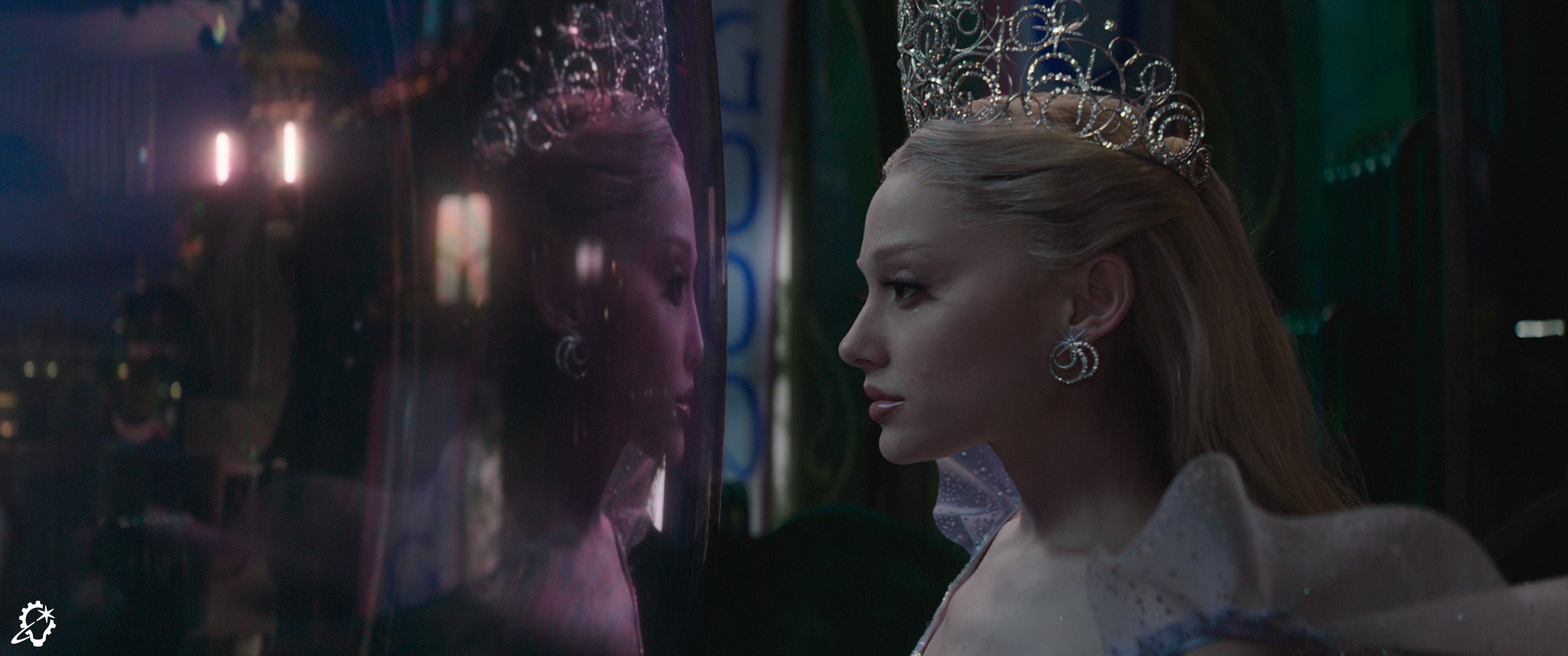
One of the first challenges that needed to be worked out was something rather simple: Just how dirty are mirrors in Oz? “Yes, the camera could go through a mirror, but to achieve the right level of subtlety, we needed to understand what the surface of the glass needed to look like to best work for the shot,” said Smith. “If it was a very dirty surface with dust and smudges all over it, the surface would be too obvious as the camera approached and passed through it, breaking the illusion, so finding the right level of dirt on the mirrors was key. We ended up with some light smudges and little bits of dust to catch the reflected light. That surface texture actually included real fingerprints from our Production team, so their fingerprints are literally all over the shot. We spent a lot of time in the composite making sure we accurately matched the camera’s depth of field. This meant that the detail on the glass surface beautifully dropped out of focus as the camera got close, which added to the elegance of the transitions. For the closet mirror, we gave Jon a bunch of options for the vertical divisions between the three sections of mirror – different placements and sizes – which again, was all about finding the right level of subtlety for Jon.”
However, mirrors inherently create a bit of filmmaking chaos. Because of a person’s innate familiarity with reflections, if something doesn’t feel right (there it is again – feel), an audience is rather immediately able to tell if a reflection isn’t correct. “None of the plates were shot with motion control, which was an intentional choice that contributed to the success of the shot – the handheld and crane movements really helped to ground it and make it feel like we were there, moving around the space with Glinda – but they also created challenges with the transitions. Each take had to be camera tracked and manipulated to align correctly with the one it was transitioning to or from. The Layout team did some great work to create a solid technical base so we could then make creative decisions. For example, for the first transition, we used a CG Glinda on the other side of the mirror as a reference to make sure we knew exactly where the reflection should be. Then we moved the reflection plate to match that position,” says Smith. “Another challenge with the first transition was that Glinda’s eyeline on the other plate wasn’t correct, so she wasn’t looking at her own reflection. To fix this we actually warped her eye direction in the reflection to make it feel like she was gazing at herself, rather than towards the camera. It only needed a very subtle change to achieve this – if we moved her pupil even a single pixel, it was too much.”
Making Room
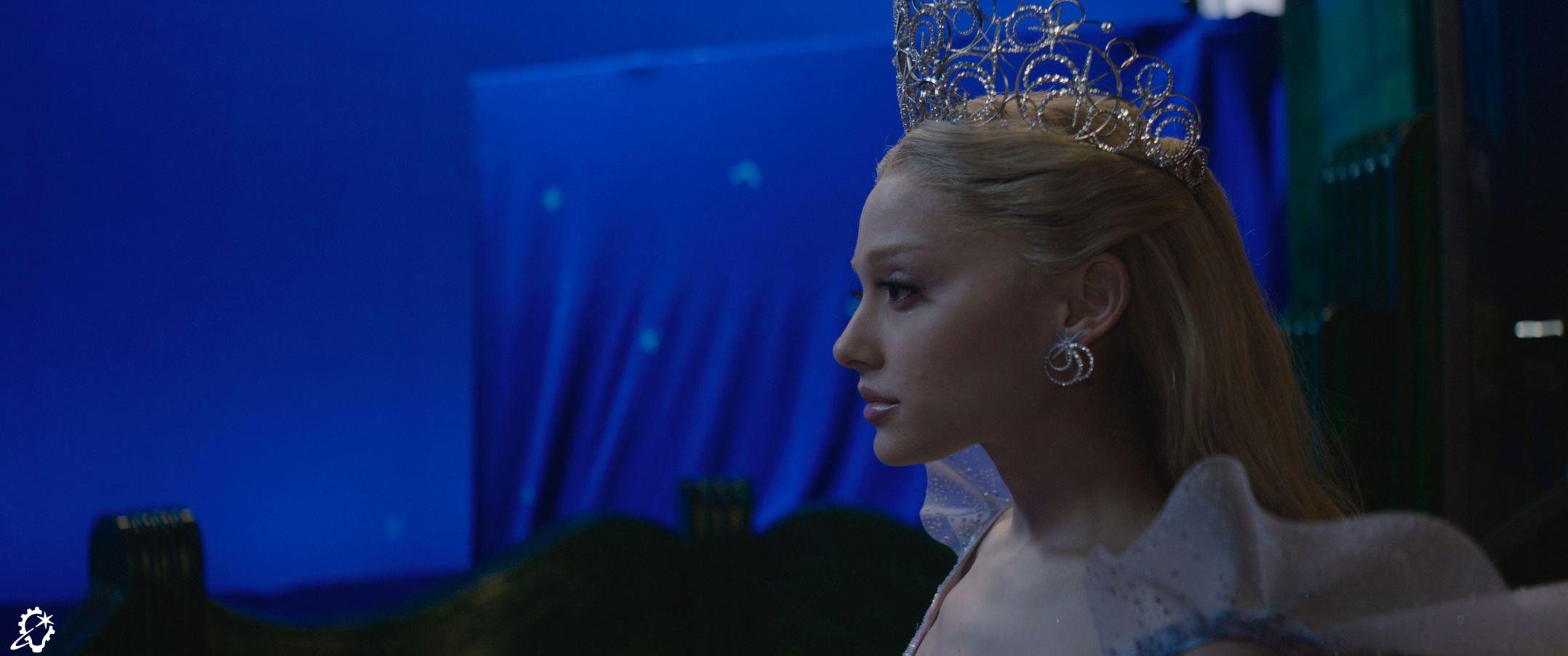
While there was talk about creating and utilizing a digital double for Glinda, it was decided that the ILM team could complete the shot with only the real performance and some “really clever 2D work.” It was all Ariana Grande. But her room, built and shot practically, had its own physical limitations. “One of the most challenging parts of the whole shot was the transition that takes place when the camera reverses through Glinda’s closet,” Smith explains. “There was a physical closet on set, but only half of it had been built, and at the end of it, there was a blue screen filling the back wall, which is where the floor-to-ceiling mirror would go so that, combined with its reflection, the closet would seem to be double its length.”
The team recreated parts of the apartment digitally, and then used pieces of it to flesh out the previously filmed set. The movie had been shot anamorphic, with a very specific “squeeze” on some lenses Alice Brooks used, which meant the team didn’t have much extra frame to work from. “We decided to build a CG version of some parts of the set because once we started our Layout process, we were able to assess how much we would need to manipulate what was shot to achieve each transition, and it became clear where things then needed to be fixed,” said Smith. “The foundation of the build was the LiDAR scan of the space. For some transitions, we were able to project the shot footage onto the geometry and render it from the manipulated camera positions. For the closet transition, this was our main methodology. Our Environments team did an incredible job of producing a huge number of camera projections to recreate all of the layers of dresses, shoes and boxes in the closet.”
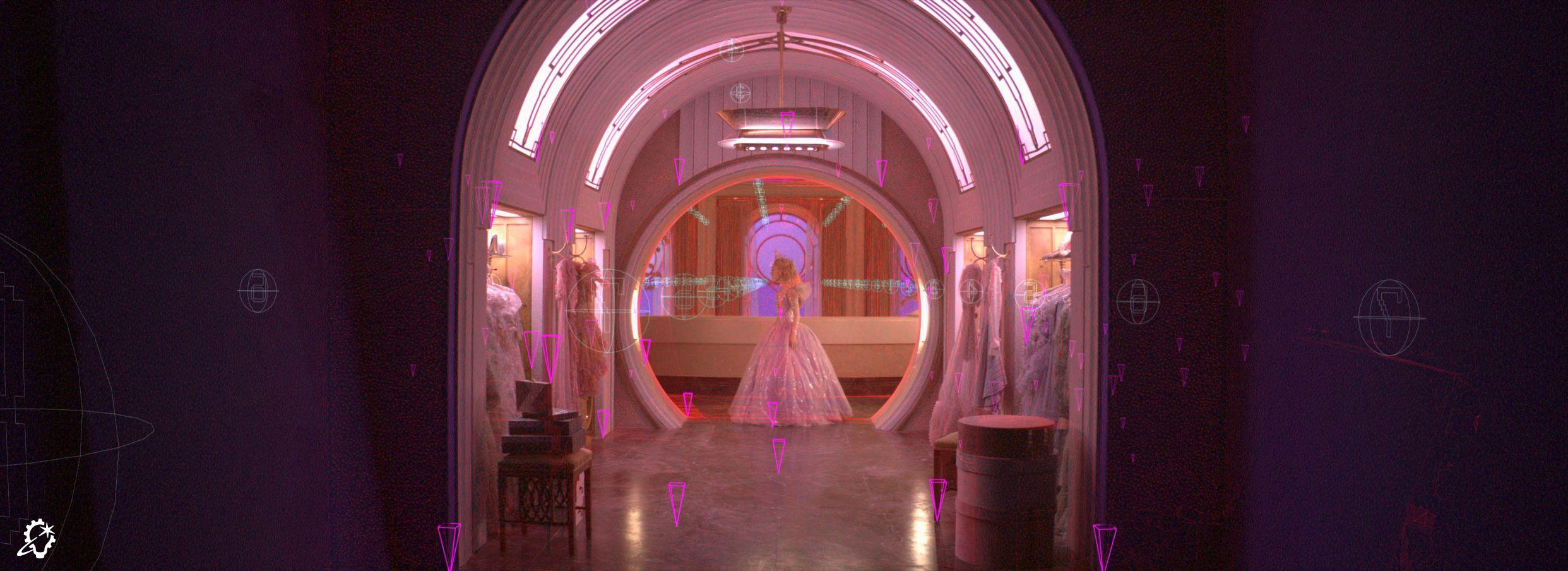
And although the ILM team was able to use the room’s geometry and high-dynamic-range photography taken on set, Smith mentions, “Texture projections would only get us so far with some of the transitions. There were parts of the room that simply had to be CG extensions. A completely CG balustrade was needed because the practical one had to be removed on set to allow the camera crane to move correctly through the space. The ceiling and its mirror were completely digital too, again because they didn’t exist on set.”
But, even though there was a real floor on set, it also sometimes needed to be replaced, as Smith explains. “When deviating from the original camera position to achieve a successful transition, one of the first things that breaks with the texture projection approach is reflective surfaces – where reflected light no longer sits in the correct screen space – and all of Glinda’s apartment floors were quite reflective. So we recreated the floors in the main apartment space and the closet to be able to move the camera away from where it was on set and still get the correct reflections. This was key for the ceiling mirror transition, where the ceiling height of the set prevented the camera from shooting Ariana from the correct height for her reflection element, so we moved her element further from camera and digitally extended the room all around her.”
There was one additional tell for eagle-eyed viewers: “Obviously, the room was never actually physically inverted. There was only ever one room. So whenever we went from the real world into the mirror world, the entire image flopped. The idea was that there was no clue there and it just felt completely seamless all the way through.”
Not all the work is “showy,” but it all has a special place in the film and in Smith’s heart: “There’s a moment after Glinda reaches the top of the stairs where there’s a really successful transition that no one is really aware of – as she walks past the camera, we did a morph blend and lots of paint work. Her walking gait – the timing of her steps – was different between the two takes we joined, so her actual step timing had to be manipulated to get them in sync. We completely extracted her from both backgrounds to do this and achieved it with some really top-notch comp and paint work. It’s one of the transitions I’m the most proud of because no one ever spots it.”
“Isn’t it high time for her bubble to pop?”
Even near the end of the process, ILM had to be flexible and communicative to deliver the final shots. As Smith remembered, “When we were a couple of months from finishing, Jon and his editor Myron Kerstein asked us if we could swap out two of the takes for alternate Ariana performances. This was not a small ask at that point because the waterfall effect of dependencies of each transition were significant, but as it was so important for the shot to get this right, we immediately started reworking them. The good thing was that we knew the feeling we had to hit with each of them, so it was only a matter of reworking the technical side of things to hit the same creative notes. The team did such an awesome job with that, and getting Jon’s approval on that camera rework for such a long shot was a really important milestone for us!”
After all of that work, “The Girl in the Bubble” cemented itself as one of the movie’s most memorable moments. “It’s kind of the reason why I love visual effects – it’s something that makes you think,” explains Helman. “Sometimes you’re working with others, and you’re in the meeting trying to solve a difficult science problem, and sometimes you can’t solve it! ILM is a perfect place for it because we are allowed to sit at a table and say, ‘Forget about what we did before, forget about everything. What if we did this thing? Would it work?’ And then I realize how lucky I am to have a job that is so creative.”
Read more about both Wicked films here on ILM.com:
“Preparation is the key to success”: Pablo Helman on the complexity of making ‘Wicked: For Good’
Defying Expectations: How ILM’s Collaborative DNA Helped Bring the World of ‘Wicked’ to Life
—
Brandon Wainerdi is a writer and interviewer, whose work can be found in Star Wars Insider, on StarWars.com, and inside the iconic horror magazine, FANGORIA. He is the author of two Star Wars books, including the recent Star Wars Encyclopedia of Starfighters and Other Vehicles. He is also the host of Talking Bay 94, a long-running behind-the-scenes podcast that interviews the cast and crew of the Star Wars saga. You can find him on Twitter and Instagram.