
StageCraft

50 Years | 500+ Film and TV credits | 135+ Awards

SINCE 1975

With ILM as a lead contributor, the Disney+ series took home the award for Outstanding Visual Effects for a Live Action Program at the 3rd Annual Children’s & Family Emmy Awards.
The logo of the 3rd Annual Children's and Family Emmy Awards.

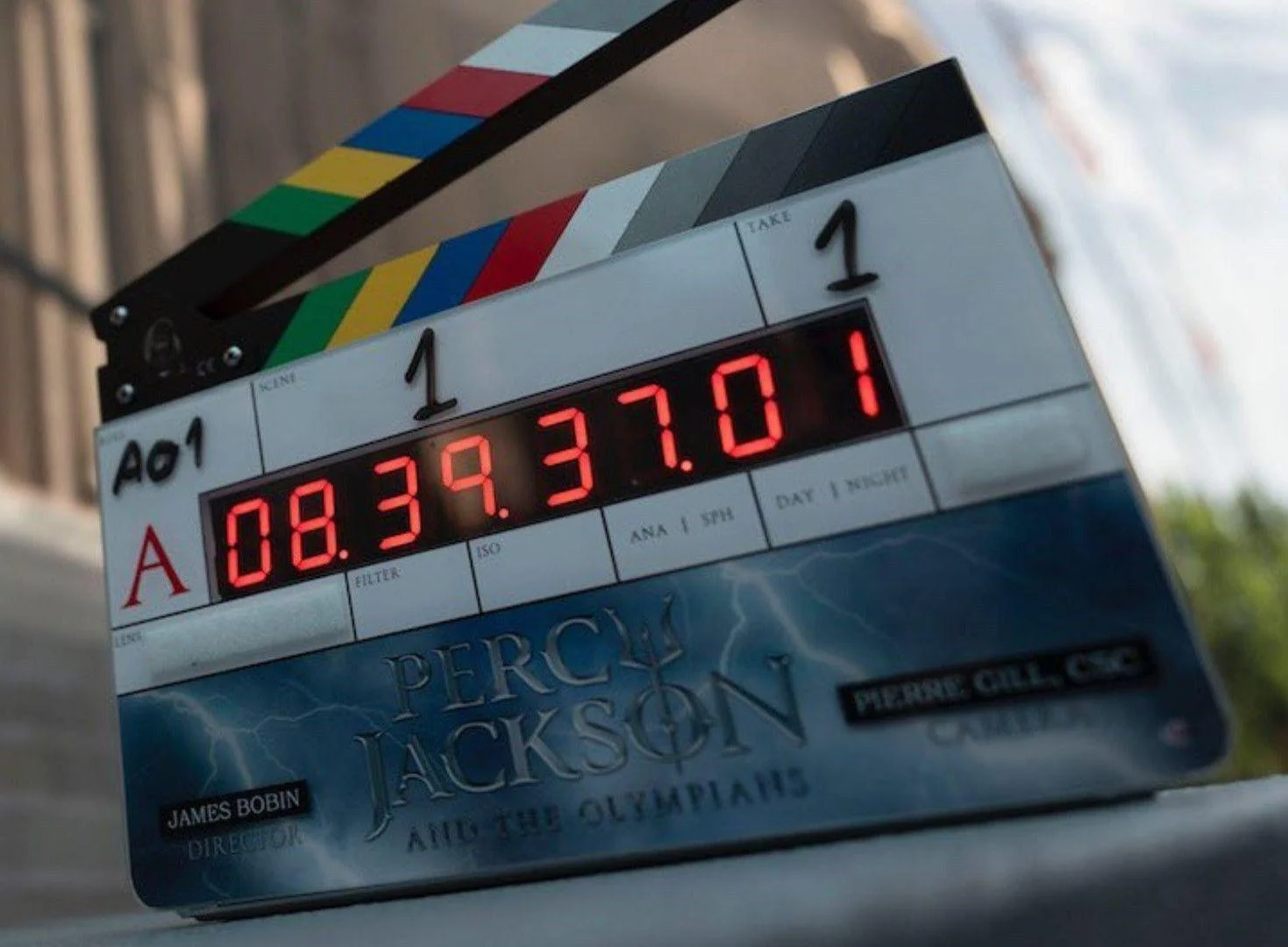
Based on the popular books by Rick Riordan, the Disney+ series Percy Jackson and the Olympians earned eight wins on 16 nominations at the 3rd Annual Children’s & Family Emmy Awards in Los Angeles on March 15. Among them was “Outstanding Visual Effects for a Live Action Program,” for which Industrial Light & Magic was a lead contributor.

ILM’s Emmy winners include visual effects supervisors Jose Burgos and Jeff White, visual effects producer Katherine Chambers, executive visual effects producer Adele Jones-Venables, virtual production supervisor Sonia Contreras, associate visual effects supervisors Donny Rausch and Daniel Schmid, and associate visual effects producer Shawn Smolensky.

Percy Jackson’s senior visual effects supervisor Erik Henry accepted the award on behalf of the visual effects team, thanking ILM and other contributing effects houses MPC, Hybride, and Raynault. The 3rd Annual Children’s & Family Awards is available to stream from the National Academy of Television Arts & Sciences.

Congratulations to our ILM Emmy winners! Watch the trailer for Percy Jackson and the Olympians:

For the first time, ILM’s groundbreaking virtual production technology transports fans inside the Star Wars galaxy.

By Clayton Sandell

Patricia Burns gets ready for her closeup on the ILM StageCraft volume at D23.

Patricia Burns steps up to her mark.

Dressed in the sleek all-black uniform worn by the Third Sister Reva Sevander from Obi-Wan Kenobi (2022), she ignites her doubled-bladed red lightsaber and waits for her cue.

A nearby stagehand counts her down and calls “Action!”

As a crane-mounted camera swoops in, Burns crouches next to R5-D4, a red and white astromech droid, swinging her lightsaber with a fierceness only a Jedi-hunting Inquisitor could conjure. Behind her, a massive wall of LED screens displays the pristine moving image of a busy Rebel hangar.

Monitors around the stage show what the camera sees in real-time: an epic, trailer-worthy shot that makes Burns the star of her own Star Wars story.

“Oh, it was awesome,” Burns tells ILM.com as she walks off the stage, grinning. “A chance of a lifetime.”

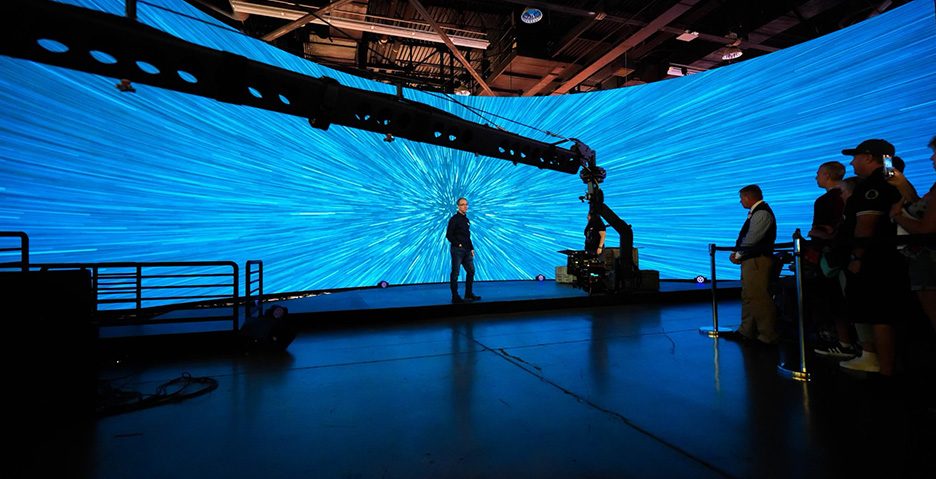
At D23: The Ultimate Disney Fan Event, Burns and hundreds of others had the unique chance to perform on a StageCraft volume— Industrial Light & Magic’s cutting-edge virtual production technology used on dozens of projects including The Mandalorian (2019 – present), Percy Jackson and the Olympians (2023 – present) and The Batman (2022).

For the first time ever, the ILM crew assembled a volume— something normally sequestered on an off-limits studio soundstage— inside the Anaheim Convention Center just for fans attending D23.

ILM’s chief creative officer Rob Bredow and virtual production supervisor Sonia Contreras host a StageCraft workshop.

“I think everybody is blown away by the scale of this, and how immersive it actually is when you get to see it here on the show floor,” says Rob Bredow, senior vice president, creative innovation for Lucasfilm and chief creative officer of ILM.

During the three-day event, a rotating trio of scenes appeared on the volume’s giant LED panels: an Imperial hangar created for The Mandalorian, a Rebel hangar from Ahsoka (2023) and a vibrant city street on the planet Daiyu seen in Obi-Wan Kenobi.

“You’re looking at over 18-and-a-half million pixels of LED wall and a live-tracked camera,” Bredow tells ILM.com. “Wherever the camera looks, we get a high-fidelity version with exactly the right perspective for the illusion of creating an immersive environment. It looks impressive enough here at the convention center but when we collaborate with the production designer and the art department on one of our productions that’s when the technology really sings. It’s a powerful tool in the filmmaker’s toolbox that we can deploy when building standing sets on a stage or traveling the cast and crew to a far-flung location isn’t feasible.”

For D23, ILM wanted to demonstrate a fully functioning StageCraft volume exactly like the ones used on a real set.

“It’s very fun to not be faking it,” Bredow quips.

Attendees at D23 take in ILM’s StageCraft volume.

ILM virtual production supervisor Ian Milham says transporting the volume from a studio lot to the convention center took a herculean scheduling and logistical effort involving a busy team of artists, engineers, and crew members. And several large trucks.

“Everybody agreed, ‘yes, we’re really going to do it’,” Milham explains. “But that meant we had to get our real gear and our real crew here. It also meant we couldn’t be making a movie with it at that time.”

The challenge was worth it, Milham says, because it gave the filmmakers a chance to finally show off their pride in StageCraft to a wider audience.

“Film sets are amazing places,” says Milham. “But it’s not like there’s a lot of chances to really share our success. So we’re really happy to be able to show the public for the first time the cool results, but also what it takes to pull off something like this and how much teamwork and technology it takes to do it.”

ILM virtual production supervisor Ian Milham demonstrates the volume.

ILM virtual production supervisor Sonia Contreras co-hosted several StageCraft presentations with Bredow. The pair challenged the D23 audience to look at several scenes and guess which elements were created with practical set pieces and props, and which ones were generated by the volume.

“I got about a third of them right,” laughs Ryan Schwartz, who watched the demonstration with his wife Katie and sons Zachary and Jonathan. Katie says she fared slightly better, guessing about half correct.

“I’ve been following ILM for a long time, and I still try and figure it out,” Ryan tells ILM.com. “They’re so amazing in their craft that it’s so hard to really piece together what is real and what is digitally done.”

Contreras says the D23 StageCraft experience is extremely special because even some ILM employees still haven’t been able to see the volume work in person.

“I would hope that people take away that there’s a lot of brains that go into making this happen,” Contreras says, pointing to the setup’s real-time rendering, camera tracking, processing power, and an aptly named “Brain Bar” crew working behind the scenes to help make the scenery so seamlessly realistic.

“The ‘wow’ factor is when you get to see what’s actually happening, all the different things that are getting coordinated in order to make that image work,” Contreras says. “It’s really cool to be able to show it to everybody.”

Lucasfilm senior vice president and executive design director Doug Chiang made a special appearance in front of a packed crowd on Saturday to talk about StageCraft’s contribution to the long history of visual effects filmmaking.

“We rarely get to share it or talk about it, because it’s an evolving technology, and it is just a tool,” says Chiang. “But at an event like this, where we can actually finally get under the hood and share the magic with the audience, it’s just terrific.”

Lucasfilm executive design director Doug Chiang and Lucasfilm Art Department associate producer Michelle Thieme in the volume.

Frequent ILM collaborator Legacy Effects also pulled the curtain back to show how their crew helps create a Star Wars galaxy full of creatures, aliens, and droids.

“When you’ve got leaders like Jon Favreau and Dave Filoni, who just embrace everyone’s contributions, it inspires you to do the best work that you can,” says Legacy Effects co-founder and special effects veteran Alan Scott.

At D23, Scott and the Legacy team explained how they bring life to characters like the silver professor droid Huyang (voiced by David Tennant) and Murley the Loth-cat for Ahsoka. The production relies on a combination of practical puppets along with digital versions inserted later, depending on the requirements of each shot.

“There are things that I think practical can do very well, especially when it comes to the interaction with the performers,” Scott tells ILM.com. “Then there’s a responsibility that says, ‘that would be better if it was done with visual effects.’”

Legacy Effects co-founder Alan Scott (left) demonstrates a character prop with colleagues Dawn Dininger and David Covarrubias.

Bredow hopes that revealing how some of the Star Wars magic is made might inspire others, especially kids, to consider working in visual effects.

“Many people don’t even realize there are these very artistic and very technical and very creative jobs that have to do with working behind the scenes of film and television production,” Bredow explains. “So this is one of the fun things to do. To connect with fans, to connect with people who might want to make this a career.”

Cosplaying as Bastila Shan from the Knights of the Old Republic (2003) video game, Star Wars fan Carly King says she was most impressed by StageCraft’s powerful mix of creativity and engineering.

“It just looked so good on the screen. It’s so interesting to see how this whole conglomeration of electronics and technology comes together. It’s an incredible thing,” King says. “It’s one thing to watch Star Wars, but it’s another thing to be in it.”

Clayton Sandell is a television news correspondent, a Star Wars author and longtime fan of the creative people who keep Industrial Light & Magic and Skywalker Sound on the leading edge of visual effects and sound design.

The filmmaker and Lucasfilm legend talks to ILM.com to reflect on what drew him to tell the story of the hit Disney+ series, “Light & Magic”.

Screenwriter and director Lawrence Kasdan.

How did you get involved with Light & Magic?
Several years ago my wife and I made a short documentary about a little diner that we used to eat at all the time that suddenly closed. In making that documentary with her, and cutting it with terrific people, it made me realize how much I liked the documentary format. I had never done that. We set out to meet some documentary people and I met Justin Wilkes at Imagine Entertainment. He asked me what I was interested in doing and I suggested a history of visual effects, because even though I had been around visual effects throughout my career, it occurred to me that I didn’t know much about them. The second thing that interested me were the people of Industrial Light & Magic that I had been working around for over forty years. So we both agreed that that would be a great story to tell: the history of visual effects, and the personal stories of these people. What drove these people, what was their life like, what made them want to stay at ILM as long as they did? Everyone loved the idea, so we went to work.

Lawrence Kasdan, center, on the set of Star Wars: The Empire Strikes Back.

What was your vision for the documentary?
From my very first film until today, I’ve always considered myself a humanist filmmaker. I’m interested in what happens between people, and why people make certain decisions in their lives. What chance is involved? What fate? What luck? So from the very beginning of this I was interested in learning what brought these people to this work. What were the relationships that they made when they arrived? Why did they continue to work there much longer than they expected, some for nearly half a century? What has all that meant to these amazing advancements in technology? It’s about people, and their gifts, and out of those gifts came technological advancements that boggle the mind.

Dennis Muren, left, and Phil Tippett, right, review images with Joe Johnston.

Why did you think this story should be told?
Because it’s great to see artists at work. The commitment of great craftsmen. I love to see people that have mastered a skill, and try to make it better, and don’t settle. I think it’s great to see expertise and this pure devotion to discipline, and that is always a good story to see. Dennis Muren, left, and Phil Tippett, right, review images with Joe Johnston.

John Dykstra and a fleet of miniature TIE, X-wing, and Y-wing starfighters.

How did you approach the research, and what resources did you use?
We had a fabulous team that Imagine Documentaries put together, some internal to the company, and some that were freelancers. They really knew their stuff, so it was a great luxury for me as a director. There were so many things that I wanted to ask during interviews, but the input from this incredible group of producers and writers and editors stimulated me all of the time to go in different directions during interviews.

ILM’s Paul Huston and Larry Tan on the set of Star Wars: Return of the Jedi.

For those that have yet to watch it, can you tell readers what the timeline of the series is?
Over the six hours we see the very birth of ILM, what happened as it came together during the production of Star Wars: A New Hope, and then off of the success of that film, how it was launched into a nearly fifty-year enterprise. We mainly follow it chronologically, but we do jump around a bit to serve the story. Part of the kick for me was that we had such a trove of archival footage, so these people might be talking about something from forty or fifty years ago, and we had stills from that moment in their career. It was incredible to be able to cut from one to the other across time, to hear them talking about a problem, and then see footage of them finding a solution. A huge part of ILM’s legacy is finding solutions to problems.

Peter Kuran, Rose Duignan, and George Lucas review effects shots for Star Wars: A New Hope.

How did you select the filmmakers that were featured in the documentary?
They are all giants, and they have all used ILM in the most expressive and innovative ways. They put pressure on themselves and then turned to ILM and said, “can you do this? Can you create something for me that I have never seen before?” ILM would always say yes. And sometimes it might be a struggle, and sometimes it might be a long process, and sometimes it might be an instantaneous solution where one of these genius people that work there would say, “I know what we could do”. These are major filmmakers that have contributed to the zeitgeist. Jim Cameron, Steven Spielberg, Bob Zemeckis, J.J. Abrams, and at the heart of it, of course, is George Lucas.

Lawrence Kasdan and J.J. Abrams on the set of Star Wars: The Force Awakens.

What was the most interesting thing you learned throughout the process of creating Light & Magic?
I think I learned what goes into creating something new, working with people you respect and depend on, and how this personal relationship then impacts the professional work. There is something beautiful about the generosity of the people that work at ILM, and through that generosity they are able to discover new frontiers and break new grounds that no one has ever been able to do.

All episodes of Light & Magic are streaming now on Disney+.

ILM | A legacy of innovative and iconic storytelling.

The Television Academy today announced the recipients of the 74th Engineering, Science & Technology Emmy® Awards honoring an individual, company, or organization for developments in broadcast technology. Industrial Light & Magic is proud to be the recipient of an Emmy Award for its StageCraft™ virtual production tool suite. StageCraft has been used on such series as The Mandalorian, The Book of Boba Fett, How I met your Father, Obi-Wan Kenobi, and The Old Man.

“Innovation is a vital part of television production; and the talented engineers, scientists and technologists we have recognized are essential to the growth of our industry,” said Frank Scherma, chairman and CEO of the Television Academy. “These pioneering companies and visionaries have leveraged the power of technology to elevate television and storytelling in fundamental ways.”

ILM StageCraft is an end-to-end virtual production tool suite that bridges the gap between practical physical production methodologies and traditional digital post-production visual effects by providing the ability to design, scout and light environments in advance of the shoot and then capture that vision in camera during principal photography. StageCraft brings together a real-time engine, a real-time renderer, high-quality color management, physical camera equipment, LED displays, motion-capture technologies, synchronization methodologies and tailored on-set user interfaces to digitally create the illusion of 3D backgrounds for live-action sets.


“Earlier this year the Academy formed the Science & Technology Peer Group representing members who are involved in the strategy and development of technologies that enable or advance the storytelling process for the television industry,” said Committee Chair John Leverence. “Under the leadership of the new peer group’s governors and co-chairs Wendy Aylsworth and Barry Zegel, this year’s newly constituted Engineering Emmy Awards Committee honors a wide range of innovative solutions to once seemingly intractable technical problems.”

Six-Part Docuseries Debuts Exclusively on Disney+ July 27

Disney+ released the trailer and key art for Lucasfilm and Imagine Documentaries’ “Light & Magic,” an immersive series that chronicles the untold history of world-renDisney+ released the trailer and key art for Lucasfilm and Imagine Documentaries’ “Light & Magic,” an immersive series that chronicles the untold history of world-renowned Industrial Light & Magic (ILM), the special visual effects, animation and virtual production division of Lucasfilm.
Granted unparalleled access, Academy Award®-nominated filmmaker Lawrence Kasdan takes viewers on an adventure behind the curtain of Industrial Light & Magic. Learn about the pioneers of modern filmmaking as we go on a journey to bring George Lucas’ vision to life. These filmmakers would then go on to inspire the entire industry of visual effects.  

The series is directed by Lawrence Kasdan, and the executive producers are Ron Howard, Brian Grazer, Justin Wilkes, Lawrence Kasdan, Kathleen Kennedy and Michelle Rejwan. 

All six episodes of “Light & Magic” premiere on July 27, exclusively on Disney+.

Twitter@DisneyPlus@ILMVFX
Instagram@DisneyPlus@ILMVFX
Facebook@DisneyPlus@ILMVFX
TikTok@DisneyPlus
Hashtag: #DisneyPlus

ABOUT DISNEY+

Disney+ is the dedicated streaming home for movies and shows from Disney, Pixar, Marvel, Star Wars, and National Geographic, along with The Simpsons and much more. In select international markets, it also includes the new general entertainment content brand, Star. The flagship direct-to-consumer streaming service from The Walt Disney Company, Disney+ is part of the Disney Media & Entertainment Distribution segment. The service offers commercial-free streaming alongside an ever-growing collection of exclusive originals, including feature-length films, documentaries, live-action and animated series, and short-form content. With unprecedented access to Disney’s long history of incredible film and television entertainment, Disney+ is also the exclusive streaming home for the newest releases from The Walt Disney Studios. Disney+ is available as a standalone streaming service or as part of The Disney Bundle that gives subscribers access to Disney+, Hulu, and ESPN+. For more, visit disneyplus.com, or find the Disney+ app on most mobile and connected TV devices.

MEDIA CONTACTS

Disney+ Media Relations
Shelby Cotten
Shelby.b.cotten@disney.com

Walt Disney Studios Global Publicity
Global Publicity (NY)
Derek Del Rossi        
derek.del.rossi@disney.com

Lucasfilm Publicity
Ian Kintzle 
ikintzle@ilm.com

San Francisco and Vancouver–Production is underway in Vancouver on the ambitious upcoming
Disney+ Original series Percy Jackson and the Olympians, based on Rick Riordan’s best-selling
novels, on a newly built state of the art Stage Craft LED stage, the first of its kind in Canada. The
stage was built through a partnership with Industrial Light & Magic (ILM) and 20th  Television
which is producing the eagerly anticipated Disney Branded Television series for Disney+.

Explained by executive producer and author Rick Riordan, “The story of Percy Jackson has
such an epic scope, I was crossing my fingers we would be able to partner with Industrial Light
& Magic. “That was really the only way to do the adaptation justice and bring our visions to life.
I am over the moon that we have forged such a great relationship to give this show such a
cutting-edge look and feel. I’m sure the Olympian gods would expect nothing less!”
 
“The 20th Television team and the series producers clearly saw the value that ILM StageCraft
brings to a production and understood it to be a perfect fit for a series like Percy,” said Chris
Bannister, executive producer, ILM StageCraft. Jeff White, creative director for ILM’s Vancouver
studio, added, “With ILM’s StageCraft technology we allow filmmakers to design, light, and
shoot the digital world as they would in the practical world all integrated in front of the cast and
crew on stage. It opens up an amazing range of possibilities right before their eyes.”
 
“Working with the team at ILM has been a dream,” said 20th executive vice president of
Production Nissa Diederich. “The fans of this franchise have high expectations for the series
and we knew that we needed the most advanced production technology available, and who
better to partner with than Industrial Light & Magic? The stage we have built will be home
to Percy and potentially dozens more of our most ambitious series. It really says to our creators,
the sky’s the limit – if you can dream it, we can shoot it.”
 
Based on Disney Hyperion’s best-selling book series by award-winning author Rick Riordan,
“Percy Jackson and the Olympians” tells the fantastical story of a 12-year-old modern demigod,
Percy Jackson, who’s just coming to terms with his newfound divine powers when the sky god
Zeus accuses him of stealing his master lightning bolt. With help from his friends Grover and
Annabeth, Percy must embark on an adventure of a lifetime to find it and restore order to
Olympus. 
 
The series will star Walker Scobell as Percy Jackson, Aryan Simhadri as Grover Underwood
and Leah Sava Jeffries as Annabeth Chase. Previously announced guest stars include Virginia

Kull as Sally Jackson, Glynn Turnman as Chiron aka Mr. Brunner, Jason Mantzoukas as
Dionysus aka Mr. D, Tim Sharp as Gab Ugliano and Megan Mullaly as Alecto aka Mrs. Dodds. 
 
Riordan and Jon Steinberg serve as writers of the pilot, and James Bobin directs. Steinberg
oversees the series with his producing partner Dan Shotz. Steinberg and Shotz also serve as
executive producers alongside Bobin, Riordan, Rebecca Riordan, Bert Salke, Monica Owusu-
Breen, Jim Rowe, Anders Engström, Jet Wilkinson and The Gotham Group’s Ellen Goldsmith-
Vein, Jeremy Bell and D.J. Goldberg.

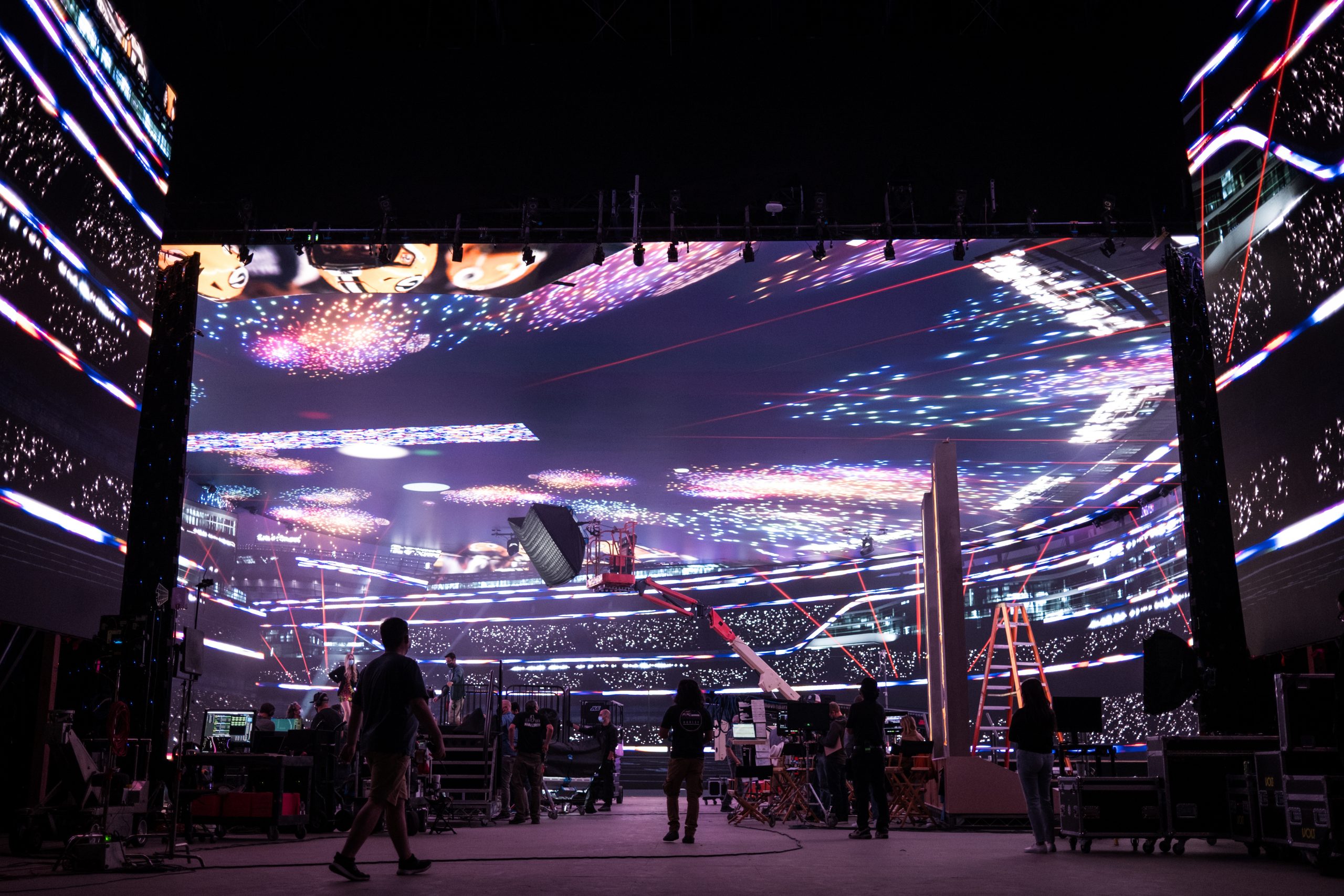
In a new “Behind the Magic” video released on YouTube and Instagram, enjoy a glimpse behind the virtual production of NBC Sports’ Sunday Night Football show opening, featuring country music star Carrie Underwood. 

“This was yet another successful demonstration of the end-to-end services available through ILM’s virtual production platform, ‘StageCraft™’,” says Chris Bannister, Executive Producer of Virtual Production at Industrial Light & Magic. “Partnering with the creative team from art concept all the way through principal photography, we were able to offer both the creative resources and real-world virtual production experience that maximized the scope and results for the project in a way that only ILM StageCraft can deliver.”

Shot on the StageCraft LED volume by Industrial Light & Magic.

The show opening is the key introduction each week to NBC’s flagship sports broadcast, and each year the creative team at NBC looks for innovative ways to top itself. 2021 was no exception, as they ideated ways to push the boundaries beyond the green screen and inject a new layer of authenticity and integration into the opener. That’s where ILM StageCraft came in.

“It was particularly important to Tripp Dixon and his creative team at NBC Sports to celebrate NFL fans coming back together,” notes Jonathan Howard, Associate Virtual Production Manager at ILM. “This unique opportunity allowed ILM to showcase both the agility, and production-hardened scalability of StageCraft 2.0, evident in the team’s ability to adapt the platform to the compressed schedule of a broadcast package.”

Shot on the StageCraft LED volume by Industrial Light & Magic.

Across the entire production, ILM was able to find unique ways to match the energy and excitement that Sunday Night Football fans are used to, while also expanding upon it in distinct ways. “This was such a rare creative project for me, because I’m typically working with creatures, droids, and spaceships,” said Hal Hickel, Animation Supervisor at ILM. “It was fun in that way though, because it got me out of my wheelhouse, while also allowing me to craft some exciting elements in a grounded production.” 

What makes StageCraft’s application for the Sunday Night Football show opening different from previous applications of the technology, is that this project is designed to look both indistinguishable from the real world, and also fantastical in its execution. Hayden Landis, Visual Effects Supervisor at ILM explains, “We had some incredible streaming elements like fireworks, along with dynamic moving components that we’ve never used before on the volume. Between the creative and technical wizardry that the StageCraft crew conjured up on the day, and the passionate support of the NBC Sports team, I think we really created something special.”

Shot on the StageCraft LED volume by Industrial Light & Magic.

Even with all the magic happening on screen, it can be easy for viewers to miss StageCraft’s sleight of hand because it is so convincing. Hal Hickel elaborates, “To let them backstage in a creative way, we came up with the idea to have Carrie enter the studio in one take, walk up onto the set, and then have the entire StageCraft Volume power-up around her. That small addition really drove home the magic of StageCraft.”

Check out the “Behind the Magic” video below, and don’t miss the show opening this Sunday, October 17 at 5:20pm PST on NBC as the Seattle Seahawks face off against the Pittsburgh Steelers.

Behind the Magic – Sunday Night Football

Industrial Light & Magic (ILM), and Epic Games (maker of the Unreal Engine), together with production technology partners Fuse, Lux Machina, Profile Studios, NVIDIA, and ARRI unveiled a new filmmaking paradigm in collaboration with Jon Favreau’s Golem Creations to bring The Mandalorian to life. The new virtual production workflow allows filmmakers to capture a significant amount of complex visual effects shots in-camera using real-time game engine technology and LED screens to represent dynamic photo-real digital landscapes and sets with creative flexibility previously unimaginable.

Over 50 percent of The Mandalorian Season One was filmed using this ground-breaking new methodology, eliminating the need for location shoots entirely. Instead, actors in The Mandalorian performed in an immersive and massive 20’ high by 270-degree semicircular LED video wall and ceiling with a 75’-diameter performance space, where the practical set pieces were combined with digital extensions on the screens. Digital 3D environments created by ILM played back interactively on the LED walls, edited in real-time during the shoot, which allowed for pixel-accurate tracking and perspective-correct 3D imagery rendered at high resolution via systems powered by NVIDIA GPUs. The environments were lit and rendered from the perspective of the camera to provide parallax in real-time, as if the camera were really capturing the physical environment with accurate interactive light on the actors and practical sets, giving showrunner Jon Favreau, executive producer and director Dave Filoni, visual effects supervisor Richard Bluff, and cinematographers Greig Fraser and Barry “Baz” Idoine, and the episodic directors the ability to make concrete creative choices for visual effects-driven work during photography and achieve real-time in-camera composites on set.

The technology and workflow required to make in-camera compositing and effects practical for on-set use combined the ingenuity of partners such as Golem Creations, Fuse, Lux Machina, Profile Studios, and ARRI together with ILM’s StageCraft™ virtual production filmmaking platform and ultimately the real-time interactivity of the Unreal Engine platform.

“We’ve been experimenting with these technologies on my past projects and were finally able to bring a group together with different perspectives to synergize film and gaming advances and test the limits of real-time, in-camera rendering,” explained Jon Favreau adding, “We are proud of what was achieved and feel that the system we built was the most efficient way to bring The Mandalorian to life.”

“Merging our efforts in the space with what Jon Favreau has been working towards using virtual reality and game engine technology in his filmmaking finally gave us the chance to execute the vision,” said Rob Bredow, Executive Creative Director and Head of ILM. “StageCraft has grown out of the culmination of over a decade of innovation in the virtual production space at ILM. Seeing our digital sets fully integrated, in real-time on stage providing the kind of in-camera shots we’ve always dreamed of while also providing the majority of the lighting was really a dream come true.”

Richard Bluff, Visual Effects Supervisor for The Mandalorian added, “Working with Kim Libreri and his Unreal team, Golem Creations, and the ILM StageCraft team has opened new avenues to both the filmmakers and my fellow key creatives on The Mandalorian, allowing us to shoot principal photography on photoreal, virtual sets that are indistinguishable from their physical counterparts while incorporating physical set pieces and props as needed for interaction. It’s truly a game-changer.”