Leadership

50 Years | 500+ Film and TV credits | 135+ Awards

SINCE 1975

Industrial Light & Magic’s immersive entertainment team will be fully integrated with the rest of the company to inspire new innovations in cross-platform storytelling.

50 years since its founding, Industrial Light & Magic has never rested on its laurels. A hallmark of ILM’s endurance over half a century and counting has been its knack for adapting to change and embracing new creative opportunities. “ILM was created by George Lucas because there was no other way for him to realize his vision for Star Wars,” senior vice president and general manager Janet Lewin tells ILM.com. “From the beginning, our mission has been to make the impossible a reality.”

The ILM spirit that’s evolved over five decades and at studios in as many different countries is “motivated by the opportunity for reinvention, evolution, innovation, and resilience,” as Lewin puts it. ILM’s ability to “react and adapt to the changing dynamics” of an ever-changing industry has been key. Time and again, ILM has increasingly broadened its creative output. “We’re known for our work-for-hire visual effects in feature films,” says Lewin, “but we’ve also branched out into streaming series, feature animation, and of course, the incredible work that Vicki Dobbs Beck has championed with immersive storytelling.”

“ILM was created by George Lucas because there was no other way for him to realize his vision for Star Wars. From the beginning, our mission has been to make the impossible a reality.” -Janet Lewin, Senior Vice President & General Manager, ILM

As vice president of immersive content for ILM and Lucasfilm, Beck co-founded ILMxLAB (later ILM Immersive) some 10 years ago. What was initially a move to experiment with storytelling in the emerging fields of virtual reality, augmented reality, and mixed reality has since yielded broader implications for the way ILM will do business. “This opportunity allowed us to participate directly in the success of a project and drive these experiences from concept to launch, delivery, and support,” notes Beck.

Building on work first pioneered by Lucasfilm’s Advanced Development Group, the immersive team leveraged the highest quality visuals and sounds combined with meaningful interactive principles to create stories with groundbreaking potential. These have included productions like PGA Innovation Award winner Vader Immortal: A Star Wars VR Series and Emmy-winning “What If…? – An Immersive Story,” as well as projects made with creative partners like Alejandro González Iñárritu’s Academy Award®-winning CARNE y ARENA. 

“We see opportunities for social experiences that are associated with our stories,” explains Beck. “We started by inviting audiences to ‘Step Inside Our Stories’ in ways they’d thought were impossible. We’re now transitioning from storytelling to storyliving, which is a much bigger idea. You’re in a world and you’re making meaningful choices that drive the narrative forward. That’s the gateway to take advantage of new technologies that are coming on the scene.”

ILM is now “seizing the moment,” as Lewin puts it, to include all of ILM in this undertaking. “Immersive storytelling is becoming more and more relevant to our audiences and our partners. On the visual effects side, ILM has been involved in projects like ABBA Voyage – a first-of-its-kind – and the content we made for Sphere Las Vegas. We started to see that the projects coming out of our immersive line of business had a natural convergence of techniques, talent, and opportunity with those of our visual effects business. 

“We’re now transitioning from storytelling to storyliving, which is a much bigger idea. You’re in a world and you’re making meaningful choices that drive the narrative forward. That’s the gateway to take advantage of new technologies that are coming on the scene.” -Vicki Dobbs Beck, Vice President, Immersive Content, ILM & Lucasfilm

“We can proactively leverage the strengths of our visual effects artists, pipeline, and storytelling passion with those of our immersive artists who are true experts in interactivity,” Lewin continues. “We see this ‘storyliving’ concept as the key growth opportunity. Not only do we want to market ourselves as one brand for audiences and clients, but we also want to empower our artists. This will allow for more cross-pollination of techniques, more opportunities for artists to move between types of projects, whether it’s an animated feature or our collaboration, “What If…? – An Immersive Story,” with Marvel Studios. If we can provide those opportunities, it allows us to keep attracting the very best talent in the industry.”

With every group now aligned under the ILM brand, the company will pursue an integrated portfolio that includes film, television, attractions, interactive products, and live events. For the immersive team, it’s a milestone following a decade of concerted effort, and for ILM as a whole, it’s the newest chapter in the company’s pioneering story. “We are poised for the next 50 years of ILM’s existence,” says Beck. 

ILM’s position as a storied entity with a globe-spanning team of artists, designers, and engineers opens up limitless possibilities. “The world is our oyster,” as Lewin puts it. “This is a time for growth and expansion. I’m really excited about the ideas that we’re exploring. This is a moment when we can redefine who ILM is in the market, be more consumer-facing, and continue to be the industry leader. I also love the idea of having more efficiency and refining a better process. These moments allow us to examine the way we work and improve it. We can bring fresh, new ideas to the table.”

And as Beck describes, this is not only an opportunity to position ILM as the best creative partners and visual storytellers, but also as “aspirational leaders” who will inspire the next generation of storytellers. “This is a way for ILM to drive its destiny in a way that has not been possible in the past. To embrace cross-platform storytelling is what we are uniquely positioned to do. If we can take advantage of that capability and build ecosystems of experiences that cross different types of media, it gives us an incredible canvas to paint on.”

“This is a time for growth and expansion…. This is a moment when we can redefine who ILM is in the market, be more consumer-facing, and continue to be the industry leader.” -Janet Lewin, Senior Vice President & General Manager, ILM


To discover more about ILM’s work in immersive storytelling, visit ILM.com/Immersive. And for all the latest news and stories from the company, visit the ILM.com Newsroom.
For the first time, ILM’s groundbreaking virtual production technology transports fans inside the Star Wars galaxy.

By Clayton Sandell

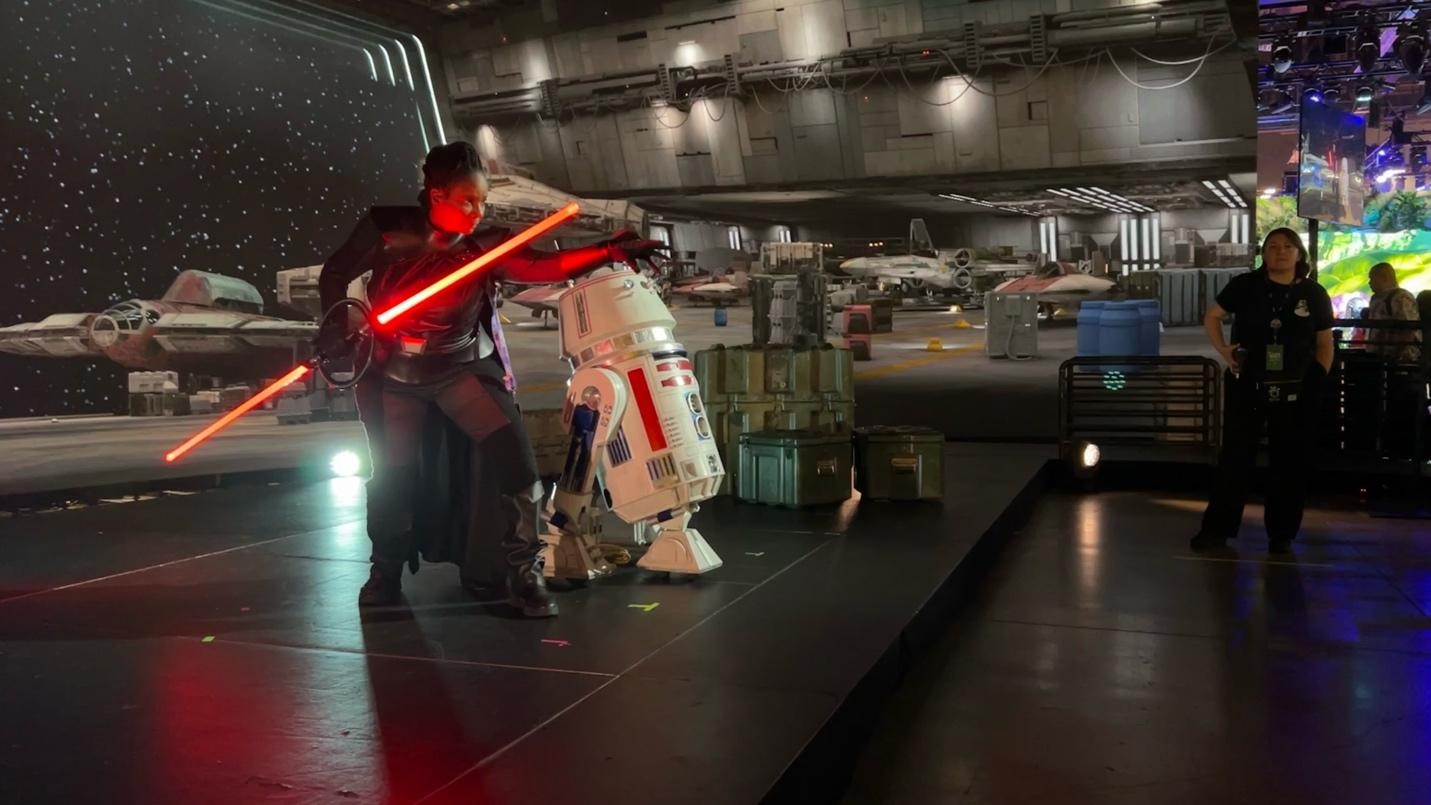
Patricia Burns gets ready for her closeup on the ILM StageCraft volume at D23.

Patricia Burns steps up to her mark.

Dressed in the sleek all-black uniform worn by the Third Sister Reva Sevander from Obi-Wan Kenobi (2022), she ignites her doubled-bladed red lightsaber and waits for her cue.

A nearby stagehand counts her down and calls “Action!”

As a crane-mounted camera swoops in, Burns crouches next to R5-D4, a red and white astromech droid, swinging her lightsaber with a fierceness only a Jedi-hunting Inquisitor could conjure. Behind her, a massive wall of LED screens displays the pristine moving image of a busy Rebel hangar.

Monitors around the stage show what the camera sees in real-time: an epic, trailer-worthy shot that makes Burns the star of her own Star Wars story.

“Oh, it was awesome,” Burns tells ILM.com as she walks off the stage, grinning. “A chance of a lifetime.”

At D23: The Ultimate Disney Fan Event, Burns and hundreds of others had the unique chance to perform on a StageCraft volume— Industrial Light & Magic’s cutting-edge virtual production technology used on dozens of projects including The Mandalorian (2019 – present), Percy Jackson and the Olympians (2023 – present) and The Batman (2022).

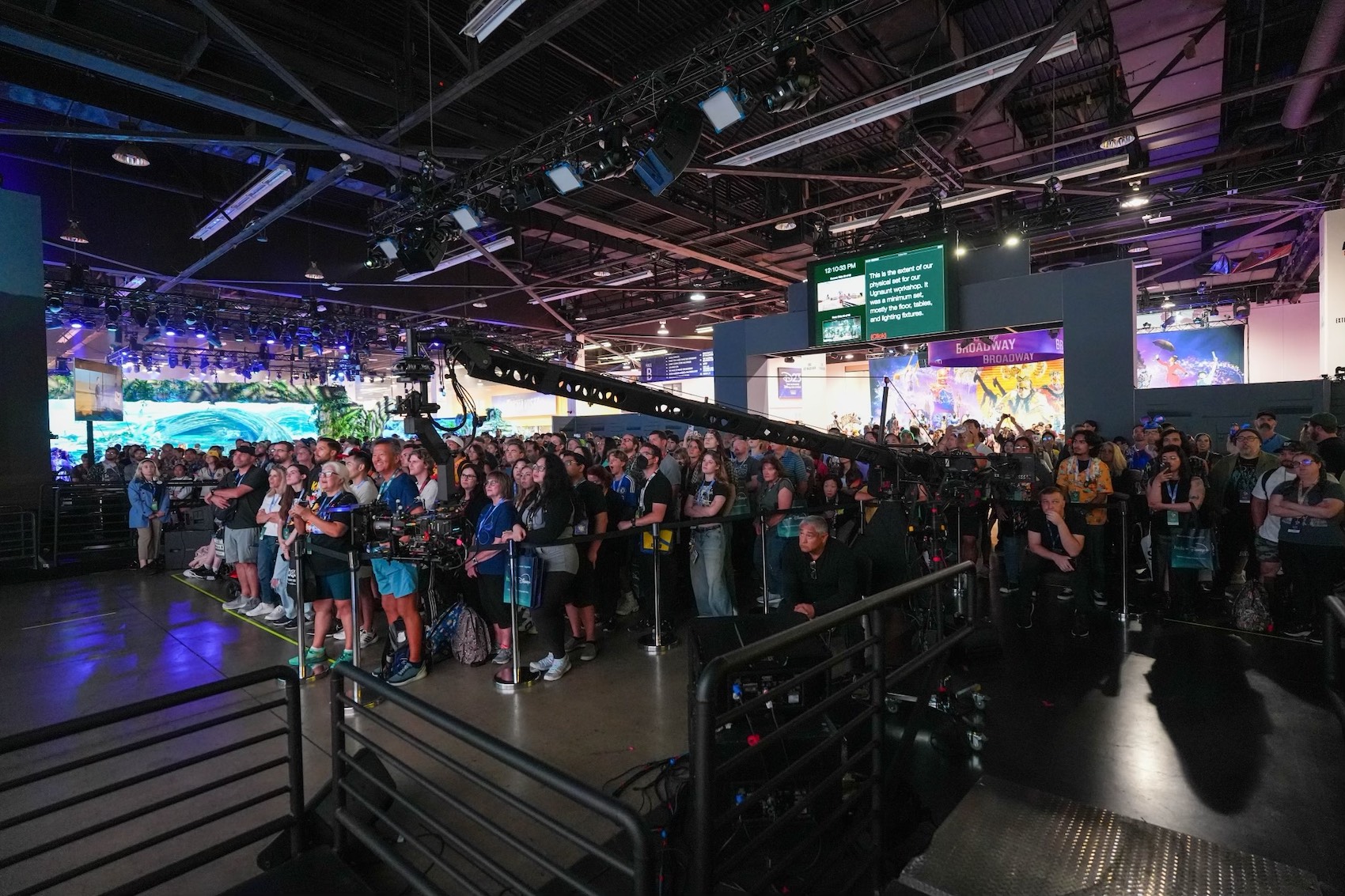
For the first time ever, the ILM crew assembled a volume— something normally sequestered on an off-limits studio soundstage— inside the Anaheim Convention Center just for fans attending D23.

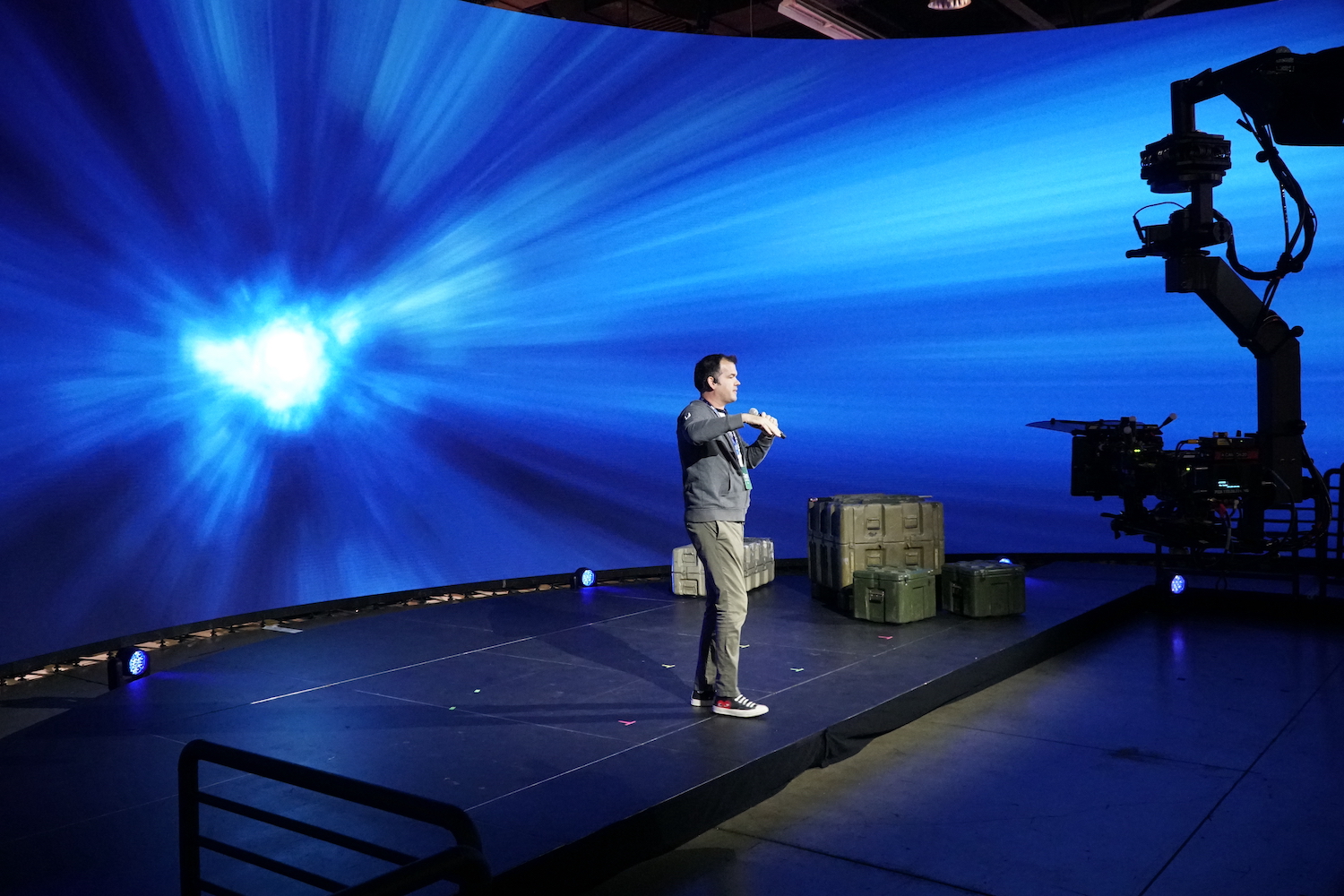
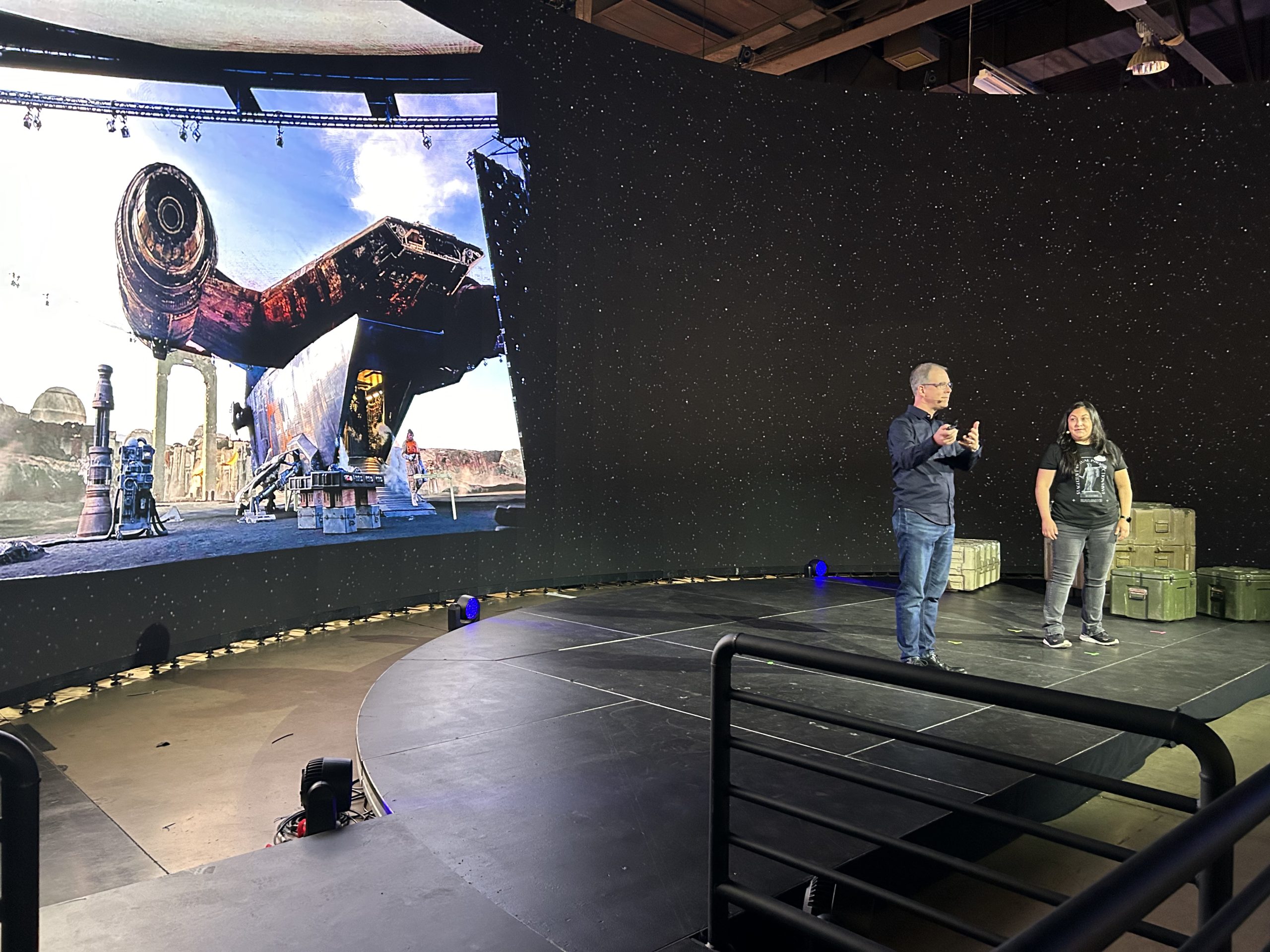
ILM’s chief creative officer Rob Bredow and virtual production supervisor Sonia Contreras host a StageCraft workshop.

“I think everybody is blown away by the scale of this, and how immersive it actually is when you get to see it here on the show floor,” says Rob Bredow, senior vice president, creative innovation for Lucasfilm and chief creative officer of ILM.

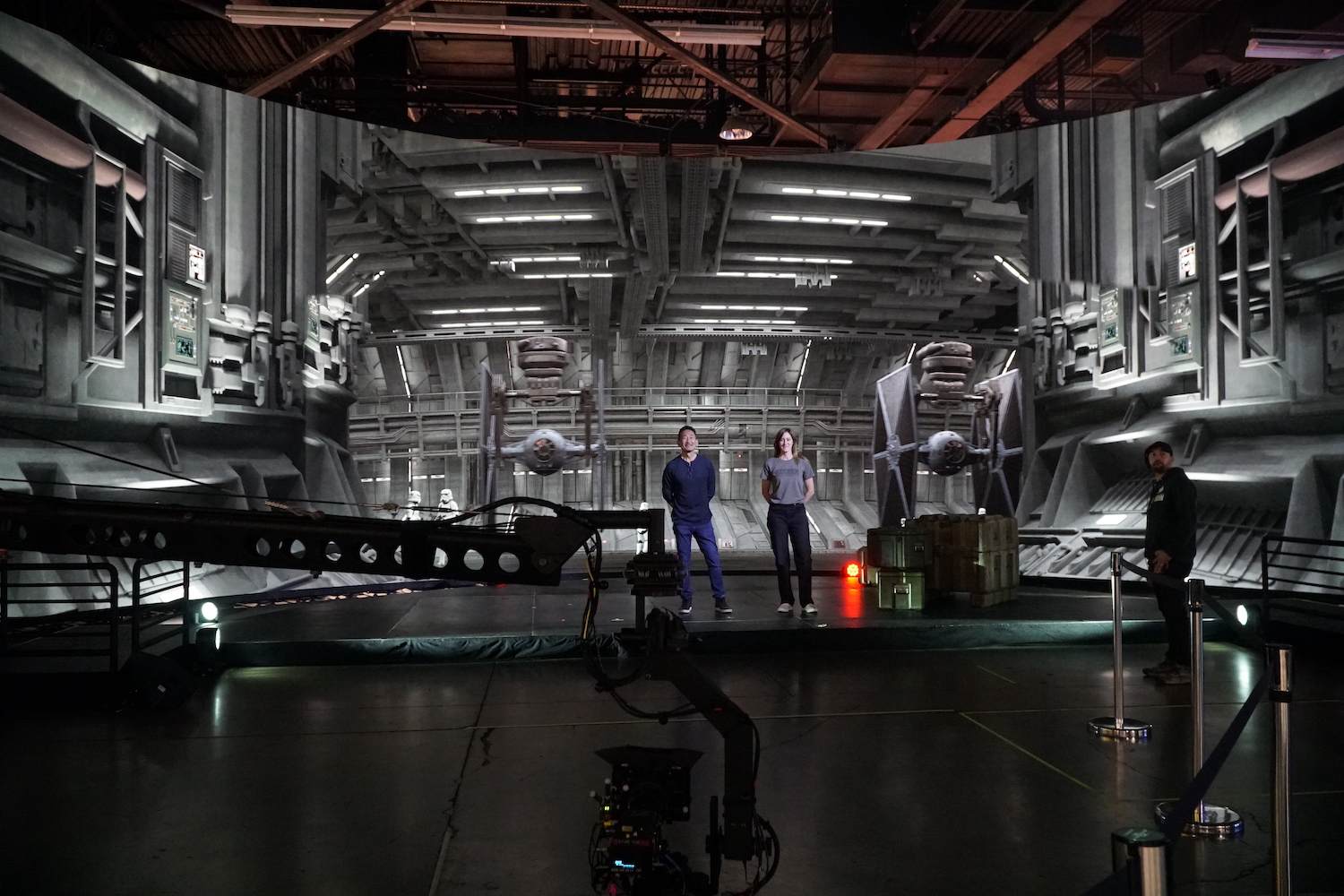
During the three-day event, a rotating trio of scenes appeared on the volume’s giant LED panels: an Imperial hangar created for The Mandalorian, a Rebel hangar from Ahsoka (2023) and a vibrant city street on the planet Daiyu seen in Obi-Wan Kenobi.

“You’re looking at over 18-and-a-half million pixels of LED wall and a live-tracked camera,” Bredow tells ILM.com. “Wherever the camera looks, we get a high-fidelity version with exactly the right perspective for the illusion of creating an immersive environment. It looks impressive enough here at the convention center but when we collaborate with the production designer and the art department on one of our productions that’s when the technology really sings. It’s a powerful tool in the filmmaker’s toolbox that we can deploy when building standing sets on a stage or traveling the cast and crew to a far-flung location isn’t feasible.”

For D23, ILM wanted to demonstrate a fully functioning StageCraft volume exactly like the ones used on a real set.

“It’s very fun to not be faking it,” Bredow quips.

Attendees at D23 take in ILM’s StageCraft volume.

ILM virtual production supervisor Ian Milham says transporting the volume from a studio lot to the convention center took a herculean scheduling and logistical effort involving a busy team of artists, engineers, and crew members. And several large trucks.

“Everybody agreed, ‘yes, we’re really going to do it’,” Milham explains. “But that meant we had to get our real gear and our real crew here. It also meant we couldn’t be making a movie with it at that time.”

The challenge was worth it, Milham says, because it gave the filmmakers a chance to finally show off their pride in StageCraft to a wider audience.

“Film sets are amazing places,” says Milham. “But it’s not like there’s a lot of chances to really share our success. So we’re really happy to be able to show the public for the first time the cool results, but also what it takes to pull off something like this and how much teamwork and technology it takes to do it.”

ILM virtual production supervisor Ian Milham demonstrates the volume.

ILM virtual production supervisor Sonia Contreras co-hosted several StageCraft presentations with Bredow. The pair challenged the D23 audience to look at several scenes and guess which elements were created with practical set pieces and props, and which ones were generated by the volume.

“I got about a third of them right,” laughs Ryan Schwartz, who watched the demonstration with his wife Katie and sons Zachary and Jonathan. Katie says she fared slightly better, guessing about half correct.

“I’ve been following ILM for a long time, and I still try and figure it out,” Ryan tells ILM.com. “They’re so amazing in their craft that it’s so hard to really piece together what is real and what is digitally done.”

Contreras says the D23 StageCraft experience is extremely special because even some ILM employees still haven’t been able to see the volume work in person.

“I would hope that people take away that there’s a lot of brains that go into making this happen,” Contreras says, pointing to the setup’s real-time rendering, camera tracking, processing power, and an aptly named “Brain Bar” crew working behind the scenes to help make the scenery so seamlessly realistic.

“The ‘wow’ factor is when you get to see what’s actually happening, all the different things that are getting coordinated in order to make that image work,” Contreras says. “It’s really cool to be able to show it to everybody.”

Lucasfilm senior vice president and executive design director Doug Chiang made a special appearance in front of a packed crowd on Saturday to talk about StageCraft’s contribution to the long history of visual effects filmmaking.

“We rarely get to share it or talk about it, because it’s an evolving technology, and it is just a tool,” says Chiang. “But at an event like this, where we can actually finally get under the hood and share the magic with the audience, it’s just terrific.”

Lucasfilm executive design director Doug Chiang and Lucasfilm Art Department associate producer Michelle Thieme in the volume.

Frequent ILM collaborator Legacy Effects also pulled the curtain back to show how their crew helps create a Star Wars galaxy full of creatures, aliens, and droids.

“When you’ve got leaders like Jon Favreau and Dave Filoni, who just embrace everyone’s contributions, it inspires you to do the best work that you can,” says Legacy Effects co-founder and special effects veteran Alan Scott.

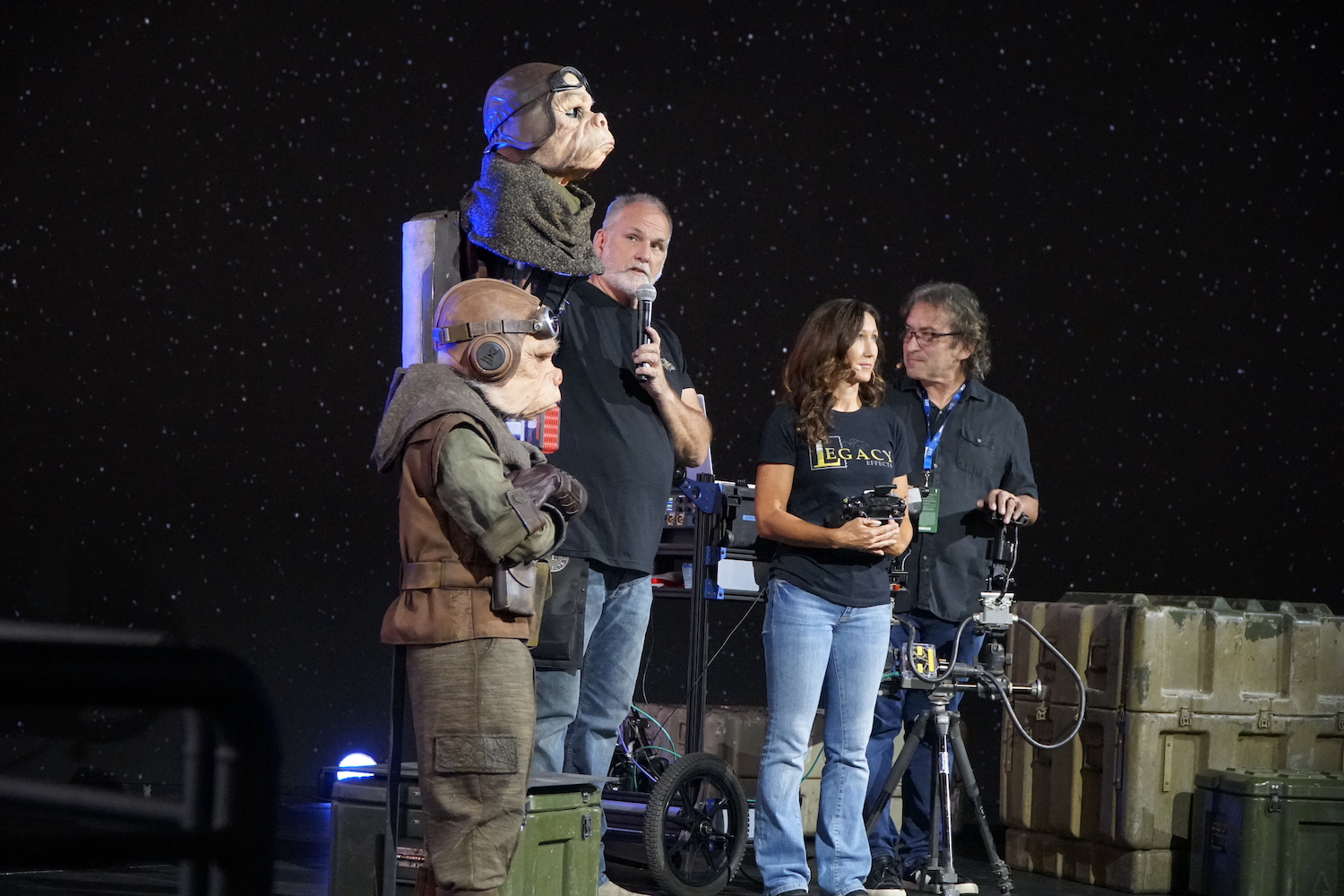
At D23, Scott and the Legacy team explained how they bring life to characters like the silver professor droid Huyang (voiced by David Tennant) and Murley the Loth-cat for Ahsoka. The production relies on a combination of practical puppets along with digital versions inserted later, depending on the requirements of each shot.

“There are things that I think practical can do very well, especially when it comes to the interaction with the performers,” Scott tells ILM.com. “Then there’s a responsibility that says, ‘that would be better if it was done with visual effects.’”

Legacy Effects co-founder Alan Scott (left) demonstrates a character prop with colleagues Dawn Dininger and David Covarrubias.

Bredow hopes that revealing how some of the Star Wars magic is made might inspire others, especially kids, to consider working in visual effects.

“Many people don’t even realize there are these very artistic and very technical and very creative jobs that have to do with working behind the scenes of film and television production,” Bredow explains. “So this is one of the fun things to do. To connect with fans, to connect with people who might want to make this a career.”

Cosplaying as Bastila Shan from the Knights of the Old Republic (2003) video game, Star Wars fan Carly King says she was most impressed by StageCraft’s powerful mix of creativity and engineering.

“It just looked so good on the screen. It’s so interesting to see how this whole conglomeration of electronics and technology comes together. It’s an incredible thing,” King says. “It’s one thing to watch Star Wars, but it’s another thing to be in it.”

Clayton Sandell is a television news correspondent, a Star Wars author and longtime fan of the creative people who keep Industrial Light & Magic and Skywalker Sound on the leading edge of visual effects and sound design.