ILM

50 Years | 500+ Film and TV credits | 135+ Awards

SINCE 1975

Industrial Light & Magic brings creative commotion to the creatures and New York cityscape of A Quiet Place: Day One.
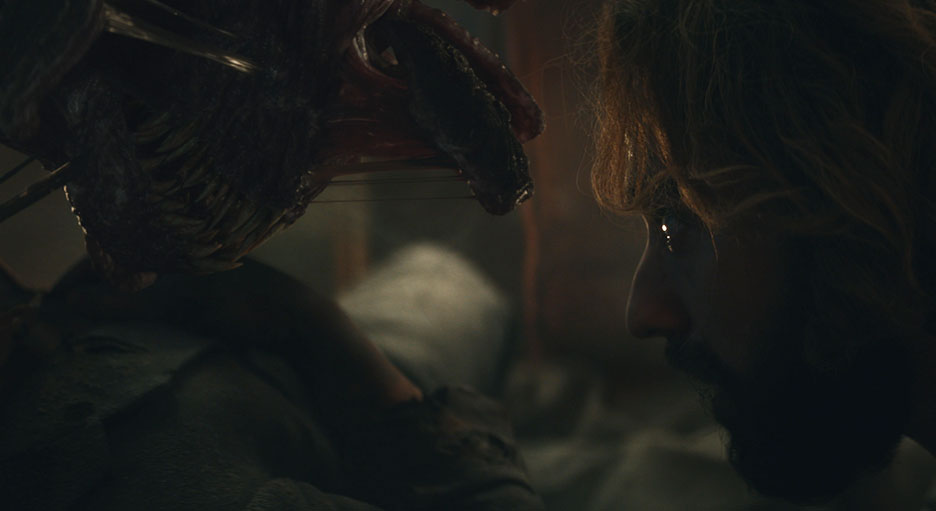
Alex Wolff as “Reuben” in A Quiet Place: Day One (Credit: Paramount Pictures).

Surviving the extra-terrestrial terror of A Quiet Place: Day One (2024) depends on the critical ability to stay absolutely silent.

Setting the third installment of the acclaimed film series in noisy New York City, however, brought an entirely new level of fear to the post-apocalyptic horror world first introduced to audiences in John Krasinski’s A Quiet Place (2018), while simultaneously presenting a welcome challenge for the visual effects team at Industrial Light & Magic.

ILM visual effects supervisor Malcolm Humphreys says early discussions with director Michael Sarnoski focused on how to bring unique and unexpected aspects to the frightening alien invaders that use a preternatural sense of hearing to stalk their human prey. 

Among the thousands of New Yorkers running for their lives is Sam, a terminally-ill cancer patient played by Academy Award-winner Lupita Nyong’o. Trying to escape the city as the monsters close in, Sam and her cat Frodo eventually encounter Eric, an English law student portrayed by Joseph Quinn. Sam is determined to get a slice of her favorite pizza before she dies.

“He wanted to make a narrative about how two different people deal with this situation in a big city,” Humphreys says of Sarnoski. “So this was an interesting take about trying to make something about two strangers that meet while all this chaos is happening.”

Concept art by Szabolcs Menyhei (Credit ILM & Paramount).

A visual effects veteran of films including Ant-Man and the Wasp: Quantumania (2023), The Batman (2022), and Star Wars: The Rise of Skywalker (2019), Humphreys and his team helped guide Sarnoski and cinematographer Pat Scola through the complex process of making a film that required a large number of visual effects sequences. Sarnoski and Scola previously collaborated on the award-winning film Pig (2021) starring Nicolas Cage. 

“Part of the job at ILM is just understanding the story and where we want to go, and just trying to build a bespoke solution depending on the different types of shots we’re doing,” Humphreys tells ILM.com.

One challenge, Humphreys says, was determining how the creatures with hypersensitive hearing might move and behave in a city environment like New York. 

“In the previous films, they’re either just stealthing on a single character or they’re sort of doing a snatch-and-grab,” explains Humphreys. “So Michael was very keen on expanding that a little bit more. For example, ‘how do they act with each other?’”

During a nighttime sequence set at a construction site, the creatures behave almost like a family gathering for dinner, ripping apart and devouring a fungus-encrusted pod for food. Behind the scenes, the ILM team came to refer to the monsters by the name “Happy.” 

“They’re not very happy creatures, so calling them ‘Happy’ is kind of fun,” Humphreys says. “There’s a really big mom that’s all caked in white, and then you’ve got the little baby happies. The little ones have slightly bigger heads. They’re smoother.”

(Credit: Paramount)

When Eric accidentally makes a noise, a nearby creature is alerted and exposes its slimy, pulsating inner ear to listen more closely. It’s a tense, relatively long shot that Humphreys says is also one of the film’s most complex.

“There’s an immense amount of detail that the modelers, the texture artists, and the effects artists have done,” he says. “There’s the eardrum that’s fluctuating. You’re actually hearing Eric’s heartbeat, and we’re pulsing the eardrum and the heartbeat together.

“You want to get an emotional reaction from the audience, so we want to sit on this shot for quite a while,” Humphreys continues. “I really, really love this shot.”

Humphreys credits animation supervisor Michael Lum with helping develop the right movement for the creatures as they do things audiences have never seen before, like scrambling up and over Manhattan buildings.

“All of the creatures are hand-animated,” Humphreys reveals. “There’s no crowd system or anything like that. They’re all handcrafted, which is amazing.”

Building out New York City was another major aspect of ILM’s work on A Quiet Place: Day One that may not be apparent to many audiences, and that’s exactly the goal.

The areas of New York that appear in the film— including the Lower East Side, Chinatown, Midtown, and Harlem—were realized as a massive partial backlot set built at Warner Bros. Studios Leavesden near London. Production designer Simon Bowles and his team built two intersecting streets that could be modified and dressed into new locations as Sam, Eric, and Frodo make their way through the city. 

Most of the backlot structures, however, were only built two stories tall, requiring ILM artists to digitally extend the height of buildings, lengthen streets, and fill in backgrounds. 

Lupita Nyong’o as “Samira” in A Quiet Place: Day One (Credit: Paramount).

“We did an immense amount of data capture,” Humphreys explains, a process that required 14 days in New York so the team could scan and photograph more than a hundred real buildings in high resolution. “We go through a whole process of building out those facades so that they can be used on many, many shots.

“For certain bits, we’ve changed quite significantly what you see in the backlot set,” Humphreys reports. “There’s a huge amount of augmentation and replacement.”

While Frodo the cat is entirely practical (played by two different feline stars, Schnitzel and Nico), a scene requiring the animal to weave through a frantic crowd running from the aliens required extensive digital artistry from ILM.

“Michael was adamant that he wanted to use the real cats,” Humphreys recalls. “There was a little bit of, ‘how are we going to do a shot like this? We can’t have a whole lot of people trampling over a cat.’”

The solution was to photograph just the cat’s performance separately at first, then add people and additional elements later.

“That shot is actually an amalgamation of hundreds of layers of different crowd people, and really timing and trying to build that shot up so that as an audience member, you get the sense of the chaos, but you also see Frodo enough for him to register,” Humphreys adds.

The film’s finale has Sam, Eric and Frodo desperately trying to reach a boat on the East River filled with survivors making their escape from New York. The sequence is built from several different locations, including part of an airfield dressed as a deserted FDR Drive, a pier along the Thames river, a moored boat, and a water tank at Pinewood Studios.

(Credit: Paramount)

“It was a lot of fun, but a lot of moving pieces,” Humphreys laughs. “We’re sort of shooting component pieces and hoping that they all go together.”

Humphreys says his favorite visual effect is the very last scene in the film. As Sam walks down a Harlem street listening to music, the camera sweeps 360 degrees around her in a single shot lasting nearly 40 seconds. Originally shot on the backlot, Humphreys notes the sequence required complex rotoscoping and compositing, with artists ultimately replacing as much as 70 percent of the original background with images created using the data ILM gathered in New York.

“We actually captured three or four blocks of Lexington Avenue, so there’s a huge amount of data capture for that one shot,” Humphreys says. “I’m really proud of that one.” 

Humphreys joined ILM in 2016 and is based at the company’s London studio. But he says the work on A Quiet Place: Day One was a truly global effort.

“I got to work with a lovely team in Vancouver, in London, Mumbai, and San Francisco,” he says. “I think we’re just good creative partners.

“The one thing you get out of ILM,” Humphreys believes, “is that it still operates very much like a smaller company in terms of communication and collaboration, which is really refreshing.”

Concept art by Daniel McGarry (Credit: ILM & Paramount).

Clayton Sandell is a television news correspondent, a Star Wars author and longtime fan of the creative people who keep Industrial Light & Magic and Skywalker Sound on the leading edge of visual effects and sound design.

Heads still roll 25 years later in the Tim Burton classic Sleepy Hollow (1999). Revisit all of the eerie magic behind Industrial Light & Magic’s work that brought Washington Irving’s folktale to life and reintroduced audiences to one of cinema’s greatest on-screen monsters, the headless horseman.

By Adam Berry

The headless horseman pursuing Ichabod Crane in the Western Woods. (Credit: Paramount)

On October 5th, 1949, the Walt Disney Studios released a feature film that reimagined two classic pieces of literature through the guise of The Adventures of Ichabod and Mr. Toad (1949). While the first half retells the whimsical story of Kenneth Grahame’s The Wind in the Willows (1908), it is the second half that left a long-lasting impression on young audiences as they were introduced to American writer Washington Irving’s eerie folktale, The Legend of Sleepy Hollow (1820).  

Released just in time for Halloween that year, this feature would go on to be recognized as one of Disney’s classics due to its memorable songs, beautiful animation, and the unforgettable visualization of Irving’s ghostly antagonist, the headless horseman. The unsettling imagery of a headless man riding horseback with a sword in one hand and a flaming jack-o’lantern in the other allowed the legend to evolve as film versions were passed down to new generations. 50 years later, The Legend of Sleepy Hollow would once again evolve on screen, and explore the story in new ways, re-introducing audiences to Irving’s horrific tale of the undead horseman.  

To take this classic into a tangible world, a highly imaginative and visual mind was necessary to capture the fantastical elements of this story while rooting it in a sense of reality. Tim Burton, director of such films as Beetlejuice (1988) and Edward Scissorhands (1990), was keen to step in as he was a fan of the Disney film. Burton told American Cinematographer, “I  was really familiar with the original story because I’d seen the Disney cartoon…. I actually didn’t read the source novel until after I had read the script.” Burton’s own history with Disney, including attending the California Institute of the Arts on a Disney scholarship, and working at Walt Disney Studios as an animator on projects such as The Black Cauldron (1985), destined him to take on the challenge of creating a fresh retelling of Sleepy Hollow.

Concept art by Scott Leberecht depicts an eerie atmosphere shrouded in fog on the road to Sleepy Hollow. (Credit: Paramount & ILM)

Burton’s vision was to create a fantasy world that felt real in which the headless horseman could exist. The aesthetic needed to emulate, but not copy, the atmosphere of the classic Hammer Studios horror films such as Dracula (1931) or Frankenstein (1931) with their moody and gothic tones that left the audience in a state of unease. With that being said, Italian director Mario Bava’s Black Sunday (1960) was the core inspiration for the film, giving Sleepy Hollow (1999) a classic movie feel while adding elements that were pictorial and synthetic.

To achieve his vision of what Sleepy Hollow needed to look like, Burton knew there had to be a balance between the use of traditional special effects and digital visual effects. “Digital technology is very interesting and certainly has its place in filmmaking, but when you’re watching a movie like Black Sunday you really feel as if you’re there,” said Burton. While he was resistant to using visual effects at first, he relied on the artists at Industrial Light & Magic (ILM) to help realize the full scope of his vision, particularly when it came to bringing the headless horseman into existence as a living, breathing creature. 

ILM visual effects supervisor Jim Mitchell was tasked with solving how the horseman could exist in the film as a real man without having to rely on older methods. Tricks like having the coat propped up on the actor’s shoulders didn’t work as the proportions were wrong, eliminating the appearance that the horseman was indeed a man. Mitchell said, “Tim and I knew that something just wasn’t going to be right with that approach. We eventually decided that our Headless Horseman would be an actual person riding the horse and flailing his axe around, except that we’d just digitally erase his head.”

The most complex shots for ILM involved removing the horseman’s head. There were about 300 horseman shots altogether, with ILM creating 220 and London’s Computer Film Company contributing the rest. To convincingly convey that the horseman was real, the ILM team innovated a special blue hood for stunt actor Ray Park to wear during action sequences that the ILM artists could later isolate and erase from the shot. Blue was used as it is easily keyed from the plate so the effects team could restore the background in place of the head.

The headless horseman claims his next victim. (Credit: Paramount)

To fill the space where the actor’s head was taken out, a clean background plate of the sequence was shot, but the artists noticed that one element was still missing as the horseman has a large cape with a collar around his neck. “It was not only necessary to replace the background where his head would have been, but to also make a digital collar in the computer that was then matched to his movements,” shared computer graphics artist Sean Schur in Paramount Pictures’ Behind the Legend documentary. By using actors and replacing heads digitally, the horseman presents as a living and breathing creature. 

Achieving this effect was particularly challenging during fight sequences with actors Johnny Depp and Casper Van Dien as their faces would be blocked out by the horseman actor’s blue hood. Once ILM erased the horseman’s head, they would also have to go back and eliminate the other actors’ heads as well. Mitchell shared, “I would have Johnny or Casper go through the same actions without the Horseman in there, and we’d just put their head into any frames where the horseman’s head was blocking theirs. It’s a tricky process, but it was actually pretty effective.”

Equally as challenging were the beheading scenes throughout the film. Creature effects artist Kevin Yagher created prosthetic heads of the actors for use in these pivotal moments while ILM was able to digitally recreate the scene using a series of three plates to blend together and form one cohesive shot. Using the scene in which the menacing Lady Van Tassel (Miranda Richardson) decapitates her bewitching sister as an example, Richardson would be filmed going through the motions of swinging her axe to dead air, then the prosthetic head flying off the body of her sister would be filmed separately, and finally the digital capture of that scene would be created. Once all three plates were finished, ILM would blend these together to make a seamless sequence for each beheading, making it feel all the more real for the audience. This was not an easy task for the artists as the film has ten decapitation sequences.

Concept art by Scott Leberecht shows ILM’s approach to depicting the headless horseman’s return to hell. (Credit: Paramount & ILM)

Burton wanted to convey suspense and a sense of impending doom throughout the film and tasked ILM with a series of subtle visual effects shots that added to the unsettling feeling when the horseman would appear. Most notable is the disturbing scene where the horseman pursues a family at their home. Killian (Steven Waddington) sits at his table with a crackling fire, which spontaneously erupts into larger flames seconds before the horseman crashes down the door. Sequence Supervisor Joel Aron shared, “I took the skull, which is the headless horseman’s skull, so I pulled up the eyebrows giving it this demonic look with a strong forehead, curling up the corners of the mouth and bringing the jaw around to continue to sculpt what would be the fire so that I knew when the fire would come off it would have an irregular shape.” It’s a blink-and-you-will-miss-it effect, but if you look closely you can see 13 demonic faces emerge within the flames in a quick flash which is meant to indicate that evil is present. It’s so subtle that it was intended for audiences to question whether they really saw the faces or not. 

Natural elements were also added and utilized to punctuate the horseman’s presence. The subtle introduction of thick fog and flashes of lightning appear every time the horseman gallops toward his next victim in pure cinematic fashion. Sleepy Hollow was shot mostly on location in a small town called Marlow, just outside of London, which meant the environment presented Burton with an ideal setting for the gloomy atmosphere. These elements could be viewed by some as cheap tricks in a major film but the use of heavy smoke for fog makes the atmosphere more haunting and interesting. “In the Western Woods set and at some of the other locations, you can definitely see the smoke – it looks like the fog they used in the old Frankenstein and Mummy movies,” said director of photography Emmanuel Lubezki.

While using smoke allowed the filmmakers to get a consistent movie look, it presented challenges for the ILM team as once they were finished adding actors’ heads back into the shots they would also have to build back in the foggy backgrounds and natural elements in each scene. “The big problem for us was [that] every shot involving the horseman also had lightning and fog,” explained Jim Mitchell, “which was constantly moving and always changing, as opposed to trees and buildings, which are rigid. Whenever lightning hit the Horseman, we had to make sure that when we replaced his collar or any other parts of his suit that his head was blocking, we put the same lighting effect on it.”

To simplify this, Mitchell asked Burton and Lubezki to shoot the scenes as though the actors’ heads were already removed despite the level of complexity it would add for the ILM team to ensure the elements moved organically with the actors as they rushed through the fog, or horse hooves galloped through the settled leaves on the ground. “There are all kinds of things we’d prefer to stay away from when we’re doing this type of work, but if you lose those [atmospheric] touches, all of a sudden it’s not the same sort of visual, and it doesn’t have the same power,” concluded Mitchell.

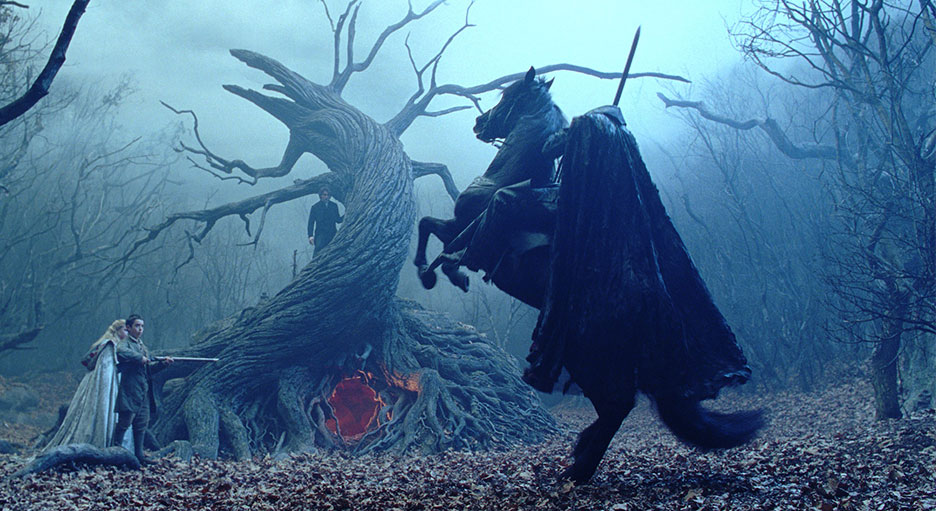
The headless horseman emerges from the tree of the dead. (Credit: Paramount)

This is especially apparent during a highly intense scene mid-film when the protagonists discover the tree of the dead, which is the horseman’s resting place and gateway to hell. The combination of the natural elements like fog and tree leaves with digital effects cemented the believability of this scene as the horseman enters from the base of the tree in a bloody and terrifying fashion. There were multiple plates used to build this effect. Firstly, a blue screen plate of the horse and jumping rider was shot. Next, a background shot of the forest environment, with the tree of the dead and actors standing close to where the horse emerges. Finally, a shot of the fog and leaves being disturbed creates the effect of the horseman jumping out of the tree. ILM didn’t have a bluescreen shot of an actual horse, so they had to create one in the computer, as well as the headless horseman, which are both digital elements. Similarly to the decapitation sequences, artists layered all of these separate plates on top of each other to form the singular shot making a scene that might have been unrealistic feel very believable instead. 

It has been 25 years since its initial theatrical release, and rewatching Sleepy Hollow you can witness firsthand how ILM’s work remains timeless and able to reach new generations. The eerie and suspenseful atmosphere that Sleepy Hollow pulls audiences in and stands as a formidable achievement of classic Hollywood filmmaking, adding another iconic cinematic monster with the headless horseman, who is equally as feared standing next to other horror icons such as the unnerving Count Dracula, and misunderstood Frankenstein monster. Washington Irving’s The Legend of Sleepy Hollow lives on through the visionary work of artists from each generation. For Burton’s retelling, ILM wielded the eerie magic that gave life to the undying legend of the headless horseman.

Adam Berry is the Studio Operations Manager for the ILM Vancouver studio. His passion for film led Adam to ILM in 2022, coming from an extensive career across different sectors of the hospitality industry including cruise ships, luxury hotels and resorts. If he’s not at the movies or traveling to new destinations, you can find Adam staying active and exploring Vancouver.

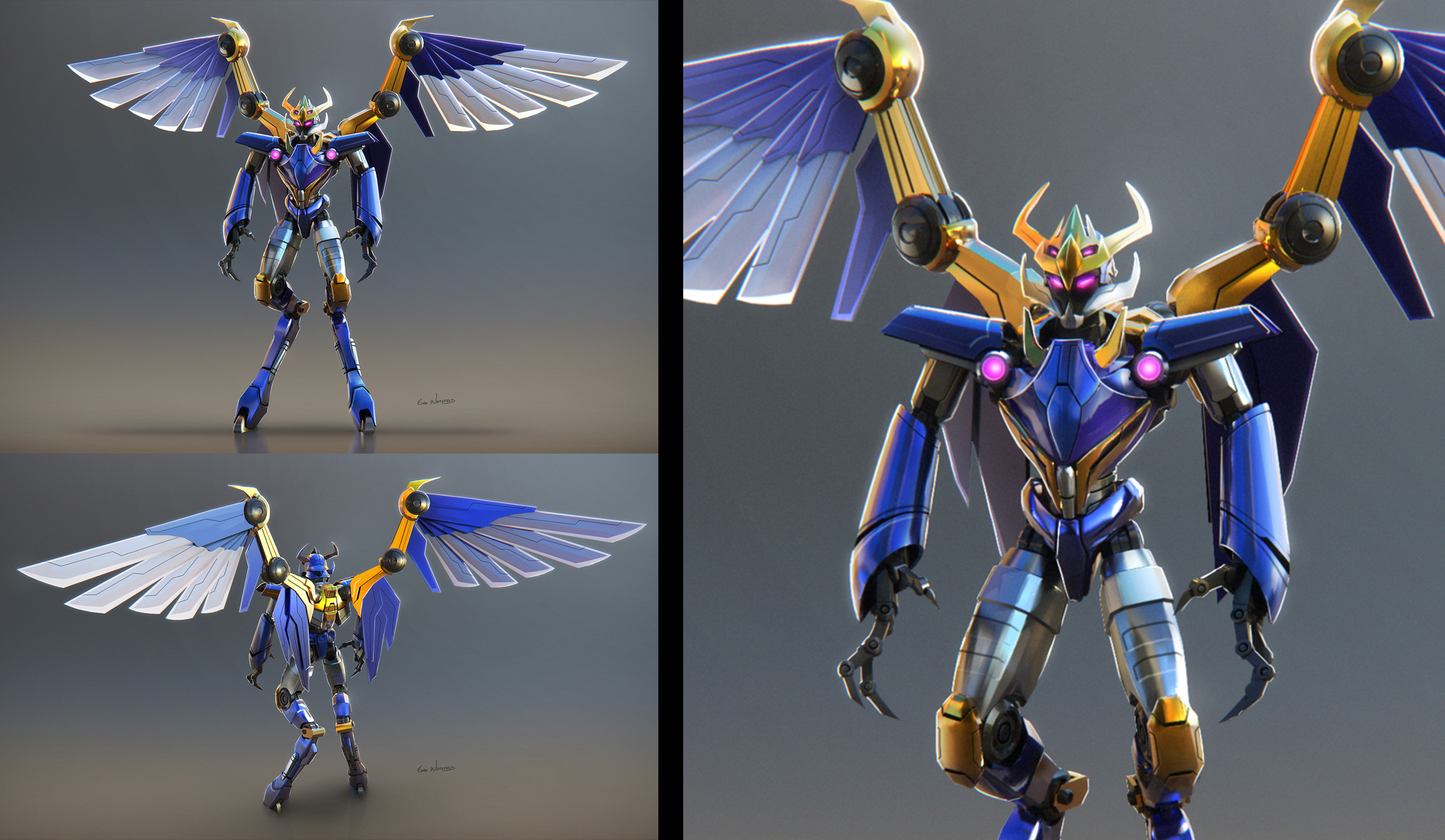
For Transformers one, the art department aimed to create shapes and silhouettes that appeared clean and simple from a distance, yet included intricate, purposeful details up-close, such as cut lines in the panels, smaller inset geometry, and layered panel work. Given that iconic Transformer designs often stem from their helmet shapes, the art department worked to seamlessly integrate faces into the helmets, enhancing their expressiveness while maintaining a mechanical, rigid aesthetic.

Check out the full design case study here: https://www.ilm.com/art-department/transformers-one-concept-art/

Exploring the technical innovations and behind-the-scenes stories that brought Slimer to life in Ghostbusters 2, reaching new heights in animatronics and practical effects at Industrial Light & Magic.
By Jamie Benning

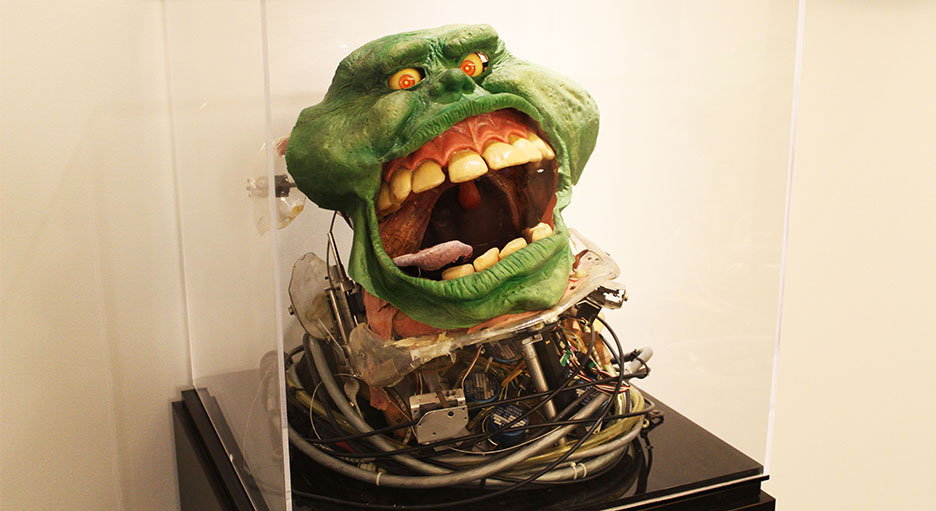
The original Slimer head on display at Lucasfilm headquarters in San Francisco.

When Ghostbusters (1984) premiered, it became an instant classic. With a star-studded cast—Bill Murray, Dan Aykroyd, Harold Ramis, and Ernie Hudson—alongside Sigourney Weaver, Rick Moranis, and Annie Potts, the film combined supernatural elements with groundbreaking visual effects and perfect comedic timing, captivating audiences worldwide. The film grossed $282 million in its initial theatrical run, cementing its place in film history.

Beyond the popular human cast, one standout element was the ghost originally named “Onionhead.” Special effects artist Steve Johnson, credited as the sculptor, likely drew inspiration for the name from its vegetable-like appearance. This gluttonous green ghost, classified as a Class 5 Full-Roaming Vapor, made a brief but memorable appearance that delighted audiences. Designed to be grotesque and chaotic, Onionhead unexpectedly became a fan favorite. Bill Murray’s famous line, “He slimed me!” as Peter Venkman, became one of the most quoted phrases of 1984. Onionhead’s popularity only grew with The Real Ghostbusters (1986) animated series, where he was reimagined as a mischievous yet lovable, pet-like character.

In the eleventh episode of The Real Ghostbusters, titled “Citizen Ghost,” which first aired in November 1986, Onionhead finally got his new name. The episode’s flashback shows how the Ghostbusters became friends with the little green ghost, with Ray Stantz giving him the fitting nickname “Slimer.” The name endured, becoming a permanent fixture in all subsequent Ghostbusters projects.

Ghostbusters 2 (1989) sought to bring the evolved version of Slimer to the big screen, balancing the charm of the original character with the expectations of younger fans familiar with the cartoon. With the baton passed from Boss Film Studios to ILM for the sequel, visual effects supervisor Dennis Muren described the task ahead of them to Cinefex. “We had the opportunity to create a whole new array of ghostly images,” he explained, using all the tools at their disposal. An early idea of using a rod puppet was quickly dismissed, with Muren preferring to opt for a fresh take on the “man in a suit” approach.

With the technological advances made in the five years since the original film, the goal was not just to capture the original magic but to push the boundaries of animatronics, puppetry, and practical effects. 

Slimer concept art for Ghostbusters 2 by Henry Mayo. (Credit: Columbia/Sony & ILM)

Reimagining Slimer

For the sequel, Slimer needed to embody the more playful, cartoonish persona. “[Executive Producer] Michael [C. Gross] wanted elements from the cartoon version incorporated as well, and to this end he had Thom [Enriquiez] do the new series of drawings – which were fabulous,” creature and makeup designer Tim Lawrence explained to Cinefex.  

Mark Siegel, a key contributor to Slimer’s original creation, was brought to ILM for Ghostbusters 2 to resculpt the character and adapt him for the film’s lighter tone. Siegel had been deeply involved in the creation of the original Onionhead ghost, sculpting his teeth, tongue, and inner mouth, as well as the complete replacement head for a second puppet with a wider, more frightened look to the mouth. He also puppeteered the tongue and eyebrows for the majority of the shots. 

The sculpting process for the design maquette was a collaborative effort, with Siegel primarily handling Slimer’s body, head, and face while fellow crew member and performer Howie Weed focused on the arms and hands. For the full-sized puppet Siegel sculpted the head and the arms.

The character of Onionhead in Ghostbusters wasn’t just an arbitrary creation. His mannerisms and chaotic energy were directly inspired by the late John Belushi, specifically his portrayal of Bluto in Animal House (1978). This connection was not merely symbolic; it was a tangible part of his design and performance. Mark Siegel recalls how Harold Ramis and Dan Aykroyd made it clear to the team that Slimer was a representation of their close friend Belushi’s comedic spirit.

The team didn’t just envision this; they meticulously pored over Belushi’s scenes. “We studied frame by frame old VHS tapes of Belushi’s Animal House scenes, focusing on his expressions,” Siegel elaborates. This analysis allowed them to incorporate Belushi’s signature movements and broad, exaggerated physicality into Slimer’s performance for the first film. According to Siegel, it was Belushi’s expressive style that truly captured the blend of charm and grotesqueness that defined Slimer’s character.

“When I first started sculpting the new Slimer, I thought, ‘Well, that’s cute,'” Siegel admits. But the evolution of the character, from disgusting blob to family-friendly ghost, presented some challenges. “I felt we were losing some of the raw, chaotic energy that made Slimer memorable in the first film.”

The sculpting process was a collaborative effort, with Siegel primarily handling Slimer’s body, head and face while fellow crew member and performer Howie Weed focused on the arms and hands. 

Scenes originally envisioned for Slimer in Ghostbusters 2 included him eating various types of food around the station house while Louis (Rick Moranis) tried in vain to catch him. Then later, when Louis straps on a backpack and tries to help the Ghostbusters, he finds Slimer driving a bus. Louis hitches a ride and the two eventually become friends. An early storyboard also shows Slimer flying around the Statue of Liberty for the final shot of the movie, mirroring the first film’s finale. But, as is often the case in artistic pursuits, things were adapted, changed, and even removed along the way, all for a multitude of reasons.


Technical Innovations: Pioneering Animatronics

One of the key advancements in Ghostbusters 2 was the shift from manual cable-controlled puppetry to the use of radio-controlled servos for Slimer’s facial expressions. Al Coulter, an ILM animatronics engineer, led the effort to remotely automate Slimer’s face, allowing for more nuanced performances. “Al wanted to mechanize Slimer’s expressions,” Siegel says. “The SNARK system (reported as both Serial Networked Actuator Relay Kit and Synthetic Neuro-Animation Repeating Kinetics module) allowed us to control multiple servos simultaneously, meaning that expressions could be achieved more easily, with fewer people.” This system was a technological leap forward, offering new possibilities for nuanced expressions, though it brought its own set of challenges.

One of the key motivations for this advancement was to streamline post-production, which had been a challenge in the original film. “In Ghostbusters, we had to deal with puppeteers in the frame, which meant removing them during post-production,” Siegel recalls. That was both time consuming and costly.

Coulter notes that while the servos were originally designed for consumer RC airplanes, significant customization was required to make them work for Slimer’s facial movements. “The joystick stuff from Hobby World caused a lot of problems when we went onstage, because there was so much interference from all the lights and the wires and the machinery…that we needed to be able to connect our character to something direct, hardwired. So we had this guy build control boards which we bundled together and plugged into a PC. And that PC would then have software on it, custom again, and it would record our performance.” It was a major advancement for the time, in a way following in the footsteps of the leaps ILM had made in motion-control in the mid 1970s for the spaceships in George Lucas’ Star Wars: A New Hope (1977). 

Coulter reflects that working with the technology of the time, particularly the slow computing speeds, was a challenge in itself. “We were working with computers that ran at 24 MHz—slow by today’s standards, but cutting edge at the time.” Despite this, the SNARK system was a pioneering achievement in real-time, computer-controlled puppetry, allowing for repeatable and detailed performances. “The facial expression, eyebrows, eyes, I think we had a nose wiggle…being updated to radio control servos, that was a great idea,” Siegel adds.

Behind-the-scenes videos posted by William Forsche (another crew member) show the incredible range of facial contortions that could be achieved with the new Slimer, from sad to happy to curious in a matter of seconds. While motion-control’s precision was essential for the spaceships in Star Wars, it wasn’t yet clear how well the recording and playback of Slimer’s facial movements would work.

Ultimately the servos introduced their own set of challenges. While the system allowed for greater control, it limited some of the more exaggerated movements that defined the original Slimer. As Siegel explains, “In the first film, Slimer’s jaw was controlled manually, allowing for more exaggerated, chaotic movements. The sculpture was extremely soft and flexible. There was no structure in the lower jaw at all. Just a little metal rod in the lower lip and a puppeteer down below could pull it, just stretch that rubber way wide, twist it from side to side and get a whole variety of expressions, make him chew and stuff…. While the servos and pneumatics we used in Ghostbusters 2 gave us more precise control over the facial expressions, they also introduced limitations in terms of flexibility and range.”

The head wasn’t the only challenge. In trying to replicate the exaggerated, cartoon-like appearance and movements of Slimer’s body from the animated series, the crew encountered more hurdles.

The original Slimer head on display at Lucasfilm headquarters in San Francisco.

Innovating Slimer’s Body Design

While the animatronics used for Slimer’s facial expressions were groundbreaking, if beginning to become troublesome, the team also had to experiment with new ways to animate Slimer’s body. Tim Lawrence proposed constructing the body out of spandex with bean-bag-like filling, aiming to give Slimer a more fluid, exaggerated range of motion similar to the stretch-and-squash effect seen in his cartoon form.

However, this idea quickly ran into practical issues, as Siegel explains. “It might have been a couple of days before we were shooting and Dennis Muren came in and looked at the whole puppet assembled, and he wisely said well that spandex is going to look entirely different on camera than that rubber head. For some reason that had never occurred to anyone before. So in a mad rush we took that spandex bean bag body into our spray ventilation booth, and I had to mix up big batches of foam latex and we actually spatulated it onto that entire body. And that’s really hard to do because the foam latex has a limited time before it sets. And then it had to be baked in an oven. So it was thrown together at short notice in less than one day. When the rubber was cured over the bean bag it made the body a lot less stretchy and flexible than Tim had intended it to be.” The problems were beginning to mount.

Robin Shelby tests the Slimer body costume. (Credit: Columbia/Sony & ILM)

Robin Shelby: The Heart Inside Slimer

While ILM envisioned the technological advancements to play a key role in bringing the reimagined Slimer to life in Ghostbusters 2, it was Robin Shelby (then Robin Navlyt), the performer inside the suit, who truly embodied the character’s spirit.

Previously known by ILM for her role as a troll in Ron Howard’s Willow (1988), she took over the role of Slimer for Ghostbusters 2 after the original actor, Bobby Porter, became unavailable. As Shelby recalls, “They had someone cast, then they wrote Slimer out of the script…and then they wrote him back in, but the original actor had taken on another project.” At just 20 years old, Shelby was tasked with bringing a new version of Slimer to life, despite the suit’s heavy and cumbersome design. But she was up for the challenge!

“I grew up doing musical theater, a lot of dance. So I was very aware of my body…and that helped a lot. I didn’t have any stunt experience at the time, but a lot of movement and dance experience,” remarks Shelby. Reflecting on her first impression of the suit, she adds, “They were still building it when I came in. It wasn’t all painted and set. They had to do a cast of my face and head so they could fit it to me. But when I first saw it with the motors, it was a little scary. The weight was extraordinary. But, the crew was amazing.”

With Shelby performing inside the suit and the expressions operated remotely, production became more efficient. By using a bluescreen and having Shelby wear a black leotard, ILM eliminated the need for puppeteer removal in post-production, just as originally planned.

Shelby and the team had about five to six weeks of rehearsal to help her adjust to the suit and coordinate with the puppeteers operating the animatronic features. The suit itself came in three interlocking segments: the main body, the gloves for the hands and arms, and the head. “I couldn’t see anything really. So what we would do is rehearse, they would shoot it, and then they would have me watch it. So I could see what it was all looking like. So, I knew in my head what we were all doing,” Shelby explains.

The physical demands of the suit were intense. Al Coulter praises her resilience, noting that the weight of the suit left marks on her nose: “As soon as you said action, she was right back there, just banging it out every time. Amazing!”

“The suit was probably over a third of my own body weight,” Shelby recalls. “I probably weighed like 95 pounds when we shot that, and it was probably 35 pounds. People ask, was it hot? It was hot, but probably the worst part of it was the weight.” 

Michael C. Gross, the executive producer, visited the set to see how Shelby’s performance was going. “He said, ‘Don’t be the dancer that I know you are, just get in there and be gritty and be mean. Just go out and have fun.’ So I was just trying to rough it up a lot on the set, make it not so dainty or perfect or dance-like, just to try and make it work for the character. It was so much fun, and they really allowed me to play with it,” Shelby enthuses.

Still, even enthusiasm has its limits. “We’d worked for about an hour, and they’d say, okay, we’re gonna take a break. They’d take the head off. I wouldn’t get out of the costume, but they’d take the head off so I could have water, get some air, and sit down. There was a time that I pushed it because we were in the middle of the scene and I didn’t want to stop. They’re like, ‘Are you okay? You’re alright?’ I’d say, ‘Yeah, yeah, let’s just keep shooting. We’re almost done.’ And then Tim is directing me, ‘Okay, Robin, we need you to turn around and go left. Robin? Robin!!’ And I wasn’t even answering. ‘Get her out,’ they shouted.

“You try to be the trooper…when you’re new and just want to please everybody. But lesson learned, yeah, absolutely,” Shelby admitted. “But I’d do it all again,” she adds.

Despite the technical challenges and physical demands, there were plenty of lighthearted moments on set as well.


Bill Murray’s Antics

Bill Murray was known to be an unpredictable presence on set, providing some much-needed levity during the intense production process. One day, he arrived at the effects shop. “I didn’t realize how tall Bill Murray is (he’s 6’ 2”),” says Siegel. “And he was messing around with Robin, who’s tiny (4′ 11″), and he was picking her up like a child, and dancing around with her. He was hilarious.” For Shelby it was a surreal moment, “I was a big Saturday Night Live fan, I still am. And so he was one of my heroes at the time…so it was pretty amazing…. He asked if he could pick me up. And he picked me up over his head…. He was actually very sweet to me. You just never knew what he was going to do next.”

Effort vs. Outcome

With the crew rehearsals helping them find the limitations of the suit and the animatronic head, they began to hone the performance with some impressive results.

As Tim Lawrence told Cinefex, “Once we saw the subtlety of the expression that was possible, Slimer suddenly had an incredible life to him that I had never seen in such a character before. To see his face light up from very sad to very happy was a wonderful thing. The scene I was most happy with was one that they just threw at us. I wasn’t sure we could even do it because it was a 30-second shot without a cutaway. In it, Louis gets off the bus and heads off down the sidewalk. At this point, Slimer and he are on friendlier terms. Suddenly, Slimer enters frame, rushes intently up to Louis and pats him on the shoulder. From his motions, it is obvious he wants to go with Louis really badly, but Louis tells him he can’t and Slimer gets all sad. Then Louis tells him something that makes him happy, and Slimer gives Louis a big wet kiss with his tongue coming out and licking him. Then he does a spin and flies off. Well, we did that all in one cut and it looked wonderful. I had never seen a rubber character do what Slimer had done.”

“For that scene, they gave me a tape of it because it was shot in New York. And I had to listen to the dialogue so I could know the exact timing. I had probably listened to that hundreds of times just to get Rick Moranis’ dialogue and timing,” explains Shelby.

“Michael just flipped – he thought the performance was excellent. But at the same time, he told us that they might not be able to use the shot – and ultimately it did not make it into the film,” Lawrence had noted.

Despite completing all of the storyboarded shots, Slimer’s role in the final cut of the film was indeed scaled back considerably. Gross again explained in Cinefex: “Whenever he was in there, it seemed like he was really an intrusion. At first we thought the answer was to add more of him, so we had an ongoing confrontation between Louis and Slimer in which Louis was constantly trying to catch him. We thought it would be funny and at screenings we expected the audience to cheer and laugh when they saw him again. But nothing. No reaction. The audience was looking at it as a fresh movie. There were a lot of kids who loved to see him, so we knew we could not abandon him completely, but he never really worked with the audience the way we expected. Ultimately we decided less was better, and in the final film we limited him to two very quick shots.”

Siegel takes a philosophical approach, “From my own experience working in the business as long as I have, I just assume that some of the work’s gonna be cut…. His presence in the movie was questionable from the beginning. So again, I wasn’t surprised if some of his shots were removed.”

The disappointment is palpable for Shelby. “I think that’s probably the most bummed out I was…. Everybody just did such a great job on putting that all together.” But for the 20-year-old, little did she know that one day she’d get a call from Paul Feig to reprise the role in the 2016 reboot Ghostbusters: Answer the Call, this time providing the voice for “Lady Slimer.”

The original Slimer head on display at Lucasfilm headquarters in San Francisco.

A Legacy of Experimentation

The experience of working on Ghostbusters 2, was always about the spirit of experimentation. Slimer’s evolution from the chaotic “ugly little spud” in the original Ghostbusters to a more cartoonish, mechanized character in Ghostbusters 2 stands as a testament to ILM’s relentless pursuit for innovation. Despite the technological limitations of the time, Slimer’s creation helped pave the way for future advancements in animatronics and practical effects. As Siegel concludes, “Every project has its challenges, but the lessons you learn set the stage for the next big breakthrough.”

While ILM pushed the envelope with cutting-edge animatronics, the process also highlighted the enduring importance of human performers. As Coulter reflects, “We overreached a bit. The software itself was very rudimentary. Everything was so experimental back then.” He highlighted that, despite the ability to program precise facial movements, human performers remained more adaptable and agile in responding to the creative needs of a scene. “At one point they brought the director and he looked at it and kind of went, ‘Could you make him incredulous at this one point?’ Er…. We don’t have an incredulous button here. It’s like turn the computer off, bring the puppeteers back in, and off we go again. A computer is not going to have any idea how to convey anger or emotion,” Coulter remarks, noting that even today, animators still rely heavily on human actors for motion capture, using them as the source for animation.

An Ongoing Partnership Between Practical and Digital

ILM’s current director of research and development Cary Phillips explains that physical puppets still hold a vital role in modern productions. “We often get called on to build digital models of physical puppets that perform on set, to execute performances that the physical models can’t. Grogu [from The Mandalorian] is a recent example. Physical models are an inspiration for the actors and everyone on set, as well as for animators who bring the digital version to life.”

He adds that some directors also prefer digital puppets that retain the movement style of their physical counterparts. “I think our human eyes are attuned to certain qualities of movement that we find appealing and comfortable because they suggest a physical medium at work. But that’s done by hand; there’s usually no automatic connection between the physical model and the digital.”

The challenge remains how to make a puppet, digital or physical, feel alive. “A frequent criticism of computer animation, sometimes legit and sometimes not, is that it can look too polished and smooth,” says Phillips, “lacking the spontaneity of a live performance, the unintentional quirks that make a character seem alive. Great animators can create this, but it’s hard. That’s one of the lasting appeals of motion capture, although it also introduces an entirely new set of technical challenges and limitations. Ideally, capture devices are simply an alternative to the keyboard and mouse as a way of describing movement, for use when appropriate.”

Phillips further reflects on the legacy of those who came before him and the evolving boundaries, or lack thereof, in modern visual effects. “Discovery is a vital part of the creative process. Something might feel like a mistake while it’s happening but turn out afterwards to have an appealing quality. The best tools let artists experiment quickly and work iteratively. One of the benefits of a computer graphics model is that it can do things that a physical model can’t, and we often get asked to make models and characters move in ways that violate the laws of physics. Leap tall buildings in a single bound. Cheat to get the action in the frame. So, there are no absolute boundaries—you can make it do anything. Even move in a way that would rip a real person apart. It’s an awesome power, but it takes real artistry to keep it looking plausible and appealing, even if it doesn’t look technically ‘real.’”

At Lucasfilm and ILM’s headquarters at the Presidio in San Francisco are halls lined with artifacts from the company’s rich history—matte paintings, spaceship models, and optical effects equipment. And around one corner, encased in acrylic, lies Slimer from Ghostbusters 2. His still vibrant green latex skin, now shrunken with age, reveals the servos and pneumatic cylinders beneath. It serves as a poignant reminder to all who pass by that character animation has deep roots in the physical world.

Jamie Benning is a filmmaker, author, podcaster and life-long fan of sci-fi and fantasy movies. Visit Filmumentaries.com and listen to The Filmumentaries podcast for twice-monthly interviews with behind the scenes artists. Find Jamie on X @jamieswb and as @filmumentaries on Threads, Instagram and Facebook.

ILM’s Sydney studio took on everything from digital creatures to CG environments for this adaptation of a beloved Disney Parks attraction.
By Lucas O. Seastrom

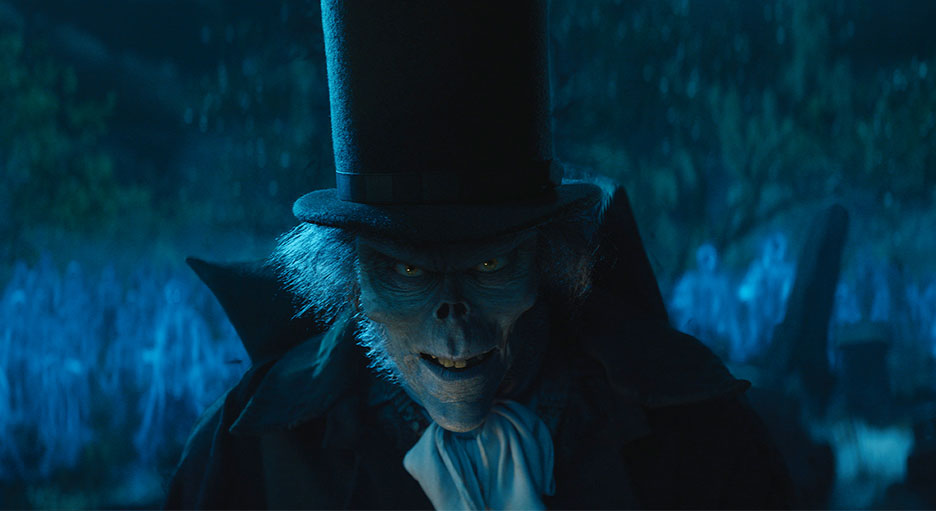
The Hatbox Ghost in Haunted Mansion.
The Hatbox Ghost, performed by Jared Leto. (Credit: Disney)

For nearly 40 years, Industrial Light & Magic has had a close relationship with Disney Parks. They have not only created visual effects for attractions themselves, from Captain EO and Star Tours in the 1980s to Star Wars: Rise of the Resistance and Guardians of the Galaxy: Cosmic Rewind in recent years, but have also worked on feature film adaptations of attractions such as Pirates of the Caribbean: Curse of the Black Pearl (2003) and Jungle Cruise (2021).

2023’s Haunted Mansion is another adaptation of a beloved attraction, which first premiered at Disneyland in 1969 and later at Walt Disney World in 1971. Director Justin Simien brought distinctly apt qualifications to the project, having worked as a Disneyland Resort cast member during his film school days at Chapman University. “Whenever I was in Disneyland, it was like being inside of a movie,” he tells ILM.com. “I would go on the rides over and over again, and I’d get chills in the same spots and catch my breath in the same places. I realized that this was cinema. It’s a theme park that’s physically happening around me, but the tools of the trade are the same.

“There’s production design, sound design, lighting, dialogue, character, and story,” Simien continues. “It sounds like something you’d say in a press interview, but it’s true – I remember going on The Haunted Mansion and Pirates of the Caribbean and thinking, ‘I need to figure out how to translate this to what I want to do as a filmmaker.’ Walt Disney and his artists brought us into these fantasy places. That’s the art. That’s the thing I needed to figure out. So for me, it all felt very complementary. Working at Disneyland was just another way of escaping into the movies.”

Simien’s approach to bringing Haunted Mansion to the screen was as complex as the vision of the attraction’s original creators. “I was really fascinated by the constant conversation that the Imagineers had about how scary it should be or how funny it should be,” Simien comments. “It was such an interesting way to make something unique. It’s not horror in the traditional sense. You’re not walking through a haunted house at Universal Horror Nights or something like that. But it’s not straightforward Disney either. It’s very subversive and there’s a lot of hidden, kind of dark stuff going on.”

Jamie Lee Curtis as Madame Leota approaches the Mansion’s front door with a bluescreen extension behind her.
 Jamie Lee Curtis as Madame Leota approaches the Mansion’s front door with a bluescreen extension behind her. (Credit: Justin Simien/Disney)

Simien and his team were able to visit the Disneyland Haunted Mansion in the off-hours, where current Imagineers helped them to understand its distinct narrative brilliance. “When you’ve made your way up through the Mansion, you’ve turned a corner, and you’re looking down into the dining room,” Simien explains. “All of the swirling dancing ghosts are there and ghost heads are coming out of the organ. It’s a culmination of all the different effects in the ride, the Pepper’s Ghost effect in particular. Even as an adult, when I know how it’s done, it takes my breath away. There are a couple of moments in the movie where we’re working from the same point of view. We pay homage. The ride has this build-up with specific timing and pacing.”

Simien took his cinematic leads from works in the 1980s and ‘90s, such as Ghostbusters (1984) and Little Shop of Horrors (1986) and the films of Tim Burton. He also went back to source material shared by the Disney Imagineers, including Robert Wise’s The Haunting from 1963. “There are so many parallels in the production design of that movie and the attraction,” he notes. “You see very subtle elements in our movie that are like that. There are slanted mirrors and shots where you look through a doorway and it’s a kind of off-angle. You get a claustrophobic ‘things are not right with the world’ feeling without really doing anything, just designing things a certain way.”

From a visual effects standpoint, Simien envisioned a mix of practical and digital techniques. “I wanted as many practical effects as I could get,” he says, “which I knew was always going to be a battle [laughs]. The movie is so fantastical. This wasn’t a typical horror movie where you hide the monster. It’s a Disney movie. There’s an expectation that you’ll get to see the ghosts. I wanted them to have a physicality, to be people in make-up and costumes moving on wires. We needed to ground the movie as much as possible in those things.”

ILM was one of multiple effects vendors on the project, and initially planned to contribute a modest sum of around 400 shots, overseen by Sydney-based visual effects supervisor Bill Georgiou and visual effects producer Arwen Munro. American-born, Georgiou spent nearly 15 years at Rhythm & Hues, climbing the ranks from rotoscope artist to compositing supervisor and sequence supervisor. He later worked as the onset visual effects supervisor on the DisneyXD program, Mighty Med, before joining ILM and moving to Australia in October 2021.

Coincidentally, Georgiou was an apt choice for Haunted Mansion, having known production visual effects supervisor Edwin Rivera for many years at Rhythm & Hues, not to mention Justin Simien himself. They had met through a mutual friend, editor Phillip Bartell, who cut Simien’s Dear White People (2014), as well as Haunted Mansion. “Edwin is very supportive and collaborative,” Georgiou tells ILM.com. “At the beginning, we were doing mostly set extensions, which is pretty straightforward. I think that he and Justin were impressed by the level of photorealism we were able to achieve, especially with the Mansion. Every shot of the Mansion has some CG, including the grounds around it. Another vendor, DNEG, was also doing some interior work, and we’d help create the views out the windows.”

Initially, Georgiou’s Sydney team worked only with ILM’s former Singapore studio, which being closer in time zones, shared the same schedule. “ILM has the best of the best,” Georgiou says. “Everyone was an amazing collaborator and shared their opinions. It was very open.” Principal photography had taken place in Georgia back in the United States, where ILM’s Andrew Roberts acted as onset visual effects supervisor. Georgiou and Munro also made a visit to Los Angeles to meet directly with the client, something Georgiou describes as essential to their continued partnership as the workload grew unexpectedly.

Reshoots would require further effects work involving an elaborate scene at the movie’s climax, where Ben (LaKeith Stanfield) confronts the villainous Hatbox Ghost (Jared Leto). “All of a sudden, we had more than twice as many shots as we started with,” Georgiou explains, “a CG human-like ghost character, and digi-doubles. It became an immense project, with over 1,000 shots. With a very short schedule, I think ILM knocked it out of the park. We had about 700 new shots, and Sydney became the hub for London, Vancouver, and San Francisco, as well as an additional vendor, Whiskytree. It became a global team. For my first real experience starting a project from the beginning at ILM, it was one of the best.

“When I first started on Stuart Little in 1998,” Georgiou continues, “one of the compositors who came in was R. Jay Williams, and he ended up being a senior compositor on Haunted Mansion [out of ILM San Francisco]. He had taught me so many things as a young roto artist, one of which was how to be nice to everybody. He always said hello and goodbye to everybody, one of the nicest, classiest people I’ve met in the industry, and I was able to finally tell him that on this project. It was so cool.”

During principal photography, a large portion of the Mansion was constructed as a physical set. “Mentally, psychologically, it was important to have a real mansion to shoot in,” Simien explains. “We could all get used to that physical space.” Other portions of the house incorporated bluescreen, including the sequence when Ben enters the ghost realm, a sort of alternate dimension within the Mansion where the hallways shift and rotate. This was amongst the work ILM received in the additional batch.

Actors Chase Dillon (left) and LaKeith Stanfield onset behind the first-floor exterior of the Mansion.
Actors Chase Dillon (left) and LaKeith Stanfield onset behind the first-floor exterior of the Mansion. (Credit: Justin Simien/Disney)

“It was quite interesting work,” Georgiou says. “Not only were we matching scans of the hallway reference that had been captured onset, but we were also matching the look to some of the previous work that DNEG had done. We then created animation for the rotations and how they would section off. The way they’d filmed onset with bluescreen was really well done, which made our work easier. The lighting was a challenge because there are candles and sconces on the wall, so you have these pools of light. The D.P. [Jeffrey Waldron] had very specific notes about how it should look. The chandeliers are swinging. Many puzzles to figure out, which is one of the best parts of visual effects. Overall, that sequence was one of the most successful, and it’s so cool that they used it in the poster.”

Of course, the appearance of 999 happy haunts would be the core element of Haunted Mansion’s visual effects. “Edwin Rivera used this term, ‘ectoplasmic effervescence’ for the ghosts, which has a Ghostbusters feel to it,” explains Georgiou. “It was fun to look through the history of cinema to find inspiration, but also figure out how we wanted to do things differently and create something that was fresh. Justin has such an incredible cinematic vocabulary. He’s looking at Kubrick and Hitchcock, and you can see that in how he’s framing shots. I felt like I was gaining plenty of knowledge.”

Another reference for Georgiou was Poltergeist (1982), one of ILM’s first client productions. “Poltergeist was very influential for me, especially when we were creating these skeletal ghosts that fly around. That was all connected to Poltergeist and the style they used for the ghost who comes right to camera. It feels really light-based but then there’s a skeleton face. Also, the way they use flares in Poltergeist was very influential for the last sequence of Haunted Mansion.”

A number of the prominently featured ghosts were performed by actors in costume and make-up. At times, ILM used digital doubles to replace them, each of which had to be modeled and textured. Others were entirely created with computer graphics, including the swarm of skeletal ghosts in the finale, which were original designs by the ILM Art Department. “The ghosts had a sort of x-ray feel to them,” says Georgiou. “It wasn’t a straightforward bone texture. We had to come up with how they glowed, both in day and night environments. They all had various types of clothing. Some had armor, or robes, or hoods. With all that comes a lot of creature work to get the costumes flowing properly. Then there are shots with hundreds and hundreds of them, as many as 600 or 700 at a time, which required crowd work. Our animation crew did hero shots, and they had the best time animating them. When they flank the Hatbox Ghost, they aren’t just standing there, but they’re chomping their teeth or doing little things with their hands. It’s subtle but it’s all there.”

A CG ghost moves through the Mansion’s library.
A CG ghost moves through the Mansion’s library. (Credit: Disney)

The fan-favorite Hatbox Ghost is part of the lore of the Disney Parks attraction, and as the film’s chief villain, many different components went into his creation. “On the set, we had a great stuntperson named Colin Follenweider,” explains Simien. “We spent a lot of time discussing the physicality of the Hatbox Ghost, why he would walk a certain way. So he was in a suit on the set with a blue face. Then with Jared [Leto], we captured his voice. Then all of that goes into a blender at ILM where we have a team of animators fine-tuning every aspect of the performance. It’s a real amalgamation of a few different traditions.”

Georgiou explains that ILM’s fellow vendor, DNEG, had created the initial character model to produce an early batch of shots. “But it was never meant to be seen in bright lighting or anything like that,” he continues. “Every plate had the stunt actor. A human face with flesh and skin is very different from a more skeletal face. We had to figure out things like, how does the neck work? A skeletal neck wouldn’t fit around the wide neck of a human stunt performer. We were able to hide a lot of that behind the scarf he’s wearing. We had to figure out how the hat sat on his head. Onset, it was a little too low, but if it was too high, it looked more like a cowboy hat. There were a lot of challenges.

“Then there’s the clothing,” Georgiou continues. “In that final sequence, the earth is breaking apart, all of these ghosts are rising up. He has 999 ghosts, and he’s trying to get the last one so he can bring the ghost realm into the human realm. There’s a lot of shaking and wind. The stunt actor was on wires, and the clothing didn’t have much movement. In some shots, we kept the body and clothing and did a face and hat replacement. For around half of the shots we used a fully-CG Hatbox Ghost. The look development team worked very hard to match it to the actor onset. It’s pretty seamless.”

The Hatbox Ghost attempts to pull Ben into his ghostly realm.
The Hatbox Ghost attempts to pull Ben into his ghostly realm. (Credit: Disney)

Georgiou explains how the character model was given new animation controls for his expanded performance. “We built that whole rig and made small controls for the wrinkles under the eyes, really small details in the face. It was really exciting. Our animation supervisor, Chris Marshall, helped us develop a lot of the facial performance for the Hatbox Ghost. I can’t wait to do another character like that.

“I kind of grew up doing shows like Garfield, Scooby-Doo, The Lion, the Witch, and the Wardrobe, and The Golden Compass where there are so many different types of visual effects,” Georgiou continues. “Haunted Mansion is very similar. We had ocean surfaces, a tsunami wave in an apartment along with its destruction, both interior and exterior. There were various effects elements, set extensions, digital doubles, crowd work, so many different kinds of shots. The Hatbox Ghost was a dream come true. Doing CG characters and placing them in live action was what I was raised on. It was a great opportunity to work on it. I’m so proud of our entire team. We have some incredible artists and I was the one who was lucky to be able to work with them.”

For Simien, the chance to tell a fantasy story laden with visual effects fulfilled his childhood dreams. “I grew up on effects-heavy films,” he says. “I’d lose myself in Star Wars, Star Trek, and X-Men. There wasn’t language for being a filmmaker when I was a kid. No one in my family talked about being a director. But what I would do is get home with the house to myself (I was a latch-key kid), put on a John Williams soundtrack, and pick up action figures and make them fight in these epic battles. I’d keep one eye closed to control the depth of field [laughs]!

“I didn’t know that I was directing,” Simien concludes. “I didn’t know that was a thing you could get paid for, but that’s what I did for fun. Having that big canvas is just part of my DNA. My first film was made for just over a million dollars, but it looks like it was made for more. To me, scale and cinematic spectacle is part of the fun of it. No matter what kind of story I’m telling, whether it’s something small and emotional or big and crazy like Haunted Mansion, I’m always going to push to see more in the world.”

The Hatbox Ghost takes his final plunge.
The Hatbox Ghost takes his final plunge. (Credit: Disney)

Read about Skywalker Sound’s work on Haunted Mansion, including more from director Justin Simien.

_

Lucas O. Seastrom is a writer and historian at Lucasfilm.

Take a deep dive into the history and lore behind the starship designs created by ILM and introduced 40 years ago in The Search for Spock.
By Jay Stobie

Written and produced by Harve Bennett, Star Trek III: The Search for Spock (1984) afforded actor Leonard Nimoy his first opportunity to direct a Star Trek feature. With Ken Ralston as visual effects supervisor, the film also supplied Industrial Light & Magic with the chance to leave its own indelible legacy on the Star Trek franchise. ILM’s work on Star Trek II: The Wrath of Khan (1982) had included a collaboration with the Lucasfilm Computer Division which yielded the first all-CG sequence in a feature film, yet the company had an even greater impact on the film series’ third installment.

Among its many contributions to Star Trek III, ILM tackled the monumental task of designing and building five major starship and space station models that were introduced in the film. Though crafted specifically for this project, those steadfast exterior designs became staples in the Star Trek universe and appeared in prominent scenes across numerous films and television series. As we celebrate The Search for Spock’s 40th anniversary, let’s examine the long-lasting nature of ILM’s iconic creations and explore the circumstances in which they were employed in later Star Trek productions.

The Merchantman starship flies through space in Star Trek III.
The Merchantman in Star Trek III: The Search for Spock. (Credit: Paramount Pictures)

The Merchantman: A Criminal Craft

A small, boxy vessel with a curved forward section lurked in deep space during the first act of Star Trek III, referred to as a merchantman by the film’s script. The ship carried a Klingon passenger (Cathie Shirriff) who had purchased intelligence related to the terraforming device known as Genesis. A much larger Klingon ship (more on that in a moment) lowered its cloaking device, becoming visible long enough to receive the data. Unfortunately, the Klingon operative had glanced at the information, prompting the vessel to swoop around and obliterate the merchantman with its weaponry.

From the earliest stages of pre-production on Star Trek III, the team at ILM — including Ralston, visual effects art directors Nilo Rodis and David Carson, supervising modelmaker Steve Gawley, and modelmaker Bill George — presented their creations to Nimoy and Bennett, who suggested alterations before final approval. Rodis and Carson generated concepts, while Gawley and George offered input and spearheaded model construction. The meticulous process was adaptable to each model’s role in the script, as the merchantman’s brief appearance meant it was fabricated in a relatively short amount of time. “The merchant ship was a design we threw together in a couple of weeks from a bunch of model parts,” visual effects cameraman Donald Dow told writer Brad Munson in Cinefex. “It was going to be blown up right at the very start, so there was no sense putting a lot of time into it.”

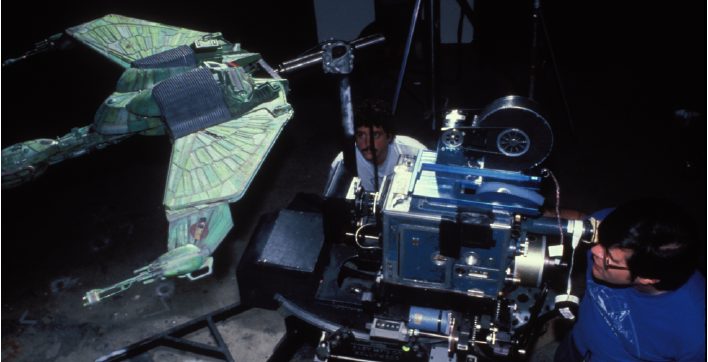
Camera operator Selwyn Eddy photographs the Merchantman miniature using ILM’s “Rama” motion-control camera.
Camera operator Selwyn Eddy photographs the Merchantman miniature using ILM’s “Rama” motion-control camera. (Credit: Industrial Light & Magic)

Yet, for a vessel not expected to see much screen time, the merchantman ultimately proved to be a testament to ILM’s dedication to quality, as the ship fulfilled its purpose in the film and went on to experience a revitalized livelihood in future productions. Boasting slight modifications in each instance, the merchantman reappeared as different vessels on six occasions. From a Sheliak transport carrying colonists in Star Trek: The Next Generation’s (1987) “The Ensigns of Command” to a Cardassian freighter targeted by saboteurs in Star Trek: Deep Space Nine’s (1993) “The Maquis, Part I,” the merchantman turned into a reliable resource for both series, as well as for Star Trek: Voyager (1995). In an intriguing twist, the merchantman — best known for being destroyed by a Klingon Bird-of-Prey in The Search for Spock — was even reconfigured to become a Klingon vessel in Deep Space Nine’s “Rules of Engagement.”

The Klingon Bird-of-Prey in Star Trek III: The Search for Spock.
The Klingon Bird-of-Prey in Star Trek III: The Search for Spock. (Credit: Paramount Pictures)

The Klingon Bird-of-Prey: A Fearsome Fighter

An imposing warship with a head-like bridge section and angled wings, the Klingon Bird-of-Prey easily outmatched the merchantman. Commanded by a Klingon named Kruge (Christopher Lloyd), the Bird-of-Prey was armed with a cloaking device that concealed it from its enemy’s scanners. Kruge sought the power of the Genesis device, traveling to the Genesis Planet and making quick work of the U.S.S. Grissom. Despite its swift victories over lesser foes, the Bird-of-Prey soon found itself squared off against the legendary U.S.S. Enterprise. Of course, unbeknownst to Kruge, James T. Kirk’s famed vessel had been severely damaged in Star Trek II and only maintained a skeleton crew on its bridge.

Modelmaker Bill George at work on the Bird-of-Prey miniature.
Modelmaker Bill George at work on the Bird-of-Prey miniature. (Credit: Industrial Light & Magic)

Perhaps the most distinctive starship ILM assembled for Star Trek III, the Klingon Bird-of-Prey model featured an intimidating green color scheme and motorized wings that could be raised above its primary hull. On top of bringing the vessel’s exterior to life, ILM pioneered the visual effect that permitted the Bird-of-Prey to decloak and become visible. “[Optical photography supervisor] Ken Smith came up with the optical effect,” Ralston shared with Nora Lee in American Cinematographer. “By using a ripple glass he threw the color sync off on each separation, so that everything is just a little out of whack. Then it all gets in sync and forms the ship.” The design impressed creatives to such a degree that, following the U.S.S. Enterprise’s destruction (yet another visual effect executed by ILM) in The Search for Spock, Kruge’s captured Bird-of-Prey — playfully renamed the H.M.S. Bounty by Kirk’s defiant crew — inherited the role of hero ship in the film’s Nimoy-directed sequel, Star Trek IV: The Voyage Home (1986).

Camera operator Selwyn Eddy shoots the Bird-of-Prey miniature while camera operator Ray Gilberti looks on.
Camera operator Selwyn Eddy (right) shoots the Bird-of-Prey miniature while camera operator Ray Gilberti (left) looks on. (Credit: Industrial Light & Magic)

However, the Bird-of-Prey’s prolific career was only just beginning. The ship’s signature profile played key parts as other nefarious Klingon vessels across the next three Star Trek films — Star Trek V: The Final Frontier (1989), Star Trek VI: The Undiscovered Country (1991), and Star Trek Generations (1994) — and popped up in numerous The Next Generation, Deep Space Nine, and Voyager episodes. As with many starships that began as physical models, the Bird-of-Prey was ultimately supplemented with a CG build in the latter stages of Deep Space Nine’s seven-season run. The craft even ended up in animated configurations for Star Trek: Lower Decks (2020) and Star Trek: Prodigy (2021). Nevertheless, all the Bird-of-Prey models that followed were based on the look established by ILM’s initial build. Furthermore, the 22nd century iterations of the Bird-of-Prey and Klingon D5-class variants which debuted in Star Trek: Enterprise (2001), a prequel series set over 100 years before The Search for Spock, were tailored to reflect their lineage as in-universe predecessors to ILM’s original Bird-of-Prey from Star Trek III.

Earth Spacedock in Star Trek III: The Search for Spock.
Earth Spacedock in Star Trek III: The Search for Spock. (Credit: Paramount Pictures)

Earth Spacedock: A Safe Haven in Space

As the U.S.S. Enterprise glided through the solar system on its way to a much-deserved respite from action, it was greeted by the sight of Earth Spacedock. With a mushroom-shaped upper section atop a stem extending downward, the gargantuan space station permitted entire starships to enter its massive superstructure and dock at a central core complete with repair facilities. Abuzz with ships and various shuttles, the lively starbase watched over Earth and kept the Federation’s fleet ready to serve missions of exploration and defense.

ILM’s Spacedock assignment necessitated three separate builds; namely the station’s illuminated exterior, its cavernous interior docking bay, and an interior view through the windows of a small, lounge-type set. Approximately five feet tall and three-and-a-half feet in diameter, the exterior model relied on a complex lighting system, which Ralston described in American Cinematographer. “[The Spacedock exterior] had lights inside after the door opens up and running lights that go inside. Sometimes it is hard to sync up all those functions with the motion control system. But I think it worked nicely.”

The issue of conveying the sheer size of a docking area able to house a multitude of starships received ILM’s innovative attention and expertise. “We found that the interior demanded some degree of atmospheric haze, even though there probably wouldn’t be any in outer space. It just needed help to look slightly degraded — not so crisp and clean,” visual effects cameraman Scott Farrar shared in Cinefex. “We ended up using blue gels on the lights and shooting in smoke for the basic fill look. Then, when we went to the light passes, we used a diffusion filter.”

ILM modelmakers work on the lighting components of the Earth Spacedock miniature.
ILM modelmakers work on the lighting components of the Earth Spacedock miniature. (Credit: Industrial Light & Magic)

As timeless as Earth Spacedock’s inaugural performance turned out to be, the station’s unveiling soon led to its return to the big-screen. In addition to being featured in the three Star Trek films which followed immediately after The Search for Spock, Earth Spacedock appeared as several other Federation starbases — Starbase 74, Lya Station Alpha, Starbase 133, and Starbase 84 — in The Next Generation via the use of stock footage. A version of Earth Spacedock seemed to be in the midst of orbital construction in the Star Trek: Discovery (2017) episode “Will You Take My Hand?,” while the design was translated into animated form to represent Douglas Station in Lower Decks. According to in-universe lore, Earth Spacedock was retired from service and transported to Athan Prime, where it was last seen as the central hub of the Fleet Museum in Star Trek: Picard’s (2020) third season.

The U.S.S. Excelsior in Star Trek III: The Search for Spock.
The U.S.S. Excelsior in Star Trek III: The Search for Spock. (Credit: Paramount Pictures)

U.S.S. Excelsior: The Transwarp Testbed

Dubbed “The Great Experiment,” the U.S.S. Excelsior acted as a testbed for an advanced faster-than-light propulsion system known as the transwarp drive. The Excelsior was spotted while berthed in Earth Spacedock, though the starship soon found itself attempting to engage its experimental engines as it pursued Admiral Kirk’s unauthorized departure aboard the Enterprise. Unfortunately for the Excelsior, Montgomery Scott (James Doohan) — the Enterprise’s chief engineer — had sabotaged the transwarp system, causing the vessel’s trial run to stall out in an abrupt and unflattering fashion.

As outlined in Star Trek: The Official Starships Collection, early U.S.S. Excelsior concepts devised by Nilo Rodis and David Carson led to Bill George’s own distinctive study model and a 7 ½-foot studio model constructed with the oversight of Steve Gawley. Our first encounter with the starship coincided with the Enterprise’s arrival at Earth Spacedock, resulting in an arduous challenge for ILM — Excelsior needed to appear stationary within the confines of the station’s interior. “[The Excelsior] was shot separately from everything else. [Visual effects cameraman] Sel Eddy shot that stuff,” Ralston told American Cinematographer. “We had to match the moves so that it looked like it was locked right into the space dock. It was a pain. We had to cheat on some of the shots where there was so much trouble with the moves.” Their diligence paid off, as the majestic sequence endures as one of The Search for Spock’s most awe-inducing visuals.

The Excelsior returned in The Voyage Home and The Final Frontier, but it received its biggest chance to shine in The Undiscovered Country, which also featured visual effects by ILM. Now captained by Hikaru Sulu (George Takei), the U.S.S. Excelsior rescued the U.S.S. Enterprise-A during a crucial battle against a rogue Klingon Bird-of-Prey. The model was heavily modified for fresh cinematic escapades in Star Trek Generations, then bearing the legendary registry of the U.S.S. Enterprise-B. The Enterprise-B variant was also utilized as the U.S.S. Lakota, an upgraded Excelsior-class vessel, in Deep Space Nine’s “Paradise Lost.”

ILM’s Excelsior design prevailed via cameos in The Next Generation, as exterior shots of the vessel — now deployed to represent an entire line of Excelsior-class starships — debuted in the show’s first and second season premieres, “Encounter at Farpoint” and “The Child.” These views were subsequently reused as stock footage to depict various Excelsior-class ships in no less than ten additional episodes of the series. As with the Klingon Bird-of-Prey, ILM’s original Excelsior model served as the basis from which all future Excelsior-class physical and CGI builds stemmed. Deep Space Nine aficionados will point to the abundance of Excelsior-class vessels dispersed throughout Dominion War-era battles in “Sacrifice of Angels,” “Tears of the Prophets,” and the series’ finale, “What You Leave Behind,” as evidence that the starships were an integral part of Starfleet’s defense armada. In fact, at least three Excelsior-class vessels stayed in active service long enough to have been prepared to confront the vaunted Borg Collective in Voyager’s own season finale, “Endgame.”

The U.S.S. Grissom in Star Trek III: The Search for Spock.
The U.S.S. Grissom in Star Trek III: The Search for Spock. (Credit: Paramount Pictures)

U.S.S. Grissom: A Scientific Scout

On a research mission to study the Genesis Planet, the U.S.S. Grissom was classified as a relatively small science vessel. After detecting an anomalous lifeform on the planet’s surface and beaming down a landing party consisting of Lieutenant Saavik (Robin Curtis) and Doctor David Marcus (Merritt Butrick), the Grissom remained tragically unaware as Kruge’s Klingon Bird-of-Prey approached under cloak and jammed all outgoing transmissions. The Bird-of-Prey dropped its invisibility field and coalesced into view, pouncing on the Grissom and destroying the Starfleet ship with a single blast.

The Roddenberry Archive notes the U.S.S. Grissom was yet another Star Trek III design conceived of by Nilo Rodis and David Carson and built by Steve Gawley and Bill George. The Grissom stood as a departure from the traditional Starfleet aesthetic in which a ship’s primary saucer was affixed to its secondary hull by a neck-like connection. A gap separated the two elements on the Grissom, with the only structures linking them being thin pylons extending from the vessel’s warp nacelles. The ship’s tragic fate didn’t merely come down to creating the biggest explosion, as plot considerations factored into ILM’s take on the Grissom’s destruction. “I didn’t think we should do something flamboyant at that point,” Ralston pointed out in Cinefex. “If we played all our best cards at the start, we’d have nothing left to show when it came time to blow up the Enterprise.”

The Grissom’s grizzly demise did not spell the end for the distinctive vessel, as the model functioned as the template for what would become known as the Oberth-class starship line. The design reemerged as a different ship of the same class berthed within Earth Spacedock in Star Trek IV before earning a recurring spot as a variety of Oberth-class ships that encountered the U.S.S. Enterprise-D in seven episodes of The Next Generation. The design garnered a great deal of attention in “The Pegasus,” an episode in which it was presented as the U.S.S. Pegasus, a testbed for an illegal Federation cloaking device. One Oberth-class ship assisted in the rescue of the Enterprise-D’s surviving crew at Veridian III in Star Trek Generations, while others could be found in the background at the Battle of Wolf 359 in Deep Space Nine’s “Emissary” and the ILM-orchestrated Battle of Sector 001 in Star Trek: First Contact. Like Earth Spacedock and the Klingon Bird-of-Prey, the Oberth-class design found itself turned into animated form for Lower Decks, this time in the episode “First First Contact.”

Director Leonard Nimoy confers with visual effects supervisor Ken Ralston (and visual effects art director David Carson during a visit to ILM’s Kerner facility.
Director Leonard Nimoy (center) confers with visual effects supervisor Ken Ralston (left) and visual effects art director David Carson (right) during a visit to ILM’s Kerner facility. (Credit: Industrial Light & Magic)

The Search for Spock’s Legacy

Crafting memorable starships and space stations for any production is a tremendous responsibility, yet Industrial Light & Magic’s contributions to Star Trek III: The Search for Spock accomplished this lofty goal and so much more. Having not one, but five major designs go on to resurface in significant roles is an achievement beyond all expectations. A recent scene in Star Trek: Picard’s third season exemplified ILM’s incredible feat, as Kruge’s Klingon Bird-of-Prey and the U.S.S. Excelsior were both positioned around Earth Spacedock as part of the Fleet Museum’s honorary assemblage of classic starships. The everlasting nature of the designs speaks to the eternal appeal of ILM’s work. Whether the new studio models that ILM designed and built for Star Trek III were reused as they were originally constructed, recreated by other visual effects companies at a later date, or called upon by future artists to inspire their own takes on starships, the original models’ extensive influence on the Star Trek universe cannot be overstated.

_

Jay Stobie (he/him) is a writer, author, and consultant who has contributed articles to ILM.com, Skysound.com, Star Wars Insider, StarWars.com, Star Trek Explorer, Star Trek Magazine, and StarTrek.com. Jay loves sci-fi, fantasy, and film, and you can learn more about him by visiting JayStobie.com or finding him on Twitter, Instagram, and other social media platforms at @StobiesGalaxy.

The ILM veteran worked on projects like Jurassic Park and The Mask, and helped create a special Halloween poster that inspired the moniker for ILM’s new podcast.
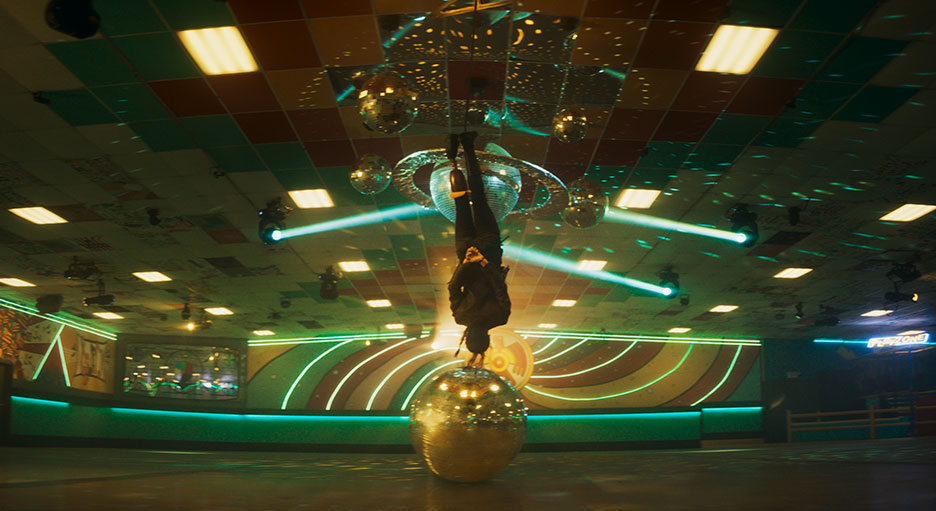
By Lucas O. Seastrom

Listeners of the premiere episode of Lighter Darker: The ILM Podcast may be curious where the show found inspiration for its name.

27 years ago in 1997, Industrial Light & Magic was in the midst of the digital renaissance in visual effects, with projects as diverse as Men in Black, Contact, and Titanic being released that year, and others like Deep Impact (1998), Saving Private Ryan (1998), and Star Wars: The Phantom Menace (1999) readily underway. ILM’s then home at the Kerner facility in San Rafael, California was a bustling center of creativity across both digital and practical disciplines, and arguably the most exciting time of year came during Halloween season when hundreds of employees and their families gathered for an annual costume party.

Benton Jew had been with the ILM Art Department since 1988, working as a storyboard and conceptual artist on everything from Memoirs of an Invisible Man (1992) to the fabled television commercial where basketball star Charles Barkley plays one-on-one with Godzilla. Later, his responsibilities grew as he became a visual effects art director on projects like The Mask (1994). But there was always time for side projects in between work for clients, and in 1997, Jew was asked to illustrate that year’s invitation and poster for the fabled ILM Halloween Party.

The 1997 ILM Halloween Party poster, featuring artwork by concept artist Benton Jew. An artist is seen clutching his computer while horror characters tell him "lighter" and "darker."
The poster for the 1997 ILM Halloween Party, designed by Mark Malabuyo and illustrated by Benton Jew.

Designed by the late Mark Malabuyo, an in-house graphic designer at the time, the poster was envisioned in the style of the classic EC Comics of the mid-20th Century, known for their horror and science fiction stories. This “issue,” dated from October 1997, is entitled “Tales of Terror: Attack of the Nitpickers,” with the subtitle, “Producers! FX Supervisors! Art Directors! Nitpickers all!” Jew’s illustration below depicts a visual effects artist surrounded by figures caricatured in the horror style. He frightfully grasps his computer as the onlookers share their feedback about his work. “…Lighter…” one says, while someone else contrasts with “…Darker…” Yet another recommends, “…Split the difference…”

This tongue-in-cheek bit of satire about the collaborative process of visual effects would have inspired a chuckle from just about everyone at the company, and two of its word bubbles have now become the namesake of ILM’s new podcast. “I just wanted to capture that look of someone when a person comes by their workstation and points something out, or someone’s expression in dailies,” Benton Jew tells ILM.com. “It seemed like that kind of situation came up a lot in CG. Okay, no one can make a decision, let’s split the difference.

“Especially as an art director, I think I’d been seen as someone who would pick out little things,” Jew continues. “I’d be on The Mask or something, and would tell an artist, ‘Oh those icicles, they’re not quite right,’ or whatever it is. I’m sure that anybody who’s worked in CG can relate to that. People are always pointing and giving you backseat directions.”

Artist Benton Jew.
Benton Jew

Known within the department for his versatile and prolific output, Jew was also a lifelong comics fan, an attribute that earned him the Halloween Party assignment. “I was sort of the resident comic book geek,” he explains, “and obviously a Halloween piece would have an EC Comics theme to it. I tried to be in the spirit of artists like Jack Davis, Jack Kamen, and Graham Ingels. Mark Malabuyo was the graphic designer on it. He was a wonderful guy, so easy to work with. He was really jovial and friendly. We all miss him. He was set on making sure that the graphics had a fidelity to the old EC stuff. He made it as close as he could, with obviously some differences.”

Growing up, Jew had first aspired to be a comics artist. Then, as he puts it, “Star Wars happened.” The 1977 feature film launched the cinematic dreams of many younger viewers at the time, including Jew and his twin brother (who also became an illustrator). “We saw all the books on the making of Star Wars with Joe Johnston’s storyboards and Ralph McQuarrie’s drawings, and got hooked into amateur filmmaking. For people who grew up in that era when Star Wars came out, it really sparked a craze for people to want to be filmmakers.”

While studying at the Academy of Art in San Francisco with teachers like celebrated poster artist Drew Struzan, Jew was recruited into ILM’s ranks courtesy of storyboard artist Stan Fleming, who’d contributed to projects like Indiana Jones and the Temple of Doom (1984). Jew loved cinema, but never lost his passion for comics and illustration. “When I started working there, most people were from the car design world,” he explains. “They weren’t necessarily drawing figurative work. They were doing architectural or vehicle-driven stuff. As things became more creature-based in visual effects, being a general illustrator worked well for me. I can’t draw a vehicle to save my life.”

From the beginning, Jew worked as a storyboard artist, directly applying his knowledge of comics to another mode of visual storytelling. Among others, he’d eventually board for director George Lucas on The Phantom Menace. “With George, all of us would sit and do thumbnails with him. But I’ve worked with plenty of directors like that where I’ll sit with them and draw lots of tiny thumbnails really quickly, and then I’ll go back and flesh those boards out later. With George, we met with him twice a week for quick little meetings. He’d basically tell us the story, and we’d all draw out different ideas and he’d make suggestions. Then we’d have this huge stack of thumbnails, and we’d get them in correct order, and someone like me or Ed Natividad or Iain McCaig would make finished drawings from those.”

Concept art of Milo the dog from The Mask, by Benton Jew.
An example of Jew’s concept art, a sketch of Milo the dog from 1994’s The Mask.

The digital renaissance led to a surge in projects requiring CG creature development, from early entries like The Abyss (1989) and Jurassic Park (1993), to even more ambitious projects like Dragonheart (1996) and The Mummy (1999). Jew had a front-row seat during this storied period that introduced new tools and tumultuous change. “My first real film was Ghostbusters 2,” he recalls, “and that was still done with foam and rubber and stuff like that. I got a pretty good idea of what that was like. I could see CG slowly coming into view. It was really a magical time and everything was changing by leaps and bounds.

“I would go down to ‘The Pit’ and watch Spaz [Steve Williams] creating those dinosaurs that he would later show to Spielberg and company,” Jew continues. “It was so weird when Jurassic Park was being made because you had to sit on this and not tell anybody, and you knew it was going to change the world. As the technology kept improving, it wasn’t replacing the artists and filmmakers; it was helping them. It’s about giving them the tools to make something that they couldn’t make with traditional means…. John [Knoll] would come by and ask us what we wanted to see in Photoshop. He meant for it to be a tool for us, not a replacement. Our pallet was growing larger.”

Departing ILM in 2001 after 13 years with the company, Jew headed for Los Angeles where he continues to work on feature films as a storyboard and concept artist. He’s also self-published comic books of his own, as well as contributed to comics for Marvel, among others. Jew still gets questions about the memorable “Tales of Terror” poster (and remains adamant that the terrified artist clutching his machine is not based on anyone in particular). Looking back on his ILM days, Jew values the artistic lessons granted him by the experience of working on so many different assignments.

“Just the idea of having to do a lot of stuff very quickly impacts how you draw,” he concludes. “You learn to do more shortcuts, what to leave in, what to take out, and things like that. Early on, I didn’t do a lot of paintings. Most of my stuff was black and white, but I learned to do more color stuff when they asked me to do it. The volume, speed, and needs always change, so you just stay flexible. As an artist or an art director, the most important thing is not your eyes or your hands, but your ears. To understand what the director or effects supervisor wants, you need to develop your ear more than anything. It’s learning what they want and how to do it correctly. It may not be your own taste, but you need to be able to talk to them and know where they’re trying to go with it.”

Lucas O. Seastrom is a writer and historian at Lucasfilm.

ILM’s Vancouver & London studios realized everything from ingenious facial replacements to a challenging plate composite for one cohesive action shot.

By Adam Berry

After the events of Marvel’s Hawkeye left Maya Lopez in an intense standoff with the powerful Kingpin, she finds herself now on the run from her criminal life, returning to her roots where she must confront her past and discover her true power; becoming the hero known as Echo (Alaqua Cox). 

As with any Marvel production, big action set pieces and storytelling are promised elements that bring the massive scope of these heroes’ lives from page to screen. As Echo is a formidable hand-to-hand combatant, with unique abilities not yet seen in the Marvel Cinematic Universe (MCU), the action needed to deliver.

Industrial Light & Magic was called upon to create some of the biggest action sequences in the show, with work being shared between the London and Vancouver studios. All together, ILM contributed an amazing 467 shots, from start to finish, with a fast turnaround of only six months.

ILM was awarded some really fun sequences to work on. From a thrilling train heist with a full CG environment, digidoubles and CG train; to a roller rink brawl requiring many face replacements and fight enhancements; a huge warehouse explosion and a photoreal CG woodpecker.”

Steven Godfrey, Visual Effects Supervisor
Daredevil joins the fight in an epic faceoff against Maya during “The Oner”.
Daredevil joins the fight in an epic faceoff against Maya during “The Oner”. 

Echo is the first MCU project to be released under the TV-MA rating for mature audiences, so the visual effects team had a lot of freedom to play around with the blood and gore for the fight sequences. At the client’s request, the stylistic violence and gore from the John Wick films were used as a reference for the show.

One pivotal action sequence that ILM was tasked with creating, known as “The Oner,” was particularly complex for the team. The work on this sequence was to stitch together multiple plates and takes as the action progresses. The scene follows Maya as she makes her way along a series of hallways, fighting off a group of security guards; knocking them to the ground one by one, showcasing her martial arts capabilities. As the security guards lay unconscious, Maya is led into a larger room by a mysterious new adversary, resulting in the main fight. The action intensifies and reveals her new opponent as none other than the man without fear, another Marvel favorite, Daredevil (Charlie Cox). The two then face off in an epic duel that moves between a large open space and a tighter caged area full of weapons.

To make the scene as visceral as possible, there was a combination of making multiple plates blend seamlessly between takes. With multiple face replacement shots for the actors, blood spurts and destruction added to the environment, “The Oner” is among the most exciting sequences from the whole show. 

It was challenging work for the team to get the plates to stitch together seamlessly; to hide transition points while ensuring that the action is still flowing throughout. By using a combination of wipes, warps, retimes and some manual tracking of multiple takes, ILM was able to stitch together all of these elements to form one cohesive shot.

Maya sends a deadly message to Kingpin’s army that ends with an explosive warehouse scene during Episode 2.
Maya sends a deadly message to Kingpin’s army that ends with an explosive warehouse scene during Episode 2. 

The biggest challenge for the team on this sequence, and others throughout the show, was face replacement work. The shots required would be fairly close to the camera and require a lot of facial performance during the intense fighting sequences. ILM became involved with the project after principal photography on Echo had wrapped, so there was limited data capture available to work with. Face replacements were especially needed for the fight sequences involving Alaqua Cox. As she is relatively new to the industry, there wasn’t a lot of data available to reference, or a Facial Action Coding System (FACS) session to capture her facial expressions, so only the footage taken during filming could be utilized. 

In total, there were about 35 shots of face replacement work throughout the show. There were different approaches taken to emulate Cox’s likeness, such as trying a 2D replacement, building a 3D digidouble and using ILM’s FaceSwap.

There wasn’t enough coverage from takes to use a 2D replacement; not enough time to build a digidouble to the standard that the showrunners wanted, and not enough footage of Cox to use for an accurate Face Swap. With limited data, there was some experimentation required to figure out how to best achieve the most accurate facial performance possible.

This was vital because Cox is very expressive during the action sequences, so the facial expressions needed to have the same energy otherwise it might feel lifeless jumping between cuts.

The plan came down to using a 3D digidouble while training a Face Swap in the background, just in case it could provide anything of use. The Face Swap took three weeks to build, and was based on only 20 minutes of footage of Cox.

After some experimentation, the solution was for ILM to utilize a combination of Face Swap with a traditional digi-base setup to accurately replicate Cox’s likeness.

The results were great and provided a better likeness of the actress, adding a photographic level of realism that was difficult to achieve using only the digidouble.

“I feel like the work done here to overcome this challenge has strengthened, or expanded how we can implement something like this again.” – Tristan Myles, Visual Effects Supervisor

In Episode 3 Maya faces off against some of Kingpin’s assassins in a chaotic roller rink melee.
In Episode 3 Maya faces off against some of Kingpin’s assassins in a chaotic roller rink melee. 

ILM’s contributions brought the explosive action sequences to life, while also making them feel grounded and realistic. The action continued onto a roller rink brawl, involving work to remove cables for stunt rigging, crash mattes and tricky crew removal from reflective surfaces, such as a giant disco ball; to an epic fight on a moving train, which needed extensive environment and animation work; then finally, a warehouse explosion calling for the team to replace the skyline, create explosions and augment explosion element plates. 

The fight sequences and action only got bigger throughout the show, delivering some of the most thrilling sequences from any MCU project yet. The vision of bringing the pulse-pounding action of this iconic character to life was fully realized by the talented crew with artistry that only visual effects can create.

Maya sabotages a train car by planting a bomb during a heist that sends her flying to escape before it’s too late.

Adam Berry is the Studio Operations Manager for the ILM Vancouver studio. His passion for film led Adam to ILM in 2022, coming from an extensive career across different sectors of the hospitality industry including cruise ships, luxury hotels and resorts. If he’s not at the movies or traveling to new destinations, you can find Adam staying active and exploring Vancouver.