Disney

50 Years | 500+ Film and TV credits | 135+ Awards

SINCE 1975

ILM.com is showcasing artwork specially chosen by members of the ILM Art Department. In this installment of a continuing series, eight artists from the San Francisco, Vancouver, London, and Sydney studios share insights about their work on the 2025 Disney production, Lilo & Stitch.

Art Director Cody Gramstad

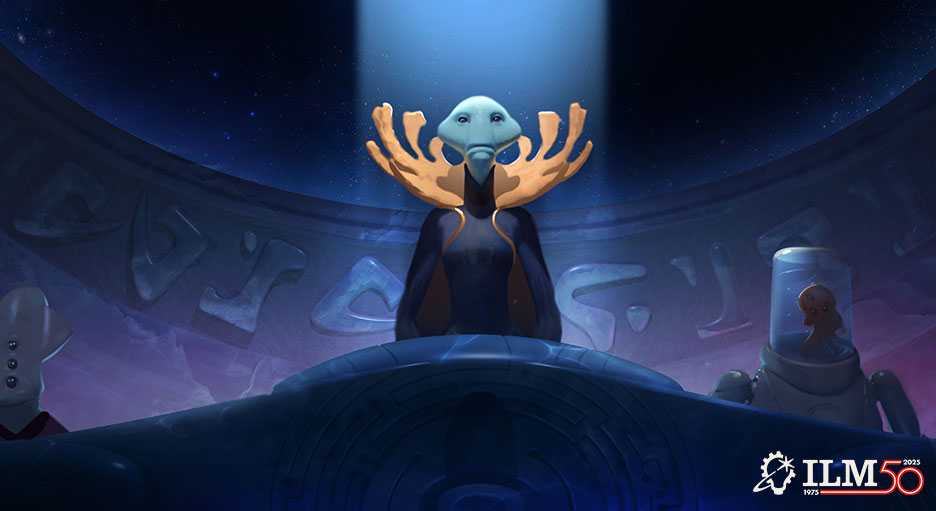
Gramstad: This concept was tackling two key problems for this scene. What should our balance be between Chris Sanders’s soriginal visual style and the limitations of live action expectations?  At the same time, we could use this image to give practical design guidance for the environment team on how to stage the podium space so that the window both frames and provides value contrast to the Grand Councilwoman’s head for our primary focal point.

The iteration process for this concept was an evolution of a pre-existing previs set. From the original film we knew key staging, camera placement, and expected lighting direction. The iterations came in adjusting the environmental elements around the figures, exploring different shape languages and materials, and experiments in color and saturation to find a balance that maintains the personality of the original animated film but could exist in the lighting and material context of a more dimensional rendering approach.

My favorite part of this piece is the simplified value shape language. When this composition is refined down to its most basic fundamental art skills, it creates a graphic shape language that feels in character to the original film, while at the same time allows for a clear read of the primary focal point.

Senior Visual Effects Art Director Alex Jaeger

Jaeger: The main brief for Lilo & Stitch was to try out some ideas to pull it away from looking like an animated feature and make it feel more realistic while keeping all the main structures from the original film the same. 

The work on this piece was done as part of a push to complete a set of shots early for the trailer. As part of the process it was also done in an effort to gain a bit more realism in this sequence and offer up some new suggestions and options for detail and lighting. So, after looking at the existing sequence, I found that the textures overall were soft and that a few indications of hard reflections might help.

One of the challenges was to not alter any of the models, but rather keep my alterations to lighting and texture. So I added more fall-off and texture to the spot lights, added a metallic line element to the platform railing and floor. I also added a more metallic glint to the threads in the banners. The hardest part was finding spots to add metallic elements that would be most effective for the added realism that the client requested, without altering major elements.

Concept Artist Mathilde Marion

Marion: After his trial, Stitch is sent to a lab room where he is being tested upon, and from where he escapes. We needed to start from the client’s design of the room, and in the same spirit, expand a workstation into a DNA reading machine. We came up with a few variations of designs and how it would work, based on the client’s storyboards. This one is, in my opinion, the most successful.

This is a frame of the overall design, but it was actually designed and sent to the client as a series of close-up shots where we can see Stitch’s hair being processed and tested by the machine. There were primarily two challenges: designing a machine in the spirit of the original animated feature, all the while showing a sequence of mechanical events that are somewhat logical. Because the movie isn’t meant to be realistic, we had a bit of leeway, but it still needed to work within the chosen design and make sense story-wise.

I took inspiration from Chris Sanders’s original designs, and the original movie’s assets and weapons. I made a goal to try and match another artist’s style, which is not the easiest thing to do. My style is usually not as cartoony, and it was important for the story that everything was sitting in the right visual universe. A stylized-type of drawing is really tough, as it requires a perfect understanding of the basic shapes, values, and color relationship. You can’t hide behind details or processing in your image. I found that very interesting and had to challenge myself.

Senior Concept Artist Brett Northcutt

Northcutt: I worked on this piece late in the schedule trying to help with lighting and reality cues to improve the look of the shot.

This shot was originally front lit against space and I thought it looked a bit flat. I reversed the lighting to make it back lit, which really helped the mother ship look more imposing. With the ship now pretty dark, adding a nebulous background really helped to make it pop and also added visual interest. Finally, adding a planet to the lower right justified adding some unusual light reflection to the dark side.

Supervising Art Director Fred Palacio

Palacio: The task was to make the character more appealing to a broader audience, while avoiding a design that may appear too frightening for some. The main challenge was the time constraint, as the character had already been modeled, textured, animated, and rendered, so any changes had to be made on the spot.

In situations like this, my approach is to assess where we are and iterate step by step through paintovers, gradually exploring the visual possibilities. For example, we might ask: what if we changed the shape of the pupil? Its size? Its color? What if the skin appeared softer, the color more uniform, or the hair density had more contrast? 

Each adjustment was aimed at subtly shifting the character toward a more stylized, graphical direction, while still preserving the realistic quality the team had already achieved. It felt almost like sending Jumba to our makeup and hairstyling department. We also explored enhancing the clothing by injecting more saturation and slightly shifting the hues to evoke the distinctive palette of the 2002 film.

Art Director Amy Beth Christenson Smith

I worked closely with senior animation supervisor Hal Hickel under a fast deadline to get final boards ready for these sequences. The location had been scouted, so I had to make sure to match the scale and layout of it all.  The most challenging part was also the best part: making sure Stitch had a lot of over-the-top personality and that the comedy would shine through.

The client shared reference for the scouted location, as well as some rough sketches for a few frames. The biggest inspiration came from the characters in the original animated movie, trying to match their body language and personality. I also took inspiration from my pet rabbit – having Stitch turn only his ears in the direction of the sound when the shop doors are opening came from how my rabbit’s ears twitch and turn when she hears any sound.

Art Director Igor Staritsin

This was an art direction shot paintover that was meant to help the visual effects team establish the look of the final shot. The main challenge for this sort of task is to make the concept as close as possible to the final quality of the shot, as if it was seen in the movie. It usually requires quite a bit of research on the subject matter, as we want to make sure that the decisions made are based on reality. For example, a good design is usually achieved not only by establishing a pleasing aesthetic look, but also a logical function. The same goes for shot paintovers. We want to play up the most important elements in the frame that help to tell the story and play down the rest.

For this shot I knew what I was going to do after gathering enough information from my prior research on the task. However, there are certainly moments when one might experience a bit of struggle when trying to find a solution. I think it is best to assess your design in the simplest way possible, meaning one shouldn’t try to go into details too soon and get lost there. It is important to make sure that big shapes read well. Proportions and distribution of shapes make for a pleasing arrangement. When the basics are in place then mindful distribution of details on top will bring the design home.

I really enjoyed adding small details, a variety of materials, and break-ups that made it all look more realistic in the end. Tiny things like halation, bloom, vignetting, and suppressing details in secondary areas, as well as increasing the attention around the focal point really helps to bring it all to life while telling the story in the shot.

Concept Artist Evan Whitefield

The squid-piloted robot was designed as a supporting but visually memorable background character in the Grand Council chamber. While not a primary character, it helped reinforce the sci-fi tone, scale, and advanced tech of the Galactic Federation. The design retained the creature-in-a-tank-helmet concept, evolving through multiple iterations to balance the charm of the original animated version with a more grounded, high-tech look for the live-action world.

When I first started exploring the design, my goal was to go all out with the initial concepts to really push the creativity and explore extreme ideas without limits. This helped uncover unique shapes and personalities for the squid-piloted robot. Once I had a strong range of options, I focused on pulling things back to create a more grounded, believable design that would fit seamlessly into the live-action world. That balance between bold exploration and practical refinement was key.

One of my favorite details is how the tank-like helmet functions as both a life-support system and a clear window into the squid’s personality, letting its expressiveness come alive. I also love the contrast between the squid’s relatively small size and its massive, bear-like robotic frame. The functional, mechanical design of the robot pairs beautifully with the organic shape of the squid, creating a compelling balance between technology and creature.

See the complete gallery of concept art from Lilo & Stitch here on ILM.com.

Learn more about the ILM Art Department.

Watch Lilo & Stitch on Disney+.

ILM’s Sydney studio took on everything from digital creatures to CG environments for this adaptation of a beloved Disney Parks attraction.
By Lucas O. Seastrom

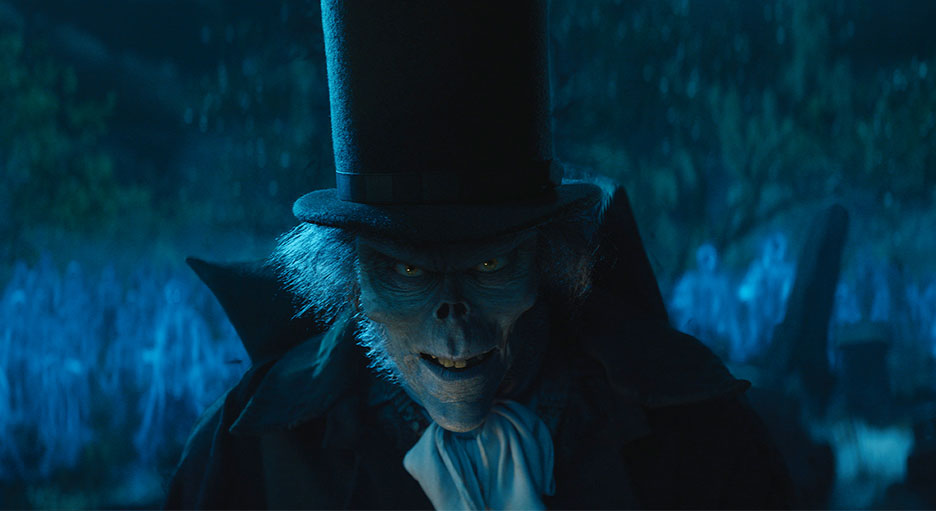
The Hatbox Ghost in Haunted Mansion.
The Hatbox Ghost, performed by Jared Leto. (Credit: Disney)

For nearly 40 years, Industrial Light & Magic has had a close relationship with Disney Parks. They have not only created visual effects for attractions themselves, from Captain EO and Star Tours in the 1980s to Star Wars: Rise of the Resistance and Guardians of the Galaxy: Cosmic Rewind in recent years, but have also worked on feature film adaptations of attractions such as Pirates of the Caribbean: Curse of the Black Pearl (2003) and Jungle Cruise (2021).

2023’s Haunted Mansion is another adaptation of a beloved attraction, which first premiered at Disneyland in 1969 and later at Walt Disney World in 1971. Director Justin Simien brought distinctly apt qualifications to the project, having worked as a Disneyland Resort cast member during his film school days at Chapman University. “Whenever I was in Disneyland, it was like being inside of a movie,” he tells ILM.com. “I would go on the rides over and over again, and I’d get chills in the same spots and catch my breath in the same places. I realized that this was cinema. It’s a theme park that’s physically happening around me, but the tools of the trade are the same.

“There’s production design, sound design, lighting, dialogue, character, and story,” Simien continues. “It sounds like something you’d say in a press interview, but it’s true – I remember going on The Haunted Mansion and Pirates of the Caribbean and thinking, ‘I need to figure out how to translate this to what I want to do as a filmmaker.’ Walt Disney and his artists brought us into these fantasy places. That’s the art. That’s the thing I needed to figure out. So for me, it all felt very complementary. Working at Disneyland was just another way of escaping into the movies.”

Simien’s approach to bringing Haunted Mansion to the screen was as complex as the vision of the attraction’s original creators. “I was really fascinated by the constant conversation that the Imagineers had about how scary it should be or how funny it should be,” Simien comments. “It was such an interesting way to make something unique. It’s not horror in the traditional sense. You’re not walking through a haunted house at Universal Horror Nights or something like that. But it’s not straightforward Disney either. It’s very subversive and there’s a lot of hidden, kind of dark stuff going on.”

Jamie Lee Curtis as Madame Leota approaches the Mansion’s front door with a bluescreen extension behind her.
 Jamie Lee Curtis as Madame Leota approaches the Mansion’s front door with a bluescreen extension behind her. (Credit: Justin Simien/Disney)

Simien and his team were able to visit the Disneyland Haunted Mansion in the off-hours, where current Imagineers helped them to understand its distinct narrative brilliance. “When you’ve made your way up through the Mansion, you’ve turned a corner, and you’re looking down into the dining room,” Simien explains. “All of the swirling dancing ghosts are there and ghost heads are coming out of the organ. It’s a culmination of all the different effects in the ride, the Pepper’s Ghost effect in particular. Even as an adult, when I know how it’s done, it takes my breath away. There are a couple of moments in the movie where we’re working from the same point of view. We pay homage. The ride has this build-up with specific timing and pacing.”

Simien took his cinematic leads from works in the 1980s and ‘90s, such as Ghostbusters (1984) and Little Shop of Horrors (1986) and the films of Tim Burton. He also went back to source material shared by the Disney Imagineers, including Robert Wise’s The Haunting from 1963. “There are so many parallels in the production design of that movie and the attraction,” he notes. “You see very subtle elements in our movie that are like that. There are slanted mirrors and shots where you look through a doorway and it’s a kind of off-angle. You get a claustrophobic ‘things are not right with the world’ feeling without really doing anything, just designing things a certain way.”

From a visual effects standpoint, Simien envisioned a mix of practical and digital techniques. “I wanted as many practical effects as I could get,” he says, “which I knew was always going to be a battle [laughs]. The movie is so fantastical. This wasn’t a typical horror movie where you hide the monster. It’s a Disney movie. There’s an expectation that you’ll get to see the ghosts. I wanted them to have a physicality, to be people in make-up and costumes moving on wires. We needed to ground the movie as much as possible in those things.”

ILM was one of multiple effects vendors on the project, and initially planned to contribute a modest sum of around 400 shots, overseen by Sydney-based visual effects supervisor Bill Georgiou and visual effects producer Arwen Munro. American-born, Georgiou spent nearly 15 years at Rhythm & Hues, climbing the ranks from rotoscope artist to compositing supervisor and sequence supervisor. He later worked as the onset visual effects supervisor on the DisneyXD program, Mighty Med, before joining ILM and moving to Australia in October 2021.

Coincidentally, Georgiou was an apt choice for Haunted Mansion, having known production visual effects supervisor Edwin Rivera for many years at Rhythm & Hues, not to mention Justin Simien himself. They had met through a mutual friend, editor Phillip Bartell, who cut Simien’s Dear White People (2014), as well as Haunted Mansion. “Edwin is very supportive and collaborative,” Georgiou tells ILM.com. “At the beginning, we were doing mostly set extensions, which is pretty straightforward. I think that he and Justin were impressed by the level of photorealism we were able to achieve, especially with the Mansion. Every shot of the Mansion has some CG, including the grounds around it. Another vendor, DNEG, was also doing some interior work, and we’d help create the views out the windows.”

Initially, Georgiou’s Sydney team worked only with ILM’s former Singapore studio, which being closer in time zones, shared the same schedule. “ILM has the best of the best,” Georgiou says. “Everyone was an amazing collaborator and shared their opinions. It was very open.” Principal photography had taken place in Georgia back in the United States, where ILM’s Andrew Roberts acted as onset visual effects supervisor. Georgiou and Munro also made a visit to Los Angeles to meet directly with the client, something Georgiou describes as essential to their continued partnership as the workload grew unexpectedly.

Reshoots would require further effects work involving an elaborate scene at the movie’s climax, where Ben (LaKeith Stanfield) confronts the villainous Hatbox Ghost (Jared Leto). “All of a sudden, we had more than twice as many shots as we started with,” Georgiou explains, “a CG human-like ghost character, and digi-doubles. It became an immense project, with over 1,000 shots. With a very short schedule, I think ILM knocked it out of the park. We had about 700 new shots, and Sydney became the hub for London, Vancouver, and San Francisco, as well as an additional vendor, Whiskytree. It became a global team. For my first real experience starting a project from the beginning at ILM, it was one of the best.

“When I first started on Stuart Little in 1998,” Georgiou continues, “one of the compositors who came in was R. Jay Williams, and he ended up being a senior compositor on Haunted Mansion [out of ILM San Francisco]. He had taught me so many things as a young roto artist, one of which was how to be nice to everybody. He always said hello and goodbye to everybody, one of the nicest, classiest people I’ve met in the industry, and I was able to finally tell him that on this project. It was so cool.”

During principal photography, a large portion of the Mansion was constructed as a physical set. “Mentally, psychologically, it was important to have a real mansion to shoot in,” Simien explains. “We could all get used to that physical space.” Other portions of the house incorporated bluescreen, including the sequence when Ben enters the ghost realm, a sort of alternate dimension within the Mansion where the hallways shift and rotate. This was amongst the work ILM received in the additional batch.

Actors Chase Dillon (left) and LaKeith Stanfield onset behind the first-floor exterior of the Mansion.
Actors Chase Dillon (left) and LaKeith Stanfield onset behind the first-floor exterior of the Mansion. (Credit: Justin Simien/Disney)

“It was quite interesting work,” Georgiou says. “Not only were we matching scans of the hallway reference that had been captured onset, but we were also matching the look to some of the previous work that DNEG had done. We then created animation for the rotations and how they would section off. The way they’d filmed onset with bluescreen was really well done, which made our work easier. The lighting was a challenge because there are candles and sconces on the wall, so you have these pools of light. The D.P. [Jeffrey Waldron] had very specific notes about how it should look. The chandeliers are swinging. Many puzzles to figure out, which is one of the best parts of visual effects. Overall, that sequence was one of the most successful, and it’s so cool that they used it in the poster.”

Of course, the appearance of 999 happy haunts would be the core element of Haunted Mansion’s visual effects. “Edwin Rivera used this term, ‘ectoplasmic effervescence’ for the ghosts, which has a Ghostbusters feel to it,” explains Georgiou. “It was fun to look through the history of cinema to find inspiration, but also figure out how we wanted to do things differently and create something that was fresh. Justin has such an incredible cinematic vocabulary. He’s looking at Kubrick and Hitchcock, and you can see that in how he’s framing shots. I felt like I was gaining plenty of knowledge.”

Another reference for Georgiou was Poltergeist (1982), one of ILM’s first client productions. “Poltergeist was very influential for me, especially when we were creating these skeletal ghosts that fly around. That was all connected to Poltergeist and the style they used for the ghost who comes right to camera. It feels really light-based but then there’s a skeleton face. Also, the way they use flares in Poltergeist was very influential for the last sequence of Haunted Mansion.”

A number of the prominently featured ghosts were performed by actors in costume and make-up. At times, ILM used digital doubles to replace them, each of which had to be modeled and textured. Others were entirely created with computer graphics, including the swarm of skeletal ghosts in the finale, which were original designs by the ILM Art Department. “The ghosts had a sort of x-ray feel to them,” says Georgiou. “It wasn’t a straightforward bone texture. We had to come up with how they glowed, both in day and night environments. They all had various types of clothing. Some had armor, or robes, or hoods. With all that comes a lot of creature work to get the costumes flowing properly. Then there are shots with hundreds and hundreds of them, as many as 600 or 700 at a time, which required crowd work. Our animation crew did hero shots, and they had the best time animating them. When they flank the Hatbox Ghost, they aren’t just standing there, but they’re chomping their teeth or doing little things with their hands. It’s subtle but it’s all there.”

A CG ghost moves through the Mansion’s library.
A CG ghost moves through the Mansion’s library. (Credit: Disney)

The fan-favorite Hatbox Ghost is part of the lore of the Disney Parks attraction, and as the film’s chief villain, many different components went into his creation. “On the set, we had a great stuntperson named Colin Follenweider,” explains Simien. “We spent a lot of time discussing the physicality of the Hatbox Ghost, why he would walk a certain way. So he was in a suit on the set with a blue face. Then with Jared [Leto], we captured his voice. Then all of that goes into a blender at ILM where we have a team of animators fine-tuning every aspect of the performance. It’s a real amalgamation of a few different traditions.”

Georgiou explains that ILM’s fellow vendor, DNEG, had created the initial character model to produce an early batch of shots. “But it was never meant to be seen in bright lighting or anything like that,” he continues. “Every plate had the stunt actor. A human face with flesh and skin is very different from a more skeletal face. We had to figure out things like, how does the neck work? A skeletal neck wouldn’t fit around the wide neck of a human stunt performer. We were able to hide a lot of that behind the scarf he’s wearing. We had to figure out how the hat sat on his head. Onset, it was a little too low, but if it was too high, it looked more like a cowboy hat. There were a lot of challenges.

“Then there’s the clothing,” Georgiou continues. “In that final sequence, the earth is breaking apart, all of these ghosts are rising up. He has 999 ghosts, and he’s trying to get the last one so he can bring the ghost realm into the human realm. There’s a lot of shaking and wind. The stunt actor was on wires, and the clothing didn’t have much movement. In some shots, we kept the body and clothing and did a face and hat replacement. For around half of the shots we used a fully-CG Hatbox Ghost. The look development team worked very hard to match it to the actor onset. It’s pretty seamless.”

The Hatbox Ghost attempts to pull Ben into his ghostly realm.
The Hatbox Ghost attempts to pull Ben into his ghostly realm. (Credit: Disney)

Georgiou explains how the character model was given new animation controls for his expanded performance. “We built that whole rig and made small controls for the wrinkles under the eyes, really small details in the face. It was really exciting. Our animation supervisor, Chris Marshall, helped us develop a lot of the facial performance for the Hatbox Ghost. I can’t wait to do another character like that.

“I kind of grew up doing shows like Garfield, Scooby-Doo, The Lion, the Witch, and the Wardrobe, and The Golden Compass where there are so many different types of visual effects,” Georgiou continues. “Haunted Mansion is very similar. We had ocean surfaces, a tsunami wave in an apartment along with its destruction, both interior and exterior. There were various effects elements, set extensions, digital doubles, crowd work, so many different kinds of shots. The Hatbox Ghost was a dream come true. Doing CG characters and placing them in live action was what I was raised on. It was a great opportunity to work on it. I’m so proud of our entire team. We have some incredible artists and I was the one who was lucky to be able to work with them.”

For Simien, the chance to tell a fantasy story laden with visual effects fulfilled his childhood dreams. “I grew up on effects-heavy films,” he says. “I’d lose myself in Star Wars, Star Trek, and X-Men. There wasn’t language for being a filmmaker when I was a kid. No one in my family talked about being a director. But what I would do is get home with the house to myself (I was a latch-key kid), put on a John Williams soundtrack, and pick up action figures and make them fight in these epic battles. I’d keep one eye closed to control the depth of field [laughs]!

“I didn’t know that I was directing,” Simien concludes. “I didn’t know that was a thing you could get paid for, but that’s what I did for fun. Having that big canvas is just part of my DNA. My first film was made for just over a million dollars, but it looks like it was made for more. To me, scale and cinematic spectacle is part of the fun of it. No matter what kind of story I’m telling, whether it’s something small and emotional or big and crazy like Haunted Mansion, I’m always going to push to see more in the world.”

The Hatbox Ghost takes his final plunge.
The Hatbox Ghost takes his final plunge. (Credit: Disney)

Read about Skywalker Sound’s work on Haunted Mansion, including more from director Justin Simien.

_

Lucas O. Seastrom is a writer and historian at Lucasfilm.

Six-Part Docuseries Debuts Exclusively on Disney+ July 27

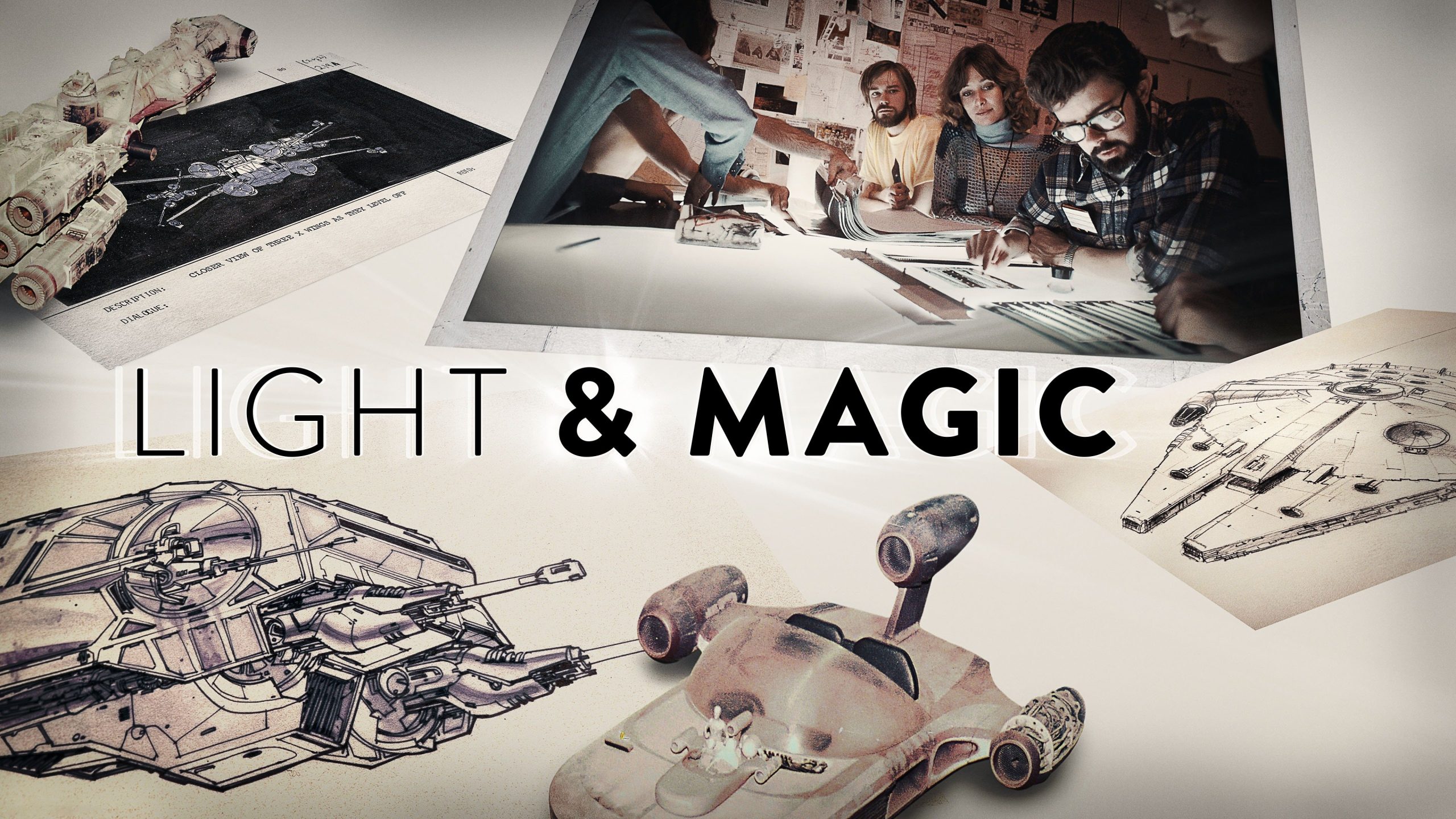
Disney+ released the trailer and key art for Lucasfilm and Imagine Documentaries’ “Light & Magic,” an immersive series that chronicles the untold history of world-renDisney+ released the trailer and key art for Lucasfilm and Imagine Documentaries’ “Light & Magic,” an immersive series that chronicles the untold history of world-renowned Industrial Light & Magic (ILM), the special visual effects, animation and virtual production division of Lucasfilm.
Granted unparalleled access, Academy Award®-nominated filmmaker Lawrence Kasdan takes viewers on an adventure behind the curtain of Industrial Light & Magic. Learn about the pioneers of modern filmmaking as we go on a journey to bring George Lucas’ vision to life. These filmmakers would then go on to inspire the entire industry of visual effects.  

The series is directed by Lawrence Kasdan, and the executive producers are Ron Howard, Brian Grazer, Justin Wilkes, Lawrence Kasdan, Kathleen Kennedy and Michelle Rejwan. 

All six episodes of “Light & Magic” premiere on July 27, exclusively on Disney+.

Twitter@DisneyPlus@ILMVFX
Instagram@DisneyPlus@ILMVFX
Facebook@DisneyPlus@ILMVFX
TikTok@DisneyPlus
Hashtag: #DisneyPlus

ABOUT DISNEY+

Disney+ is the dedicated streaming home for movies and shows from Disney, Pixar, Marvel, Star Wars, and National Geographic, along with The Simpsons and much more. In select international markets, it also includes the new general entertainment content brand, Star. The flagship direct-to-consumer streaming service from The Walt Disney Company, Disney+ is part of the Disney Media & Entertainment Distribution segment. The service offers commercial-free streaming alongside an ever-growing collection of exclusive originals, including feature-length films, documentaries, live-action and animated series, and short-form content. With unprecedented access to Disney’s long history of incredible film and television entertainment, Disney+ is also the exclusive streaming home for the newest releases from The Walt Disney Studios. Disney+ is available as a standalone streaming service or as part of The Disney Bundle that gives subscribers access to Disney+, Hulu, and ESPN+. For more, visit disneyplus.com, or find the Disney+ app on most mobile and connected TV devices.

MEDIA CONTACTS

Disney+ Media Relations
Shelby Cotten
Shelby.b.cotten@disney.com

Walt Disney Studios Global Publicity
Global Publicity (NY)
Derek Del Rossi        
derek.del.rossi@disney.com

Lucasfilm Publicity
Ian Kintzle 
ikintzle@ilm.com

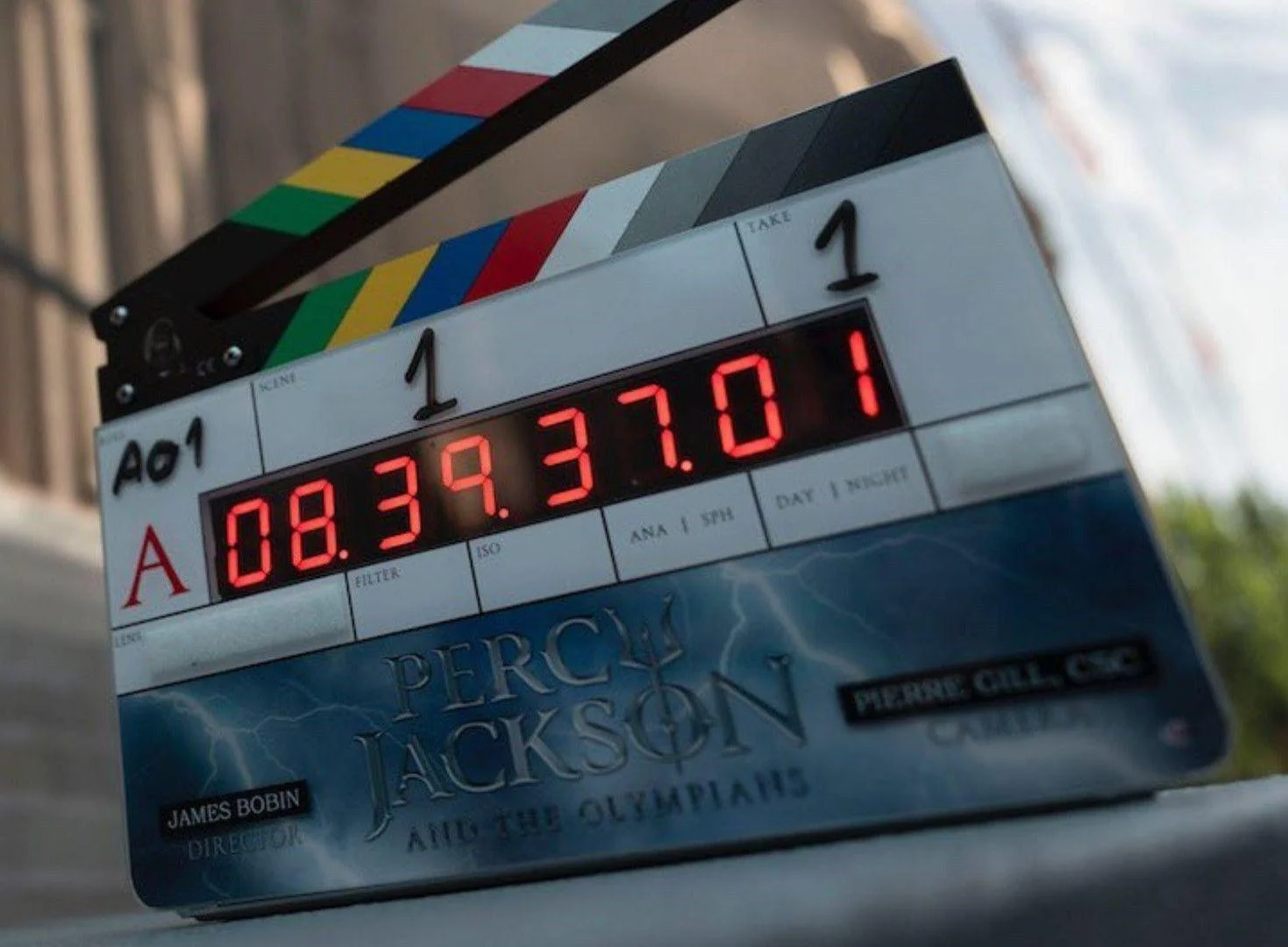
San Francisco and Vancouver–Production is underway in Vancouver on the ambitious upcoming
Disney+ Original series Percy Jackson and the Olympians, based on Rick Riordan’s best-selling
novels, on a newly built state of the art Stage Craft LED stage, the first of its kind in Canada. The
stage was built through a partnership with Industrial Light & Magic (ILM) and 20th  Television
which is producing the eagerly anticipated Disney Branded Television series for Disney+.

Explained by executive producer and author Rick Riordan, “The story of Percy Jackson has
such an epic scope, I was crossing my fingers we would be able to partner with Industrial Light
& Magic. “That was really the only way to do the adaptation justice and bring our visions to life.
I am over the moon that we have forged such a great relationship to give this show such a
cutting-edge look and feel. I’m sure the Olympian gods would expect nothing less!”
 
“The 20th Television team and the series producers clearly saw the value that ILM StageCraft
brings to a production and understood it to be a perfect fit for a series like Percy,” said Chris
Bannister, executive producer, ILM StageCraft. Jeff White, creative director for ILM’s Vancouver
studio, added, “With ILM’s StageCraft technology we allow filmmakers to design, light, and
shoot the digital world as they would in the practical world all integrated in front of the cast and
crew on stage. It opens up an amazing range of possibilities right before their eyes.”
 
“Working with the team at ILM has been a dream,” said 20th executive vice president of
Production Nissa Diederich. “The fans of this franchise have high expectations for the series
and we knew that we needed the most advanced production technology available, and who
better to partner with than Industrial Light & Magic? The stage we have built will be home
to Percy and potentially dozens more of our most ambitious series. It really says to our creators,
the sky’s the limit – if you can dream it, we can shoot it.”
 
Based on Disney Hyperion’s best-selling book series by award-winning author Rick Riordan,
“Percy Jackson and the Olympians” tells the fantastical story of a 12-year-old modern demigod,
Percy Jackson, who’s just coming to terms with his newfound divine powers when the sky god
Zeus accuses him of stealing his master lightning bolt. With help from his friends Grover and
Annabeth, Percy must embark on an adventure of a lifetime to find it and restore order to
Olympus. 
 
The series will star Walker Scobell as Percy Jackson, Aryan Simhadri as Grover Underwood
and Leah Sava Jeffries as Annabeth Chase. Previously announced guest stars include Virginia

Kull as Sally Jackson, Glynn Turnman as Chiron aka Mr. Brunner, Jason Mantzoukas as
Dionysus aka Mr. D, Tim Sharp as Gab Ugliano and Megan Mullaly as Alecto aka Mrs. Dodds. 
 
Riordan and Jon Steinberg serve as writers of the pilot, and James Bobin directs. Steinberg
oversees the series with his producing partner Dan Shotz. Steinberg and Shotz also serve as
executive producers alongside Bobin, Riordan, Rebecca Riordan, Bert Salke, Monica Owusu-
Breen, Jim Rowe, Anders Engström, Jet Wilkinson and The Gotham Group’s Ellen Goldsmith-
Vein, Jeremy Bell and D.J. Goldberg.