
Sydney News

50 Years | 500+ Film and TV credits | 135+ Awards

SINCE 1975

Visual effects supervisor Nelson Sepulveda-Fauser discusses the collaborative effort to make Alien fans scream once more.

By Dan Brooks

(Credit: 20th Century Studios)

Nelson Sepulveda-Fauser remembers it well. It was summer 1979. He was 12 years old. Two years prior, Star Wars: A New Hope had been the talk of his school, but now a new sci-fi movie was garnering all the recess buzz. It was called Alien and he was dying to see it, though he was too young to buy a ticket and his parents refused to take him. As such, Sepulveda-Fauser did what any underage cinema-obsessed kid would: he snuck in to see it at Los Angeles’ vaunted Egyptian Theatre.

“I remember the impact that it had on me,” he tells ILM.com. “It was the first movie that I saw where I said, ‘Oh my God, that’s what a real alien movie is about.’”

Cut to 2024, and Sepulveda-Fauser is now a visual effects supervisor at Industrial Light & Magic, having led the company’s Sydney studio in work on Alien: Romulus. For him, Alien will always be about the feeling of Ridley Scott’s original film and, thankfully, Alien: Romulus director Fede Álvarez thought the same.

“When Fede described his idea of making it like the original, it was just one of those realizations where it’s like, man, I get to recreate that childhood moment, in a way,” Sepulveda-Fauser says. “The result was a 40-year full circle for me.”

Alien: Romulus arrived in theaters August 16 and quickly became a bona-fide box-office hit; as the movie continued its impressive run, Sepulveda-Fauser spoke with ILM.com about his approach to Romulus’ visual effects and the secrets behind some of its most memorable sequences.

Concept art by Amy Beth Christenson (Credit: ILM & 20th Century Studios)

Back to basics

The seventh film in the Alien series, Alien: Romulus takes place between the events of the original film and Aliens (1986), and follows a group of young Weyland-Yutani colony workers eager to abscond to a better life. At the heart of Alien: Romulus are Rain (Cailee Spaeny) and her adopted brother, Andy (David Jonsson), who just happens to be a kind-hearted but damaged robot. A chance at escape leads the crew to an abandoned spacecraft, but instead of freedom they find unexpected terrors — including our old friend, the xenomorph.

Romulus leans into the series’ horror roots and, from the beginning, Álvarez and Sepulveda-Fauser were in alignment on how it all should look.

“From the get-go, from the day that I met him, one of the very first things that he said was, ‘I don’t want this thing to feel CG. I want this creature to feel real. If it doesn’t feel real, it’s not going to be scary.’ So the goal was to get as many practical elements in camera as we could. Everything else that we needed to build in computer graphics had to work around that, and integrate into photography seamlessly.” This would be a stark contrast to 2017’s Alien: Covenant, the last film in the series, which relied heavily on digital effects and creatures. For Romulus, Legacy Effects was on board to handle the practical elements, with ILM and Weta FX creating the visual effects for various sequences.

Director Fede Álvarez. Photo by Murray Close. (Credit: 20th Century Studios)

Under this ethos, the main challenge for Sepulveda-Fauser, as well as production visual effects supervisor Eric Barba, was matching ILM’s visual effects to Legacy’s practical work; if they were successful, audiences would not be able to tell where one stopped and the other started. This includes not just creatures, but sets and starships. Álvarez had the model shop create miniatures of the Corbelan ship, research center, and the EV, which Sepulveda-Fauser used to create digital replicas for the movie. “The tricky part was keeping the character of a practical model in the close-ups,” he notes.

First and foremost, however, was bringing the xenomorph back to life.

Bigger Chap

When it came to realizing the xenomorph, Alien: Romulus used just about every trick in the book. There was a man-in-a-suit version, a bunraku puppet, and an electronic build. Scenes requiring more fluid movement, however, meant ILM would have to work its magic.

“The Legacy puppets are beautiful up close. They hold up really well. But as soon as we have to incorporate specific body movements, we have to jump in with visual effects,” Sepulveda-Fauser says. “When the xenomorph is in motion, we can’t get a practical creature of that size to perform some of the movements required for an action sequence. In the elevator shaft sequence, for example, when he’s getting shot or when he catches Rain or he’s coming toward her, those scenes are a blend of our wide and medium close-ups with practical effects. We had to match the xenomorph model perfectly so we could have closeups cut between practical and CG.”

(Credit: 20th Century Studios)

Still, Sepulveda-Fauser and his team took care not to overdo it, always looking at the original “Big Chap,” as the xenomorph was called during production of Alien, as a guide, as well as those in James Cameron’s Aliens for reference.

“Fede always said, ‘I want this alien to be creepy.’ He didn’t want over-exaggerated motion on the creature,” Sepulveda-Fauser explains. “His concern was that as soon as it moves too much or too fast, we take the audience out of the movie. We start feeling that CG on the screen. He wanted creepier movements. That’s why there’s the slow crawling on the walls. The slower movements make it feel creepier, strange. The creature is doing something impossible — it’s crawling on a wall — yet we had to make it feel possible, ominous, and weird.”

Ultimately, having Legacy’s new builds proved to be the best reference.

“I mean, seeing a practical creature on set is inspiring. You’re seeing it under real, live conditions and in real action,” he says. “You see it and think, ‘We know exactly what this xeno needs to look like,’ and we did. We replicated it as faithfully as we could to a real living creature.”

Facehugger stroll

One of the more tense sequences of Alien: Romulus finds Rain, Andy, and friends tip-toeing through a frigid corridor, hoping to avoid the attention of the craft’s resident Facehuggers. Throughout, the creepy crawlies move slowly, tapping their finger-like appendages, before finally becoming alert to their guests’ presence and launching a spine-tingling attack.

“That’s funny, because that sequence was shot in a couple of different spots,” Sepulveda-Fauser notes. “I shot a lot of that second unit, and that was in conjunction with some puppet work for the Facehuggers. There were Facehuggers that were set up in crates by the Weta puppeteers and the actors performed through the rest of the set imagining the CG huggers that we would fill in. When you look at that sequence, it’s a combination of, again, jumping from practicals to all CG. The Facehugger was another creature that we had to match absolutely perfectly.”

(Credit: 20th Century Studios)

Animating the Facehuggers is one case where ILM broke a bit from the original films, feeling the creatures could use a bit more fluidity to satisfy Fede’s vision.

“In some cases when we saw that action of the Facehugger on set, it was obvious that it was a puppet. Although that was desirable in many cases, after a while the director realized this sequence was not going to be super exciting with things on wheels rolling along chasing these guys,” Sepulveda-Fauser says. “So we had to work out different Hugger run cycles for the chase. That took some time and experimentation, because it needed to both look like a mechanical thing, so it could pass as practical, and also it needed to follow this very specific action that the director wanted. We went through tons and tons of experimentation on how to make that work and, finally, we landed on something that Fede was really happy with, because they still look like they could be animatronic. We always kept it to some grounded reality.”

The x-ray

Featured prominently in the movie’s trailer is a particularly disturbing scene: the crew’s pilot, Navarro, uses an x-ray wand to scan her own chest, and finds something alive inside. It’s a clever spin on the series’ classic chestburster scenes of old and, to work, it had to look both believable and creepy.

“When the creature guys came on to do the chestburster, everybody was really excited because they were doing tests on the side and it was the first time we were seeing something so iconic to Alien in a scene,” recalls Sepulveda-Fauser. “It was a good feeling, ‘We’re going to do it like they did in the original.’ When Fede came up with the idea of the x-ray, it was even more exciting because we’ve never seen what this looks like from the inside. How exactly do we do that? So we digitally-built all of Navarro’s skeletal, muscular, circulatory structure, as well as organs. We researched the look of an x-ray, and we worked up the ideas in compositing, with animation to match the original puppet, broke some ribs, and popped it through. It was a quick moment but pretty neat.”

(Credit: 20th Century Studios)

Considering its heavy use in promoting Alien: Romulus, I submit to Sepulveda-Fauser that this scene played a large role in getting fans new and old excited for the movie.

“It was a new take on the chestbuster and he made it terrifying in a different way,” Sepulveda-Fauser says. “I remember the original movie. You didn’t know what was going to happen, then all of a sudden, blam! This guy’s on the table and the alien pops out of his chest and everybody in the audience goes bonkers. You couldn’t do that again. If you recreate it, it’s not going to be as effective. So setting it up with Navarro, again feeling sick, you kind of know what’s going to happen, but you actually don’t know what’s going to happen. The reveal of the creature from the inside was a great idea. That was the scary moment. Understanding this thing is ready to pop out. We weren’t repeating the original, we’re scaring you in a slightly different way, and I thought that was really cool.”

Zero-G journey

In a movie filled with action set pieces, this might be the standout. Following a shootout with a xenomorph swarm, Rain must navigate from one end of a hall to another — all in zero gravity — while the creatures’ acid blood floats dangerously around her. Initially, however, it was meant to be a much smaller sequence.

“That was an interesting one because Fede had a really specific idea of what he wanted,” explains Sepulveda-Fauser. “In the beginning when we were first understanding the effect, it was a lot more subdued. It was going to be some alien blood in zero-g. But it’s a big action sequence and Rain’s had this big fight. There was a lot going on. The acid effect needed to have more character and quickly developed into, ‘No, the acid is an actor in this scene.’ This is a very, very scary moment. It’s got to be something else, it needs to be frightening, turbulent, it’s got to be an immediate danger that they can’t pass. And it needs to perform with intensity and visual impact.”

To achieve the intensity of the redesigned sequence, Sepulveda-Fauser’s Sydney team worked closely with ILM’s San Francisco studio.

(Credit: 20th Century Studios)

“We worked hard with the team in San Francisco to put all this together,” he says. “There were a lot of requirements there. We were in zero-g, it needed to be terrifying, it needed to come toward our actors, to look impassable, but they still needed to be able to somehow make it through. We also needed a moving air current to affect the acid swirling in zero-g. So there was a lot of choreography needed. It took a lot of development and experimentation to get the recipe for realism so that it didn’t feel magical as in a Harry Potter movie. It was easy to go into a fantasy world really quick with this effect. We finally came to a setup that I believe was successful, so that it sold the idea that this was possible as kind of a funnel of real acid happening within the set.”

Signing off

Thanks to the success of Alien: Romulus, now the highest-grossing horror film of the year, the future seems bright for the xenomorph and our favorite space horror franchise. Though it’s gratifying for Sepulveda-Fauser, the reward is in the work on-screen.

“It makes me really proud to say that the Sydney team put this together,” Sepulveda-Fauser concludes. “I’m a little older now. I’ve been at ILM for 20 years and in the industry for 30-plus years. A lot of the people that I worked with are of course a bit younger and very, very excited about what we do. To see that new generation of talent embracing traditional methods of filmmaking and adding to it is inspiring. This was one of those shows where you’re looking back at film history, looking back at a historic movie, and having to produce something new that still touches back to that with fidelity. This team really put in a thousand percent to make that happen. We achieved something memorable, hopefully for the audiences but even more so for us as big fans. It was a difficult task and it was an easy thing to not get right. But the crew got it right. They worked so hard and put so much care and love into it, that it worked. I really am proud of this work. It’s likely one of the best projects that I’ve ever worked on.”

Concept art by Mathilde Marion (Credit: ILM & 20th Century Studios).

Dan Brooks is a writer who loves movies, comics, video games, and sports. A member of the Lucasfilm Online team for over a decade, Dan served as senior editor of both StarWars.com and Lucasfilm.com, and is a co-author of DK Publishing’s Star Wars Encyclopedia. Follow him on Instagram at @therealdanbrooks and X at @dan_brooks.

ILM’s Sydney studio took on everything from digital creatures to CG environments for this adaptation of a beloved Disney Parks attraction.

By Lucas O. Seastrom

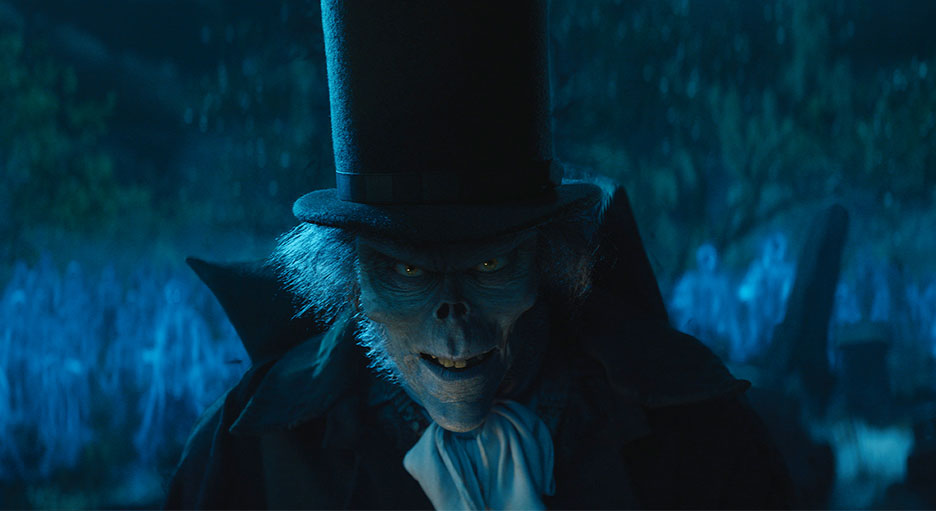
The Hatbox Ghost in Haunted Mansion.
The Hatbox Ghost, performed by Jared Leto. (Credit: Disney)

For nearly 40 years, Industrial Light & Magic has had a close relationship with Disney Parks. They have not only created visual effects for attractions themselves, from Captain EO and Star Tours in the 1980s to Star Wars: Rise of the Resistance and Guardians of the Galaxy: Cosmic Rewind in recent years, but have also worked on feature film adaptations of attractions such as Pirates of the Caribbean: Curse of the Black Pearl (2003) and Jungle Cruise (2021).

2023’s Haunted Mansion is another adaptation of a beloved attraction, which first premiered at Disneyland in 1969 and later at Walt Disney World in 1971. Director Justin Simien brought distinctly apt qualifications to the project, having worked as a Disneyland Resort cast member during his film school days at Chapman University. “Whenever I was in Disneyland, it was like being inside of a movie,” he tells ILM.com. “I would go on the rides over and over again, and I’d get chills in the same spots and catch my breath in the same places. I realized that this was cinema. It’s a theme park that’s physically happening around me, but the tools of the trade are the same.

“There’s production design, sound design, lighting, dialogue, character, and story,” Simien continues. “It sounds like something you’d say in a press interview, but it’s true – I remember going on The Haunted Mansion and Pirates of the Caribbean and thinking, ‘I need to figure out how to translate this to what I want to do as a filmmaker.’ Walt Disney and his artists brought us into these fantasy places. That’s the art. That’s the thing I needed to figure out. So for me, it all felt very complementary. Working at Disneyland was just another way of escaping into the movies.”

Simien’s approach to bringing Haunted Mansion to the screen was as complex as the vision of the attraction’s original creators. “I was really fascinated by the constant conversation that the Imagineers had about how scary it should be or how funny it should be,” Simien comments. “It was such an interesting way to make something unique. It’s not horror in the traditional sense. You’re not walking through a haunted house at Universal Horror Nights or something like that. But it’s not straightforward Disney either. It’s very subversive and there’s a lot of hidden, kind of dark stuff going on.”

Jamie Lee Curtis as Madame Leota approaches the Mansion’s front door with a bluescreen extension behind her.
 Jamie Lee Curtis as Madame Leota approaches the Mansion’s front door with a bluescreen extension behind her. (Credit: Justin Simien/Disney)

Simien and his team were able to visit the Disneyland Haunted Mansion in the off-hours, where current Imagineers helped them to understand its distinct narrative brilliance. “When you’ve made your way up through the Mansion, you’ve turned a corner, and you’re looking down into the dining room,” Simien explains. “All of the swirling dancing ghosts are there and ghost heads are coming out of the organ. It’s a culmination of all the different effects in the ride, the Pepper’s Ghost effect in particular. Even as an adult, when I know how it’s done, it takes my breath away. There are a couple of moments in the movie where we’re working from the same point of view. We pay homage. The ride has this build-up with specific timing and pacing.”

Simien took his cinematic leads from works in the 1980s and ‘90s, such as Ghostbusters (1984) and Little Shop of Horrors (1986) and the films of Tim Burton. He also went back to source material shared by the Disney Imagineers, including Robert Wise’s The Haunting from 1963. “There are so many parallels in the production design of that movie and the attraction,” he notes. “You see very subtle elements in our movie that are like that. There are slanted mirrors and shots where you look through a doorway and it’s a kind of off-angle. You get a claustrophobic ‘things are not right with the world’ feeling without really doing anything, just designing things a certain way.”

From a visual effects standpoint, Simien envisioned a mix of practical and digital techniques. “I wanted as many practical effects as I could get,” he says, “which I knew was always going to be a battle [laughs]. The movie is so fantastical. This wasn’t a typical horror movie where you hide the monster. It’s a Disney movie. There’s an expectation that you’ll get to see the ghosts. I wanted them to have a physicality, to be people in make-up and costumes moving on wires. We needed to ground the movie as much as possible in those things.”

ILM was one of multiple effects vendors on the project, and initially planned to contribute a modest sum of around 400 shots, overseen by Sydney-based visual effects supervisor Bill Georgiou and visual effects producer Arwen Munro. American-born, Georgiou spent nearly 15 years at Rhythm & Hues, climbing the ranks from rotoscope artist to compositing supervisor and sequence supervisor. He later worked as the onset visual effects supervisor on the DisneyXD program, Mighty Med, before joining ILM and moving to Australia in October 2021.

Coincidentally, Georgiou was an apt choice for Haunted Mansion, having known production visual effects supervisor Edwin Rivera for many years at Rhythm & Hues, not to mention Justin Simien himself. They had met through a mutual friend, editor Phillip Bartell, who cut Simien’s Dear White People (2014), as well as Haunted Mansion. “Edwin is very supportive and collaborative,” Georgiou tells ILM.com. “At the beginning, we were doing mostly set extensions, which is pretty straightforward. I think that he and Justin were impressed by the level of photorealism we were able to achieve, especially with the Mansion. Every shot of the Mansion has some CG, including the grounds around it. Another vendor, DNEG, was also doing some interior work, and we’d help create the views out the windows.”

Initially, Georgiou’s Sydney team worked only with ILM’s former Singapore studio, which being closer in time zones, shared the same schedule. “ILM has the best of the best,” Georgiou says. “Everyone was an amazing collaborator and shared their opinions. It was very open.” Principal photography had taken place in Georgia back in the United States, where ILM’s Andrew Roberts acted as onset visual effects supervisor. Georgiou and Munro also made a visit to Los Angeles to meet directly with the client, something Georgiou describes as essential to their continued partnership as the workload grew unexpectedly.

Reshoots would require further effects work involving an elaborate scene at the movie’s climax, where Ben (LaKeith Stanfield) confronts the villainous Hatbox Ghost (Jared Leto). “All of a sudden, we had more than twice as many shots as we started with,” Georgiou explains, “a CG human-like ghost character, and digi-doubles. It became an immense project, with over 1,000 shots. With a very short schedule, I think ILM knocked it out of the park. We had about 700 new shots, and Sydney became the hub for London, Vancouver, and San Francisco, as well as an additional vendor, Whiskytree. It became a global team. For my first real experience starting a project from the beginning at ILM, it was one of the best.

“When I first started on Stuart Little in 1998,” Georgiou continues, “one of the compositors who came in was R. Jay Williams, and he ended up being a senior compositor on Haunted Mansion [out of ILM San Francisco]. He had taught me so many things as a young roto artist, one of which was how to be nice to everybody. He always said hello and goodbye to everybody, one of the nicest, classiest people I’ve met in the industry, and I was able to finally tell him that on this project. It was so cool.”

During principal photography, a large portion of the Mansion was constructed as a physical set. “Mentally, psychologically, it was important to have a real mansion to shoot in,” Simien explains. “We could all get used to that physical space.” Other portions of the house incorporated bluescreen, including the sequence when Ben enters the ghost realm, a sort of alternate dimension within the Mansion where the hallways shift and rotate. This was amongst the work ILM received in the additional batch.

Actors Chase Dillon (left) and LaKeith Stanfield onset behind the first-floor exterior of the Mansion.
Actors Chase Dillon (left) and LaKeith Stanfield onset behind the first-floor exterior of the Mansion. (Credit: Justin Simien/Disney)

“It was quite interesting work,” Georgiou says. “Not only were we matching scans of the hallway reference that had been captured onset, but we were also matching the look to some of the previous work that DNEG had done. We then created animation for the rotations and how they would section off. The way they’d filmed onset with bluescreen was really well done, which made our work easier. The lighting was a challenge because there are candles and sconces on the wall, so you have these pools of light. The D.P. [Jeffrey Waldron] had very specific notes about how it should look. The chandeliers are swinging. Many puzzles to figure out, which is one of the best parts of visual effects. Overall, that sequence was one of the most successful, and it’s so cool that they used it in the poster.”

Of course, the appearance of 999 happy haunts would be the core element of Haunted Mansion’s visual effects. “Edwin Rivera used this term, ‘ectoplasmic effervescence’ for the ghosts, which has a Ghostbusters feel to it,” explains Georgiou. “It was fun to look through the history of cinema to find inspiration, but also figure out how we wanted to do things differently and create something that was fresh. Justin has such an incredible cinematic vocabulary. He’s looking at Kubrick and Hitchcock, and you can see that in how he’s framing shots. I felt like I was gaining plenty of knowledge.”

Another reference for Georgiou was Poltergeist (1982), one of ILM’s first client productions. “Poltergeist was very influential for me, especially when we were creating these skeletal ghosts that fly around. That was all connected to Poltergeist and the style they used for the ghost who comes right to camera. It feels really light-based but then there’s a skeleton face. Also, the way they use flares in Poltergeist was very influential for the last sequence of Haunted Mansion.”

A number of the prominently featured ghosts were performed by actors in costume and make-up. At times, ILM used digital doubles to replace them, each of which had to be modeled and textured. Others were entirely created with computer graphics, including the swarm of skeletal ghosts in the finale, which were original designs by the ILM Art Department. “The ghosts had a sort of x-ray feel to them,” says Georgiou. “It wasn’t a straightforward bone texture. We had to come up with how they glowed, both in day and night environments. They all had various types of clothing. Some had armor, or robes, or hoods. With all that comes a lot of creature work to get the costumes flowing properly. Then there are shots with hundreds and hundreds of them, as many as 600 or 700 at a time, which required crowd work. Our animation crew did hero shots, and they had the best time animating them. When they flank the Hatbox Ghost, they aren’t just standing there, but they’re chomping their teeth or doing little things with their hands. It’s subtle but it’s all there.”

A CG ghost moves through the Mansion’s library.
A CG ghost moves through the Mansion’s library. (Credit: Disney)

The fan-favorite Hatbox Ghost is part of the lore of the Disney Parks attraction, and as the film’s chief villain, many different components went into his creation. “On the set, we had a great stuntperson named Colin Follenweider,” explains Simien. “We spent a lot of time discussing the physicality of the Hatbox Ghost, why he would walk a certain way. So he was in a suit on the set with a blue face. Then with Jared [Leto], we captured his voice. Then all of that goes into a blender at ILM where we have a team of animators fine-tuning every aspect of the performance. It’s a real amalgamation of a few different traditions.”

Georgiou explains that ILM’s fellow vendor, DNEG, had created the initial character model to produce an early batch of shots. “But it was never meant to be seen in bright lighting or anything like that,” he continues. “Every plate had the stunt actor. A human face with flesh and skin is very different from a more skeletal face. We had to figure out things like, how does the neck work? A skeletal neck wouldn’t fit around the wide neck of a human stunt performer. We were able to hide a lot of that behind the scarf he’s wearing. We had to figure out how the hat sat on his head. Onset, it was a little too low, but if it was too high, it looked more like a cowboy hat. There were a lot of challenges.

“Then there’s the clothing,” Georgiou continues. “In that final sequence, the earth is breaking apart, all of these ghosts are rising up. He has 999 ghosts, and he’s trying to get the last one so he can bring the ghost realm into the human realm. There’s a lot of shaking and wind. The stunt actor was on wires, and the clothing didn’t have much movement. In some shots, we kept the body and clothing and did a face and hat replacement. For around half of the shots we used a fully-CG Hatbox Ghost. The look development team worked very hard to match it to the actor onset. It’s pretty seamless.”

The Hatbox Ghost attempts to pull Ben into his ghostly realm.
The Hatbox Ghost attempts to pull Ben into his ghostly realm. (Credit: Disney)

Georgiou explains how the character model was given new animation controls for his expanded performance. “We built that whole rig and made small controls for the wrinkles under the eyes, really small details in the face. It was really exciting. Our animation supervisor, Chris Marshall, helped us develop a lot of the facial performance for the Hatbox Ghost. I can’t wait to do another character like that.

“I kind of grew up doing shows like Garfield, Scooby-Doo, The Lion, the Witch, and the Wardrobe, and The Golden Compass where there are so many different types of visual effects,” Georgiou continues. “Haunted Mansion is very similar. We had ocean surfaces, a tsunami wave in an apartment along with its destruction, both interior and exterior. There were various effects elements, set extensions, digital doubles, crowd work, so many different kinds of shots. The Hatbox Ghost was a dream come true. Doing CG characters and placing them in live action was what I was raised on. It was a great opportunity to work on it. I’m so proud of our entire team. We have some incredible artists and I was the one who was lucky to be able to work with them.”

For Simien, the chance to tell a fantasy story laden with visual effects fulfilled his childhood dreams. “I grew up on effects-heavy films,” he says. “I’d lose myself in Star Wars, Star Trek, and X-Men. There wasn’t language for being a filmmaker when I was a kid. No one in my family talked about being a director. But what I would do is get home with the house to myself (I was a latch-key kid), put on a John Williams soundtrack, and pick up action figures and make them fight in these epic battles. I’d keep one eye closed to control the depth of field [laughs]!

“I didn’t know that I was directing,” Simien concludes. “I didn’t know that was a thing you could get paid for, but that’s what I did for fun. Having that big canvas is just part of my DNA. My first film was made for just over a million dollars, but it looks like it was made for more. To me, scale and cinematic spectacle is part of the fun of it. No matter what kind of story I’m telling, whether it’s something small and emotional or big and crazy like Haunted Mansion, I’m always going to push to see more in the world.”

The Hatbox Ghost takes his final plunge.
The Hatbox Ghost takes his final plunge. (Credit: Disney)

Read about Skywalker Sound’s work on Haunted Mansion, including more from director Justin Simien.

_

Lucas O. Seastrom is a writer and historian at Lucasfilm.

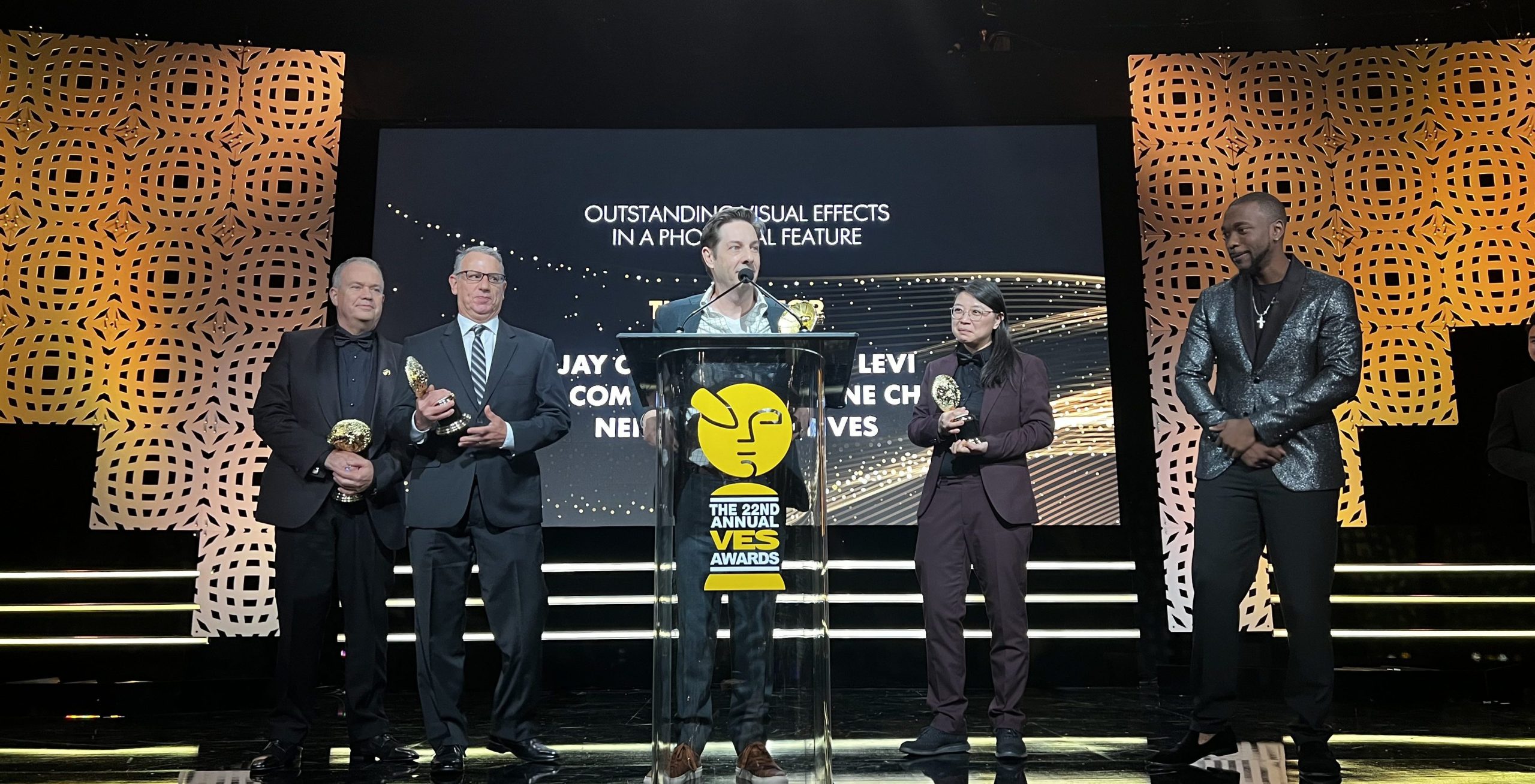
Wednesday evening, the Visual Effects Society (VES), the industry’s global professional honorary society, held the 22nd Annual VES Awards, the prestigious yearly celebration that recognizes outstanding visual effects artistry, and innovation in film, animation, television, commercials, video games, and special venues.

ILM’s work on The Creator earned six nominations and won four awards including the coveted top prize Outstanding Visual Effects in a Photoreal Feature, Outstanding Created Environment in a Photoreal Feature, Outstanding Model in a Photoreal of Animated Project, and Outstanding Effects Simulations in a Photoreal Feature, with a partner company winning a fifth award for the film for Outstanding Compositing and Lighting in a Feature.

ILM’s work on Darren Aronofsky’s groundbreaking film Postcard from Earth won for Outstanding Visual Effects in a Special Venue Project while The Mandalorian (Season 3) won for Outstanding Effects Simulations in an Episode, Commercial, Game, Cinematic or Real-Time Project.

“It’s a true testament to our amazing global teams that our work was honored by our industry colleagues on the winning shows noted above as well as the ILM shows that were nominated, including Indiana Jones & The Dial of Destiny, Ahsoka, Willow, Mission: Impossible, Dead Reckoning Part One, Dungeons & Dragons: Honor Among Thieves, Napolean, Killers of the Flower Moon and Guardians of the Galaxy, Vol. 3” said Janet Lewin, ILM General Manager, “I couldn’t be more proud of our teams.” 

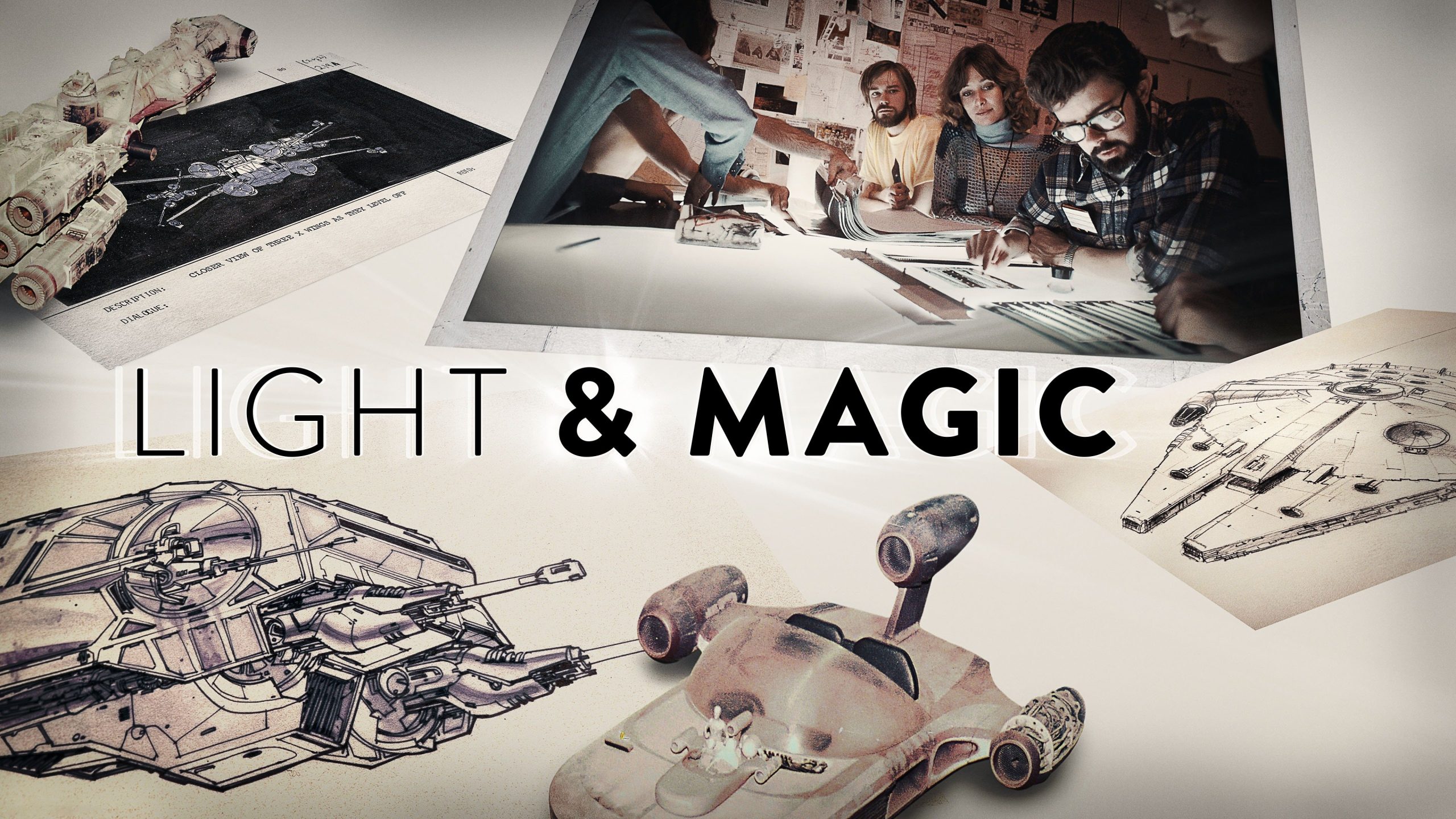
The filmmaker and Lucasfilm legend talks to ILM.com to reflect on what drew him to tell the story of the hit Disney+ series, “Light & Magic”.

Screenwriter and director Lawrence Kasdan.

How did you get involved with Light & Magic?
Several years ago my wife and I made a short documentary about a little diner that we used to eat at all the time that suddenly closed. In making that documentary with her, and cutting it with terrific people, it made me realize how much I liked the documentary format. I had never done that. We set out to meet some documentary people and I met Justin Wilkes at Imagine Entertainment. He asked me what I was interested in doing and I suggested a history of visual effects, because even though I had been around visual effects throughout my career, it occurred to me that I didn’t know much about them. The second thing that interested me were the people of Industrial Light & Magic that I had been working around for over forty years. So we both agreed that that would be a great story to tell: the history of visual effects, and the personal stories of these people. What drove these people, what was their life like, what made them want to stay at ILM as long as they did? Everyone loved the idea, so we went to work.

Lawrence Kasdan, center, on the set of Star Wars: The Empire Strikes Back.

What was your vision for the documentary?
From my very first film until today, I’ve always considered myself a humanist filmmaker. I’m interested in what happens between people, and why people make certain decisions in their lives. What chance is involved? What fate? What luck? So from the very beginning of this I was interested in learning what brought these people to this work. What were the relationships that they made when they arrived? Why did they continue to work there much longer than they expected, some for nearly half a century? What has all that meant to these amazing advancements in technology? It’s about people, and their gifts, and out of those gifts came technological advancements that boggle the mind.

Dennis Muren, left, and Phil Tippett, right, review images with Joe Johnston.

Why did you think this story should be told?
Because it’s great to see artists at work. The commitment of great craftsmen. I love to see people that have mastered a skill, and try to make it better, and don’t settle. I think it’s great to see expertise and this pure devotion to discipline, and that is always a good story to see. Dennis Muren, left, and Phil Tippett, right, review images with Joe Johnston.

John Dykstra and a fleet of miniature TIE, X-wing, and Y-wing starfighters.

How did you approach the research, and what resources did you use?
We had a fabulous team that Imagine Documentaries put together, some internal to the company, and some that were freelancers. They really knew their stuff, so it was a great luxury for me as a director. There were so many things that I wanted to ask during interviews, but the input from this incredible group of producers and writers and editors stimulated me all of the time to go in different directions during interviews.

ILM’s Paul Huston and Larry Tan on the set of Star Wars: Return of the Jedi.

For those that have yet to watch it, can you tell readers what the timeline of the series is?
Over the six hours we see the very birth of ILM, what happened as it came together during the production of Star Wars: A New Hope, and then off of the success of that film, how it was launched into a nearly fifty-year enterprise. We mainly follow it chronologically, but we do jump around a bit to serve the story. Part of the kick for me was that we had such a trove of archival footage, so these people might be talking about something from forty or fifty years ago, and we had stills from that moment in their career. It was incredible to be able to cut from one to the other across time, to hear them talking about a problem, and then see footage of them finding a solution. A huge part of ILM’s legacy is finding solutions to problems.

Peter Kuran, Rose Duignan, and George Lucas review effects shots for Star Wars: A New Hope.

How did you select the filmmakers that were featured in the documentary?
They are all giants, and they have all used ILM in the most expressive and innovative ways. They put pressure on themselves and then turned to ILM and said, “can you do this? Can you create something for me that I have never seen before?” ILM would always say yes. And sometimes it might be a struggle, and sometimes it might be a long process, and sometimes it might be an instantaneous solution where one of these genius people that work there would say, “I know what we could do”. These are major filmmakers that have contributed to the zeitgeist. Jim Cameron, Steven Spielberg, Bob Zemeckis, J.J. Abrams, and at the heart of it, of course, is George Lucas.

Lawrence Kasdan and J.J. Abrams on the set of Star Wars: The Force Awakens.

What was the most interesting thing you learned throughout the process of creating Light & Magic?
I think I learned what goes into creating something new, working with people you respect and depend on, and how this personal relationship then impacts the professional work. There is something beautiful about the generosity of the people that work at ILM, and through that generosity they are able to discover new frontiers and break new grounds that no one has ever been able to do.

All episodes of Light & Magic are streaming now on Disney+.

ILM | A legacy of innovative and iconic storytelling.

“I wanted to make sure we brought the magic back to the ILM logo,” noted John Knoll, Industrial Light & Magic’s Executive Creative Director, participating in one of the dozens of interviews completed over the course of the fourteen-month rebranding project for the renowned visual effects and animation studio founded by George Lucas. 

“We wanted our new branding to pair closely with ILM’s mission statement, We are visual storytellers who create iconic moments to inspire the imagination”, explained Janet Lewin, SVP General Manager, ILM, “At ILM, we prioritize our culture of collaboration and community and we truly value innovation and quality. These core ideals allow us to confidently take risks and embrace the unknown on the challenging projects we seek out.”

Knoll was one of over a thousand ILM employees who provided input to twin sisters Amy and Jen Hood who own the Southern California brand identity and type design studio, Hoodzpah. As part of their exploration of ILM, its employees, its legacy, and its values, the interviews revealed fascinating insights into the company and how it has managed to keep both its creative team inspired and its technology on the cutting edge of innovation for nearly five decades. Knolls’ sentiment struck a chord and it became an oft-referred phrase as the Hoodzpah team collaborated with a core group of ILM leaders on how best to capture the company’s incredible legacy while building a unique identity system that would serve it well into the future.

“ILM has several different logos in the past forty-eight years,” explained Rob Bredow, SVP and Chief Creative Officer for ILM, “and all have incorporated the core elements from the company’s original logo, the famous wand-wielding magician framed by a large gear with the letters ‘ILM’ originally illustrated by Michael Pangrazio in the late 1970s and later finalized in a painting by renowned artist, Drew Struzan. The company and the industry have evolved substantially in the past eighteen years and we felt the time was right to develop a new brand identity that captured the global studio we’ve become.”

Now with six global studios—San Francisco, Singapore, Vancouver, London, Sydney, and Mumbai—ILM has not only revolutionized the field of visual effects with groundbreaking innovations in digital effects, performance capture, previsualization, and digital humans, and has most recently innovated in areas as diverse as real-time rendering, immersive entertainment, and virtual production with it’s Emmy Award-winning StageCraft platform.

Hoodzpah began the assignment by getting to know the company through individual and group interviews with key members of ILM’s leadership team and representatives of the employee base across all strata of the studio and each of ILM’s globe locations. Then came the task of distilling the information into key learnings. “It was remarkable given the sheer number of people we interviewed that there was such cohesion in terms of what the employees felt the brand represented and where they aspired to be,” said Jen Hood.

The new dynamic glyph and custom wordmark combine to draw from the company’s illustrious legacy while carrying it into the future. Amy Hood, explained, “The mark utilizes negative space within the silhouette of a gear giving the impression of a lightbulb contained within, both elements existed in the company’s original logo by Pangrazio and Struzan. We incorporated a swoosh trailing a spark of magic in the new mark which represents the global nature of ILM’s talent base and studios. Paired with the mark is the Industrial Light & Magic wordmark designed and set in a bold customized serif face evocative of the abbreviated type in the company’s original logo.” The team also developed updated logos for sub-brands ILM Art, ILM StageCraft, ILM Technoprops, and ILM Immersive (formerly ILMxLAB). The supporting visual identity uses cinematic colors inspired by ILM projects over the years, as well as bold type, and stark minimal layouts. The rebrand scope spanned deck templates, social media assets, a new homepage redesign, logo animations, swag, and more.

Now in its 48th year of existence, ILM continues to be a creative partner to storytellers and filmmakers alike. The talented artists, technicians, and production teams ensure that the company remains on the cutting edge as they continue to develop new techniques and technologies that allow audiences the world over to be immersed in the visuals and experiences the company helps to create.

Six-Part Docuseries Debuts Exclusively on Disney+ July 27

Disney+ released the trailer and key art for Lucasfilm and Imagine Documentaries’ “Light & Magic,” an immersive series that chronicles the untold history of world-renDisney+ released the trailer and key art for Lucasfilm and Imagine Documentaries’ “Light & Magic,” an immersive series that chronicles the untold history of world-renowned Industrial Light & Magic (ILM), the special visual effects, animation and virtual production division of Lucasfilm.

Granted unparalleled access, Academy Award®-nominated filmmaker Lawrence Kasdan takes viewers on an adventure behind the curtain of Industrial Light & Magic. Learn about the pioneers of modern filmmaking as we go on a journey to bring George Lucas’ vision to life. These filmmakers would then go on to inspire the entire industry of visual effects.  

The series is directed by Lawrence Kasdan, and the executive producers are Ron Howard, Brian Grazer, Justin Wilkes, Lawrence Kasdan, Kathleen Kennedy and Michelle Rejwan. 

All six episodes of “Light & Magic” premiere on July 27, exclusively on Disney+.

Twitter@DisneyPlus@ILMVFX
Instagram@DisneyPlus@ILMVFX
Facebook@DisneyPlus@ILMVFX
TikTok@DisneyPlus
Hashtag: #DisneyPlus

ABOUT DISNEY+

Disney+ is the dedicated streaming home for movies and shows from Disney, Pixar, Marvel, Star Wars, and National Geographic, along with The Simpsons and much more. In select international markets, it also includes the new general entertainment content brand, Star. The flagship direct-to-consumer streaming service from The Walt Disney Company, Disney+ is part of the Disney Media & Entertainment Distribution segment. The service offers commercial-free streaming alongside an ever-growing collection of exclusive originals, including feature-length films, documentaries, live-action and animated series, and short-form content. With unprecedented access to Disney’s long history of incredible film and television entertainment, Disney+ is also the exclusive streaming home for the newest releases from The Walt Disney Studios. Disney+ is available as a standalone streaming service or as part of The Disney Bundle that gives subscribers access to Disney+, Hulu, and ESPN+. For more, visit disneyplus.com, or find the Disney+ app on most mobile and connected TV devices.

MEDIA CONTACTS

Disney+ Media Relations
Shelby Cotten
Shelby.b.cotten@disney.com

Walt Disney Studios Global Publicity
Global Publicity (NY)
Derek Del Rossi        
derek.del.rossi@disney.com

Lucasfilm Publicity
Ian Kintzle 
ikintzle@ilm.com

Join employees across Industrial Light & Magic, Lucasfilm, ILMxLAB, and Skywalker Sound as they share stories on discovering their passions, beginning their careers, and the challenges and satisfactions of working in their current roles and departments. We hope their personal stories and recommendations inspire the next generation of young artists to break into and make their impact on the entertainment industry.

To learn more about Get in the Door, visit GetInTheDoorProject.com and watch the trailer below.

The Hollywood Professional Association announced the nominees for its annual HPA Awards for post-production, an honor that promotes outstanding creative artistry, and recognizes the achievement of talent, innovation, and engineering excellence. ILM is thrilled to have contributed to three shows nominated in the Outstanding Visual Effects category this year. Nominees include Richard Bluff, Hal Hickel, Jeff Capogreco, Abbigail Keller, and Joe Bauer for The Mandalorian – “Chapter 9: The Marshal”, David Seager, Alexandra Greene, George Kuruvilla, Dan Mayer, and Dan DeLeeuw for Loki – “Journey Into Mystery”, and Chad Wiebe for his work on Jungle Cruise.

“It is an absolute honour to have been nominated for our work,” said Alexandra Greene, Visual Effects Producer at ILM. “It’s hard to put into words the gratitude I have for all the ILM artists and production crews who poured their heart and souls into bringing the “Void” to life on Loki, along with all of the larger-than-life creatures that reside there. Every day I find myself amazed by both the innovation and creativity that comes from our teams here at ILM, including the work by our fellow ILM nominees for The Mandalorian, and Jungle Cruise. Congratulations are in order!”

Janet Lewin, ILM’s General Manager and Senior Vice President notes, “I could not be more proud of the nominees and their teams that worked on these incredible shows,” adding, “I’m continually in awe of our team’s technical ingenuity, imagination, and relentless spirit, and I’m so pleased to see their hard work recognized by the HPA.”

The annual HPA Awards are returning as an in-person event this year, presented at a live gala on Thursday, November 18th at the historic Hollywood Legion Theater. Tickets are on sale now.