A streetwise NYPD detective joins a secret organization that polices extraterrestrial affairs on Earth.
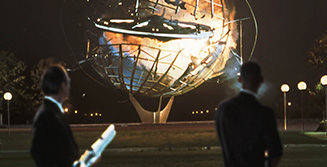
From the fully animated CG close-up of Tony Shalhoub’s head to the one-quarter scale model of the Midtown Tunnel, Men in Black required ILM to utilize every tool in their repertoire of special effects techniques. Men in Black was a unique project for ILM because of the comedic performances the CG characters had to deliver in conjunction with the technical aspects of their creation.
Through a combination of amazing models, replicas, sets, robots, and CG effects, ILM was able to successfully navigate between two eras of visual effects (physical and digital) and two genres of films (comedy and action).
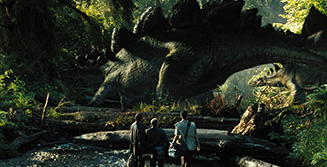
A research team is sent to the Jurassic Park Site B island to study the dinosaurs there while another team approaches with a different agenda.
The successful creature animation in Jurassic Park left no doubt that ILM could put even more digital dinosaurs into this film — herds of them, in fact — thanks to impressive new software that slid virtual skin over digital muscles. The eye-opening dinosaurs in this film solidified ILM’s leadership in creature animation.
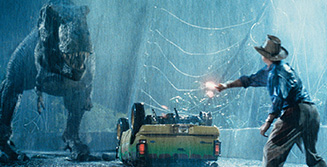
Jurassic Park represents a milestone in modern visual effects and ushered an era of films whose scripts were once thought to be impossible to film. To create living, breathing, photorealistic dinosaurs the likes of which had never been seen before, the visual effects team developed a substantial amount of new technology. From Viewpaint, a 3D texturing tool that allowed artists to paint directly on 3D models and see their results in context, to camera motion tracking, to the Dinosaur Input Device (D.I.D.) which was created in collaboration with Phil Tippett, Randal Dutra, Tom St. Amand, and the team at Tippett Studios and used to bridge the gap between traditional stop motion animation and CG animation there were numerous breakthroughs on the film.
No one had put living, breathing synthetic animals in a live-action movie before; creature animation had always been mechanical and animatronic. Before Jurassic Park, animators had never even tried to reproduce real animals digitally for a feature film. But ILM showed Steven Spielberg a test created by CG artists Steve “Spaz” Williams and Mark Dippé with digital dinosaurs, and they looked so natural and moved so freely that there was no turning back.
The breathtaking shots of dinosaurs walking through a field and placidly eating leaves from the tops of trees have become milestones in visual effects and in filmmaking. Suddenly, directors could imagine making films in which realistic animals, fantasy creatures, even digital people could perform without restraint.
This project marks a major advance in digitally simulating living organisms. The various software breakthroughs allow for unprecedented freedom in the digital compositing of CG creations and live-action film. For the first time, all restrictions on camera movement in background plates are removed, thanks to such software tools as Softimage. Jurassic Park is the first major film to use this commercial 3-D animation package. The film also pioneered work in the field of film input scanning.
Although ILM created fewer than 60 shots of the fully CG dinosaurs they remain a huge part of what makes the film so memorable.
The film won the 1993 Academy Award® Winner for Best Visual Effects and as well as the BAFTA Award for Best Special Visual Effects.
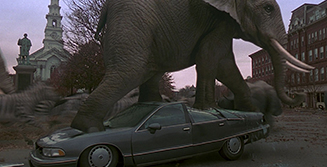
Robin Williams and Kirsten Dunst star in this blockbuster hit and critical favorite that combines magical special effects with an entrancing mix of fantasy, adventure, and comedy. Young Alan Parrish sits down as a young boy to play a game with his friend, Sarah, and on a roll of the dice is mysteriously transported into the strange jungle realm of Jumanji. There he remains trapped for 26 years, until two newly orphaned children, Judy (Dunst) and Peter (Bradley Pierce), playing in the attic of Alan’s childhood home, free the now-adult Alan (Williams) from the game’s clutches.
Among other effects, ILM was tasked with creating a stampede of rhinos, elephants, and birds, and mischievous monkeys wielding knives, all created with computer graphics, and the Parrish house that is literally torn apart – Created as a large-scale model built in the ILM Model Shop and shot against bluesceen.
When his young children are abducted by his old nemesis Captain Hook, middle-aged lawyer Peter Banning returns to his magical origins as Peter Pan.
With 200,000 accumulated work hours, the film is only second to Return of the Jedi for the most time-intensive ILM production in the company’s first 15 years of business.
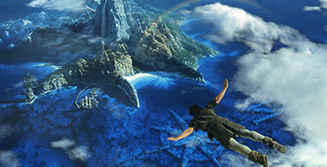
The film is notable for featuring the first-ever dimensional matte painting — where a traditional matte painting painted by Yusei Uesugi was mapped onto 3D geometry by Stefen Fangmeier, allowing for camera parallax and resulting in a truly spectacular shot of Pan flying towards the magical landscape of Neverland.
Tinkerbell’s fluttering wings were nine-inch plastic devices built by the ILM Model Shop and photographed separately. Go-Motion animation created their flapping effects.
Hook would go on to be nominated in the Best Visual Effects category at the 64th Academy Awards (Eric Brevig, Harley Jessup, Mark Sullivan and Michael Lantieri).
Slow-witted Forrest Gump, never thinking of himself as disadvantaged, leads anything but a restricted life.
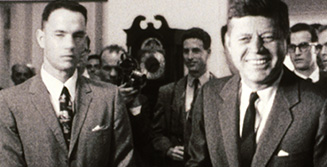
ILM broke new ground in weaving archival footage seamlessly into the film’s story, allowing Forrest Gump to shake hands with Presidents Nixon, Johnson, and Kennedy.
A variety of “invisible” effects were also created for the film, including the now iconic falling feather, the transformation of Lieutenant Dan into a double amputee, scenes of war in Vietnam, crowds in the National Mall, the Olympic ping pong battle, and filling an Alabama football stadium with raucous fans.
ILM’s effects team was honored with the Academy Award® for Visual Effects in 1994.
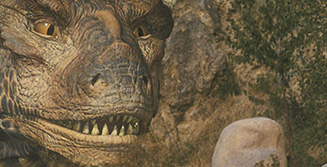
ILM further developed its breakthrough facial animation software, Caricature, to make Draco come to life for this film. The technology became a big stepping stone at ILM, impacting many of its digital characters for years to come. For ILM, the project lasted about two years, with a mixture of practical and digital effects including a full-sized puppeteer dragon built by ILM’s renowned Creature Shop. ILM’s Caricature Animation System would later be recognized with an Academy Award® for Technical Achievement.
Kurt Russell and William Baldwin are two feuding siblings carrying on a heroic family tradition as Chicago firefighters in this acclaimed suspense story filled with some of the most awe-inspiring fire sequences ever captured on film.
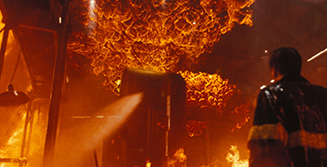
ILM contributed to a number of critical shots for the film — cutting seamlessly with the onset special effects supervisor and cinematographer’s incredible work — and its miniatures, matte paintings, and live action elements were combined to create the magnificent imagery of a burning, collapsing rooftop. The ILM team was honored with an Academy award for Best Visual Effects for their work.