
Mumbai News

50 Years | 500+ Film and TV credits | 135+ Awards

SINCE 1975

The filmmaker and Lucasfilm legend talks to ILM.com to reflect on what drew him to tell the story of the hit Disney+ series, “Light & Magic”.

Screenwriter and director Lawrence Kasdan.

How did you get involved with Light & Magic?
Several years ago my wife and I made a short documentary about a little diner that we used to eat at all the time that suddenly closed. In making that documentary with her, and cutting it with terrific people, it made me realize how much I liked the documentary format. I had never done that. We set out to meet some documentary people and I met Justin Wilkes at Imagine Entertainment. He asked me what I was interested in doing and I suggested a history of visual effects, because even though I had been around visual effects throughout my career, it occurred to me that I didn’t know much about them. The second thing that interested me were the people of Industrial Light & Magic that I had been working around for over forty years. So we both agreed that that would be a great story to tell: the history of visual effects, and the personal stories of these people. What drove these people, what was their life like, what made them want to stay at ILM as long as they did? Everyone loved the idea, so we went to work.
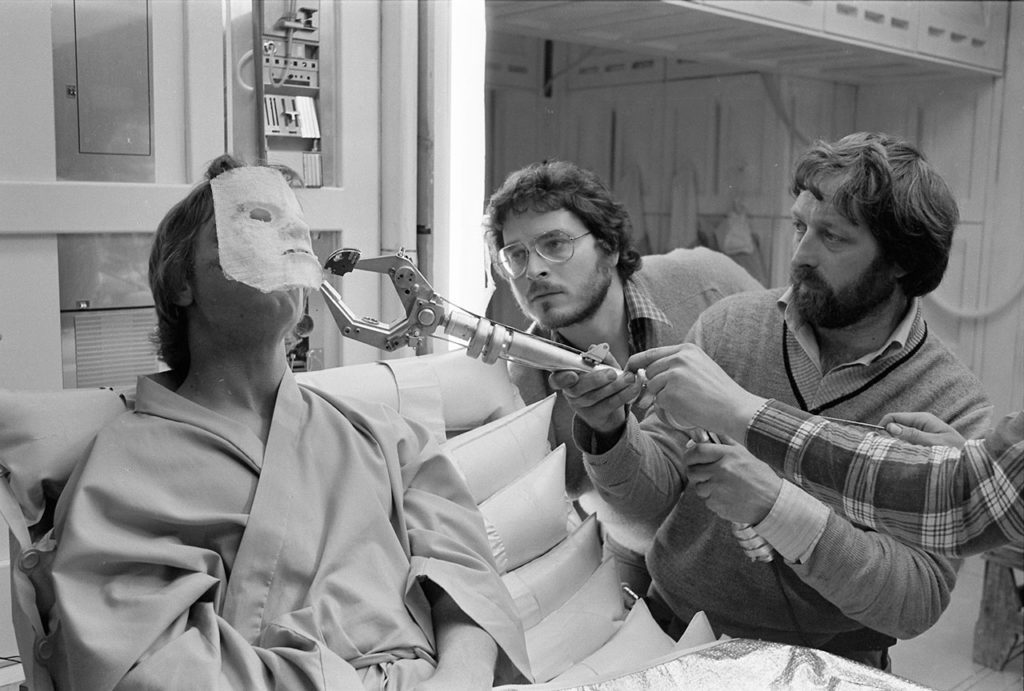
Lawrence Kasdan, center, on the set of Star Wars: The Empire Strikes Back.

What was your vision for the documentary?
From my very first film until today, I’ve always considered myself a humanist filmmaker. I’m interested in what happens between people, and why people make certain decisions in their lives. What chance is involved? What fate? What luck? So from the very beginning of this I was interested in learning what brought these people to this work. What were the relationships that they made when they arrived? Why did they continue to work there much longer than they expected, some for nearly half a century? What has all that meant to these amazing advancements in technology? It’s about people, and their gifts, and out of those gifts came technological advancements that boggle the mind.
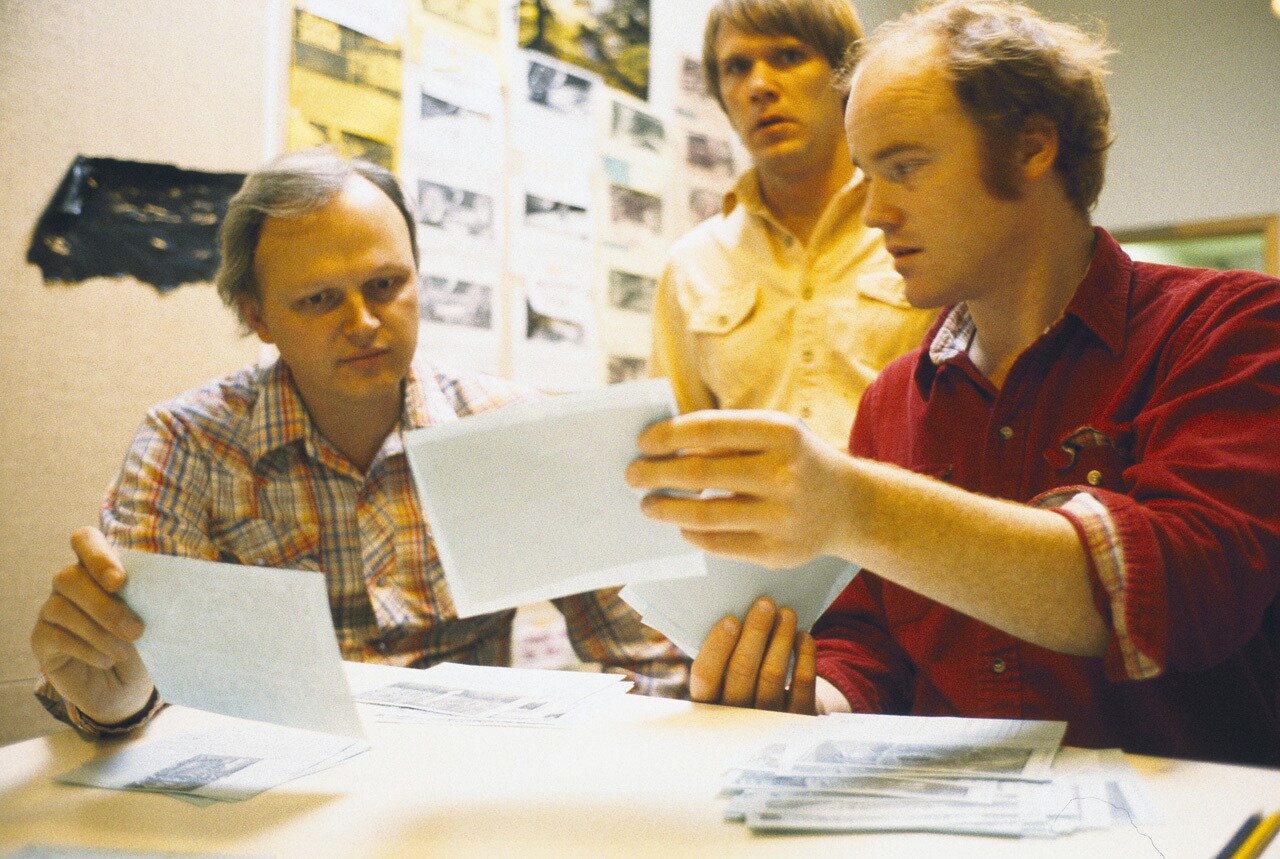
Dennis Muren, left, and Phil Tippett, right, review images with Joe Johnston.

Why did you think this story should be told?
Because it’s great to see artists at work. The commitment of great craftsmen. I love to see people that have mastered a skill, and try to make it better, and don’t settle. I think it’s great to see expertise and this pure devotion to discipline, and that is always a good story to see. Dennis Muren, left, and Phil Tippett, right, review images with Joe Johnston.
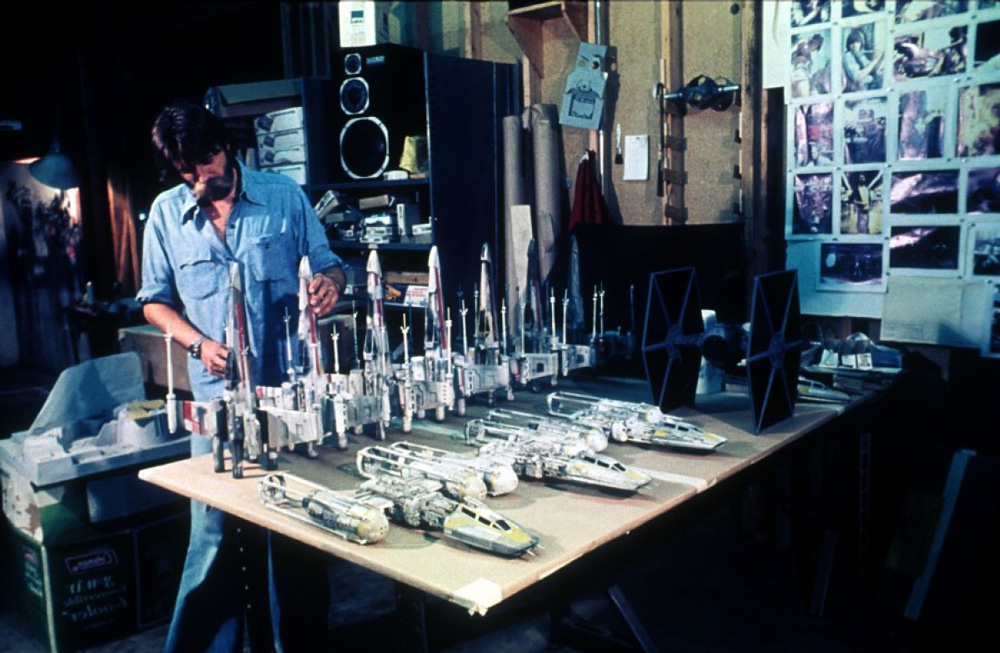
John Dykstra and a fleet of miniature TIE, X-wing, and Y-wing starfighters.

How did you approach the research, and what resources did you use?
We had a fabulous team that Imagine Documentaries put together, some internal to the company, and some that were freelancers. They really knew their stuff, so it was a great luxury for me as a director. There were so many things that I wanted to ask during interviews, but the input from this incredible group of producers and writers and editors stimulated me all of the time to go in different directions during interviews.
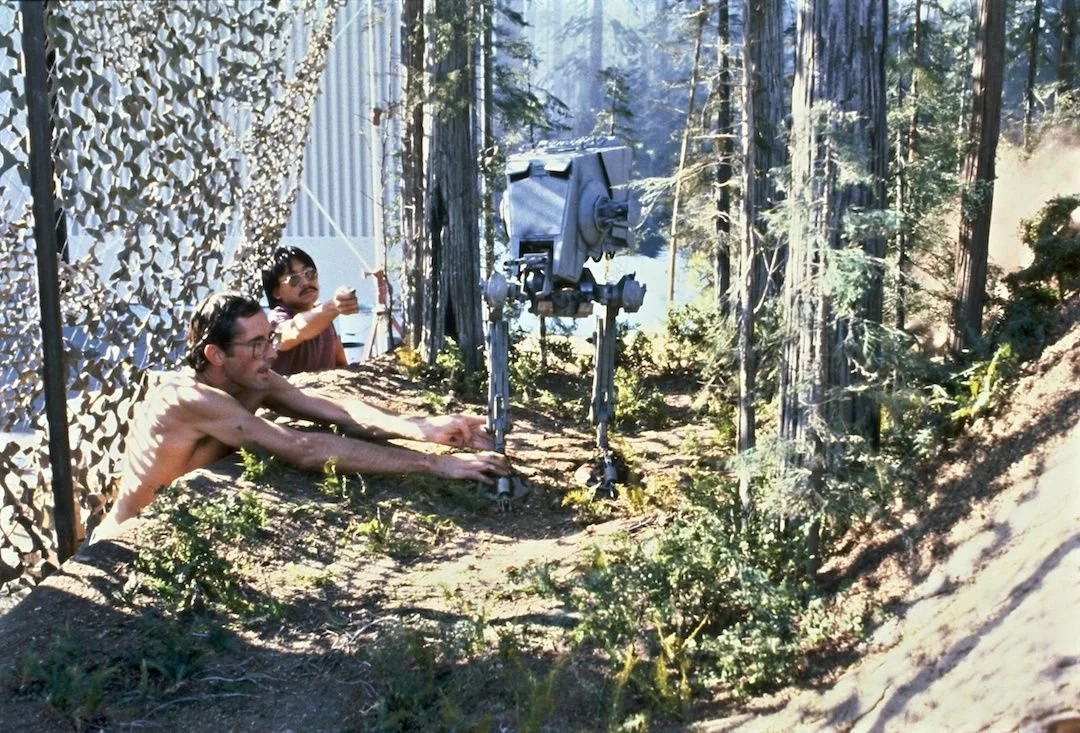
ILM’s Paul Huston and Larry Tan on the set of Star Wars: Return of the Jedi.

For those that have yet to watch it, can you tell readers what the timeline of the series is?
Over the six hours we see the very birth of ILM, what happened as it came together during the production of Star Wars: A New Hope, and then off of the success of that film, how it was launched into a nearly fifty-year enterprise. We mainly follow it chronologically, but we do jump around a bit to serve the story. Part of the kick for me was that we had such a trove of archival footage, so these people might be talking about something from forty or fifty years ago, and we had stills from that moment in their career. It was incredible to be able to cut from one to the other across time, to hear them talking about a problem, and then see footage of them finding a solution. A huge part of ILM’s legacy is finding solutions to problems.
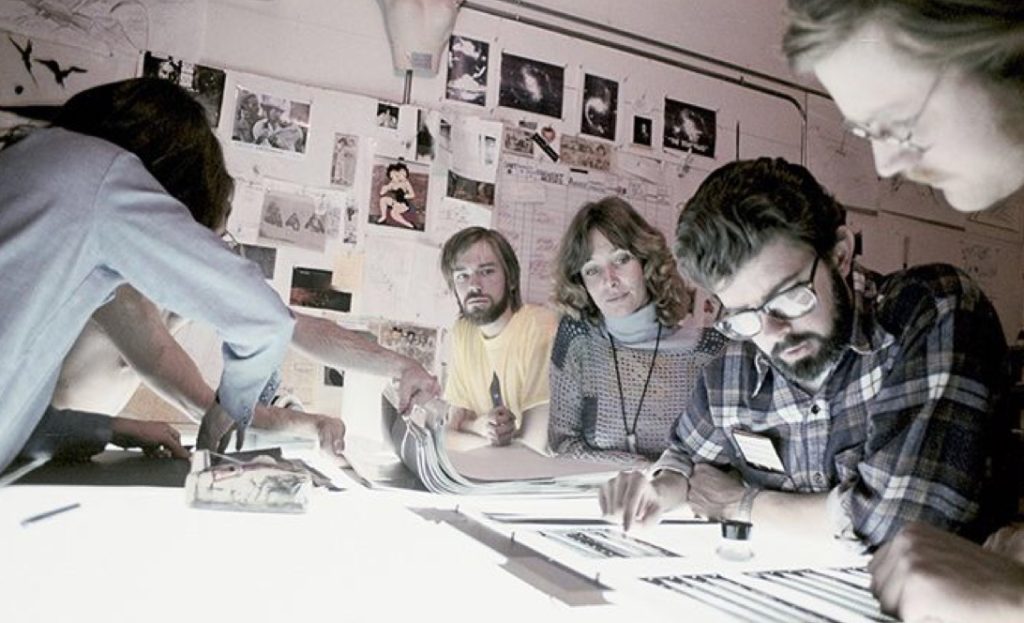
Peter Kuran, Rose Duignan, and George Lucas review effects shots for Star Wars: A New Hope.

How did you select the filmmakers that were featured in the documentary?
They are all giants, and they have all used ILM in the most expressive and innovative ways. They put pressure on themselves and then turned to ILM and said, “can you do this? Can you create something for me that I have never seen before?” ILM would always say yes. And sometimes it might be a struggle, and sometimes it might be a long process, and sometimes it might be an instantaneous solution where one of these genius people that work there would say, “I know what we could do”. These are major filmmakers that have contributed to the zeitgeist. Jim Cameron, Steven Spielberg, Bob Zemeckis, J.J. Abrams, and at the heart of it, of course, is George Lucas.
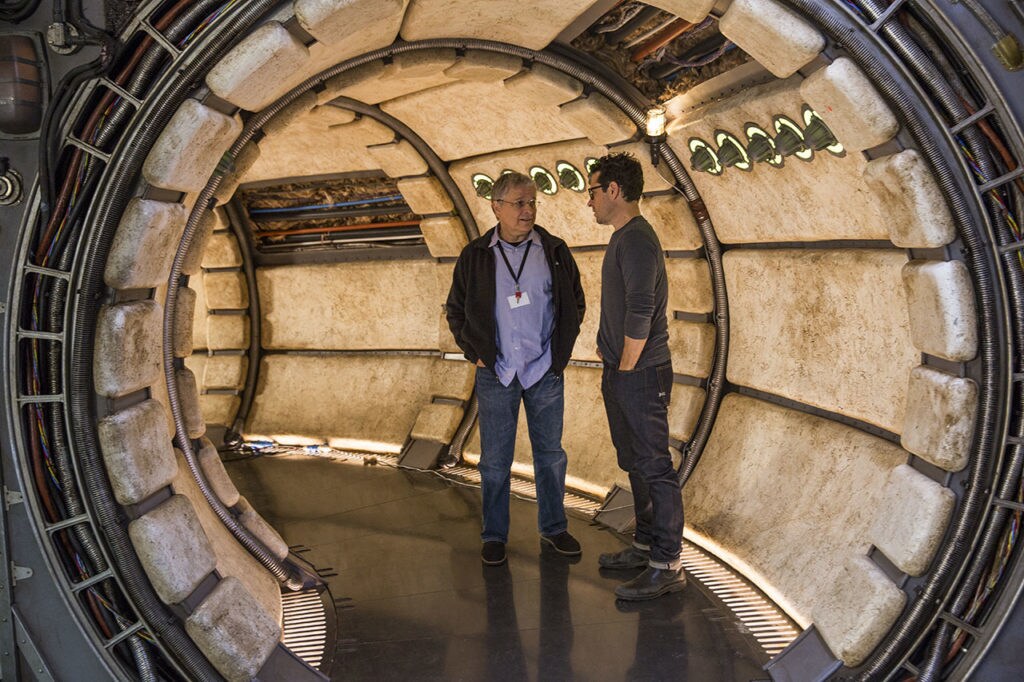
Lawrence Kasdan and J.J. Abrams on the set of Star Wars: The Force Awakens.

What was the most interesting thing you learned throughout the process of creating Light & Magic?
I think I learned what goes into creating something new, working with people you respect and depend on, and how this personal relationship then impacts the professional work. There is something beautiful about the generosity of the people that work at ILM, and through that generosity they are able to discover new frontiers and break new grounds that no one has ever been able to do.

All episodes of Light & Magic are streaming now on Disney+.

ILM | A legacy of innovative and iconic storytelling.

“I wanted to make sure we brought the magic back to the ILM logo,” noted John Knoll, Industrial Light & Magic’s Executive Creative Director, participating in one of the dozens of interviews completed over the course of the fourteen-month rebranding project for the renowned visual effects and animation studio founded by George Lucas. 

“We wanted our new branding to pair closely with ILM’s mission statement, We are visual storytellers who create iconic moments to inspire the imagination”, explained Janet Lewin, SVP General Manager, ILM, “At ILM, we prioritize our culture of collaboration and community and we truly value innovation and quality. These core ideals allow us to confidently take risks and embrace the unknown on the challenging projects we seek out.”

Knoll was one of over a thousand ILM employees who provided input to twin sisters Amy and Jen Hood who own the Southern California brand identity and type design studio, Hoodzpah. As part of their exploration of ILM, its employees, its legacy, and its values, the interviews revealed fascinating insights into the company and how it has managed to keep both its creative team inspired and its technology on the cutting edge of innovation for nearly five decades. Knolls’ sentiment struck a chord and it became an oft-referred phrase as the Hoodzpah team collaborated with a core group of ILM leaders on how best to capture the company’s incredible legacy while building a unique identity system that would serve it well into the future.

“ILM has several different logos in the past forty-eight years,” explained Rob Bredow, SVP and Chief Creative Officer for ILM, “and all have incorporated the core elements from the company’s original logo, the famous wand-wielding magician framed by a large gear with the letters ‘ILM’ originally illustrated by Michael Pangrazio in the late 1970s and later finalized in a painting by renowned artist, Drew Struzan. The company and the industry have evolved substantially in the past eighteen years and we felt the time was right to develop a new brand identity that captured the global studio we’ve become.”

Now with six global studios—San Francisco, Singapore, Vancouver, London, Sydney, and Mumbai—ILM has not only revolutionized the field of visual effects with groundbreaking innovations in digital effects, performance capture, previsualization, and digital humans, and has most recently innovated in areas as diverse as real-time rendering, immersive entertainment, and virtual production with it’s Emmy Award-winning StageCraft platform.

Hoodzpah began the assignment by getting to know the company through individual and group interviews with key members of ILM’s leadership team and representatives of the employee base across all strata of the studio and each of ILM’s globe locations. Then came the task of distilling the information into key learnings. “It was remarkable given the sheer number of people we interviewed that there was such cohesion in terms of what the employees felt the brand represented and where they aspired to be,” said Jen Hood.

The new dynamic glyph and custom wordmark combine to draw from the company’s illustrious legacy while carrying it into the future. Amy Hood, explained, “The mark utilizes negative space within the silhouette of a gear giving the impression of a lightbulb contained within, both elements existed in the company’s original logo by Pangrazio and Struzan. We incorporated a swoosh trailing a spark of magic in the new mark which represents the global nature of ILM’s talent base and studios. Paired with the mark is the Industrial Light & Magic wordmark designed and set in a bold customized serif face evocative of the abbreviated type in the company’s original logo.” The team also developed updated logos for sub-brands ILM Art, ILM StageCraft, ILM Technoprops, and ILM Immersive (formerly ILMxLAB). The supporting visual identity uses cinematic colors inspired by ILM projects over the years, as well as bold type, and stark minimal layouts. The rebrand scope spanned deck templates, social media assets, a new homepage redesign, logo animations, swag, and more.

Now in its 48th year of existence, ILM continues to be a creative partner to storytellers and filmmakers alike. The talented artists, technicians, and production teams ensure that the company remains on the cutting edge as they continue to develop new techniques and technologies that allow audiences the world over to be immersed in the visuals and experiences the company helps to create.

New Mumbai studio to provide full visual effects and animation services for film & television

Cassian Andor (Diego Luna) in Lucasfilm’s ANDOR, exclusively on Disney+. ©2022 Lucasfilm Ltd. & TM. All Rights Reserved.

Industrial Light & Magic (ILM), the award-winning visual effects division of Lucasfilm Ltd., announced today that the company is expanding its global operations. The studio, which is headquartered in San Francisco and has existing studios in Vancouver, London, Singapore and Sydney, will open a new full pipeline studio in Mumbai to gain access to the incredible talent base in the region. The Mumbai studio will be led by Kiran ‘KP’ Prasad, who was formerly head of studio at DNEG Bangalore & Chennai. Prasad will report to ILM SVP and General Manager, Janet Lewin.

Kiran Prasad, Executive in charge, Mumbai studio.

“With five global studios consistently operating at capacity and continuing to grow, the time was right for ILM to expand once again to meet the industry’s increasing demand for high-caliber visual effects,” explained Lewin. “This new full-fledged visual effects studio in India will allow us to offer even greater capacity while ensuring that we always meet the high-quality bar that our clients expect of us.” 

Rob Bredow, SVP and chief creative officer of ILM noted, “We’re excited to be building our ILM Studio in India where we can recruit the top artistic and technical talent from the visual effects industry now in India. This is the perfect time for ILM to form our sixth studio where artists will leverage our full pipeline of disciplines working across a wide variety of exciting shows – at the top quality and reliability our creative partners have come to expect from ILM.”

“ILM has always been at the forefront of technological and creative innovation in the visual effects industry and there is no better time to start our studio in India than now, as the Indian VFX industry is poised for spectacular growth in the coming years,” said Prasad. “It is exciting and an honor to be part of the ILM team at such a key moment in the VFX industry with technological developments pushing the boundaries of visual storytelling. I look forward to working with the executive team to set up the studio from the ground up, building a world-class facility, and bringing the best of the diverse Indian talent together for  an opportunity with endless possibilities.”

ILM’s last expansion effort came in 2019 with the company’s Sydney studio. That studio is currently 400 people strong and growing. Combined, the ILM global studios will grow to over 2,500 artists and will continue to offer award-winning visual effects and animation as well as concept design and development, and virtual production, with the artistry, innovation, and creative problem-solving that is the hallmark of the company. As with the other studios, ILM’s Mumbai studio will work on all projects of all shapes and sizes, including live-action and animated feature films, television, streaming, and themed attractions.

ILM will be hiring leadership, technology, support, production, and artist roles over the coming months, openings will be posted on https://www.ilm.com/careers.