
Visual effects supervisors Charmaine Chan, Andrew Roberts, and Simone Coco share their experiences working together on the on Oscar-nominated Jurassic World Rebirth.
By Amy Richau
Bringing dinosaurs to the screen for Jurassic World Rebirth (2025) required a true team effort with multiple ILM visual effects supervisors collaborating in teams around the world. While some films only require one visual effects supervisor to see the production through from start to finish, other films are just – bigger. Backing up production visual effects supervisor David Vickery, who recently talked about his work on Rebirth with ILM, were multiple visual effects supervisors from ILM, as well as others from partner studios like Midas VFX and ILP.
Charmaine Chan, Andrew Roberts, and Simone Coco talked with ILM.com about wrangling a herd of dinosaurs (both familiar and new to audiences), coordinating their individual teams’ work into one cohesive film, and the pressure of working on such a legendary franchise.
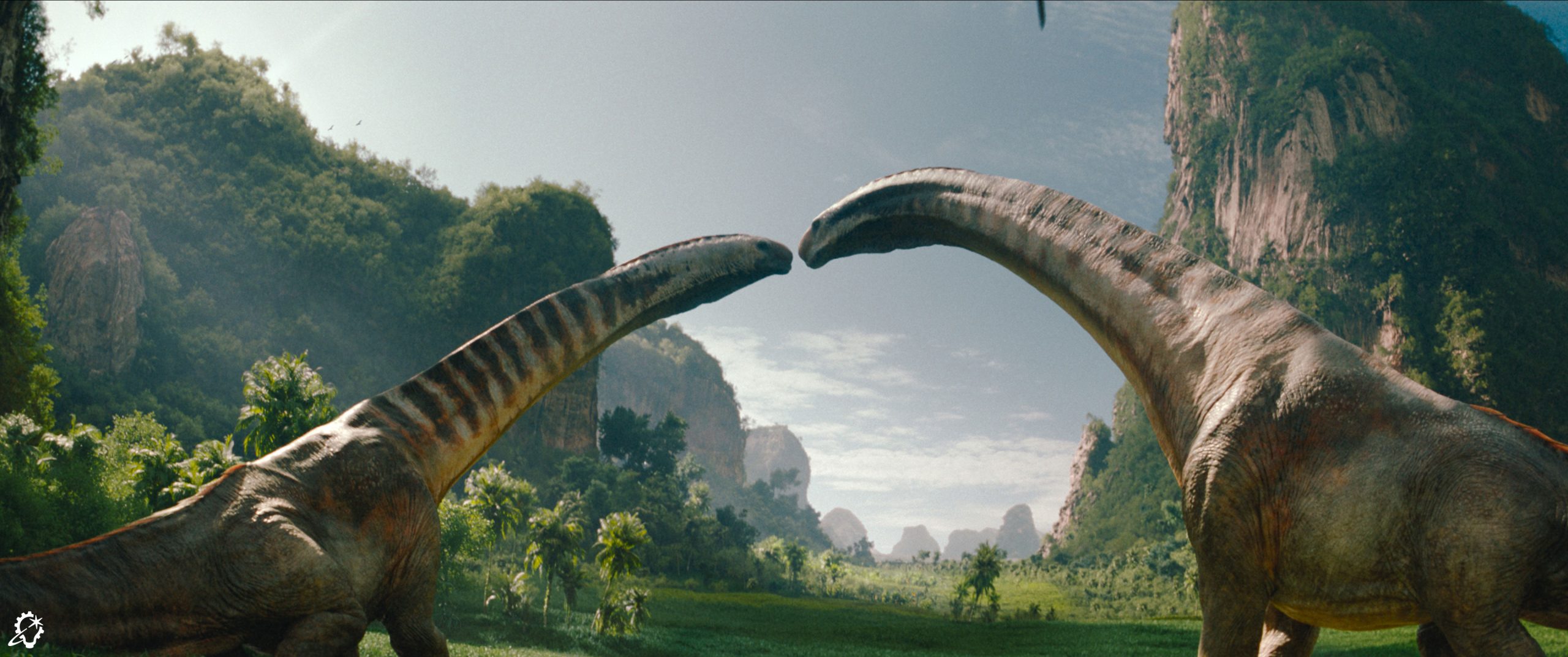
Getting the call
Working on an installment in the Jurassic film series was a full-circle moment for Chan, Roberts, and Coco, who all pointed to the original Jurassic Park (1993) as a moment that kick-started their careers in visual effects.
In the 1990s, while still working in the games industry, Roberts attended a talk from Jurassic Park’s CG supervisor Stefen Fangmeier in London. Hearing Fangmeier break down the work on Jurassic helped Roberts make the connection from his current work to a potential future in visual effects. “Seeing the same techniques of modeling, animation, and compositing that we were using in the games industry was the initial spark,” Roberts tells ILM.com. “That was an inflection point for me, where I started to pursue working in TV and film. The movie, as well as understanding the work that went into it, completely changed my life and my career and was the reason that I started to pursue computer graphics.”
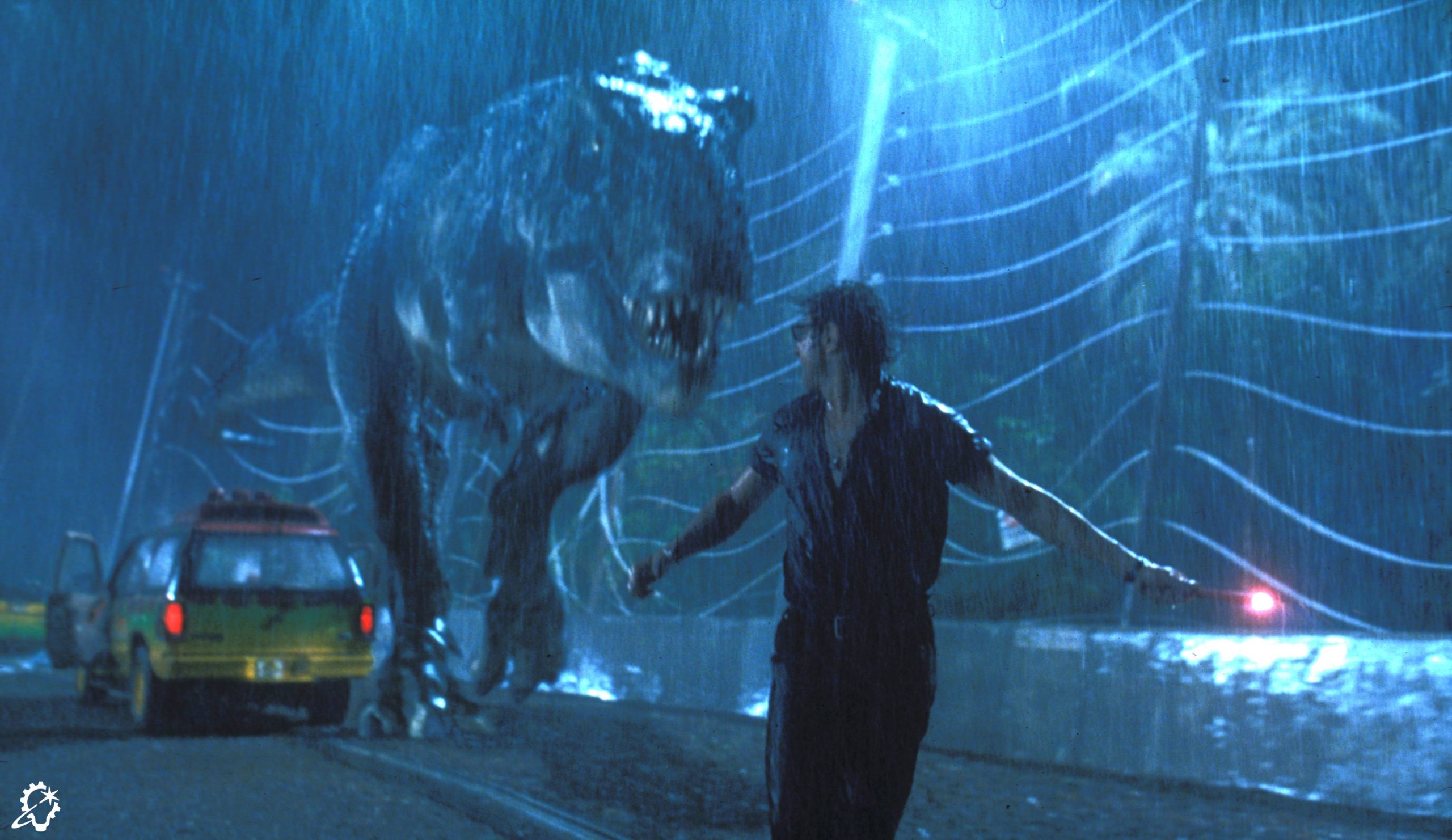
The scene that stood out to Coco the most from the original film involved the iconic Tyrannosaurus rex. “It was so real and scary,” he notes. “I remember the T. rex screaming in the rain and shaking the glass and everything in the car.” The realism of that scene inspired Coco to better understand how the visual effects were created in other scenes in the film, eventually leading to his work at ILM, starting with projects like Napoleon (2023) and Mission: Impossible Dead Reckoning Part One (2023).
Chan was growing up in Hawaii, close to where Jurassic Park was filmed, when it was released. “I remember thinking, ‘Oh my god, dinosaurs could be there.’ I was a kid, and it just felt so real to me.” After joining ILM, Chan worked on Star Wars: The Last Jedi (2017), The Mandalorian (2019-23), and The Creator (2023) before joining the Rebirth crew, where she attended a special ILM screening of Jurassic Park. “It still stands up,” notes Chan, “that sense of awe and amazement and seeing the dinosaurs for the first time. And for me, it’s about wanting to recreate that feeling.”
While Rebirth was Roberts’s first Jurassic project, he had recently worked closely with director Gareth Edwards on The Creator. But even with that experience, Rebirth provided a “pinch-me” moment for him. “It was a little daunting, just seeing the quality of work and the deep history that ILM has with this franchise,” remembers Roberts. “So it was daunting, but very exciting. And I was definitely up for the challenge.”
Supervisor 101
The role of a visual effects supervisor can vary from film to film. Chan describes the role as that of both a mediator and translator, as well as the person to whom crew members come to with questions. “You see the big picture of everything and have such a huge overview of what’s going on that you can basically connect the dots that are needed for each department and each person within your team,” says Chan.
Coco points to being on set as an important part of the journey to reaching this role. “You start to see how the set works and how things develop from script to bidding to how we’re going to shoot this once getting on set.”
“In some ways, we’re here to facilitate the visual direction,” notes Chan. “Whether that be from the director or from our production visual effects supervisor, we make sure everyone is on the same page of what that visual need is. A lot of it is just working with people on a daily basis, reviewing their work and seeing that everyone’s moving in the same direction.”
The large number of visual effects shots in Rebirth (over 1,200) required splitting up the work throughout production and postproduction. Pulling off that many shots required constant communication between multiple departments and the visual effects supervisors, the latter of whom kept their focus on being creative problem solvers.
Designing the Dinosaurs
Chan was the first of the supervisors to join Rebirth in April of 2024, after dinosaur development at ILM had already begun. Figuring out how the dinosaurs would look and move on screen was a challenge they embraced through to the very last shot of the film. “We were constantly trying to make them the scariest, coolest, most fun dinosaurs we could,” says Chan. “We wanted something different from the previous worlds that we’d seen, something that honored some of the original Jurassic Park dinosaurs. But also, Gareth gave his own twist and turn to the design of them.”
Roberts, who joined Rebirth’s team last September, notes the jump between seeing skeletons of a dinosaur in a museum to thinking about how the creature’s joints would move in different environments. Before joining the film, he rewatched previous Jurassic films to get “familiar with the quality of work in all of them, how some of the creatures moved, and conveying the sense of weight for some of the bigger creatures.”
Gareth Edwards was heavily involved throughout the process of deciding how the dinosaurs would look in the film. “I think at one point we had a two-hour live session with Gareth trying to figure out what the Mutadon was going to look like,” remembers Chan, where one of the team’s modelers would try putting different pieces of real dinosaurs onto a Mutadon sculpture to piece it together. “I think that was vital to the process of making sure that our dinosaurs, from their basic stance, without even being in a shot, could stand by themselves and look cool. Once they were at the state that both David and Gareth were happy with, we would place them into a shot.”
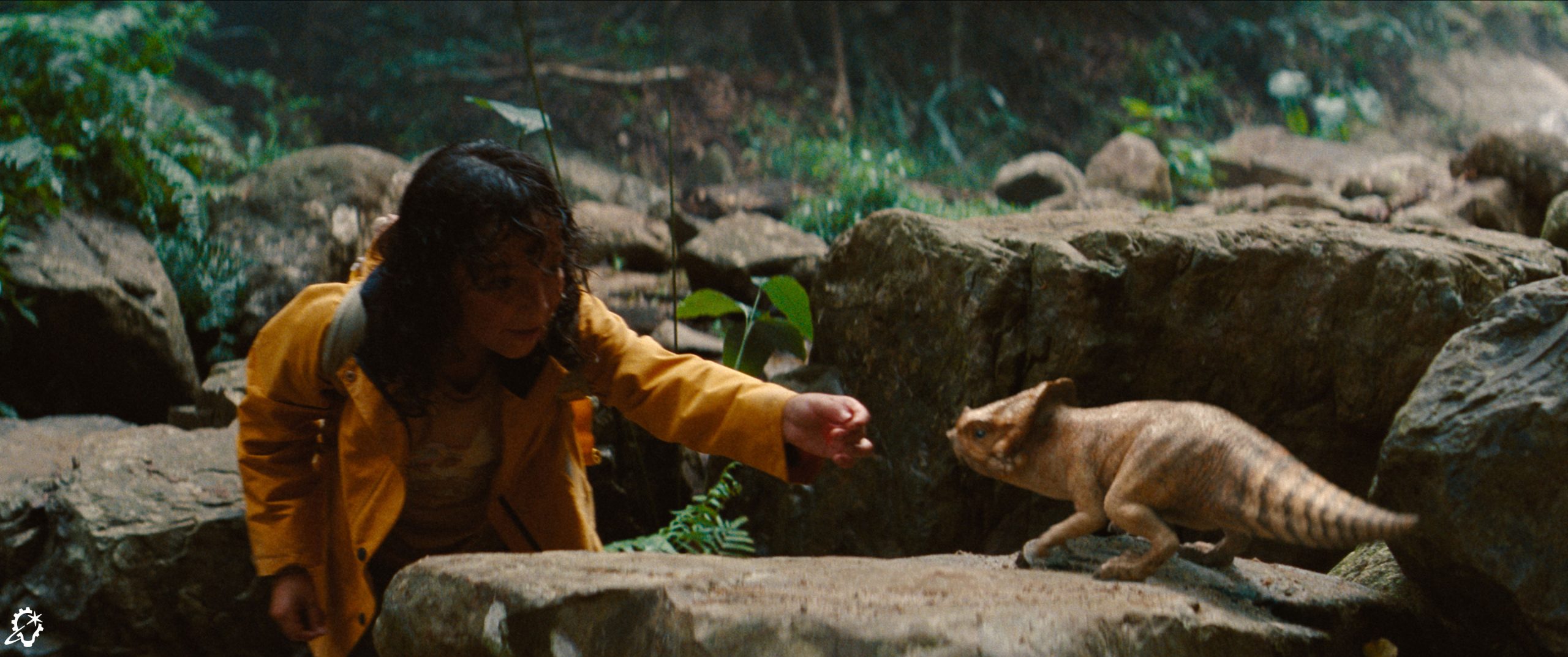
Finding real-world animal references for each dinosaur was a key part of making the movements of dinosaurs in Rebirth appear believable and anchored in reality. To create Dolores, the small Aquilops dinosaur that Isabella Delgado (Audrina Miranda) adopts as her pet, an ILM team, led by animation supervisor Delio Tramontozzi, used videos of themselves interacting with their own pet dogs and cats. “They would have multiple takes of the way their pets were responding to a laser light or picking them up in a way that allowed them to snuggle into the crook of an arm or drape over a shoulder,” says Roberts. The reference videos were submitted with animation of Dolores or other dinosaurs so Roberts and other team members could see how those real-life moments translated to animated shots in Rebirth.
As Vickery was usually the only effects supervisor on set, he made sure to communicate what he and Edwards were looking for as far as dinosaur movements and behavior in different scenes. For the scenes in the tunnels when the Mutadon dinosaur pursued several characters from the film, Vickery took on the role of a dinosaur squeezing into the tunnel and picking itself up after landing on the floor. “There’s a moment where it plants its hands on the floor, leans forward with real weight, and roars before charging,” remembers Roberts. “And for a lot of that, David or [animation supervisor] Steve [Aplin] would act out to really convey the emotion they wanted. I think we really benefited from that. We’re all very comfortable with each other and locked in and just really enthusiastic about getting that character into the creatures.”
For another scene near the beginning of the film where a hybrid dinosaur almost caresses a lab worker with its claw before killing him, an animator was filmed holding a water bottle, looking at it, sniffing it, giving it a quick touch, and then snatching it. Notes Roberts, “that was a wonderful, fun performance from our animators, where they were able to get a bit more emotion into the scene from their own performance, which then was applied to some of the hybrid creatures.”
Dividing and Conquering
Different ILM supervisors took lead roles for each major sequence in the film. Chan’s team took on many of the water-heavy sequences featuring the Mosasaurus and the Spinosaurus, as well as the team that developed the Distortus ex. Coco worked on the Mutadon sequences in the market and the tunnels as well as the T-rex chase sequence on the river, while Roberts tackled the beginning and ending of the film, as well as the cliff sequence featuring the Quetzalcoatlus.
Coco noted that splitting up the work into sections was helpful to their teams, so animators or compositors could go to one supervisor to ask a question, instead of having to approach multiple people to get the information they needed. Daily communication between supervisors and their teams of artists was also key throughout the production, as the team involved hundreds of people working in London, San Francisco, Vancouver, and Mumbai.
“It was very important for us all to hear what Gareth’s feedback was,” says Chan. “Because some feedback given on one dinosaur would also apply to another dinosaur in another sequence. And even though we were different teams, it was vital for us to still be sharing information about how we approach winged creatures or creatures in water — there were a lot of tips and tricks that we shared with one another.”
A library of shared assets documenting the workflow, along with an internal website, allowed everyone to understand what visual effects setups were established and ready to use and what they would need to create from scratch. This was especially helpful to Roberts and Coco, who joined the production after Chan. “A big part is sharing the tools up front to be on the same page about how we’re going to tackle things,” notes Roberts. “And then we have a number of chat groups for supervisors, as well as weekly meetings for each sequence and discipline.” Coco adds, “It was good to see what Gareth was looking for in a shot, or what was important for him in a particular environment, so I could follow that line.”
In one case, Roberts referenced the texture and amount of light in the sky in a night sequence at a gas station that the ILM team in London had worked on. That helped him to prepare a night scene his team had coming up. “We inherited that established look as a mood board of London’s work, allowing our team to match it seamlessly from the start,” notes Roberts, “so that when our team came on, we could say ‘we’re matching that.’ This is something that Gareth has already established. He likes this language for night, so we didn’t have to rediscover or explore that too much. So, without ego, just sharing and following, taking London’s lead where they were ahead, and then we also presented some of our work when we were ahead, or when it was on us to sort of establish a look. Very open communication made it a success and made it feel like it’s one team doing all the work together.”
Chat groups would also give supervisors an easy way to ask each other questions about how they might solve similar problems, especially in sequences where there was a bit of overlap between supervisors. To help with the time difference between London and San Francisco, Roberts and his team started their day early to increase the time the two teams were actively working.Another vital piece of the ILM crew on Rebirth was the production team – visual effects producers and production managers – who made sure supervisor teams were properly staffed, flagged important deadlines, and blocked off time for teams who needed to develop a new technique or tool.
Putting it All Together
The challenges Jurassic World Rebirth presented for its visual effects supervisors were varied, ranging from dinosaurs interacting with simulated water, designing environments from multiple elements, and satisfying a director well-versed in visual effects.
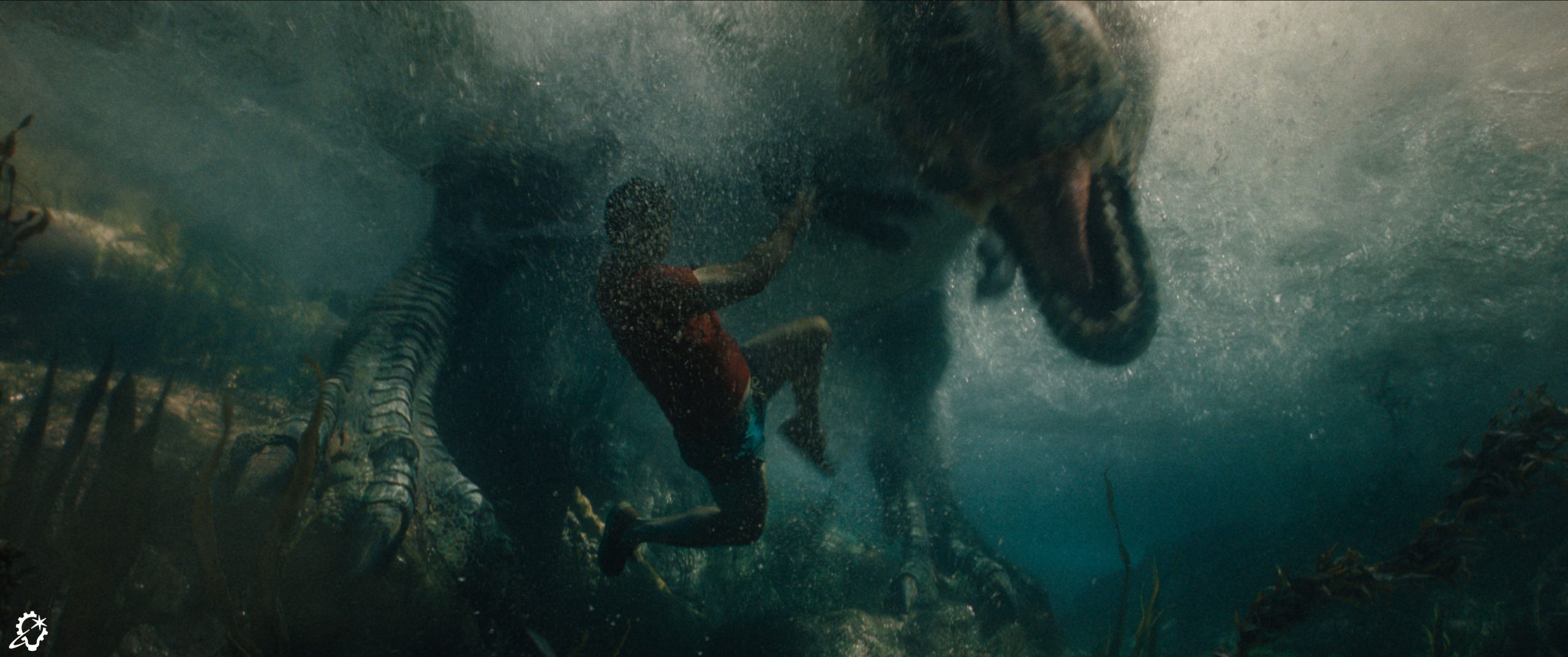
Coco’s team tackled the effects-heavy, intense action sequence where the Delgado family is chased by a just-awakened T-rex. While the river in the film is on a tropical island near the equator, these scenes were filmed at a British Olympic river course. “The T-rex interacting with the water, the digitally simulated water, and the family. It was a big, big moment,” notes Coco. “I don’t think a couple of years ago we would be able to do it because of the turnaround time needed. We had amazing effects artists who turned around the simulated water effects in record time.”
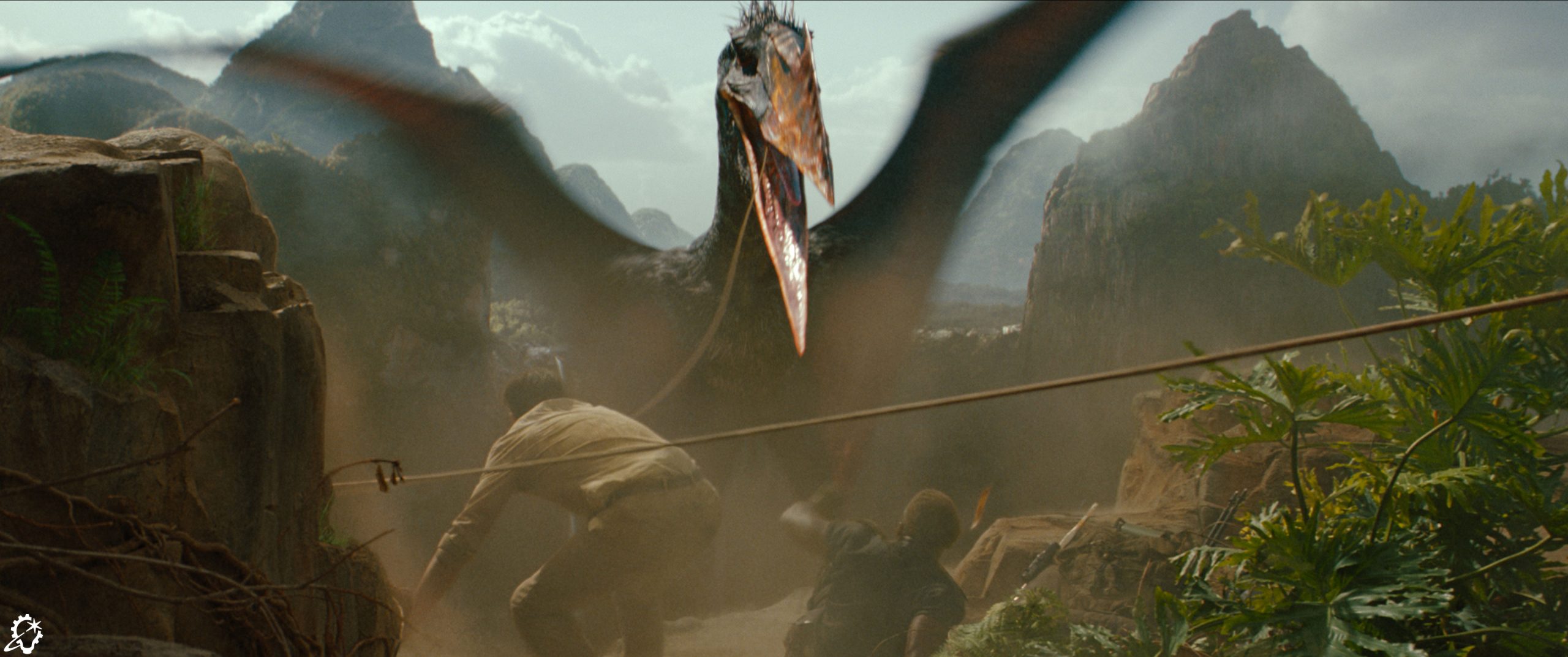
The Quetzalcoatlus sequence, when Zora Bennett (Scarlet Johansson) and other members of her team climb down a cliff to retrieve a sample from an egg, had its own unique challenges – and not all dinosaur-related. The cliff and cave environment was put together from a mix of elements, including footage shot at the cave set at Shepperton Studios in England, footage shot at Jog Falls in India, and millions of gallons of digitally simulated water. Mixing footage shot on location, wider shots that were fully CG, and digital extensions on top of drone work became a bit of a puzzle for Roberts’s team to make into one coherent environment. Another important part of this process was getting the right balance, wherein the background isn’t pulling too much focus from the actors. “Even though it’s multiple elements and different sections, you want to create a continuous environment where the audience truly believes the actors are immersed in that backdrop.”
Other shots not involving dinosaurs also occasionally proved tricky to get Edward’s sign-off on, in part because of his knowledge and appreciation of visual effects.
“Gareth has such a particular eye for blue screens that he can tell when a shot is a blue screen shot,” says Chan, “and for him, it’s successful when he can’t tell it’s a blue screen shot. So we are constantly trying to blend in, change lighting, include more atmospheric lens details, just so many little details that most people, when you think of just green screen or blue screen shots, wouldn’t even consider. Because Gareth wanted to make sure it never felt like a blue screen shot.”
Landing on the right scale for the dinosaurs was also an ongoing process for the visual effects supervisors and Edwards. “We’ve created these dinosaurs at a certain height and size,” notes Chan. “We put them in the shots the way they should naturally be at that size and height. And Gareth would look at some shots and say, ‘No, it doesn’t feel big enough.’ So we played this constant game of make it bigger, make it bigger, okay, that’s too big.
“One thing that Gareth just absolutely excelled at is scale and suspense,” Chan continues. “He knows how to compose every shot and frame to give you that sense. So to him, it’s less about the continuity and making sure things physically and scientifically look correct. It’s more about what makes the audience sit and look at something and feel that suspense. And so we worked with our animation team through many, many iterations of trying to figure out compositionally, what is the scale that works best for these shots?”
After months of hard work from teams across the world, the final product came together for the film’s release in July of 2025, giving both audiences and Rebirth’s crew an adventure to remember. “I think, every person who worked on the movie, and everyone that I talked to, they always said it’s been a dream to work on it, because it is such an iconic movie,” says Coco. “And in many cases, they started in visual effects because of Jurassic, so they don’t do it just because of the work, but because they love it. And working on such a big and iconic movie, they put their heart into it.”
–
Amy Richau is a freelance writer and editor with a background in film preservation. She’s the author of several pop culture reference books including Star Wars Timelines, LEGO Marvel Visual Dictionary, and Star Wars: The Phantom Menace: A Visual Archive. She is also the founder of the 365 Star Wars Women Project – that includes over 90 interviews with women who have worked on Star Wars productions. Find her on Bluesky or Instagram.