
The production visual effects supervisor discusses the Emerald City, Elphaba in flight, and collaborating with Jon M. Chu.
By Mark Newbold
Based on the novel Wicked: The Life and Times of the Wicked Witch of the West by American author Gregory Maguire, the Wicked musical has enchanted audiences worldwide, both on the stage and on the big screen. Maguire’s 1995 novel was not only an adult-oriented version of L. Frank Baum’s classic children’s story, The Wonderful Wizard of Oz, but it was also the first entry in The Wicked Years book series.
With music and lyrics by Stephen Schwartz and a book by Winnie Holzman, the stage version of Wicked (or to give it its full title, Wicked: The Untold Story of the Witches of Oz) premiered on May 28, 2003 at the Curran Theatre in San Francisco and has broken records wherever it has been performed, including over 7,000 performances in London’s West End.
A true phenomenon ripe for further adaptations, director Jon M. Chu’s Wicked landed in cinemas in November 2024. Capturing the imagination of the cinema audience, the final moments of the film promised a sequel, and that promise was kept when Wicked: For Good debuted a year later in November of 2025, continuing the story of Elphaba Thropp (Cynthia Erivo), Glinda Upland (Ariana Grande), Fiyero Tigelaar (Jonathan Bailey), the Wizard (Jeff Goldblum), and the people of Oz.
Loaded with sequences of dizzying visual complexity, Industrial Light & Magic was tasked with bringing Chu’s vision to vivid, yellow-bricked life. ILM.com had the opportunity to sit down with the production’s four-time Oscar-nominated visual effects supervisor Pablo Helman to discuss Wicked: For Good and the task of unveiling even more of Munchkinland, Shiz University, and the Emerald City.
“It was a 155-day shoot for a two-part story,” says Helman. “We thought of Wicked and Wicked: For Good as one movie, and we shot it that way.” That meant intense preparation and planning, given the logistical and technical nature of certain sequences in the films.
“Visual effects can often be challenging because you’re asking the director, the editor, and everybody else to think about things that they normally don’t want to think about,” explains Helman. “A director is thinking of the whole story, but we’re asking them to look at specific sequences because we need to turn over a certain number of shots. They don’t like to be presented with choices because they think they’ve already made their choice, so why present another one? That means they have to rethink, and that takes time.”
Jon Chu was open to the challenge. “Jon takes an organic approach to filmmaking, he loves having choices and different possibilities,” Helman says. “There might be a script and a plan in place, but the process of making a major motion picture still has plenty of fluidity. “Lots of things change throughout the process of filming, and there are lots of choices to make.”
“It’s a Transactional Thing”
Creative choices are one thing, but a production like Wicked: For Good requires a large amount of preparation and resources, and a sizable portion of those resources are given over to visual effects. As production visual effects supervisor, Helman was deeply involved with practical as well as creative duties.
“Part of my role is managing the project in partnership with my effects producer,” Helman explains. “That includes talent, financials, resources, all kinds of things. So if you’re not thinking ahead, you’re not doing your job. Nobody likes to be in dailies and not be able to say, ‘Yes, I can do this,’ and the only reason you say ‘I can do this’ is because you have a plan A, a plan B, and a plan C.”
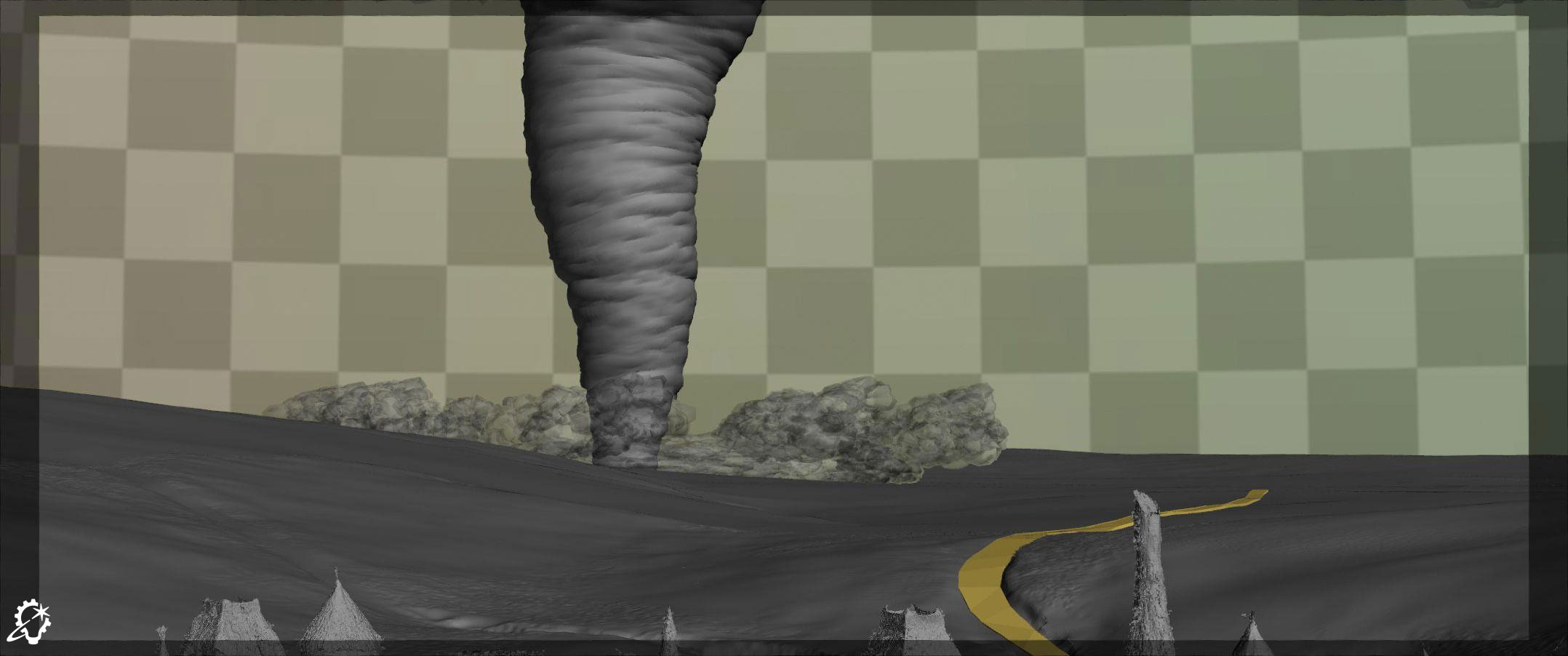
Those plans require intense work from the team, gathering as much data as they can. “We have LiDAR [a laser system that scans objects and environments to recreate physical objects and sets as digital models], we have high resolution textures, HDRIs for lighting, all the science behind it, so that when we’re in dailies, I can say ‘Yes, we can do this.’” That preparation is integral to the production. “Nobody likes to be surprised or ambushed. You don’t want to get into those situations, and we never did with Jon. He’s a great communicator and a terrific person. There was never a moment when he was annoyed about anything. For four years on a project, that is an accomplishment.”
Art always comes with the cost of tools, be it the canvas, brushes, and oils a painter uses, or the clay and tools of a sculptor. It’s the same for visual effects artists, but as Helman explains, creativity always leads the discussion.
“The creative stuff that we put together as a team comes first, and after that, you have to be conscious of the resources,” Helman says. “I could go to a producer and say, ‘Look, I know that we’re spending a lot more resources in this section, but I promise that when we get here, I’m going to find a way to get back the resources that we’re putting into this.’ It’s a transactional thing, but it’s all about the storytelling.
“There’s always a way of doing what is needed for the movie,” Helman continues. “You look at the storytelling and the amount of resources and ask, ‘Is it worth it? Is there a payoff?’” Time and money are challenges for every production, no matter the scale, but Helman believes one is more of a problem than the other. “At some point, you run out of resources, but the resource isn’t money; it’s time, which is finite. You can throw all kinds of money at the problem, but it won’t get done, because it needs more time in the oven. Then it’s not my choice, it’s a choice that we make together.”
“Every Department Brings Something to the Storytelling”
The work of the visual effects team overlaps with many departments, few more than the special effects team, whose focus is on-set effects like steam, smoke, weather elements, and anything the performers physically touch. Helman gives an example of where the seam between the two lies. “Production design can’t build a 79-story building. They can build 55 feet of it, and then visual effects takes that and develops it, all based on what was done on set.” ILM and their fellow effects houses can expand the world of Wicked, but it only works if the departments are on the same page.
“There’s plenty of discussion about special effects, what can and cannot be done in camera, what’s safe and what’s not,” says Helman. “Filmmaking is one of the most collaborative art disciplines because if you don’t collaborate, you end up with something that is flat. Every department brings something to the storytelling and adds nuance in a way that is individual, surprising, interesting, and curious. So it’s a combination of all those things. There were about 1,000 artists and production crew on these films, and I really would like to thank them because if it wasn’t for them, we wouldn’t be doing this.”
To the Emerald City
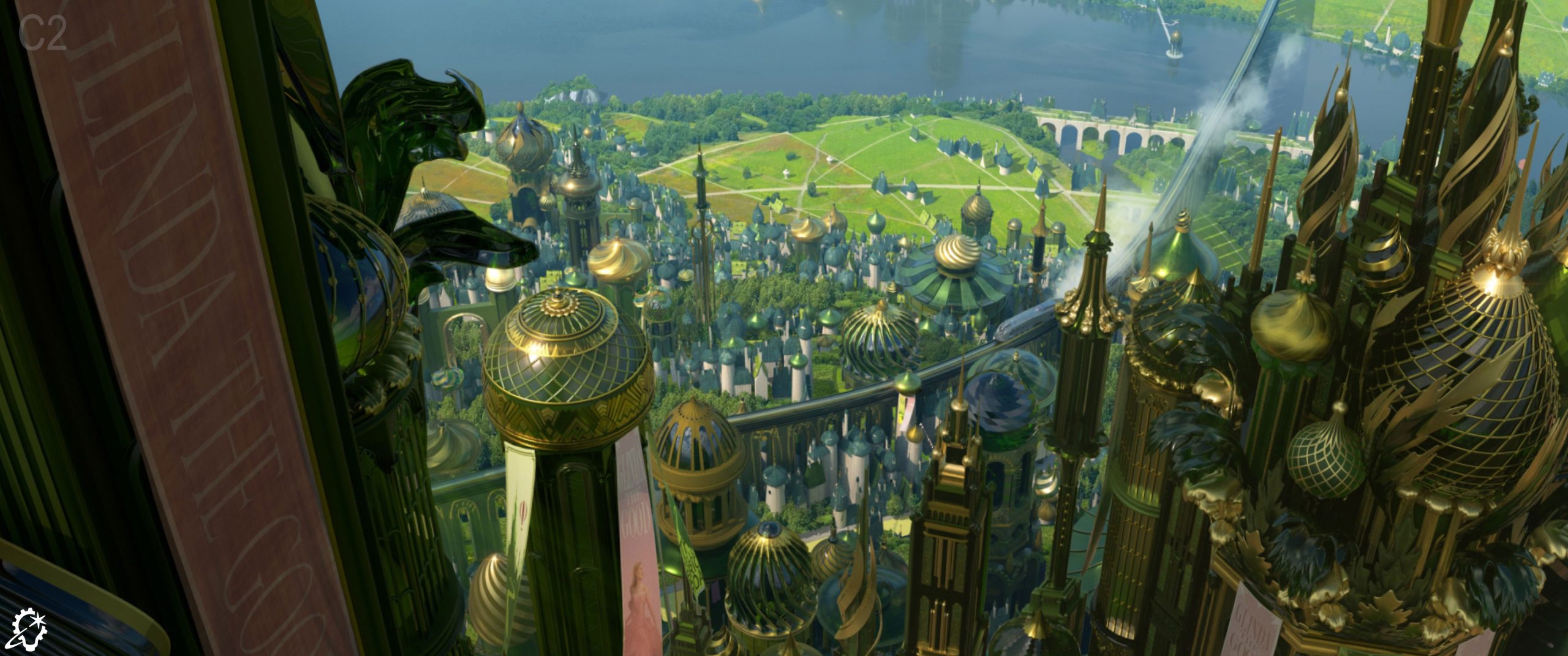
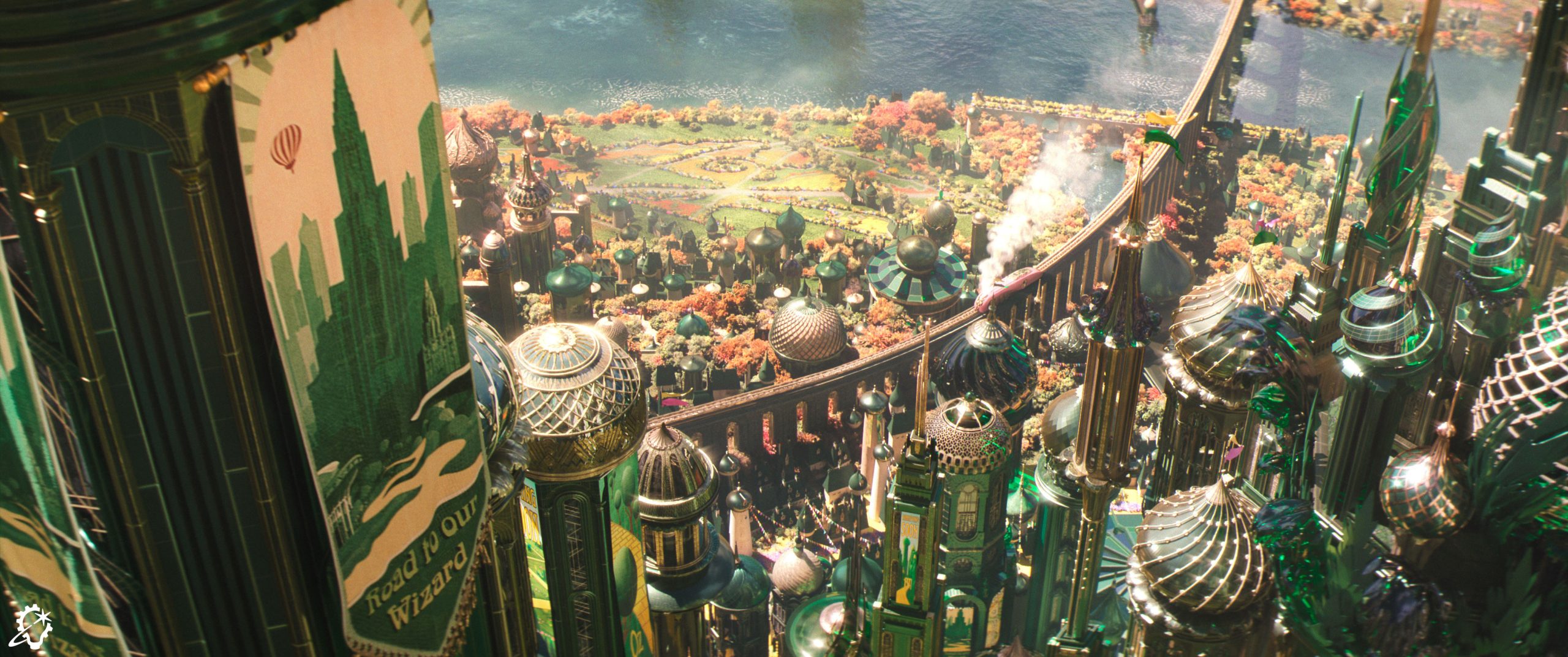
The Emerald City is as much a character in both Wicked films as Elphaba, Glinda, Fiyero, Boq (Ethan Slater, aka the Tin Man), Madame Morrible (Michelle Yeoh), and The Cowardly Lion (voiced by Colman Domingo). It is the home of the wonderful wizard and the high society of Oz, as well as the underclasses who have to fight for every scrap. Wicked showed us a vast swathe of the city, and Wicked: For Good not only takes us back there, but it takes us into places we’ve not seen before, a task that fell to Helman and his team.
“There were certain parts of Emerald City that we saw in the first part of the story, and certain parts of that we see in the second, so we built different assets for different parts of the story,” explains Helman. “The first movie was a lot more presentational. Things were being set up, and tonally, the movie was lighter, whereas the second one is a lot darker.” That visual change also mirrors the journey of the characters.
“Every character has a specific arc, so in Wicked: For Good, they deal with the consequences of the choices they made in the first film. Part of production design and visual effects is to accompany the performances with the environment,” Helman continues. “The atmospherics are always thick, and the light direction is purposely very dramatic at times. The sun is low, so there’s less light.” Time is also a factor in the progression of the environment. “It’s a combination of things. The clothes and the creatures get used, and the buildings get worn because they went through a specific experience.” He laughs, as he adds with a wink, “When I started the movie, my hair was brown, and now it’s white.”
“We’re Off to See the Wizard”
At the heart of the Wicked films are Elphaba and Glinda, and the second film gave the production the opportunity to delve deeper into the classic characters of L. Frank Baum’s original novel and add a 2025 spin on the characters.
“It was really exciting,” says Helman. “I remember the first test that we did with Dorothy, Toto, the Tin Man, and the Scarecrow. It’s funny because some of the critics were saying that the chronology of the story didn’t do this or that. Well, you know what? It’s a complicated story, and everybody remembers it differently, so I think this is another point of view of that story.”
Based on Gregory Maguire’s novel, which itself presented the story and characters of Baum’s world in a more mature, complicated light, it gave the filmmakers the chance to overlap parallel stories in ways that didn’t step on each other. “It was fun to think about. One thing is right there in the background, but if I come around and go in front, the story is different. It’s an opportunity.”
“Mitigate the Forces of Gravity”
With plenty of experience in making us believe a human, a superpowered dog, or a battered old Corellian freighter can fly, ILM was charged with taking Elphaba into the skies of Oz, a task that required visual effects know-how and a game performer in Cynthia Erivo.
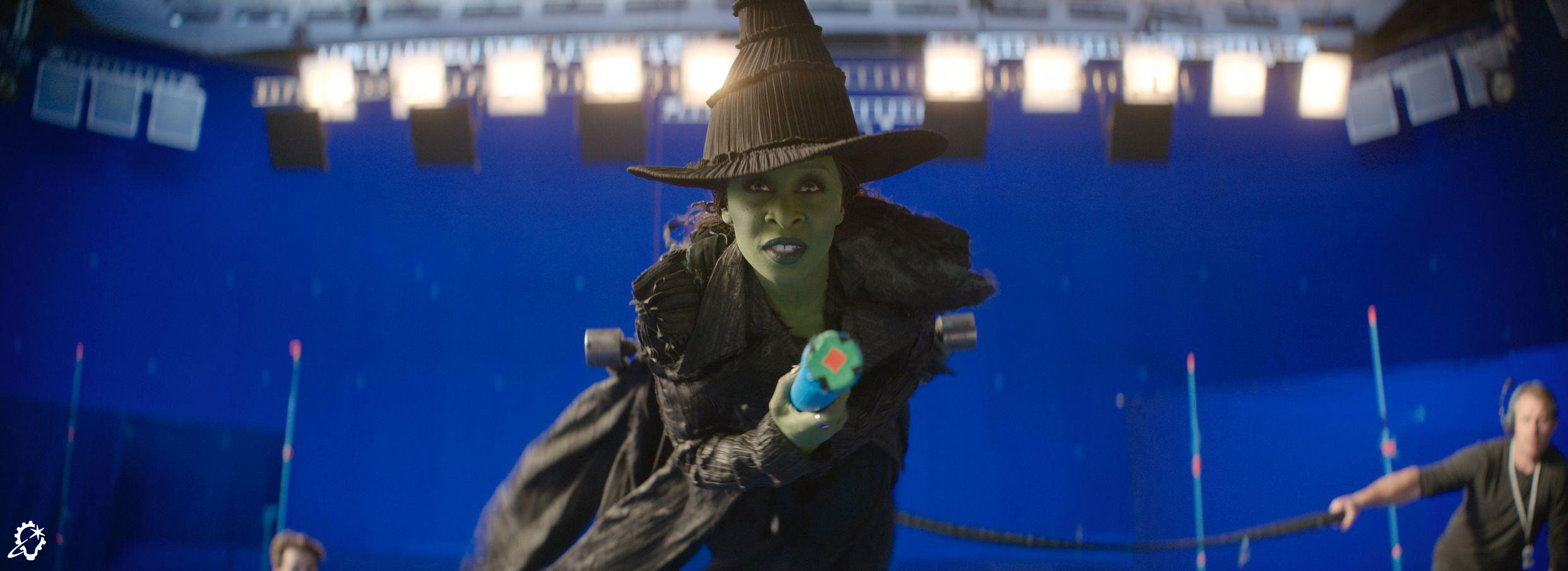
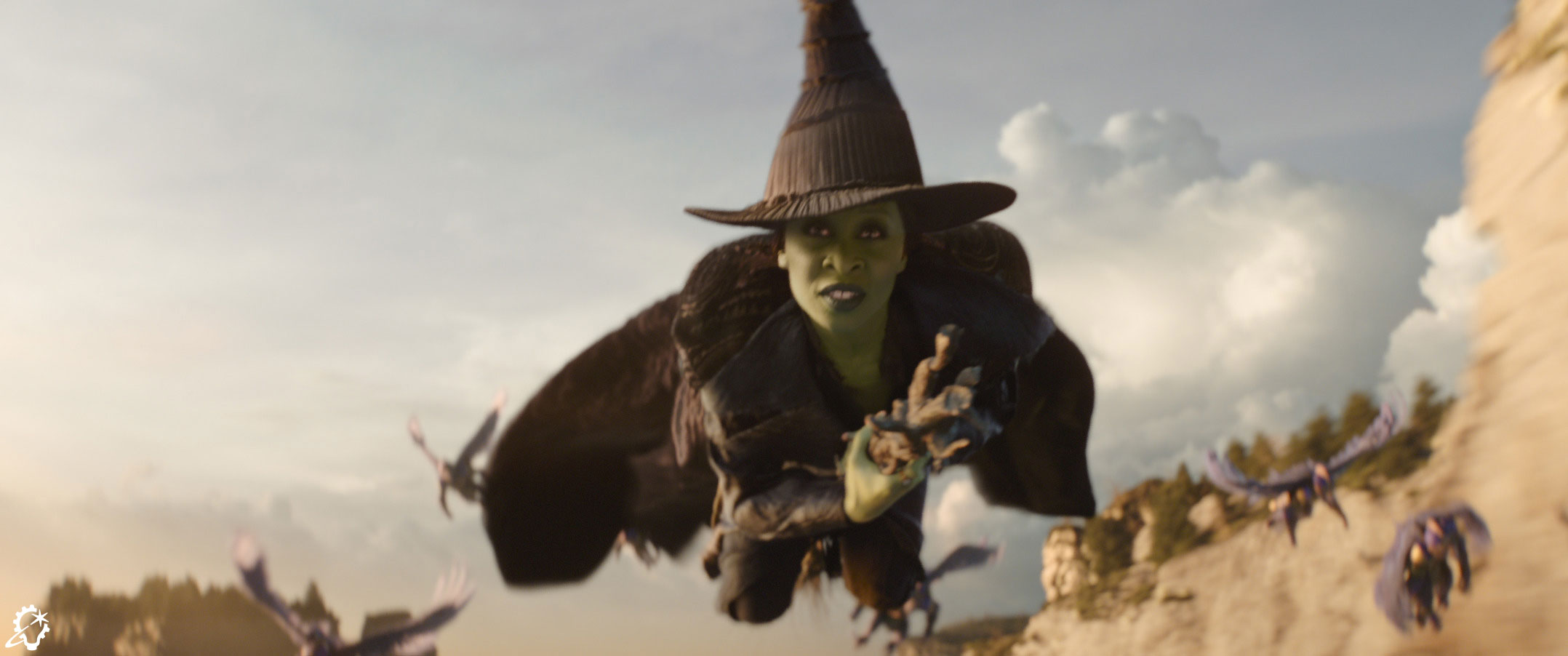
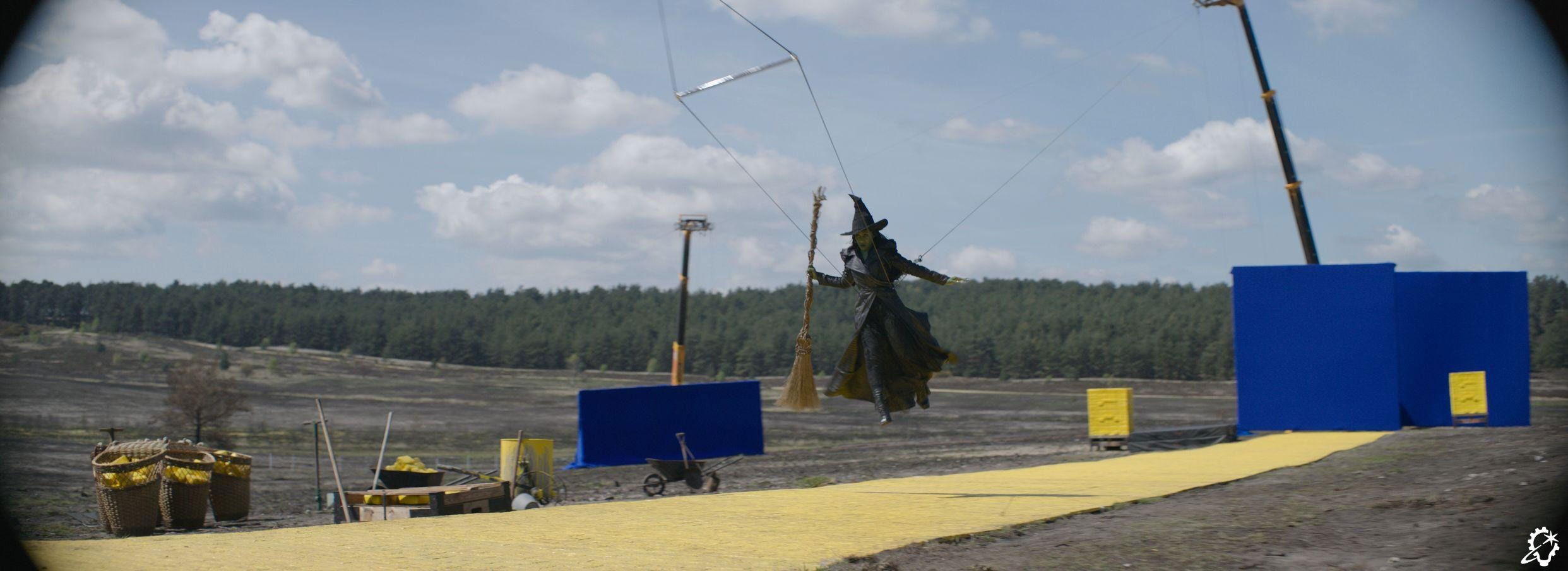
“The approach was always going to be Cynthia doing the flying,” says Helman. “That meant that she needed to mitigate the forces of gravity, no pun intended. She’s singing while trying to get her body to do very specific actions. Cynthia is very strong, but it takes some effort.”
A willing actor and all the right equipment don’t necessarily mean the results are what is required by the director or the visual effects team. “Sometimes it doesn’t work. Sometimes, because of safety and other things, the actors are not fully exerting themselves, but Cynthia did.” That combination meant that when all was said and done, Elphaba looked even more imposing in the air in the sequel than she did in the first film. “In the arc of the story, she’s proficient. She’s gliding and then stopping. She knows what she’s doing and she’s done it before. She takes time to look at the world under her, and that requires some skill.”
Along with flying, there’s another aspect to the illusion: Elphaba’s cape, one of the most striking elements of her appearance as she heads down a dark path. “Elphaba’s cape isn’t in the cast, but it is a character in the movie, and it does a lot, not only when flying but also landing and taking off,” notes Helman. “Its creation required the skills of two visual effects houses. “ILM and Framestore created it because we couldn’t do a 30-foot-long cape physically.” With practical and visual effects work woven together, parts of the performer were also replaced to create the complete shot, but as Helman explains, “we always used Cynthia’s face and performance.”
Creating the physical cape meant crafting clothing that gives the right look and says something about the character, a challenge the designers went to great lengths to achieve. “The cape has different layers of materials and transparency, but we took some liberties with it,” explains Helman. “We know how difficult it is from doing different capes, from the Vader cape to Superman. The cape says who he or she is.”
As is often the case, trial and error was the path to finding the right blend. “There was a lot of testing, we did simulations and resins, but at the end of the day, we said let’s forget about the science of it because it’s about the content. It might be scientifically correct, but it doesn’t work if it’s not doing what we need it to do and it’s not correct for the story we’re trying to tell.”

Unlimited Together
Just like its smash-hit predecessor, Wicked: For Good brings together an impressive array of on-screen and off-screen talent, all laser-focused on bringing their utmost in service of making the best film they possibly can. On visual epics like Wicked, visual effects, storytelling, and direction need to be in lockstep.
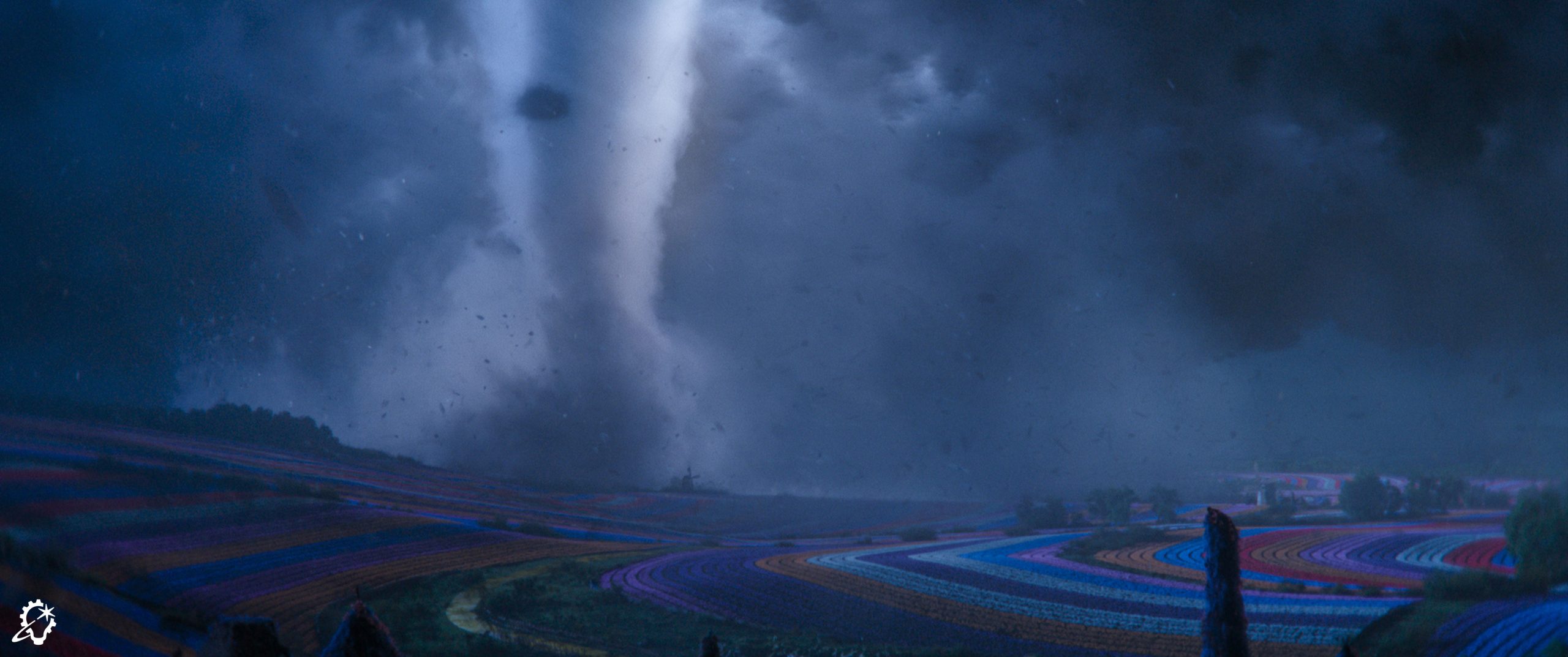
“There’s a four-minute sequence with this beautiful song that Glinda sings at the beginning of the movie called ‘I Couldn’t Be Happier,’” Helman says. “We redressed Munchkintown, we replaced the sky, the tulips, all kinds of things, but when we looked at it, Jon said ‘We’re missing something because this is a very subtle song.’ Jon said, ‘What if, when she starts singing, the confetti stops?’”
It’s a striking visual as the confetti hangs motionless in the air, but one that entailed more work than one might imagine. “I asked how long are we doing this for, and Jon said the whole scene. That’s four minutes of really resource-intensive particle work that we didn’t know would work or not, but we had to complete it because we needed to know.” That would require Helman’s most valuable resource: time. “Jon understood that if he wanted to see this, it was going to take weeks to get it. It’s important to have that communication with the director, and to have somebody who understands what we’re doing.”
Magic, Glory, and Love
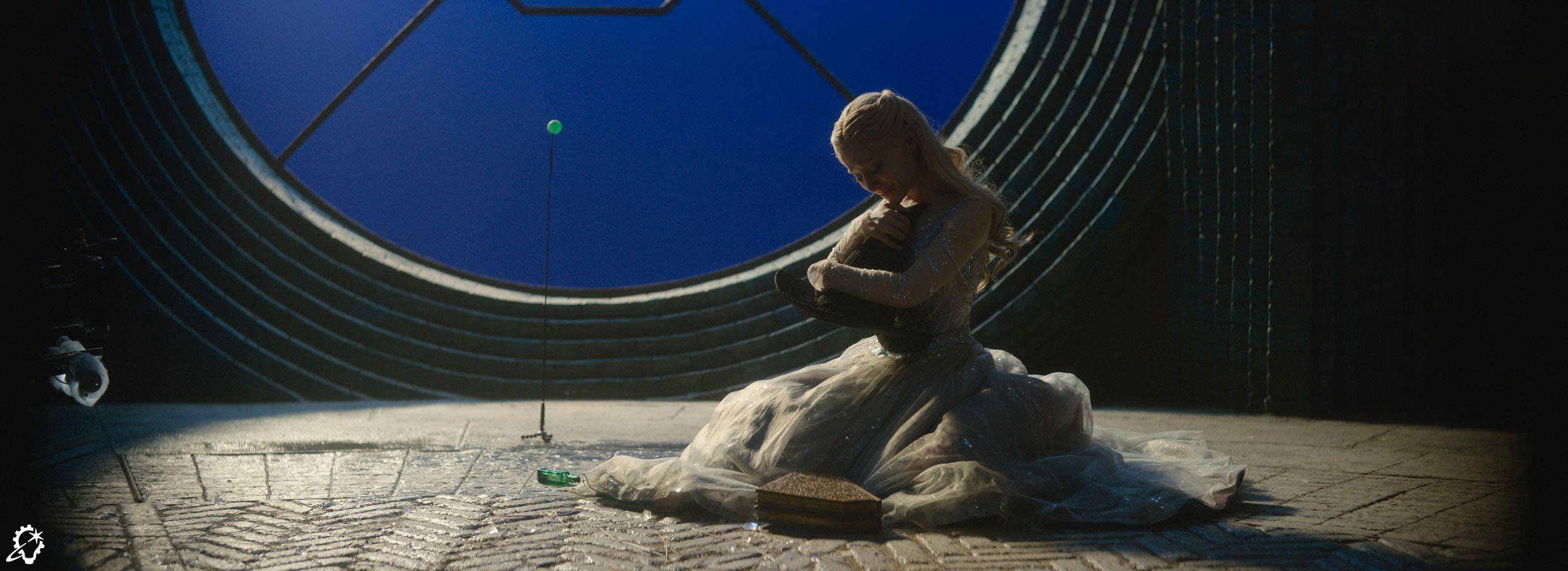
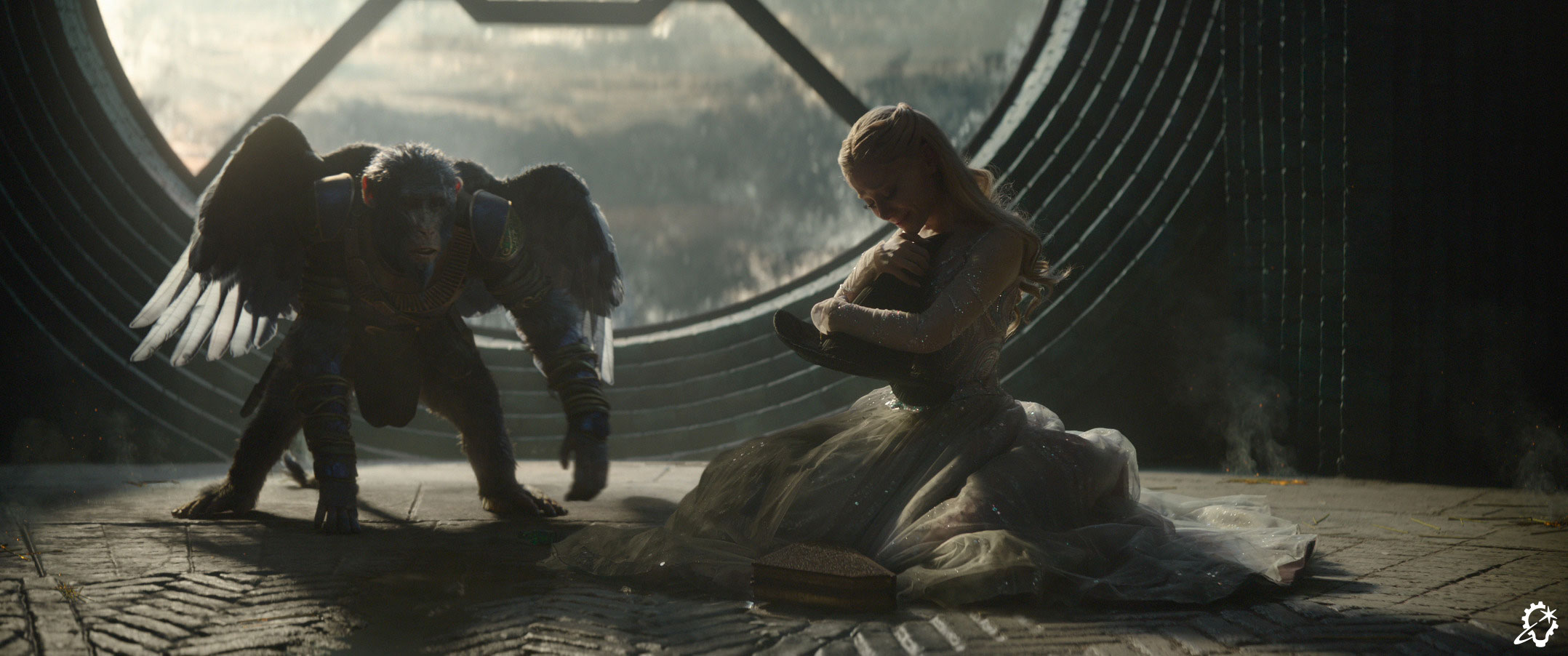
The ultimate combination of visual effects, performance, direction, production design, and numerous other departments is “The Girl In The Bubble,” written by Stephen Lawrence Schwartz and performed by Ariana Grande. Here we find Glinda in her home, inspired to finally take action following the cyclone that killed Elphaba’s favored sister, Nessarose. It’s a sequence brimming with emotion and meaning, and one that took almost the entire production schedule (that’s both films) to complete.
“We started ‘The Girl in the Bubble’ during the first week of filming on the first movie because it was a very complicated sequence, and we knew that it was going to take us two years. It was a four-minute, continuous shot.” A weighty task, and one that needed to pull in all the eyes it could to make it work. “We did a lot of work with [cinematographer] Alice Brooks and used lots of props before we understood what we needed for the previs.”
It’s one thing to dream up a film sequence, but it’s another to make that dream reality. So with previsualisation underway, Helman and his team also needed to work out the real-world technical aspects of the scene.
“Once we had the previs, then we did a techvis, which meant taking a look at the previs and taking a step back,” Helman continues. “For example, let’s say we previsualize where the camera is moving and, BOOM, there’s a wall in the way, but it’s not a wild wall [meaning it can be easily moved and then put back]. On set, the director might say, ‘Well, move the wall,’ but then you’re wasting two hours of time and resources. Techvis will look at the distance between two points, how fast things will move, and where the blocking is. If you don’t prepare before the shoot, we might put the lens on and find we can’t focus because it’s too close or too far, or the camera doesn’t fit in the space and the director has to change the shot.”
With the techvis in progress, the team moved to the actual set itself. “We went on set to look at what the camera was doing,” says Helman, “and we realized that when she goes up the stairs, the set would have to be stripped because the camera couldn’t get there. We’d need a 50-foot crane. So we’d have to take the wall out and build a CG set as the camera comes around.” As it was for the entire production, planning in advance was key. “You have to figure these things out beforehand. It’s not necessarily something that a director would look at, but the other departments need that techvis information as well.”
While there was a physical set with props, Helman’s visual effects team added a surprising amount of detail afterward. “The railing is created in computer graphics, everything behind Glinda is created in computer graphics, and once she gets to the closet, only half of the closet was built, so we had to build the reverse of that.” There are even different takes of Grande’s performance brought together for the completed sequence, and that meant more delicate work for the team. “We had performances that were morphed, so the reflections had to match those performances. There were morphs in the middle of it that were very, very difficult, so there was the nuance of doing that.”
Even after completing this technical maze of work and collaboration, changes were still required. “Once we were done, Jon and Myron [Kerstein, editor of Wicked: For Good] changed two performances. We had about seven different plates that needed to be stitched into one, but they changed two of them because they thought the performances were better, so we had to redo the layout. We had all the assets, but then you have to resync everything so that it works.”
That meant the team on the ground needed to be extra vigilant and imaginative to keep the pieces where they needed to be. “The on-set video assist was so important because they needed to play it back and flop it [reverse the image],” Helman explains. “The floppiness of it was mind-boggling, and you have to make sure that you have plenty of imagination because there’s a lot of compositing that goes into the sequence that can’t be done on set in real time. You have to do all the thinking before.”
Nevertheless, the reward is in the work itself. “It took two years to do, but it was really satisfying,” Helman concludes. “It’s one of the reasons why I love visual effects. It’s that satisfaction, and I realize how lucky I am to have a job that is so creative, because a lot of people don’t.”
Read more about ILM’s work on Wicked here on ILM.com.
–
Mark Newbold has written for Star Wars Insider magazine since 2006, ILM.com, Skysound.com, and news site FanthaTracks.com, having previously contributed to StarWars.com and StarTrek.com. He is a 4-time Star Wars Celebration Podcast Stage host, podcasting for over 20 years, and has been involved in websites since 1996. You can find this Hoopy frood @Prefect_Timing.