
Cutting-edge digital artistry, modern inspiration, and retro callbacks help launch the latest Tron adventure from the cyber world into reality.
By Clayton Sandell
Light Cycles, Super Recognizers, and Programs roar off the Grid and into the real world for the first time in Tron: Ares (2025), a four-decades-in-the-making moment that challenged Industrial Light & Magic to deploy a full creative arsenal to make the impossible real.
ILM’s David Seager served as the production visual effects supervisor for the third entry in a franchise that began with the original 1982 film Tron and continued with 2010’s Tron: Legacy. The first Tron movie follows the adventures of software engineer Kevin Flynn (Jeff Bridges), who is trapped inside a neon digital realm where computer programs appear as human avatars.
Then-nine-year-old Seager became an instant Tron devotee. “I was very excited when this opportunity came along, so I definitely jumped at it,” he tells ILM.com. “Tron, for me, was right up there with the Star Wars franchise and many of those types of films.”
Directed by Joachim Rønning, Tron: Ares stars Jared Leto as the titular hero, a sophisticated Master Control Program reporting to Dillinger Systems executive Julian Dillinger (Evan Peters). Ares is billed as the ultimate soldier and the first artificial intelligence being – or construct – to appear in the real world. But outside of the Grid, Ares can only live for 29 minutes, sending Dillinger and rival company ENCOM on a quest to find Flynn’s long-lost Permanence Code that will extend a construct’s lifespan. When ENCOM CEO Eve Kim (Greta Lee) discovers the code first, Dillinger dispatches Ares and his second-in-command, Athena (Jodie Turner-Smith), to track her down and steal it.
Inspired by Modern Tech
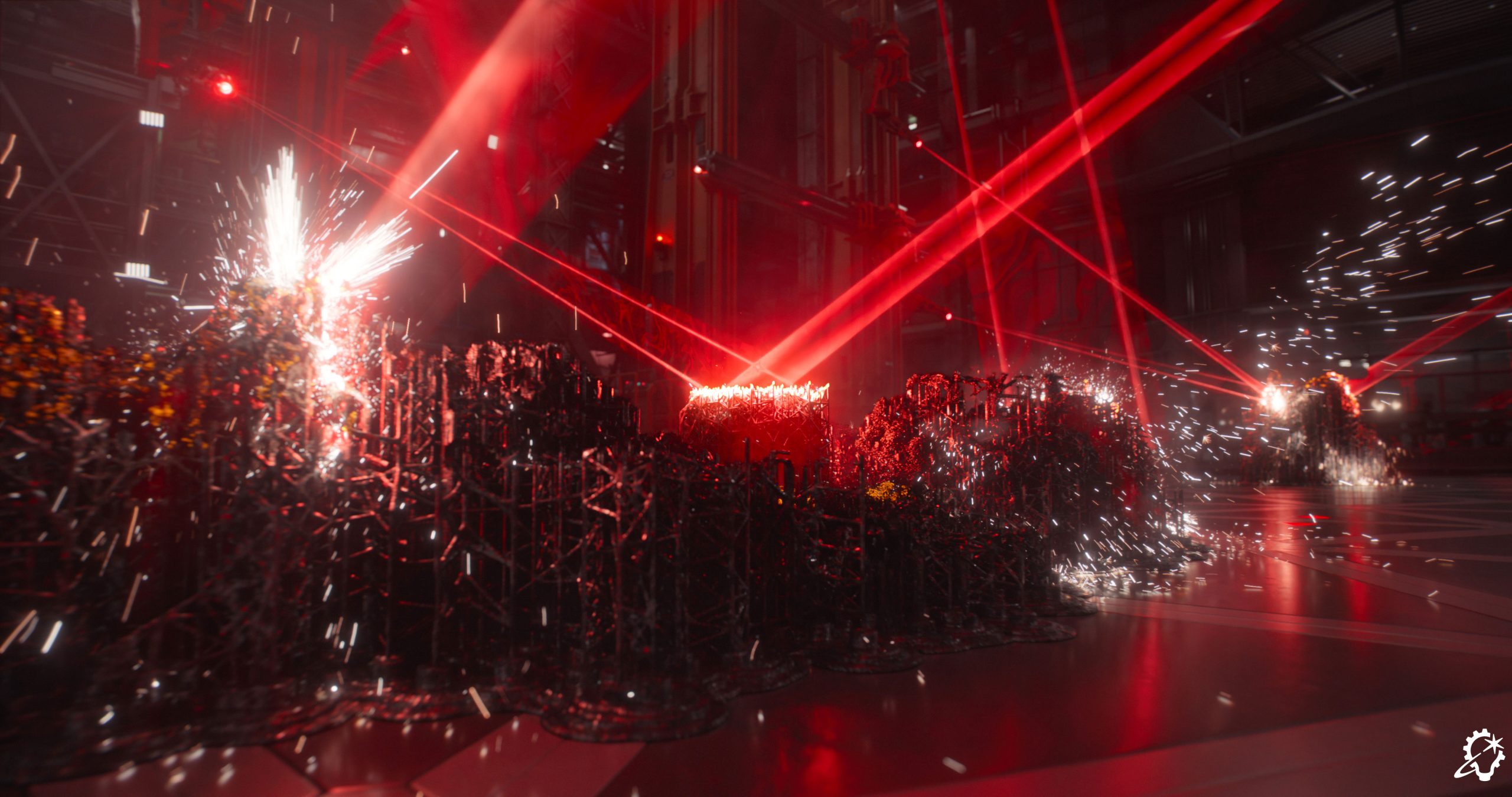
Inside a massive Dillinger complex hangar, Ares and Athena– along with their Light Cycles – are brought into physical form by an array of rapid-firing red particle lasers attached to robotic arms.
“Using lasers to get to and from the Grid has been part of Tron since the beginning,” Seager explains. “So we knew there was going to be a laser component to it. But also, I thought it was a great opportunity to show that the Dillinger company isn’t making games anymore. They’re more a part of the military-industrial complex, so it was always important that it had an industrial feel.”
During preproduction, design inspiration came from a 3D printer purring away in the art department. “It was in one of our meetings where we just happened to look over, and there was a print in progress,” recalls Seager. “And it had the support structure surrounding it, this kind of ‘jig’ structure, as we called it.”
Incorporating the concept of 3D printing helped ground the sequence in a visual language people are familiar with, Seager explains. There’s even an added storytelling flourish when the mass of rough, excess jig pieces builds up and suddenly collapses, exposing the object underneath. “We wanted it to feel messy, and then it just falls away, and there’s the creation. It was one of those happy accidents,” Seager says. “It became a really great reveal.”

Cycles and Walls of Light
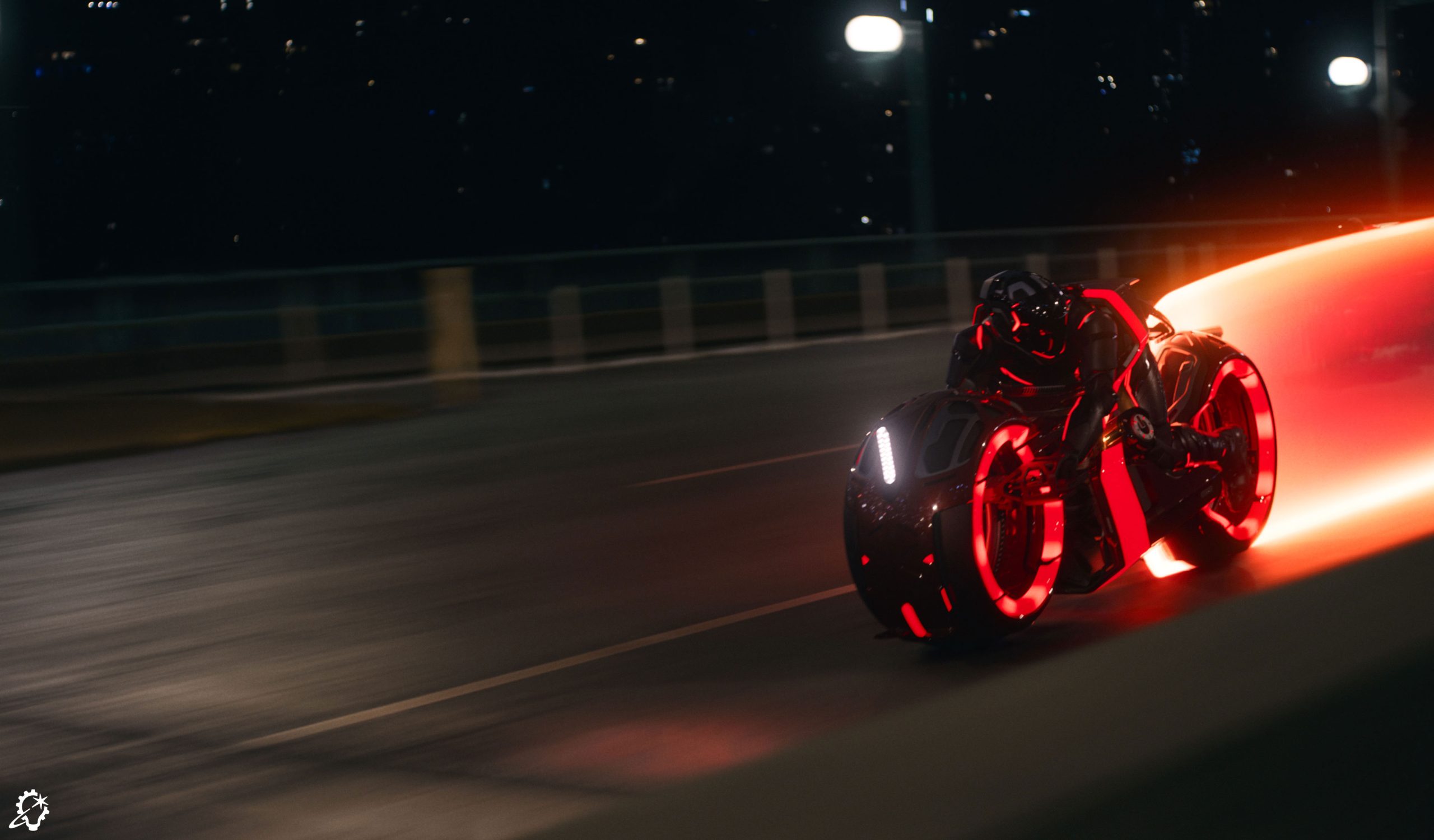
Riding their Light Cycles at high speed through nighttime city streets and across bridges, Ares and Athena pursue Eve in a sequence largely shot on location in Vancouver, Canada. “It became very evident that we all wanted to go shoot as much as possible on location,” Seager recalls. “You get a million little things that happen organically.”
On set, modified Harley Davidson electric motorcycles stood in as proxies for the Light Cycles, outfitted with practical lighting to cast realistic reflections and glow onto the wet pavement. “It became our job in visual effects to go in and replace the proxies that we created for the Light Cycles,” says Seager. “We had to replace 100% of them.” The special effects department also built hero versions of the Light Cycles for shooting close-ups of the actors, either against a blue screen or an LED screen.
During the chase, the Light Cycles emit a signature Tron element in their wake: lethal ribbons of reddish, semi-transparent light. The challenge, Seager explains, was making the light walls work visually in a non-Grid environment.
“That was more traditional look development work – adjusting the amount of refraction, reflection, and brightness and those types of things,” according to Seager. “There’s a little bit of heat distortion. We want it to feel hot. And because it was very easy for it to feel glassy, and there’s a certain brittleness that comes with glass, you’re like, ‘Oh, we don’t want that.’”
In one of the film’s most memorable shots, a light wall slices a police cruiser into perfect halves, an effect that uses a combination of practical and digital techniques.
“That was a real car,” Seager reveals. “The special effects team was like, ‘Oh, we could build this!’ So they took a car and chopped it right down the middle lengthwise. It was a repeatable stunt, and there was limited steering they could do after the split. We ended up having to shoot it a couple of times, but the vast majority of what you see is the stunt that we shot. And then we have to go in and make the edges seem glowing hot – like it just got cut – and add steam and those types of things coming out.
“Light Cycles are to Tron like lightsabers are to Star Wars,” Seager adds with a smile. “I’m so proud of what we achieved in the Light Cycle chase.”
One of Seager’s favorite moments in the sequence is a Light Cycle sideways slide that pays homage to an iconic shot in the landmark 1988 anime action film, Akira. “I’m a lifelong anime fan and fell in love with Katsuhiro Otomo’s manga of Akira and was one of the first kids in town to obtain a VHS copy of the anime,” Seager says. “Needless to say, it is very rare to be able to work on a project that combines two influential films from your childhood.”
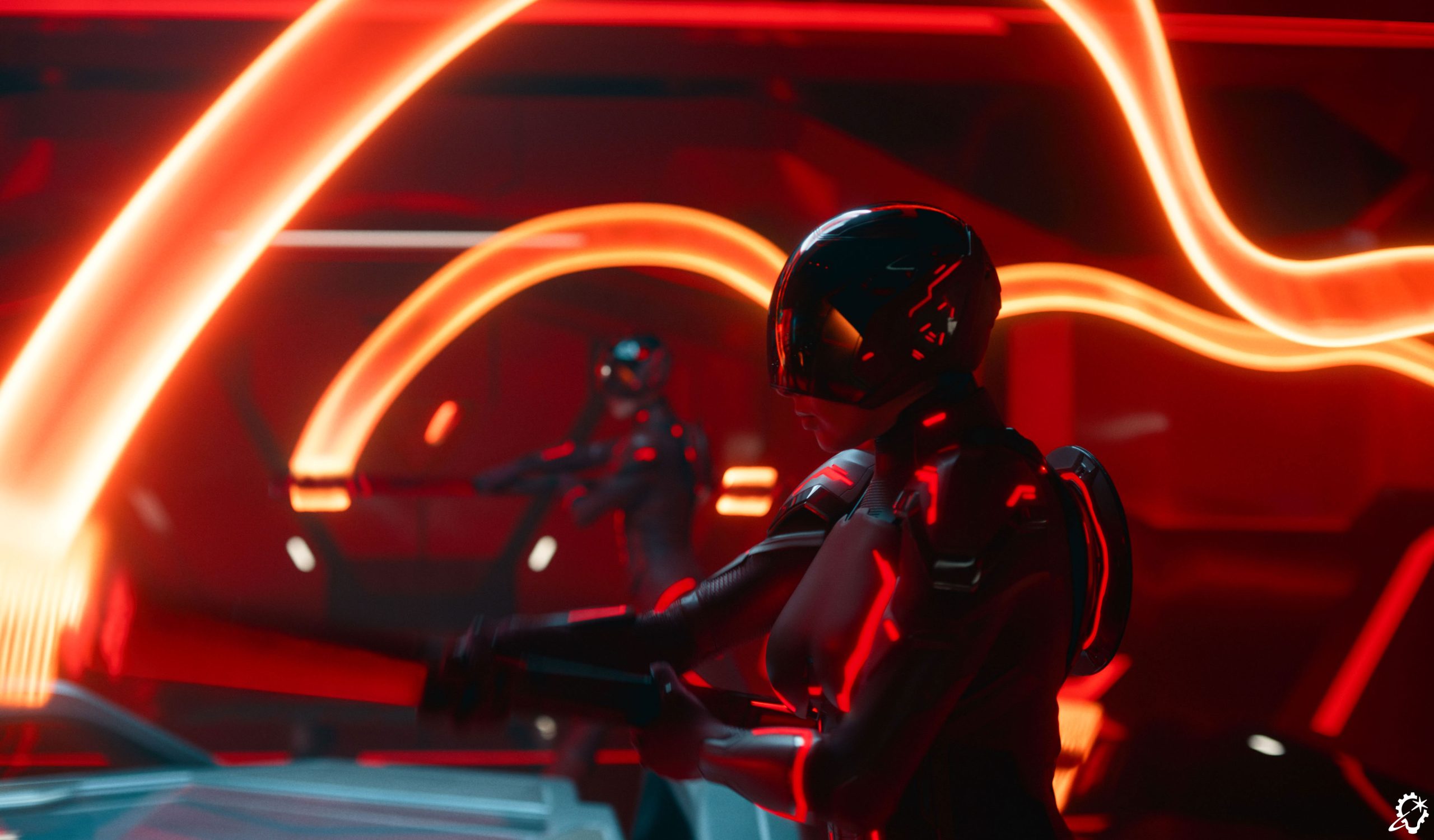
A climactic street battle between Ares’s and Athena’s armed Dillinger sentries features a weapon that proved to be one of the more challenging effects to pull off: the Light Staff.
“It’s the fun new weapon that was introduced in our film. The idea is a staff that you could fight with, and the ends emit a white ribbon four or five inches wide,” Seager explains. “We came up with the idea that you’d have this almost dial-up lifespan, so the light ribbon could last a second, or two seconds, or five. We knew Joachim always wanted them as long as possible, but there were times when they had to go away.”
The Light Staff fight required complex coordination between the actors and stunt performers on set, but the frenetic pace of the action sometimes created unavoidable visual conflicts. “I’d be sitting there going, ‘Wait a second, if they swipe like this and then they run forward, their head just hit the thing,’” remembers Seager. “You have to almost think in terms of, ‘Oh, I need to duck under this.’ I think everyone did a great job of trying to choreograph the fights.
“We got as close as we could during shooting,” Seager continues. “And then in postproduction, we went in there and started tracking the staff and emitting the beam from it. We just started going, ‘Oh, there’s a problem there.’ And you just have to go try other things.”
Seager says some fun and unexpected ideas also popped up during shooting. “The stunt team came up with the idea of characters making a light ribbon and using it to jump off of,” he says. “So there are cool moments where Ares basically creates terrain for himself.”
Another visual quandary came with the Super Recognizer, a massive flying security transport that Athena pilots into the city as she searches for Eve. “The design work was beautiful. I think our biggest challenge was how big it was,” Seager says. “We had our LiDAR and survey data of real Vancouver streets, and when we put those two together for the first time, we’re like, ‘Okay, the Recognizer doesn’t fit into any street.’
“There’s a fair amount of digital surgery where we had to kind of wipe the city away because if you make the Recognizer too small, the threat goes away,” continues Seager. “So we were trying to find that balance. But the main work we did there was trying to find ways to make it fit.”
Enter the Grid(s)
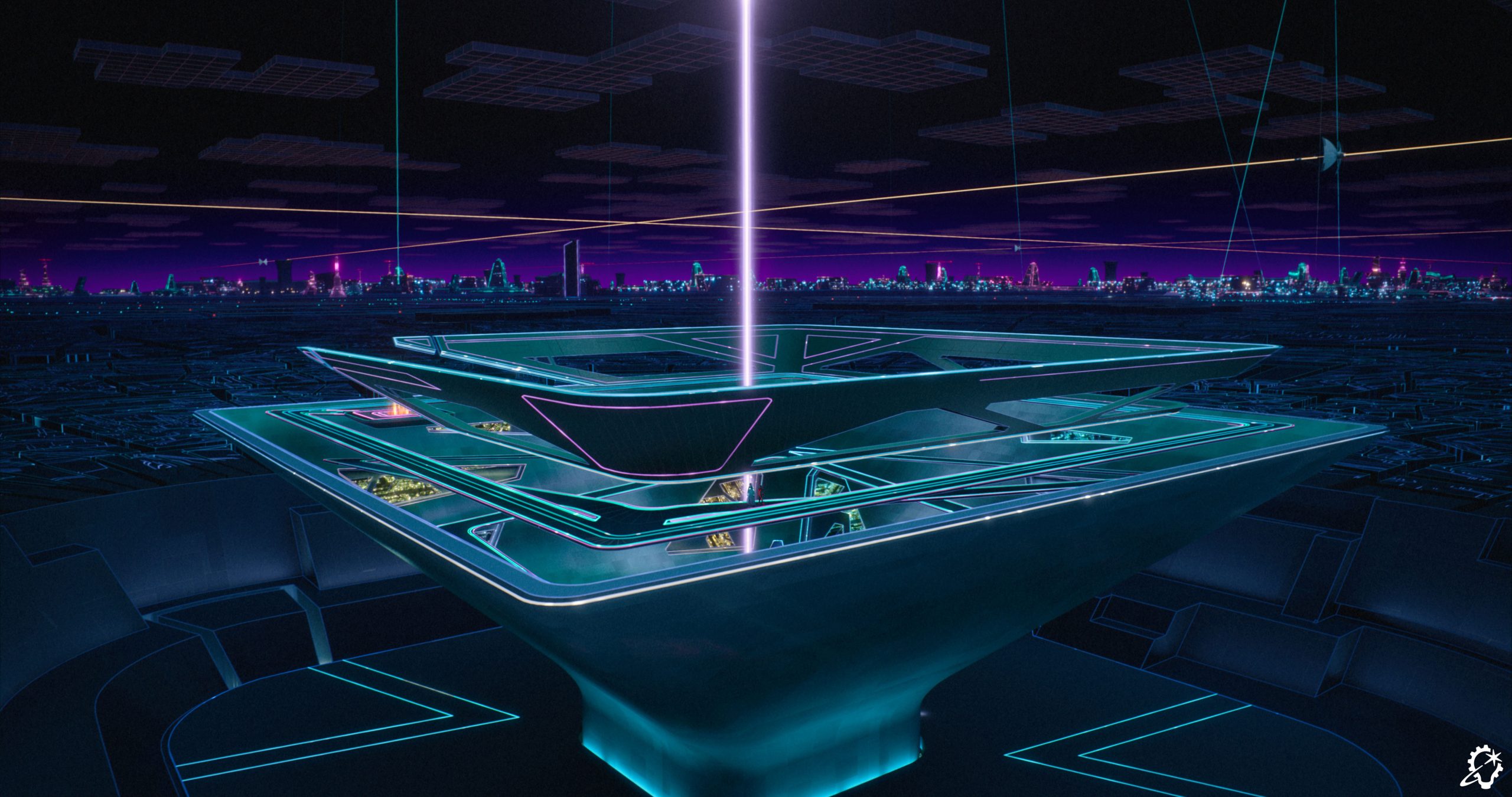
Much of the look of the ENCOM and Dillinger Grids is inspired by designs established in Tron: Legacy by production designer Darren Gilford, who returned for Ares.
“The Dillinger Grid – the red one – definitely followed the aesthetic of Tron: Legacy with a dark, shiny, almost wet look to it. It’s atmospheric, and it has a stormy feeling,” says Seager. “Darren always talked to me about that Grid being inspired by circuit boards.”
For both Grids, the production built a combination of complete and partial sets on a Vancouver soundstage. “Most of the big sets that we built were for the Dillinger Grid,” Seager says. “There were two major red rooms. One we called the ‘extraction’ room, which is where Eve is printed into the Grid and where Ares later escapes. And then there was what we call the ‘regeneration’ room.”
Seager credits the production art department for crafting beautiful, practical sets that, in many cases, only needed minimal digital enhancement, like adding ceilings or extending walls. “Early on in the show, I took some pictures as we were building the set and doing walkthroughs, and I sent them to one of my fellow ILM supervisors because they were very pretty. And they were like, ‘Oh, that’s great looking concept art.’ I was like, ‘That’s not concept art!’” Seager laughs.
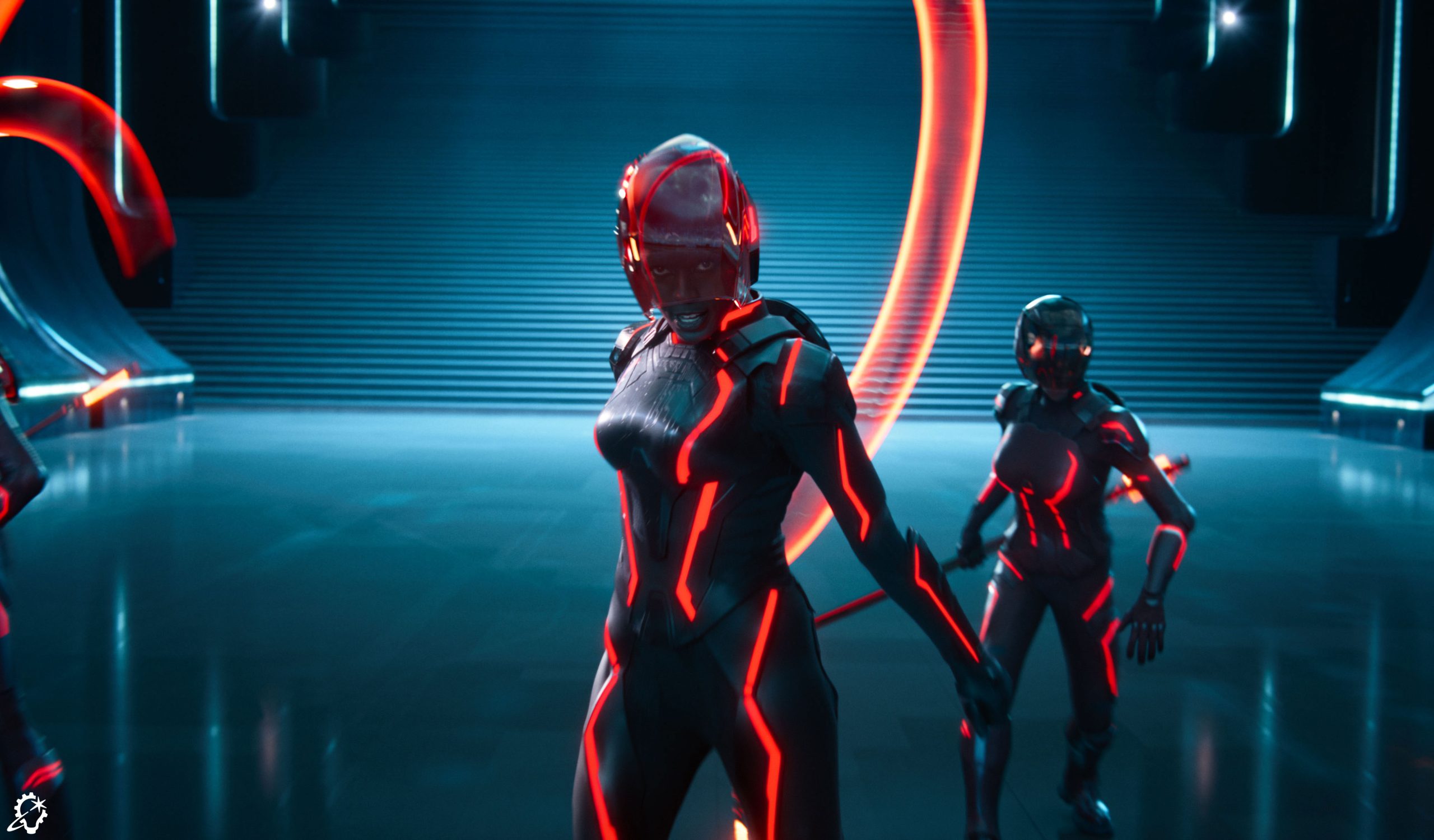
For a sequence in which Ares and his team infiltrate the blue-tinted ENCOM Grid, ILM took on extensive digital world-building. “That was a little more traditional blue screen work,” says Seager. “We built minimal floors and then expanded from there because the characters had to cover a great distance. We built the staircase that we could shoot against, but in post, we did the rest of the environments.”
Seager explains that the ENCOM Grid also offered a chance to break from a traditional nighttime look to portray a more daylight setting. “We just wanted it to feel thematically brighter,” he says. “It’s the sunny, good-guy Grid. It’s still overcast, but it’s not quite darkness. That has its own challenges because light lines look great when it’s dark out, but if you turn the lights up and also have a competing bright scene, now you’re trying to make the bright light lines work.”
Still hunting for the Permanence Code, Ares is transported inside Flynn’s original server,
providing audiences a nostalgic visit to the relatively primitive digital landscapes of the 1982 classic. “It was a lot of fun, and I actually consider it one of the more challenging developments on the show,” explains Seager. “ ‘Challenging’ usually means ‘big, big, big.’ And this one was challenging going the other way. It’s stripping away, it’s simplified.”
Executing the retro look of the Flynn Grid fell to the team at Distillery Visual Effects in Vancouver, which worked to incorporate updated versions of the distinctive visual artifacts from the 1982 film, like flickering faces, desaturated skin tones, and backgrounds marked by noticeable “frozen grain.”
“In visual effects, if you have frozen grain, your shot is broken,” Seager notes. “In our shots, we intentionally added frozen grain to the background to try to make it look that way. The light suits built by WETA Workshop were immaculate, but we actually made them kind of flicker and the edges kind of wobble because we wanted to have a little bit of a hand-rotoscoped feel.”
Seager says the Flynn Grid is loaded with Easter eggs – including an appearance by the binary guide known as Bit – that he hopes fans will pick up on. One of his favorite throwbacks can be seen as Ares takes control of a classic yellow Light Cycle and follows Bit off the Game Grid through the same jagged hole used by Flynn and his companions to make an escape back in 1982.
“We went in, and we looked at that exact break pattern. True fans hopefully can see that it’s the one they made 40 years ago,” Seager says.
Opening the Complete ILM Toolbox
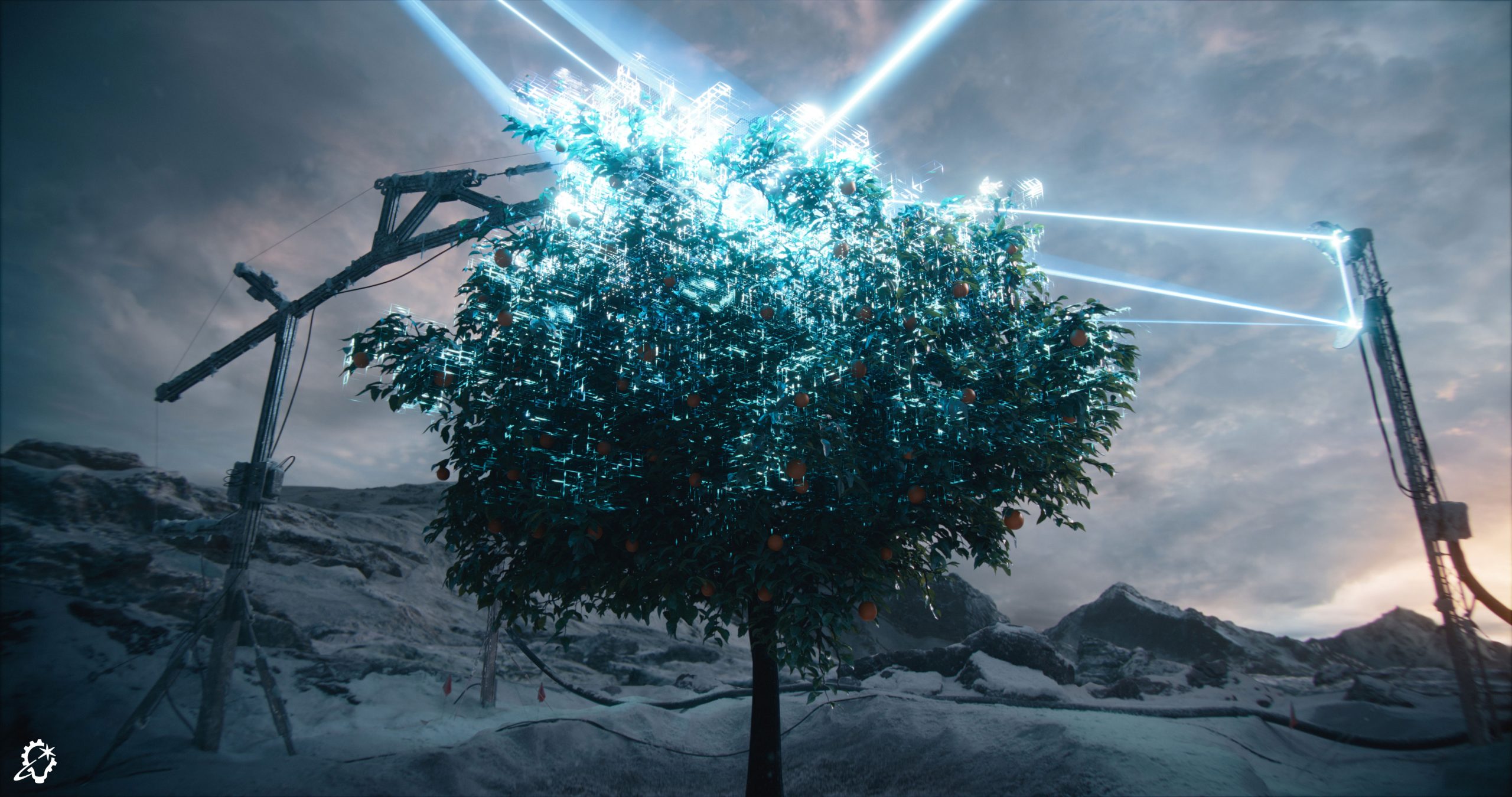
ILM Stagecraft’s LED volume technology proved invaluable for scenes set in very different exterior and interior environments. Assembled on a soundstage at Mammoth Studios near Vancouver, the volume completed the snowy landscape around a remote mountain station in Alaska, where Eve and her partner, Seth Flores (Arturo Castro), use the Permanence Code to assemble an orange tree in the real world.
“There were also two offices. Dillinger’s office, which overlooks the transfer bay, was built maybe 16 feet up, then we hung LED screens outside the windows. And the scene out there was a fully realized 3D version of the transfer bay,” Seager says. “The ENCOM office set also had an LED cityscape when you looked out the windows.”
The production employed the same volume ILM used for season one of the Disney+ series Percy Jackson and the Olympians (2023-present). Scenes inside the Grid featuring Ares speaking with Julian Dillinger’s digital visage utilized MEDUSA, the Academy Award-winning facial capture system developed by ILM and Disney Research Studios. For action scenes, ILM FaceSwap tools were used extensively to put an actor’s likeness onto a stunt double.
The Home Team Advantage
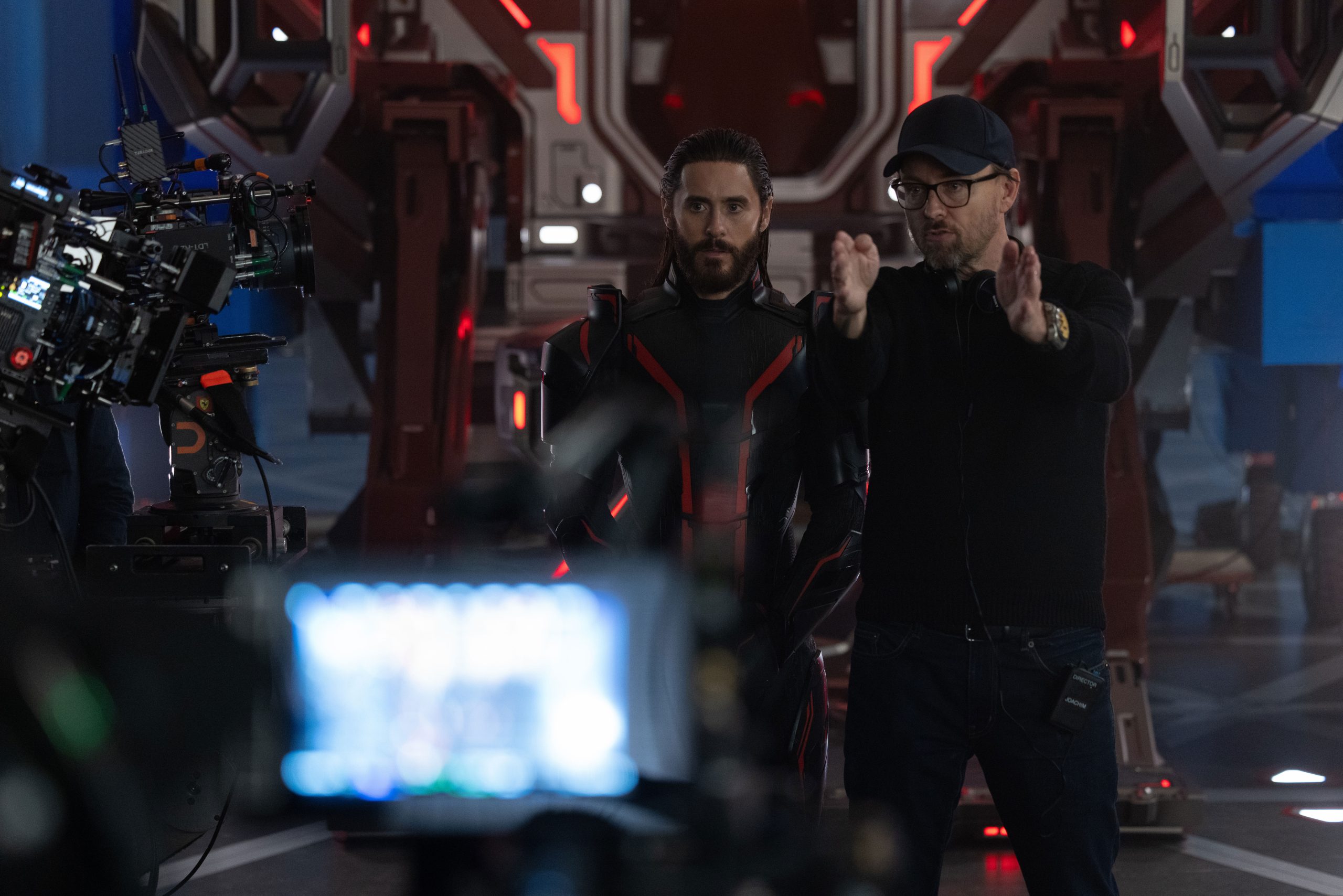
Work on Tron: Ares was primarily divided between ILM’s Vancouver and Sydney studios, with additional contributions from Distillery Visual Effects, Lola Visual Effects, Image Engine, Prologue, GMUNK, Imaginary Forces, and OPSIS. Seager, who lives in Vancouver, says having Tron: Ares shoot in his home city provided a rare opportunity for the ILM team to observe the production process up close.
“For the artists, it’s huge,” Seager insists, “because it’s really hard to get experience on set for up-and-coming talent. We had a great relationship with the production team, so I was able to bring a lot of the folks out to get their first-ever on-set exposure. We tried to take advantage of that as much as possible.”
Seager adds one more Vancouver factoid: When an F-35 fighter plane slams into the Super Recognizer, the massive craft crash-lands in front of a building that in real life is only half a block from ILM’s Vancouver studio.
Now You See Him, Now You Don’t
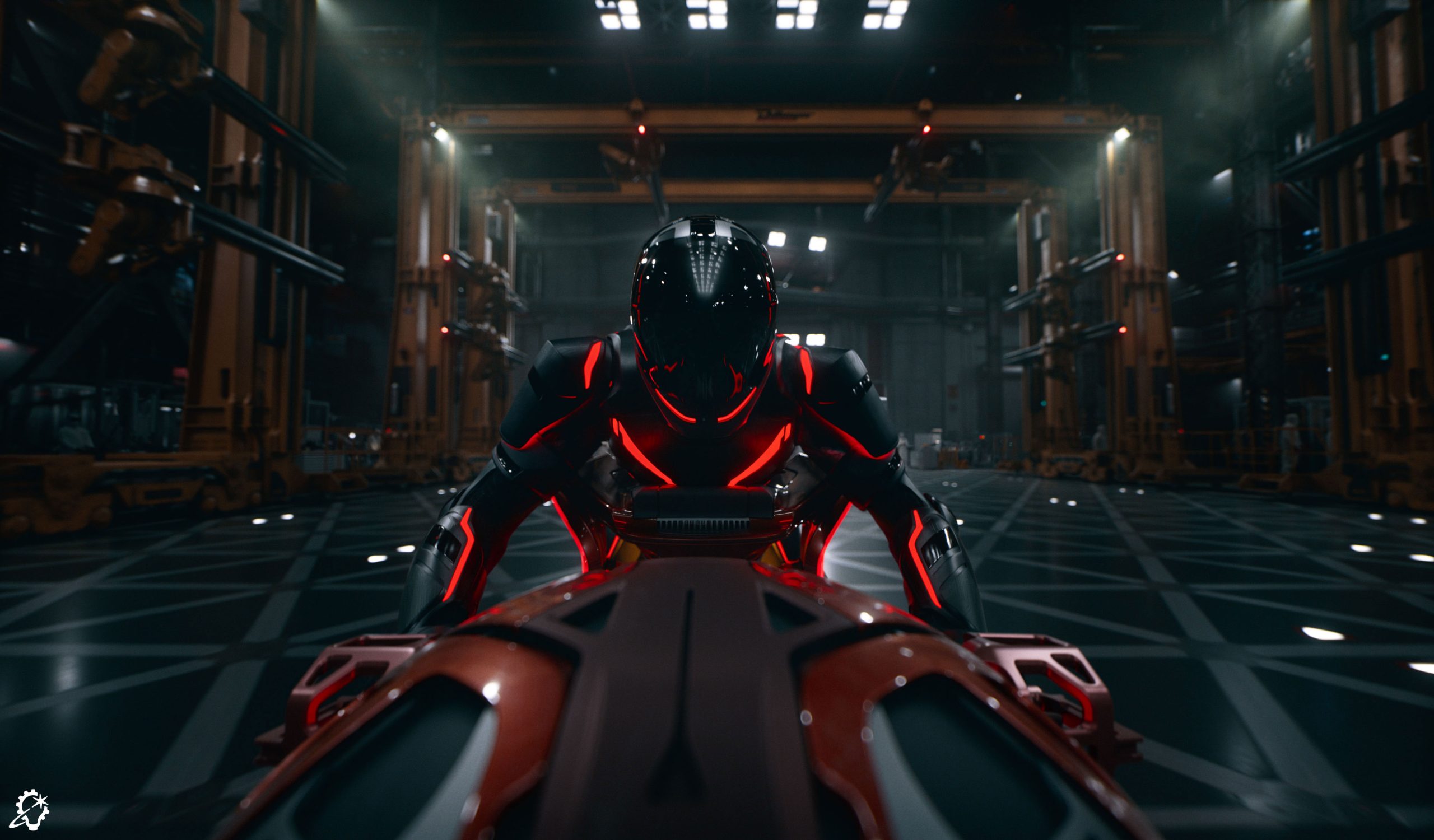
Tron: Ares contains just over 2,100 visual effects shots, but Seager says there’s one illusion the audience will never notice. Early in the film, Dillinger introduces Ares to a group of shareholders. Appearing for the first time inside a Dillinger Systems Amphibious Rapid Response Tank, or DART, he wears a black Light Suit with glowing red accents and a highly reflective helmet hiding his face.
But when the scene was first shot, Jared Leto was not wearing a helmet at all.
“An idea came in postproduction to have him be this faceless automaton that reveals at the right moment,” Seager says, explaining that it was up to digital artists to craft a highly reflective CG helmet from scratch, matching it perfectly with the Light Suit and practical environment. Adding to the challenge: Leto had long hair that needed to be painted out of every shot.
“I don’t think people will ever know the work we did,” remarks Seager. “The camera is inches from his face in some of the shots where we had to track the helmet in there. In that entire scene, those helmets are all digitally added shot-by-shot.”
End of Line
Seager has much praise for the hundreds of artists and collaborators who made working in the Tron universe such a rewarding challenge, and especially director Joachim Rønning.
“Paramount to Joachim’s vision was that he never wanted this to feel bigger than life. It’s really easy to toss a lot of gimmicks at something set in the real world, and all of a sudden it starts to not feel as grounded. So it was trying to find that sweet spot where it felt like you could believe you’re watching from the street corner.”
Instead of watching from a distance, however, Seager found himself at the creative center of the Tron universe, drawing on 40-plus years of fandom to help bring the latest chapter to the big screen. “It was a dream come true,” he says.
Read more about Tron: Ares here on ILM.com:
ILM’s Jeff Capogreco and Jhon Alvarado Take Us Into the Grid of ‘Tron: Ares’
Inside the ILM Art Department: ‘Tron: Ares’
—
Clayton Sandell is a Star Wars author and enthusiast, Celebration stage host, and a longtime fan of the creative people who keep Industrial Light & Magic and Skywalker Sound on the leading edge of visual effects and sound design. Follow him on Instagram (@claytonsandell), Bluesky (@claytonsandell.com), or X (@Clayton_Sandell).