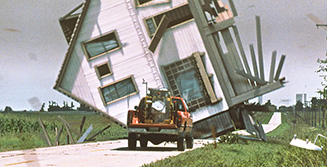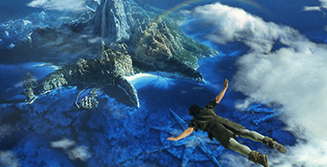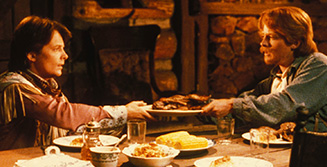
Bill and Jo Harding, advanced storm chasers on the brink of divorce, must join together to create an advanced weather alert system by putting themselves in the cross-hairs of extremely violent tornadoes.
Director Jan de Bont wanted to shoot the tornadoes with a handheld camera on location for this fictional story as if he were filming a documentary.
One problem: the tornadoes would be digital and added in post-production.
Rather than restrict the director to filming actors using a locked-off camera, which was the common approach at the time and would have made post-production easier, ILM set De Bont free by creating extreme digital effects. A custom interface for a new software system called Dynamation that could control massive amounts of particles made it possible for the technical crew at ILM to produce the digital tornadoes into which they inserted spinning digital cows, furniture, and other CG objects.
1997 Academy Award® nominee for Best Visual Effects and BAFTA Award winner for Best Special Visual Effects.
2000 BAFTA Award nominee Best Special Visual Effects.
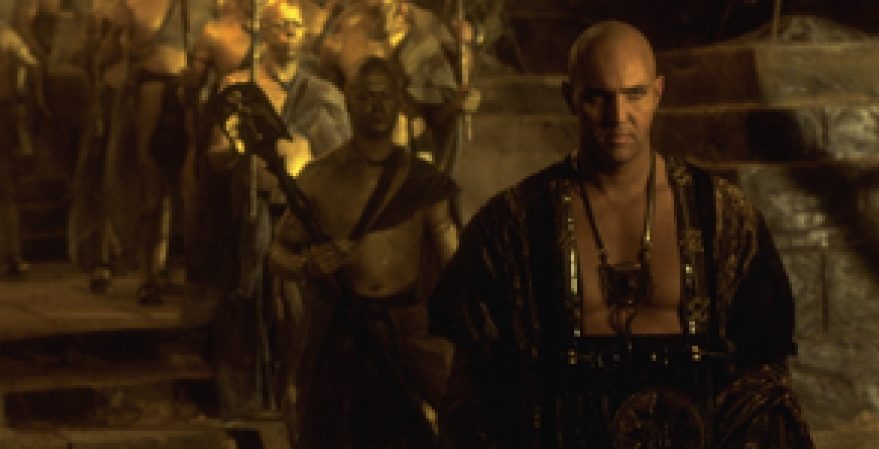
An American serving in the French Foreign Legion on an archaeological dig at the ancient city of Hamunaptra accidentally awakens a Mummy.
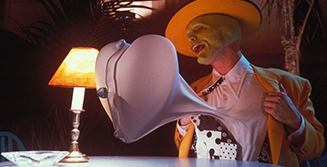
No one had attempted the Tex-Avery style animation with 3D graphics in a live-action film before The Mask. ILM’s eye-popping effects spin actor Jim Carrey into a human cartoon. By mixing these extreme effects into the live-action footage, ILM redefined any preconceived notions of what filmmakers could do to move a compelling narrative forward.
The breakthrough work resulting in an Academy Award® nomination for Best Visual Effects and BAFTA Award nomination for Best Special Visual Effects.
1991 Academy Award® Winner for Best Visual Effects.
1991 BAFTA Award Winner for Best Special Visual Effects.
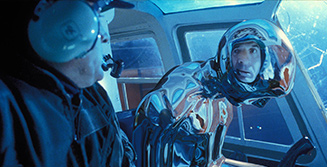
Terminator 2 is heralded as a milestone in computer graphics and marked the first time that a lead character in a feature film had been created, as least in part, through the use of computer graphics.
1999 Academy Award® Nomination for Best Visual Effects.
1999 BAFTA Award Nomination for Best Achievement in Visual Effects.
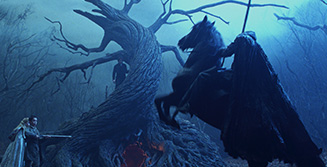
Ichabod Crane is sent to Sleepy Hollow to investigate the decapitations of three people with the culprit being the legendary apparition, the Headless Horseman.
In part a reaction to the computer-generated effects in Mars Attacks!, director Tim Burton opted to go old school and use as few digital effects as possible. ILM was responsible for making the headless horseman look realistic. To do this, they had the headless horseman stunt double wear a blue ski mask so they could use the chroma key effect and digitally remove his head. The result was flawless.
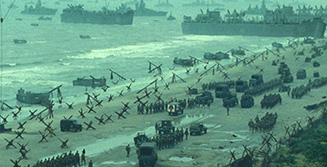
Following the Normandy landings, a group of U.S. soldiers go behind enemy lines to retrieve a paratrooper whose brothers have been killed in action.
ILM has always needed to react to what George Lucas wanted — that is, to add effects to footage he shot, they never told Lucas what he could and couldn’t do. So, even as far back as 1998, the studio totally supported the cinematographer’s and director’s vision although doing so often meant taking risks.
Risks like those cinematographer, Janusz Kaminski, had in mind for the opening shots of the Allied invasion of Normandy in World War II. His wild idea was to reduce the camera shutter to produce crisp images and to film the landing with a handheld camera. The combination would give the footage a chattering look. But, digital effects studios often relied on motion blur in live action footage to help hide effects, and Kaminski’s method would eliminate motion blur. In 1998, other studios might have insisted that he shoot on bluescreen stages with a normal shutter speed, but ILM agreed to track CG elements – digital doubles, bullets, body parts, and ships – into the crisp footage that Kaminski shot with the freely moving camera. The resulting opening shots of soldiers hit with gunfire as they waded ashore had an uncomfortable authenticity that deeply affected audiences.
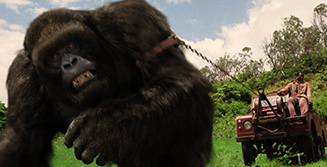
A legendary 15-foot tall mountain gorilla named Joe is taken to an animal sanctuary in California by a zoologist and a young woman whom he grew up with.
By 1998, audiences were far too sophisticated to settle for a film about a giant gorilla if the gorilla can’t do anything more than a man in a suit could. Mighty Joe Young had to leap from tall freeways, climb structures and wreak havoc on city streets.
That meant ILM’s digital hairdressers faced their biggest challenge to date: match a man in a gorilla suit with digital fur on an animated digital gorilla. Although ILM had groomed Jumaji’s digital lion using an early version of the studio’s hair and fur system, Mighty Joe’s fur needed to be a cut above in order to give the gorilla the proper bounce during his hair-raising race to freedom.
A streetwise NYPD detective joins a secret organization that polices extraterrestrial affairs on Earth.
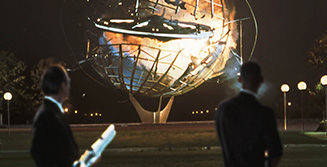
From the fully animated CG close-up of Tony Shalhoub’s head to the one-quarter scale model of the Midtown Tunnel, Men in Black required ILM to utilize every tool in their repertoire of special effects techniques. Men in Black was a unique project for ILM because of the comedic performances the CG characters had to deliver in conjunction with the technical aspects of their creation.
Through a combination of amazing models, replicas, sets, robots, and CG effects, ILM was able to successfully navigate between two eras of visual effects (physical and digital) and two genres of films (comedy and action).
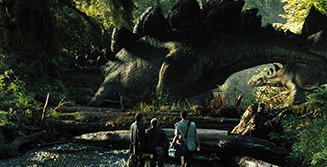
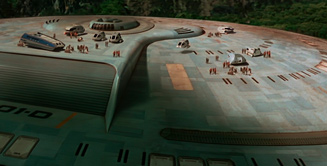
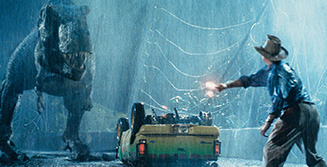
A research team is sent to the Jurassic Park Site B island to study the dinosaurs there while another team approaches with a different agenda.
The successful creature animation in Jurassic Park left no doubt that ILM could put even more digital dinosaurs into this film — herds of them, in fact — thanks to impressive new software that slid virtual skin over digital muscles. The eye-opening dinosaurs in this film solidified ILM’s leadership in creature animation.
Jurassic Park represents a milestone in modern visual effects and ushered an era of films whose scripts were once thought to be impossible to film. To create living, breathing, photorealistic dinosaurs the likes of which had never been seen before, the visual effects team developed a substantial amount of new technology. From Viewpaint, a 3D texturing tool that allowed artists to paint directly on 3D models and see their results in context, to camera motion tracking, to the Dinosaur Input Device (D.I.D.) which was created in collaboration with Phil Tippett, Randal Dutra, Tom St. Amand, and the team at Tippett Studios and used to bridge the gap between traditional stop motion animation and CG animation there were numerous breakthroughs on the film.
No one had put living, breathing synthetic animals in a live-action movie before; creature animation had always been mechanical and animatronic. Before Jurassic Park, animators had never even tried to reproduce real animals digitally for a feature film. But ILM showed Steven Spielberg a test created by CG artists Steve “Spaz” Williams and Mark Dippé with digital dinosaurs, and they looked so natural and moved so freely that there was no turning back.
The breathtaking shots of dinosaurs walking through a field and placidly eating leaves from the tops of trees have become milestones in visual effects and in filmmaking. Suddenly, directors could imagine making films in which realistic animals, fantasy creatures, even digital people could perform without restraint.
This project marks a major advance in digitally simulating living organisms. The various software breakthroughs allow for unprecedented freedom in the digital compositing of CG creations and live-action film. For the first time, all restrictions on camera movement in background plates are removed, thanks to such software tools as Softimage. Jurassic Park is the first major film to use this commercial 3-D animation package. The film also pioneered work in the field of film input scanning.
Although ILM created fewer than 60 shots of the fully CG dinosaurs they remain a huge part of what makes the film so memorable.
The film won the 1993 Academy Award® Winner for Best Visual Effects and as well as the BAFTA Award for Best Special Visual Effects.
Robin Williams and Kirsten Dunst star in this blockbuster hit and critical favorite that combines magical special effects with an entrancing mix of fantasy, adventure, and comedy. Young Alan Parrish sits down as a young boy to play a game with his friend, Sarah, and on a roll of the dice is mysteriously transported into the strange jungle realm of Jumanji. There he remains trapped for 26 years, until two newly orphaned children, Judy (Dunst) and Peter (Bradley Pierce), playing in the attic of Alan’s childhood home, free the now-adult Alan (Williams) from the game’s clutches.
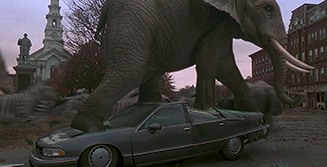
Among other effects, ILM was tasked with creating a stampede of rhinos, elephants, and birds, and mischievous monkeys wielding knives, all created with computer graphics, and the Parrish house that is literally torn apart – Created as a large-scale model built in the ILM Model Shop and shot against bluesceen.
When his young children are abducted by his old nemesis Captain Hook, middle-aged lawyer Peter Banning returns to his magical origins as Peter Pan.
With 200,000 accumulated work hours, the film is only second to Return of the Jedi for the most time-intensive ILM production in the company’s first 15 years of business.
The film is notable for featuring the first-ever dimensional matte painting — where a traditional matte painting painted by Yusei Uesugi was mapped onto 3D geometry by Stefen Fangmeier, allowing for camera parallax and resulting in a truly spectacular shot of Pan flying towards the magical landscape of Neverland.
Tinkerbell’s fluttering wings were nine-inch plastic devices built by the ILM Model Shop and photographed separately. Go-Motion animation created their flapping effects.
Hook would go on to be nominated in the Best Visual Effects category at the 64th Academy Awards (Eric Brevig, Harley Jessup, Mark Sullivan and Michael Lantieri).
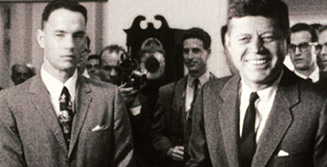
Slow-witted Forrest Gump, never thinking of himself as disadvantaged, leads anything but a restricted life.
ILM broke new ground in weaving archival footage seamlessly into the film’s story, allowing Forrest Gump to shake hands with Presidents Nixon, Johnson, and Kennedy.
A variety of “invisible” effects were also created for the film, including the now iconic falling feather, the transformation of Lieutenant Dan into a double amputee, scenes of war in Vietnam, crowds in the National Mall, the Olympic ping pong battle, and filling an Alabama football stadium with raucous fans.
ILM’s effects team was honored with the Academy Award® for Visual Effects in 1994.
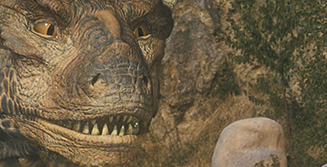
ILM further developed its breakthrough facial animation software, Caricature, to make Draco come to life for this film. The technology became a big stepping stone at ILM, impacting many of its digital characters for years to come. For ILM, the project lasted about two years, with a mixture of practical and digital effects including a full-sized puppeteer dragon built by ILM’s renowned Creature Shop. ILM’s Caricature Animation System would later be recognized with an Academy Award® for Technical Achievement.
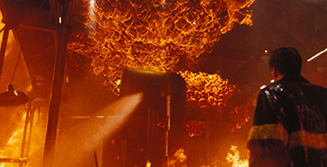
Kurt Russell and William Baldwin are two feuding siblings carrying on a heroic family tradition as Chicago firefighters in this acclaimed suspense story filled with some of the most awe-inspiring fire sequences ever captured on film.
ILM contributed to a number of critical shots for the film — cutting seamlessly with the onset special effects supervisor and cinematographer’s incredible work — and its miniatures, matte paintings, and live action elements were combined to create the magnificent imagery of a burning, collapsing rooftop. The ILM team was honored with an Academy award for Best Visual Effects for their work.
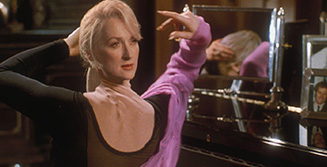
ILM’s work in Death Becomes Her predates many of the digital advancements and breakthroughs of Jurassic Park, which came only a year later. Experimenting in the development of commercial and proprietary software, the film marked the first time human skin texture had been computer generated. ILM’s team was honored with an Academy Award® for their groundbreaking work.
They’ve saved the biggest trip for last as the most popular time-traveling movie trilogy of all time comes to a rousing conclusion in Back to the Future Part III!
To create the complex scenes where Fox has to act opposite himself playing both Marty McFly and Seamus McFly, ILM’s engineers developed a high speed, motion-controlled silent camera dolly making it possible to film moving-camera composite shots of actors while recording live dialogue.
The pioneering technology would go on to be recognized with a Technical Achievement Academy Award® in 1998. Other notable effects sequences include Clara’s hoverboard rescue, the locomotive careening off the railroad trestle, and the flying future train — the latter two achieved though the use of intricately-detailed scale miniatures.
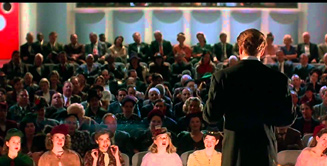
Radioland Murders is a comedic mystery thriller co-written and executive produced by George Lucas. Set in 1939, the film pays homage to the comedies of the 1930s.
ILM’s contribution to the effects for the film was predominantly digital matte painting work.